T O O L S F O R C O L L E C T I N G Q U A N T I TAT I V E D ATA


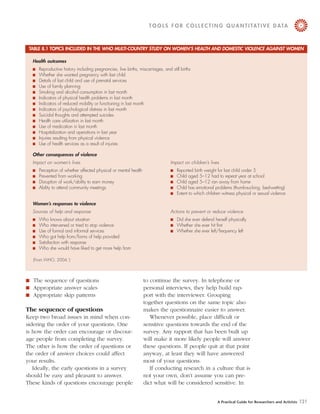
 TABLE 8.1 TOPICS INCLUDED IN THE WHO MULTI-COUNTRY STUDY ON WOMEN’S HEALTH AND DOMESTIC VIOLENCE AGAINST WOMEN

    Health outcomes
    I   Reproductive history including pregnancies, live births, miscarriages, and still births
    I   Whether she wanted pregnancy with last child
    I   Details of last child and use of prenatal services
    I   Use of family planning
    I   Smoking and alcohol consumption in last month
    I   Indicators of physical health problems in last month
    I   Indicators of reduced mobility or functioning in last month
    I   Indicators of psychological distress in last month
    I   Suicidal thoughts and attempted suicides
    I   Health care utilization in last month
    I   Use of medication in last month
    I   Hospitalization and operations in last year
    I   Injuries resulting from physical violence
    I   Use of health services as a result of injuries

    Other consequences of violence
    Impact on women’s lives                                                        Impact on children’s lives
    I   Perception of whether affected physical or mental health                   I   Reported birth weight for last child under 5
    I   Prevented from working                                                     I   Child aged 5–12 had to repeat year at school
    I   Disruption of work/ability to earn money                                   I   Child aged 5–12 ran away from home
    I   Ability to attend community meetings                                       I   Child has emotional problems (thumb-sucking, bed-wetting)
                                                                                   I   Extent to which children witness physical or sexual violence

    Women’s responses to violence
    Sources of help and response                                                   Actions to prevent or reduce violence
    I   Who knows about situation                                                  I   Did she ever defend herself physically
    I   Who intervened or tried to stop violence                                   I   Whether she ever hit first
    I   Use of formal and informal services                                        I   Whether she ever left/frequency left
    I   Who got help from/forms of help provided
    I   Satisfaction with response
    I   Who she would have liked to get more help from

    (From WHO, 2004.1)


I The sequence of questions                                        to continue the survey. In telephone or
I Appropriate answer scales                                        personal interviews, they help build rap-
I Appropriate skip patterns                                        port with the interviewer. Grouping
                                                                   together questions on the same topic also
The sequence of questions                                          makes the questionnaire easier to answer.
Keep two broad issues in mind when con-                               Whenever possible, place difficult or
sidering the order of your questions. One                          sensitive questions towards the end of the
is how the order can encourage or discour-                         survey. Any rapport that has been built up
age people from completing the survey.                             will make it more likely people will answer
The other is how the order of questions or                         these questions. If people quit at that point
the order of answer choices could affect                           anyway, at least they will have answered
your results.                                                      most of your questions.
   Ideally, the early questions in a survey                           If conducting research in a culture that is
should be easy and pleasant to answer.                             not your own, don’t assume you can pre-
These kinds of questions encourage people                          dict what will be considered sensitive. In


                                                                                                             A Practical Guide for Researchers and Activists   121
CHAPTER EIGHT


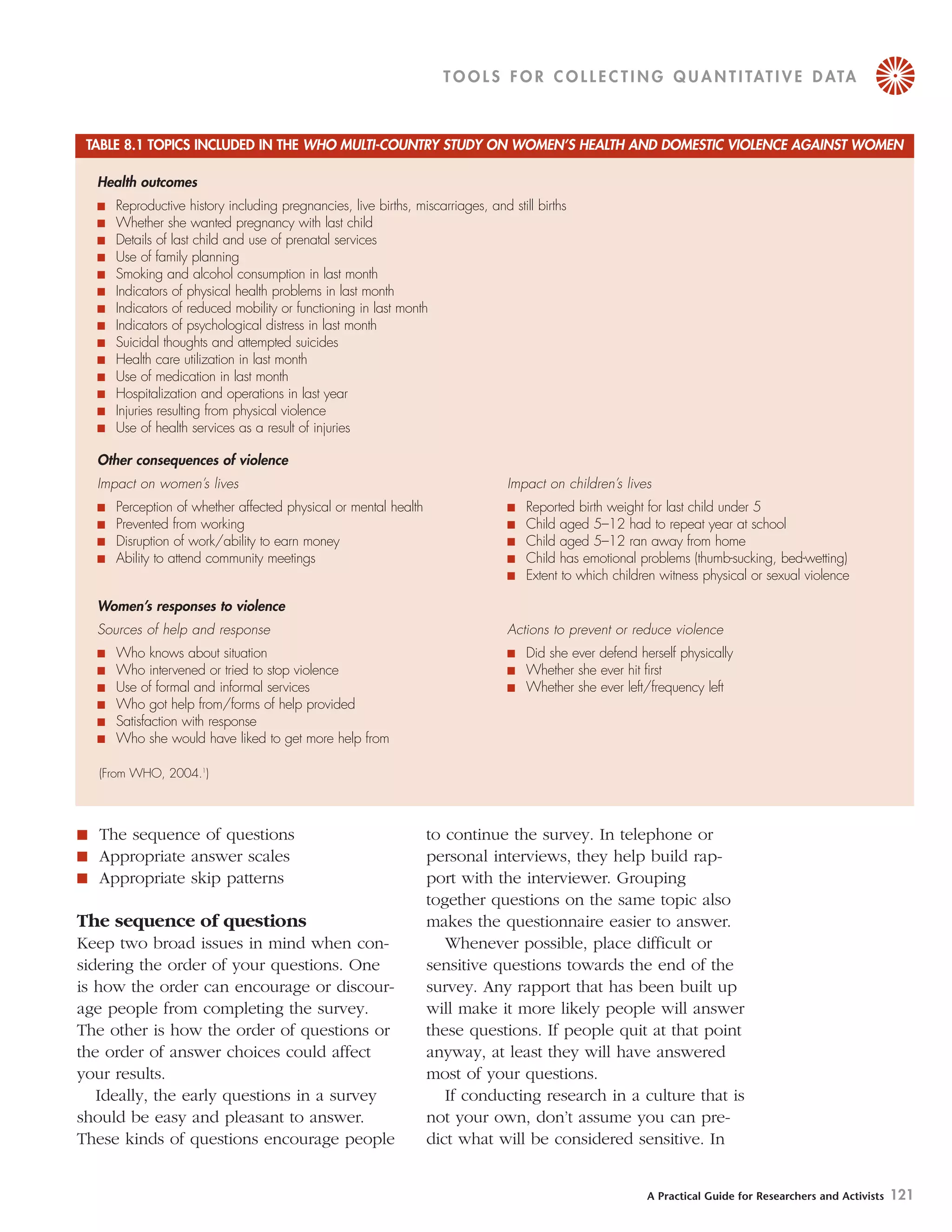
          BOX 8.1 QUESTIONNAIRE DEVELOPMENT IN SOUTH AFRICA                                      the WHO VAW study, for example, the
                                                                                                 questions considered most sensitive varied
 In 1998, the South African Medical Research Council conducted a survey on vio-                  dramatically by country. In Bangladesh, it
 lence against women. The survey was applied to a random sample of 750 house-
                                                                                                 was considered routine to ask women
 holds per province in three (of nine) rural provinces with women aged 18-49. The
 questionnaire for the women’s survey was developed using instruments from other                 about family planning and this was seen as
 countries and two South African focus groups. It was tested and refined over a three-           a good rapport-building topic. In Japan,
 month period with abused women, other women, and NGO staff. The final revi-
                                                                                                 questions about birth control were per-
 sions were made after a pilot training session for fieldworkers.
                                                                                                 ceived as highly sensitive. The Japan team
 Mental health questions were particularly difficult. At the outset, researchers consid-
 ered using a 20-item self-reporting questionnaire that had been tested and calibrated           urged leaving these questions until later in
 to similar African settings. During testing, however, informants and fieldworkers had           the questionnaire.
 enormous difficulty understanding the questions, and the instrument’s length was                   Another strategy for increasing response
 problematic in an already long questionnaire. In addition, scores seemed to be
 improbably high.                                                                                rates on highly sensitive questions, or in sit-
 This prompted an investigation of indigenous and lay expressions of mental ill                  uations where privacy is difficult to achieve,
 health—a process that yielded several expressions of distress shared among all                  is to allow individuals to respond by point-
 African linguistic groups in South Africa. Idioms used to describe mental distress              ing out the appropriate answer on response
 include ”the spirit is low” and, if more severe, ”the spirit/heart is painful.” These
 expressions were incorporated into the questionnaire.                                           cards rather than saying an answer out
                                                                                                 loud. Keep in mind that this strategy only
 (From Jewkes et al, 1999.2)
                                                                                                 works with literate populations.

                                        BOX 8.2 DEVELOPING THE CORE QUESTIONNAIRE FOR THE WHO MULTI-COUNTRY STUDY
                                                ON WOMEN’S HEALTH AND DOMESTIC VIOLENCE AGAINST WOMEN

                                  The questionnaire used in the study was the product of a long process of discussion and consultation. This has
                                  involved reviewing existing literature and numerous instruments, and incorporating input from technical experts in
                                  specific areas (including violence against women, reproductive health, mental health, and drug and alcohol use)
                                  from members of the expert steering committee, and from experts in the field of conducting large population-based
                                  surveys (e.g., the DHS). Moreover, to ensure maximum comparability across studies, discussions were also held
                                  with groups such as the International Network of Clinical Epidemiologists (INCLEN) that were conducting research
                                  in related areas. For practical reasons, the questionnaire consists primarily of structured questions with closed
                                  responses.
                                  In the development phase, the questionnaire was first translated and pre-tested in a limited number of countries on a
                                  convenience sample of women. This process was used to explore a range of issues associated with the content of
                                  the different sections of the questionnaire. At this stage, respondents were not only asked to answer questions from
                                  the questionnaire, but also were requested to provide feedback on the clarity and acceptability of the questions
                                  asked, and the way in which the questionnaire was being delivered. At the end of this first pre-test, all interviewers
                                  met with the country research team to review the questionnaire, to determine where problems were arising, and to
                                  explore possible solutions. This feedback was used to revise different modules within the questionnaire.
                                  Subsequent drafts were informed by qualitative research in the culturally diverse countries and were field-tested
                                  again in a second pre-test in the remaining participating countries. This experience resulted in extensive revisions to
                                  improve accuracy and cross-cultural comparability, and in the final content and structure. The final revisions to the
                                  questionnaire were made following the fourth research team meeting. The revised questionnaire was then sent to
                                  each country research team for a final pre-test. This resulted in version 9.9, which was used in the first eight coun-
                                  tries of the multi-country study.
                                  Each country could add only a limited number of relevant country specific questions, and adapted certain response
                                  codes to reflect local circumstances.
                                  Between 1999 and 2002, the final questionnaire was used in 13 languages during the implementation of the
                                  WHO multi-country study in Bangladesh, Brazil, Japan, Namibia, Peru, Samoa, Tanzania, and Thailand.
                                  Additional studies in Chile, China, Serbia, New Zealand, Ethiopia, and Indonesia have also used
                                  this questionnaire. The questionnaire and a manual with the question-by-question description of the questionnaire is
                                  available from WHO at genderandhealth@ who.int. A shortened version of the instrument can be found in
                                  Appendix I of this guide.

                                  (From WHO, 2004.1)


122   Researching Violence Against Women
T O O L S F O R C O L L E C T I N G Q U A N T I TAT I V E D ATA


   The other way question order can                             that positive attitudes or beliefs are
affect results is habituation. This problem                     sometimes scored with a yes answer or a
applies to a series of questions that all                       high number on a scale and on other
have the same answer choices. After                             questions with a no answer or a low
being asked a series of similar questions                       number.
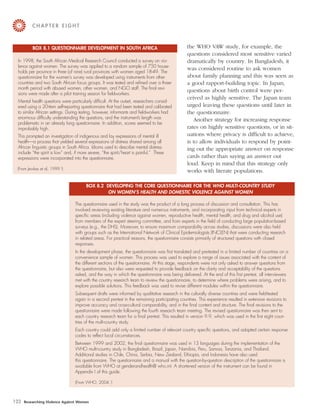
people may give the same answer with-                              Box 8.3 presents an example of ques-
out really considering it. One way to                           tions asked in the WHO VAW study about
avoid this is by asking some questions so                       women’s attitudes toward gender roles.

                    BOX 8.3 QUESTIONS FROM THE WHO VAW STUDY ON GENDER ROLES

 In this community and elsewhere, people have different ideas about families and what is acceptable behavior for
 men and women in the home. I am going to read you a list of statements, and I would like you to tell me whether
 you generally agree or disagree with the statement. There are no right or wrong answers.


 A good wife obeys her husband even if she disagrees.                         Agree                 __________
                                                                              Disagree              __________
                                                                              Don’t Know            __________
                                                                              Refused/No Answer     __________


 Family problems should only be discussed with people in the family.          Agree                 __________
                                                                              Disagree              __________
                                                                              Don’t Know            __________
                                                                              Refused/No Answer     __________


 It is important for a man to show his wife/partner who is the boss.          Agree                 __________
                                                                              Disagree              __________
                                                                              Don’t Know            __________
                                                                              Refused/No Answer     __________


 A woman should be able to choose her own friends even if her                 Agree                 __________
 husband disapproves.                                                         Disagree              __________
                                                                              Don’t Know            __________
                                                                              Refused/No Answer     __________


 It’s a wife’s obligation to have sex with her husband even if she doesn’t    Agree                 __________
 feel like it.                                                                Disagree              __________
                                                                              Don’t Know            __________
                                                                              Refused/No Answer     __________


 If a man mistreats his wife, others outside of the family should intervene   Agree                 __________
                                                                              Disagree              __________
                                                                              Don’t Know            __________
                                                                              Refused/No Answer     __________
  (From WHO, 2004.1)


                                                                                                   A Practical Guide for Researchers and Activists   123

Who path 2005, p. 121-123

  • 1.
    T O OL S F O R C O L L E C T I N G Q U A N T I TAT I V E D ATA TABLE 8.1 TOPICS INCLUDED IN THE WHO MULTI-COUNTRY STUDY ON WOMEN’S HEALTH AND DOMESTIC VIOLENCE AGAINST WOMEN Health outcomes I Reproductive history including pregnancies, live births, miscarriages, and still births I Whether she wanted pregnancy with last child I Details of last child and use of prenatal services I Use of family planning I Smoking and alcohol consumption in last month I Indicators of physical health problems in last month I Indicators of reduced mobility or functioning in last month I Indicators of psychological distress in last month I Suicidal thoughts and attempted suicides I Health care utilization in last month I Use of medication in last month I Hospitalization and operations in last year I Injuries resulting from physical violence I Use of health services as a result of injuries Other consequences of violence Impact on women’s lives Impact on children’s lives I Perception of whether affected physical or mental health I Reported birth weight for last child under 5 I Prevented from working I Child aged 5–12 had to repeat year at school I Disruption of work/ability to earn money I Child aged 5–12 ran away from home I Ability to attend community meetings I Child has emotional problems (thumb-sucking, bed-wetting) I Extent to which children witness physical or sexual violence Women’s responses to violence Sources of help and response Actions to prevent or reduce violence I Who knows about situation I Did she ever defend herself physically I Who intervened or tried to stop violence I Whether she ever hit first I Use of formal and informal services I Whether she ever left/frequency left I Who got help from/forms of help provided I Satisfaction with response I Who she would have liked to get more help from (From WHO, 2004.1) I The sequence of questions to continue the survey. In telephone or I Appropriate answer scales personal interviews, they help build rap- I Appropriate skip patterns port with the interviewer. Grouping together questions on the same topic also The sequence of questions makes the questionnaire easier to answer. Keep two broad issues in mind when con- Whenever possible, place difficult or sidering the order of your questions. One sensitive questions towards the end of the is how the order can encourage or discour- survey. Any rapport that has been built up age people from completing the survey. will make it more likely people will answer The other is how the order of questions or these questions. If people quit at that point the order of answer choices could affect anyway, at least they will have answered your results. most of your questions. Ideally, the early questions in a survey If conducting research in a culture that is should be easy and pleasant to answer. not your own, don’t assume you can pre- These kinds of questions encourage people dict what will be considered sensitive. In A Practical Guide for Researchers and Activists 121
  • 2.
    CHAPTER EIGHT BOX 8.1 QUESTIONNAIRE DEVELOPMENT IN SOUTH AFRICA the WHO VAW study, for example, the questions considered most sensitive varied In 1998, the South African Medical Research Council conducted a survey on vio- dramatically by country. In Bangladesh, it lence against women. The survey was applied to a random sample of 750 house- was considered routine to ask women holds per province in three (of nine) rural provinces with women aged 18-49. The questionnaire for the women’s survey was developed using instruments from other about family planning and this was seen as countries and two South African focus groups. It was tested and refined over a three- a good rapport-building topic. In Japan, month period with abused women, other women, and NGO staff. The final revi- questions about birth control were per- sions were made after a pilot training session for fieldworkers. ceived as highly sensitive. The Japan team Mental health questions were particularly difficult. At the outset, researchers consid- ered using a 20-item self-reporting questionnaire that had been tested and calibrated urged leaving these questions until later in to similar African settings. During testing, however, informants and fieldworkers had the questionnaire. enormous difficulty understanding the questions, and the instrument’s length was Another strategy for increasing response problematic in an already long questionnaire. In addition, scores seemed to be improbably high. rates on highly sensitive questions, or in sit- This prompted an investigation of indigenous and lay expressions of mental ill uations where privacy is difficult to achieve, health—a process that yielded several expressions of distress shared among all is to allow individuals to respond by point- African linguistic groups in South Africa. Idioms used to describe mental distress ing out the appropriate answer on response include ”the spirit is low” and, if more severe, ”the spirit/heart is painful.” These expressions were incorporated into the questionnaire. cards rather than saying an answer out loud. Keep in mind that this strategy only (From Jewkes et al, 1999.2) works with literate populations. BOX 8.2 DEVELOPING THE CORE QUESTIONNAIRE FOR THE WHO MULTI-COUNTRY STUDY ON WOMEN’S HEALTH AND DOMESTIC VIOLENCE AGAINST WOMEN The questionnaire used in the study was the product of a long process of discussion and consultation. This has involved reviewing existing literature and numerous instruments, and incorporating input from technical experts in specific areas (including violence against women, reproductive health, mental health, and drug and alcohol use) from members of the expert steering committee, and from experts in the field of conducting large population-based surveys (e.g., the DHS). Moreover, to ensure maximum comparability across studies, discussions were also held with groups such as the International Network of Clinical Epidemiologists (INCLEN) that were conducting research in related areas. For practical reasons, the questionnaire consists primarily of structured questions with closed responses. In the development phase, the questionnaire was first translated and pre-tested in a limited number of countries on a convenience sample of women. This process was used to explore a range of issues associated with the content of the different sections of the questionnaire. At this stage, respondents were not only asked to answer questions from the questionnaire, but also were requested to provide feedback on the clarity and acceptability of the questions asked, and the way in which the questionnaire was being delivered. At the end of this first pre-test, all interviewers met with the country research team to review the questionnaire, to determine where problems were arising, and to explore possible solutions. This feedback was used to revise different modules within the questionnaire. Subsequent drafts were informed by qualitative research in the culturally diverse countries and were field-tested again in a second pre-test in the remaining participating countries. This experience resulted in extensive revisions to improve accuracy and cross-cultural comparability, and in the final content and structure. The final revisions to the questionnaire were made following the fourth research team meeting. The revised questionnaire was then sent to each country research team for a final pre-test. This resulted in version 9.9, which was used in the first eight coun- tries of the multi-country study. Each country could add only a limited number of relevant country specific questions, and adapted certain response codes to reflect local circumstances. Between 1999 and 2002, the final questionnaire was used in 13 languages during the implementation of the WHO multi-country study in Bangladesh, Brazil, Japan, Namibia, Peru, Samoa, Tanzania, and Thailand. Additional studies in Chile, China, Serbia, New Zealand, Ethiopia, and Indonesia have also used this questionnaire. The questionnaire and a manual with the question-by-question description of the questionnaire is available from WHO at genderandhealth@ who.int. A shortened version of the instrument can be found in Appendix I of this guide. (From WHO, 2004.1) 122 Researching Violence Against Women
  • 3.
    T O OL S F O R C O L L E C T I N G Q U A N T I TAT I V E D ATA The other way question order can that positive attitudes or beliefs are affect results is habituation. This problem sometimes scored with a yes answer or a applies to a series of questions that all high number on a scale and on other have the same answer choices. After questions with a no answer or a low being asked a series of similar questions number. people may give the same answer with- Box 8.3 presents an example of ques- out really considering it. One way to tions asked in the WHO VAW study about avoid this is by asking some questions so women’s attitudes toward gender roles. BOX 8.3 QUESTIONS FROM THE WHO VAW STUDY ON GENDER ROLES In this community and elsewhere, people have different ideas about families and what is acceptable behavior for men and women in the home. I am going to read you a list of statements, and I would like you to tell me whether you generally agree or disagree with the statement. There are no right or wrong answers. A good wife obeys her husband even if she disagrees. Agree __________ Disagree __________ Don’t Know __________ Refused/No Answer __________ Family problems should only be discussed with people in the family. Agree __________ Disagree __________ Don’t Know __________ Refused/No Answer __________ It is important for a man to show his wife/partner who is the boss. Agree __________ Disagree __________ Don’t Know __________ Refused/No Answer __________ A woman should be able to choose her own friends even if her Agree __________ husband disapproves. Disagree __________ Don’t Know __________ Refused/No Answer __________ It’s a wife’s obligation to have sex with her husband even if she doesn’t Agree __________ feel like it. Disagree __________ Don’t Know __________ Refused/No Answer __________ If a man mistreats his wife, others outside of the family should intervene Agree __________ Disagree __________ Don’t Know __________ Refused/No Answer __________ (From WHO, 2004.1) A Practical Guide for Researchers and Activists 123