1Examples of consequences of VAW
Violence impacts on women’s health		I suffered a long time and swallowed my pain. That is why I am constantly visiting doctors and using medicines. No one should have to do this. Woman interviewed in Serbia & MontenegroWomen who have ever experienced violence by a partner have:Worse general healthMore symptoms of ill health such as pain, memory loss, dizziness in the past 4 weeksMore signs of mental distressMore suicidal thoughts and attemptsMore induced abortions and miscarriages2
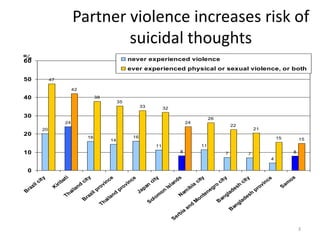
Partner violence increases risk of suicidal thoughts3
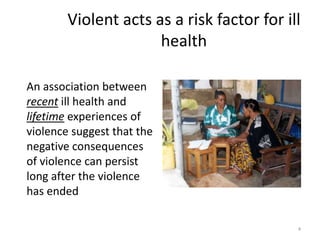
Violent acts as a risk factor for ill healthAn association between recent ill health and lifetimeexperiences of violence suggest that the negative consequences of violence can persist long after the violence has ended4
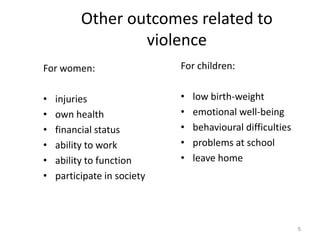
5Other outcomes related to violenceFor children:low birth-weightemotional well-beingbehavioural difficulties problems at schoolleave homeFor women:injuriesown healthfinancial statusability to workability to functionparticipate in society
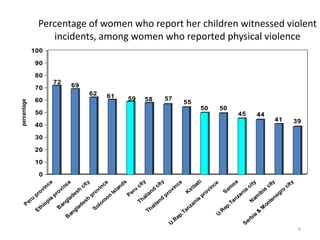
Percentage of women who report her children witnessed violent incidents, among women who reported physical violence6
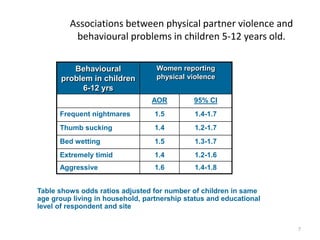
Associations between physical partner violence and behavioural problems in children 5-12 years old. Table shows odds ratios adjusted for number of children in same age group living in household, partnership status and educational level of respondent and site7
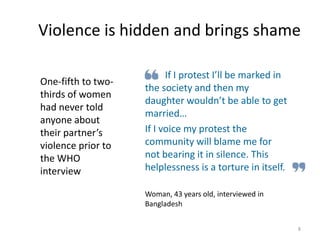
Violence is hidden and brings shameIf I protest I’ll be marked in the society and then my daughter wouldn’t be able to get married…	If I voice my protest the community will blame me for not bearing it in silence. This helplessness is a torture in itself. Woman, 43 years old, interviewed in BangladeshOne-fifth to two-thirds of women had never told anyone about their partner’s violence prior to the WHO interview8
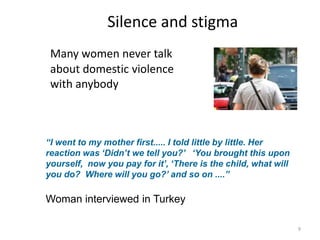
Silence and stigmaMany women never talk about domestic violence with anybody“I went to my mother first..... I told little by little. Her reaction was ‘Didn’t we tell you?’   ‘You brought this upon yourself,  now you pay for it’, ‘There is the child, what will you do?  Where will you go?’ and so on ....”Woman interviewed in Turkey9
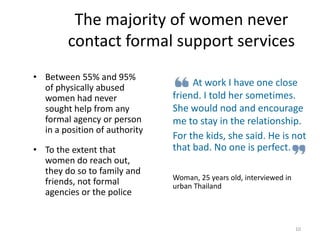
The majority of women never contact formal support servicesBetween 55% and 95% of physically abused women had never sought help from any formal agency or person in a position of authorityTo the extent that women do reach out, they do so to family and friends, not formal agencies or the policeAt work I have one close friend. I told her sometimes. She would nod and encourage me to stay in the relationship.	For the kids, she said. He is not that bad. No one is perfect.Woman, 25 years old, interviewed in urban Thailand10
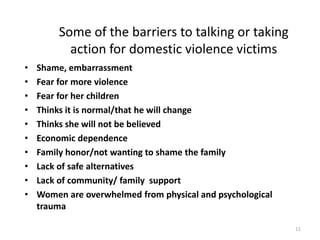
Some of the barriers to talking or taking action for domestic violence victimsShame, embarrassment Fear for more violenceFear for her childrenThinks it is normal/that he will changeThinks she will not be believedEconomic dependenceFamily honor/not wanting to shame the familyLack of safe alternativesLack of community/ family  supportWomen are overwhelmed from physical and psychological trauma11
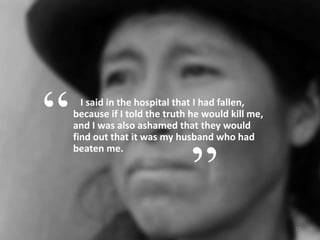
“I said in the hospital that I had fallen, because if I told the truth he would kill me, and I was also ashamed that they would find out that it was my husband who had beaten me. ”12
13ConclusionsDomestic violence against women affects a significant proportion of women around the world, with grave consequences for them and their children Violence against women is linked with shame and stigma and represents a hidden burden on health systems
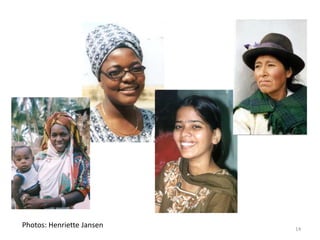
14Photos: Henriette Jansen

Consequences of vaw

  • 1.
  • 2.
    Violence impacts onwomen’s health I suffered a long time and swallowed my pain. That is why I am constantly visiting doctors and using medicines. No one should have to do this. Woman interviewed in Serbia & MontenegroWomen who have ever experienced violence by a partner have:Worse general healthMore symptoms of ill health such as pain, memory loss, dizziness in the past 4 weeksMore signs of mental distressMore suicidal thoughts and attemptsMore induced abortions and miscarriages2
  • 3.
    Partner violence increasesrisk of suicidal thoughts3
  • 4.
    Violent acts asa risk factor for ill healthAn association between recent ill health and lifetimeexperiences of violence suggest that the negative consequences of violence can persist long after the violence has ended4
  • 5.
    5Other outcomes relatedto violenceFor children:low birth-weightemotional well-beingbehavioural difficulties problems at schoolleave homeFor women:injuriesown healthfinancial statusability to workability to functionparticipate in society
  • 6.
    Percentage of womenwho report her children witnessed violent incidents, among women who reported physical violence6
  • 7.
    Associations between physicalpartner violence and behavioural problems in children 5-12 years old. Table shows odds ratios adjusted for number of children in same age group living in household, partnership status and educational level of respondent and site7
  • 8.
    Violence is hiddenand brings shameIf I protest I’ll be marked in the society and then my daughter wouldn’t be able to get married… If I voice my protest the community will blame me for not bearing it in silence. This helplessness is a torture in itself. Woman, 43 years old, interviewed in BangladeshOne-fifth to two-thirds of women had never told anyone about their partner’s violence prior to the WHO interview8
  • 9.
    Silence and stigmaManywomen never talk about domestic violence with anybody“I went to my mother first..... I told little by little. Her reaction was ‘Didn’t we tell you?’ ‘You brought this upon yourself, now you pay for it’, ‘There is the child, what will you do? Where will you go?’ and so on ....”Woman interviewed in Turkey9
  • 10.
    The majority ofwomen never contact formal support servicesBetween 55% and 95% of physically abused women had never sought help from any formal agency or person in a position of authorityTo the extent that women do reach out, they do so to family and friends, not formal agencies or the policeAt work I have one close friend. I told her sometimes. She would nod and encourage me to stay in the relationship. For the kids, she said. He is not that bad. No one is perfect.Woman, 25 years old, interviewed in urban Thailand10
  • 11.
    Some of thebarriers to talking or taking action for domestic violence victimsShame, embarrassment Fear for more violenceFear for her childrenThinks it is normal/that he will changeThinks she will not be believedEconomic dependenceFamily honor/not wanting to shame the familyLack of safe alternativesLack of community/ family supportWomen are overwhelmed from physical and psychological trauma11
  • 12.
    “I said inthe hospital that I had fallen, because if I told the truth he would kill me, and I was also ashamed that they would find out that it was my husband who had beaten me. ”12
  • 13.
    13ConclusionsDomestic violence againstwomen affects a significant proportion of women around the world, with grave consequences for them and their children Violence against women is linked with shame and stigma and represents a hidden burden on health systems
  • 14.