ESTIMATION OF IRON
• Iron content in the sample can be determined by
complexing with 1, 10-phenanthroline.
• Iron (II) forms an orange red color complex [Fe
(C12H8N2)3]2+
• iron (III) forms yellow color complex with the same
reagent [Fe (C12H8N2)3]3+.
• Both iron (II) and (III) can be determined from the
absorbance of the complexes.
PREPARATION OF TEST SAMPLE
test sample containing
both iron (II) and (III)
is made slightly acidic
with sulphuric acid
treated with 1, 10-
phenanthroline
reagent
buffered to pH 3.9
with potassium
hydrogen phthalate
absorbance at 396 nm
gives the total amount
absorbance at 515 nm
is due to iron (II)
complex alone
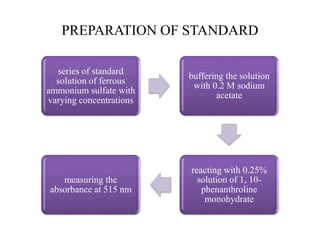
PREPARATION OF STANDARD
series of standard
solution of ferrous
ammonium sulfate with
varying concentrations
buffering the solution
with 0.2 M sodium
acetate
reacting with 0.25%
solution of 1, 10-
phenanthroline
monohydrate
measuring the
absorbance at 515 nm
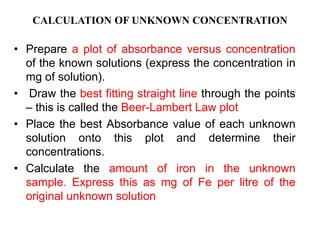
CALCULATION OF UNKNOWN CONCENTRATION
• Prepare a plot of absorbance versus concentration
of the known solutions (express the concentration in
mg of solution).
• Draw the best fitting straight line through the points
– this is called the Beer-Lambert Law plot
• Place the best Absorbance value of each unknown
solution onto this plot and determine their
concentrations.
• Calculate the amount of iron in the unknown
sample. Express this as mg of Fe per litre of the
original unknown solution
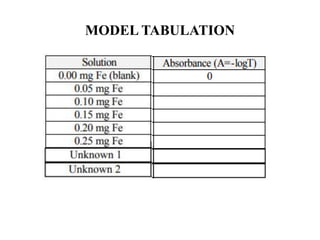
MODEL TABULATION
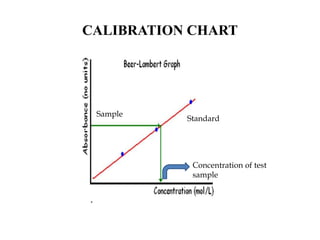
CALIBRATION CHART
Standard
Sample
Concentration of test
sample
• The calibration chart of measured absorbance as
a function of iron concentration is linear
• concentration of iron in the test sample is
determined graphically.
• The iron (II) complex is quite stable and the
intensity of orange-red color is independent of pH
in the range 2-9, and hence is used for
spectrometric measurements.
• Any iron (III) that may be present is reduced to
iron (II) with hydroxylammonium chloride

ESTIMATION OF IRON.pptx

  • 1.
  • 2.
    • Iron contentin the sample can be determined by complexing with 1, 10-phenanthroline. • Iron (II) forms an orange red color complex [Fe (C12H8N2)3]2+ • iron (III) forms yellow color complex with the same reagent [Fe (C12H8N2)3]3+. • Both iron (II) and (III) can be determined from the absorbance of the complexes.
  • 3.
    PREPARATION OF TESTSAMPLE test sample containing both iron (II) and (III) is made slightly acidic with sulphuric acid treated with 1, 10- phenanthroline reagent buffered to pH 3.9 with potassium hydrogen phthalate absorbance at 396 nm gives the total amount absorbance at 515 nm is due to iron (II) complex alone
  • 4.
    PREPARATION OF STANDARD seriesof standard solution of ferrous ammonium sulfate with varying concentrations buffering the solution with 0.2 M sodium acetate reacting with 0.25% solution of 1, 10- phenanthroline monohydrate measuring the absorbance at 515 nm
  • 5.
    CALCULATION OF UNKNOWNCONCENTRATION • Prepare a plot of absorbance versus concentration of the known solutions (express the concentration in mg of solution). • Draw the best fitting straight line through the points – this is called the Beer-Lambert Law plot • Place the best Absorbance value of each unknown solution onto this plot and determine their concentrations. • Calculate the amount of iron in the unknown sample. Express this as mg of Fe per litre of the original unknown solution
  • 6.
  • 7.
  • 8.
    • The calibrationchart of measured absorbance as a function of iron concentration is linear • concentration of iron in the test sample is determined graphically. • The iron (II) complex is quite stable and the intensity of orange-red color is independent of pH in the range 2-9, and hence is used for spectrometric measurements. • Any iron (III) that may be present is reduced to iron (II) with hydroxylammonium chloride