
2015 (Establishing a Policy Development
Process at DepED)
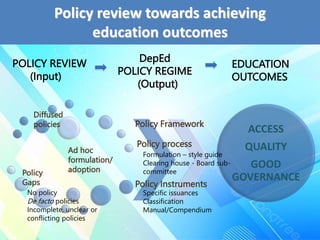
Policy review towards achieving
education outcomes
ACCESS
QUALITY
GOOD
GOVERNANCE
Policy Instruments
POLICY REVIEW
(Input)
DepEd
POLICY REGIME
(Output)
EDUCATION
OUTCOMES
Diffused
policies
Ad hoc
formulation/
adoption
Policy
Gaps
Specific issuances
Classification
Manual/Compendium
No policy
De facto policies
Incomplete, unclear or
conflicting policies
Policy Framework
Policy process
Formulation – style guide
Clearing house - Board sub-
committee
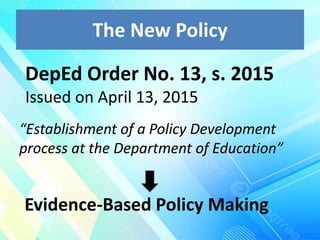
The New Policy
DepEd Order No. 13, s. 2015
Issued on April 13, 2015
“Establishment of a Policy Development
process at the Department of Education”
Evidence-Based Policy Making
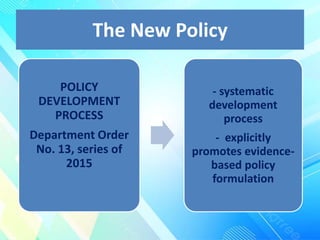
POLICY
DEVELOPMENT
PROCESS
Department Order
No. 13, series of
2015
- systematic
development
process
- explicitly
promotes evidence-
based policy
formulation
The New Policy
Evidence-Based Policy Making
An approach that ‘helps people make well
informed decisions about policies,
programmes and projects by putting the best
available evidence from research at the
heart of policy development and
implementation’ (Davies, 2004: 3).
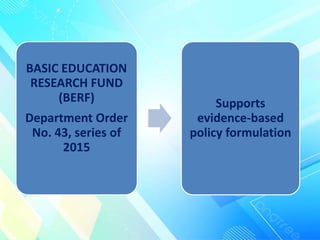
BASIC EDUCATION
RESEARCH FUND
(BERF)
Department Order
No. 43, series of
2015
Supports
evidence-based
policy formulation
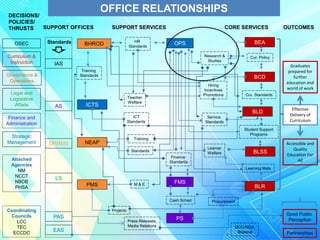
DECISIONS/
POLICIES/
THRUSTS SUPPORT OFFICES SUPPORT SERVICES CORE SERVICES OUTCOMES
AS
DRRMS
LS
PAS
BHROD
ICTS
NEAP
PMS
OPS
FMS
PS
BEA
BCD
BLD
BLSS
Training
Standards
HR
Standards
Teacher
Welfare
Training
Standards
M & E
Cash Sched
Research &
Studies
Hiring
Incentives
Promotions
Service
Standards
Learner
Welfare
Cur. Policy
Cur. Standards
Student Support
Programs
Finance
Standards
Projects
Procurement
BLR
Learning Mats
EAS
Graduates
prepared for
further
education and
world of work
Accessible and
Quality
Education For
All
Effective
Delivery of
Curriculum
Good Public
Perception
Partnerships
Curriculum &
Instruction
Governance &
Operations
Legal and
Legislative
Affaits
Finance and
Administration
Strategic
Management
Attached
Agencies
NM
NCCT
NBDB
PHSA
Coordinating
Councils
LCC
TEC
ECCDC
OFFICE RELATIONSHIPS
Standards
OSEC
IAS
Press Releases,
Media Relations MOU/MOA,
Bilateral
ICT
Standards
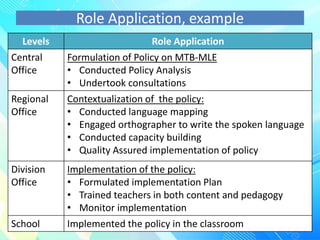
Role Application, example
Levels Role Application
Central
Office
Formulation of Policy on MTB-MLE
• Conducted Policy Analysis
• Undertook consultations
Regional
Office
Contextualization of the policy:
• Conducted language mapping
• Engaged orthographer to write the spoken language
• Conducted capacity building
• Quality Assured implementation of policy
Division
Office
Implementation of the policy:
• Formulated implementation Plan
• Trained teachers in both content and pedagogy
• Monitor implementation
School Implemented the policy in the classroom
Policy Approval Process
(for DepEd Order)
DepEd implements
the new policy
PRD conducts review
and rapid policy
analysis
Proponent conducts
consultation with
relevant offices
PRD endorses the
proposed policy
issuance to EXECOM
for Deliberation
EXECOM en banc
deliberates on the
proposed policy
issuance
Secretary of
Education approves
the policy issuance
PAS-PD assigns
appropriate number
publishes the newly
approved policy
Implementing Office
collaboration with PRD
conducts periodic M&E
No
Yes
Preparation
Implementation
and
M&E
Approval
Pass
Proponent defines
the policy
issue/problem
No
Yes
Approved?
Returns the draft policy issuance with
comments and recommendation to the
proponent for revision
Proponent writes the
proposed policy issuance
and submits to PRD
with complete CSW
Implementing Office and PRD
submits periodic reports on
the progress of policy
implementation
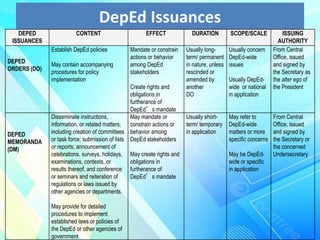
DepEd Issuances
DEPED
ISSUANCES
CONTENT EFFECT DURATION SCOPE/SCALE ISSUING
AUTHORITY
DEPED
ORDERS (DO)
Establish DepEd policies
May contain accompanying
procedures for policy
implementation
Mandate or constrain
actions or behavior
among DepEd
stakeholders
Create rights and
obligations in
furtherance of
DepEd’s mandate
Usually long-
term/ permanent
in nature, unless
rescinded or
amended by
another
DO
Usually concern
DepEd-wide
issues
Usually DepEd-
wide or national
in application
From Central
Office, issued
and signed by
the Secretary as
the alter ego of
the President
DEPED
MEMORANDA
(DM)
Disseminate instructions,
information, or related matters,
including creation of committees
or task force; submission of lists
or reports; announcement of
celebrations, surveys, holidays,
examinations, contests, or
results thereof, and conference
or seminars and reiteration of
regulations or laws issued by
other agencies or departments.
May provide for detailed
procedures to implement
established laws or policies of
the DepEd or other agencies of
government
May mandate or
constrain actions or
behavior among
DepEd stakeholders
May create rights and
obligations in
furtherance of
DepEd’s mandate
Usually short-
term/ temporary
in application
May refer to
DepEd-wide
matters or more
specific concerns
May be DepEd-
wide or specific
in application
From Central
Office, issued
and signed by
the Secretary or
the concerned
Undersecretary
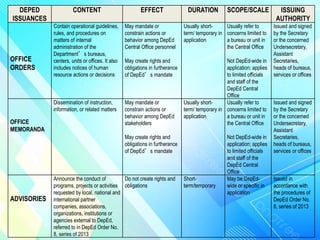
DEPED
ISSUANCES
CONTENT EFFECT DURATION SCOPE/SCALE ISSUING
AUTHORITY
OFFICE
ORDERS
Contain operational guidelines,
rules, and procedures on
matters of internal
administration of the
Department’s bureaus,
centers, units or offices. It also
includes notices of human
resource actions or decisions
May mandate or
constrain actions or
behavior among DepEd
Central Office personnel
May create rights and
obligations in furtherance
of DepEd’s mandate
Usually short-
term/ temporary in
application
Usually refer to
concerns limited to
a bureau or unit in
the Central Office
Not DepEd-wide in
application; applies
to limited officials
and staff of the
DepEd Central
Office
Issued and signed
by the Secretary
or the concerned
Undersecretary,
Assistant
Secretaries,
heads of bureaus,
services or offices
OFFICE
MEMORANDA
Dissemination of instruction,
information, or related matters
May mandate or
constrain actions or
behavior among DepEd
stakeholders
May create rights and
obligations in furtherance
of DepEd’s mandate
Usually short-
term/ temporary in
application
Usually refer to
concerns limited to
a bureau or unit in
the Central Office
Not DepEd-wide in
application; applies
to limited officials
and staff of the
DepEd Central
Office
Issued and signed
by the Secretary
or the concerned
Undersecretary,
Assistant
Secretaries,
heads of bureaus,
services or offices
ADVISORIES
Announce the conduct of
programs, projects or activities
requested by local, national and
international partner
companies, associations,
organizations, institutions or
agencies external to DepEd,
referred to in DepEd Order No.
8, series of 2013
Do not create rights and
obligations
Short-
term/temporary
May be DepEd-
wide or specific in
application
Issued in
accordance with
the procedures of
DepEd Order No.
8, series of 2013
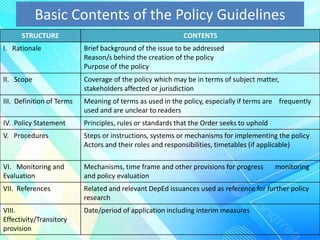
Basic Contents of the Policy Guidelines
STRUCTURE CONTENTS
I. Rationale Brief background of the issue to be addressed
Reason/s behind the creation of the policy
Purpose of the policy
II. Scope Coverage of the policy which may be in terms of subject matter,
stakeholders affected or jurisdiction
III. Definition of Terms Meaning of terms as used in the policy, especially if terms are frequently
used and are unclear to readers
IV. Policy Statement Principles, rules or standards that the Order seeks to uphold
V. Procedures Steps or instructions, systems or mechanisms for implementing the policy
Actors and their roles and responsibilities, timetables (if applicable)
VI. Monitoring and
Evaluation
Mechanisms, time frame and other provisions for progress monitoring
and policy evaluation
VII. References Related and relevant DepEd issuances used as reference for further policy
research
VIII.
Effectivity/Transitory
provision
Date/period of application including interim measures
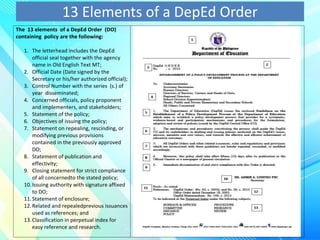
13 Elements of a DepEd Order
The 13 elements of a DepEd Order (DO)
containing policy are the following:
1. The letterhead includes the DepEd
official seal together with the agency
name in Old English Text MT;
2. Official Date (Date signed by the
Secretary or his/her authorized official);
3. Control Number with the series (s.) of
year disseminated;
4. Concerned officials, policy proponent
and implementers, and stakeholders;
5. Statement of the policy;
6. Objectives of issuing the policy;
7. Statement on repealing, rescinding, or
modifying previous provisions
contained in the previously approved
DO;
8. Statement of publication and
effectivity;
9. Closing statement for strict compliance
of all concernedto the stated policy;
10.Issuing authority with signature affixed
to DO;
11.Statement of enclosure;
12.Related and repealedprevious issuances
used as references; and
13.Classification in perpetual index for
easy reference and research.
Rapid Policy Analysis
Upon Receipt of draft policy
issuance, check if the required
annexes are complete and all the
required forms are substantially
accomplished
If incomplete, immediately
return the documents to the
proponents with detailed
notes and observation.
If complete, check the policy
proposal summary and check if
each required elements are
properly accomplished.
Focus on the main problem being
address by the proposed policy.
Check if the problem is evident or
if there are existing policies that
addresses directly and indirectly
the stated problem.
Check if the proposed policy is
appropriately prepared, check
if pre-requisite activities like
consultation was undertaken.
Note all observations on
substance, language and style
and include it in the detailed
feedback to the proponent.
If the proposed policy is well
written and needs no revision,
endorse the documents to PD-PAS
for styling and language review.
Once returned by PD-PS, prepare
the endorsement letter to
ExeCom for approval.
If incomplete, requiring
revision, does not follow the
basic steps, and other
observations, return the policy
proposal to the proponent
detailing the observations,
suggestions and
recommendations
Do an in-depth policy research
to substantiate the
observations. Wait for the
proponent to re-submit the
policy proposal, make follow ups
when necessary.
Completeness
Substance
Recommendatio
n
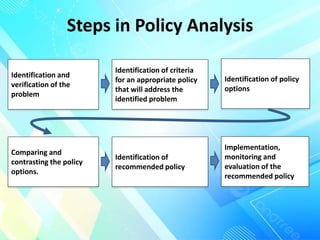
Steps in Policy Analysis
Identification and
verification of the
problem
Identification of criteria
for an appropriate policy
that will address the
identified problem
Identification of policy
options
Implementation,
monitoring and
evaluation of the
recommended policy
Identification of
recommended policy
Comparing and
contrasting the policy
options.
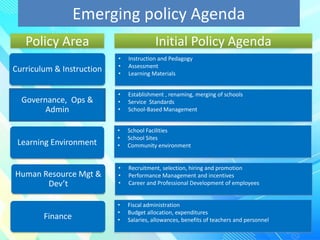
Emerging policy Agenda
Curriculum & Instruction
Learning Environment
Governance, Ops &
Admin
Human Resource Mgt &
Dev’t
Finance
• Instruction and Pedagogy
• Assessment
• Learning Materials
• Establishment , renaming, merging of schools
• Service Standards
• School-Based Management
• Recruitment, selection, hiring and promotion
• Performance Management and incentives
• Career and Professional Development of employees
• School Facilities
• School Sites
• Community environment
• Fiscal administration
• Budget allocation, expenditures
• Salaries, allowances, benefits of teachers and personnel
Policy Area Initial Policy Agenda
Here is an overview of the
policy formulation and
implementation process in
the DepEd:
OPS-PPD
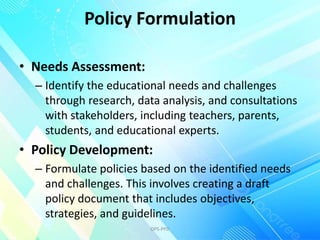
Policy Formulation
• Needs Assessment:
– Identify the educational needs and challenges
through research, data analysis, and consultations
with stakeholders, including teachers, parents,
students, and educational experts.
• Policy Development:
– Formulate policies based on the identified needs
and challenges. This involves creating a draft
policy document that includes objectives,
strategies, and guidelines.
OPS-PPD
Policy Formulation
• Consultation and Stakeholder Involvement:
– Conduct consultations with various stakeholders, such as
teachers' associations, parents' groups, and educational
experts, to gather feedback and input on the proposed
policies.
• Legal Review:
– Ensure that the proposed policies align with existing laws
and regulations. Legal experts review the draft policy to
ensure its legality and compliance.
• Policy Approval:
– Submit the finalized policy proposal to higher authorities
within the DepEd or relevant government bodies for
approval. This may involve review and approval at different
levels.
OPS-PPD
Policy Implementation:
• Communication and Training:
– Communicate the new policies to all relevant
stakeholders, including teachers, school
administrators, and regional offices. Develop
training programs to ensure understanding and
effective implementation.
• Resource Allocation:
– Allocate resources, including budgetary funds,
personnel, and materials, to support the
implementation of the policies. This may involve
collaboration with other government agencies and
stakeholders. OPS-PPD
Policy Implementation:
• Adaptation and Revision:
– Based on monitoring and evaluation results, be
prepared to adapt and revise policies as needed.
This may involve addressing unforeseen
challenges, updating strategies, or making
improvements based on feedback.
• Capacity Building:
– Provide continuous support and capacity-building
programs to ensure that educators and
administrators are well-equipped to implement
the policies effectively.
OPS-PPD
Policy Implementation:
• Feedback Mechanism:
– Establish a feedback mechanism that allows teachers, school
administrators, and other stakeholders to provide input and report
challenges encountered during policy implementation.
• Coordination with Local Government Units (LGUs):
– Collaborate with LGUs to ensure effective coordination between
national policies and local contexts. Local implementation may require
adjustments to meet the specific needs of different regions.
• Public Awareness:
– Promote awareness of the new policies among the general public,
emphasizing the importance of education and the positive impact of
the implemented changes.
OPS-PPD
The success of policy formulation and
implementation in the DepEd relies on
collaboration, effective communication, and
a continuous feedback loop to address
challenges and improve educational
outcomes. Regular reviews and updates to
policies are essential to ensure that they
remain relevant and effective in addressing
the evolving needs of the education sector.
“What is important is to keep
learning, to enjoy challenge, and
to tolerate ambiguity. In the end,
there are no certain answers.”
Martina Horner

Establishing a Policy Development Process at DepED.pptx

  • 1.
    2015 (Establishing aPolicy Development Process at DepED)
  • 2.
    Policy review towardsachieving education outcomes ACCESS QUALITY GOOD GOVERNANCE Policy Instruments POLICY REVIEW (Input) DepEd POLICY REGIME (Output) EDUCATION OUTCOMES Diffused policies Ad hoc formulation/ adoption Policy Gaps Specific issuances Classification Manual/Compendium No policy De facto policies Incomplete, unclear or conflicting policies Policy Framework Policy process Formulation – style guide Clearing house - Board sub- committee
  • 3.
    The New Policy DepEdOrder No. 13, s. 2015 Issued on April 13, 2015 “Establishment of a Policy Development process at the Department of Education” Evidence-Based Policy Making
  • 4.
    POLICY DEVELOPMENT PROCESS Department Order No. 13,series of 2015 - systematic development process - explicitly promotes evidence- based policy formulation The New Policy
  • 5.
    Evidence-Based Policy Making Anapproach that ‘helps people make well informed decisions about policies, programmes and projects by putting the best available evidence from research at the heart of policy development and implementation’ (Davies, 2004: 3).
  • 6.
    BASIC EDUCATION RESEARCH FUND (BERF) DepartmentOrder No. 43, series of 2015 Supports evidence-based policy formulation
  • 7.
    DECISIONS/ POLICIES/ THRUSTS SUPPORT OFFICESSUPPORT SERVICES CORE SERVICES OUTCOMES AS DRRMS LS PAS BHROD ICTS NEAP PMS OPS FMS PS BEA BCD BLD BLSS Training Standards HR Standards Teacher Welfare Training Standards M & E Cash Sched Research & Studies Hiring Incentives Promotions Service Standards Learner Welfare Cur. Policy Cur. Standards Student Support Programs Finance Standards Projects Procurement BLR Learning Mats EAS Graduates prepared for further education and world of work Accessible and Quality Education For All Effective Delivery of Curriculum Good Public Perception Partnerships Curriculum & Instruction Governance & Operations Legal and Legislative Affaits Finance and Administration Strategic Management Attached Agencies NM NCCT NBDB PHSA Coordinating Councils LCC TEC ECCDC OFFICE RELATIONSHIPS Standards OSEC IAS Press Releases, Media Relations MOU/MOA, Bilateral ICT Standards
  • 8.
    Role Application, example LevelsRole Application Central Office Formulation of Policy on MTB-MLE • Conducted Policy Analysis • Undertook consultations Regional Office Contextualization of the policy: • Conducted language mapping • Engaged orthographer to write the spoken language • Conducted capacity building • Quality Assured implementation of policy Division Office Implementation of the policy: • Formulated implementation Plan • Trained teachers in both content and pedagogy • Monitor implementation School Implemented the policy in the classroom
  • 9.
    Policy Approval Process (forDepEd Order) DepEd implements the new policy PRD conducts review and rapid policy analysis Proponent conducts consultation with relevant offices PRD endorses the proposed policy issuance to EXECOM for Deliberation EXECOM en banc deliberates on the proposed policy issuance Secretary of Education approves the policy issuance PAS-PD assigns appropriate number publishes the newly approved policy Implementing Office collaboration with PRD conducts periodic M&E No Yes Preparation Implementation and M&E Approval Pass Proponent defines the policy issue/problem No Yes Approved? Returns the draft policy issuance with comments and recommendation to the proponent for revision Proponent writes the proposed policy issuance and submits to PRD with complete CSW Implementing Office and PRD submits periodic reports on the progress of policy implementation
  • 10.
    DepEd Issuances DEPED ISSUANCES CONTENT EFFECTDURATION SCOPE/SCALE ISSUING AUTHORITY DEPED ORDERS (DO) Establish DepEd policies May contain accompanying procedures for policy implementation Mandate or constrain actions or behavior among DepEd stakeholders Create rights and obligations in furtherance of DepEd’s mandate Usually long- term/ permanent in nature, unless rescinded or amended by another DO Usually concern DepEd-wide issues Usually DepEd- wide or national in application From Central Office, issued and signed by the Secretary as the alter ego of the President DEPED MEMORANDA (DM) Disseminate instructions, information, or related matters, including creation of committees or task force; submission of lists or reports; announcement of celebrations, surveys, holidays, examinations, contests, or results thereof, and conference or seminars and reiteration of regulations or laws issued by other agencies or departments. May provide for detailed procedures to implement established laws or policies of the DepEd or other agencies of government May mandate or constrain actions or behavior among DepEd stakeholders May create rights and obligations in furtherance of DepEd’s mandate Usually short- term/ temporary in application May refer to DepEd-wide matters or more specific concerns May be DepEd- wide or specific in application From Central Office, issued and signed by the Secretary or the concerned Undersecretary
  • 11.
    DEPED ISSUANCES CONTENT EFFECT DURATIONSCOPE/SCALE ISSUING AUTHORITY OFFICE ORDERS Contain operational guidelines, rules, and procedures on matters of internal administration of the Department’s bureaus, centers, units or offices. It also includes notices of human resource actions or decisions May mandate or constrain actions or behavior among DepEd Central Office personnel May create rights and obligations in furtherance of DepEd’s mandate Usually short- term/ temporary in application Usually refer to concerns limited to a bureau or unit in the Central Office Not DepEd-wide in application; applies to limited officials and staff of the DepEd Central Office Issued and signed by the Secretary or the concerned Undersecretary, Assistant Secretaries, heads of bureaus, services or offices OFFICE MEMORANDA Dissemination of instruction, information, or related matters May mandate or constrain actions or behavior among DepEd stakeholders May create rights and obligations in furtherance of DepEd’s mandate Usually short- term/ temporary in application Usually refer to concerns limited to a bureau or unit in the Central Office Not DepEd-wide in application; applies to limited officials and staff of the DepEd Central Office Issued and signed by the Secretary or the concerned Undersecretary, Assistant Secretaries, heads of bureaus, services or offices ADVISORIES Announce the conduct of programs, projects or activities requested by local, national and international partner companies, associations, organizations, institutions or agencies external to DepEd, referred to in DepEd Order No. 8, series of 2013 Do not create rights and obligations Short- term/temporary May be DepEd- wide or specific in application Issued in accordance with the procedures of DepEd Order No. 8, series of 2013
  • 12.
    Basic Contents ofthe Policy Guidelines STRUCTURE CONTENTS I. Rationale Brief background of the issue to be addressed Reason/s behind the creation of the policy Purpose of the policy II. Scope Coverage of the policy which may be in terms of subject matter, stakeholders affected or jurisdiction III. Definition of Terms Meaning of terms as used in the policy, especially if terms are frequently used and are unclear to readers IV. Policy Statement Principles, rules or standards that the Order seeks to uphold V. Procedures Steps or instructions, systems or mechanisms for implementing the policy Actors and their roles and responsibilities, timetables (if applicable) VI. Monitoring and Evaluation Mechanisms, time frame and other provisions for progress monitoring and policy evaluation VII. References Related and relevant DepEd issuances used as reference for further policy research VIII. Effectivity/Transitory provision Date/period of application including interim measures
  • 13.
    13 Elements ofa DepEd Order The 13 elements of a DepEd Order (DO) containing policy are the following: 1. The letterhead includes the DepEd official seal together with the agency name in Old English Text MT; 2. Official Date (Date signed by the Secretary or his/her authorized official); 3. Control Number with the series (s.) of year disseminated; 4. Concerned officials, policy proponent and implementers, and stakeholders; 5. Statement of the policy; 6. Objectives of issuing the policy; 7. Statement on repealing, rescinding, or modifying previous provisions contained in the previously approved DO; 8. Statement of publication and effectivity; 9. Closing statement for strict compliance of all concernedto the stated policy; 10.Issuing authority with signature affixed to DO; 11.Statement of enclosure; 12.Related and repealedprevious issuances used as references; and 13.Classification in perpetual index for easy reference and research.
  • 14.
    Rapid Policy Analysis UponReceipt of draft policy issuance, check if the required annexes are complete and all the required forms are substantially accomplished If incomplete, immediately return the documents to the proponents with detailed notes and observation. If complete, check the policy proposal summary and check if each required elements are properly accomplished. Focus on the main problem being address by the proposed policy. Check if the problem is evident or if there are existing policies that addresses directly and indirectly the stated problem. Check if the proposed policy is appropriately prepared, check if pre-requisite activities like consultation was undertaken. Note all observations on substance, language and style and include it in the detailed feedback to the proponent. If the proposed policy is well written and needs no revision, endorse the documents to PD-PAS for styling and language review. Once returned by PD-PS, prepare the endorsement letter to ExeCom for approval. If incomplete, requiring revision, does not follow the basic steps, and other observations, return the policy proposal to the proponent detailing the observations, suggestions and recommendations Do an in-depth policy research to substantiate the observations. Wait for the proponent to re-submit the policy proposal, make follow ups when necessary. Completeness Substance Recommendatio n
  • 15.
    Steps in PolicyAnalysis Identification and verification of the problem Identification of criteria for an appropriate policy that will address the identified problem Identification of policy options Implementation, monitoring and evaluation of the recommended policy Identification of recommended policy Comparing and contrasting the policy options.
  • 16.
    Emerging policy Agenda Curriculum& Instruction Learning Environment Governance, Ops & Admin Human Resource Mgt & Dev’t Finance • Instruction and Pedagogy • Assessment • Learning Materials • Establishment , renaming, merging of schools • Service Standards • School-Based Management • Recruitment, selection, hiring and promotion • Performance Management and incentives • Career and Professional Development of employees • School Facilities • School Sites • Community environment • Fiscal administration • Budget allocation, expenditures • Salaries, allowances, benefits of teachers and personnel Policy Area Initial Policy Agenda
  • 17.
    Here is anoverview of the policy formulation and implementation process in the DepEd: OPS-PPD
  • 18.
    Policy Formulation • NeedsAssessment: – Identify the educational needs and challenges through research, data analysis, and consultations with stakeholders, including teachers, parents, students, and educational experts. • Policy Development: – Formulate policies based on the identified needs and challenges. This involves creating a draft policy document that includes objectives, strategies, and guidelines. OPS-PPD
  • 19.
    Policy Formulation • Consultationand Stakeholder Involvement: – Conduct consultations with various stakeholders, such as teachers' associations, parents' groups, and educational experts, to gather feedback and input on the proposed policies. • Legal Review: – Ensure that the proposed policies align with existing laws and regulations. Legal experts review the draft policy to ensure its legality and compliance. • Policy Approval: – Submit the finalized policy proposal to higher authorities within the DepEd or relevant government bodies for approval. This may involve review and approval at different levels. OPS-PPD
  • 20.
    Policy Implementation: • Communicationand Training: – Communicate the new policies to all relevant stakeholders, including teachers, school administrators, and regional offices. Develop training programs to ensure understanding and effective implementation. • Resource Allocation: – Allocate resources, including budgetary funds, personnel, and materials, to support the implementation of the policies. This may involve collaboration with other government agencies and stakeholders. OPS-PPD
  • 21.
    Policy Implementation: • Adaptationand Revision: – Based on monitoring and evaluation results, be prepared to adapt and revise policies as needed. This may involve addressing unforeseen challenges, updating strategies, or making improvements based on feedback. • Capacity Building: – Provide continuous support and capacity-building programs to ensure that educators and administrators are well-equipped to implement the policies effectively. OPS-PPD
  • 22.
    Policy Implementation: • FeedbackMechanism: – Establish a feedback mechanism that allows teachers, school administrators, and other stakeholders to provide input and report challenges encountered during policy implementation. • Coordination with Local Government Units (LGUs): – Collaborate with LGUs to ensure effective coordination between national policies and local contexts. Local implementation may require adjustments to meet the specific needs of different regions. • Public Awareness: – Promote awareness of the new policies among the general public, emphasizing the importance of education and the positive impact of the implemented changes. OPS-PPD
  • 23.
    The success ofpolicy formulation and implementation in the DepEd relies on collaboration, effective communication, and a continuous feedback loop to address challenges and improve educational outcomes. Regular reviews and updates to policies are essential to ensure that they remain relevant and effective in addressing the evolving needs of the education sector.
  • 24.
    “What is importantis to keep learning, to enjoy challenge, and to tolerate ambiguity. In the end, there are no certain answers.” Martina Horner

Editor's Notes

  • #3 Policy review objective: Provide coherence in deped policies State of deped policies * diffused – many separate issuances 12k+ DMs, 3,700+DOs, uploated * no institutionalized system for formulation * gaps Absence of policy – new policies De facto policies- adopt Incomplete policies- new/additional Unclear policies – new/clarificatory Inconsistent policies – new/clarificatory Output is to develop a deped policy regime that will support the attainment of educ outcomes Policy framework (includes process) – what policies are, rationale, areas Policy process – Procedure/steps on how policy is formulated/draft, adopted (who, when, implemented, monitored and evaluated Identify and address policy gaps – Policy instruments (provide examples) Manual/compendium
  • #5 The need for an office in DepEd which will serve as a clearing house for all the policies or DepEd Order that will be issued in the Department. DepEd Order 13 defines the policy development process. Rationalization plan provided the right unit and positions that will manage the research and policy development process in the Department.
  • #7 Revisit BERF Policy of 2010
  • #17 Criteria 1. Follow a uniform format 2. Research and evidence-based -- fair, just, impartial, risk manageable; and risk responsive 3. Relevant and useful 4. Enabling and Empowering 5. Clear and unambiguous with: Objectives & messages Procedure Term and scope of application: long term, general or issue-specific Accountability and responsibility Effectivity 6. Consistent with principles and provisions within the policy, other applicable non-DepEd policies 7. Feasible, attainable 8. Gender and child sensitive 9. Measurable for effective M&E for future policy review / reformulation