Regional Implementation Guidelines on Application of
Education and Application of Learning and
Development per DepEd Order No.7, s. 2023
RATIONALE
In accordance with Section 2(2) of Article IX (B) of the 1987
Philippine Constitution, appointments in the Civil Service must be
based on merit and fitness. Section 2, Subtitle A, Title I, Book V
of Executive Order (EO) No. 292, also known as the
Administrative Code of 1987, mandates that government
employment be open to all qualified citizens, with an emphasis on
attracting the best candidates. Selections are to be made
based on the individual’s ability to fulfill the duties and
responsibilities required by their positions.
To uphold these constitutional principles, the Department of Education
(DepEd) introduced a new Merit and Selection Plan in 2023 through DepEd
Order No. 19, s. 2022, and DepEd Order No. 7, s. 2023. These policies
cover the selection, hiring, appointment, and promotion of individuals in
teaching, school administration, related-teaching, and non-teaching
positions at all governance levels. The plan is built on the values of merit,
competence, fitness, accountability, transparency, and equal opportunity in
recruitment, selection, and placement. Hence, this regional implementation
guidelines ensures that qualified individuals regardless of their personal
characteristics or affiliations have a fair opportunity to serve in higher
capacities.
As outlined in DepEd Order No. 030, s. 2021, a variety of Learning
Delivery Modalities (LDMs) can be considered in the
development and application of Learning and Development
interventions. These modalities include formal and non-formal
methods, whether face-to-face, online, or through blended learning
approaches. Incorporating these LDMs ensures that applicants'
learning experiences are flexible, inclusive, and aligned with their
career progression, thus enabling them to contribute meaningfully to
the organization's goals.
In this context, the Region has established guidelines
for the application of both education and learning and
development to ensure clear, consistent instructions in
assessing these elements. The overarching goal is to
ensure that there is a standard interpretation,
evaluation process, and means of verification
across the region. Ultimately, this guideline ensures
placement of the right people, for the right job, at the
right time.
SCOPE
This Regional Implementation Guidelines shall apply to the
evaluation of Application of Education and Application of
Learning and Development within the Department of Education
(DepEd), specifically addressing teaching, school
administration, related-teaching, and non-teaching positions
at the regional, division, and school levels. These guidelines
provide a clear framework for the evaluation of applicants’
Application of Education and Application of Learning and
Development (L&D), in alignment with the merit-based
principles outlined in DepEd Order No. 7, s. 2023.
III. Definition of Terms
A. Application of Education – refers to how an applicant has utilized
knowledge and skills acquired through their academic studies or
completed coursework to contribute meaningfully to their
workplace. Points are awarded to applicants who have effectively
translated their educational experiences, such as relevant concepts,
processes, and skills, into practical applications that have achieved
positive outcomes in their current or past roles. Greater emphasis is
placed on educational applications or interventions that align
closely with the requirements of the position being applied for.
B. Application of Learning and Development – pertains to
the demonstrated skills or knowledge gained through human
resource development (HRD) activities attended or
completed by the applicant, resulting in a positive,
measurable outcomes in their current or past job
performance.
C. Education – refers to the formal or non-formal, academic,
technical, or vocational studies that enable an applicant to
successfully perform the duties and responsibilities of a position.
D. Higher Education - refers to any of various types of education
given in post-secondary institutions learning and usually affording,
at the end of a course study , a named degree, diploma, or
certificate of higher study.
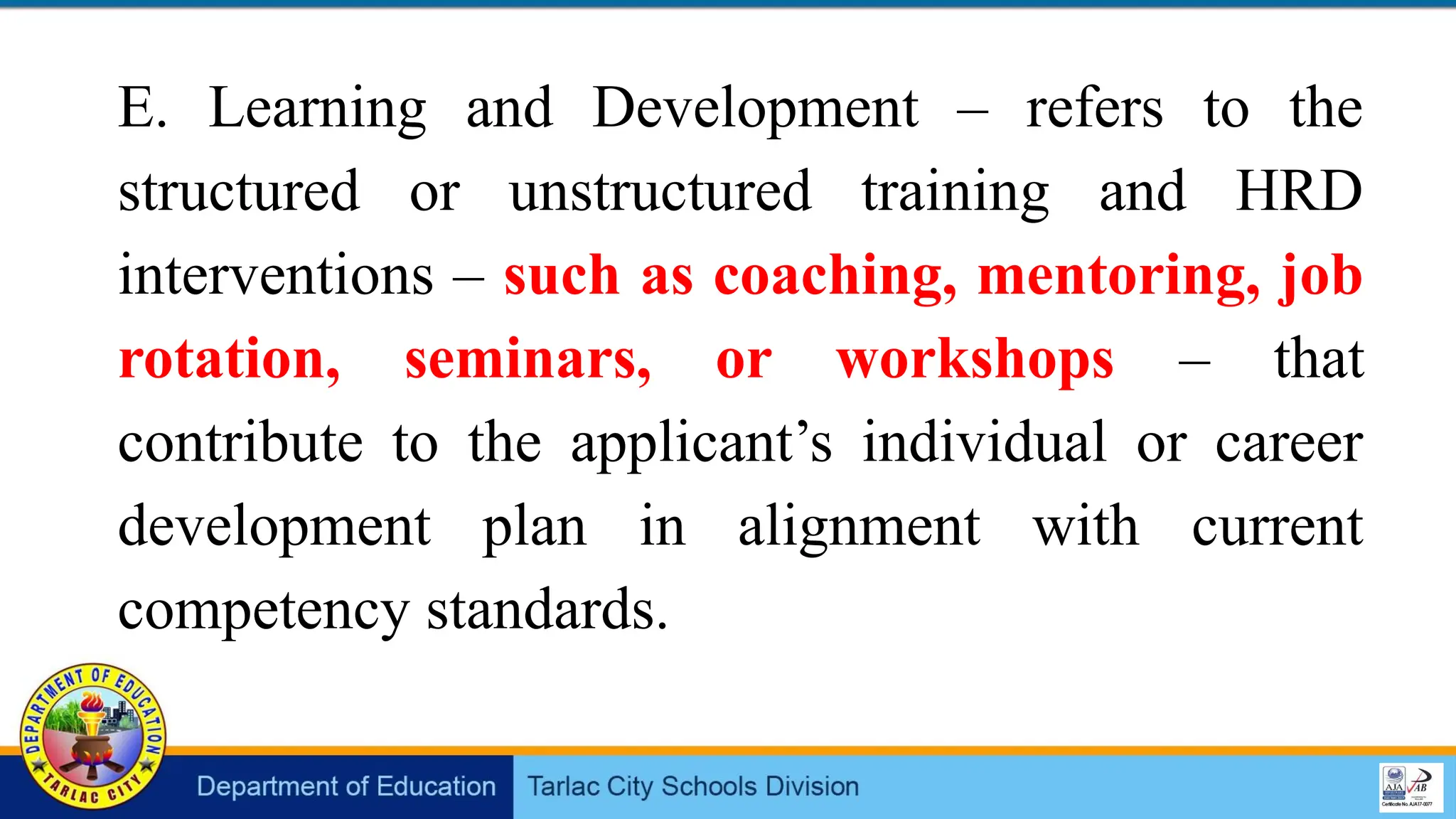
E. Learning and Development – refers to the
structured or unstructured training and HRD
interventions – such as coaching, mentoring, job
rotation, seminars, or workshops – that
contribute to the applicant’s individual or career
development plan in alignment with current
competency standards.
IV. Application of
Education/Learning and
Development Management Cycle
Implementation Process for the
Application of Education
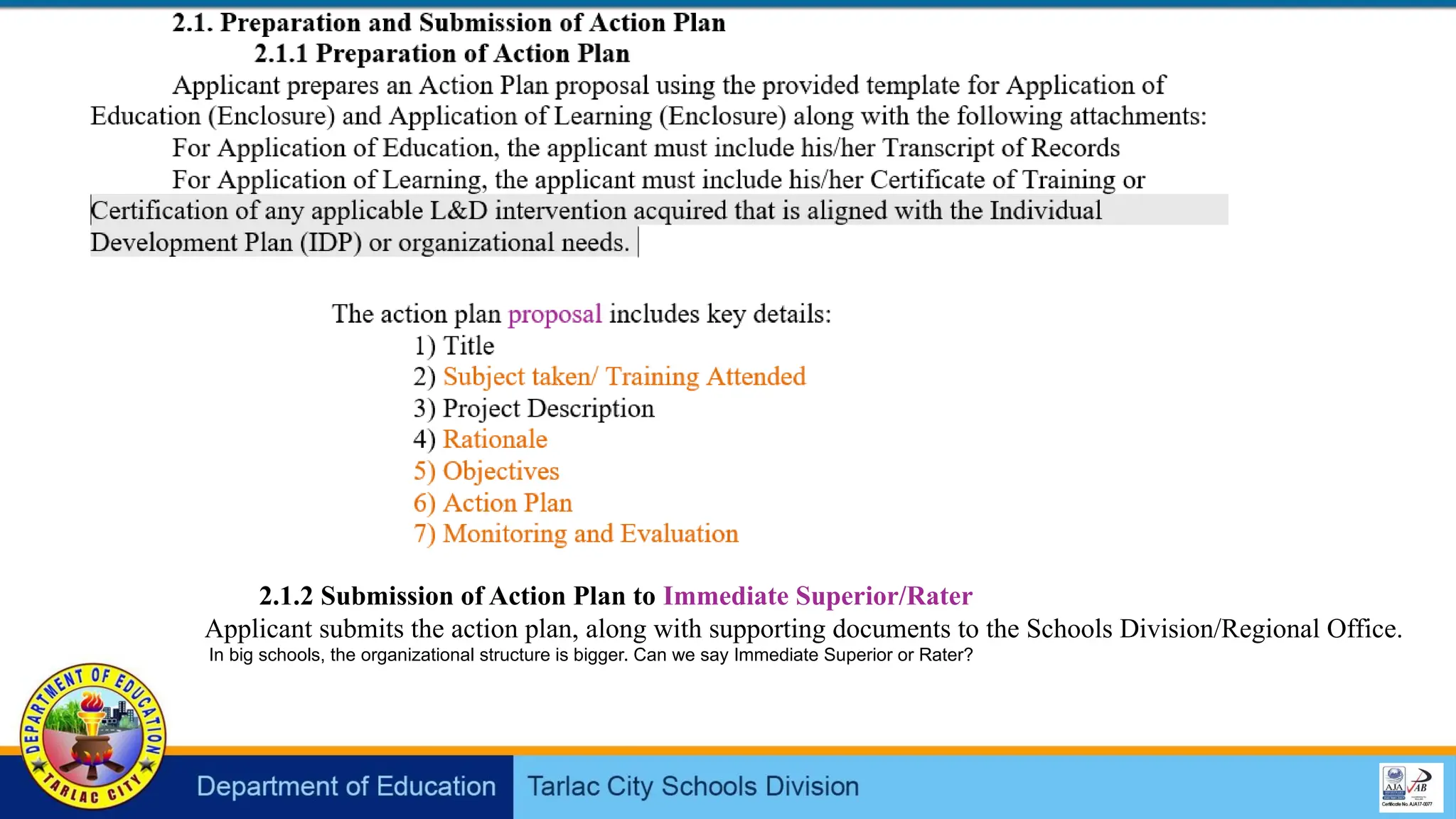
2.1.2 Submission of Action Plan to Immediate Superior/Rater
Applicant submits the action plan, along with supporting documents to the Schools Division/Regional Office.
In big schools, the organizational structure is bigger. Can we say Immediate Superior or Rater?
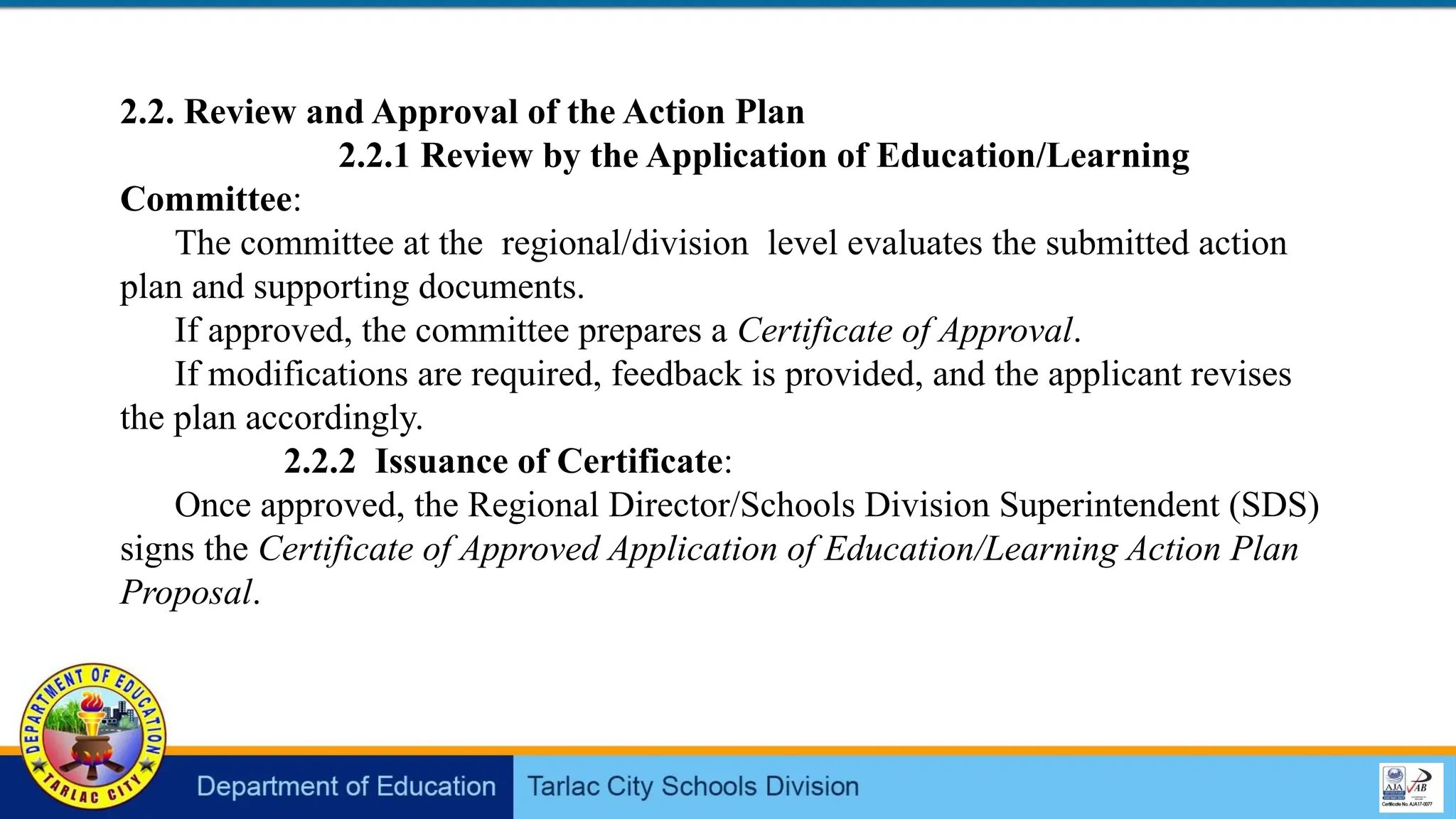
2.2. Review and Approval of the Action Plan
2.2.1 Review by the Application of Education/Learning
Committee:
The committee at the regional/division level evaluates the submitted action
plan and supporting documents.
If approved, the committee prepares a Certificate of Approval.
If modifications are required, feedback is provided, and the applicant revises
the plan accordingly.
2.2.2 Issuance of Certificate:
Once approved, the Regional Director/Schools Division Superintendent (SDS)
signs the Certificate of Approved Application of Education/Learning Action Plan
Proposal.
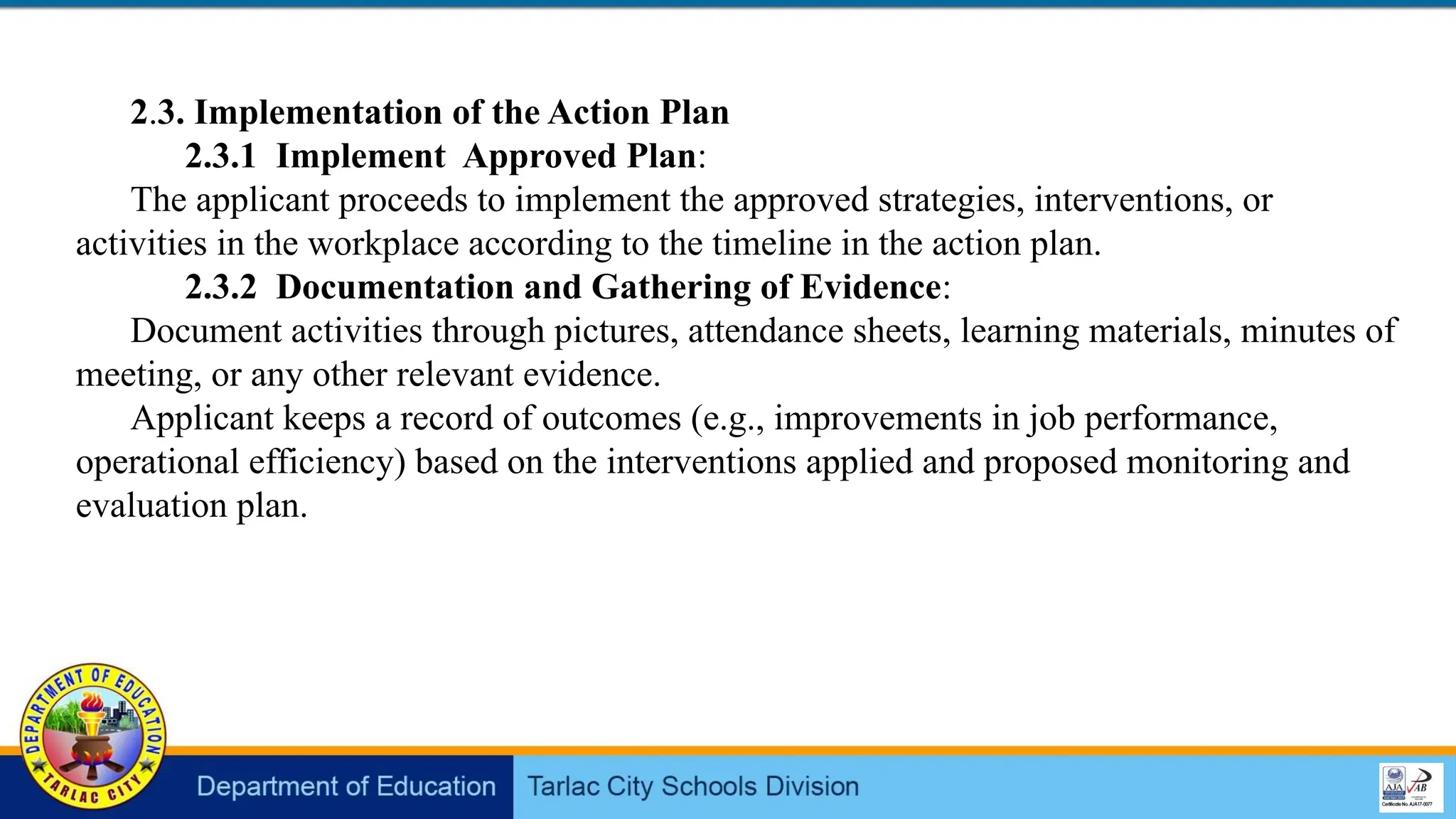
2.3. Implementation of the Action Plan
2.3.1 Implement Approved Plan:
The applicant proceeds to implement the approved strategies, interventions, or
activities in the workplace according to the timeline in the action plan.
2.3.2 Documentation and Gathering of Evidence:
Document activities through pictures, attendance sheets, learning materials, minutes of
meeting, or any other relevant evidence.
Applicant keeps a record of outcomes (e.g., improvements in job performance,
operational efficiency) based on the interventions applied and proposed monitoring and
evaluation plan.
2.4. Preparation of Accomplishment Report
2.4.1 Prepare Accomplishment Report:
The applicant prepares the Accomplishment Report using the template provided
( enclosure)
The accomplishment of report of the implemented Application of Education/Learning
includes the following key details:
1) Title Page
2) Abstract
3) Results and Discussion
4) Recommendations
5) References
2.4.2 Submission of Accomplishment Report:
The applicant submits the report to the Office of the Regional Director/Schools
Division Superintendent along with supporting documents.
2.5. Final Evaluation and Issuance of Certificate of Completion
2.5.1 Evaluation by the Committee:
The Application of Education/L&D Committee evaluates the submitted
accomplishment report and supporting evidence and assess the impact on
workplace performance and overall outcomes.
2. 5.2 Issuance of Certificate of Accomplishment:
If the application is deemed successful, the committee issues a Certificate
of Accomplishment and, where applicable, a Certificate of
Utilization/Adoption signed by the Regional Director/Schools Division
Superintendent through the recommendation of the validating committee.
V. MONITORING AND
EVALUATION
The Head of Office shall ensure that all HRMPSB members, sub-committees, and
other stakeholders are provided with adequate capability building interventions to
ensure smooth implementation and regularly monitor strict adherence to this
guideline. They shall establish a systematic feedback mechanism, evaluate, address,
and report implementation and policy issues that may arise.
The Human Resource Development Division in the region and HRD Unit in the
Schools Division Offices shall monitor and evaluate the submission of application of
learning and development and application of education.
The PPRD -RO and Planning and Research Division in SDOs shall provide technical
inputs in the crafting of the AE and L and D.
The QAD and SMM&E in SDOs shall quality assure the entire content, processes and
needs within their respective areas.
Issues and concerns in relation to the implementation, monitoring and evaluation of
the application projects shall be addressed in adherence to this guideline.
Relative to DepEd Order 29, s. 2022 on the Adoption of the Basic Monitoring and
Evaluation Framework (BEMEF) which aims to track and measure the
achievement of BEDP 2020, the DepEd expands its efforts to improve delivery of
Basic Education services as it also introduces reforms by improving its internal
processes and systems toward improved accountability and transparency.
Anent to this, the Quality Assurance Division (QAD), and the SGOD at the division
level through Human Resource Development Unit and School Management
Monitoring and Evaluation (SMM&E) Unit in conducting progress monitoring of
Application of Education and Application of Learning and Development projects
shall monitor and evaluate the entire application project cycle within their
respective areas to continuously improve the management of these projects.
The outcome and impact of completed application projects shall be
monitored by the Schools Division Offices through its review committee.
Feedback shall be communicated prior to the approval and issuance of
certification of utilization of the Application of Education and Application
of Learning and Development.
The adoption of the application projects by the Office at the local or
higher level shall also be monitored and validated by the review
committee to ensure its authenticity.
The QAD in the RO, SGOD in the SDOs and the school heads shall ensure
compliance with this policy. They shall provide feedback for the continuous
improvement of the policy.
SEE TEMPLATES

APPLICATION OF Learning and Development Policies

  • 1.
    Regional Implementation Guidelineson Application of Education and Application of Learning and Development per DepEd Order No.7, s. 2023
  • 2.
  • 3.
    In accordance withSection 2(2) of Article IX (B) of the 1987 Philippine Constitution, appointments in the Civil Service must be based on merit and fitness. Section 2, Subtitle A, Title I, Book V of Executive Order (EO) No. 292, also known as the Administrative Code of 1987, mandates that government employment be open to all qualified citizens, with an emphasis on attracting the best candidates. Selections are to be made based on the individual’s ability to fulfill the duties and responsibilities required by their positions.
  • 4.
    To uphold theseconstitutional principles, the Department of Education (DepEd) introduced a new Merit and Selection Plan in 2023 through DepEd Order No. 19, s. 2022, and DepEd Order No. 7, s. 2023. These policies cover the selection, hiring, appointment, and promotion of individuals in teaching, school administration, related-teaching, and non-teaching positions at all governance levels. The plan is built on the values of merit, competence, fitness, accountability, transparency, and equal opportunity in recruitment, selection, and placement. Hence, this regional implementation guidelines ensures that qualified individuals regardless of their personal characteristics or affiliations have a fair opportunity to serve in higher capacities.
  • 5.
    As outlined inDepEd Order No. 030, s. 2021, a variety of Learning Delivery Modalities (LDMs) can be considered in the development and application of Learning and Development interventions. These modalities include formal and non-formal methods, whether face-to-face, online, or through blended learning approaches. Incorporating these LDMs ensures that applicants' learning experiences are flexible, inclusive, and aligned with their career progression, thus enabling them to contribute meaningfully to the organization's goals.
  • 6.
    In this context,the Region has established guidelines for the application of both education and learning and development to ensure clear, consistent instructions in assessing these elements. The overarching goal is to ensure that there is a standard interpretation, evaluation process, and means of verification across the region. Ultimately, this guideline ensures placement of the right people, for the right job, at the right time.
  • 7.
  • 8.
    This Regional ImplementationGuidelines shall apply to the evaluation of Application of Education and Application of Learning and Development within the Department of Education (DepEd), specifically addressing teaching, school administration, related-teaching, and non-teaching positions at the regional, division, and school levels. These guidelines provide a clear framework for the evaluation of applicants’ Application of Education and Application of Learning and Development (L&D), in alignment with the merit-based principles outlined in DepEd Order No. 7, s. 2023.
  • 9.
  • 10.
    A. Application ofEducation – refers to how an applicant has utilized knowledge and skills acquired through their academic studies or completed coursework to contribute meaningfully to their workplace. Points are awarded to applicants who have effectively translated their educational experiences, such as relevant concepts, processes, and skills, into practical applications that have achieved positive outcomes in their current or past roles. Greater emphasis is placed on educational applications or interventions that align closely with the requirements of the position being applied for.
  • 11.
    B. Application ofLearning and Development – pertains to the demonstrated skills or knowledge gained through human resource development (HRD) activities attended or completed by the applicant, resulting in a positive, measurable outcomes in their current or past job performance.
  • 12.
    C. Education –refers to the formal or non-formal, academic, technical, or vocational studies that enable an applicant to successfully perform the duties and responsibilities of a position. D. Higher Education - refers to any of various types of education given in post-secondary institutions learning and usually affording, at the end of a course study , a named degree, diploma, or certificate of higher study.
  • 13.
    E. Learning andDevelopment – refers to the structured or unstructured training and HRD interventions – such as coaching, mentoring, job rotation, seminars, or workshops – that contribute to the applicant’s individual or career development plan in alignment with current competency standards.
  • 14.
    IV. Application of Education/Learningand Development Management Cycle
  • 17.
    Implementation Process forthe Application of Education
  • 18.
    2.1.2 Submission ofAction Plan to Immediate Superior/Rater Applicant submits the action plan, along with supporting documents to the Schools Division/Regional Office. In big schools, the organizational structure is bigger. Can we say Immediate Superior or Rater?
  • 19.
    2.2. Review andApproval of the Action Plan 2.2.1 Review by the Application of Education/Learning Committee: The committee at the regional/division level evaluates the submitted action plan and supporting documents. If approved, the committee prepares a Certificate of Approval. If modifications are required, feedback is provided, and the applicant revises the plan accordingly. 2.2.2 Issuance of Certificate: Once approved, the Regional Director/Schools Division Superintendent (SDS) signs the Certificate of Approved Application of Education/Learning Action Plan Proposal.
  • 20.
    2.3. Implementation ofthe Action Plan 2.3.1 Implement Approved Plan: The applicant proceeds to implement the approved strategies, interventions, or activities in the workplace according to the timeline in the action plan. 2.3.2 Documentation and Gathering of Evidence: Document activities through pictures, attendance sheets, learning materials, minutes of meeting, or any other relevant evidence. Applicant keeps a record of outcomes (e.g., improvements in job performance, operational efficiency) based on the interventions applied and proposed monitoring and evaluation plan.
  • 21.
    2.4. Preparation ofAccomplishment Report 2.4.1 Prepare Accomplishment Report: The applicant prepares the Accomplishment Report using the template provided ( enclosure) The accomplishment of report of the implemented Application of Education/Learning includes the following key details: 1) Title Page 2) Abstract 3) Results and Discussion 4) Recommendations 5) References 2.4.2 Submission of Accomplishment Report: The applicant submits the report to the Office of the Regional Director/Schools Division Superintendent along with supporting documents.
  • 22.
    2.5. Final Evaluationand Issuance of Certificate of Completion 2.5.1 Evaluation by the Committee: The Application of Education/L&D Committee evaluates the submitted accomplishment report and supporting evidence and assess the impact on workplace performance and overall outcomes. 2. 5.2 Issuance of Certificate of Accomplishment: If the application is deemed successful, the committee issues a Certificate of Accomplishment and, where applicable, a Certificate of Utilization/Adoption signed by the Regional Director/Schools Division Superintendent through the recommendation of the validating committee.
  • 23.
  • 24.
    The Head ofOffice shall ensure that all HRMPSB members, sub-committees, and other stakeholders are provided with adequate capability building interventions to ensure smooth implementation and regularly monitor strict adherence to this guideline. They shall establish a systematic feedback mechanism, evaluate, address, and report implementation and policy issues that may arise. The Human Resource Development Division in the region and HRD Unit in the Schools Division Offices shall monitor and evaluate the submission of application of learning and development and application of education. The PPRD -RO and Planning and Research Division in SDOs shall provide technical inputs in the crafting of the AE and L and D. The QAD and SMM&E in SDOs shall quality assure the entire content, processes and needs within their respective areas.
  • 25.
    Issues and concernsin relation to the implementation, monitoring and evaluation of the application projects shall be addressed in adherence to this guideline. Relative to DepEd Order 29, s. 2022 on the Adoption of the Basic Monitoring and Evaluation Framework (BEMEF) which aims to track and measure the achievement of BEDP 2020, the DepEd expands its efforts to improve delivery of Basic Education services as it also introduces reforms by improving its internal processes and systems toward improved accountability and transparency. Anent to this, the Quality Assurance Division (QAD), and the SGOD at the division level through Human Resource Development Unit and School Management Monitoring and Evaluation (SMM&E) Unit in conducting progress monitoring of Application of Education and Application of Learning and Development projects shall monitor and evaluate the entire application project cycle within their respective areas to continuously improve the management of these projects.
  • 26.
    The outcome andimpact of completed application projects shall be monitored by the Schools Division Offices through its review committee. Feedback shall be communicated prior to the approval and issuance of certification of utilization of the Application of Education and Application of Learning and Development. The adoption of the application projects by the Office at the local or higher level shall also be monitored and validated by the review committee to ensure its authenticity. The QAD in the RO, SGOD in the SDOs and the school heads shall ensure compliance with this policy. They shall provide feedback for the continuous improvement of the policy.
  • 27.