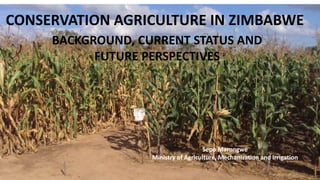
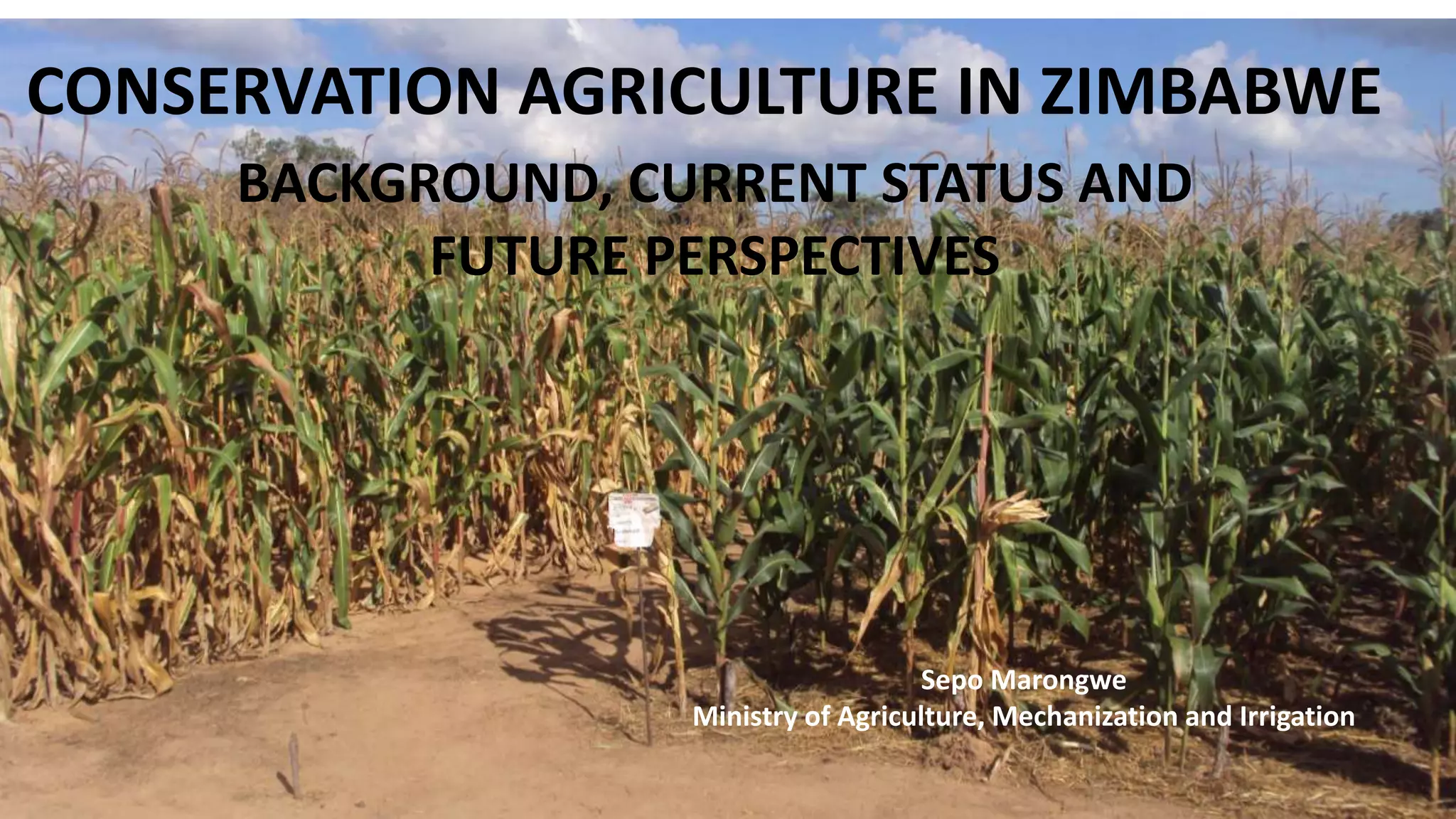
CONSERVATION AGRICULTURE IN ZIMBABWE 
BACKGROUND, CURRENT STATUS AND 
FUTURE PERSPECTIVES 
Sepo Marongwe 
Ministry of Agriculture, Mechanization and Irrigation
Presentation Outline 
I. Agro-ecological characteristics 
II. Farming sectors and cereal production highlights 
III. History and Development of CA in Zimbabwe 
IV. Renewed efforts to promote CA in 
Zimbabwe(2004/2005) 
V. Opportunities and Challenges 
VI. Conclusion
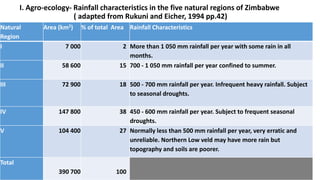
I. Agro-ecology- Rainfall characteristics in the five natural regions of Zimbabwe 
( adapted from Rukuni and Eicher, 1994 pp.42) 
Natural 
Region 
Area (km2) % of total Area Rainfall Characteristics 
I 7 000 2 More than 1 050 mm rainfall per year with some rain in all 
months. 
II 58 600 15 700 - 1 050 mm rainfall per year confined to summer. 
III 72 900 18 500 - 700 mm rainfall per year. Infrequent heavy rainfall. Subject 
to seasonal droughts. 
IV 147 800 38 450 - 600 mm rainfall per year. Subject to frequent seasonal 
droughts. 
V 104 400 27 Normally less than 500 mm rainfall per year, very erratic and 
unreliable. Northern Low veld may have more rain but 
topography and soils are poorer. 
Total 
390 700 
100
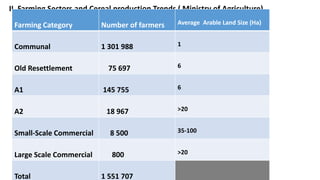
II. Farming Sectors and Cereal production Trends ( Ministry of Agriculture) 
Farming Category 
Number of farmers 
Average Arable Land Size (Ha) 
Communal 
1 301 988 
1 
Old Resettlement 
75 697 
6 
A1 
145 755 
6 
A2 
18 967 
>20 
Small-Scale Commercial 
8 500 
35-100 
Large Scale Commercial 
800 
>20 
Total 
1 551 707
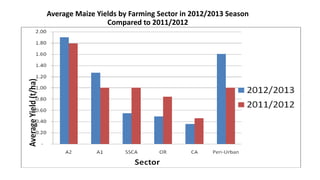
Average Maize Yields by Farming Sector in 2012/2013 Season 
Compared to 2011/2012
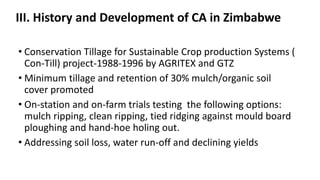
III. History and Development of CA in Zimbabwe 
• Conservation Tillage for Sustainable Crop production Systems ( 
Con-Till) project-1988-1996 by AGRITEX and GTZ 
• Minimum tillage and retention of 30% mulch/organic soil 
cover promoted 
• On-station and on-farm trials testing the following options: 
mulch ripping, clean ripping, tied ridging against mould board 
ploughing and hand-hoe holing out. 
• Addressing soil loss, water run-off and declining yields
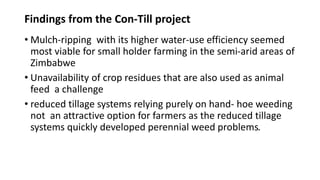
Findings from the Con-Till project 
• Mulch-ripping with its higher water-use efficiency seemed 
most viable for small holder farming in the semi-arid areas of 
Zimbabwe 
• Unavailability of crop residues that are also used as animal 
feed a challenge 
• reduced tillage systems relying purely on hand- hoe weeding 
not an attractive option for farmers as the reduced tillage 
systems quickly developed perennial weed problems.
•Numerous on-station and on-farm trials have 
failed to see any significant up-take of 
conservation tillage technologies among small 
holder farmers
Recommendations from the Con-Till project 
REDUCED TILLAGE TECHNIQUES NEED TO BE 
FURTHER MECHANIZED AND COMBINED 
WITH IMPROVED CROPPING SYSTEMS 
CAPABLE OF REDUCING WEED INFESTATIONS 
AND SPREADING LABOUR
International workshop on conservation tillage for 
sustainable agriculture-1998 
Objectives: 
• To establish an inventory of the conservation tillage technologies 
and approaches in use regions . 
• To identify factors contributing to the success and failure of CT 
adoption. 
• To come up with dissemination strategies& platforms where by 
conservation tillage options can be successfully disseminated. 
• To come up with national and regional action plans. To create fora 
for, and stimulate the sharing and exchange of information and 
encourage the formation of national networks 
Formation of African Conservation Tillage Network
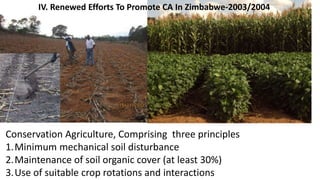
IV. Renewed Efforts To Promote CA In Zimbabwe-2003/2004 
Conservation Agriculture, Comprising three principles 
1.Minimum mechanical soil disturbance 
2.Maintenance of soil organic cover (at least 30%) 
3.Use of suitable crop rotations and interactions
Characteristics of the new approach 
• CA concept introduced as a humanitarian intervention in 
response to food deficits, by donor community 
• Farmers supplied with farming inputs to implement CA in 
parts of their fields 
• Poor or vulnerable households targeted 
• Only manual (hand hoe) CA systems promoted 
• Targeted only communal areas (uncontested lands) 
• CA exclusively promoted as a crop- based technology-no 
place for farmers with livestock
•Little or no reference made to 
previous work 
No lessons learnt!
Implications of the approach 
• Manual systems labour intensive( land preparation and 
weeding) , especially without herbicide use 
• CA focused on mainly maize whose marketing not very viable 
and attractive 
• Poorly resourced households were targeted, creating 
perception/stigma that CA is for poor 
• Benefits of CA initially not clear since all CA farmers had 
fertilizer
Implications of the approach….. 
• Initial CA capacity building activities did not include CA 
mechanization- low capacities in CA mechanization 
• Issue of residue management that need to be addressed at 
village or community level continues to be a major challenge 
• Many farmers only apply the principle of minimum tillage 
•Weed management issues not effectively addressed 
• Market issues that surround “suitable” rotation crops 
discourage farmers from including rotations in their cropping 
systems 
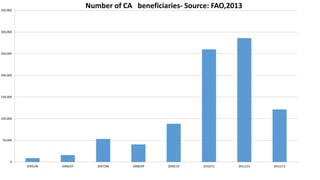
• Average area under CA still very low despite the large number 
od farmers implementing CA components
350,000 
300,000 
250,000 
200,000 
150,000 
100,000 
50,000 
0 
Number of CA beneficiaries- Source: FAO,2013 
2005/06 2006/07 2007/08 2008/09 2009/10 2010/11 2011/12 2012/13
350000 
300000 
250000 
200000 
150000 
100000 
50000 
0 
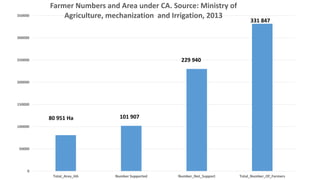
Farmer Numbers and Area under CA. Source: Ministry of 
Agriculture, mechanization and Irrigation, 2013 
80 951 Ha 101 907 
229 940 
331 847 
Total_Area_HA Number Supported Number_Not_Support Total_Number_Of_Farmers
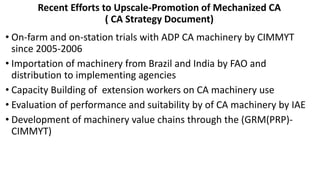
Recent Efforts to Upscale-Promotion of Mechanized CA 
( CA Strategy Document) 
• On-farm and on-station trials with ADP CA machinery by CIMMYT 
since 2005-2006 
• Importation of machinery from Brazil and India by FAO and 
distribution to implementing agencies 
• Capacity Building of extension workers on CA machinery use 
• Evaluation of performance and suitability by of CA machinery by IAE 
• Development of machinery value chains through the (GRM(PRP)- 
CIMMYT)
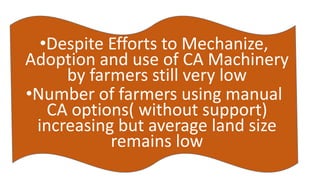
•Despite Efforts to Mechanize, 
Adoption and use of CA Machinery 
by farmers still very low 
•Number of farmers using manual 
CA options( without support) 
increasing but average land size 
remains low
V. Opportunity 
• CA Strategy document (Up scaling through mechanization) 
• Buy in by governments (National, Food and Nutrition Policy, ZIMASSET) 
• ZIMCAN, CARWG- networking 
• Regional Policy Institutions (NEPAD- CAADP Pillars, COMESA 
Programmes ) 
• Including of gender aspects in CA- machinery development and 
Implementation
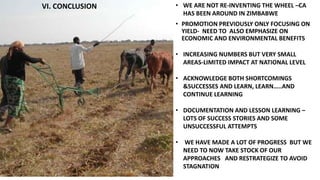
• WE ARE NOT RE-INVENTING THE WHEEL –CA 
HAS BEEN AROUND IN ZIMBABWE 
• PROMOTION PREVIOUSLY ONLY FOCUSING ON 
YIELD- NEED TO ALSO EMPHASIZE ON 
ECONOMIC AND ENVIRONMENTAL BENEFITS 
• INCREASING NUMBERS BUT VERY SMALL 
AREAS-LIMITED IMPACT AT NATIONAL LEVEL 
• ACKNOWLEDGE BOTH SHORTCOMINGS 
&SUCCESSES AND LEARN, LEARN…..AND 
CONTINUE LEARNING 
• DOCUMENTATION AND LESSON LEARNING – 
LOTS OF SUCCESS STORIES AND SOME 
UNSUCCESSFUL ATTEMPTS 
• WE HAVE MADE A LOT OF PROGRESS BUT WE 
NEED TO NOW TAKE STOCK OF OUR 
APPROACHES AND RESTRATEGIZE TO AVOID 
STAGNATION 
VI. CONCLUSION
S marongwe experiences from zim

S marongwe experiences from zim

  • 1.
    CONSERVATION AGRICULTURE INZIMBABWE BACKGROUND, CURRENT STATUS AND FUTURE PERSPECTIVES Sepo Marongwe Ministry of Agriculture, Mechanization and Irrigation
  • 2.
    Presentation Outline I.Agro-ecological characteristics II. Farming sectors and cereal production highlights III. History and Development of CA in Zimbabwe IV. Renewed efforts to promote CA in Zimbabwe(2004/2005) V. Opportunities and Challenges VI. Conclusion
  • 3.
    I. Agro-ecology- Rainfallcharacteristics in the five natural regions of Zimbabwe ( adapted from Rukuni and Eicher, 1994 pp.42) Natural Region Area (km2) % of total Area Rainfall Characteristics I 7 000 2 More than 1 050 mm rainfall per year with some rain in all months. II 58 600 15 700 - 1 050 mm rainfall per year confined to summer. III 72 900 18 500 - 700 mm rainfall per year. Infrequent heavy rainfall. Subject to seasonal droughts. IV 147 800 38 450 - 600 mm rainfall per year. Subject to frequent seasonal droughts. V 104 400 27 Normally less than 500 mm rainfall per year, very erratic and unreliable. Northern Low veld may have more rain but topography and soils are poorer. Total 390 700 100
  • 4.
    II. Farming Sectorsand Cereal production Trends ( Ministry of Agriculture) Farming Category Number of farmers Average Arable Land Size (Ha) Communal 1 301 988 1 Old Resettlement 75 697 6 A1 145 755 6 A2 18 967 >20 Small-Scale Commercial 8 500 35-100 Large Scale Commercial 800 >20 Total 1 551 707
  • 5.
    Average Maize Yieldsby Farming Sector in 2012/2013 Season Compared to 2011/2012
  • 6.
    III. History andDevelopment of CA in Zimbabwe • Conservation Tillage for Sustainable Crop production Systems ( Con-Till) project-1988-1996 by AGRITEX and GTZ • Minimum tillage and retention of 30% mulch/organic soil cover promoted • On-station and on-farm trials testing the following options: mulch ripping, clean ripping, tied ridging against mould board ploughing and hand-hoe holing out. • Addressing soil loss, water run-off and declining yields
  • 7.
    Findings from theCon-Till project • Mulch-ripping with its higher water-use efficiency seemed most viable for small holder farming in the semi-arid areas of Zimbabwe • Unavailability of crop residues that are also used as animal feed a challenge • reduced tillage systems relying purely on hand- hoe weeding not an attractive option for farmers as the reduced tillage systems quickly developed perennial weed problems.
  • 8.
    •Numerous on-station andon-farm trials have failed to see any significant up-take of conservation tillage technologies among small holder farmers
  • 9.
    Recommendations from theCon-Till project REDUCED TILLAGE TECHNIQUES NEED TO BE FURTHER MECHANIZED AND COMBINED WITH IMPROVED CROPPING SYSTEMS CAPABLE OF REDUCING WEED INFESTATIONS AND SPREADING LABOUR
  • 10.
    International workshop onconservation tillage for sustainable agriculture-1998 Objectives: • To establish an inventory of the conservation tillage technologies and approaches in use regions . • To identify factors contributing to the success and failure of CT adoption. • To come up with dissemination strategies& platforms where by conservation tillage options can be successfully disseminated. • To come up with national and regional action plans. To create fora for, and stimulate the sharing and exchange of information and encourage the formation of national networks Formation of African Conservation Tillage Network
  • 11.
    IV. Renewed EffortsTo Promote CA In Zimbabwe-2003/2004 Conservation Agriculture, Comprising three principles 1.Minimum mechanical soil disturbance 2.Maintenance of soil organic cover (at least 30%) 3.Use of suitable crop rotations and interactions
  • 12.
    Characteristics of thenew approach • CA concept introduced as a humanitarian intervention in response to food deficits, by donor community • Farmers supplied with farming inputs to implement CA in parts of their fields • Poor or vulnerable households targeted • Only manual (hand hoe) CA systems promoted • Targeted only communal areas (uncontested lands) • CA exclusively promoted as a crop- based technology-no place for farmers with livestock
  • 13.
    •Little or noreference made to previous work No lessons learnt!
  • 14.
    Implications of theapproach • Manual systems labour intensive( land preparation and weeding) , especially without herbicide use • CA focused on mainly maize whose marketing not very viable and attractive • Poorly resourced households were targeted, creating perception/stigma that CA is for poor • Benefits of CA initially not clear since all CA farmers had fertilizer
  • 15.
    Implications of theapproach….. • Initial CA capacity building activities did not include CA mechanization- low capacities in CA mechanization • Issue of residue management that need to be addressed at village or community level continues to be a major challenge • Many farmers only apply the principle of minimum tillage •Weed management issues not effectively addressed • Market issues that surround “suitable” rotation crops discourage farmers from including rotations in their cropping systems • Average area under CA still very low despite the large number od farmers implementing CA components
  • 17.
    350,000 300,000 250,000 200,000 150,000 100,000 50,000 0 Number of CA beneficiaries- Source: FAO,2013 2005/06 2006/07 2007/08 2008/09 2009/10 2010/11 2011/12 2012/13
  • 18.
    350000 300000 250000 200000 150000 100000 50000 0 Farmer Numbers and Area under CA. Source: Ministry of Agriculture, mechanization and Irrigation, 2013 80 951 Ha 101 907 229 940 331 847 Total_Area_HA Number Supported Number_Not_Support Total_Number_Of_Farmers
  • 19.
    Recent Efforts toUpscale-Promotion of Mechanized CA ( CA Strategy Document) • On-farm and on-station trials with ADP CA machinery by CIMMYT since 2005-2006 • Importation of machinery from Brazil and India by FAO and distribution to implementing agencies • Capacity Building of extension workers on CA machinery use • Evaluation of performance and suitability by of CA machinery by IAE • Development of machinery value chains through the (GRM(PRP)- CIMMYT)
  • 20.
    •Despite Efforts toMechanize, Adoption and use of CA Machinery by farmers still very low •Number of farmers using manual CA options( without support) increasing but average land size remains low
  • 21.
    V. Opportunity •CA Strategy document (Up scaling through mechanization) • Buy in by governments (National, Food and Nutrition Policy, ZIMASSET) • ZIMCAN, CARWG- networking • Regional Policy Institutions (NEPAD- CAADP Pillars, COMESA Programmes ) • Including of gender aspects in CA- machinery development and Implementation
  • 22.
    • WE ARENOT RE-INVENTING THE WHEEL –CA HAS BEEN AROUND IN ZIMBABWE • PROMOTION PREVIOUSLY ONLY FOCUSING ON YIELD- NEED TO ALSO EMPHASIZE ON ECONOMIC AND ENVIRONMENTAL BENEFITS • INCREASING NUMBERS BUT VERY SMALL AREAS-LIMITED IMPACT AT NATIONAL LEVEL • ACKNOWLEDGE BOTH SHORTCOMINGS &SUCCESSES AND LEARN, LEARN…..AND CONTINUE LEARNING • DOCUMENTATION AND LESSON LEARNING – LOTS OF SUCCESS STORIES AND SOME UNSUCCESSFUL ATTEMPTS • WE HAVE MADE A LOT OF PROGRESS BUT WE NEED TO NOW TAKE STOCK OF OUR APPROACHES AND RESTRATEGIZE TO AVOID STAGNATION VI. CONCLUSION