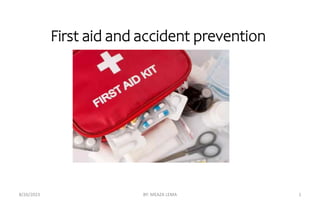
First aid and accident prevention
8/26/2023 BY: MEAZA LEMA 1
Introduction to first aid
8/26/2023 BY: MEAZA LEMA 2
Learning Objectives
After studying the material in this chapter, the student will be
able to:-
1. Define first aid
2. Describe the reasons why first aid is given
3. Appreciate values of first aid
4. Identify general directions for giving first aid
Introduction to first aid
8/26/2023 BY: MEAZA LEMA 3
• Definition: First aid is the immediate care given to a person who has
been injured or suddenly ill.
• It includes home care if medical assistance is not available or
delayed.
• It also includes well selected words of encouragement, evidence of
willingness to help, and promotion of confidence by demonstration
of competence (American red cross, 1998).
Definition of important terms
 Accident: is an unfortunate incident that happens
unexpectedly and unintentionally, typically resulting in damage
or injury.
e.g. crashing of automobiles
 Casualty: somebody who has a fatal accident or a serious injury
 Cardiac arrest: is the sudden stopping of the heartbeat.
 Resuscitation: is a process of correcting physiological
disorders in an acutely ill patient.
 Cardiopulmonary resuscitation: is a procedure performed to
restore spontaneous blood circulation and breathing in a
person who is in cardiac arrest.
8/26/2023 BY: MEAZA LEMA 4
Definition of important terms conti.
 Breathing: act of taking air in and out of the lung.
 Respiration: process of supplying oxygen to cells.
 Artificial respiration: is the act of assisting or
stimulating respiration
 ABC is a word used to remember essential steps when
dealing with a patient.
• It stands for Airway, Breathing and Circulation
8/26/2023 BY: MEAZA LEMA 5
Reasons why first aid is given
8/26/2023 BY: MEAZA LEMA 6
1. To preserve life
 E.g. mouth to mouth respiration when breathing has
stopped.
2. To prevent further injury(complication)
 E.g. -immobilizing the fractured bone.
 -Cervical spine protection
3. To promote healing and recovery
 E.g. reassuring the patient, relief pain, protecting from cold
and arranging for transfer.
• NOTE: Protect yourself – don’t be the victims!
Values of First Aid Training
8/26/2023 BY: MEAZA LEMA 7
The need for first aid training is greater than ever.
Why?
Values of First Aid Training
8/26/2023 BY: MEAZA LEMA 8
The need for first aid training is greater than ever because of:
Population growth through out the world
Increased use of technological products; such as
mechanical and electrical appliances in everyday use at
home, working place and play areas which make more
people at risk of injury.
In Ethiopia, infrastructure is developing like high speed-
roads, hotels, universities, dams, etc
Thus, there is an ever growing demand for first aid training
for personal use and from the demand for certified first-
aiders as part of industrial and commercial establishments.
General directions to give first aid
8/26/2023 BY: MEAZA LEMA 9
A. Assessment of the situation - scene size up
–Is the scene is safe?
–What was the cause?
–How many victims were involved?
–The traffic pattern? etc
B. Identifying the problem
–Type - Mechanism of injury
–Severity
General directions to give first aid conti.
8/26/2023 BY: MEAZA LEMA 10
C. Prioritizing: a casualty may have more than one injury and that
some casualties will require more urgent attention than others.
D. Extricating the victims: disentangling the patient from difficulty
E. Giving immediate and adequate treatment
F. Arrangement of transportation for casualty with out delay
accompanied with brief written report
Extrication
8/26/2023 BY: MEAZA LEMA 11
 Definition: the process of safe removal of the patient from
source of accident
 Two primary extrication goals:
1. To obtain safe access to the patients
2. To ensure patient stabilization
Keep in mind these basic guidelines
1. Know the limitations of your training, equipment, and skill.
2. Identify any hazards (eg, gasoline, power lines or wires,
hazardous materials).
3. Control those hazards for which you are trained and equipped.
4. Gain access to the patients.
5. Provide patient care and stabilization.
6. Move patients only if absolutely necessary.
8/26/2023 BY: MEAZA LEMA 12
Emergency patient assessment
8/26/2023 BY: MEAZA LEMA 13
Triage
French word “trier”, literally means: “to sort out”.
A method of ranking sick or injured people.
 According to the severity of their sickness or injury.
 According to the capacity of the facility (mass
causality or multiple causality.)
Emergency patient assessment conti.
8/26/2023 BY: MEAZA LEMA 14
 Patients are sorted with a scientific triage scale in order of
urgency.
 The aim is to bring:
 The greatest good to the greatest number of people.
 The patient with the greatest need is helped first.
 to place them in one of the following categories:
E= Emergency
P= Priority and
Q= Queue (non-urgent)
Emergency patient assessment conti.
• EMERGENCY signs: who require immediate emergency
treatment
• PRIORITY signs: who should be given priority in the queue,
rapidly assessed and treated without delay
• NON-URGENT cases: who can wait their turn in the queue.
The majority of seen will be non-urgent cases.
8/26/2023 BY: MEAZA LEMA 15
Emergency patient assessment conti.
8/26/2023 BY: MEAZA LEMA 16
• Life threatening problems are identified and dealt with
FIRST.
• This is done in a strict order of priorities in order to ensure
that the most important steps are undertaken in a logical
order ensuring nothing is missed.
Emergent Severity Index (ESI)
• ESI 1- (RED): Emergency signs are sorted in order of priority
as: ABCDO
A = Airway
B = Breathing
C = Circulation, Coma, Convulsions
D = Dehydration
O= Others (bleeding, trauma with open fracture, Acute
poisoning)
8/26/2023 BY: MEAZA LEMA 17
Emergent Severity Index (ESI)
ESI 1- (RED): Immediately life threatening
 Respiratory failure, severe respiratory distress
 facial, neck, chest injuries,
 severe hemorrhage, unstable vital signs (shock),
 Coma with airway obstruction, convulsions, chest
pain with unstable v/s.
8/26/2023 BY: MEAZA LEMA 18
Emergent Severity Index (ESI)
ESI 2 – (Orange): Emergent imminently/potentially life
threatening if care is not given within 15min
–pending respiratory failure
–altered consciousness with out airway obstruction
–moderate trauma with stable vital signs
–Such patients require frequent re-triage until they
are seen by the professional and they are the second
in priority following the red
–If any deterioration appears, they may be
categorized accordingly
8/26/2023 BY: MEAZA LEMA 19
Emergent Severity Index (ESI)
ESI 3 - (Yellow): less urgent, potentially serious, could be
delayed up to 1hr
E.g
 injuries to the Lower genitourinary tract,
 peripheral nerves and vessels,
 splinted fractures
 soft tissue lesions
They also require re triaging until they are assessed by the
health professional and if any deterioration appears they
may be categorized accordingly.
8/26/2023 BY: MEAZA LEMA 20
Emergent Severity Index (ESI)
ESI 4 (Green):
 They will require a professional care in several hours
to days but not immediately.
 May wait for a number of hours or be told to go home
and come back the next day, non urgent.
 Can be send to near by health institution
8/26/2023 BY: MEAZA LEMA 21
Emergency patient assessment conti.
8/26/2023 BY: MEAZA LEMA 22
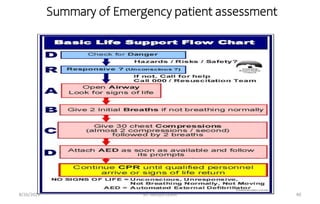
The Primary Survey uses the systematic approach: DR.ABCD.
 Dangers
 Response
 Airway
 Breathing
 Compressions
 Defibrillation
if available
D- DANGER
8/26/2023 BY: MEAZA LEMA 23
1. Eliminate/minimize the dangers before you approach.
2. Ensure the safety of yourself, any bystanders and the
casualty.
3. If it is too dangerous to approach, keep at a safe distance
and call the emergency services.
4. Only move the casualty/casualties if absolutely necessary.
5. Use bystanders to assist you where possible i.e. controlling
traffic, phoning for help.
6. Use barrier devices where possible i.e. use a face shield and
gloves.
R - RESPONSE
 If you have more than one casualty, always treat the
unconscious ones first.
 Question: If someone is screaming and shouting and one is
on their back quiet which one would be your priority?
 If they are screaming and shouting, they are
breathing.
 Use the touch and talk approach.
 NEVER SHAKE an unconscious casualty.
 The best way to see if the casualty responds is to use the
'COWS' method: touch and talk approach
 Can you hear me?
 Open your eyes!
 What's your name?
 Squeeze my hands!
8/26/2023 BY: MEAZA LEMA 24
R – RESPONSE conti.
8/26/2023 BY: MEAZA LEMA 25
 If the casualty responds, ask their name and carry out
the ‘history, signs & symptoms' assessment principle
 If the casualty is unconscious, not responding to talk
and touch, call your ambulance now and move onto the
airway.
A - AIRWAY
 Assessing the airway of the casualty without turning onto
the side.
 Keeping the head in the position you found it, look in the
mouth.
 If any solid or liquid is found, place the casualty onto their
side and clear the airway.
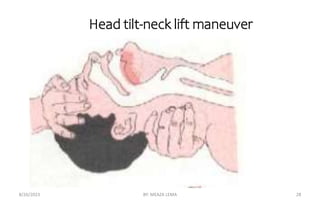
 If nothing is found but not breathing adequately, open the
airway using the head tilt-chin lift technique, head tilt-neck
lift technique or jaw thrust method.
8/26/2023 BY: MEAZA LEMA 26
A – AIRWAY conti.
8/26/2023 BY: MEAZA LEMA 27
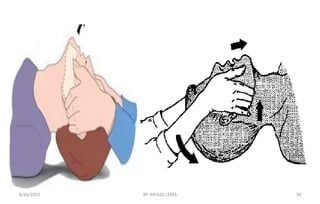
Head tilt-chin lift
 Place one hand on the casualty's forehead and two fingers
under the chin.
 Tilt the head back and lift chin up opening the airway.
 The maneuver is performed by tilting the head backwards in
unconscious patients, often by applying pressure to the
forehead and the chin.
What are contraindications?
Head tilt-neck lift maneuver
8/26/2023 BY: MEAZA LEMA 28
Jaw-thrust maneuver
 Is performed by placing the index and middle fingers to
physically push the posterior aspects of the mandible upwards
while their thumbs push down on the chin to open the mouth.
 When the mandible is displaced forward, it pulls the tongue
forward and prevents it from obstructing the entrance to
the trachea.
 Lifting the mandible using both mandible angles and pushing
forward and upward.
 Use jaw thrust especially in patients with suspicion of cervical
spine injury(see picture below)
8/26/2023 BY: MEAZA LEMA 29
8/26/2023 BY: MEAZA LEMA 30
Advanced airway management
8/26/2023 BY: MEAZA LEMA 31
B - BREATHING
8/26/2023 BY: MEAZA LEMA 32
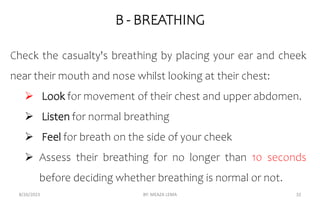
Check the casualty's breathing by placing your ear and cheek
near their mouth and nose whilst looking at their chest:
 Look for movement of their chest and upper abdomen.
 Listen for normal breathing
 Feel for breath on the side of your cheek
 Assess their breathing for no longer than 10 seconds
before deciding whether breathing is normal or not.
B – BREATHING conti.
• If the patient has adequate breathing effort place in recovery
position, with the patient leant over on their side (see the
picture below).
• this has an effect of clearing the tongue from the pharynx
• Avoids a common cause of death in unconscious patients,
choking on regurgitated stomach contents.
• It also avoids aspiration.
8/26/2023 BY: MEAZA LEMA 33
C – Compressions
8/26/2023 BY: MEAZA LEMA 34
 Asses for circulation on the carotid artery
for pulse for 9-10sec.
 If no pulse, start chest compression.
 Compress the chest 30 times at a rate of
100 compressions per minute and give 2
rescue breathe.
C – Compressions conti.
8/26/2023 BY: MEAZA LEMA 35
 The goal of resuscitation interventions for a patient in
respiratory or cardiac arrest is to:
1. Restore effective oxygenation & ventilation
2. Restore circulation
3. Return of intact neurological functions
A compression depth of at least 4 cm in infants and 5 cm in
children PUSH HARD
C – Compressions conti.
 Once you have carried out 30 chest compressions, and 2
rescue breaths,
 Continue at a ratio of 30:2 until either:
 Professional arrives to relieve you.
 It becomes too dangerous to continue
 The casualty begins to breathe normally
 You become too exhausted to continue
 Another competent first aider takes over from you
 The casualty begins to vomit
8/26/2023 BY: MEAZA LEMA 36
Reassurance
8/26/2023 BY: MEAZA LEMA 37
 Easing of discomfort and anxiety is a very important process
of first aid.
 Many first aiders forget that they are treating a 'person', as
well as the injury/illness.
 By combining reassurance with good first aid management,
and possibly distracting or diverting the casualty's attention
to something else, you will, in most circumstances, actually
ease the anxiety and pain levels of the casualty.
Reassurance conti.
 By easing anxiety and pain levels you will help to
promote recovery of the injured/ill casualty.
 This will in turn:
 Decrease blood loss
 Which will in turn slow down the shock process
 Decreasing the heart rate
8/26/2023 BY: MEAZA LEMA 38
REMEMBER:
 Any resuscitation is better than no resuscitation at all.
 If you are unwilling or unable to carry out rescue breaths,
then carry out chest compression alone.
 If you don't do anything they will stay dead
8/26/2023 BY: MEAZA LEMA 39
Summary of Emergency patient assessment
8/26/2023 BY: MEAZA LEMA 40
CHAPTER TWO
RESPIRATORY EMERGENCIES AND ARTIFICIAL RESPIRATION
8/26/2023 BY: MEAZA LEMA 41
Learning Objectives
After studying the material in this chapter, the student will be able to:-
1. Define respiratory emergencies and artificial respiration.
2. Explain the breathing process.
3. Identify causes of respiratory failure
4. Give artificial respiration and manage respiratory accident.
5. Demonstrate cardiopulmonary resuscitation
Definition of terms
8/26/2023 BY: MEAZA LEMA 42
 Respiratory emergency- is one in which normal breathing stops or in
which breathing is reduced so that oxygen intake is insufficient to
support life.
 Respiratory failure- is a syndrome in which the respiratory system fails in
one or both of its gas exchange functions: oxygenation and carbon
dioxide elimination.
 Artificial respiration- is a procedure for making air to flow into and out
of a person’s lungs when natural breathing is inadequate or ceases.
The breathing process
8/26/2023 BY: MEAZA LEMA 43
Natural breathing is accomplished by increasing and decreasing
the capacity of the chest and the lung.
 During the inhalation phase of breathing
1. The muscles of the chest contracts and lift the ribs,
expanding the chest.
2. At the same time, the diaphragm contracts and descends
toward the abdomen. In this way, the chest cavities
increased in size and air flows in
 When all muscles relax, the ribs and diaphragm resume their
normal position, the chest cavity becomes smaller, and air
flows out.
 In all manual methods of artificial respiration, the objective is
to cause an alternate decrease and increase in size of the chest
cavity.
 When this is done, air flows in and out if there is no obstruction
8/26/2023 BY: MEAZA LEMA 44
Breathing process conti…
Respiratory physiology
8/26/2023 BY: MEAZA LEMA 45
• The act of respiration engages 3 processes:
1. Transfer of oxygen across the alveolus
2. Transport of oxygen to the tissues
3. Removal of carbon dioxide from blood into the alveolus
and then into the environment.
• Any disruption in one or more of these leads to Respiratory
failure.
Types of respiratory failure
8/26/2023 BY: MEAZA LEMA 46
1. Hypoxemic respiratory failure (type I)
2. Hypercapnic respiratory failure (type II)
1. Hypoxemic respiratory failure (type I)
 characterized by:
 an arterial oxygen tension (Pa O2) lower than 60 mm Hg
 with a normal or low arterial carbon dioxide tension (Pa
CO2).
 The most common form of respiratory failure.
Causes of Respiratory Failure
8/26/2023 BY: MEAZA LEMA 47
A. Anatomical Obstruction
 The most common cause of respiratory emergency which
interfere with breathing caused by the dropping of the
tongue back and obstructing the throat.
 Other causes of obstruction that constrict the air passages
are:
Asthma
Croup
Diphtheria
Laryngeal spasm
Swelling after burns of the face
Swallowing of corrosive poisons
8/26/2023 BY: MEAZA LEMA 48
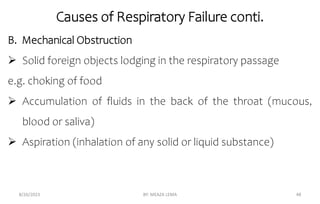
B. Mechanical Obstruction
 Solid foreign objects lodging in the respiratory passage
e.g. choking of food
 Accumulation of fluids in the back of the throat (mucous,
blood or saliva)
 Aspiration (inhalation of any solid or liquid substance)
Causes of Respiratory Failure conti.
8/26/2023 BY: MEAZA LEMA 49
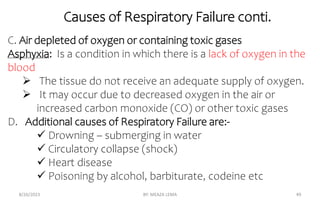
C. Air depleted of oxygen or containing toxic gases
Asphyxia: Is a condition in which there is a lack of oxygen in the
blood
 The tissue do not receive an adequate supply of oxygen.
 It may occur due to decreased oxygen in the air or
increased carbon monoxide (CO) or other toxic gases
D. Additional causes of Respiratory Failure are:-
 Drowning – submerging in water
 Circulatory collapse (shock)
 Heart disease
 Poisoning by alcohol, barbiturate, codeine etc
Causes of Respiratory Failure conti.
Management of Respiratory Accidents
8/26/2023 BY: MEAZA LEMA 50
Artificial Respiration
Purpose:
1. To maintain open air way through the mouth and nose.
2. To restore breathing by maintaining an alternating increase
and decrease in the expansion of the chest.
General Information
 The average person may die with in 4-6 minutes if his/her
oxygen supply is cut off.
 Recovery is usually rapid except in case of carbon monoxide
poisoning, over dosage of drugs or electrical shock.
 In such cases, it is often necessary to continue artificial
respiration for a long time.
Recognition of respiratory emergencies
8/26/2023 BY: MEAZA LEMA 51
The underlying problem in most cases of Respiratory Failure is
hypoxia and this is recognized by
tachypnea
tachycardia
sweating
peripheral vasoconstriction
central and peripheral cyanosis
restlessness
mental confusion
bradycardia accompanied by gasping respirations,
which warn of the impending cardiac arrest.
Recognition of respiratory emergencies
8/26/2023 BY: MEAZA LEMA 52
S/s of hypercapnia
peripheral vasodilatation
Sweating
dilatation of the pupils
drowsiness: A very sleepy state
muscle twitching
coma
Features of obstructed airway
8/26/2023 BY: MEAZA LEMA 53
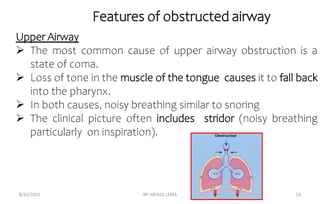
Upper Airway
 The most common cause of upper airway obstruction is a
state of coma.
 Loss of tone in the muscle of the tongue causes it to fall back
into the pharynx.
 In both causes, noisy breathing similar to snoring
 The clinical picture often includes stridor (noisy breathing
particularly on inspiration).
Features of obstructed airway conti.
8/26/2023 BY: MEAZA LEMA 54
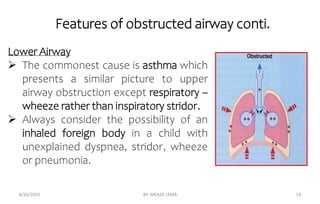
Lower Airway
 The commonest cause is asthma which
presents a similar picture to upper
airway obstruction except respiratory –
wheeze rather than inspiratory stridor.
 Always consider the possibility of an
inhaled foreign body in a child with
unexplained dyspnea, stridor, wheeze
or pneumonia.
Artificial respirations
8/26/2023 BY: MEAZA LEMA 55
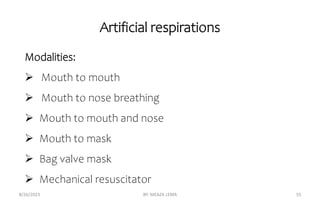
Modalities:
 Mouth to mouth
 Mouth to nose breathing
 Mouth to mouth and nose
 Mouth to mask
 Bag valve mask
 Mechanical resuscitator
Artificial respirations conti.
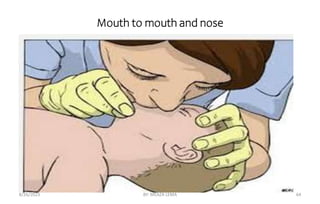
• Mouth to mouth and nose
– Used on infants (usually up to around 1 year old), as this forms the
most effective seal
• Mouth to mask
– Most organizations recommend the use of some sort of barrier
between rescuer and patient to reduce cross infection risk. One
popular type is the 'pocket mask'. This may be able to provide higher
tidal volumes than a Bag Valve Mask
.
8/26/2023 BY: MEAZA LEMA 56
'pocket mask
Artificial respirations conti.
 Ventilation with a Bag- valve- mask
• Select a mask of the correct size.
• Position yourself at the patient's vertex.
• Tilt the patient's head back.
• Hold the mask securely to the patient's face.
• Use your other hand to squeeze the bag
• Squeezing the bag once every 5–6 seconds for an adult or once every 3
seconds for an infant or child.
8/26/2023 BY: MEAZA LEMA 57
Ambu bag
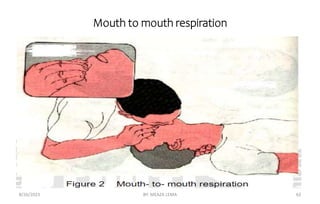
Mouth- to- mouth (mouth- to- nose) method or” kiss
of life”
8/26/2023 BY: MEAZA LEMA 58
Steps
1. Determine consciousness by tapping the victim on shoulder and asking
loudly ''Are you OK''?
2. Open air way using the head tilt- chin lift or Jaw thrust.
3. Place your cheek and ear close to the victim’s mouth and nose to
assess for respiration.
4. If absent/insufficient, pinch the victim’s nostrils shut with the thumb
and index finger of your hand i.e. pressing on the victim’s forehead,
5. Blow air in to the victim’s mouth- give 2 rescue breaths given/2
seconds..
 Maintain the head tilt and again look, listen, feel for
exhalation of air & check the pulse for at least 5-7 sec. but
not greeter than 10 sec.
 If no pulse and no breath do CPR
 If there is pulse & no breath provide at least 1 breath
every 5 sec. or 12 /minute for adults.
 Watch the victim's chest to see when it rises.
 Stop blowing when the victim's chest is expands and falls by
it self.
8/26/2023 BY: MEAZA LEMA 59
Mouth- to- mouth (mouth- to- nose) method or” kiss
of life” cont…
6. If the chest doesn’t rise when you blow air
A. Reopen the airway by tilting the head and lifting the jaw
B. Pinch the nose again
C. Make a better seal around the mouth
D. Try blowing again
7. If the chest still doesn’t rise, give first aid for choking
8/26/2023 BY: MEAZA LEMA 60
Mouth- to- mouth (mouth- to- nose) method or” kiss
of life” cont…
For children & infant
Both the mouth & nose should be sealed off by your mouth (mouth
-to-mouth and nose resuscitation).
Blow into the infant's mouth & nose once every 3 seconds
(once every 4 seconds for a child) with less pressure &
volume.
N.B. The amount of air is determined by the size of the victim.
The head tilt should not be as extensive as that for adults.
8/26/2023 BY: MEAZA LEMA 61
Mouth to mouth respiration
8/26/2023 BY: MEAZA LEMA 62
Mouth to nose respiration
8/26/2023 BY: MEAZA LEMA 63
Mouth to mouth and nose
8/26/2023 BY: MEAZA LEMA 64
Recognition of choking person
8/26/2023 BY: MEAZA LEMA 65
 Ask the person “Are you choking?”
 If the person is able to answer you by speaking, it is a partial airway
obstruction.
 Stay with the person and encourage him or her to cough until the
obstruction is cleared.
 Do not give the person anything to drink because fluids may take up
space needed for the passage of air.
 Someone who cannot answer by speaking and can only nod the head
has a complete airway obstruction and needs emergency help.
First Aid for Choking
8/26/2023 BY: MEAZA LEMA 66
 The treatment for a choking person varies with the person's
age.
 Abdominal thrusts (“Heimlich maneuver")
 Used for adults & children older than one year of age.
 It may be forceful enough to clear the airway.
 The quick, upward abdominal thrusts force pushes the
diaphragm upward very suddenly, making the chest cavity
smaller.
 This has the effect of rapidly compressing the lungs and
forcing air out.
 The rush of air out will hopefully force out whatever is
causing the person to choke.
First Aid for Choking conti.
8/26/2023 BY: MEAZA LEMA 67
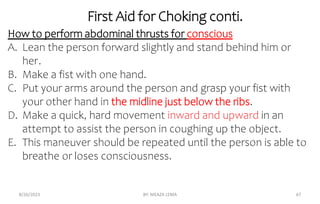
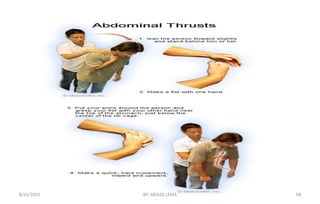
How to perform abdominal thrusts for conscious
A. Lean the person forward slightly and stand behind him or
her.
B. Make a fist with one hand.
C. Put your arms around the person and grasp your fist with
your other hand in the midline just below the ribs.
D. Make a quick, hard movement inward and upward in an
attempt to assist the person in coughing up the object.
E. This maneuver should be repeated until the person is able to
breathe or loses consciousness.
8/26/2023 BY: MEAZA LEMA 68
Abdominal trust for conscious
8/26/2023 BY: MEAZA LEMA 69
Back slab for conscious
8/26/2023 BY: MEAZA LEMA 70
First Aid for Choking conti.
8/26/2023 BY: MEAZA LEMA 71
How to perform abdominal thrusts if the person loses consciousness
A. Gently lay him or her flat on their back on the floor.
A. To clear the airway, kneel next to the person & put the heel of
your hand against the middle of the abdomen, just below the
ribs.
B. Place your other hand on top and press inward and upward
five times with both hands.
C. If the airway clears & the person is still unresponsive, begin
CPR
8/26/2023 BY: MEAZA LEMA 72
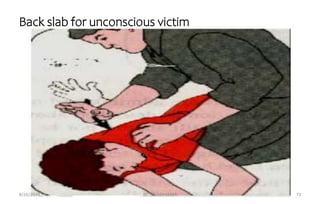
Back slab for unconscious victim
8/26/2023 BY: MEAZA LEMA 73
Abdominal trust for unconscious
Clearing a Blocked Airway in an Infant
8/26/2023 BY: MEAZA LEMA 74
Back blows/slap
Used for an infant instead of abdominal thrust.
1. The infant is turned face down, the chest
resting on the rescuer's forearm, with the head
lower than the body.
2. The rescuer then strikes the infant between the
shoulder blades 5 times using the heel of the
hand.
3. The strikes should be firm but not hard enough
to cause injury.
4. The rescuer then checks the mouth, removing
any visible objects.
Choked infant cont’d…
8/26/2023 BY: MEAZA LEMA 75
 If the airway remains blocked, the rescuer
turns the infant face up with the head
down, and using the second and third
fingers, thrusts inward and upward on
the infant's breastbone 5 times (chest
thrusts).
 The rescuer then checks the mouth
again
8/26/2023 BY: MEAZA LEMA 76
Back slap
Chest thrusts for babies
8/26/2023 BY: MEAZA LEMA 77
Mechanical suffocation (Strangulation)
8/26/2023 BY: MEAZA LEMA 78
 If pressure is exerted on the outside of the neck, the air way
is squeezed and the flow of air to the lung is cut off.
 The main causes of such pressure are:
1. Hanging- suspension of the body by rope around the
neck or throat.
2. Strangulation- constriction or squeezing around the
neck or throat.
 Hanging may cause a broken neck; for this reason, a casualty
in this situation must be handled very carefully.
Recognition (signs)
 A constricting article around the neck
 Marks around the casualty’s neck
 Rapid, difficult breathing; impaired consciousness, cyanosis.
 Congestion of the face, with prominent veins and, possibly,
tiny red spots on the face or on the whites of the eyes.
Caution
 Do not move the casualty unnecessarily, in case of spinal injury.
 Do not destroy or interfere with any material that has been
constricting the neck, such as knotted rope; police may need it
as evidence.
8/26/2023 BY: MEAZA LEMA 79
Mechanical suffocation (Strangulation) conti.
First aid aim and interventions
8/26/2023 BY: MEAZA LEMA 80
The aims are:
To restore adequate breathing.
To arrange urgent removal to the hospital
Interventions/measurements
1. Quickly remove any constriction from around the
casualty’s neck. Support the body while you do so; if it is
still hanging. Be aware that the body may be very heavy.
2. Lay the casualty on the ground. Open the airway and
check breathing. If he/she is not breathing, be prepared
to give rescue breaths and chest compressions if
necessary.
If he/she is breathing, place her in the recovery position.

First Aid For Lab students.pptx

  • 1.
    First aid andaccident prevention 8/26/2023 BY: MEAZA LEMA 1
  • 2.
    Introduction to firstaid 8/26/2023 BY: MEAZA LEMA 2 Learning Objectives After studying the material in this chapter, the student will be able to:- 1. Define first aid 2. Describe the reasons why first aid is given 3. Appreciate values of first aid 4. Identify general directions for giving first aid
  • 3.
    Introduction to firstaid 8/26/2023 BY: MEAZA LEMA 3 • Definition: First aid is the immediate care given to a person who has been injured or suddenly ill. • It includes home care if medical assistance is not available or delayed. • It also includes well selected words of encouragement, evidence of willingness to help, and promotion of confidence by demonstration of competence (American red cross, 1998).
  • 4.
    Definition of importantterms  Accident: is an unfortunate incident that happens unexpectedly and unintentionally, typically resulting in damage or injury. e.g. crashing of automobiles  Casualty: somebody who has a fatal accident or a serious injury  Cardiac arrest: is the sudden stopping of the heartbeat.  Resuscitation: is a process of correcting physiological disorders in an acutely ill patient.  Cardiopulmonary resuscitation: is a procedure performed to restore spontaneous blood circulation and breathing in a person who is in cardiac arrest. 8/26/2023 BY: MEAZA LEMA 4
  • 5.
    Definition of importantterms conti.  Breathing: act of taking air in and out of the lung.  Respiration: process of supplying oxygen to cells.  Artificial respiration: is the act of assisting or stimulating respiration  ABC is a word used to remember essential steps when dealing with a patient. • It stands for Airway, Breathing and Circulation 8/26/2023 BY: MEAZA LEMA 5
  • 6.
    Reasons why firstaid is given 8/26/2023 BY: MEAZA LEMA 6 1. To preserve life  E.g. mouth to mouth respiration when breathing has stopped. 2. To prevent further injury(complication)  E.g. -immobilizing the fractured bone.  -Cervical spine protection 3. To promote healing and recovery  E.g. reassuring the patient, relief pain, protecting from cold and arranging for transfer. • NOTE: Protect yourself – don’t be the victims!
  • 7.
    Values of FirstAid Training 8/26/2023 BY: MEAZA LEMA 7 The need for first aid training is greater than ever. Why?
  • 8.
    Values of FirstAid Training 8/26/2023 BY: MEAZA LEMA 8 The need for first aid training is greater than ever because of: Population growth through out the world Increased use of technological products; such as mechanical and electrical appliances in everyday use at home, working place and play areas which make more people at risk of injury. In Ethiopia, infrastructure is developing like high speed- roads, hotels, universities, dams, etc Thus, there is an ever growing demand for first aid training for personal use and from the demand for certified first- aiders as part of industrial and commercial establishments.
  • 9.
    General directions togive first aid 8/26/2023 BY: MEAZA LEMA 9 A. Assessment of the situation - scene size up –Is the scene is safe? –What was the cause? –How many victims were involved? –The traffic pattern? etc B. Identifying the problem –Type - Mechanism of injury –Severity
  • 10.
    General directions togive first aid conti. 8/26/2023 BY: MEAZA LEMA 10 C. Prioritizing: a casualty may have more than one injury and that some casualties will require more urgent attention than others. D. Extricating the victims: disentangling the patient from difficulty E. Giving immediate and adequate treatment F. Arrangement of transportation for casualty with out delay accompanied with brief written report
  • 11.
    Extrication 8/26/2023 BY: MEAZALEMA 11  Definition: the process of safe removal of the patient from source of accident  Two primary extrication goals: 1. To obtain safe access to the patients 2. To ensure patient stabilization
  • 12.
    Keep in mindthese basic guidelines 1. Know the limitations of your training, equipment, and skill. 2. Identify any hazards (eg, gasoline, power lines or wires, hazardous materials). 3. Control those hazards for which you are trained and equipped. 4. Gain access to the patients. 5. Provide patient care and stabilization. 6. Move patients only if absolutely necessary. 8/26/2023 BY: MEAZA LEMA 12
  • 13.
    Emergency patient assessment 8/26/2023BY: MEAZA LEMA 13 Triage French word “trier”, literally means: “to sort out”. A method of ranking sick or injured people.  According to the severity of their sickness or injury.  According to the capacity of the facility (mass causality or multiple causality.)
  • 14.
    Emergency patient assessmentconti. 8/26/2023 BY: MEAZA LEMA 14  Patients are sorted with a scientific triage scale in order of urgency.  The aim is to bring:  The greatest good to the greatest number of people.  The patient with the greatest need is helped first.  to place them in one of the following categories: E= Emergency P= Priority and Q= Queue (non-urgent)
  • 15.
    Emergency patient assessmentconti. • EMERGENCY signs: who require immediate emergency treatment • PRIORITY signs: who should be given priority in the queue, rapidly assessed and treated without delay • NON-URGENT cases: who can wait their turn in the queue. The majority of seen will be non-urgent cases. 8/26/2023 BY: MEAZA LEMA 15
  • 16.
    Emergency patient assessmentconti. 8/26/2023 BY: MEAZA LEMA 16 • Life threatening problems are identified and dealt with FIRST. • This is done in a strict order of priorities in order to ensure that the most important steps are undertaken in a logical order ensuring nothing is missed.
  • 17.
    Emergent Severity Index(ESI) • ESI 1- (RED): Emergency signs are sorted in order of priority as: ABCDO A = Airway B = Breathing C = Circulation, Coma, Convulsions D = Dehydration O= Others (bleeding, trauma with open fracture, Acute poisoning) 8/26/2023 BY: MEAZA LEMA 17
  • 18.
    Emergent Severity Index(ESI) ESI 1- (RED): Immediately life threatening  Respiratory failure, severe respiratory distress  facial, neck, chest injuries,  severe hemorrhage, unstable vital signs (shock),  Coma with airway obstruction, convulsions, chest pain with unstable v/s. 8/26/2023 BY: MEAZA LEMA 18
  • 19.
    Emergent Severity Index(ESI) ESI 2 – (Orange): Emergent imminently/potentially life threatening if care is not given within 15min –pending respiratory failure –altered consciousness with out airway obstruction –moderate trauma with stable vital signs –Such patients require frequent re-triage until they are seen by the professional and they are the second in priority following the red –If any deterioration appears, they may be categorized accordingly 8/26/2023 BY: MEAZA LEMA 19
  • 20.
    Emergent Severity Index(ESI) ESI 3 - (Yellow): less urgent, potentially serious, could be delayed up to 1hr E.g  injuries to the Lower genitourinary tract,  peripheral nerves and vessels,  splinted fractures  soft tissue lesions They also require re triaging until they are assessed by the health professional and if any deterioration appears they may be categorized accordingly. 8/26/2023 BY: MEAZA LEMA 20
  • 21.
    Emergent Severity Index(ESI) ESI 4 (Green):  They will require a professional care in several hours to days but not immediately.  May wait for a number of hours or be told to go home and come back the next day, non urgent.  Can be send to near by health institution 8/26/2023 BY: MEAZA LEMA 21
  • 22.
    Emergency patient assessmentconti. 8/26/2023 BY: MEAZA LEMA 22 The Primary Survey uses the systematic approach: DR.ABCD.  Dangers  Response  Airway  Breathing  Compressions  Defibrillation if available
  • 23.
    D- DANGER 8/26/2023 BY:MEAZA LEMA 23 1. Eliminate/minimize the dangers before you approach. 2. Ensure the safety of yourself, any bystanders and the casualty. 3. If it is too dangerous to approach, keep at a safe distance and call the emergency services. 4. Only move the casualty/casualties if absolutely necessary. 5. Use bystanders to assist you where possible i.e. controlling traffic, phoning for help. 6. Use barrier devices where possible i.e. use a face shield and gloves.
  • 24.
    R - RESPONSE If you have more than one casualty, always treat the unconscious ones first.  Question: If someone is screaming and shouting and one is on their back quiet which one would be your priority?  If they are screaming and shouting, they are breathing.  Use the touch and talk approach.  NEVER SHAKE an unconscious casualty.  The best way to see if the casualty responds is to use the 'COWS' method: touch and talk approach  Can you hear me?  Open your eyes!  What's your name?  Squeeze my hands! 8/26/2023 BY: MEAZA LEMA 24
  • 25.
    R – RESPONSEconti. 8/26/2023 BY: MEAZA LEMA 25  If the casualty responds, ask their name and carry out the ‘history, signs & symptoms' assessment principle  If the casualty is unconscious, not responding to talk and touch, call your ambulance now and move onto the airway.
  • 26.
    A - AIRWAY Assessing the airway of the casualty without turning onto the side.  Keeping the head in the position you found it, look in the mouth.  If any solid or liquid is found, place the casualty onto their side and clear the airway.  If nothing is found but not breathing adequately, open the airway using the head tilt-chin lift technique, head tilt-neck lift technique or jaw thrust method. 8/26/2023 BY: MEAZA LEMA 26
  • 27.
    A – AIRWAYconti. 8/26/2023 BY: MEAZA LEMA 27 Head tilt-chin lift  Place one hand on the casualty's forehead and two fingers under the chin.  Tilt the head back and lift chin up opening the airway.  The maneuver is performed by tilting the head backwards in unconscious patients, often by applying pressure to the forehead and the chin. What are contraindications?
  • 28.
    Head tilt-neck liftmaneuver 8/26/2023 BY: MEAZA LEMA 28
  • 29.
    Jaw-thrust maneuver  Isperformed by placing the index and middle fingers to physically push the posterior aspects of the mandible upwards while their thumbs push down on the chin to open the mouth.  When the mandible is displaced forward, it pulls the tongue forward and prevents it from obstructing the entrance to the trachea.  Lifting the mandible using both mandible angles and pushing forward and upward.  Use jaw thrust especially in patients with suspicion of cervical spine injury(see picture below) 8/26/2023 BY: MEAZA LEMA 29
  • 30.
  • 31.
  • 32.
    B - BREATHING 8/26/2023BY: MEAZA LEMA 32 Check the casualty's breathing by placing your ear and cheek near their mouth and nose whilst looking at their chest:  Look for movement of their chest and upper abdomen.  Listen for normal breathing  Feel for breath on the side of your cheek  Assess their breathing for no longer than 10 seconds before deciding whether breathing is normal or not.
  • 33.
    B – BREATHINGconti. • If the patient has adequate breathing effort place in recovery position, with the patient leant over on their side (see the picture below). • this has an effect of clearing the tongue from the pharynx • Avoids a common cause of death in unconscious patients, choking on regurgitated stomach contents. • It also avoids aspiration. 8/26/2023 BY: MEAZA LEMA 33
  • 34.
    C – Compressions 8/26/2023BY: MEAZA LEMA 34  Asses for circulation on the carotid artery for pulse for 9-10sec.  If no pulse, start chest compression.  Compress the chest 30 times at a rate of 100 compressions per minute and give 2 rescue breathe.
  • 35.
    C – Compressionsconti. 8/26/2023 BY: MEAZA LEMA 35  The goal of resuscitation interventions for a patient in respiratory or cardiac arrest is to: 1. Restore effective oxygenation & ventilation 2. Restore circulation 3. Return of intact neurological functions A compression depth of at least 4 cm in infants and 5 cm in children PUSH HARD
  • 36.
    C – Compressionsconti.  Once you have carried out 30 chest compressions, and 2 rescue breaths,  Continue at a ratio of 30:2 until either:  Professional arrives to relieve you.  It becomes too dangerous to continue  The casualty begins to breathe normally  You become too exhausted to continue  Another competent first aider takes over from you  The casualty begins to vomit 8/26/2023 BY: MEAZA LEMA 36
  • 37.
    Reassurance 8/26/2023 BY: MEAZALEMA 37  Easing of discomfort and anxiety is a very important process of first aid.  Many first aiders forget that they are treating a 'person', as well as the injury/illness.  By combining reassurance with good first aid management, and possibly distracting or diverting the casualty's attention to something else, you will, in most circumstances, actually ease the anxiety and pain levels of the casualty.
  • 38.
    Reassurance conti.  Byeasing anxiety and pain levels you will help to promote recovery of the injured/ill casualty.  This will in turn:  Decrease blood loss  Which will in turn slow down the shock process  Decreasing the heart rate 8/26/2023 BY: MEAZA LEMA 38
  • 39.
    REMEMBER:  Any resuscitationis better than no resuscitation at all.  If you are unwilling or unable to carry out rescue breaths, then carry out chest compression alone.  If you don't do anything they will stay dead 8/26/2023 BY: MEAZA LEMA 39
  • 40.
    Summary of Emergencypatient assessment 8/26/2023 BY: MEAZA LEMA 40
  • 41.
    CHAPTER TWO RESPIRATORY EMERGENCIESAND ARTIFICIAL RESPIRATION 8/26/2023 BY: MEAZA LEMA 41 Learning Objectives After studying the material in this chapter, the student will be able to:- 1. Define respiratory emergencies and artificial respiration. 2. Explain the breathing process. 3. Identify causes of respiratory failure 4. Give artificial respiration and manage respiratory accident. 5. Demonstrate cardiopulmonary resuscitation
  • 42.
    Definition of terms 8/26/2023BY: MEAZA LEMA 42  Respiratory emergency- is one in which normal breathing stops or in which breathing is reduced so that oxygen intake is insufficient to support life.  Respiratory failure- is a syndrome in which the respiratory system fails in one or both of its gas exchange functions: oxygenation and carbon dioxide elimination.  Artificial respiration- is a procedure for making air to flow into and out of a person’s lungs when natural breathing is inadequate or ceases.
  • 43.
    The breathing process 8/26/2023BY: MEAZA LEMA 43 Natural breathing is accomplished by increasing and decreasing the capacity of the chest and the lung.  During the inhalation phase of breathing 1. The muscles of the chest contracts and lift the ribs, expanding the chest. 2. At the same time, the diaphragm contracts and descends toward the abdomen. In this way, the chest cavities increased in size and air flows in
  • 44.
     When allmuscles relax, the ribs and diaphragm resume their normal position, the chest cavity becomes smaller, and air flows out.  In all manual methods of artificial respiration, the objective is to cause an alternate decrease and increase in size of the chest cavity.  When this is done, air flows in and out if there is no obstruction 8/26/2023 BY: MEAZA LEMA 44 Breathing process conti…
  • 45.
    Respiratory physiology 8/26/2023 BY:MEAZA LEMA 45 • The act of respiration engages 3 processes: 1. Transfer of oxygen across the alveolus 2. Transport of oxygen to the tissues 3. Removal of carbon dioxide from blood into the alveolus and then into the environment. • Any disruption in one or more of these leads to Respiratory failure.
  • 46.
    Types of respiratoryfailure 8/26/2023 BY: MEAZA LEMA 46 1. Hypoxemic respiratory failure (type I) 2. Hypercapnic respiratory failure (type II) 1. Hypoxemic respiratory failure (type I)  characterized by:  an arterial oxygen tension (Pa O2) lower than 60 mm Hg  with a normal or low arterial carbon dioxide tension (Pa CO2).  The most common form of respiratory failure.
  • 47.
    Causes of RespiratoryFailure 8/26/2023 BY: MEAZA LEMA 47 A. Anatomical Obstruction  The most common cause of respiratory emergency which interfere with breathing caused by the dropping of the tongue back and obstructing the throat.  Other causes of obstruction that constrict the air passages are: Asthma Croup Diphtheria Laryngeal spasm Swelling after burns of the face Swallowing of corrosive poisons
  • 48.
    8/26/2023 BY: MEAZALEMA 48 B. Mechanical Obstruction  Solid foreign objects lodging in the respiratory passage e.g. choking of food  Accumulation of fluids in the back of the throat (mucous, blood or saliva)  Aspiration (inhalation of any solid or liquid substance) Causes of Respiratory Failure conti.
  • 49.
    8/26/2023 BY: MEAZALEMA 49 C. Air depleted of oxygen or containing toxic gases Asphyxia: Is a condition in which there is a lack of oxygen in the blood  The tissue do not receive an adequate supply of oxygen.  It may occur due to decreased oxygen in the air or increased carbon monoxide (CO) or other toxic gases D. Additional causes of Respiratory Failure are:-  Drowning – submerging in water  Circulatory collapse (shock)  Heart disease  Poisoning by alcohol, barbiturate, codeine etc Causes of Respiratory Failure conti.
  • 50.
    Management of RespiratoryAccidents 8/26/2023 BY: MEAZA LEMA 50 Artificial Respiration Purpose: 1. To maintain open air way through the mouth and nose. 2. To restore breathing by maintaining an alternating increase and decrease in the expansion of the chest. General Information  The average person may die with in 4-6 minutes if his/her oxygen supply is cut off.  Recovery is usually rapid except in case of carbon monoxide poisoning, over dosage of drugs or electrical shock.  In such cases, it is often necessary to continue artificial respiration for a long time.
  • 51.
    Recognition of respiratoryemergencies 8/26/2023 BY: MEAZA LEMA 51 The underlying problem in most cases of Respiratory Failure is hypoxia and this is recognized by tachypnea tachycardia sweating peripheral vasoconstriction central and peripheral cyanosis restlessness mental confusion bradycardia accompanied by gasping respirations, which warn of the impending cardiac arrest.
  • 52.
    Recognition of respiratoryemergencies 8/26/2023 BY: MEAZA LEMA 52 S/s of hypercapnia peripheral vasodilatation Sweating dilatation of the pupils drowsiness: A very sleepy state muscle twitching coma
  • 53.
    Features of obstructedairway 8/26/2023 BY: MEAZA LEMA 53 Upper Airway  The most common cause of upper airway obstruction is a state of coma.  Loss of tone in the muscle of the tongue causes it to fall back into the pharynx.  In both causes, noisy breathing similar to snoring  The clinical picture often includes stridor (noisy breathing particularly on inspiration).
  • 54.
    Features of obstructedairway conti. 8/26/2023 BY: MEAZA LEMA 54 Lower Airway  The commonest cause is asthma which presents a similar picture to upper airway obstruction except respiratory – wheeze rather than inspiratory stridor.  Always consider the possibility of an inhaled foreign body in a child with unexplained dyspnea, stridor, wheeze or pneumonia.
  • 55.
    Artificial respirations 8/26/2023 BY:MEAZA LEMA 55 Modalities:  Mouth to mouth  Mouth to nose breathing  Mouth to mouth and nose  Mouth to mask  Bag valve mask  Mechanical resuscitator
  • 56.
    Artificial respirations conti. •Mouth to mouth and nose – Used on infants (usually up to around 1 year old), as this forms the most effective seal • Mouth to mask – Most organizations recommend the use of some sort of barrier between rescuer and patient to reduce cross infection risk. One popular type is the 'pocket mask'. This may be able to provide higher tidal volumes than a Bag Valve Mask . 8/26/2023 BY: MEAZA LEMA 56 'pocket mask
  • 57.
    Artificial respirations conti. Ventilation with a Bag- valve- mask • Select a mask of the correct size. • Position yourself at the patient's vertex. • Tilt the patient's head back. • Hold the mask securely to the patient's face. • Use your other hand to squeeze the bag • Squeezing the bag once every 5–6 seconds for an adult or once every 3 seconds for an infant or child. 8/26/2023 BY: MEAZA LEMA 57 Ambu bag
  • 58.
    Mouth- to- mouth(mouth- to- nose) method or” kiss of life” 8/26/2023 BY: MEAZA LEMA 58 Steps 1. Determine consciousness by tapping the victim on shoulder and asking loudly ''Are you OK''? 2. Open air way using the head tilt- chin lift or Jaw thrust. 3. Place your cheek and ear close to the victim’s mouth and nose to assess for respiration. 4. If absent/insufficient, pinch the victim’s nostrils shut with the thumb and index finger of your hand i.e. pressing on the victim’s forehead, 5. Blow air in to the victim’s mouth- give 2 rescue breaths given/2 seconds..
  • 59.
     Maintain thehead tilt and again look, listen, feel for exhalation of air & check the pulse for at least 5-7 sec. but not greeter than 10 sec.  If no pulse and no breath do CPR  If there is pulse & no breath provide at least 1 breath every 5 sec. or 12 /minute for adults.  Watch the victim's chest to see when it rises.  Stop blowing when the victim's chest is expands and falls by it self. 8/26/2023 BY: MEAZA LEMA 59 Mouth- to- mouth (mouth- to- nose) method or” kiss of life” cont…
  • 60.
    6. If thechest doesn’t rise when you blow air A. Reopen the airway by tilting the head and lifting the jaw B. Pinch the nose again C. Make a better seal around the mouth D. Try blowing again 7. If the chest still doesn’t rise, give first aid for choking 8/26/2023 BY: MEAZA LEMA 60 Mouth- to- mouth (mouth- to- nose) method or” kiss of life” cont…
  • 61.
    For children &infant Both the mouth & nose should be sealed off by your mouth (mouth -to-mouth and nose resuscitation). Blow into the infant's mouth & nose once every 3 seconds (once every 4 seconds for a child) with less pressure & volume. N.B. The amount of air is determined by the size of the victim. The head tilt should not be as extensive as that for adults. 8/26/2023 BY: MEAZA LEMA 61
  • 62.
    Mouth to mouthrespiration 8/26/2023 BY: MEAZA LEMA 62
  • 63.
    Mouth to noserespiration 8/26/2023 BY: MEAZA LEMA 63
  • 64.
    Mouth to mouthand nose 8/26/2023 BY: MEAZA LEMA 64
  • 65.
    Recognition of chokingperson 8/26/2023 BY: MEAZA LEMA 65  Ask the person “Are you choking?”  If the person is able to answer you by speaking, it is a partial airway obstruction.  Stay with the person and encourage him or her to cough until the obstruction is cleared.  Do not give the person anything to drink because fluids may take up space needed for the passage of air.  Someone who cannot answer by speaking and can only nod the head has a complete airway obstruction and needs emergency help.
  • 66.
    First Aid forChoking 8/26/2023 BY: MEAZA LEMA 66  The treatment for a choking person varies with the person's age.  Abdominal thrusts (“Heimlich maneuver")  Used for adults & children older than one year of age.  It may be forceful enough to clear the airway.  The quick, upward abdominal thrusts force pushes the diaphragm upward very suddenly, making the chest cavity smaller.  This has the effect of rapidly compressing the lungs and forcing air out.  The rush of air out will hopefully force out whatever is causing the person to choke.
  • 67.
    First Aid forChoking conti. 8/26/2023 BY: MEAZA LEMA 67 How to perform abdominal thrusts for conscious A. Lean the person forward slightly and stand behind him or her. B. Make a fist with one hand. C. Put your arms around the person and grasp your fist with your other hand in the midline just below the ribs. D. Make a quick, hard movement inward and upward in an attempt to assist the person in coughing up the object. E. This maneuver should be repeated until the person is able to breathe or loses consciousness.
  • 68.
  • 69.
    Abdominal trust forconscious 8/26/2023 BY: MEAZA LEMA 69
  • 70.
    Back slab forconscious 8/26/2023 BY: MEAZA LEMA 70
  • 71.
    First Aid forChoking conti. 8/26/2023 BY: MEAZA LEMA 71 How to perform abdominal thrusts if the person loses consciousness A. Gently lay him or her flat on their back on the floor. A. To clear the airway, kneel next to the person & put the heel of your hand against the middle of the abdomen, just below the ribs. B. Place your other hand on top and press inward and upward five times with both hands. C. If the airway clears & the person is still unresponsive, begin CPR
  • 72.
    8/26/2023 BY: MEAZALEMA 72 Back slab for unconscious victim
  • 73.
    8/26/2023 BY: MEAZALEMA 73 Abdominal trust for unconscious
  • 74.
    Clearing a BlockedAirway in an Infant 8/26/2023 BY: MEAZA LEMA 74 Back blows/slap Used for an infant instead of abdominal thrust. 1. The infant is turned face down, the chest resting on the rescuer's forearm, with the head lower than the body. 2. The rescuer then strikes the infant between the shoulder blades 5 times using the heel of the hand. 3. The strikes should be firm but not hard enough to cause injury. 4. The rescuer then checks the mouth, removing any visible objects.
  • 75.
    Choked infant cont’d… 8/26/2023BY: MEAZA LEMA 75  If the airway remains blocked, the rescuer turns the infant face up with the head down, and using the second and third fingers, thrusts inward and upward on the infant's breastbone 5 times (chest thrusts).  The rescuer then checks the mouth again
  • 76.
    8/26/2023 BY: MEAZALEMA 76 Back slap
  • 77.
    Chest thrusts forbabies 8/26/2023 BY: MEAZA LEMA 77
  • 78.
    Mechanical suffocation (Strangulation) 8/26/2023BY: MEAZA LEMA 78  If pressure is exerted on the outside of the neck, the air way is squeezed and the flow of air to the lung is cut off.  The main causes of such pressure are: 1. Hanging- suspension of the body by rope around the neck or throat. 2. Strangulation- constriction or squeezing around the neck or throat.  Hanging may cause a broken neck; for this reason, a casualty in this situation must be handled very carefully.
  • 79.
    Recognition (signs)  Aconstricting article around the neck  Marks around the casualty’s neck  Rapid, difficult breathing; impaired consciousness, cyanosis.  Congestion of the face, with prominent veins and, possibly, tiny red spots on the face or on the whites of the eyes. Caution  Do not move the casualty unnecessarily, in case of spinal injury.  Do not destroy or interfere with any material that has been constricting the neck, such as knotted rope; police may need it as evidence. 8/26/2023 BY: MEAZA LEMA 79 Mechanical suffocation (Strangulation) conti.
  • 80.
    First aid aimand interventions 8/26/2023 BY: MEAZA LEMA 80 The aims are: To restore adequate breathing. To arrange urgent removal to the hospital Interventions/measurements 1. Quickly remove any constriction from around the casualty’s neck. Support the body while you do so; if it is still hanging. Be aware that the body may be very heavy. 2. Lay the casualty on the ground. Open the airway and check breathing. If he/she is not breathing, be prepared to give rescue breaths and chest compressions if necessary. If he/she is breathing, place her in the recovery position.

Editor's Notes

  • #6 What is the difference between breathing and respiration?????
  • #10 Scene: The place where some action occurs
  • #11 Disentangle: Free from involvement or entanglement Casualty: Someone injured or killed or captured or missing in a military engagement
  • #23 Defibrillation: Treatment by stopping fibrillation of heart muscles (usually by electric shock delivered by a defibrillator) DR ABC[edit] One of the most widely used adaptations is the addition of "DR" in front of "ABC", which stands for Danger andResponse.[27] This refers to the guiding principle in first aid to protect yourself before attempting to help others, and then ascertaining that the patient is unresponsive before attempting to treat them, using systems such as AVPU or the Glasgow Coma Score. As the original initialism was devised for in-hospital use, this was not part of the original protocol.[28] In some areas, the related SR ABC is used, with the S to mean Safety.[26] DRsABC[edit] A modification to DRABC is that when there is no response from the patient, the rescuer is told to send (or shout) for help'[29][30] ABCD[edit] There are several protocols taught which add a D to the end of the simpler ABC (or DR ABC). This may stand for different things, depending on what the trainer is trying to teach, and at what level.[31] It can stand for: Defibrillation[32] — The definitive treatment step for cardiac arrest Disability or Dysfunction[2][33] — Disabilities caused by the injury, not pre-existing conditions Deadly Bleeding[34][35] (Differential) Diagnosis[36] Decompression[37] ABCDE[edit] Additionally, some protocols call for an 'E' step to patient assessment. All protocols that use 'E' steps diverge from looking after basic life support at that point, and begin looking for underlying causes.[38] In some protocols, there can be up to 3 E's used. E can stand for: Expose and Examine[2][33] — Predominantly for ambulance-level practitioners, where it is important to remove clothing and other obstructions in order to assess wounds. Environment[39][40] — only after assessing ABCD does the responder deal with environmentally related symptoms or conditions, such as cold and lightning. Escaping Air — Checking for air escaping, such as through a sucking chest wound, which could lead to a collapsed lung. Elimination[37] Evaluate — Is the patient "time-critical" and/or does the rescuer need further assistance. ABCDEF[edit] An 'F' in the protocol can stand for: Fundus — relating to pregnancy, it is a reminder for crews to check if a female is pregnant, and if she is, how far progressed she is (the position of the fundus in relation to the bellybutton gives a ready reckoning guide).[41] Family (in France) — indicates that rescuers must also deal with the witnesses and the family, who may be able to give precious information about the accident or the health of the patient, or may present a problem for the rescuer. Fluids[37] — A check for obvious fluids (blood, cerebro-spinal fluid (CSF) etc.) Fluid resuscitation[40] Final Steps[42] — Consulting the nearest definitive care facility ABCDEFG[edit] A 'G' in the protocol can stand for Go Quickly! — A reminder to ensure all assessments and on-scene treatments are completed with speed, in order to get the patient to hospital within the Golden Hour Glucose — The professional rescuer may choose to perform a blood glucose test, and this can form the 'G' or alternately, the 'DEFG' can stand for "Don't Ever Forget Glucose"[43][44] AcBC[edit] Some trainers and protocols use an additional (small) 'c' in between the A and B, standing for 'cervical spine' or 'consider C-spine'.[45] This is a reminder to be aware of potential neck injuries to a patient, as opening the airway may cause further damage unless a special technique is used. CABC[edit] The military frequently use CABC. With the first C standing for catastrophic haemorrhage. It is hypothesised that major bleeding will kill a casualty before an airway obstruction and with the development of quick and easy to apply haemostatic agents controlling blood loss should occur first.[46] MARCH[edit] Massive Haemorrhage Airway Respiratory Circulation Hypothermia
  • #24 Bystanders: A nonparticipant spectator
  • #36 Standard[edit] A universal compression to ventilation ratio of 30:2 is recommended by the AHA.[8]:8 With children, if at least 2 trained rescuers are present a ratio of 15:2 is preferred.[8]:8 In newborns a rate of 3:1 is recommended unless a cardiac cause is known in which case a 15:2 ratio is reasonable.[2]:S647 If an advanced airway such as an endotracheal tube or laryngeal mask airway is in place, artificial ventilation should occur without pauses in compressions at a rate of 8–10 per minute.[9] The recommended order of interventions is chest compressions, airway, breathing or CAB in most situations,[2]:S642 with a compression rate of at least 100 per minute in all groups.[8]:8Recommended compression depth in adults and children is at least 5 cm (2 inches) and in infants it is 4 centimetres (1.6 in).[8]:8 As of 2010 the Resuscitation Council (UK) still recommends ABC for children.[10] As it can be difficult to determine the presence or absence of a pulse, the pulse check has been removed for lay providers and should not be performed for more than 10 seconds by healthcare providers.[8]:8 In adults, rescuers should use two hands for the chest compressions, while in children they should use one, and with infants two fingers (index and middle fingers).[11] Compression only[edit] Compression-only (hands-only or cardiocerebral resuscitation) CPR is a technique that involves chest compressions without artificial respiration.[2]:S643 It is recommended as the method of choice for the untrained rescuer or those who are not proficient because it is easier to perform and instructions are easier to give over a phone.[2]:S643[8]:8[12] In adults with out-of-hospital cardiac arrest, compression-only CPR by the lay public has a higher success rate than standard CPR.[12] The exceptions are cases of drownings, drug overdose and arrest in children. Children who receive compression-only CPR have the same outcomes as those having received no CPR.[2]:S646 The method of delivering chest compressions remains the same, as does the rate (at least 100 per minute). It is hoped that the use of compression-only delivery will increase the chances of the lay public delivering CPR.[13] As per the American Heart Association, the beat of the Bee Gees song "Stayin' Alive" provides an ideal rhythm in terms of beats per minute to use for hands-only CPR.[14] One can also hum Queen's "Another One Bites The Dust", which is exactly 100 beats-per-minute and contains a memorable repeating drum pattern.[15] For those with non cardiac arrest and people less than 20 years of age, standard CPR is superior to compression-only CPR.[16][17] Prone CPR[edit] Simultaneous maintenance of blood circulation and ventilation can be obtained by compressing the back if the victim is in prone position, by turning the head to the side and compressing the back. Due to the head's being turned, the risk of vomiting and complications caused by aspiration pneumonia is significantly reduced, and the method means the patient continues to get air into their lungs without the need for mouth-to-mouth respiration.[18] Pregnancy[edit] During pregnancy when a woman is lying on her back, the uterus may compress the inferior vena cava and thus decrease venous return.[4] It is therefore recommended that the uterus be pushed to the woman's left; if this is not effective, either roll the woman 30° or healthcare professionals should consider emergency Caesarean section.[4] Other[edit] Interposed abdominal compressions may be beneficial in the hospital environment.[19] There is no evidence of benefit pre-hospital or in children.[19] Cooling during CPR is being studied as currently results are unclear whether or not it improves outcomes.[20] Internal cardiac massage is manual squeezing of the exposed heart itself carried out through a surgical incision into the chest cavity, usually when the chest is already open for cardiac surgery.
  • #41 automated external defibrillator (AED)
  • #47 Hypoxemia: (medicine) condition of having abnormally little oxygen in the blood
  • #48 Croup : A disease of infants and young children; harsh coughing and hoarseness and fever and difficult breathing Corrosive: Of a substance, especially a strong acid; capable of destroying or eating away by chemical action
  • #53 Hypercapnia: The physical condition of having the presence of an abnormally high level of carbon dioxide in the circulating blood Who is going to suffer from vasoconstriction? Since CO2 is the most potent vasodilator, vasoconstriction should be a problem for those people who suffer from arterial hypocapnia. This relates to people with hyperventilation (or breathing more than the medical norms) and a normal or nearly normal ventilation-perfusion ratio (e.g., no problems with lungs). Indeed, people with, for example, COPD, may hyperventilate, but their blood CO2 is generally higher than normal. Here are some studies that explain blood flow and vasodilation/vasoconstriction in the healthy and sick people. Studies related to CO2-induced vasodilation and vasoconstriction Dr. K. P. Buteyko and his colleagues found that there were vasoconstrictive effects of hypocapnia (CO2 deficiency) on arteries and peripheral blood vessels (Buteyko et al, 1964a; Buteyko et al, 1964b; Buteyko et al, 1964c; Buteyko et al, 1965; Buteyko et al, 1967), while additional CO2 causes vasodilation, which is a normal state of arteries and arterioles. As western physiological studies found, vasodilation requires normal arterial CO2 concentration, while hypocapnia (low CO2 concentration in the arterial blood) decreased perfusion of the following organs due to vasoconstriction: - brain (Fortune et al, 1995; Karlsson et al, 1994; Liem et al, 1995; Macey et al, 2007; Santiago & Edelman, 1986; Starling & Evans, 1968; Tsuda et al, 1987), - heart (Coetzee et al, 1984; Fox et al, 1979; Karlsson et al, 1994; Okazaki et al, 1991; Okazaki et al, 1992; Wexels et al, 1985), - liver (Dutton et al, 1976; Fujita et al, 1989; Hughes et al, 1979; Okazaki, 1989), - kidneys (Karlsson et al, 1994; Okazaki, 1989), - spleen (Karlsson et al, 1994), - colon (Gilmour et al, 1980). Some abstracts from these studies are provided at the bottom of this page. Vasodilation and vasoconstriction in simple terms What is the physiological mechanism of the reduced blood flow to vital organs? Arteries and arterioles have their own tiny smooth muscles that can constrict or dilate (causing vasodilation) depending on CO2 concentrations. When we breathe more, our arterial CO2 level becomes smaller, blood vessels constrict and vital organs (like the brain, heart, kidneys, liver, stomach, spleen, colon, etc.) get less blood supply. Similarly, hypocapnia causes spasm of all other smooth muscles of the human body: airways or bronchi and bronchioles, diaphragm, colon, bile ducts, etc. This effect explains why sick people have less blood going to their brains, heart, liver, and other vital organs. A normal breathing pattern provides people with normal perfusion and oxygen supply for all vital organs due to CO2 vasodilation. However, since modern people breathe more than the medical norm (hyperventilate), they have to suffer from CO2-deficiency effects. Are there any related systemic effects? The state of these blood vessels (arteries and arterioles) define total resistance to the systemic blood flow in the human body. Hence, hypocapnia increases strain on the heart. Normal CO2 parameters make resistance to blood flow in the cardiovascular system small. Hence, breathing directly participates in regulation of the heart rate. The father of cardiorespiratory physiology, Yale University Professor Yandell Henderson (1873-1944), investigated this effect about a century ago. Among his numerous physiological studies, he performed experiments with anaesthetized dogs on mechanical ventilation. The results were described in his publication "Acapnia and shock. - I. Carbon dioxide as a factor in the regulation of the heart rate". In this article, published in 1908 in the American Journal of Physiology, he wrote, "... we were enabled to regulate the heart to any desired rate from 40 or fewer up to 200 or more beats per minute. The method was very simple. It depended on the manipulation of the hand bellows with which artificial respiration was administered... As the pulmonary ventilation increased or diminished the heart rate was correspondingly accelerated or retarded" (p.127, Henderson, 1908). Be observant. When you get a small bleeding cut or a wound, deliberately hyperventilate and see if that can help stop the bleeding. It should due to vasoconsctriction. As an alternative, perform comfortable breath holding and breathe less and accumulate CO2. What would happen with your bleeding? (It should increase due to vasodilation.) Now you know what to do after dental surgeries, brain traumas, and other accidents involving bleeding. It is natural for humans and other animals to breathe heavily in such conditions. Hence, hyperventilation can be life-saving in cases of severe bleeding.