IAM Integrated

 Analyzing the “Platform” versus
   “Point Solution” Approach

                 Spring 2012


           Derek E. Brink, BS, MBA, CISSP
Vice President & Research Fellow, IT Security / IT GRC
             Derek.Brink@aberdeen.com
Outline

   Introductions
        Myself
        Research methodology
        Benchmark study on IAM
 Business context
 Aberdeen’s research findings

 Summary and recommendations

 Additional resources


                                  2
Introductions
Derek E. Brink, CISSP – www.linkedin.com/in/derekbrink

   VP & Research Fellow covering topics in IT Security and IT GRC
    at Aberdeen Group, a Harte-Hanks Company
       I help organizations to improve their security and compliance initiatives
        by researching, writing about and speaking about the people, processes
        and technologies that correspond most strongly with the top performers
   Adjunct Professor in Graduate Professional Studies at Brandeis University
       I help individuals to improve their critical thinking, leadership skills and
        communication skills by teaching graduate courses in information
        assurance
   Senior high-tech executive experienced in strategy development and
    execution, corporate / business development, product management and
    product marketing
        RSA Security, IBM, Gradient, Sun Microsystems, Hewlett-Packard
   MBA – Harvard Business School
   BS Applied Mathematics – Rochester Institute of Technology

                                                                                       3
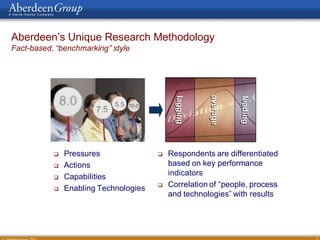
Aberdeen’s Unique Research Methodology
Fact-based, “benchmarking” style


                                                       average
                                             lagging


                                                                 leading
              Pressures                  Respondents are differentiated
              Actions                     based on key performance
              Capabilities                indicators
              Enabling Technologies      Correlation of “people, process
                                           and technologies” with results


                                                                             4
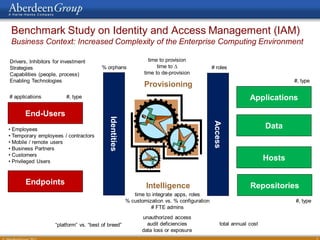
Benchmark Study on Identity and Access Management (IAM)
 Business Context: Increased Complexity of the Enterprise Computing Environment

Drivers, Inhibitors for investment                                time to provision
Strategies                               % orphans                    time to ∆                # roles
Capabilities (people, process)                                  time to de-provision
Enabling Technologies                                                                                                          #, type
                                                                Provisioning
# applications           #, type                                                                                Applications

       End-Users
                                            Identities


                                                                                               Access
• Employees                                                                                                            Data
• Temporary employees / contractors
• Mobile / remote users
• Business Partners
• Customers
• Privileged Users                                                                                                     Hosts


       Endpoints                                                 Intelligence                                   Repositories
                                                            time to integrate apps, roles
                                                         % customization vs. % configuration                                   #, type
                                                                   # FTE admins
                                                               unauthorized access
                    “platform” vs. “best of breed”               audit deficiencies                total annual cost
                                                               data loss or exposure
                                                                                                                                         5
Outline

 Introductions
 Business context

       End-users
       Endpoints
       Applications and data
       The cost complexity and compliance
 Aberdeen’s research findings
 Summary and recommendations

 Additional resources


                                             6
Business Context
Evolving End-User Populations
• The days of enterprise end-users being largely synonymous with internal employees are over


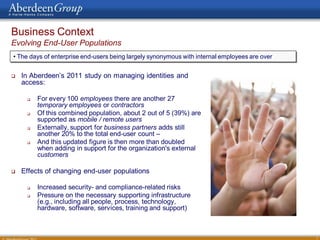
   In Aberdeen’s 2011 study on managing identities and
    access:

        For every 100 employees there are another 27
         temporary employees or contractors
        Of this combined population, about 2 out of 5 (39%) are
         supported as mobile / remote users
        Externally, support for business partners adds still
         another 20% to the total end-user count –
        And this updated figure is then more than doubled
         when adding in support for the organization's external
         customers

   Effects of changing end-user populations

        Increased security- and compliance-related risks
        Pressure on the necessary supporting infrastructure
         (e.g., including all people, process, technology,
         hardware, software, services, training and support)


                                                                                               7
Business Context
Evolving Endpoint Complexity
• Momentum behind greater diversity and complexity of the enterprise IT infrastructure continues to mount


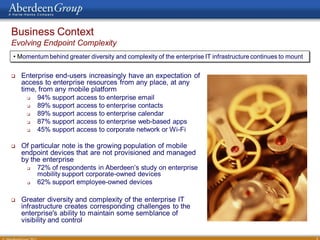
   Enterprise end-users increasingly have an expectation of
    access to enterprise resources from any place, at any
    time, from any mobile platform
        94% support access to enterprise email
        89% support access to enterprise contacts
        89% support access to enterprise calendar
        87% support access to enterprise web-based apps
        45% support access to corporate network or Wi-Fi

   Of particular note is the growing population of mobile
    endpoint devices that are not provisioned and managed
    by the enterprise
        72% of respondents in Aberdeen’s study on enterprise
         mobility support corporate-owned devices
        62% support employee-owned devices

   Greater diversity and complexity of the enterprise IT
    infrastructure creates corresponding challenges to the
    enterprise's ability to maintain some semblance of
    visibility and control

                                                                                                            8
Business Context
Evolving Characteristics of Enterprise Applications and Data
• Enterprise data is generally not created to be hidden away – it is generally created to be shared
• This naturally increases the need for the means to access enterprise resources, securely and reliably

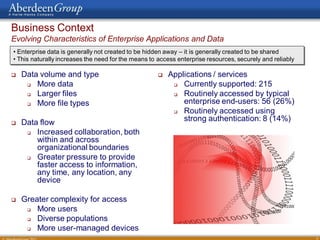
   Data volume and type                                Applications / services
       More data                                           Currently supported: 215
       Larger files                                        Routinely accessed by typical
       More file types                                      enterprise end-users: 56 (26%)
                                                            Routinely accessed using
   Data flow                                                strong authentication: 8 (14%)
       Increased collaboration, both
        within and across
        organizational boundaries
       Greater pressure to provide
        faster access to information,
        any time, any location, any
        device

   Greater complexity for access
       More users
       Diverse populations
       More user-managed devices
                                                                                                          9
Business Context
The cost of Complexity also amplifies the cost of Compliance
• In the context of their identity and access management initiatives, many organizations struggle with
implementing repeatable approaches to demonstrating compliance with regulatory requirements such as
attestation and separation of duties (SoD) … and this is consuming more and more of their IT budgets


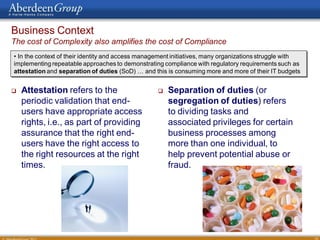
   Attestation refers to the                         Separation of duties (or
    periodic validation that end-                      segregation of duties) refers
    users have appropriate access                      to dividing tasks and
    rights, i.e., as part of providing                 associated privileges for certain
    assurance that the right end-                      business processes among
    users have the right access to                     more than one individual, to
    the right resources at the right                   help prevent potential abuse or
    times.                                             fraud.


                                                                                                         10
Outline

 Introductions
 Business context

 Aberdeen’s research findings

       Vendor-integrated “platform” approach
        vs. enterprise-integrated “point solution” approach
       Quantification of benefits
 Summary and recommendations
 Additional resources


                                                              11
Aberdeen’s Research Findings
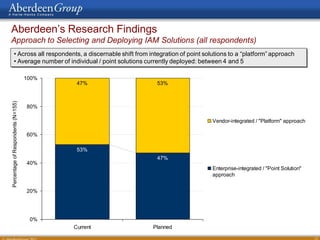
Approach to Selecting and Deploying IAM Solutions (all respondents)
        • Across all respondents, a discernable shift from integration of point solutions to a “platform” approach
        • Average number of individual / point solutions currently deployed: between 4 and 5

                                    100%
                                            47%               53%
Percentage of Respondents (N=155)


                                    80%

                                                                                   Vendor-integrated / "Platform" approach

                                    60%

                                            53%
                                                              47%
                                    40%
                                                                                   Enterprise-integrated / "Point Solution"
                                                                                   approach


                                    20%


                                     0%
                                           Current          Planned

                                                                                                                              12
Analysis
“Platform” vs. “Point Solution”

   Aberdeen’s research shows a discernable shift from
    enterprise self-integration of point solutions for IAM
    toward more of a vendor-integrated approach
        Some solution providers refer to this as an IAM "platform“
        Others emphasize vendor integration, but feel that the
         term "platform" implies a lack of flexibility and choice

   Aberdeen’s perspective
        Any approach that shifts the burden of integration from the
         enterprise to the solution provider is a welcome trend
        Analysis of organizations adopting each approach
         provides additional insights
             Platform approach (N=32)
             Point Solution approach (N=39)


                                                                       13
Summary of Findings
Analysis of Organizations Adopting “Platform” vs. “Point Solution” Approach to IAM
   Benefits                     Description and Derivation of Benefits                      Platform vs. Point
                                                                                                 Solution

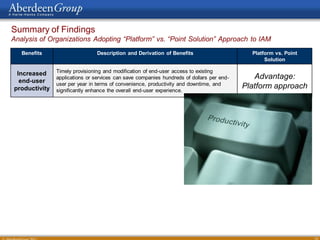
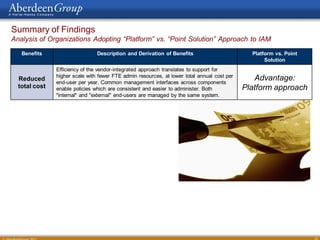
 Increased     Timely provisioning and modification of end-user access to existing
  end-user
               applications or services can save companies hundreds of dollars per end-      Advantage:
               user per year in terms of convenience, productivity and downtime, and
productivity   significantly enhance the overall end-user experience.
                                                                                          Platform approach


                                                                                                                 14
Summary of Findings
Analysis of Organizations Adopting “Platform” vs. “Point Solution” Approach to IAM
    Benefits                          Description and Derivation of Benefits                      Platform vs. Point
                                                                                                       Solution

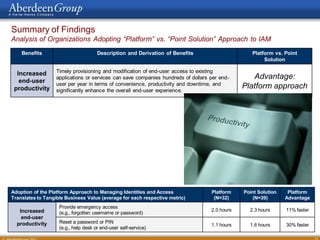
  Increased        Timely provisioning and modification of end-user access to existing
   end-user
                   applications or services can save companies hundreds of dollars per end-       Advantage:
                   user per year in terms of convenience, productivity and downtime, and
 productivity      significantly enhance the overall end-user experience.
                                                                                               Platform approach


Adoption of the Platform Approach to Managing Identities and Access                Platform    Point Solution    Platform
Translates to Tangible Business Value (average for each respective metric)          (N=32)         (N=39)       Advantage
                    Provide emergency access
   Increased                                                                       2.0 hours     2.3 hours      11% faster
                    (e.g., forgotten username or password)
    end-user
  productivity      Reset a password or PIN
                                                                                   1.1 hours     1.6 hours      30% faster
                    (e.g., help desk or end-user self-service)

                                                                                                                             15
Summary of Findings
Analysis of Organizations Adopting “Platform” vs. “Point Solution” Approach to IAM
   Benefits                    Description and Derivation of Benefits                         Platform vs. Point
                                                                                                   Solution
              Rapid de-provisioning of end-user access, on the other hand, is more about
              cost avoidance than it is about cost savings – e.g., by reducing the window
  Reduced     of vulnerability from orphaned accounts and minimizing the potential for         Advantage:
    risk      downstream misuse. Periodic attestation of access privileges and
              enforcement for separation of duties are also critical elements of reducing
                                                                                            Platform approach
              risk.


                                                                                                                   16
Summary of Findings
Analysis of Organizations Adopting “Platform” vs. “Point Solution” Approach to IAM
    Benefits                          Description and Derivation of Benefits                           Platform vs. Point
                                                                                                            Solution
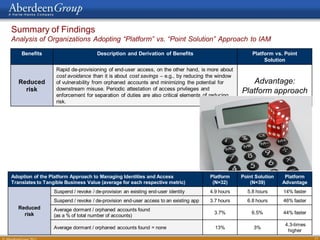
                   Rapid de-provisioning of end-user access, on the other hand, is more about
                   cost avoidance than it is about cost savings – e.g., by reducing the window
   Reduced         of vulnerability from orphaned accounts and minimizing the potential for           Advantage:
     risk          downstream misuse. Periodic attestation of access privileges and
                   enforcement for separation of duties are also critical elements of reducing
                                                                                                   Platform approach
                   risk.


Adoption of the Platform Approach to Managing Identities and Access                    Platform    Point Solution    Platform
Translates to Tangible Business Value (average for each respective metric)              (N=32)         (N=39)       Advantage
                  Suspend / revoke / de-provision an existing end-user identity        4.9 hours     5.8 hours      14% faster
                  Suspend / revoke / de-provision end-user access to an existing app   3.7 hours     6.8 hours      46% faster
   Reduced        Average dormant / orphaned accounts found
     risk                                                                               3.7%           6.5%         44% faster
                  (as a % of total number of accounts)
                                                                                                                     4.3-times
                  Average dormant / orphaned accounts found = none                       13%            3%
                                                                                                                      higher
                                                                                                                                 17
Summary of Findings
Analysis of Organizations Adopting “Platform” vs. “Point Solution” Approach to IAM
   Benefits                     Description and Derivation of Benefits                            Platform vs. Point
                                                                                                       Solution
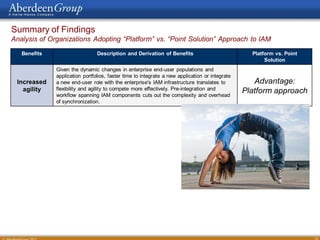
              Given the dynamic changes in enterprise end-user populations and
              application portfolios, faster time to integrate a new application or integrate
 Increased    a new end-user role with the enterprise's IAM infrastructure translates to           Advantage:
   agility    flexibility and agility to compete more effectively. Pre-integration and
              workflow spanning IAM components cuts out the complexity and overhead
                                                                                                Platform approach
              of synchronization.


                                                                                                                       18
Summary of Findings
Analysis of Organizations Adopting “Platform” vs. “Point Solution” Approach to IAM
    Benefits                         Description and Derivation of Benefits                             Platform vs. Point
                                                                                                             Solution
                   Given the dynamic changes in enterprise end-user populations and
                   application portfolios, faster time to integrate a new application or integrate
  Increased        a new end-user role with the enterprise's IAM infrastructure translates to           Advantage:
    agility        flexibility and agility to compete more effectively. Pre-integration and
                   workflow spanning IAM components cuts out the complexity and overhead
                                                                                                     Platform approach
                   of synchronization.


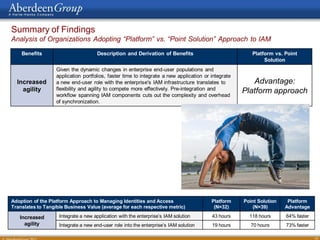
Adoption of the Platform Approach to Managing Identities and Access                      Platform    Point Solution    Platform
Translates to Tangible Business Value (average for each respective metric)                (N=32)         (N=39)       Advantage

   Increased        Integrate a new application with the enterprise’s IAM solution       43 hours      118 hours      64% faster
     agility        Integrate a new end-user role into the enterprise’s IAM solution     19 hours       70 hours      73% faster

                                                                                                                                   19
Summary of Findings
Analysis of Organizations Adopting “Platform” vs. “Point Solution” Approach to IAM

   Benefits                    Description and Derivation of Benefits                           Platform vs. Point
                                                                                                     Solution
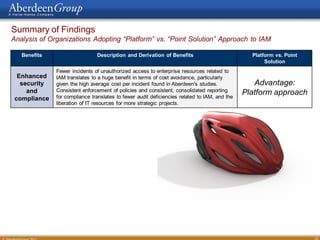
              Fewer incidents of unauthorized access to enterprise resources related to
  Enhanced    IAM translates to a huge benefit in terms of cost avoidance, particularly
   security   given the high average cost per incident found in Aberdeen's studies.              Advantage:
     and      Consistent enforcement of policies and consistent, consolidated reporting
              for compliance translates to fewer audit deficiencies related to IAM, and the
                                                                                              Platform approach
 compliance
              liberation of IT resources for more strategic projects.


                                                                                                                     20
Summary of Findings
Analysis of Organizations Adopting “Platform” vs. “Point Solution” Approach to IAM

    Benefits                         Description and Derivation of Benefits                           Platform vs. Point
                                                                                                           Solution
                   Fewer incidents of unauthorized access to enterprise resources related to
  Enhanced         IAM translates to a huge benefit in terms of cost avoidance, particularly
   security        given the high average cost per incident found in Aberdeen's studies.              Advantage:
     and           Consistent enforcement of policies and consistent, consolidated reporting
                   for compliance translates to fewer audit deficiencies related to IAM, and the
                                                                                                   Platform approach
 compliance
                   liberation of IT resources for more strategic projects.


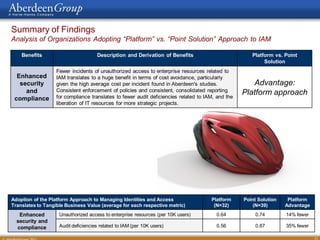
Adoption of the Platform Approach to Managing Identities and Access                   Platform     Point Solution    Platform
Translates to Tangible Business Value (average for each respective metric)             (N=32)          (N=39)       Advantage
   Enhanced         Unauthorized access to enterprise resources (per 10K users)         0.64           0.74         14% fewer
  security and
  compliance        Audit deficiencies related to IAM (per 10K users)                   0.56           0.87         35% fewer

                                                                                                                                21
Summary of Findings
Analysis of Organizations Adopting “Platform” vs. “Point Solution” Approach to IAM
   Benefits                     Description and Derivation of Benefits                         Platform vs. Point
                                                                                                    Solution
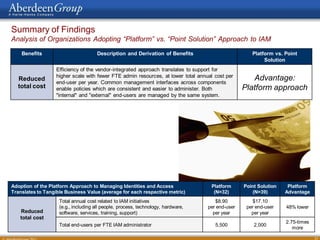
               Efficiency of the vendor-integrated approach translates to support for
               higher scale with fewer FTE admin resources, at lower total annual cost per
  Reduced
               end-user per year. Common management interfaces across components
                                                                                                Advantage:
  total cost   enable policies which are consistent and easier to administer. Both           Platform approach
               "internal" and "external" end-users are managed by the same system.


                                                                                                                    22
Summary of Findings
Analysis of Organizations Adopting “Platform” vs. “Point Solution” Approach to IAM
    Benefits                          Description and Derivation of Benefits                         Platform vs. Point
                                                                                                          Solution
                   Efficiency of the vendor-integrated approach translates to support for
                   higher scale with fewer FTE admin resources, at lower total annual cost per
  Reduced
                   end-user per year. Common management interfaces across components
                                                                                                     Advantage:
  total cost       enable policies which are consistent and easier to administer. Both            Platform approach
                   "internal" and "external" end-users are managed by the same system.


Adoption of the Platform Approach to Managing Identities and Access                 Platform      Point Solution    Platform
Translates to Tangible Business Value (average for each respective metric)           (N=32)           (N=39)       Advantage
                    Total annual cost related to IAM initiatives                      $8.90          $17.10
                    (e.g., including all people, process, technology, hardware,    per end-user    per end-user    48% lower
   Reduced          software, services, training, support)                           per year        per year
   total cost
                                                                                                                   2.75-times
                    Total end-users per FTE IAM administrator                         5,500           2,000
                                                                                                                      more

                                                                                                                                23
Summary of Findings
Analysis of Organizations Adopting “Platform” vs. “Point Solution” Approach to IAM
   Benefits                      Description and Derivation of Benefits                            Platform vs. Point
                                                                                                        Solution

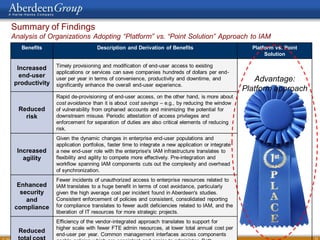
 Increased     Timely provisioning and modification of end-user access to existing
               applications or services can save companies hundreds of dollars per end-
  end-user
productivity
               user per year in terms of convenience, productivity and downtime, and                Advantage:
               significantly enhance the overall end-user experience.
                                                                                                 Platform approach
               Rapid de-provisioning of end-user access, on the other hand, is more about
               cost avoidance than it is about cost savings – e.g., by reducing the window
  Reduced      of vulnerability from orphaned accounts and minimizing the potential for
    risk       downstream misuse. Periodic attestation of access privileges and
               enforcement for separation of duties are also critical elements of reducing
               risk.
               Given the dynamic changes in enterprise end-user populations and
               application portfolios, faster time to integrate a new application or integrate
 Increased     a new end-user role with the enterprise's IAM infrastructure translates to
   agility     flexibility and agility to compete more effectively. Pre-integration and
               workflow spanning IAM components cuts out the complexity and overhead
               of synchronization.
               Fewer incidents of unauthorized access to enterprise resources related to
  Enhanced     IAM translates to a huge benefit in terms of cost avoidance, particularly
   security    given the high average cost per incident found in Aberdeen's studies.
     and       Consistent enforcement of policies and consistent, consolidated reporting
 compliance    for compliance translates to fewer audit deficiencies related to IAM, and the
               liberation of IT resources for more strategic projects.
               Efficiency of the vendor-integrated approach translates to support for
               higher scale with fewer FTE admin resources, at lower total annual cost per
  Reduced
               end-user per year. Common management interfaces across components
                                                                                                                        24
Details of Analysis
Adoption of the Platform Approach to IAM Translates to Tangible Business Value
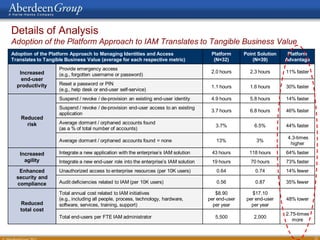
Adoption of the Platform Approach to Managing Identities and Access                     Platform      Point Solution    Platform
Translates to Tangible Business Value (average for each respective metric)               (N=32)           (N=39)       Advantage
                    Provide emergency access
   Increased                                                                            2.0 hours       2.3 hours      11% faster
                    (e.g., forgotten username or password)
    end-user
  productivity      Reset a password or PIN
                                                                                        1.1 hours       1.6 hours      30% faster
                    (e.g., help desk or end-user self-service)
                    Suspend / revoke / de-provision an existing end-user identity       4.9 hours       5.8 hours      14% faster
                    Suspend / revoke / de-provision end-user access to an existing
                                                                                        3.7 hours       6.8 hours      46% faster
                    application
    Reduced
      risk          Average dormant / orphaned accounts found
                                                                                          3.7%            6.5%         44% faster
                    (as a % of total number of accounts)
                                                                                                                        4.3-times
                    Average dormant / orphaned accounts found = none                      13%              3%
                                                                                                                         higher

   Increased        Integrate a new application with the enterprise’s IAM solution      43 hours        118 hours      64% faster
     agility        Integrate a new end-user role into the enterprise’s IAM solution    19 hours         70 hours      73% faster
   Enhanced         Unauthorized access to enterprise resources (per 10K users)           0.64            0.74         14% fewer
  security and
  compliance        Audit deficiencies related to IAM (per 10K users)                     0.56            0.87         35% fewer

                    Total annual cost related to IAM initiatives                          $8.90          $17.10
                    (e.g., including all people, process, technology, hardware,        per end-user    per end-user    48% lower
   Reduced          software, services, training, support)                               per year        per year
   total cost
                                                                                                                       2.75-times
                    Total end-users per FTE IAM administrator                             5,500           2,000
                                                                                                                          more


                                                                                                                                    25
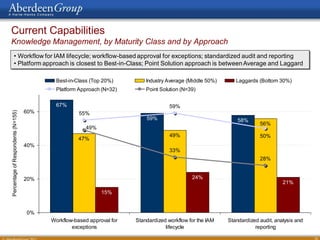
Current Capabilities
Knowledge Management, by Maturity Class and by Approach
         • Workflow for IAM lifecycle; workflow-based approval for exceptions; standardized audit and reporting
         • Platform approach is closest to Best-in-Class; Point Solution approach is between Average and Laggard

                                            Best-in-Class (Top 20%)         Industry Average (Middle 50%)      Laggards (Bottom 30%)
                                            Platform Approach (N=32)        Point Solution (N=39)

                                            67%                                       59%
                                    60%
Percentage of Respondents (N=155)


                                                     55%
                                                                            59%                                 58%
                                                                                                                         56%
                                                        49%
                                                                                      49%                                50%
                                                     47%
                                    40%
                                                                                      33%
                                                                                                                         28%


                                    20%                                                        24%
                                                                                                                                   21%
                                                              15%


                                    0%
                                          Workflow-based approval for   Standardized workflow for the IAM   Standardized audit, analysis and
                                                  exceptions                        lifecycle                          reporting

                                                                                                                                               26
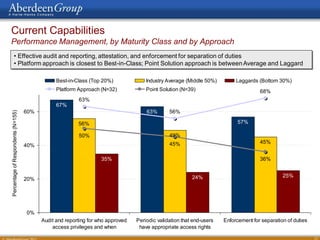
Current Capabilities
Performance Management, by Maturity Class and by Approach
         • Effective audit and reporting, attestation, and enforcement for separation of duties
         • Platform approach is closest to Best-in-Class; Point Solution approach is between Average and Laggard

                                                Best-in-Class (Top 20%)              Industry Average (Middle 50%)         Laggards (Bottom 30%)
                                                Platform Approach (N=32)             Point Solution (N=39)                           68%
                                                         63%
                                                67%
                                    60%                                              63%       56%
Percentage of Respondents (N=155)


                                                         56%                                                                57%

                                                         50%                                   49%
                                                                                               45%                                   45%
                                    40%

                                                                   35%                                                               36%


                                                                                                         24%                                   25%
                                    20%


                                    0%
                                          Audit and reporting for who approved   Periodic validation that end-users   Enforcement for separation of duties
                                              access privileges and when          have appropriate access rights

                                                                                                                                                             27
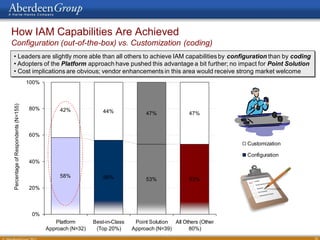
How IAM Capabilities Are Achieved
Configuration (out-of-the-box) vs. Customization (coding)
• Leaders are slightly more able than all others to achieve IAM capabilities by configuration than by coding
• Adopters of the Platform approach have pushed this advantage a bit further; no impact for Point Solution
• Cost implications are obvious; vendor enhancements in this area would receive strong market welcome
                                    100%
Percentage of Respondents (N=155)


                                    80%         42%              44%              47%               47%


                                    60%
                                                                                                                 Customization

                                                                                                                 Configuration
                                    40%

                                                58%              56%              53%               53%
                                    20%


                                     0%
                                              Platform       Best-in-Class    Point Solution All Others (Other
                                           Approach (N=32)    (Top 20%)      Approach (N=39)       80%)
                                                                                                                                 28
Outline

 Introductions
 Business context

 Aberdeen’s research findings

 Summary and recommendations

 Additional resources


                                 31
Summary

   Based on more a study of more than 160 respondents, Aberdeen's
    analysis of 32 enterprises which have adopted the vendor-integrated
    (Platform) approach to identity and access management, and 39
    organizations which have adopted the enterprise-integrated (Point
    Solution) approach, showed that the vendor-integrated approach
    correlates with the realization of significant advantages –
    including

        Increased end-user productivity
        Reduced risk
        Increased agility
        Enhanced security and compliance
        Reduced total cost.


                                                                          32
Recommendations
Crawl / Walk / Run (1 of 3)
• Aberdeen's research consistently confirms the merits of a pragmatic "Crawl, Walk, Run" approach as
the basic template for successful enterprise-wide initiatives


   Adopt a primary strategic focus. Which of the following strategies
    supports the most compelling business case for your organization's
    investments in IAM: convenience and productivity for end-users?
    Compliance and security requirements? Consistency of policies for
    managing identities and access to corporate resources? Cost savings and
    cost avoidance through greater efficiency and effectiveness? The essential
    first step is to identify the strategy that is most compelling for your
    organization to get started, and begin.

   Put someone in charge. Having a responsible executive or team with
    primary ownership for important enterprise-wide initiatives is consistently
    correlated with the achievement of top results. IAM initiatives are consistent
    with this pattern.

   Prioritize security control objectives as a function of requirements for
    risk, audit and compliance. Emphasizing security before compliance, rather
    than the other way around, reduces the probability of overlaps in controls
    (which waste resources) or gaps (which increase vulnerabilities).
                                                                                                       33
Recommendations
Crawl / Walk / Run (2 of 3)

   Establish consistent policies for end-user identities and end-user access
    to enterprise resources. As the expression of management's intent for the
    business, consistent policies are the foundation for any successful IAM
    initiative.

   Standardize the workflow for the IAM lifecycle, including workflow-based
    approval for exceptions. Standardization and automation of workflow should
    not mean automatic approval, however – on the contrary, increased
    involvement and accountability for approvals puts a greater responsibility on
    the business owners rather than on the IT staff.

   Standardize audit, analysis and reporting for IAM projects, including
    reporting for who approved access and when, periodic validation that end-
    users have appropriate access, and enforcement for separation of duties.
    Quarterly attestation reviews, for example, are common to address
    requirements for regulatory compliance.


                                                                                    34
Recommendations
Crawl / Walk / Run (3 of 3)

   Evaluate and select IAM solutions. Pay special attention to the level of
    integration and intelligence provided by the IAM solution provider(s), versus
    the degree of integration that remains to be completed by the enterprise.
    Another critical consideration is the proportion of capabilities that can be
    achieved by configuration (i.e., out-of-the-box) versus customization (i.e.,
    coding and services). Proposals which are disproportionately heavy with
    professional services from vendors or their third-party business partners do
    not move a given solution from the enterprise-integrated category to the
    vendor-integrated category.


                                                                                    35
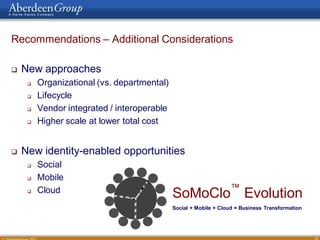
Recommendations – Additional Considerations

   New approaches
        Organizational (vs. departmental)
        Lifecycle
        Vendor integrated / interoperable
        Higher scale at lower total cost


   New identity-enabled opportunities
                     DEVRE ER STHGIR LLA puo rG need rebA 1102 ©
                          S


        Social
        Mobile
         Cloud                                                                                    ™
     
                                                                   DU OLC   SoMoClo Evolution
                                                                            Social + Mobile + Cloud = Business Transformation


                                                                                                                                36
Outline

 Introductions
 Business context

 Aberdeen’s research findings

 Summary and recommendations

 Additional resources


                                 37
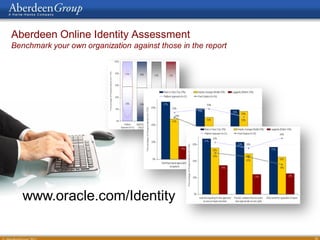
Aberdeen Online Identity Assessment
Benchmark your own organization against those in the report


   www.oracle.com/Identity

                                                              38

Aberdeen ppt-iam integrated-db-06 20120412

  • 1.
    IAM Integrated Analyzingthe “Platform” versus “Point Solution” Approach Spring 2012 Derek E. Brink, BS, MBA, CISSP Vice President & Research Fellow, IT Security / IT GRC Derek.Brink@aberdeen.com
  • 2.
    Outline  Introductions  Myself  Research methodology  Benchmark study on IAM  Business context  Aberdeen’s research findings  Summary and recommendations  Additional resources 2
  • 3.
    Introductions Derek E. Brink,CISSP – www.linkedin.com/in/derekbrink  VP & Research Fellow covering topics in IT Security and IT GRC at Aberdeen Group, a Harte-Hanks Company  I help organizations to improve their security and compliance initiatives by researching, writing about and speaking about the people, processes and technologies that correspond most strongly with the top performers  Adjunct Professor in Graduate Professional Studies at Brandeis University  I help individuals to improve their critical thinking, leadership skills and communication skills by teaching graduate courses in information assurance  Senior high-tech executive experienced in strategy development and execution, corporate / business development, product management and product marketing  RSA Security, IBM, Gradient, Sun Microsystems, Hewlett-Packard  MBA – Harvard Business School  BS Applied Mathematics – Rochester Institute of Technology 3
  • 4.
    Aberdeen’s Unique ResearchMethodology Fact-based, “benchmarking” style average lagging leading  Pressures  Respondents are differentiated  Actions based on key performance  Capabilities indicators  Enabling Technologies  Correlation of “people, process and technologies” with results 4
  • 5.
    Benchmark Study onIdentity and Access Management (IAM) Business Context: Increased Complexity of the Enterprise Computing Environment Drivers, Inhibitors for investment time to provision Strategies % orphans time to ∆ # roles Capabilities (people, process) time to de-provision Enabling Technologies #, type Provisioning # applications #, type Applications End-Users Identities Access • Employees Data • Temporary employees / contractors • Mobile / remote users • Business Partners • Customers • Privileged Users Hosts Endpoints Intelligence Repositories time to integrate apps, roles % customization vs. % configuration #, type # FTE admins unauthorized access “platform” vs. “best of breed” audit deficiencies total annual cost data loss or exposure 5
  • 6.
    Outline  Introductions  Businesscontext  End-users  Endpoints  Applications and data  The cost complexity and compliance  Aberdeen’s research findings  Summary and recommendations  Additional resources 6
  • 7.
    Business Context Evolving End-UserPopulations • The days of enterprise end-users being largely synonymous with internal employees are over  In Aberdeen’s 2011 study on managing identities and access:  For every 100 employees there are another 27 temporary employees or contractors  Of this combined population, about 2 out of 5 (39%) are supported as mobile / remote users  Externally, support for business partners adds still another 20% to the total end-user count –  And this updated figure is then more than doubled when adding in support for the organization's external customers  Effects of changing end-user populations  Increased security- and compliance-related risks  Pressure on the necessary supporting infrastructure (e.g., including all people, process, technology, hardware, software, services, training and support) 7
  • 8.
    Business Context Evolving EndpointComplexity • Momentum behind greater diversity and complexity of the enterprise IT infrastructure continues to mount  Enterprise end-users increasingly have an expectation of access to enterprise resources from any place, at any time, from any mobile platform  94% support access to enterprise email  89% support access to enterprise contacts  89% support access to enterprise calendar  87% support access to enterprise web-based apps  45% support access to corporate network or Wi-Fi  Of particular note is the growing population of mobile endpoint devices that are not provisioned and managed by the enterprise  72% of respondents in Aberdeen’s study on enterprise mobility support corporate-owned devices  62% support employee-owned devices  Greater diversity and complexity of the enterprise IT infrastructure creates corresponding challenges to the enterprise's ability to maintain some semblance of visibility and control 8
  • 9.
    Business Context Evolving Characteristicsof Enterprise Applications and Data • Enterprise data is generally not created to be hidden away – it is generally created to be shared • This naturally increases the need for the means to access enterprise resources, securely and reliably  Data volume and type  Applications / services  More data  Currently supported: 215  Larger files  Routinely accessed by typical  More file types enterprise end-users: 56 (26%)  Routinely accessed using  Data flow strong authentication: 8 (14%)  Increased collaboration, both within and across organizational boundaries  Greater pressure to provide faster access to information, any time, any location, any device  Greater complexity for access  More users  Diverse populations  More user-managed devices 9
  • 10.
    Business Context The costof Complexity also amplifies the cost of Compliance • In the context of their identity and access management initiatives, many organizations struggle with implementing repeatable approaches to demonstrating compliance with regulatory requirements such as attestation and separation of duties (SoD) … and this is consuming more and more of their IT budgets  Attestation refers to the  Separation of duties (or periodic validation that end- segregation of duties) refers users have appropriate access to dividing tasks and rights, i.e., as part of providing associated privileges for certain assurance that the right end- business processes among users have the right access to more than one individual, to the right resources at the right help prevent potential abuse or times. fraud. 10
  • 11.
    Outline  Introductions  Businesscontext  Aberdeen’s research findings  Vendor-integrated “platform” approach vs. enterprise-integrated “point solution” approach  Quantification of benefits  Summary and recommendations  Additional resources 11
  • 12.
    Aberdeen’s Research Findings Approachto Selecting and Deploying IAM Solutions (all respondents) • Across all respondents, a discernable shift from integration of point solutions to a “platform” approach • Average number of individual / point solutions currently deployed: between 4 and 5 100% 47% 53% Percentage of Respondents (N=155) 80% Vendor-integrated / "Platform" approach 60% 53% 47% 40% Enterprise-integrated / "Point Solution" approach 20% 0% Current Planned 12
  • 13.
    Analysis “Platform” vs. “PointSolution”  Aberdeen’s research shows a discernable shift from enterprise self-integration of point solutions for IAM toward more of a vendor-integrated approach  Some solution providers refer to this as an IAM "platform“  Others emphasize vendor integration, but feel that the term "platform" implies a lack of flexibility and choice  Aberdeen’s perspective  Any approach that shifts the burden of integration from the enterprise to the solution provider is a welcome trend  Analysis of organizations adopting each approach provides additional insights  Platform approach (N=32)  Point Solution approach (N=39) 13
  • 14.
    Summary of Findings Analysisof Organizations Adopting “Platform” vs. “Point Solution” Approach to IAM Benefits Description and Derivation of Benefits Platform vs. Point Solution Increased Timely provisioning and modification of end-user access to existing end-user applications or services can save companies hundreds of dollars per end- Advantage: user per year in terms of convenience, productivity and downtime, and productivity significantly enhance the overall end-user experience. Platform approach 14
  • 15.
    Summary of Findings Analysisof Organizations Adopting “Platform” vs. “Point Solution” Approach to IAM Benefits Description and Derivation of Benefits Platform vs. Point Solution Increased Timely provisioning and modification of end-user access to existing end-user applications or services can save companies hundreds of dollars per end- Advantage: user per year in terms of convenience, productivity and downtime, and productivity significantly enhance the overall end-user experience. Platform approach Adoption of the Platform Approach to Managing Identities and Access Platform Point Solution Platform Translates to Tangible Business Value (average for each respective metric) (N=32) (N=39) Advantage Provide emergency access Increased 2.0 hours 2.3 hours 11% faster (e.g., forgotten username or password) end-user productivity Reset a password or PIN 1.1 hours 1.6 hours 30% faster (e.g., help desk or end-user self-service) 15
  • 16.
    Summary of Findings Analysisof Organizations Adopting “Platform” vs. “Point Solution” Approach to IAM Benefits Description and Derivation of Benefits Platform vs. Point Solution Rapid de-provisioning of end-user access, on the other hand, is more about cost avoidance than it is about cost savings – e.g., by reducing the window Reduced of vulnerability from orphaned accounts and minimizing the potential for Advantage: risk downstream misuse. Periodic attestation of access privileges and enforcement for separation of duties are also critical elements of reducing Platform approach risk. 16
  • 17.
    Summary of Findings Analysisof Organizations Adopting “Platform” vs. “Point Solution” Approach to IAM Benefits Description and Derivation of Benefits Platform vs. Point Solution Rapid de-provisioning of end-user access, on the other hand, is more about cost avoidance than it is about cost savings – e.g., by reducing the window Reduced of vulnerability from orphaned accounts and minimizing the potential for Advantage: risk downstream misuse. Periodic attestation of access privileges and enforcement for separation of duties are also critical elements of reducing Platform approach risk. Adoption of the Platform Approach to Managing Identities and Access Platform Point Solution Platform Translates to Tangible Business Value (average for each respective metric) (N=32) (N=39) Advantage Suspend / revoke / de-provision an existing end-user identity 4.9 hours 5.8 hours 14% faster Suspend / revoke / de-provision end-user access to an existing app 3.7 hours 6.8 hours 46% faster Reduced Average dormant / orphaned accounts found risk 3.7% 6.5% 44% faster (as a % of total number of accounts) 4.3-times Average dormant / orphaned accounts found = none 13% 3% higher 17
  • 18.
    Summary of Findings Analysisof Organizations Adopting “Platform” vs. “Point Solution” Approach to IAM Benefits Description and Derivation of Benefits Platform vs. Point Solution Given the dynamic changes in enterprise end-user populations and application portfolios, faster time to integrate a new application or integrate Increased a new end-user role with the enterprise's IAM infrastructure translates to Advantage: agility flexibility and agility to compete more effectively. Pre-integration and workflow spanning IAM components cuts out the complexity and overhead Platform approach of synchronization. 18
  • 19.
    Summary of Findings Analysisof Organizations Adopting “Platform” vs. “Point Solution” Approach to IAM Benefits Description and Derivation of Benefits Platform vs. Point Solution Given the dynamic changes in enterprise end-user populations and application portfolios, faster time to integrate a new application or integrate Increased a new end-user role with the enterprise's IAM infrastructure translates to Advantage: agility flexibility and agility to compete more effectively. Pre-integration and workflow spanning IAM components cuts out the complexity and overhead Platform approach of synchronization. Adoption of the Platform Approach to Managing Identities and Access Platform Point Solution Platform Translates to Tangible Business Value (average for each respective metric) (N=32) (N=39) Advantage Increased Integrate a new application with the enterprise’s IAM solution 43 hours 118 hours 64% faster agility Integrate a new end-user role into the enterprise’s IAM solution 19 hours 70 hours 73% faster 19
  • 20.
    Summary of Findings Analysisof Organizations Adopting “Platform” vs. “Point Solution” Approach to IAM Benefits Description and Derivation of Benefits Platform vs. Point Solution Fewer incidents of unauthorized access to enterprise resources related to Enhanced IAM translates to a huge benefit in terms of cost avoidance, particularly security given the high average cost per incident found in Aberdeen's studies. Advantage: and Consistent enforcement of policies and consistent, consolidated reporting for compliance translates to fewer audit deficiencies related to IAM, and the Platform approach compliance liberation of IT resources for more strategic projects. 20
  • 21.
    Summary of Findings Analysisof Organizations Adopting “Platform” vs. “Point Solution” Approach to IAM Benefits Description and Derivation of Benefits Platform vs. Point Solution Fewer incidents of unauthorized access to enterprise resources related to Enhanced IAM translates to a huge benefit in terms of cost avoidance, particularly security given the high average cost per incident found in Aberdeen's studies. Advantage: and Consistent enforcement of policies and consistent, consolidated reporting for compliance translates to fewer audit deficiencies related to IAM, and the Platform approach compliance liberation of IT resources for more strategic projects. Adoption of the Platform Approach to Managing Identities and Access Platform Point Solution Platform Translates to Tangible Business Value (average for each respective metric) (N=32) (N=39) Advantage Enhanced Unauthorized access to enterprise resources (per 10K users) 0.64 0.74 14% fewer security and compliance Audit deficiencies related to IAM (per 10K users) 0.56 0.87 35% fewer 21
  • 22.
    Summary of Findings Analysisof Organizations Adopting “Platform” vs. “Point Solution” Approach to IAM Benefits Description and Derivation of Benefits Platform vs. Point Solution Efficiency of the vendor-integrated approach translates to support for higher scale with fewer FTE admin resources, at lower total annual cost per Reduced end-user per year. Common management interfaces across components Advantage: total cost enable policies which are consistent and easier to administer. Both Platform approach "internal" and "external" end-users are managed by the same system. 22
  • 23.
    Summary of Findings Analysisof Organizations Adopting “Platform” vs. “Point Solution” Approach to IAM Benefits Description and Derivation of Benefits Platform vs. Point Solution Efficiency of the vendor-integrated approach translates to support for higher scale with fewer FTE admin resources, at lower total annual cost per Reduced end-user per year. Common management interfaces across components Advantage: total cost enable policies which are consistent and easier to administer. Both Platform approach "internal" and "external" end-users are managed by the same system. Adoption of the Platform Approach to Managing Identities and Access Platform Point Solution Platform Translates to Tangible Business Value (average for each respective metric) (N=32) (N=39) Advantage Total annual cost related to IAM initiatives $8.90 $17.10 (e.g., including all people, process, technology, hardware, per end-user per end-user 48% lower Reduced software, services, training, support) per year per year total cost 2.75-times Total end-users per FTE IAM administrator 5,500 2,000 more 23
  • 24.
    Summary of Findings Analysisof Organizations Adopting “Platform” vs. “Point Solution” Approach to IAM Benefits Description and Derivation of Benefits Platform vs. Point Solution Increased Timely provisioning and modification of end-user access to existing applications or services can save companies hundreds of dollars per end- end-user productivity user per year in terms of convenience, productivity and downtime, and Advantage: significantly enhance the overall end-user experience. Platform approach Rapid de-provisioning of end-user access, on the other hand, is more about cost avoidance than it is about cost savings – e.g., by reducing the window Reduced of vulnerability from orphaned accounts and minimizing the potential for risk downstream misuse. Periodic attestation of access privileges and enforcement for separation of duties are also critical elements of reducing risk. Given the dynamic changes in enterprise end-user populations and application portfolios, faster time to integrate a new application or integrate Increased a new end-user role with the enterprise's IAM infrastructure translates to agility flexibility and agility to compete more effectively. Pre-integration and workflow spanning IAM components cuts out the complexity and overhead of synchronization. Fewer incidents of unauthorized access to enterprise resources related to Enhanced IAM translates to a huge benefit in terms of cost avoidance, particularly security given the high average cost per incident found in Aberdeen's studies. and Consistent enforcement of policies and consistent, consolidated reporting compliance for compliance translates to fewer audit deficiencies related to IAM, and the liberation of IT resources for more strategic projects. Efficiency of the vendor-integrated approach translates to support for higher scale with fewer FTE admin resources, at lower total annual cost per Reduced end-user per year. Common management interfaces across components 24
  • 25.
    Details of Analysis Adoptionof the Platform Approach to IAM Translates to Tangible Business Value Adoption of the Platform Approach to Managing Identities and Access Platform Point Solution Platform Translates to Tangible Business Value (average for each respective metric) (N=32) (N=39) Advantage Provide emergency access Increased 2.0 hours 2.3 hours 11% faster (e.g., forgotten username or password) end-user productivity Reset a password or PIN 1.1 hours 1.6 hours 30% faster (e.g., help desk or end-user self-service) Suspend / revoke / de-provision an existing end-user identity 4.9 hours 5.8 hours 14% faster Suspend / revoke / de-provision end-user access to an existing 3.7 hours 6.8 hours 46% faster application Reduced risk Average dormant / orphaned accounts found 3.7% 6.5% 44% faster (as a % of total number of accounts) 4.3-times Average dormant / orphaned accounts found = none 13% 3% higher Increased Integrate a new application with the enterprise’s IAM solution 43 hours 118 hours 64% faster agility Integrate a new end-user role into the enterprise’s IAM solution 19 hours 70 hours 73% faster Enhanced Unauthorized access to enterprise resources (per 10K users) 0.64 0.74 14% fewer security and compliance Audit deficiencies related to IAM (per 10K users) 0.56 0.87 35% fewer Total annual cost related to IAM initiatives $8.90 $17.10 (e.g., including all people, process, technology, hardware, per end-user per end-user 48% lower Reduced software, services, training, support) per year per year total cost 2.75-times Total end-users per FTE IAM administrator 5,500 2,000 more 25
  • 26.
    Current Capabilities Knowledge Management,by Maturity Class and by Approach • Workflow for IAM lifecycle; workflow-based approval for exceptions; standardized audit and reporting • Platform approach is closest to Best-in-Class; Point Solution approach is between Average and Laggard Best-in-Class (Top 20%) Industry Average (Middle 50%) Laggards (Bottom 30%) Platform Approach (N=32) Point Solution (N=39) 67% 59% 60% Percentage of Respondents (N=155) 55% 59% 58% 56% 49% 49% 50% 47% 40% 33% 28% 20% 24% 21% 15% 0% Workflow-based approval for Standardized workflow for the IAM Standardized audit, analysis and exceptions lifecycle reporting 26
  • 27.
    Current Capabilities Performance Management,by Maturity Class and by Approach • Effective audit and reporting, attestation, and enforcement for separation of duties • Platform approach is closest to Best-in-Class; Point Solution approach is between Average and Laggard Best-in-Class (Top 20%) Industry Average (Middle 50%) Laggards (Bottom 30%) Platform Approach (N=32) Point Solution (N=39) 68% 63% 67% 60% 63% 56% Percentage of Respondents (N=155) 56% 57% 50% 49% 45% 45% 40% 35% 36% 24% 25% 20% 0% Audit and reporting for who approved Periodic validation that end-users Enforcement for separation of duties access privileges and when have appropriate access rights 27
  • 28.
    How IAM CapabilitiesAre Achieved Configuration (out-of-the-box) vs. Customization (coding) • Leaders are slightly more able than all others to achieve IAM capabilities by configuration than by coding • Adopters of the Platform approach have pushed this advantage a bit further; no impact for Point Solution • Cost implications are obvious; vendor enhancements in this area would receive strong market welcome 100% Percentage of Respondents (N=155) 80% 42% 44% 47% 47% 60% Customization Configuration 40% 58% 56% 53% 53% 20% 0% Platform Best-in-Class Point Solution All Others (Other Approach (N=32) (Top 20%) Approach (N=39) 80%) 28
  • 29.
    Outline  Introductions  Businesscontext  Aberdeen’s research findings  Summary and recommendations  Additional resources 31
  • 30.
    Summary  Based on more a study of more than 160 respondents, Aberdeen's analysis of 32 enterprises which have adopted the vendor-integrated (Platform) approach to identity and access management, and 39 organizations which have adopted the enterprise-integrated (Point Solution) approach, showed that the vendor-integrated approach correlates with the realization of significant advantages – including  Increased end-user productivity  Reduced risk  Increased agility  Enhanced security and compliance  Reduced total cost. 32
  • 31.
    Recommendations Crawl / Walk/ Run (1 of 3) • Aberdeen's research consistently confirms the merits of a pragmatic "Crawl, Walk, Run" approach as the basic template for successful enterprise-wide initiatives  Adopt a primary strategic focus. Which of the following strategies supports the most compelling business case for your organization's investments in IAM: convenience and productivity for end-users? Compliance and security requirements? Consistency of policies for managing identities and access to corporate resources? Cost savings and cost avoidance through greater efficiency and effectiveness? The essential first step is to identify the strategy that is most compelling for your organization to get started, and begin.  Put someone in charge. Having a responsible executive or team with primary ownership for important enterprise-wide initiatives is consistently correlated with the achievement of top results. IAM initiatives are consistent with this pattern.  Prioritize security control objectives as a function of requirements for risk, audit and compliance. Emphasizing security before compliance, rather than the other way around, reduces the probability of overlaps in controls (which waste resources) or gaps (which increase vulnerabilities). 33
  • 32.
    Recommendations Crawl / Walk/ Run (2 of 3)  Establish consistent policies for end-user identities and end-user access to enterprise resources. As the expression of management's intent for the business, consistent policies are the foundation for any successful IAM initiative.  Standardize the workflow for the IAM lifecycle, including workflow-based approval for exceptions. Standardization and automation of workflow should not mean automatic approval, however – on the contrary, increased involvement and accountability for approvals puts a greater responsibility on the business owners rather than on the IT staff.  Standardize audit, analysis and reporting for IAM projects, including reporting for who approved access and when, periodic validation that end- users have appropriate access, and enforcement for separation of duties. Quarterly attestation reviews, for example, are common to address requirements for regulatory compliance. 34
  • 33.
    Recommendations Crawl / Walk/ Run (3 of 3)  Evaluate and select IAM solutions. Pay special attention to the level of integration and intelligence provided by the IAM solution provider(s), versus the degree of integration that remains to be completed by the enterprise. Another critical consideration is the proportion of capabilities that can be achieved by configuration (i.e., out-of-the-box) versus customization (i.e., coding and services). Proposals which are disproportionately heavy with professional services from vendors or their third-party business partners do not move a given solution from the enterprise-integrated category to the vendor-integrated category. 35
  • 34.
    Recommendations – AdditionalConsiderations  New approaches  Organizational (vs. departmental)  Lifecycle  Vendor integrated / interoperable  Higher scale at lower total cost  New identity-enabled opportunities DEVRE ER STHGIR LLA puo rG need rebA 1102 © S  Social  Mobile Cloud ™  DU OLC SoMoClo Evolution Social + Mobile + Cloud = Business Transformation 36
  • 35.
    Outline  Introductions  Businesscontext  Aberdeen’s research findings  Summary and recommendations  Additional resources 37
  • 36.
    Aberdeen Online IdentityAssessment Benchmark your own organization against those in the report www.oracle.com/Identity 38