

Critical thinking leaders as
Rational Manager
Kepner-Tregoe:
A systematic problem solving
& decision making method
Inspired by : The New Rational Manager by Charles H. Kepner & Benjamin B. Tregoe
A critical thinking leader is a rational manager
As leaders, you often face some of the following critical
moments either as a routine or isolated cases:
1.Troubleshooting a major operations glitch
2.Solving a major IT system interruption or outage
3.Identifying technical glitch for a manufacturing
equipment problem
4.Deciding to increase the capacity of a distribution centre
5.Selecting to hire a new employee
Leaders equipped with rational process will arrive at the core issue to identify
problems , and thereafter, applies critical thinking with problem solving techniques
to finding solutions and make decisions
Linking Critical Thinking Leaders to
Rational Manager
Definition from Kepner-Tregoe for a rational manager is about leading
rational processes to maximize the critical thinking skills of people. They are
easily learned and applicable at all levels within an organization, from the IT
professional to the CEO. Rational processes provide organized ways of
applying critical thinking skills to an issue. They constitute an explicit, logical
system that can have a far-reaching impact (Lemieux,2009, December 17).
The Kepner-Tregoe Tool
A systematic critical thinking
approach to rational decision
making for managers
Think of a Problem
One existing problem you are currently
experiencing in your job
or the one experienced in the past.
Write it down.
Overview of The
Kepner-Tregoe Tool
• Situation Analysis
• Problem Analysis
• Decision Analysis
• Potential Problem (Opportunity) Analysis
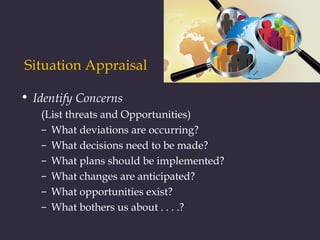
Situation Appraisal
• Identify Concerns
(List threats and Opportunities)
– What deviations are occurring?
– What decisions need to be made?
– What plans should be implemented?
– What changes are anticipated?
– What opportunities exist?
– What bothers us about . . . .?
Situation Appraisal
• Separate and Clarify Concerns
– What do we mean by . . . ?
– What exactly is . . . ?
– What else concerns us about . . . ?
– What evidence do we have . . . ?
– What different deviations,
decisions, or plans are part of this
concern?
Situation Appraisal
• Set Priority
– Which concern should we work on
first?
– Consider . . .
 . . . the current impact
• What is the current impact on
people, safety, cost,
customers/stakeholders,
productivity, reputation, etc?
• What evidence do you have?
• Which concern is most serious?
Situation Appraisal
• Set Priority
– Consider . . .
 . . . the future impact
• If left unresolved, how and when
will the seriousness change?
• What evidence do you have?
• Which concern is getting worse
quicker?
Situation Appraisal
• Set Priority
– Consider . . .
 . . . the time frame
• What is the deadline? When do we
need to start?
• When would resolution become
difficult, expensive, impossible, or
meaningless?
• What evidence do you have?
• Which concern will be the hardest to
resolve later?
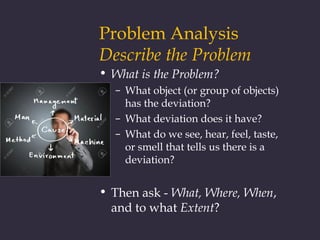
Problem Analysis
Describe the Problem
• What is the Problem?
– What object (or group of objects)
has the deviation?
– What deviation does it have?
– What do we see, hear, feel, taste,
or smell that tells us there is a
deviation?
• Then ask - What, Where, When,
and to what Extent?
Problem Analysis
Identify Possible Causes
• Use knowledge and experience to develop
possible cause statements
• From experience, what could have caused
the deviation?
• Use distinctions and changes to develop
possible cause statements
• What is different, odd, special, or unique
about an IS compared to an IS NOT?
• What was changed in, on, around, or about
each distinction?
• When did the change occur?
• How could each change have caused this
deviation?
Problem Analysis
Evaluate Possible Causes
• Test possible causes against the IS
and IS NOT specification
• If _______ is the true cause of
________, how does it explain both
the IS and IS NOT information?
• What assumptions have to be made?
• Determine the most probable
cause
• Which possible cause best explains
the IS and IS NOT information?
• Which possible cause has the fewest,
simplest, and most reasonable
assumptions?
Problem Analysis
Confirm True Cause
• What can be done to verify any
assumptions made?
• How can this cause be observed at
work?
• How can we demonstrate the cause-
and-effect relationship?
• When corrective action is taken,
how will results be checked?
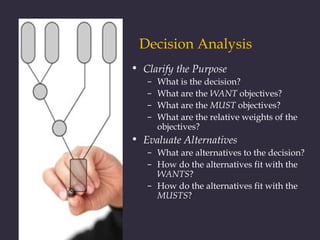
Decision Analysis
• Clarify the Purpose
– What is the decision?
– What are the WANT objectives?
– What are the MUST objectives?
– What are the relative weights of the
objectives?
• Evaluate Alternatives
– What are alternatives to the decision?
– How do the alternatives fit with the
WANTS?
– How do the alternatives fit with the
MUSTS?
Decision Analysis
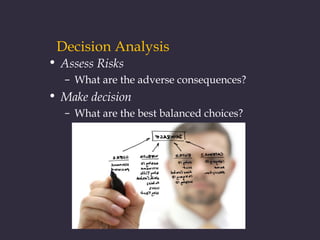
• Assess Risks
– What are the adverse consequences?
• Make decision
– What are the best balanced choices?
Planning the Next Steps
• Potential Problem
(Opportunity)
Analysis
• Do we have an
Action or Plan to
protect (enhance)?
Potential Problem
(Opportunity) Analysis
• Identify Potential Problems
(Opportunities)
– What are the potential actions?
– What are the potential problems?
– What are the potential opportunities?
• Identify Likely Causes
– What are the possible causes for the
potential problem?
– What are the possible causes for the
potential opportunity?
Potential Problem
(Opportunity) Analysis
• Take Preventative (Promoting) Action
– What actions do we need to take to
address (encourage) likely causes?
• Plan Contingent (Capitalizing) Action
and Set Triggers
– What actions do we need to prepare to
reduce (enhance) likely effects?
– What triggers do we need to set for
contingent (capitalizing) actions?
Reference
Lemieux, R. (2009, December 17). 5-Step Problem Management with Kepner-Tregoe. DITY Weekly
Newsletter, 5(49). Retrieved from
http://www.itsmsolutions.com/newsletters/DITYvol5iss49.pdf/newsletters/DITYvol5iss49.pdf/
Image sources adapted with credits to:
http://www.isasaschoolfinder.co.za/info/wp-content/uploads/2015/08/project-manager-meeting-organization.jpg
http://www.careerealism.com/wp-content/uploads/2014/06/great-manager-secret.jpg
http://images.huffingtonpost.com/2014-07-15-patientphotoropter.jpg
https://ticketleap-media-master.s3.amazonaws.com/9aecae1e-c852-4991-a2ad-0f0dcebb1a6b/hero.jpg
http://www.attacat.co.uk/wp-content/uploads/2015/12/cookie-tool.png?f7e2d7
http://www.unfpa.org/sites/default/files/featured-publication/PSAslide1_0711.jpg
http://www.kepner-tregoe.com/default/assets/Image/blog/KT%20Situation%20Appraisal.jpg
http://www.akungo.com/images/blog/5-steps-to-handling-your-appraisal.jpg
http://recservices.usask.ca/images/pages/forms-index
http://www.learntotradebinaryoptions.net/wp-content/uploads/2015/01/binary-options-timeframes.jpg
http://mixhe1c9e7n3czs8519ugw61.wpengine.netdna-cdn.com/wp-content/uploads/2012/08/Decision_Tree.jpg
http://www.eoi.es/blogs/patriciaperez/files/2012/01/Project-Management-Blog-Image-2.jpg
http://www.oklahomamoneymatters.org/Images/choose_a_path.jpg
http://marcestes.com/wp-content/uploads/2010/08/problem-solving1.jpg
http://www.quantummarketer.com/wp-content/uploads/2012/02/Questions.jpg
http://previews.123rf.com/images/dskdesign/dskdesign1204/dskdesign120400633/13241767-business-man-investigate-
and-analyze-cause-of-industrial-problem-from-man-machine-material-managemen-Stock-Photo.jpg
http://www.raac.nu/images/route-cause.png
http://www.czbaa.com/sites/default/files/field/image/forum_img/jie_ti_neng_li_01.jpg
http://www.onetouchpayroll.com/blog/wp-content/uploads/2013/02/increased-payroll-efficiency.jpg

Critical thinking leaders as rational manager

  • 1.
    Critical thinking leadersas Rational Manager Kepner-Tregoe: A systematic problem solving & decision making method Inspired by : The New Rational Manager by Charles H. Kepner & Benjamin B. Tregoe
  • 2.
    A critical thinkingleader is a rational manager As leaders, you often face some of the following critical moments either as a routine or isolated cases: 1.Troubleshooting a major operations glitch 2.Solving a major IT system interruption or outage 3.Identifying technical glitch for a manufacturing equipment problem 4.Deciding to increase the capacity of a distribution centre 5.Selecting to hire a new employee Leaders equipped with rational process will arrive at the core issue to identify problems , and thereafter, applies critical thinking with problem solving techniques to finding solutions and make decisions
  • 3.
    Linking Critical ThinkingLeaders to Rational Manager Definition from Kepner-Tregoe for a rational manager is about leading rational processes to maximize the critical thinking skills of people. They are easily learned and applicable at all levels within an organization, from the IT professional to the CEO. Rational processes provide organized ways of applying critical thinking skills to an issue. They constitute an explicit, logical system that can have a far-reaching impact (Lemieux,2009, December 17).
  • 4.
    The Kepner-Tregoe Tool Asystematic critical thinking approach to rational decision making for managers
  • 5.
    Think of aProblem One existing problem you are currently experiencing in your job or the one experienced in the past. Write it down.
  • 6.
    Overview of The Kepner-TregoeTool • Situation Analysis • Problem Analysis • Decision Analysis • Potential Problem (Opportunity) Analysis
  • 7.
    Situation Appraisal • IdentifyConcerns (List threats and Opportunities) – What deviations are occurring? – What decisions need to be made? – What plans should be implemented? – What changes are anticipated? – What opportunities exist? – What bothers us about . . . .?
  • 8.
    Situation Appraisal • Separateand Clarify Concerns – What do we mean by . . . ? – What exactly is . . . ? – What else concerns us about . . . ? – What evidence do we have . . . ? – What different deviations, decisions, or plans are part of this concern?
  • 9.
    Situation Appraisal • SetPriority – Which concern should we work on first? – Consider . . .  . . . the current impact • What is the current impact on people, safety, cost, customers/stakeholders, productivity, reputation, etc? • What evidence do you have? • Which concern is most serious?
  • 10.
    Situation Appraisal • SetPriority – Consider . . .  . . . the future impact • If left unresolved, how and when will the seriousness change? • What evidence do you have? • Which concern is getting worse quicker?
  • 11.
    Situation Appraisal • SetPriority – Consider . . .  . . . the time frame • What is the deadline? When do we need to start? • When would resolution become difficult, expensive, impossible, or meaningless? • What evidence do you have? • Which concern will be the hardest to resolve later?
  • 12.
    Problem Analysis Describe theProblem • What is the Problem? – What object (or group of objects) has the deviation? – What deviation does it have? – What do we see, hear, feel, taste, or smell that tells us there is a deviation? • Then ask - What, Where, When, and to what Extent?
  • 13.
    Problem Analysis Identify PossibleCauses • Use knowledge and experience to develop possible cause statements • From experience, what could have caused the deviation? • Use distinctions and changes to develop possible cause statements • What is different, odd, special, or unique about an IS compared to an IS NOT? • What was changed in, on, around, or about each distinction? • When did the change occur? • How could each change have caused this deviation?
  • 14.
    Problem Analysis Evaluate PossibleCauses • Test possible causes against the IS and IS NOT specification • If _______ is the true cause of ________, how does it explain both the IS and IS NOT information? • What assumptions have to be made? • Determine the most probable cause • Which possible cause best explains the IS and IS NOT information? • Which possible cause has the fewest, simplest, and most reasonable assumptions?
  • 15.
    Problem Analysis Confirm TrueCause • What can be done to verify any assumptions made? • How can this cause be observed at work? • How can we demonstrate the cause- and-effect relationship? • When corrective action is taken, how will results be checked?
  • 16.
    Decision Analysis • Clarifythe Purpose – What is the decision? – What are the WANT objectives? – What are the MUST objectives? – What are the relative weights of the objectives? • Evaluate Alternatives – What are alternatives to the decision? – How do the alternatives fit with the WANTS? – How do the alternatives fit with the MUSTS?
  • 17.
    Decision Analysis • AssessRisks – What are the adverse consequences? • Make decision – What are the best balanced choices?
  • 18.
    Planning the NextSteps • Potential Problem (Opportunity) Analysis • Do we have an Action or Plan to protect (enhance)?
  • 19.
    Potential Problem (Opportunity) Analysis •Identify Potential Problems (Opportunities) – What are the potential actions? – What are the potential problems? – What are the potential opportunities? • Identify Likely Causes – What are the possible causes for the potential problem? – What are the possible causes for the potential opportunity?
  • 20.
    Potential Problem (Opportunity) Analysis •Take Preventative (Promoting) Action – What actions do we need to take to address (encourage) likely causes? • Plan Contingent (Capitalizing) Action and Set Triggers – What actions do we need to prepare to reduce (enhance) likely effects? – What triggers do we need to set for contingent (capitalizing) actions?
  • 22.
    Reference Lemieux, R. (2009,December 17). 5-Step Problem Management with Kepner-Tregoe. DITY Weekly Newsletter, 5(49). Retrieved from http://www.itsmsolutions.com/newsletters/DITYvol5iss49.pdf/newsletters/DITYvol5iss49.pdf/ Image sources adapted with credits to: http://www.isasaschoolfinder.co.za/info/wp-content/uploads/2015/08/project-manager-meeting-organization.jpg http://www.careerealism.com/wp-content/uploads/2014/06/great-manager-secret.jpg http://images.huffingtonpost.com/2014-07-15-patientphotoropter.jpg https://ticketleap-media-master.s3.amazonaws.com/9aecae1e-c852-4991-a2ad-0f0dcebb1a6b/hero.jpg http://www.attacat.co.uk/wp-content/uploads/2015/12/cookie-tool.png?f7e2d7 http://www.unfpa.org/sites/default/files/featured-publication/PSAslide1_0711.jpg http://www.kepner-tregoe.com/default/assets/Image/blog/KT%20Situation%20Appraisal.jpg http://www.akungo.com/images/blog/5-steps-to-handling-your-appraisal.jpg http://recservices.usask.ca/images/pages/forms-index http://www.learntotradebinaryoptions.net/wp-content/uploads/2015/01/binary-options-timeframes.jpg http://mixhe1c9e7n3czs8519ugw61.wpengine.netdna-cdn.com/wp-content/uploads/2012/08/Decision_Tree.jpg http://www.eoi.es/blogs/patriciaperez/files/2012/01/Project-Management-Blog-Image-2.jpg http://www.oklahomamoneymatters.org/Images/choose_a_path.jpg http://marcestes.com/wp-content/uploads/2010/08/problem-solving1.jpg http://www.quantummarketer.com/wp-content/uploads/2012/02/Questions.jpg http://previews.123rf.com/images/dskdesign/dskdesign1204/dskdesign120400633/13241767-business-man-investigate- and-analyze-cause-of-industrial-problem-from-man-machine-material-managemen-Stock-Photo.jpg http://www.raac.nu/images/route-cause.png http://www.czbaa.com/sites/default/files/field/image/forum_img/jie_ti_neng_li_01.jpg http://www.onetouchpayroll.com/blog/wp-content/uploads/2013/02/increased-payroll-efficiency.jpg

Editor's Notes

  • #2 http://www.careerealism.com/wp-content/uploads/2014/06/great-manager-secret.jpg
  • #3 Rational Process will allow you to “cut through the clutter” of business complexity and address the most serious challenges confronting your organization. This common language and process are essential for effective, efficient collaboration across teams, functions, and geographies. Are you looking for an edge to advance your career? The same principles found in The New Rational Manager that were leveraged by NASA to return Apollo XIII safely to earth have also been used by C-Suite executives, managers, and engineers to increase quality, improve efficiency, and lower costs in almost all industries and business functions. The New Rational Manager has the business cases to prove it and the steps for you to make it happen. - See more at: http://www.kepner-tregoe.com/tools/books/the-new-rational-manager/#sthash.fW2UDEGT.dpuf
  • #4 http://www.itsmsolutions.com/newsletters/DITYvol5iss49.pdf http://www.isasaschoolfinder.co.za/info/wp-content/uploads/2015/08/project-manager-meeting-organization.jpg The Kepner-Tregoe rational processes maximize the critical thinking skills of people. They are easily learned and applicable at all levels within an organization, from the IT professional to the CEO. Not dependent on a specific culture, technology, education level, or other factor, KT processes are flexible tools that provide enduring value in today's rapidly changing world. Many clients have embedded these systematic methods into their organization's workflow and as a result have realized quantum leaps in overall performance and customer satisfaction. In an organizational setting, rational processes can make full use of the thinking ability within the organization, on a continuing basis. Rational processes provide organized ways of applying critical thinking skills to an issue. They constitute an explicit, logical system that can have a far-reaching impact. The objective is to move an organization closer to its full potential to meet critical business objectives. This is achieved by the continuing, conscious use of common approaches, expressed in a simple language, and directed toward resolution of an organization's important concerns.
  • #5 http://images.huffingtonpost.com/2014-07-15-patientphotoropter.jpg
  • #6 https://ticketleap-media-master.s3.amazonaws.com/9aecae1e-c852-4991-a2ad-0f0dcebb1a6b/hero.jpg
  • #7 http://www.attacat.co.uk/wp-content/uploads/2015/12/cookie-tool.png?f7e2d7
  • #8 http://www.unfpa.org/sites/default/files/featured-publication/PSAslide1_0711.jpg
  • #9 http://www.kepner-tregoe.com/default/assets/Image/blog/KT%20Situation%20Appraisal.jpg
  • #10 http://www.akungo.com/images/blog/5-steps-to-handling-your-appraisal.jpg
  • #11 http://recservices.usask.ca/images/pages/forms-index
  • #12 http://www.learntotradebinaryoptions.net/wp-content/uploads/2015/01/binary-options-timeframes.jpg
  • #13 http://previews.123rf.com/images/dskdesign/dskdesign1204/dskdesign120400633/13241767-business-man-investigate-and-analyze-cause-of-industrial-problem-from-man-machine-material-managemen-Stock-Photo.jpg
  • #14 http://www.raac.nu/images/route-cause.png
  • #15 http://www.czbaa.com/sites/default/files/field/image/forum_img/jie_ti_neng_li_01.jpg
  • #16 http://www.onetouchpayroll.com/blog/wp-content/uploads/2013/02/increased-payroll-efficiency.jpg
  • #17 http://mixhe1c9e7n3czs8519ugw61.wpengine.netdna-cdn.com/wp-content/uploads/2012/08/Decision_Tree.jpg
  • #18 http://www.eoi.es/blogs/patriciaperez/files/2012/01/Project-Management-Blog-Image-2.jpg
  • #19 http://www.oklahomamoneymatters.org/Images/choose_a_path.jpg
  • #20 http://marcestes.com/wp-content/uploads/2010/08/problem-solving1.jpg
  • #21 http://www.quantummarketer.com/wp-content/uploads/2012/02/Questions.jpg
  • #23 http://www.isasaschoolfinder.co.za/info/wp-content/uploads/2015/08/project-manager-meeting-organization.jpg http://www.careerealism.com/wp-content/uploads/2014/06/great-manager-secret.jpg http://images.huffingtonpost.com/2014-07-15-patientphotoropter.jpg https://ticketleap-media-master.s3.amazonaws.com/9aecae1e-c852-4991-a2ad-0f0dcebb1a6b/hero.jpg http://www.attacat.co.uk/wp-content/uploads/2015/12/cookie-tool.png?f7e2d7 http://www.unfpa.org/sites/default/files/featured-publication/PSAslide1_0711.jpg http://www.kepner-tregoe.com/default/assets/Image/blog/KT%20Situation%20Appraisal.jpg http://www.akungo.com/images/blog/5-steps-to-handling-your-appraisal.jpg http://recservices.usask.ca/images/pages/forms-index http://www.learntotradebinaryoptions.net/wp-content/uploads/2015/01/binary-options-timeframes.jpg http://mixhe1c9e7n3czs8519ugw61.wpengine.netdna-cdn.com/wp-content/uploads/2012/08/Decision_Tree.jpg http://www.eoi.es/blogs/patriciaperez/files/2012/01/Project-Management-Blog-Image-2.jpg http://www.oklahomamoneymatters.org/Images/choose_a_path.jpg http://marcestes.com/wp-content/uploads/2010/08/problem-solving1.jpg http://www.quantummarketer.com/wp-content/uploads/2012/02/Questions.jpg