The EkoSkola Programme Fulfilling the 7 Steps
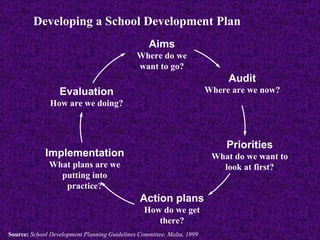
D evelo ping  a School Development Plan Aims Where do we want to go? Source:   School Development Planning Guidelines Committee, Malta, 1999 Audit Where are we now? Priorities What do we want to look at first? Action plans How do we get there? Implementation What plans are we putting into practice? Evaluation How are we doing?
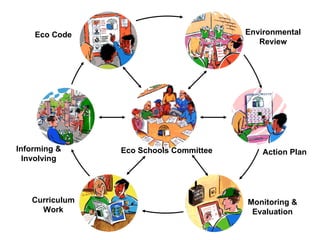
The Seven Steps  of the  EkoSkola process
Environmental Review Action Plan Monitoring & Evaluation Curriculum Work Informing & Involving Eco Code Eco Schools Committee
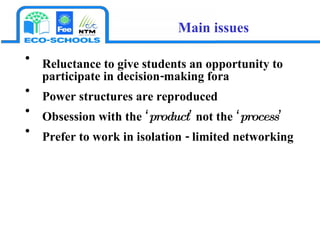
Reluctance to give students an opportunity to participate in decision-making fora Power structures are reproduced Obsession with the ‘ product ’ not the ‘ process ’ Prefer to work in isolation - limited networking Main issues
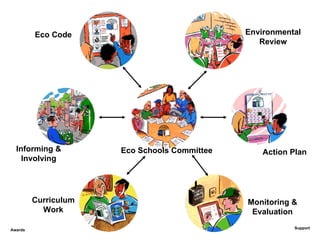
Awards Support Environmental Review Action Plan Monitoring & Evaluation Curriculum Work Informing & Involving Eco Code Eco Schools Committee
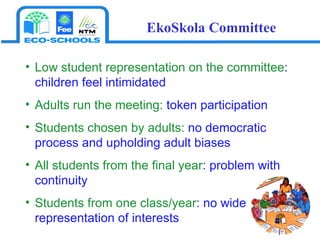
Low student representation on the committee : children feel intimidated Adults run the meeting:  token participation Students chosen by adults:  no democratic process and upholding adult biases All students from the final year : problem with continuity Students from one class/year : no wide representation of interests EkoSkola Committee
Brainstorming session : good ONLY as an initial step to identify main school concerns  No grid used:  auditing is not systematic No results issued:  decisions based on hunches and real issues are not addressed Results are not communicated:    issues are not shared by everyone Environmental Review
Achievements cannot be monitored because  proposed tasks are not specific: No deadlines are set:  progress is slowed down No persons responsible identified:  ownership and responsibility of tasks is not clear Not communicated to all the school:  collective responsibility is low Action Plan
Not given priority:  EkoSkola process is stalled Deadlines are not followed : progress is slowed Progress is not communicated:  success is not shared, sense of achievement is lost and collective motivation is reduced Action plan is not updated:  actions are  focused on controlling symptoms not    eliminating causes Monitoring & Evaluation
Staff seminars to explore ways how to integrate environmental education in the curriculum Environmental education is presented as an extra-curricular activity : process is not valued by the school community  EkoSkola is presented as an additional  chore:  becomes an added burden    not an opportunity for growth Curriculum Work
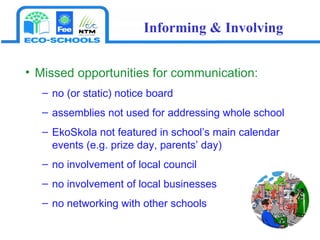
Missed opportunities for communication:   no (or static) notice board assemblies not used for addressing whole school EkoSkola not featured in school’s main calendar events (e.g. prize day, parents’ day) no involvement of local council  no involvement of local businesses  no networking with other schools Informing & Involving
Scope of Eco-Code is not understood:  presents   clichés rather than students’ beliefs and intents Given marginalised importance : environmental ethic fails to be integrated in the school ethos Compiled by adult:  no ownership by school Does not reflect Action Plan targets:  lack of direction Eco-Code
Anxiety to get the Green Flag:  time is needed to establish. School might get flag and lose out in its renewal … with discouraging results Process usually takes from 2 – 3 years … depending on the prior values of the school No time for assimilation/internalisation of values …  achievements are only superficial The Awards
7 steps are seen as stand-alones  … no continuity … more effort to maintain and a lot of committee meetings Bronze and Silver Awards are not requested:  missing out on an opportunity to acknowledge effort through a tangible award School forced to participate/get award : EkoSkola is  totally  voluntary and criterion referenced The Awards
the National EkoSkola Co-ordinator regional EkoSkola Officers offering: support re the 7-steps process professional development seminars promoting a whole school approach  SDP planning sessions to introduce ES and/or integrate the Action Plan  nationally based in-service course: “The EkoSkola Programme: a whole school approach to environmental education” ‘ Trends’: “Promoting School Development through Environmental Education” Support given
resource sheets offering support leading schools through the ES process  enviromental education  curriculum packs  networking services with local/foreign schools electronic local EkoSkola newsletter electronic international bimonthly newsletter:  http:// www.eco-schools.org/new/newsletters.html local website:  http://www.ekoskolamalta.com international website:  http:// www.eco-schools.org/ Support given

Es Tips Re The 7 Steps

  • 1.
    The EkoSkola ProgrammeFulfilling the 7 Steps
  • 2.
    D evelo ping a School Development Plan Aims Where do we want to go? Source: School Development Planning Guidelines Committee, Malta, 1999 Audit Where are we now? Priorities What do we want to look at first? Action plans How do we get there? Implementation What plans are we putting into practice? Evaluation How are we doing?
  • 3.
    The Seven Steps of the EkoSkola process
  • 4.
    Environmental Review ActionPlan Monitoring & Evaluation Curriculum Work Informing & Involving Eco Code Eco Schools Committee
  • 5.
    Reluctance to givestudents an opportunity to participate in decision-making fora Power structures are reproduced Obsession with the ‘ product ’ not the ‘ process ’ Prefer to work in isolation - limited networking Main issues
  • 6.
    Awards Support EnvironmentalReview Action Plan Monitoring & Evaluation Curriculum Work Informing & Involving Eco Code Eco Schools Committee
  • 7.
    Low student representationon the committee : children feel intimidated Adults run the meeting: token participation Students chosen by adults: no democratic process and upholding adult biases All students from the final year : problem with continuity Students from one class/year : no wide representation of interests EkoSkola Committee
  • 8.
    Brainstorming session :good ONLY as an initial step to identify main school concerns No grid used: auditing is not systematic No results issued: decisions based on hunches and real issues are not addressed Results are not communicated: issues are not shared by everyone Environmental Review
  • 9.
    Achievements cannot bemonitored because proposed tasks are not specific: No deadlines are set: progress is slowed down No persons responsible identified: ownership and responsibility of tasks is not clear Not communicated to all the school: collective responsibility is low Action Plan
  • 10.
    Not given priority: EkoSkola process is stalled Deadlines are not followed : progress is slowed Progress is not communicated: success is not shared, sense of achievement is lost and collective motivation is reduced Action plan is not updated: actions are focused on controlling symptoms not eliminating causes Monitoring & Evaluation
  • 11.
    Staff seminars toexplore ways how to integrate environmental education in the curriculum Environmental education is presented as an extra-curricular activity : process is not valued by the school community EkoSkola is presented as an additional chore: becomes an added burden not an opportunity for growth Curriculum Work
  • 12.
    Missed opportunities forcommunication: no (or static) notice board assemblies not used for addressing whole school EkoSkola not featured in school’s main calendar events (e.g. prize day, parents’ day) no involvement of local council no involvement of local businesses no networking with other schools Informing & Involving
  • 13.
    Scope of Eco-Codeis not understood: presents clichés rather than students’ beliefs and intents Given marginalised importance : environmental ethic fails to be integrated in the school ethos Compiled by adult: no ownership by school Does not reflect Action Plan targets: lack of direction Eco-Code
  • 14.
    Anxiety to getthe Green Flag: time is needed to establish. School might get flag and lose out in its renewal … with discouraging results Process usually takes from 2 – 3 years … depending on the prior values of the school No time for assimilation/internalisation of values … achievements are only superficial The Awards
  • 15.
    7 steps areseen as stand-alones … no continuity … more effort to maintain and a lot of committee meetings Bronze and Silver Awards are not requested: missing out on an opportunity to acknowledge effort through a tangible award School forced to participate/get award : EkoSkola is totally voluntary and criterion referenced The Awards
  • 16.
    the National EkoSkolaCo-ordinator regional EkoSkola Officers offering: support re the 7-steps process professional development seminars promoting a whole school approach SDP planning sessions to introduce ES and/or integrate the Action Plan nationally based in-service course: “The EkoSkola Programme: a whole school approach to environmental education” ‘ Trends’: “Promoting School Development through Environmental Education” Support given
  • 17.
    resource sheets offeringsupport leading schools through the ES process enviromental education curriculum packs networking services with local/foreign schools electronic local EkoSkola newsletter electronic international bimonthly newsletter: http:// www.eco-schools.org/new/newsletters.html local website: http://www.ekoskolamalta.com international website: http:// www.eco-schools.org/ Support given