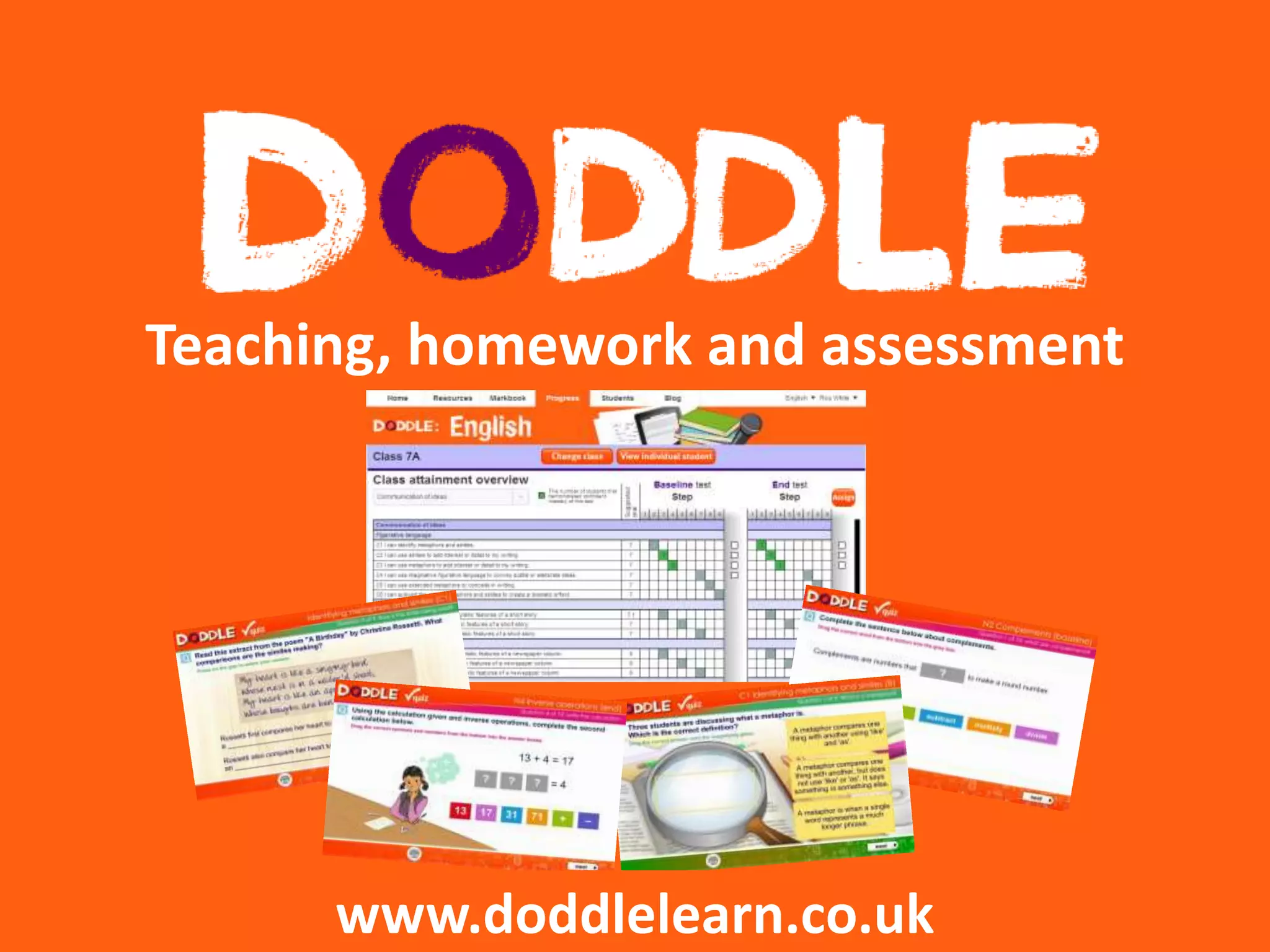
Teaching, homework and assessment
www.doddlelearn.co.uk
© Boardworks Ltd 20142 of 4
Implementation model 1:
School background
- 11-18 comprehensive
- 1600 on roll
- Reasonable ICT provision.
- Ofsted 3:
 pupil premium gap
 3 levels progress.
© Boardworks Ltd 20143 of 4
Current progress tracking at KS3:
• Assessment and levelling: departments have their own
systems.
• Consistency and quality assurance: internally within
departments.
• Intervention systems: Data into SIMS 5 times/year.
Intervention department-based. English/maths/science
intervention coordinated by Year Leaders.
• Responsibilities: KS3 has SLT RSL. Year Leaders
responsible for progress of their year group, reporting to
RSL.
© Boardworks Ltd 20144 of 4
Why are they making this change?
• Clarity: System of levels and sub-levels
confusing and unhelpful for parents and
students.
• Consistency: Pulling together different,
sometimes esoteric departmental systems.
• Targeted intervention: Interventions lacking
impact, insufficiently targeted.
© Boardworks Ltd 20145 of 4
Why Doddle?
• Consistency: Interactive tests, consistent
format.
• Managing workload: Less marking, efficient
interface.
• Progress clear: Easy to see if progress is being
made.
© Boardworks Ltd 20146 of 4
Implementation model
English and Maths pilot: to Feb half term.
• Y 7 groups.
• Mapped competencies to scheme of work.
• Reduced number of competencies.
• Different models: some did interactive tests in
school, some at home, some a mix.
© Boardworks Ltd 20147 of 4
Implementation model
Conclusions:
English:
• Remove less important competencies to make
more manageable number.
• Not realistic to do all tests in school given limit on
IT facilities.
• Identify key interactive tests for controlled
conditions in school. Others complete either for
homework or through paper tests.
© Boardworks Ltd 20148 of 4
Implementation model
Conclusions:
Maths:
• Remove less important competencies.
• All interactive tests to be carried out online.
• Identify key interactive tests for controlled
conditions in school.
• Others completed for homework
© Boardworks Ltd 20149 of 4
Implementation model
Other subjects pilot:
Key questions:
- Online at school/online at home/paper?
- Timing of tests.
- How to share data with students/parents?
- How to integrate Doddle therapy into process?
© Boardworks Ltd 201410 of 4
Implementation model
Ongoing:
Discussion between HoDs and SLT line
managers.
May training day:
• Feedback on department conclusions.
• Discussion and further planning.
• Feed into final departmental plans.
© Boardworks Ltd 201411 of 4
Implementation model
Reporting:
• Average steps will be reported to parents and
students.
• These will be accompanied by progress charts and
key competencies requiring therapy.
© Boardworks Ltd 201412 of 4
Implementation model
Communication:
- Roll out starts with Y7 in September 2015.
- System announced at Y6 information
evening, summer 2015.
- Guidance booklet published.
- Parents’ information evening following first
review in late September.

Implementation models presentation

  • 1.
    Teaching, homework andassessment www.doddlelearn.co.uk
  • 2.
    © Boardworks Ltd20142 of 4 Implementation model 1: School background - 11-18 comprehensive - 1600 on roll - Reasonable ICT provision. - Ofsted 3:  pupil premium gap  3 levels progress.
  • 3.
    © Boardworks Ltd20143 of 4 Current progress tracking at KS3: • Assessment and levelling: departments have their own systems. • Consistency and quality assurance: internally within departments. • Intervention systems: Data into SIMS 5 times/year. Intervention department-based. English/maths/science intervention coordinated by Year Leaders. • Responsibilities: KS3 has SLT RSL. Year Leaders responsible for progress of their year group, reporting to RSL.
  • 4.
    © Boardworks Ltd20144 of 4 Why are they making this change? • Clarity: System of levels and sub-levels confusing and unhelpful for parents and students. • Consistency: Pulling together different, sometimes esoteric departmental systems. • Targeted intervention: Interventions lacking impact, insufficiently targeted.
  • 5.
    © Boardworks Ltd20145 of 4 Why Doddle? • Consistency: Interactive tests, consistent format. • Managing workload: Less marking, efficient interface. • Progress clear: Easy to see if progress is being made.
  • 6.
    © Boardworks Ltd20146 of 4 Implementation model English and Maths pilot: to Feb half term. • Y 7 groups. • Mapped competencies to scheme of work. • Reduced number of competencies. • Different models: some did interactive tests in school, some at home, some a mix.
  • 7.
    © Boardworks Ltd20147 of 4 Implementation model Conclusions: English: • Remove less important competencies to make more manageable number. • Not realistic to do all tests in school given limit on IT facilities. • Identify key interactive tests for controlled conditions in school. Others complete either for homework or through paper tests.
  • 8.
    © Boardworks Ltd20148 of 4 Implementation model Conclusions: Maths: • Remove less important competencies. • All interactive tests to be carried out online. • Identify key interactive tests for controlled conditions in school. • Others completed for homework
  • 9.
    © Boardworks Ltd20149 of 4 Implementation model Other subjects pilot: Key questions: - Online at school/online at home/paper? - Timing of tests. - How to share data with students/parents? - How to integrate Doddle therapy into process?
  • 10.
    © Boardworks Ltd201410 of 4 Implementation model Ongoing: Discussion between HoDs and SLT line managers. May training day: • Feedback on department conclusions. • Discussion and further planning. • Feed into final departmental plans.
  • 11.
    © Boardworks Ltd201411 of 4 Implementation model Reporting: • Average steps will be reported to parents and students. • These will be accompanied by progress charts and key competencies requiring therapy.
  • 12.
    © Boardworks Ltd201412 of 4 Implementation model Communication: - Roll out starts with Y7 in September 2015. - System announced at Y6 information evening, summer 2015. - Guidance booklet published. - Parents’ information evening following first review in late September.