Erythrocytes/RBCs
SHAZIA REHMAN
Definition
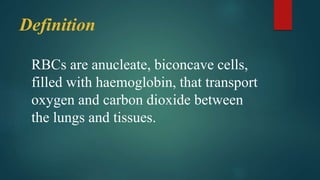
RBCs are anucleate, biconcave cells,
filled with haemoglobin, that transport
oxygen and carbon dioxide between
the lungs and tissues.
Composition of RBCs
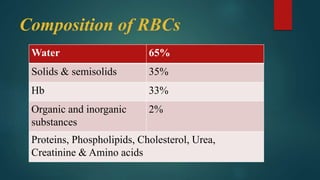
Water 65%
Solids & semisolids 35%
Hb 33%
Organic and inorganic
substances
2%
Proteins, Phospholipids, Cholesterol, Urea,
Creatinine & Amino acids
Shape
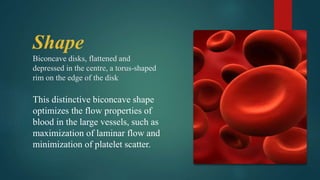
Biconcave disks, flattened and
depressed in the centre, a torus-shaped
rim on the edge of the disk
This distinctive biconcave shape
optimizes the flow properties of
blood in the large vessels, such as
maximization of laminar flow and
minimization of platelet scatter.
Count
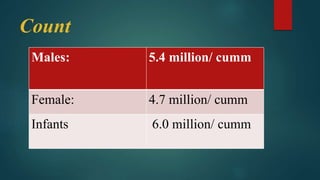
Males: 5.4 million/ cumm
Female: 4.7 million/ cumm
Infants 6.0 million/ cumm
Life span
Average life span of RBCs:120 days
In neonatal (baby) RBCs life span (70 to 90)
days
For energy, RBCs depend upon plasma
glucose.
Production of RBCs
1st trimester : Fetal yolk sac.
2nd trimester: liver, spleen and lymph nodes.
3rd trimester : From bone marrow.
Up to the age of 5year all bones produces RBCs.
After the age of 20:Bone marrow of long bones does not produce
RBCs.
After the age of 25years: RBCs are mostly produced in the marrow
of membranous bones. Example: Sternum, ribs, vertebrae &ilium.
Erythropoiesis
The production of red blood cells.
In response to decreased blood oxygen,
kidney release erythropoietin, which
stimulates RBCs production in the
redbone marrow
Factors needed for erythropoiesis
i. Vitamin B12 Is essential vit. for DNA synthesis.
ii. Vitamin C and folic acid both are important for
erythropoiesis.
iii. Proteins (Amino acid are necessary for the synthesis of
globin in the synthesis of Hb.
iv. Intrinsic factor, Fe and some hormones are also
essential for erythropoiesis.
Physiological variations in RBCs count
Diurnal Variation:5% variation occurs in 24hours.
Lowest during sleep and early morning hours
Highest during evening.
Temperature: RBCs count increases during an increase in external
temperature.
High Altitude: RBCs count increases at high altitudes due to the lack
of oxygen.
Hypoxia: Increases the RBCs count.
X-Ray: Repeated X-Ray decrease RBCs production by depressing
bone marrow actively.
Functions of RBCs
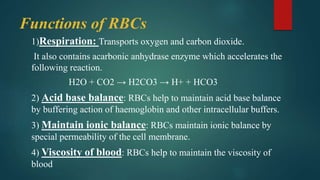
1)Respiration: Transports oxygen and carbon dioxide.
It also contains acarbonic anhydrase enzyme which accelerates the
following reaction.
H2O + CO2 → H2CO3 → H+ + HCO3
2) Acid base balance: RBCs help to maintain acid base balance
by buffering action of haemoglobin and other intracellular buffers.
3) Maintain ionic balance: RBCs maintain ionic balance by
special permeability of the cell membrane.
4) Viscosity of blood: RBCs help to maintain the viscosity of
blood
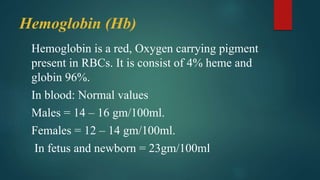
Hemoglobin (Hb)
Hemoglobin is a red, Oxygen carrying pigment
present in RBCs. It is consist of 4% heme and
globin 96%.
In blood: Normal values
Males = 14 – 16 gm/100ml.
Females = 12 – 14 gm/100ml.
In fetus and newborn = 23gm/100ml
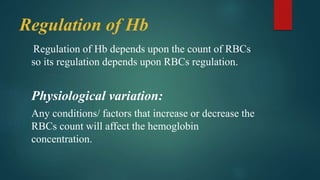
Regulation of Hb
Regulation of Hb depends upon the count of RBCs
so its regulation depends upon RBCs regulation.
Physiological variation:
Any conditions/ factors that increase or decrease the
RBCs count will affect the hemoglobin
concentration.
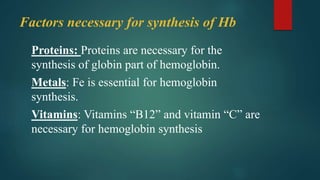
Factors necessary for synthesis of Hb
Proteins: Proteins are necessary for the
synthesis of globin part of hemoglobin.
Metals: Fe is essential for hemoglobin
synthesis.
Vitamins: Vitamins “B12” and vitamin “C” are
necessary for hemoglobin synthesis
Functions of Hemoglobin
Oxygen transport: It is essential for O2carriage
Carbon dioxide transport: Carries same amount of CO2 to
the lungs from the tissues.
Acid- Base balance: Due to the globin fraction it acts as a
strong buffer and helps to maintain the PH of the blood.
Pigments: Bilirubin Different pigments of bile, stool, urine
etc are formed from hemoglobin and excreted through the
urine and stool.

Erythrocytes / RBCs

  • 1.
  • 2.
    Definition RBCs are anucleate,biconcave cells, filled with haemoglobin, that transport oxygen and carbon dioxide between the lungs and tissues.
  • 3.
    Composition of RBCs Water65% Solids & semisolids 35% Hb 33% Organic and inorganic substances 2% Proteins, Phospholipids, Cholesterol, Urea, Creatinine & Amino acids
  • 4.
    Shape Biconcave disks, flattenedand depressed in the centre, a torus-shaped rim on the edge of the disk This distinctive biconcave shape optimizes the flow properties of blood in the large vessels, such as maximization of laminar flow and minimization of platelet scatter.
  • 5.
    Count Males: 5.4 million/cumm Female: 4.7 million/ cumm Infants 6.0 million/ cumm
  • 6.
    Life span Average lifespan of RBCs:120 days In neonatal (baby) RBCs life span (70 to 90) days For energy, RBCs depend upon plasma glucose.
  • 7.
    Production of RBCs 1sttrimester : Fetal yolk sac. 2nd trimester: liver, spleen and lymph nodes. 3rd trimester : From bone marrow. Up to the age of 5year all bones produces RBCs. After the age of 20:Bone marrow of long bones does not produce RBCs. After the age of 25years: RBCs are mostly produced in the marrow of membranous bones. Example: Sternum, ribs, vertebrae &ilium.
  • 8.
    Erythropoiesis The production ofred blood cells. In response to decreased blood oxygen, kidney release erythropoietin, which stimulates RBCs production in the redbone marrow
  • 9.
    Factors needed forerythropoiesis i. Vitamin B12 Is essential vit. for DNA synthesis. ii. Vitamin C and folic acid both are important for erythropoiesis. iii. Proteins (Amino acid are necessary for the synthesis of globin in the synthesis of Hb. iv. Intrinsic factor, Fe and some hormones are also essential for erythropoiesis.
  • 10.
    Physiological variations inRBCs count Diurnal Variation:5% variation occurs in 24hours. Lowest during sleep and early morning hours Highest during evening. Temperature: RBCs count increases during an increase in external temperature. High Altitude: RBCs count increases at high altitudes due to the lack of oxygen. Hypoxia: Increases the RBCs count. X-Ray: Repeated X-Ray decrease RBCs production by depressing bone marrow actively.
  • 11.
    Functions of RBCs 1)Respiration:Transports oxygen and carbon dioxide. It also contains acarbonic anhydrase enzyme which accelerates the following reaction. H2O + CO2 → H2CO3 → H+ + HCO3 2) Acid base balance: RBCs help to maintain acid base balance by buffering action of haemoglobin and other intracellular buffers. 3) Maintain ionic balance: RBCs maintain ionic balance by special permeability of the cell membrane. 4) Viscosity of blood: RBCs help to maintain the viscosity of blood
  • 12.
    Hemoglobin (Hb) Hemoglobin isa red, Oxygen carrying pigment present in RBCs. It is consist of 4% heme and globin 96%. In blood: Normal values Males = 14 – 16 gm/100ml. Females = 12 – 14 gm/100ml. In fetus and newborn = 23gm/100ml
  • 13.
    Regulation of Hb Regulationof Hb depends upon the count of RBCs so its regulation depends upon RBCs regulation. Physiological variation: Any conditions/ factors that increase or decrease the RBCs count will affect the hemoglobin concentration.
  • 14.
    Factors necessary forsynthesis of Hb Proteins: Proteins are necessary for the synthesis of globin part of hemoglobin. Metals: Fe is essential for hemoglobin synthesis. Vitamins: Vitamins “B12” and vitamin “C” are necessary for hemoglobin synthesis
  • 15.
    Functions of Hemoglobin Oxygentransport: It is essential for O2carriage Carbon dioxide transport: Carries same amount of CO2 to the lungs from the tissues. Acid- Base balance: Due to the globin fraction it acts as a strong buffer and helps to maintain the PH of the blood. Pigments: Bilirubin Different pigments of bile, stool, urine etc are formed from hemoglobin and excreted through the urine and stool.