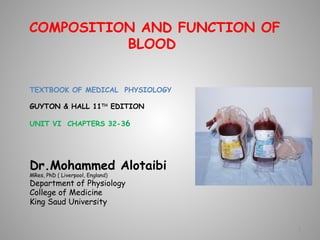
COMPOSITION AND FUNCTION OF
BLOOD
TEXTBOOK OF MEDICAL PHYSIOLOGY
GUYTON & HALL 11TH
EDITION
UNIT VI CHAPTERS 32-36
Dr.Mohammed Alotaibi
MRes, PhD ( Liverpool, England)
Department of Physiology
College of Medicine
King Saud University
1
Objectives
At the end of this lecture student
should be able to:
1. Recognize functions of blood
2. Describe Cellular and non-cellular
components of blood
3. Define Erythropoiesis; leukopoiesis, and
thrombopoiesis.
4. Describe features of RBCs, WBCs, and
Platelets.
What is Blood?
• Blood is a fluid connective tissue found within
the cardiovascular system
• accounts for about 8% of TBW
• Its volume is 5-6 L in males and 4-5 L in females
• Much more dense than pure water
• It is slightly alkaline, with a pH of 7.35- 7.45
• Its color varies from bright to dark red
• It has a salty metallic taste
General Function of the Blood
1- Transportation:
A) Gases: O2 , CO2 , …..
B) Nutrient and metabolic Wastes: Glucose, amino acids, ….
C) Hormones and Enzymes
D) Antibodies
E) Electrolytes and Ions
2- Regulation:
A) Temperature regulation
B) pH regulation: By buffering systems found in the
blood that maintain the pH between 7.35 to 7.45
C) Electrolytes regulation (Na, K, Cl,…..)
D) Blood pressure regulation: by increasing or
decreasing blood flow to the kidneys
General Function of the Blood
Cont.
3- Protection:
A) Defense mechanism: By white blood cells
B) Clotting mechanism: Blood contains materials that
stop bleeding when vessels are damaged
(Hemostasis)
General Function of the Blood
Cont.
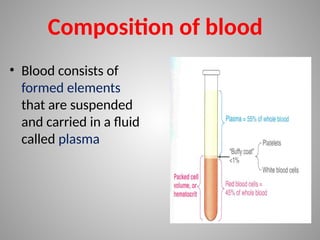
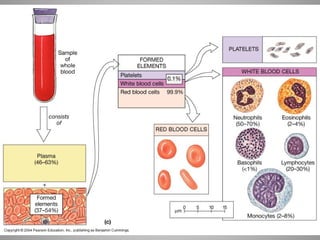
Composition of blood
• Blood consists of
formed elements
that are suspended
and carried in a fluid
called plasma
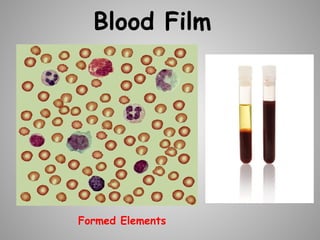
Blood Film
Formed Elements
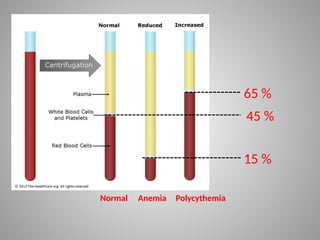
45 %
Anemia Polycythemia
Normal
15 %
65 %
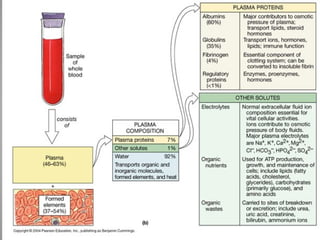
Plasma
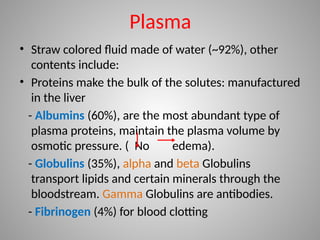
• Straw colored fluid made of water (~92%), other
contents include:
• Proteins make the bulk of the solutes: manufactured
in the liver
- Albumins (60%), are the most abundant type of
plasma proteins, maintain the plasma volume by
osmotic pressure. ( No edema).
- Globulins (35%), alpha and beta Globulins
transport lipids and certain minerals through the
bloodstream. Gamma Globulins are antibodies.
- Fibrinogen (4%) for blood clotting
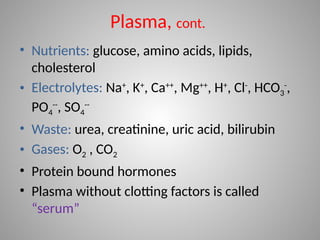
• Nutrients: glucose, amino acids, lipids,
cholesterol
• Electrolytes: Na+
, K+
, Ca++
, Mg++
, H+
, Cl-
, HCO3
-
,
PO4
--
, SO4
--
• Waste: urea, creatinine, uric acid, bilirubin
• Gases: O2 , CO2
• Protein bound hormones
• Plasma without clotting factors is called
“serum”
Plasma, cont.
BLOOD COMPOSITION
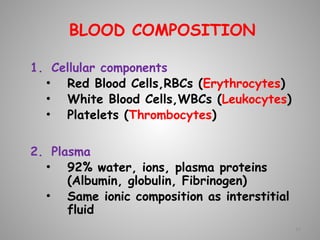
1. Cellular components
• Red Blood Cells,RBCs (Erythrocytes)
• White Blood Cells,WBCs (Leukocytes)
• Platelets (Thrombocytes)
2. Plasma
• 92% water, ions, plasma proteins
(Albumin, globulin, Fibrinogen)
• Same ionic composition as interstitial
fluid
14
Blood Volume
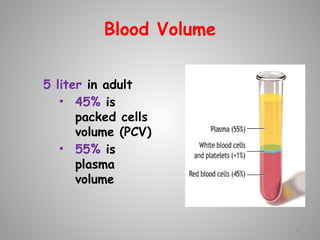
5 liter in adult
• 45% is
packed cells
volume (PCV)
• 55% is
plasma
volume
15
Blood Cells
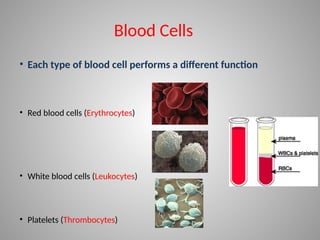
• Each type of blood cell performs a different function
• Red blood cells (Erythrocytes)
• White blood cells (Leukocytes)
• Platelets (Thrombocytes)
Hematopoiesis
• Is a formation of blood cells from stem cells in the red
bone marrow (myeloid stem cell) & lymphatic tissue
(lymphoid stem cell)
• Erythropoiesis is formation of RBCs – Stimulated by
erythropoietin (EPO) from kidney
• Leukopoiesis is formation of WBCs – Stimulated by
variety of cytokines
• Thrombopoiesis is formation of platelets
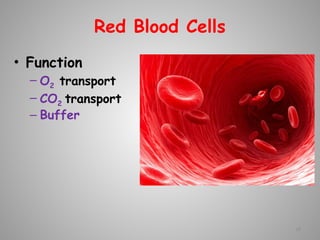
Red Blood Cells
• Function
– O2 transport
– CO2 transport
– Buffer
18
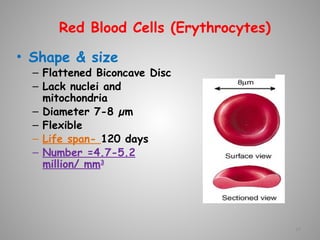
Red Blood Cells (Erythrocytes)
• Shape & size
– Flattened Biconcave Disc
– Lack nuclei and
mitochondria
– Diameter 7-8 µm
– Flexible
– Life span- 120 days
– Number =4.7-5.2
million/ mm3
19
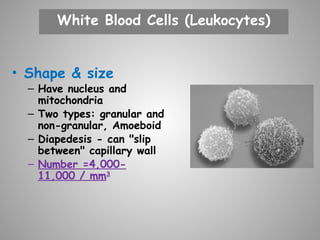
White Blood Cells (Leukocytes)
• Shape & size
– Have nucleus and
mitochondria
– Two types: granular and
non-granular, Amoeboid
– Diapedesis - can "slip
between" capillary wall
– Number =4,000-
11,000 / mm3
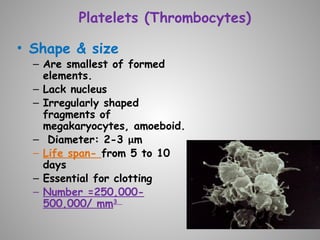
Platelets (Thrombocytes)
• Shape & size
– Are smallest of formed
elements.
– Lack nucleus
– Irregularly shaped
fragments of
megakaryocytes, amoeboid.
– Diameter: 2-3 µm
– Life span- from 5 to 10
days
– Essential for clotting
– Number =250,000-
500,000/ mm3
Objectives
At the end of this lecture student
should be able to:
1. Recognize functions of blood
2. Describe Cellular and non-cellular
components of blood
3. Define Erythropoiesis; leukopoiesis, and
thrombopoiesis.
4. Describe features of RBCs, WBCs, and
Platelets.

COMPOSITION AND FUNCTION OF BLOOD.ppt

  • 1.
    COMPOSITION AND FUNCTIONOF BLOOD TEXTBOOK OF MEDICAL PHYSIOLOGY GUYTON & HALL 11TH EDITION UNIT VI CHAPTERS 32-36 Dr.Mohammed Alotaibi MRes, PhD ( Liverpool, England) Department of Physiology College of Medicine King Saud University 1
  • 2.
    Objectives At the endof this lecture student should be able to: 1. Recognize functions of blood 2. Describe Cellular and non-cellular components of blood 3. Define Erythropoiesis; leukopoiesis, and thrombopoiesis. 4. Describe features of RBCs, WBCs, and Platelets.
  • 3.
    What is Blood? •Blood is a fluid connective tissue found within the cardiovascular system • accounts for about 8% of TBW • Its volume is 5-6 L in males and 4-5 L in females • Much more dense than pure water • It is slightly alkaline, with a pH of 7.35- 7.45 • Its color varies from bright to dark red • It has a salty metallic taste
  • 4.
    General Function ofthe Blood 1- Transportation: A) Gases: O2 , CO2 , ….. B) Nutrient and metabolic Wastes: Glucose, amino acids, …. C) Hormones and Enzymes D) Antibodies E) Electrolytes and Ions
  • 5.
    2- Regulation: A) Temperatureregulation B) pH regulation: By buffering systems found in the blood that maintain the pH between 7.35 to 7.45 C) Electrolytes regulation (Na, K, Cl,…..) D) Blood pressure regulation: by increasing or decreasing blood flow to the kidneys General Function of the Blood Cont.
  • 6.
    3- Protection: A) Defensemechanism: By white blood cells B) Clotting mechanism: Blood contains materials that stop bleeding when vessels are damaged (Hemostasis) General Function of the Blood Cont.
  • 7.
    Composition of blood •Blood consists of formed elements that are suspended and carried in a fluid called plasma
  • 8.
  • 10.
  • 12.
    Plasma • Straw coloredfluid made of water (~92%), other contents include: • Proteins make the bulk of the solutes: manufactured in the liver - Albumins (60%), are the most abundant type of plasma proteins, maintain the plasma volume by osmotic pressure. ( No edema). - Globulins (35%), alpha and beta Globulins transport lipids and certain minerals through the bloodstream. Gamma Globulins are antibodies. - Fibrinogen (4%) for blood clotting
  • 13.
    • Nutrients: glucose,amino acids, lipids, cholesterol • Electrolytes: Na+ , K+ , Ca++ , Mg++ , H+ , Cl- , HCO3 - , PO4 -- , SO4 -- • Waste: urea, creatinine, uric acid, bilirubin • Gases: O2 , CO2 • Protein bound hormones • Plasma without clotting factors is called “serum” Plasma, cont.
  • 14.
    BLOOD COMPOSITION 1. Cellularcomponents • Red Blood Cells,RBCs (Erythrocytes) • White Blood Cells,WBCs (Leukocytes) • Platelets (Thrombocytes) 2. Plasma • 92% water, ions, plasma proteins (Albumin, globulin, Fibrinogen) • Same ionic composition as interstitial fluid 14
  • 15.
    Blood Volume 5 literin adult • 45% is packed cells volume (PCV) • 55% is plasma volume 15
  • 16.
    Blood Cells • Eachtype of blood cell performs a different function • Red blood cells (Erythrocytes) • White blood cells (Leukocytes) • Platelets (Thrombocytes)
  • 17.
    Hematopoiesis • Is aformation of blood cells from stem cells in the red bone marrow (myeloid stem cell) & lymphatic tissue (lymphoid stem cell) • Erythropoiesis is formation of RBCs – Stimulated by erythropoietin (EPO) from kidney • Leukopoiesis is formation of WBCs – Stimulated by variety of cytokines • Thrombopoiesis is formation of platelets
  • 18.
    Red Blood Cells •Function – O2 transport – CO2 transport – Buffer 18
  • 19.
    Red Blood Cells(Erythrocytes) • Shape & size – Flattened Biconcave Disc – Lack nuclei and mitochondria – Diameter 7-8 µm – Flexible – Life span- 120 days – Number =4.7-5.2 million/ mm3 19
  • 20.
    White Blood Cells(Leukocytes) • Shape & size – Have nucleus and mitochondria – Two types: granular and non-granular, Amoeboid – Diapedesis - can "slip between" capillary wall – Number =4,000- 11,000 / mm3
  • 21.
    Platelets (Thrombocytes) • Shape& size – Are smallest of formed elements. – Lack nucleus – Irregularly shaped fragments of megakaryocytes, amoeboid. – Diameter: 2-3 µm – Life span- from 5 to 10 days – Essential for clotting – Number =250,000- 500,000/ mm3
  • 22.
    Objectives At the endof this lecture student should be able to: 1. Recognize functions of blood 2. Describe Cellular and non-cellular components of blood 3. Define Erythropoiesis; leukopoiesis, and thrombopoiesis. 4. Describe features of RBCs, WBCs, and Platelets.

Editor's Notes

  • #19 Shape biconcave to provide wide surface area for diffusion.