Introduction to SAP-PoweredDigital Innovation
01
Process Automation
Implementing SAP solutions to automate business
processes can significantly increase efficiency,
reduce manual errors, and free up resources for
strategic initiatives.
02
Data Analytics
Leveraging SAP analytics tools enables organizations to
gain valuable insights from data, helping in better
decision- making and identifying growth opportunities.
03
Enhanced Collaboration
Utilizing SAP platforms fosters improved
collaboration among teams, facilitating real-time
communication and seamless project management
across departments.
3.
Overview of ROBOXAServices
01
Consulting
Expert guidance on leveraging SAP technologies for streamlined
business processes and improved decision-making.
02
Implementation
Efficient deployment of SAP solutions tailored to enhance
operational efficiency and support business growth.
03
Support
Comprehensive support services ensuring optimal performance
and continuous improvement of SAP systems.
04
Training
Tailored training programs designed to empower teams with
SAP knowledge and enhance their skill sets.
4.
Why Digital Innovation
Mattersfor Growth
01
Increased
Efficiency
Implementing SAP solutions streamlines
processes, reduces operational costs, and
enhances productivity, allowing businesses to
respond faster to market demands and improve
overall performance.
02
Enhanced Customer
Experience
Digital innovations personalize customer
interactions through data-driven insights,
enabling businesses to meet consumer needs
effectively and foster long- term loyalty.
5.
Problem
1
Problem
2
Identifying Business GrowthChallenges
Problem
3
Problem
4
Inefficient Processes
Affecting Operational
Performance
Manual processes leading
to delays in execution
Lack of automation
hampers productivity
significantly
Difficulty in Data-Driven
Decision Making
Insufficient data analytics
for informed choices
Limited insights into
customer behavior
trends
Challenges in Adapting to
Market Changes
Quickly
Slow response to
evolving customer
demands
Inability to pivot business
strategy efficiently
Integration Challenges
with Existing Systems and
Tools
Fragmented systems
causing data silos and
confusion
Legacy systems unable to
support growth
initiatives
6.
Understanding SAP Solutionsfor Businesses
01
Data
Integration
Leveraging SAP solutions enables seamless data
integration across various departmental
applications, enhancing real-time data access and
informed decision-making capabilities for
organizations.
02
Process
Automation
Implementing SAP solutions facilitates process
automation within business operations, improving
efficiency and reducing manual errors while
conserving valuable time and resources.
7.
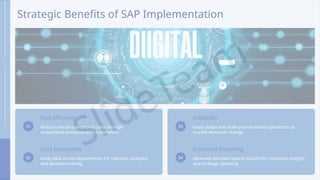
Strategic Benefits ofSAP Implementation
01
Cost Efficiency
Reduce overall operational costs through
streamlined processes and automation.
02
Data Integration
Unify data across departments for real-time analytics
and decision-making.
03
Scalability
Easily adapt and scale your business operations as
market demands change.
04
Enhanced Reporting
Generate detailed reports quickly for improved insights
and strategic planning.
8.
Case Studies: SuccessStories
with SAP
Problem Faced
Inefficient supply chain leading to
delays.
Solution Offered
Implemented SAP for streamlined
logistics management.
Benefits
Reduced delivery times and improved
customer satisfaction.
9.
Aligning Business Goalswith Digital Innovation
Clear Objectives
Define specific, measurable objectives for
digital transformation initiatives.
Stakeholder Engagement
Involve key stakeholders to ensure alignment on goals
and expectations.
Technology Assessment
Evaluate current technologies to identify any
gaps in capabilities.
Process Optimization
Analyze current processes to streamline and
enhance efficiency.
Data Strategy
Develop a robust strategy for data management and
analytics usage.
Continuous Assessment
Create a mechanism for ongoing evaluation of
digital initiatives' impact.
10.
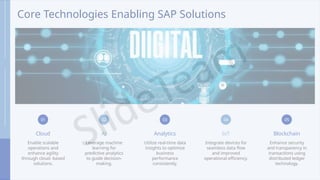
Core Technologies EnablingSAP Solutions
01
Cloud
Enable scalable
operations and
enhance agility
through cloud- based
solutions.
02
AI
Leverage machine
learning for
predictive analytics
to guide decision-
making.
03
Analytics
Utilize real-time data
insights to optimize
business
performance
consistently.
04
IoT
Integrate devices for
seamless data flow
and improved
operational efficiency.
05
Blockchain
Enhance security
and transparency in
transactions using
distributed ledger
technology.
11.
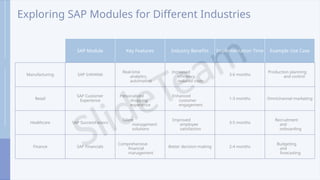
Exploring SAP Modulesfor Different Industries
SAP Module Key Features Industry Benefits Implementation Time Example Use Case
Manufacturing SAP S/4HANA
Real-time
analytics,
automation
Increased
efficiency,
reduced costs
3-6 months
Production planning
and control
Retail
SAP Customer
Experience
Personalized
shopping
experience
Enhanced
customer
engagement
1-3 months Omnichannel marketing
Healthcare SAP SuccessFactors
Talent
management
solutions
Improved
employee
satisfaction
3-5 months
Recruitment
and
onboarding
Finance SAP Financials
Comprehensive
financial
management
Better decision making 2-4 months
Budgeting
and
forecasting
12.
Customizing SAP Solutionsfor Your Business
Solutio
n
01
Tailored SAP
Configurations
• Adjust functionalities to meet
your business needs.
02
Integration with Legacy
Systems
• Seamlessly connect SAP with
existing software platforms.
03
User-Centric
Customizations
• Enhance user experience
with personalized interfaces.
13.
Accelerating Time-to-Value withSAP
2023
Launch
Initiate the
digital
innovation
project
2024
Integration
Connect existing
systems with
SAP solutions
2025
Optimization
Streamline processes
for increased efficiency
2026
Expansion
Scale operations
based on market
demands
2027
Innovation
Implement new
features for enhanced
user experience
14.
Change Management Strategiesfor SAP
Adoption
01
Assess
Evaluate
current
processes and
identify gaps
efficiently.
02
Plan
Develop a
comprehensive
strategy for
successful
implementatio
n.
03
Communicate
Engage all
stakeholders
and share the
vision clearly.
04
Train
Provide
necessary
training to
ensure user
proficiency.
05
Monitor
Continuously track
progress and
adapt as required.
15.
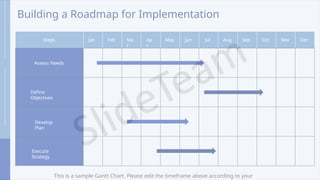
Building a Roadmapfor Implementation
Steps Jan Feb Ma
r
Ap
r
May Jun Jul Aug Sep Oct Nov Dec
This is a sample Gantt Chart. Please edit the timeframe above according to your
Assess Needs
Define
Objectives
Develop
Plan
Execute
Strategy
16.
Performance Metrics forMeasuring Success
Revenue Growth
20%
Customer Satisfaction
85%
Market Share
15%
Operational Efficiency
90%
Q1 Q2 Q3 Q4
0
10
20
30
60
50
40
70
80
90
10
20
30
40
70
75
80
85
Quarterly Performance
Metrics
Quarter
s
Values
40%
30%
20%
10%
Revenue Distribution by
Source
Product A Product B Service C
Others
This is a sample dashboard. Please edit the metrics according to your
17.
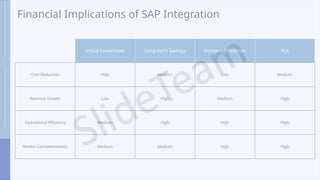
Financial Implications ofSAP Integration
Initial Investment Long-term Savings Increased Revenue ROI
Cost Reduction High Medium Low Medium
Revenue Growth Low High Medium High
Operational Efficiency Medium High High High
Market Competitiveness Medium Medium High High
18.
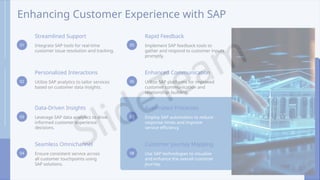
Enhancing Customer Experiencewith SAP
01
Streamlined Support
Integrate SAP tools for real-time
customer issue resolution and tracking.
02
Personalized Interactions
Utilize SAP analytics to tailor services
based on customer data insights.
03
Data-Driven Insights
Leverage SAP data analytics to drive
informed customer experience
decisions.
04
Seamless Omnichannel
Ensure consistent service across
all customer touchpoints using
SAP solutions.
05
Rapid Feedback
Implement SAP feedback tools to
gather and respond to customer inputs
promptly.
06
Enhanced Communication
Utilize SAP platforms for improved
customer communication and
relationship- building.
07
Automated Processes
Employ SAP automation to reduce
response times and improve
service efficiency.
08
Customer Journey Mapping
Use SAP technologies to visualize
and enhance the overall customer
journey.
19.
Automating Business Processeswith SAP
Start
Identify
Tasks
Automat
e
Yes
Reassess Processes
Implement
Changes
This is a sample flowchart for this slide. Please rearrange the flowchart to convey your
Flow
Chart
No
No
Yes
Yes
No
End
20.
Leveraging SAP forData-Driven Decisions
01
Real-time Analytics
Utilize SAP HANA to process data instantly
for timely insights, improving decision-
making efficiency.
02
Predictive Insights
Harness SAP's predictive analytics for
forecasting trends, enabling proactive strategy
adjustments.
03
Data Integration
Seamlessly connect SAP systems with
external data sources to enhance decision-
making accuracy and depth.
21.
Integrating SAP withExisting Systems
01
Assess
Evaluate current
systems for
compatibility with
SAP integration.
02
Plan
Develop a
comprehensive
integration
strategy and
timeline.
03
Execute
Implement the
integration,
ensuring minimal
disruption to
operations.
04
Optimize
Monitor the
integration and
continuously
improve system
performances.
22.
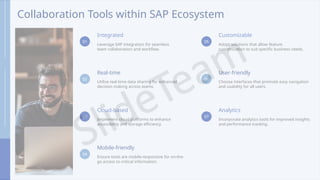
Collaboration Tools withinSAP Ecosystem
01
Integrated
Leverage SAP integration for seamless
team collaboration and workflow.
02
Real-time
Utilize real-time data sharing for enhanced
decision making across teams.
03
Cloud-based
Implement cloud platforms to enhance
accessibility and storage efficiency.
04
Mobile-friendly
Ensure tools are mobile-responsive for on-the-
go access to critical information.
05
Customizable
Adopt solutions that allow feature
customization to suit specific business needs.
06
User-friendly
Choose interfaces that promote easy navigation
and usability for all users.
07
Analytics
Incorporate analytics tools for improved insights
and performance tracking.
23.
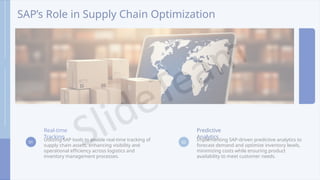
SAP’s Role inSupply Chain Optimization
01
Real-time
Tracking
Utilizing SAP tools to enable real-time tracking of
supply chain assets, enhancing visibility and
operational efficiency across logistics and
inventory management processes.
02
Predictive
Analytics
Implementing SAP-driven predictive analytics to
forecast demand and optimize inventory levels,
minimizing costs while ensuring product
availability to meet customer needs.
24.
Vision
Empowering businesses
to thrivein a digital
economy through
innovative SAP solutions
and strategies.
Mission
To deliver exceptional SAP-
powered services that drive
sustainable growth and
efficiency for clients
worldwide.
Values
Integrity, Innovation,
Collaboration, and
Excellence in all our SAP-
driven initiatives and
solutions.
Future-Proofing Your Business with SAP
25.
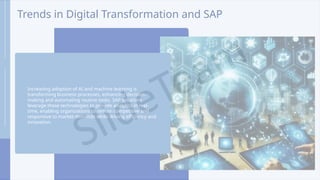
Trends in DigitalTransformation and SAP
Increasing adoption of AI and machine learning is
transforming business processes, enhancing decision-
making and automating routine tasks. SAP solutions
leverage these technologies to provide analytics in real-
time, enabling organizations to remain competitive and
responsive to market demands while driving efficiency and
innovation.
26.
Training and Supportfor SAP Users
01
Onboarding Sessions
Conduct comprehensive onboarding sessions to equip
new users with essential SAP skills, ensuring swift
adaptation and immediate productivity in their roles.
02
Ongoing Workshops
Organize regular workshops focusing on advanced
SAP functionalities, enabling users to deepen their
knowledge and leverage the system's full capabilities
for business advantages.
03
24/7 Helpdesk Support
Provide round-the-clock helpdesk support to address
user queries and technical issues, minimizing
downtime and enhancing overall user experience with
SAP systems.
27.
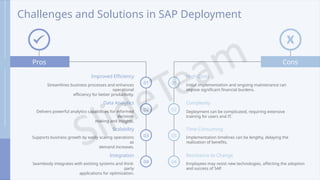
Challenges and Solutionsin SAP Deployment
Pros
01
Improved Efficiency
Streamlines business processes and enhances
operational
efficiency for better productivity.
02
Data Analytics
Delivers powerful analytics capabilities for informed
decision-
making and insights.
03
Scalability
Supports business growth by easily scaling operations
as
demand increases.
04
Integration
Seamlessly integrates with existing systems and third-
party
applications for optimization.
Cons
01
High Costs
Initial implementation and ongoing maintenance can
impose significant financial burdens.
02
Complexity
Deployment can be complicated, requiring extensive
training for users and IT.
03
Time-Consuming
Implementation timelines can be lengthy, delaying the
realization of benefits.
04
Resistance to Change
Employees may resist new technologies, affecting the adoption
and success of SAP.
28.
Interactive Q&A Sessionon SAP
Innovation
How has SAP innovation
impacted your business
processes today?
01
What challenges do you face
in adopting SAP solutions
fully?
02
03
Which SAP feature do you
find most beneficial for
growth?
29.
Feedback and Recommendationson SAP Usage
Alice
SAP has significantly
improved our
operational efficiency
and visibility.
Bob
The integration with
our legacy systems
was seamless and
effective.
Carol
We have seen a
noticeable increase
in productivity since
implementing SAP.
David
Customer support
has been
exceptional, making
the transition easier.
Eva
SAP's analytics
capabilities have
provided us with
valuable insights.
30.
Insights from IndustryLeaders on SAP
Alex
SAP helped us
streamline our
operations and
enhance
productivity
significantly.
Mia
The transformation
journey with SAP
was smooth and
exceeded our
expectations.
Liam
We experienced
remarkable growth
thanks to SAP's
innovative
solutions.
31.
Digital Innovation StrategyAssessment
Strength
s
•
•
ROBOXA Services leverages
SAP expertise to enhance
operational efficiency and
productivity.
Integration with SAP
systems drives innovation,
improving customer
experience and satisfaction.
Weaknesses
•
•
Dependency on SAP
may limit flexibility in
adopting alternative
solutions and
technologies.
High costs associated
with SAP licensing and
implementation could
deter potential clients.
S W
O Opportunitie
s
•
•
Growing demand for
digital transformation
solutions opens new
market opportunities for
ROBOXA.
Collaboration with tech
startups can enhance
innovative offerings and
expand service
capabilities.
T
Threat
s
•
•
Intense competition in the
digital innovation space
may impact market share
for ROBOXA.
Rapid technological
advancements require
constant adaptation to
avoid obsolescence in
services.
32.
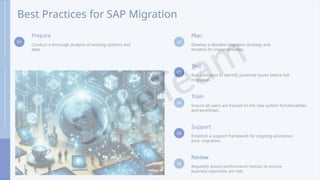
Best Practices forSAP Migration
01
Prepare
Conduct a thorough analysis of existing systems and
data.
02
Plan
Develop a detailed migration strategy and
timeline for implementation.
03
Test
Run pilot tests to identify potential issues before full
migration.
04
Train
Ensure all users are trained on the new system functionalities
and workflows.
05
Support
Establish a support framework for ongoing assistance
post- migration.
06
Review
Regularly assess performance metrics to ensure
business objectives are met.
33.
Sustainability Goals
Supported bySAP
01
Carbon Footprint
SAP solutions enable businesses to measure and reduce their
carbon emissions effectively.
02
Resource Efficiency
Leverage SAP tools to optimize resource usage and minimize
waste in production processes.
03
Sustainable Supply Chain
Use SAP to ensure transparency and sustainability throughout the
supply chain management.
04
Regulatory Compliance
Robust SAP systems aid in adhering to environmental regulations
and sustainability standards.
34.
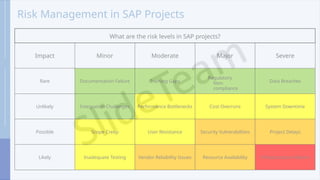
Risk Management inSAP Projects
What are the risk levels in SAP projects?
Impact Minor Moderate Major Severe
Rare Documentation Failure Training Gaps
Regulatory
Non-
compliance
Data Breaches
Unlikely Integration Challenges Performance Bottlenecks Cost Overruns System Downtime
Possible Scope Creep User Resistance Security Vulnerabilities Project Delays
Likely Inadequate Testing Vendor Reliability Issues Resource Availability Infrastructure Failures
35.
Lessons Learned fromSAP Implementations
01
Stakeholder Engagement
Involve key stakeholders early to ensure
alignment and support.
02
Change Management
Implement effective change management
strategies to adopt new processes.
03
Data Quality
Maintain high data quality for successful
SAP system integration.
04
Scalability Focus
Design solutions with scalability in mind for
future growth.
05
User Training
Prioritize comprehensive user training to
maximize system utilization.
06
Agile Methodology
Utilize agile practices for flexibility in
project management.
07
Continuous Improvement
Establish a culture of continuous improvement
post- implementation.
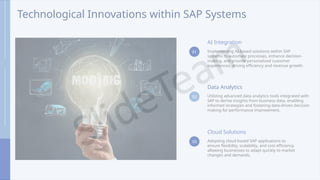
Technological Innovations withinSAP Systems
01
AI Integration
Implementing AI-based solutions within SAP
systems to automate processes, enhance decision-
making, and provide personalized customer
experiences, driving efficiency and revenue growth.
02
Data Analytics
Utilizing advanced data analytics tools integrated with
SAP to derive insights from business data, enabling
informed strategies and fostering data-driven decision
making for performance improvement.
03
Cloud Solutions
Adopting cloud-based SAP applications to
ensure flexibility, scalability, and cost efficiency,
allowing businesses to adapt quickly to market
changes and demands.
38.
Continuous Improvement throughSAP Analytics
ROI
20%
Growt
h
15%
Sales
24%
Efficienc
y
30%
Insight
s
15%
This is a sample dashboard. Please edit the metrics according to your
39.
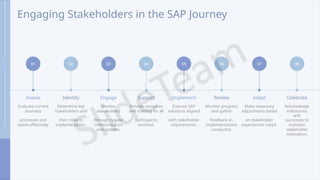
Engaging Stakeholders inthe SAP Journey
01 02 03 04 05 06 07 08
Assess Identify Engage Support Implement Review Adapt Celebrate
Evaluate current Determine key Involve Provide resources Execute SAP Monitor progress Make necessary Acknowledge
business stakeholders and stakeholders and training for all solutions aligned and gather adjustments based milestones
and
processes and their roles in through regular participants with stakeholder feedback on on stakeholder successes to
needs effectively. implementation. communication involved. requirements. implementations experiences noted. maintain
and updates. conducted. stakeholder
motivation.
40.
Future Directions forSAP Development
Vision
To lead the transformation of
businesses through innovative
SAP solutions that drive efficiency
and growth.
Mission
Our mission is to empower
organizations to achieve their
goals through tailored SAP-
powered digital innovation and
strategic insights.
Goals
We value collaboration, integrity,
and excellence in delivering SAP
solutions to our clients and
partners.
41.
Creating a CompetitiveAdvantage with SAP
Gain
Streamlined operations
leading to increased
productivity and
profitability.
Pain
Challenges in operational
efficiency impacting
overall business
performance.
Customer jobs
Ensuring seamless
integration of business
processes for optimal
results.
Value map
Achieving measurable
growth through data-driven
decision- making and
analytics.
Pain relievers
Providing innovative
solutions that address
current business obstacles
effectively.
Key partners
Collaborating with industry leaders to enhance technology and market reach.
Product and services
Offering SAP solutions tailored to meet unique business needs and
challenges.
42.
User Testimonials andExperiences with SAP
John
Implementing SAP
transformed our
business
operations
significantly and
efficiently.
Lisa
Our profits soared
after integrating SAP
solutions into our
daily processes.
Mike
SAP's tools helped
streamline our
workflow and
improve team
collaboration
immensely.
Sara
With SAP, we could
analyze data
faster and make
informed
decisions rapidly.
43.
Innovation Workshops
and Hands-On
Demonstrations
01
Practical
Insights
Deliverreal-world examples through case studies
and scenarios showcasing SAP implementations
that drive efficiency and innovation in various
business functions.
02
Hands-On Sessions
Engage participants in interactive sessions,
allowing them to experience SAP tools firsthand,
enhancing their understanding and skills in
leveraging digital solutions for business growth.
44.
Dashboard Development forSAP Insights
Sales
Increas
e
Efficienc
y
Boos
t
Growt
h
2x
ROI
Hig
h
Satisfactio
n
Improve
d
Insight
s
Real-
time
This is a sample dashboard. Please edit the metrics according to your
45.
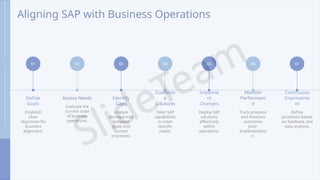
Aligning SAP withBusiness Operations
01
Define
Goals
Establish
clear
objectives for
business
alignment.
02
Assess Needs
Evaluate the
current state
of business
operations.
03
Identify
Gaps
Analyze
discrepancies
between
goals and
current
processes.
04
Customiz
e
Solutions
Tailor SAP
capabilities
to meet
specific
needs.
05
Impleme
nt
Changes
Deploy SAP
solutions
effectively
within
operations.
06
Monitor
Performanc
e
Track progress
and measure
outcomes
post-
implementatio
n.
07
Continuous
Improveme
nt
Refine
processes based
on feedback and
data analysis.
46.
Key Takeaways fromAccelerating Business
Growth
01
Leverage SAP Expertise
Utilize specialized knowledge to optimize business
processes effectively.
02
Focus on Innovation
Prioritize digital technologies to enhance operational efficiency
and agility.
03
Enhance Customer Experience
Implement solutions that personalize and streamline
customer interactions.
04
Data-Driven Decisions
Use analytics to drive strategic insights and
operational improvements.
05
Streamline Workflows
Integrate systems to reduce redundancies and improve
productivity.
06
Agile Transformation
Adopt an iterative approach to continually adapt and
evolve business strategies.
47.
Conclusion and NextSteps
for
SAP
Implementation
Assess Current Systems
Evaluate current business processes and identify areas
for SAP enhancement.
Define Implementation Roadmap
Create a clear roadmap to guide the SAP
implementation process effectively.
Engage Key Stakeholders
Involve key stakeholders early for support and
resource allocation throughout the implementation.
Monitor Progress Regularly
Establish KPIs to track the progress and effectiveness of
the SAP implementation.
48.
Address
123 Innovation Road,Tech City,
CA
Email Address
contact@roboxa.co
m
Contact
Number
(123) 456-7890
THANK YOU
49.
Instructions to ChangeColor of
Shapes
Some shapes in this deck need to be ungrouped
to change colors
Step 1:
Select the shape,
and right click on
it
Step 2:
Select Group -
> Ungroup.
Step 3:
Once ungrouped,
you will be able
to change colors
using the “Format
Shape” option
























![SML_Presentation_SD5_MM_QM_PP_SD_FI_EXCE[1].pptx](https://cdn.slidesharecdn.com/ss_thumbnails/smlpresentationsd5mmqmppsdfiexce1-240328071303-c7b0eaee-thumbnail.jpg?width=640&height=640&fit=bounds)


![Lect 1 Number systems and base conversions. [Autosaved].pptx](https://cdn.slidesharecdn.com/ss_thumbnails/lect1numbersystemsandbaseconversions-260111134109-67c2d865-thumbnail.jpg?width=640&height=640&fit=bounds)