Software 2008: The Convergence of Open Source & SaaS  Presented by, Jeff Kaplan Managing Director THINKstrategies [email_address] 781-431-2690
The World Is Changing Changing Competitive Environment Changing Workers/Work Environment Changing Economic Climate/Pressures Changing Technology Environment
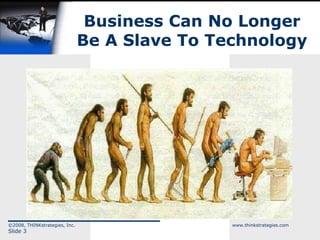
Business Can No Longer Be A Slave To Technology
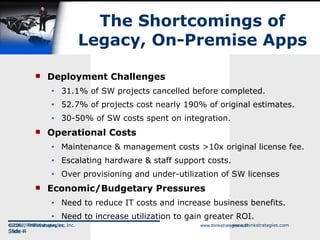
The Shortcomings of Legacy, On-Premise Apps Deployment Challenges 31.1% of SW projects cancelled before completed. 52.7% of projects cost nearly 190% of original estimates. 30-50% of SW costs spent on integration. Operational Costs Maintenance & management costs >10x original license fee. Escalating hardware & staff support costs. Over provisioning and under-utilization of SW licenses Economic/Budgetary Pressures Need to reduce IT costs and increase business benefits. Need to increase utilization to gain greater ROI. ©2008, THINKstrategies, Inc.  www.thinkstrategies.com Slide
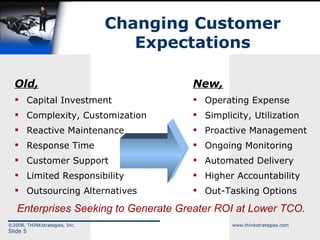
Changing Customer Expectations Old, Capital Investment Complexity, Customization Reactive Maintenance  Response Time Customer Support Limited Responsibility Outsourcing Alternatives New, Operating Expense Simplicity, Utilization Proactive Management Ongoing Monitoring Automated Delivery Higher Accountability Out-Tasking Options Enterprises Seeking to Generate Greater ROI at Lower TCO.
The Nicholas Carr Affect "...Imagine what future generations will see when they look back at the current time...won't the way corporate computing is practiced today appear fundamentally illogical -- and inherently doomed?” “ The End of Corporate Computing” Nicholas Carr, The MIT Sloan Management Review, Spring 2005.
Converting Software Products Into Services “ A hundred years ago, companies stopped generating their own power with steam engines and dynamos and plugged into the newly built electric grid…Today, a similar revolution is under way.” - Nicholas Carr
The Shift from Outsourcing to Out-Tasking Businesses seeking functionality, not technology. IT outsourcing deals have failed. Selective outsourcing, or ‘out-tasking’ gaining attention. SaaS is a form of out-tasking.
Software-as-a-Service (SaaS) Defined One-to-many SW distribution model delivered and managed by a vendor/service provider. Delivered to customers via a network, typically the Internet. Customers acquire SW on a pay-as-you-go basis. Also referred to as “ASP”, “On-Demand”, “Hosted”, “Managed Services”, etc. ©2008, THINKstrategies, Inc.  www.thinkstrategies.com Slide
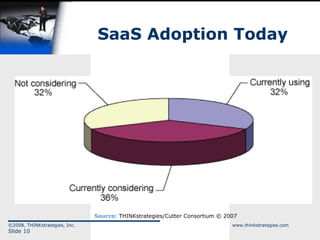
SaaS Adoption Today Source:  THINKstrategies/Cutter Consortium © 2007
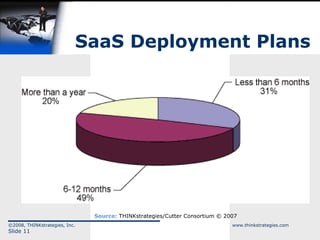
SaaS Deployment Plans Source:  THINKstrategies/Cutter Consortium © 2007
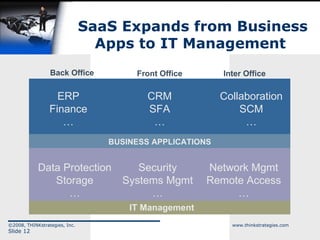
SaaS Expands from Business Apps to IT Management  BUSINESS APPLICATIONS CRM SFA … Collaboration SCM … ERP Finance … Front Office Inter Office Back Office Security Systems Mgmt … Network Mgmt Remote Access … Data Protection Storage … IT Management
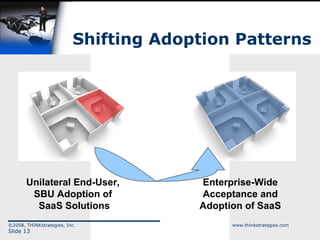
Shifting Adoption Patterns Unilateral End-User,  SBU Adoption of  SaaS Solutions Enterprise-Wide Acceptance and Adoption of SaaS
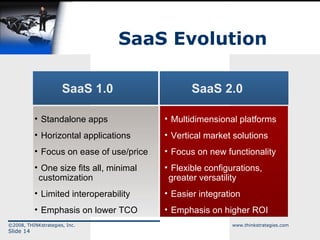
SaaS Evolution SaaS 1.0 SaaS 2.0 Standalone apps Horizontal applications Focus on ease of use/price One size fits all, minimal customization Limited interoperability Emphasis on lower TCO Multidimensional platforms Vertical market solutions Focus on new functionality Flexible configurations, greater versatility Easier integration Emphasis on higher ROI
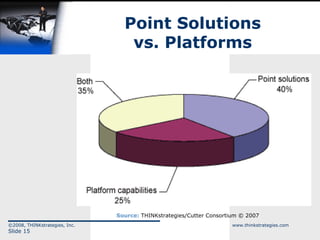
Point Solutions vs. Platforms Source:  THINKstrategies/Cutter Consortium © 2007
Competition and Validation
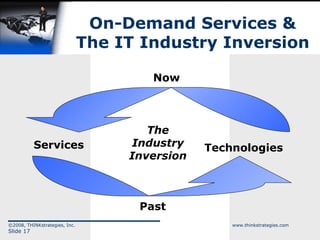
On-Demand Services & The IT Industry Inversion Services Technologies Past Now The Industry Inversion
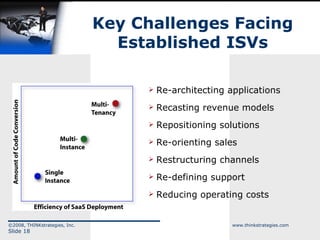
Key Challenges Facing Established ISVs Re-architecting applications Recasting revenue models Repositioning solutions Re-orienting sales Restructuring channels Re-defining support Reducing operating costs
Implications of Inversion R&D  focus on service delivery methodologies rather than product features. Marketing  focus on packaging and pricing services/solutions, not technology/products. Sales  focus on selling economic business value not product features. Customer support  focus on provisioning, billing and automated, remote management.
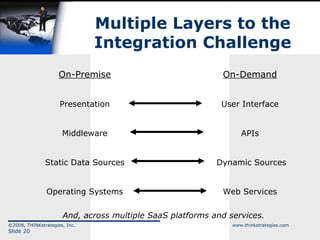
Multiple Layers to the Integration Challenge On-Premise Presentation Middleware Static Data Sources Operating Systems On-Demand User Interface APIs Dynamic Sources Web Services And, across multiple SaaS platforms and services.
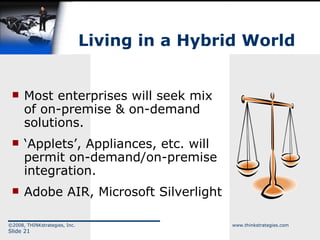
Living in a Hybrid World Most enterprises will seek mix of on-premise & on-demand solutions. ‘ Applets’, Appliances, etc. will permit on-demand/on-premise integration. Adobe AIR, Microsoft Silverlight
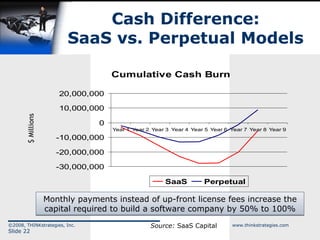
Cash Difference: SaaS vs. Perpetual Models Monthly payments instead of up-front license fees increase the capital required to build a software company by 50% to 100% $ Millions Source:  SaaS Capital
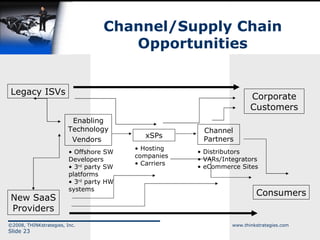
Channel/Supply Chain Opportunities Legacy ISVs New SaaS Providers Enabling Technology Vendors   Offshore SW Developers 3 rd  party SW platforms 3 rd  party HW systems xSPs Hosting companies Carriers Channel Partners Distributors VARs/Integrators eCommerce Sites Corporate Customers Consumers
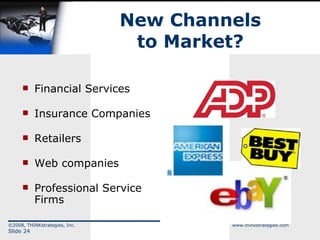
New Channels to Market? Financial Services Insurance Companies Retailers Web companies Professional Service Firms
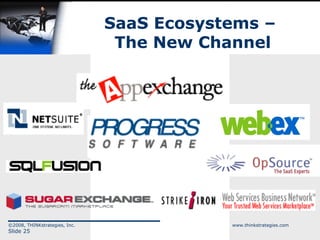
SaaS Ecosystems –  The New Channel
What SaaS Vendors Have Learned from Open Source
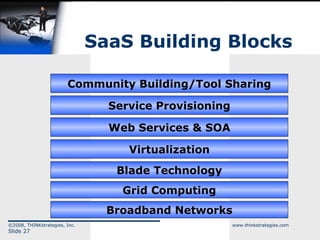
SaaS Building Blocks Broadband Networks Grid Computing Blade Technology Virtualization Web Services & SOA Service Provisioning Community Building/Tool Sharing
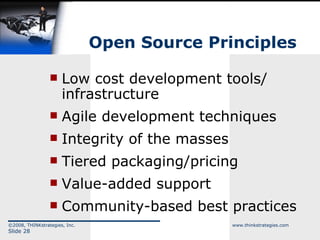
Open Source Principles Low cost development tools/ infrastructure Agile development techniques Integrity of the masses Tiered packaging/pricing Value-added support Community-based best practices
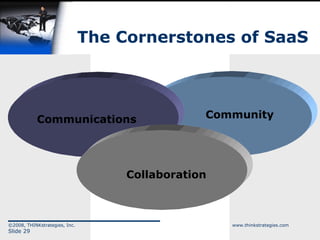
The Cornerstones of SaaS Communications Community Collaboration
The Value-Add of SaaS Communities Real-time, aggregated data Meaningful benchmark studies Practical best practices forums Continuous updates, new ideas Dynamic toolkit clearinghouse
Conclusions: SaaS & Open Source Gaining broad-based acceptance. Customers demanding greater functionality and flexibility. Market attracting more players and competition is driving down prices. SaaS providers must reduce costs and create new value. Open source world creating new tools, techniques, best practices and opportunities.
For More Information… www.SaaS-Showplace.com www.thinkstrategies.com [email_address]

THINKstrategies Open Source Presentation Software 2008

  • 1.
    Software 2008: TheConvergence of Open Source & SaaS Presented by, Jeff Kaplan Managing Director THINKstrategies [email_address] 781-431-2690
  • 2.
    The World IsChanging Changing Competitive Environment Changing Workers/Work Environment Changing Economic Climate/Pressures Changing Technology Environment
  • 3.
    Business Can NoLonger Be A Slave To Technology
  • 4.
    The Shortcomings ofLegacy, On-Premise Apps Deployment Challenges 31.1% of SW projects cancelled before completed. 52.7% of projects cost nearly 190% of original estimates. 30-50% of SW costs spent on integration. Operational Costs Maintenance & management costs >10x original license fee. Escalating hardware & staff support costs. Over provisioning and under-utilization of SW licenses Economic/Budgetary Pressures Need to reduce IT costs and increase business benefits. Need to increase utilization to gain greater ROI. ©2008, THINKstrategies, Inc. www.thinkstrategies.com Slide
  • 5.
    Changing Customer ExpectationsOld, Capital Investment Complexity, Customization Reactive Maintenance Response Time Customer Support Limited Responsibility Outsourcing Alternatives New, Operating Expense Simplicity, Utilization Proactive Management Ongoing Monitoring Automated Delivery Higher Accountability Out-Tasking Options Enterprises Seeking to Generate Greater ROI at Lower TCO.
  • 6.
    The Nicholas CarrAffect "...Imagine what future generations will see when they look back at the current time...won't the way corporate computing is practiced today appear fundamentally illogical -- and inherently doomed?” “ The End of Corporate Computing” Nicholas Carr, The MIT Sloan Management Review, Spring 2005.
  • 7.
    Converting Software ProductsInto Services “ A hundred years ago, companies stopped generating their own power with steam engines and dynamos and plugged into the newly built electric grid…Today, a similar revolution is under way.” - Nicholas Carr
  • 8.
    The Shift fromOutsourcing to Out-Tasking Businesses seeking functionality, not technology. IT outsourcing deals have failed. Selective outsourcing, or ‘out-tasking’ gaining attention. SaaS is a form of out-tasking.
  • 9.
    Software-as-a-Service (SaaS) DefinedOne-to-many SW distribution model delivered and managed by a vendor/service provider. Delivered to customers via a network, typically the Internet. Customers acquire SW on a pay-as-you-go basis. Also referred to as “ASP”, “On-Demand”, “Hosted”, “Managed Services”, etc. ©2008, THINKstrategies, Inc. www.thinkstrategies.com Slide
  • 10.
    SaaS Adoption TodaySource: THINKstrategies/Cutter Consortium © 2007
  • 11.
    SaaS Deployment PlansSource: THINKstrategies/Cutter Consortium © 2007
  • 12.
    SaaS Expands fromBusiness Apps to IT Management BUSINESS APPLICATIONS CRM SFA … Collaboration SCM … ERP Finance … Front Office Inter Office Back Office Security Systems Mgmt … Network Mgmt Remote Access … Data Protection Storage … IT Management
  • 13.
    Shifting Adoption PatternsUnilateral End-User, SBU Adoption of SaaS Solutions Enterprise-Wide Acceptance and Adoption of SaaS
  • 14.
    SaaS Evolution SaaS1.0 SaaS 2.0 Standalone apps Horizontal applications Focus on ease of use/price One size fits all, minimal customization Limited interoperability Emphasis on lower TCO Multidimensional platforms Vertical market solutions Focus on new functionality Flexible configurations, greater versatility Easier integration Emphasis on higher ROI
  • 15.
    Point Solutions vs.Platforms Source: THINKstrategies/Cutter Consortium © 2007
  • 16.
  • 17.
    On-Demand Services &The IT Industry Inversion Services Technologies Past Now The Industry Inversion
  • 18.
    Key Challenges FacingEstablished ISVs Re-architecting applications Recasting revenue models Repositioning solutions Re-orienting sales Restructuring channels Re-defining support Reducing operating costs
  • 19.
    Implications of InversionR&D focus on service delivery methodologies rather than product features. Marketing focus on packaging and pricing services/solutions, not technology/products. Sales focus on selling economic business value not product features. Customer support focus on provisioning, billing and automated, remote management.
  • 20.
    Multiple Layers tothe Integration Challenge On-Premise Presentation Middleware Static Data Sources Operating Systems On-Demand User Interface APIs Dynamic Sources Web Services And, across multiple SaaS platforms and services.
  • 21.
    Living in aHybrid World Most enterprises will seek mix of on-premise & on-demand solutions. ‘ Applets’, Appliances, etc. will permit on-demand/on-premise integration. Adobe AIR, Microsoft Silverlight
  • 22.
    Cash Difference: SaaSvs. Perpetual Models Monthly payments instead of up-front license fees increase the capital required to build a software company by 50% to 100% $ Millions Source: SaaS Capital
  • 23.
    Channel/Supply Chain OpportunitiesLegacy ISVs New SaaS Providers Enabling Technology Vendors Offshore SW Developers 3 rd party SW platforms 3 rd party HW systems xSPs Hosting companies Carriers Channel Partners Distributors VARs/Integrators eCommerce Sites Corporate Customers Consumers
  • 24.
    New Channels toMarket? Financial Services Insurance Companies Retailers Web companies Professional Service Firms
  • 25.
    SaaS Ecosystems – The New Channel
  • 26.
    What SaaS VendorsHave Learned from Open Source
  • 27.
    SaaS Building BlocksBroadband Networks Grid Computing Blade Technology Virtualization Web Services & SOA Service Provisioning Community Building/Tool Sharing
  • 28.
    Open Source PrinciplesLow cost development tools/ infrastructure Agile development techniques Integrity of the masses Tiered packaging/pricing Value-added support Community-based best practices
  • 29.
    The Cornerstones ofSaaS Communications Community Collaboration
  • 30.
    The Value-Add ofSaaS Communities Real-time, aggregated data Meaningful benchmark studies Practical best practices forums Continuous updates, new ideas Dynamic toolkit clearinghouse
  • 31.
    Conclusions: SaaS &Open Source Gaining broad-based acceptance. Customers demanding greater functionality and flexibility. Market attracting more players and competition is driving down prices. SaaS providers must reduce costs and create new value. Open source world creating new tools, techniques, best practices and opportunities.
  • 32.
    For More Information…www.SaaS-Showplace.com www.thinkstrategies.com [email_address]