CONSUMERLAB
INTERNET
GOES MOBILE
An Ericsson Consumer Insight Summary Report
April 2015
Country report Nigeria
This study analyzes evolving consumer expectations and
requirements for mobile broadband and other changing
services in Nigeria. We aim to highlight the underlying desires
of consumers when it comes to these services as well as their
perceptions of their current operators and services.
The report makes use of data compiled through a total of 1,653
face-to-face interviews with Nigerians between the ages of 15-69.
The research sample represents 30 million people between social
economic classes (SECs) A-D in metropolitan areas, representing
about 40 percent of Nigeria’s urban population.These interviews were
selected by random sampling and conducted across the country
in Lagos, Kano, Ibadan, Kaduna, Port Harcourt, Enugu and Abuja.
METHODOLOGY
2  ERICSSON CONSUMERLAB INTERNET GOES MOBILE
Ericsson ConsumerLab has 20 years’ experience of studying
people’s behaviors and values, including the way they act and think
about ICT products and services. Ericsson ConsumerLab provides
unique insights on market and consumer trends.
Ericsson ConsumerLab gains its knowledge through a global
consumer research program based on interviews with 100,000
individuals each year, in more than 40 countries and 15 megacities –
statistically representing the views of 1.1 billion people.
Both quantitative and qualitative methods are used, and hundreds of
hours are spent with consumers from different cultures. To be close
to the market and consumers, Ericsson ConsumerLab has analysts
in all regions where Ericsson is present, developing a thorough
global understanding of the ICT market and business models.
All reports can be found at: www.ericsson.com/consumerlab
the voice of the consumer
contents
FROM DUSK ’TIL DAWN	 3
LOCATION EQUATION	 4
CONNECTIVITY CALCULATIONS	 5
SERVICE AND DEVICE PICKS	 7
Key findings
ERICSSON CONSUMERLAB INTERNET GOES MOBILE  3
From the marketplace to the boardroom, from schools
to households, the free flow of ideas and information
shapes our lives and our everyday decisions. Having
access to relevant information at any time and
location has become integral for consumers across
the globe. Nigeria is no different, with its growing
economy and a population that is eager to explore
new ways of performing different activities.
Users expect good service, wherever they are
>	 Irrespective of their location, users want to
remain connected with messaging and calling,
updated with browsing and social networking
and have access to entertainment (mainly music)
>	 45 percent of those who send messages
regularly use internet based instant
messaging services
Mobile phones have the highest device
share of internet services
>	 84 percent of smartphones are connected
to the internet
>	 82 percent of mobile phone users access
the internet with their device on a daily basis.
45 percent of PC users and 44 percent of
tablet users do the same
Widespread usage of mobile broadband
(MBB) services
>	 Many more use mobile broadband across
devices (laptops, mobile phones and tablets)
than Wi-Fi
>	 More than 95 percent of mobile broadband users
access mobile broadband on smartphones
The availability of good network and voice quality
drives up consumer satisfaction
>	 56 percent of mobile phone users are satisfied
with data speed and voice connection quality
>	 Over 50 percent of those who
switch between Wi-Fi and
mobile broadband do so due
to changing locations or the
availability of connections
FROM DUSK
’TIL DAWN
Exploring new ways of doing
business
4  ERICSSON CONSUMERLAB INTERNET GOES MOBILE
LOCATION EQUATION
11%
2%
52%
10%
71%
9%
86%
12%
89%
28%
94%
28%
94%
31%
97%
37%
97%
54%
LISTENING
TO MUSIC
GAMINGSOCIAL
NETWORKING
CALLS ONLINE
SHOPPING
WATCHING
VIDEO
WORK/STUDY
RELATED
MESSAGING INTERNET
BROWSING
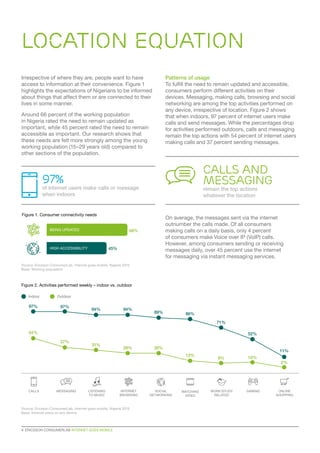
Figure 2. Activities performed weekly – indoor vs. outdoor
Indoor Outdoor
Source: Ericsson ConsumerLab, Internet goes mobile, Nigeria 2015
Base: Internet users on any device
Irrespective of where they are, people want to have
access to information at their convenience. Figure 1
highlights the expectations of Nigerians to be informed
about things that affect them or are connected to their
lives in some manner.
Around 66 percent of the working population
in Nigeria rated the need to remain updated as
important, while 45 percent rated the need to remain
accessible as important. Our research shows that
these needs are felt more strongly among the young
working population (15–29 years old) compared to
other sections of the population.
Figure 1. Consumer connectivity needs
Source: Ericsson ConsumerLab, Internet goes mobile, Nigeria 2015
Base: Working population
HIGH ACCESSIBILITY
BEING UPDATED 66%
45%
calls and
messaging
remain the top actions
whatever the location
97%
of internet users make calls or message
when indoors
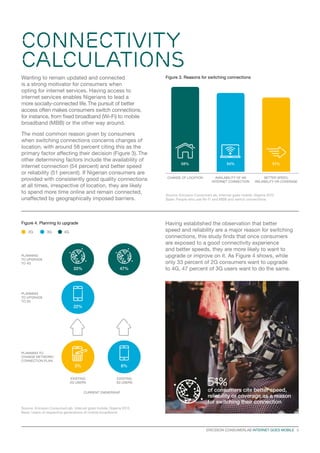
Patterns of usage
To fulfill the need to remain updated and accessible,
consumers perform different activities on their
devices. Messaging, making calls, browsing and social
networking are among the top activities performed on
any device, irrespective of location. Figure 2 shows
that when indoors, 97 percent of internet users make
calls and send messages. While the percentages drop
for activities performed outdoors, calls and messaging
remain the top actions with 54 percent of internet users
making calls and 37 percent sending messages.
On average, the messages sent via the internet
outnumber the calls made. Of all consumers
making calls on a daily basis, only 4 percent
of consumers make Voice over IP (VoIP) calls.
However, among consumers sending or receiving
messages daily, over 45 percent use the internet
for messaging via instant messaging services.
ERICSSON CONSUMERLAB INTERNET GOES MOBILE   5
Wanting to remain updated and connected
is a strong motivator for consumers when
opting for internet services. Having access to
internet services enables Nigerians to lead a
more socially-connected life.The pursuit of better
access often makes consumers switch connections,
for instance, from fixed broadband (Wi-Fi) to mobile
broadband (MBB) or the other way around.
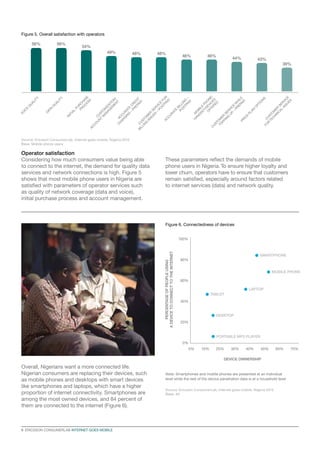
The most common reason given by consumers
when switching connections concerns changes of
location, with around 58 percent citing this as the
primary factor affecting their decision (Figure 3). The
other determining factors include the availability of
internet connection (54 percent) and better speed
or reliability (51 percent). If Nigerian consumers are
provided with consistently good quality connections
at all times, irrespective of location, they are likely
to spend more time online and remain connected,
unaffected by geographically imposed barriers.
51%
of consumers cite better speed,
reliability or coverage as a reason
for switching their connection
Figure 3. Reasons for switching connections
Figure 4. Planning to upgrade
Source: Ericsson ConsumerLab, Internet goes mobile, Nigeria 2015
Base: People who use Wi-Fi and MBB and switch connections
BETTER SPEED,
RELIABILITY OR COVERAGE
51%
CHANGE OF LOCATION
58%
AVAILABILITY OF AN
INTERNET CONNECTION
54%
Source: Ericsson ConsumerLab, Internet goes mobile, Nigeria 2015
Base: Users of respective generations of mobile broadband
2G 3G 4G
CURRENT OWNERSHIP
Having established the observation that better
speed and reliability are a major reason for switching
connections, this study finds that once consumers
are exposed to a good connectivity experience
and better speeds, they are more likely to want to
upgrade or improve on it. As Figure 4 shows, while
only 33 percent of 2G consumers want to upgrade
to 4G, 47 percent of 3G users want to do the same.
PLANNING
TO UPGRADE
TO 4G
PLANNING
TO UPGRADE
TO 3G
PLANNING TO
CHANGE NETWORK/
CONNECTION PLAN
EXISTING
3G USERS
EXISTING
2G USERS
8%
47%
3%
22%
33%
Connectivity
Calculations
6  ERICSSON CONSUMERLAB INTERNET GOES MOBILE
Figure 5. Overall satisfaction with operators
Source: Ericsson ConsumerLab, Internet goes mobile, Nigeria 2015
Base: Mobile phone users
Overall, Nigerians want a more connected life.
Nigerian consumers are replacing their devices, such
as mobile phones and desktops with smart devices
like smartphones and laptops, which have a higher
proportion of internet connectivity. Smartphones are
among the most owned devices, and 84 percent of
them are connected to the internet (Figure 6).
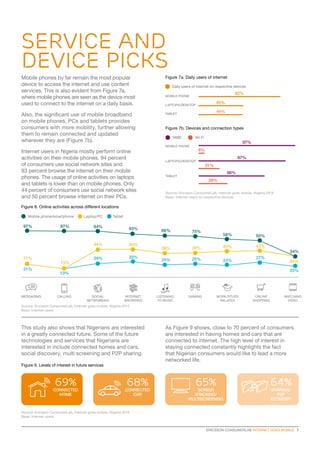
Operator satisfaction
Considering how much consumers value being able
to connect to the internet, the demand for quality data
services and network connections is high. Figure 5
shows that most mobile phone users in Nigeria are
satisfied with parameters of operator services such
as quality of network coverage (data and voice),
initial purchase process and account management.
These parameters reflect the demands of mobile
phone users in Nigeria.To ensure higher loyalty and
lower churn, operators have to ensure that customers
remain satisfied, especially around factors related
to internet services (data) and network quality.
VO
IC
E
Q
UALITY
DATA
Q
UALITY
C
U
STO
M
IZATIO
N
/
AC
C
O
U
N
T
M
AN
AG
EM
EN
T
AC
C
U
RATE
BILLIN
G
–
PO
STPAID
PRIC
E
PLAN
O
PTIO
N
S
C
U
STO
M
ER
SERVIC
E
W
H
ILE
TO
PPIN
G
U
P
–
PREPAID
M
O
BILE
PH
O
N
E/
H
AN
DSET/DEVIC
ES
O
FFERED
AC
C
U
RATE
C
REDIT
C
H
ARG
IN
G
–
PREPAID
C
U
STO
M
ER
SERVIC
E
FO
R
TEC
H
N
ICAL
ISSU
ES
IN
ITIAL
PU
RC
H
ASE
PRO
C
ESS
C
U
STO
M
ER
SERVIC
E
FO
R
BILLIN
G
ISSU
ES
–
PO
STPAID
56% 56%
54%
49% 48% 48%
46% 46%
44% 43%
39%
Figure 6. Connectedness of devices
Source: Ericsson ConsumerLab, Internet goes mobile, Nigeria 2015
Base: All
Note: Smartphones and mobile phones are presented at an individual
level while the rest of the device penetration data is at a household level
0%
0% 10% 20% 30% 40% 50% 60% 70%
60%
20%
80%
40%
100%
LAPTOP
SMARTPHONE
DESKTOP
PORTABLE MP3 PLAYER
MOBILE PHONE
TABLET
DEVICE OWNERSHIP
PERCENTAGEOFPEOPLEUSING
ADEVICETOCONNECTTOTHEINTERNET
ERICSSON CONSUMERLAB INTERNET GOES MOBILE   7
Service and
Device picks
Figure 9. Levels of interest in future services
This study also shows that Nigerians are interested
in a greatly connected future. Some of the future
technologies and services that Nigerians are
interested in include connected homes and cars,
social discovery, multi screening and P2P sharing.
As Figure 9 shows, close to 70 percent of consumers
are interested in having homes and cars that are
connected to internet. The high level of interest in
staying connected constantly highlights the fact
that Nigerian consumers would like to lead a more
networked life.
Source: Ericsson ConsumerLab, Internet goes mobile, Nigeria 2015
Base: Internet users
69% 68% 65% 64%
CONNECTED
HOME
CONNECTED
CAR
SCREEN
STACKING/
MULTISCREENING
SHARING/
P2P
ECONOMY
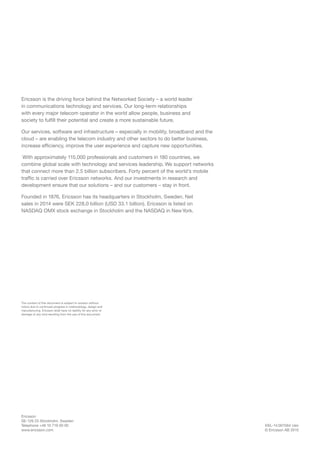
Mobile phones by far remain the most popular
device to access the internet and use content
services. This is also evident from Figure 7a,
where mobile phones are seen as the device most
used to connect to the internet on a daily basis.
Also, the significant use of mobile broadband
on mobile phones, PCs and tablets provides
consumers with more mobility, further allowing
them to remain connected and updated
wherever they are (Figure 7b).
Internet users in Nigeria mostly perform online
activities on their mobile phones. 94 percent
of consumers use social network sites and
93 percent browse the internet on their mobile
phones. The usage of online activities on laptops
and tablets is lower than on mobile phones. Only
44 percent of consumers use social network sites
and 50 percent browse internet on their PCs.
82%
45%
44%
Figure 7a. Daily users of internet
MOBILE PHONE
LAPTOPS/DESKTOP
TABLET
Daily users of internet on respective devices
Source: Ericsson ConsumerLab, Internet goes mobile, Nigeria 2015
Base: Internet users on respective devices
97%
6%
87%
66%
21%
29%
Figure 7b. Devices and connection types
MOBILE PHONE
LAPTOPS/DESKTOP
TABLET
MBB Wi-Fi
Source: Ericsson ConsumerLab, Internet goes mobile, Nigeria 2015
Base: Internet users
Figure 8. Online activities across different locations
CALLING LISTENING
TO MUSIC
GAMINGSOCIAL
NETWORKING
ONLINE
SHOPPING
WATCHING
VIDEO
WORK/STUDY
RELATED
MESSAGING INTERNET
BROWSING
Mobile phone/smartphone Laptop/PC Tablet
97% 97% 94% 93% 86% 75%
56% 50%
34%
21%
13%
44% 50%
36% 39% 43% 43%
34%
21%
13%
29% 33%
24% 25% 23%
27%
23%
EKL-14:001564 Uen
© Ericsson AB 2015
Ericsson
SE-126 25 Stockholm, Sweden
Telephone +46 10 719 00 00
www.ericsson.com
The content of this document is subject to revision without
notice due to continued progress in methodology, design and
manufacturing. Ericsson shall have no liability for any error or
damage of any kind resulting from the use of this document.
Ericsson is the driving force behind the Networked Society – a world leader
in communications technology and services. Our long-term relationships
with every major telecom operator in the world allow people, business and
society to fulfill their potential and create a more sustainable future.
Our services, software and infrastructure – especially in mobility, broadband and the
cloud – are enabling the telecom industry and other sectors to do better business,
increase efficiency, improve the user experience and capture new opportunities.
With approximately 115,000 professionals and customers in 180 countries, we
combine global scale with technology and services leadership. We support networks
that connect more than 2.5 billion subscribers. Forty percent of the world’s mobile
traffic is carried over Ericsson networks. And our investments in research and
development ensure that our solutions – and our customers – stay in front.
Founded in 1876, Ericsson has its headquarters in Stockholm, Sweden. Net
sales in 2014 were SEK 228.0 billion (USD 33.1 billion). Ericsson is listed on
NASDAQ OMX stock exchange in Stockholm and the NASDAQ in NewYork.

Ericsson ConsumerLab: Internet goes mobile - Nigeria

  • 1.
    CONSUMERLAB INTERNET GOES MOBILE An EricssonConsumer Insight Summary Report April 2015 Country report Nigeria
  • 2.
    This study analyzesevolving consumer expectations and requirements for mobile broadband and other changing services in Nigeria. We aim to highlight the underlying desires of consumers when it comes to these services as well as their perceptions of their current operators and services. The report makes use of data compiled through a total of 1,653 face-to-face interviews with Nigerians between the ages of 15-69. The research sample represents 30 million people between social economic classes (SECs) A-D in metropolitan areas, representing about 40 percent of Nigeria’s urban population.These interviews were selected by random sampling and conducted across the country in Lagos, Kano, Ibadan, Kaduna, Port Harcourt, Enugu and Abuja. METHODOLOGY 2  ERICSSON CONSUMERLAB INTERNET GOES MOBILE Ericsson ConsumerLab has 20 years’ experience of studying people’s behaviors and values, including the way they act and think about ICT products and services. Ericsson ConsumerLab provides unique insights on market and consumer trends. Ericsson ConsumerLab gains its knowledge through a global consumer research program based on interviews with 100,000 individuals each year, in more than 40 countries and 15 megacities – statistically representing the views of 1.1 billion people. Both quantitative and qualitative methods are used, and hundreds of hours are spent with consumers from different cultures. To be close to the market and consumers, Ericsson ConsumerLab has analysts in all regions where Ericsson is present, developing a thorough global understanding of the ICT market and business models. All reports can be found at: www.ericsson.com/consumerlab the voice of the consumer contents FROM DUSK ’TIL DAWN 3 LOCATION EQUATION 4 CONNECTIVITY CALCULATIONS 5 SERVICE AND DEVICE PICKS 7
  • 3.
    Key findings ERICSSON CONSUMERLABINTERNET GOES MOBILE  3 From the marketplace to the boardroom, from schools to households, the free flow of ideas and information shapes our lives and our everyday decisions. Having access to relevant information at any time and location has become integral for consumers across the globe. Nigeria is no different, with its growing economy and a population that is eager to explore new ways of performing different activities. Users expect good service, wherever they are > Irrespective of their location, users want to remain connected with messaging and calling, updated with browsing and social networking and have access to entertainment (mainly music) > 45 percent of those who send messages regularly use internet based instant messaging services Mobile phones have the highest device share of internet services > 84 percent of smartphones are connected to the internet > 82 percent of mobile phone users access the internet with their device on a daily basis. 45 percent of PC users and 44 percent of tablet users do the same Widespread usage of mobile broadband (MBB) services > Many more use mobile broadband across devices (laptops, mobile phones and tablets) than Wi-Fi > More than 95 percent of mobile broadband users access mobile broadband on smartphones The availability of good network and voice quality drives up consumer satisfaction > 56 percent of mobile phone users are satisfied with data speed and voice connection quality > Over 50 percent of those who switch between Wi-Fi and mobile broadband do so due to changing locations or the availability of connections FROM DUSK ’TIL DAWN Exploring new ways of doing business
  • 4.
    4  ERICSSON CONSUMERLABINTERNET GOES MOBILE LOCATION EQUATION 11% 2% 52% 10% 71% 9% 86% 12% 89% 28% 94% 28% 94% 31% 97% 37% 97% 54% LISTENING TO MUSIC GAMINGSOCIAL NETWORKING CALLS ONLINE SHOPPING WATCHING VIDEO WORK/STUDY RELATED MESSAGING INTERNET BROWSING Figure 2. Activities performed weekly – indoor vs. outdoor Indoor Outdoor Source: Ericsson ConsumerLab, Internet goes mobile, Nigeria 2015 Base: Internet users on any device Irrespective of where they are, people want to have access to information at their convenience. Figure 1 highlights the expectations of Nigerians to be informed about things that affect them or are connected to their lives in some manner. Around 66 percent of the working population in Nigeria rated the need to remain updated as important, while 45 percent rated the need to remain accessible as important. Our research shows that these needs are felt more strongly among the young working population (15–29 years old) compared to other sections of the population. Figure 1. Consumer connectivity needs Source: Ericsson ConsumerLab, Internet goes mobile, Nigeria 2015 Base: Working population HIGH ACCESSIBILITY BEING UPDATED 66% 45% calls and messaging remain the top actions whatever the location 97% of internet users make calls or message when indoors Patterns of usage To fulfill the need to remain updated and accessible, consumers perform different activities on their devices. Messaging, making calls, browsing and social networking are among the top activities performed on any device, irrespective of location. Figure 2 shows that when indoors, 97 percent of internet users make calls and send messages. While the percentages drop for activities performed outdoors, calls and messaging remain the top actions with 54 percent of internet users making calls and 37 percent sending messages. On average, the messages sent via the internet outnumber the calls made. Of all consumers making calls on a daily basis, only 4 percent of consumers make Voice over IP (VoIP) calls. However, among consumers sending or receiving messages daily, over 45 percent use the internet for messaging via instant messaging services.
  • 5.
    ERICSSON CONSUMERLAB INTERNETGOES MOBILE   5 Wanting to remain updated and connected is a strong motivator for consumers when opting for internet services. Having access to internet services enables Nigerians to lead a more socially-connected life.The pursuit of better access often makes consumers switch connections, for instance, from fixed broadband (Wi-Fi) to mobile broadband (MBB) or the other way around. The most common reason given by consumers when switching connections concerns changes of location, with around 58 percent citing this as the primary factor affecting their decision (Figure 3). The other determining factors include the availability of internet connection (54 percent) and better speed or reliability (51 percent). If Nigerian consumers are provided with consistently good quality connections at all times, irrespective of location, they are likely to spend more time online and remain connected, unaffected by geographically imposed barriers. 51% of consumers cite better speed, reliability or coverage as a reason for switching their connection Figure 3. Reasons for switching connections Figure 4. Planning to upgrade Source: Ericsson ConsumerLab, Internet goes mobile, Nigeria 2015 Base: People who use Wi-Fi and MBB and switch connections BETTER SPEED, RELIABILITY OR COVERAGE 51% CHANGE OF LOCATION 58% AVAILABILITY OF AN INTERNET CONNECTION 54% Source: Ericsson ConsumerLab, Internet goes mobile, Nigeria 2015 Base: Users of respective generations of mobile broadband 2G 3G 4G CURRENT OWNERSHIP Having established the observation that better speed and reliability are a major reason for switching connections, this study finds that once consumers are exposed to a good connectivity experience and better speeds, they are more likely to want to upgrade or improve on it. As Figure 4 shows, while only 33 percent of 2G consumers want to upgrade to 4G, 47 percent of 3G users want to do the same. PLANNING TO UPGRADE TO 4G PLANNING TO UPGRADE TO 3G PLANNING TO CHANGE NETWORK/ CONNECTION PLAN EXISTING 3G USERS EXISTING 2G USERS 8% 47% 3% 22% 33% Connectivity Calculations
  • 6.
    6  ERICSSON CONSUMERLABINTERNET GOES MOBILE Figure 5. Overall satisfaction with operators Source: Ericsson ConsumerLab, Internet goes mobile, Nigeria 2015 Base: Mobile phone users Overall, Nigerians want a more connected life. Nigerian consumers are replacing their devices, such as mobile phones and desktops with smart devices like smartphones and laptops, which have a higher proportion of internet connectivity. Smartphones are among the most owned devices, and 84 percent of them are connected to the internet (Figure 6). Operator satisfaction Considering how much consumers value being able to connect to the internet, the demand for quality data services and network connections is high. Figure 5 shows that most mobile phone users in Nigeria are satisfied with parameters of operator services such as quality of network coverage (data and voice), initial purchase process and account management. These parameters reflect the demands of mobile phone users in Nigeria.To ensure higher loyalty and lower churn, operators have to ensure that customers remain satisfied, especially around factors related to internet services (data) and network quality. VO IC E Q UALITY DATA Q UALITY C U STO M IZATIO N / AC C O U N T M AN AG EM EN T AC C U RATE BILLIN G – PO STPAID PRIC E PLAN O PTIO N S C U STO M ER SERVIC E W H ILE TO PPIN G U P – PREPAID M O BILE PH O N E/ H AN DSET/DEVIC ES O FFERED AC C U RATE C REDIT C H ARG IN G – PREPAID C U STO M ER SERVIC E FO R TEC H N ICAL ISSU ES IN ITIAL PU RC H ASE PRO C ESS C U STO M ER SERVIC E FO R BILLIN G ISSU ES – PO STPAID 56% 56% 54% 49% 48% 48% 46% 46% 44% 43% 39% Figure 6. Connectedness of devices Source: Ericsson ConsumerLab, Internet goes mobile, Nigeria 2015 Base: All Note: Smartphones and mobile phones are presented at an individual level while the rest of the device penetration data is at a household level 0% 0% 10% 20% 30% 40% 50% 60% 70% 60% 20% 80% 40% 100% LAPTOP SMARTPHONE DESKTOP PORTABLE MP3 PLAYER MOBILE PHONE TABLET DEVICE OWNERSHIP PERCENTAGEOFPEOPLEUSING ADEVICETOCONNECTTOTHEINTERNET
  • 7.
    ERICSSON CONSUMERLAB INTERNETGOES MOBILE   7 Service and Device picks Figure 9. Levels of interest in future services This study also shows that Nigerians are interested in a greatly connected future. Some of the future technologies and services that Nigerians are interested in include connected homes and cars, social discovery, multi screening and P2P sharing. As Figure 9 shows, close to 70 percent of consumers are interested in having homes and cars that are connected to internet. The high level of interest in staying connected constantly highlights the fact that Nigerian consumers would like to lead a more networked life. Source: Ericsson ConsumerLab, Internet goes mobile, Nigeria 2015 Base: Internet users 69% 68% 65% 64% CONNECTED HOME CONNECTED CAR SCREEN STACKING/ MULTISCREENING SHARING/ P2P ECONOMY Mobile phones by far remain the most popular device to access the internet and use content services. This is also evident from Figure 7a, where mobile phones are seen as the device most used to connect to the internet on a daily basis. Also, the significant use of mobile broadband on mobile phones, PCs and tablets provides consumers with more mobility, further allowing them to remain connected and updated wherever they are (Figure 7b). Internet users in Nigeria mostly perform online activities on their mobile phones. 94 percent of consumers use social network sites and 93 percent browse the internet on their mobile phones. The usage of online activities on laptops and tablets is lower than on mobile phones. Only 44 percent of consumers use social network sites and 50 percent browse internet on their PCs. 82% 45% 44% Figure 7a. Daily users of internet MOBILE PHONE LAPTOPS/DESKTOP TABLET Daily users of internet on respective devices Source: Ericsson ConsumerLab, Internet goes mobile, Nigeria 2015 Base: Internet users on respective devices 97% 6% 87% 66% 21% 29% Figure 7b. Devices and connection types MOBILE PHONE LAPTOPS/DESKTOP TABLET MBB Wi-Fi Source: Ericsson ConsumerLab, Internet goes mobile, Nigeria 2015 Base: Internet users Figure 8. Online activities across different locations CALLING LISTENING TO MUSIC GAMINGSOCIAL NETWORKING ONLINE SHOPPING WATCHING VIDEO WORK/STUDY RELATED MESSAGING INTERNET BROWSING Mobile phone/smartphone Laptop/PC Tablet 97% 97% 94% 93% 86% 75% 56% 50% 34% 21% 13% 44% 50% 36% 39% 43% 43% 34% 21% 13% 29% 33% 24% 25% 23% 27% 23%
  • 8.
    EKL-14:001564 Uen © EricssonAB 2015 Ericsson SE-126 25 Stockholm, Sweden Telephone +46 10 719 00 00 www.ericsson.com The content of this document is subject to revision without notice due to continued progress in methodology, design and manufacturing. Ericsson shall have no liability for any error or damage of any kind resulting from the use of this document. Ericsson is the driving force behind the Networked Society – a world leader in communications technology and services. Our long-term relationships with every major telecom operator in the world allow people, business and society to fulfill their potential and create a more sustainable future. Our services, software and infrastructure – especially in mobility, broadband and the cloud – are enabling the telecom industry and other sectors to do better business, increase efficiency, improve the user experience and capture new opportunities. With approximately 115,000 professionals and customers in 180 countries, we combine global scale with technology and services leadership. We support networks that connect more than 2.5 billion subscribers. Forty percent of the world’s mobile traffic is carried over Ericsson networks. And our investments in research and development ensure that our solutions – and our customers – stay in front. Founded in 1876, Ericsson has its headquarters in Stockholm, Sweden. Net sales in 2014 were SEK 228.0 billion (USD 33.1 billion). Ericsson is listed on NASDAQ OMX stock exchange in Stockholm and the NASDAQ in NewYork.