Copyright © Texas Education Agency, 2017. All rights reserved. 1
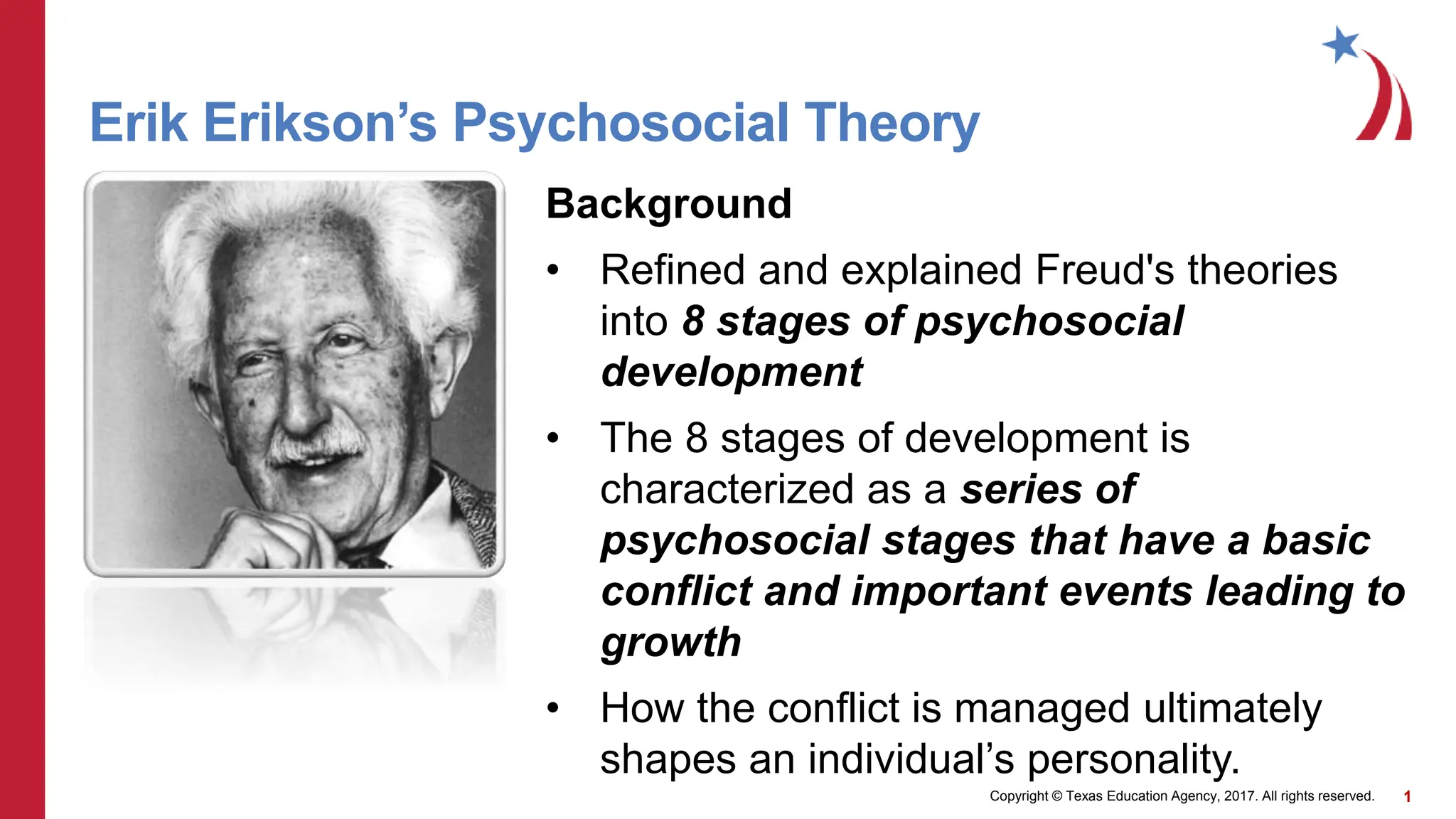
Erik Erikson’s Psychosocial Theory
Background
• Refined and explained Freud's theories
into 8 stages of psychosocial
development
• The 8 stages of development is
characterized as a series of
psychosocial stages that have a basic
conflict and important events leading to
growth
• How the conflict is managed ultimately
shapes an individual’s personality.
Copyright © Texas Education Agency, 2017. All rights reserved. 2
Erik Erikson
• Proposed a theory of psychosocial development from infancy to
adulthood.
• During each stage, the person experiences a psychosocial crisis
which could have a positive or negative outcome on personality
development.
• The success of each stage depends on how well the previous crisis was
resolved.
• The successful completion of each of these stages results in a healthy
personality and acquiring new virtues
• Failure to complete any of these stages results in a reduced capacity to
complete the other stages, which in turn results in an unhealthy
personality and sense of self
Copyright © Texas Education Agency, 2017. All rights reserved. 3
Erikson
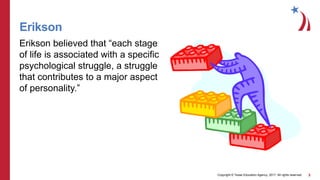
Erikson believed that “each stage
of life is associated with a specific
psychological struggle, a struggle
that contributes to a major aspect
of personality.”
Copyright © Texas Education Agency, 2017. All rights reserved. 4
Psychosocial Theory – Erikson
 Childhood is very important in
personality development
 Accepted many of Freud's
theories, including the id, ego
and superego
 Unlike Freud, felt that
personality continued to
develop beyond five years of
age
Copyright © Texas Education Agency, 2017. All rights reserved. 5
Erikson
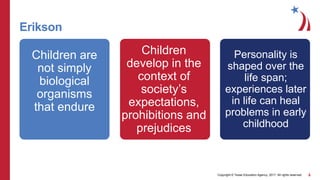
Children are
not simply
biological
organisms
that endure
Children
develop in the
context of
society’s
expectations,
prohibitions and
prejudices
Personality is
shaped over the
life span;
experiences later
in life can heal
problems in early
childhood
Copyright © Texas Education Agency, 2017. All rights reserved. 6
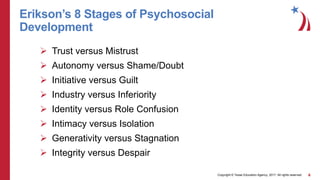
Erikson’s 8 Stages of Psychosocial
Development
 Trust versus Mistrust
 Autonomy versus Shame/Doubt
 Initiative versus Guilt
 Industry versus Inferiority
 Identity versus Role Confusion
 Intimacy versus Isolation
 Generativity versus Stagnation
 Integrity versus Despair
Copyright © Texas Education Agency, 2017. All rights reserved. 7
Stage 1: Trust vs. Mistrust (birth to 1 year)
Infancy
• Virtue: Hope
• Important event: Feeding
• Children develop a sense of trust when caregivers provide reliability,
care and affection. A lack of this will lead to mistrust
For example....
• With warm and responsive care, infants gain a sense of TRUST
• Infant may develop a secure attachment with caregiver
• Secure attachment: A relationship in which an infant obtains both
comfort and confidence from the presence of his or her caregiver.
• They feel confident and sees the world as a fun, safe
Copyright © Texas Education Agency, 2017. All rights reserved. 8
Stage 1: Trust vs. Mistrust (birth to 1 year)
Infancy
• Mistrust develops when infants have to wait too long for comfort or are
handled too harshly
• These infants may develop insecure-avoidant attachment
• Insecure-avoidant attachment: A pattern of attachment in which an
infant avoids connection with the caregiver, as when the infant seems
not to care about the caregiver's presence, departure or return
• Infants are mistrustful
• Change in infant's Temperament and as a result develop anxiety
• Temperament: is defined as the “biologically based core of individual
differences in styles of approach and response to the environment that
is stable across time and situations
Copyright © Texas Education Agency, 2017. All rights reserved. 9
Stage 2: Autonomy vs. Shame and Doubt
(1 to 3 years) Early Childhood
• Virtue: Will
• Important Events: Toilet Training, feeding
• Children need to develop a sense of personal control over physical
skills and a sense of independence. Success leads to feeling of
autonomy, failure results in feelings of shame and doubt
• Children starts wanting to choose and make decisions for themselves
• Autonomy is nurtured when parents allow kids to make reasonable
choices/decisions
• “Which pair of shoes do you want to wear?”
Copyright © Texas Education Agency, 2017. All rights reserved. 10
Stage 2: Autonomy vs. Shame and Doubt
(1 to 3 years) Early Childhood
• Children do not learn to be independent and begin to doubt their ability
to make good choices
• Feels shameful
• Authoritarian parenting: An approach to child rearing that is
characterized by high behavioral standards, strict punishment for
misconduct, and little communication from child to parent
• Authoritarian parent: "You're wearing this shirt because I said so"
• When parents are over-controlling and uses an authoritarian parenting
style and do not allow reasonable choices.
Copyright © Texas Education Agency, 2017. All rights reserved. 11
Stage 3: Initiative vs. Guilt
(4 to 5 years) Preschool
• Virtue: Purpose
• Important Event: Exploration
• Children need to begin asserting control and power over the
environment. Success in this stage leads to a sense of purpose.
Children who try to exert too much power experience disapproval,
resulting in a sense of guilt.
In this stage the child learns to:
• Cooperate with peers
• Develop their ability to lead others
• Imagine and to broaden his/her skills e.g. tying a shoe lace, doing their
zippers and dressing themselves
Copyright © Texas Education Agency, 2017. All rights reserved. 12
Stage 3: Initiative vs. Guilt
(4 to 5 years) Preschool
Outcomes
• When those tasks/initiative undertaken are achieved they feel good
about themselves and their accomplishments
• When the undertaken tasks does not produce the desired results, the
child feels guilt
Guilt can also result in:
• aggressive behaviors (e.g., yelling and throwing objects)
• fearfulness
• social phobias
Copyright © Texas Education Agency, 2017. All rights reserved. 13
Stage 4: Industry vs. Inferiority
(6 to 11 years) Middle and Late Childhood
• Virtue: Competence
• Important Event: School
• Children need to cope with new social and academic demand. Success
leads to a sense of competence, while failure results in feeling of
inferiority.
Key Features
• Children busily practices and then master new skills
• For example, children are more eager to learn and put a lot more effort
into becoming better at more complexed skills like reading, telling time,
writing structured sentences etc.
Copyright © Texas Education Agency, 2017. All rights reserved. 14
Stage 4: Industry vs. Inferiority
(6 to 11 years) Middle and Late Childhood
• Industry develops when children have successful experiences in:
 School
 Extra-curricular activities
 Social groups
• Inferiority develops when children have negative experiences that lead
to feelings of incompetence
• For example; a child that is not good at soccer like his/her peers may
feel incompetent/ inferior
Copyright © Texas Education Agency, 2017. All rights reserved. 15
Stage 5: Identity vs. Role Confusion
(12 to 19 years) Adolescence
• Virtue: Fidelity
• Important Event: Social relationship
• Teens need to develop a sense of self and personal identity. Success
leads to an ability to stay true to self, while failure leads to role
confusion and a weak sense of self.
Key Features
• Adolescence ask and tries to answer the question: “who am I?”
• They acquire a sense of identity or can be confused about what their
roles are in the adult world
• In response to role confusion or identity crisis, an adolescent may begin
to experiment with different lifestyles (e.g., work, education or political
activities)
Copyright © Texas Education Agency, 2017. All rights reserved. 16
Stage 6: Intimacy vs. Isolation
(20 to 25 years) Young adulthood
• Virtue: Love
• Important Event: Relationships
• Young adults need to form intimate, loving relationships with others.
Success leads to strong relationships, while failure results in loneliness
and isolation.
Outcomes
• The successful adult can experience true intimacy, which makes things
possible like enduring friendships and marriage.
• Because of earlier disappointments, some individuals cannot form close
relationships with others and remain isolated.
Copyright © Texas Education Agency, 2017. All rights reserved. 17
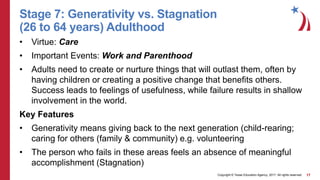
Stage 7: Generativity vs. Stagnation
(26 to 64 years) Adulthood
• Virtue: Care
• Important Events: Work and Parenthood
• Adults need to create or nurture things that will outlast them, often by
having children or creating a positive change that benefits others.
Success leads to feelings of usefulness, while failure results in shallow
involvement in the world.
Key Features
• Generativity means giving back to the next generation (child-rearing;
caring for others (family & community) e.g. volunteering
• The person who fails in these areas feels an absence of meaningful
accomplishment (Stagnation)
Copyright © Texas Education Agency, 2017. All rights reserved. 18
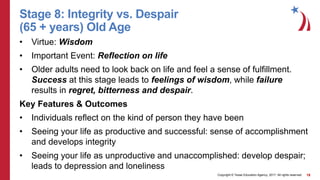
Stage 8: Integrity vs. Despair
(65 + years) Old Age
• Virtue: Wisdom
• Important Event: Reflection on life
• Older adults need to look back on life and feel a sense of fulfillment.
Success at this stage leads to feelings of wisdom, while failure
results in regret, bitterness and despair.
Key Features & Outcomes
• Individuals reflect on the kind of person they have been
• Seeing your life as productive and successful: sense of accomplishment
and develops integrity
• Seeing your life as unproductive and unaccomplished: develop despair;
leads to depression and loneliness
Copyright © Texas Education Agency, 2017. All rights reserved. 19
ESSAY
WRITING
What kind of life are you
envisioning in the future?
Is it a life of ego integrity
or despair?

Erik Erikson's Psychosocial Development.pptx

  • 1.
    Copyright © TexasEducation Agency, 2017. All rights reserved. 1 Erik Erikson’s Psychosocial Theory Background • Refined and explained Freud's theories into 8 stages of psychosocial development • The 8 stages of development is characterized as a series of psychosocial stages that have a basic conflict and important events leading to growth • How the conflict is managed ultimately shapes an individual’s personality.
  • 2.
    Copyright © TexasEducation Agency, 2017. All rights reserved. 2 Erik Erikson • Proposed a theory of psychosocial development from infancy to adulthood. • During each stage, the person experiences a psychosocial crisis which could have a positive or negative outcome on personality development. • The success of each stage depends on how well the previous crisis was resolved. • The successful completion of each of these stages results in a healthy personality and acquiring new virtues • Failure to complete any of these stages results in a reduced capacity to complete the other stages, which in turn results in an unhealthy personality and sense of self
  • 3.
    Copyright © TexasEducation Agency, 2017. All rights reserved. 3 Erikson Erikson believed that “each stage of life is associated with a specific psychological struggle, a struggle that contributes to a major aspect of personality.”
  • 4.
    Copyright © TexasEducation Agency, 2017. All rights reserved. 4 Psychosocial Theory – Erikson  Childhood is very important in personality development  Accepted many of Freud's theories, including the id, ego and superego  Unlike Freud, felt that personality continued to develop beyond five years of age
  • 5.
    Copyright © TexasEducation Agency, 2017. All rights reserved. 5 Erikson Children are not simply biological organisms that endure Children develop in the context of society’s expectations, prohibitions and prejudices Personality is shaped over the life span; experiences later in life can heal problems in early childhood
  • 6.
    Copyright © TexasEducation Agency, 2017. All rights reserved. 6 Erikson’s 8 Stages of Psychosocial Development  Trust versus Mistrust  Autonomy versus Shame/Doubt  Initiative versus Guilt  Industry versus Inferiority  Identity versus Role Confusion  Intimacy versus Isolation  Generativity versus Stagnation  Integrity versus Despair
  • 7.
    Copyright © TexasEducation Agency, 2017. All rights reserved. 7 Stage 1: Trust vs. Mistrust (birth to 1 year) Infancy • Virtue: Hope • Important event: Feeding • Children develop a sense of trust when caregivers provide reliability, care and affection. A lack of this will lead to mistrust For example.... • With warm and responsive care, infants gain a sense of TRUST • Infant may develop a secure attachment with caregiver • Secure attachment: A relationship in which an infant obtains both comfort and confidence from the presence of his or her caregiver. • They feel confident and sees the world as a fun, safe
  • 8.
    Copyright © TexasEducation Agency, 2017. All rights reserved. 8 Stage 1: Trust vs. Mistrust (birth to 1 year) Infancy • Mistrust develops when infants have to wait too long for comfort or are handled too harshly • These infants may develop insecure-avoidant attachment • Insecure-avoidant attachment: A pattern of attachment in which an infant avoids connection with the caregiver, as when the infant seems not to care about the caregiver's presence, departure or return • Infants are mistrustful • Change in infant's Temperament and as a result develop anxiety • Temperament: is defined as the “biologically based core of individual differences in styles of approach and response to the environment that is stable across time and situations
  • 9.
    Copyright © TexasEducation Agency, 2017. All rights reserved. 9 Stage 2: Autonomy vs. Shame and Doubt (1 to 3 years) Early Childhood • Virtue: Will • Important Events: Toilet Training, feeding • Children need to develop a sense of personal control over physical skills and a sense of independence. Success leads to feeling of autonomy, failure results in feelings of shame and doubt • Children starts wanting to choose and make decisions for themselves • Autonomy is nurtured when parents allow kids to make reasonable choices/decisions • “Which pair of shoes do you want to wear?”
  • 10.
    Copyright © TexasEducation Agency, 2017. All rights reserved. 10 Stage 2: Autonomy vs. Shame and Doubt (1 to 3 years) Early Childhood • Children do not learn to be independent and begin to doubt their ability to make good choices • Feels shameful • Authoritarian parenting: An approach to child rearing that is characterized by high behavioral standards, strict punishment for misconduct, and little communication from child to parent • Authoritarian parent: "You're wearing this shirt because I said so" • When parents are over-controlling and uses an authoritarian parenting style and do not allow reasonable choices.
  • 11.
    Copyright © TexasEducation Agency, 2017. All rights reserved. 11 Stage 3: Initiative vs. Guilt (4 to 5 years) Preschool • Virtue: Purpose • Important Event: Exploration • Children need to begin asserting control and power over the environment. Success in this stage leads to a sense of purpose. Children who try to exert too much power experience disapproval, resulting in a sense of guilt. In this stage the child learns to: • Cooperate with peers • Develop their ability to lead others • Imagine and to broaden his/her skills e.g. tying a shoe lace, doing their zippers and dressing themselves
  • 12.
    Copyright © TexasEducation Agency, 2017. All rights reserved. 12 Stage 3: Initiative vs. Guilt (4 to 5 years) Preschool Outcomes • When those tasks/initiative undertaken are achieved they feel good about themselves and their accomplishments • When the undertaken tasks does not produce the desired results, the child feels guilt Guilt can also result in: • aggressive behaviors (e.g., yelling and throwing objects) • fearfulness • social phobias
  • 13.
    Copyright © TexasEducation Agency, 2017. All rights reserved. 13 Stage 4: Industry vs. Inferiority (6 to 11 years) Middle and Late Childhood • Virtue: Competence • Important Event: School • Children need to cope with new social and academic demand. Success leads to a sense of competence, while failure results in feeling of inferiority. Key Features • Children busily practices and then master new skills • For example, children are more eager to learn and put a lot more effort into becoming better at more complexed skills like reading, telling time, writing structured sentences etc.
  • 14.
    Copyright © TexasEducation Agency, 2017. All rights reserved. 14 Stage 4: Industry vs. Inferiority (6 to 11 years) Middle and Late Childhood • Industry develops when children have successful experiences in:  School  Extra-curricular activities  Social groups • Inferiority develops when children have negative experiences that lead to feelings of incompetence • For example; a child that is not good at soccer like his/her peers may feel incompetent/ inferior
  • 15.
    Copyright © TexasEducation Agency, 2017. All rights reserved. 15 Stage 5: Identity vs. Role Confusion (12 to 19 years) Adolescence • Virtue: Fidelity • Important Event: Social relationship • Teens need to develop a sense of self and personal identity. Success leads to an ability to stay true to self, while failure leads to role confusion and a weak sense of self. Key Features • Adolescence ask and tries to answer the question: “who am I?” • They acquire a sense of identity or can be confused about what their roles are in the adult world • In response to role confusion or identity crisis, an adolescent may begin to experiment with different lifestyles (e.g., work, education or political activities)
  • 16.
    Copyright © TexasEducation Agency, 2017. All rights reserved. 16 Stage 6: Intimacy vs. Isolation (20 to 25 years) Young adulthood • Virtue: Love • Important Event: Relationships • Young adults need to form intimate, loving relationships with others. Success leads to strong relationships, while failure results in loneliness and isolation. Outcomes • The successful adult can experience true intimacy, which makes things possible like enduring friendships and marriage. • Because of earlier disappointments, some individuals cannot form close relationships with others and remain isolated.
  • 17.
    Copyright © TexasEducation Agency, 2017. All rights reserved. 17 Stage 7: Generativity vs. Stagnation (26 to 64 years) Adulthood • Virtue: Care • Important Events: Work and Parenthood • Adults need to create or nurture things that will outlast them, often by having children or creating a positive change that benefits others. Success leads to feelings of usefulness, while failure results in shallow involvement in the world. Key Features • Generativity means giving back to the next generation (child-rearing; caring for others (family & community) e.g. volunteering • The person who fails in these areas feels an absence of meaningful accomplishment (Stagnation)
  • 18.
    Copyright © TexasEducation Agency, 2017. All rights reserved. 18 Stage 8: Integrity vs. Despair (65 + years) Old Age • Virtue: Wisdom • Important Event: Reflection on life • Older adults need to look back on life and feel a sense of fulfillment. Success at this stage leads to feelings of wisdom, while failure results in regret, bitterness and despair. Key Features & Outcomes • Individuals reflect on the kind of person they have been • Seeing your life as productive and successful: sense of accomplishment and develops integrity • Seeing your life as unproductive and unaccomplished: develop despair; leads to depression and loneliness
  • 19.
    Copyright © TexasEducation Agency, 2017. All rights reserved. 19 ESSAY WRITING What kind of life are you envisioning in the future? Is it a life of ego integrity or despair?

Editor's Notes

  • #4 Erik Erikson (1902 – 1994) was the German founder of the Psychosocial Theory who later became an American citizen, teaching at Berkeley and Harvard. Erikson’s theory states that human beings go through many stages, generally based on age, as they add to their personality. He stated that these items will happen in this order and that children will learn one or the other. http://www.erikson.edu/about/history/erik-erikson
  • #5 Like Freud’s theories, the Psychosocial Theory states that childhood is very important in personality development. This theory accepts many of Freud’s ideas, including those of the id, ego, and superego. Unlike Freud’s theories, the psychosocial theory purports that personality continues to develop beyond five years of age.
  • #6 http://www.erikson.edu/about/history/erik-erikson
  • #7 According to Erikson, children’s personality develops within these stages, and personality traits are established within them. For instance, around the age of 18 months, children will have learned either to trust or mistrust the world, based on the experiences that they have had to date. Let’s look at each of these stages. Erikson states that each conflict must be resolved before the person can move to the next stage.