Lecture 2
     Entity Relationship (ER) Model
Enhanced Entity Relationship (EER) Model
Objectives

    • Overview of Database Design Process
    • Example Database Application (COMPANY)
    • ER Model Concepts
          §   Entities and Attributes
          §   Entity Types, Value Sets, and Key Attributes
          §   Relationships and Relationship Types
          §   Weak Entity Types
          §   Roles and Attributes in Relationship Types
    • ER Diagrams - Notation


    • Reference: Chapter 3 - 4

Faculty of Science and Technology   Database Fundamentals    2
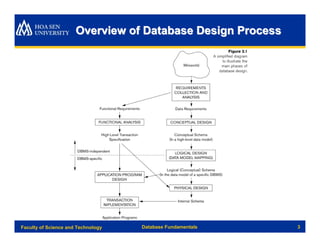
Overview of Database Design Process


Faculty of Science and Technology   Database Fundamentals   3
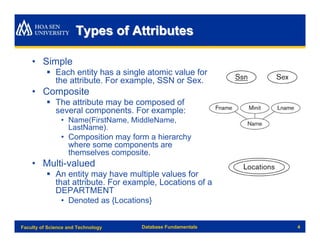
Types of Attributes

    • Simple
          § Each entity has a single atomic value for
            the attribute. For example, SSN or Sex.
    • Composite
          § The attribute may be composed of
            several components. For example:
                • Name(FirstName, MiddleName,
                  LastName).
                • Composition may form a hierarchy
                  where some components are
                  themselves composite.
    • Multi-valued
          § An entity may have multiple values for
            that attribute. For example, Locations of a
            DEPARTMENT
              • Denoted as {Locations}


Faculty of Science and Technology    Database Fundamentals   4
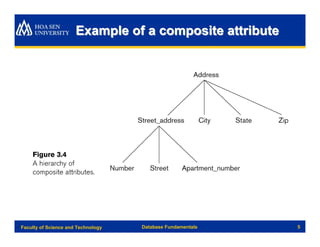
Example of a composite attribute


Faculty of Science and Technology   Database Fundamentals   5
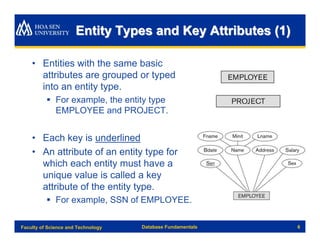
Entity Types and Key Attributes (1)

    • Entities with the same basic
      attributes are grouped or typed
      into an entity type.
          § For example, the entity type
            EMPLOYEE and PROJECT.


    • Each key is underlined
    • An attribute of an entity type for
      which each entity must have a
      unique value is called a key
      attribute of the entity type.
          § For example, SSN of EMPLOYEE.

Faculty of Science and Technology   Database Fundamentals   6
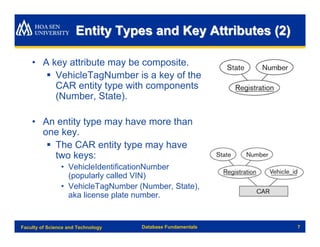
Entity Types and Key Attributes (2)

    • A key attribute may be composite.
       § VehicleTagNumber is a key of the
         CAR entity type with components
         (Number, State).

    • An entity type may have more than
      one key.
       § The CAR entity type may have
         two keys:
                • VehicleIdentificationNumber
                  (popularly called VIN)
                • VehicleTagNumber (Number, State),
                  aka license plate number.


Faculty of Science and Technology   Database Fundamentals   7
Entity Set

    • Each entity type will have a collection of entities
      stored in the database
          § Called the entity set


    • Entity set is the current state of the entities of
      that type that are stored in the database


Faculty of Science and Technology   Database Fundamentals   8
Initial Design of Entity Types for the
                      COMPANY Database Schema

    • Based on the requirements, we can identify four initial
      entity types in the COMPANY database:
          §   DEPARTMENT
          §   PROJECT
          §   EMPLOYEE
          §   DEPENDENT
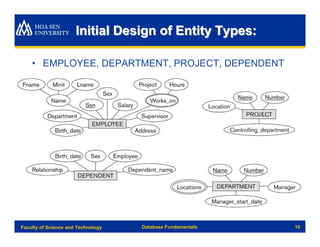
    • Their initial design is shown on the following slide
    • The initial attributes shown are derived from the
      requirements description


Faculty of Science and Technology   Database Fundamentals       9
Initial Design of Entity Types:

    • EMPLOYEE, DEPARTMENT, PROJECT, DEPENDENT


Faculty of Science and Technology   Database Fundamentals   10
Refining the initial design by introducing
                      relationships

    • The initial design is typically not complete
    • Some aspects in the requirements will be represented as
      relationships

    • ER model has three main concepts:
          § Entities (and their entity types and entity sets)
          § Attributes (simple, composite, multivalued)
          § Relationships (and their relationship types and relationship
            sets)


Faculty of Science and Technology   Database Fundamentals                  11
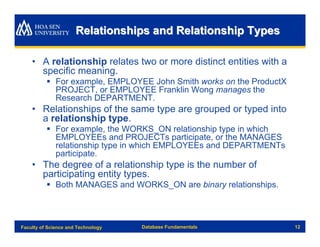
Relationships and Relationship Types

    • A relationship relates two or more distinct entities with a
      specific meaning.
          § For example, EMPLOYEE John Smith works on the ProductX
            PROJECT, or EMPLOYEE Franklin Wong manages the
            Research DEPARTMENT.
    • Relationships of the same type are grouped or typed into
      a relationship type.
          § For example, the WORKS_ON relationship type in which
            EMPLOYEEs and PROJECTs participate, or the MANAGES
            relationship type in which EMPLOYEEs and DEPARTMENTs
            participate.
    • The degree of a relationship type is the number of
      participating entity types.
          § Both MANAGES and WORKS_ON are binary relationships.


Faculty of Science and Technology   Database Fundamentals            12
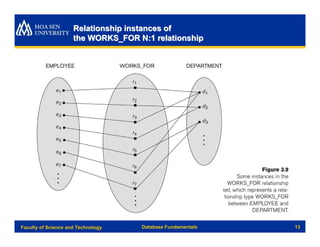
Relationship instances of
                     the WORKS_FOR N:1 relationship


Faculty of Science and Technology   Database Fundamentals   13
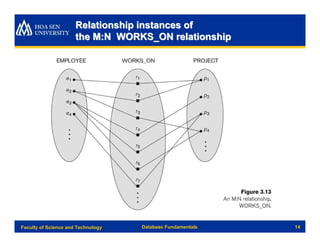
Relationship instances of
                      the M:N WORKS_ON relationship


Faculty of Science and Technology   Database Fundamentals   14
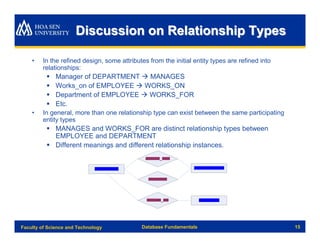
Discussion on Relationship Types

    •   In the refined design, some attributes from the initial entity types are refined into
        relationships:
          §   Manager of DEPARTMENT à MANAGES
          §   Works_on of EMPLOYEE à WORKS_ON
          §   Department of EMPLOYEE à WORKS_FOR
          §   Etc.
    •   In general, more than one relationship type can exist between the same participating
        entity types
          § MANAGES and WORKS_FOR are distinct relationship types between
            EMPLOYEE and DEPARTMENT
          § Different meanings and different relationship instances.


Faculty of Science and Technology           Database Fundamentals                               15
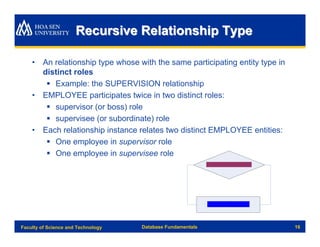
Recursive Relationship Type

    • An relationship type whose with the same participating entity type in
      distinct roles
       § Example: the SUPERVISION relationship
    • EMPLOYEE participates twice in two distinct roles:
       § supervisor (or boss) role
       § supervisee (or subordinate) role
    • Each relationship instance relates two distinct EMPLOYEE entities:
       § One employee in supervisor role
       § One employee in supervisee role


Faculty of Science and Technology   Database Fundamentals                     16
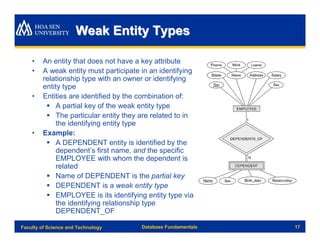
Weak Entity Types

    •   An entity that does not have a key attribute
    •   A weak entity must participate in an identifying
        relationship type with an owner or identifying
        entity type
    •   Entities are identified by the combination of:
         § A partial key of the weak entity type
         § The particular entity they are related to in
            the identifying entity type
    •   Example:
         § A DEPENDENT entity is identified by the
            dependent’s first name, and the specific
            EMPLOYEE with whom the dependent is
            related
         § Name of DEPENDENT is the partial key
         § DEPENDENT is a weak entity type
         § EMPLOYEE is its identifying entity type via
            the identifying relationship type
            DEPENDENT_OF

Faculty of Science and Technology      Database Fundamentals   17
Constraints on Relationships

    • Constraints on Relationship Types
          § (Also known as ratio constraints)
          § Cardinality Ratio (specifies maximum participation)
                • One-to-one (1:1)
                • One-to-many (1:N) or Many-to-one (N:1)
                • Many-to-many (M:N)
          § Existence Dependency Constraint (specifies minimum
            participation) (also called participation constraint)
                • zero (optional participation, not existence-dependent)
                • one or more (mandatory participation, existence-dependent)


Faculty of Science and Technology    Database Fundamentals                     18
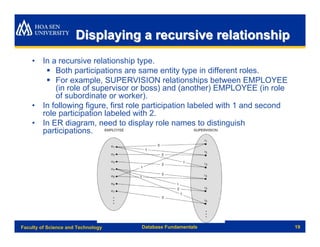
Displaying a recursive relationship
    • In a recursive relationship type.
       § Both participations are same entity type in different roles.
       § For example, SUPERVISION relationships between EMPLOYEE
          (in role of supervisor or boss) and (another) EMPLOYEE (in role
          of subordinate or worker).
    • In following figure, first role participation labeled with 1 and second
      role participation labeled with 2.
    • In ER diagram, need to display role names to distinguish
      participations.


Faculty of Science and Technology   Database Fundamentals                       19
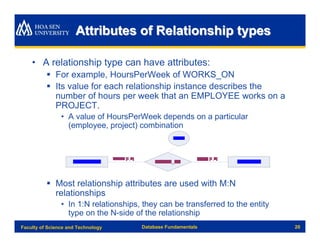
Attributes of Relationship types

    • A relationship type can have attributes:
          § For example, HoursPerWeek of WORKS_ON
          § Its value for each relationship instance describes the
            number of hours per week that an EMPLOYEE works on a
            PROJECT.
                • A value of HoursPerWeek depends on a particular
                  (employee, project) combination


          § Most relationship attributes are used with M:N
            relationships
                • In 1:N relationships, they can be transferred to the entity
                  type on the N-side of the relationship
Faculty of Science and Technology      Database Fundamentals                    20
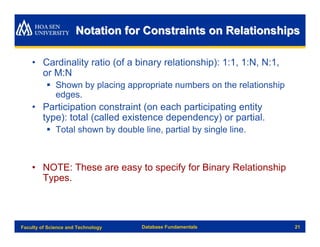
Notation for Constraints on Relationships

    • Cardinality ratio (of a binary relationship): 1:1, 1:N, N:1,
      or M:N
          § Shown by placing appropriate numbers on the relationship
            edges.
    • Participation constraint (on each participating entity
      type): total (called existence dependency) or partial.
          § Total shown by double line, partial by single line.


    • NOTE: These are easy to specify for Binary Relationship
      Types.


Faculty of Science and Technology   Database Fundamentals              21
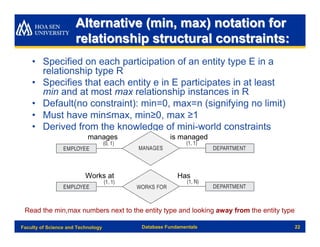
Alternative (min, max) notation for
                      relationship structural constraints:
    • Specified on each participation of an entity type E in a
      relationship type R
    • Specifies that each entity e in E participates in at least
      min and at most max relationship instances in R
    • Default(no constraint): min=0, max=n (signifying no limit)
    • Must have min≤max, min≥0, max ≥1
    • Derived from the knowledge of mini-world constraints
                           manages              is managed


                          Works at                 Has


 Read the min,max numbers next to the entity type and looking away from the entity type

Faculty of Science and Technology     Database Fundamentals                               22
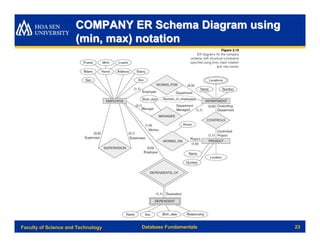
COMPANY ER Schema Diagram using
                      (min, max) notation


Faculty of Science and Technology   Database Fundamentals   23
Relationships of Higher Degree

    • Relationship types of degree 2 are called binary

    • Relationship types of degree 3 are called ternary and of
      degree n are called n-ary

    • In general, an n-ary relationship is not equivalent to n
      binary relationships

    • Constraints are harder to specify for higher-degree
      relationships (n > 2) than for binary relationships


Faculty of Science and Technology   Database Fundamentals        24
Discussion of n-ary relationships (n > 2)

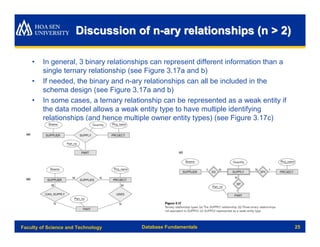
    •   In general, 3 binary relationships can represent different information than a
        single ternary relationship (see Figure 3.17a and b)
    •   If needed, the binary and n-ary relationships can all be included in the
        schema design (see Figure 3.17a and b)
    •   In some cases, a ternary relationship can be represented as a weak entity if
        the data model allows a weak entity type to have multiple identifying
        relationships (and hence multiple owner entity types) (see Figure 3.17c)


Faculty of Science and Technology      Database Fundamentals                            25
Discussion of n-ary relationships (n > 2)

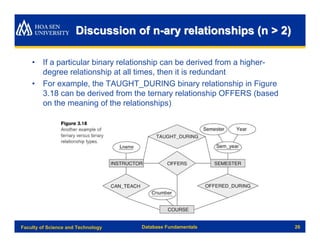
    • If a particular binary relationship can be derived from a higher-
      degree relationship at all times, then it is redundant
    • For example, the TAUGHT_DURING binary relationship in Figure
      3.18 can be derived from the ternary relationship OFFERS (based
      on the meaning of the relationships)


Faculty of Science and Technology   Database Fundamentals                 26
Displaying constraints on higher-degree
                      relationships

    • The (min, max) constraints can be displayed on the
      edges – however, they do not fully describe the
      constraints
    • Displaying a 1, M, or N indicates additional constraints
          § An M or N indicates no constraint
          § A 1 indicates that an entity can participate in at most one
            relationship instance that has a particular combination of
            the other participating entities
    • In general, both (min, max) and 1, M, or N are needed to
      describe fully the constraints


Faculty of Science and Technology   Database Fundamentals                 27
EER: Subclasses and Superclasses

    • An entity type may have additional meaningful
      subgroupings of its entities
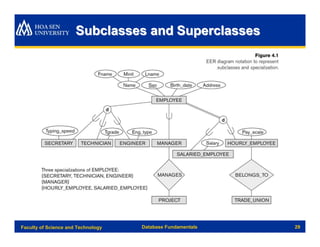
          § Example: EMPLOYEE may be further grouped into:
                • SECRETARY, ENGINEER, TECHNICIAN, …
                      § Based on the EMPLOYEE’s Job
                • MANAGER
                      § EMPLOYEEs who are managers
                • SALARIED_EMPLOYEE, HOURLY_EMPLOYEE
                      § Based on the EMPLOYEE’s method of pay
    • EER diagrams extend ER diagrams to represent these
      additional subgroupings, called subclasses or subtypes


Faculty of Science and Technology      Database Fundamentals    28
Subclasses and Superclasses


Faculty of Science and Technology   Database Fundamentals   29
Subclasses and Superclasses (2)

    • Each of these subgroupings is a subset of EMPLOYEE
      entities
    • Each is called a subclass of EMPLOYEE
    • EMPLOYEE is the superclass for each of these
      subclasses
    • These are called superclass/subclass relationships:
          §   EMPLOYEE/SECRETARY
          §   EMPLOYEE/TECHNICIAN
          §   EMPLOYEE/MANAGER
          §   …


Faculty of Science and Technology   Database Fundamentals   30
Subclasses and Superclasses (3)

    • These are also called IS-A relationships
          § SECRETARY IS-A EMPLOYEE, TECHNICIAN IS-A
            EMPLOYEE, ….
    • Note: An entity that is member of a subclass represents
      the same real-world entity as some member of the
      superclass:
          § The subclass member is the same entity in a distinct
            specific role
          § An entity cannot exist in the database merely by being a
            member of a subclass; it must also be a member of the
            superclass
          § A member of the superclass can be optionally included as
            a member of any number of its subclasses
    • It is not necessary that every entity in a superclass be a
      member of some subclass
Faculty of Science and Technology   Database Fundamentals              31
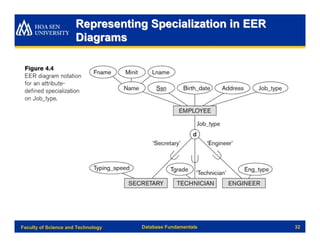
Representing Specialization in EER
                      Diagrams


Faculty of Science and Technology   Database Fundamentals   32
Attribute Inheritance in Superclass /
                      Subclass Relationships

    • An entity that is member of a subclass inherits
          § All attributes of the entity as a member of the superclass
          § All relationships of the entity as a member of the
            superclass

    • Example:
          § In the previous slide, SECRETARY (as well as
            TECHNICIAN and ENGINEER) inherit the attributes
            Name, SSN, …, from EMPLOYEE
          § Every SECRETARY entity will have values for the inherited
            attributes


Faculty of Science and Technology   Database Fundamentals                33
Specialization

    • Specialization is the process of defining a set of
      subclasses of a superclass

    • The set of subclasses is based upon some distinguishing
      characteristics of the entities in the superclass
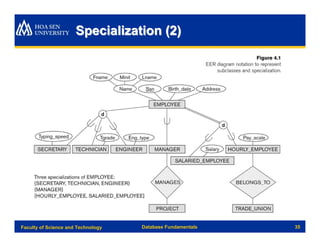
          § Example: {SECRETARY, ENGINEER, TECHNICIAN} is a
            specialization of EMPLOYEE based upon job type.
                • May have several specializations of the same superclass


Faculty of Science and Technology    Database Fundamentals                  34
Specialization (2)


Faculty of Science and Technology   Database Fundamentals   35
Generalization

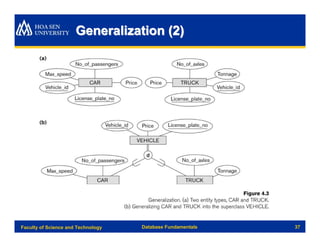
    • Generalization is the reverse of the specialization
      process
    • Several classes with common features are generalized
      into a superclass;
          § original classes become its subclasses


    • Example: CAR, TRUCK generalized into VEHICLE;
          § both CAR, TRUCK become subclasses of the superclass
            VEHICLE.
          § We can view {CAR, TRUCK} as a specialization of
            VEHICLE
          § Alternatively, we can view VEHICLE as a generalization of
            CAR and TRUCK
Faculty of Science and Technology   Database Fundamentals               36
Generalization (2)


Faculty of Science and Technology   Database Fundamentals   37
Generalization and Specialization

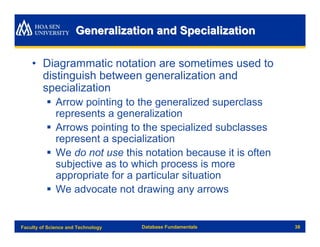
    • Diagrammatic notation are sometimes used to
      distinguish between generalization and
      specialization
          § Arrow pointing to the generalized superclass
            represents a generalization
          § Arrows pointing to the specialized subclasses
            represent a specialization
          § We do not use this notation because it is often
            subjective as to which process is more
            appropriate for a particular situation
          § We advocate not drawing any arrows


Faculty of Science and Technology   Database Fundamentals     38
Generalization and Specialization (2)


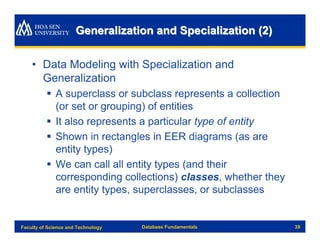
    • Data Modeling with Specialization and
      Generalization
          § A superclass or subclass represents a collection
            (or set or grouping) of entities
          § It also represents a particular type of entity
          § Shown in rectangles in EER diagrams (as are
            entity types)
          § We can call all entity types (and their
            corresponding collections) classes, whether they
            are entity types, superclasses, or subclasses


Faculty of Science and Technology   Database Fundamentals      39
Constraints on Specialization and
                      Generalization

    • If we can determine exactly those entities that
      will become members of each subclass by a
      condition, the subclasses are called predicate-
      defined (or condition-defined) subclasses
          § Condition is a constraint that determines subclass
            members
          § Display a predicate-defined subclass by writing
            the predicate condition next to the line attaching
            the subclass to its superclass


Faculty of Science and Technology   Database Fundamentals        40
Constraints on Specialization and
                      Generalization (2)

    • If all subclasses in a specialization have membership
      condition on same attribute of the superclass,
      specialization is called an attribute-defined specialization
          § Attribute is called the defining attribute of the specialization
          § Example: JobType is the defining attribute of the
            specialization {SECRETARY, TECHNICIAN, ENGINEER}
            of EMPLOYEE
    • If no condition determines membership, the subclass is
      called user-defined
          § Membership in a subclass is determined by the database
            users by applying an operation to add an entity to the
            subclass
          § Membership in the subclass is specified individually for
            each entity in the superclass by the user


Faculty of Science and Technology   Database Fundamentals                      41
Constraints on Specialization and
                      Generalization (3)

    • Two basic constraints can apply to a
      specialization/generalization:
          § Disjointness Constraint
          § Completeness Constraint


Faculty of Science and Technology   Database Fundamentals   42
Constraints on Specialization and
                      Generalization (4)

    • Disjointness Constraint:
          § Specifies that the subclasses of the specialization
            must be disjoint:
                • an entity can be a member of at most one of the
                  subclasses of the specialization
          § Specified by d in EER diagram
          § If not disjoint, specialization is overlapping:
                • that is the same entity may be a member of more
                  than one subclass of the specialization
          § Specified by o in EER diagram


Faculty of Science and Technology   Database Fundamentals           43
Constraints on Specialization and
                      Generalization (5)

    • Completeness Constraint:
          § Total specifies that every entity in the superclass
            must be a member of some subclass in the
            specialization/generalization
          § Shown in EER diagrams by a double line
          § Partial allows an entity not to belong to any of the
            subclasses
          § Shown in EER diagrams by a single line


Faculty of Science and Technology   Database Fundamentals          44
Specialization/Generalization Hierarchies,
                      Lattices & Shared Subclasses

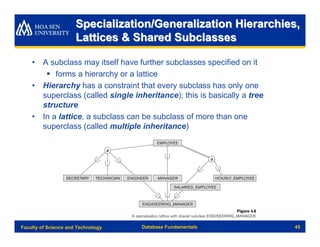
    • A subclass may itself have further subclasses specified on it
       § forms a hierarchy or a lattice
    • Hierarchy has a constraint that every subclass has only one
      superclass (called single inheritance); this is basically a tree
      structure
    • In a lattice, a subclass can be subclass of more than one
      superclass (called multiple inheritance)


Faculty of Science and Technology   Database Fundamentals                45
Specialization/Generalization Hierarchies,
                      Lattices & Shared Subclasses (2)

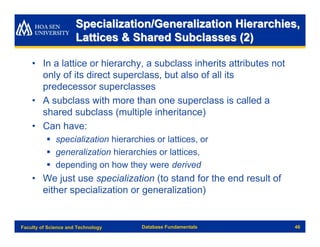
    • In a lattice or hierarchy, a subclass inherits attributes not
      only of its direct superclass, but also of all its
      predecessor superclasses
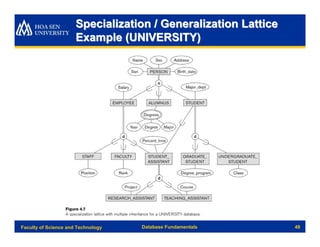
    • A subclass with more than one superclass is called a
      shared subclass (multiple inheritance)
    • Can have:
          § specialization hierarchies or lattices, or
          § generalization hierarchies or lattices,
          § depending on how they were derived
    • We just use specialization (to stand for the end result of
      either specialization or generalization)


Faculty of Science and Technology   Database Fundamentals             46
Specialization/Generalization Hierarchies,
                      Lattices & Shared Subclasses (3)

    • In specialization, start with an entity type and
      then define subclasses of the entity type by
      successive specialization
          § called a top down conceptual refinement process
    • In generalization, start with many entity types
      and generalize those that have common
      properties
          § Called a bottom up conceptual synthesis process
    • In practice, a combination of both processes is
      usually employed

Faculty of Science and Technology   Database Fundamentals     47
Specialization / Generalization Lattice
                      Example (UNIVERSITY)


Faculty of Science and Technology   Database Fundamentals       48
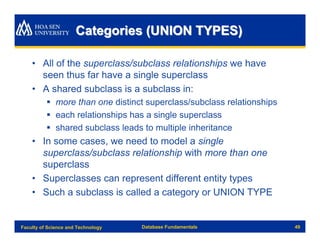
Categories (UNION TYPES)

    • All of the superclass/subclass relationships we have
      seen thus far have a single superclass
    • A shared subclass is a subclass in:
          § more than one distinct superclass/subclass relationships
          § each relationships has a single superclass
          § shared subclass leads to multiple inheritance
    • In some cases, we need to model a single
      superclass/subclass relationship with more than one
      superclass
    • Superclasses can represent different entity types
    • Such a subclass is called a category or UNION TYPE


Faculty of Science and Technology   Database Fundamentals              49
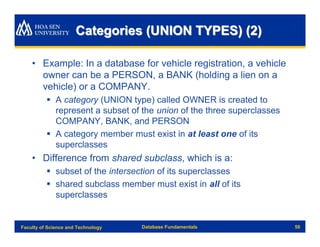
Categories (UNION TYPES) (2)

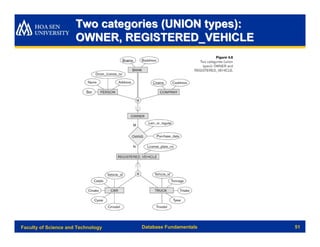
    • Example: In a database for vehicle registration, a vehicle
      owner can be a PERSON, a BANK (holding a lien on a
      vehicle) or a COMPANY.
          § A category (UNION type) called OWNER is created to
            represent a subset of the union of the three superclasses
            COMPANY, BANK, and PERSON
          § A category member must exist in at least one of its
            superclasses
    • Difference from shared subclass, which is a:
          § subset of the intersection of its superclasses
          § shared subclass member must exist in all of its
            superclasses


Faculty of Science and Technology   Database Fundamentals               50
Two categories (UNION types):
                      OWNER, REGISTERED_VEHICLE


Faculty of Science and Technology   Database Fundamentals   51
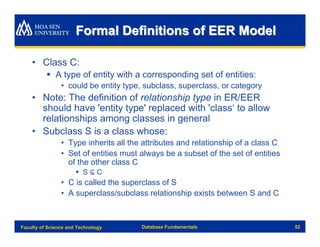
Formal Definitions of EER Model

    • Class C:
          § A type of entity with a corresponding set of entities:
                • could be entity type, subclass, superclass, or category
    • Note: The definition of relationship type in ER/EER
      should have 'entity type' replaced with 'class‘ to allow
      relationships among classes in general
    • Subclass S is a class whose:
                • Type inherits all the attributes and relationship of a class C
                • Set of entities must always be a subset of the set of entities
                  of the other class C
                      § S⊆C
                • C is called the superclass of S
                • A superclass/subclass relationship exists between S and C


Faculty of Science and Technology      Database Fundamentals                       52
Formal Definitions of EER Model (2)

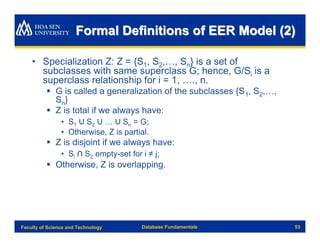
    • Specialization Z: Z = {S1, S2,…, Sn} is a set of
      subclasses with same superclass G; hence, G/Si is a
      superclass relationship for i = 1, …., n.
          § G is called a generalization of the subclasses {S 1, S2,…,
            Sn}
          § Z is total if we always have:
                • S1 ∪ S2 ∪ … ∪ Sn = G;
                • Otherwise, Z is partial.
          § Z is disjoint if we always have:
                • Si ∩ S2 empty-set for i ≠ j;
          § Otherwise, Z is overlapping.


Faculty of Science and Technology       Database Fundamentals            53
Formal Definitions of EER Model (3)

    • Subclass S of C is predicate defined if predicate
      (condition) p on attributes of C is used to specify
      membership in S;
          § that is, S = C[p], where C[p] is the set of entities in C that
            satisfy condition p
    • A subclass not defined by a predicate is called user-
      defined
    • Attribute-defined specialization: if a predicate A = ci
      (where A is an attribute of G and ci is a constant value
      from the domain of A) is used to specify membership in
      each subclass Si in Z
          § Note: If ci ≠ cj for i ≠ j, and A is single-valued, then the
            attribute-defined specialization will be disjoint.


Faculty of Science and Technology   Database Fundamentals                    54
Formal Definitions of EER Model (4)

    • Category or UNION type T
          § A class that is a subset of the union of n defining
            superclasses
            D1, D2,…Dn, n>1:
                • T ⊆ (D1 ∪ D2 ∪ … ∪ Dn)
          § Can have a predicate pi on the attributes of D i to specify
            entities of Di that are members of T.
          § If a predicate is specified on every D i: T = (D1[p1] ∪ D2[p2]
            ∪…∪ Dn[pn])


Faculty of Science and Technology   Database Fundamentals                    55
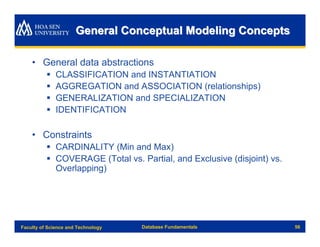
General Conceptual Modeling Concepts

    • General data abstractions
          §   CLASSIFICATION and INSTANTIATION
          §   AGGREGATION and ASSOCIATION (relationships)
          §   GENERALIZATION and SPECIALIZATION
          §   IDENTIFICATION

    • Constraints
          § CARDINALITY (Min and Max)
          § COVERAGE (Total vs. Partial, and Exclusive (disjoint) vs.
            Overlapping)


Faculty of Science and Technology   Database Fundamentals               56
Faculty of Science and Technology   Database Fundamentals   57

ER&EER models

  • 1.
    Lecture 2 Entity Relationship (ER) Model Enhanced Entity Relationship (EER) Model
  • 2.
    Objectives • Overview of Database Design Process • Example Database Application (COMPANY) • ER Model Concepts § Entities and Attributes § Entity Types, Value Sets, and Key Attributes § Relationships and Relationship Types § Weak Entity Types § Roles and Attributes in Relationship Types • ER Diagrams - Notation • Reference: Chapter 3 - 4 Faculty of Science and Technology Database Fundamentals 2
  • 3.
    Overview of DatabaseDesign Process Faculty of Science and Technology Database Fundamentals 3
  • 4.
    Types of Attributes • Simple § Each entity has a single atomic value for the attribute. For example, SSN or Sex. • Composite § The attribute may be composed of several components. For example: • Name(FirstName, MiddleName, LastName). • Composition may form a hierarchy where some components are themselves composite. • Multi-valued § An entity may have multiple values for that attribute. For example, Locations of a DEPARTMENT • Denoted as {Locations} Faculty of Science and Technology Database Fundamentals 4
  • 5.
    Example of acomposite attribute Faculty of Science and Technology Database Fundamentals 5
  • 6.
    Entity Types andKey Attributes (1) • Entities with the same basic attributes are grouped or typed into an entity type. § For example, the entity type EMPLOYEE and PROJECT. • Each key is underlined • An attribute of an entity type for which each entity must have a unique value is called a key attribute of the entity type. § For example, SSN of EMPLOYEE. Faculty of Science and Technology Database Fundamentals 6
  • 7.
    Entity Types andKey Attributes (2) • A key attribute may be composite. § VehicleTagNumber is a key of the CAR entity type with components (Number, State). • An entity type may have more than one key. § The CAR entity type may have two keys: • VehicleIdentificationNumber (popularly called VIN) • VehicleTagNumber (Number, State), aka license plate number. Faculty of Science and Technology Database Fundamentals 7
  • 8.
    Entity Set • Each entity type will have a collection of entities stored in the database § Called the entity set • Entity set is the current state of the entities of that type that are stored in the database Faculty of Science and Technology Database Fundamentals 8
  • 9.
    Initial Design ofEntity Types for the COMPANY Database Schema • Based on the requirements, we can identify four initial entity types in the COMPANY database: § DEPARTMENT § PROJECT § EMPLOYEE § DEPENDENT • Their initial design is shown on the following slide • The initial attributes shown are derived from the requirements description Faculty of Science and Technology Database Fundamentals 9
  • 10.
    Initial Design ofEntity Types: • EMPLOYEE, DEPARTMENT, PROJECT, DEPENDENT Faculty of Science and Technology Database Fundamentals 10
  • 11.
    Refining the initialdesign by introducing relationships • The initial design is typically not complete • Some aspects in the requirements will be represented as relationships • ER model has three main concepts: § Entities (and their entity types and entity sets) § Attributes (simple, composite, multivalued) § Relationships (and their relationship types and relationship sets) Faculty of Science and Technology Database Fundamentals 11
  • 12.
    Relationships and RelationshipTypes • A relationship relates two or more distinct entities with a specific meaning. § For example, EMPLOYEE John Smith works on the ProductX PROJECT, or EMPLOYEE Franklin Wong manages the Research DEPARTMENT. • Relationships of the same type are grouped or typed into a relationship type. § For example, the WORKS_ON relationship type in which EMPLOYEEs and PROJECTs participate, or the MANAGES relationship type in which EMPLOYEEs and DEPARTMENTs participate. • The degree of a relationship type is the number of participating entity types. § Both MANAGES and WORKS_ON are binary relationships. Faculty of Science and Technology Database Fundamentals 12
  • 13.
    Relationship instances of the WORKS_FOR N:1 relationship Faculty of Science and Technology Database Fundamentals 13
  • 14.
    Relationship instances of the M:N WORKS_ON relationship Faculty of Science and Technology Database Fundamentals 14
  • 15.
    Discussion on RelationshipTypes • In the refined design, some attributes from the initial entity types are refined into relationships: § Manager of DEPARTMENT à MANAGES § Works_on of EMPLOYEE à WORKS_ON § Department of EMPLOYEE à WORKS_FOR § Etc. • In general, more than one relationship type can exist between the same participating entity types § MANAGES and WORKS_FOR are distinct relationship types between EMPLOYEE and DEPARTMENT § Different meanings and different relationship instances. Faculty of Science and Technology Database Fundamentals 15
  • 16.
    Recursive Relationship Type • An relationship type whose with the same participating entity type in distinct roles § Example: the SUPERVISION relationship • EMPLOYEE participates twice in two distinct roles: § supervisor (or boss) role § supervisee (or subordinate) role • Each relationship instance relates two distinct EMPLOYEE entities: § One employee in supervisor role § One employee in supervisee role Faculty of Science and Technology Database Fundamentals 16
  • 17.
    Weak Entity Types • An entity that does not have a key attribute • A weak entity must participate in an identifying relationship type with an owner or identifying entity type • Entities are identified by the combination of: § A partial key of the weak entity type § The particular entity they are related to in the identifying entity type • Example: § A DEPENDENT entity is identified by the dependent’s first name, and the specific EMPLOYEE with whom the dependent is related § Name of DEPENDENT is the partial key § DEPENDENT is a weak entity type § EMPLOYEE is its identifying entity type via the identifying relationship type DEPENDENT_OF Faculty of Science and Technology Database Fundamentals 17
  • 18.
    Constraints on Relationships • Constraints on Relationship Types § (Also known as ratio constraints) § Cardinality Ratio (specifies maximum participation) • One-to-one (1:1) • One-to-many (1:N) or Many-to-one (N:1) • Many-to-many (M:N) § Existence Dependency Constraint (specifies minimum participation) (also called participation constraint) • zero (optional participation, not existence-dependent) • one or more (mandatory participation, existence-dependent) Faculty of Science and Technology Database Fundamentals 18
  • 19.
    Displaying a recursiverelationship • In a recursive relationship type. § Both participations are same entity type in different roles. § For example, SUPERVISION relationships between EMPLOYEE (in role of supervisor or boss) and (another) EMPLOYEE (in role of subordinate or worker). • In following figure, first role participation labeled with 1 and second role participation labeled with 2. • In ER diagram, need to display role names to distinguish participations. Faculty of Science and Technology Database Fundamentals 19
  • 20.
    Attributes of Relationshiptypes • A relationship type can have attributes: § For example, HoursPerWeek of WORKS_ON § Its value for each relationship instance describes the number of hours per week that an EMPLOYEE works on a PROJECT. • A value of HoursPerWeek depends on a particular (employee, project) combination § Most relationship attributes are used with M:N relationships • In 1:N relationships, they can be transferred to the entity type on the N-side of the relationship Faculty of Science and Technology Database Fundamentals 20
  • 21.
    Notation for Constraintson Relationships • Cardinality ratio (of a binary relationship): 1:1, 1:N, N:1, or M:N § Shown by placing appropriate numbers on the relationship edges. • Participation constraint (on each participating entity type): total (called existence dependency) or partial. § Total shown by double line, partial by single line. • NOTE: These are easy to specify for Binary Relationship Types. Faculty of Science and Technology Database Fundamentals 21
  • 22.
    Alternative (min, max)notation for relationship structural constraints: • Specified on each participation of an entity type E in a relationship type R • Specifies that each entity e in E participates in at least min and at most max relationship instances in R • Default(no constraint): min=0, max=n (signifying no limit) • Must have min≤max, min≥0, max ≥1 • Derived from the knowledge of mini-world constraints manages is managed Works at Has Read the min,max numbers next to the entity type and looking away from the entity type Faculty of Science and Technology Database Fundamentals 22
  • 23.
    COMPANY ER SchemaDiagram using (min, max) notation Faculty of Science and Technology Database Fundamentals 23
  • 24.
    Relationships of HigherDegree • Relationship types of degree 2 are called binary • Relationship types of degree 3 are called ternary and of degree n are called n-ary • In general, an n-ary relationship is not equivalent to n binary relationships • Constraints are harder to specify for higher-degree relationships (n > 2) than for binary relationships Faculty of Science and Technology Database Fundamentals 24
  • 25.
    Discussion of n-aryrelationships (n > 2) • In general, 3 binary relationships can represent different information than a single ternary relationship (see Figure 3.17a and b) • If needed, the binary and n-ary relationships can all be included in the schema design (see Figure 3.17a and b) • In some cases, a ternary relationship can be represented as a weak entity if the data model allows a weak entity type to have multiple identifying relationships (and hence multiple owner entity types) (see Figure 3.17c) Faculty of Science and Technology Database Fundamentals 25
  • 26.
    Discussion of n-aryrelationships (n > 2) • If a particular binary relationship can be derived from a higher- degree relationship at all times, then it is redundant • For example, the TAUGHT_DURING binary relationship in Figure 3.18 can be derived from the ternary relationship OFFERS (based on the meaning of the relationships) Faculty of Science and Technology Database Fundamentals 26
  • 27.
    Displaying constraints onhigher-degree relationships • The (min, max) constraints can be displayed on the edges – however, they do not fully describe the constraints • Displaying a 1, M, or N indicates additional constraints § An M or N indicates no constraint § A 1 indicates that an entity can participate in at most one relationship instance that has a particular combination of the other participating entities • In general, both (min, max) and 1, M, or N are needed to describe fully the constraints Faculty of Science and Technology Database Fundamentals 27
  • 28.
    EER: Subclasses andSuperclasses • An entity type may have additional meaningful subgroupings of its entities § Example: EMPLOYEE may be further grouped into: • SECRETARY, ENGINEER, TECHNICIAN, … § Based on the EMPLOYEE’s Job • MANAGER § EMPLOYEEs who are managers • SALARIED_EMPLOYEE, HOURLY_EMPLOYEE § Based on the EMPLOYEE’s method of pay • EER diagrams extend ER diagrams to represent these additional subgroupings, called subclasses or subtypes Faculty of Science and Technology Database Fundamentals 28
  • 29.
    Subclasses and Superclasses Facultyof Science and Technology Database Fundamentals 29
  • 30.
    Subclasses and Superclasses(2) • Each of these subgroupings is a subset of EMPLOYEE entities • Each is called a subclass of EMPLOYEE • EMPLOYEE is the superclass for each of these subclasses • These are called superclass/subclass relationships: § EMPLOYEE/SECRETARY § EMPLOYEE/TECHNICIAN § EMPLOYEE/MANAGER § … Faculty of Science and Technology Database Fundamentals 30
  • 31.
    Subclasses and Superclasses(3) • These are also called IS-A relationships § SECRETARY IS-A EMPLOYEE, TECHNICIAN IS-A EMPLOYEE, …. • Note: An entity that is member of a subclass represents the same real-world entity as some member of the superclass: § The subclass member is the same entity in a distinct specific role § An entity cannot exist in the database merely by being a member of a subclass; it must also be a member of the superclass § A member of the superclass can be optionally included as a member of any number of its subclasses • It is not necessary that every entity in a superclass be a member of some subclass Faculty of Science and Technology Database Fundamentals 31
  • 32.
    Representing Specialization inEER Diagrams Faculty of Science and Technology Database Fundamentals 32
  • 33.
    Attribute Inheritance inSuperclass / Subclass Relationships • An entity that is member of a subclass inherits § All attributes of the entity as a member of the superclass § All relationships of the entity as a member of the superclass • Example: § In the previous slide, SECRETARY (as well as TECHNICIAN and ENGINEER) inherit the attributes Name, SSN, …, from EMPLOYEE § Every SECRETARY entity will have values for the inherited attributes Faculty of Science and Technology Database Fundamentals 33
  • 34.
    Specialization • Specialization is the process of defining a set of subclasses of a superclass • The set of subclasses is based upon some distinguishing characteristics of the entities in the superclass § Example: {SECRETARY, ENGINEER, TECHNICIAN} is a specialization of EMPLOYEE based upon job type. • May have several specializations of the same superclass Faculty of Science and Technology Database Fundamentals 34
  • 35.
    Specialization (2) Faculty ofScience and Technology Database Fundamentals 35
  • 36.
    Generalization • Generalization is the reverse of the specialization process • Several classes with common features are generalized into a superclass; § original classes become its subclasses • Example: CAR, TRUCK generalized into VEHICLE; § both CAR, TRUCK become subclasses of the superclass VEHICLE. § We can view {CAR, TRUCK} as a specialization of VEHICLE § Alternatively, we can view VEHICLE as a generalization of CAR and TRUCK Faculty of Science and Technology Database Fundamentals 36
  • 37.
    Generalization (2) Faculty ofScience and Technology Database Fundamentals 37
  • 38.
    Generalization and Specialization • Diagrammatic notation are sometimes used to distinguish between generalization and specialization § Arrow pointing to the generalized superclass represents a generalization § Arrows pointing to the specialized subclasses represent a specialization § We do not use this notation because it is often subjective as to which process is more appropriate for a particular situation § We advocate not drawing any arrows Faculty of Science and Technology Database Fundamentals 38
  • 39.
    Generalization and Specialization(2) • Data Modeling with Specialization and Generalization § A superclass or subclass represents a collection (or set or grouping) of entities § It also represents a particular type of entity § Shown in rectangles in EER diagrams (as are entity types) § We can call all entity types (and their corresponding collections) classes, whether they are entity types, superclasses, or subclasses Faculty of Science and Technology Database Fundamentals 39
  • 40.
    Constraints on Specializationand Generalization • If we can determine exactly those entities that will become members of each subclass by a condition, the subclasses are called predicate- defined (or condition-defined) subclasses § Condition is a constraint that determines subclass members § Display a predicate-defined subclass by writing the predicate condition next to the line attaching the subclass to its superclass Faculty of Science and Technology Database Fundamentals 40
  • 41.
    Constraints on Specializationand Generalization (2) • If all subclasses in a specialization have membership condition on same attribute of the superclass, specialization is called an attribute-defined specialization § Attribute is called the defining attribute of the specialization § Example: JobType is the defining attribute of the specialization {SECRETARY, TECHNICIAN, ENGINEER} of EMPLOYEE • If no condition determines membership, the subclass is called user-defined § Membership in a subclass is determined by the database users by applying an operation to add an entity to the subclass § Membership in the subclass is specified individually for each entity in the superclass by the user Faculty of Science and Technology Database Fundamentals 41
  • 42.
    Constraints on Specializationand Generalization (3) • Two basic constraints can apply to a specialization/generalization: § Disjointness Constraint § Completeness Constraint Faculty of Science and Technology Database Fundamentals 42
  • 43.
    Constraints on Specializationand Generalization (4) • Disjointness Constraint: § Specifies that the subclasses of the specialization must be disjoint: • an entity can be a member of at most one of the subclasses of the specialization § Specified by d in EER diagram § If not disjoint, specialization is overlapping: • that is the same entity may be a member of more than one subclass of the specialization § Specified by o in EER diagram Faculty of Science and Technology Database Fundamentals 43
  • 44.
    Constraints on Specializationand Generalization (5) • Completeness Constraint: § Total specifies that every entity in the superclass must be a member of some subclass in the specialization/generalization § Shown in EER diagrams by a double line § Partial allows an entity not to belong to any of the subclasses § Shown in EER diagrams by a single line Faculty of Science and Technology Database Fundamentals 44
  • 45.
    Specialization/Generalization Hierarchies, Lattices & Shared Subclasses • A subclass may itself have further subclasses specified on it § forms a hierarchy or a lattice • Hierarchy has a constraint that every subclass has only one superclass (called single inheritance); this is basically a tree structure • In a lattice, a subclass can be subclass of more than one superclass (called multiple inheritance) Faculty of Science and Technology Database Fundamentals 45
  • 46.
    Specialization/Generalization Hierarchies, Lattices & Shared Subclasses (2) • In a lattice or hierarchy, a subclass inherits attributes not only of its direct superclass, but also of all its predecessor superclasses • A subclass with more than one superclass is called a shared subclass (multiple inheritance) • Can have: § specialization hierarchies or lattices, or § generalization hierarchies or lattices, § depending on how they were derived • We just use specialization (to stand for the end result of either specialization or generalization) Faculty of Science and Technology Database Fundamentals 46
  • 47.
    Specialization/Generalization Hierarchies, Lattices & Shared Subclasses (3) • In specialization, start with an entity type and then define subclasses of the entity type by successive specialization § called a top down conceptual refinement process • In generalization, start with many entity types and generalize those that have common properties § Called a bottom up conceptual synthesis process • In practice, a combination of both processes is usually employed Faculty of Science and Technology Database Fundamentals 47
  • 48.
    Specialization / GeneralizationLattice Example (UNIVERSITY) Faculty of Science and Technology Database Fundamentals 48
  • 49.
    Categories (UNION TYPES) • All of the superclass/subclass relationships we have seen thus far have a single superclass • A shared subclass is a subclass in: § more than one distinct superclass/subclass relationships § each relationships has a single superclass § shared subclass leads to multiple inheritance • In some cases, we need to model a single superclass/subclass relationship with more than one superclass • Superclasses can represent different entity types • Such a subclass is called a category or UNION TYPE Faculty of Science and Technology Database Fundamentals 49
  • 50.
    Categories (UNION TYPES)(2) • Example: In a database for vehicle registration, a vehicle owner can be a PERSON, a BANK (holding a lien on a vehicle) or a COMPANY. § A category (UNION type) called OWNER is created to represent a subset of the union of the three superclasses COMPANY, BANK, and PERSON § A category member must exist in at least one of its superclasses • Difference from shared subclass, which is a: § subset of the intersection of its superclasses § shared subclass member must exist in all of its superclasses Faculty of Science and Technology Database Fundamentals 50
  • 51.
    Two categories (UNIONtypes): OWNER, REGISTERED_VEHICLE Faculty of Science and Technology Database Fundamentals 51
  • 52.
    Formal Definitions ofEER Model • Class C: § A type of entity with a corresponding set of entities: • could be entity type, subclass, superclass, or category • Note: The definition of relationship type in ER/EER should have 'entity type' replaced with 'class‘ to allow relationships among classes in general • Subclass S is a class whose: • Type inherits all the attributes and relationship of a class C • Set of entities must always be a subset of the set of entities of the other class C § S⊆C • C is called the superclass of S • A superclass/subclass relationship exists between S and C Faculty of Science and Technology Database Fundamentals 52
  • 53.
    Formal Definitions ofEER Model (2) • Specialization Z: Z = {S1, S2,…, Sn} is a set of subclasses with same superclass G; hence, G/Si is a superclass relationship for i = 1, …., n. § G is called a generalization of the subclasses {S 1, S2,…, Sn} § Z is total if we always have: • S1 ∪ S2 ∪ … ∪ Sn = G; • Otherwise, Z is partial. § Z is disjoint if we always have: • Si ∩ S2 empty-set for i ≠ j; § Otherwise, Z is overlapping. Faculty of Science and Technology Database Fundamentals 53
  • 54.
    Formal Definitions ofEER Model (3) • Subclass S of C is predicate defined if predicate (condition) p on attributes of C is used to specify membership in S; § that is, S = C[p], where C[p] is the set of entities in C that satisfy condition p • A subclass not defined by a predicate is called user- defined • Attribute-defined specialization: if a predicate A = ci (where A is an attribute of G and ci is a constant value from the domain of A) is used to specify membership in each subclass Si in Z § Note: If ci ≠ cj for i ≠ j, and A is single-valued, then the attribute-defined specialization will be disjoint. Faculty of Science and Technology Database Fundamentals 54
  • 55.
    Formal Definitions ofEER Model (4) • Category or UNION type T § A class that is a subset of the union of n defining superclasses D1, D2,…Dn, n>1: • T ⊆ (D1 ∪ D2 ∪ … ∪ Dn) § Can have a predicate pi on the attributes of D i to specify entities of Di that are members of T. § If a predicate is specified on every D i: T = (D1[p1] ∪ D2[p2] ∪…∪ Dn[pn]) Faculty of Science and Technology Database Fundamentals 55
  • 56.
    General Conceptual ModelingConcepts • General data abstractions § CLASSIFICATION and INSTANTIATION § AGGREGATION and ASSOCIATION (relationships) § GENERALIZATION and SPECIALIZATION § IDENTIFICATION • Constraints § CARDINALITY (Min and Max) § COVERAGE (Total vs. Partial, and Exclusive (disjoint) vs. Overlapping) Faculty of Science and Technology Database Fundamentals 56
  • 57.
    Faculty of Scienceand Technology Database Fundamentals 57