Jobs: manager
vs supervisor
BAJARDI KDIROV DAULETGELDI
TEKSHIRDI NASIMAHON EZOZHONOVA
Toshkent xalqaro moliyaviy boshqaruv va
texnologiyalar universeteti
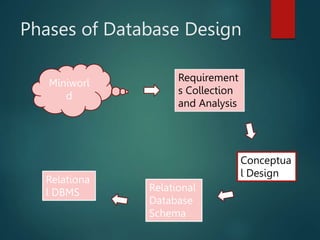
Phases of Database Design
Miniworl
d
Requirement
s Collection
and Analysis
Conceptua
l Design
Relational
Database
Schema
Relationa
l DBMS
Phases of Database Design
Miniworl
d
Requirement
s Collection
and Analysis
Conceptua
l Design
Relational
Database
Schema
Relationa
l DBMS
We are here
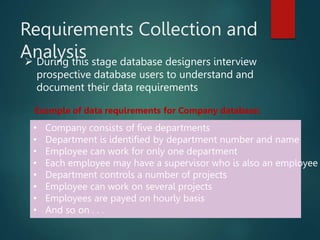
Requirements Collection and
Analysis
 During this stage database designers interview
prospective database users to understand and
document their data requirements
• Company consists of five departments
• Department is identified by department number and name
• Employee can work for only one department
• Each employee may have a supervisor who is also an employee
• Department controls a number of projects
• Employee can work on several projects
• Employees are payed on hourly basis
• And so on . . .
Example of data requirements for Company database:
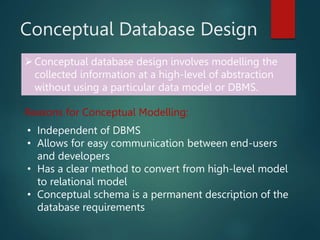
Conceptual Database Design
Conceptual database design involves modelling the
collected information at a high-level of abstraction
without using a particular data model or DBMS.
Reasons for Conceptual Modelling:
• Independent of DBMS
• Allows for easy communication between end-users
and developers
• Has a clear method to convert from high-level model
to relational model
• Conceptual schema is a permanent description of the
database requirements
Conceptual Database
Schema
As a result of using High-Level Conceptual Data
Model a Conceptual Database Schema is created
Conceptual Schema includes detailed description of
the entity types, relationships, and constraints
Conceptual Schema reflects all the data requirements
collected during the initial stage
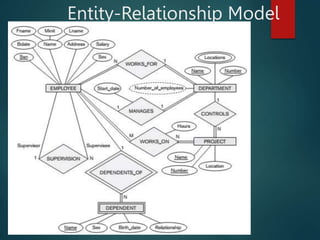
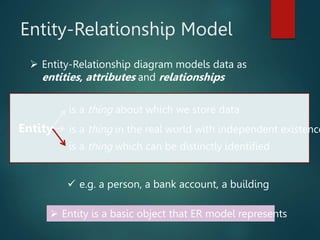
Entity-Relationship Model
 Entity-Relationship diagram models data as
entities, attributes and relationships
is a thing which can be distinctly identified
is a thing about which we store data
Entity
 e.g. a person, a bank account, a building
is a thing in the real world with independent existence
 Entity is a basic object that ER model represents
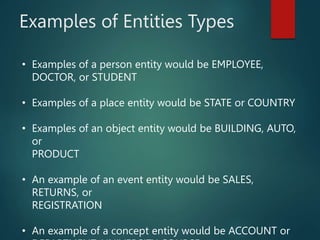
Examples of Entities Types
• Examples of a person entity would be EMPLOYEE,
DOCTOR, or STUDENT
• Examples of a place entity would be STATE or COUNTRY
• Examples of an object entity would be BUILDING, AUTO,
or
PRODUCT
• An example of an event entity would be SALES,
RETURNS, or
REGISTRATION
• An example of a concept entity would be ACCOUNT or
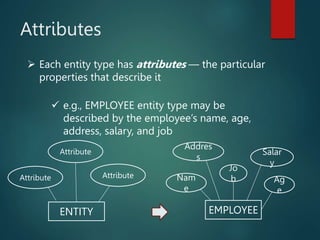
Attributes
 Each entity type has attributes — the particular
properties that describe it
 e.g., EMPLOYEE entity type may be
described by the employee’s name, age,
address, salary, and job
EMPLOYEE
Nam
e
Addres
s
Salar
y
Jo
b Ag
e
ENTITY
Attribute
Attribute
Attribute
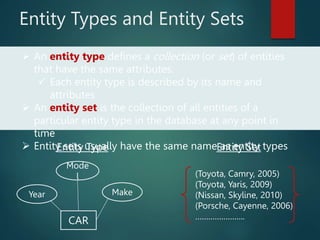
Entity Types and Entity Sets
 An entity type defines a collection (or set) of entities
that have the same attributes.
 Each entity type is described by its name and
attributes
 An entity set is the collection of all entities of a
particular entity type in the database at any point in
time
 Entity sets usually have the same name as entity types
CAR
Year
Mode
l
Make
Entity Type Entity Set
(Toyota, Camry, 2005)
(Toyota, Yaris, 2009)
(Nissan, Skyline, 2010)
(Porsche, Cayenne, 2006)
…………………..
Types of Attributes
Several types of attributes occur in the ER model:
 simple (atomic) versus composite
 Single-valued versus multi-valued
 stored versus derived
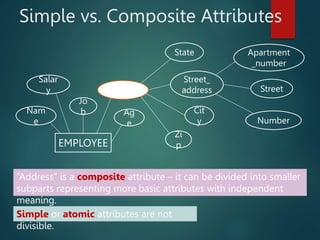
Simple vs. Composite Attributes
EMPLOYEE
Nam
e
Addres
s
Salar
y
Jo
b Ag
e
Street_
address
Zi
p
State
Cit
y
Apartment
_number
Street
Number
“Address” is a composite attribute – it can be divided into smaller
subparts representing more basic attributes with independent
meaning.
Simple or atomic attributes are not
divisible.
Another example of a
composite attribute
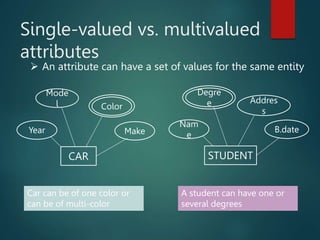
Single-valued vs. multivalued
attributes
 An attribute can have a set of values for the same entity
CAR
Year
Mode
l Color
Make
Car can be of one color or
can be of multi-color
STUDENT
Nam
e
Degre
e Addres
s
B.date
A student can have one or
several degrees
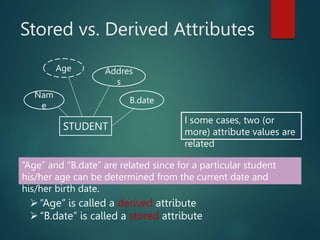
Stored vs. Derived Attributes
STUDENT
Nam
e
Addres
s
B.date
Age
I some cases, two (or
more) attribute values are
related
“Age” and “B.date” are related since for a particular student
his/her age can be determined from the current date and
his/her birth date.
“Age” is called a derived attribute
“B.date” is called a stored attribute
Key Attributes
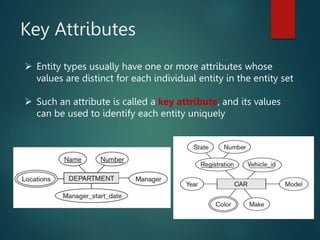
 Entity types usually have one or more attributes whose
values are distinct for each individual entity in the entity set
 Such an attribute is called a key attribute, and its values
can be used to identify each entity uniquely
Example: Requirements Collection and Analysis
“COMPANY”
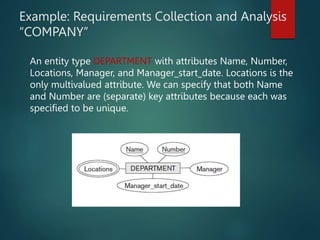
An entity type DEPARTMENT with attributes Name, Number,
Locations, Manager, and Manager_start_date. Locations is the
only multivalued attribute. We can specify that both Name
and Number are (separate) key attributes because each was
specified to be unique.
Example: Requirements Collection and Analysis
“COMPANY”
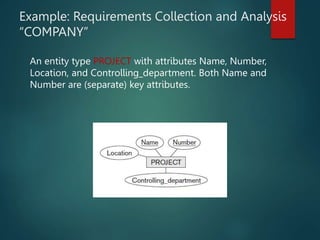
An entity type PROJECT with attributes Name, Number,
Location, and Controlling_department. Both Name and
Number are (separate) key attributes.
Example: Requirements Collection and Analysis
“COMPANY”
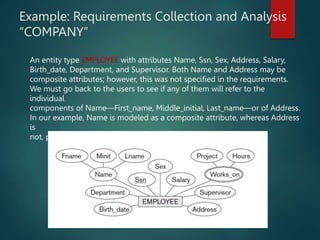
An entity type EMPLOYEE with attributes Name, Ssn, Sex, Address, Salary,
Birth_date, Department, and Supervisor. Both Name and Address may be
composite attributes; however, this was not specified in the requirements.
We must go back to the users to see if any of them will refer to the
individual
components of Name—First_name, Middle_initial, Last_name—or of Address.
In our example, Name is modeled as a composite attribute, whereas Address
is
not, presumably after consultation with the users.
Example: Requirements Collection and Analysis
“COMPANY”
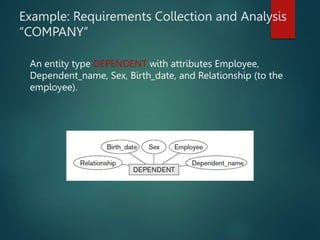
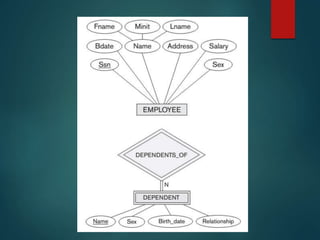
An entity type DEPENDENT with attributes Employee,
Dependent_name, Sex, Birth_date, and Relationship (to the
employee).
Identifying Relationships
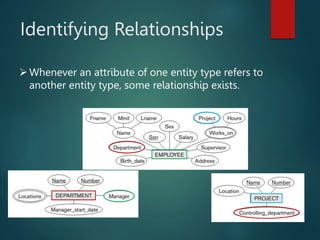
Whenever an attribute of one entity type refers to
another entity type, some relationship exists.
Understanding Relationships
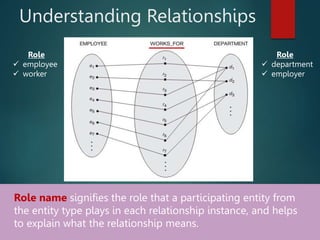
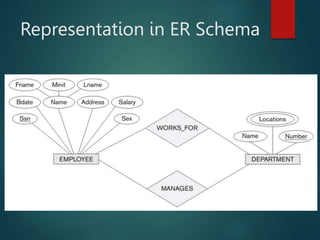
Role name signifies the role that a participating entity from
the entity type plays in each relationship instance, and helps
to explain what the relationship means.
Role
 employee
 worker
Role
 department
 employer
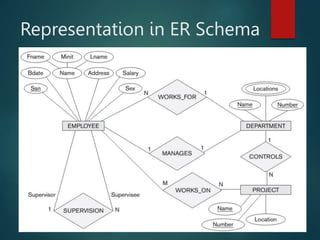
Representation in ER Schema
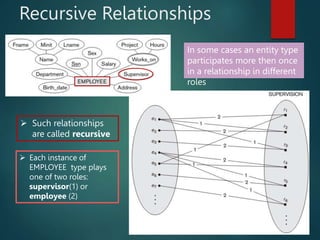
Recursive Relationships
EMPLOYEE
In some cases an entity type
participates more then once
in a relationship in different
roles
 Such relationships
are called recursive
 Each instance of
EMPLOYEE type plays
one of two roles:
supervisor(1) or
employee (2)
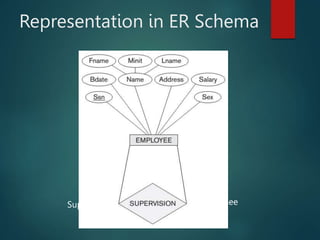
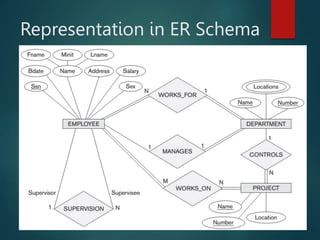
Representation in ER Schema
Supervisor Supervisee
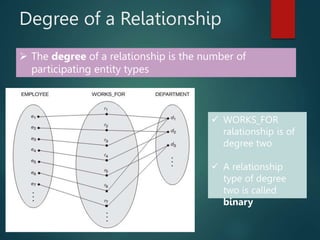
Degree of a Relationship
 The degree of a relationship is the number of
participating entity types
 WORKS_FOR
ralationship is of
degree two
 A relationship
type of degree
two is called
binary
Degree of a Relationship
 SUPPLY
ralationship is of
degree three
 A relationship
type of degree
three is called
ternary
 If N entity types
participate in a
relationship then such
relationship is of degree
N
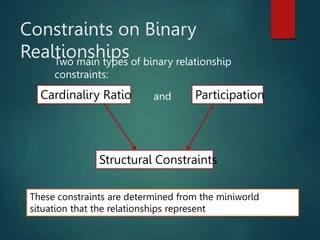
Constraints on Binary
Realtionships
These constraints are determined from the miniworld
situation that the relationships represent
Two main types of binary relationship
constraints:
Participation
Cardinaliry Ratio
Structural Constraints
and
Cardinality Ratios for
Binary Relationships
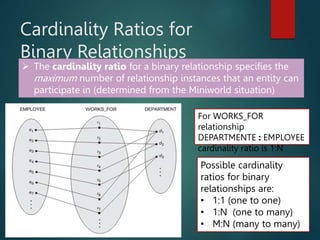
 The cardinality ratio for a binary relationship specifies the
maximum number of relationship instances that an entity can
participate in (determined from the Miniworld situation)
For WORKS_FOR
relationship
DEPARTMENTE : EMPLOYEE
cardinality ratio is 1:N
Possible cardinality
ratios for binary
relationships are:
• 1:1 (one to one)
• 1:N (one to many)
• M:N (many to many)
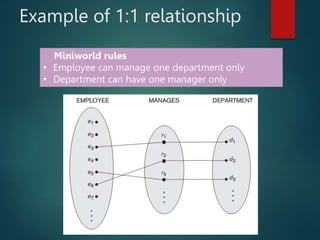
Example of 1:1 relationship
Miniworld rules
• Employee can manage one department only
• Department can have one manager only
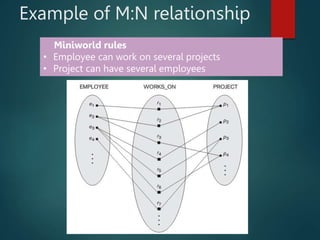
Example of M:N relationship
Miniworld rules
• Employee can work on several projects
• Project can have several employees
Representation in ER Schema
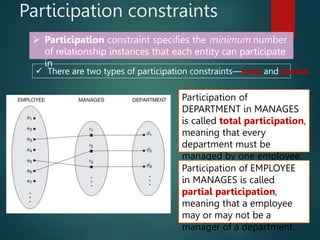
Participation constraints
 There are two types of participation constraints—total and partial
 Participation constraint specifies the minimum number
of relationship instances that each entity can participate
in
Participation of
DEPARTMENT in MANAGES
is called total participation,
meaning that every
department must be
managed by one employee.
Participation of EMPLOYEE
in MANAGES is called
partial participation,
meaning that a employee
may or may not be a
manager of a department.
Representation in ER Schema
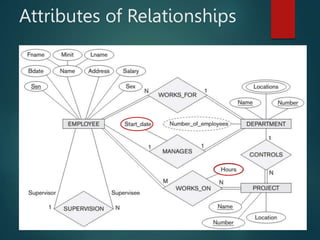
Attributes of Relationships
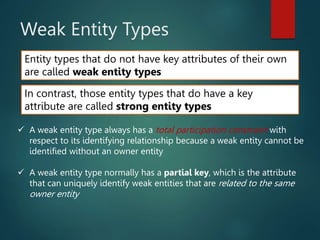
Weak Entity Types
Entity types that do not have key attributes of their own
are called weak entity types
In contrast, those entity types that do have a key
attribute are called strong entity types
 A weak entity type always has a total participation constraint with
respect to its identifying relationship because a weak entity cannot be
identified without an owner entity
 A weak entity type normally has a partial key, which is the attribute
that can uniquely identify weak entities that are related to the same
owner entity
Jobs manager vs supervisor.pptx

Jobs manager vs supervisor.pptx

  • 1.
    Jobs: manager vs supervisor BAJARDIKDIROV DAULETGELDI TEKSHIRDI NASIMAHON EZOZHONOVA Toshkent xalqaro moliyaviy boshqaruv va texnologiyalar universeteti
  • 2.
    Phases of DatabaseDesign Miniworl d Requirement s Collection and Analysis Conceptua l Design Relational Database Schema Relationa l DBMS
  • 3.
    Phases of DatabaseDesign Miniworl d Requirement s Collection and Analysis Conceptua l Design Relational Database Schema Relationa l DBMS We are here
  • 4.
    Requirements Collection and Analysis During this stage database designers interview prospective database users to understand and document their data requirements • Company consists of five departments • Department is identified by department number and name • Employee can work for only one department • Each employee may have a supervisor who is also an employee • Department controls a number of projects • Employee can work on several projects • Employees are payed on hourly basis • And so on . . . Example of data requirements for Company database:
  • 5.
    Conceptual Database Design Conceptualdatabase design involves modelling the collected information at a high-level of abstraction without using a particular data model or DBMS. Reasons for Conceptual Modelling: • Independent of DBMS • Allows for easy communication between end-users and developers • Has a clear method to convert from high-level model to relational model • Conceptual schema is a permanent description of the database requirements
  • 6.
    Conceptual Database Schema As aresult of using High-Level Conceptual Data Model a Conceptual Database Schema is created Conceptual Schema includes detailed description of the entity types, relationships, and constraints Conceptual Schema reflects all the data requirements collected during the initial stage
  • 7.
  • 8.
    Entity-Relationship Model  Entity-Relationshipdiagram models data as entities, attributes and relationships is a thing which can be distinctly identified is a thing about which we store data Entity  e.g. a person, a bank account, a building is a thing in the real world with independent existence  Entity is a basic object that ER model represents
  • 9.
    Examples of EntitiesTypes • Examples of a person entity would be EMPLOYEE, DOCTOR, or STUDENT • Examples of a place entity would be STATE or COUNTRY • Examples of an object entity would be BUILDING, AUTO, or PRODUCT • An example of an event entity would be SALES, RETURNS, or REGISTRATION • An example of a concept entity would be ACCOUNT or
  • 10.
    Attributes  Each entitytype has attributes — the particular properties that describe it  e.g., EMPLOYEE entity type may be described by the employee’s name, age, address, salary, and job EMPLOYEE Nam e Addres s Salar y Jo b Ag e ENTITY Attribute Attribute Attribute
  • 11.
    Entity Types andEntity Sets  An entity type defines a collection (or set) of entities that have the same attributes.  Each entity type is described by its name and attributes  An entity set is the collection of all entities of a particular entity type in the database at any point in time  Entity sets usually have the same name as entity types CAR Year Mode l Make Entity Type Entity Set (Toyota, Camry, 2005) (Toyota, Yaris, 2009) (Nissan, Skyline, 2010) (Porsche, Cayenne, 2006) …………………..
  • 12.
    Types of Attributes Severaltypes of attributes occur in the ER model:  simple (atomic) versus composite  Single-valued versus multi-valued  stored versus derived
  • 13.
    Simple vs. CompositeAttributes EMPLOYEE Nam e Addres s Salar y Jo b Ag e Street_ address Zi p State Cit y Apartment _number Street Number “Address” is a composite attribute – it can be divided into smaller subparts representing more basic attributes with independent meaning. Simple or atomic attributes are not divisible.
  • 14.
    Another example ofa composite attribute
  • 15.
    Single-valued vs. multivalued attributes An attribute can have a set of values for the same entity CAR Year Mode l Color Make Car can be of one color or can be of multi-color STUDENT Nam e Degre e Addres s B.date A student can have one or several degrees
  • 16.
    Stored vs. DerivedAttributes STUDENT Nam e Addres s B.date Age I some cases, two (or more) attribute values are related “Age” and “B.date” are related since for a particular student his/her age can be determined from the current date and his/her birth date. “Age” is called a derived attribute “B.date” is called a stored attribute
  • 17.
    Key Attributes  Entitytypes usually have one or more attributes whose values are distinct for each individual entity in the entity set  Such an attribute is called a key attribute, and its values can be used to identify each entity uniquely
  • 18.
    Example: Requirements Collectionand Analysis “COMPANY” An entity type DEPARTMENT with attributes Name, Number, Locations, Manager, and Manager_start_date. Locations is the only multivalued attribute. We can specify that both Name and Number are (separate) key attributes because each was specified to be unique.
  • 19.
    Example: Requirements Collectionand Analysis “COMPANY” An entity type PROJECT with attributes Name, Number, Location, and Controlling_department. Both Name and Number are (separate) key attributes.
  • 20.
    Example: Requirements Collectionand Analysis “COMPANY” An entity type EMPLOYEE with attributes Name, Ssn, Sex, Address, Salary, Birth_date, Department, and Supervisor. Both Name and Address may be composite attributes; however, this was not specified in the requirements. We must go back to the users to see if any of them will refer to the individual components of Name—First_name, Middle_initial, Last_name—or of Address. In our example, Name is modeled as a composite attribute, whereas Address is not, presumably after consultation with the users.
  • 21.
    Example: Requirements Collectionand Analysis “COMPANY” An entity type DEPENDENT with attributes Employee, Dependent_name, Sex, Birth_date, and Relationship (to the employee).
  • 22.
    Identifying Relationships Whenever anattribute of one entity type refers to another entity type, some relationship exists.
  • 23.
    Understanding Relationships Role namesignifies the role that a participating entity from the entity type plays in each relationship instance, and helps to explain what the relationship means. Role  employee  worker Role  department  employer
  • 24.
  • 25.
    Recursive Relationships EMPLOYEE In somecases an entity type participates more then once in a relationship in different roles  Such relationships are called recursive  Each instance of EMPLOYEE type plays one of two roles: supervisor(1) or employee (2)
  • 26.
    Representation in ERSchema Supervisor Supervisee
  • 27.
    Degree of aRelationship  The degree of a relationship is the number of participating entity types  WORKS_FOR ralationship is of degree two  A relationship type of degree two is called binary
  • 28.
    Degree of aRelationship  SUPPLY ralationship is of degree three  A relationship type of degree three is called ternary  If N entity types participate in a relationship then such relationship is of degree N
  • 29.
    Constraints on Binary Realtionships Theseconstraints are determined from the miniworld situation that the relationships represent Two main types of binary relationship constraints: Participation Cardinaliry Ratio Structural Constraints and
  • 30.
    Cardinality Ratios for BinaryRelationships  The cardinality ratio for a binary relationship specifies the maximum number of relationship instances that an entity can participate in (determined from the Miniworld situation) For WORKS_FOR relationship DEPARTMENTE : EMPLOYEE cardinality ratio is 1:N Possible cardinality ratios for binary relationships are: • 1:1 (one to one) • 1:N (one to many) • M:N (many to many)
  • 31.
    Example of 1:1relationship Miniworld rules • Employee can manage one department only • Department can have one manager only
  • 32.
    Example of M:Nrelationship Miniworld rules • Employee can work on several projects • Project can have several employees
  • 33.
  • 34.
    Participation constraints  Thereare two types of participation constraints—total and partial  Participation constraint specifies the minimum number of relationship instances that each entity can participate in Participation of DEPARTMENT in MANAGES is called total participation, meaning that every department must be managed by one employee. Participation of EMPLOYEE in MANAGES is called partial participation, meaning that a employee may or may not be a manager of a department.
  • 35.
  • 36.
  • 37.
    Weak Entity Types Entitytypes that do not have key attributes of their own are called weak entity types In contrast, those entity types that do have a key attribute are called strong entity types  A weak entity type always has a total participation constraint with respect to its identifying relationship because a weak entity cannot be identified without an owner entity  A weak entity type normally has a partial key, which is the attribute that can uniquely identify weak entities that are related to the same owner entity