ER MODELING
Contents
  An Introduction
  Entities & Relationships
  Building an Entity-Relationship model
  Attributes and Identifiers
  Cardinality, Degree, Existence of
  Relationships
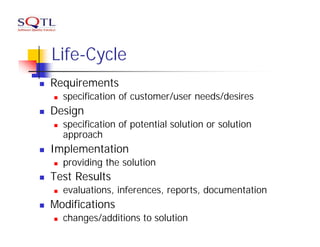
Life-Cycle
n   Requirements
    n   specification of customer/user needs/desires
n   Design
    n   specification of potential solution or solution
        approach
n   Implementation
    n   providing the solution
n   Test Results
    n   evaluations, inferences, reports, documentation
n   Modifications
    n   changes/additions to solution
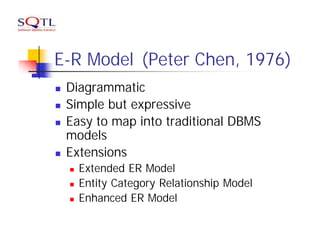
E-R Model (Peter Chen, 1976)
n   Diagrammatic
n   Simple but expressive
n   Easy to map into traditional DBMS
    models
n   Extensions
    n   Extended ER Model
    n   Entity Category Relationship Model
    n   Enhanced ER Model
The Conceptual Model
 Conceptual model captures the global/
 institutional view of the data semantics.
 It investigates and enumerates the various
 entities that participate in the business
 environment being modelled.
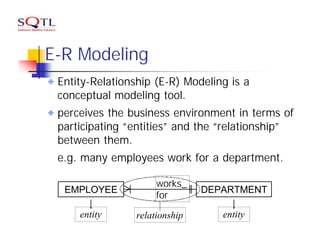
E-R Modeling
 Entity-Relationship (E-R) Modeling is a
 conceptual modeling tool.
 perceives the business environment in terms of
 participating “entities” and the “relationship”
 between them.
 e.g. many employees work for a department.

                      works_
  EMPLOYEE                      DEPARTMENT
                      for
     entity      relationship      entity
Entity
 is a “data object”
 models some object/entity in the real-world;
 entity type represents the set of all similar
 objects.
 identified by the nouns in the requirements
 specification.
 must have a name that is unique across the
 entire model and has a consistent meaning
 across the modelling team and the end users.
Attributes
  characteristics/properties of an entity, that
  provide descriptive details of it.
  every attribute must be given a name that is
  unique across the entity (distinct entities may
  have attributes with the same name).
  attribute names are also subject to the same
  rules that govern entity names (consistent
  meaning, documentation, etc..)
Types of Attributes
n   Simple and composite
n   Single-valued and multivalued
n   Null
n   Derived
Simple and Composite
                Attributes
n   Simple Attribute: An attribute composed of a
    single component with an independent
    existence. E.g position and salary of the Staff
    entity.
n   Composite Attribute: An attribute composed
    of multiple components, each with an
    independent existence. E.g adress attribute of
    the branch entity that can be subdivided into
    street, city and postcode attributes.
Single-Valued and Multi-
         Valued Attributes
n   Single-Valued Attribute: An attribute that
    holds a single valuefor each occurrence of an
    entity type. E.g branchNo.
n   Multi-Valued Attributes: An attribute that
    holds multiple values for each occurrence of
    an entity type. E.g telephoneNo.
Derived Attributes
n   Derived Attributes: An attribute that
    represents a value that is derivable from the
    value of a related attribute or set of
    attributes, not necessarily in the same entity
    type.
     n E.g attribute duration which value is

       derived from the rentStart and rentFinish
       attributes.
Relationship
models the real-world association between two
or more entities (binary, n-ary relationship).
A relationship can be optional or mandatory
“degree” is the number of entity sets involved in
the relationship.   typically 2 (binary); other
common degrees are 1 (recursive) and 3 (ternary).
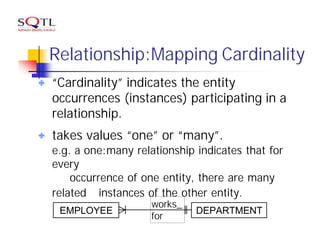
Relationship:Mapping Cardinality
“Cardinality” indicates the entity
occurrences (instances) participating in a
relationship.
takes values “one” or “many”.
e.g. a one:many relationship indicates that for
every
    occurrence of one entity, there are many
related instances of the other entity.
                    works_
 EMPLOYEE                    DEPARTMENT
                    for
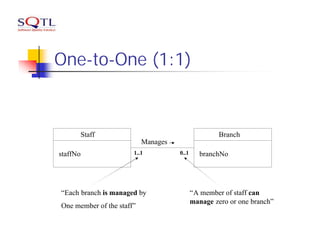
One-to-One (1:1)


          Staff                                      Branch
                           Manages
staffNo                1..1          0..1      branchNo


“Each branch is managed by                  “A member of staff can
                                            manage zero or one branch”
One member of the staff”
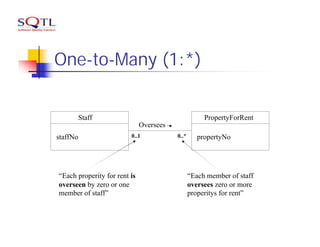
One-to-Many (1:*)


          Staff                                      PropertyForRent
                              Oversees
staffNo                  0..1            0..*      propertyNo


“Each properity for rent is                     “Each member of staff
overseen by zero or one                         oversees zero or more
member of staff”                                properitys for rent”
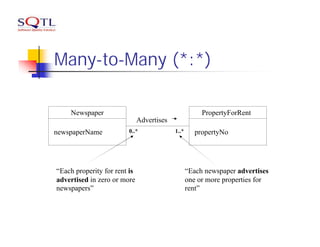
Many-to-Many (*:*)

    Newspaper                                          PropertyForRent
                              Advertises
newspaperName           0..*               1..*      propertyNo


“Each properity for rent is                       “Each newspaper advertises
advertised in zero or more                        one or more properties for
newspapers”                                       rent”
Building the ER Model
the requirements specification is the first step to
any design; it captures the ‘what’ of the business
environment.
also documents the “business rules” - i.e., the
constraints that will apply to your database.
e.g. every department must have a manager;
     and only one manager.

the ER model must capture the participating
entities as well as these business rules.
Entity : Categorisation
 Fundamental/strong entity
     an entity that is capable of its “own
    existence” - i.e. an entity whose instances
    exist notwithstanding the existence of other
    entities.
 Weak Entities
 Associative Entities
Entity types : Weak
 an entity that is not capable of “its own
 existence”.
 characterised by the need to have at least
 one external identifier (of another entity)
 as part of its own identifier.
 e.g. consider “ payment” and “ pmt_items”
    “ pmt_items” cannot exist without a
 corresponding
     “ payment” instance. “pmt_id” of “ payment”
     will be part of the identifier of “ pmt_items”
Entity types : Associative

 a relationship translates into migration of a key
 - many:many relationship implies the keys
 migrating many times, both ways.
 such migration leads to redundancy and
 many:many relationships must therefore be
 resolved.
 “Associative entity” is an entity that is used to
 resolve a many:many relationship.
Summary
 Entities & Relationships
 Building an Entity-Relationship model
 Attributes and Identifiers
 Cardinality, Degree, Existence of
 Relationships

ER Modelling

  • 1.
  • 2.
    Contents AnIntroduction Entities & Relationships Building an Entity-Relationship model Attributes and Identifiers Cardinality, Degree, Existence of Relationships
  • 3.
    Life-Cycle n Requirements n specification of customer/user needs/desires n Design n specification of potential solution or solution approach n Implementation n providing the solution n Test Results n evaluations, inferences, reports, documentation n Modifications n changes/additions to solution
  • 4.
    E-R Model (PeterChen, 1976) n Diagrammatic n Simple but expressive n Easy to map into traditional DBMS models n Extensions n Extended ER Model n Entity Category Relationship Model n Enhanced ER Model
  • 5.
    The Conceptual Model Conceptual model captures the global/ institutional view of the data semantics. It investigates and enumerates the various entities that participate in the business environment being modelled.
  • 6.
    E-R Modeling Entity-Relationship(E-R) Modeling is a conceptual modeling tool. perceives the business environment in terms of participating “entities” and the “relationship” between them. e.g. many employees work for a department. works_ EMPLOYEE DEPARTMENT for entity relationship entity
  • 7.
    Entity is a“data object” models some object/entity in the real-world; entity type represents the set of all similar objects. identified by the nouns in the requirements specification. must have a name that is unique across the entire model and has a consistent meaning across the modelling team and the end users.
  • 8.
    Attributes characteristics/propertiesof an entity, that provide descriptive details of it. every attribute must be given a name that is unique across the entity (distinct entities may have attributes with the same name). attribute names are also subject to the same rules that govern entity names (consistent meaning, documentation, etc..)
  • 9.
    Types of Attributes n Simple and composite n Single-valued and multivalued n Null n Derived
  • 10.
    Simple and Composite Attributes n Simple Attribute: An attribute composed of a single component with an independent existence. E.g position and salary of the Staff entity. n Composite Attribute: An attribute composed of multiple components, each with an independent existence. E.g adress attribute of the branch entity that can be subdivided into street, city and postcode attributes.
  • 11.
    Single-Valued and Multi- Valued Attributes n Single-Valued Attribute: An attribute that holds a single valuefor each occurrence of an entity type. E.g branchNo. n Multi-Valued Attributes: An attribute that holds multiple values for each occurrence of an entity type. E.g telephoneNo.
  • 12.
    Derived Attributes n Derived Attributes: An attribute that represents a value that is derivable from the value of a related attribute or set of attributes, not necessarily in the same entity type. n E.g attribute duration which value is derived from the rentStart and rentFinish attributes.
  • 13.
    Relationship models the real-worldassociation between two or more entities (binary, n-ary relationship). A relationship can be optional or mandatory “degree” is the number of entity sets involved in the relationship. typically 2 (binary); other common degrees are 1 (recursive) and 3 (ternary).
  • 14.
    Relationship:Mapping Cardinality “Cardinality” indicatesthe entity occurrences (instances) participating in a relationship. takes values “one” or “many”. e.g. a one:many relationship indicates that for every occurrence of one entity, there are many related instances of the other entity. works_ EMPLOYEE DEPARTMENT for
  • 15.
    One-to-One (1:1) Staff Branch Manages staffNo 1..1 0..1 branchNo “Each branch is managed by “A member of staff can manage zero or one branch” One member of the staff”
  • 16.
    One-to-Many (1:*) Staff PropertyForRent Oversees staffNo 0..1 0..* propertyNo “Each properity for rent is “Each member of staff overseen by zero or one oversees zero or more member of staff” properitys for rent”
  • 17.
    Many-to-Many (*:*) Newspaper PropertyForRent Advertises newspaperName 0..* 1..* propertyNo “Each properity for rent is “Each newspaper advertises advertised in zero or more one or more properties for newspapers” rent”
  • 18.
    Building the ERModel the requirements specification is the first step to any design; it captures the ‘what’ of the business environment. also documents the “business rules” - i.e., the constraints that will apply to your database. e.g. every department must have a manager; and only one manager. the ER model must capture the participating entities as well as these business rules.
  • 19.
    Entity : Categorisation Fundamental/strong entity an entity that is capable of its “own existence” - i.e. an entity whose instances exist notwithstanding the existence of other entities. Weak Entities Associative Entities
  • 20.
    Entity types :Weak an entity that is not capable of “its own existence”. characterised by the need to have at least one external identifier (of another entity) as part of its own identifier. e.g. consider “ payment” and “ pmt_items” “ pmt_items” cannot exist without a corresponding “ payment” instance. “pmt_id” of “ payment” will be part of the identifier of “ pmt_items”
  • 21.
    Entity types :Associative a relationship translates into migration of a key - many:many relationship implies the keys migrating many times, both ways. such migration leads to redundancy and many:many relationships must therefore be resolved. “Associative entity” is an entity that is used to resolve a many:many relationship.
  • 22.
    Summary Entities &Relationships Building an Entity-Relationship model Attributes and Identifiers Cardinality, Degree, Existence of Relationships