ePortfolio: an educational 
and assessment tool 
fernando albuquerque costa 
carolina pereira 
UNIVERSITY OF LISBON 
ePortfolio: an educational and assessment tool fernando albuquerque costa | carolina pereira | ULISBON
- PORTFOLIO: WHY AND WHAT FOR? 
- THE PROFESSION OF TRAINER 
- ABOUT THE PORTFOLIO STRATEGY 
- WHY ELECTRONIC PORTFOLIOS? 
- A CONCEPTUAL FRAMEWORK 
- REFLECTION AS A SYNTHESIS 
ePortfolio: an educational and assessment tool fernando albuquerque costa | carolina pereira | ULISBON
PORTFOLIO: WHY AND WHAT FOR? 
ePortfolio: an educational and assessment tool fernando albuquerque costa | carolina pereira | ULISBON
What about your own goals for 
using portfolio? 
Why to use a portfolio strategy? 
What for in our case? 
… an agent capable of changing his/her practices by 
developing his/her reflection capacity… 
ePortfolio: an educational and assessment tool fernando albuquerque costa | carolina pereira | ULISBON
“The best way to kill it (portfolio) would be to 
make it mandatory or use it for evaluation” 
(Teitel, Ricci and Coogan, 1998) 
ePortfolio: an educational and assessment tool fernando albuquerque costa | carolina pereira | ULISBON
THE PROFESSION OF TRAINER 
ePortfolio: an educational and assessment tool fernando albuquerque costa | carolina pereira | ULISBON
Trainer as agent of Education, but also 
an agent of change (isomorphism) 
- Trainer as learner (a constructivist perspective) 
- Trainer as life-long learner (a continuous task) 
A profession based on reflective practice: 
An agent capable of building, analysing, evaluating 
and changing his/her practices, as well as re-orienting 
the founding and underlying values 
Also, training as a collaborative process… 
… that implies a collaborative reflection 
ePortfolio: an educational and assessment tool fernando albuquerque costa | carolina pereira | ULISBON
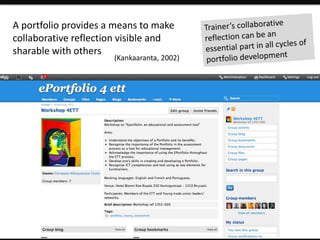
A portfolio provides a means to make 
collaborative reflection visible and 
sharable with others 
(Kankaaranta, 2002) 
ePortfolio: an educational and assessment tool fernando albuquerque costa | carolina pereira | ULISBON
ABOUT THE PORTFOLIO STRATEGY 
ePortfolio: an educational and assessment tool fernando albuquerque costa | carolina pereira | ULISBON
Portfolio have attracted 
much attention as 
an alternative to 
traditional assessment 
AUTHENTIC 
ASSESSMENT 
the contents should be 
related to real life 
problems and 
solutions… 
PORTFOLIO 
Portfolio as 
collection of 
multidimensional 
data in order to 
understand the 
learning and 
changes in 
learners 
ePortfolio: an educational and assessment tool fernando albuquerque costa | carolina pereira | ULISBON
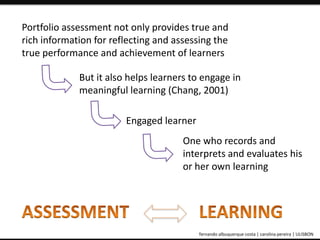
Portfolio assessment not only provides true and 
rich information for reflecting and assessing the 
true performance and achievement of learners 
But it also helps learners to engage in 
meaningful learning (Chang, 2001) 
Engaged learner 
One who records and 
interprets and evaluates his 
or her own learning 
ePortfolio: an educational and assessment tool fernando albuquerque costa | carolina pereira | ULISBON
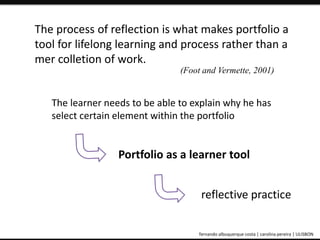
The process of reflection is what makes portfolio a 
tool for lifelong learning and process rather than a 
mer colletion of work. 
(Foot and Vermette, 2001) 
The learner needs to be able to explain why he has 
select certain element within the portfolio 
Portfolio as a learner tool 
reflective practice 
ePortfolio: an educational and assessment tool fernando albuquerque costa | carolina pereira | ULISBON
Potential to provide evidence 
of self-regulation as well as a 
tool to support and scaffold 
self-regulation. 
(Wade, Abrami, & Sclater, 2005) 
SELF-REGULATION 
Self-regulated learners are individuals who are 
metacognitively, motivationally, and behaviourally 
active participants in their own learning. 
(Zimmerman, 2000) 
ePortfolio: an educational and assessment tool fernando albuquerque costa | carolina pereira | ULISBON
A portfolio contributes to a 
more reflective and more 
autonomous professionals 
with greater critical ability 
- it needs attitude changes regarding 
assessment and a new perspective on 
what learning is; 
- but also be aware on the new roles of the 
trainer in a constantly changing society. 
ePortfolio: an educational and assessment tool fernando albuquerque costa | carolina pereira | ULISBON
WHY ELECTRONIC PORTFOLIOS? 
ePortfolio: an educational and assessment tool fernando albuquerque costa | carolina pereira | ULISBON
Digital portfolios are the 
Information Age’s version 
of the artist’s portfolio in 
the sense that they not 
only summarize an artist’s 
creative achievements but 
also illustrate the process 
of reaching those 
achievements. 
ePortfolio: an educational and assessment tool fernando albuquerque costa | carolina pereira | ULISBON
POTENCIAL OF THE 
PORTFOLIO CONCEPT 
+ 
POTENCIAL OF THE 
DIGITAL TECHNOLOGY 
ELECTRONIC 
(OR DIGITAL) 
PORTFOLIO 
ePortfolio: an educational and assessment tool fernando albuquerque costa | carolina pereira | ULISBON
Traditionally portfolio assessment 
relies on manual data collection 
and a writing-centred learning 
process. 
The difficulties in data storage, 
search and management after 
long term implementation 
have become a problem. 
Computer technology has facilitated the production of 
electronic or digital based portfolios, which enable to 
combine text, pictures, images and sound to present 
richer and more diversity file content through 
multimedia. 
Today, the Web 2.0 tools… 
ePortfolio: an educational and assessment tool fernando albuquerque costa | carolina pereira | ULISBON
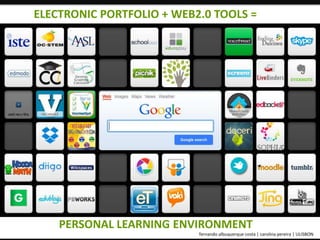
ELECTRONIC PORTFOLIO + WEB2.0 TOOLS = 
PERSONAL LEARNING ENVIRONMENT 
ePortfolio: an educational and assessment tool fernando albuquerque costa | carolina pereira | ULISBON
A CONCEPTUAL FRAMEWORK 
ePortfolio: an educational and assessment tool fernando albuquerque costa | carolina pereira | ULISBON
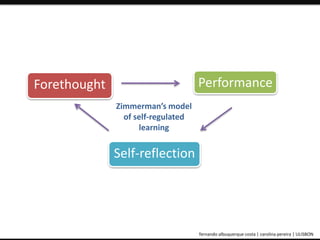
Forethought Performance 
Zimmerman’s model 
of self-regulated 
learning 
Self-reflection 
ePortfolio: an educational and assessment tool fernando albuquerque costa | carolina pereira | ULISBON
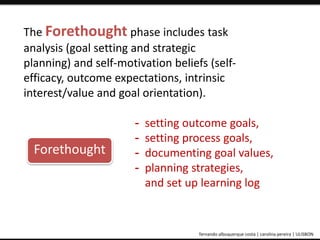
The Forethought phase includes task 
analysis (goal setting and strategic 
planning) and self-motivation beliefs (self-efficacy, 
outcome expectations, intrinsic 
interest/value and goal orientation). 
- setting outcome goals, 
- setting process goals, 
- documenting goal values, 
- planning strategies, 
and set up learning log 
Forethought 
ePortfolio: an educational and assessment tool fernando albuquerque costa | carolina pereira | ULISBON
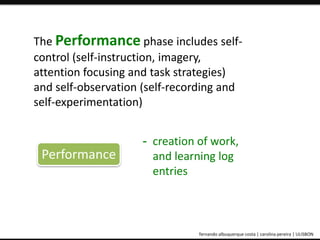
The Performance phase includes self-control 
(self-instruction, imagery, 
attention focusing and task strategies) 
and self-observation (self-recording and 
self-experimentation) 
- creation of work, 
and learning log 
entries 
Performance 
ePortfolio: an educational and assessment tool fernando albuquerque costa | carolina pereira | ULISBON
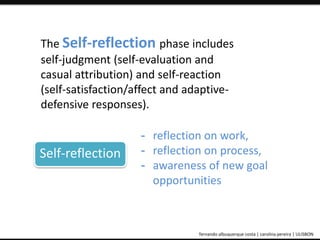
The Self-reflection phase includes 
self-judgment (self-evaluation and 
casual attribution) and self-reaction 
(self-satisfaction/affect and adaptive-defensive 
responses). 
- reflection on work, 
- reflection on process, 
- awareness of new goal 
opportunities 
Self-reflection 
ePortfolio: an educational and assessment tool fernando albuquerque costa | carolina pereira | ULISBON
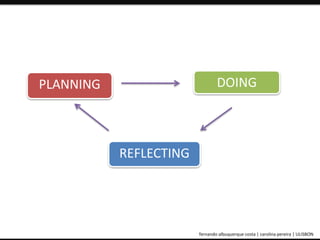
PLANNING DOING 
REFLECTING 
ePortfolio: an educational and assessment tool fernando albuquerque costa | carolina pereira | ULISBON
REFLECTION AS A SYNTHESIS 
ePortfolio: an educational and assessment tool fernando albuquerque costa | carolina pereira | ULISBON
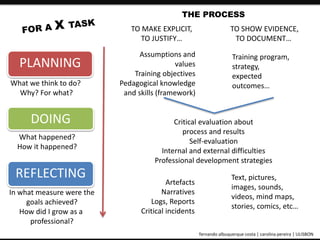
THE PROCESS 
TO SHOW EVIDENCE, 
TO DOCUMENT… 
Training program, 
strategy, 
expected 
outcomes… 
ePortfolio: an educational and assessment tool fernando albuquerque costa | carolina pereira | ULISBON 
PLANNING 
DOING 
REFLECTING 
Assumptions and 
values 
Training objectives 
Pedagogical knowledge 
and skills (framework) 
Artefacts 
Narratives 
Logs, Reports 
Critical incidents 
What we think to do? 
Why? For what? 
What happened? 
How it happened? 
In what measure were the 
goals achieved? 
How did I grow as a 
professional? 
Critical evaluation about 
process and results 
Self-evaluation 
Internal and external difficulties 
Professional development strategies 
Text, pictures, 
images, sounds, 
videos, mind maps, 
stories, comics, etc… 
TO MAKE EXPLICIT, 
TO JUSTIFY…
REFLECTION 
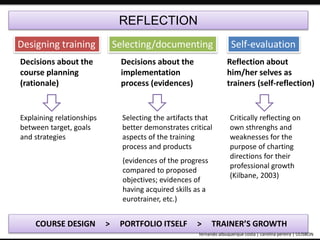
Designing training Selecting/documenting Self-evaluation 
Decisions about the 
Decisions about the 
course planning 
implementation 
(rationale) 
process (evidences) 
Reflection about 
him/her selves as 
trainers (self-reflection) 
Explaining relationships 
between target, goals 
and strategies 
Selecting the artifacts that 
better demonstrates critical 
aspects of the training 
process and products 
(evidences of the progress 
compared to proposed 
objectives; evidences of 
having acquired skills as a 
eurotrainer, etc.) 
Critically reflecting on 
own sthrenghs and 
weaknesses for the 
purpose of charting 
directions for their 
professional growth 
(Kilbane, 2003) 
COURSE DESIGN > PORTFOLIO ITSELF > TRAINER’S GROWTH 
ePortfolio: an educational and assessment tool fernando albuquerque costa | carolina pereira | ULISBON
ePortfolio: an educational 
and assessment tool 
fernando albuquerque costa 
carolina pereira 
UNIVERSITY OF LISBON 
ePortfolio: an educational and assessment tool fernando albuquerque costa | carolina pereira | ULISBON

ePortfolio an educational tool

  • 1.
    ePortfolio: an educational and assessment tool fernando albuquerque costa carolina pereira UNIVERSITY OF LISBON ePortfolio: an educational and assessment tool fernando albuquerque costa | carolina pereira | ULISBON
  • 2.
    - PORTFOLIO: WHYAND WHAT FOR? - THE PROFESSION OF TRAINER - ABOUT THE PORTFOLIO STRATEGY - WHY ELECTRONIC PORTFOLIOS? - A CONCEPTUAL FRAMEWORK - REFLECTION AS A SYNTHESIS ePortfolio: an educational and assessment tool fernando albuquerque costa | carolina pereira | ULISBON
  • 3.
    PORTFOLIO: WHY ANDWHAT FOR? ePortfolio: an educational and assessment tool fernando albuquerque costa | carolina pereira | ULISBON
  • 4.
    What about yourown goals for using portfolio? Why to use a portfolio strategy? What for in our case? … an agent capable of changing his/her practices by developing his/her reflection capacity… ePortfolio: an educational and assessment tool fernando albuquerque costa | carolina pereira | ULISBON
  • 5.
    “The best wayto kill it (portfolio) would be to make it mandatory or use it for evaluation” (Teitel, Ricci and Coogan, 1998) ePortfolio: an educational and assessment tool fernando albuquerque costa | carolina pereira | ULISBON
  • 6.
    THE PROFESSION OFTRAINER ePortfolio: an educational and assessment tool fernando albuquerque costa | carolina pereira | ULISBON
  • 7.
    Trainer as agentof Education, but also an agent of change (isomorphism) - Trainer as learner (a constructivist perspective) - Trainer as life-long learner (a continuous task) A profession based on reflective practice: An agent capable of building, analysing, evaluating and changing his/her practices, as well as re-orienting the founding and underlying values Also, training as a collaborative process… … that implies a collaborative reflection ePortfolio: an educational and assessment tool fernando albuquerque costa | carolina pereira | ULISBON
  • 8.
    A portfolio providesa means to make collaborative reflection visible and sharable with others (Kankaaranta, 2002) ePortfolio: an educational and assessment tool fernando albuquerque costa | carolina pereira | ULISBON
  • 9.
    ABOUT THE PORTFOLIOSTRATEGY ePortfolio: an educational and assessment tool fernando albuquerque costa | carolina pereira | ULISBON
  • 10.
    Portfolio have attracted much attention as an alternative to traditional assessment AUTHENTIC ASSESSMENT the contents should be related to real life problems and solutions… PORTFOLIO Portfolio as collection of multidimensional data in order to understand the learning and changes in learners ePortfolio: an educational and assessment tool fernando albuquerque costa | carolina pereira | ULISBON
  • 11.
    Portfolio assessment notonly provides true and rich information for reflecting and assessing the true performance and achievement of learners But it also helps learners to engage in meaningful learning (Chang, 2001) Engaged learner One who records and interprets and evaluates his or her own learning ePortfolio: an educational and assessment tool fernando albuquerque costa | carolina pereira | ULISBON
  • 12.
    The process ofreflection is what makes portfolio a tool for lifelong learning and process rather than a mer colletion of work. (Foot and Vermette, 2001) The learner needs to be able to explain why he has select certain element within the portfolio Portfolio as a learner tool reflective practice ePortfolio: an educational and assessment tool fernando albuquerque costa | carolina pereira | ULISBON
  • 13.
    Potential to provideevidence of self-regulation as well as a tool to support and scaffold self-regulation. (Wade, Abrami, & Sclater, 2005) SELF-REGULATION Self-regulated learners are individuals who are metacognitively, motivationally, and behaviourally active participants in their own learning. (Zimmerman, 2000) ePortfolio: an educational and assessment tool fernando albuquerque costa | carolina pereira | ULISBON
  • 14.
    A portfolio contributesto a more reflective and more autonomous professionals with greater critical ability - it needs attitude changes regarding assessment and a new perspective on what learning is; - but also be aware on the new roles of the trainer in a constantly changing society. ePortfolio: an educational and assessment tool fernando albuquerque costa | carolina pereira | ULISBON
  • 15.
    WHY ELECTRONIC PORTFOLIOS? ePortfolio: an educational and assessment tool fernando albuquerque costa | carolina pereira | ULISBON
  • 16.
    Digital portfolios arethe Information Age’s version of the artist’s portfolio in the sense that they not only summarize an artist’s creative achievements but also illustrate the process of reaching those achievements. ePortfolio: an educational and assessment tool fernando albuquerque costa | carolina pereira | ULISBON
  • 17.
    POTENCIAL OF THE PORTFOLIO CONCEPT + POTENCIAL OF THE DIGITAL TECHNOLOGY ELECTRONIC (OR DIGITAL) PORTFOLIO ePortfolio: an educational and assessment tool fernando albuquerque costa | carolina pereira | ULISBON
  • 18.
    Traditionally portfolio assessment relies on manual data collection and a writing-centred learning process. The difficulties in data storage, search and management after long term implementation have become a problem. Computer technology has facilitated the production of electronic or digital based portfolios, which enable to combine text, pictures, images and sound to present richer and more diversity file content through multimedia. Today, the Web 2.0 tools… ePortfolio: an educational and assessment tool fernando albuquerque costa | carolina pereira | ULISBON
  • 19.
    ELECTRONIC PORTFOLIO +WEB2.0 TOOLS = PERSONAL LEARNING ENVIRONMENT ePortfolio: an educational and assessment tool fernando albuquerque costa | carolina pereira | ULISBON
  • 20.
    A CONCEPTUAL FRAMEWORK ePortfolio: an educational and assessment tool fernando albuquerque costa | carolina pereira | ULISBON
  • 21.
    Forethought Performance Zimmerman’smodel of self-regulated learning Self-reflection ePortfolio: an educational and assessment tool fernando albuquerque costa | carolina pereira | ULISBON
  • 22.
    The Forethought phaseincludes task analysis (goal setting and strategic planning) and self-motivation beliefs (self-efficacy, outcome expectations, intrinsic interest/value and goal orientation). - setting outcome goals, - setting process goals, - documenting goal values, - planning strategies, and set up learning log Forethought ePortfolio: an educational and assessment tool fernando albuquerque costa | carolina pereira | ULISBON
  • 23.
    The Performance phaseincludes self-control (self-instruction, imagery, attention focusing and task strategies) and self-observation (self-recording and self-experimentation) - creation of work, and learning log entries Performance ePortfolio: an educational and assessment tool fernando albuquerque costa | carolina pereira | ULISBON
  • 24.
    The Self-reflection phaseincludes self-judgment (self-evaluation and casual attribution) and self-reaction (self-satisfaction/affect and adaptive-defensive responses). - reflection on work, - reflection on process, - awareness of new goal opportunities Self-reflection ePortfolio: an educational and assessment tool fernando albuquerque costa | carolina pereira | ULISBON
  • 25.
    PLANNING DOING REFLECTING ePortfolio: an educational and assessment tool fernando albuquerque costa | carolina pereira | ULISBON
  • 26.
    REFLECTION AS ASYNTHESIS ePortfolio: an educational and assessment tool fernando albuquerque costa | carolina pereira | ULISBON
  • 27.
    THE PROCESS TOSHOW EVIDENCE, TO DOCUMENT… Training program, strategy, expected outcomes… ePortfolio: an educational and assessment tool fernando albuquerque costa | carolina pereira | ULISBON PLANNING DOING REFLECTING Assumptions and values Training objectives Pedagogical knowledge and skills (framework) Artefacts Narratives Logs, Reports Critical incidents What we think to do? Why? For what? What happened? How it happened? In what measure were the goals achieved? How did I grow as a professional? Critical evaluation about process and results Self-evaluation Internal and external difficulties Professional development strategies Text, pictures, images, sounds, videos, mind maps, stories, comics, etc… TO MAKE EXPLICIT, TO JUSTIFY…
  • 28.
    REFLECTION Designing trainingSelecting/documenting Self-evaluation Decisions about the Decisions about the course planning implementation (rationale) process (evidences) Reflection about him/her selves as trainers (self-reflection) Explaining relationships between target, goals and strategies Selecting the artifacts that better demonstrates critical aspects of the training process and products (evidences of the progress compared to proposed objectives; evidences of having acquired skills as a eurotrainer, etc.) Critically reflecting on own sthrenghs and weaknesses for the purpose of charting directions for their professional growth (Kilbane, 2003) COURSE DESIGN > PORTFOLIO ITSELF > TRAINER’S GROWTH ePortfolio: an educational and assessment tool fernando albuquerque costa | carolina pereira | ULISBON
  • 29.
    ePortfolio: an educational and assessment tool fernando albuquerque costa carolina pereira UNIVERSITY OF LISBON ePortfolio: an educational and assessment tool fernando albuquerque costa | carolina pereira | ULISBON

Editor's Notes

  • #5 What about your goals for using portfolio? Why? What for in our case? Professional development? an agent capable of changing his/her practices by developing his/her reflection capacity!
  • #8 Trainer as agent of Education, but also an agent of change (isomorphism) Trainer as learner (more constructivist perspective) Trainer as life-long learner (a continuous task) A profession based on reflective practice An agent capable of building, analysing, evaluating and changing his/her practices, as well as re-orienting the founding and underlying values Also, training as a collaborative process That implies a collaborative reflection
  • #9 Portfolio Rationale A portfolio provides a means to make collaborative reflection visible and sharable with others (Kankaaranta, 2002) Trainer’s collaborative reflection can be an essential part in all cycles of portfolio development Portfolio as a compulsory task? <or> Portfolio as an intrinsec motivation for a continuous professional development? (a voluntary process; a reflective culture of professional development) “The best way to kill it would be to make it mandatory or use it for evaluation” (Teitel, Ricci and Coogan, 1998)
  • #12 About Portfolio Portfolio assessment not only provides true and rich information for reflecting and assessing the true performance and achievement of learners But it also helps learners to engage in meaningful learning (Chang, 2001) Deep learning Engaged learner One who records and interprets and evaluates his or her own learning Portfolio traditionally used for assessment But mainly for learning ASSESSMENT <> LEARNING
  • #13 Self-reflection The process of reflection is what makes portfolio a tool for lifelong learning and process rather than a mer colletion of work (Foot and Vermette, 2001) The learner needs to be able to explain why he has select certain element within the portfolio Portfolio as a learner tool reflective practice
  • #15 The portfolio contributes to a more reflective and more autonomous professionals with greater critical ability it needs attitude changes regarding assessment and a new perspective on what learning is but also be aware on the new roles of the trainer in a constantly changing society Portfolio have attracted much attention as an alternative to traditional assessment. Authentic assessment: the contents in this assessment strategy should be related to real life problems and solutions Portfolio as collection of multidimensional data in order to understand the learning and changes in learners
  • #19 About e-portfolio Traditionally portfolio assessment relies on manual data colleciton and a writing-centered learning process. The difficulties in data storage, search and management after long term implementation have become a problem. Computer technology has facilitated the production of electronic or digital based portfolios, which enable to combine text, pictures, images and sound to present richer and more diversity file content through multimedia Today, the Web 2.0 tools
  • #29 About reflection To map out his/her thoughts REFLECTION For Designing Training Decisions taken for designing a course Explain relationships between target, goals and strategies (rationale) For selecting/documenting Decisions about evidences about the development process Selection of the artifacts that better demonstrates critical aspects of the training process and products (evidences of the progress compared to proposed objectives; evidences of having acquired skills as a eurotrainer, etc.) For Self-evaluation Reflection about him/her selves as trainers Self-reflection (meta-analyse dimensions and indicators): to reflect critically on their own sthrenghs and weaknesses for the purpose of charting directions for their professional growth (Kilbane, 2003) COURSE DESIGN > PORTFOLIO ITSELF > TRAINER’S GROWTH Quality of reflection and self-evaluation