1
2019
2
3
TABLE OF CONTENTS
I.	 Welcome Messages									
II.	 Workshop Programme								
III.	 Abstracts										
IV.	 Directory of Delegates								
V.	 Programme Steering Committee							
VI.	 Acknowledgment									
VII.	 Sponsors										
VIII.	 Media Partners									
IX.	 Notes											
1
10
14
37
46
46
47
47
48
1
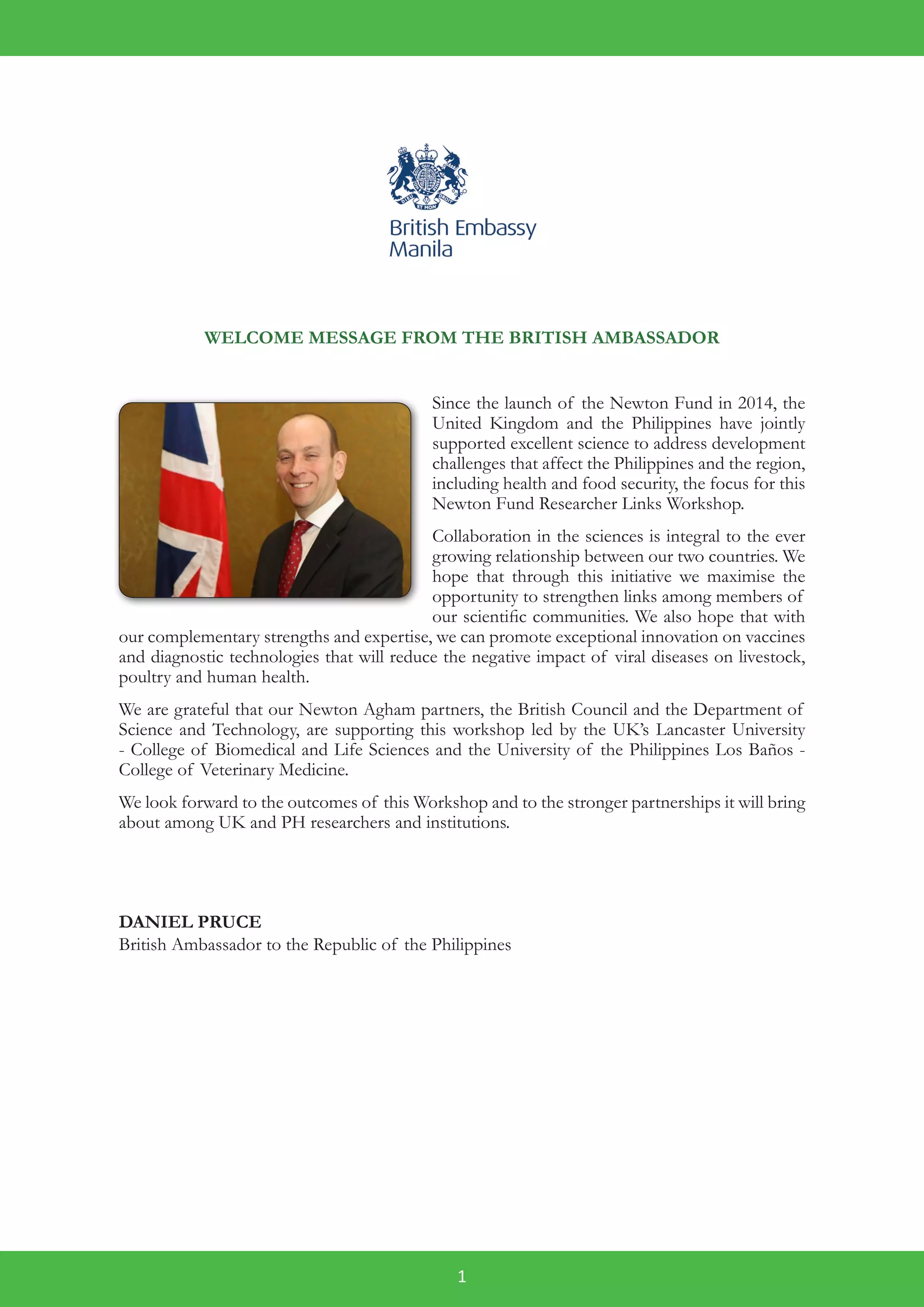
WELCOME MESSAGE FROM THE BRITISH AMBASSADOR
Since the launch of the Newton Fund in 2014, the
United Kingdom and the Philippines have jointly
supported excellent science to address development
challenges that affect the Philippines and the region,
including health and food security, the focus for this
Newton Fund Researcher Links Workshop.
Collaboration in the sciences is integral to the ever
growing relationship between our two countries. We
hope that through this initiative we maximise the
opportunity to strengthen links among members of
our scientific communities. We also hope that with
our complementary strengths and expertise, we can promote exceptional innovation on vaccines
and diagnostic technologies that will reduce the negative impact of viral diseases on livestock,
poultry and human health.
We are grateful that our Newton Agham partners, the British Council and the Department of
Science and Technology, are supporting this workshop led by the UK’s Lancaster University
- College of Biomedical and Life Sciences and the University of the Philippines Los Baños -
College of Veterinary Medicine.
We look forward to the outcomes of this Workshop and to the stronger partnerships it will bring
about among UK and PH researchers and institutions.
DANIEL PRUCE
British Ambassador to the Republic of the Philippines
2
WELCOME MESSAGE FROM THE SECRETARY,
DEPARTMENT OF SCIENCE AND TECHNOLOGY (DOST), PHILIPPINES
The Department of Science and Technology (DOST) extend its
warm welcome to the participants of the Researcher Links
working under the Newton AghamProgramme. It is an honor to
partner with the British Council and the College of Veterinary
Medicine of the University of the Philippines Los Baños in
conducting a truly worthwhile pursuit.
This international research workshop primarily aims to provide
opportunities for scientists 	 and animal health specialists
from both the Philippines and the United Kingdom to jointly
examine the current disease problems of various animal industries
throughout the world. In addition, discussions will also revolve around providing appropriate
proactive solutions through the use of emerging and next generation vaccine design strategies to
combat veterinary viruses.
It is hoped that this collaborative activity will serve as a multidisciplinary avenue for imparting
vaccine designs and diagnostics not just to prominent scientists and promising researchers but
also to the local livestock and poultry industry players. This workshop can also serve as a take off
point for long-term research partnerships between researchers in the UK and the Philippines.
May this workshop be truly a fruitful one.
FORTUNATO T. DE LA PEÑA
Secretary
Department of Science and Technology
3
WELCOME MESSAGE FROM THE UNDERSECRETARY,
DEPARTMENT OF SCIENCE AND TECHNOLOGY (DOST), PHILIPPINES
On behalf of the Department of Science and Technology, we
extend our warmest greetings in welcoming all the delegates.
It is indeed both a pleasure and privilege for DOST to partner
with the British Council and the College of Veterinary Medicine
of the University of the Philippines Los Baños in holding this
international research workshop. We are indeed glad that scientists
and researchers from the UK and the Philippines have come
together for this very significant undertaking.
The Newton Researcher Links Programme is under the umbrella
of the Newton Fund Researcher Mobility Programme, a collaborative engagement between the
British Council and the UK National Academies. The Newton Researcher Links component is
managed by the British Council in partnership with the Department of Science and Technology.
This programme aspires to encourage initial links and support capacity building between budding
Filipino researchers and the more senior UK mentors to share their knowledge and expertise.
This research workshop has assembled not just scientists and researchers known in their fields
but also the local livestock and poultry industry players. This engagement aims to examine and
be aware of the emerging and next generation vaccine design strategies that can be utilized
against veterinary viruses.
We are hopeful that these joint discussions will produce and develop a collaborative network
between the scientists and animal health specialists from the Philippines and the United Kingdom
and thus, together explore possible solutions to disease problems that are faced by the animal
industries throughout the world.
On behalf of the Department of Science and Technology, our sincerest thanks to all for your
participation and engagement in this workshop.
CAROL M. YOROBE
Undersecretary for Scientific and Technical Services
Department of Science and Technology
4
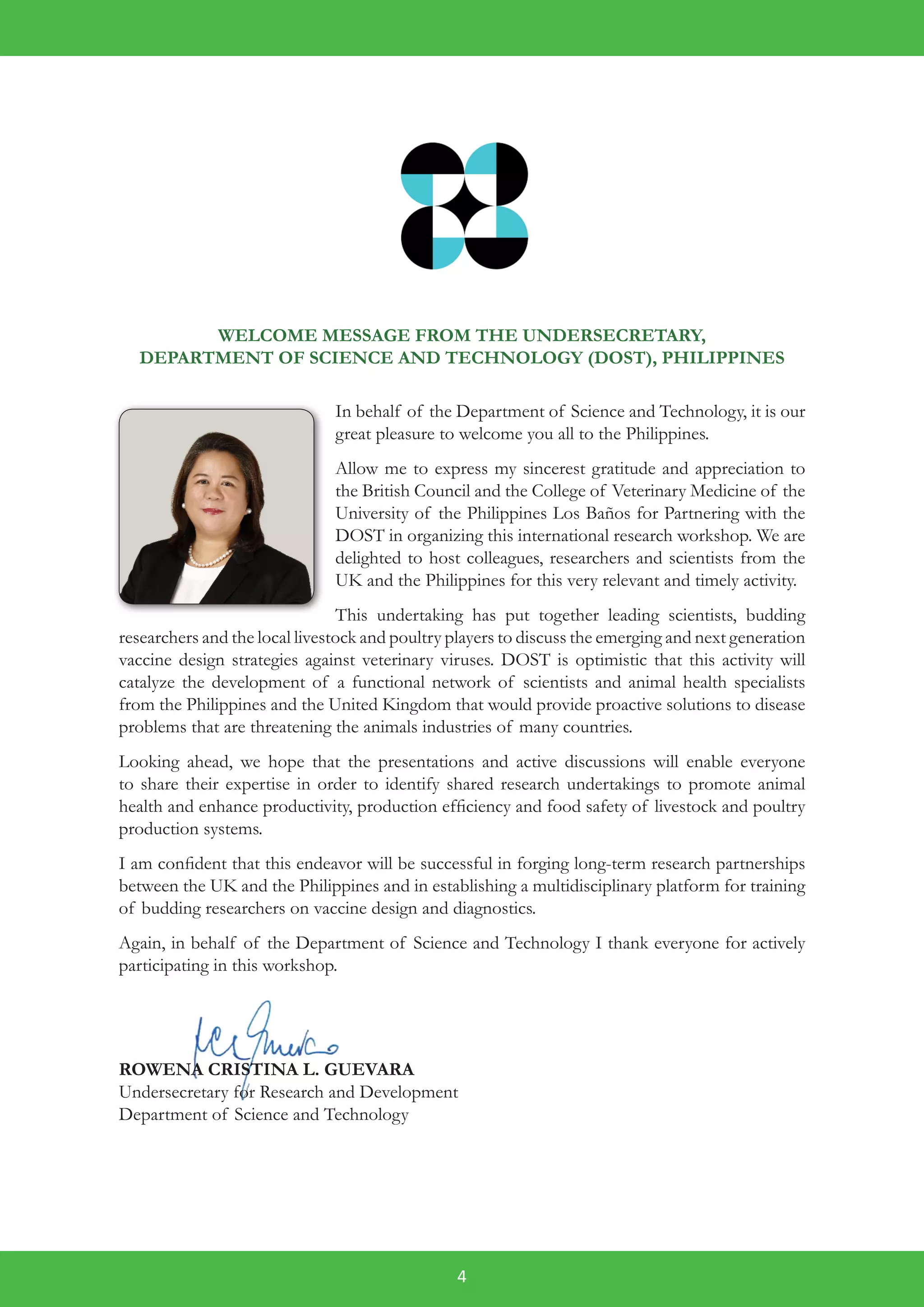
WELCOME MESSAGE FROM THE UNDERSECRETARY,
DEPARTMENT OF SCIENCE AND TECHNOLOGY (DOST), PHILIPPINES
In behalf of the Department of Science and Technology, it is our
great pleasure to welcome you all to the Philippines.
Allow me to express my sincerest gratitude and appreciation to
the British Council and the College of Veterinary Medicine of the
University of the Philippines Los Baños for Partnering with the
DOST in organizing this international research workshop. We are
delighted to host colleagues, researchers and scientists from the
UK and the Philippines for this very relevant and timely activity.
This undertaking has put together leading scientists, budding
researchers and the local livestock and poultry players to discuss the emerging and next generation
vaccine design strategies against veterinary viruses. DOST is optimistic that this activity will
catalyze the development of a functional network of scientists and animal health specialists
from the Philippines and the United Kingdom that would provide proactive solutions to disease
problems that are threatening the animals industries of many countries.
Looking ahead, we hope that the presentations and active discussions will enable everyone
to share their expertise in order to identify shared research undertakings to promote animal
health and enhance productivity, production efficiency and food safety of livestock and poultry
production systems.
I am confident that this endeavor will be successful in forging long-term research partnerships
between the UK and the Philippines and in establishing a multidisciplinary platform for training
of budding researchers on vaccine design and diagnostics.
Again, in behalf of the Department of Science and Technology I thank everyone for actively
participating in this workshop.
ROWENA CRISTINA L. GUEVARA
Undersecretary for Research and Development
Department of Science and Technology
5
WELCOME MESSAGE FROM THE
EXECUTIVE SECRETARY, PCAARRD-DOST
Greetings to the guests, resource persons, participants, and
organizers of this international workshop!
On behalf of the Philippine Council for Agriculture, Aquatic and
Natural Resources Research and Development of the Department
of Science and Technology (DOST-PCAARRD), I thank the
organizers,theBritishCouncilandtheUPLBCollegeof Veterinary
Medicine, for partnering with DOST in the implementation of this
very timely international research workshop on Novel Vaccines
and Diagnostic Technologies against Emerging and Re-emerging
Veterinary Pathogens.
This undertaking has staged a platform where leading scientists, researchers, and livestock
industry players come together to form long-term research partnerships in order to generate
R&D plans and projects that aim to reduce the impact of viral diseases on the livestock and
poultry industries.
DOST-PCAARRD is confident that this activity will tackle major challenges on animal health
that are currently threatening the animal industries of many countries.
With R&D activities currently focused on healthcare and production management, DOST-
PCAARRD aspires to develop quick and reliable disease diagnosis techniques in order to
promote sustainable production of food and other goods from livestock and poultry.
Again, on behalf of DOST-PCAARRD, I thank everyone for giving part of your precious time
to actively participate and share your experiences and expertise in this workshop.
REYNALDO V. EBORA
Acting Executive Director
Philippine Council for Agriculture, Aquatic and Natural Resources
Research and Development
PCAARRD-DOSTPHILIPPINE COUNCIL FOR AGRICULTURE, AQUATIC AND NATURAL RESOURCES
RESEARCH AND DEVELOPMENT
Department of Science and Technology
6
WELCOME MESSAGE FROM THE CHANCELLOR,
UNIVERSITY OF THE PHILIPPINES LOS BAÑOS
On behalf of the University of the Philippine Los Baños (UPLB),
I welcome all the speakers and participants of the Novel Vaccines
and Diagnostics Technologies Against Emerging and Re-emerging Veterinary
Pathogens Workshop.
With due focus on the emerging trends in vaccine design and
vaccine administration, this workshop aims to contribute in the
development of more efficient animal disease prevention and
control strategies. The workshop also aims to serve as a platform
for researchers, stakeholders from the livestock industry, and
officials from disease control agencies in the Philippines and
United Kingdom, to interact with one another and explore
potential future research collaborations and knowledge exchange activities.
As a globally competitive graduate and research university, UPLB is committed to support timely
and important initiatives that contribute to our country’s development goals.
May you have an insightful and inspiring conference.
FERNANDO C. SANCHEZ, JR.
Chancellor
University of the Philippines Los Baños
7
WELCOME MESSAGE FROM THE DEAN,
COLLEGE OF VETERINARY MEDICINE, UPLB
Together with the College of Veterinary Medicine, University of
the Philippines Los Baños, we extend our warmest welcome to all
the participants of this international research workshop.
Both universities, CVM-UPLB and the Biomedical and Life
Sciences, Lancaster University, United Kingdom (UK)are grateful
that through the grant approved by the British Council and
Department of Science and Technology (DOST), we are given
an opportunity to organize an extremely timely and important
undertaking.
It is indeed vital that an avenue for thorough and in-depth
discussions on emerging trends in vaccine design and novel ways of vaccine administration
be made available. Through this, formulation of more efficient animal disease control and
prevention strategies can be tackled, explored and discovered. In addition, the gathering of
prominent scientists, researchers and players in the various animal industries may hopefully form
a continuous working network and produce relevant collaborative projects and activities.
In behalf of the College, we again would like to extend our gratefulness to the organizing
committee, funding agencies, sponsors, and participants in making this even a success. May the
works that transpire here be of help not just to UK and the Philippines but the various countries
as well.
EDUARDO B. TORRES
Dean
College of Veterinary Medicine
University of the Philippines LosBaños
8
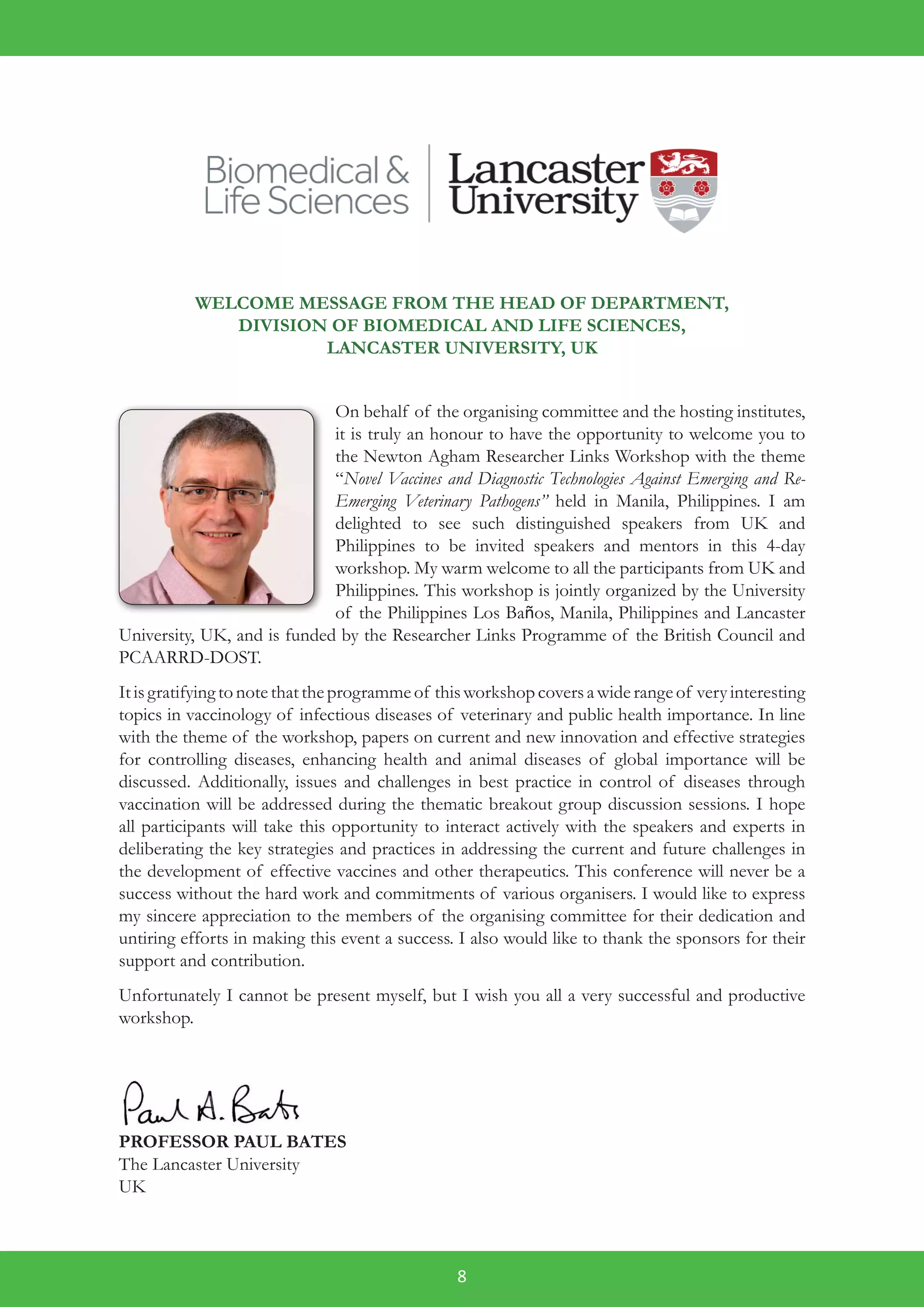
WELCOME MESSAGE FROM THE HEAD OF DEPARTMENT,
DIVISION OF BIOMEDICAL AND LIFE SCIENCES,
LANCASTER UNIVERSITY, UK
On behalf of the organising committee and the hosting institutes,
it is truly an honour to have the opportunity to welcome you to
the Newton Agham Researcher Links Workshop with the theme
“Novel Vaccines and Diagnostic Technologies Against Emerging and Re-
Emerging Veterinary Pathogens” held in Manila, Philippines. I am
delighted to see such distinguished speakers from UK and
Philippines to be invited speakers and mentors in this 4-day
workshop. My warm welcome to all the participants from UK and
Philippines. This workshop is jointly organized by the University
of the Philippines Los Baños, Manila, Philippines and Lancaster
University, UK, and is funded by the Researcher Links Programme of the British Council and
PCAARRD-DOST.
Itisgratifyingtonotethattheprogrammeof thisworkshopcoversawiderangeof veryinteresting
topics in vaccinology of infectious diseases of veterinary and public health importance. In line
with the theme of the workshop, papers on current and new innovation and effective strategies
for controlling diseases, enhancing health and animal diseases of global importance will be
discussed. Additionally, issues and challenges in best practice in control of diseases through
vaccination will be addressed during the thematic breakout group discussion sessions. I hope
all participants will take this opportunity to interact actively with the speakers and experts in
deliberating the key strategies and practices in addressing the current and future challenges in
the development of effective vaccines and other therapeutics. This conference will never be a
success without the hard work and commitments of various organisers. I would like to express
my sincere appreciation to the members of the organising committee for their dedication and
untiring efforts in making this event a success. I also would like to thank the sponsors for their
support and contribution.
Unfortunately I cannot be present myself, but I wish you all a very successful and productive
workshop.
PROFESSOR PAUL BATES
The Lancaster University
UK
9
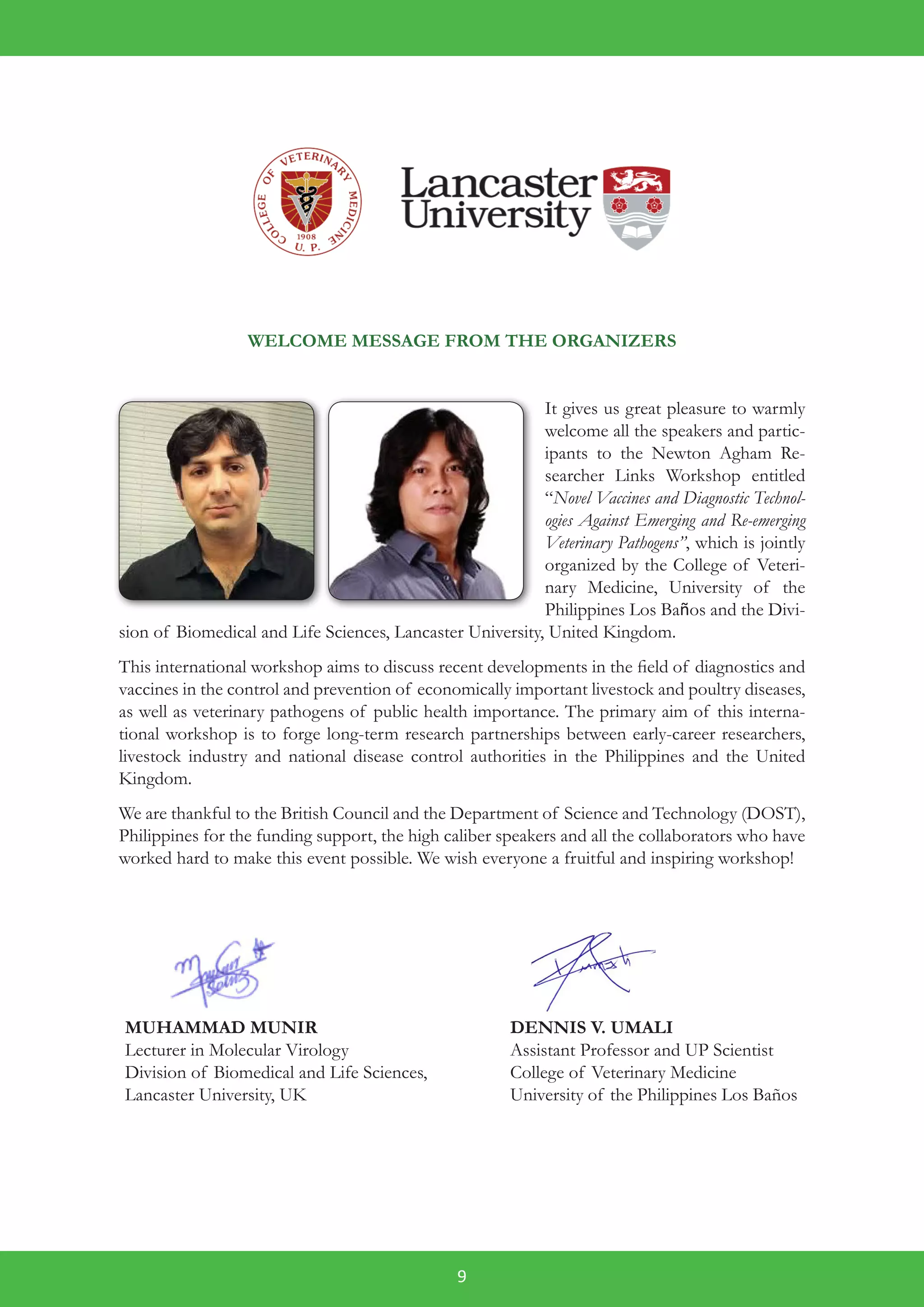
WELCOME MESSAGE FROM THE ORGANIZERS
It gives us great pleasure to warmly
welcome all the speakers and partic-
ipants to the Newton Agham Re-
searcher Links Workshop entitled
“Novel Vaccines and Diagnostic Technol-
ogies Against Emerging and Re-emerging
Veterinary Pathogens”, which is jointly
organized by the College of Veteri-
nary Medicine, University of the
Philippines Los Baños and the Divi-
sion of Biomedical and Life Sciences, Lancaster University, United Kingdom.
This international workshop aims to discuss recent developments in the field of diagnostics and
vaccines in the control and prevention of economically important livestock and poultry diseases,
as well as veterinary pathogens of public health importance. The primary aim of this interna-
tional workshop is to forge long-term research partnerships between early-career researchers,
livestock industry and national disease control authorities in the Philippines and the United
Kingdom.
We are thankful to the British Council and the Department of Science and Technology (DOST),
Philippines for the funding support, the high caliber speakers and all the collaborators who have
worked hard to make this event possible. We wish everyone a fruitful and inspiring workshop!
	
MUHAMMAD MUNIR
Lecturer in Molecular Virology
Division of Biomedical and Life Sciences,
Lancaster University, UK
DENNIS V. UMALI
Assistant Professor and UP Scientist
College of Veterinary Medicine
University of the Philippines Los Baños
10
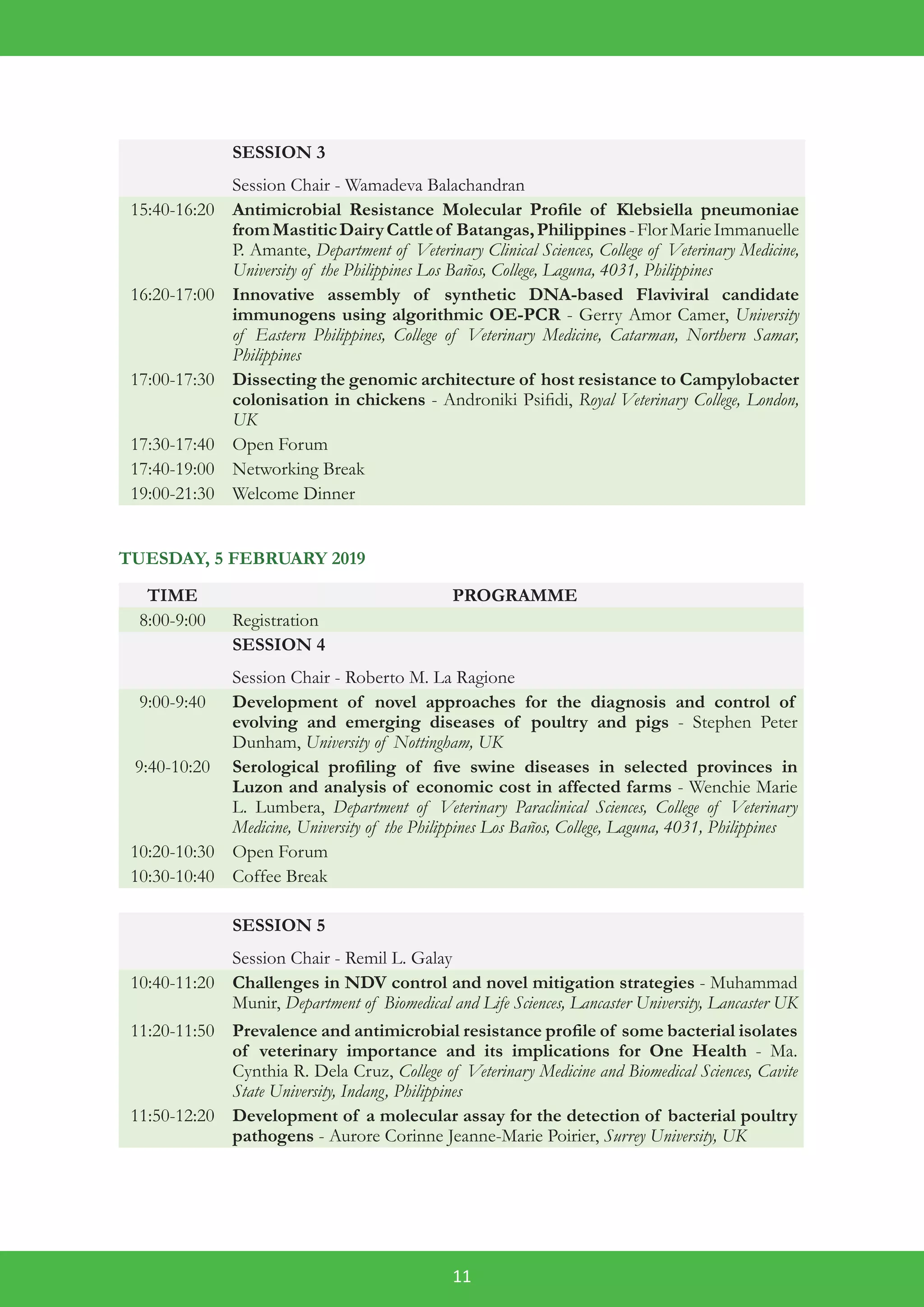
WORKSHOP PROGRAMME
MONDAY, 4 FEBRUARY 2019
TIME PROGRAMME
7:00-9:00 Registration
9:00-10:00 OPENING CEREMONY:
Masters of Ceremonies - Dennis V. Umali and Jesalyn L. Constante
10:00-10:10 Coffee Break
SESSION 1
Session Chair - Muhammad Munir
10:10-10:50 Emerging and re-emerging veterinary diseases in the Philippines:
Current status and updates - Daphne L. Jorca, Samuel Joseph M. Castro
and Ronnie D. Domingo, Bureau of Animal Industry, Visayas Avenue, Quezon City,
Philippines
10:50-11:30 Modulating the gut microbiome of poultry to control infectious diseases
- Roberto M. La Ragione, School of Veterinary Medicine, Faculty of Health and Medical
Sciences, University of Surrey, UK
11:30-12:10 Molecular characterization and phylogenetic analyses of economically
important poultry pathogens in the Philippines - Dennis V. Umali,
Department of Veterinary Clinical Sciences, College of Veterinary Medicine, University
of the Philippines Los Baños, College, Laguna, 4031, Philippines
12:10-12:20 Open Forum
12:20-13:30 Lunch
SESSION 2
Session Chair - Clarissa Yvonne J. Domingo
13:30-14:10 Molecular determinants for antigenicity and vaccine efficacy of H9 and
H7 Avian influenza viruses - Munir Iqbal, Avian Influenza group, The Pirbright
Institute, Ash Road, Pirbright, Woking, GU24 0NF, UK
14:10-14:50 Swine viral vaccines and diagnostic kits - Rainelda C. dela Pena, Bureau of
Animal Industry, Visayas Avenue, Diliman, Quezon City, Philippines
14:50-15:20 Rapiddiagnosticsandcontrolstrategiesforentericpathogensinbackyard
and commercial poultry production in Thailand and the Philippines -
Amy Wedley, Institute of Infection and Global Health, Department of Infection Biology,
University of Liverpool, UK
15:20-15:30 Open Forum
15:30-15:40 Coffee Break
11
SESSION 3
Session Chair - Wamadeva Balachandran
15:40-16:20 Antimicrobial Resistance Molecular Profile of Klebsiella pneumoniae
fromMastiticDairyCattleof Batangas,Philippines-FlorMarieImmanuelle
P. Amante, Department of Veterinary Clinical Sciences, College of Veterinary Medicine,
University of the Philippines Los Baños, College, Laguna, 4031, Philippines
16:20-17:00 Innovative assembly of synthetic DNA-based Flaviviral candidate
immunogens using algorithmic OE-PCR - Gerry Amor Camer, University
of Eastern Philippines, College of Veterinary Medicine, Catarman, Northern Samar,
Philippines
17:00-17:30 Dissecting the genomic architecture of host resistance to Campylobacter
colonisation in chickens - Androniki Psifidi, Royal Veterinary College, London,
UK
17:30-17:40 Open Forum
17:40-19:00 Networking Break
19:00-21:30 Welcome Dinner
TUESDAY, 5 FEBRUARY 2019
TIME PROGRAMME
8:00-9:00 Registration
SESSION 4
Session Chair - Roberto M. La Ragione
9:00-9:40 Development of novel approaches for the diagnosis and control of
evolving and emerging diseases of poultry and pigs - Stephen Peter
Dunham, University of Nottingham, UK
9:40-10:20 Serological profiling of five swine diseases in selected provinces in
Luzon and analysis of economic cost in affected farms - Wenchie Marie
L. Lumbera, Department of Veterinary Paraclinical Sciences, College of Veterinary
Medicine, University of the Philippines Los Baños, College, Laguna, 4031, Philippines
10:20-10:30 Open Forum
10:30-10:40 Coffee Break
SESSION 5
Session Chair - Remil L. Galay
10:40-11:20 Challenges in NDV control and novel mitigation strategies - Muhammad
Munir, Department of Biomedical and Life Sciences, Lancaster University, Lancaster UK
11:20-11:50 Prevalence and antimicrobial resistance profile of some bacterial isolates
of veterinary importance and its implications for One Health - Ma.
Cynthia R. Dela Cruz, College of Veterinary Medicine and Biomedical Sciences, Cavite
State University, Indang, Philippines
11:50-12:20 Development of a molecular assay for the detection of bacterial poultry
pathogens - Aurore Corinne Jeanne-Marie Poirier, Surrey University, UK
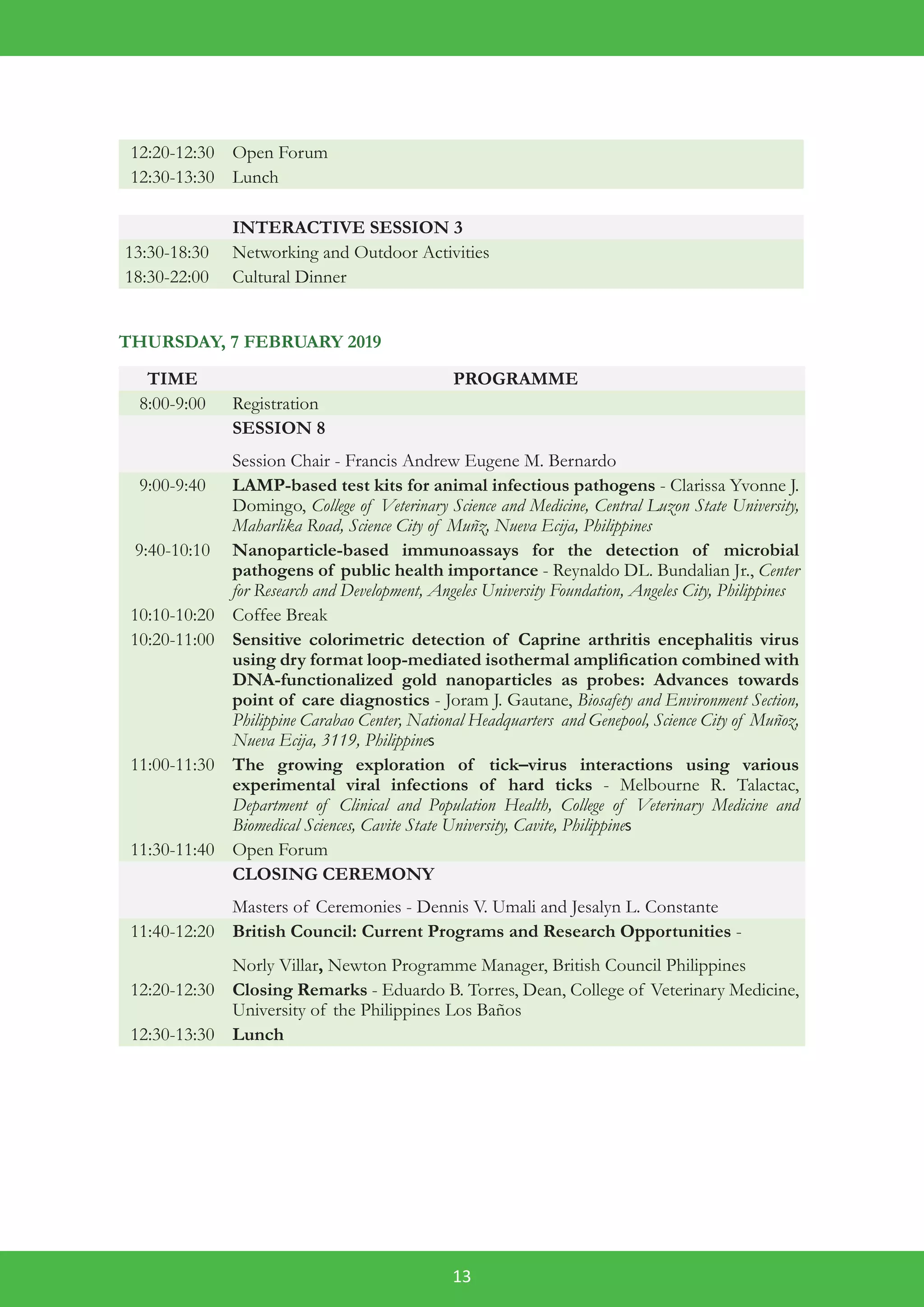
12
12:20-12:30 Open Forum
12:30-13:30 Lunch
INTERACTIVE SESSION 1
13:30-15:00 Current Challenges in British and Philippine Livestock and Poultry and
Potential Mitigation Plans
15:00-15:10 Coffee Break
INTERACTIVE SESSION 2
15:10-17:00 Current Challenges in Livestock and Poultry Vaccines, Diagnostics
Epidemiology and Policy in the United Kingdom and the Philippines
and Potential Mitigation Plans
17:00-19:00 Networking Break
19:00-21:30 Dinner
WEDNESDAY, 6 FEBRUARY 2019
TIME PROGRAMME
8:00-9:00 Registration
SESSION 6
Session Chair - Stephen Peter Dunham
9:00-9:40 Advanced biosensors for detecting zoonotic pathogen
- Wamadeva Balachandran, College of Engineering, Design and Physical Sciences,
Brunel University London
9:40-10:10 Development of a low-cost molecular diagnostic platform for rapid
detection of poultry pathogens - Manoharanehru Branavan, Brunel University
London, UK
10:10-10:20 Open Forum
10:20-10:30 Coffee Break
SESSION 7
Session Chair - Munir Iqbal
10:30-11:10 The role of head-associated respiratory and lymphoid tissues in
providing protection against infectious bronchitis virus in chickens
- Kannan Ganapathy, Poultry Respiratory Disease Group, University of Liverpool,
Leahurst Campus, Neston, Cheshire, UK
11:10-11:50 Current approach in anti-tick vaccine design - Remil L. Galay, Department
of Veterinary Paraclinical Sciences, College of Veterinary Medicine, University of the
Philippines Los Baños, Laguna, 4031, Philippines
11:50-12:20 Schistosoma japonicum cathepsin B as potential diagnostic antigen for
Asian zoonotic schistosomiasis - Adrian Miki C. Macalanda, Department
of Immunopathology and Microbiology, College of Veterinary Medicine and Biomedical
Sciences, Cavite State University, Cavite, Philippines
13
12:20-12:30 Open Forum
12:30-13:30 Lunch
INTERACTIVE SESSION 3
13:30-18:30 Networking and Outdoor Activities
18:30-22:00 Cultural Dinner
THURSDAY, 7 FEBRUARY 2019
TIME PROGRAMME
8:00-9:00 Registration
SESSION 8
Session Chair - Francis Andrew Eugene M. Bernardo
9:00-9:40 LAMP-based test kits for animal infectious pathogens - Clarissa Yvonne J.
Domingo, College of Veterinary Science and Medicine, Central Luzon State University,
Maharlika Road, Science City of Muñz, Nueva Ecija, Philippines
9:40-10:10 Nanoparticle-based immunoassays for the detection of microbial
pathogens of public health importance - Reynaldo DL. Bundalian Jr., Center
for Research and Development, Angeles University Foundation, Angeles City, Philippines
10:10-10:20 Coffee Break
10:20-11:00 Sensitive colorimetric detection of Caprine arthritis encephalitis virus
using dry format loop-mediated isothermal amplification combined with
DNA-functionalized gold nanoparticles as probes: Advances towards
point of care diagnostics - Joram J. Gautane, Biosafety and Environment Section,
Philippine Carabao Center, National Headquarters and Genepool, Science City of Muñoz,
Nueva Ecija, 3119, Philippines
11:00-11:30 The growing exploration of tick–virus interactions using various
experimental viral infections of hard ticks - Melbourne R. Talactac,
Department of Clinical and Population Health, College of Veterinary Medicine and
Biomedical Sciences, Cavite State University, Cavite, Philippines
11:30-11:40 Open Forum
CLOSING CEREMONY
Masters of Ceremonies - Dennis V. Umali and Jesalyn L. Constante
11:40-12:20 British Council: Current Programs and Research Opportunities -
Norly Villar, Newton Programme Manager, British Council Philippines
12:20-12:30 Closing Remarks - Eduardo B. Torres, Dean, College of Veterinary Medicine,
University of the Philippines Los Baños
12:30-13:30 Lunch
14
SESSION 1. 4 FEBRUARY 2019. 10:10-10:50
EMERGING AND RE-EMERGING VETERINARY DISEASES IN THE
PHILIPPINES: CURRENT STATUS AND UPDATES
Daphne L. Jorca, Samuel Joseph M. Castro and Ronnie D. Domingo
Bureau of Animal Industry, Visayas Avenue, Quezon City, Philippines
ABSTRACT
Over the past decades, emerging and re-emerging animal diseases have been associated to no-
table outbreaks leading to serious human and animal health consequences. To cope up with
the production demand and food security, various complex livestock systems and value chains
are being adapted. This in turn led to intensified farming practices, increased animal transport
and trade, compromised biosecurity measures, vulnerability of food animals to disease threats,
disease incursions, encroaching of wildlife areas, and pathogen mutation. Furthermore, animal
disease can also affect human health. According to OIE, approximately 75% of the emerging
animal diseases are zoonotic and 60% of the human pathogens are of animal origin. The emer-
gence of zoonotic diseases is also attributed to changes in the earth’s climate and ecosystems
that are affecting the animal population and impacting on human health. The key in mitigating
the risks associated with emerging diseases lies in the coordinated actions of the different health,
animal and environmental sectors.
Best practices and lessons learned from the successful eradication of Foot and Mouth Disease
and the control of Avian Influenza in the country have helped define the country’s strategies in
addressing animal diseases. Employing the One Health approach ensures collaboration between
concerned government and private sector stakeholders in dealing with animal disease emergen-
cies.
15
SESSION 1. 4 FEBRUARY 2019. 10:50-11:30
MODULATING THE GUT MICROBIOME OF POULTRY
TO CONTROL INFECTIOUS DISEASES
Roberto M. La Ragione
School of Veterinary Medicine, Faculty of Health and Medical Sciences,
University of Surrey, Guildford, Surrey, GU2 7AL, United Kingdom
ABSTRACT
Infectious diseases are responsible for significant economic losses in the livestock industry and
have implications with regard to animal welfare. Furthermore, a number of livestock pathogens
are zoonotic. Traditionally infectious diseases in livestock have been controlled through the use
of vaccination, biosecurity measures and antibiotics. However, with the increased awareness of
the emergence of antimicrobial resistance, alternative control strategies are urgently required.
One such alternative may be to use prebiotics and probiotics to modulate the gut microflora.
Probiotics are classified as live microbial feed supplements; often members of the normal flora.
Lactobacillus-based probiotics have been reported previously as protecting against infection with
common enteric pathogens in livestock. Prebiotics are non-digestible in the upper gut however
they are fermented in the large intestine.Diets enriched with prebiotic oligosaccharides, such as
galactooligosaccharide (GOS), have been shown to increase the number of lactic acid bacteria
(LAB) such as bifidobacteria and lactobacilli and/or their fermentation products in the colon
and thus may stimulate beneficial bacteria and therefore selectively modulate the gut microbiota.
However, despite the widespread use of prebiotics and probiotics in humans and animals the
mechanisms of action of these novel interventions remain to be elucidated. The studies report-
ed here utilised, in vitro and in vivo models to determine the mode of action and efficacy of pre
and probiotics in livestock.
Our studies demonstrated that in vitro, probiotic bacteria and prebiotics can antagonise aspects
of the pathobiology of Brachyspira pilosicoli and Salmonella Typhimurium. Furthermore, the stud-
ies have demonstrated that probiotic bacteria and prebiotics are capable of mitigating the pa-
thology associated with Brachyspira pilosicoli and Salmonella Typhimurium infections in livestock.
Collectively these data sets indicate that prebiotics and Lactobacillus based probiotic bacteria may
be effective in the control of bacterial pathogens in livestock.
16
SESSION 1. 4 FEBRUARY 2019. 11:30-12:10
MOLECULAR CHARACTERIZATION AND
PHYLOGENETIC ANALYSES OF ECONOMICALLY
IMPORTANT POULTRY PATHOGENS IN THE PHILIPPINES
Dennis V. Umali
Department of Veterinary Clinical Sciences, College of Veterinary Medicine,
University of the Philippines Los Baños, College, Laguna 4031 Philippines
ABSTRACT
Molecular and phylogenetic analyses were performed on several strains of economically import-
ant poultry pathogens in the Philippines and were correlated with clinical signs and production
performance. For Newcastle disease virus (NDV), a total of 40 epidemiological investigations
were performed on commercial poultry to determine the molecular characteristics of NDVs
involved in recent outbreaks in the Philippines. Results showed that the most prevalent NDV
strains were from genotype II and VIIi for broilers, genotype II, VIIa, VIIh and VIIi for layers,
genotype VIIi for gamefowls and genotype VIb2 for pigeons. For Salmonella, a total of 1,920
commercial eggs from selected major public markets in Metro Manila were analyzed. No Salmo-
nella spp. were isolated from internal egg contents, however, a Salmonella-positive rate of 27.1%
were obtained from shelled-eggs. Molecular serotyping showed that the Salmonella spp. detected
from shelled-eggs were serovars S. Mbandaka, S. Braenderup, S. Anatum, S. Heidelberg, S. Para-
typhi B, S. Newport and S. Livingstone. For commercial broiler meat, 300 ready-to-slaughter
birds were tested for the presence of Salmonella spp. in which, one out of 50 (2.0%) pools of
liver samples was positive in bacterial isolation and PCR. For Philippine native chickens, out of
116 samples analyzed, Salmonella was isolated in one sample (0.86%) using conventional bacterial
isolation and in 11 out of 39 pooled samples (28.2%) using PCR. For Infectious bursal disease
virus (IBDV), four field strains of IBDVs from gamefowls were characterized. Phylogenetic
analysis showed that the field IBDVs belong to the European-like vvIBDVs and were closely
related to (97-98%) to Spanish, South African and Nigerian strains. For Chicken anemia virus
(CAV), five out of ten pooled tissue samples from 49 Philippine native chickens from different
live bird markets in Luzon were CAV-positive in PCR. Nucleotide sequencing showed that the
field CAV strains were from genotype A2, D1 and D2. For Ornithobacterium rhinotracheale (ORT),
five (19.23%) out of 26 pooled tissue samples from Philippine native chickens were ORT-pos-
itive in PCR. Nucleotide sequencing showed that the field strains were closely related (99%) to
field and reference ORT strains and belong to ORT clade I and clade II. At present, these are the
first studies to genetically characterize these pathogens in the Philippines, which may be helpful
in the formulation of more effective prevention and treatment protocols.
17
SESSION 2. 4 FEBRUARY 2019. 13:30-14:10
MOLECULAR DETERMINANTS FOR ANTIGENICITY AND VACCINE
EFFICACY OF H9 AND H7 AVIAN INFLUENZA VIRUSES.
Munir Iqbal
Avian Influenza Group, The Pirbright Institute,
Ash Road, Pirbright, Woking, GU24 0NF, United Kingdom
ABSTRACT
Avian influenza viruses are a threat to global poultry production as well as human health through
zoonotic infection and are therefore considered viruses with pandemic potential. Vaccination of
poultry is a key element of disease control in endemic countries and human vaccination would
be a major component of the response in a pandemic situation. Vaccine effectiveness is however
persistently challenged by the emergence of antigenically variant viruses. Here we employed a
combination of techniques to provide an enhanced understanding of the molecular determi-
nants in the haemagglutinin (HA) proteins of H9 and H7 viruses that drive antigenic variability
and vaccine failure. We propagated the viruses under virus-specific monoclonal antibodies and
polyclonal antisera. The mutant viruses escaped from immune pressure carry amino acid sub-
stitutions and showed altered antigenicity compared with the wild type H9N2 or H7N9 viruses.
These results provide new molecular markers of antigenic change for H9N2 and H7N9 viruses
that will help explain vaccine breakdown in the field. We also observed changes to epitope
structure determine antigenicity. We find evidence for the importance of other mechanisms of
immune escape, with substitutions increasing glycosylation or receptor-binding avidity exhib-
iting the largest impacts on chicken antisera binding. Of these, meta-analysis indicates avidity
regulation to be more relevant to the evolution of circulating viruses, suggesting that a specific
focus on avidity regulation is required to fully understand the molecular basis of influenza virus
antigenicity, immune escape and vaccine failure. These results will guide surveillance efforts for
arising antigenic variants as well as evidence based vaccine seed selection and vaccine design.
18
SESSION 2. 4 FEBRUARY 2019. 14:10-14:50
SWINE VIRAL VACCINES AND DIAGNOSTIC KITS
Rainelda C. dela Pena
Bureau of Animal Industry, Visayas Avenue, Diliman, Quezon City
ABSTRACT
Different kinds of vaccines are registered and commercially available in the country against
economically important diseases affecting the pig population caused by swine viral pathogens
such as Porcine Parvovirus (PPV), Aujeszkys Disease Virus (ADV), Classical Swine Fever Virus
(CSFV), Swine Influenza Virus (SIV), Porcine Epidemic Diarrhea Virus (PEDV), Porcine Re-
productive and Respiratory Syndrome Virus (PRRSV), and Porcine Circovirus Type 2 (PCV2).
PPV vaccine is inactivated and usually this is used in combination with Erysipelas and Leptospira
bacterins. Most of the ADV vaccines are modified live and are gene deleted while only few are
inactivated and whole virus preparation. CSFV vaccines are basically modified live, tissue culture
based and the strains are Chinese, GPE negative, LOM, and French Thiverval. SIV vaccines are
all inactivated and the strains are H1N1, H1N2, and H3N2. There are 4 types of PEDV vaccines
namely killed and intramuscular, live and intramuscular, live and oral, and RNA or sequence vac-
cines. The PRRSV vaccine is either European or North American strain, either killed or live, re-
spiratory form (for piglet) or reproductive (for breeder), and either conventional or subunit vac-
cine. There are several kinds of PCV2 vaccines: mostly are ORF2 subunit, few are conventional
or whole virus, one vaccine is a Type 1-Type 2 Chimera, either for sow or piglet, and some is in
combination with Mycoplasma bacterin and PRRSV vaccine. Quality control testing procedures
are usually being done in the laboratory to determine the sterility, safety, and potency of vaccines.
Serological tests and virological techniques are performed to evaluate the potency of inactivated
and live vaccines, respectively. The most common diagnostic kits that are sold in the market are
the ELISA antibody and antigen test kits. Another type of kit has also become popular which
is the chromatographic immunoassay for multiple or single qualitative detection of viral caus-
ative agents of diarrhea in pigs such as PEDV, Transmissible Gastroenteritis Virus (TGE), and
Rotavirus. Recently, a One-Step Reverse Transcriptase (RT) - Polymerase Chain Reaction (PCR)
multiplex assay kits have been available that permits simultaneous amplification of target DNA
or RNA of swine respiratory viral pathogen in infected samples and a quantitative PCR (qPCR)
that detects RNA or DNA from virus in extracts from swine samples. Lately, a PED RT-LAMP
(Loop-mediated Isothermal Amplification) based diagnostic kit has been developed. LAMP re-
action proceeds at a constant temperature for a strand displacement and annealing reaction.
19
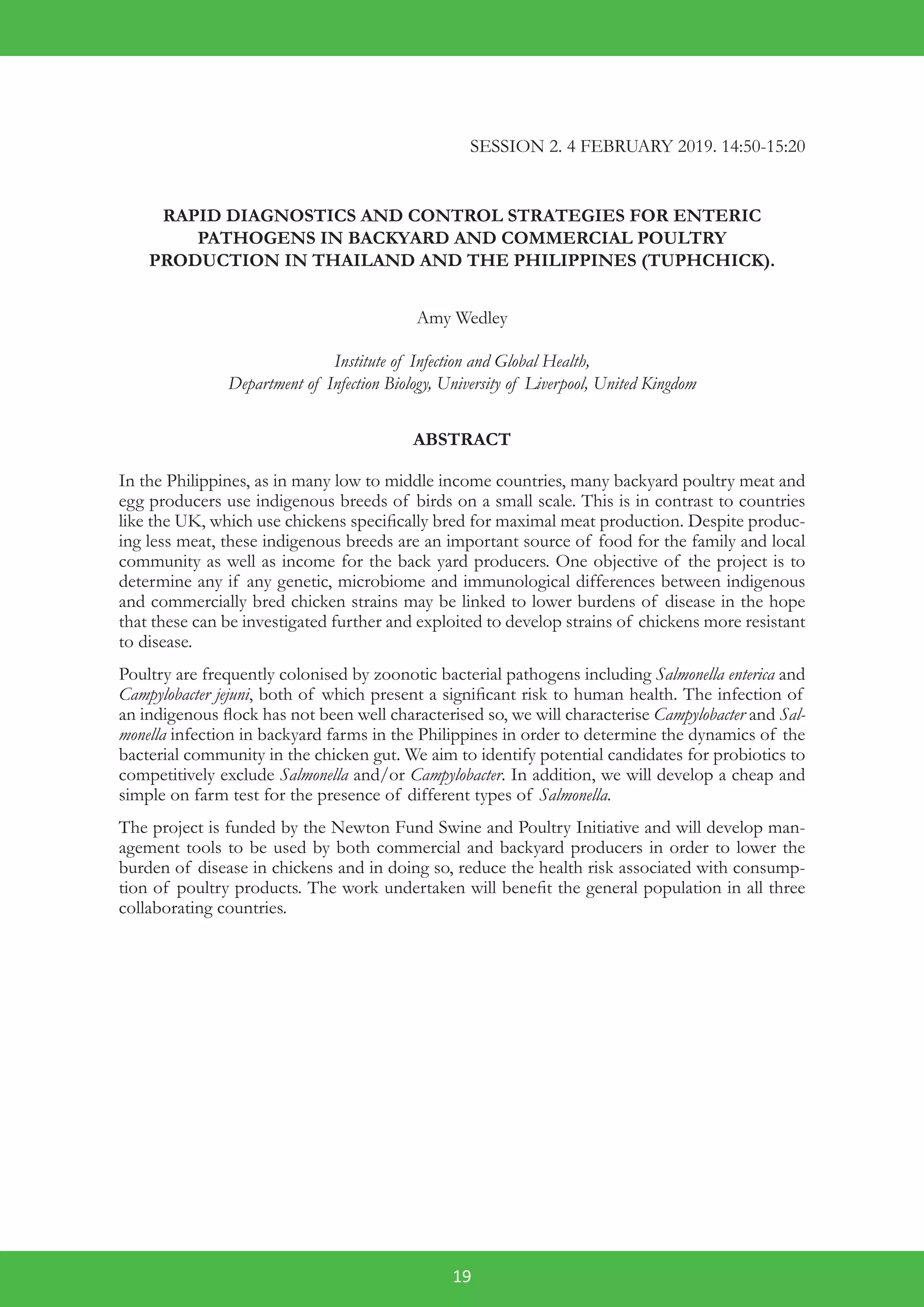
SESSION 2. 4 FEBRUARY 2019. 14:50-15:20
RAPID DIAGNOSTICS AND CONTROL STRATEGIES FOR ENTERIC
PATHOGENS IN BACKYARD AND COMMERCIAL POULTRY
PRODUCTION IN THAILAND AND THE PHILIPPINES (TUPHCHICK).
Amy Wedley
Institute of Infection and Global Health,
Department of Infection Biology, University of Liverpool, United Kingdom
ABSTRACT
In the Philippines, as in many low to middle income countries, many backyard poultry meat and
egg producers use indigenous breeds of birds on a small scale. This is in contrast to countries
like the UK, which use chickens specifically bred for maximal meat production. Despite produc-
ing less meat, these indigenous breeds are an important source of food for the family and local
community as well as income for the back yard producers. One objective of the project is to
determine any if any genetic, microbiome and immunological differences between indigenous
and commercially bred chicken strains may be linked to lower burdens of disease in the hope
that these can be investigated further and exploited to develop strains of chickens more resistant
to disease.
Poultry are frequently colonised by zoonotic bacterial pathogens including Salmonella enterica and
Campylobacter jejuni, both of which present a significant risk to human health. The infection of
an indigenous flock has not been well characterised so, we will characterise Campylobacter and Sal-
monella infection in backyard farms in the Philippines in order to determine the dynamics of the
bacterial community in the chicken gut. We aim to identify potential candidates for probiotics to
competitively exclude Salmonella and/or Campylobacter. In addition, we will develop a cheap and
simple on farm test for the presence of different types of Salmonella.
The project is funded by the Newton Fund Swine and Poultry Initiative and will develop man-
agement tools to be used by both commercial and backyard producers in order to lower the
burden of disease in chickens and in doing so, reduce the health risk associated with consump-
tion of poultry products. The work undertaken will benefit the general population in all three
collaborating countries.
20
SESSION 3. 4 FEBRUARY 2019. 15:40-16:20
ANTIMICROBIAL RESISTANCE MOLECULAR PROFILE OF
Klebsiella pneumoniae FROM MASTITIC DAIRY
CATTLE OF BATANGAS, PHILIPPINES
Flor Marie Immanuelle P. Amante1
; Loinda R. Baldrias2
;
Antonio A. Rayos3
and Billy P. Divina2
1
Department of Veterinary Clinical Sciences, College of Veterinary Medicine,
University of the Philippines Los Baños, Laguna 4031, Philippines;
2
Department of Veterinary Paraclinical Sciences, College of Veterinary Medicine,
University of the Philippines Los Baños, Laguna 4031, Philippines
3
Institute of Animal Science, College of Agriculture and Food Science,
ABSTRACT
Mastitis caused by Klebsiella pneumoniae is more severe due to its poor antimicrobial response,
rapid progress to toxic shock and death. Resistant organisms can be acquired through the con-
sumption of untreated or inadequately treated milk. This study was conducted to understand the
antimicrobial resistance (AMR) and genetic characterization of Klebsiella pneumoniae isolates from
bovine milk. California mastitis test (CMT) was done on 2,406 teats from 624 milking cows in
12 dairy cattle farms in Batangas, Philippines last June 2016. Individual quarter milk samples of
CMT scores 3 and 2 (n=230) were collected aseptically and cultured in McConkey agar. Bacterial
growths were subcultured in McConkey-inositol-potassium tellurite agar. After colony morphol-
ogy, biochemical testing and molecular detection, six isolates remained with a prevalence rate of
2.6% (6/230). Antibiotic sensitivity testing (AST) was done through broth microdilution. Using
PCR, isolates were screened for the integrase gene intl1 (254 bp) and gene cassettes (1000 bp)
were screened on isolates containing int1 gene. Extended-spectrum ß-lactamase (ESBL) genes
like blaCTX-M (variable size), blaTEM (799bp) and blaSHV (862bp) and resistance genes for
streptomycin (aadA1-631bp and aadA2 – 500bp), sulfamethoxaole (sul1 – 331 bp), tetracycline
(tetA – 210bp and tetB – 659bp) and trimethoprim (dfrA6 – 419 bp and dfrA12 – 395bp) were
investigated. The subclinical mastitis rate was at 9% (215/2,406) while the clinical mastitis rate
was at 18% (425/2,406). There was intense AMR to trimethoprim (100%), streptomycin (83%),
cefoperazone (67%) and colistin (33%) but with susceptibility to doxycycline (83%) and sulfa-
methazine (100%). All cassette, blaSHV
, aadA2, sul1 and tetA genes were present in one, five, one
and two of the isolates respectively. It appears that locally isolated Klebsiella pneumoniae have al-
ready incurred antibiotic resistance genes. It has the capacity to transfer its gene systems through
site-specific recombination mechanisms such as the integron gene cassettes. The data collected
provide more evidence in claiming that food sourced from animals could pose as a means of
transmission of antimicrobial resistance.
21
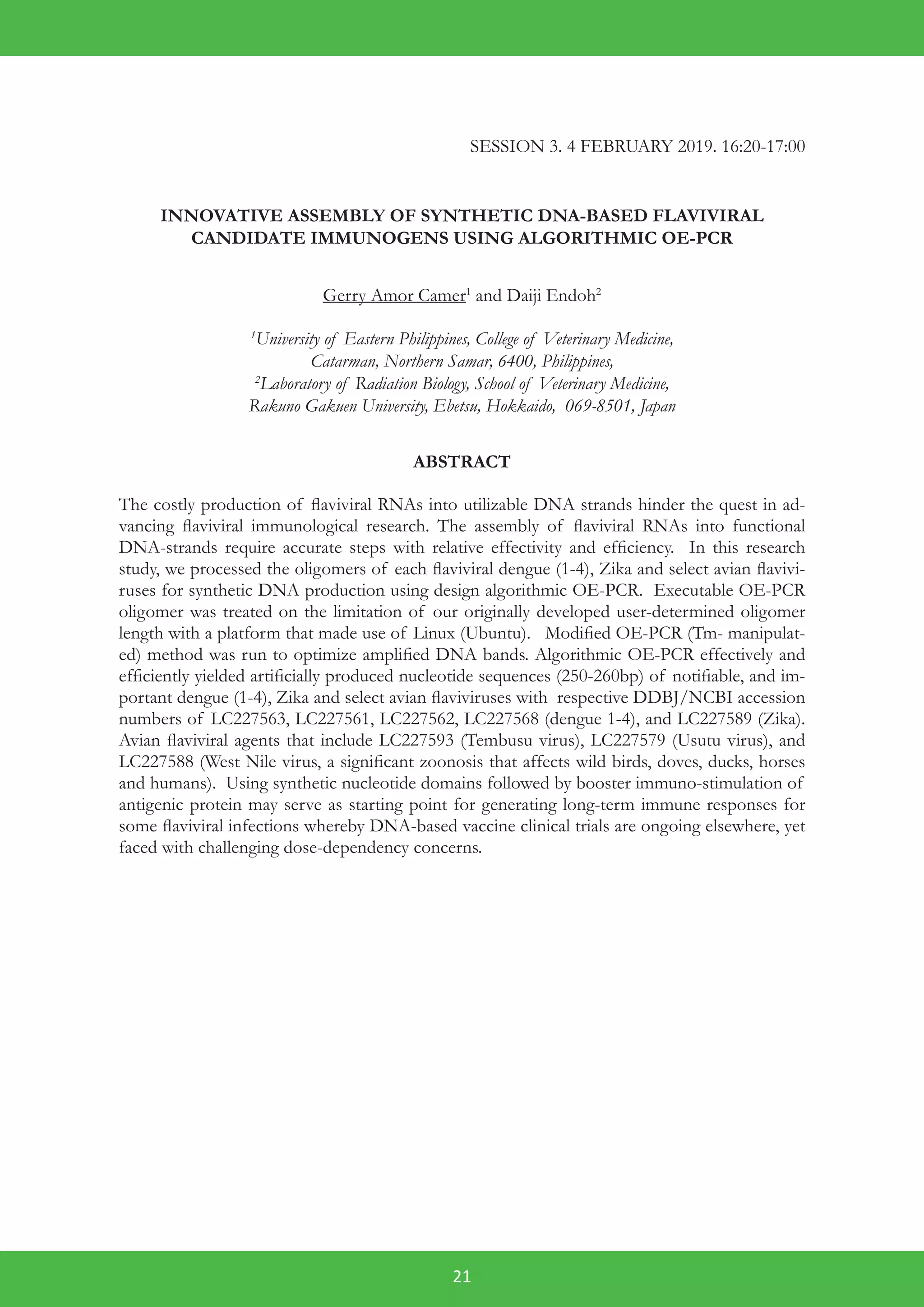
SESSION 3. 4 FEBRUARY 2019. 16:20-17:00
INNOVATIVE ASSEMBLY OF SYNTHETIC DNA-BASED FLAVIVIRAL
CANDIDATE IMMUNOGENS USING ALGORITHMIC OE-PCR
Gerry Amor Camer1
and Daiji Endoh2
1
University of Eastern Philippines, College of Veterinary Medicine,
Catarman, Northern Samar, 6400, Philippines,
2
Laboratory of Radiation Biology, School of Veterinary Medicine,
Rakuno Gakuen University, Ebetsu, Hokkaido, 069-8501, Japan
ABSTRACT
The costly production of flaviviral RNAs into utilizable DNA strands hinder the quest in ad-
vancing flaviviral immunological research. The assembly of flaviviral RNAs into functional
DNA-strands require accurate steps with relative effectivity and efficiency. In this research
study, we processed the oligomers of each flaviviral dengue (1-4), Zika and select avian flavivi-
ruses for synthetic DNA production using design algorithmic OE-PCR. Executable OE-PCR
oligomer was treated on the limitation of our originally developed user-determined oligomer
length with a platform that made use of Linux (Ubuntu). Modified OE-PCR (Tm- manipulat-
ed) method was run to optimize amplified DNA bands. Algorithmic OE-PCR effectively and
efficiently yielded artificially produced nucleotide sequences (250-260bp) of notifiable, and im-
portant dengue (1-4), Zika and select avian flaviviruses with respective DDBJ/NCBI accession
numbers of LC227563, LC227561, LC227562, LC227568 (dengue 1-4), and LC227589 (Zika).
Avian flaviviral agents that include LC227593 (Tembusu virus), LC227579 (Usutu virus), and
LC227588 (West Nile virus, a significant zoonosis that affects wild birds, doves, ducks, horses
and humans). Using synthetic nucleotide domains followed by booster immuno-stimulation of
antigenic protein may serve as starting point for generating long-term immune responses for
some flaviviral infections whereby DNA-based vaccine clinical trials are ongoing elsewhere, yet
faced with challenging dose-dependency concerns.
22
SESSION 3. 4 FEBRUARY 2019. 17:00-17:30
DISSECTING THE GENOMIC ARCHITECTURE OF HOST RESISTANCE
TO CAMPYLOBACTER COLONISATION IN CHICKENS
Androniki Psifidi
Royal Veterinary College, London, United Kingdom
ABSTRACT
Campylobacter is the leading cause of human foodborne diarrhea. The main source of infection
is consumption or handling of contaminated poultry meat. While there is a range of effective
biosecurity strategies at farm level, there are no effective vaccines and inhibitors. Moreover,
little is known about the genetic basis of Campylobacter colonisation. To identify genomic re-
gions influencing Campylobacter load we performed a GWAS study and determined whether
eQTLs, allelic-imbalance and significant gene-expression differences are present in broilers with
different Campylobacter load. Caecal contents were collected from 3,000 broilers and the number
of viable Campylobacter per gram was determined. All the birds were genotyped with the 600K
SNP-array (Affymetrix). Heritability of the trait was modest (h2=0.11). GWAS and RHM anal-
yses identified four QTLs on chromosomes 14, 16, 19 and 26. Twenty-three birds were selected
for RNA-sequencing based on their genotype and phenotype. RNA was extracted from the
caecal tonsils. Three genes located within the QTL region on chromosome 16 were differen-
tially expressed (BFIV21 and two BTN-like). We identified strong cis-QTLs located within the
Major-Histocompatibility-Complex (MHC) region on chromosome 16 (the QTL explained 60%
of the genetic variance, log allelic-fold-change 2.03), suggesting the presence of cis-acting muta-
tions in BFIV21 and BG1 genes. Further, we identified 22 trans-acting elements. Based on these
results the MHC region seems to play an important role in Campylobacter resistance in chickens,
and we have identified strong candidate genes underlying this load-associated QTL.
23
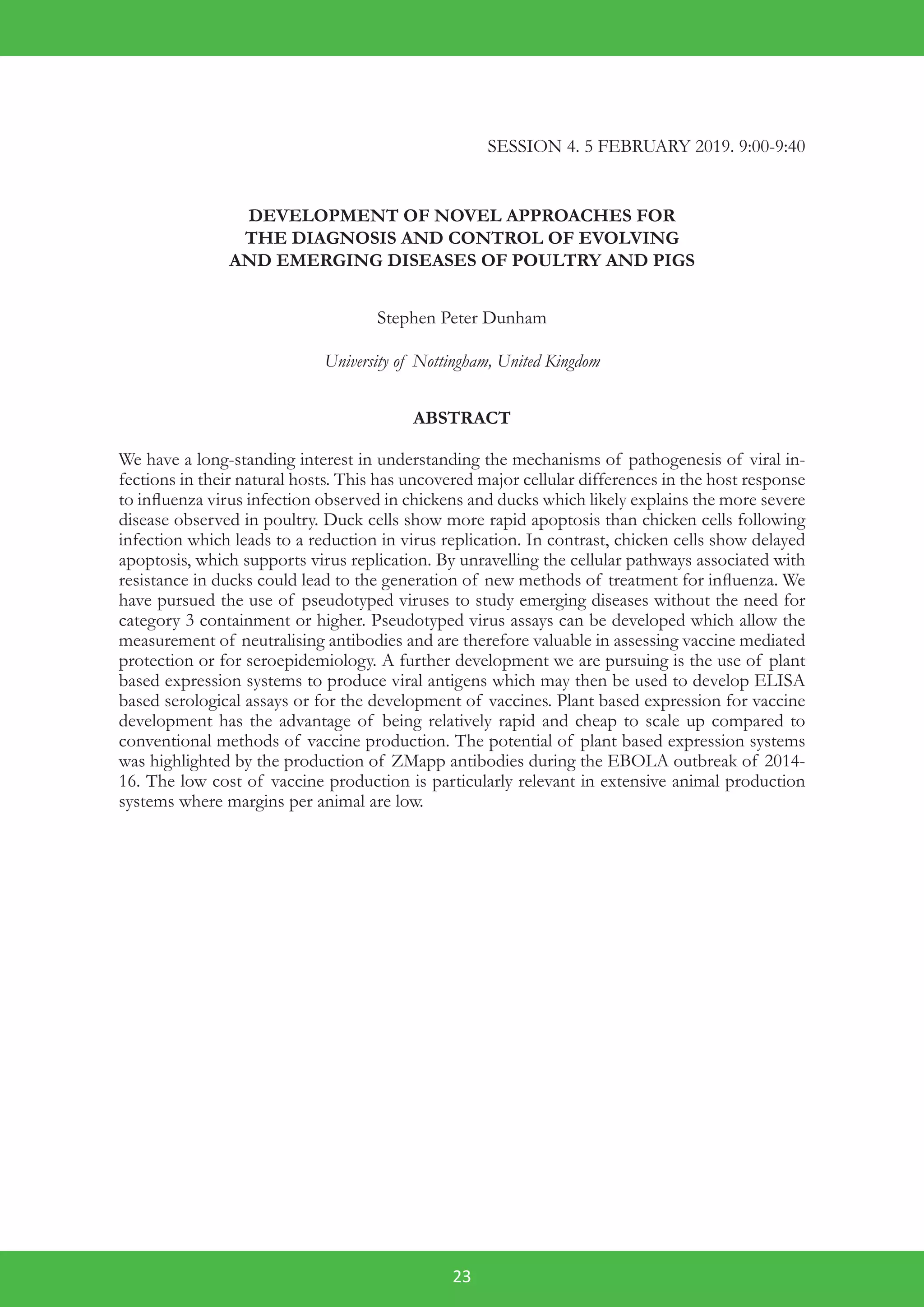
SESSION 4. 5 FEBRUARY 2019. 9:00-9:40
DEVELOPMENT OF NOVEL APPROACHES FOR
THE DIAGNOSIS AND CONTROL OF EVOLVING
AND EMERGING DISEASES OF POULTRY AND PIGS
Stephen Peter Dunham
University of Nottingham, United Kingdom
ABSTRACT
We have a long-standing interest in understanding the mechanisms of pathogenesis of viral in-
fections in their natural hosts. This has uncovered major cellular differences in the host response
to influenza virus infection observed in chickens and ducks which likely explains the more severe
disease observed in poultry. Duck cells show more rapid apoptosis than chicken cells following
infection which leads to a reduction in virus replication. In contrast, chicken cells show delayed
apoptosis, which supports virus replication. By unravelling the cellular pathways associated with
resistance in ducks could lead to the generation of new methods of treatment for influenza. We
have pursued the use of pseudotyped viruses to study emerging diseases without the need for
category 3 containment or higher. Pseudotyped virus assays can be developed which allow the
measurement of neutralising antibodies and are therefore valuable in assessing vaccine mediated
protection or for seroepidemiology. A further development we are pursuing is the use of plant
based expression systems to produce viral antigens which may then be used to develop ELISA
based serological assays or for the development of vaccines. Plant based expression for vaccine
development has the advantage of being relatively rapid and cheap to scale up compared to
conventional methods of vaccine production. The potential of plant based expression systems
was highlighted by the production of ZMapp antibodies during the EBOLA outbreak of 2014-
16. The low cost of vaccine production is particularly relevant in extensive animal production
systems where margins per animal are low.
24
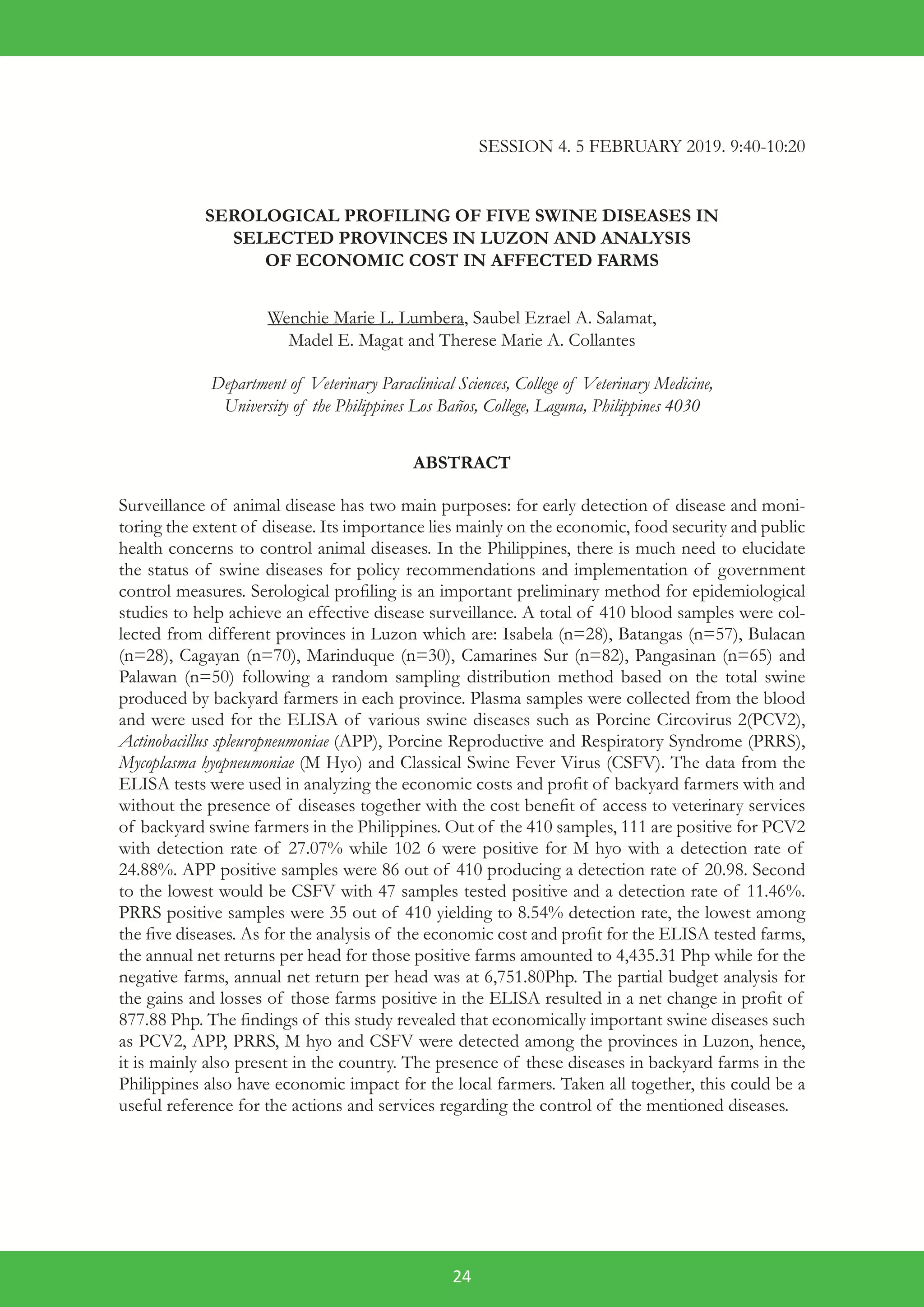
SESSION 4. 5 FEBRUARY 2019. 9:40-10:20
SEROLOGICAL PROFILING OF FIVE SWINE DISEASES IN
SELECTED PROVINCES IN LUZON AND ANALYSIS
OF ECONOMIC COST IN AFFECTED FARMS
Wenchie Marie L. Lumbera, Saubel Ezrael A. Salamat,
Madel E. Magat and Therese Marie A. Collantes
Department of Veterinary Paraclinical Sciences, College of Veterinary Medicine,
University of the Philippines Los Baños, College, Laguna, Philippines 4030
ABSTRACT
Surveillance of animal disease has two main purposes: for early detection of disease and moni-
toring the extent of disease. Its importance lies mainly on the economic, food security and public
health concerns to control animal diseases. In the Philippines, there is much need to elucidate
the status of swine diseases for policy recommendations and implementation of government
control measures. Serological profiling is an important preliminary method for epidemiological
studies to help achieve an effective disease surveillance. A total of 410 blood samples were col-
lected from different provinces in Luzon which are: Isabela (n=28), Batangas (n=57), Bulacan
(n=28), Cagayan (n=70), Marinduque (n=30), Camarines Sur (n=82), Pangasinan (n=65) and
Palawan (n=50) following a random sampling distribution method based on the total swine
produced by backyard farmers in each province. Plasma samples were collected from the blood
and were used for the ELISA of various swine diseases such as Porcine Circovirus 2(PCV2),
Actinobacillus spleuropneumoniae (APP), Porcine Reproductive and Respiratory Syndrome (PRRS),
Mycoplasma hyopneumoniae (M Hyo) and Classical Swine Fever Virus (CSFV). The data from the
ELISA tests were used in analyzing the economic costs and profit of backyard farmers with and
without the presence of diseases together with the cost benefit of access to veterinary services
of backyard swine farmers in the Philippines. Out of the 410 samples, 111 are positive for PCV2
with detection rate of 27.07% while 102 6 were positive for M hyo with a detection rate of
24.88%. APP positive samples were 86 out of 410 producing a detection rate of 20.98. Second
to the lowest would be CSFV with 47 samples tested positive and a detection rate of 11.46%.
PRRS positive samples were 35 out of 410 yielding to 8.54% detection rate, the lowest among
the five diseases. As for the analysis of the economic cost and profit for the ELISA tested farms,
the annual net returns per head for those positive farms amounted to 4,435.31 Php while for the
negative farms, annual net return per head was at 6,751.80Php. The partial budget analysis for
the gains and losses of those farms positive in the ELISA resulted in a net change in profit of
877.88 Php. The findings of this study revealed that economically important swine diseases such
as PCV2, APP, PRRS, M hyo and CSFV were detected among the provinces in Luzon, hence,
it is mainly also present in the country. The presence of these diseases in backyard farms in the
Philippines also have economic impact for the local farmers. Taken all together, this could be a
useful reference for the actions and services regarding the control of the mentioned diseases.
25
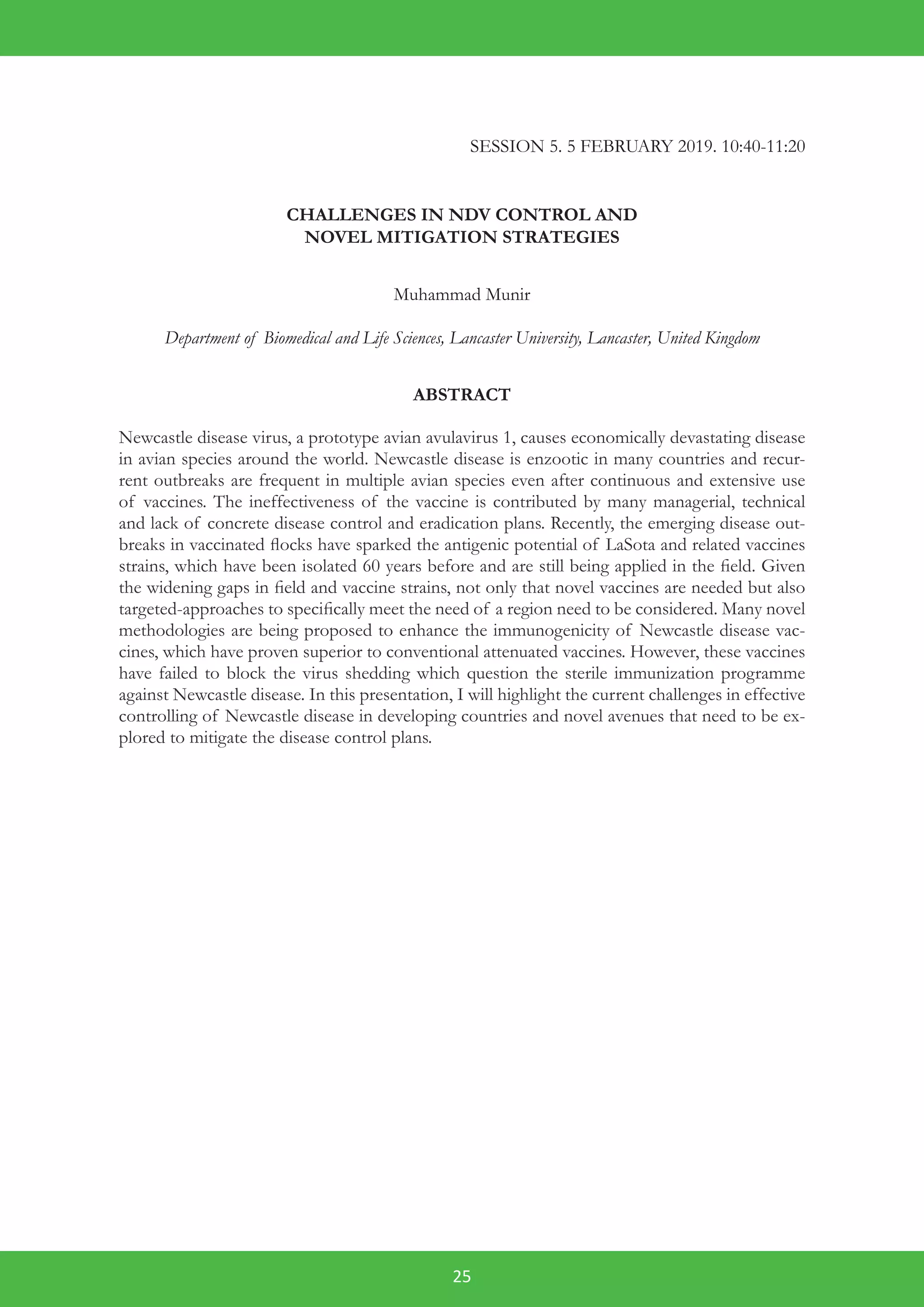
SESSION 5. 5 FEBRUARY 2019. 10:40-11:20
CHALLENGES IN NDV CONTROL AND
NOVEL MITIGATION STRATEGIES
Muhammad Munir
Department of Biomedical and Life Sciences, Lancaster University, Lancaster, United Kingdom
ABSTRACT
Newcastle disease virus, a prototype avian avulavirus 1, causes economically devastating disease
in avian species around the world. Newcastle disease is enzootic in many countries and recur-
rent outbreaks are frequent in multiple avian species even after continuous and extensive use
of vaccines. The ineffectiveness of the vaccine is contributed by many managerial, technical
and lack of concrete disease control and eradication plans. Recently, the emerging disease out-
breaks in vaccinated flocks have sparked the antigenic potential of LaSota and related vaccines
strains, which have been isolated 60 years before and are still being applied in the field. Given
the widening gaps in field and vaccine strains, not only that novel vaccines are needed but also
targeted-approaches to specifically meet the need of a region need to be considered. Many novel
methodologies are being proposed to enhance the immunogenicity of Newcastle disease vac-
cines, which have proven superior to conventional attenuated vaccines. However, these vaccines
have failed to block the virus shedding which question the sterile immunization programme
against Newcastle disease. In this presentation, I will highlight the current challenges in effective
controlling of Newcastle disease in developing countries and novel avenues that need to be ex-
plored to mitigate the disease control plans.
26
SESSION 5. 5 FEBRUARY 2019. 11:20-11:50
PREVALENCE AND ANTIMICROBIAL RESISTANCE PROFILE OF SOME
BACTERIAL ISOLATES OF VETERINARY IMPORTANCE AND ITS
IMPLICATIONS FOR ONE HEALTH
Ma. Cynthia R. Dela Cruz
College of Veterinary Medicine and Biomedical Sciences,
Cavite State University, Indang, Cavite
ABSTRACT
The prevalence and antimicrobial resistance profile of selected bacterial isolates of veterinary
importance were determined. Among these isolates were Escherichia coli in particular the en-
terohemorrhagic pathotype found in cattle, swine and small ruminants; Salmonella enterica and
Haemophilus paragallinarum (now Avibacterium paragallinarum). The antimicrobial profile depended
largely on the prevailing antibiotics utilized in the farm during treatment and as in-feed ingredient
as antibiotic growth promotant (AGP). The growing consensus among veterinary practitioners
is the need to rear AGP-free and antibiotic residue-free livestock and poultry as demanded by
large food institutions. In the long run antimicrobial resistance prevention and control in animals
can only be successfully achieved by improving basic hygiene and sanitation, by providing a con-
scientious vaccination program, use of sustainable alternative therapies and a robust education
program on preventing antibiotic misuse among veterinary practitioners, agrivet supplies, com-
panies, the academe and the food consuming public. The studies, in particular on E. coli O157,
confirmed the presence of the pathogens among the domestic animals in the Philippines.
27
SESSION 5. 5 FEBRUARY 2019. 11:50-12:20
DEVELOPMENT OF A MOLECULAR ASSAY FOR THE
DETECTION OF BACTERIAL POULTRY PATHOGENS
Aurore Corinne Jeanne-Marie Poirier
Surrey University, United Kingdom
ABSTRACT
Chicken production accounts for 15% of the agricultural output of the Philippines and is grow-
ing at a rate of a few percent per annum. One of the key factors affecting the growth of this
industry is an inability to rapidly detect disease and control outbreaks. The main poultry dis-
eases are caused by Newcastle disease virus, Infectious Bursal Disease virus, avian Infectious
Bronchitis virus, Salmonella spp., Avian Pathogenic E. coli and Mycoplasma gallisepticum and
synoviae. Currently, diagnosis relies on a drop in production performance, presence of clinical
signs, pathological lesions and serological tests which can be time-consuming. Therefore, the use
of rapid field based molecular testing has the potential to reduce diagnosis time, help to prevent
disease spread and facilitate appropriate selection of treatments. Loop-mediated isothermal am-
plification (LAMP) is a molecular technique carried out in a single step at constant temperature,
and does not require a thermal cycler. Due to the specific nature of the enzyme and the loop
primers used for the amplification, LAMP can detect and amplify only few copies of DNA, even
in a sample with a degraded DNA copies in less than 1 hour. Therefore, LAMP can be used to
detect the presence of bacterial DNA in faecal/respiratory swabs and tissue samples. At the Uni-
versity of Surrey, LAMP primers has been and will be designed to specifically recognise bacterial
genes representative of each pathogen species. The designed primers will be tested on bacteria
isolated from diseased chicken, as well as external groups to assess their specificity.
28
SESSION 6. 6 FEBRUARY 2019. 9:00-9:40
ADVANCED BIOSENSORS FOR DETECTING ZOONOTIC PATHOGEN
Wamadeva Balachandran
College of Engineering, Design and Physical Sciences, Brunel University London
ABSTRACT
Infectious animal diseases caused by pathogenic microorganisms such as bacteria and virus
threaten the health of livestock and human populations limit productivity and increase signifi-
cantly economic losses to each sector. Viral infections in animals carry global public health risks
of sporadic human zoonotic infections or emergence of pandemic viral strains. Animals are
thought to be the source of more than 70% of all emerging infections. The pathogen detec-
tion is an important step for diagnostics, successful treatment of animal infection diseases and
control management in farms and field conditions. Biosensors have been designed to detect
the targets such as protein or nucleic acid sequence related to pathogen by using sensitive and
selective recognition properties of antibodies, aptamers, glucans and DNA probes. These elec-
trochemical, optical or colorimetric sensing elements emit a direct signal when the target is rec-
ognised. The ideal diagnostic tools for infectious diseases should have the ability to be sensitive,
rapid, specific, accurate, robust, low-cost and user friendly. Conventional diagnosis of pathogens
in livestock and poultry include culture and microscopy, immunology, as well as PCR strategies.
These techniques have shown many limitations, such as time-consuming and frequently incapa-
ble of distinguish between low and highly pathogenic strains. Molecular techniques such as PCR
and RT-PCR are being used in central laboratories to diagnose and identify relevant infectious
diseases in animals and humans. However, these nucleic acid based methodologies need isolated
genetic materials and sophisticated instruments, being not suitable for in field analysis, conse-
quently there is strong need for developing new rapid point-of-care biosensing systems for early
detection of animal and human diseases with high sensitivity and specificity. Recent advance-
ment in nanotechnology and the unique properties of nanomaterials in optical, mechanical,
magnetic, catalytic and electrochemical has provided opportunities to develop POCT platforms
with portable, robust and affordable features to detect infectious diseases at the point of need in
the developing countries. To be used outside the laboratories, a biosensor usually needs adapta-
tion for implementation in field conditions in order to reduce the risk of obtaining false positive
or false negative results. Paper-based platforms are being developed as an affordable, rapid and
easy to perform sensing systems for implementation in the field condition. This presentation will
briefly review this fast moving technology using state-of-the-art biosensors.
29
SESSION 6. 6 FEBRUARY 2019. 9:40-10:10
DEVELOPMENT OF A LOW-COST MOLECULAR DIAGNOSTIC
PLATFORM FOR RAPID DETECTION OF POULTRY PATHOGENS
Manoharanehru Branavan
Brunel University London, United Kingdom
ABSTRACT
Chicken farming accounts for approximately 15% of the agricultural output of the Philippines
and is growing at a rate of a few percent per annum. Currently the Philippine lacks the tools
and infrastructure to effectively and rapidly diagnose and track disease outbreaks. Diagnosis is
currently reliant on a drop in production performance, presence of clinical signs, pathological
lesions and serological findings. It is recognised by experts within the Philippines that although
the use of molecular methods for detection, identification, and characterization of infectious
agents in poultry is gaining importance abroad, diagnosis using molecular techniques is still at its
infancy in the country. The use of rapid field based molecular testing has the potential to greatly
reduce diagnosis times and consequently reduce disease spread and may facilitate appropriate
selection and more efficient management and treatment protocols. To address this need, a por-
table, battery powered, low-cost molecular diagnostic device has been developed. The device is
capable of performing isothermal calorimetric LAMP assays and communicate the results to a
central location where a veterinarian can perform the diagnosis and recommend management
and treatment protocols.
30
SESSION 7. 6 FEBRUARY 2019. 10:30-11:10
THE ROLE OF HEAD-ASSOCIATED RESPIRATORY AND LYMPHOID
TISSUES IN PROVIDING PROTECTION AGAINST INFECTIOUS
BRONCHITIS VIRUS IN CHICKENS
Kannan Ganapathy
Poultry Respiratory Disease Group, University of Liverpool,
Leahurst Campus , Neston, Cheshire, United Kingdom
ABSTRACT
Infectious bronchitis (IB) is caused by infectious bronchitis viruses (IBVs) that mainly infect
the respiratory system in chicken flocks. Infection causes economic losses due to high mortality,
poor body weight gain, decreased egg production or quality in layers. Further complications can
occur in some cases, including cystic oviducts and false layer syndrome. Certain IBVs have been
associated with nephritis and proventriculitis in chickens. IBV is a single stranded RNA virus be-
longing to the family Coronaviradae. It contains four structural proteins but the spike protein (S)
has been shown to have a greater role, including attachment to host cells, neutralization of anti-
bodies and initiation of protective immunity. Also, most mutations and recombination occurs in
the S gene, which may lead to the emergence of new variant strains. To date, much attention was
given to trachea as primary replication site of IBV though other respiratory tissues, particularly
those in the head could be equally important. We examined the viral load, pro-inflammatory
cytokines and host gene signatures in respiratory and lymphoid tissues in IBV-vaccinated and
unvaccinated chicks that were subsequently challenged with a virulent M41. The findings were
cross-compared with tracheal ciliary protection provided by vaccine/vaccination used. Results
to date showed almost equivalent levels of IBV viral load and replication in the turbinate and
choanal-cleft though some variations were evident at different sampling days. For the levels of
mRNA gene expression of TLR3, MDA5, INF-ß and IL-6, different patterns of expression
were found for different tissues, pending the sampling days and type of tissues examined.
31
SESSION 7. 6 FEBRUARY 2019. 11:10-11:50
CURRENT APPROACH IN ANTI-TICK VACCINE DESIGN
Remil L. Galay
Department of Veterinary Paraclinical Sciences, College of Veterinary Medicine,
University of the Philippines Los Baños, Laguna, Philippines
ABSTRACT
Ticks are blood-sucking arthropods notorious for their role as vectors of various pathogens
to humans and animals. They are second to mosquitoes in transmitting pathogens to humans,
most of which cause life-threatening diseases. In animals, ticks are primary transmitters of vi-
ruses, bacteria, and protozoa, causing fatal diseases and great economic losses in the animal
industry. Until now, tick control is predominantly through the application of chemical acaricides
particularly in livestock management and companion animals, but several disadvantages arise
from emergence of resistant tick strains and concerns on animal product and environmental
contamination. Vaccination is a promising control alternative that is expected to overcome the
drawbacks of chemical acaricide application. Moreover, vaccination is also viewed as an ideal
method of preventing transmission of pathogens. In this presentation, I will discuss the current
approach in designing anti-tick and transmission blocking vaccine, from reverse genetic charac-
terization of candidate antigens to tick challenge after immunization.
32
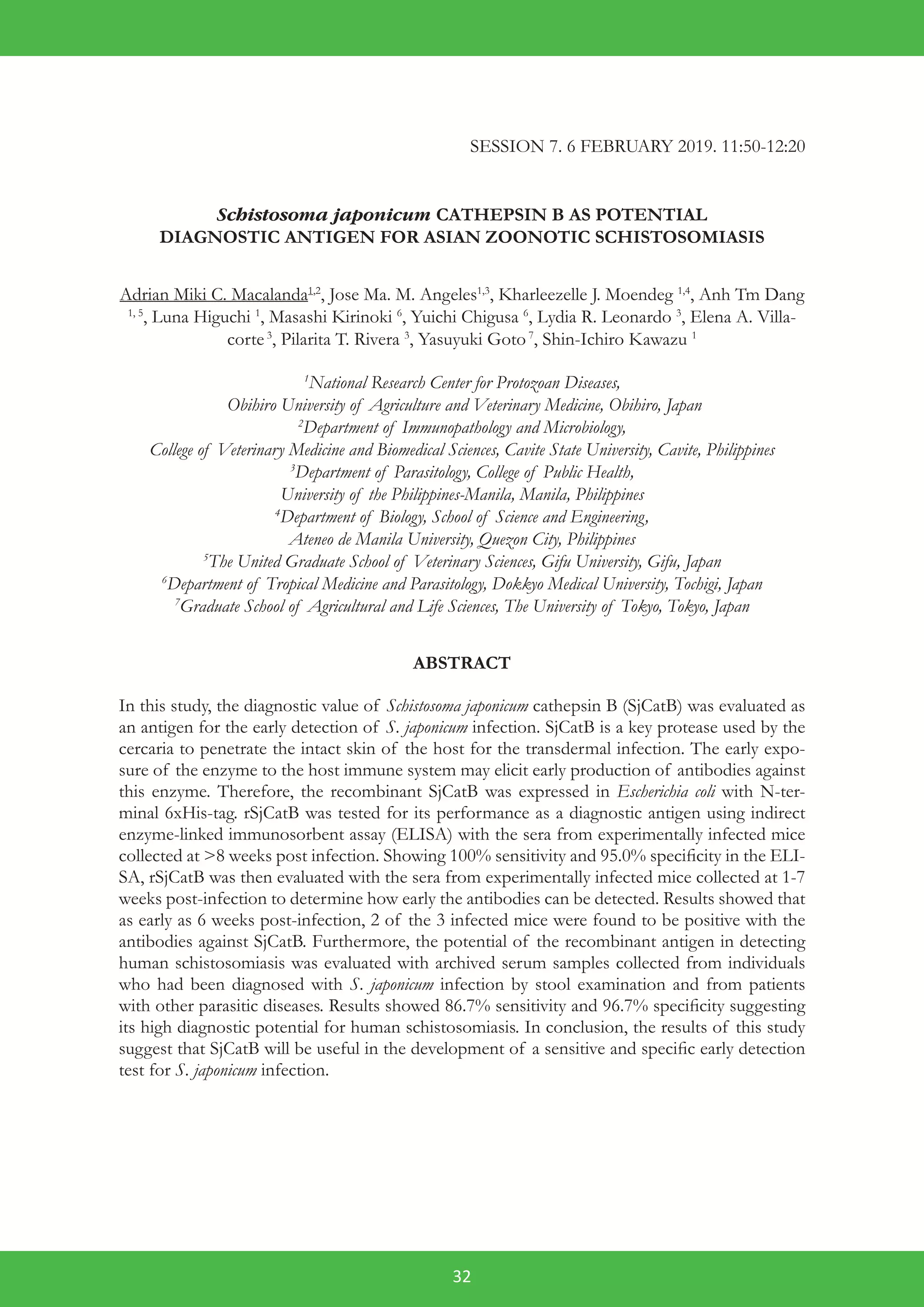
SESSION 7. 6 FEBRUARY 2019. 11:50-12:20
Schistosoma japonicum CATHEPSIN B AS POTENTIAL
DIAGNOSTIC ANTIGEN FOR ASIAN ZOONOTIC SCHISTOSOMIASIS
Adrian Miki C. Macalanda1,2
, Jose Ma. M. Angeles1,3
, Kharleezelle J. Moendeg 1,4
, Anh Tm Dang
1, 5
, Luna Higuchi 1
, Masashi Kirinoki 6
, Yuichi Chigusa 6
, Lydia R. Leonardo 3
, Elena A. Villa-
corte3
, Pilarita T. Rivera 3
, Yasuyuki Goto7
, Shin-Ichiro Kawazu 1
1
National Research Center for Protozoan Diseases,
Obihiro University of Agriculture and Veterinary Medicine, Obihiro, Japan
2
Department of Immunopathology and Microbiology,
College of Veterinary Medicine and Biomedical Sciences, Cavite State University, Cavite, Philippines
3
Department of Parasitology, College of Public Health,
University of the Philippines-Manila, Manila, Philippines
4
Department of Biology, School of Science and Engineering,
Ateneo de Manila University, Quezon City, Philippines
5
The United Graduate School of Veterinary Sciences, Gifu University, Gifu, Japan
6
Department of Tropical Medicine and Parasitology, Dokkyo Medical University, Tochigi, Japan
7
Graduate School of Agricultural and Life Sciences, The University of Tokyo, Tokyo, Japan
ABSTRACT
In this study, the diagnostic value of Schistosoma japonicum cathepsin B (SjCatB) was evaluated as
an antigen for the early detection of S. japonicum infection. SjCatB is a key protease used by the
cercaria to penetrate the intact skin of the host for the transdermal infection. The early expo-
sure of the enzyme to the host immune system may elicit early production of antibodies against
this enzyme. Therefore, the recombinant SjCatB was expressed in Escherichia coli with N-ter-
minal 6xHis-tag. rSjCatB was tested for its performance as a diagnostic antigen using indirect
enzyme-linked immunosorbent assay (ELISA) with the sera from experimentally infected mice
collected at >8 weeks post infection. Showing 100% sensitivity and 95.0% specificity in the ELI-
SA, rSjCatB was then evaluated with the sera from experimentally infected mice collected at 1-7
weeks post-infection to determine how early the antibodies can be detected. Results showed that
as early as 6 weeks post-infection, 2 of the 3 infected mice were found to be positive with the
antibodies against SjCatB. Furthermore, the potential of the recombinant antigen in detecting
human schistosomiasis was evaluated with archived serum samples collected from individuals
who had been diagnosed with S. japonicum infection by stool examination and from patients
with other parasitic diseases. Results showed 86.7% sensitivity and 96.7% specificity suggesting
its high diagnostic potential for human schistosomiasis. In conclusion, the results of this study
suggest that SjCatB will be useful in the development of a sensitive and specific early detection
test for S. japonicum infection.
33
SESSION 8. 7 FEBRUARY 2019. 9:00-9:40
LAMP-BASED TEST KITS FOR ANIMAL INFECTIOUS PATHOGENS
Clarissa Yvonne J. Domingo, Rubigilda P. Alili, Rizalee Pilare and Rayniel Joshua Aquino
College of Veterinary Science and Medicine, Central Luzon State University, Maharlika Road,
Science City of Muñoz, Nueva Ecija, Philippines
ABSTRACT
The College of Veterinary Science and Medicine (CVSM) of the Central Luzon State University
(CLSU) has been actively developing Loop mediated isothermal amplification (LAMP)-based
diagnostic protocols for different animal pathogens, whether of public health importance or of
specific animal species such as swine, grazing livestock or poultry. Since 2011, programs and proj-
ects based on LAMP were funded nationally by the government through the DOST-PCAARRD
and DA-BAR, CHED and through international collaborations with ACIAR, FAO-UN and the
Newton Fund/BBSRC. The CVSM, through the initiative, has indigenously developed wet for-
mat LAMP (wLAMP) assays (primer designs, protocols and reaction profiles) for the following
organisms namely Cryptosporidium pig genotype II, Cathepsin B for the prepatent detection of
Fasciola gigantica larvae, Salmonella spp., Mycoplasma hyopneumoniae. The College also did some op-
timization and validation projects of wLAMP assays that were adapted from published articles
but modified under Philippine condition. These assays detected Actinobacillus pleuropneumoniae,
Hemophilus parasuis and Lawsonia intracellularis. Likewise, wRT-LAMP assays were also developed
for Newcastle disease virus (NCDV), Porcine Epidemic Diarrhea (PED) virus, Porcine Repro-
ductive and Respiratory Syndrome (PRRS) virus, Classical Swine Fever (CSF) virus. All these
projects/programs focused on the finetuning of the wLAMP laboratory workflow. On the other
hand, certain wLAMP laboratory workflows were translated into handy, rapid, simple-to-use test
kits and the method or process was submitted last 2015 for patent. These test kits were made
for NCDV, PEDV and Cathepsin B for prepatent detection of Fasciola gigantica. The PEDV test
kit was registered by the Bureau of Animal Industry after passing the validation criteria and
is now being commercialized under the University’s Technology Business Incubation program
and at present, the market includes commercial farms, undergraduate thesis students, PED vac-
cine suppliers and the Regional Animal Disease Diagnostic Laboratories. The NCDV test kit
was used for NCD active surveillance last 2016 when an outbreak occurred in Central Luzon.
Cathepsin B was used for passive surveillance by the Nueva Vizcaya State University in Region
II. PEDV test kit was used for passive surveillance in southern Luzon by the Cavity State Univer-
sity. Recently, the project has optimized the dry format RT-LAMP (dRT-LAMP) for PEDV and
NCDV that can be stored or shipped to distant places without the need for dry ice. The dRT-
LAMP premixes can be stored at room temperature without exposure to humidity for one year.
34
SESSION 8. 7 FEBRUARY 2019. 9:40-10:10
NANOPARTICLE-BASED IMMUNOASSAYS FOR THE DETECTION OF
MICROBIAL PATHOGENS OF PUBLIC HEALTH IMPORTANCE
Reynaldo DL. Bundalian Jr.
Center for Research and Development, Angeles University Foundation, Angeles City
ABSTRACT
In the recent years, the advancement in nanomaterials and nanobiotechnology has provided
improved detection of analytes in samples with highly complex matrices. Real time detection of
multiple analytes is samples provided opportunity in improving diagnosis of different forms of
diseases. As an example, magnetic nanoparticles have been explored as alternative nanomaterial
support in the development of more sensitive and specific immunoassays. The use of magnetic
nanoparticles provides simplified isolation of target analytes which can be coupled with a suit-
able detection method to shorten the identification process. The use of mobile immunoassay
supports also enables integration with microfluidic technologies that can increase the portability
of the tests on site.
35
SESSION 8. 7 FEBRUARY 2019. 10:20-11:00
SENSITIVE COLORIMETRIC DETECTION OF CAPRINE ARTHRITIS
ENCEPHALITIS VIRUS USING DRY FORMAT LOOP-MEDIATED
ISOTHERMAL AMPLIFICATION COMBINED WITH
DNA-FUNCTIONALIZED GOLD NANOPARTICLES AS PROBES:
ADVANCES TOWARDS POINT OF CARE DIAGNOSTICS
Joram J. Gautane
Biosafety and Environment Section, Philippine Carabao Center,
National Headquarters and Genepool, Science City of Muñoz, Nueva Ecija, 3119, Philippines
ABSTRACT
Belonging to the family of Retroviridae, Caprine Arthritis Encephalitis Virus (CAEV) is a
multi-organ disease of goats which is characterized by long incubation period and persistent in-
fection. The presence of this virus in the herd may cause great loss in animal production. Detec-
tion of this virus can be done through serological tests such as enzyme-linked immune sorbent
assay (ELISA) and recently, molecular tests such as polymerase chain reaction (PCR). However,
these techniques are laborious and require expensive equipment that may not be present in
some laboratories thus, may not be suitable in resource-limited areas or in field settings. We de-
veloped a simple dry format loop-mediated isothermal amplification (LAMP) assay combined
with DNAfunctionalized, ssDNA-labelled nano gold probe (AuNP) to detect CAEV. The dried
format LAMP can detect CAEV in clinical samples through amplification of the CAEV proviral
DNA at an isothermal temperature of 60˚C for 15 minutes to 1 hour in a heat block or water
bath. The dry format LAMP is stable at room temperature, 4˚C and -20˚C hence, this permits
conduct or use of the technique even in resource-limited areas. This simple and rapid test is also
sensitive and specific and offers a lower cost molecular-based test for the detection of CAEV.
36
SESSION 8. 7 FEBRUARY 2019. 11:00-11:30
THE GROWING EXPLORATION OF TICK–VIRUS INTERACTIONS USING
VARIOUS EXPERIMENTAL VIRAL INFECTIONS OF HARD TICKS
Melbourne R. Talactac1
, Emmanuel P. Hernandez2
, Kozo Fujisaki3
and Tetsuya Tanaka2
1
Department of Clinical and Population Health,
College of Veterinary Medicine and Biomedical Sciences, Cavite State University, Cavite, Philippines
2
Laboratory of Infectious Diseases, Joint Faculty of Veterinary Medicine,
Kagoshima University, Kagoshima, Japan
3
National Agriculture and Food Research Organization, 3-1-5 Kannondai, Tsukuba, Japan
ABSTRACT
Ticks are obligate ectoparasites that are greatly considered important vectors of disease-causing
microorganisms affecting humans, livestock, wild and companion animals. To successfully un-
ravel the ticks’ role as vectors of viral pathogens, their susceptibility to new control measures,
and their ability to develop acaricide resistance, acclimatization of ticks under laboratory con-
ditions is greatly needed. However, the unique and complicated feeding behavior of these ticks,
especially the ixodid (hard) ticks compared to that of other hematophagous arthropods requires
efficient and effective techniques to infect them with tick-borne viruses (TBVs). In addition,
relatively expensive maintenance of animals for blood feeding and associated concerns about
animal welfare critically limit our understanding of TBVs. This presentation aims to summarize
the current knowledge about the artificial infection of hard ticks with viral pathogens, which is
currently used to elucidate virus transmission and vector competence and to discover immune
modulators related to tick–virus interactions. This review will also present the advantages and
limitations of the current techniques for tick infection. Fortunately, new artificial techniques
arise, and the limitations of current protocols are greatly reduced as researchers continuously
improve, streamline, and standardize the laboratory procedures to lower cost and produce better
adoptability. In summary, convenient and low-cost techniques to study the interactions between
ticks and TBVs provide a great opportunity to identify new targets for the future control of
tick-borne diseases.
37
DIRECTORY OF DELEGATES
Delegate Name Lifeiz Grace V. Aguto
Organisation Department of Agriculture-RFO 13
Designation Veterinarian II
Mailing Address Curato Street, Purok Caimito, Barangay 6, Buenavista,
Agusan del Norte
Email Poohbear_es20@yahoo.com
Delegate Name Nieta C. Amit
Organisation University of Eastern Philippines
Designation Clinical Instructor, Extension Coordinator, Associate
Prof. 1
Mailing Address 157 Veloso Boulevard, UEP Campus, Catarman, North-
ern Samar
Email NCAmit@yahoo.com
Delegate Name Rosemarie N. Antegro
Organisation Bureau of Animal Industry
Designation Veterinarian IV/ Head of Veterinary Biologics
Production Section
Mailing Address BAI, Visayas Ave., Diliman, Quezon City
Email rantegro@yahoo.com
Delegate Name Wamadeva Balachandran
Organisation Brunel University London
Designation Research Professor
Mailing Address ECE, College of Engineering, Design and Physical
Sciences
Email emstwwb@brunel.ac.uk
Delegate Name Myrna D. Baldecañas
Organisation Bureau of Animal Industry
Designation Veterinarian III - Head, Bacterial Vet. Biologics Produc-
tion Laboratory
Mailing Address Bureau of Animal Industry Veterinary Laboratory Divi-
sion Visayas Avenue, Diliman, Quezon City
Email mdbaldecanas@gmail.com
Delegate Name Criselda T. Bautista
Organisation Research Institute for Tropical Medicine (RITM)
Designation Senior Science Research Specialist
Mailing Address Blk3 Lot 13 Southwynd Residences, Palo Alto, Mayapa,
Calamba Laguna
Email 8essel8@gmail.com
38
Delegate Name Maryneth B. Barrios
Organisation Capiz State University
Designation LRDC Director/ Instructor
Mailing Address Capiz State University, Dumarao, Capiz, 5812
Email Neth0285@yahoo.Com
Delegate Name Francis Andrew Eugene M. Bernardo
Organisation Department of Veterinary Clinical Science, College of
Veterinary Medicine, UPLB
Designation Associate Professor
Mailing Address Dept. Veterinary Clinical Sciences, U.P. Los Banos,
Laguna, 4031
Email fmbernardo@up.edu.ph
Delegate Name Manoharanehru Branavan
Organisation Brunel University
Designation Postdoctoral Research Fellow
Mailing Address Michael Sterling 051, Brunel University, Kingston Lane,
Uxbridge, UB8 3PH, UK.
Email Manoharanehru.Branavan@brunel.ac.uk
Delegate Name Reynaldo Bundalian Jr.
Organisation Angeles University Foundation
Designation Assistant Director, Center for Research and
Development
Mailing Address RM A213, Main Building, Angeles University
Foundation Mc-Arthur Hi way Angeles City, 2009
Email bundalianrdjr.cas@auf.edu.ph
Delegate Name Gerry Amor Camer
Organisation University of Eastern Philippines
Designation University Professor
Mailing Address L3 B12 University Homes, Cawayan, Catarman,
Northern Samar, 6400 Philippines
Email gercamer@uep.edu.ph/
gerryamorcamer@gmail.com
Delegate Name Aleli Arambulo Collado
Organisation DOST-PCAARRD
Designation Science Research Specialist II
Mailing Address 3361 Aguila St., Rhoda Subd., Anos, Los Baños,
Laguna 4030
Email aleli_arambulo_collado@yahoo.com
39
Delegate Name Elizabeth C. Conde
Organisation East Asia Laboratory, Inc.
Designation Assistant Manager
Mailing Address East Asia Laboratories, Incorporated, Marvi Hills
Subdivision, St. Matthew Street, San Mateo, Rizal
Email titabethconde@yahoo.com
Delegate Name Jesalyn L. Constante
Organisation Department of Veterinary Clinical Science, College of
Veterinary Medicine, UPLB
Designation Assistant Professor
Mailing Address College of Veterinary Medicine, UPLB, College,
Laguna, 4031, Philippines
Email jlconstante@up.edu.ph
Delegate Name Ma. Cynthia R. Dela Cruz
Organisation Cavite State University
Designation Associate Professor III
Mailing Address College of Veterinary Medicine and Biomedical Sci-
ences, Cavite State University, Don Severino delas Alas
Campus, Indang, Cavite 4122
Email ma.cynthiadelacruz@cvsu.edu.ph
Delegate Name Rainelda C. dela Pena
Organisation Veterinary Biologics Assay Section, Veterinary Labora-
tory Division, Bureau of Animal Industry
Designation Veterinarian III, Head - Swine Viral and Companion
Animal Biologics Assay Unit
Mailing Address Bureau of Animal Industry, Visayas Avenue, Diliman
1101, Quezon City
Email daicpena@yahoo.com
Delegate Name Ruby H. Destajo
Organisation Cebu Technological University – Barili Campus
Designation Associate Professor
Mailing Address College of Veterinary Medicine, Cebu Technological
University - Barili Campus, Cagay, Barili, Cebu
Email rhdestajo@yahoo.com
Delegate Name Clarissa Yvonne J. Domingo
Organisation College of Veterinary Science & Medicine,
Central Luzon State University
Designation Professor
Mailing Address CVSM, CLSU, Maharlika Road, Bantug, Science City
of Munoz, Nueva Ecija, Philippines
Email cyjd1793@gmail.com
40
Delegate Name Rio John T. Ducusin
Organisation College of Veterinary Medicine,
University of the Philippines Los Baños
Designation Professor
Mailing Address College of Veterinary Medicine,
University of the Philippines Los Baños 4031
Email rtducusin@up.edu.ph
Delegate Name Stephen Dunham
Organisation University of Nottingham
Designation Associate Professor of Veterinary Virology
Mailing Address University of Nottingham, College Road, Sutton
Bonington, LE12 5RD
Email stephen.dunham@nottingham.ac.uk
Delegate Name Anil Fernando
Organisation University of Surrey, UK
Designation Leader of the Multimedia Communications
Mailing Address Centre for Vision Speech and Signal Processing,
University of Surrey, Guildford GU1 2TX, UK
Email W.Fernando@surrey.ac.uk
Delegate Name Remil L. Galay
Organisation UP College of Veterinary Medicine
Designation Assistant Professor, Department Chair
Mailing Address 651-B E. Taleon St., Santisima Cruz, Santa Cruz, Lagu-
na 4009 Philippines
Email rlgalay@up.edu.ph
Delegate Name Kannan Ganapathy
Organisation University of Liverpool
Designation Senior Lecturer
Mailing Address Leahurst Campus, University of Liverpool, Leahurst,
Neston, Cheshire CH64 7TE, UK
Email gana@liverpool.ac.uk
Delegate Name Joram J. Gautane
Organisation Livestock Biotechnology Center, DA-BAR
Designation Nanotech-Nanosensor Research Consultant
Mailing Address Poblacion West, Science City of Munoz, Nueva Ecija
3120, Philippines
Email jjgautane23@gmail.com
41
Delegate Name Riva Marie C. Gonzales
Organisation Bureau of Animal Industry
Designation
Section Head,
ADDRL-Veterinary Laboratory Division
Mailing Address Animal Disease Diagnosis and Reference Laboratory,
BAI Compd., Visayas Ave., QC
Email ivy.gonzales@gmail.com
Delegate Name Catherine A. Gorospe
Organisation Provincial Veterinary Office – Rizal Province
Designation Veterinarian IV/ Provincial Animal Health Program
Coordinator
Mailing Address Rizal Province Capitol, Ynares, Antipolo City
Email rizalprovincialveterinary@gmail.com
Delegate Name Munir Iqbal
Organisation The Pirbright Institute
Designation Head of Avian Influenza Group
Mailing Address The Pirbright Institute, Ash Road, Pirbright, Woking,
GU24 0NF, UK
Email munir.iqbal@pirbright.ac.uk
Delegate Name Daphne L. Jorca
Organisation Bureau of Animal Industry
Designation Veterinarian III
Mailing Address Bureau of Animal Industry, Visayas Avenue, Diliman,
Quezon City
Email daf03a@gmail.com
Delegate Name Roberto La Ragione
Organisation University of Surrey
Designation Professor and Head of Department
Mailing Address School of Veterinary Medicine, Faculty of Health and
Medical Sciences, Vet School Main Building, Daphne
Jackson Road, University of Surrey, Guildford, GU2
7AL, UK
Email r.laragione@surrey.ac.uk
Delegate Name Ma Suzanneth G. Lola
Organisation CVM, UPLB
Designation Assistant Professor
Mailing Address 923 Mindoro St. Sampaloc, Manila 1008
Email mglola@up.edu.ph
42
Delegate Name Wenchie Marie L. Lumbera
Organisation Department of Veterinary Paraclinical Sciences
College of Veterinary Medicine, UPLB
Designation Assistant Professor
Mailing Address College of Veterinary Medicine, UPLB, College,
Laguna 4030
Email wllumbera@up.edu.ph
Delegate Name Adrian Miki C. Macalanda
Organisation Cavite State University/National Research Center for
Protozoan Diseases, Obihiro University of Agriculture
and Veterinary Medicine,
Designation Assistant Professor/ Foreign Visiting Researcher
Mailing Address B5 L11 Chico St., Ceris 3, Canlubang, Calamba, Lagu-
na, Philippines
Email adrian_macalanda@yahoo.com
Delegate Name Milagros R. Mananggit
Organisation Department of Agriculture, Regional Field Office III
(DA, RFO3)
Designation Chief, Integrated Laboratory Division
Mailing Address # 236 Briones Village, San Isidro, Cabanatuan City,
Nueva Ecija
Email raidl3@yahoo.com
Delegate Name Jennifer L. Lucero-Maravilla
Organisation BAI -Animal Disease Diagnosis and Reference
Laboratory
Designation Veterinarian II
Mailing Address Animal Disease Diagnosis and Reference Laboratory,
Visayas Avenue, Diliman, QC
Email jenniferlucerodvm@yahoo.com
Delegate Name Benjamin Reuel G. Marte
Organisation UPLB College of Veterinary Medicine
Designation Associate Professor
Mailing Address College of Veterinary Medicine, UPLB, College,
Laguna, 4031 Philippines
Email bgmarte@up.edu.ph
Delegate Name Rodolfo F. Medrano Jr.
Organisation Central Luzon State University
Designation Assistant Professor
Mailing Address College of Veterinary Science and Medicine, Central
Luzon State University, Bantug, Science City of
Munoz, Nueva Ecija 3120 Philippines
Email rfmedrano@clsucvsm.edu.ph
43
Delegate Name Marlon G. Mendez
Organisation Department of Agriculture – Regional Field Office 1
Designation Veterinarian II
Mailing Address Department of Agriculture-RFO1, Aguila Rd., Sevilla,
San Fernando City, La Union
Email regulatorydarfo1@gmail.com
Delegate Name Sarah Jane L. Moog
Organisation Office of the Provincial Veterinarian - Batangas
Designation Veterinarian I
Mailing Address #741 Balagtasin, San Jose, Batangas, 4227
Email sajinmoog@gmail.com
Delegate Name Muhammad Munir
Organisation The Lancaster University, UK
Designation Lecturer
Mailing Address Division of Biomedical and Life Sciences, Furness
College, Lancaster University
Furness B69, LA1 4YG, Lancaster, UK
Email Muhammad.munir@lancaster.ac.uk
Delegate Name Jessica Gay M. Ortiz
Organisation Philippine Carabao Center
Designation Science Research Specialist I
Mailing Address 25 C-West Golden Homes Cmpd. Dao St. Marikina
Heights, Marikina City
Email jega.ortiz@gmail.com
Delegate Name Dave Bryan R. Padaon
Organisation University of Eastern Philippines
Designation Science Research Assistant
Mailing Address 1512 Purok 2, Brgy. Libertad Victoria, Northern Samar
Email davebryanpadaon@gmail.com
Delegate Name Coleen M. Pangilinan
Organisation UPM NIH - Institute of Molecular Biology and
Biotechnology
Designation Science Research Specialist
Mailing Address 623 Central Laboratories NIH Bldg UP Manila, Pedro
Gil St. Ermita, Manila City
Email cmpangilinan@up.edu.ph
44
Delegate Name Flor Marie Immanuelle R. Pilapil-Amante
Organisation Department of Veterinary Clinical Sciences
College of Veterinary Medicine, UPLB
Designation Assistant Professor
Mailing Address College of Veterinary Medicine, UPLB, College,
Laguna 4030
Email frpilapil@up.edu.ph
Delegate Name Thea Claudette E. Plete
Organisation Department of Agriculture – Regional Animal Disease
Diagnostic Laboratory IV-A
Designation Veterinarian II
Mailing Address Tanco Drive, Marawoy, Lipa City, Batangas
Email theaplete@rocketmail.com
Delegate Name Aurore Corinne Jeanne-Marie Poirier
Organisation University of Surrey, UK
Designation Research Fellow
Mailing Address School of Veterinary Medicine, Vet School Main
Building, Daphne Jackson Road, University of Surrey,
Guildford, GU2 7AL, United Kingdom
Email a.poirier@surrey.ac.uk
Delegate Name Androniki Psifidi
Organisation Royal Veterinary College, London, UK
Designation Lecturer in Veterinary Clinical Genetics
Mailing Address Queen Mother Hospital for Animals , The Royal
Veterinary College, Hawkshead Lane, North Mymms,
Hatfield, Hertfordshire, AL9 7TA, UK
Email apsifidi@rvc.ac.uk
Delegate Name Melbourne R. Talactac
Organisation College of VetMed & Biomedical Sciences,
Cavite State University
Designation Research Coordinator/Department Chair
Mailing Address Don Severino Delas Alas Campus,
Bancod, Indang, Cavite
Email talactacdvm@cvsu.edu.ph
Delegate Name Neil C. Tanquilut
Organisation Pampanga State Agricultural University
Designation Faculty Member
Mailing Address PSAU, Magalang, Pampanga
Email neil@psau.edu.ph
45
Delegate Name Yves Roy M. Tibayan
Organisation Cavite State University
Designation Science Research Assistant
Mailing Address 105 Minantok West, Amadeo, Cavite, Philippines
Email yvesroy.tibayan@cvsu.edu.ph
Delegate Name Dennis V. Umali
Organisation Department of Veterinary Clinical Sciences, College of
Veterinary Medicine, UPLB
Designation Assistant Professor and UP Scientist
Mailing Address College of Veterinary Medicine, UPLB, College,
Laguna, 4031, Philippines
Email dvumali@up.edu.ph
Delegate Name Milcah I. Valente
Organisation Quezon Provincial Veterinary Office
Designation Agricultural Center Chief I
Mailing Address G/F Social Services Bldg. Capitol Cmpd.,
Lucena City
Email milcahvalente@yahoo.com
Delegate Name Amy Wedley
Organisation University of Liverpool
Designation Post-Doctoral Research Associate
Mailing Address Institute of Infection and Global Health, Department
of Infection Biology, University of Liverpool, Leahurst
Campus, Chester High Road
Neston, CH64 7TE
Email a.l.wedley@liverpool.ac.uk
Delegate Name RAYAN I. YSULAT
Organisation National Dairy Authority
Designation OIC Asst. Department Manager
Mailing Address c/o Science Centrum, Bago Oshiro, Tugbok District,
Davao City 8000
Email rayanysulat@gmail.com
46
PROGRAMME STEERING COMMITTEE
Chair Dennis V. Umali, Assistant Professor, CVM, UPLB
Muhammad Munir, Lecturer, Lancaster University
Co-Chair Jesalyn L. Constante, Assistant Professor, CVM, UPLB
Members Junelle L. Paler, Administrative Officer II, CVM, UPLB
Angelita Q. Go, Administrative Officer I, CVM, UPLB
Andres P. Advisio, Administrative Assistant IV, CVM, UPLB
Monitoring Agency Aleli A. Collado, Science Research Specialist II, PCAARRD
Eric E. Perez, Science Research Specialist II, PCAARRD
Glenda P. Fule, Science Research Specialist I, PCAARRD
Rapporteur Rio John T. Ducusin, Professor, CVM, UPLB
ACKNOWLEDGEMENT
This work was supported by a Researcher Links workshop grant 2017-RLWK9-11103 under
the Newton Agham Programme. The grant is funded by the UK Department for Business,
Energy and Industrial Strategy (BEIS) and the Department of Science and Technology
(DOST), Philippines and delivered by the British Council. For further information, please
visit www.newtonfund.ac.uk.
47
SPONSORS
MEDIA PARTNERS
48
NOTES
49
NOTES

2019 newton agham researcher links workshop vaccines and diagnostics conference proceedings

  • 1.
  • 2.
  • 3.
    3 TABLE OF CONTENTS I. Welcome Messages II. Workshop Programme III. Abstracts IV. Directory of Delegates V. Programme Steering Committee VI. Acknowledgment VII. Sponsors VIII. Media Partners IX. Notes 1 10 14 37 46 46 47 47 48
  • 4.
    1 WELCOME MESSAGE FROMTHE BRITISH AMBASSADOR Since the launch of the Newton Fund in 2014, the United Kingdom and the Philippines have jointly supported excellent science to address development challenges that affect the Philippines and the region, including health and food security, the focus for this Newton Fund Researcher Links Workshop. Collaboration in the sciences is integral to the ever growing relationship between our two countries. We hope that through this initiative we maximise the opportunity to strengthen links among members of our scientific communities. We also hope that with our complementary strengths and expertise, we can promote exceptional innovation on vaccines and diagnostic technologies that will reduce the negative impact of viral diseases on livestock, poultry and human health. We are grateful that our Newton Agham partners, the British Council and the Department of Science and Technology, are supporting this workshop led by the UK’s Lancaster University - College of Biomedical and Life Sciences and the University of the Philippines Los Baños - College of Veterinary Medicine. We look forward to the outcomes of this Workshop and to the stronger partnerships it will bring about among UK and PH researchers and institutions. DANIEL PRUCE British Ambassador to the Republic of the Philippines
  • 5.
    2 WELCOME MESSAGE FROMTHE SECRETARY, DEPARTMENT OF SCIENCE AND TECHNOLOGY (DOST), PHILIPPINES The Department of Science and Technology (DOST) extend its warm welcome to the participants of the Researcher Links working under the Newton AghamProgramme. It is an honor to partner with the British Council and the College of Veterinary Medicine of the University of the Philippines Los Baños in conducting a truly worthwhile pursuit. This international research workshop primarily aims to provide opportunities for scientists and animal health specialists from both the Philippines and the United Kingdom to jointly examine the current disease problems of various animal industries throughout the world. In addition, discussions will also revolve around providing appropriate proactive solutions through the use of emerging and next generation vaccine design strategies to combat veterinary viruses. It is hoped that this collaborative activity will serve as a multidisciplinary avenue for imparting vaccine designs and diagnostics not just to prominent scientists and promising researchers but also to the local livestock and poultry industry players. This workshop can also serve as a take off point for long-term research partnerships between researchers in the UK and the Philippines. May this workshop be truly a fruitful one. FORTUNATO T. DE LA PEÑA Secretary Department of Science and Technology
  • 6.
    3 WELCOME MESSAGE FROMTHE UNDERSECRETARY, DEPARTMENT OF SCIENCE AND TECHNOLOGY (DOST), PHILIPPINES On behalf of the Department of Science and Technology, we extend our warmest greetings in welcoming all the delegates. It is indeed both a pleasure and privilege for DOST to partner with the British Council and the College of Veterinary Medicine of the University of the Philippines Los Baños in holding this international research workshop. We are indeed glad that scientists and researchers from the UK and the Philippines have come together for this very significant undertaking. The Newton Researcher Links Programme is under the umbrella of the Newton Fund Researcher Mobility Programme, a collaborative engagement between the British Council and the UK National Academies. The Newton Researcher Links component is managed by the British Council in partnership with the Department of Science and Technology. This programme aspires to encourage initial links and support capacity building between budding Filipino researchers and the more senior UK mentors to share their knowledge and expertise. This research workshop has assembled not just scientists and researchers known in their fields but also the local livestock and poultry industry players. This engagement aims to examine and be aware of the emerging and next generation vaccine design strategies that can be utilized against veterinary viruses. We are hopeful that these joint discussions will produce and develop a collaborative network between the scientists and animal health specialists from the Philippines and the United Kingdom and thus, together explore possible solutions to disease problems that are faced by the animal industries throughout the world. On behalf of the Department of Science and Technology, our sincerest thanks to all for your participation and engagement in this workshop. CAROL M. YOROBE Undersecretary for Scientific and Technical Services Department of Science and Technology
  • 7.
    4 WELCOME MESSAGE FROMTHE UNDERSECRETARY, DEPARTMENT OF SCIENCE AND TECHNOLOGY (DOST), PHILIPPINES In behalf of the Department of Science and Technology, it is our great pleasure to welcome you all to the Philippines. Allow me to express my sincerest gratitude and appreciation to the British Council and the College of Veterinary Medicine of the University of the Philippines Los Baños for Partnering with the DOST in organizing this international research workshop. We are delighted to host colleagues, researchers and scientists from the UK and the Philippines for this very relevant and timely activity. This undertaking has put together leading scientists, budding researchers and the local livestock and poultry players to discuss the emerging and next generation vaccine design strategies against veterinary viruses. DOST is optimistic that this activity will catalyze the development of a functional network of scientists and animal health specialists from the Philippines and the United Kingdom that would provide proactive solutions to disease problems that are threatening the animals industries of many countries. Looking ahead, we hope that the presentations and active discussions will enable everyone to share their expertise in order to identify shared research undertakings to promote animal health and enhance productivity, production efficiency and food safety of livestock and poultry production systems. I am confident that this endeavor will be successful in forging long-term research partnerships between the UK and the Philippines and in establishing a multidisciplinary platform for training of budding researchers on vaccine design and diagnostics. Again, in behalf of the Department of Science and Technology I thank everyone for actively participating in this workshop. ROWENA CRISTINA L. GUEVARA Undersecretary for Research and Development Department of Science and Technology
  • 8.
    5 WELCOME MESSAGE FROMTHE EXECUTIVE SECRETARY, PCAARRD-DOST Greetings to the guests, resource persons, participants, and organizers of this international workshop! On behalf of the Philippine Council for Agriculture, Aquatic and Natural Resources Research and Development of the Department of Science and Technology (DOST-PCAARRD), I thank the organizers,theBritishCouncilandtheUPLBCollegeof Veterinary Medicine, for partnering with DOST in the implementation of this very timely international research workshop on Novel Vaccines and Diagnostic Technologies against Emerging and Re-emerging Veterinary Pathogens. This undertaking has staged a platform where leading scientists, researchers, and livestock industry players come together to form long-term research partnerships in order to generate R&D plans and projects that aim to reduce the impact of viral diseases on the livestock and poultry industries. DOST-PCAARRD is confident that this activity will tackle major challenges on animal health that are currently threatening the animal industries of many countries. With R&D activities currently focused on healthcare and production management, DOST- PCAARRD aspires to develop quick and reliable disease diagnosis techniques in order to promote sustainable production of food and other goods from livestock and poultry. Again, on behalf of DOST-PCAARRD, I thank everyone for giving part of your precious time to actively participate and share your experiences and expertise in this workshop. REYNALDO V. EBORA Acting Executive Director Philippine Council for Agriculture, Aquatic and Natural Resources Research and Development PCAARRD-DOSTPHILIPPINE COUNCIL FOR AGRICULTURE, AQUATIC AND NATURAL RESOURCES RESEARCH AND DEVELOPMENT Department of Science and Technology
  • 9.
    6 WELCOME MESSAGE FROMTHE CHANCELLOR, UNIVERSITY OF THE PHILIPPINES LOS BAÑOS On behalf of the University of the Philippine Los Baños (UPLB), I welcome all the speakers and participants of the Novel Vaccines and Diagnostics Technologies Against Emerging and Re-emerging Veterinary Pathogens Workshop. With due focus on the emerging trends in vaccine design and vaccine administration, this workshop aims to contribute in the development of more efficient animal disease prevention and control strategies. The workshop also aims to serve as a platform for researchers, stakeholders from the livestock industry, and officials from disease control agencies in the Philippines and United Kingdom, to interact with one another and explore potential future research collaborations and knowledge exchange activities. As a globally competitive graduate and research university, UPLB is committed to support timely and important initiatives that contribute to our country’s development goals. May you have an insightful and inspiring conference. FERNANDO C. SANCHEZ, JR. Chancellor University of the Philippines Los Baños
  • 10.
    7 WELCOME MESSAGE FROMTHE DEAN, COLLEGE OF VETERINARY MEDICINE, UPLB Together with the College of Veterinary Medicine, University of the Philippines Los Baños, we extend our warmest welcome to all the participants of this international research workshop. Both universities, CVM-UPLB and the Biomedical and Life Sciences, Lancaster University, United Kingdom (UK)are grateful that through the grant approved by the British Council and Department of Science and Technology (DOST), we are given an opportunity to organize an extremely timely and important undertaking. It is indeed vital that an avenue for thorough and in-depth discussions on emerging trends in vaccine design and novel ways of vaccine administration be made available. Through this, formulation of more efficient animal disease control and prevention strategies can be tackled, explored and discovered. In addition, the gathering of prominent scientists, researchers and players in the various animal industries may hopefully form a continuous working network and produce relevant collaborative projects and activities. In behalf of the College, we again would like to extend our gratefulness to the organizing committee, funding agencies, sponsors, and participants in making this even a success. May the works that transpire here be of help not just to UK and the Philippines but the various countries as well. EDUARDO B. TORRES Dean College of Veterinary Medicine University of the Philippines LosBaños
  • 11.
    8 WELCOME MESSAGE FROMTHE HEAD OF DEPARTMENT, DIVISION OF BIOMEDICAL AND LIFE SCIENCES, LANCASTER UNIVERSITY, UK On behalf of the organising committee and the hosting institutes, it is truly an honour to have the opportunity to welcome you to the Newton Agham Researcher Links Workshop with the theme “Novel Vaccines and Diagnostic Technologies Against Emerging and Re- Emerging Veterinary Pathogens” held in Manila, Philippines. I am delighted to see such distinguished speakers from UK and Philippines to be invited speakers and mentors in this 4-day workshop. My warm welcome to all the participants from UK and Philippines. This workshop is jointly organized by the University of the Philippines Los Baños, Manila, Philippines and Lancaster University, UK, and is funded by the Researcher Links Programme of the British Council and PCAARRD-DOST. Itisgratifyingtonotethattheprogrammeof thisworkshopcoversawiderangeof veryinteresting topics in vaccinology of infectious diseases of veterinary and public health importance. In line with the theme of the workshop, papers on current and new innovation and effective strategies for controlling diseases, enhancing health and animal diseases of global importance will be discussed. Additionally, issues and challenges in best practice in control of diseases through vaccination will be addressed during the thematic breakout group discussion sessions. I hope all participants will take this opportunity to interact actively with the speakers and experts in deliberating the key strategies and practices in addressing the current and future challenges in the development of effective vaccines and other therapeutics. This conference will never be a success without the hard work and commitments of various organisers. I would like to express my sincere appreciation to the members of the organising committee for their dedication and untiring efforts in making this event a success. I also would like to thank the sponsors for their support and contribution. Unfortunately I cannot be present myself, but I wish you all a very successful and productive workshop. PROFESSOR PAUL BATES The Lancaster University UK
  • 12.
    9 WELCOME MESSAGE FROMTHE ORGANIZERS It gives us great pleasure to warmly welcome all the speakers and partic- ipants to the Newton Agham Re- searcher Links Workshop entitled “Novel Vaccines and Diagnostic Technol- ogies Against Emerging and Re-emerging Veterinary Pathogens”, which is jointly organized by the College of Veteri- nary Medicine, University of the Philippines Los Baños and the Divi- sion of Biomedical and Life Sciences, Lancaster University, United Kingdom. This international workshop aims to discuss recent developments in the field of diagnostics and vaccines in the control and prevention of economically important livestock and poultry diseases, as well as veterinary pathogens of public health importance. The primary aim of this interna- tional workshop is to forge long-term research partnerships between early-career researchers, livestock industry and national disease control authorities in the Philippines and the United Kingdom. We are thankful to the British Council and the Department of Science and Technology (DOST), Philippines for the funding support, the high caliber speakers and all the collaborators who have worked hard to make this event possible. We wish everyone a fruitful and inspiring workshop! MUHAMMAD MUNIR Lecturer in Molecular Virology Division of Biomedical and Life Sciences, Lancaster University, UK DENNIS V. UMALI Assistant Professor and UP Scientist College of Veterinary Medicine University of the Philippines Los Baños
  • 13.
    10 WORKSHOP PROGRAMME MONDAY, 4FEBRUARY 2019 TIME PROGRAMME 7:00-9:00 Registration 9:00-10:00 OPENING CEREMONY: Masters of Ceremonies - Dennis V. Umali and Jesalyn L. Constante 10:00-10:10 Coffee Break SESSION 1 Session Chair - Muhammad Munir 10:10-10:50 Emerging and re-emerging veterinary diseases in the Philippines: Current status and updates - Daphne L. Jorca, Samuel Joseph M. Castro and Ronnie D. Domingo, Bureau of Animal Industry, Visayas Avenue, Quezon City, Philippines 10:50-11:30 Modulating the gut microbiome of poultry to control infectious diseases - Roberto M. La Ragione, School of Veterinary Medicine, Faculty of Health and Medical Sciences, University of Surrey, UK 11:30-12:10 Molecular characterization and phylogenetic analyses of economically important poultry pathogens in the Philippines - Dennis V. Umali, Department of Veterinary Clinical Sciences, College of Veterinary Medicine, University of the Philippines Los Baños, College, Laguna, 4031, Philippines 12:10-12:20 Open Forum 12:20-13:30 Lunch SESSION 2 Session Chair - Clarissa Yvonne J. Domingo 13:30-14:10 Molecular determinants for antigenicity and vaccine efficacy of H9 and H7 Avian influenza viruses - Munir Iqbal, Avian Influenza group, The Pirbright Institute, Ash Road, Pirbright, Woking, GU24 0NF, UK 14:10-14:50 Swine viral vaccines and diagnostic kits - Rainelda C. dela Pena, Bureau of Animal Industry, Visayas Avenue, Diliman, Quezon City, Philippines 14:50-15:20 Rapiddiagnosticsandcontrolstrategiesforentericpathogensinbackyard and commercial poultry production in Thailand and the Philippines - Amy Wedley, Institute of Infection and Global Health, Department of Infection Biology, University of Liverpool, UK 15:20-15:30 Open Forum 15:30-15:40 Coffee Break
  • 14.
    11 SESSION 3 Session Chair- Wamadeva Balachandran 15:40-16:20 Antimicrobial Resistance Molecular Profile of Klebsiella pneumoniae fromMastiticDairyCattleof Batangas,Philippines-FlorMarieImmanuelle P. Amante, Department of Veterinary Clinical Sciences, College of Veterinary Medicine, University of the Philippines Los Baños, College, Laguna, 4031, Philippines 16:20-17:00 Innovative assembly of synthetic DNA-based Flaviviral candidate immunogens using algorithmic OE-PCR - Gerry Amor Camer, University of Eastern Philippines, College of Veterinary Medicine, Catarman, Northern Samar, Philippines 17:00-17:30 Dissecting the genomic architecture of host resistance to Campylobacter colonisation in chickens - Androniki Psifidi, Royal Veterinary College, London, UK 17:30-17:40 Open Forum 17:40-19:00 Networking Break 19:00-21:30 Welcome Dinner TUESDAY, 5 FEBRUARY 2019 TIME PROGRAMME 8:00-9:00 Registration SESSION 4 Session Chair - Roberto M. La Ragione 9:00-9:40 Development of novel approaches for the diagnosis and control of evolving and emerging diseases of poultry and pigs - Stephen Peter Dunham, University of Nottingham, UK 9:40-10:20 Serological profiling of five swine diseases in selected provinces in Luzon and analysis of economic cost in affected farms - Wenchie Marie L. Lumbera, Department of Veterinary Paraclinical Sciences, College of Veterinary Medicine, University of the Philippines Los Baños, College, Laguna, 4031, Philippines 10:20-10:30 Open Forum 10:30-10:40 Coffee Break SESSION 5 Session Chair - Remil L. Galay 10:40-11:20 Challenges in NDV control and novel mitigation strategies - Muhammad Munir, Department of Biomedical and Life Sciences, Lancaster University, Lancaster UK 11:20-11:50 Prevalence and antimicrobial resistance profile of some bacterial isolates of veterinary importance and its implications for One Health - Ma. Cynthia R. Dela Cruz, College of Veterinary Medicine and Biomedical Sciences, Cavite State University, Indang, Philippines 11:50-12:20 Development of a molecular assay for the detection of bacterial poultry pathogens - Aurore Corinne Jeanne-Marie Poirier, Surrey University, UK
  • 15.
    12 12:20-12:30 Open Forum 12:30-13:30Lunch INTERACTIVE SESSION 1 13:30-15:00 Current Challenges in British and Philippine Livestock and Poultry and Potential Mitigation Plans 15:00-15:10 Coffee Break INTERACTIVE SESSION 2 15:10-17:00 Current Challenges in Livestock and Poultry Vaccines, Diagnostics Epidemiology and Policy in the United Kingdom and the Philippines and Potential Mitigation Plans 17:00-19:00 Networking Break 19:00-21:30 Dinner WEDNESDAY, 6 FEBRUARY 2019 TIME PROGRAMME 8:00-9:00 Registration SESSION 6 Session Chair - Stephen Peter Dunham 9:00-9:40 Advanced biosensors for detecting zoonotic pathogen - Wamadeva Balachandran, College of Engineering, Design and Physical Sciences, Brunel University London 9:40-10:10 Development of a low-cost molecular diagnostic platform for rapid detection of poultry pathogens - Manoharanehru Branavan, Brunel University London, UK 10:10-10:20 Open Forum 10:20-10:30 Coffee Break SESSION 7 Session Chair - Munir Iqbal 10:30-11:10 The role of head-associated respiratory and lymphoid tissues in providing protection against infectious bronchitis virus in chickens - Kannan Ganapathy, Poultry Respiratory Disease Group, University of Liverpool, Leahurst Campus, Neston, Cheshire, UK 11:10-11:50 Current approach in anti-tick vaccine design - Remil L. Galay, Department of Veterinary Paraclinical Sciences, College of Veterinary Medicine, University of the Philippines Los Baños, Laguna, 4031, Philippines 11:50-12:20 Schistosoma japonicum cathepsin B as potential diagnostic antigen for Asian zoonotic schistosomiasis - Adrian Miki C. Macalanda, Department of Immunopathology and Microbiology, College of Veterinary Medicine and Biomedical Sciences, Cavite State University, Cavite, Philippines
  • 16.
    13 12:20-12:30 Open Forum 12:30-13:30Lunch INTERACTIVE SESSION 3 13:30-18:30 Networking and Outdoor Activities 18:30-22:00 Cultural Dinner THURSDAY, 7 FEBRUARY 2019 TIME PROGRAMME 8:00-9:00 Registration SESSION 8 Session Chair - Francis Andrew Eugene M. Bernardo 9:00-9:40 LAMP-based test kits for animal infectious pathogens - Clarissa Yvonne J. Domingo, College of Veterinary Science and Medicine, Central Luzon State University, Maharlika Road, Science City of Muñz, Nueva Ecija, Philippines 9:40-10:10 Nanoparticle-based immunoassays for the detection of microbial pathogens of public health importance - Reynaldo DL. Bundalian Jr., Center for Research and Development, Angeles University Foundation, Angeles City, Philippines 10:10-10:20 Coffee Break 10:20-11:00 Sensitive colorimetric detection of Caprine arthritis encephalitis virus using dry format loop-mediated isothermal amplification combined with DNA-functionalized gold nanoparticles as probes: Advances towards point of care diagnostics - Joram J. Gautane, Biosafety and Environment Section, Philippine Carabao Center, National Headquarters and Genepool, Science City of Muñoz, Nueva Ecija, 3119, Philippines 11:00-11:30 The growing exploration of tick–virus interactions using various experimental viral infections of hard ticks - Melbourne R. Talactac, Department of Clinical and Population Health, College of Veterinary Medicine and Biomedical Sciences, Cavite State University, Cavite, Philippines 11:30-11:40 Open Forum CLOSING CEREMONY Masters of Ceremonies - Dennis V. Umali and Jesalyn L. Constante 11:40-12:20 British Council: Current Programs and Research Opportunities - Norly Villar, Newton Programme Manager, British Council Philippines 12:20-12:30 Closing Remarks - Eduardo B. Torres, Dean, College of Veterinary Medicine, University of the Philippines Los Baños 12:30-13:30 Lunch
  • 17.
    14 SESSION 1. 4FEBRUARY 2019. 10:10-10:50 EMERGING AND RE-EMERGING VETERINARY DISEASES IN THE PHILIPPINES: CURRENT STATUS AND UPDATES Daphne L. Jorca, Samuel Joseph M. Castro and Ronnie D. Domingo Bureau of Animal Industry, Visayas Avenue, Quezon City, Philippines Bureau of Animal Industry, Visayas Avenue, Quezon City, Philippines ABSTRACT Over the past decades, emerging and re-emerging animal diseases have been associated to no- table outbreaks leading to serious human and animal health consequences. To cope up with the production demand and food security, various complex livestock systems and value chains are being adapted. This in turn led to intensified farming practices, increased animal transport and trade, compromised biosecurity measures, vulnerability of food animals to disease threats, disease incursions, encroaching of wildlife areas, and pathogen mutation. Furthermore, animal disease can also affect human health. According to OIE, approximately 75% of the emerging animal diseases are zoonotic and 60% of the human pathogens are of animal origin. The emer- gence of zoonotic diseases is also attributed to changes in the earth’s climate and ecosystems that are affecting the animal population and impacting on human health. The key in mitigating the risks associated with emerging diseases lies in the coordinated actions of the different health, animal and environmental sectors. Best practices and lessons learned from the successful eradication of Foot and Mouth Disease and the control of Avian Influenza in the country have helped define the country’s strategies in addressing animal diseases. Employing the One Health approach ensures collaboration between concerned government and private sector stakeholders in dealing with animal disease emergen- cies.
  • 18.
    15 SESSION 1. 4FEBRUARY 2019. 10:50-11:30 MODULATING THE GUT MICROBIOME OF POULTRY TO CONTROL INFECTIOUS DISEASES Roberto M. La Ragione School of Veterinary Medicine, Faculty of Health and Medical Sciences, University of Surrey, Guildford, Surrey, GU2 7AL, United Kingdom ABSTRACT Infectious diseases are responsible for significant economic losses in the livestock industry and have implications with regard to animal welfare. Furthermore, a number of livestock pathogens are zoonotic. Traditionally infectious diseases in livestock have been controlled through the use of vaccination, biosecurity measures and antibiotics. However, with the increased awareness of the emergence of antimicrobial resistance, alternative control strategies are urgently required. One such alternative may be to use prebiotics and probiotics to modulate the gut microflora. Probiotics are classified as live microbial feed supplements; often members of the normal flora. Lactobacillus-based probiotics have been reported previously as protecting against infection with common enteric pathogens in livestock. Prebiotics are non-digestible in the upper gut however they are fermented in the large intestine.Diets enriched with prebiotic oligosaccharides, such as galactooligosaccharide (GOS), have been shown to increase the number of lactic acid bacteria (LAB) such as bifidobacteria and lactobacilli and/or their fermentation products in the colon and thus may stimulate beneficial bacteria and therefore selectively modulate the gut microbiota. However, despite the widespread use of prebiotics and probiotics in humans and animals the mechanisms of action of these novel interventions remain to be elucidated. The studies report- ed here utilised, in vitro and in vivo models to determine the mode of action and efficacy of pre and probiotics in livestock. Our studies demonstrated that in vitro, probiotic bacteria and prebiotics can antagonise aspects of the pathobiology of Brachyspira pilosicoli and Salmonella Typhimurium. Furthermore, the stud- ies have demonstrated that probiotic bacteria and prebiotics are capable of mitigating the pa- thology associated with Brachyspira pilosicoli and Salmonella Typhimurium infections in livestock. Collectively these data sets indicate that prebiotics and Lactobacillus based probiotic bacteria may be effective in the control of bacterial pathogens in livestock.
  • 19.
    16 SESSION 1. 4FEBRUARY 2019. 11:30-12:10 MOLECULAR CHARACTERIZATION AND PHYLOGENETIC ANALYSES OF ECONOMICALLY IMPORTANT POULTRY PATHOGENS IN THE PHILIPPINES Dennis V. Umali Department of Veterinary Clinical Sciences, College of Veterinary Medicine, University of the Philippines Los Baños, College, Laguna 4031 Philippines ABSTRACT Molecular and phylogenetic analyses were performed on several strains of economically import- ant poultry pathogens in the Philippines and were correlated with clinical signs and production performance. For Newcastle disease virus (NDV), a total of 40 epidemiological investigations were performed on commercial poultry to determine the molecular characteristics of NDVs involved in recent outbreaks in the Philippines. Results showed that the most prevalent NDV strains were from genotype II and VIIi for broilers, genotype II, VIIa, VIIh and VIIi for layers, genotype VIIi for gamefowls and genotype VIb2 for pigeons. For Salmonella, a total of 1,920 commercial eggs from selected major public markets in Metro Manila were analyzed. No Salmo- nella spp. were isolated from internal egg contents, however, a Salmonella-positive rate of 27.1% were obtained from shelled-eggs. Molecular serotyping showed that the Salmonella spp. detected from shelled-eggs were serovars S. Mbandaka, S. Braenderup, S. Anatum, S. Heidelberg, S. Para- typhi B, S. Newport and S. Livingstone. For commercial broiler meat, 300 ready-to-slaughter birds were tested for the presence of Salmonella spp. in which, one out of 50 (2.0%) pools of liver samples was positive in bacterial isolation and PCR. For Philippine native chickens, out of 116 samples analyzed, Salmonella was isolated in one sample (0.86%) using conventional bacterial isolation and in 11 out of 39 pooled samples (28.2%) using PCR. For Infectious bursal disease virus (IBDV), four field strains of IBDVs from gamefowls were characterized. Phylogenetic analysis showed that the field IBDVs belong to the European-like vvIBDVs and were closely related to (97-98%) to Spanish, South African and Nigerian strains. For Chicken anemia virus (CAV), five out of ten pooled tissue samples from 49 Philippine native chickens from different live bird markets in Luzon were CAV-positive in PCR. Nucleotide sequencing showed that the field CAV strains were from genotype A2, D1 and D2. For Ornithobacterium rhinotracheale (ORT), five (19.23%) out of 26 pooled tissue samples from Philippine native chickens were ORT-pos- itive in PCR. Nucleotide sequencing showed that the field strains were closely related (99%) to field and reference ORT strains and belong to ORT clade I and clade II. At present, these are the first studies to genetically characterize these pathogens in the Philippines, which may be helpful in the formulation of more effective prevention and treatment protocols.
  • 20.
    17 SESSION 2. 4FEBRUARY 2019. 13:30-14:10 MOLECULAR DETERMINANTS FOR ANTIGENICITY AND VACCINE EFFICACY OF H9 AND H7 AVIAN INFLUENZA VIRUSES. Munir Iqbal Avian Influenza Group, The Pirbright Institute, Ash Road, Pirbright, Woking, GU24 0NF, United Kingdom ABSTRACT Avian influenza viruses are a threat to global poultry production as well as human health through zoonotic infection and are therefore considered viruses with pandemic potential. Vaccination of poultry is a key element of disease control in endemic countries and human vaccination would be a major component of the response in a pandemic situation. Vaccine effectiveness is however persistently challenged by the emergence of antigenically variant viruses. Here we employed a combination of techniques to provide an enhanced understanding of the molecular determi- nants in the haemagglutinin (HA) proteins of H9 and H7 viruses that drive antigenic variability and vaccine failure. We propagated the viruses under virus-specific monoclonal antibodies and polyclonal antisera. The mutant viruses escaped from immune pressure carry amino acid sub- stitutions and showed altered antigenicity compared with the wild type H9N2 or H7N9 viruses. These results provide new molecular markers of antigenic change for H9N2 and H7N9 viruses that will help explain vaccine breakdown in the field. We also observed changes to epitope structure determine antigenicity. We find evidence for the importance of other mechanisms of immune escape, with substitutions increasing glycosylation or receptor-binding avidity exhib- iting the largest impacts on chicken antisera binding. Of these, meta-analysis indicates avidity regulation to be more relevant to the evolution of circulating viruses, suggesting that a specific focus on avidity regulation is required to fully understand the molecular basis of influenza virus antigenicity, immune escape and vaccine failure. These results will guide surveillance efforts for arising antigenic variants as well as evidence based vaccine seed selection and vaccine design.
  • 21.
    18 SESSION 2. 4FEBRUARY 2019. 14:10-14:50 SWINE VIRAL VACCINES AND DIAGNOSTIC KITS Rainelda C. dela Pena Bureau of Animal Industry, Visayas Avenue, Diliman, Quezon City ABSTRACT Different kinds of vaccines are registered and commercially available in the country against economically important diseases affecting the pig population caused by swine viral pathogens such as Porcine Parvovirus (PPV), Aujeszkys Disease Virus (ADV), Classical Swine Fever Virus (CSFV), Swine Influenza Virus (SIV), Porcine Epidemic Diarrhea Virus (PEDV), Porcine Re- productive and Respiratory Syndrome Virus (PRRSV), and Porcine Circovirus Type 2 (PCV2). PPV vaccine is inactivated and usually this is used in combination with Erysipelas and Leptospira bacterins. Most of the ADV vaccines are modified live and are gene deleted while only few are inactivated and whole virus preparation. CSFV vaccines are basically modified live, tissue culture based and the strains are Chinese, GPE negative, LOM, and French Thiverval. SIV vaccines are all inactivated and the strains are H1N1, H1N2, and H3N2. There are 4 types of PEDV vaccines namely killed and intramuscular, live and intramuscular, live and oral, and RNA or sequence vac- cines. The PRRSV vaccine is either European or North American strain, either killed or live, re- spiratory form (for piglet) or reproductive (for breeder), and either conventional or subunit vac- cine. There are several kinds of PCV2 vaccines: mostly are ORF2 subunit, few are conventional or whole virus, one vaccine is a Type 1-Type 2 Chimera, either for sow or piglet, and some is in combination with Mycoplasma bacterin and PRRSV vaccine. Quality control testing procedures are usually being done in the laboratory to determine the sterility, safety, and potency of vaccines. Serological tests and virological techniques are performed to evaluate the potency of inactivated and live vaccines, respectively. The most common diagnostic kits that are sold in the market are the ELISA antibody and antigen test kits. Another type of kit has also become popular which is the chromatographic immunoassay for multiple or single qualitative detection of viral caus- ative agents of diarrhea in pigs such as PEDV, Transmissible Gastroenteritis Virus (TGE), and Rotavirus. Recently, a One-Step Reverse Transcriptase (RT) - Polymerase Chain Reaction (PCR) multiplex assay kits have been available that permits simultaneous amplification of target DNA or RNA of swine respiratory viral pathogen in infected samples and a quantitative PCR (qPCR) that detects RNA or DNA from virus in extracts from swine samples. Lately, a PED RT-LAMP (Loop-mediated Isothermal Amplification) based diagnostic kit has been developed. LAMP re- action proceeds at a constant temperature for a strand displacement and annealing reaction.
  • 22.
    19 SESSION 2. 4FEBRUARY 2019. 14:50-15:20 RAPID DIAGNOSTICS AND CONTROL STRATEGIES FOR ENTERIC PATHOGENS IN BACKYARD AND COMMERCIAL POULTRY PRODUCTION IN THAILAND AND THE PHILIPPINES (TUPHCHICK). Amy Wedley Institute of Infection and Global Health, Department of Infection Biology, University of Liverpool, United Kingdom ABSTRACT In the Philippines, as in many low to middle income countries, many backyard poultry meat and egg producers use indigenous breeds of birds on a small scale. This is in contrast to countries like the UK, which use chickens specifically bred for maximal meat production. Despite produc- ing less meat, these indigenous breeds are an important source of food for the family and local community as well as income for the back yard producers. One objective of the project is to determine any if any genetic, microbiome and immunological differences between indigenous and commercially bred chicken strains may be linked to lower burdens of disease in the hope that these can be investigated further and exploited to develop strains of chickens more resistant to disease. Poultry are frequently colonised by zoonotic bacterial pathogens including Salmonella enterica and Campylobacter jejuni, both of which present a significant risk to human health. The infection of an indigenous flock has not been well characterised so, we will characterise Campylobacter and Sal- monella infection in backyard farms in the Philippines in order to determine the dynamics of the bacterial community in the chicken gut. We aim to identify potential candidates for probiotics to competitively exclude Salmonella and/or Campylobacter. In addition, we will develop a cheap and simple on farm test for the presence of different types of Salmonella. The project is funded by the Newton Fund Swine and Poultry Initiative and will develop man- agement tools to be used by both commercial and backyard producers in order to lower the burden of disease in chickens and in doing so, reduce the health risk associated with consump- tion of poultry products. The work undertaken will benefit the general population in all three collaborating countries.
  • 23.
    20 SESSION 3. 4FEBRUARY 2019. 15:40-16:20 ANTIMICROBIAL RESISTANCE MOLECULAR PROFILE OF Klebsiella pneumoniae FROM MASTITIC DAIRY CATTLE OF BATANGAS, PHILIPPINES Flor Marie Immanuelle P. Amante1 ; Loinda R. Baldrias2 ; Antonio A. Rayos3 and Billy P. Divina2 1 Department of Veterinary Clinical Sciences, College of Veterinary Medicine, University of the Philippines Los Baños, Laguna 4031, Philippines; 2 Department of Veterinary Paraclinical Sciences, College of Veterinary Medicine, University of the Philippines Los Baños, Laguna 4031, Philippines 3 Institute of Animal Science, College of Agriculture and Food Science, ABSTRACT Mastitis caused by Klebsiella pneumoniae is more severe due to its poor antimicrobial response, rapid progress to toxic shock and death. Resistant organisms can be acquired through the con- sumption of untreated or inadequately treated milk. This study was conducted to understand the antimicrobial resistance (AMR) and genetic characterization of Klebsiella pneumoniae isolates from bovine milk. California mastitis test (CMT) was done on 2,406 teats from 624 milking cows in 12 dairy cattle farms in Batangas, Philippines last June 2016. Individual quarter milk samples of CMT scores 3 and 2 (n=230) were collected aseptically and cultured in McConkey agar. Bacterial growths were subcultured in McConkey-inositol-potassium tellurite agar. After colony morphol- ogy, biochemical testing and molecular detection, six isolates remained with a prevalence rate of 2.6% (6/230). Antibiotic sensitivity testing (AST) was done through broth microdilution. Using PCR, isolates were screened for the integrase gene intl1 (254 bp) and gene cassettes (1000 bp) were screened on isolates containing int1 gene. Extended-spectrum ß-lactamase (ESBL) genes like blaCTX-M (variable size), blaTEM (799bp) and blaSHV (862bp) and resistance genes for streptomycin (aadA1-631bp and aadA2 – 500bp), sulfamethoxaole (sul1 – 331 bp), tetracycline (tetA – 210bp and tetB – 659bp) and trimethoprim (dfrA6 – 419 bp and dfrA12 – 395bp) were investigated. The subclinical mastitis rate was at 9% (215/2,406) while the clinical mastitis rate was at 18% (425/2,406). There was intense AMR to trimethoprim (100%), streptomycin (83%), cefoperazone (67%) and colistin (33%) but with susceptibility to doxycycline (83%) and sulfa- methazine (100%). All cassette, blaSHV , aadA2, sul1 and tetA genes were present in one, five, one and two of the isolates respectively. It appears that locally isolated Klebsiella pneumoniae have al- ready incurred antibiotic resistance genes. It has the capacity to transfer its gene systems through site-specific recombination mechanisms such as the integron gene cassettes. The data collected provide more evidence in claiming that food sourced from animals could pose as a means of transmission of antimicrobial resistance.
  • 24.
    21 SESSION 3. 4FEBRUARY 2019. 16:20-17:00 INNOVATIVE ASSEMBLY OF SYNTHETIC DNA-BASED FLAVIVIRAL CANDIDATE IMMUNOGENS USING ALGORITHMIC OE-PCR Gerry Amor Camer1 and Daiji Endoh2 1 University of Eastern Philippines, College of Veterinary Medicine, Catarman, Northern Samar, 6400, Philippines, 2 Laboratory of Radiation Biology, School of Veterinary Medicine, Rakuno Gakuen University, Ebetsu, Hokkaido, 069-8501, Japan ABSTRACT The costly production of flaviviral RNAs into utilizable DNA strands hinder the quest in ad- vancing flaviviral immunological research. The assembly of flaviviral RNAs into functional DNA-strands require accurate steps with relative effectivity and efficiency. In this research study, we processed the oligomers of each flaviviral dengue (1-4), Zika and select avian flavivi- ruses for synthetic DNA production using design algorithmic OE-PCR. Executable OE-PCR oligomer was treated on the limitation of our originally developed user-determined oligomer length with a platform that made use of Linux (Ubuntu). Modified OE-PCR (Tm- manipulat- ed) method was run to optimize amplified DNA bands. Algorithmic OE-PCR effectively and efficiently yielded artificially produced nucleotide sequences (250-260bp) of notifiable, and im- portant dengue (1-4), Zika and select avian flaviviruses with respective DDBJ/NCBI accession numbers of LC227563, LC227561, LC227562, LC227568 (dengue 1-4), and LC227589 (Zika). Avian flaviviral agents that include LC227593 (Tembusu virus), LC227579 (Usutu virus), and LC227588 (West Nile virus, a significant zoonosis that affects wild birds, doves, ducks, horses and humans). Using synthetic nucleotide domains followed by booster immuno-stimulation of antigenic protein may serve as starting point for generating long-term immune responses for some flaviviral infections whereby DNA-based vaccine clinical trials are ongoing elsewhere, yet faced with challenging dose-dependency concerns.
  • 25.
    22 SESSION 3. 4FEBRUARY 2019. 17:00-17:30 DISSECTING THE GENOMIC ARCHITECTURE OF HOST RESISTANCE TO CAMPYLOBACTER COLONISATION IN CHICKENS Androniki Psifidi Royal Veterinary College, London, United Kingdom ABSTRACT Campylobacter is the leading cause of human foodborne diarrhea. The main source of infection is consumption or handling of contaminated poultry meat. While there is a range of effective biosecurity strategies at farm level, there are no effective vaccines and inhibitors. Moreover, little is known about the genetic basis of Campylobacter colonisation. To identify genomic re- gions influencing Campylobacter load we performed a GWAS study and determined whether eQTLs, allelic-imbalance and significant gene-expression differences are present in broilers with different Campylobacter load. Caecal contents were collected from 3,000 broilers and the number of viable Campylobacter per gram was determined. All the birds were genotyped with the 600K SNP-array (Affymetrix). Heritability of the trait was modest (h2=0.11). GWAS and RHM anal- yses identified four QTLs on chromosomes 14, 16, 19 and 26. Twenty-three birds were selected for RNA-sequencing based on their genotype and phenotype. RNA was extracted from the caecal tonsils. Three genes located within the QTL region on chromosome 16 were differen- tially expressed (BFIV21 and two BTN-like). We identified strong cis-QTLs located within the Major-Histocompatibility-Complex (MHC) region on chromosome 16 (the QTL explained 60% of the genetic variance, log allelic-fold-change 2.03), suggesting the presence of cis-acting muta- tions in BFIV21 and BG1 genes. Further, we identified 22 trans-acting elements. Based on these results the MHC region seems to play an important role in Campylobacter resistance in chickens, and we have identified strong candidate genes underlying this load-associated QTL.
  • 26.
    23 SESSION 4. 5FEBRUARY 2019. 9:00-9:40 DEVELOPMENT OF NOVEL APPROACHES FOR THE DIAGNOSIS AND CONTROL OF EVOLVING AND EMERGING DISEASES OF POULTRY AND PIGS Stephen Peter Dunham University of Nottingham, United Kingdom ABSTRACT We have a long-standing interest in understanding the mechanisms of pathogenesis of viral in- fections in their natural hosts. This has uncovered major cellular differences in the host response to influenza virus infection observed in chickens and ducks which likely explains the more severe disease observed in poultry. Duck cells show more rapid apoptosis than chicken cells following infection which leads to a reduction in virus replication. In contrast, chicken cells show delayed apoptosis, which supports virus replication. By unravelling the cellular pathways associated with resistance in ducks could lead to the generation of new methods of treatment for influenza. We have pursued the use of pseudotyped viruses to study emerging diseases without the need for category 3 containment or higher. Pseudotyped virus assays can be developed which allow the measurement of neutralising antibodies and are therefore valuable in assessing vaccine mediated protection or for seroepidemiology. A further development we are pursuing is the use of plant based expression systems to produce viral antigens which may then be used to develop ELISA based serological assays or for the development of vaccines. Plant based expression for vaccine development has the advantage of being relatively rapid and cheap to scale up compared to conventional methods of vaccine production. The potential of plant based expression systems was highlighted by the production of ZMapp antibodies during the EBOLA outbreak of 2014- 16. The low cost of vaccine production is particularly relevant in extensive animal production systems where margins per animal are low.
  • 27.
    24 SESSION 4. 5FEBRUARY 2019. 9:40-10:20 SEROLOGICAL PROFILING OF FIVE SWINE DISEASES IN SELECTED PROVINCES IN LUZON AND ANALYSIS OF ECONOMIC COST IN AFFECTED FARMS Wenchie Marie L. Lumbera, Saubel Ezrael A. Salamat, Madel E. Magat and Therese Marie A. Collantes Department of Veterinary Paraclinical Sciences, College of Veterinary Medicine, University of the Philippines Los Baños, College, Laguna, Philippines 4030 ABSTRACT Surveillance of animal disease has two main purposes: for early detection of disease and moni- toring the extent of disease. Its importance lies mainly on the economic, food security and public health concerns to control animal diseases. In the Philippines, there is much need to elucidate the status of swine diseases for policy recommendations and implementation of government control measures. Serological profiling is an important preliminary method for epidemiological studies to help achieve an effective disease surveillance. A total of 410 blood samples were col- lected from different provinces in Luzon which are: Isabela (n=28), Batangas (n=57), Bulacan (n=28), Cagayan (n=70), Marinduque (n=30), Camarines Sur (n=82), Pangasinan (n=65) and Palawan (n=50) following a random sampling distribution method based on the total swine produced by backyard farmers in each province. Plasma samples were collected from the blood and were used for the ELISA of various swine diseases such as Porcine Circovirus 2(PCV2), Actinobacillus spleuropneumoniae (APP), Porcine Reproductive and Respiratory Syndrome (PRRS), Mycoplasma hyopneumoniae (M Hyo) and Classical Swine Fever Virus (CSFV). The data from the ELISA tests were used in analyzing the economic costs and profit of backyard farmers with and without the presence of diseases together with the cost benefit of access to veterinary services of backyard swine farmers in the Philippines. Out of the 410 samples, 111 are positive for PCV2 with detection rate of 27.07% while 102 6 were positive for M hyo with a detection rate of 24.88%. APP positive samples were 86 out of 410 producing a detection rate of 20.98. Second to the lowest would be CSFV with 47 samples tested positive and a detection rate of 11.46%. PRRS positive samples were 35 out of 410 yielding to 8.54% detection rate, the lowest among the five diseases. As for the analysis of the economic cost and profit for the ELISA tested farms, the annual net returns per head for those positive farms amounted to 4,435.31 Php while for the negative farms, annual net return per head was at 6,751.80Php. The partial budget analysis for the gains and losses of those farms positive in the ELISA resulted in a net change in profit of 877.88 Php. The findings of this study revealed that economically important swine diseases such as PCV2, APP, PRRS, M hyo and CSFV were detected among the provinces in Luzon, hence, it is mainly also present in the country. The presence of these diseases in backyard farms in the Philippines also have economic impact for the local farmers. Taken all together, this could be a useful reference for the actions and services regarding the control of the mentioned diseases.
  • 28.
    25 SESSION 5. 5FEBRUARY 2019. 10:40-11:20 CHALLENGES IN NDV CONTROL AND NOVEL MITIGATION STRATEGIES Muhammad Munir Department of Biomedical and Life Sciences, Lancaster University, Lancaster, United Kingdom ABSTRACT Newcastle disease virus, a prototype avian avulavirus 1, causes economically devastating disease in avian species around the world. Newcastle disease is enzootic in many countries and recur- rent outbreaks are frequent in multiple avian species even after continuous and extensive use of vaccines. The ineffectiveness of the vaccine is contributed by many managerial, technical and lack of concrete disease control and eradication plans. Recently, the emerging disease out- breaks in vaccinated flocks have sparked the antigenic potential of LaSota and related vaccines strains, which have been isolated 60 years before and are still being applied in the field. Given the widening gaps in field and vaccine strains, not only that novel vaccines are needed but also targeted-approaches to specifically meet the need of a region need to be considered. Many novel methodologies are being proposed to enhance the immunogenicity of Newcastle disease vac- cines, which have proven superior to conventional attenuated vaccines. However, these vaccines have failed to block the virus shedding which question the sterile immunization programme against Newcastle disease. In this presentation, I will highlight the current challenges in effective controlling of Newcastle disease in developing countries and novel avenues that need to be ex- plored to mitigate the disease control plans.
  • 29.
    26 SESSION 5. 5FEBRUARY 2019. 11:20-11:50 PREVALENCE AND ANTIMICROBIAL RESISTANCE PROFILE OF SOME BACTERIAL ISOLATES OF VETERINARY IMPORTANCE AND ITS IMPLICATIONS FOR ONE HEALTH Ma. Cynthia R. Dela Cruz College of Veterinary Medicine and Biomedical Sciences, Cavite State University, Indang, Cavite ABSTRACT The prevalence and antimicrobial resistance profile of selected bacterial isolates of veterinary importance were determined. Among these isolates were Escherichia coli in particular the en- terohemorrhagic pathotype found in cattle, swine and small ruminants; Salmonella enterica and Haemophilus paragallinarum (now Avibacterium paragallinarum). The antimicrobial profile depended largely on the prevailing antibiotics utilized in the farm during treatment and as in-feed ingredient as antibiotic growth promotant (AGP). The growing consensus among veterinary practitioners is the need to rear AGP-free and antibiotic residue-free livestock and poultry as demanded by large food institutions. In the long run antimicrobial resistance prevention and control in animals can only be successfully achieved by improving basic hygiene and sanitation, by providing a con- scientious vaccination program, use of sustainable alternative therapies and a robust education program on preventing antibiotic misuse among veterinary practitioners, agrivet supplies, com- panies, the academe and the food consuming public. The studies, in particular on E. coli O157, confirmed the presence of the pathogens among the domestic animals in the Philippines.
  • 30.
    27 SESSION 5. 5FEBRUARY 2019. 11:50-12:20 DEVELOPMENT OF A MOLECULAR ASSAY FOR THE DETECTION OF BACTERIAL POULTRY PATHOGENS Aurore Corinne Jeanne-Marie Poirier Surrey University, United Kingdom ABSTRACT Chicken production accounts for 15% of the agricultural output of the Philippines and is grow- ing at a rate of a few percent per annum. One of the key factors affecting the growth of this industry is an inability to rapidly detect disease and control outbreaks. The main poultry dis- eases are caused by Newcastle disease virus, Infectious Bursal Disease virus, avian Infectious Bronchitis virus, Salmonella spp., Avian Pathogenic E. coli and Mycoplasma gallisepticum and synoviae. Currently, diagnosis relies on a drop in production performance, presence of clinical signs, pathological lesions and serological tests which can be time-consuming. Therefore, the use of rapid field based molecular testing has the potential to reduce diagnosis time, help to prevent disease spread and facilitate appropriate selection of treatments. Loop-mediated isothermal am- plification (LAMP) is a molecular technique carried out in a single step at constant temperature, and does not require a thermal cycler. Due to the specific nature of the enzyme and the loop primers used for the amplification, LAMP can detect and amplify only few copies of DNA, even in a sample with a degraded DNA copies in less than 1 hour. Therefore, LAMP can be used to detect the presence of bacterial DNA in faecal/respiratory swabs and tissue samples. At the Uni- versity of Surrey, LAMP primers has been and will be designed to specifically recognise bacterial genes representative of each pathogen species. The designed primers will be tested on bacteria isolated from diseased chicken, as well as external groups to assess their specificity.
  • 31.
    28 SESSION 6. 6FEBRUARY 2019. 9:00-9:40 ADVANCED BIOSENSORS FOR DETECTING ZOONOTIC PATHOGEN Wamadeva Balachandran College of Engineering, Design and Physical Sciences, Brunel University London ABSTRACT Infectious animal diseases caused by pathogenic microorganisms such as bacteria and virus threaten the health of livestock and human populations limit productivity and increase signifi- cantly economic losses to each sector. Viral infections in animals carry global public health risks of sporadic human zoonotic infections or emergence of pandemic viral strains. Animals are thought to be the source of more than 70% of all emerging infections. The pathogen detec- tion is an important step for diagnostics, successful treatment of animal infection diseases and control management in farms and field conditions. Biosensors have been designed to detect the targets such as protein or nucleic acid sequence related to pathogen by using sensitive and selective recognition properties of antibodies, aptamers, glucans and DNA probes. These elec- trochemical, optical or colorimetric sensing elements emit a direct signal when the target is rec- ognised. The ideal diagnostic tools for infectious diseases should have the ability to be sensitive, rapid, specific, accurate, robust, low-cost and user friendly. Conventional diagnosis of pathogens in livestock and poultry include culture and microscopy, immunology, as well as PCR strategies. These techniques have shown many limitations, such as time-consuming and frequently incapa- ble of distinguish between low and highly pathogenic strains. Molecular techniques such as PCR and RT-PCR are being used in central laboratories to diagnose and identify relevant infectious diseases in animals and humans. However, these nucleic acid based methodologies need isolated genetic materials and sophisticated instruments, being not suitable for in field analysis, conse- quently there is strong need for developing new rapid point-of-care biosensing systems for early detection of animal and human diseases with high sensitivity and specificity. Recent advance- ment in nanotechnology and the unique properties of nanomaterials in optical, mechanical, magnetic, catalytic and electrochemical has provided opportunities to develop POCT platforms with portable, robust and affordable features to detect infectious diseases at the point of need in the developing countries. To be used outside the laboratories, a biosensor usually needs adapta- tion for implementation in field conditions in order to reduce the risk of obtaining false positive or false negative results. Paper-based platforms are being developed as an affordable, rapid and easy to perform sensing systems for implementation in the field condition. This presentation will briefly review this fast moving technology using state-of-the-art biosensors.
  • 32.
    29 SESSION 6. 6FEBRUARY 2019. 9:40-10:10 DEVELOPMENT OF A LOW-COST MOLECULAR DIAGNOSTIC PLATFORM FOR RAPID DETECTION OF POULTRY PATHOGENS Manoharanehru Branavan Brunel University London, United Kingdom ABSTRACT Chicken farming accounts for approximately 15% of the agricultural output of the Philippines and is growing at a rate of a few percent per annum. Currently the Philippine lacks the tools and infrastructure to effectively and rapidly diagnose and track disease outbreaks. Diagnosis is currently reliant on a drop in production performance, presence of clinical signs, pathological lesions and serological findings. It is recognised by experts within the Philippines that although the use of molecular methods for detection, identification, and characterization of infectious agents in poultry is gaining importance abroad, diagnosis using molecular techniques is still at its infancy in the country. The use of rapid field based molecular testing has the potential to greatly reduce diagnosis times and consequently reduce disease spread and may facilitate appropriate selection and more efficient management and treatment protocols. To address this need, a por- table, battery powered, low-cost molecular diagnostic device has been developed. The device is capable of performing isothermal calorimetric LAMP assays and communicate the results to a central location where a veterinarian can perform the diagnosis and recommend management and treatment protocols.
  • 33.
    30 SESSION 7. 6FEBRUARY 2019. 10:30-11:10 THE ROLE OF HEAD-ASSOCIATED RESPIRATORY AND LYMPHOID TISSUES IN PROVIDING PROTECTION AGAINST INFECTIOUS BRONCHITIS VIRUS IN CHICKENS Kannan Ganapathy Poultry Respiratory Disease Group, University of Liverpool, Leahurst Campus , Neston, Cheshire, United Kingdom ABSTRACT Infectious bronchitis (IB) is caused by infectious bronchitis viruses (IBVs) that mainly infect the respiratory system in chicken flocks. Infection causes economic losses due to high mortality, poor body weight gain, decreased egg production or quality in layers. Further complications can occur in some cases, including cystic oviducts and false layer syndrome. Certain IBVs have been associated with nephritis and proventriculitis in chickens. IBV is a single stranded RNA virus be- longing to the family Coronaviradae. It contains four structural proteins but the spike protein (S) has been shown to have a greater role, including attachment to host cells, neutralization of anti- bodies and initiation of protective immunity. Also, most mutations and recombination occurs in the S gene, which may lead to the emergence of new variant strains. To date, much attention was given to trachea as primary replication site of IBV though other respiratory tissues, particularly those in the head could be equally important. We examined the viral load, pro-inflammatory cytokines and host gene signatures in respiratory and lymphoid tissues in IBV-vaccinated and unvaccinated chicks that were subsequently challenged with a virulent M41. The findings were cross-compared with tracheal ciliary protection provided by vaccine/vaccination used. Results to date showed almost equivalent levels of IBV viral load and replication in the turbinate and choanal-cleft though some variations were evident at different sampling days. For the levels of mRNA gene expression of TLR3, MDA5, INF-ß and IL-6, different patterns of expression were found for different tissues, pending the sampling days and type of tissues examined.
  • 34.
    31 SESSION 7. 6FEBRUARY 2019. 11:10-11:50 CURRENT APPROACH IN ANTI-TICK VACCINE DESIGN Remil L. Galay Department of Veterinary Paraclinical Sciences, College of Veterinary Medicine, University of the Philippines Los Baños, Laguna, Philippines ABSTRACT Ticks are blood-sucking arthropods notorious for their role as vectors of various pathogens to humans and animals. They are second to mosquitoes in transmitting pathogens to humans, most of which cause life-threatening diseases. In animals, ticks are primary transmitters of vi- ruses, bacteria, and protozoa, causing fatal diseases and great economic losses in the animal industry. Until now, tick control is predominantly through the application of chemical acaricides particularly in livestock management and companion animals, but several disadvantages arise from emergence of resistant tick strains and concerns on animal product and environmental contamination. Vaccination is a promising control alternative that is expected to overcome the drawbacks of chemical acaricide application. Moreover, vaccination is also viewed as an ideal method of preventing transmission of pathogens. In this presentation, I will discuss the current approach in designing anti-tick and transmission blocking vaccine, from reverse genetic charac- terization of candidate antigens to tick challenge after immunization.
  • 35.
    32 SESSION 7. 6FEBRUARY 2019. 11:50-12:20 Schistosoma japonicum CATHEPSIN B AS POTENTIAL DIAGNOSTIC ANTIGEN FOR ASIAN ZOONOTIC SCHISTOSOMIASIS Adrian Miki C. Macalanda1,2 , Jose Ma. M. Angeles1,3 , Kharleezelle J. Moendeg 1,4 , Anh Tm Dang 1, 5 , Luna Higuchi 1 , Masashi Kirinoki 6 , Yuichi Chigusa 6 , Lydia R. Leonardo 3 , Elena A. Villa- corte3 , Pilarita T. Rivera 3 , Yasuyuki Goto7 , Shin-Ichiro Kawazu 1 1 National Research Center for Protozoan Diseases, Obihiro University of Agriculture and Veterinary Medicine, Obihiro, Japan 2 Department of Immunopathology and Microbiology, College of Veterinary Medicine and Biomedical Sciences, Cavite State University, Cavite, Philippines 3 Department of Parasitology, College of Public Health, University of the Philippines-Manila, Manila, Philippines 4 Department of Biology, School of Science and Engineering, Ateneo de Manila University, Quezon City, Philippines 5 The United Graduate School of Veterinary Sciences, Gifu University, Gifu, Japan 6 Department of Tropical Medicine and Parasitology, Dokkyo Medical University, Tochigi, Japan 7 Graduate School of Agricultural and Life Sciences, The University of Tokyo, Tokyo, Japan ABSTRACT In this study, the diagnostic value of Schistosoma japonicum cathepsin B (SjCatB) was evaluated as an antigen for the early detection of S. japonicum infection. SjCatB is a key protease used by the cercaria to penetrate the intact skin of the host for the transdermal infection. The early expo- sure of the enzyme to the host immune system may elicit early production of antibodies against this enzyme. Therefore, the recombinant SjCatB was expressed in Escherichia coli with N-ter- minal 6xHis-tag. rSjCatB was tested for its performance as a diagnostic antigen using indirect enzyme-linked immunosorbent assay (ELISA) with the sera from experimentally infected mice collected at >8 weeks post infection. Showing 100% sensitivity and 95.0% specificity in the ELI- SA, rSjCatB was then evaluated with the sera from experimentally infected mice collected at 1-7 weeks post-infection to determine how early the antibodies can be detected. Results showed that as early as 6 weeks post-infection, 2 of the 3 infected mice were found to be positive with the antibodies against SjCatB. Furthermore, the potential of the recombinant antigen in detecting human schistosomiasis was evaluated with archived serum samples collected from individuals who had been diagnosed with S. japonicum infection by stool examination and from patients with other parasitic diseases. Results showed 86.7% sensitivity and 96.7% specificity suggesting its high diagnostic potential for human schistosomiasis. In conclusion, the results of this study suggest that SjCatB will be useful in the development of a sensitive and specific early detection test for S. japonicum infection.
  • 36.
    33 SESSION 8. 7FEBRUARY 2019. 9:00-9:40 LAMP-BASED TEST KITS FOR ANIMAL INFECTIOUS PATHOGENS Clarissa Yvonne J. Domingo, Rubigilda P. Alili, Rizalee Pilare and Rayniel Joshua Aquino College of Veterinary Science and Medicine, Central Luzon State University, Maharlika Road, Science City of Muñoz, Nueva Ecija, Philippines ABSTRACT The College of Veterinary Science and Medicine (CVSM) of the Central Luzon State University (CLSU) has been actively developing Loop mediated isothermal amplification (LAMP)-based diagnostic protocols for different animal pathogens, whether of public health importance or of specific animal species such as swine, grazing livestock or poultry. Since 2011, programs and proj- ects based on LAMP were funded nationally by the government through the DOST-PCAARRD and DA-BAR, CHED and through international collaborations with ACIAR, FAO-UN and the Newton Fund/BBSRC. The CVSM, through the initiative, has indigenously developed wet for- mat LAMP (wLAMP) assays (primer designs, protocols and reaction profiles) for the following organisms namely Cryptosporidium pig genotype II, Cathepsin B for the prepatent detection of Fasciola gigantica larvae, Salmonella spp., Mycoplasma hyopneumoniae. The College also did some op- timization and validation projects of wLAMP assays that were adapted from published articles but modified under Philippine condition. These assays detected Actinobacillus pleuropneumoniae, Hemophilus parasuis and Lawsonia intracellularis. Likewise, wRT-LAMP assays were also developed for Newcastle disease virus (NCDV), Porcine Epidemic Diarrhea (PED) virus, Porcine Repro- ductive and Respiratory Syndrome (PRRS) virus, Classical Swine Fever (CSF) virus. All these projects/programs focused on the finetuning of the wLAMP laboratory workflow. On the other hand, certain wLAMP laboratory workflows were translated into handy, rapid, simple-to-use test kits and the method or process was submitted last 2015 for patent. These test kits were made for NCDV, PEDV and Cathepsin B for prepatent detection of Fasciola gigantica. The PEDV test kit was registered by the Bureau of Animal Industry after passing the validation criteria and is now being commercialized under the University’s Technology Business Incubation program and at present, the market includes commercial farms, undergraduate thesis students, PED vac- cine suppliers and the Regional Animal Disease Diagnostic Laboratories. The NCDV test kit was used for NCD active surveillance last 2016 when an outbreak occurred in Central Luzon. Cathepsin B was used for passive surveillance by the Nueva Vizcaya State University in Region II. PEDV test kit was used for passive surveillance in southern Luzon by the Cavity State Univer- sity. Recently, the project has optimized the dry format RT-LAMP (dRT-LAMP) for PEDV and NCDV that can be stored or shipped to distant places without the need for dry ice. The dRT- LAMP premixes can be stored at room temperature without exposure to humidity for one year.
  • 37.
    34 SESSION 8. 7FEBRUARY 2019. 9:40-10:10 NANOPARTICLE-BASED IMMUNOASSAYS FOR THE DETECTION OF MICROBIAL PATHOGENS OF PUBLIC HEALTH IMPORTANCE Reynaldo DL. Bundalian Jr. Center for Research and Development, Angeles University Foundation, Angeles City ABSTRACT In the recent years, the advancement in nanomaterials and nanobiotechnology has provided improved detection of analytes in samples with highly complex matrices. Real time detection of multiple analytes is samples provided opportunity in improving diagnosis of different forms of diseases. As an example, magnetic nanoparticles have been explored as alternative nanomaterial support in the development of more sensitive and specific immunoassays. The use of magnetic nanoparticles provides simplified isolation of target analytes which can be coupled with a suit- able detection method to shorten the identification process. The use of mobile immunoassay supports also enables integration with microfluidic technologies that can increase the portability of the tests on site.
  • 38.
    35 SESSION 8. 7FEBRUARY 2019. 10:20-11:00 SENSITIVE COLORIMETRIC DETECTION OF CAPRINE ARTHRITIS ENCEPHALITIS VIRUS USING DRY FORMAT LOOP-MEDIATED ISOTHERMAL AMPLIFICATION COMBINED WITH DNA-FUNCTIONALIZED GOLD NANOPARTICLES AS PROBES: ADVANCES TOWARDS POINT OF CARE DIAGNOSTICS Joram J. Gautane Biosafety and Environment Section, Philippine Carabao Center, National Headquarters and Genepool, Science City of Muñoz, Nueva Ecija, 3119, Philippines ABSTRACT Belonging to the family of Retroviridae, Caprine Arthritis Encephalitis Virus (CAEV) is a multi-organ disease of goats which is characterized by long incubation period and persistent in- fection. The presence of this virus in the herd may cause great loss in animal production. Detec- tion of this virus can be done through serological tests such as enzyme-linked immune sorbent assay (ELISA) and recently, molecular tests such as polymerase chain reaction (PCR). However, these techniques are laborious and require expensive equipment that may not be present in some laboratories thus, may not be suitable in resource-limited areas or in field settings. We de- veloped a simple dry format loop-mediated isothermal amplification (LAMP) assay combined with DNAfunctionalized, ssDNA-labelled nano gold probe (AuNP) to detect CAEV. The dried format LAMP can detect CAEV in clinical samples through amplification of the CAEV proviral DNA at an isothermal temperature of 60˚C for 15 minutes to 1 hour in a heat block or water bath. The dry format LAMP is stable at room temperature, 4˚C and -20˚C hence, this permits conduct or use of the technique even in resource-limited areas. This simple and rapid test is also sensitive and specific and offers a lower cost molecular-based test for the detection of CAEV.
  • 39.
    36 SESSION 8. 7FEBRUARY 2019. 11:00-11:30 THE GROWING EXPLORATION OF TICK–VIRUS INTERACTIONS USING VARIOUS EXPERIMENTAL VIRAL INFECTIONS OF HARD TICKS Melbourne R. Talactac1 , Emmanuel P. Hernandez2 , Kozo Fujisaki3 and Tetsuya Tanaka2 1 Department of Clinical and Population Health, College of Veterinary Medicine and Biomedical Sciences, Cavite State University, Cavite, Philippines 2 Laboratory of Infectious Diseases, Joint Faculty of Veterinary Medicine, Kagoshima University, Kagoshima, Japan 3 National Agriculture and Food Research Organization, 3-1-5 Kannondai, Tsukuba, Japan ABSTRACT Ticks are obligate ectoparasites that are greatly considered important vectors of disease-causing microorganisms affecting humans, livestock, wild and companion animals. To successfully un- ravel the ticks’ role as vectors of viral pathogens, their susceptibility to new control measures, and their ability to develop acaricide resistance, acclimatization of ticks under laboratory con- ditions is greatly needed. However, the unique and complicated feeding behavior of these ticks, especially the ixodid (hard) ticks compared to that of other hematophagous arthropods requires efficient and effective techniques to infect them with tick-borne viruses (TBVs). In addition, relatively expensive maintenance of animals for blood feeding and associated concerns about animal welfare critically limit our understanding of TBVs. This presentation aims to summarize the current knowledge about the artificial infection of hard ticks with viral pathogens, which is currently used to elucidate virus transmission and vector competence and to discover immune modulators related to tick–virus interactions. This review will also present the advantages and limitations of the current techniques for tick infection. Fortunately, new artificial techniques arise, and the limitations of current protocols are greatly reduced as researchers continuously improve, streamline, and standardize the laboratory procedures to lower cost and produce better adoptability. In summary, convenient and low-cost techniques to study the interactions between ticks and TBVs provide a great opportunity to identify new targets for the future control of tick-borne diseases.
  • 40.
    37 DIRECTORY OF DELEGATES DelegateName Lifeiz Grace V. Aguto Organisation Department of Agriculture-RFO 13 Designation Veterinarian II Mailing Address Curato Street, Purok Caimito, Barangay 6, Buenavista, Agusan del Norte Email Poohbear_es20@yahoo.com Delegate Name Nieta C. Amit Organisation University of Eastern Philippines Designation Clinical Instructor, Extension Coordinator, Associate Prof. 1 Mailing Address 157 Veloso Boulevard, UEP Campus, Catarman, North- ern Samar Email NCAmit@yahoo.com Delegate Name Rosemarie N. Antegro Organisation Bureau of Animal Industry Designation Veterinarian IV/ Head of Veterinary Biologics Production Section Mailing Address BAI, Visayas Ave., Diliman, Quezon City Email rantegro@yahoo.com Delegate Name Wamadeva Balachandran Organisation Brunel University London Designation Research Professor Mailing Address ECE, College of Engineering, Design and Physical Sciences Email emstwwb@brunel.ac.uk Delegate Name Myrna D. Baldecañas Organisation Bureau of Animal Industry Designation Veterinarian III - Head, Bacterial Vet. Biologics Produc- tion Laboratory Mailing Address Bureau of Animal Industry Veterinary Laboratory Divi- sion Visayas Avenue, Diliman, Quezon City Email mdbaldecanas@gmail.com Delegate Name Criselda T. Bautista Organisation Research Institute for Tropical Medicine (RITM) Designation Senior Science Research Specialist Mailing Address Blk3 Lot 13 Southwynd Residences, Palo Alto, Mayapa, Calamba Laguna Email 8essel8@gmail.com
  • 41.
    38 Delegate Name MarynethB. Barrios Organisation Capiz State University Designation LRDC Director/ Instructor Mailing Address Capiz State University, Dumarao, Capiz, 5812 Email Neth0285@yahoo.Com Delegate Name Francis Andrew Eugene M. Bernardo Organisation Department of Veterinary Clinical Science, College of Veterinary Medicine, UPLB Designation Associate Professor Mailing Address Dept. Veterinary Clinical Sciences, U.P. Los Banos, Laguna, 4031 Email fmbernardo@up.edu.ph Delegate Name Manoharanehru Branavan Organisation Brunel University Designation Postdoctoral Research Fellow Mailing Address Michael Sterling 051, Brunel University, Kingston Lane, Uxbridge, UB8 3PH, UK. Email Manoharanehru.Branavan@brunel.ac.uk Delegate Name Reynaldo Bundalian Jr. Organisation Angeles University Foundation Designation Assistant Director, Center for Research and Development Mailing Address RM A213, Main Building, Angeles University Foundation Mc-Arthur Hi way Angeles City, 2009 Email bundalianrdjr.cas@auf.edu.ph Delegate Name Gerry Amor Camer Organisation University of Eastern Philippines Designation University Professor Mailing Address L3 B12 University Homes, Cawayan, Catarman, Northern Samar, 6400 Philippines Email gercamer@uep.edu.ph/ gerryamorcamer@gmail.com Delegate Name Aleli Arambulo Collado Organisation DOST-PCAARRD Designation Science Research Specialist II Mailing Address 3361 Aguila St., Rhoda Subd., Anos, Los Baños, Laguna 4030 Email aleli_arambulo_collado@yahoo.com
  • 42.
    39 Delegate Name ElizabethC. Conde Organisation East Asia Laboratory, Inc. Designation Assistant Manager Mailing Address East Asia Laboratories, Incorporated, Marvi Hills Subdivision, St. Matthew Street, San Mateo, Rizal Email titabethconde@yahoo.com Delegate Name Jesalyn L. Constante Organisation Department of Veterinary Clinical Science, College of Veterinary Medicine, UPLB Designation Assistant Professor Mailing Address College of Veterinary Medicine, UPLB, College, Laguna, 4031, Philippines Email jlconstante@up.edu.ph Delegate Name Ma. Cynthia R. Dela Cruz Organisation Cavite State University Designation Associate Professor III Mailing Address College of Veterinary Medicine and Biomedical Sci- ences, Cavite State University, Don Severino delas Alas Campus, Indang, Cavite 4122 Email ma.cynthiadelacruz@cvsu.edu.ph Delegate Name Rainelda C. dela Pena Organisation Veterinary Biologics Assay Section, Veterinary Labora- tory Division, Bureau of Animal Industry Designation Veterinarian III, Head - Swine Viral and Companion Animal Biologics Assay Unit Mailing Address Bureau of Animal Industry, Visayas Avenue, Diliman 1101, Quezon City Email daicpena@yahoo.com Delegate Name Ruby H. Destajo Organisation Cebu Technological University – Barili Campus Designation Associate Professor Mailing Address College of Veterinary Medicine, Cebu Technological University - Barili Campus, Cagay, Barili, Cebu Email rhdestajo@yahoo.com Delegate Name Clarissa Yvonne J. Domingo Organisation College of Veterinary Science & Medicine, Central Luzon State University Designation Professor Mailing Address CVSM, CLSU, Maharlika Road, Bantug, Science City of Munoz, Nueva Ecija, Philippines Email cyjd1793@gmail.com
  • 43.
    40 Delegate Name RioJohn T. Ducusin Organisation College of Veterinary Medicine, University of the Philippines Los Baños Designation Professor Mailing Address College of Veterinary Medicine, University of the Philippines Los Baños 4031 Email rtducusin@up.edu.ph Delegate Name Stephen Dunham Organisation University of Nottingham Designation Associate Professor of Veterinary Virology Mailing Address University of Nottingham, College Road, Sutton Bonington, LE12 5RD Email stephen.dunham@nottingham.ac.uk Delegate Name Anil Fernando Organisation University of Surrey, UK Designation Leader of the Multimedia Communications Mailing Address Centre for Vision Speech and Signal Processing, University of Surrey, Guildford GU1 2TX, UK Email W.Fernando@surrey.ac.uk Delegate Name Remil L. Galay Organisation UP College of Veterinary Medicine Designation Assistant Professor, Department Chair Mailing Address 651-B E. Taleon St., Santisima Cruz, Santa Cruz, Lagu- na 4009 Philippines Email rlgalay@up.edu.ph Delegate Name Kannan Ganapathy Organisation University of Liverpool Designation Senior Lecturer Mailing Address Leahurst Campus, University of Liverpool, Leahurst, Neston, Cheshire CH64 7TE, UK Email gana@liverpool.ac.uk Delegate Name Joram J. Gautane Organisation Livestock Biotechnology Center, DA-BAR Designation Nanotech-Nanosensor Research Consultant Mailing Address Poblacion West, Science City of Munoz, Nueva Ecija 3120, Philippines Email jjgautane23@gmail.com
  • 44.
    41 Delegate Name RivaMarie C. Gonzales Organisation Bureau of Animal Industry Designation Section Head, ADDRL-Veterinary Laboratory Division Mailing Address Animal Disease Diagnosis and Reference Laboratory, BAI Compd., Visayas Ave., QC Email ivy.gonzales@gmail.com Delegate Name Catherine A. Gorospe Organisation Provincial Veterinary Office – Rizal Province Designation Veterinarian IV/ Provincial Animal Health Program Coordinator Mailing Address Rizal Province Capitol, Ynares, Antipolo City Email rizalprovincialveterinary@gmail.com Delegate Name Munir Iqbal Organisation The Pirbright Institute Designation Head of Avian Influenza Group Mailing Address The Pirbright Institute, Ash Road, Pirbright, Woking, GU24 0NF, UK Email munir.iqbal@pirbright.ac.uk Delegate Name Daphne L. Jorca Organisation Bureau of Animal Industry Designation Veterinarian III Mailing Address Bureau of Animal Industry, Visayas Avenue, Diliman, Quezon City Email daf03a@gmail.com Delegate Name Roberto La Ragione Organisation University of Surrey Designation Professor and Head of Department Mailing Address School of Veterinary Medicine, Faculty of Health and Medical Sciences, Vet School Main Building, Daphne Jackson Road, University of Surrey, Guildford, GU2 7AL, UK Email r.laragione@surrey.ac.uk Delegate Name Ma Suzanneth G. Lola Organisation CVM, UPLB Designation Assistant Professor Mailing Address 923 Mindoro St. Sampaloc, Manila 1008 Email mglola@up.edu.ph
  • 45.
    42 Delegate Name WenchieMarie L. Lumbera Organisation Department of Veterinary Paraclinical Sciences College of Veterinary Medicine, UPLB Designation Assistant Professor Mailing Address College of Veterinary Medicine, UPLB, College, Laguna 4030 Email wllumbera@up.edu.ph Delegate Name Adrian Miki C. Macalanda Organisation Cavite State University/National Research Center for Protozoan Diseases, Obihiro University of Agriculture and Veterinary Medicine, Designation Assistant Professor/ Foreign Visiting Researcher Mailing Address B5 L11 Chico St., Ceris 3, Canlubang, Calamba, Lagu- na, Philippines Email adrian_macalanda@yahoo.com Delegate Name Milagros R. Mananggit Organisation Department of Agriculture, Regional Field Office III (DA, RFO3) Designation Chief, Integrated Laboratory Division Mailing Address # 236 Briones Village, San Isidro, Cabanatuan City, Nueva Ecija Email raidl3@yahoo.com Delegate Name Jennifer L. Lucero-Maravilla Organisation BAI -Animal Disease Diagnosis and Reference Laboratory Designation Veterinarian II Mailing Address Animal Disease Diagnosis and Reference Laboratory, Visayas Avenue, Diliman, QC Email jenniferlucerodvm@yahoo.com Delegate Name Benjamin Reuel G. Marte Organisation UPLB College of Veterinary Medicine Designation Associate Professor Mailing Address College of Veterinary Medicine, UPLB, College, Laguna, 4031 Philippines Email bgmarte@up.edu.ph Delegate Name Rodolfo F. Medrano Jr. Organisation Central Luzon State University Designation Assistant Professor Mailing Address College of Veterinary Science and Medicine, Central Luzon State University, Bantug, Science City of Munoz, Nueva Ecija 3120 Philippines Email rfmedrano@clsucvsm.edu.ph
  • 46.
    43 Delegate Name MarlonG. Mendez Organisation Department of Agriculture – Regional Field Office 1 Designation Veterinarian II Mailing Address Department of Agriculture-RFO1, Aguila Rd., Sevilla, San Fernando City, La Union Email regulatorydarfo1@gmail.com Delegate Name Sarah Jane L. Moog Organisation Office of the Provincial Veterinarian - Batangas Designation Veterinarian I Mailing Address #741 Balagtasin, San Jose, Batangas, 4227 Email sajinmoog@gmail.com Delegate Name Muhammad Munir Organisation The Lancaster University, UK Designation Lecturer Mailing Address Division of Biomedical and Life Sciences, Furness College, Lancaster University Furness B69, LA1 4YG, Lancaster, UK Email Muhammad.munir@lancaster.ac.uk Delegate Name Jessica Gay M. Ortiz Organisation Philippine Carabao Center Designation Science Research Specialist I Mailing Address 25 C-West Golden Homes Cmpd. Dao St. Marikina Heights, Marikina City Email jega.ortiz@gmail.com Delegate Name Dave Bryan R. Padaon Organisation University of Eastern Philippines Designation Science Research Assistant Mailing Address 1512 Purok 2, Brgy. Libertad Victoria, Northern Samar Email davebryanpadaon@gmail.com Delegate Name Coleen M. Pangilinan Organisation UPM NIH - Institute of Molecular Biology and Biotechnology Designation Science Research Specialist Mailing Address 623 Central Laboratories NIH Bldg UP Manila, Pedro Gil St. Ermita, Manila City Email cmpangilinan@up.edu.ph
  • 47.
    44 Delegate Name FlorMarie Immanuelle R. Pilapil-Amante Organisation Department of Veterinary Clinical Sciences College of Veterinary Medicine, UPLB Designation Assistant Professor Mailing Address College of Veterinary Medicine, UPLB, College, Laguna 4030 Email frpilapil@up.edu.ph Delegate Name Thea Claudette E. Plete Organisation Department of Agriculture – Regional Animal Disease Diagnostic Laboratory IV-A Designation Veterinarian II Mailing Address Tanco Drive, Marawoy, Lipa City, Batangas Email theaplete@rocketmail.com Delegate Name Aurore Corinne Jeanne-Marie Poirier Organisation University of Surrey, UK Designation Research Fellow Mailing Address School of Veterinary Medicine, Vet School Main Building, Daphne Jackson Road, University of Surrey, Guildford, GU2 7AL, United Kingdom Email a.poirier@surrey.ac.uk Delegate Name Androniki Psifidi Organisation Royal Veterinary College, London, UK Designation Lecturer in Veterinary Clinical Genetics Mailing Address Queen Mother Hospital for Animals , The Royal Veterinary College, Hawkshead Lane, North Mymms, Hatfield, Hertfordshire, AL9 7TA, UK Email apsifidi@rvc.ac.uk Delegate Name Melbourne R. Talactac Organisation College of VetMed & Biomedical Sciences, Cavite State University Designation Research Coordinator/Department Chair Mailing Address Don Severino Delas Alas Campus, Bancod, Indang, Cavite Email talactacdvm@cvsu.edu.ph Delegate Name Neil C. Tanquilut Organisation Pampanga State Agricultural University Designation Faculty Member Mailing Address PSAU, Magalang, Pampanga Email neil@psau.edu.ph
  • 48.
    45 Delegate Name YvesRoy M. Tibayan Organisation Cavite State University Designation Science Research Assistant Mailing Address 105 Minantok West, Amadeo, Cavite, Philippines Email yvesroy.tibayan@cvsu.edu.ph Delegate Name Dennis V. Umali Organisation Department of Veterinary Clinical Sciences, College of Veterinary Medicine, UPLB Designation Assistant Professor and UP Scientist Mailing Address College of Veterinary Medicine, UPLB, College, Laguna, 4031, Philippines Email dvumali@up.edu.ph Delegate Name Milcah I. Valente Organisation Quezon Provincial Veterinary Office Designation Agricultural Center Chief I Mailing Address G/F Social Services Bldg. Capitol Cmpd., Lucena City Email milcahvalente@yahoo.com Delegate Name Amy Wedley Organisation University of Liverpool Designation Post-Doctoral Research Associate Mailing Address Institute of Infection and Global Health, Department of Infection Biology, University of Liverpool, Leahurst Campus, Chester High Road Neston, CH64 7TE Email a.l.wedley@liverpool.ac.uk Delegate Name RAYAN I. YSULAT Organisation National Dairy Authority Designation OIC Asst. Department Manager Mailing Address c/o Science Centrum, Bago Oshiro, Tugbok District, Davao City 8000 Email rayanysulat@gmail.com
  • 49.
    46 PROGRAMME STEERING COMMITTEE ChairDennis V. Umali, Assistant Professor, CVM, UPLB Muhammad Munir, Lecturer, Lancaster University Co-Chair Jesalyn L. Constante, Assistant Professor, CVM, UPLB Members Junelle L. Paler, Administrative Officer II, CVM, UPLB Angelita Q. Go, Administrative Officer I, CVM, UPLB Andres P. Advisio, Administrative Assistant IV, CVM, UPLB Monitoring Agency Aleli A. Collado, Science Research Specialist II, PCAARRD Eric E. Perez, Science Research Specialist II, PCAARRD Glenda P. Fule, Science Research Specialist I, PCAARRD Rapporteur Rio John T. Ducusin, Professor, CVM, UPLB ACKNOWLEDGEMENT This work was supported by a Researcher Links workshop grant 2017-RLWK9-11103 under the Newton Agham Programme. The grant is funded by the UK Department for Business, Energy and Industrial Strategy (BEIS) and the Department of Science and Technology (DOST), Philippines and delivered by the British Council. For further information, please visit www.newtonfund.ac.uk.
  • 50.
  • 51.
  • 52.