e-Philanthropy
Technology and
Philanthropy
Munir Ahmad
International Advisor
Civil Society and Technology
Agenda
• Why online giving is important
• Global trends and the giving landscape
• Facts and figures
• Giving websites
• 10 e-Fundraising mantras
“…make no mistake: The e-philanthropy revolution is
here to stay, and it will transform charitable giving in as
profound a way as technology is changing the
commercial world. NGOs that have dismissed e-
philanthropy or run from it in confusion, will, sooner or
later, need to become reconciled to it. If they don’t, they
risk losing touch with donors and hurting the vitality of
their work.”
in Chronicle of Philanthropy
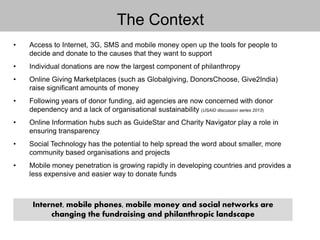
The Context
• Access to Internet, 3G, SMS and mobile money open up the tools for people to
decide and donate to the causes that they want to support
• Individual donations are now the largest component of philanthropy
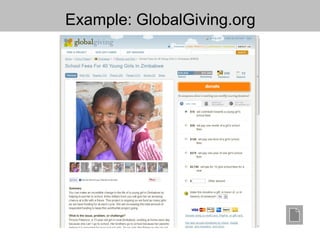
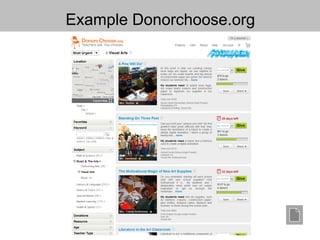
• Online Giving Marketplaces (such as Globalgiving, DonorsChoose, Give2India)
raise significant amounts of money
• Following years of donor funding, aid agencies are now concerned with donor
dependency and a lack of organisational sustainability (USAID discussion series 2013)
• Online Information hubs such as GuideStar and Charity Navigator play a role in
ensuring transparency
• Social Technology has the potential to help spread the word about smaller, more
community based organisations and projects
• Mobile money penetration is growing rapidly in developing countries and provides a
less expensive and easier way to donate funds
Internet, mobile phones, mobile money and social networks are
changing the fundraising and philanthropic landscape
WHY ONLINE GIVING MATTERS?
Why online giving is important
• Online giving is expected to track to the trends of
online shopping and online banking
• Consumers value the convenience and speed of online
transactions.
• Online giving is becoming donors’ main avenue of
choice at times of disaster.
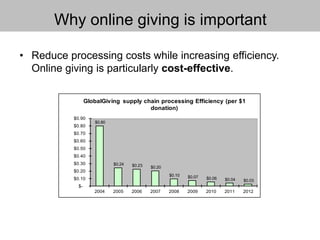
Why online giving is important
• Reduce processing costs while increasing efficiency.
Online giving is particularly cost-effective.
$0.80
$0.24 $0.23 $0.20
$0.10 $0.07 $0.06 $0.04 $0.03
$-
$0.10
$0.20
$0.30
$0.40
$0.50
$0.60
$0.70
$0.80
$0.90
2004 2005 2006 2007 2008 2009 2010 2011 2012
GlobalGiving supply chain processing Efficiency (per $1
donation)
• Attract new donors at a much lower cost
• Reach a more diverse group of people (including diaspora)
• Access money faster
• Build awareness
• Convenience
• Immediacy - reduce time between decision to give and fulfillment
• Faster feedback – donors require more engagement and
interaction
• Instant gratification from the donor perspective
• Increased transparency and accountability
• Promote social giving (social networks) and many-to-many
donations
Why use technology for Philanthropy?
The Web offers an excellent opportunity to cast a wider net to better
communicate with current donors and reach out to new ones.
FACTS AND FIGURES
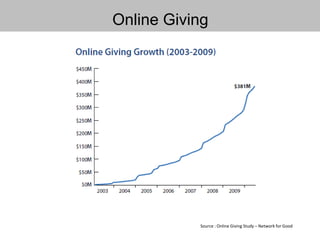
Online Giving
Source : Online Giving Study – Network for Good
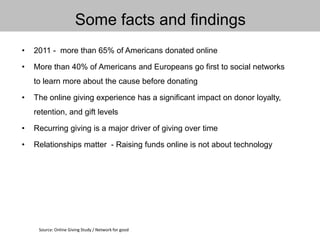
Some facts and findings
• 2011 - more than 65% of Americans donated online
• More than 40% of Americans and Europeans go first to social networks
to learn more about the cause before donating
• The online giving experience has a significant impact on donor loyalty,
retention, and gift levels
• Recurring giving is a major driver of giving over time
• Relationships matter - Raising funds online is not about technology
Source: Online Giving Study / Network for good
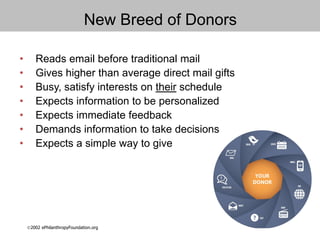
New Breed of Donors
• Reads email before traditional mail
• Gives higher than average direct mail gifts
• Busy, satisfy interests on their schedule
• Expects information to be personalized
• Expects immediate feedback
• Demands information to take decisions
• Expects a simple way to give
2002 ePhilanthropyFoundation.org
FINDINGS
Did you know?
Who Gives Online?
• Online givers are young, with men and women giving in equal
numbers (average age is 38).
• Nearly all – 96% – of online donors reported having already
donated offline
• A significantly lower percentage – 62% – report having given
online before (recurring givers).
• Donors are not new to giving, but they tend to be new to
giving online.
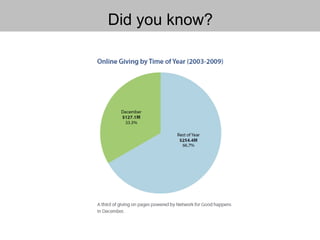
Did you know?
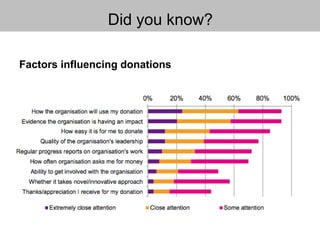
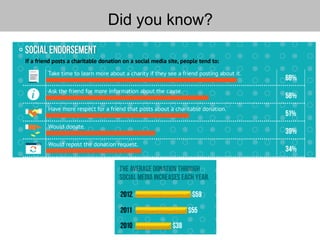
Factors influencing donations
Did you know?
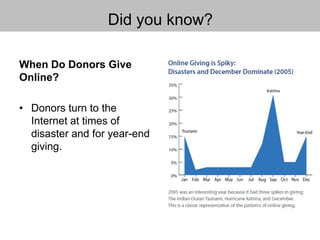
When Do Donors Give
Online?
• Donors turn to the
Internet at times of
disaster and for year-end
giving.
Did you know?
Did you know?
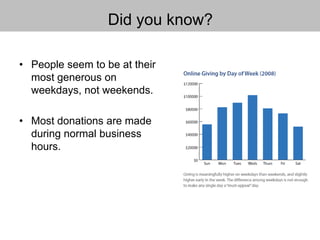
• People seem to be at their
most generous on
weekdays, not weekends.
• Most donations are made
during normal business
hours.
Did you know?
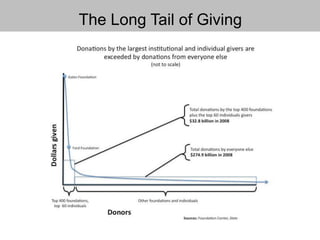
The Long Tail of Giving
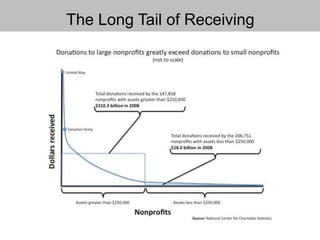
The Long Tail of Receiving
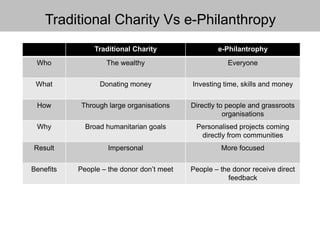
Traditional Charity Vs e-Philanthropy
Traditional Charity e-Philantrophy
Who The wealthy Everyone
What Donating money Investing time, skills and money
How Through large organisations Directly to people and grassroots
organisations
Why Broad humanitarian goals Personalised projects coming
directly from communities
Result Impersonal More focused
Benefits People – the donor don’t meet People – the donor receive direct
feedback
GIVING SUPPLY CHAINS
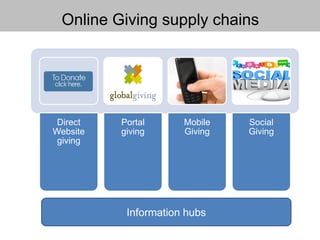
Online Giving supply chains
Direct
Website
giving
Portal
giving
Mobile
Giving
Social
Giving
Information hubs
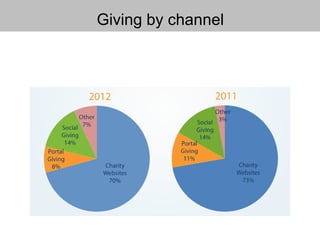
Giving by channel
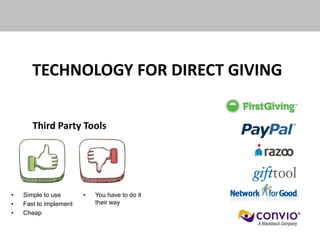
TECHNOLOGY FOR DIRECT GIVING
Third Party Tools
• Simple to use
• Fast to implement
• Cheap
• You have to do it
their way
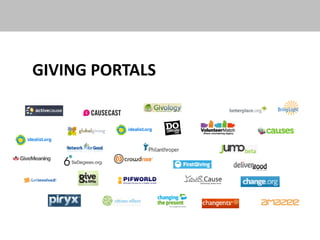
GIVING PORTALS
Example: GlobalGiving.org
Example Donorchoose.org
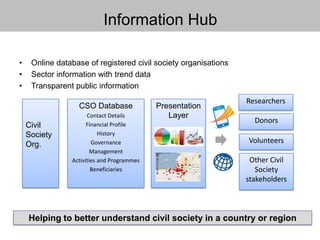
Information Hub
• Online database of registered civil society organisations
• Sector information with trend data
• Transparent public information
Civil
Society
Org.
CSO Database
Contact Details
Financial Profile
History
Governance
Management
Activities and Programmes
Beneficiaries
Researchers
Donors
Volunteers
Other Civil
Society
stakeholders
Presentation
Layer
Helping to better understand civil society in a country or region
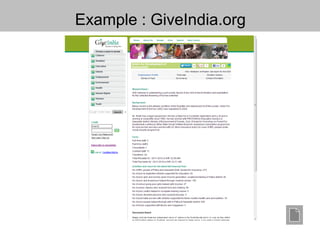
Example : GiveIndia.org
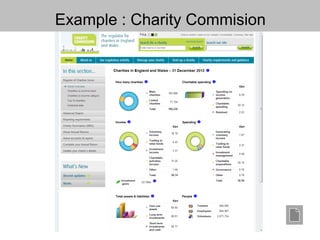
Example : Charity Commision
10 E-FUNDRAISING MANTRAS
Source: Network for good
1. I will maximize online giving.
• Use a reliable, flexible solution for online donation
processing
• Don’t be ashamed to get active.
• Leave the door open to donations everywhere.
• Track your donations.
• Remember to make giving about the donor – not about
your organization.
• Be transparent.
• Set a goal.
2. I will get mobile.
Ask yourself:
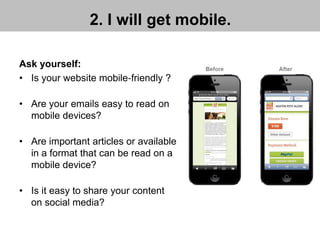
• Is your website mobile‐friendly ?
• Are your emails easy to read on
mobile devices?
• Are important articles or available
in a format that can be read on a
mobile device?
• Is it easy to share your content
on social media?
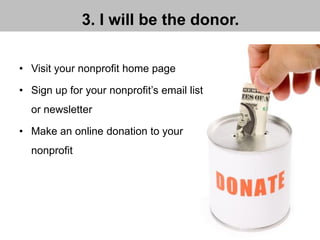
3. I will be the donor.
• Visit your nonprofit home page
• Sign up for your nonprofit’s email list
or newsletter
• Make an online donation to your
nonprofit
4. I will grow my email list.
• Encourage email signups by
showing value – not just another
e‐newsletter
• Build your email list.
• Create a special offer.
• Find a reputable email service
provider (ESP).
5. I will tell a great story.
• Everybody has a story to tell.
• Nice is not enough.
• Don’t be too close and don’t be too far.
• Share your senses.
• Always keep your audience in mind.
• Fit into a larger trend or story.
6. I will rethink my messenger.
Ideas for Compelling Nonprofit Messengers
• People who have been helped by your organization
• Donors
• Volunteers
• Fans
• Partners
• Kids who care about your issue
• Local leaders
The bottom line: make sure you’re not the only one saying
your work is great!
7. I will retain my donors.
• Thank your donors three times for every one time you
ask for more money.
• Experiment with handwritten notes, phone calls,
drawings, and volunteer‐written thank‐you letters.
• Tell them what you did/are doing with their donations and
why it matters.
• Be fast. Send receipts and personalize thank‐you
immediately upon receiving a donation.
• Focus on donor retention more than donor acquisition.
8. I will use my website wisely.
• Use text efficiently – less is more
• Use more photos and video to showcase your work.
• Determine what you want visitors do and offer a clear
call to action.
• When it comes to your donate button, think big, bold and
above the fold.
• Make it easy for people to share your site with their
family and friends.
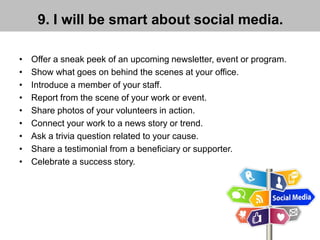
9. I will be smart about social media.
• Offer a sneak peek of an upcoming newsletter, event or program.
• Show what goes on behind the scenes at your office.
• Introduce a member of your staff.
• Report from the scene of your work or event.
• Share photos of your volunteers in action.
• Connect your work to a news story or trend.
• Ask a trivia question related to your cause.
• Share a testimonial from a beneficiary or supporter.
• Celebrate a success story.
10. I will measure and test.
• Be clear on your goals.
• Outline a testable hypothesis.
• Outline your testing methodology.
• Outline the metrics you will measure.
• Review, reflect and adapt
GROUP WORK
1 – Giving Platforms
Objective : Understand how giving platforms can help us
• Go to www.globalgiving.com
• Identify:
– How does the site work?
– What are the main features/functionalities?
– Which are the strongest/coolest features?
– Would you be compelled to give? Why? Why not?
– What is missing on the website? How could you make it better?
– What are the benefits for organizations to work with them?
– How can an organization engage?
• Procedures, Obligations, etc.
2 – Direct Giving
Objective: Create an on-line fundraising strategy
• Imagine you just started an NGO (you can use one existing)
• Identify:
– Who is your audience for the website?
– What features/content you would have in your website?
– How would you encourage on-line giving?
– What other complementary strategies would you have? In which
channels? How would you manage those channels/strategies?
– How would you integrate your offline strategies with online
strategies?
– Create a plan of implementation of the overall project
3 – Storytelling and feedback
Objective: Understand how to tell your story and create donor
retention
• Discuss:
– Why stories are important in fundraising?
– How can we tell better stories?
– What should be included in the stories?
– What media can we use and how?
– Identify some best practises and recommendations
– Identify some good examples online to showcase
– How should we provide feedback to donor? Discuss best
practises
– What strategies can be used to improve donor retention?
Munir Ahmad
International Advisor
Technology and Civil Society
munirpt@gmail.com

E-philanthropy

  • 1.
  • 2.
    Agenda • Why onlinegiving is important • Global trends and the giving landscape • Facts and figures • Giving websites • 10 e-Fundraising mantras
  • 3.
    “…make no mistake:The e-philanthropy revolution is here to stay, and it will transform charitable giving in as profound a way as technology is changing the commercial world. NGOs that have dismissed e- philanthropy or run from it in confusion, will, sooner or later, need to become reconciled to it. If they don’t, they risk losing touch with donors and hurting the vitality of their work.” in Chronicle of Philanthropy
  • 4.
    The Context • Accessto Internet, 3G, SMS and mobile money open up the tools for people to decide and donate to the causes that they want to support • Individual donations are now the largest component of philanthropy • Online Giving Marketplaces (such as Globalgiving, DonorsChoose, Give2India) raise significant amounts of money • Following years of donor funding, aid agencies are now concerned with donor dependency and a lack of organisational sustainability (USAID discussion series 2013) • Online Information hubs such as GuideStar and Charity Navigator play a role in ensuring transparency • Social Technology has the potential to help spread the word about smaller, more community based organisations and projects • Mobile money penetration is growing rapidly in developing countries and provides a less expensive and easier way to donate funds Internet, mobile phones, mobile money and social networks are changing the fundraising and philanthropic landscape
  • 5.
  • 6.
    Why online givingis important • Online giving is expected to track to the trends of online shopping and online banking • Consumers value the convenience and speed of online transactions. • Online giving is becoming donors’ main avenue of choice at times of disaster.
  • 7.
    Why online givingis important • Reduce processing costs while increasing efficiency. Online giving is particularly cost-effective. $0.80 $0.24 $0.23 $0.20 $0.10 $0.07 $0.06 $0.04 $0.03 $- $0.10 $0.20 $0.30 $0.40 $0.50 $0.60 $0.70 $0.80 $0.90 2004 2005 2006 2007 2008 2009 2010 2011 2012 GlobalGiving supply chain processing Efficiency (per $1 donation)
  • 8.
    • Attract newdonors at a much lower cost • Reach a more diverse group of people (including diaspora) • Access money faster • Build awareness • Convenience • Immediacy - reduce time between decision to give and fulfillment • Faster feedback – donors require more engagement and interaction • Instant gratification from the donor perspective • Increased transparency and accountability • Promote social giving (social networks) and many-to-many donations Why use technology for Philanthropy? The Web offers an excellent opportunity to cast a wider net to better communicate with current donors and reach out to new ones.
  • 9.
  • 10.
    Online Giving Source :Online Giving Study – Network for Good
  • 11.
    Some facts andfindings • 2011 - more than 65% of Americans donated online • More than 40% of Americans and Europeans go first to social networks to learn more about the cause before donating • The online giving experience has a significant impact on donor loyalty, retention, and gift levels • Recurring giving is a major driver of giving over time • Relationships matter - Raising funds online is not about technology Source: Online Giving Study / Network for good
  • 12.
    New Breed ofDonors • Reads email before traditional mail • Gives higher than average direct mail gifts • Busy, satisfy interests on their schedule • Expects information to be personalized • Expects immediate feedback • Demands information to take decisions • Expects a simple way to give 2002 ePhilanthropyFoundation.org
  • 13.
  • 14.
    Did you know? WhoGives Online? • Online givers are young, with men and women giving in equal numbers (average age is 38). • Nearly all – 96% – of online donors reported having already donated offline • A significantly lower percentage – 62% – report having given online before (recurring givers). • Donors are not new to giving, but they tend to be new to giving online.
  • 15.
    Did you know? Factorsinfluencing donations
  • 16.
    Did you know? WhenDo Donors Give Online? • Donors turn to the Internet at times of disaster and for year-end giving.
  • 17.
  • 18.
    Did you know? •People seem to be at their most generous on weekdays, not weekends. • Most donations are made during normal business hours.
  • 19.
  • 20.
    The Long Tailof Giving
  • 21.
    The Long Tailof Receiving
  • 22.
    Traditional Charity Vse-Philanthropy Traditional Charity e-Philantrophy Who The wealthy Everyone What Donating money Investing time, skills and money How Through large organisations Directly to people and grassroots organisations Why Broad humanitarian goals Personalised projects coming directly from communities Result Impersonal More focused Benefits People – the donor don’t meet People – the donor receive direct feedback
  • 23.
  • 24.
    Online Giving supplychains Direct Website giving Portal giving Mobile Giving Social Giving Information hubs
  • 25.
  • 26.
    TECHNOLOGY FOR DIRECTGIVING Third Party Tools • Simple to use • Fast to implement • Cheap • You have to do it their way
  • 27.
  • 28.
  • 29.
  • 30.
    Information Hub • Onlinedatabase of registered civil society organisations • Sector information with trend data • Transparent public information Civil Society Org. CSO Database Contact Details Financial Profile History Governance Management Activities and Programmes Beneficiaries Researchers Donors Volunteers Other Civil Society stakeholders Presentation Layer Helping to better understand civil society in a country or region
  • 31.
  • 32.
  • 33.
  • 34.
    1. I willmaximize online giving. • Use a reliable, flexible solution for online donation processing • Don’t be ashamed to get active. • Leave the door open to donations everywhere. • Track your donations. • Remember to make giving about the donor – not about your organization. • Be transparent. • Set a goal.
  • 35.
    2. I willget mobile. Ask yourself: • Is your website mobile‐friendly ? • Are your emails easy to read on mobile devices? • Are important articles or available in a format that can be read on a mobile device? • Is it easy to share your content on social media?
  • 36.
    3. I willbe the donor. • Visit your nonprofit home page • Sign up for your nonprofit’s email list or newsletter • Make an online donation to your nonprofit
  • 37.
    4. I willgrow my email list. • Encourage email signups by showing value – not just another e‐newsletter • Build your email list. • Create a special offer. • Find a reputable email service provider (ESP).
  • 38.
    5. I willtell a great story. • Everybody has a story to tell. • Nice is not enough. • Don’t be too close and don’t be too far. • Share your senses. • Always keep your audience in mind. • Fit into a larger trend or story.
  • 39.
    6. I willrethink my messenger. Ideas for Compelling Nonprofit Messengers • People who have been helped by your organization • Donors • Volunteers • Fans • Partners • Kids who care about your issue • Local leaders The bottom line: make sure you’re not the only one saying your work is great!
  • 40.
    7. I willretain my donors. • Thank your donors three times for every one time you ask for more money. • Experiment with handwritten notes, phone calls, drawings, and volunteer‐written thank‐you letters. • Tell them what you did/are doing with their donations and why it matters. • Be fast. Send receipts and personalize thank‐you immediately upon receiving a donation. • Focus on donor retention more than donor acquisition.
  • 41.
    8. I willuse my website wisely. • Use text efficiently – less is more • Use more photos and video to showcase your work. • Determine what you want visitors do and offer a clear call to action. • When it comes to your donate button, think big, bold and above the fold. • Make it easy for people to share your site with their family and friends.
  • 42.
    9. I willbe smart about social media. • Offer a sneak peek of an upcoming newsletter, event or program. • Show what goes on behind the scenes at your office. • Introduce a member of your staff. • Report from the scene of your work or event. • Share photos of your volunteers in action. • Connect your work to a news story or trend. • Ask a trivia question related to your cause. • Share a testimonial from a beneficiary or supporter. • Celebrate a success story.
  • 43.
    10. I willmeasure and test. • Be clear on your goals. • Outline a testable hypothesis. • Outline your testing methodology. • Outline the metrics you will measure. • Review, reflect and adapt
  • 45.
  • 46.
    1 – GivingPlatforms Objective : Understand how giving platforms can help us • Go to www.globalgiving.com • Identify: – How does the site work? – What are the main features/functionalities? – Which are the strongest/coolest features? – Would you be compelled to give? Why? Why not? – What is missing on the website? How could you make it better? – What are the benefits for organizations to work with them? – How can an organization engage? • Procedures, Obligations, etc.
  • 47.
    2 – DirectGiving Objective: Create an on-line fundraising strategy • Imagine you just started an NGO (you can use one existing) • Identify: – Who is your audience for the website? – What features/content you would have in your website? – How would you encourage on-line giving? – What other complementary strategies would you have? In which channels? How would you manage those channels/strategies? – How would you integrate your offline strategies with online strategies? – Create a plan of implementation of the overall project
  • 48.
    3 – Storytellingand feedback Objective: Understand how to tell your story and create donor retention • Discuss: – Why stories are important in fundraising? – How can we tell better stories? – What should be included in the stories? – What media can we use and how? – Identify some best practises and recommendations – Identify some good examples online to showcase – How should we provide feedback to donor? Discuss best practises – What strategies can be used to improve donor retention?
  • 49.
    Munir Ahmad International Advisor Technologyand Civil Society munirpt@gmail.com