Environmental AgenciesEnvironmental Agencies
& the Regulatory Process& the Regulatory Process
Environmental AgenciesEnvironmental Agencies
& the Regulatory Process& the Regulatory Process
by Craig Collins, Ph.D.
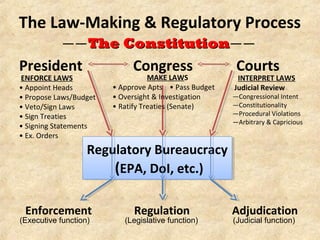
The Law-Making & Regulatory Process
——The ConstitutionThe Constitution——
President Congress Courts
Regulatory Bureaucracy
(EPA, DoI, etc.)
Regulatory Bureaucracy
(EPA, DoI, etc.)
Enforcement Regulation Adjudication
MAKE LAWS
• Approve Apts • Pass Budget
• Oversight & Investigation
• Ratify Treaties (Senate)
ENFORCE LAWS
• Appoint Heads
• Propose Laws/Budget
• Veto/Sign Laws
• Sign Treaties
• Signing Statements
• Ex. Orders
INTERPRET LAWS
Judicial Review
—Congressional Intent
—Constitutionality
—Procedural Violations
—Arbitrary & Capricious
(Executive function) (Legislative function) (Judicial function)
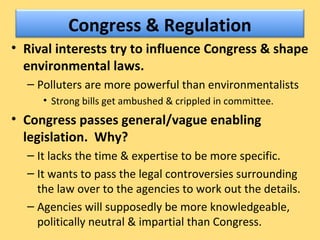
Congress & Regulation
• Rival interests try to influence Congress & shape
environmental laws.
– Polluters are more powerful than environmentalists
• Strong bills get ambushed & crippled in committee.
• Congress passes general/vague enabling
legislation. Why?
– It lacks the time & expertise to be more specific.
– It wants to pass the legal controversies surrounding
the law over to the agencies to work out the details.
– Agencies will supposedly be more knowledgeable,
politically neutral & impartial than Congress.
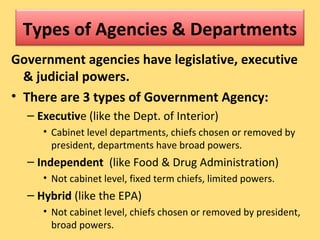
Types of Agencies & Departments
Government agencies have legislative, executive
& judicial powers.
• There are 3 types of Government Agency:
– Executive (like the Dept. of Interior)
• Cabinet level departments, chiefs chosen or removed by
president, departments have broad powers.
– Independent (like Food & Drug Administration)
• Not cabinet level, fixed term chiefs, limited powers.
– Hybrid (like the EPA)
• Not cabinet level, chiefs chosen or removed by president,
broad powers.
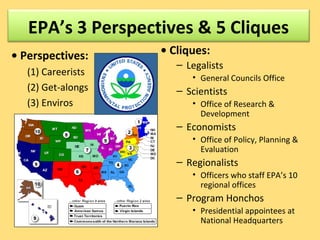
EPA’s 3 Perspectives & 5 Cliques
• Perspectives:
(1) Careerists
(2) Get-alongs
(3) Enviros
• Cliques:
– Legalists
• General Councils Office
– Scientists
• Office of Research &
Development
– Economists
• Office of Policy, Planning &
Evaluation
– Regionalists
• Officers who staff EPA’s 10
regional offices
– Program Honchos
• Presidential appointees at
National Headquarters
Two Approaches To RegulationTwo Approaches To Regulation
• Media Specific Laws:
– Attempt to regulate the levels of pollution within
a specific media--like air and water. The foremost
examples being the Clean Air Act (CAA) and the
Clean Water Act (CWA).
• Pollution Specific Laws:
– Target specific kinds of pollutants like pesticides
(FIFRA), toxic chemicals (TSCA), toxic waste (RCRA
& Superfund).
• Media Specific Laws:
– Attempt to regulate the levels of pollution within
a specific media--like air and water. The foremost
examples being the Clean Air Act (CAA) and the
Clean Water Act (CWA).
• Pollution Specific Laws:
– Target specific kinds of pollutants like pesticides
(FIFRA), toxic chemicals (TSCA), toxic waste (RCRA
& Superfund).
Regulatory PerformanceRegulatory Performance
May be judged by 6 performance criteria:
• Administrative Feasibility
• Legal Survivability
• Enforceability
• Efficiency
• Fairness (Equity)
• Capacity to Foster Technological Innovation
*These criteria often conflict with each other*These criteria often conflict with each other.
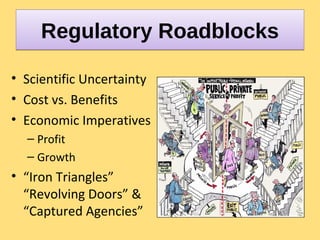
Regulatory RoadblocksRegulatory Roadblocks
• Scientific Uncertainty
• Cost vs. Benefits
• Economic Imperatives
– Profit
– Growth
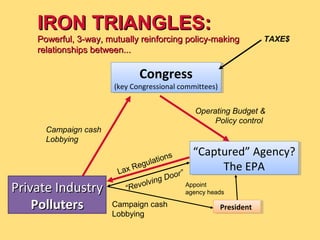
• “Iron Triangles”
“Revolving Doors” &
“Captured Agencies”
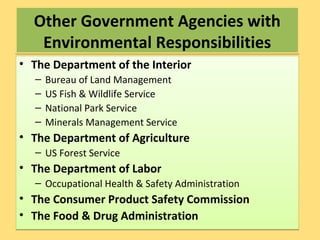
Other Government Agencies with
Environmental Responsibilities
Other Government Agencies with
Environmental Responsibilities
• The Department of the Interior
– Bureau of Land Management
– US Fish & Wildlife Service
– National Park Service
– Minerals Management Service
• The Department of Agriculture
– US Forest Service
• The Department of Labor
– Occupational Health & Safety Administration
• The Consumer Product Safety Commission
• The Food & Drug Administration
• The Department of the Interior
– Bureau of Land Management
– US Fish & Wildlife Service
– National Park Service
– Minerals Management Service
• The Department of Agriculture
– US Forest Service
• The Department of Labor
– Occupational Health & Safety Administration
• The Consumer Product Safety Commission
• The Food & Drug Administration
Congress
(key Congressional committees)
Congress
(key Congressional committees)
Private IndustryPrivate Industry
PollutersPolluters
“Captured” Agency?
The EPA
“Captured” Agency?
The EPA
IRON TRIANGLES:IRON TRIANGLES:
Powerful, 3-way, mutually reinforcing policy-makingPowerful, 3-way, mutually reinforcing policy-making
relationships between...relationships between...
TAXE$
Campaign cash
Lobbying
Operating Budget &
Policy control
“Revolving Door”
PresidentPresidentCampaign cash
Lobbying
Appoint
agency heads
Lax Regulations
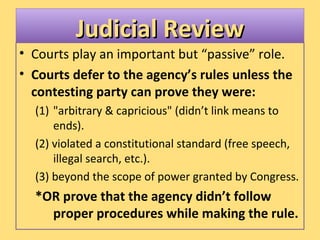
Judicial ReviewJudicial ReviewJudicial ReviewJudicial Review
• Courts play an important but “passive” role.
• Courts defer to the agency’s rules unless the
contesting party can prove they were:
(1) "arbitrary & capricious" (didn’t link means to
ends).
(2) violated a constitutional standard (free speech,
illegal search, etc.).
(3) beyond the scope of power granted by Congress.
*OR prove that the agency didn’t follow
proper procedures while making the rule.
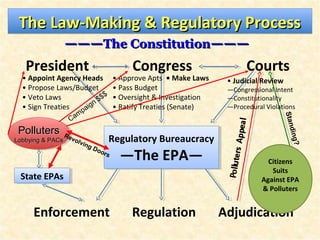
The Law-Making & Regulatory ProcessThe Law-Making & Regulatory ProcessThe Law-Making & Regulatory ProcessThe Law-Making & Regulatory Process
——————The ConstitutionThe Constitution——————
President Congress Courts
Regulatory Bureaucracy
—The EPA—
Regulatory Bureaucracy
—The EPA—
Enforcement Regulation Adjudication
• Approve Apts • Make Laws
• Pass Budget
• Oversight & Investigation
• Ratify Treaties (Senate)
• Appoint Agency Heads
• Propose Laws/Budget
• Veto Laws
• Sign Treaties
• Judicial Review
—Congressional Intent
—Constitutionality
—Procedural Violations
State EPAsState EPAs
PollutersPolluters
Lobbying & PACsLobbying & PACs
PollutersPolluters
Lobbying & PACsLobbying & PACs
Revolving Doors
Citizens
Suits
Against EPA
& Polluters
Standing?
Campaign $$$

The EPA & the Regulatory Process

  • 1.
    Environmental AgenciesEnvironmental Agencies &the Regulatory Process& the Regulatory Process Environmental AgenciesEnvironmental Agencies & the Regulatory Process& the Regulatory Process by Craig Collins, Ph.D.
  • 2.
    The Law-Making &Regulatory Process ——The ConstitutionThe Constitution—— President Congress Courts Regulatory Bureaucracy (EPA, DoI, etc.) Regulatory Bureaucracy (EPA, DoI, etc.) Enforcement Regulation Adjudication MAKE LAWS • Approve Apts • Pass Budget • Oversight & Investigation • Ratify Treaties (Senate) ENFORCE LAWS • Appoint Heads • Propose Laws/Budget • Veto/Sign Laws • Sign Treaties • Signing Statements • Ex. Orders INTERPRET LAWS Judicial Review —Congressional Intent —Constitutionality —Procedural Violations —Arbitrary & Capricious (Executive function) (Legislative function) (Judicial function)
  • 3.
    Congress & Regulation •Rival interests try to influence Congress & shape environmental laws. – Polluters are more powerful than environmentalists • Strong bills get ambushed & crippled in committee. • Congress passes general/vague enabling legislation. Why? – It lacks the time & expertise to be more specific. – It wants to pass the legal controversies surrounding the law over to the agencies to work out the details. – Agencies will supposedly be more knowledgeable, politically neutral & impartial than Congress.
  • 4.
    Types of Agencies& Departments Government agencies have legislative, executive & judicial powers. • There are 3 types of Government Agency: – Executive (like the Dept. of Interior) • Cabinet level departments, chiefs chosen or removed by president, departments have broad powers. – Independent (like Food & Drug Administration) • Not cabinet level, fixed term chiefs, limited powers. – Hybrid (like the EPA) • Not cabinet level, chiefs chosen or removed by president, broad powers.
  • 5.
    EPA’s 3 Perspectives& 5 Cliques • Perspectives: (1) Careerists (2) Get-alongs (3) Enviros • Cliques: – Legalists • General Councils Office – Scientists • Office of Research & Development – Economists • Office of Policy, Planning & Evaluation – Regionalists • Officers who staff EPA’s 10 regional offices – Program Honchos • Presidential appointees at National Headquarters
  • 6.
    Two Approaches ToRegulationTwo Approaches To Regulation • Media Specific Laws: – Attempt to regulate the levels of pollution within a specific media--like air and water. The foremost examples being the Clean Air Act (CAA) and the Clean Water Act (CWA). • Pollution Specific Laws: – Target specific kinds of pollutants like pesticides (FIFRA), toxic chemicals (TSCA), toxic waste (RCRA & Superfund). • Media Specific Laws: – Attempt to regulate the levels of pollution within a specific media--like air and water. The foremost examples being the Clean Air Act (CAA) and the Clean Water Act (CWA). • Pollution Specific Laws: – Target specific kinds of pollutants like pesticides (FIFRA), toxic chemicals (TSCA), toxic waste (RCRA & Superfund).
  • 7.
    Regulatory PerformanceRegulatory Performance Maybe judged by 6 performance criteria: • Administrative Feasibility • Legal Survivability • Enforceability • Efficiency • Fairness (Equity) • Capacity to Foster Technological Innovation *These criteria often conflict with each other*These criteria often conflict with each other.
  • 8.
    Regulatory RoadblocksRegulatory Roadblocks •Scientific Uncertainty • Cost vs. Benefits • Economic Imperatives – Profit – Growth • “Iron Triangles” “Revolving Doors” & “Captured Agencies”
  • 9.
    Other Government Agencieswith Environmental Responsibilities Other Government Agencies with Environmental Responsibilities • The Department of the Interior – Bureau of Land Management – US Fish & Wildlife Service – National Park Service – Minerals Management Service • The Department of Agriculture – US Forest Service • The Department of Labor – Occupational Health & Safety Administration • The Consumer Product Safety Commission • The Food & Drug Administration • The Department of the Interior – Bureau of Land Management – US Fish & Wildlife Service – National Park Service – Minerals Management Service • The Department of Agriculture – US Forest Service • The Department of Labor – Occupational Health & Safety Administration • The Consumer Product Safety Commission • The Food & Drug Administration
  • 10.
    Congress (key Congressional committees) Congress (keyCongressional committees) Private IndustryPrivate Industry PollutersPolluters “Captured” Agency? The EPA “Captured” Agency? The EPA IRON TRIANGLES:IRON TRIANGLES: Powerful, 3-way, mutually reinforcing policy-makingPowerful, 3-way, mutually reinforcing policy-making relationships between...relationships between... TAXE$ Campaign cash Lobbying Operating Budget & Policy control “Revolving Door” PresidentPresidentCampaign cash Lobbying Appoint agency heads Lax Regulations
  • 11.
    Judicial ReviewJudicial ReviewJudicialReviewJudicial Review • Courts play an important but “passive” role. • Courts defer to the agency’s rules unless the contesting party can prove they were: (1) "arbitrary & capricious" (didn’t link means to ends). (2) violated a constitutional standard (free speech, illegal search, etc.). (3) beyond the scope of power granted by Congress. *OR prove that the agency didn’t follow proper procedures while making the rule.
  • 12.
    The Law-Making &Regulatory ProcessThe Law-Making & Regulatory ProcessThe Law-Making & Regulatory ProcessThe Law-Making & Regulatory Process ——————The ConstitutionThe Constitution—————— President Congress Courts Regulatory Bureaucracy —The EPA— Regulatory Bureaucracy —The EPA— Enforcement Regulation Adjudication • Approve Apts • Make Laws • Pass Budget • Oversight & Investigation • Ratify Treaties (Senate) • Appoint Agency Heads • Propose Laws/Budget • Veto Laws • Sign Treaties • Judicial Review —Congressional Intent —Constitutionality —Procedural Violations State EPAsState EPAs PollutersPolluters Lobbying & PACsLobbying & PACs PollutersPolluters Lobbying & PACsLobbying & PACs Revolving Doors Citizens Suits Against EPA & Polluters Standing? Campaign $$$