REGULATION OF
ENZYMES
Allosteric Regulation of Enzymes
Presented by
Dr Arshia Mehmood
Contents
• Regulation of Enzymes
• Regulatory Enzymes
• Allosteric regulation of Enzymes
• Types of allosteric effectors
• Properties of Allosteric Enzymes
• Feedback inhibition
• Kinetic properties of Allosteric Enzymes
Regulation of Enzymes & Regulatory
Enzymes
• The control (up and down) of enzyme activity in body is called
Regulation.
• A regulatory enzyme is an enzyme in
a biochemical pathway which, through its responses to the
presence of certain other biomolecules, regulates the pathway
activity. Regulatory enzymes exist at high concentrations (low
Vmax) so their activity can be increased or decreased with
changes in substrate concentrations.
• In cellular metabolism, groups of enzymes work together in
sequential pathways to carry out a given metabolic process,
such as the multireaction breakdown of glucose to lactate or
the multireaction synthesis of an amino acid from simpler
precursors. In such enzyme systems, the reaction product of
one enzyme becomes the substrate of the next.
Allosteric Regulation of Enzymes
• Allosteric regulation is the regulation of an enzyme by
binding an effector molecule at a site other than the
enzyme's active site.
• (Allosteric Effectors/ Modulators/Modifiers)
• The site to which the effector binds is termed the allosteric
site or regulatory site.
• Allosteric sites allow effectors to bind to the protein, often
resulting in a conformational change and/or a change
in protein dynamics.
•
Types of Effectors
• Effectors that enhance the protein's activity are referred to
as Positive allosteric effectors.
• Effectors that decrease the protein's activity are
called Negative allosteric effectors.
Properties of allosteric enzymes
• Conformational changes induced by one or more
modulators interconvert more active and less-active forms
of the enzyme. The modulators for allosteric enzymes
may be inhibitory or stimulatory. Often the modulator is
the substrate itself.
• Regulatory enzymes for which substrate and modulator
are identical are called homotropic. The effect is similar to
that of O2 binding to hemoglobin.
• Binding of the ligand—or substrate, in the case of
enzymes— causes conformational changes that affect the
subsequent activity of other sites on the protein.
• When the modulator is a molecule other than the
substrate, the enzyme is said to be heterotropic.
Properties of allosteric enzmes
• In addition to active sites, allosteric enzymes generally
have one or more regulatory, or allosteric, sites for binding
the modulator. Just as an enzyme’s active site is specific
for its substrate, each regulatory site is specific for its
modulator.
• In homotropic enzymes, the active site and regulatory site
are the same.
• In heterotropic enzymes, the active site is different from
regulatory site.
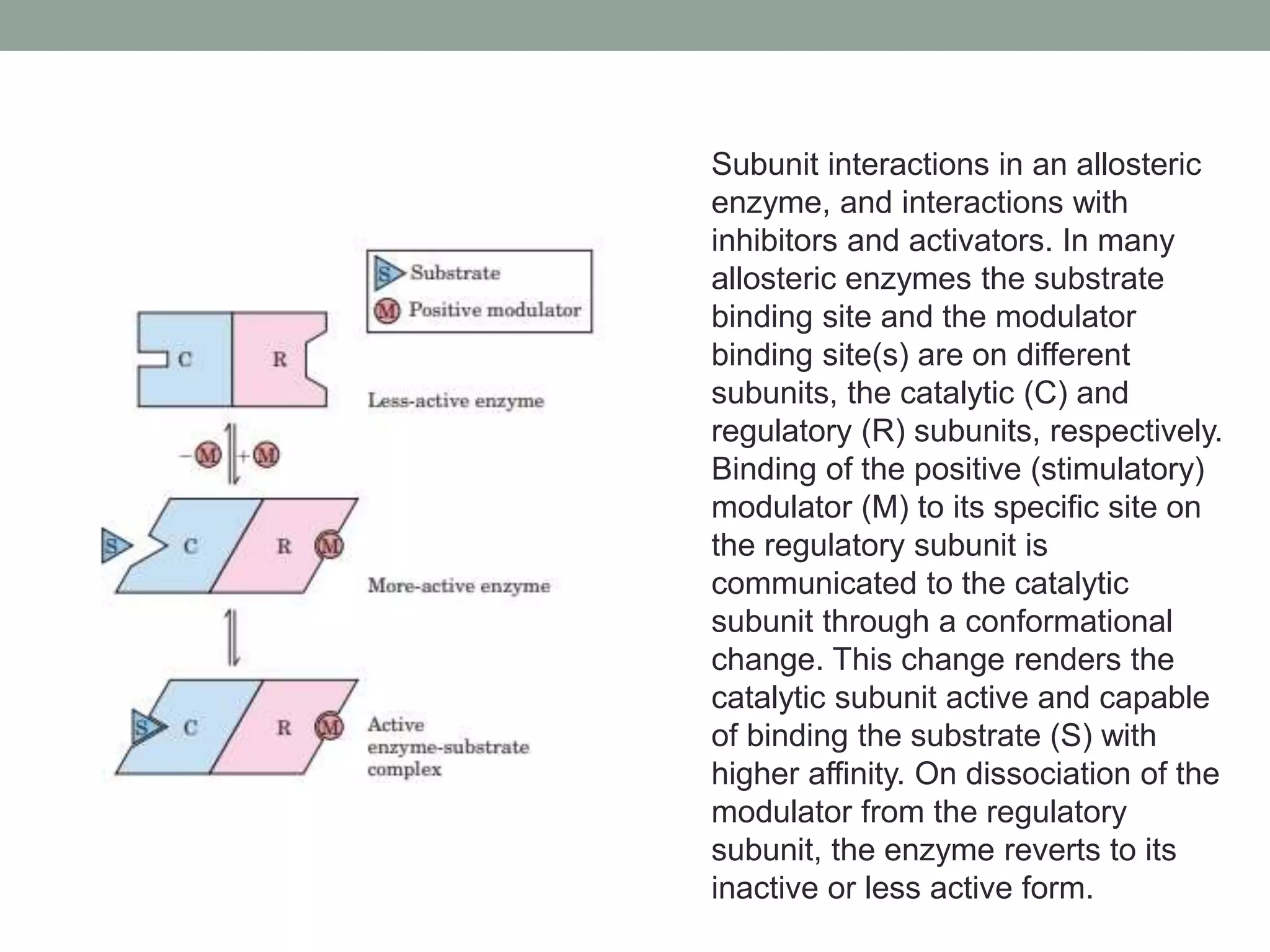
Subunit interactions in an allosteric
enzyme, and interactions with
inhibitors and activators. In many
allosteric enzymes the substrate
binding site and the modulator
binding site(s) are on different
subunits, the catalytic (C) and
regulatory (R) subunits, respectively.
Binding of the positive (stimulatory)
modulator (M) to its specific site on
the regulatory subunit is
communicated to the catalytic
subunit through a conformational
change. This change renders the
catalytic subunit active and capable
of binding the substrate (S) with
higher affinity. On dissociation of the
modulator from the regulatory
subunit, the enzyme reverts to its
inactive or less active form.
Feedback Inhibition
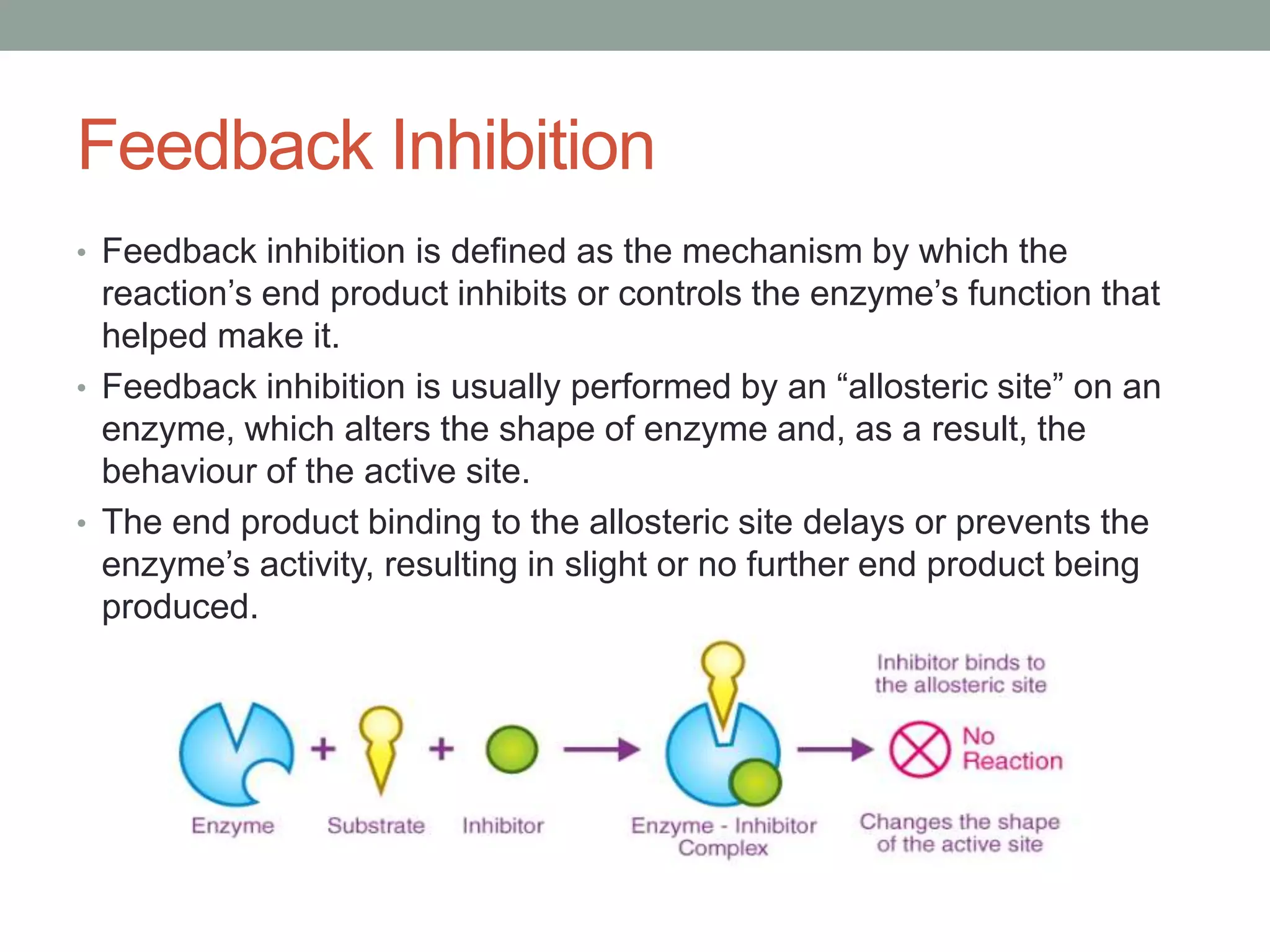
• Feedback inhibition is defined as the mechanism by which the
reaction’s end product inhibits or controls the enzyme’s function that
helped make it.
• Feedback inhibition is usually performed by an “allosteric site” on an
enzyme, which alters the shape of enzyme and, as a result, the
behaviour of the active site.
• The end product binding to the allosteric site delays or prevents the
enzyme’s activity, resulting in slight or no further end product being
produced.
In Many Pathways a Regulated Step Is
Catalyzed by an Allosteric Enzyme
• In some multienzyme systems, the regulatory enzyme is
specifically inhibited by the end product of the pathway
whenever the concentration of the end product exceeds
the cell’s requirements.
• When the regulatory enzyme reaction is slowed, all
subsequent enzymes operate at reduced rates as their
substrates are depleted.
• The rate of production of the pathway’s end product is
thereby brought into balance with the cell’s needs. This
type of regulation is called feedback inhibition
Feedback Inhibition
Feedback inhibition
The conversion of L-threonine to L-
isoleucine is catalyzed by a sequence
of five enzymes (E1 to E5). Threonine
dehydratase (E1) is specifically
inhibited allosterically by L-isoleucine,
the end product of the sequence, but
not by any of the four intermediates
(A to D).
Allosteric enzymes show relationships between V0 and [S]
that differ from Michaelis-Menten kinetics.
They do exhibit saturation with the substrate when [S] is
sufficiently high, but for some allosteric enzymes, plots of
V0 versus [S] produce a sigmoid saturation curve, rather
than the hyperbolic curve typical of nonregulatory enzymes.
On the sigmoid saturation curve we can find a value of [S]
at which V0 is half-maximal, but we cannot refer to it with
the designation Km, because the enzyme does not follow
the hyperbolic MichaelisMenten relationship.
Instead, the symbol [S]0.5 or K0.5 is often used to
represent the substrate concentration giving half-maximal
velocity of the reaction catalyzed by an allosteric enzyme
The Kinetic properties of allosteric enzymes diverge
from Michaelis Menton kinetics
Kinetic properties of homotropic allosteric
enzymes
• Homotropic allosteric enzymes generally are multisubunit
proteins and, as noted earlier, the same binding site on each
subunit functions as both the active site and the regulatory site.
• Most commonly, the substrate acts as a positive modulator (an
activator), because the subunits act cooperatively.
• The binding of one molecule of substrate to one binding site
alters the enzyme’s conformation and enhances the binding of
subsequent substrate molecules.
• This accounts for the sigmoid rather than hyperbolic change in
V0 with increasing [S]. One characteristic of sigmoid kinetics is
that small changes in the concentration of a modulator can be
associated with large changes in activity.
The sigmoid curve of a homotropic enzyme, in
which the substrate also serves as a positive
(stimulatory) modulator, or activator.
Kinetic properties of homotropic allosteric
enzymes
• For heterotropic allosteric enzymes:
• An activator may cause the curve to become more nearly
hyperbolic, with a decrease in K0.5 but no change in
Vmax, resulting in an increased reaction velocity at a fixed
substrate concentration.
• V0 is higher for any value of [S].
The effects of a positive modulator (+) and a negative
modulator () on an allosteric enzyme in which K0.5 is
altered without a change in Vmax. The central curve
shows the substrate-activity relationship without a
modulator
A less common type of modulation, in which
Vmax is altered and K0.5 is nearly constant.
• Other heterotropic allosteric enzymes respond to an
activator by an increase in Vmax with little change in K0.5
(Fig. 6–29c). A negative modulator (an inhibitor) may
produce a more sigmoid substrate-saturation curve,
Regulation of Enzymes.pptx

Regulation of Enzymes.pptx

  • 1.
    REGULATION OF ENZYMES Allosteric Regulationof Enzymes Presented by Dr Arshia Mehmood
  • 2.
    Contents • Regulation ofEnzymes • Regulatory Enzymes • Allosteric regulation of Enzymes • Types of allosteric effectors • Properties of Allosteric Enzymes • Feedback inhibition • Kinetic properties of Allosteric Enzymes
  • 3.
    Regulation of Enzymes& Regulatory Enzymes • The control (up and down) of enzyme activity in body is called Regulation. • A regulatory enzyme is an enzyme in a biochemical pathway which, through its responses to the presence of certain other biomolecules, regulates the pathway activity. Regulatory enzymes exist at high concentrations (low Vmax) so their activity can be increased or decreased with changes in substrate concentrations. • In cellular metabolism, groups of enzymes work together in sequential pathways to carry out a given metabolic process, such as the multireaction breakdown of glucose to lactate or the multireaction synthesis of an amino acid from simpler precursors. In such enzyme systems, the reaction product of one enzyme becomes the substrate of the next.
  • 4.
    Allosteric Regulation ofEnzymes • Allosteric regulation is the regulation of an enzyme by binding an effector molecule at a site other than the enzyme's active site. • (Allosteric Effectors/ Modulators/Modifiers) • The site to which the effector binds is termed the allosteric site or regulatory site. • Allosteric sites allow effectors to bind to the protein, often resulting in a conformational change and/or a change in protein dynamics. •
  • 5.
    Types of Effectors •Effectors that enhance the protein's activity are referred to as Positive allosteric effectors. • Effectors that decrease the protein's activity are called Negative allosteric effectors.
  • 6.
    Properties of allostericenzymes • Conformational changes induced by one or more modulators interconvert more active and less-active forms of the enzyme. The modulators for allosteric enzymes may be inhibitory or stimulatory. Often the modulator is the substrate itself. • Regulatory enzymes for which substrate and modulator are identical are called homotropic. The effect is similar to that of O2 binding to hemoglobin. • Binding of the ligand—or substrate, in the case of enzymes— causes conformational changes that affect the subsequent activity of other sites on the protein. • When the modulator is a molecule other than the substrate, the enzyme is said to be heterotropic.
  • 7.
    Properties of allostericenzmes • In addition to active sites, allosteric enzymes generally have one or more regulatory, or allosteric, sites for binding the modulator. Just as an enzyme’s active site is specific for its substrate, each regulatory site is specific for its modulator. • In homotropic enzymes, the active site and regulatory site are the same. • In heterotropic enzymes, the active site is different from regulatory site.
  • 8.
    Subunit interactions inan allosteric enzyme, and interactions with inhibitors and activators. In many allosteric enzymes the substrate binding site and the modulator binding site(s) are on different subunits, the catalytic (C) and regulatory (R) subunits, respectively. Binding of the positive (stimulatory) modulator (M) to its specific site on the regulatory subunit is communicated to the catalytic subunit through a conformational change. This change renders the catalytic subunit active and capable of binding the substrate (S) with higher affinity. On dissociation of the modulator from the regulatory subunit, the enzyme reverts to its inactive or less active form.
  • 9.
    Feedback Inhibition • Feedbackinhibition is defined as the mechanism by which the reaction’s end product inhibits or controls the enzyme’s function that helped make it. • Feedback inhibition is usually performed by an “allosteric site” on an enzyme, which alters the shape of enzyme and, as a result, the behaviour of the active site. • The end product binding to the allosteric site delays or prevents the enzyme’s activity, resulting in slight or no further end product being produced.
  • 10.
    In Many Pathwaysa Regulated Step Is Catalyzed by an Allosteric Enzyme • In some multienzyme systems, the regulatory enzyme is specifically inhibited by the end product of the pathway whenever the concentration of the end product exceeds the cell’s requirements. • When the regulatory enzyme reaction is slowed, all subsequent enzymes operate at reduced rates as their substrates are depleted. • The rate of production of the pathway’s end product is thereby brought into balance with the cell’s needs. This type of regulation is called feedback inhibition
  • 11.
    Feedback Inhibition Feedback inhibition Theconversion of L-threonine to L- isoleucine is catalyzed by a sequence of five enzymes (E1 to E5). Threonine dehydratase (E1) is specifically inhibited allosterically by L-isoleucine, the end product of the sequence, but not by any of the four intermediates (A to D).
  • 12.
    Allosteric enzymes showrelationships between V0 and [S] that differ from Michaelis-Menten kinetics. They do exhibit saturation with the substrate when [S] is sufficiently high, but for some allosteric enzymes, plots of V0 versus [S] produce a sigmoid saturation curve, rather than the hyperbolic curve typical of nonregulatory enzymes. On the sigmoid saturation curve we can find a value of [S] at which V0 is half-maximal, but we cannot refer to it with the designation Km, because the enzyme does not follow the hyperbolic MichaelisMenten relationship. Instead, the symbol [S]0.5 or K0.5 is often used to represent the substrate concentration giving half-maximal velocity of the reaction catalyzed by an allosteric enzyme The Kinetic properties of allosteric enzymes diverge from Michaelis Menton kinetics
  • 13.
    Kinetic properties ofhomotropic allosteric enzymes • Homotropic allosteric enzymes generally are multisubunit proteins and, as noted earlier, the same binding site on each subunit functions as both the active site and the regulatory site. • Most commonly, the substrate acts as a positive modulator (an activator), because the subunits act cooperatively. • The binding of one molecule of substrate to one binding site alters the enzyme’s conformation and enhances the binding of subsequent substrate molecules. • This accounts for the sigmoid rather than hyperbolic change in V0 with increasing [S]. One characteristic of sigmoid kinetics is that small changes in the concentration of a modulator can be associated with large changes in activity.
  • 14.
    The sigmoid curveof a homotropic enzyme, in which the substrate also serves as a positive (stimulatory) modulator, or activator.
  • 15.
    Kinetic properties ofhomotropic allosteric enzymes • For heterotropic allosteric enzymes: • An activator may cause the curve to become more nearly hyperbolic, with a decrease in K0.5 but no change in Vmax, resulting in an increased reaction velocity at a fixed substrate concentration. • V0 is higher for any value of [S].
  • 16.
    The effects ofa positive modulator (+) and a negative modulator () on an allosteric enzyme in which K0.5 is altered without a change in Vmax. The central curve shows the substrate-activity relationship without a modulator
  • 17.
    A less commontype of modulation, in which Vmax is altered and K0.5 is nearly constant. • Other heterotropic allosteric enzymes respond to an activator by an increase in Vmax with little change in K0.5 (Fig. 6–29c). A negative modulator (an inhibitor) may produce a more sigmoid substrate-saturation curve,