ENZYMES
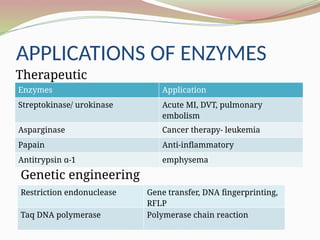
APPLICATIONS OF ENZYMES
Enzymes Application
Streptokinase/ urokinase Acute MI, DVT, pulmonary
embolism
Asparginase Cancer therapy- leukemia
Papain Anti-inflammatory
Antitrypsin α-1 emphysema
Therapeutic
Restriction endonuclease Gene transfer, DNA fingerprinting,
RFLP
Taq DNA polymerase Polymerase chain reaction
Genetic engineering
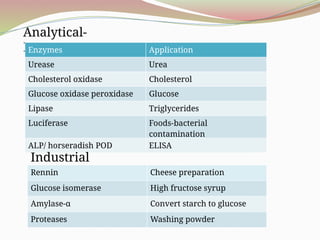
Analytical-
Reagents
Enzymes Application
Urease Urea
Cholesterol oxidase Cholesterol
Glucose oxidase peroxidase Glucose
Lipase Triglycerides
Luciferase Foods-bacterial
contamination
ALP/ horseradish POD ELISA
Industrial
Rennin Cheese preparation
Glucose isomerase High fructose syrup
Amylase-α Convert starch to glucose
Proteases Washing powder
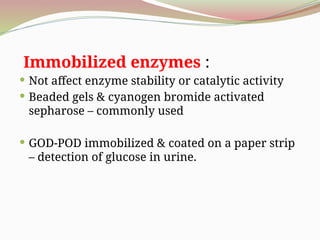
Immobilized enzymes :
 Not affect enzyme stability or catalytic activity
 Beaded gels & cyanogen bromide activated
sepharose – commonly used
 GOD-POD immobilized & coated on a paper strip
– detection of glucose in urine.
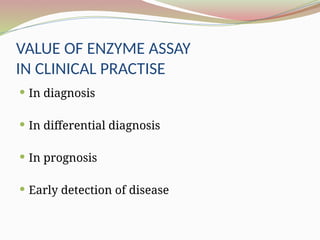
VALUE OF ENZYME ASSAY
IN CLINICAL PRACTISE
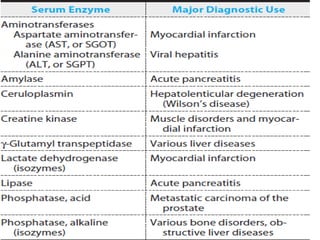
 In diagnosis
 In differential diagnosis
 In prognosis
 Early detection of disease
DIAGNOSTIC IMPORTANCE OF ENZYMES
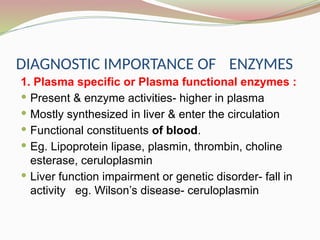
1. Plasma specific or Plasma functional enzymes :
 Present & enzyme activities- higher in plasma
 Mostly synthesized in liver & enter the circulation
 Functional constituents of blood.
 Eg. Lipoprotein lipase, plasmin, thrombin, choline
esterase, ceruloplasmin
 Liver function impairment or genetic disorder- fall in
activity eg. Wilson’s disease- ceruloplasmin
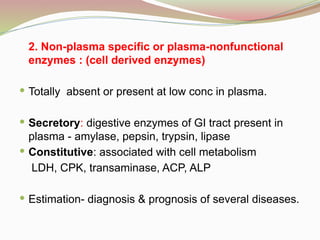
2. Non-plasma specific or plasma-nonfunctional
enzymes : (cell derived enzymes)
 Totally absent or present at low conc in plasma.
 Secretory: digestive enzymes of GI tract present in
plasma - amylase, pepsin, trypsin, lipase
 Constitutive: associated with cell metabolism
LDH, CPK, transaminase, ACP, ALP
 Estimation- diagnosis & prognosis of several diseases.
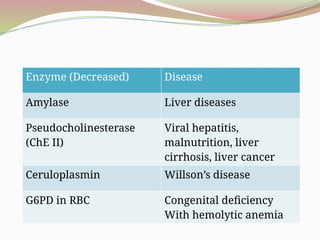
Enzyme (Decreased) Disease
Amylase Liver diseases
Pseudocholinesterase
(ChE II)
Viral hepatitis,
malnutrition, liver
cirrhosis, liver cancer
Ceruloplasmin Willson’s disease
G6PD in RBC Congenital deficiency
With hemolytic anemia
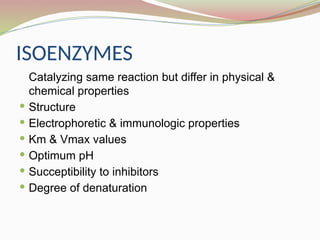
ISOENZYMES
Catalyzing same reaction but differ in physical &
chemical properties
 Structure
 Electrophoretic & immunologic properties
 Km & Vmax values
 Optimum pH
 Succeptibility to inhibitors
 Degree of denaturation
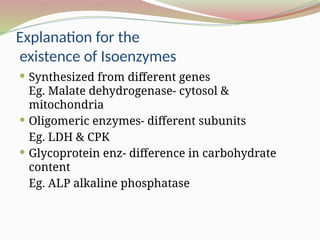
Explanation for the
existence of Isoenzymes
 Synthesized from different genes
Eg. Malate dehydrogenase- cytosol &
mitochondria
 Oligomeric enzymes- different subunits
Eg. LDH & CPK
 Glycoprotein enz- difference in carbohydrate
content
Eg. ALP alkaline phosphatase
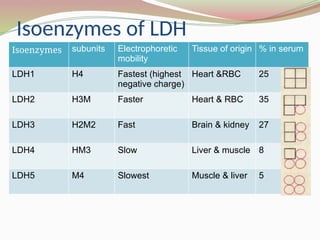
Isoenzymes of LDH
Isoenzymes subunits Electrophoretic
mobility
Tissue of origin % in serum
LDH1 H4 Fastest (highest
negative charge)
Heart &RBC 25
LDH2 H3M Faster Heart & RBC 35
LDH3 H2M2 Fast Brain & kidney 27
LDH4 HM3 Slow Liver & muscle 8
LDH5 M4 Slowest Muscle & liver 5
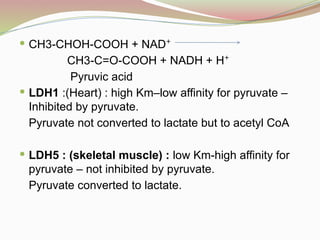
 CH3-CHOH-COOH + NAD⁺
CH3-C=O-COOH + NADH + H⁺
Pyruvic acid
 LDH1 :(Heart) : high Km–low affinity for pyruvate –
Inhibited by pyruvate.
Pyruvate not converted to lactate but to acetyl CoA
 LDH5 : (skeletal muscle) : low Km-high affinity for
pyruvate – not inhibited by pyruvate.
Pyruvate converted to lactate.
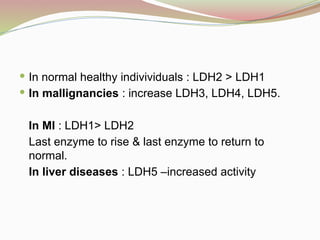
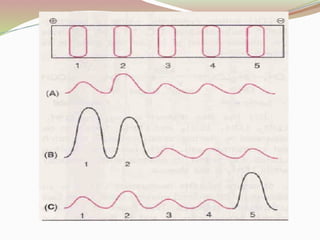
 In normal healthy indivividuals : LDH2 > LDH1
 In mallignancies : increase LDH3, LDH4, LDH5.
In MI : LDH1> LDH2
Last enzyme to rise & last enzyme to return to
normal.
In liver diseases : LDH5 –increased activity
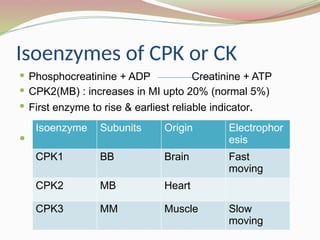
Isoenzymes of CPK or CK
 Phosphocreatinine + ADP Creatinine + ATP
 CPK2(MB) : increases in MI upto 20% (normal 5%)
 First enzyme to rise & earliest reliable indicator.

Isoenzyme Subunits Origin Electrophor
esis
CPK1 BB Brain Fast
moving
CPK2 MB Heart
CPK3 MM Muscle Slow
moving
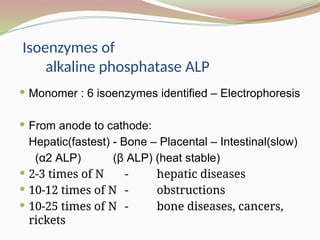
Isoenzymes of
alkaline phosphatase ALP
 Monomer : 6 isoenzymes identified – Electrophoresis
 From anode to cathode:
Hepatic(fastest) - Bone – Placental – Intestinal(slow)
(α2 ALP) (β ALP) (heat stable)
 2-3 times of N - hepatic diseases
 10-12 times of N - obstructions
 10-25 times of N - bone diseases, cancers,
rickets
Isoenzymes of
alcohol dehydrogenase
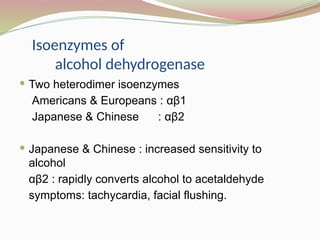
 Two heterodimer isoenzymes
Americans & Europeans : αβ1
Japanese & Chinese : αβ2
 Japanese & Chinese : increased sensitivity to
alcohol
αβ2 : rapidly converts alcohol to acetaldehyde
symptoms: tachycardia, facial flushing.
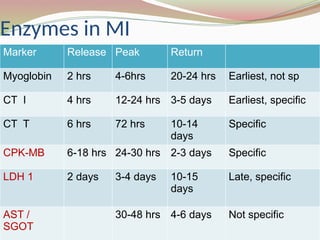
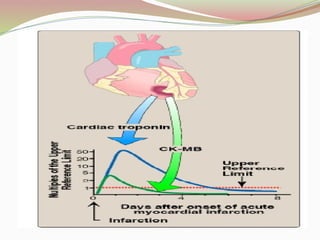
Enzymes in MI
Marker Release Peak Return
Myoglobin 2 hrs 4-6hrs 20-24 hrs Earliest, not sp
CT I 4 hrs 12-24 hrs 3-5 days Earliest, specific
CT T 6 hrs 72 hrs 10-14
days
Specific
CPK-MB 6-18 hrs 24-30 hrs 2-3 days Specific
LDH 1 2 days 3-4 days 10-15
days
Late, specific
AST /
SGOT
30-48 hrs 4-6 days Not specific
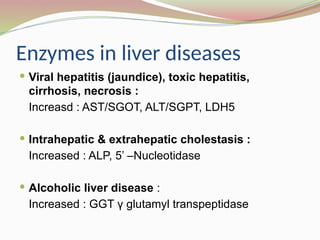
Enzymes in liver diseases
 Viral hepatitis (jaundice), toxic hepatitis,
cirrhosis, necrosis :
Increasd : AST/SGOT, ALT/SGPT, LDH5
 Intrahepatic & extrahepatic cholestasis :
Increased : ALP, 5’ –Nucleotidase
 Alcoholic liver disease :
Increased : GGT γ glutamyl transpeptidase
Enzymes in muscle diseases
 CPK : more sensitive & more specific CPK3 MM
 Aldolase
Enzymes in bone diseases
 Serum alkaline phosphatase ALP :only useful assay
Enzymes in cancers
 ↑ ACP (tartarate labile) : Prostatic carcinoma
 ↑ LAP(Leucine amino peptidase) : Liver carcinoma
 ↑ Β-Glucoronidase (urine) : Ca urinary bladder,
Ca pancreas
 ↑ ALP : Osteoblastic metastasis in bone
Metastasis in liver
 Nonspecific ↑LDH, ALP, transaminase :
Mallignancy in any part of the body.
1. A 19 year old boy presented with severe chest
pain. ECG findings shows ST elevation. On
investigation CPK-MB level found to be raised
above the normal.
 Diagnosis
 Other markers.
2. A 60 year old man presented with pruritus,
yellow colored eyes and dark yellow colored
urine. On investigation AST and ALT levels -
slightly increased and marked elevation in ALP.
THANK YOU!

Enzyme biochemistry mbbs first prof ppt.pptx

  • 1.
  • 2.
    APPLICATIONS OF ENZYMES EnzymesApplication Streptokinase/ urokinase Acute MI, DVT, pulmonary embolism Asparginase Cancer therapy- leukemia Papain Anti-inflammatory Antitrypsin α-1 emphysema Therapeutic Restriction endonuclease Gene transfer, DNA fingerprinting, RFLP Taq DNA polymerase Polymerase chain reaction Genetic engineering
  • 3.
    Analytical- Reagents Enzymes Application Urease Urea Cholesteroloxidase Cholesterol Glucose oxidase peroxidase Glucose Lipase Triglycerides Luciferase Foods-bacterial contamination ALP/ horseradish POD ELISA Industrial Rennin Cheese preparation Glucose isomerase High fructose syrup Amylase-α Convert starch to glucose Proteases Washing powder
  • 4.
    Immobilized enzymes : Not affect enzyme stability or catalytic activity  Beaded gels & cyanogen bromide activated sepharose – commonly used  GOD-POD immobilized & coated on a paper strip – detection of glucose in urine.
  • 5.
    VALUE OF ENZYMEASSAY IN CLINICAL PRACTISE  In diagnosis  In differential diagnosis  In prognosis  Early detection of disease
  • 6.
    DIAGNOSTIC IMPORTANCE OFENZYMES 1. Plasma specific or Plasma functional enzymes :  Present & enzyme activities- higher in plasma  Mostly synthesized in liver & enter the circulation  Functional constituents of blood.  Eg. Lipoprotein lipase, plasmin, thrombin, choline esterase, ceruloplasmin  Liver function impairment or genetic disorder- fall in activity eg. Wilson’s disease- ceruloplasmin
  • 7.
    2. Non-plasma specificor plasma-nonfunctional enzymes : (cell derived enzymes)  Totally absent or present at low conc in plasma.  Secretory: digestive enzymes of GI tract present in plasma - amylase, pepsin, trypsin, lipase  Constitutive: associated with cell metabolism LDH, CPK, transaminase, ACP, ALP  Estimation- diagnosis & prognosis of several diseases.
  • 9.
    Enzyme (Decreased) Disease AmylaseLiver diseases Pseudocholinesterase (ChE II) Viral hepatitis, malnutrition, liver cirrhosis, liver cancer Ceruloplasmin Willson’s disease G6PD in RBC Congenital deficiency With hemolytic anemia
  • 10.
    ISOENZYMES Catalyzing same reactionbut differ in physical & chemical properties  Structure  Electrophoretic & immunologic properties  Km & Vmax values  Optimum pH  Succeptibility to inhibitors  Degree of denaturation
  • 11.
    Explanation for the existenceof Isoenzymes  Synthesized from different genes Eg. Malate dehydrogenase- cytosol & mitochondria  Oligomeric enzymes- different subunits Eg. LDH & CPK  Glycoprotein enz- difference in carbohydrate content Eg. ALP alkaline phosphatase
  • 12.
    Isoenzymes of LDH Isoenzymessubunits Electrophoretic mobility Tissue of origin % in serum LDH1 H4 Fastest (highest negative charge) Heart &RBC 25 LDH2 H3M Faster Heart & RBC 35 LDH3 H2M2 Fast Brain & kidney 27 LDH4 HM3 Slow Liver & muscle 8 LDH5 M4 Slowest Muscle & liver 5
  • 13.
     CH3-CHOH-COOH +NAD⁺ CH3-C=O-COOH + NADH + H⁺ Pyruvic acid  LDH1 :(Heart) : high Km–low affinity for pyruvate – Inhibited by pyruvate. Pyruvate not converted to lactate but to acetyl CoA  LDH5 : (skeletal muscle) : low Km-high affinity for pyruvate – not inhibited by pyruvate. Pyruvate converted to lactate.
  • 14.
     In normalhealthy indivividuals : LDH2 > LDH1  In mallignancies : increase LDH3, LDH4, LDH5. In MI : LDH1> LDH2 Last enzyme to rise & last enzyme to return to normal. In liver diseases : LDH5 –increased activity
  • 16.
    Isoenzymes of CPKor CK  Phosphocreatinine + ADP Creatinine + ATP  CPK2(MB) : increases in MI upto 20% (normal 5%)  First enzyme to rise & earliest reliable indicator.  Isoenzyme Subunits Origin Electrophor esis CPK1 BB Brain Fast moving CPK2 MB Heart CPK3 MM Muscle Slow moving
  • 17.
    Isoenzymes of alkaline phosphataseALP  Monomer : 6 isoenzymes identified – Electrophoresis  From anode to cathode: Hepatic(fastest) - Bone – Placental – Intestinal(slow) (α2 ALP) (β ALP) (heat stable)  2-3 times of N - hepatic diseases  10-12 times of N - obstructions  10-25 times of N - bone diseases, cancers, rickets
  • 18.
    Isoenzymes of alcohol dehydrogenase Two heterodimer isoenzymes Americans & Europeans : αβ1 Japanese & Chinese : αβ2  Japanese & Chinese : increased sensitivity to alcohol αβ2 : rapidly converts alcohol to acetaldehyde symptoms: tachycardia, facial flushing.
  • 19.
    Enzymes in MI MarkerRelease Peak Return Myoglobin 2 hrs 4-6hrs 20-24 hrs Earliest, not sp CT I 4 hrs 12-24 hrs 3-5 days Earliest, specific CT T 6 hrs 72 hrs 10-14 days Specific CPK-MB 6-18 hrs 24-30 hrs 2-3 days Specific LDH 1 2 days 3-4 days 10-15 days Late, specific AST / SGOT 30-48 hrs 4-6 days Not specific
  • 21.
    Enzymes in liverdiseases  Viral hepatitis (jaundice), toxic hepatitis, cirrhosis, necrosis : Increasd : AST/SGOT, ALT/SGPT, LDH5  Intrahepatic & extrahepatic cholestasis : Increased : ALP, 5’ –Nucleotidase  Alcoholic liver disease : Increased : GGT γ glutamyl transpeptidase
  • 22.
    Enzymes in musclediseases  CPK : more sensitive & more specific CPK3 MM  Aldolase Enzymes in bone diseases  Serum alkaline phosphatase ALP :only useful assay
  • 23.
    Enzymes in cancers ↑ ACP (tartarate labile) : Prostatic carcinoma  ↑ LAP(Leucine amino peptidase) : Liver carcinoma  ↑ Β-Glucoronidase (urine) : Ca urinary bladder, Ca pancreas  ↑ ALP : Osteoblastic metastasis in bone Metastasis in liver  Nonspecific ↑LDH, ALP, transaminase : Mallignancy in any part of the body.
  • 24.
    1. A 19year old boy presented with severe chest pain. ECG findings shows ST elevation. On investigation CPK-MB level found to be raised above the normal.  Diagnosis  Other markers. 2. A 60 year old man presented with pruritus, yellow colored eyes and dark yellow colored urine. On investigation AST and ALT levels - slightly increased and marked elevation in ALP.
  • 25.