VCE Biology
                                            2011
                                            Unit 1
                                          Outcome 1

                                 Activity of an Enzyme
INTRODUCTION

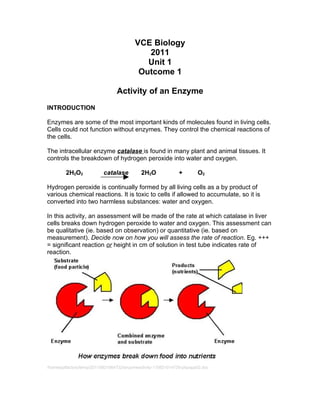
Enzymes are some of the most important kinds of molecules found in living cells.
Cells could not function without enzymes. They control the chemical reactions of
the cells.

The intracellular enzyme catalase is found in many plant and animal tissues. It
controls the breakdown of hydrogen peroxide into water and oxygen.

        2H2O2             catalase          2H2O              +        O2

Hydrogen peroxide is continually formed by all living cells as a by product of
various chemical reactions. It is toxic to cells if allowed to accumulate, so it is
converted into two harmless substances: water and oxygen.

In this activity, an assessment will be made of the rate at which catalase in liver
cells breaks down hydrogen peroxide to water and oxygen. This assessment can
be qualitative (ie. based on observation) or quantitative (ie. based on
measurement). Decide now on how you will assess the rate of reaction. Eg. +++
= significant reaction or height in cm of solution in test tube indicates rate of
reaction.


/home/pptfactory/temp/20110831064732/enzymeactivity-110831014730-phpapp02.doc
AIM To investigate some of the factors that influence the rate of a chemical
reaction catalysed by an enzyme.
MATERIALS
(per pair of students)
   • 4 Clean test tubes
   • Test tube rack
   • Test tube holder
   • Bunsen burner
   • Matches
   • Heat proof mat
   • Tripod stand
   • Mortar and pestle
   • Fresh 6% hydrogen peroxide solution
   • Distilled water
   • 250 ml beaker
   • Glass marking pens
   • Forceps
   • Spatula
   • Wooden splints
   • Fine, washed sand (approx. 2g)
   • Fresh liver
METHOD
Part A. Whole Liver versus Ground Liver
   1. Pour hydrogen peroxide to a depth of about 2 cm into each of the test
      tubes. CAUTION: Hydrogen peroxide is corrosive and may burn your skin
      and clothing. Take care when handling it.
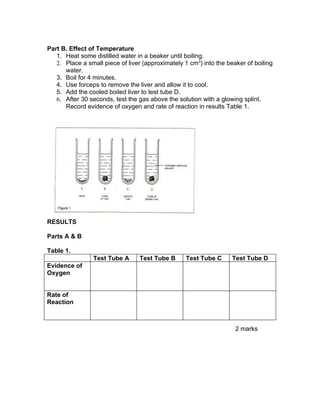
   2. Label the test tubes A to D.
   3. Using a mortar and pestle, grind a small piece of liver (approximately 3
      cm3) with a small quantity of sand until the tissue is completely macerated.
   4. To test tube A add a spatula of fine sand. Cover the top of the test tube
      and shake the mixture.
   5. After 30 seconds, test the gas above the solution with a glowing splint. (If
      it re-ignites oxygen is present.) Record evidence of oxygen and rate of
      reaction in results Table 1.
   6. To test tube B add a small cube of liver (approximately 1 cm 3).
   7. After 30 seconds, test the gas above the solution with a glowing splint.
      Record evidence of oxygen and rate of reaction in results Table 1.
   8. To test tube C add the ground liver. (You will need to scrape as much as
      possible from the mortar so that the quantity is as close as possible to that
      in test tube B.)
   9. After 30 seconds, test the gas above the solution with a glowing splint.
      Record evidence of oxygen and rate of reaction in results Table 1.
Part B. Effect of Temperature
   1. Heat some distilled water in a beaker until boiling.
   2. Place a small piece of liver (approximately 1 cm3) into the beaker of boiling
      water.
   3. Boil for 4 minutes.
   4. Use forceps to remove the liver and allow it to cool.
   5. Add the cooled boiled liver to test tube D.
   6. After 30 seconds, test the gas above the solution with a glowing splint.
      Record evidence of oxygen and rate of reaction in results Table 1.


RESULTS

Parts A & B

Table 1.
                Test Tube A       Test Tube B      Test Tube C      Test Tube D
Evidence of
Oxygen


Rate of
Reaction


                                                                     2 marks
Questions

  1. What was the control in Part A of this experiment? Explain the purpose of
     the control.                                                 1 mark


  2. What was the control for Part B in this experiment? Explain the purpose of
     the control.                                                  1 mark


  3. State one hypothesis this experiment may have been testing.1 mark


  4. a) What conclusion can you draw from your results about the effect
     grinding has on catalase activity?                         1 mark


     b) Suggest a reason for these results (Test tube C)          1 mark


  5. Suggest what has happened to the enzyme molecule in Part B of this
     experiment (Test tube D)                                 2 marks


  6. One group of students recorded some breakdown of hydrogen peroxide in
     the sample using boiled liver. Suggest a possible explanation for this
     result.                                                     1 mark

Enzyme activity

  • 1.
    VCE Biology 2011 Unit 1 Outcome 1 Activity of an Enzyme INTRODUCTION Enzymes are some of the most important kinds of molecules found in living cells. Cells could not function without enzymes. They control the chemical reactions of the cells. The intracellular enzyme catalase is found in many plant and animal tissues. It controls the breakdown of hydrogen peroxide into water and oxygen. 2H2O2 catalase 2H2O + O2 Hydrogen peroxide is continually formed by all living cells as a by product of various chemical reactions. It is toxic to cells if allowed to accumulate, so it is converted into two harmless substances: water and oxygen. In this activity, an assessment will be made of the rate at which catalase in liver cells breaks down hydrogen peroxide to water and oxygen. This assessment can be qualitative (ie. based on observation) or quantitative (ie. based on measurement). Decide now on how you will assess the rate of reaction. Eg. +++ = significant reaction or height in cm of solution in test tube indicates rate of reaction. /home/pptfactory/temp/20110831064732/enzymeactivity-110831014730-phpapp02.doc
  • 2.
    AIM To investigatesome of the factors that influence the rate of a chemical reaction catalysed by an enzyme. MATERIALS (per pair of students) • 4 Clean test tubes • Test tube rack • Test tube holder • Bunsen burner • Matches • Heat proof mat • Tripod stand • Mortar and pestle • Fresh 6% hydrogen peroxide solution • Distilled water • 250 ml beaker • Glass marking pens • Forceps • Spatula • Wooden splints • Fine, washed sand (approx. 2g) • Fresh liver METHOD Part A. Whole Liver versus Ground Liver 1. Pour hydrogen peroxide to a depth of about 2 cm into each of the test tubes. CAUTION: Hydrogen peroxide is corrosive and may burn your skin and clothing. Take care when handling it. 2. Label the test tubes A to D. 3. Using a mortar and pestle, grind a small piece of liver (approximately 3 cm3) with a small quantity of sand until the tissue is completely macerated. 4. To test tube A add a spatula of fine sand. Cover the top of the test tube and shake the mixture. 5. After 30 seconds, test the gas above the solution with a glowing splint. (If it re-ignites oxygen is present.) Record evidence of oxygen and rate of reaction in results Table 1. 6. To test tube B add a small cube of liver (approximately 1 cm 3). 7. After 30 seconds, test the gas above the solution with a glowing splint. Record evidence of oxygen and rate of reaction in results Table 1. 8. To test tube C add the ground liver. (You will need to scrape as much as possible from the mortar so that the quantity is as close as possible to that in test tube B.) 9. After 30 seconds, test the gas above the solution with a glowing splint. Record evidence of oxygen and rate of reaction in results Table 1.
  • 3.
    Part B. Effectof Temperature 1. Heat some distilled water in a beaker until boiling. 2. Place a small piece of liver (approximately 1 cm3) into the beaker of boiling water. 3. Boil for 4 minutes. 4. Use forceps to remove the liver and allow it to cool. 5. Add the cooled boiled liver to test tube D. 6. After 30 seconds, test the gas above the solution with a glowing splint. Record evidence of oxygen and rate of reaction in results Table 1. RESULTS Parts A & B Table 1. Test Tube A Test Tube B Test Tube C Test Tube D Evidence of Oxygen Rate of Reaction 2 marks
  • 4.
    Questions 1.What was the control in Part A of this experiment? Explain the purpose of the control. 1 mark 2. What was the control for Part B in this experiment? Explain the purpose of the control. 1 mark 3. State one hypothesis this experiment may have been testing.1 mark 4. a) What conclusion can you draw from your results about the effect grinding has on catalase activity? 1 mark b) Suggest a reason for these results (Test tube C) 1 mark 5. Suggest what has happened to the enzyme molecule in Part B of this experiment (Test tube D) 2 marks 6. One group of students recorded some breakdown of hydrogen peroxide in the sample using boiled liver. Suggest a possible explanation for this result. 1 mark