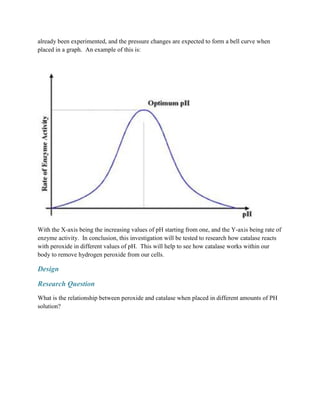
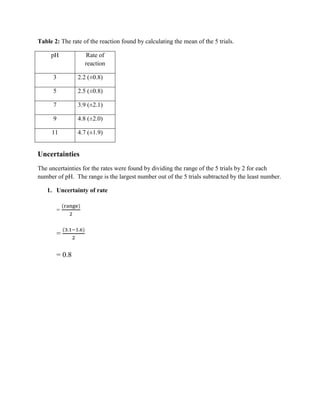
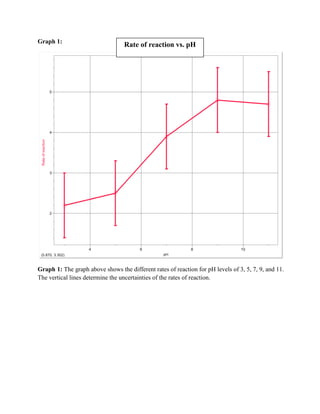
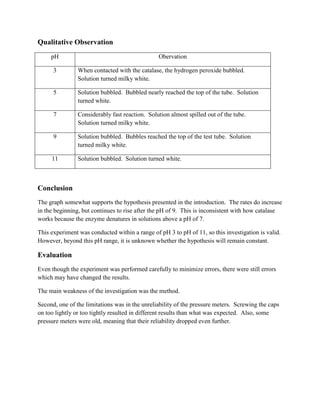
Christopher Kim<br />Biology SL<br />October 16, 2009<br />Relationship Between Catalase and Peroxide<br />Introduction<br />Enzymes are proteins which are vital to our body because they are effective catalysts and they play an important part in reactions within our cells.  Enzymes are specific; different enzymes only react with certain substrates which results in the lock and key model, where the shapes enzymes and substrates match with their corresponding half.   An enzyme can be used over and over again until it is denatured, or until it changes shape which makes it unable to react with its specific substrate.  The enzyme that will be tested in this experiment is catalase, which is essential in breaking down hydrogen peroxide, another important part of this investigation.<br />catalaseH2O2, commonly known as hydrogen peroxide, is a harmful substance that kills cells.    Nonetheless, our body generates peroxide within each individual cell as a regular cellular function.  So, in order to get rid of this toxic compound, our body has developed catalase to break down peroxide into water and oxygen.  This can be shown by the following equation:<br />2 H2O2 -------------------- 2 H2O + 2 O2<br />This is a balanced equation with H2O being water and O2 being oxygen gas.  So, catalase is the enzyme specific to peroxide, which breaks it down into harmless substances which prevents injury to our cells.  This can be shown in the use of peroxide as an antiseptic used to clean cuts on skin.  The peroxide bubbles and causes a decomposition reaction; it reacts with the catalase in our blood and releases oxygen gas.  The oxygen gas is vital in dealing with certain bacteria which our immune system cannot kill.  The release of O2 will result in a pressure change if the catalase was applied to the peroxide in an enclosed space, such as a tube.  So, in this research, the rate of the pressure change will be measured to see how fast the catalase reacted with the peroxide, with the addition of PH.<br />Enzymes react more quickly or slowly when placed in different values of pH.  pH is a measure of the acidity or alkalinity of a solution, which is determined by the ratio between OH- and H+ ions.  Solutions with a pH greater than seven are basic, while solutions with a pH less then seven are considered acidic. Subsequently, in this experiment, hydrogen peroxide will be mixed with various levels of pH buffers, which then will be broken down by catalase to test how effectively our cells remove peroxide in our body.  Thus, the pressure will signify whether the catalse reacted quickly or slowly than usual.  According to prevalent scientific research, this concept has already been experimented, and the pressure changes are expected to form a bell curve when placed in a graph.  An example of this is: <br />With the X-axis being the increasing values of pH starting from one, and the Y-axis being rate of enzyme activity.  In conclusion, this investigation will be tested to research how catalase reacts with peroxide in different values of pH.  This will help to see how catalase works within our body to remove hydrogen peroxide from our cells.<br />Design<br />Research Question<br />What is the relationship between peroxide and catalase when placed in different amounts of PH solution?<br />Variables<br />Independent variable: the amount of catalase and peroxide<br />Dependent variable: the pressure of the oxygen after the catalase has reacted with the peroxide<br />Controlled variables: The size of the tubes were controlled by using the same sized test tubes for the experiment.  The volume of the solution was controlled by using the same amount of solution for the test tubes.  The temperature was controlled by conducting the experiment in the same room.  The procedure was controlled by using the same method for the enzymatic reactions in the investigation.<br />Materials<br />Laptop
Logger pro program (graphing device)
Beakers
25 test tubes (15 x 150 mm)
25 test tubes (25 x 150 mm)
Hydrogen peroxide (3%)
Pressure sensor
Stoppers (connected to the pressure sensors)

Biology Catalase Lab

  • 1.
    Christopher Kim<br />BiologySL<br />October 16, 2009<br />Relationship Between Catalase and Peroxide<br />Introduction<br />Enzymes are proteins which are vital to our body because they are effective catalysts and they play an important part in reactions within our cells. Enzymes are specific; different enzymes only react with certain substrates which results in the lock and key model, where the shapes enzymes and substrates match with their corresponding half. An enzyme can be used over and over again until it is denatured, or until it changes shape which makes it unable to react with its specific substrate. The enzyme that will be tested in this experiment is catalase, which is essential in breaking down hydrogen peroxide, another important part of this investigation.<br />catalaseH2O2, commonly known as hydrogen peroxide, is a harmful substance that kills cells. Nonetheless, our body generates peroxide within each individual cell as a regular cellular function. So, in order to get rid of this toxic compound, our body has developed catalase to break down peroxide into water and oxygen. This can be shown by the following equation:<br />2 H2O2 -------------------- 2 H2O + 2 O2<br />This is a balanced equation with H2O being water and O2 being oxygen gas. So, catalase is the enzyme specific to peroxide, which breaks it down into harmless substances which prevents injury to our cells. This can be shown in the use of peroxide as an antiseptic used to clean cuts on skin. The peroxide bubbles and causes a decomposition reaction; it reacts with the catalase in our blood and releases oxygen gas. The oxygen gas is vital in dealing with certain bacteria which our immune system cannot kill. The release of O2 will result in a pressure change if the catalase was applied to the peroxide in an enclosed space, such as a tube. So, in this research, the rate of the pressure change will be measured to see how fast the catalase reacted with the peroxide, with the addition of PH.<br />Enzymes react more quickly or slowly when placed in different values of pH. pH is a measure of the acidity or alkalinity of a solution, which is determined by the ratio between OH- and H+ ions. Solutions with a pH greater than seven are basic, while solutions with a pH less then seven are considered acidic. Subsequently, in this experiment, hydrogen peroxide will be mixed with various levels of pH buffers, which then will be broken down by catalase to test how effectively our cells remove peroxide in our body. Thus, the pressure will signify whether the catalse reacted quickly or slowly than usual. According to prevalent scientific research, this concept has already been experimented, and the pressure changes are expected to form a bell curve when placed in a graph. An example of this is: <br />With the X-axis being the increasing values of pH starting from one, and the Y-axis being rate of enzyme activity. In conclusion, this investigation will be tested to research how catalase reacts with peroxide in different values of pH. This will help to see how catalase works within our body to remove hydrogen peroxide from our cells.<br />Design<br />Research Question<br />What is the relationship between peroxide and catalase when placed in different amounts of PH solution?<br />Variables<br />Independent variable: the amount of catalase and peroxide<br />Dependent variable: the pressure of the oxygen after the catalase has reacted with the peroxide<br />Controlled variables: The size of the tubes were controlled by using the same sized test tubes for the experiment. The volume of the solution was controlled by using the same amount of solution for the test tubes. The temperature was controlled by conducting the experiment in the same room. The procedure was controlled by using the same method for the enzymatic reactions in the investigation.<br />Materials<br />Laptop
  • 2.
    Logger pro program(graphing device)
  • 3.
  • 4.
    25 test tubes(15 x 150 mm)
  • 5.
    25 test tubes(25 x 150 mm)
  • 6.
  • 7.
  • 8.
    Stoppers (connected tothe pressure sensors)