Global Warming Impact Solutions Actions by:  Alyse Lysgaard
What is global warming? Global warming is the increase in the average temperature of the near-surface air and oceans of the Earth.  This phenomena has been occurring since the mid-20th century and it is projected to continue.
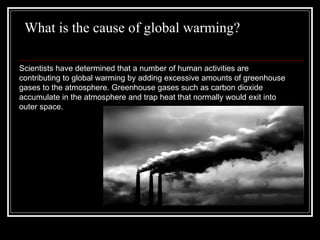
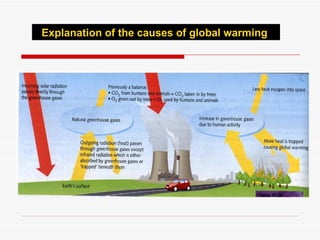
What is the cause of global warming? Scientists have determined that a number of human activities are contributing to global warming by adding excessive amounts of greenhouse gases to the atmosphere. Greenhouse gases such as carbon dioxide accumulate in the atmosphere and trap heat that normally would exit into outer space.
Explanation of the causes of global warming
What exactly are greenhouse gases?
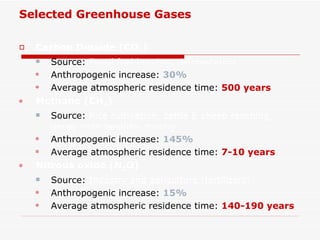
Selected Greenhouse Gases Carbon Dioxide (CO 2 )   Source:  Fossil fuel burning, deforestation  Anthropogenic increase:   30% Average atmospheric residence time:   500 years Methane (CH 4 )   Source:  Rice cultivation, cattle & sheep ranching, decay from landfills, mining  Anthropogenic increase:   145% Average atmospheric residence time:   7-10 years  Nitrous oxide (N 2 O)   Source:  Industry and agriculture (fertilizers)  Anthropogenic increase:   15% Average atmospheric residence time:   140-190 years
Where Do These Greenhouse Gases Come From?
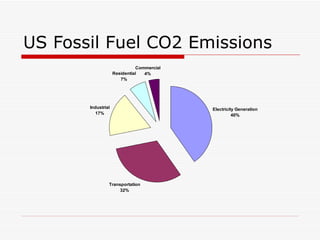
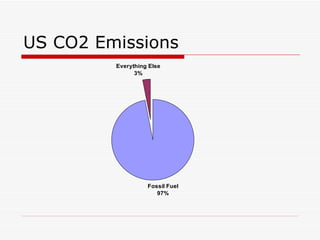
US Fossil Fuel CO2 Emissions
US CO2 Emissions
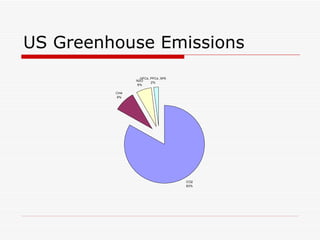
US Greenhouse Emissions
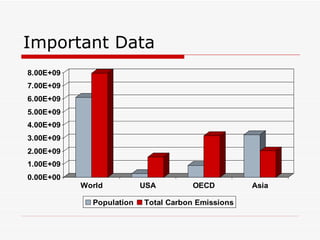
Important Data
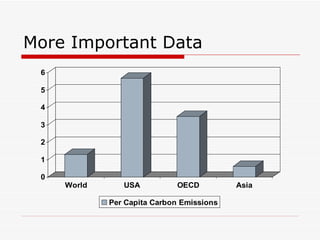
More Important Data
Why should we be concerned about Global Warming?
Global Warming is the greatest environmental threat of the 21 st  Century by many scientists, researchers and environmentalists.  In the late 1990s scientists reached a consensus that global warming was a cause for concern.  So, why should you be concerned about global warming?   “ Why Should I Care?”
 
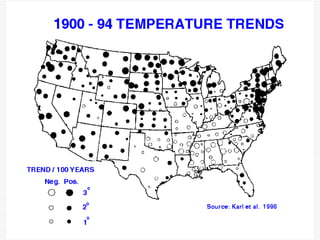
What is the evidence of global warming? Global surface temperature increased 0.74  ± 0.18 °C (1.33 ± 0.32 °F) during the 100 years ending in 2005  The Intergovernmental Panel on Climate Change (IPCC) concludes that most of the temperature increase since the mid-twentieth century is "very likely" due to the increase in anthropogenic greenhouse gas concentrations.  More frequent extreme weather is happening all over the globe. Sea ice is melting in the Arctic and Antarctic Oceans.
 
More evidence! The atmospheric levels of the greenhouse gas carbon dioxide, have been increasing since pre-industrial times from 280 part per million (ppm) to 377.5 ppm (2004 Carbon Dioxide Information Analysis Center), a 34% increase. Carbon dioxide concentrations in the atmosphere are the highest in 650,000 years.  Levels of atmospheric methane, a powerful greenhouse gas, have risen 145% in the last 100 years
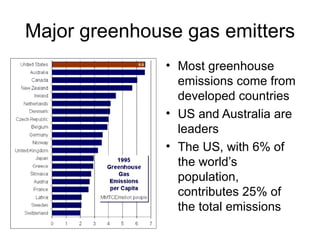
Major greenhouse gas emitters Most greenhouse emissions come from developed countries US and Australia are leaders The US, with 6% of the world’s population, contributes 25% of the total emissions
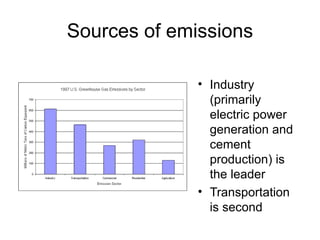
Sources of emissions Industry (primarily electric power generation and cement production) is the leader Transportation is second
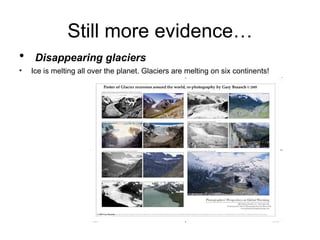
Still more evidence… Disappearing glaciers   Ice is melting all over the planet. Glaciers are melting on six continents!
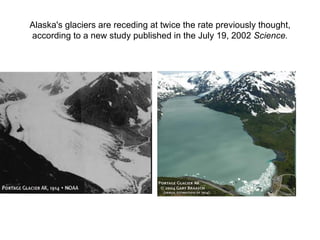
Alaska's glaciers are receding at twice the rate previously thought, according to a new study published in the July 19, 2002  Science. Note how the ice has pulled nearly out of sight from 1914 to 2004.
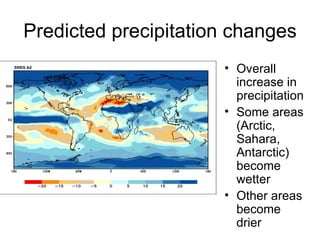
Predicted precipitation changes Overall increase in precipitation Some areas (Arctic, Sahara, Antarctic) become wetter Other areas become drier Annual mean precipitation change:  2071 to 2100 Relative to 1990 Source:  IPCC, 2001
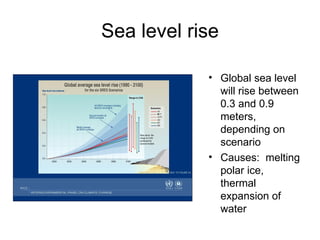
Sea level rise Global sea level will rise between 0.3 and 0.9 meters, depending on scenario Causes:  melting polar ice, thermal expansion of water Source:  IPCC, 2001
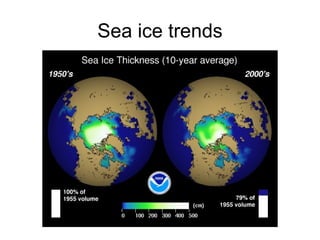
Sea ice trends
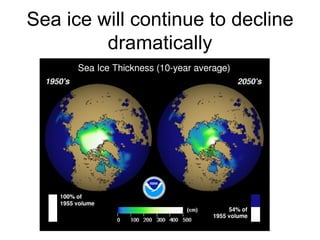
Sea ice will continue to decline dramatically
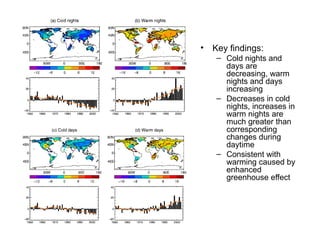
Key findings: Cold nights and days are decreasing, warm nights and days increasing Decreases in cold nights, increases in warm nights are much greater than corresponding changes during daytime Consistent with warming caused by enhanced greenhouse effect
Predicted effects of global warming Drier conditions reduce grain harvest. Reduced rainfall in rainforests as a result of deforestation Flooding due to rising sea levels Damage to habitats due to changes in the ecosystem Changes in water supply – water shortages and contamination Spreading of tropical diseases - directly related to global warming Increased air pollution
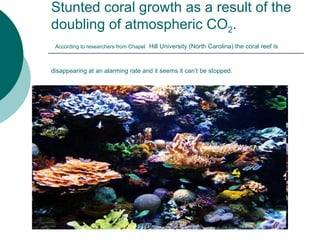
Stunted coral growth as a result of the doubling of atmospheric CO 2 .   According to researchers from Chapel   Hill University (North Carolina) the coral reef is  disappearing at an alarming rate and it seems it can’t be stopped.
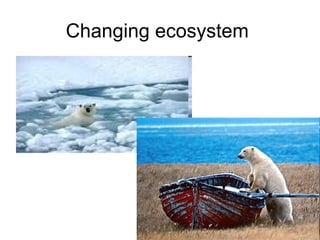
Changing ecosystem  Global warming is causing a change in habitat requiring species to adapt and change!
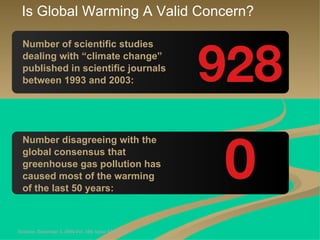
Science, December 3, 2004 Vol. 306, Issue 5702,1686 Is Global Warming A Valid Concern? Number disagreeing with the global consensus that greenhouse gas pollution has caused most of the warming of the last 50 years: Number of scientific studies dealing with “climate change” published in scientific journals between 1993 and 2003:
What Can WE Do?
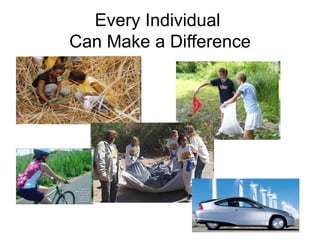
Every Individual  Can Make a Difference
We Need Leadership!
We Need:  Leaders P olitical… Credit: John Decker Nevada Senator Harry Reid Senate Majority Leader Representative Shelley Berkley Representative Dina Titus Senator John Ensign Representative Dean Heller
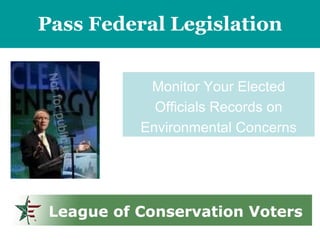
Pass Federal Legislation Monitor Your Elected Officials Records on Environmental Concerns
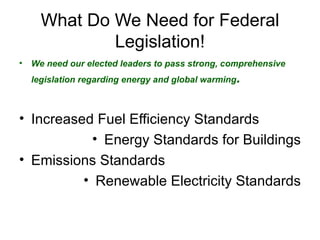
What Do We Need for Federal Legislation! We need our elected leaders to pass strong, comprehensive legislation regarding energy and global warming . Increased Fuel Efficiency Standards Energy Standards for Buildings Emissions Standards Renewable Electricity Standards
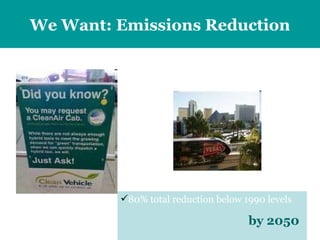
We Want:  Emissions Reduction 80% total reduction below 1990 levels by 2050
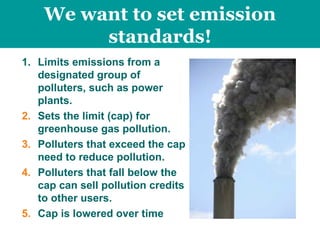
Limits emissions from a designated group of polluters, such as power plants.  Sets the limit (cap) for greenhouse gas pollution. Polluters that exceed the cap need to reduce pollution. Polluters that fall below the cap can sell pollution credits to other users. Cap is lowered over time We want to set emission standards!
How Can I Help With Federal Legislation? Write letters to your elected officials Write letters to the editor of your local newspaper or television station Start or participate in a global warming blog Educate your peers
Is Federal Legislation the Only Answer? NO! Individuals, Businesses, and Communities can all work together to reduce emissions immediately.
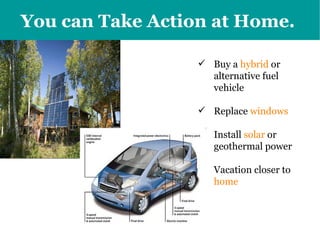
You can Take Action at Home.   Buy a  hybrid  or alternative fuel vehicle Replace  windows Install  solar  or geothermal power  Vacation closer to  home
More Action  At Home The Easy Stuff... Change your  Thermostat Stop Water Leaks Fix Weather Stripping  and  Caulking Replace Incandescent Bulbs
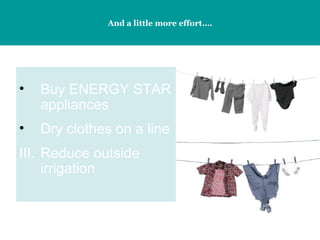
And a little more effort…. Buy ENERGY STAR appliances Dry clothes on a line III. Reduce outside irrigation
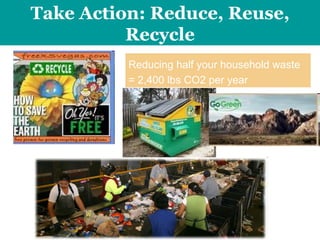
Take Action:  Reduce, Reuse, Recycle Reducing half your household waste = 2,400 lbs CO2 per year
Take Action  In Your Community Work   with others in your area to: Help schools, businesses, and local governments cut their energy use.  Encourage local, state and federal government to protect open spaces, farmland, and forests The Las Vegas Strip will soon be going dark, and the reason is to help Mother Nature. In just two months, Las Vegas will participate in a global movement known as "Earth Hour," all in an effort to raise awareness regarding climate change and global warming.
Educate Others to  Take Action
What Do We Gain by Participating in Global Warming Activities? Energy  independence -  Freedom   from fossil fuels and pollution Cleaner, Better  air and water quality Clean   energy/technology jobs  More   forests, farmland, wetlands, wildlife
Take Action  and   Vote Inform your elected representatives how important  global warming solutions  are to you.
The Most Important Crossroads Of Our Lives…
Credits http://www.ecobridge.org/content/g_evd.htm Turning up the heat on the future:  Global Warming and its Consequences.  Dr. John Heinrichs. Department of Geoscience.  www.audobon.org Chemistry in Context.  Applying Chemistry to Society http://www.lvwash.org/html/ http://reid.senate.gov/ http://ensign.senate.gov/public/ http://berkley.house.gov/ http://heller.house.gov/ http://titus.house.gov http://www.livescience.com/environment/050621_warming_  changes.html http://www.sierraclub.org/energy/habitat/
Alyse L Pp4 Gw

  • 1.
    Global Warming ImpactSolutions Actions by: Alyse Lysgaard
  • 2.
    What is globalwarming? Global warming is the increase in the average temperature of the near-surface air and oceans of the Earth. This phenomena has been occurring since the mid-20th century and it is projected to continue.
  • 3.
    What is thecause of global warming? Scientists have determined that a number of human activities are contributing to global warming by adding excessive amounts of greenhouse gases to the atmosphere. Greenhouse gases such as carbon dioxide accumulate in the atmosphere and trap heat that normally would exit into outer space.
  • 4.
    Explanation of thecauses of global warming
  • 5.
    What exactly aregreenhouse gases?
  • 6.
    Selected Greenhouse GasesCarbon Dioxide (CO 2 ) Source: Fossil fuel burning, deforestation Anthropogenic increase: 30% Average atmospheric residence time: 500 years Methane (CH 4 ) Source: Rice cultivation, cattle & sheep ranching, decay from landfills, mining Anthropogenic increase: 145% Average atmospheric residence time: 7-10 years Nitrous oxide (N 2 O) Source: Industry and agriculture (fertilizers) Anthropogenic increase: 15% Average atmospheric residence time: 140-190 years
  • 7.
    Where Do TheseGreenhouse Gases Come From?
  • 8.
    US Fossil FuelCO2 Emissions
  • 9.
  • 10.
  • 11.
  • 12.
  • 13.
    Why should webe concerned about Global Warming?
  • 14.
    Global Warming isthe greatest environmental threat of the 21 st Century by many scientists, researchers and environmentalists. In the late 1990s scientists reached a consensus that global warming was a cause for concern. So, why should you be concerned about global warming? “ Why Should I Care?”
  • 15.
  • 16.
    What is theevidence of global warming? Global surface temperature increased 0.74 ± 0.18 °C (1.33 ± 0.32 °F) during the 100 years ending in 2005 The Intergovernmental Panel on Climate Change (IPCC) concludes that most of the temperature increase since the mid-twentieth century is "very likely" due to the increase in anthropogenic greenhouse gas concentrations. More frequent extreme weather is happening all over the globe. Sea ice is melting in the Arctic and Antarctic Oceans.
  • 17.
  • 18.
    More evidence! Theatmospheric levels of the greenhouse gas carbon dioxide, have been increasing since pre-industrial times from 280 part per million (ppm) to 377.5 ppm (2004 Carbon Dioxide Information Analysis Center), a 34% increase. Carbon dioxide concentrations in the atmosphere are the highest in 650,000 years. Levels of atmospheric methane, a powerful greenhouse gas, have risen 145% in the last 100 years
  • 19.
    Major greenhouse gasemitters Most greenhouse emissions come from developed countries US and Australia are leaders The US, with 6% of the world’s population, contributes 25% of the total emissions
  • 20.
    Sources of emissionsIndustry (primarily electric power generation and cement production) is the leader Transportation is second
  • 21.
    Still more evidence…Disappearing glaciers  Ice is melting all over the planet. Glaciers are melting on six continents!
  • 22.
    Alaska's glaciers arereceding at twice the rate previously thought, according to a new study published in the July 19, 2002 Science. Note how the ice has pulled nearly out of sight from 1914 to 2004.
  • 23.
    Predicted precipitation changesOverall increase in precipitation Some areas (Arctic, Sahara, Antarctic) become wetter Other areas become drier Annual mean precipitation change: 2071 to 2100 Relative to 1990 Source: IPCC, 2001
  • 24.
    Sea level riseGlobal sea level will rise between 0.3 and 0.9 meters, depending on scenario Causes: melting polar ice, thermal expansion of water Source: IPCC, 2001
  • 25.
  • 26.
    Sea ice willcontinue to decline dramatically
  • 27.
    Key findings: Coldnights and days are decreasing, warm nights and days increasing Decreases in cold nights, increases in warm nights are much greater than corresponding changes during daytime Consistent with warming caused by enhanced greenhouse effect
  • 28.
    Predicted effects ofglobal warming Drier conditions reduce grain harvest. Reduced rainfall in rainforests as a result of deforestation Flooding due to rising sea levels Damage to habitats due to changes in the ecosystem Changes in water supply – water shortages and contamination Spreading of tropical diseases - directly related to global warming Increased air pollution
  • 29.
    Stunted coral growthas a result of the doubling of atmospheric CO 2 . According to researchers from Chapel Hill University (North Carolina) the coral reef is disappearing at an alarming rate and it seems it can’t be stopped.
  • 30.
    Changing ecosystem Global warming is causing a change in habitat requiring species to adapt and change!
  • 31.
    Science, December 3,2004 Vol. 306, Issue 5702,1686 Is Global Warming A Valid Concern? Number disagreeing with the global consensus that greenhouse gas pollution has caused most of the warming of the last 50 years: Number of scientific studies dealing with “climate change” published in scientific journals between 1993 and 2003:
  • 32.
  • 33.
    Every Individual Can Make a Difference
  • 34.
  • 35.
    We Need: Leaders P olitical… Credit: John Decker Nevada Senator Harry Reid Senate Majority Leader Representative Shelley Berkley Representative Dina Titus Senator John Ensign Representative Dean Heller
  • 36.
    Pass Federal LegislationMonitor Your Elected Officials Records on Environmental Concerns
  • 37.
    What Do WeNeed for Federal Legislation! We need our elected leaders to pass strong, comprehensive legislation regarding energy and global warming . Increased Fuel Efficiency Standards Energy Standards for Buildings Emissions Standards Renewable Electricity Standards
  • 38.
    We Want: Emissions Reduction 80% total reduction below 1990 levels by 2050
  • 39.
    Limits emissions froma designated group of polluters, such as power plants. Sets the limit (cap) for greenhouse gas pollution. Polluters that exceed the cap need to reduce pollution. Polluters that fall below the cap can sell pollution credits to other users. Cap is lowered over time We want to set emission standards!
  • 40.
    How Can IHelp With Federal Legislation? Write letters to your elected officials Write letters to the editor of your local newspaper or television station Start or participate in a global warming blog Educate your peers
  • 41.
    Is Federal Legislationthe Only Answer? NO! Individuals, Businesses, and Communities can all work together to reduce emissions immediately.
  • 42.
    You can TakeAction at Home. Buy a hybrid or alternative fuel vehicle Replace windows Install solar or geothermal power Vacation closer to home
  • 43.
    More Action At Home The Easy Stuff... Change your Thermostat Stop Water Leaks Fix Weather Stripping and Caulking Replace Incandescent Bulbs
  • 44.
    And a littlemore effort…. Buy ENERGY STAR appliances Dry clothes on a line III. Reduce outside irrigation
  • 45.
    Take Action: Reduce, Reuse, Recycle Reducing half your household waste = 2,400 lbs CO2 per year
  • 46.
    Take Action In Your Community Work with others in your area to: Help schools, businesses, and local governments cut their energy use. Encourage local, state and federal government to protect open spaces, farmland, and forests The Las Vegas Strip will soon be going dark, and the reason is to help Mother Nature. In just two months, Las Vegas will participate in a global movement known as "Earth Hour," all in an effort to raise awareness regarding climate change and global warming.
  • 47.
    Educate Others to Take Action
  • 48.
    What Do WeGain by Participating in Global Warming Activities? Energy independence - Freedom from fossil fuels and pollution Cleaner, Better air and water quality Clean energy/technology jobs More forests, farmland, wetlands, wildlife
  • 49.
    Take Action and Vote Inform your elected representatives how important global warming solutions are to you.
  • 50.
    The Most ImportantCrossroads Of Our Lives…
  • 51.
    Credits http://www.ecobridge.org/content/g_evd.htm Turningup the heat on the future: Global Warming and its Consequences. Dr. John Heinrichs. Department of Geoscience. www.audobon.org Chemistry in Context. Applying Chemistry to Society http://www.lvwash.org/html/ http://reid.senate.gov/ http://ensign.senate.gov/public/ http://berkley.house.gov/ http://heller.house.gov/ http://titus.house.gov http://www.livescience.com/environment/050621_warming_ changes.html http://www.sierraclub.org/energy/habitat/