Agenda
Introduction – Energy in perspective
1. Substances of Concern – complete but never ending
2. EOL Recovery & Recycling – green chemistry for Fullcycling
3. Energy in Life Cycle– standby reduction and use phase
Conclusions
Environmental Programs in the
Consumer Products Sector:
Challenges, Successes & What’s Next
Motorola General Business Information - UIUC Electronics & Systainability: Design for Energy & the Environment Symposium, Feb. 23-24, 2010
MOTOROLA and the Stylized M Logo are registered in the US Patent & Trademark Office.
All other product or service names are the property of their respective owners. © 2010 Motorola, Inc. All rights reserved.
Roger L. Franz – Motorola Mobile Devices – Libertyville, IL
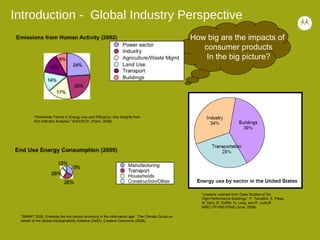
Introduction - Global Industry Perspective
"Worldwide Trends in Energy Use and Efficiency: Key Insights from
IEA Indicator Analysis." IEA/OECD, (Paris, 2008).
“SMART 2020: Enabling the low carbon economy in the information age,” The Climate Group on
behalf of the Global eSustainability Initiative (GeSI), Creative Commons (2008).
“Lessons Learned from Case Studies of Six
High-Performance Buildings,” P. Torcellini, S. Pless,
M. Deru, B. Griffith, N. Long, and R. Judkoff
NREL/TP-550-37542 (June, 2006)
How big are the impacts of
consumer products
In the big picture?
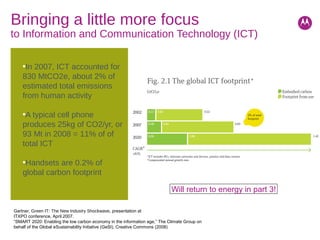
Bringing a little more focus
to Information and Communication Technology (ICT)
•In 2007, ICT accounted for
830 MtCO2e, about 2% of
estimated total emissions
from human activity
•A typical cell phone
produces 25kg of CO2/yr, or
93 Mt in 2008 = 11% of of
total ICT
•Handsets are 0.2% of
global carbon footprint
Gartner, Green IT: The New Industry Shockwave, presentation at
ITXPO conference, April 2007.
“SMART 2020: Enabling the low carbon economy in the information age,” The Climate Group on
behalf of the Global eSustainability Initiative (GeSI), Creative Commons (2008)
Will return to energy in part 3!
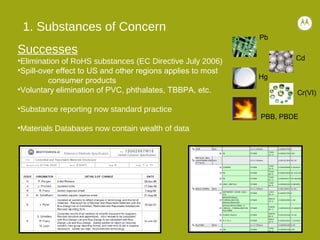
1. Substances of Concern
Successes
•Elimination of RoHS substances (EC Directive July 2006)
•Spill-over effect to US and other regions applies to most
consumer products
•Voluntary elimination of PVC, phthalates, TBBPA, etc.
•Substance reporting now standard practice
•Materials Databases now contain wealth of data
Pb
Cd
Hg
Cr(VI)
PBB, PBDE
So we’re done with substance
replacement, right? (Wrong!)
California Green Chemistry Proposal
Difficult to predict what will be the next wave
Recycling Mobile Phones
FACT SHEET:MANAGEMENT OF ELECTRONIC WASTE IN THE UNITED STATES,
EPA530-F-08-014 revised July 2008)
Good news
Cell phone
recycling
is increasing
Driver:
Precious Metals
Highlighted next: 3 of many cell phone recycling programs
Note: Approach Two based on number of devices rather than weight
http://www.epa.gov/epawaste/partnerships/plugin/cellphone/index.htm
Wireless Industry - CTIA
http://www.recyclewirelessphones.com/documents/WNR_Brochure.pdf
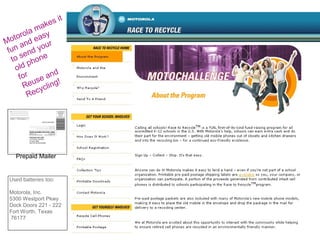
Motorola makes it
fun and easy
to send your
old phone
for
Reuse and
Recycling!
Used batteries too:
Motorola, Inc.
5300 Westport Pkwy
Dock Doors 221 - 222
Fort Worth, Texas
76177
Prepaid Mailer
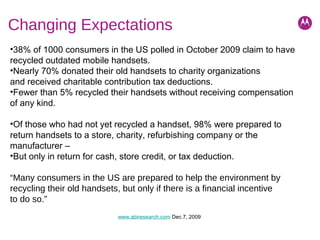
Changing Expectations
•38% of 1000 consumers in the US polled in October 2009 claim to have
recycled outdated mobile handsets.
•Nearly 70% donated their old handsets to charity organizations
and received charitable contribution tax deductions.
•Fewer than 5% recycled their handsets without receiving compensation
of any kind.
•Of those who had not yet recycled a handset, 98% were prepared to
return handsets to a store, charity, refurbishing company or the
manufacturer –
•But only in return for cash, store credit, or tax deduction.
“Many consumers in the US are prepared to help the environment by
recycling their old handsets, but only if there is a financial incentive
to do so.”
www.abiresearch.com Dec.7, 2009
End of Life Recovery & Recycling
B. Renewable Plastics – Green Chemistry Needed
for Fullcycling not just Recycling
Unlike metals, plastics cannot recycle repeatedly
(thermoplastics), or really at all (thermosets).
So… Observations on two plastics key to electronics:
•Thermoplastic – polycarbonate
•Used in housings, doors, lenses
•Thermoset - epoxy
•Used in PWB’s & molded component packages
Making PC & Epoxy (oversimplified)
Benzene, Propylene & Chlorine required
C9 Cumene
C6 Benzene C3 Propylene
C6 Phenol C3 Isopropanol
C3 Acetone
C15 Bisphenol A
Chlorine
C3 Epichlorohydrin
CO
C1 Phosgene
Polycarbonates Epoxies
Source: Various Textbooks Graphic: R. Franz
Halogen Free??
C= # carbons
Inorganics,
solvents,
byproducts
not shown
J.J. Bozell, “The Use of Renewable Feedstocks for the Production of Chemicals and
Materials - A Brief Overview of Concepts.” National Renewable Energy Laboratory,
Biomass and Solar Energy Workshops; August 3-4, 2004.
Promising Renewable Feedstocks…
but no Propylene (i.e. no path to PC or Epoxy)
*
* Benzene, Toluene, Xylene
Lignin from wood
Most promising source of Aromatics
http://blogs.princeton.edu/chm333/f2006/biomass/bio_oil/02_chemistryprocessing_the_basics/01_chemistry/
www.palaeos.com/Plants/Lists/Glossary/GlossaryL.html
“Recent Industrial Applications of Lignin: A Sustainable Alternative to Nonrenewable Materials,” J.H. Lora, W.G. Glasser,
Journal of Polymers and the Environment, 10(1-2): 39-48 (April, 2002).
•Lignin in epoxy PWB’s – 2001
•Eurolignin project – 2002-2005
•International Lignin Institute
•Thermoplastics
•Thermosets
•Adhesives
•Composites/fillers
•Technaro GmbH resins
L.L. Kosbar et. al., Introducing Biobased Materials into the Electronics Industry,” J. Ind. Ecology 4(3):93-105 (2001)
www.ili-lignin.com www.technaro.de
Emerging Sources of Propylene
• Catalytic conversion of synthesis gas from natural gas, coal,
biomass or other hydrocarbon source
• Oxygen-blown natural gas reforming, synthesis and
methanol to propylene conversion
• Sugar cane to methanol to propylene
• Commercialization remains to be realized
W. Liebner, H. Koempel, H. Bach,Lurgi, “Gas to Propylene – Lurgi’s Way,” 17th World Petroleum Congress, Rio de Janeiro, Brazil September 1 - 5, 2002 .
S. Abhay, L. Sunggyu, “Alternative source of propylene,”,Energy Sources, 27(6): 489-500 (2005).
Electronics OEM’s want drop-in
equivalents to PC and Epoxies
www.braskem.com.br
Recycled Thermoplastics
A ‘worry list’ for Engineering applications
• Mixing polymer types, grades, manufacturers
• Unknown additives, catalysts, other composition variations
• Foreign material: metals, inorganics, adhesives, coatings
• Chemical changes in functional groups, oxidation
• Molecular weight degradation
• Branching, cross-linking, initiator site creation
• Change in mechanical properties (modulus)
• Change in physical properties (density, color)
• Change in processing behavior (melt flow)
• etc.
Plastics recycling must be carefully implemented.
A renewable source of virgin resin would be preferred.
cf. H. Zweifel, Plastics Additives Handbook, 5th
Ed., p. 976, (Munich: Hanser, 2001),
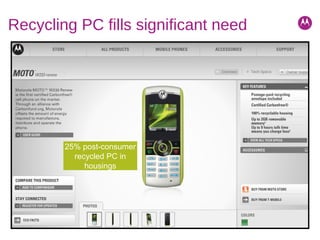
Recycling PC fills significant need
25% post-consumer
recycled PC in
housings
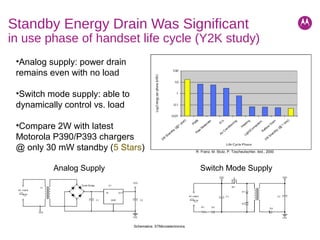
Standby Energy Drain Was Significant
in use phase of handset life cycle (Y2K study)
Schematics: STMicroelectronics
Analog Supply Switch Mode Supply
•Analog supply: power drain
remains even with no load
•Switch mode supply: able to
dynamically control vs. load
•Compare 2W with latest
Motorola P390/P393 chargers
@ only 30 mW standby (5 Stars) R. Franz, M. Stutz, P. Tzscheutschler, ibid., 2000
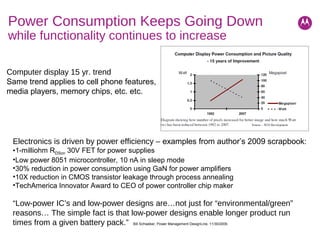
Power Consumption Keeps Going Down
while functionality continues to increase
Computer display 15 yr. trend
Same trend applies to cell phone features,
media players, memory chips, etc. etc.
Electronics is driven by power efficiency – examples from author’s 2009 scrapbook:
•1-milliohm RDSon 30V FET for power supplies
•Low power 8051 microcontroller, 10 nA in sleep mode
•30% reduction in power consumption using GaN for power amplifiers
•10X reduction in CMOS transistor leakage through process annealing
•TechAmerica Innovator Award to CEO of power controller chip maker
“Low-power IC’s and low-power designs are…not just for “environmental/green”
reasons… The simple fact is that low-power designs enable longer product run
times from a given battery pack.” Bill Schweber, Power Management DesignLine, 11/30/2009.
Beyond the Handset
Infrastructure, network, cloud, grid…
“Cloud Computing…a new paradigm…shifts the location of this infrastructure
to the network.” L.M. Vaquero et. al., A Break in the Clouds: Towards a Cloud Definition, ACM SIGCOMM Computer Communication Review, 39(1):50-55 (Jan. 2009)
Life Cycle Assessment of ICT Products more complex than ever
Network Improvements
Predicted to yield 42% drop in carbon emissions by 2013 through
•integration of clean energy sources: solar, wind, and fuel cells
•more energy-efficient network equipment (base stations and RF power amplifiers)
•more efficient network architectures and topologies
GSMA’s Green Power for Mobile program (global)
Announced 2008 to promote basestations using PV, wind, non-food biofuels
•2008 actual: 1500 off-grid basestations
•2010 goal: 14,000
•2012 goal: 118,000
Pike Research, http://www.cellular-news.com/story/40461.php (4th November 2009)
GSMA – http://www.gsmworld.com
Aditya Kaul, ABI Research, 1/7/2010
Personal Communications Today:
Energy efficiency distributed across networks
ICT Energy Efficiency Trends
continued
More efficient data centers:
Drivers in 2008 survey are both economic & environmental
– 54% - reducing electricity consumption
– 51% - reducing cooling costs
– 42% - sense of responsibility to the community
Consortium seeks 1000X improvement in ICT systems based on study of
– optics
– wireless
– electronics
– processing
– routing
– architecture
Symantec, 2008 Data Center Report www.greentouch.org
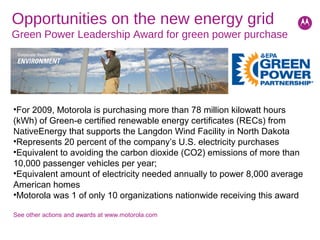
Opportunities on the new energy grid
Green Power Leadership Award for green power purchase
•For 2009, Motorola is purchasing more than 78 million kilowatt hours
(kWh) of Green-e certified renewable energy certificates (RECs) from
NativeEnergy that supports the Langdon Wind Facility in North Dakota
•Represents 20 percent of the company’s U.S. electricity purchases
•Equivalent to avoiding the carbon dioxide (CO2) emissions of more than
10,000 passenger vehicles per year;
•Equivalent amount of electricity needed annually to power 8,000 average
American homes
•Motorola was 1 of only 10 organizations nationwide receiving this award
See other actions and awards at www.motorola.com
What else can individuals do
to reduce their environmental footprint
Use phase
•Know your applications!
•Set screen savers to dim
•Use battery monitor software -->
•Solar chargers
•Off-grid options
•Coming: energy harvesting
End-of-Life
•Take advantage of recycling options
•2012 & beyond: universal µUSB charger (in Europe)
http://www.techdelicious.com/google-released-sdkandroid-16/
Conclusions
1. Substances of Concern
•Toxics replacement to date: grade A
•Next test beyond RoHS & halogens: grade Incomplete
2. EOL Recovery & Recycling
•Progress to date: grade B. Room for improvement.
•Renewable carbon chemistries: grade Incomplete
3. Energy
•Standby loss reduction to date: grade B. Why not Zero
across all types of products?
•Use phase: grade B. Battery life. Industry trends and
commitments to “Green IT/Green ICT”
•Assessment of networks & cloud computing difficult
•Actual results are literally in the hands of the user.

Environmental programs : Sustainable Electronics

  • 1.
    Agenda Introduction – Energyin perspective 1. Substances of Concern – complete but never ending 2. EOL Recovery & Recycling – green chemistry for Fullcycling 3. Energy in Life Cycle– standby reduction and use phase Conclusions Environmental Programs in the Consumer Products Sector: Challenges, Successes & What’s Next Motorola General Business Information - UIUC Electronics & Systainability: Design for Energy & the Environment Symposium, Feb. 23-24, 2010 MOTOROLA and the Stylized M Logo are registered in the US Patent & Trademark Office. All other product or service names are the property of their respective owners. © 2010 Motorola, Inc. All rights reserved. Roger L. Franz – Motorola Mobile Devices – Libertyville, IL
  • 2.
    Introduction - GlobalIndustry Perspective "Worldwide Trends in Energy Use and Efficiency: Key Insights from IEA Indicator Analysis." IEA/OECD, (Paris, 2008). “SMART 2020: Enabling the low carbon economy in the information age,” The Climate Group on behalf of the Global eSustainability Initiative (GeSI), Creative Commons (2008). “Lessons Learned from Case Studies of Six High-Performance Buildings,” P. Torcellini, S. Pless, M. Deru, B. Griffith, N. Long, and R. Judkoff NREL/TP-550-37542 (June, 2006) How big are the impacts of consumer products In the big picture?
  • 3.
    Bringing a littlemore focus to Information and Communication Technology (ICT) •In 2007, ICT accounted for 830 MtCO2e, about 2% of estimated total emissions from human activity •A typical cell phone produces 25kg of CO2/yr, or 93 Mt in 2008 = 11% of of total ICT •Handsets are 0.2% of global carbon footprint Gartner, Green IT: The New Industry Shockwave, presentation at ITXPO conference, April 2007. “SMART 2020: Enabling the low carbon economy in the information age,” The Climate Group on behalf of the Global eSustainability Initiative (GeSI), Creative Commons (2008) Will return to energy in part 3!
  • 4.
    1. Substances ofConcern Successes •Elimination of RoHS substances (EC Directive July 2006) •Spill-over effect to US and other regions applies to most consumer products •Voluntary elimination of PVC, phthalates, TBBPA, etc. •Substance reporting now standard practice •Materials Databases now contain wealth of data Pb Cd Hg Cr(VI) PBB, PBDE
  • 5.
    So we’re donewith substance replacement, right? (Wrong!) California Green Chemistry Proposal California Green Chemistry Proposal Difficult to predict what will be the next wave
  • 6.
    Recycling Mobile Phones FACTSHEET:MANAGEMENT OF ELECTRONIC WASTE IN THE UNITED STATES, EPA530-F-08-014 revised July 2008) Good news Cell phone recycling is increasing Driver: Precious Metals Highlighted next: 3 of many cell phone recycling programs Note: Approach Two based on number of devices rather than weight
  • 7.
  • 8.
    Wireless Industry -CTIA http://www.recyclewirelessphones.com/documents/WNR_Brochure.pdf
  • 9.
    Motorola makes it funand easy to send your old phone for Reuse and Recycling! Used batteries too: Motorola, Inc. 5300 Westport Pkwy Dock Doors 221 - 222 Fort Worth, Texas 76177 Prepaid Mailer
  • 10.
    Changing Expectations •38% of1000 consumers in the US polled in October 2009 claim to have recycled outdated mobile handsets. •Nearly 70% donated their old handsets to charity organizations and received charitable contribution tax deductions. •Fewer than 5% recycled their handsets without receiving compensation of any kind. •Of those who had not yet recycled a handset, 98% were prepared to return handsets to a store, charity, refurbishing company or the manufacturer – •But only in return for cash, store credit, or tax deduction. “Many consumers in the US are prepared to help the environment by recycling their old handsets, but only if there is a financial incentive to do so.” www.abiresearch.com Dec.7, 2009
  • 11.
    End of LifeRecovery & Recycling B. Renewable Plastics – Green Chemistry Needed for Fullcycling not just Recycling Unlike metals, plastics cannot recycle repeatedly (thermoplastics), or really at all (thermosets). So… Observations on two plastics key to electronics: •Thermoplastic – polycarbonate •Used in housings, doors, lenses •Thermoset - epoxy •Used in PWB’s & molded component packages
  • 12.
    Making PC &Epoxy (oversimplified) Benzene, Propylene & Chlorine required C9 Cumene C6 Benzene C3 Propylene C6 Phenol C3 Isopropanol C3 Acetone C15 Bisphenol A Chlorine C3 Epichlorohydrin CO C1 Phosgene Polycarbonates Epoxies Source: Various Textbooks Graphic: R. Franz Halogen Free?? C= # carbons Inorganics, solvents, byproducts not shown
  • 13.
    J.J. Bozell, “TheUse of Renewable Feedstocks for the Production of Chemicals and Materials - A Brief Overview of Concepts.” National Renewable Energy Laboratory, Biomass and Solar Energy Workshops; August 3-4, 2004. Promising Renewable Feedstocks… but no Propylene (i.e. no path to PC or Epoxy) * * Benzene, Toluene, Xylene
  • 14.
    Lignin from wood Mostpromising source of Aromatics http://blogs.princeton.edu/chm333/f2006/biomass/bio_oil/02_chemistryprocessing_the_basics/01_chemistry/ www.palaeos.com/Plants/Lists/Glossary/GlossaryL.html “Recent Industrial Applications of Lignin: A Sustainable Alternative to Nonrenewable Materials,” J.H. Lora, W.G. Glasser, Journal of Polymers and the Environment, 10(1-2): 39-48 (April, 2002). •Lignin in epoxy PWB’s – 2001 •Eurolignin project – 2002-2005 •International Lignin Institute •Thermoplastics •Thermosets •Adhesives •Composites/fillers •Technaro GmbH resins L.L. Kosbar et. al., Introducing Biobased Materials into the Electronics Industry,” J. Ind. Ecology 4(3):93-105 (2001) www.ili-lignin.com www.technaro.de
  • 15.
    Emerging Sources ofPropylene • Catalytic conversion of synthesis gas from natural gas, coal, biomass or other hydrocarbon source • Oxygen-blown natural gas reforming, synthesis and methanol to propylene conversion • Sugar cane to methanol to propylene • Commercialization remains to be realized W. Liebner, H. Koempel, H. Bach,Lurgi, “Gas to Propylene – Lurgi’s Way,” 17th World Petroleum Congress, Rio de Janeiro, Brazil September 1 - 5, 2002 . S. Abhay, L. Sunggyu, “Alternative source of propylene,”,Energy Sources, 27(6): 489-500 (2005). Electronics OEM’s want drop-in equivalents to PC and Epoxies www.braskem.com.br
  • 16.
    Recycled Thermoplastics A ‘worrylist’ for Engineering applications • Mixing polymer types, grades, manufacturers • Unknown additives, catalysts, other composition variations • Foreign material: metals, inorganics, adhesives, coatings • Chemical changes in functional groups, oxidation • Molecular weight degradation • Branching, cross-linking, initiator site creation • Change in mechanical properties (modulus) • Change in physical properties (density, color) • Change in processing behavior (melt flow) • etc. Plastics recycling must be carefully implemented. A renewable source of virgin resin would be preferred. cf. H. Zweifel, Plastics Additives Handbook, 5th Ed., p. 976, (Munich: Hanser, 2001),
  • 17.
    Recycling PC fillssignificant need 25% post-consumer recycled PC in housings
  • 18.
    Standby Energy DrainWas Significant in use phase of handset life cycle (Y2K study) Schematics: STMicroelectronics Analog Supply Switch Mode Supply •Analog supply: power drain remains even with no load •Switch mode supply: able to dynamically control vs. load •Compare 2W with latest Motorola P390/P393 chargers @ only 30 mW standby (5 Stars) R. Franz, M. Stutz, P. Tzscheutschler, ibid., 2000
  • 19.
    Power Consumption KeepsGoing Down while functionality continues to increase Computer display 15 yr. trend Same trend applies to cell phone features, media players, memory chips, etc. etc. Electronics is driven by power efficiency – examples from author’s 2009 scrapbook: •1-milliohm RDSon 30V FET for power supplies •Low power 8051 microcontroller, 10 nA in sleep mode •30% reduction in power consumption using GaN for power amplifiers •10X reduction in CMOS transistor leakage through process annealing •TechAmerica Innovator Award to CEO of power controller chip maker “Low-power IC’s and low-power designs are…not just for “environmental/green” reasons… The simple fact is that low-power designs enable longer product run times from a given battery pack.” Bill Schweber, Power Management DesignLine, 11/30/2009.
  • 20.
    Beyond the Handset Infrastructure,network, cloud, grid… “Cloud Computing…a new paradigm…shifts the location of this infrastructure to the network.” L.M. Vaquero et. al., A Break in the Clouds: Towards a Cloud Definition, ACM SIGCOMM Computer Communication Review, 39(1):50-55 (Jan. 2009) Life Cycle Assessment of ICT Products more complex than ever
  • 21.
    Network Improvements Predicted toyield 42% drop in carbon emissions by 2013 through •integration of clean energy sources: solar, wind, and fuel cells •more energy-efficient network equipment (base stations and RF power amplifiers) •more efficient network architectures and topologies GSMA’s Green Power for Mobile program (global) Announced 2008 to promote basestations using PV, wind, non-food biofuels •2008 actual: 1500 off-grid basestations •2010 goal: 14,000 •2012 goal: 118,000 Pike Research, http://www.cellular-news.com/story/40461.php (4th November 2009) GSMA – http://www.gsmworld.com Aditya Kaul, ABI Research, 1/7/2010 Personal Communications Today: Energy efficiency distributed across networks
  • 22.
    ICT Energy EfficiencyTrends continued More efficient data centers: Drivers in 2008 survey are both economic & environmental – 54% - reducing electricity consumption – 51% - reducing cooling costs – 42% - sense of responsibility to the community Consortium seeks 1000X improvement in ICT systems based on study of – optics – wireless – electronics – processing – routing – architecture Symantec, 2008 Data Center Report www.greentouch.org
  • 23.
    Opportunities on thenew energy grid Green Power Leadership Award for green power purchase •For 2009, Motorola is purchasing more than 78 million kilowatt hours (kWh) of Green-e certified renewable energy certificates (RECs) from NativeEnergy that supports the Langdon Wind Facility in North Dakota •Represents 20 percent of the company’s U.S. electricity purchases •Equivalent to avoiding the carbon dioxide (CO2) emissions of more than 10,000 passenger vehicles per year; •Equivalent amount of electricity needed annually to power 8,000 average American homes •Motorola was 1 of only 10 organizations nationwide receiving this award See other actions and awards at www.motorola.com
  • 24.
    What else canindividuals do to reduce their environmental footprint Use phase •Know your applications! •Set screen savers to dim •Use battery monitor software --> •Solar chargers •Off-grid options •Coming: energy harvesting End-of-Life •Take advantage of recycling options •2012 & beyond: universal µUSB charger (in Europe) http://www.techdelicious.com/google-released-sdkandroid-16/
  • 25.
    Conclusions 1. Substances ofConcern •Toxics replacement to date: grade A •Next test beyond RoHS & halogens: grade Incomplete 2. EOL Recovery & Recycling •Progress to date: grade B. Room for improvement. •Renewable carbon chemistries: grade Incomplete 3. Energy •Standby loss reduction to date: grade B. Why not Zero across all types of products? •Use phase: grade B. Battery life. Industry trends and commitments to “Green IT/Green ICT” •Assessment of networks & cloud computing difficult •Actual results are literally in the hands of the user.