


IMPACT OF
INFORMATION
TECHNOLOGY
ON ENVIRONMENT
          •   K. Sai Malleswar
          •   Kshitiz Sinha
          •   Kumar Harshit
          •   L. Deepak
Topic
• Information technology (IT) is the acquisition,
  processing, storage and dissemination of vocal,
  pictorial, textual and numerical information by
  a microelectronics-based combination
  of computing and telecommunications.

• Having both positive and negative effects on
  environment.

• What can be done to maximize POSITIVE aspects
  and minimize the NEGATIVES?
positive aspects
of INFORMATION
TECHNOLOGY for
Environment
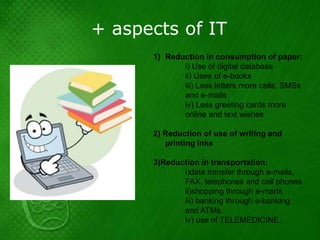
+ aspects of IT
      1) Reduction in consumption of paper:
             i) Use of digital database
             ii) Uses of e-books
             iii) Less letters more calls, SMSs
             and e-mails
             iv) Less greeting cards more
             online and text wishes

      2) Reduction of use of writing and
         printing inks

      3)Reduction in transportation:
             i)data transfer through e-mails,
             FAX, telephones and cell phones
             ii)shopping through e-marts
             iii) banking through e-banking
             and ATMs.
             iv) use of TELEMEDICINE.
+ aspects of IT

        4) compact space, reduction in
        cutting of trees

        5) Monitering and controlling
        changes in the Earth’s
        environment through satellites

        6) Spreading awareness
        regarding environment through
        INFORMATION TECHNOLOGY:
                using television, internet,
                radio channels and
                messages.
negative aspects of
INFORMATION
TECHNOLOGY
21st century

•   Information age or computer age
•   Information technology
•   Telecommunications
•   77% of world population owns mobile phones
•   4-5 % of world population owns PCs
Computers
  • Every single computer requires about 1.8
    tonnes of chemicals, fossil fuels and water
    for its manufacture.
  • Emission of about 0.1 tonne of carbon
    dioxide in a year.
  • 2 per cent of world's total carbon dioxide
    emissions
  • Global warming
  • Dumping of old computers in landfills
  • Soil pollution
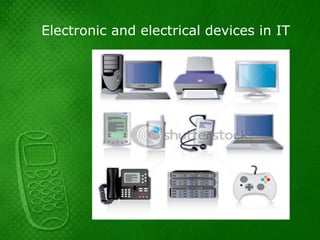
Electronic and electrical devices in IT
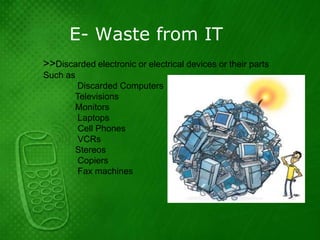
E- Waste from IT
>>Discarded electronic or electrical devices or their parts
Such as
        Discarded Computers
        Televisions
        Monitors
         Laptops
         Cell Phones
         VCRs
        Stereos
         Copiers
         Fax machines
Dangerous elements in E-waste from IT

       The cathode ray tubes (CRTs), which contain significant
        amounts of lead.
       Liquid Crystal Displays (LCDs) are illuminated by
        mercury-filled panels.
       Circuitry contain chromium, copper, and lead that
        exceed regulatory limits.
       The batteries contain such as lead, nickel, cadmium,
        silver, lithium, and other dangerous metals.
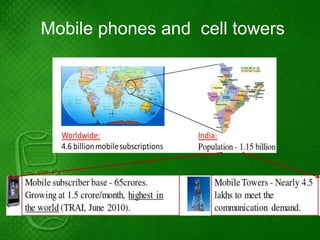
Mobile phones and cell towers
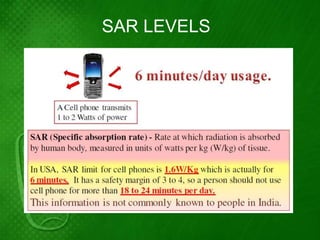
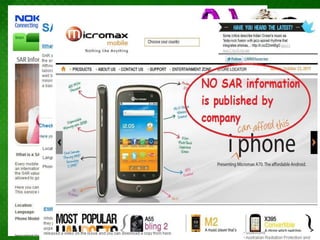
SAR LEVELS
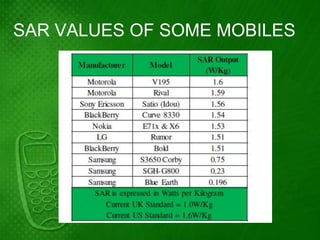
SAR VALUES OF SOME MOBILES
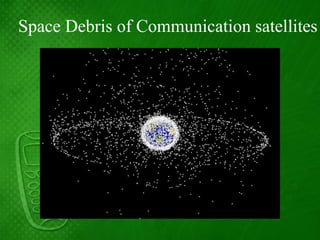
Space Debris of Communication satellites
Mobile radiation:
Effects on environment
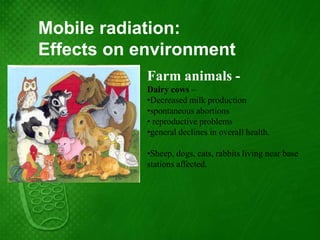
            Farm animals -
            Dairy cows –
            •Decreased milk production
            •spontaneous abortions
            • reproductive problems
            •general declines in overall health.

            •Sheep, dogs, cats, rabbits living near base
            stations affected.
Mobile radiation:
Effects on environment
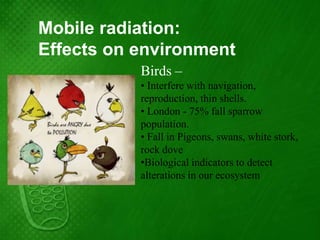
           Birds –
           • Interfere with navigation,
           reproduction, thin shells.
           • London - 75% fall sparrow
           population.
           • Fall in Pigeons, swans, white stork,
           rock dove
           •Biological indicators to detect
           alterations in our ecosystem
Mobile radiation: Effects
on environment
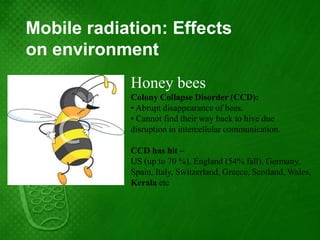
            Honey bees
            Colony Collapse Disorder (CCD):
            • Abrupt disappearance of bees.
            • Cannot find their way back to hive due
            disruption in intercellular communication.

            CCD has hit –
            US (up to 70 %), England (54% fall), Germany,
            Spain, Italy, Switzerland, Greece, Scotland, Wales,
            Kerala etc
MANAGEMENT & CONTROL

        • INSTITUTIONS / INDUSTRIES FOR WASTE
        DISPOSAL

        • GOVT. INITIATIVE

        • INDIVIDUAL COMMITMENT
INSTITUTIONS & INDUSTRIES
      Role:
      • The IT related industries (esp. the manufacturing
      ones) should reduce the use of toxic substances in
      products.
      • Recycling plants and collection centers should be
      set up .


     Do not   DESIGN TO Dump !


     Instead, DESIGN   TO LAST !!!
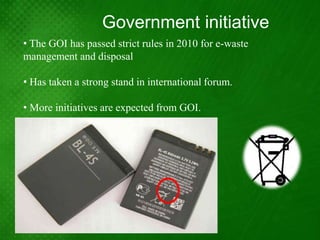
Government initiative
• The GOI has passed strict rules in 2010 for e-waste
management and disposal

• Has taken a strong stand in international forum.

• More initiatives are expected from GOI.
INDIVIDUAL COMMITMENT
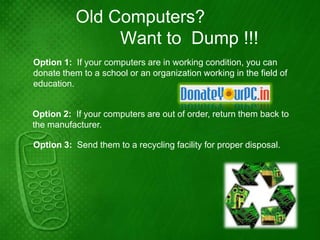
Old Computers?
                Want to Dump !!!
Option 1: If your computers are in working condition, you can
donate them to a school or an organization working in the field of
education.


Option 2: If your computers are out of order, return them back to
the manufacturer.

Option 3: Send them to a recycling facility for proper disposal.
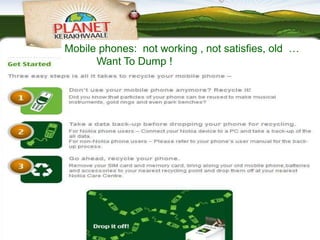
Mobile phones: not working , not satisfies, old …
      Want To Dump !
Want to buy a gadget ?
                 -- Be a ROHS
    compliant customer.
ROHS :Restriction Of the use of certain Hazardous Substances in
electrical and                   electronic equipment


           Lead (Pb)
           Mercury (Hg)
           Cadmium (Cd)
           Hexavalent chromium (Cr6+)
           Polybrominated biphenyls (PBB)
           Polybrominated diphenyl ether (PBDE)
           PBB and PBDE are flame retardants used
           in several plastics.
Buying a new cell phone

Check its SAR level first….
Going to buy a new gadget
Do you really need one?


                  Think
                  twice, be
                  wise
Bibliography

Impact of IT on environment

  • 1.
    IMPACT OF INFORMATION TECHNOLOGY ON ENVIRONMENT • K. Sai Malleswar • Kshitiz Sinha • Kumar Harshit • L. Deepak
  • 2.
    Topic • Information technology(IT) is the acquisition, processing, storage and dissemination of vocal, pictorial, textual and numerical information by a microelectronics-based combination of computing and telecommunications. • Having both positive and negative effects on environment. • What can be done to maximize POSITIVE aspects and minimize the NEGATIVES?
  • 3.
  • 4.
    + aspects ofIT 1) Reduction in consumption of paper: i) Use of digital database ii) Uses of e-books iii) Less letters more calls, SMSs and e-mails iv) Less greeting cards more online and text wishes 2) Reduction of use of writing and printing inks 3)Reduction in transportation: i)data transfer through e-mails, FAX, telephones and cell phones ii)shopping through e-marts iii) banking through e-banking and ATMs. iv) use of TELEMEDICINE.
  • 5.
    + aspects ofIT 4) compact space, reduction in cutting of trees 5) Monitering and controlling changes in the Earth’s environment through satellites 6) Spreading awareness regarding environment through INFORMATION TECHNOLOGY: using television, internet, radio channels and messages.
  • 6.
  • 7.
    21st century • Information age or computer age • Information technology • Telecommunications • 77% of world population owns mobile phones • 4-5 % of world population owns PCs
  • 8.
    Computers •Every single computer requires about 1.8 tonnes of chemicals, fossil fuels and water for its manufacture. • Emission of about 0.1 tonne of carbon dioxide in a year. • 2 per cent of world's total carbon dioxide emissions • Global warming • Dumping of old computers in landfills • Soil pollution
  • 9.
  • 10.
    E- Waste fromIT >>Discarded electronic or electrical devices or their parts Such as Discarded Computers Televisions Monitors Laptops Cell Phones VCRs Stereos Copiers Fax machines
  • 11.
    Dangerous elements inE-waste from IT  The cathode ray tubes (CRTs), which contain significant amounts of lead.  Liquid Crystal Displays (LCDs) are illuminated by mercury-filled panels.  Circuitry contain chromium, copper, and lead that exceed regulatory limits.  The batteries contain such as lead, nickel, cadmium, silver, lithium, and other dangerous metals.
  • 12.
    Mobile phones andcell towers
  • 13.
  • 14.
    SAR VALUES OFSOME MOBILES
  • 15.
    Space Debris ofCommunication satellites
  • 16.
    Mobile radiation: Effects onenvironment Farm animals - Dairy cows – •Decreased milk production •spontaneous abortions • reproductive problems •general declines in overall health. •Sheep, dogs, cats, rabbits living near base stations affected.
  • 17.
    Mobile radiation: Effects onenvironment Birds – • Interfere with navigation, reproduction, thin shells. • London - 75% fall sparrow population. • Fall in Pigeons, swans, white stork, rock dove •Biological indicators to detect alterations in our ecosystem
  • 18.
    Mobile radiation: Effects onenvironment Honey bees Colony Collapse Disorder (CCD): • Abrupt disappearance of bees. • Cannot find their way back to hive due disruption in intercellular communication. CCD has hit – US (up to 70 %), England (54% fall), Germany, Spain, Italy, Switzerland, Greece, Scotland, Wales, Kerala etc
  • 19.
    MANAGEMENT & CONTROL • INSTITUTIONS / INDUSTRIES FOR WASTE DISPOSAL • GOVT. INITIATIVE • INDIVIDUAL COMMITMENT
  • 20.
    INSTITUTIONS & INDUSTRIES Role: • The IT related industries (esp. the manufacturing ones) should reduce the use of toxic substances in products. • Recycling plants and collection centers should be set up . Do not DESIGN TO Dump ! Instead, DESIGN TO LAST !!!
  • 21.
    Government initiative • TheGOI has passed strict rules in 2010 for e-waste management and disposal • Has taken a strong stand in international forum. • More initiatives are expected from GOI.
  • 22.
  • 23.
    Old Computers? Want to Dump !!! Option 1: If your computers are in working condition, you can donate them to a school or an organization working in the field of education. Option 2: If your computers are out of order, return them back to the manufacturer. Option 3: Send them to a recycling facility for proper disposal.
  • 24.
    Mobile phones: notworking , not satisfies, old … Want To Dump !
  • 25.
    Want to buya gadget ? -- Be a ROHS compliant customer. ROHS :Restriction Of the use of certain Hazardous Substances in electrical and electronic equipment Lead (Pb) Mercury (Hg) Cadmium (Cd) Hexavalent chromium (Cr6+) Polybrominated biphenyls (PBB) Polybrominated diphenyl ether (PBDE) PBB and PBDE are flame retardants used in several plastics.
  • 26.
    Buying a newcell phone Check its SAR level first….
  • 27.
    Going to buya new gadget Do you really need one? Think twice, be wise
  • 28.