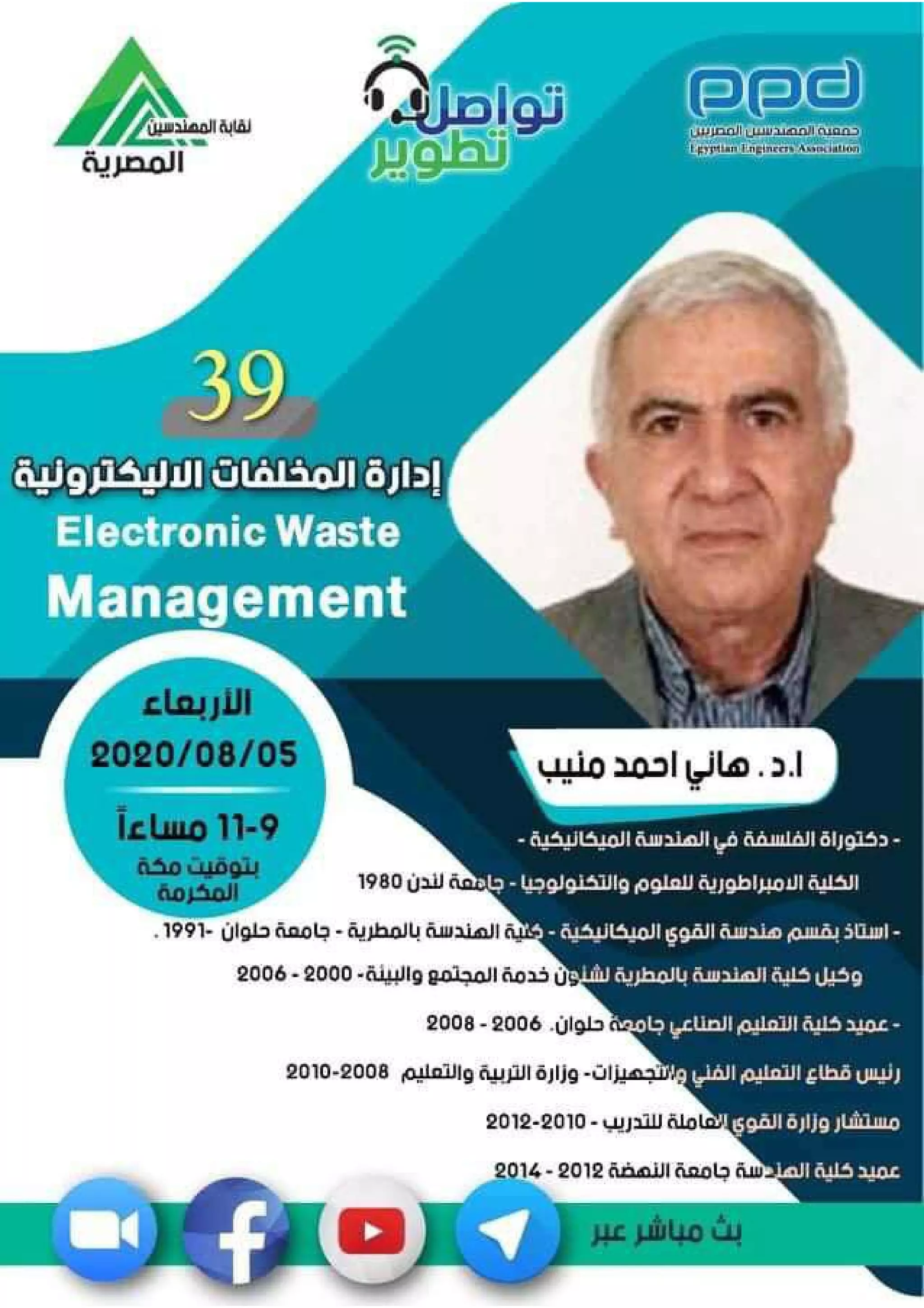

‫اإللكترونية‬ ‫المخلفات‬ ‫إدارة‬
‫مب‬‫ادرة‬#‫تواصل‬_‫مع‬ ‫المبادرة‬ ‫من‬ ‫والثالثون‬ ‫التاسعة‬ ‫تطويرالمحاضرة‬
‫الدكتور‬ ‫األستاذ‬/‫منيب‬ ‫أحمد‬ ‫هاني‬‫حلوان‬ ‫جامعة‬ ‫المطرية‬ ‫بهندسة‬ ‫الميكانيكية‬ ‫الهندسة‬ ‫أستاذ‬
Electronic Waste Management
Contents
1- Sustainability – Definition
2- The Problem: Waste Electrical Electronic Equipment (WEEE)
3- Beneficiaries
4- Examples of Electrical /Electronic Wastes
5- Statistical Data Related to WEEE
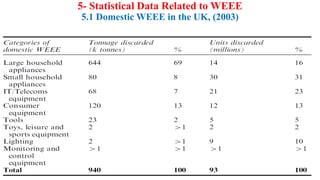
5.1 Domestic WEEE in the UK, (2003)
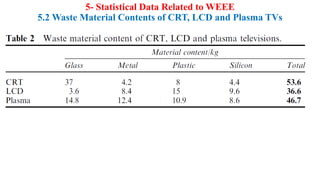
5.2 Waste Material Contents of CRT, LCD and Plasma TVs
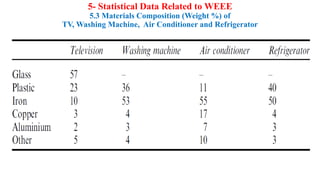
5.3 Materials Composition (Weight %) of TV, Washing Machine, Air Conditioner and Refrigerator
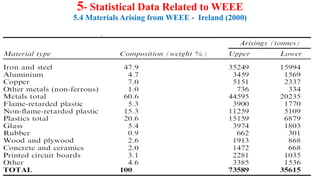
5.4 Materials Arising from WEEE - Ireland (2000)
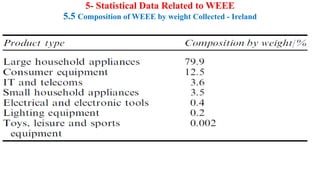
5.5 Composition of WEEE by weight Collected – Ireland
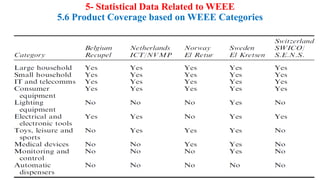
5.6 Product Coverage based on WEEE Categories
6- European Community Legislations
7- EC Producer Responsibility legislation
1- Sustainability - Definition
1- According to World Commission on Environment & Development
(Top Level Definition)
“Meeting the needs of the present generations without compromising the
ability of future generations to meet their own needs”
2- According to the Context of Industry
“Adopting strategies and activities that meet the needs of the enterprise and its
stakeholders today while protecting, sustaining and enhancing the human and
natural resources that will be needed in the future”
2- The Problem
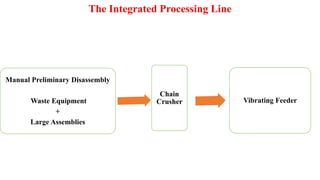
Waste Electrical Electronic Equipment (WEEE)
• The Problem
• Spectacular growth in the volumes of electronic wastes.
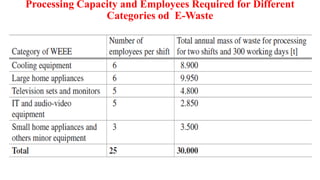
• Progressive reduction in the lifetimes of electronic wastes. (Fashion rather than
function).
• Promotion and Legislation for the recycling and recovery of the materials of
electronic wastes. (Metals, or Speciality Organic Chemicals and Plastics).
Cradle-to-Grave Planning Cradle-to-Cradle Planning
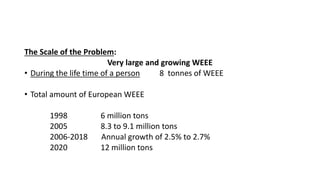
The Scale of the Problem:
Very large and growing WEEE
• During the life time of a person 8 tonnes of WEEE
• Total amount of European WEEE
1998 6 million tons
2005 8.3 to 9.1 million tons
2006-2018 Annual growth of 2.5% to 2.7%
2020 12 million tons
3- Beneficiaries
➢ Engineers and managers in eWaste industry
➢ Environmentalists
➢ Policymakers
➢ Students in environmental science and engineering and management courses.
4- Examples of Electrical /Electronic Wastes
• Mobile Telephones,
• Personal Computers
• Flat Screen TVs (CRT, LCD, Plasma)
• Household Appliances; (Refrigerators And Washing Machines)
• Small Household Appliances
• Car Instrument Panels
• Medical Electronics
• IT and Telecom Equipment
• Cathode Ray Tubes
• Toys, Leisure and sport Equipment
• Monitoring and Control equipment
• Lighting
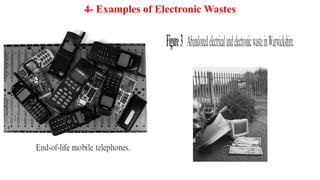
4- Examples of Electronic Wastes
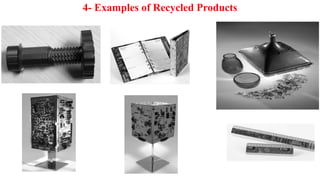
4- Examples of Recycled Products
5- Statistical Data Related to WEEE
5.1 Domestic WEEE in the UK, (2003)
5- Statistical Data Related to WEEE
5.2 Waste Material Contents of CRT, LCD and Plasma TVs
5- Statistical Data Related to WEEE
5.3 Materials Composition (Weight %) of
TV, Washing Machine, Air Conditioner and Refrigerator
5- Statistical Data Related to WEEE
5.4 Materials Arising from WEEE - Ireland (2000)
5- Statistical Data Related to WEEE
5.5 Composition of WEEE by weight Collected - Ireland
5- Statistical Data Related to WEEE
5.6 Product Coverage based on WEEE Categories
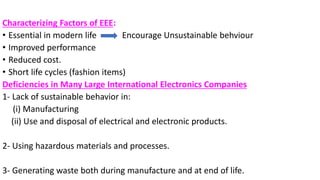
Characterizing Factors of EEE:
• Essential in modern life Encourage Unsustainable behviour
• Improved performance
• Reduced cost.
• Short life cycles (fashion items)
Deficiencies in Many Large International Electronics Companies
1- Lack of sustainable behavior in:
(i) Manufacturing
(ii) Use and disposal of electrical and electronic products.
2- Using hazardous materials and processes.
3- Generating waste both during manufacture and at end of life.
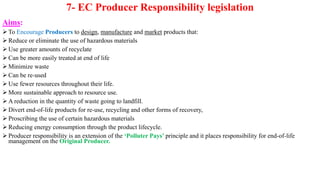
7- EC Producer Responsibility legislation
Aims:
➢ To Encourage Producers to design, manufacture and market products that:
➢ Reduce or eliminate the use of hazardous materials
➢ Use greater amounts of recyclate
➢ Can be more easily treated at end of life
➢ Minimize waste
➢ Can be re-used
➢ Use fewer resources throughout their life.
➢ More sustainable approach to resource use.
➢ A reduction in the quantity of waste going to landfill.
➢ Divert end-of-life products for re-use, recycling and other forms of recovery,
➢ Proscribing the use of certain hazardous materials
➢ Reducing energy consumption through the product lifecycle.
➢ Producer responsibility is an extension of the ‘Polluter Pays’ principle and it places responsibility for end-of-life
management on the Original Producer.
7- EC Producer Responsibility legislation
7.2 Responsibilities of Manufacturers
1. The adoption of NEW MANUFACTURING PROCESSES.
2. The use of NEW MATERIALS.
3. The development of Enhanced Recovery and Re-use Strategies at end of life.
4. Further Research and Development.
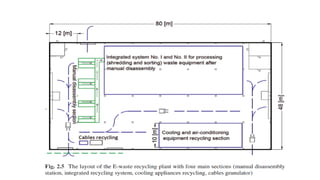
E-waste Recycling Plant Layout for Different
Categories of Equipment
Case Study
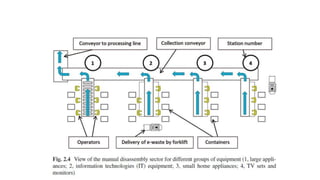
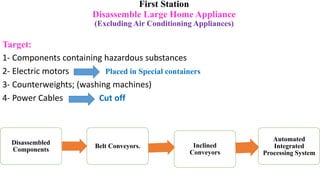
First Station
Disassemble Large Home Appliance
(Excluding Air Conditioning Appliances)
Target:
1- Components containing hazardous substances
2- Electric motors Placed in Special containers
3- Counterweights; (washing machines)
4- Power Cables Cut off
Disassembled
Components
Belt Conveyors. Inclined
Conveyors
Automated
Integrated
Processing System
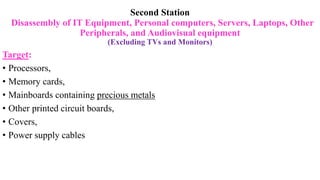
Second Station
Disassembly of IT Equipment, Personal computers, Servers, Laptops, Other
Peripherals, and Audiovisual equipment
(Excluding TVs and Monitors)
Target:
• Processors,
• Memory cards,
• Mainboards containing precious metals
• Other printed circuit boards,
• Covers,
• Power supply cables
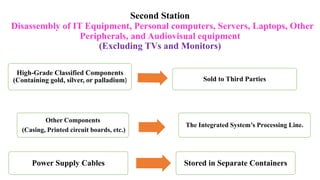
Second Station
Disassembly of IT Equipment, Personal computers, Servers, Laptops, Other
Peripherals, and Audiovisual equipment
(Excluding TVs and Monitors)
High-Grade Classified Components
(Containing gold, silver, or palladium) Sold to Third Parties
Other Components
(Casing, Printed circuit boards, etc.)
The Integrated System’s Processing Line.
Power Supply Cables Stored in Separate Containers
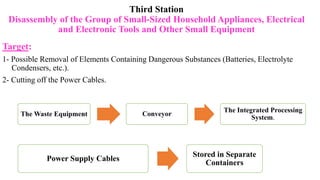
Third Station
Disassembly of the Group of Small-Sized Household Appliances, Electrical
and Electronic Tools and Other Small Equipment
Target:
1- Possible Removal of Elements Containing Dangerous Substances (Batteries, Electrolyte
Condensers, etc.).
2- Cutting off the Power Cables.
The Waste Equipment Conveyor
The Integrated Processing
System.
Power Supply Cables
Stored in Separate
Containers
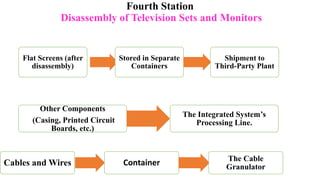
Fourth Station
Disassembly of Television Sets and Monitors
Flat Screens (after
disassembly)
Stored in Separate
Containers
Shipment to
Third-Party Plant
Other Components
(Casing, Printed Circuit
Boards, etc.)
The Integrated System’s
Processing Line.
Cables and Wires Container The Cable
Granulator
The Integrated Processing Line
Target:
➢Preparation of high-purity concentration of waste fractions of:
o Metallic – (Ferrous and Non-Ferrous) Wastes
o Plastics.
Elements of the Integrated Processing Line:
• Line No. I: For Large Home Appliances and Heavy Equipment
• Capacity: 2–4 [tonnes/h]
• Equipment:
• Belt conveyors and vibratory feeders
• Chain crusher
• Dust extraction systems
• Pneumatic sieves
• Separators: magnetic, eddy current, and electrostatic
The Integrated Processing Line
Manual Preliminary Disassembly
Waste Equipment
+
Large Assemblies
Chain
Crusher Vibrating Feeder
The Integrated Processing Line
Line No. II: For Small or Medium Equipment
&
Crush Residues from Line No. I
Capacity: 1–2 [tonnes/h]
Equipment:
o Belt conveyors and vibratory feeders
o Hammer mill
o Screening separators
o Electrostatic, magnetic, and eddy current separators.
Processing Capacity and Employees Required for Different
Categories od E-Waste
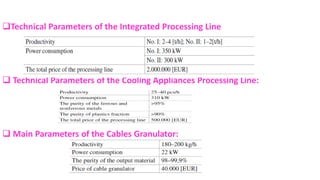
❑Technical Parameters of the Integrated Processing Line
❑ Technical Parameters of the Cooling Appliances Processing Line:
❑ Main Parameters of the Cables Granulator:
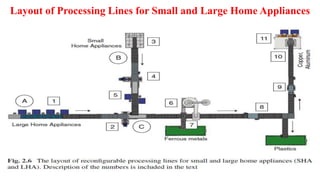
Layout of Processing Lines for Small and Large Home Appliances
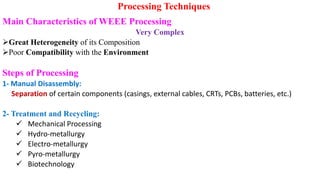
Processing Techniques
Main Characteristics of WEEE Processing
Very Complex
➢Great Heterogeneity of its Composition
➢Poor Compatibility with the Environment
Steps of Processing
1- Manual Disassembly:
Separation of certain components (casings, external cables, CRTs, PCBs, batteries, etc.)
2- Treatment and Recycling:
✓ Mechanical Processing
✓ Hydro-metallurgy
✓ Electro-metallurgy
✓ Pyro-metallurgy
✓ Biotechnology
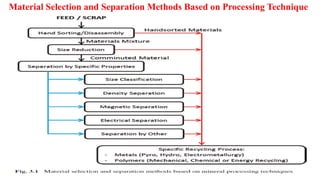
1. Mechanical Processing
Purpose: Pretreatment for separation of material)
➢ Select
➢ Separate Materials (based on steps of mineral processing techniques)
Methodologies of separation
➢ Density difference
➢ Particle size
➢ Magnetic
➢ Electrical properties
Material Selection and Separation Methods Based on Processing Technique
2- Hydrometallurgy
Steps:
1- Initial Step:
A number of Acidic or Caustic Attacks to dissolve the solid material
2- Subsequent Steps:
T
The Solutions are Subjected To Separation Processes; e.g.
➢ Solvent Extraction,
➢ Precipitation,
➢ Cementation,
➢ Ion Exchange,
➢ Filtration
➢ Distillation (To Isolate and concentrate the Metals of Interest)
2- Hydrometallurgy
The Main Advantages:
• Reduced risk of air pollution
• Higher selectivity to metals
• Lower process costs (e.g. low power consumption and reuse of chemical reagents).
The Disadvantages:
• Difficulty in processing more complex electronic scraps
• Need for mechanical pre-treatment of the scrap to reduce volume
• The chemical dissolution is effective only if the metal is exposed
• Large volume of solutions
• The wastewater can be corrosive, toxic or both
• Generation of solid waste.
3- Biotechnology
Principle:
Use of Bacteria in Metals Recycling
(The dissolution of metals and the recovery of gold from electronic waste)
Methodology:
Method 1:
Treatment of WEEE with a solution containing: (for 2 days)
o 10 g/l of Fe+3
o A culture of the bacterium (YTL-2) at pH < 2.5, temperature of 20–35 °C.
Metal Recovered: gold
Method 2: Microbiological Processes
Bacteria: Thiobacillus Thiooxidans - Ferroxidans
Fungus: Aspergillus iger - Penicillium Simplicissimum)
Metals Recovered: : Cu, Ni, Zn and Al
3- Biotechnology
Merits:
1- Low operating costs and
2- Low investment in equipment, in addition to
3- Generating little waste, effluents or toxic gases.
Main Limitations:
1- The long periods necessary for the leaching.
2- The metals content must be mainly located on the surface layer.
3- Restricted in terms of large scale implementation
4- Electrometallurgy
Steps of the Electro Winning Process that ultimately seeks to Recover a Pure Metal
Methodology:
Electrochemical processes are usually performed in Aqueous Electrolytes or Molten
Salts and can be used to recover metals from various types of waste.
Advantages
• Few steps
• Higher selectivity for desired metals
• The electrolyte can be reused
• Pure metals can be obtained.
The main limitation:
• The need of a Pre-treatment (usually based on mechanical and hydrometallurgical
processes).
4- Electrometallurgy
Advantages:
• Few steps
• Higher selectivity for desired metals
• The electrolyte can be reused
• Pure metals can be obtained.
Main Limitation:
The need of a pre-treatment (usually based on mechanical and hydrometallurgical
processes).
5- Pyrometallurgy
The Conventional Pyro-metallurgical Processing
1- Concentrating metals in a metallic phase
and
2- Rejecting most other materials in a slag and/or gas phase
Advantages
Applicability to any type of electronic waste, (no need for pre-treatment and few steps in
the process.
Problems: (Associated with Thermal Processing)
• Polymers and other insulating materials become a source of air pollution
(formation of dioxins and furans).
• Some metals can be lost through volatilization of their chlorides.
• Ceramic and glass components present in the scrap increase the amount of slag
in the furnace, increasing the losses of precious and base metals.
• Low Recovery of some metals (e.g. Sn and Pb) or almost impossible (e.g. Al and Zn).
Mechanical Processing
Steps:
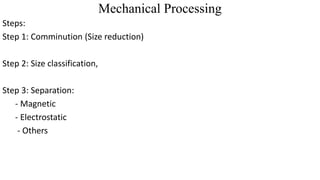
Step 1: Comminution (Size reduction)
Step 2: Size classification,
Step 3: Separation:
- Magnetic
- Electrostatic
- Others
Mechanical Processing
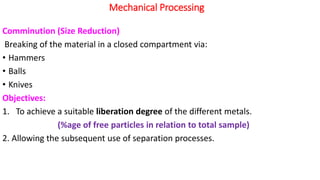
Comminution (Size Reduction)
Breaking of the material in a closed compartment via:
• Hammers
• Balls
• Knives
Objectives:
1. To achieve a suitable liberation degree of the different metals.
(%age of free particles in relation to total sample)
2. Allowing the subsequent use of separation processes.
Mechanical Processing
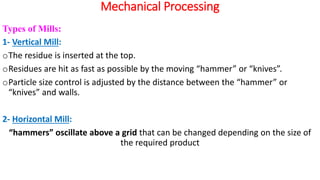
Types of Mills:
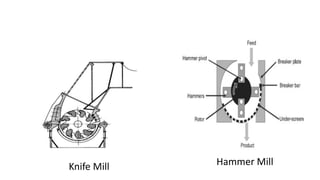
1- Vertical Mill:
oThe residue is inserted at the top.
oResidues are hit as fast as possible by the moving “hammer” or “knives”.
oParticle size control is adjusted by the distance between the “hammer” or
“knives” and walls.
2- Horizontal Mill:
“hammers” oscillate above a grid that can be changed depending on the size of
the required product
Knife Mill Hammer Mill
Step 2: Size Separation
Sieving:
A cascaded perforated surfaces over which the particles are moved. The smaller
particles pass through those perforations while the larger particles remain on the
sieve; (classification according to size only)
Types of Sieves:
o Vibrating sieves; (most common)
o Rotary sieves
o Vibration machines with air injection
Main Factors Affecting Sieving:
1- Material:
• Density • Particle Size Distribution • Particle Shapes • Particle Surfaces
2- Equipment:
• Sieve area • Percentage of perforated area • Hole diameter
• Hole shapes • Sieve thickness
3- Movement applied:
• Frequency • Amplitude and direction of vibration
• Tilt angle • Processing time
3- Density Separation (gravimetric Separation)
Principle:
The separation of the materials by
• Different densities,
• Sizes,
• Shapes
The Main Mechanisms in the Process:
➢ Differential acceleration,
➢ Sedimentation rates,
➢ Differential speed in laminar flow,
➢ Interstitial consolidation,
➢ The effect of shear forces
Types of WEEE materials to be separated by Density Difference:
polymers Densities < 2.0 g/cm3
light metals, (aluminum), Density = 2.7 g/cm3
heavy metals, (Cu, Fe, Ni and Pb) Density > 7 g/cm3
Main Processes:
➢ Air Classifiers Non-metallic components
➢ Dense Medium and Concentrators: Fractions of non-ferrous metals
➢ Suspensions
➢ Jigs, Air and Flowing Film Concentrators.
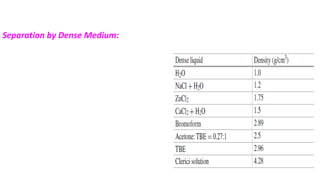
Separation by Dense Medium:
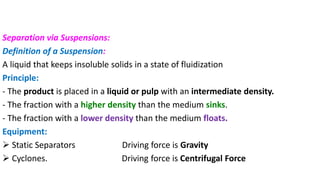
Separation via Suspensions:
Definition of a Suspension:
A liquid that keeps insoluble solids in a state of fluidization
Principle:
- The product is placed in a liquid or pulp with an intermediate density.
- The fraction with a higher density than the medium sinks.
- The fraction with a lower density than the medium floats.
Equipment:
➢ Static Separators Driving force is Gravity
➢ Cyclones. Driving force is Centrifugal Force
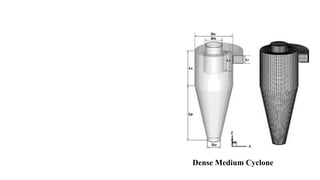
Dense Medium Cyclone

م.39-مبادرة#تواصل_تطوير-أ.د.هانى أحمد منيب-إدارة المخلفات الإلكترونية

  • 2.
    ‫اإللكترونية‬ ‫المخلفات‬ ‫إدارة‬ ‫مب‬‫ادرة‬#‫تواصل‬_‫مع‬‫المبادرة‬ ‫من‬ ‫والثالثون‬ ‫التاسعة‬ ‫تطويرالمحاضرة‬ ‫الدكتور‬ ‫األستاذ‬/‫منيب‬ ‫أحمد‬ ‫هاني‬‫حلوان‬ ‫جامعة‬ ‫المطرية‬ ‫بهندسة‬ ‫الميكانيكية‬ ‫الهندسة‬ ‫أستاذ‬
  • 3.
    Electronic Waste Management Contents 1-Sustainability – Definition 2- The Problem: Waste Electrical Electronic Equipment (WEEE) 3- Beneficiaries 4- Examples of Electrical /Electronic Wastes 5- Statistical Data Related to WEEE 5.1 Domestic WEEE in the UK, (2003) 5.2 Waste Material Contents of CRT, LCD and Plasma TVs 5.3 Materials Composition (Weight %) of TV, Washing Machine, Air Conditioner and Refrigerator 5.4 Materials Arising from WEEE - Ireland (2000) 5.5 Composition of WEEE by weight Collected – Ireland 5.6 Product Coverage based on WEEE Categories 6- European Community Legislations 7- EC Producer Responsibility legislation
  • 4.
    1- Sustainability -Definition 1- According to World Commission on Environment & Development (Top Level Definition) “Meeting the needs of the present generations without compromising the ability of future generations to meet their own needs” 2- According to the Context of Industry “Adopting strategies and activities that meet the needs of the enterprise and its stakeholders today while protecting, sustaining and enhancing the human and natural resources that will be needed in the future”
  • 5.
    2- The Problem WasteElectrical Electronic Equipment (WEEE) • The Problem • Spectacular growth in the volumes of electronic wastes. • Progressive reduction in the lifetimes of electronic wastes. (Fashion rather than function). • Promotion and Legislation for the recycling and recovery of the materials of electronic wastes. (Metals, or Speciality Organic Chemicals and Plastics). Cradle-to-Grave Planning Cradle-to-Cradle Planning
  • 6.
    The Scale ofthe Problem: Very large and growing WEEE • During the life time of a person 8 tonnes of WEEE • Total amount of European WEEE 1998 6 million tons 2005 8.3 to 9.1 million tons 2006-2018 Annual growth of 2.5% to 2.7% 2020 12 million tons
  • 7.
    3- Beneficiaries ➢ Engineersand managers in eWaste industry ➢ Environmentalists ➢ Policymakers ➢ Students in environmental science and engineering and management courses.
  • 8.
    4- Examples ofElectrical /Electronic Wastes • Mobile Telephones, • Personal Computers • Flat Screen TVs (CRT, LCD, Plasma) • Household Appliances; (Refrigerators And Washing Machines) • Small Household Appliances • Car Instrument Panels • Medical Electronics • IT and Telecom Equipment • Cathode Ray Tubes • Toys, Leisure and sport Equipment • Monitoring and Control equipment • Lighting
  • 9.
    4- Examples ofElectronic Wastes
  • 10.
    4- Examples ofRecycled Products
  • 11.
    5- Statistical DataRelated to WEEE 5.1 Domestic WEEE in the UK, (2003)
  • 12.
    5- Statistical DataRelated to WEEE 5.2 Waste Material Contents of CRT, LCD and Plasma TVs
  • 13.
    5- Statistical DataRelated to WEEE 5.3 Materials Composition (Weight %) of TV, Washing Machine, Air Conditioner and Refrigerator
  • 14.
    5- Statistical DataRelated to WEEE 5.4 Materials Arising from WEEE - Ireland (2000)
  • 15.
    5- Statistical DataRelated to WEEE 5.5 Composition of WEEE by weight Collected - Ireland
  • 16.
    5- Statistical DataRelated to WEEE 5.6 Product Coverage based on WEEE Categories
  • 17.
    Characterizing Factors ofEEE: • Essential in modern life Encourage Unsustainable behviour • Improved performance • Reduced cost. • Short life cycles (fashion items) Deficiencies in Many Large International Electronics Companies 1- Lack of sustainable behavior in: (i) Manufacturing (ii) Use and disposal of electrical and electronic products. 2- Using hazardous materials and processes. 3- Generating waste both during manufacture and at end of life.
  • 18.
    7- EC ProducerResponsibility legislation Aims: ➢ To Encourage Producers to design, manufacture and market products that: ➢ Reduce or eliminate the use of hazardous materials ➢ Use greater amounts of recyclate ➢ Can be more easily treated at end of life ➢ Minimize waste ➢ Can be re-used ➢ Use fewer resources throughout their life. ➢ More sustainable approach to resource use. ➢ A reduction in the quantity of waste going to landfill. ➢ Divert end-of-life products for re-use, recycling and other forms of recovery, ➢ Proscribing the use of certain hazardous materials ➢ Reducing energy consumption through the product lifecycle. ➢ Producer responsibility is an extension of the ‘Polluter Pays’ principle and it places responsibility for end-of-life management on the Original Producer.
  • 19.
    7- EC ProducerResponsibility legislation 7.2 Responsibilities of Manufacturers 1. The adoption of NEW MANUFACTURING PROCESSES. 2. The use of NEW MATERIALS. 3. The development of Enhanced Recovery and Re-use Strategies at end of life. 4. Further Research and Development.
  • 22.
    E-waste Recycling PlantLayout for Different Categories of Equipment Case Study
  • 23.
    First Station Disassemble LargeHome Appliance (Excluding Air Conditioning Appliances) Target: 1- Components containing hazardous substances 2- Electric motors Placed in Special containers 3- Counterweights; (washing machines) 4- Power Cables Cut off Disassembled Components Belt Conveyors. Inclined Conveyors Automated Integrated Processing System
  • 24.
    Second Station Disassembly ofIT Equipment, Personal computers, Servers, Laptops, Other Peripherals, and Audiovisual equipment (Excluding TVs and Monitors) Target: • Processors, • Memory cards, • Mainboards containing precious metals • Other printed circuit boards, • Covers, • Power supply cables
  • 25.
    Second Station Disassembly ofIT Equipment, Personal computers, Servers, Laptops, Other Peripherals, and Audiovisual equipment (Excluding TVs and Monitors) High-Grade Classified Components (Containing gold, silver, or palladium) Sold to Third Parties Other Components (Casing, Printed circuit boards, etc.) The Integrated System’s Processing Line. Power Supply Cables Stored in Separate Containers
  • 26.
    Third Station Disassembly ofthe Group of Small-Sized Household Appliances, Electrical and Electronic Tools and Other Small Equipment Target: 1- Possible Removal of Elements Containing Dangerous Substances (Batteries, Electrolyte Condensers, etc.). 2- Cutting off the Power Cables. The Waste Equipment Conveyor The Integrated Processing System. Power Supply Cables Stored in Separate Containers
  • 27.
    Fourth Station Disassembly ofTelevision Sets and Monitors Flat Screens (after disassembly) Stored in Separate Containers Shipment to Third-Party Plant Other Components (Casing, Printed Circuit Boards, etc.) The Integrated System’s Processing Line. Cables and Wires Container The Cable Granulator
  • 28.
    The Integrated ProcessingLine Target: ➢Preparation of high-purity concentration of waste fractions of: o Metallic – (Ferrous and Non-Ferrous) Wastes o Plastics. Elements of the Integrated Processing Line: • Line No. I: For Large Home Appliances and Heavy Equipment • Capacity: 2–4 [tonnes/h] • Equipment: • Belt conveyors and vibratory feeders • Chain crusher • Dust extraction systems • Pneumatic sieves • Separators: magnetic, eddy current, and electrostatic
  • 29.
    The Integrated ProcessingLine Manual Preliminary Disassembly Waste Equipment + Large Assemblies Chain Crusher Vibrating Feeder
  • 30.
    The Integrated ProcessingLine Line No. II: For Small or Medium Equipment & Crush Residues from Line No. I Capacity: 1–2 [tonnes/h] Equipment: o Belt conveyors and vibratory feeders o Hammer mill o Screening separators o Electrostatic, magnetic, and eddy current separators.
  • 31.
    Processing Capacity andEmployees Required for Different Categories od E-Waste
  • 34.
    ❑Technical Parameters ofthe Integrated Processing Line ❑ Technical Parameters of the Cooling Appliances Processing Line: ❑ Main Parameters of the Cables Granulator:
  • 35.
    Layout of ProcessingLines for Small and Large Home Appliances
  • 36.
    Processing Techniques Main Characteristicsof WEEE Processing Very Complex ➢Great Heterogeneity of its Composition ➢Poor Compatibility with the Environment Steps of Processing 1- Manual Disassembly: Separation of certain components (casings, external cables, CRTs, PCBs, batteries, etc.) 2- Treatment and Recycling: ✓ Mechanical Processing ✓ Hydro-metallurgy ✓ Electro-metallurgy ✓ Pyro-metallurgy ✓ Biotechnology
  • 37.
    1. Mechanical Processing Purpose:Pretreatment for separation of material) ➢ Select ➢ Separate Materials (based on steps of mineral processing techniques) Methodologies of separation ➢ Density difference ➢ Particle size ➢ Magnetic ➢ Electrical properties
  • 38.
    Material Selection andSeparation Methods Based on Processing Technique
  • 39.
    2- Hydrometallurgy Steps: 1- InitialStep: A number of Acidic or Caustic Attacks to dissolve the solid material 2- Subsequent Steps: T The Solutions are Subjected To Separation Processes; e.g. ➢ Solvent Extraction, ➢ Precipitation, ➢ Cementation, ➢ Ion Exchange, ➢ Filtration ➢ Distillation (To Isolate and concentrate the Metals of Interest)
  • 40.
    2- Hydrometallurgy The MainAdvantages: • Reduced risk of air pollution • Higher selectivity to metals • Lower process costs (e.g. low power consumption and reuse of chemical reagents). The Disadvantages: • Difficulty in processing more complex electronic scraps • Need for mechanical pre-treatment of the scrap to reduce volume • The chemical dissolution is effective only if the metal is exposed • Large volume of solutions • The wastewater can be corrosive, toxic or both • Generation of solid waste.
  • 41.
    3- Biotechnology Principle: Use ofBacteria in Metals Recycling (The dissolution of metals and the recovery of gold from electronic waste) Methodology: Method 1: Treatment of WEEE with a solution containing: (for 2 days) o 10 g/l of Fe+3 o A culture of the bacterium (YTL-2) at pH < 2.5, temperature of 20–35 °C. Metal Recovered: gold Method 2: Microbiological Processes Bacteria: Thiobacillus Thiooxidans - Ferroxidans Fungus: Aspergillus iger - Penicillium Simplicissimum) Metals Recovered: : Cu, Ni, Zn and Al
  • 42.
    3- Biotechnology Merits: 1- Lowoperating costs and 2- Low investment in equipment, in addition to 3- Generating little waste, effluents or toxic gases. Main Limitations: 1- The long periods necessary for the leaching. 2- The metals content must be mainly located on the surface layer. 3- Restricted in terms of large scale implementation
  • 43.
    4- Electrometallurgy Steps ofthe Electro Winning Process that ultimately seeks to Recover a Pure Metal Methodology: Electrochemical processes are usually performed in Aqueous Electrolytes or Molten Salts and can be used to recover metals from various types of waste. Advantages • Few steps • Higher selectivity for desired metals • The electrolyte can be reused • Pure metals can be obtained. The main limitation: • The need of a Pre-treatment (usually based on mechanical and hydrometallurgical processes).
  • 44.
    4- Electrometallurgy Advantages: • Fewsteps • Higher selectivity for desired metals • The electrolyte can be reused • Pure metals can be obtained. Main Limitation: The need of a pre-treatment (usually based on mechanical and hydrometallurgical processes).
  • 45.
    5- Pyrometallurgy The ConventionalPyro-metallurgical Processing 1- Concentrating metals in a metallic phase and 2- Rejecting most other materials in a slag and/or gas phase Advantages Applicability to any type of electronic waste, (no need for pre-treatment and few steps in the process. Problems: (Associated with Thermal Processing) • Polymers and other insulating materials become a source of air pollution (formation of dioxins and furans). • Some metals can be lost through volatilization of their chlorides. • Ceramic and glass components present in the scrap increase the amount of slag in the furnace, increasing the losses of precious and base metals. • Low Recovery of some metals (e.g. Sn and Pb) or almost impossible (e.g. Al and Zn).
  • 46.
    Mechanical Processing Steps: Step 1:Comminution (Size reduction) Step 2: Size classification, Step 3: Separation: - Magnetic - Electrostatic - Others
  • 47.
    Mechanical Processing Comminution (SizeReduction) Breaking of the material in a closed compartment via: • Hammers • Balls • Knives Objectives: 1. To achieve a suitable liberation degree of the different metals. (%age of free particles in relation to total sample) 2. Allowing the subsequent use of separation processes.
  • 48.
    Mechanical Processing Types ofMills: 1- Vertical Mill: oThe residue is inserted at the top. oResidues are hit as fast as possible by the moving “hammer” or “knives”. oParticle size control is adjusted by the distance between the “hammer” or “knives” and walls. 2- Horizontal Mill: “hammers” oscillate above a grid that can be changed depending on the size of the required product
  • 49.
  • 50.
    Step 2: SizeSeparation Sieving: A cascaded perforated surfaces over which the particles are moved. The smaller particles pass through those perforations while the larger particles remain on the sieve; (classification according to size only) Types of Sieves: o Vibrating sieves; (most common) o Rotary sieves o Vibration machines with air injection
  • 51.
    Main Factors AffectingSieving: 1- Material: • Density • Particle Size Distribution • Particle Shapes • Particle Surfaces 2- Equipment: • Sieve area • Percentage of perforated area • Hole diameter • Hole shapes • Sieve thickness 3- Movement applied: • Frequency • Amplitude and direction of vibration • Tilt angle • Processing time
  • 52.
    3- Density Separation(gravimetric Separation) Principle: The separation of the materials by • Different densities, • Sizes, • Shapes The Main Mechanisms in the Process: ➢ Differential acceleration, ➢ Sedimentation rates, ➢ Differential speed in laminar flow, ➢ Interstitial consolidation, ➢ The effect of shear forces
  • 53.
    Types of WEEEmaterials to be separated by Density Difference: polymers Densities < 2.0 g/cm3 light metals, (aluminum), Density = 2.7 g/cm3 heavy metals, (Cu, Fe, Ni and Pb) Density > 7 g/cm3 Main Processes: ➢ Air Classifiers Non-metallic components ➢ Dense Medium and Concentrators: Fractions of non-ferrous metals ➢ Suspensions ➢ Jigs, Air and Flowing Film Concentrators.
  • 54.
  • 55.
    Separation via Suspensions: Definitionof a Suspension: A liquid that keeps insoluble solids in a state of fluidization Principle: - The product is placed in a liquid or pulp with an intermediate density. - The fraction with a higher density than the medium sinks. - The fraction with a lower density than the medium floats. Equipment: ➢ Static Separators Driving force is Gravity ➢ Cyclones. Driving force is Centrifugal Force
  • 56.