 To provide up-to-date, controlled
  documentation of all
  programs, procedures, documents, etc.
 To provide user-friendly, around the clock
  access to ensure proper implementation of
  all EMS programs and procedures.
 Proactive approach to help a company
  address regulatory demands systematically
  and cost-effectively
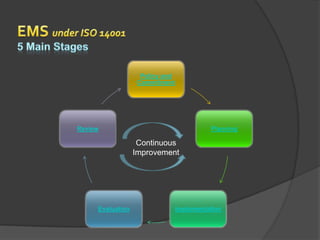
Policy and
                   Commitment


Review                                     Planning

                   Continuous
                  Improvement


     Evaluation                  Implementation
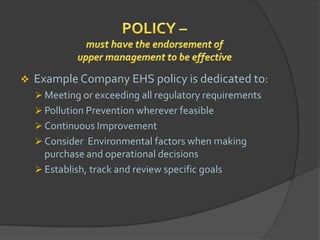
   Example Company EHS policy is dedicated to:
     Meeting or exceeding all regulatory requirements
     Pollution Prevention wherever feasible
     Continuous Improvement
     Consider Environmental factors when making
      purchase and operational decisions
     Establish, track and review specific goals
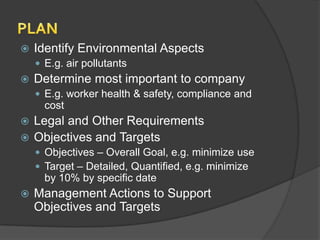
   Identify Environmental Aspects
     E.g. air pollutants
   Determine most important to company
     E.g. worker health & safety, compliance and
      cost
 Legal and Other Requirements
 Objectives and Targets
     Objectives – Overall Goal, e.g. minimize use
     Target – Detailed, Quantified, e.g. minimize
      by 10% by specific date
   Management Actions to Support
    Objectives and Targets
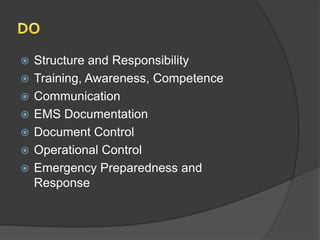
   Structure and Responsibility
   Training, Awareness, Competence
   Communication
   EMS Documentation
   Document Control
   Operational Control
   Emergency Preparedness and
    Response
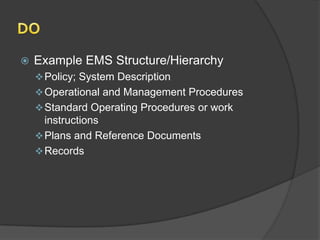
   Example EMS Structure/Hierarchy
     Policy; System Description
     Operational and Management Procedures
     Standard Operating Procedures or work
      instructions
     Plans and Reference Documents
     Records
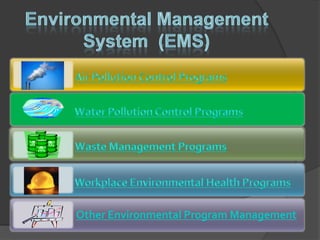
Other Environmental Program Management
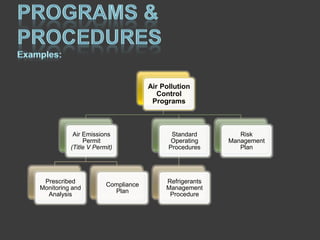
Air Pollution
                                       Control
                                     Programs


           Air Emissions                   Standard        Risk
               Permit                      Operating    Management
          (Title V Permit)                Procedures       Plan


 Prescribed                              Refrigerants
                       Compliance
Monitoring and                           Management
                         Plan
  Analysis                                Procedure
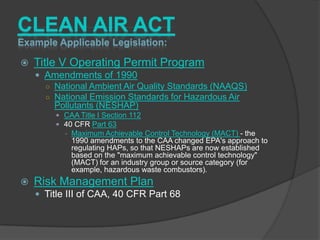
CLEAN AIR ACT
Example Applicable Legislation:

   Title V Operating Permit Program
     Amendments of 1990
      ○ National Ambient Air Quality Standards (NAAQS)
      ○ National Emission Standards for Hazardous Air
        Pollutants (NESHAP)
         CAA Title I Section 112
         40 CFR Part 63
           - Maximum Achievable Control Technology (MACT) - the
             1990 amendments to the CAA changed EPA's approach to
             regulating HAPs, so that NESHAPs are now established
             based on the "maximum achievable control technology"
             (MACT) for an industry group or source category (for
             example, hazardous waste combustors).
   Risk Management Plan
     Title III of CAA, 40 CFR Part 68
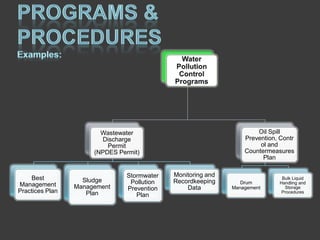
Wastewater                                    Oil Spill
                        Discharge                                 Prevention, Contr
                          Permit                                       ol and
                      (NPDES Permit)                              Countermeasures
                                                                        Plan

                                Stormwater   Monitoring and
    Best           Sludge                                                      Bulk Liquid
                                 Pollution   Recordkeeping       Drum         Handling and
Management       Management     Prevention       Data         Management        Storage
Practices Plan      Plan                                                       Procedures
                                   Plan
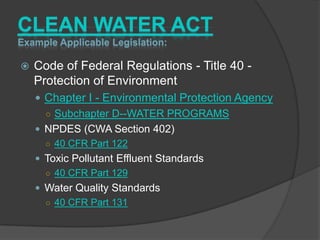
CLEAN WATER ACT
Example Applicable Legislation:

   Code of Federal Regulations - Title 40 -
    Protection of Environment
     Chapter I - Environmental Protection Agency
      ○ Subchapter D--WATER PROGRAMS
     NPDES (CWA Section 402)
      ○ 40 CFR Part 122
     Toxic Pollutant Effluent Standards
      ○ 40 CFR Part 129
     Water Quality Standards
      ○ 40 CFR Part 131
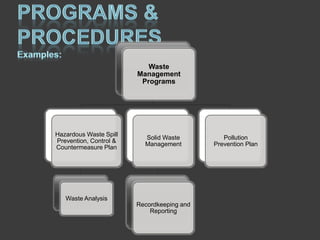
Waste
                        Management
                         Programs


Hazardous Waste Spill
                          Solid Waste          Pollution
Prevention, Control &
                          Management        Prevention Plan
Countermeasure Plan


   Waste Analysis
                        Recordkeeping and
                            Reporting
WASTE MANAGEMENT
Example Applicable Legislation:

   Resource Conservation and Recovery Act
    (RCRA)
     Non-hazardous waste/Solid waste 40 CFR Part
      239-259
     Hazardous waste 40 CFR Part 260 [-279]
      ○ Details – Part 261
         Ignitable Waste (I) Corrosive Waste (C) Reactive Waste (R)
          Toxicity Characteristic Waste (E) Acute Hazardous Waste (H) Toxic
          Waste (T) = Characteristic waste
         Specific wastes such as, slop oil emulsion solids from the
          petroleum refining industry [K049] = Listed waste

     Pollution Prevention Act
     Toxic Substances Control Act
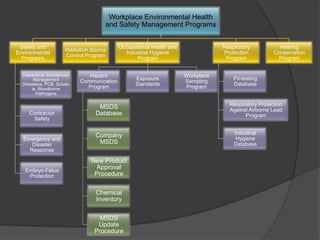
Safety and                                Occupational Health and               Respiratory           Hearing
                      Radiation Source
Environmental                                Industrial Hygiene                  Protection          Conservation
                      Control Program
  Programs                                       Program                          Program              Program


  Hazardous Substances        Hazard                                 Workplace
       Management                                Exposure                            Fit-testing
                           Communication                             Sampling
  [Asbestos, PCB, Solven                         Standards                           Database
      ts, Bloodborne         Program                                 Program
        Pathogens


                                  MSDS                                             Respiratory Protection
                                                                                   Against Airborne Lead
     Contractor                  Database                                                Program
      Safety


                                 Company                                             Industrial
  Emergency and                                                                       Hygiene
     Disaster                     MSDS                                               Database
    Response

                                New Product
   Embryo-Fetus
                                  Approval
    Protection                   Procedure


                                 Chemical
                                 Inventory


                                   MSDS
                                  Update
                                 Procedure
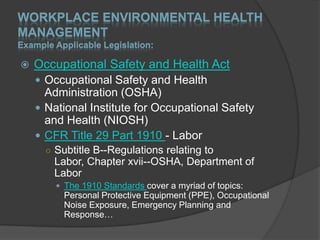
WORKPLACE ENVIRONMENTAL HEALTH
MANAGEMENT
Example Applicable Legislation:

   Occupational Safety and Health Act
     Occupational Safety and Health
      Administration (OSHA)
     National Institute for Occupational Safety
      and Health (NIOSH)
     CFR Title 29 Part 1910 - Labor
      ○ Subtitle B--Regulations relating to
        Labor, Chapter xvii--OSHA, Department of
        Labor
         The 1910 Standards cover a myriad of topics:
          Personal Protective Equipment (PPE), Occupational
          Noise Exposure, Emergency Planning and
          Response…
Other Environmental
                                                      Program Management


Corporate Citizenship
                                                                EHS Management                              EMS Manual
     Program


         Tier II Reports
          [Inventory of
                              Programs, Procedures            Environmental Calendar
         Substances for                                                                Compliance Reviews            Policy
                              and work instructions            and Training Schedule
           Emergency
          Responders]


                                    Descriptions of Roles,
    Toxic Release Inventory           Responsibilities,                                                      Lists of Objectives and
           Reports                 Authorities and Lines of                                                           Targets
                                      Communications


      Community Relations           Equipment Calibration                                                   Environmental Aspects
      and Communications                 Procedure                                                          and Impacts Inventory
OTHER ENVIRONMENTAL
PROGRAM MANAGEMENT
Example Applicable Legislation:
 Comprehensive Environmental
  Response, Compensation, and Liability Act
  (CERCLA) Hazardous Substances
  [Superfund]
 Superfund Amendments and
  Reauthorization Act (SARA)
     Emergency Planning and Community Right-to-
      Know Act (EPCRA) [also known as SARA Title III]
      ○ Tier II Report [SARA 311/312] – Inventory of
        Substances for Emergency Responders, 40 CFR
        Part 370
      ○ Toxic Release Inventory Report – [SARA 313] Tier
        III Report
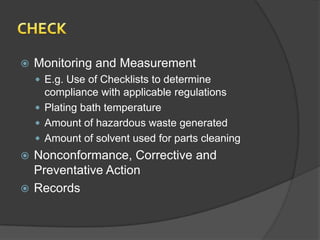
   Monitoring and Measurement
     E.g. Use of Checklists to determine
      compliance with applicable regulations
     Plating bath temperature
     Amount of hazardous waste generated
     Amount of solvent used for parts cleaning
 Nonconformance, Corrective and
  Preventative Action
 Records
 EMS Audits
 Management Review
     Determines if original policy is consistent with
      company values
     Possible revisions to optimize effectiveness


   This final review stage creates a loop of
    continuous improvement for a company
Environmental Management
       System (EMS) Example
   This presentation is an         Environmental, Safety and
    example and not site             Health Programs, Plans
    specific                         and Procedures overlap
   Each company - industry -         For example, Drum
    site requires specific             Management is a stand
                                       alone SOP, but also a part
    programs, plans, practices         of the OSPCC Plan
    and procedures                    Again, Best Management
   Intended for an overview -         Practices (BMP) is stand
    example - general idea -           alone, but also part of the
    demonstration purposes             NPDES permit
    only                              OSHA 1910, in particular,
                                       addresses health and
                                       safety, but overlaps with
                                       environmental aspects
                                        ○ i.e. HazCom, Hearing
                                          Conservation, Respiratory
                                          Protection, PPE usage…

Environmental Management System Development

  • 2.
     To provideup-to-date, controlled documentation of all programs, procedures, documents, etc.  To provide user-friendly, around the clock access to ensure proper implementation of all EMS programs and procedures.  Proactive approach to help a company address regulatory demands systematically and cost-effectively
  • 3.
    Policy and Commitment Review Planning Continuous Improvement Evaluation Implementation
  • 4.
    Example Company EHS policy is dedicated to:  Meeting or exceeding all regulatory requirements  Pollution Prevention wherever feasible  Continuous Improvement  Consider Environmental factors when making purchase and operational decisions  Establish, track and review specific goals
  • 5.
    Identify Environmental Aspects  E.g. air pollutants  Determine most important to company  E.g. worker health & safety, compliance and cost  Legal and Other Requirements  Objectives and Targets  Objectives – Overall Goal, e.g. minimize use  Target – Detailed, Quantified, e.g. minimize by 10% by specific date  Management Actions to Support Objectives and Targets
  • 6.
    Structure and Responsibility  Training, Awareness, Competence  Communication  EMS Documentation  Document Control  Operational Control  Emergency Preparedness and Response
  • 7.
    Example EMS Structure/Hierarchy  Policy; System Description  Operational and Management Procedures  Standard Operating Procedures or work instructions  Plans and Reference Documents  Records
  • 8.
  • 9.
    Air Pollution Control Programs Air Emissions Standard Risk Permit Operating Management (Title V Permit) Procedures Plan Prescribed Refrigerants Compliance Monitoring and Management Plan Analysis Procedure
  • 10.
    CLEAN AIR ACT ExampleApplicable Legislation:  Title V Operating Permit Program  Amendments of 1990 ○ National Ambient Air Quality Standards (NAAQS) ○ National Emission Standards for Hazardous Air Pollutants (NESHAP)  CAA Title I Section 112  40 CFR Part 63 - Maximum Achievable Control Technology (MACT) - the 1990 amendments to the CAA changed EPA's approach to regulating HAPs, so that NESHAPs are now established based on the "maximum achievable control technology" (MACT) for an industry group or source category (for example, hazardous waste combustors).  Risk Management Plan  Title III of CAA, 40 CFR Part 68
  • 11.
    Wastewater Oil Spill Discharge Prevention, Contr Permit ol and (NPDES Permit) Countermeasures Plan Stormwater Monitoring and Best Sludge Bulk Liquid Pollution Recordkeeping Drum Handling and Management Management Prevention Data Management Storage Practices Plan Plan Procedures Plan
  • 12.
    CLEAN WATER ACT ExampleApplicable Legislation:  Code of Federal Regulations - Title 40 - Protection of Environment  Chapter I - Environmental Protection Agency ○ Subchapter D--WATER PROGRAMS  NPDES (CWA Section 402) ○ 40 CFR Part 122  Toxic Pollutant Effluent Standards ○ 40 CFR Part 129  Water Quality Standards ○ 40 CFR Part 131
  • 13.
    Waste Management Programs Hazardous Waste Spill Solid Waste Pollution Prevention, Control & Management Prevention Plan Countermeasure Plan Waste Analysis Recordkeeping and Reporting
  • 14.
    WASTE MANAGEMENT Example ApplicableLegislation:  Resource Conservation and Recovery Act (RCRA)  Non-hazardous waste/Solid waste 40 CFR Part 239-259  Hazardous waste 40 CFR Part 260 [-279] ○ Details – Part 261  Ignitable Waste (I) Corrosive Waste (C) Reactive Waste (R) Toxicity Characteristic Waste (E) Acute Hazardous Waste (H) Toxic Waste (T) = Characteristic waste  Specific wastes such as, slop oil emulsion solids from the petroleum refining industry [K049] = Listed waste  Pollution Prevention Act  Toxic Substances Control Act
  • 15.
    Safety and Occupational Health and Respiratory Hearing Radiation Source Environmental Industrial Hygiene Protection Conservation Control Program Programs Program Program Program Hazardous Substances Hazard Workplace Management Exposure Fit-testing Communication Sampling [Asbestos, PCB, Solven Standards Database ts, Bloodborne Program Program Pathogens MSDS Respiratory Protection Against Airborne Lead Contractor Database Program Safety Company Industrial Emergency and Hygiene Disaster MSDS Database Response New Product Embryo-Fetus Approval Protection Procedure Chemical Inventory MSDS Update Procedure
  • 16.
    WORKPLACE ENVIRONMENTAL HEALTH MANAGEMENT ExampleApplicable Legislation:  Occupational Safety and Health Act  Occupational Safety and Health Administration (OSHA)  National Institute for Occupational Safety and Health (NIOSH)  CFR Title 29 Part 1910 - Labor ○ Subtitle B--Regulations relating to Labor, Chapter xvii--OSHA, Department of Labor  The 1910 Standards cover a myriad of topics: Personal Protective Equipment (PPE), Occupational Noise Exposure, Emergency Planning and Response…
  • 17.
    Other Environmental Program Management Corporate Citizenship EHS Management EMS Manual Program Tier II Reports [Inventory of Programs, Procedures Environmental Calendar Substances for Compliance Reviews Policy and work instructions and Training Schedule Emergency Responders] Descriptions of Roles, Toxic Release Inventory Responsibilities, Lists of Objectives and Reports Authorities and Lines of Targets Communications Community Relations Equipment Calibration Environmental Aspects and Communications Procedure and Impacts Inventory
  • 18.
    OTHER ENVIRONMENTAL PROGRAM MANAGEMENT ExampleApplicable Legislation:  Comprehensive Environmental Response, Compensation, and Liability Act (CERCLA) Hazardous Substances [Superfund]  Superfund Amendments and Reauthorization Act (SARA)  Emergency Planning and Community Right-to- Know Act (EPCRA) [also known as SARA Title III] ○ Tier II Report [SARA 311/312] – Inventory of Substances for Emergency Responders, 40 CFR Part 370 ○ Toxic Release Inventory Report – [SARA 313] Tier III Report
  • 19.
    Monitoring and Measurement  E.g. Use of Checklists to determine compliance with applicable regulations  Plating bath temperature  Amount of hazardous waste generated  Amount of solvent used for parts cleaning  Nonconformance, Corrective and Preventative Action  Records
  • 20.
     EMS Audits Management Review  Determines if original policy is consistent with company values  Possible revisions to optimize effectiveness  This final review stage creates a loop of continuous improvement for a company
  • 21.
    Environmental Management System (EMS) Example  This presentation is an  Environmental, Safety and example and not site Health Programs, Plans specific and Procedures overlap  Each company - industry -  For example, Drum site requires specific Management is a stand alone SOP, but also a part programs, plans, practices of the OSPCC Plan and procedures  Again, Best Management  Intended for an overview - Practices (BMP) is stand example - general idea - alone, but also part of the demonstration purposes NPDES permit only  OSHA 1910, in particular, addresses health and safety, but overlaps with environmental aspects ○ i.e. HazCom, Hearing Conservation, Respiratory Protection, PPE usage…

Editor's Notes

  • #2 An Environmental Management System (EMS) is a set of processes and practices that enable an organization to reduce its environmental impacts and increase its operating efficiency. Basic Elements of an EMS:Reviewing the company's environmental goalsAnalyzing its environmental impacts and legal requirementsSetting environmental objectives and targets to reduce environmental impacts and comply with legal requirementsEstablishing programs to meet these objectives and targetsMonitoring and measuring progress in achieving the objectivesEnsuring employees' environmental awareness and competenceReviewing progress of the EMS and making improvements
  • #3 An Environmental Management System (EMS) is a framework that helps a company achieve its environmental goals through consistent control of its operations. The assumption is that this increased control will improve the environmental performance of the company. The EMS itself does not dictate a level of environmental performance that must be achieved; each company's EMS is tailored to the company's business and goals.
  • #4 An EMS encourages a company to continuously improve its environmental performance. The system follows a repeating cycle (see figure). The company first commits to an environmental policy, then uses its policy as a basis for establishing a plan, which sets objectives and targets for improving environmental performance. The next step is implementation. After that, the company evaluates its environmental performance to see whether the objectives and targets are being met. If targets are not being met, corrective action is taken. The results of this evaluation are then reviewed by top management to see if the EMS is working. Management revisits the environmental policy and sets new targets in a revised plan. The company then implements the revised plan. The cycle repeats, and continuous improvement occurs.
  • #5 1. Commitment and PolicyTop management commits to environmental improvement and establishes a company environmental policy. The policy is the foundation of the EMS.
  • #6 2. PlanningA company first identifies environmental aspects of its operations. Environmental aspects are those items, such as air pollutants or hazardous waste, that can have negative impacts on people and/or the environment. A company then determines which aspects are significant by choosing criteria considered most important by the company. For example, a company may choose worker health and safety, environmental compliance, and cost as its criteria. Once significant environmental aspects are determined, a company sets objectives and targets. An objective is an overall environmental goal (e.g., minimize use of chemical X). A target is a detailed, quantified requirement that arises from the objectives (e.g., reduce use of chemical X by 25% by September 1998). The final part of the planning stage is devising an action plan for meeting the targets. This includes designating responsibilities, establishing a schedule, and outlining clearly defined steps to meet the targets.The devised action plan for meeting the targets must include: Responsibility designationAn established scheduleClearly defined steps to meet targets
  • #7 3. ImplementationA company follows through with the action plan using the necessary resources (human, financial, etc.). An important component is employee training and awareness for all employees. Other steps in the implementation stage include documentation, following operating procedures, and setting up internal and external communication lines.Follow throughEmployee awareness and trainingDocumentationStandard Operating ProceduresCommunication
  • #20 4. EvaluationA company monitors its operations to evaluate whether targets are being met. If not, the company takes corrective action.5. ReviewTop management reviews the results of the evaluation to see if the EMS is working. Management determines whether the original environmental policy is consistent with company values. The plan is then revised to optimize the effectiveness of the EMS. The review stage creates a loop of continuous improvement for a company.