SUBTOPICS:

    1. Wastewater

    2. Pollution of
    Receiving Water

    3. Wastewater
    Collection


Reporter: Salinas
SUBTOPICS:

    1. Principles of
    Wastewater
    Treatment

    2. Land-Based
    Treatment


Reporter: Japin
SUBTOPICS:


    1. Wastewater
    Treatment
    Plants


Reporter: Orlanes
SUBTOPICS:

    1. On-Site
    Treatment
    Facilities

    2. Government /
    Public Role in
    Pollution Control


Reporter: Real
12.2 WASTEWATER

      Wastewater can be formed by a variety of
activities, including washing, bathing, and using
the toilet. Rainwater runoff is also considered
wastewater. No matter where it comes from, this
water is full of bacteria, chemicals, and other
contaminants.

What is Wastewater Treatment?
      Wastewater treatment is the process of taking
wastewater and making it suitable for discharge
back into the environment. Wastewater treatment
reduces the contaminants to acceptable levels so as
to be safe for discharge into the environment.
12.2.1 CONSTITUENTS
1. Microorganism
2. Solids
 - Total Solids
 - Inorganic Constituents
 - Organic Matter

Inorganic constituents of wastewater includes:
1. Chlorides & Sulfates
2. Nitrogen & Phosphorus
3. Carbonates & Bicarbonates
4. Toxic Substances
Organic Matter includes:
1. Protein
2. Carbohydrates


   The sources of these biodegradable
contaminants include excreta and urine
from humans: food wastes from sinks:
soil and dirt from bathing, washing,
laundering:    plus   various    soaps,
detergents,    and    other    cleaning
products.
12.2.2 BOD MEASUREMENT

   The amount of organic matter in water
or wastewater can be measured directly
(as TOC),but this doesn’t tell us
whether the organics are biodegradable
or not. TOC is determined by measuring
the amount of CO2 produced when the
produced when the organic carbon in the
sample is oxidized by a strong oxidizer
and comparing it with the amount in a
standard of known TOC.
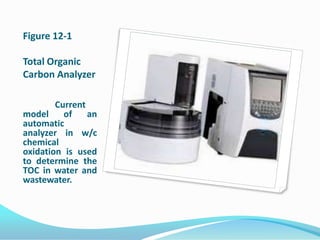
Figure 12-1

Total Organic
Carbon Analyzer

        Current
model     of    an
automatic
analyzer in w/c
chemical
oxidation is used
to determine the
TOC in water and
wastewater.
12.2.2 BOD MEASUREMENT

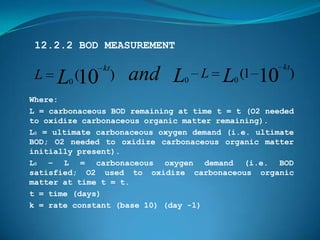
               kt                                   kt
 L   L0 (10 )       and L       0
                                    L   L (1 10
                                          0
                                                         )
Where:
L = carbonaceous BOD remaining at time t = t (O2 needed
to oxidize carbonaceous organic matter remaining).
L0 = ultimate carbonaceous oxygen demand (i.e. ultimate
BOD; O2 needed to oxidize carbonaceous organic matter
initially present).
L0 – L = carbonaceous oxygen demand (i.e. BOD
satisfied; O2 used to oxidize carbonaceous organic
matter at time t = t.
t = time (days)
k = rate constant (base 10) (day -1)
12.2.3 Municipal Wastewater
     The excreted waste from humans
is     called    sanitary     sewage.
Wastewater form residential areas,
referred to as domestic sewage,
includes kitchen, bath, laundry, and
floor drain wastes. These, together
with    the   liquid   wastes    from
commercial       and       industrial
establishments, are termed municipal
wastewater.
12.2.3 Industrial Wastewater
     Wastewater from industries include
employees’ sanitary wastes, process wastes
from   manufacturing,   wash  waters,  and
relatively    uncontaminated  water   from
heating and cooling operations.

12.2.3 Stormwater
     The runoff from rainfall, snowmelt,
and    street   washing.    It   is    less
contaminated than municipal wastewater.
12.3 POLLUTION OF RECEIVING WATERS
     12.3.1 Effects of Pollutants
          Water pollution occurs when the
discharge of wastes impairs water quality
or   disturbs   the    natural   ecological
balance.
The contaminants that cause problems includes:
1. Pathogens
2. Organic Matter
3. Solids
4. Nutrients
5. Toxic & Hazardous Substances
6. Other   Pollutants   (color,   foam,   heat,   &
   radioactive materials.
12.4 WASTEWATER COLLECTION
    1. Early Systems
    2. Present Systems

Present Systems
    Sewage collection systems today
normally consist of separate storm
and sanitary sewers in the newer
areas and combined sewers in the
older sections of cities.
3 Types of Sewers
1. Sanitary Sewers
      Sanitary sewers carry domestic sewage, liquid
   commercial and industrial wastes, and
   undesirable contributions from infiltration and
   storm water.
2. Storm Sewers
      Storm sewers receive storm water runoff from
   roads, roofs, lawns, & other surfaces.
3. Combined Sewers
      Combined sewers perform the functions of
   sanitary and storm sewers and are common in the
   older section of most municipalities because
   these sewers carry sanitary wastes and are
   connected to basement floor drains, any
   surcharging could cause a backup of untreated
   sanitary sewage into basements.
There are two types of wastewater
treatment systems:
1.Biological treatment plant , &
2.Physical/Chemical treatment plant
Commonly used chemical processes for
industrial wastewater treatment:
1.Oxidation
2.Reduction
3.Precipitation
4.Neutralization

Commonly used chemical processes for
municipal wastewater treatment:
1.Disinfection
2.Precipitation
Physical processes of wastewater treatment:
1.Removing grit
2.Clarifyinhg raw sewage & concentrating
   the settled solids
4.Clarifying biological suspensions &
   concentrating the settled floc
5.Gravity thickening of primary or
   secondary sludges
Impounded System:
1.Wetlands
2.Aerated Lagoons
3.Anaerobic Lagoons
4.Aerated Ponds
5.Facultative Ponds

Advantages of Land based Treatment
Methods Over Wastewater Treatment Plants:
1.Characterized Simplicity
2.Lower Operating Cost
3.Lower Capital Cost
Regarded as Practical Cutlets for
the Disposal of Treated or
Untreated Wastewater:
1.Streams
2.Lakes
3.Rivers
4.Oceans
Factors that Influence the Decision in
Choosing a Suitable Wastewater
Treatment Method:
1.Local Preference
2.Experience of the consultant based on
engineering methods
3.Wastewater process/track record of
the process

Options in Dealing with the Organic &
Inorganic Contaminants:
1.Removed physically
2.Converted biologically
3.Changed chemically
Objective of Land Application System
     The objective of the land based
treatment was to reduce waste
discharged to surface waters while
utilizing the nutrient content for
crops and encourage the used of
effluent for irrigation and ground
water recharge.
Permeable Soil – a type soil having
pores or openings that permits
liquids or gases to pass through.
Impervious soil – an impenetrable
soil.
Sludge – the substances that are
removed during water treatment.
Permeable Soil – a type soil having
pores or openings that permits
liquids or gases to pass through.
Impervious soil – an impenetrable
soil.
Sludge – the substances that are
removed during water treatment.

Environmental engineering

  • 2.
    SUBTOPICS: 1. Wastewater 2. Pollution of Receiving Water 3. Wastewater Collection Reporter: Salinas
  • 3.
    SUBTOPICS: 1. Principles of Wastewater Treatment 2. Land-Based Treatment Reporter: Japin
  • 4.
    SUBTOPICS: 1. Wastewater Treatment Plants Reporter: Orlanes
  • 5.
    SUBTOPICS: 1. On-Site Treatment Facilities 2. Government / Public Role in Pollution Control Reporter: Real
  • 6.
    12.2 WASTEWATER Wastewater can be formed by a variety of activities, including washing, bathing, and using the toilet. Rainwater runoff is also considered wastewater. No matter where it comes from, this water is full of bacteria, chemicals, and other contaminants. What is Wastewater Treatment? Wastewater treatment is the process of taking wastewater and making it suitable for discharge back into the environment. Wastewater treatment reduces the contaminants to acceptable levels so as to be safe for discharge into the environment.
  • 7.
    12.2.1 CONSTITUENTS 1. Microorganism 2.Solids - Total Solids - Inorganic Constituents - Organic Matter Inorganic constituents of wastewater includes: 1. Chlorides & Sulfates 2. Nitrogen & Phosphorus 3. Carbonates & Bicarbonates 4. Toxic Substances
  • 8.
    Organic Matter includes: 1.Protein 2. Carbohydrates The sources of these biodegradable contaminants include excreta and urine from humans: food wastes from sinks: soil and dirt from bathing, washing, laundering: plus various soaps, detergents, and other cleaning products.
  • 9.
    12.2.2 BOD MEASUREMENT The amount of organic matter in water or wastewater can be measured directly (as TOC),but this doesn’t tell us whether the organics are biodegradable or not. TOC is determined by measuring the amount of CO2 produced when the produced when the organic carbon in the sample is oxidized by a strong oxidizer and comparing it with the amount in a standard of known TOC.
  • 10.
    Figure 12-1 Total Organic CarbonAnalyzer Current model of an automatic analyzer in w/c chemical oxidation is used to determine the TOC in water and wastewater.
  • 11.
    12.2.2 BOD MEASUREMENT kt kt L L0 (10 ) and L 0 L L (1 10 0 ) Where: L = carbonaceous BOD remaining at time t = t (O2 needed to oxidize carbonaceous organic matter remaining). L0 = ultimate carbonaceous oxygen demand (i.e. ultimate BOD; O2 needed to oxidize carbonaceous organic matter initially present). L0 – L = carbonaceous oxygen demand (i.e. BOD satisfied; O2 used to oxidize carbonaceous organic matter at time t = t. t = time (days) k = rate constant (base 10) (day -1)
  • 12.
    12.2.3 Municipal Wastewater The excreted waste from humans is called sanitary sewage. Wastewater form residential areas, referred to as domestic sewage, includes kitchen, bath, laundry, and floor drain wastes. These, together with the liquid wastes from commercial and industrial establishments, are termed municipal wastewater.
  • 13.
    12.2.3 Industrial Wastewater Wastewater from industries include employees’ sanitary wastes, process wastes from manufacturing, wash waters, and relatively uncontaminated water from heating and cooling operations. 12.2.3 Stormwater The runoff from rainfall, snowmelt, and street washing. It is less contaminated than municipal wastewater.
  • 14.
    12.3 POLLUTION OFRECEIVING WATERS 12.3.1 Effects of Pollutants Water pollution occurs when the discharge of wastes impairs water quality or disturbs the natural ecological balance. The contaminants that cause problems includes: 1. Pathogens 2. Organic Matter 3. Solids 4. Nutrients 5. Toxic & Hazardous Substances 6. Other Pollutants (color, foam, heat, & radioactive materials.
  • 15.
    12.4 WASTEWATER COLLECTION 1. Early Systems 2. Present Systems Present Systems Sewage collection systems today normally consist of separate storm and sanitary sewers in the newer areas and combined sewers in the older sections of cities.
  • 16.
    3 Types ofSewers 1. Sanitary Sewers Sanitary sewers carry domestic sewage, liquid commercial and industrial wastes, and undesirable contributions from infiltration and storm water. 2. Storm Sewers Storm sewers receive storm water runoff from roads, roofs, lawns, & other surfaces. 3. Combined Sewers Combined sewers perform the functions of sanitary and storm sewers and are common in the older section of most municipalities because these sewers carry sanitary wastes and are connected to basement floor drains, any surcharging could cause a backup of untreated sanitary sewage into basements.
  • 17.
    There are twotypes of wastewater treatment systems: 1.Biological treatment plant , & 2.Physical/Chemical treatment plant
  • 20.
    Commonly used chemicalprocesses for industrial wastewater treatment: 1.Oxidation 2.Reduction 3.Precipitation 4.Neutralization Commonly used chemical processes for municipal wastewater treatment: 1.Disinfection 2.Precipitation
  • 21.
    Physical processes ofwastewater treatment: 1.Removing grit 2.Clarifyinhg raw sewage & concentrating the settled solids 4.Clarifying biological suspensions & concentrating the settled floc 5.Gravity thickening of primary or secondary sludges
  • 22.
    Impounded System: 1.Wetlands 2.Aerated Lagoons 3.AnaerobicLagoons 4.Aerated Ponds 5.Facultative Ponds Advantages of Land based Treatment Methods Over Wastewater Treatment Plants: 1.Characterized Simplicity 2.Lower Operating Cost 3.Lower Capital Cost
  • 23.
    Regarded as PracticalCutlets for the Disposal of Treated or Untreated Wastewater: 1.Streams 2.Lakes 3.Rivers 4.Oceans
  • 24.
    Factors that Influencethe Decision in Choosing a Suitable Wastewater Treatment Method: 1.Local Preference 2.Experience of the consultant based on engineering methods 3.Wastewater process/track record of the process Options in Dealing with the Organic & Inorganic Contaminants: 1.Removed physically 2.Converted biologically 3.Changed chemically
  • 25.
    Objective of LandApplication System The objective of the land based treatment was to reduce waste discharged to surface waters while utilizing the nutrient content for crops and encourage the used of effluent for irrigation and ground water recharge.
  • 26.
    Permeable Soil –a type soil having pores or openings that permits liquids or gases to pass through. Impervious soil – an impenetrable soil. Sludge – the substances that are removed during water treatment.
  • 27.
    Permeable Soil –a type soil having pores or openings that permits liquids or gases to pass through. Impervious soil – an impenetrable soil. Sludge – the substances that are removed during water treatment.