STRATEGIC MANAGEMENT AND
BUSINESS POLICY
THIRD EDITION
Chapter 3
Environmental appraisal
AZHAR KAZMI
2
Concept of environment
• The environment of any organisation is "the aggregate of all
conditions, events and influences that surround and affect it."
K. Davis, The Challenge of Business, (New York, N.Y.: McGraw-Hill, 1975),p.43
(c) Dr. Azhar Kazmi 2008 3
Characteristics of environment
•Environment is complex
•Environment is dynamic
•Environment is multi-faceted
•Environment has a far-reaching impact
ORGANIZATIONAL ENVIRONMENT
 Environment plays an important role in strategy
formulation as well as in its performance
Dimensions of environment
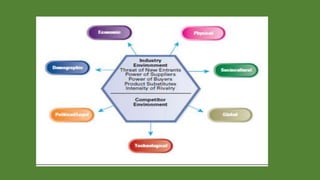
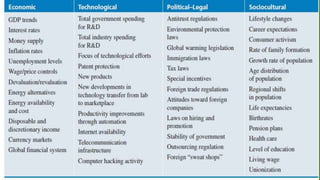
 External environment : It can be generally divided into
five major divisions—natural, political, technological,
economic, and social.
 The internal environment : It comprises a company’s
resources, capabilities, and distinctive competencies.
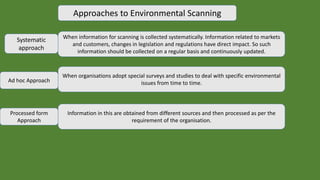
Approaches to Environmental Scanning
Systematic
approach
When information for scanning is collected systematically. Information related to markets
and customers, changes in legislation and regulations have direct impact. So such
information should be collected on a regular basis and continuously updated.
Ad hoc Approach
When organisations adopt special surveys and studies to deal with specific environmental
issues from time to time.
Information in this are obtained from different sources and then processed as per the
requirement of the organisation.
Processed form
Approach
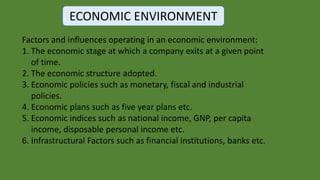
ECONOMIC ENVIRONMENT
Factors and influences operating in an economic environment:
1. The economic stage at which a company exits at a given point
of time.
2. The economic structure adopted.
3. Economic policies such as monetary, fiscal and industrial
policies.
4. Economic plans such as five year plans etc.
5. Economic indices such as national income, GNP, per capita
income, disposable personal income etc.
6. Infrastructural Factors such as financial institutions, banks etc.
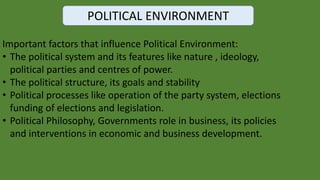
POLITICAL ENVIRONMENT
Important factors that influence Political Environment:
• The political system and its features like nature , ideology,
political parties and centres of power.
• The political structure, its goals and stability
• Political processes like operation of the party system, elections
funding of elections and legislation.
• Political Philosophy, Governments role in business, its policies
and interventions in economic and business development.
https://auto.economictimes.indiatimes.com/news/two-
wheelers/motorcycles/hero-motocorp-domestic-sales-drop-16-
to-429208-units-in-july/84962988
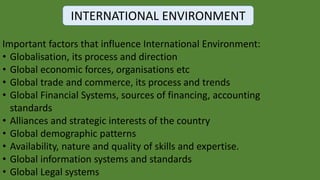
INTERNATIONAL ENVIRONMENT
Important factors that influence International Environment:
• Globalisation, its process and direction
• Global economic forces, organisations etc
• Global trade and commerce, its process and trends
• Global Financial Systems, sources of financing, accounting
standards
• Alliances and strategic interests of the country
• Global demographic patterns
• Availability, nature and quality of skills and expertise.
• Global information systems and standards
• Global Legal systems
MARKET ENVIRONMENT
Important factors that influence Market Environment:
• Customer or Client factors such as needs,
preferences,perceptions,attitudes, values, bargaining power .
• Product Factors such as demand, image, features, utility,
function differentiation and availability of substitutes etc.
• Marketing Intermediary factors such as levels and quality of
customer service, middlemen, distribution channels, delivery
systems.
• Competitor related factors such as different types of
competitors, entry and exit of major competitor, nature of
competition and relative strategic position of major competitor.
Regulatory ENVIRONMENT
Important factors that influence regulatory environment:
• The constitutional Framework, directives, fundamental rights
etc.
• Policies related to licensing, monopolies, FDIs
• Policies related to distribution and pricing and their control.
• Policies related to imports and exports
• Other policies related to public sector, small scale industries,
sick industries etc.
TECHNOLOGICAL ENVIRONMENT
1.New manufacturing processes
2. New products and services of competitors
3. New products and services of supply chain partners
4. Any new technology that could impact the business
5. Efficiency of infrastructure, including roads, ports,
airports, rolling stock, hospitals, education,
healthcare, and communication
6. Industrial productivity
7. Energy availability and cost
8. Natural resource availability
9. Trademark protection
10. Telecommunications network and cost
11. Regulations on technology transfer
SOCIOCULTURAL ENVIRONMENT
• This includes knowledge, beliefs, art, morals, laws,
customs, and other capabilities and habits acquired by
humans
• It can be classified into demographic, attitudinal, and
cultural factors
• Socio cultural variables could have favorable as well as
adverse impacts on business.
Example: In IT companies increasing the number of women
in the workforce
SUPPLIER ENVIRONMENT
Important factors that influence regulatory environment:
• Cost of supply of raw materials sub assemblies, parts and
components.
• Cost and availability of finances for plans and projects
• Dependability and cost of Human Resources
• Infrastructural support and availability of different factors of
production.
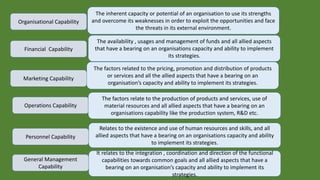
Organisational Capability
The availability , usages and management of funds and all allied aspects
that have a bearing on an organisations capacity and ability to implement
its strategies.
Financial Capability
Marketing Capability
Operations Capability
Personnel Capability
General Management
Capability
The inherent capacity or potential of an organisation to use its strengths
and overcome its weaknesses in order to exploit the opportunities and face
the threats in its external environment.
The factors related to the pricing, promotion and distribution of products
or services and all the allied aspects that have a bearing on an
organisation’s capacity and ability to implement its strategies.
The factors relate to the production of products and services, use of
material resources and all allied aspects that have a bearing on an
organisations capability like the production system, R&D etc.
Relates to the existence and use of human resources and skills, and all
allied aspects that have a bearing on an organisations capacity and ability
to implement its strategies.
It relates to the integration , coordination and direction of the functional
capabilities towards common goals and all allied aspects that have a
bearing on an organisation’s capacity and ability to implement its
strategies.
(c) Dr. Azhar Kazmi 2008 21
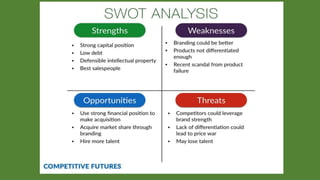
Internal environment
• The internal environment refers to all factors within an organisation that impact
strengths or cause weaknesses of a strategic nature.
 Strength is an inherent capacity which an organisation can use to gain strategic advantage.
Examples of strength are: good reputation among customers, resources, assets, people,
experience, knowledge, data, and capabilities.
 Weakness is an inherent limitation or constraint which creates strategic disadvantages. Examples
of weakness are: gaps in capabilities, financial deadlines, low morale, and overdependence on a
single product line.
(c) Dr. Azhar Kazmi 2008 22
External environment
• The external environment includes all the factors outside the organisation
which provide opportunities or pose threats to the organisation.
 Opportunity is a favourable condition in the organisation's environment which enables it to consolidate
and strengthen its position. Examples of opportunity are: economic boom, favourable demographic
shifts, arrival of new technologies, loosening of regulations, favourable global influences, and unfulfilled
customer needs.
 Threat is an unfavourable condition in the organisation's environment which creates a risk for, or causes
damage to, the organisation. Examples of threat are: economic downturn, demographic shifts, new
competitors, unexpected shifts in consumer tastes, demanding new regulations, unfavourable political or
legislative, new technology, and loss of key staff.
(c) Dr. Azhar Kazmi 2008 24
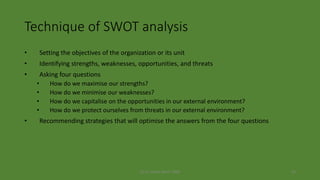
Technique of SWOT analysis
• Setting the objectives of the organization or its unit
• Identifying strengths, weaknesses, opportunities, and threats
• Asking four questions
• How do we maximise our strengths?
• How do we minimise our weaknesses?
• How do we capitalise on the opportunities in our external environment?
• How do we protect ourselves from threats in our external environment?
• Recommending strategies that will optimise the answers from the four questions
Benefits of SWOT Analysis
1.Simple to Use
2.Low Cost
3.Flexible and can be adapted to varying
situations
4.Leads to clarification of issues
5.Development of Goal oriented issues
6.Useful as a starting point for Strategic analysis

Module 3.ppt

  • 1.
    STRATEGIC MANAGEMENT AND BUSINESSPOLICY THIRD EDITION Chapter 3 Environmental appraisal AZHAR KAZMI
  • 2.
    2 Concept of environment •The environment of any organisation is "the aggregate of all conditions, events and influences that surround and affect it." K. Davis, The Challenge of Business, (New York, N.Y.: McGraw-Hill, 1975),p.43
  • 3.
    (c) Dr. AzharKazmi 2008 3 Characteristics of environment •Environment is complex •Environment is dynamic •Environment is multi-faceted •Environment has a far-reaching impact
  • 4.
    ORGANIZATIONAL ENVIRONMENT  Environmentplays an important role in strategy formulation as well as in its performance Dimensions of environment  External environment : It can be generally divided into five major divisions—natural, political, technological, economic, and social.  The internal environment : It comprises a company’s resources, capabilities, and distinctive competencies.
  • 5.
    Approaches to EnvironmentalScanning Systematic approach When information for scanning is collected systematically. Information related to markets and customers, changes in legislation and regulations have direct impact. So such information should be collected on a regular basis and continuously updated. Ad hoc Approach When organisations adopt special surveys and studies to deal with specific environmental issues from time to time. Information in this are obtained from different sources and then processed as per the requirement of the organisation. Processed form Approach
  • 10.
    ECONOMIC ENVIRONMENT Factors andinfluences operating in an economic environment: 1. The economic stage at which a company exits at a given point of time. 2. The economic structure adopted. 3. Economic policies such as monetary, fiscal and industrial policies. 4. Economic plans such as five year plans etc. 5. Economic indices such as national income, GNP, per capita income, disposable personal income etc. 6. Infrastructural Factors such as financial institutions, banks etc.
  • 11.
    POLITICAL ENVIRONMENT Important factorsthat influence Political Environment: • The political system and its features like nature , ideology, political parties and centres of power. • The political structure, its goals and stability • Political processes like operation of the party system, elections funding of elections and legislation. • Political Philosophy, Governments role in business, its policies and interventions in economic and business development.
  • 12.
  • 13.
    INTERNATIONAL ENVIRONMENT Important factorsthat influence International Environment: • Globalisation, its process and direction • Global economic forces, organisations etc • Global trade and commerce, its process and trends • Global Financial Systems, sources of financing, accounting standards • Alliances and strategic interests of the country • Global demographic patterns • Availability, nature and quality of skills and expertise. • Global information systems and standards • Global Legal systems
  • 14.
    MARKET ENVIRONMENT Important factorsthat influence Market Environment: • Customer or Client factors such as needs, preferences,perceptions,attitudes, values, bargaining power . • Product Factors such as demand, image, features, utility, function differentiation and availability of substitutes etc. • Marketing Intermediary factors such as levels and quality of customer service, middlemen, distribution channels, delivery systems. • Competitor related factors such as different types of competitors, entry and exit of major competitor, nature of competition and relative strategic position of major competitor.
  • 15.
    Regulatory ENVIRONMENT Important factorsthat influence regulatory environment: • The constitutional Framework, directives, fundamental rights etc. • Policies related to licensing, monopolies, FDIs • Policies related to distribution and pricing and their control. • Policies related to imports and exports • Other policies related to public sector, small scale industries, sick industries etc.
  • 16.
    TECHNOLOGICAL ENVIRONMENT 1.New manufacturingprocesses 2. New products and services of competitors 3. New products and services of supply chain partners 4. Any new technology that could impact the business 5. Efficiency of infrastructure, including roads, ports, airports, rolling stock, hospitals, education, healthcare, and communication 6. Industrial productivity 7. Energy availability and cost 8. Natural resource availability 9. Trademark protection 10. Telecommunications network and cost 11. Regulations on technology transfer
  • 17.
    SOCIOCULTURAL ENVIRONMENT • Thisincludes knowledge, beliefs, art, morals, laws, customs, and other capabilities and habits acquired by humans • It can be classified into demographic, attitudinal, and cultural factors • Socio cultural variables could have favorable as well as adverse impacts on business. Example: In IT companies increasing the number of women in the workforce
  • 18.
    SUPPLIER ENVIRONMENT Important factorsthat influence regulatory environment: • Cost of supply of raw materials sub assemblies, parts and components. • Cost and availability of finances for plans and projects • Dependability and cost of Human Resources • Infrastructural support and availability of different factors of production.
  • 20.
    Organisational Capability The availability, usages and management of funds and all allied aspects that have a bearing on an organisations capacity and ability to implement its strategies. Financial Capability Marketing Capability Operations Capability Personnel Capability General Management Capability The inherent capacity or potential of an organisation to use its strengths and overcome its weaknesses in order to exploit the opportunities and face the threats in its external environment. The factors related to the pricing, promotion and distribution of products or services and all the allied aspects that have a bearing on an organisation’s capacity and ability to implement its strategies. The factors relate to the production of products and services, use of material resources and all allied aspects that have a bearing on an organisations capability like the production system, R&D etc. Relates to the existence and use of human resources and skills, and all allied aspects that have a bearing on an organisations capacity and ability to implement its strategies. It relates to the integration , coordination and direction of the functional capabilities towards common goals and all allied aspects that have a bearing on an organisation’s capacity and ability to implement its strategies.
  • 21.
    (c) Dr. AzharKazmi 2008 21 Internal environment • The internal environment refers to all factors within an organisation that impact strengths or cause weaknesses of a strategic nature.  Strength is an inherent capacity which an organisation can use to gain strategic advantage. Examples of strength are: good reputation among customers, resources, assets, people, experience, knowledge, data, and capabilities.  Weakness is an inherent limitation or constraint which creates strategic disadvantages. Examples of weakness are: gaps in capabilities, financial deadlines, low morale, and overdependence on a single product line.
  • 22.
    (c) Dr. AzharKazmi 2008 22 External environment • The external environment includes all the factors outside the organisation which provide opportunities or pose threats to the organisation.  Opportunity is a favourable condition in the organisation's environment which enables it to consolidate and strengthen its position. Examples of opportunity are: economic boom, favourable demographic shifts, arrival of new technologies, loosening of regulations, favourable global influences, and unfulfilled customer needs.  Threat is an unfavourable condition in the organisation's environment which creates a risk for, or causes damage to, the organisation. Examples of threat are: economic downturn, demographic shifts, new competitors, unexpected shifts in consumer tastes, demanding new regulations, unfavourable political or legislative, new technology, and loss of key staff.
  • 24.
    (c) Dr. AzharKazmi 2008 24 Technique of SWOT analysis • Setting the objectives of the organization or its unit • Identifying strengths, weaknesses, opportunities, and threats • Asking four questions • How do we maximise our strengths? • How do we minimise our weaknesses? • How do we capitalise on the opportunities in our external environment? • How do we protect ourselves from threats in our external environment? • Recommending strategies that will optimise the answers from the four questions
  • 25.
    Benefits of SWOTAnalysis 1.Simple to Use 2.Low Cost 3.Flexible and can be adapted to varying situations 4.Leads to clarification of issues 5.Development of Goal oriented issues 6.Useful as a starting point for Strategic analysis

Editor's Notes

  • #17 Technological factors impact a firm’s strategy. Example, cement was manufactured in India predominantly using primitive wet processing till the mid 1980s.
  • #18 Example:Increasing number of women in the workforce brings gender equality and stability of resources with IT companies, as women are considered to be a more loyal workforce. At the same time, it improves the demand for consumer goods and luxury goods as disposable incomes increase