Days of My Years
     Contributed by
    E. Sarathbabu
Founder & CEO, Foodking


         Presented on 23rd Feb 2008 at

         Bharathiar School of Management &
         Entrepreneur Development (BSMED),
         Coimbatore
         A NEN Member Institute
PART -- I
Entrepreneurship – a Mission
     with burning desire
Entrepreneurship- Rational Fears
• I want safety, I’m risk averse
    – Uncertainty about next paycheck
    – What safety does corporate life provide?
    – What are the essential traits needed in the personality?
• How do I get the magic idea
    – When do I stop theorizing and get on with the implementation
• What will my parents say, how do I go against what people generally
  do
    – If many are doing it, then surely it is more difficult to get profits,
      and go to the top.
• Can I develop the heart for entrepreneurship, how long should I try,
  what are the exit options
    – How do I jump of the cliff
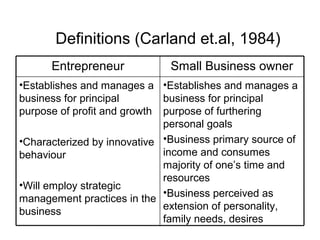
Definitions (Carland et.al, 1984)
      Entrepreneur            Small Business owner
•Establishes and manages a •Establishes and manages a
business for principal       business for principal
purpose of profit and growth purpose of furthering
                             personal goals
•Characterized by innovative •Business primary source of
behaviour                    income and consumes
                             majority of one’s time and
                             resources
•Will employ strategic
                             •
management practices in the Business perceived as
business                     extension of personality,
                             family needs, desires
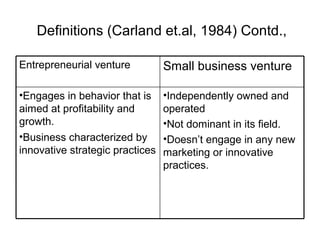
Definitions (Carland et.al, 1984) Contd.,

Entrepreneurial venture          Small business venture

•Engages in behavior that is     •Independently owned and
aimed at profitability and       operated
growth.                          •Not dominant in its field.
•Business characterized by       •Doesn’t engage in any new
innovative strategic practices   marketing or innovative
                                 practices.
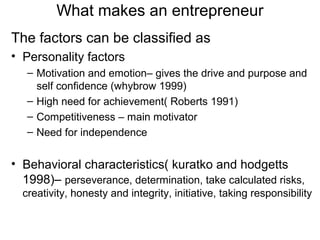
What makes an entrepreneur
The factors can be classified as
• Personality factors
   – Motivation and emotion– gives the drive and purpose and
     self confidence (whybrow 1999)
   – High need for achievement( Roberts 1991)
   – Competitiveness – main motivator
   – Need for independence


• Behavioral characteristics( kuratko and hodgetts
  1998)– perseverance, determination, take calculated risks,
  creativity, honesty and integrity, initiative, taking responsibility
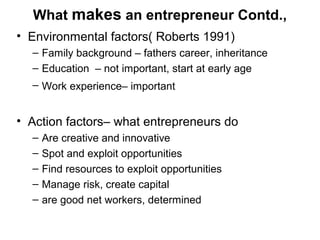
What makes an entrepreneur Contd.,
• Environmental factors( Roberts 1991)
  – Family background – fathers career, inheritance
  – Education – not important, start at early age
  – Work experience– important


• Action factors– what entrepreneurs do
  –   Are creative and innovative
  –   Spot and exploit opportunities
  –   Find resources to exploit opportunities
  –   Manage risk, create capital
  –   are good net workers, determined
Types of Opportunities
• Creation of new products
• Discovery of new geographical markets
• Creation or discovery of new raw materials
• New methods of production
• New ways of organizing
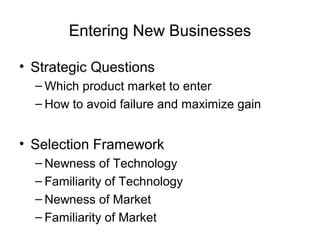
Entering New Businesses

• Strategic Questions
  – Which product market to enter
  – How to avoid failure and maximize gain


• Selection Framework
  – Newness of Technology
  – Familiarity of Technology
  – Newness of Market
  – Familiarity of Market
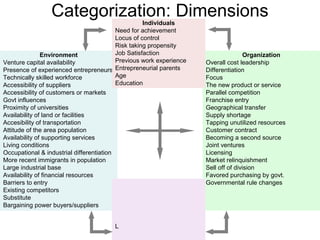
Categorization: Dimensions         Individuals
                                          Need for achievement
                                          Locus of control
                                          Risk taking propensity
               Environment                Job Satisfaction                           Organization
Venture capital availability              Previous work experience   Overall cost leadership
Presence of experienced entrepreneurs Entrepreneurial parents        Differentiation
Technically skilled workforce             Age                        Focus
Accessibility of suppliers                Education                  The new product or service
Accessibility of customers or markets                                Parallel competition
Govt influences                                                      Franchise entry
Proximity of universities                                            Geographical transfer
Availability of land or facilities                                   Supply shortage
Accesibility of transportation                                       Tapping unutilized resources
Attitude of the area population                                      Customer contract
Availability of supporting services                                  Becoming a second source
Living conditions                                                    Joint ventures
Occupational & industrial differentiation                            Licensing
More recent immigrants in population                                 Market relinquishment
Large industrial base                                                Sell off of division
Availability of financial resources                                  Favored purchasing by govt.
Barriers to entry                                                    Governmental rule changes
Existing competitors
Substitute
Bargaining power buyers/suppliers


                                        L
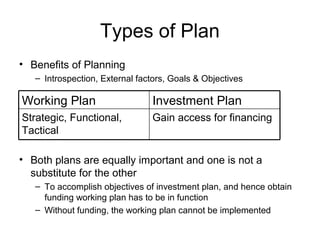
Types of Plan
• Benefits of Planning
   – Introspection, External factors, Goals & Objectives

Working Plan                    Investment Plan
Strategic, Functional,          Gain access for financing
Tactical

• Both plans are equally important and one is not a
  substitute for the other
   – To accomplish objectives of investment plan, and hence obtain
     funding working plan has to be in function
   – Without funding, the working plan cannot be implemented
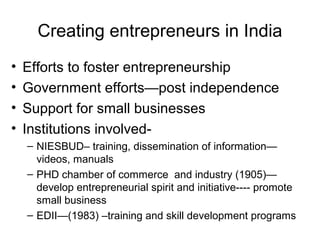
Creating entrepreneurs in India
•   Efforts to foster entrepreneurship
•   Government efforts—post independence
•   Support for small businesses
•   Institutions involved-
    – NIESBUD– training, dissemination of information—
      videos, manuals
    – PHD chamber of commerce and industry (1905)—
      develop entrepreneurial spirit and initiative---- promote
      small business
    – EDII—(1983) –training and skill development programs
References
• Social Entrepreneurs and Catalytic Change -- Sandra A.
  Waddock, James E. Post
• Creating entrepreneurs in India -- Leo Paul Dana, Journal of
  small business management—2000
• Opportunities and Entrepreneurship -- Jonathan T Eckhardt
  & Scott A Shane, Journal of Management, 2003, Vol 29, Iss. 3;p.333
• Entering New Businesses: Selecting Strategies for
  Success -- EB Roberts & CA Berry, Sloan Management Review
  1985)
PART -- II
Challenges faced
• During Childhood
  – Malnutrition
  – Poverty- Education

• During College days
  – Thought to be an alien
  – Communication
  – Lack of Family support
Overcoming Challenges

• Exploring within
• Help from Societies
• Few entrepreneurial activities
Thought Process behind starting a
         New Venture

• Passion to create something on own
• Unemployment problems
PART -- III
Why Food Sector?


• Food Sector in India is mostly unorganized
• Potential to generate large number of
  employment opportunities
• Food sector in India is largely untapped
Foodking… Current Scenario
March 26th, 2006 – Incorporated “Foodking
                Catering Services Private Limited”
April 1st, 2006 – “Foodking” was inaugurated by
                   Shri Narayana Murthy, Chairman
                    Infosys Technologies Limited

May 10th, 2006 – Ist Operation started
June 30th, 2006 – 1st outlet at IIM Ahmedabad was
                   inaugurated by Shri Bakul H.
                   Dholakia
Foodking… Current Scenario Contd.,


•Currently 180 persons are working for
the company
Strategy
• Overall Cost Leadership Strategy
• Cities will be formed as clusters of
  businesses
• Expanding through franchise route for
  Snack outlets
Future goals


• Establish an Indian brand for fast food
  chain
• To be operational in at least major 10
  cities in India in 5 years
Thank You!!

Days of-my-years

  • 1.
    Days of MyYears Contributed by E. Sarathbabu Founder & CEO, Foodking Presented on 23rd Feb 2008 at Bharathiar School of Management & Entrepreneur Development (BSMED), Coimbatore A NEN Member Institute
  • 2.
  • 3.
    Entrepreneurship – aMission with burning desire
  • 4.
    Entrepreneurship- Rational Fears •I want safety, I’m risk averse – Uncertainty about next paycheck – What safety does corporate life provide? – What are the essential traits needed in the personality? • How do I get the magic idea – When do I stop theorizing and get on with the implementation • What will my parents say, how do I go against what people generally do – If many are doing it, then surely it is more difficult to get profits, and go to the top. • Can I develop the heart for entrepreneurship, how long should I try, what are the exit options – How do I jump of the cliff
  • 5.
    Definitions (Carland et.al,1984) Entrepreneur Small Business owner •Establishes and manages a •Establishes and manages a business for principal business for principal purpose of profit and growth purpose of furthering personal goals •Characterized by innovative •Business primary source of behaviour income and consumes majority of one’s time and resources •Will employ strategic • management practices in the Business perceived as business extension of personality, family needs, desires
  • 6.
    Definitions (Carland et.al,1984) Contd., Entrepreneurial venture Small business venture •Engages in behavior that is •Independently owned and aimed at profitability and operated growth. •Not dominant in its field. •Business characterized by •Doesn’t engage in any new innovative strategic practices marketing or innovative practices.
  • 7.
    What makes anentrepreneur The factors can be classified as • Personality factors – Motivation and emotion– gives the drive and purpose and self confidence (whybrow 1999) – High need for achievement( Roberts 1991) – Competitiveness – main motivator – Need for independence • Behavioral characteristics( kuratko and hodgetts 1998)– perseverance, determination, take calculated risks, creativity, honesty and integrity, initiative, taking responsibility
  • 8.
    What makes anentrepreneur Contd., • Environmental factors( Roberts 1991) – Family background – fathers career, inheritance – Education – not important, start at early age – Work experience– important • Action factors– what entrepreneurs do – Are creative and innovative – Spot and exploit opportunities – Find resources to exploit opportunities – Manage risk, create capital – are good net workers, determined
  • 9.
    Types of Opportunities •Creation of new products • Discovery of new geographical markets • Creation or discovery of new raw materials • New methods of production • New ways of organizing
  • 10.
    Entering New Businesses •Strategic Questions – Which product market to enter – How to avoid failure and maximize gain • Selection Framework – Newness of Technology – Familiarity of Technology – Newness of Market – Familiarity of Market
  • 11.
    Categorization: Dimensions Individuals Need for achievement Locus of control Risk taking propensity Environment Job Satisfaction Organization Venture capital availability Previous work experience Overall cost leadership Presence of experienced entrepreneurs Entrepreneurial parents Differentiation Technically skilled workforce Age Focus Accessibility of suppliers Education The new product or service Accessibility of customers or markets Parallel competition Govt influences Franchise entry Proximity of universities Geographical transfer Availability of land or facilities Supply shortage Accesibility of transportation Tapping unutilized resources Attitude of the area population Customer contract Availability of supporting services Becoming a second source Living conditions Joint ventures Occupational & industrial differentiation Licensing More recent immigrants in population Market relinquishment Large industrial base Sell off of division Availability of financial resources Favored purchasing by govt. Barriers to entry Governmental rule changes Existing competitors Substitute Bargaining power buyers/suppliers L
  • 12.
    Types of Plan •Benefits of Planning – Introspection, External factors, Goals & Objectives Working Plan Investment Plan Strategic, Functional, Gain access for financing Tactical • Both plans are equally important and one is not a substitute for the other – To accomplish objectives of investment plan, and hence obtain funding working plan has to be in function – Without funding, the working plan cannot be implemented
  • 13.
    Creating entrepreneurs inIndia • Efforts to foster entrepreneurship • Government efforts—post independence • Support for small businesses • Institutions involved- – NIESBUD– training, dissemination of information— videos, manuals – PHD chamber of commerce and industry (1905)— develop entrepreneurial spirit and initiative---- promote small business – EDII—(1983) –training and skill development programs
  • 14.
    References • Social Entrepreneursand Catalytic Change -- Sandra A. Waddock, James E. Post • Creating entrepreneurs in India -- Leo Paul Dana, Journal of small business management—2000 • Opportunities and Entrepreneurship -- Jonathan T Eckhardt & Scott A Shane, Journal of Management, 2003, Vol 29, Iss. 3;p.333 • Entering New Businesses: Selecting Strategies for Success -- EB Roberts & CA Berry, Sloan Management Review 1985)
  • 15.
  • 16.
    Challenges faced • DuringChildhood – Malnutrition – Poverty- Education • During College days – Thought to be an alien – Communication – Lack of Family support
  • 17.
    Overcoming Challenges • Exploringwithin • Help from Societies • Few entrepreneurial activities
  • 18.
    Thought Process behindstarting a New Venture • Passion to create something on own • Unemployment problems
  • 19.
  • 20.
    Why Food Sector? •Food Sector in India is mostly unorganized • Potential to generate large number of employment opportunities • Food sector in India is largely untapped
  • 21.
    Foodking… Current Scenario March26th, 2006 – Incorporated “Foodking Catering Services Private Limited” April 1st, 2006 – “Foodking” was inaugurated by Shri Narayana Murthy, Chairman Infosys Technologies Limited May 10th, 2006 – Ist Operation started June 30th, 2006 – 1st outlet at IIM Ahmedabad was inaugurated by Shri Bakul H. Dholakia
  • 22.
    Foodking… Current ScenarioContd., •Currently 180 persons are working for the company
  • 23.
    Strategy • Overall CostLeadership Strategy • Cities will be formed as clusters of businesses • Expanding through franchise route for Snack outlets
  • 24.
    Future goals • Establishan Indian brand for fast food chain • To be operational in at least major 10 cities in India in 5 years
  • 25.