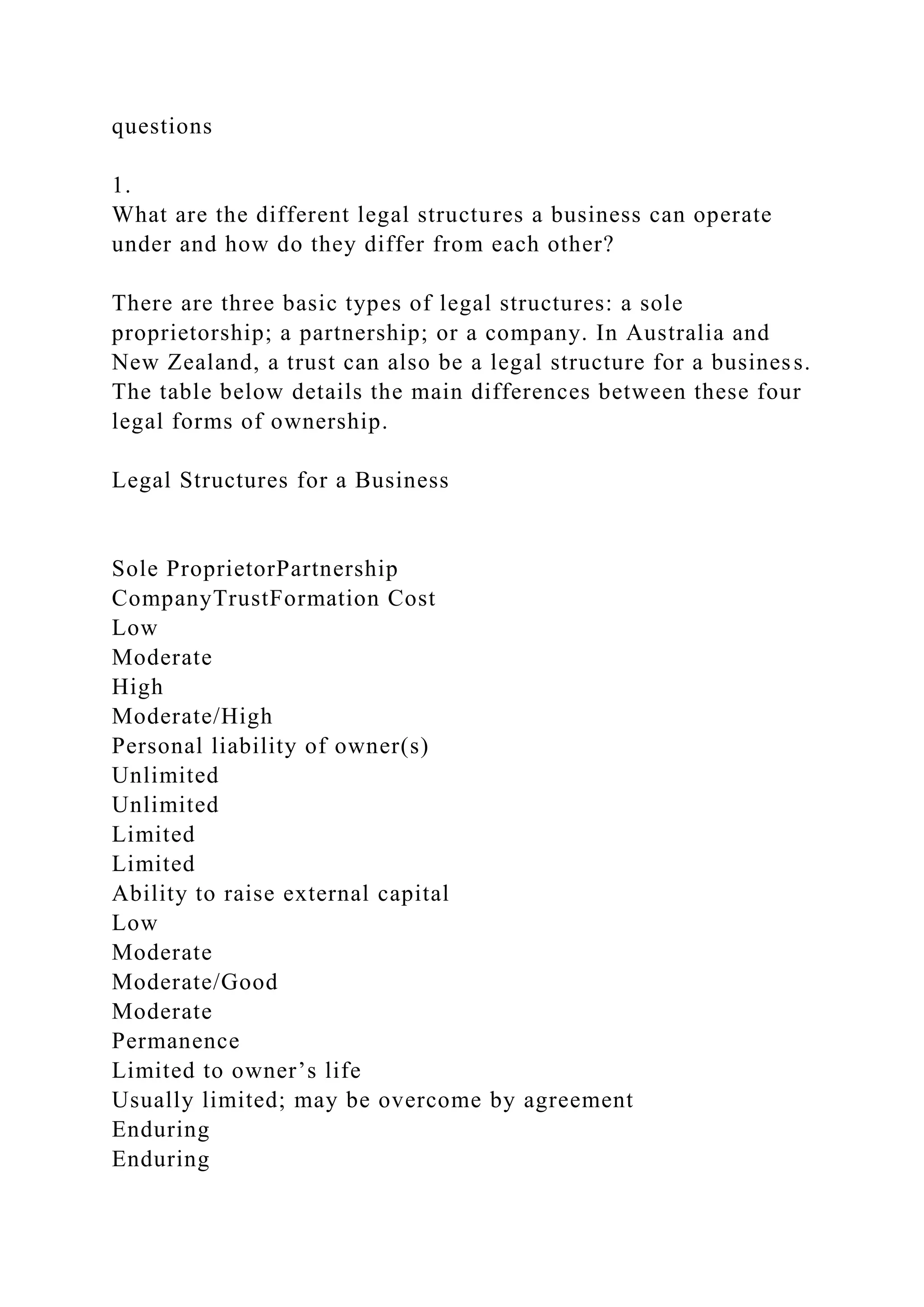
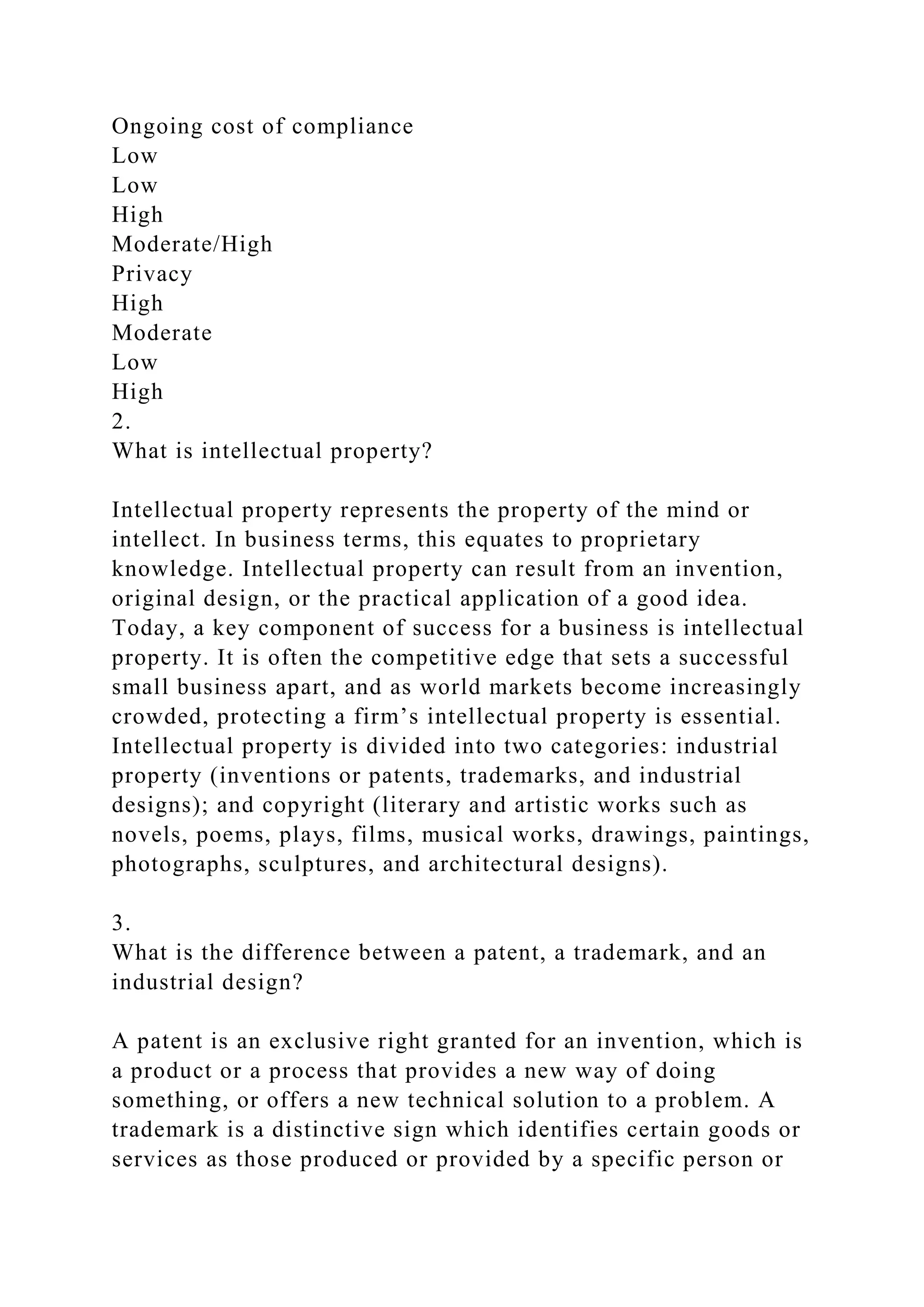
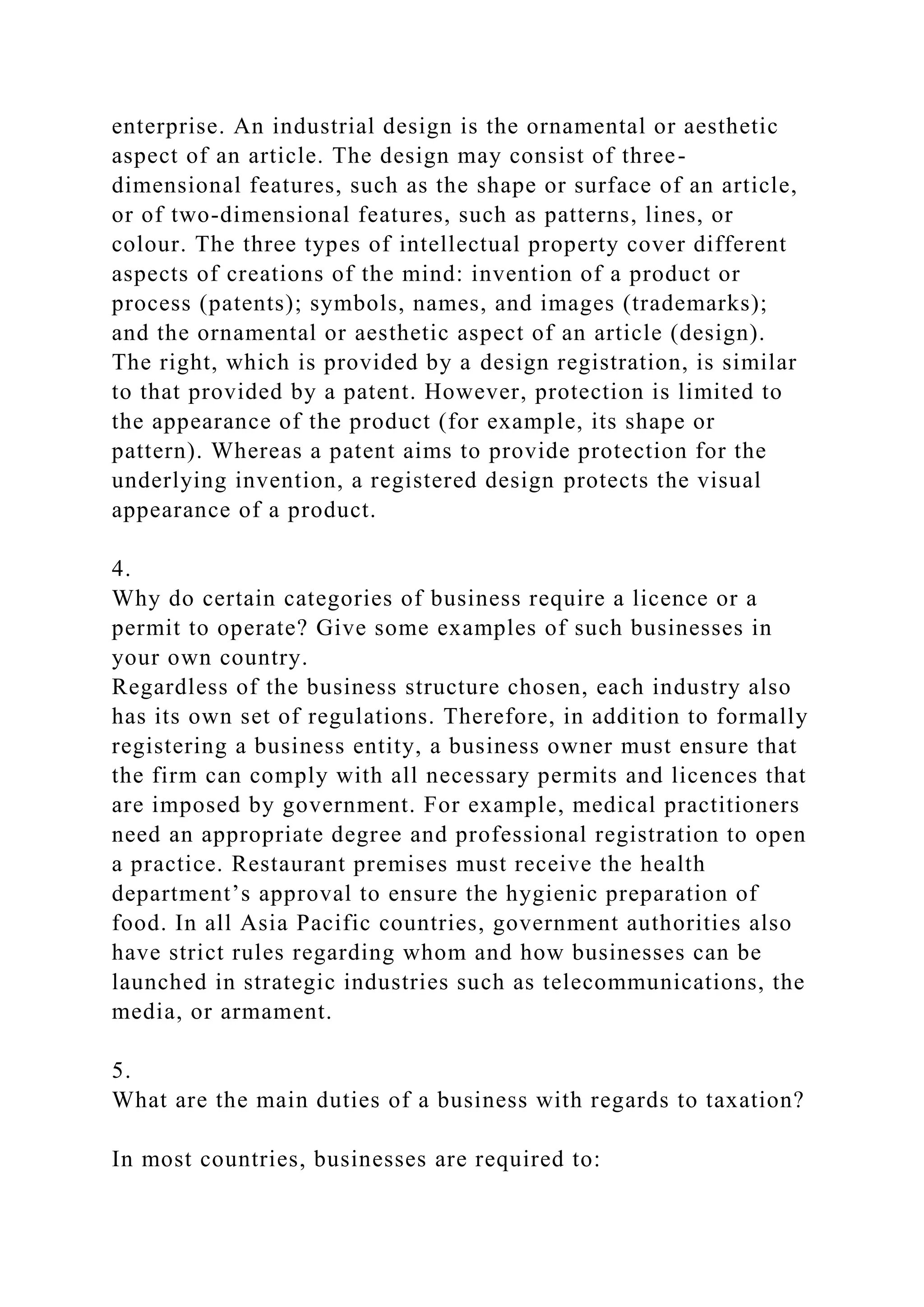
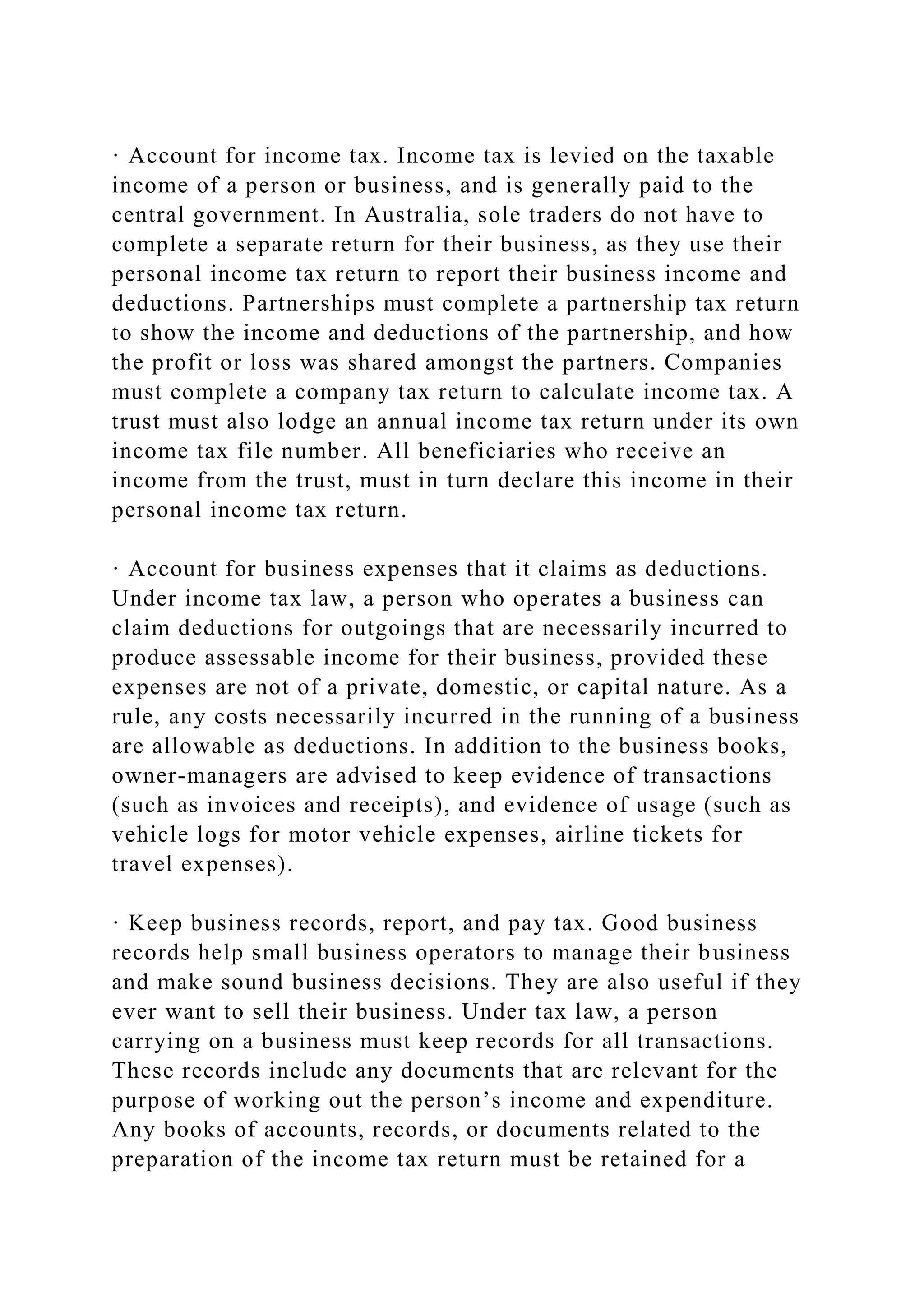
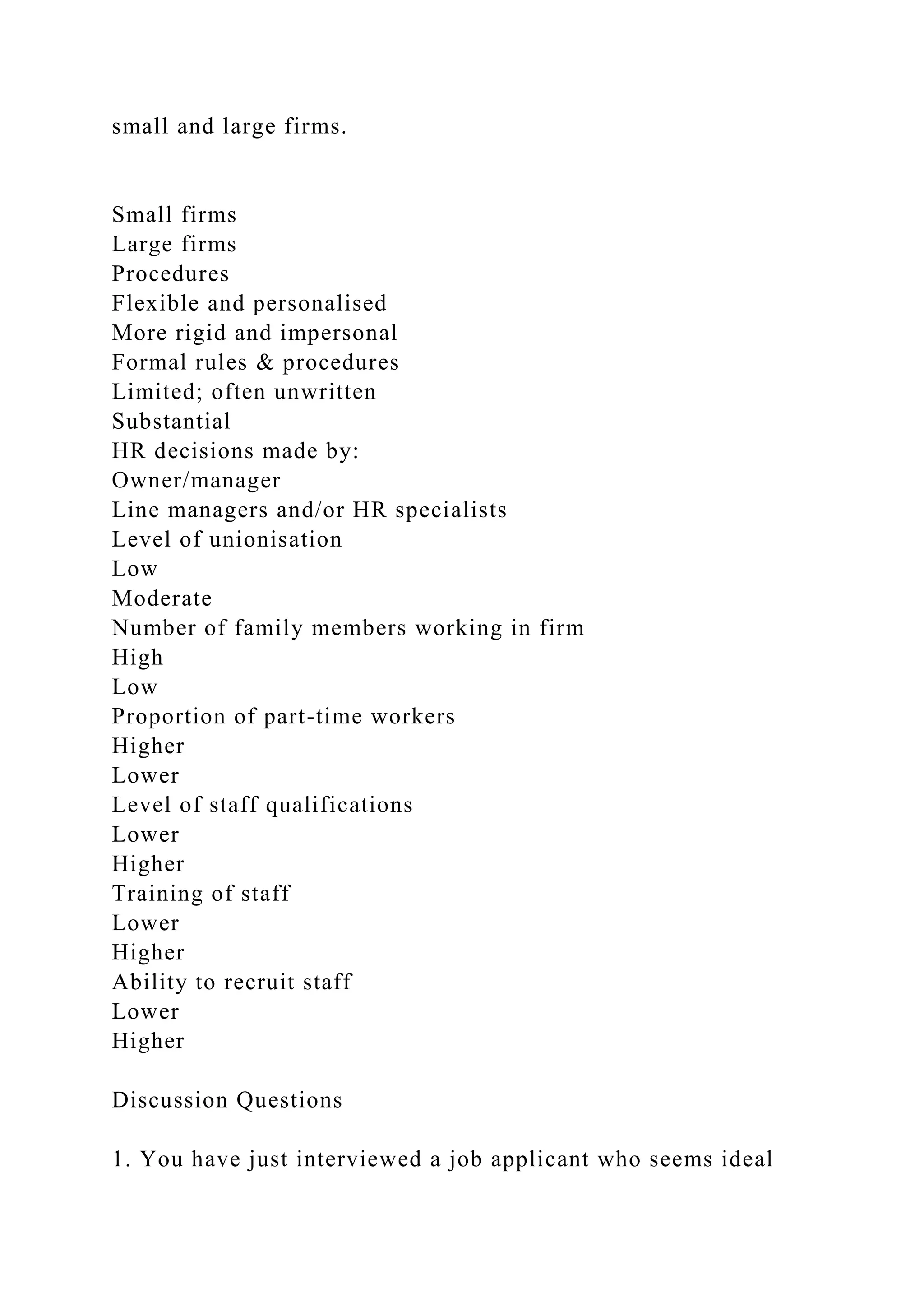
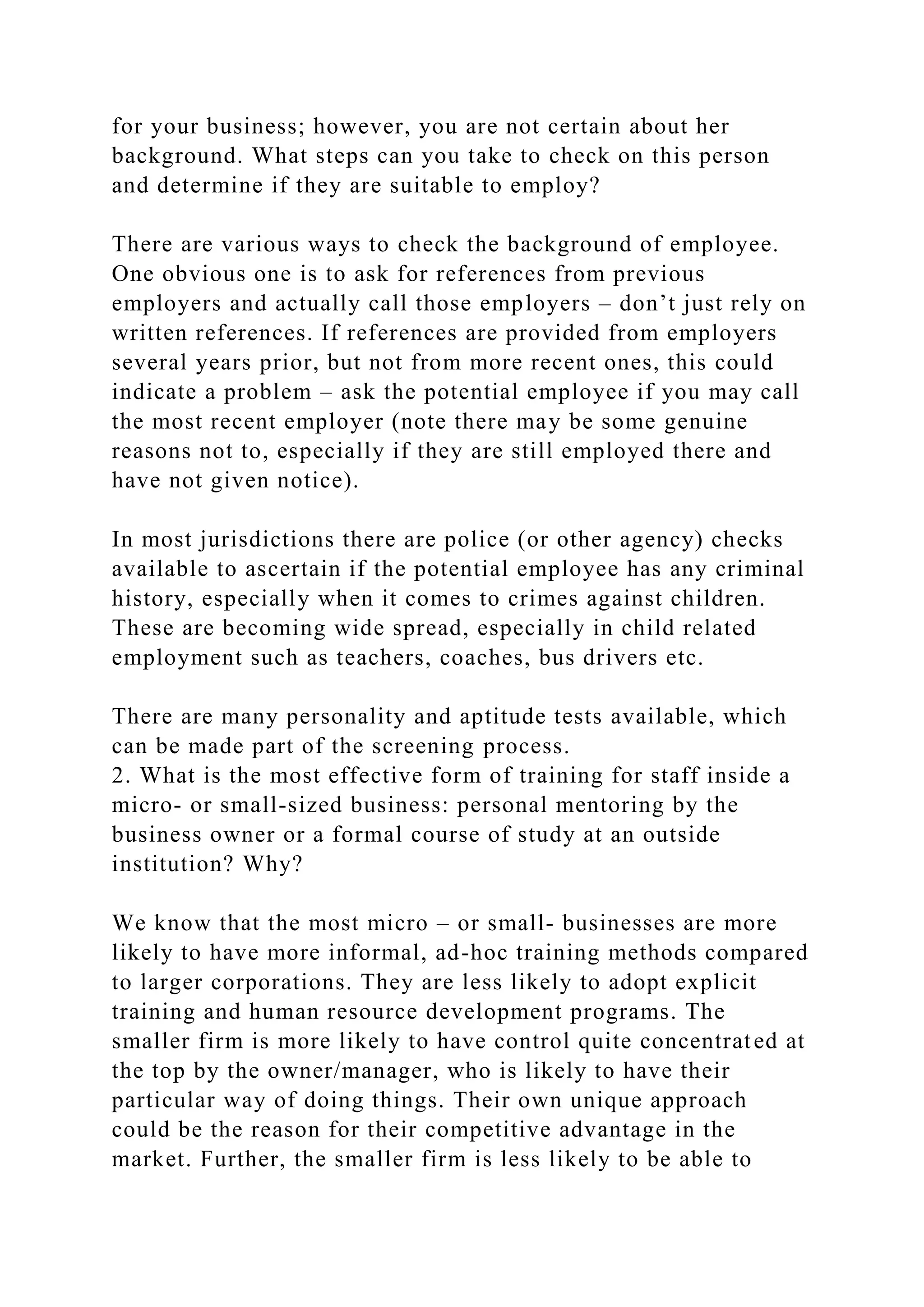
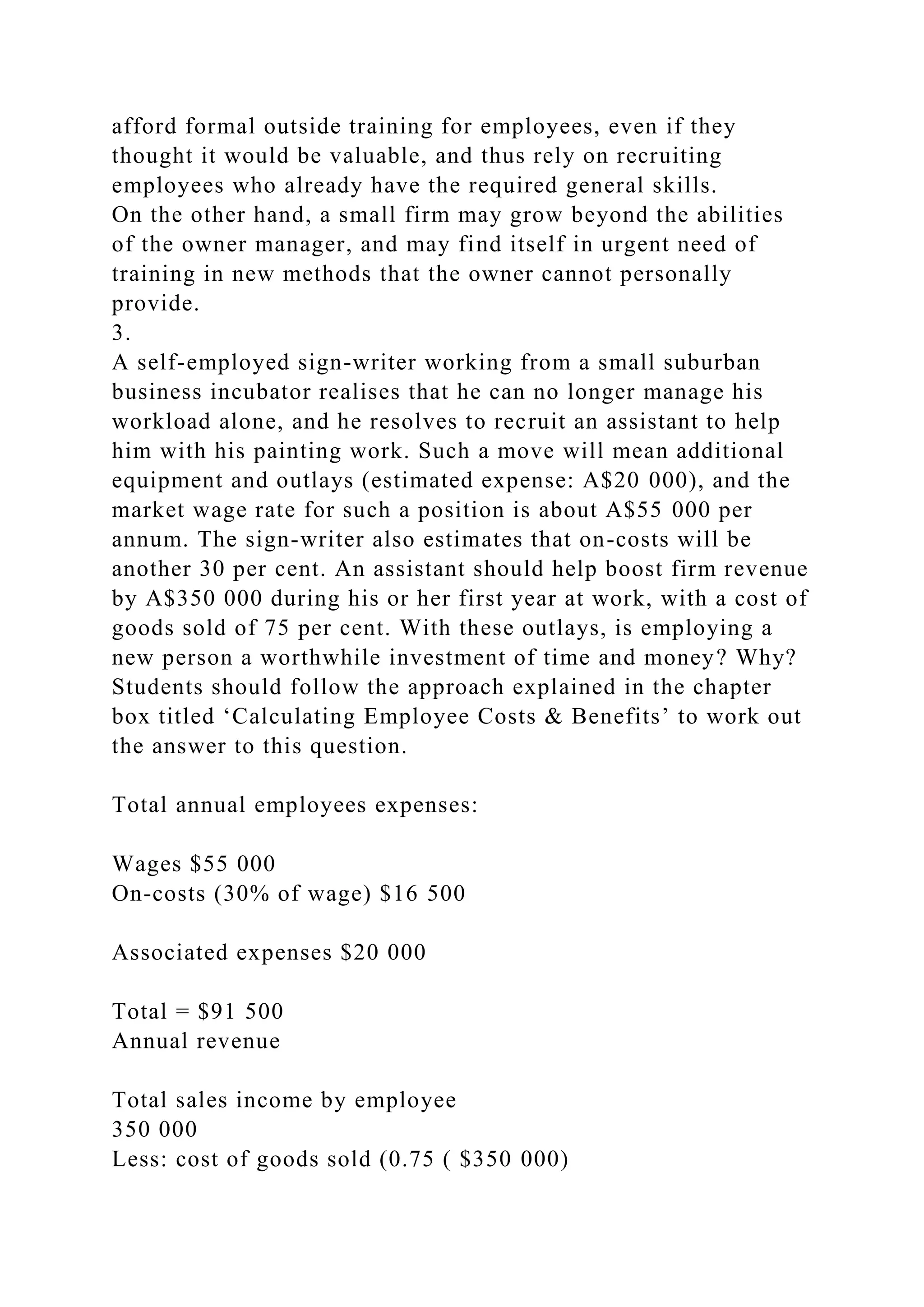
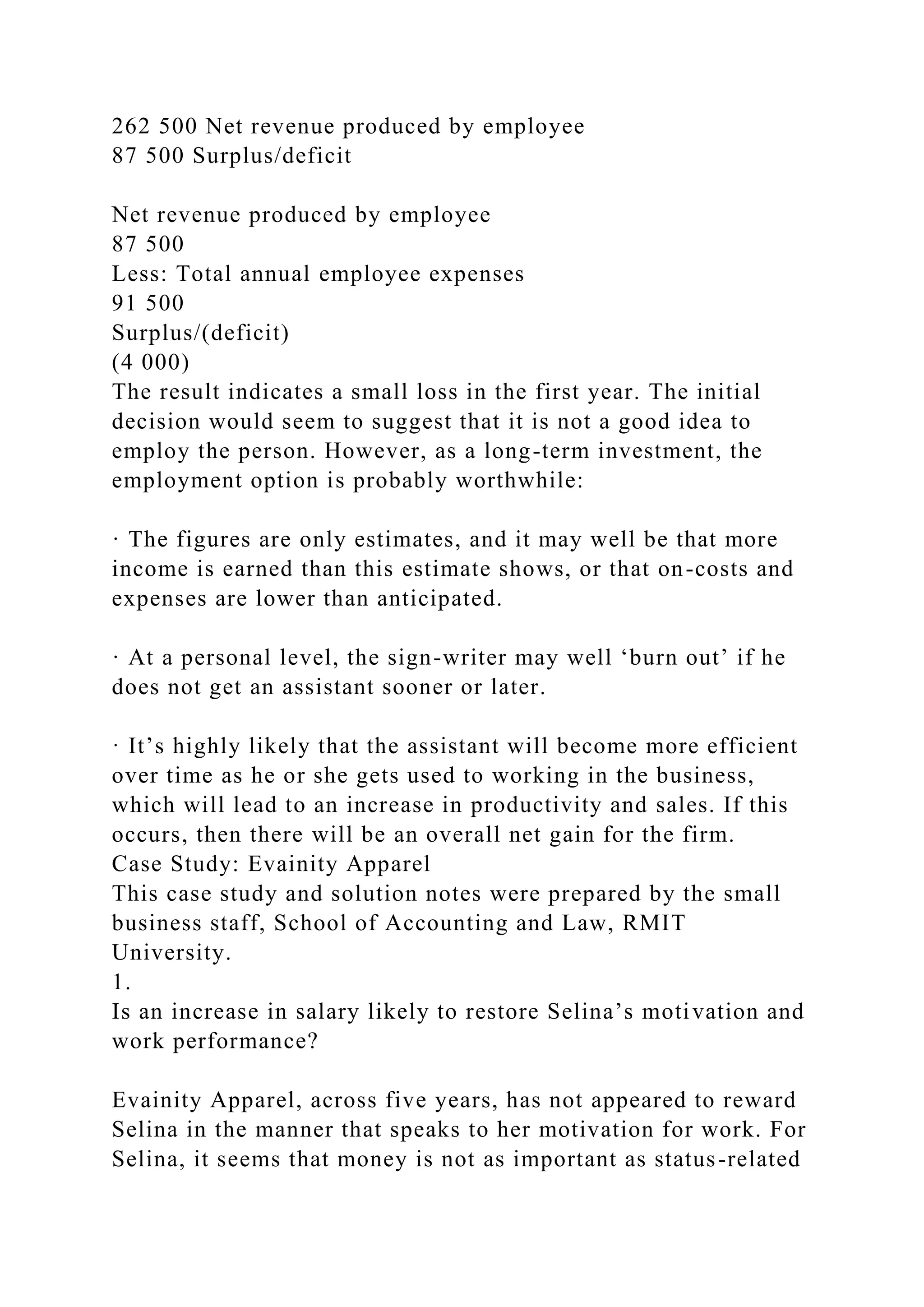
S---C/.DS_Store
__MACOSX/S---C/._.DS_Store
S---C/chapters book high light /.DS_Store
S---C/chapters book high light /schaper4e_irg_ch01.doc
Chapter 1: Entrepreneurship: definition and evolution
Instructor resource guide to accompany Entrepreneurship and
small business 4e by Shaper et al
Instructor Resource Guide
to accompany
Entrepreneurship and Small Business
4th Edition
Prepared by
Michael Schaper, Thierry Volery,
Paull Weber and Kate Lewis
Updated by
Mark Hornshaw
University of Notre Dame
© John Wiley & Sons Australia, Ltd 2014Chapter 1 -
Entrepreneurship: definition and evolution
Review questions
1. What are the key elements of entrepreneurship?
Much of the argument over the definition of entrepreneurship
revolves around the factors considered necessary for
entrepreneurship to occur. As depicted in Figure 1.1, five
factors have been commonly cited for entrepreneurship to take
place: an individual (the entrepreneur), a market opportunity,
adequate resources, a business organisation and a favourable
environment. These five factors are considered contingencies —
something that must be present in the phenomenon but can
materialise in many different ways. The entrepreneur is
responsible for bringing these contingencies together to create
new value.
1. The entrepreneur: Researchers have hypothesised a number of
factors that influence the way opportunities are recognised and
exploited by entrepreneurs. Among these, four have been
identified as especially important: the active search of
opportunities, entrepreneurial alertness, prior knowledge and
social networks.
2. Opportunities: In broad terms, an opportunity can be defined
as a situation in which a new product, service or process can be
introduced and sold at greater than its cost of production. But
‘opportunities’ describe a range of phenomena that begin
unformed and become more developed through time. In its most
elemental form, what may later be called an opportunity may
appear as imprecisely-defined market needs, or unemployed
resources or capacities. The former type of opportunities could
be called market-pulled opportunities, whereas the latter could
be called market-pushed opportunities.
3. Resources: Having distilled an opportunity, would-be
entrepreneurs must be willing and capable of marshalling
resources to pursue the opportunity, and to transform their idea
into an organisation. A resource is any thing or quality that is
useful. The resource-based theory recognises six types of
resources: financial, physical, human, technological, social and
organisational. Entrepreneurs may use time-relevant language or
symbols (e.g. polished business plans, stories or fancy
facilities) to create an image of success that will encourage
providers to commit resources to the venture. In this way, some
resources (e.g. social) are leveraged to obtain others (e.g.
financial).
4. Organisation: Many different types of organisational
arrangements exist for the exploitation of entrepreneurial
opportunities. Although most media attention and research in
entrepreneurship has focused on new independent start-ups,
other possible types of organisational structures include
corporate ventures, franchises, joint ventures and business
acquisitions. This indicates that entrepreneurship can take place
in very diverse environments and there are many ways to
become an entrepreneur.
5. Environment: The environment plays a critical role in
entrepreneurship. Entrepreneurs operate in an environment that
can be more or less rich in opportunities, and where several
conditions influence the pursuit of these opportunities. For
example, opportunities can emerge because of market
inefficiencies that result from information asymmetry across
time and geography, or as a result of political, regulatory, social
or demographic changes. Two important dimensions of the
environment are important to consider: the community
(population density and relationship) at the micro-level and the
society (values, culture, government) at the macro-level.
2.
What are the critical stages in the process of new venture
formation?
The first stage is the discovery of an opportunity. Central to the
process of new venture formation is the founding individual.
Whether the entrepreneur is perceived as a hard-headed risk
bearer, a man apart, or a visionary, he or she is overwhelmingly
perceived to be different in important ways from the non
entrepreneur (e.g. the manager), and many believe these
differences lie in the psychological traits and background of the
entrepreneur. However, entrepreneurs do not operate in a
vacuum; they respond to their environments. A conducive
political, economic, social and infrastructure environment
facilitates the emergence of new business ventures. The
initiation of new ventures requires the combination of the right
individual at the right place.
The second stage is the evaluation of the opportunity. After
having identified a promising opportunity, the actual decision to
attempt to launch the venture arises from a clear intention and
this implies action. In new venture formation, intention is a
conscious state of mind that directs attention toward the goal of
establishing the new organisation. With the expression of
intention the hopeful entrepreneur takes some concrete steps to
evaluate the business opportunity and to gather resources in
order to launch the venture. Such steps can include the
formulation of strategy, the development of a prototype, market
research, the identification of potential partners, and the
drafting of a business plan. While gathering resources, the
nascent entrepreneur is seeking, receiving and processing
information to decide whether to proceed or abandon the
attempt.
The third stage is the exploitation of the opportunity. Just as the
would-be entrepreneur must decide to attempt to found a
business, would-be entrepreneurs must finally decide whether to
proceed or abandon the attempt. The decision may be triggered
by a specific event, or simply by the accumulated weight of
confirming and disconfirming information. Although some
precipitating events (e.g. a dismissal, job frustration,
graduation, inheritance) may trigger the launch of the business
venture, it is often the passion of the individual – sustained
ultimately by the motivation — that pushes the entrepreneur to
‘take the plunge’.
3.
What are the central factors necessary for entrepreneurship to
thrive in a country?
By studying economic history, we notice that values, politics
and economic institutions play a crucial role in the development
of entrepreneurship. In terms of values, readiness for change, or
at least the willingness to live with it, is essential if a society is
to get richer (except by conquest). Acquisitiveness is another
value sustaining growth. Entrepreneurs, as change agents in a
society, have a regard for the material and they are willing to
exploit nature for man’s benefits. Yet naked greed is no use.
Growth is based on sustainable development; it requires
investment — and investment is gratification deferred.
At a macro-level, politics provide a framework for
entrepreneurship. Economic institutions are the tools used by
entrepreneurs to capitalise on opportunities and convert those
into marketable products or services. Successful societies create
and manage a tension between order and chaos without letting
either of them get out of hand. New ideas are easily frustrated if
societies are not receptive to the chaos that comes from change,
yet societies have to maintain an appropriate degree of order to
take advantage of creative breakthroughs.
Institutions such as property rights, stock exchanges, banks,
courts, laws of contract play a central role in the development
of entrepreneurship. These allow a flourishing of many different
types of economic enterprise — different in size, ownership and
organisation (e.g. companies, trusts, partnerships, joint
ventures). Yet there is a need for a pluralism of institutions: just
as governments compete, so do the entrepreneurs and the
different forms of organisation.
4.
What are the common features of entrepreneurship in the Asia
Pacific region?
{no change}
Despite the differences across the different countries and
systems in the region, there exist some key features in Asia–
Pacific entrepreneurship that distinguish it from European and
American entrepreneurship. A first common characteristic has
been the key role played by the state in the development of
entrepreneurship. Over the past decades, the state has played an
ubiquitous role in entrepreneurship in virtually all Asia–Pacific
countries.
A second common denominator is the presence of ethnic
entrepreneurs, such as ethnic Chinese and ethnic Indian
entrepreneurs. For the ethnic Chinese, the initial hardship of
migrating has cultivated values for economic survival, such
pragmatism, a work ethic, and materialism that also correspond
to traditional Chinese values. Similarly, ethnic Indians share
some common features. The vast majority adhere to some form
of the caste system and Hindu mythology pervades their culture.
India has also instituted an exceptional education system that
trained a ready core of highly skilled and highly educated
professionals and entrepreneurs who are familiar with the
English language and Western ways.
A third common feature of entrepreneurship in the Asia Pacific
region relates to the type of ownership and structure of the
enterprises. Most of the businesses across the region are family-
owned, although the proportion of family businesses is lower in
Australia and New Zealand compared with Asia.
5.
What are the emerging trends affecting entrepreneurship in the
Asia Pacific region?
Following the 1997 Asian financial crisis and the spread of the
free market, the region has undergone major changes. Among
these, the movement for privatisation and deregulation, the
adoption of Western ideas, the emergence of rules-based
systems, and the increased pressure for disclosure are likely to
have profound effects on entrepreneurship and small businesses.
These trends have led to the rise of the entrepreneurial society
which recognises and celebrates the vital economic and societal
roles played by entrepreneurs.Discussion questions
1.
Why is it often said that entrepreneurship is a complex
phenomenon? Identify different dimensions of or approaches to
this phenomenon.
Entrepreneurship is a multifaceted phenomenon that cuts across
many disciplinary boundaries (e.g. sociology, psychology,
economics, strategic management, marketing, finance).
Moreover, the studies on entrepreneurship have adopted
different theoretical perspectives, units of analysis and
methodologies. The fact that there is no generalisable definition
must not prevent us from attempting to build a definition. Much
of the argument over the definition of entrepreneurship revolves
around the factors considered necessary for entrepreneurship to
take place. The factors that are most commonly cited for
entrepreneurship to take place are:
— There is wide agreement that
entrepreneurship necessitates at least one motivated individual.
Although research seeking some common psychological
characteristics of entrepreneurs has not been very fruitful, the
people within entrepreneurship processes are clearly important.
— Entrepreneurship involves an orientation toward
action and a belief structure that impels the individual.
Entrepreneurs, therefore, are individuals who are not only astute
at identifying opportunities but who will do something to
capitalise on them. Although everyone agrees that
entrepreneurship involves an action, there is considerable
difference of opinion as to exactly what this action must involve
(introducing an innovative product/service, setting up a new
business venture, or both?)
— There has long been a school of thought
that considers the creation of organisations as a condition for
entrepreneurship. Yet, there is no general agreement about what
constitutes ‘an organisation’, particularly if we consider that it
must be new and independent.
— Many believe that it is not sufficient to launch
an enterprise, but that it must represent innovation to constitute
entrepreneurship. Innovation is traditionally defined as the
successful implementation of creative ideas. Although many
scholars support innovation as a necessary part of an
entrepreneurship model or definition, the exact nature and
extent of the innovation required varies greatly.
2.
It is often said that entrepreneurship consists of ‘economic
experiments’. Would you agree with this statement? Why?
The entrepreneur is somebody who sees ‘value’ that other
people do not see. They perceive that there is a need in the
marketplace that is not being met, or that could be fulfilled in a
better way. They then expend their own efforts and assemble the
resources to meet this perceived need. A good entrepreneur will
endeavour to test their assumptions with research, but there is
no guarantee that they are right until they take action to
implement their plan. If they misjudged the needs of the market,
or if somebody else serves it better, they could make a loss.
Therefore the entrepreneur must by definition take on some
level of risk. If there were guaranteed returns with no risk, it is
unlikely that the opportunity would be there for very long.
It takes a lot to be an entrepreneur and to set up a new business
venture. Firstly, there is a need to have the right individual
(creative, risk taking, confident, resilient) at the right place
(conducive socio-political environment). If this condition is
met, the individual might be able to discover an opportunity.
This opportunity will need to be further evaluated (collection of
information, search for funds, development of a business plan,
prototype). With the desire to evaluate the business opportunity,
the individual expresses his or her intention to start a business
venture. However, the intention does not necessarily lead to the
start-up. Once the evaluation stage has been completed, many
would-be entrepreneurs decide to abandon the project and only
a minority will effectively exploit the entrepreneurial
opportunity by setting up a new business venture. Of those that
do, not every one will be economically viable.
3.
What are the main benefits of entrepreneurship?
Today it is widely claimed that entrepreneurship is one of the
most powerful drivers of growth and prosperity in the modern
global economy. There are generally three main benefits arising
from entrepreneurship:
· Job creation. With the reduced opportunities for employment
in larger companies and government, attention has turned to
self-employment and small firms as important sources of new
jobs. Entrepreneurship has a vital role to play in creating them.
But for a number of reasons a statistical link between
entrepreneurship and employment is difficult to establish.
Entrepreneurship cannot be measured directly. It is often latent,
its presence manifested in behaviour which can be taken only as
proxies of entrepreneurship. In addition, the causal connection
between entrepreneurship and employment runs in both
directions: for example, when unemployment rises and wage-
earners are threatened with redundancy, the opportunity cost of
becoming an entrepreneur is lowered.
· Development of innovation. Entrepreneurs identify
opportunities and bring the new technologies and new concepts
into active commercial use. Similarly, entrepreneurial behaviour
is likewise a key to accelerating the generation, dissemination
and application of innovative ideas. Many innovations promote
and satisfy new demands. Research showed that about 70% of
the goods and services consumed in the early 1990s bore little
relationship to those consumed 100 years earlier
· Contribution to a dynamic and competitive economy.
Entrepreneurship is characterised by "creation destruction" —
the process of simultaneous emergence and disappearance of
technologies, products and firms in the marketplace as a result
of innovation. Entrepreneurs are central to the process of
creative destruction; they identify opportunities and bring the
new technologies and new concepts into active commercial use.
This phenomenon leads to a dynamic and competitive economy
sustained by natural selection.
4.
At what level (national or regional) can policy makers
encourage entrepreneurship? Explain your reasoning?
Different levels of government can encourage entrepreneurship
in different ways. At a national level, political and economic
roadblocks that hinder entrepreneurship can be removed, and an
environment conducive to entrepreneurship can be established.
For example, in an economy plagued by corruption, inconsistent
respect for property rights, a biased legal system, protectionist
trade policies, and regulations that favour large or state owned
enterprises, entrepreneurship has many headwinds. These
situations are unfortunately all too common in less developed
countries. Entrepreneurship can be encouraged by creating a
system that rewards those who serve the needs of others,
without interference by those with coercive power.
At a regional or local level, policy makers are closer to the
actual entrepreneurs and their markets – assuming the
entrepreneur starts locally. Policy makers can more directly
encourage entrepreneurship by offering support services such as
business mentoring services, office facilities, marketing support
services and short courses.
5.
Can entrepreneurship be taught and learned?
One crucial element to foster entrepreneurship is to motivate
individuals to become entrepreneurs and equip them with the
right skills to turn opportunities into successful ventures.
Encouraging entrepreneurship has become an accepted wisdom
in economic management and government decisions.
Consequently, many business schools have been initiating
courses and programmes over the past two decades. More
recently, several governments and foundations have set up
initiatives to create awareness about ‘entrepreneurship’ and to
train potential entrepreneurs. A central premise of these
approaches is that entrepreneurship is a learned phenomenon.
That is, entrepreneurs are not born but created by their
experience as they grow and learn, being influenced by
teachers, parents, mentors, and role models during their growth.
Perhaps entrepreneurs cannot be taught, but they can be
encouraged, rather than discouraged, as many of our educational
institutions currently do to them. So what do entrepreneurs need
to learn and what can we teach them?
General recognition of what content should lie at the core of
entrepreneurship education has not kept pace with the
compelling and accelerating case emerging for entrepreneurship
education — especially in the education delivery community. In
particular, many schools and curricula have inadvertently
clambered onto the much better understood and structured
bandwagon of management education, in their well-intentioned
attempts to tackle the more poorly understood and elusive goal
of entrepreneurship education. Clearly entrepreneurship has to
be different, or at least more than management; there is
something distinct, which reaches beyond the effective co-
ordination of resources. We may characterise this as opportunity
perception and evaluation, the marshalling and commitment of
resources to pursue the opportunity, and the creation of an
operating business venture to implement the opportunity-
motivated business idea.
Case study: Green Building Material
1.
Given the limited resources, how would you (as CEO of Teacher
Time) ensure that the product solves a problem or a need
teachers have?
The team at Teacher Time are currently expending their time for
no salary, putting most of their efforts into developing the
product and promoting it at conferences. The original concept
came from Jesse’s own first hand experience as a teacher.
However, the needs in the market may be changing rapidly, and
if Jesse is not careful he could be providing a solution to
yesterday’s needs, or over-estimating the desire in the market to
actually pay for such as solution. Teacher Time does not have a
budget to pay outside providers for a broad range of market
research. Jesse should use the time that he does have in the field
to conduct in depth interviews with teachers and teacher
trainers, and ascertain whether the need is real, the solution is
valid, and there is a willingness to pay for this solution.
Additonally, having signed on their very first paying customers
Jesse should try to leverage this opportunity to seek feedback
from real customers. He should approach this with an open
mind, and be willing to change track if necessary.
2.
What are the difficulties associated with coordinting a team for
a start-up of similar size and focus? What skill sets do you think
are of the most utility in this scenario?
The main difficulty facing a start up such as Teacher Time is
that there is no finance available to pay salaries to the owners
or staff members. That means that everybody working on the
project must necessarily be working for some future hope or
promise of success. In other words they must believe in the
vision of Teacher Time, with so much faith in its eventual
success that they are willing to make personal sacrifices in the
present. This becomes more and more difficult as time goes by
and “the future” turns out to be further away than some might
have anticipated during the early excitement. Therefore,
articulating the vision and inspiring and maintaining a
commitment to it is extremely important. It is not only staff
members that must be “sold” on the concept, but investors or
lenders. If financiers can be brought in and believe in the future
prospects, it can relieve the pressure on the team members.
Besides this high level visionary role, a new startup venture
such as Teacher Time requires real practical skills such as
software development, administration, marketing and sales. The
owners can’t expect to hire-in experts in these fields without
paying market rates of remuneration. So to start up in such a
‘lean’ way, the owners themselves must possess at least
intermediate level skills in these crucial areas.
3.
Assuming that Teacher Time receives the $380,000 funding they
are seeking to raise, what would you (As the CEO of Teacher
Time) do with the money? Explain your reasoning.
An injection of $380,000 would be an amazing morale boost to
the hardworking team at Teacher Time. This could be seen as
having “made it”. But actually, with the funding comes the
responsibility to deliver real results and make good on their
promises to investors. Importantly, the seed funding may be the
only large injection of cash they receive in the short term, so
this may well have to last until it is fully replaced by income
from product sales or subscriptions.
Teacher Time has been able to obtain most of its overheads free
of charge (such as Google Apps, Dropbox, Skype) or through
monthly subscriptions (such as web hosting) and I would
recommend they continue to make use of such services. I would
recommend using some of the seed funding to cover salaries of
crucial staff members such as web developers, customer service
agents and sales staff. It is important to have a sound plan to
replace this funding with actual business income as soon as
possible. Some of the seed funding should be used for pre-
launch market research to make sure that the product is the right
solution for the right need. And finally, I would set aside part of
the money for a major marketing campaign centred around an
official launch.
© John Wiley & Sons Australia, Ltd 2014
2
© John Wiley & Sons Australia, Ltd 2014
3
__MACOSX/S---C/chapters book high light
/._schaper4e_irg_ch01.doc
S---C/chapters book high light /schaper4e_irg_ch02.doc
Chapter 2: The personality of entrepreneurs
Instructor resource guide to accompany Entrepreneurship and
Small Business 4e by Schaper et al
Instructor Resource Guide
to accompany
Entrepreneurship and Small Business
4th Edition
Prepared by
Michael Schaper, Thierry Volery,
Paull Weber and Kate Lewis
Updated by
Mark Hornshaw
University of Notre Dame
© John Wiley & Sons Australia, Ltd 2014
Chapter 2 - The Personality of Entrepreneurs
What Would You Do?
Should I take the plunge?
1.
From a personal perspective, what performance measures should
you take into account when assessing this opportunity?
The entrepreneur must consider four measures: opportunity cost,
liquidity premium, risk premium and uncertainty premium. The
opportunity cost is the cost of bypassed employment alternative.
In this case, these cost amounts to A$60 000 per year, which is
the salary that the graduate would get as a F&B manager. The
liquidity premium to date amounts to two months of work spent
on the project to prepare recipes and draft a business plan. The
risk premium is low because take away food is a well
established business in Australia and there is precedent to
calculate the probability of success. Similarly, the uncertainty is
relatively low and the would-be entrepreneurs have already
built a prototype of the mobile vending vehicle and tested their
business concepts over a couple of weekends. The product was
well received by the market and there is a clear potential to
generate a profit.
2.
What are the risks involved in this business venture?
There are a series of risks that the young graduates should
consider;
· Financial risk: They may lose the money invested in the
business venture.
· Career risk: This risk is relatively low because the would-be
entrepreneurs have very little to lose. Their career is not
established yet and they can afford to fail. The Australian
society has a high tolerance for failure. Many entrepreneurs
experience failure before "getting it right."
· Social risk: This risk is moderate. The couple would set up
and operate the business together and this could test their
relationship.
· Health risk: The long working-hours during the start-up stage
will be physically and psychologically demanding.Review
questions
1.
What are the two theories explaining the formation of
entrepreneurial opportunities?
The two dominant views of entrepreneurial opportunities are the
discovery perspective and the creation perspective. The former
views opportunities as concrete realities which exist
independently of any particular entrepreneur, waiting to be
discovered and exploited. The latter sees the entrepreneur’s own
creative actions as being the driver, creating an opportunity for
their vision to be expressed in the world around them.
2.
What techniques can potential entrepreneurs use to decide
whether or not they should pursue an opportunity?
Entrepreneurs tend to exploit opportunities that have a high
expected value, and the decision will depend on both the nature
of the opportunity and the individual themselves. The
opportunity cost of pursuing an entrepreneurial venture will
depend in large part on the income the entrepreneur could
expect to earn otherwise. A highly paid engineer has a greater
opportunity cost than an unemployed labourer for example.
Some techniques for weighing up the merits of the opportunity
itself include:
· Risk return analysis: counting the expected rewards such as
future profits (expressed as their net present value) and the
costs required to achieve them, including implicit costs such as
the opportunity cost of time and the risk involved.
· Real options: Thinking of the pathway from idea all the way to
future success as a series of stages, each with an element of
risk, and calculating the cost involved in giving oneself the
‘option’ of proceeding further, if the previous stage works out,
but limiting the potential losses to moneys already spend, if the
project is to be abandoned.
· Affordable loss: Entrepreneurs will pursue an opportunity if
the potential loss is seen to be affordable to them, which of
course will vary from person to person depending on their
financial and life situation.
3.
Which entrepreneurial traits suggested from the behaviourist
approach have received wide attention in the literature and show
a high level of validity?
Among the almost endless list of entrepreneurial traits
suggested by researchers, only three have received wide
attention in the literature and show a high level of validity: the
need for achievement, internal locus of control, the risk-taking
propensity.
The need for achievement means that entrepreneurs are people
who strive for excellence and thrive on success in competitive
situations. They are self motivated and driven individuals who
set high standards for themselves and seek immediate feedback
on their performance.
People with an internal locus of control believe that events
happen mostly from their own behaviour and actions, rather
than feeling that they controlled by external forces, chance or
fate.
A risk taking propensity means taking calculated and
controllable risks and managing risks well, as opposed to
foolhardy risk taking or risk aversion.
4.
What types of risks should be considered before embracing a
career in entrepreneurship?
Those are: financial risks, career risks, social risks and health
risks. All would-be entrepreneurs must ask themselves if they
are prepared to live with these risks and they should prepare
strategies to minimise them. Each kind of risk will vary
according to the entrepreneur themselves and the particular
opportunity they are considering.
5.
To what extent does the social context play a role in
entrepreneurship? What are the key features of a person’s social
context to consider?
The social context is a crucial dimension to understand the
situations in which entrepreneurial opportunities will emerge
and be pursued. Three features of a person’s social context
appear to play a role in relation to the perception of
entrepreneurial opportunities and the decision to seize them:
life stage; social networks; and ethnicity.
Discussion questions
1.
Identify major changes that create opportunities for
entrepreneurs.
Entrepreneurs are often thought to be ‘inspired people’, and
perhaps they are; but, more importantly, they often recognise
changes and opportunities that can result from a dynamic world.
Scientific knowledge, one source of change, has been rapidly
advancing and the combination of new knowledge often leads to
exciting new innovations. Also important are rapid changes
taking places in process innovations. Market changes occur as
new competitors enter industries, as social and economic shifts
occur, and as cultural norms evolve. Markets also change as the
demographic structure of a community or nation changes.
2.
Assuming that opportunities are created rather than discovered,
what are the implications for entrepreneurial action?
The theory that opportunities are created through the behaviours
and actions of entrepreneurs implies that entrepreneurs must
act, they must ‘do entrepreneurial things’ to create new
opportunities, since the opportunities themselves do not just
exist in the world independently. Extensive new knowledge and
information may have to be created from scratch; a self
assessment of available ‘means’ needs to be carried out;
relationships with potential stakeholders need to be sought
after. Only when the knowledge and relationships are
assembled, are the ‘ends’ or goals of the endeavour worked out
by the entrepreneur.
3.
Are entrepreneurs born or made?
The idea that the characteristics of entrepreneurs cannot be
taught or learned, that they are innate, has long been prevalent.
These traits include need for achievement, internal locus of
control, and risk-taking propensity. Today, however, the
recognition of entrepreneurship as a discipline tends to suggest
that one can also learn some aspects and better prepare oneself
for a career in entrepreneurship. Opportunity screening
techniques, and sound business and financial planning, for
example, can make a mediocre idea fly.
4.
If a would-be entrepreneur evaluates all the potential risks
before starting a business, does it mean that the business
venture will not fail?
No, the best-prepared entrepreneur never knows for sure ex ante
if the projected business venture will effectively work. If this
was possible, it would be common knowledge and everyone
would try to launch this project. As the economists have
showed, there is always an element of risk in entrepreneurship,
and most often uncertainty.
5.
Social networks are recognised as important elements for ethnic
Chinese entrepreneurs. Are these networks equally important for
entrepreneurs of other ethnic origins?
Yes, all entrepreneurs are social animals, they relate to others.
Therefore, they all have a social network. A person’s self-image
determines what connections are established and the person’s
identity is shaped by his or her network. Each and every tie is
thus unique. A dense and reliable social network is crucial for
any entrepreneur, including westerners. Through a network,
entrepreneurs can mobilise the resources needed (e.g.
information, money, labour) to set up new ventures that are
alien to the market. Westerners are aware of this fact. For
example, many Australians, whether of British or Chinese origin
have recognised the need to build social networks very early.
That’s the reason why a lot of parents send their offspring to
private schools from the primary level. It is never too early to
build a good network!
Case study: Rebekah Campbell, Posse
1.
How did Posse’s opportunity initially emerge? Was this
opportunity independent of the perceptions of Rebekah
Campbell, just waiting to be discovered? Or, was it created by
her actions? Explain your reasoning.
Posse initially emerged from a creative solution that Rebekah
Campbell applied to her existing record and concert promotion
business. Faced with a lack of ticket sales to a particular
concert, she enlisted the help of the band’s biggest fans,
attracting students to on-sell tickets to their friends in return for
VIP passes. This was an immediate success, and became the
basis for the launch of Posse, providing such promotion services
to other bands and promoters.
It is obvious that the actions of Rebekah were central to the
opportunity becoming a reality. The two opposing perspectives
of discovery and creation are both useful frameworks for
studying entrepreneurial venture creation, but are not
necessarily an either-or choice. The opportunity came into
existence in part because of the entrepreneur’s actions, and it is
also true that the entrepreneur’s actions were targeted at a real
problem that needed a solution.
2.
Some cynical observers might regard changes of direction (or
pivots) as marks of failure. Explain why you disagree with this
view. What do you need to consider in order to execute a
successful pivot?
Rebekah’s determination to make Posse a successful web
platform has caused her to change direction when the current
course was not working as well as anticipated. She did this on
more than one occasion, after $1.5 million of capital had been
raised. If investors were investing in what they saw as a
particular opportunity, they could have seen this as a failure.
But Posse was always a result of Rebekah’s observations and
actions, so wise investors might have seen their investment as
an investment in Rebekah and her entrepreneurial talents. A
pivot towards something that has more chance of succeeding is
better than a dogged perseverance with something that is no
longer working.
In order to execute a successful pivot, the entrepreneur needs to
consider the market environment, their own abilities, and the
attitudes of investors to ensure that they are flexible enough to
allow the change of direction.
3.
To what extent did Campbell’s social network play a role in the
launch and development of Posse?
Rebekah Campbell was already known in the music industry
prior to the launch of Posse, having signed some well known
artists to her label. These artists had their own loyal fan bases,
which became valuable contacts for Campbell herself in making
Posse a reality. Her industry connections helped her to raise
$1.5 million from a syndicate which included EMI Music. In the
second phase of Posse, which moved into the retail world more
generally rather than the music industry, Campbell met key
retailers through a women’s business networking group. Her
various social networks were invaluable in discovering and
exploiting business opportunities.
© John Wiley & Sons Australia, Ltd 2014
4
© John Wiley & Sons Australia, Ltd 2014
1
__MACOSX/S---C/chapters book high light
/._schaper4e_irg_ch02.doc
S---C/chapters book high light /schaper4e_irg_ch03.doc
Chapter 3: Creativity, innovation and entrepreneurship
Instructor resource guide to accompany Entrepreneurship and
Small Business 4e by Schaper et al
Instructor Resource Guide
to accompany
Entrepreneurship and Small Business
4th Edition
Prepared by
Michael Schaper, Thierry Volery,
Paull Weber and Kate Lewis
Updated by
Mark Hornshaw
University of Notre Dame
© John Wiley & Sons Australia, Ltd 2014
Chapter 3 - Creativity, innovation and entrepreneurship
What would you do?
Weighing in with creativity
1.
Use two creativity techniques to generate new ideas in the area
of weight maintenance. What ideas can you identify?
Most of the creativity techniques presented in this chapter can
be applied to this case. The actual ideas generated will be
unique to each student.Problem reversal
· State the problem in reverse. For example, try to identify the
challenges involved in changing one’s lifestyle, rather than the
problems of obesity
· Try to identify the products and services that current providers
are not providing.
· Examine the situation from a personal perspective rather than
a society wide one.
Forced analogy/metaphorical thinking
Forced analogy requires us to make an association between two
unlike things. It also helps to adopt a metaphorical way of
thinking. This technique seeks to compare our problem with that
of a natural or well-known system, so we can identify gaps and
fill them with unexpected ideas. Try to develop an analogy
between obesity and forests, or obesity and computers, to obtain
some new ideas!
Attribute listing
List all the attributes of various weight loss or healthy lifestyle
products and services already on the market. Look for
similarities or inconsistencies and use the attributes of these
products and generate new ideas.
Brainstorming and mind-mapping
Form groups of 4-5 students with a moderator-secretary in each
group, conduct 10-minute brainstorming session to come up
with as many new ideas as possible. The group secretary has to
draw a mind-map of the ideas suggested. Remind the students of
the general rules for brainstorming sessions: (1) strive to come
up with as many ideas as possible; (2) defer judgment of any
idea; and (3) build upon the ideas of others.
2.
Which of the ideas you identified has the potential to generate a
sustainable profit? Why?
Answers will vary depending on the ideas that students
generate. In determining which ones have potential to generate
a sustainable profit, students should consider whether the ideas
have broad appeal to the general public (not just to researchers
or public health experts), whether there is some niche market
that others are not already providing, and whether their solution
is something that people will want to make repeat purchases of.
3.
To what extent do obesity prevention, weight maintenance, and
weight loss relate to each other? Use a mind map to show the
relationships.
Ask students to first draw a mind map individually (5 min.) and
then to exchange their ideas in a team of three students (5 min.).
Each team should then present a "consolidated mind map"
integrating the outcome of the team discussion. Students
equipped with a laptop can use Microsoft Mind Manager to do
this exercise. Here is an example of a mind map linking the
three concepts.
Review questions
1.
What are the different components of creativity?
Within every individual, creativity is a function of three
components: creative thinking skills, knowledge and motivation.
Creative thinking refers to how people approach problems and
solutions – their capacity to put existing ideas and knowledge
together in new combinations. Expertise or knowledge
encompasses everything that a person knows and can do in the
broad domain of his or her work. The third factor – motivation –
determines what people will actually do. Here, intrinsic
motivation plays an important role
2.
What are the factors that can affect creativity?
Encouragement, autonomy, resources availability and workload
pressures are important factors to consider in this respect. In
addition to organisational constraints, creativity can be impeded
at the individual level because of various mental blocks.
Prejudice, functional fixation, and learned helplessness are
some examples of mental blocks.
3.
What are the different sources of innovation?
Most innovations result from a conscious, purposeful search for
opportunities, which are found in only a few situations. Drucker
identified four of such areas of opportunity within a company or
industry: (1) unexpected occurrences; (2) incongruities; (3)
process needs; (4) industry and market changes. Three
additional sources of opportunities exist outside a company in
its social and intellectual environment: (1) demographic
changes, perceptual changes, and (3) new knowledge.
4.
What do creativity, innovation and entrepreneurship have in
common?
Knowledge is the first common thread. The three successive
stages of creativity (idea generation), innovation (idea
development and evaluation) and entrepreneurship (idea
implementation) consist essentially of developing and
formalising knowledge to eventually encapsulate it into a
marketable product or service. Social networks are the second
common thread. They act as the ‘pipeline’ and catalyst for the
development and dissemination of knowledge in entrepreneurial
organisations.
5.
What are the key steps to screen an opportunity?
The creativity-innovation-entrepreneurship process essentially
implies evaluating and shaping opportunities. Along this
process, business ideas will assessed to determine if they
represent a real entrepreneurial opportunity — a situation where
sustainable value can be created for the entrepreneur and the
customer. One such tool is the R-W-W ("real, win, worth it")
screen. The process consists of a series of strict filters that are
first used to screen out opportunities in order to identify those
that offer a significant, commercial viable potential to be
exploited. It aims to assess an opportunity and to address three
critical issues:
(
Product feasibility — Is it real? Can the product be made or
service delivered using currently available, or at least feasible,
technology?
(
Market feasibility — Can we win? Does anyone want it? Has
the product any features that someone values and would be
ready to pay for?
(
Economic feasibility — Is it worth it? Can the product be
developed, manufactured and distributed while generating a
profit?
Discussion questions
1.
Can everyone learn to be creative?
In his seminal book on creativity The Mechanism of the Mind,
Edward de Bono showed that the brain is specifically designed
to be non-creative – and we should be grateful for this. With 11
pieces of clothing there are 39,916,800 ways of getting dressed.
Trying out one method every minute would take 76 years! The
purpose of the brain, he said, is to make stable patterns for
dealing with a stable universe. That is why you can get dressed
in the morning, cross the road, get to work, read or write.
However, thanks to the work of de Bono and the likes, we can
now understand creativity. We can understand its logical basis
in how the brain works. From such understanding, we can derive
the deliberate tools. And these tools can be learnt and used. As
with any skill, some people will become more skilful than
others. But everyone can learn to be creative. It is not a
mystical gift.
2.
How can entrepreneurs evaluate the potential return of an
innovation?
Having creative ideas is only the beginning of the
entrepreneurial process. Would-be entrepreneurs must also be
able to assess whether their ideas are entrepreneurial
opportunities (can the idea be implemented and sold with a
profit? Is there a market for the product?). During the next step
of the entrepreneurial process, innovation, entrepreneurs must
demonstrate that their idea is technically feasible. To do this, a
business plan and a prototype of the product are usually built.
Finally, the product or service must be sold in the market place.
This is the value creation stage and many would-be
entrepreneurs also fail to reach this threshold.
3.
Why do seasoned entrepreneurs often say: “You don’t need to
reinvent the wheel to become an entrepreneur?”
Entrepreneurship can occur with little, if any, innovation. Most
of the ‘new’ products and services launched in the marketplace,
and the business ventures set up to produce those are more or
less copy cats. Thus, the presence of innovation is viewed as a
sufficient condition for entrepreneurship but not a necessary
one. Moreover, the newness or uniqueness of an innovation is a
matter of degree both in terms of the tangible characteristics
and in terms of the relevant market. A new business can be
based on an incremental innovation (e.g. extension, duplication,
synthesis) of an existing product, service or process.
4.
Why do consumers fail to buy innovative products even when
they offer distinct improvements over existing ones?
To understand why new products fail to live up to companies'
expectations, we must delve in to the psychology of behaviour
change. New products often requires consumers to change their
behaviour. As entrepreneurs know, those behaviour changes
entail costs Consumers incur transaction costs, such as the
activation fees they have to pay when they switch from mobile
phone provider to another. What business don't take into
account, however, are the psychological costs associated with
behaviour changes. Many products fail because of universal, but
largely ignored psychological bias. People irrationally
overvalue benefits they currently possess relative to those they
don't. This bias leads consumers to value the advantages of
products they own more than the benefits of new ones. It also
leads entrepreneurs to value benefits of innovations they've
developed over the advantages of incumbent products.
5.
Today’s mix of technological innovation and intensifying
globalisation is ushering in a new industrial revolution that
provides unprecedented opportunities for innovative
entrepreneurs. What is your view regarding this statement?
Much of the thrust of innovation today is occurring in the
digital space. Rather than an ‘industrial’ revolution, it could be
considered an information revolution is taking place, with the
volume and availability of information increasing exponentially.
This rapid change is also linking people around the world and
breaking down geographical barriers to business. This is
creating many opportunities for entrepreneurs with I.T. and
programming skills or ideas. Disruptive innovation is the idea
that a new innovation can totally change the competitive
landscape, rendering old ways of doing business obsolete. For
example, the idea of television streaming on demand is a major
threat to traditional broadcast television. But that does not mean
the opportunities are limited to I.C.T. fields. The availability of
information can lead entrepreneurs to discover value more
readily in any market, including traditional ‘offline’ markets.
Entrepreneurs may have access to market knowledge that leads
them to fill customer needs better than large existing
businesses. There is no monopoly on information and
knowledge.Case study: JamiQ
1.
What type of real innovation has JamiQ introduced in the
marketplace?
JamiQ is able to offer business clients real time, highly detailed
information on how they are being discussed in social media of
all kinds. They can do this in many different languages, and
provide clients with critical real-time insights for strategic
decision making. Their services include:
· Real time buzz trending: picking up the moment the client’s
company name (or key phrases) appear in social media networks
and tracing the buzz (of sharing and discussion) as it unfolds
· Sentiment detection: Allowing them to judge to underlying
sentiment (positive or negative) towards the company based on
social media interactions
· Influence scoring: Analysing the level of influence of various
media platforms
· Market segmentation: Using data mining to show exactly
which groups of customers, by location, demographics, and
social media platforms are commenting on the company.
2.
Who could best take advantage of JamiQ’s services?
JamiQ offers a scalable service for business clients, large or
small, from one search word to many. Business clients in any
country could take advantage of this service, as it works in
multiple languages. Government agencies, political parties and
not-for-profits may also benefit from this insight into how they
are being talked about. In partnership with SingTel they offer a
stripped down version called ReputationWatch which is more
tailored to small to medium business clients.
3.
What additional services could JamiQ offer?
JamiQ provides a social media data mining service to business
clients. It is likely that clients will become very dependent on
JamiQ, and this provides an opportunity to offer further
products and services to the same client base. For example, they
could offer more traditional CRM software, integrated into the
social media tracking service, so that data can be responded to
on a customer by customer basis. They could offer a social
media marketing campaign service or public relations
management service, which actually manages the social media
efforts for the company, responds to the feedback that their
product delivers, and reports back to the client on real results.
This would be a value added service rather than merely
providing the raw data that clients must respond to themselves.
© John Wiley & Sons Australia, Ltd 2014
4
© John Wiley & Sons Australia, Ltd 2014
5
__MACOSX/S---C/chapters book high light
/._schaper4e_irg_ch03.doc
S---C/chapters book high light /schaper4e_irg_ch04.doc
Chapter 4: The nature of small business
Instructor resource guide to accompany Entrepreneurship and
Small Business 4e by Schaper et al
Instructor Resource Guide
to accompany
Entrepreneurship and Small Business
4th Edition
Prepared by
Michael Schaper, Thierry Volery,
Paull Weber and Kate Lewis
Updated by
Mark Hornshaw
University of Notre Dame
© John Wiley & Sons Australia, Ltd 2014Chapter 4: The nature
of small business
What Would You Do?
The Shirt On His Back
1 .
List the different options that you have for the next 12 months,
and the advantages and disadvantages of each course of action.
There are several different possible outcomes, the key ones of
which are:
· Continue trading in the same manner as your father.
The advantages of this course of action include: you are already
familiar with the operating system and processes, the income
and expenses are well known, and the market you service is also
well known to you. The disadvantages include the fact that sales
and income growth prospects are limited, you will forego the
lump cash sum of $35,000 being offered by the competitor, and
you will have to face the threat of a new rival business
competing directly against you in a situation where you have
previously had a monopoly.
The cost of remaining in your family business is $31,200 – this
is the amount you will have to pay your father ($200 per week x
52 weeks x 3 years).
· Sell out to the larger competitor.
The advantage of this option is that it would provide you with
ongoing employment, and you would also make a small profit
(you will receive $35,000 compared to the $31,200 you would
have to spend in buying the business from your father).
However, the drawback includes a loss of independence and
autonomy in your working life; the fact that you will no longer
'be your own boss'; and constraints on your future income-
earning capacity.
Students should also be encouraged to consider other practical
courses of action that might lie between these two extremes. For
example, you could consider offering the business to a third
party (presumably, if someone is prepared to buy it from you
for $35,000 then there may also be other willing buyers).
2. Would a typical small business owner react differently to this
situation than an entrepreneur? Explain your reasoning.
This discussion should commence by referring to the key
characteristics of both small business owners and entrepreneurs
discussed within this chapter. As noted within the text, although
there is frequently overlap between the two categories, and
many entrepreneurs can be found in small businesses, not all
small business owners are entrepreneurs. Entrepreneurs are
growth-oriented, comfortable with taking risk, proactive and
future-focused. In contrast, many small business owners are
inherently conservative, have a low growth orientation and are
unwilling to take on risk.
In this situation, a typical small business owner and an
entrepreneur might indeed have very different responses to the
challenge posed to them.
For example, a small business owner might be likely to accept
the competitor’s offer to sell the business, as it provides an
immediate cash benefit, heightened job security and little risk.
However, an entrepreneur may consider the following options:
· Decide to fight it out with the competitor. This would be
reflective of a fairly aggressive approach to business, and
entails some risk.
· Keep trading, and utilise the other three days a week that are
currently free to start another business.
· Sell the business to the competitor, but turn down the job
offer, and use your contacts to start a new clothing stall at a
different market.
· Offer a joint venture with the competitor. Going into business
with your opposition would be a creative, original response to a
challenge, and one that could potentially offer a 'win-win'
outcome for both parties.
Review Questions
1.
List the main qualitative and quantitative criteria used to define
a small business.
Qualitative criteria:
· The firm is independently owned and operated.
· The owner/managers contribute most, if not all, of the
operating capital.
· Most decision-making functions rest with the owner/managers.
· The business only has a small share of the market it operates
in.
Quantitative (measurable) criteria:
· The number of staff (if any) that work in the firm.
· The annual wages and salaries expenditure.
· The legal structure of the firm.
· The total annual turnover (sales revenue) that the business
makes.
· The dollar value of the assets (such as office equipment,
factory machinery and/or property) that the business owns.
· The share of ownership that is held by the owner/manager(s).
2.
Outline the economic significance of SMEs in the Asia-Pacific
region.
Students should be able to outline the main points raised in p.
93-95 of the chapter, regarding the number of SMEs in each
country, their contribution to employment and to national
economic output (note that slightly different measures are cited
for each country, due to different data collected and published
in each country):
Australia: 95.8% of all trading business are small or micro-
sized;
New Zealand:97% of all businesses are small- and medium-
sized firms, accounting for about 31% of all employment and
approximately 39% of national economic output;
Hong Kong: 98% of all firms are SMEs, which employ almost
half of the private sector workforce;
Singapore: SMEs account for 99% of all firms and almost half
of total national economic output;
Malaysia: 99.2% of businesses are SMEs, which contribute a
third of national economic output and who employ over 55% of
the private sector workforce;
China: an estimated 99% of all firms are SMEs, who account for
75% of the urban workforce and 60% of industrial output;
India: 13 million SMEs employ 31 million people, and account
for 33% of all exports and 40% of industrial output. 3.
How does a small business differ from a large one?
· More female owner/managers.
· Managers have fewer qualifications.
· Fewer unionised employees.
· Operate for fewer hours each week.
· Less likely to use formal management improvement and
planning techniques.
· Less likely to access government assistance.
· Less likely to export.
· Use less external financing.
· Less likely to want to grow bigger.
· More likely to fail.
· Differences in managerial perspective.
More detail is also shown in Table 4.2 within the text.
4.
What is a business exit and how does it differ from the concept
of business failure?
A ‘business exit’ refers to any situation where a business ceases
to exist, including closure, liquidation, bankruptcy, sale or
transfer to another owner, or merger. It does not necessarily
imply that the enterprise was not able to function effectively or
was a failure, but simply indicates that a business no longer
continues to operate in its original form. This can occur for
many reasons, not just negative ones. For example, many firms
cease to exist through a deliberate choice of the owner — the
owner may receive a lucrative offer to sell his or her firm to a
competitor; may close the business because they plan to retire;
or may simply have made enough money and no longer need to
run the firm.
In contrast, ‘failure’ is a more subjective term that implies an
inability to operate successfully. Typical cases of failure
include bankruptcy, a distress sale of the enterprise, a forced or
involuntary merger with another firm, or liquidation by the
owners, creditors or administrators. It is often hard to
objectively determine if a business has actually failed. For
example, so-called financial failure can range from a situation
where the business is making a trading loss each year or where
liabilities exceed assets, through to a situation where it is
simply not making a satisfactory level of profit or sufficient
return on capital invested. In terms of the firm’s marketing
performance, a business could be considered a failure if its
product recognition is low, its market share declines, or where
its original market ceases to exist, even if it still trades at a
profit.
5.
List the general characteristics of a small business.
· Ownership usually consists of just one or two individuals
· Financing is provided by the owner
· The business has limited market share
· Limited life span
· Sometimes run on a part-time basis
· There is a low level of net profit
· Limited product or service offering
· Frequently is a home-based business
· Geographically limited to one or two locations
· Is often a family-based business
· Is only located in the private sector
Discussion Questions
1. Why do so many different countries seem to have similar
proportions of SMEs in their business populations?
As is indicated in the chapter, most countries have many micro-
businesses, some small businesses, a few medium-sized firms
and only a limited number of large firms. This could be for a
number of reasons:
· It always takes a large number of micro- and small-sized
businesses to support a few large ones
· Business opportunities, competition and other pressures with
the private sector inevitably lead to a series of pressures (in
every country) that favour the survival of only a small number
of large firms
· Large business may develop the ability to utilise political
connections to tilt the competitive landscape in their favour,
such as regulations that suit their business model but that
smaller competitors find it harder to comply with
· Students should also be encouraged to suggest their own ideas,
as the literature on this topic is limited and has failed to
conclusively answer this question.
2. Is there any meaningful difference in the definitions of small
business and entrepreneurship?
Yes. The difference is more than just semantic. It is sometimes
a different way of dealing with the business world.
Entrepreneurs tend to be focused on issues such as innovation,
risk-taking and business growth. They may start small, but
generally have an ambition to become a medium or large
business. Small business is more directly related to a small-
scale firm that may have a more staid and conservative approach
to future business development. A small firm may not
necessarily be entrepreneurial if it simply continues in a static
state. The answers to the case study below also elaborate these
differences in more detail.
3. What are the advantages and disadvantages of operating a
home-based business?
Home based businesses are usually in the services sector,
relying on the knowledge and abilities of the owner operator.
Some advantages include the obvious convenience of being able
to work from home and save on travel time, the ability to
combine family responsibilities with work, and the opportunity
to turn a hobby into an income producing business. Some people
may want the business to remain small so this situation can
continue. Disadvantages include the lack of separation between
work and home, where work responsibilities (such as phone
calls, clients, at the door, etc) can intrude on personal time.
Some people may find it difficult to work from a home
environment, for example feeling embarrassed to take a phone
call with the sound of children in the background, and may need
a totally separate space. As a business grows and takes on other
staff members it may put strains on the rest of the household.
4. What is the most important contribution that SMEs make to a
national economy: job creation, wealth generation for their
owners, or increased innovation? Explain your reasoning.
Answers will depend on students own judgement. Example
answers:
Job creation: Small business account for around half of all
private sector jobs in most countries, so this is a crucial engine
for job creation. This also means competition in the employment
market and a greater variety of jobs to do.
Wealth generation for their owners: Without any coercive power
and without a captive market such as a monopoly, the way an
entrepreneur becomes wealthy is by serving the needs of others.
This is a win-win for the entrepreneur and the wider society.
The entrepreneur delivers products and services that people
desire, and are themselves rewarded with profits. This is also a
way to limit the power of large companies and avoid the feeling
of being ‘forced’ to work in a job you don’t like – go and create
a business of your own.
Increased innovation: In striving to serve the needs of the
market and find an opportunity to profit, entrepreneurs are
innovators. They can’t simply continue to do the same things
that have always been done, but must look for ways of doing
things better, or more efficiently. Large existing businesses can
be stuck in their ways, but entrepreneurs usually don’t have this
luxury – they must innovate if they want to find a new
opportunity. This then forces larger firms to also innovate and
better serve the needs of customers, or face losing market share.
Society benefits by having more choices, better products and
lower prices due to increased competition.
Case Study: Bespoke Threads – tailor-made for success
1.
Would you recommend that Alison keep operating as she is, or
should she expand via franchising? Explain your reasoning.
Student answers will vary depending on their perspective.
Example answer:
I would recommend Alison keeps operating as she is and does
not venture into franchising. Alison’s motivation for going into
business was to stop working for other people and work for
herself. Bespoke Threads in its current form allows her to do
this. Alison is more contented now that she is working from
home rather than a city shopfront. It suits her lifestyle and
family responsibilities, and returns an income she is happy with.
The home business is at maximum capacity, and if Alison
employed any staff she would need to rent external premises,
which she does not want to do. If Alison became a franchisor,
she would find she had a lot more management responsibilities,
be doing more legal and administrative work, and probably
interstate travel. She may not be able to do this as well as run
her own Bespoke Threads outlet at the same time, and would
therefore need to take on staff (either administrative or
customer service). Possibly, the impetus to pursue franchising
comes from a misplaced idea that all successful small
businesses ‘must’ grow – but this is not necessarily the true.
On the other hand, if Alison, really does want to grow the
business, franchising would be a good way to do this. A
franchisee is more likely to have the dedication to customer
service that is required, with less direct supervision than an
employee, and Alison’s ‘head office’ can still be relatively
small. She might find ways to get around the space restrictions
at home, even moving to a bigger house if necessary.
2.
What are some of the personal problems of growing the business
further?
If Alison was to grow the business any further she would need
to take on staff, and this would require more space. If Alison
had to rent outside premises again, this would take away the
lifestyle advantage she feels she has gained by working from
home. Her focus would also be taken away from serving
customers in person, and be directed towards marketing,
administering the larger organisation, dealing with legal issues
and supervising staff members or franchisees. The business
itself, which requires a high level of customer service, may also
need to be adapted and systemised to accommodate a larger
scale, as not everybody will be as skilled as Alison is herself.
3.
Is Alison more likely to fail than a bespoke clothing business
operating out of a shop?
Working from home, Alison has very few overheads. She has no
shopfront rent to pay and no staff wages to pay. Therefore
Alison is much less likely to fail while working from home. If
the business goes through a period of low sales, her expenses
(being mostly variable costs) will also decline so that she won’t
actually ‘lose’ money. If she takes on fixed costs such as
shopfront rents, she is less able to withstand a decline in sales,
as a high level of sales is needed just to break even.
© John Wiley & Sons Australia, Ltd 2014
6
© John Wiley & Sons Australia, Ltd 2014
5
S---C/chapters book high light /schaper4e_irg_ch05.doc
Chapter 5: Community contexts of small business
Instructor resource guide to accompany Entrepreneurship and
small business 4e by Shaper et al
Instructor Resource Guide
to accompany
Entrepreneurship and Small Business
4th Edition
Prepared by
Michael Schaper, Thierry Volery,
Paull Weber and Kate Lewis
Updated by
Mark Hornshaw
University of Notre Dame
© John Wiley & Sons Australia, Ltd 2014
Chapter 5 - Community Contexts of Small Business
What Would You Do?
The fin edge of the wedge?
1.
Would you ban shark fin soup from your menu? Give reasons to
justify your answer.
Yes, I would ban shark fin soup from my menu. I would put my
values ahead of other considerations. I would make every effort
to gain a business advantage from the decision, but be satisfied
that I had done the right thing whether this pays off or not. For
example, I would try to make the name of my restaurant
synonymous with the push for sustainable fishing practices by
joining and donating to awareness campaigns, and branding my
restaurant as a sustainable business, and in so doing try to
attract a new, environmentally concerned clientele. At the same
time, I would try to bring along my existing clientele by
respectfully explaining the decision and offering alternative
menu choices.
Alternatively:
No, I would not ban shark fin soup. I would perhaps make it a
less prominent feature on the menu and not promote it as a
“chef’s suggestion”. But my role is to serve the customer what
they want, and leave the final ethical decision to them. If they
still want shark fin soup, I should not overrule them by
imposing my values. When they stop buying it, I will stop
selling it. I may however donate money towards programs to
help endangered species as a way of offsetting the wrong that I
feel is being done.
2.
What steps can you and other restaurateurs take to improve the
level of environmental responsibility in restaurants?
As a restaurant owner, I could develop an environmental
sustainability policy, addressing two key areas – the sourcing of
produce, and the day to day running of the restaurant.
In regards to the sourcing of produce, it might take considerable
time and effort in order to trace the origins of all food products,
and ascertain whether they are grown/harvested/procured using
environmentally responsible techniques. One way around this
may be to “go organic” and rely on third party certification of
all products. However this may be expensive and limiting of
choices. There may be products which are not necessarily
organically certified but which may be a “greener” option than
the next product. This especially applies to ocean fish, which
can be caught in extremely destructive ways due to the “tragedy
of the commons” problem. It will take diligence and resolve to
ask the right questions and prove the validity of suppliers’
answers.
In regards to the day to day running of the restaurant, the owner
can develop guidelines around the use of packaging, energy and
water use, and waste management/recycling. There may be
significant cost savings as well as environmental benefits
involved in the choice of energy for running stoves and
refrigerators, for example.
3.
How, if at all, are your answers to the first two questions
influenced by the size of your business?
The size of the business will have a bearing on the resources
available to make any changes, where those changes come at a
cost (of either time or money). A smaller business may feel
their financial capacity is more restricted. On the other hand, a
smaller business may feel more compelled than a larger one to
be responsive to the demands of customers. A small business
owner/manager, working in their own restaurant and dealing
with customers every day, may also be able to observe and
respond to customer needs in a more immediate and nimble way
and the implications of their decision can be quickly observed.
Review Questions
1. What is the difference between social responsiveness and
social responsibility?
Social responsiveness — a firm that is willing to engage in
socially-beneficial activities, primarily because there is a
pragmatic benefit in doing so.
Social responsibility — firm that is willing to pursue long-term
goals that benefit one’s society, even if there is no individual
gain in doing so.
The principal difference is the extent to which the firm
proactively engages in activities that are beneficial to the
community. Socially responsible firms do such things
voluntarily, because they believe in them and think that they are
important; socially responsive firms do things because they are
responding to what their customers, the community, their staff
or some other stakeholder wants.
2. What are the seven components that an eco-efficient firm
uses in its activities?
Eco-efficiency is a management strategy that focuses on the
delivery of competitively priced goods and services that satisfy
consumer needs while progressively reducing ecological
impacts throughout the product life cycle.
There are seven ways a firm can make itself more eco-efficient.
These require it to:
· Reduce the material intensity of goods and services (for
example, limit the amount of raw materials used in
manufacturing a product)
· Reduce the energy intensity of goods and services (limit
electricity and other energy used to manufacture an item or to
operate it)
· Reduce toxic dispersion (reduce production and emission of
waste and pollutants)
· Enhance material recyclability
· Maximise sustainable use of renewable resources
· Extend product durability (give the product a long life-span)
· Increase the service intensity of goods and services (encourage
consumers to purchase intangible services from your firm,
rather than actual tangible products that consume more
electricity, raw materials, and emit more waste).
3. How does a social entrepreneur differ from a conventional
one?
A social entrepreneur is an individual who applies
entrepreneurial principles and skills to the resolution of social
or community problems. They are usually found working in, or
managing, a government or not-for-profit sector organisation,
rather than a privately-owned firm. They are more likely to lack
conventional business skills or have difficulty in raising finance
than their private sector counterparts. They also have to answer
to a board of management, whereas a conventional entrepreneur
usually does not. They measure their performance against a
triple bottom line of environmental, social and financial
outcomes, while most entrepreneurs only measure their financial
performance. Finally, they usually wish to share or disseminate
their intellectual property (ideas), rather than guarding them as
a private asset.
4.
For what reasons is it important to study family businesses?
It is important to study family businesses because they make up
a very large proportion of all firms. It is suggested that family
firms may account for 90% of all businesses worldwide and
make a major contribution to wealth creation, job generation
and competitiveness. In Australia, for example, family
businesses appear to account for a more conservative 70 per
cent of all businesses, employ an average 37 employees each,
and have an average turnover of AUD $12 million per annum.
If we make assumptions about how a rational business owner
might make decisions, those assumptions may not necessarily
hold true when it comes to family businesses. The business
goals and management style may be different, especially
regarding long term objectives and management transition.
5. Describe some of the issues unique to family firms.
While many issues faced by family firms are similar to those
faced by any business, there are some issues unique to family
firms at the individual level, the interpersonal level, and the
organisational level. Importantly, the founders of family firms
are likely to have a significant and long lasting influence on the
culture of the firm, even more so than in non family businesses.
Founders are likely to personally work in the business for an
extended period of time, and take a long term perspective on the
success of the business and family. The business may likely be
used as a vehicle to advance family goals, not just financial
goals.
The involvement of the next generation in the family business
has its own unique implications. Some family members may join
the firm from a sense of obligation, and may or may not share
the passion and skills of the founder, which could cause
tensions. The additional training and on the job performance
achieved by next generation will influence the transfer of
knowledge and power from the founder.
Intergenerational transition becomes of major importance to the
family firm. Managers from the next generation may have their
own management style and business strategies, which may be
beneficial, or may be seen as disloyal to the founder’s way of
doing business. Misunderstandings and conflicts need to be
handled in a sensitive and thorough way, as they do not only
affect the business but spill over in to family life. Discussion
Questions
1.
Are the economic needs and concerns of a small-business owner
always opposed to those of the broader community?
The small business owner serves a need in the community in the
daily operation of the business. The baker serves the community
by baking bread while the plumber serves the community by
fixing toilets. The business owner who serves well is rewarded
with profits, while one who serves below the standard that
consumers expect, is punished with losses. In this way, the
business owner is forced to comply with the wishes of
consumers, who make up the broader community. However, on
occasion the economic imperatives of surviving and prospering
in business may mean that the owner’s perspective is different
from that of the rest of the community. For example, the
community may benefit from increased competition to drive
down prices and ensure quality is delivered, whereas a business
owner may find it easier to block the entry competitors, through
government regulations favourable to their own business model,
rather than facing the constant threat of competition.
2.
Identify community-based resources and activities that support
the existence of small firms and discuss how those firms should
compensate the community for its use of such resources.
Answers to this will vary based on the cause itself and the
creativity of the students.
3. Do you agree that family businesses may have unique issues
that could influence performance? Justify your selection of at
least one unique issue that you believe is important.
Business founder’s influence: The founder is likely to be not
only a successful entrepreneur but an admired family elder.
They are likely to have profound and long lasting influence on
the culture of the firm, which manifests through the family as
well as the employees. They are likely to have goals which are
not only centred around profitability, but around longevity and
family succession.
Next-generation involvement: The successor to the founder is
not necessarily somebody who is hired in an arm’s length way
purely for their talents, but may be a family member groomed
for the role. This causes relationship issues and potential
sources of conflict. There may be unwillingness on the part of
the elder or the incoming generation, which may be masked due
to family loyalty. There may be different skills, management
styles or business strategies which are important for the firm,
but which may or may not be displayed due to the legacy and
influence of the founder.
Case Study: HealthPlus Pty Ltd
1.
Despite the importance of succession and the need to plan for it,
why don’t 80% of Australian family firms (such as HealthPlus
Pty Ltd) put considerable effort into planning for succession?
What are some of the obstacles to planning for succession to the
next generation?
As can be seen from the case of HealthPlus, succession planning
in a family business is not dispassionate and “business-like”, it
requires addressing deep family tensions and conflicting goals.
Family business owners may realise that succession planning is
needed, but may be reluctant to bring this up, for fear of lifting
the lid on simmering tensions. It is easier to put it off until
another day. John, by not properly addressing this during his
life time, has allowed the situation to be even more troublesome
after his death, when the family has to not only deal with the
leadership tensions, but do this at a time of grief and shock over
the loss of John, and without his input.
2.
What does the term ‘succession planning’ actually mean and
encompass? Is it more than just about who will be the next
CEO? Who should be involved in developing a succession plan
and ideally, when should a firm commence succession planning?
Explain your reasoning.
As can be seen from the case study, succession planning is more
than just selecting who will be the next CEO. It involves all of
the roles of family members, and all the tensions that come
from the relationships between them. In the case of HealthPlus
Pty Ltd, five family members are now beneficial owners of the
firm, with equal shares. One is the matriarch of the family, two
are full time employees of the firm, and two are children not
working in the firm. Each has a different level of interest in the
firm, and some have tensions between them. Any choice of the
new CEO is likely to have ripple effects on these relationships.
Succession planning, should involve all stakeholders and be
done over an extended period of time through family meetings.
Ideally this should be commenced while the founder is still
alive. For HealthPlus, this is complicated further by the fact
that some of the children are married, and Olivia’s partner Phil
is also working for the firm. If Phil were also involved in
family meetings, it could be seen to be giving Olivia one more
‘vote’ at the table. The family might do well to get external
consultants or advisors involved to help mediate and guide the
process.
4. With regard to HealthPlus:
a) In what ways has the lack of succession planning affected the
(i) business and (ii) the family?
b) Based on the available information, who do you think should
be appointed to the position of CEO? What would be an
appropriate process to oversee the appointment of the next
CEO? Explain your reasoning.
c) What changes would you make to the organisational structure
of the firm?
d) What governance structures would you implement?
e) In relation to the ownership distribution, what are some
potential issues that HP may need to address in the future?
a) The lack of succession planning has left the business in a
state of limbo, without a CEO and with family tensions (as well
as grief) potentially overriding business needs. This could be
troubling for other employees and customers. It has left the
family in a situation where the simmering tensions need to be
dealt with in a hasty and potentially aggravated way.
b) I would advise the firm to hire an external, neutral business
advisor to oversee the process of choosing the next CEO. While
the next CEO could potentially be a non family member, and
this may be a good compromise, it is likely that the founder’s
vision was to keep the firm ‘in the family’ and the family may
want to honour this by selecting one of the siblings. The new
CEO, if it is a family member, needs to be somebody who has
the time and dedication available for the business. This rules
out Niki who is more interested in other things at the present
time. If Olivia wants the job, she and Phil will need to work out
a way of making this possible, with the heavy family
responsibilities she also carries. Sam is a contender, with
outside experience to offer although no ‘inside’ experience at
HP. Andrew appears to be the one with the ambition and inside
experience, and the grooming provided by John, although his
authoritative management style may not suit a situation where
ownership is shared.
c) I would alter the organisation structure by placing a board of
directors over the CEO, and including all beneficial owners as
directors. Even Niki, who is overseas, would be encouraged to
participate in strategic company decisions at this level.
d) The governance structure follows from the organisational
chart; the CEO should operate as the executive director, but be
accountable to the board of directors. The board of directors
must have final authority, including the authority to remove the
CEO (as an executive, but not as an owner). This would be a
high stakes, confrontational move if it were to occur, but the
CEO should voluntarily submit themselves to this oversight, and
should be chosen on the basis of their willingness to do so.
e) The ownership includes a 20 per cent share held by the
matriarch Mary. Mary is ageing, and if she dies in the future,
she may bequeath her share as she pleases. She may leave it to
the four children in equal proportion, or may grant it unequally
to one or more children, or may even leave her share to
somebody outside the family. This could be a cause for concern
in the future. The family should address this early on, while
Mary is alive. If she wishes to leave her share to an outsider or
to the children unequally, the family may wish to discuss the
buying out of that share for cash.
© John Wiley & Sons Australia, Ltd 2014
6
© John Wiley & Sons Australia, Ltd 2014
1
__MACOSX/S---C/chapters book high light
/._schaper4e_irg_ch05.doc
S---C/chapters book high light /schaper4e_irg_ch06.doc
Chapter 5: Options for going into business
Instructor resource guide to accompany Entrepreneurship and
Small Business 4e by Schaper et al
Instructor Resource Guide
to accompany
Entrepreneurship and Small Business
4th Edition
Prepared by
Michael Schaper, Thierry Volery,
Paull Weber and Kate Lewis
Updated by
Mark Hornshaw
University of Notre Dame
© John Wiley & Sons Australia, Ltd 2014Chapter 6 - Options
for going into businessWhat would you do?
Food for thought
1.
What advice will you give your clients?
As a broker, my advice is limited to the purchase of one of
these two businesses. Each has its advantages and disadvantages
for their situation. They should consider the following:
Learning Curve: Elaina and Alex have experience in a television
studio and a large corporation, not in the fast food industry. So
they will face a steep learning curve. A franchise system will
usually offer full training and a detailed business system to
follow, whereas the independent business will require more on-
the-job learning and more dependency on the existing staff.
With committed staff, this could be overcome.
Flexibility: If the clients want to work within a fairly rigid
system, then the franchise would be ideal. If they want to make
changes to the style of food, the type of service offered, the
opening hours or any other changes, they would be better off
with the independent business.
Risk: A franchise system is usually considered lower risk, as
they business follows a replicated system that is proven to work
in other places, with centralised marketing and administrative
support, and is therefore less dependent on the skills of the
franchisee/owner. On the other hand, there is also the risk that
the franchise group will go out of business or that the franchise
agreement will not be renewed in five years time. With a stand
alone business, the clients sink or swim based on their own
management abilities.
Competition: In this particular case, the two businesses are in
fierce competition with each other and this should be considered
before purchasing. If they clients buy the stand alone business,
they face a competitor in the noodle franchise which has a
larger (central) marketing capacity, but also a fairly rigid
product range. They face a “known quantity”, but have for
themselves the ability to adapt to customer tastes whenever they
want to. They could add noodles to their own menu if they want
to. On the other hand if they buy the franchise business, they
face the reverse situation, not knowing who will purchase the
stand alone business and how it will be modified to compete
against them.
Ongoing Costs and Profits: The two opportunities have the same
purchase price. But the clients should consider the ongoing
running costs and opportunities to profit. The franchise system
may have an ongoing franchise fee or commission payable to
the franchisor, but may get better discounts on supplies due to
the larger purchasing power. The stand alone business may face
higher costs for supplies, but also has the most flexibility to
change suppliers if a better deal can be found.
Future scope: The clients should consider their longer term
goals. Do they desire to have a steady business which will
provide them a regular income? Or do they have ambitions to
expand and grow exponentially? If they are extremely
entrepreneurial, they franchise system may end up being a
limitation on their ability to grow. The stand alone business, if
done well, could be turned into a franchise of their own or
expanded to other locations.
2. Are there any other options that they should consider if they
want to go into business?
Of course Elaina and Alex are not limited to these two
opportunities. With money saved up, some skills and ambition,
they can explore any kind of business in any industry they
desire.
Another avenue for them to consider is to start their own
business from scratch. Considering the fast food industry, there
are advantages and disadvantages to this. On the plus side, they
have full flexibility to start any kind of food outlet they like, in
any location they like, and to set it up according to their own
style and personality. They will also avoid paying the large
upfront cost for the goodwill of the business and for any capital
equipment they don’t need, and instead will spend their money
in numerous small amounts. On the downside, they face a very
steep learning curve. Everything must be researched and
negotiated from scratch, and all in a short period of time. From
the big decisions such as leasing a shopfront and hiring staff, to
the small choices of items such as tablecloths, aprons and
straws, everything must be thought through. They must also
build up a customer base from nothing, so will need to invest
heavily in marketing with uncertain results. Cash flow might be
sporadic and the raising of additional funds, if necessary, might
be difficult. The purchase of an existing business, while
somewhat restrictive, avoids many of these problems in an
industry such a fast food. Review questions
1.
Explain the respective advantages and disadvantages of starting
and buying your own business.
Advantages of starting your own business:
· Owner can shape his/her own vision
· Flexibility
· Cost minimisation
· Inability to purchase
· Can pursue lifestyle goals
Disadvantages of buying a business:
· Hard to raise capital
· Lack of established customer base
· Hard to manage cash flow
· Time and effort wasted on learning how to do things (learning
curve expenses)
Advantages of buying a business:
· Established customer and marketing base
· Easier to borrow funds to buy
· Predictable cash flow
· Established goodwill
Disadvantages of buying a business:
· May be hard to break existing organisational culture (the
attitudes and practices of existing staff)
· More expensive to purchase
2.
What are the different formulas used to calculate the selling
price of a business?
Market-based valuations
1.
The going market rate method
Sales price = Sales price of similar firms
2.
Revenue multiplier method
Sales price = (Turnover) (Standard industry multiple)
Asset-based valuations
1.
Book value
Sales price = Tangible assets + Intangible assets – Liabilities
2.
Adjusted book (net asset) value
No precise formula—instead, valuers often adjust the initial
book value in a number of ways. The assets may be revalued to
reflect their current worth, as may be the liabilities. This is a
somewhat subjective measure that can vary from one valuer to
another.
3.
Liquidation value
No precise formula – it is the value the owner could sell the
assets for as stand-alone items, rather than as part of a going
concern (i.e. if selling a restaurant at liquidation value, it would
be the sum total of all of the individual pots, pans and cooking
equipment; chairs and seats; decorations; food still in storage;
etc).
4.
Replacement value
The cost of replacing all of the firm’s tangible assets at current
market costs.
Earnings-based (cash flow) valuations
1.
Return on investment (capitalised value method)
Sales price = (Net Annual Profit)(100/ROI)
2.
Discounted cash flows
CFt = the expected cash flow in period t
r = required rate of return, or discount rate, or opportunity rate
n = the number of periods considered in the analysis
Terminal value = value of the business after the forecast period.
There are two ways to compute this value: (1) use the
liquidation value of the business expected at the end of the
time-frame under consideration; or (2) take the last period’s
cash flow as perpetuity and discount it back to present value.
3.
Explain the difference between a product franchise and a
business system franchise?
Product franchise
· A franchise to sell a particular product or service
· Limited to particular items
· Does not help show how to run or successfully manage a
business
· Simpler; less contractual requirements
· Less help to novice business operators
· Better suited to entrepreneurs (allows growth-oriented
individuals more scope to expand and innovative than is
permitted within a business system franchise).
Business system franchise
· An arrangement where the franchisor not only supplies the
product, but also gives comprehensive guidelines as to how the
business is to be run.
· Aimed at management as much as marketing of products
· Binds the operator into a complex set of day-to-day
requirements and commitments
4.
What are the six steps to follow when starting a business
venture?
1. Conduct market research into the basic business idea.
2. Check the statutory requirements—see what licenses, laws
and permits apply to the industry you plan to operate in.
3. Access suitable resources— check to see if you have enough
money, suitable premises, can obtain relevant insurance, can
recruit the right staff, can source suppliers, obtain all necessary
equipment, etc.
4. Critical evaluation - compare the three commencement
options (buy, start-up or franchise).
5. Work out financial projections (including capital required,
sales mix, cash-flow, profit & loss forecasts, etc).
6. Business plan preparation.
5.
What are the main differences between the three types of
business start-up options?
The most succinct way to answer this question is to refer to
table 6.2 in the text.
Differences Amongst Commencement Options
Start-Up
Purchase
Franchise
Market/Customer Base
Unknown
Defined
Pre-determined
Advertising & Pricing Strategy
Unknown
Defined
Pre-determined
Future Growth Possibilities
Unlimited
Unlimited
Restricted
Staffing Flexibility
High
Low
Moderate
Flexibility in Managerial Decision-Making
High
Moderate
Low
Risk of Failure
High
Moderate
Low
Level of Initial Financial Outlay
At owner’s discretion
Substantial
Substantial
Subsequent Financial Commitments
Nil
Nil
Yes (ongoing levies and royalties)
Goodwill Costs?
No
Yes
Yes
Ability to Raise External Funds
Poor
Moderate
Moderate
Note:
· There is rarely, if ever, one best commencement option that
will suit the needs of all entrepreneurs or small business
owners.
· Other items can also be added to this list by students.
· Also need to take into account personal goals, financial and
other resources, etc.
Discussion questions
1.
Why might an independent start-up business have a better
survival rate than a franchise?
There is a commonly held view that most franchises have a
lower failure rate than new independent small businesses.
However, there is only limited empirical evidence to support
this argument. In many cases, independent start-ups may in face
have better survival rates. Some possible reasons include:
· The kind of people who start new businesses could be more
entrepreneurial, more in touch with the local customer needs
and better able to adapt
· Failure, if it does occur, is limited to the one business. If a
franchise organisation fails, it can lead to the closure of all the
franchisees as well, even if they were individually running
successful outlets.
· Franchises commonly start from one successful prototype
business which works well, is systemised, and then replicated.
But this process could be “locking in” the bad with the good.
The market conditions which lead to the success of the
prototype might change over time, but the franchise company
may have become large and out of touch. An independent
business on the other hand has local knowledge which can be
implemented more easily as the needs of the market change.
· Conflict between franchisees and franchisors can lead to
unhappiness with the system. For example, if they franchise
agreement requires every franchise to buy they supplies (for
example paper cups) from the agreed supplier, but the
franchisee discovers they can buy the same paper cups for a
lower cost elsewhere, this may lead to conflict and eventual
breakdown of the contract.
2.
If you were preparing to sell your own business, what specific
management actions could you take to maximise its selling
price?
Some steps could include the following:
· Prepare a complete set of accurate financial records.
· Calculate the sales price using the various different formulas;
ascertain which method produces the best result, and use this as
your bargaining chip for sales negotiations.
· Encourage sales turnover in the period leading up to the
listing of the firm for sale; this will show the firm having a high
level of income and hence make it more attractive to potential
purchasers.
· Ensure that the physical appearance of the premises is
attractive.
· Update and formalise any systems and procedures for the
business, to show that it can be run according to a set formula.
If it can be run without the day to day involvement of the
owner, it will be much more attractive to buyers.
· Anticipate any questions the potential buyer is likely to ask –
especially the common question: “why are you selling?” Show
that all loose ends are tied up and the transition will be a
smooth one.
3.
What sort of person is best suited to operating a home-based
business?
A home based business can be advantageous to somebody who
wants to minimise their costs and allow themselves added
flexibility and hours to suit their lifestyle. It suits somebody
who wants to be self-employed and not necessarily grow too
large. And it suits somebody wishing to run a professional or
service oriented business, without the need for excessive stock
or customer traffic. More information is presented in chapter 5.
Exercises
1.
Using the ROI valuation technique. Calculate the purchase price
for a business with a $250 000 annual profit and a level of risk
that commands a 15 per cent return on investment. What would
be the purchase price for the same business if the anticipated
ROI was 10 per cent.
Purchase (selling) price
=
ROI must be converted into a decimal, therefore:
For a 15% return on investment:
Purchase (selling) price = (Net Annual Profit) / (ROI/100)
= (250 000)/(15/100)
= (250 000)/(0.15)
= $1 666 666
For a 10% return on investment:
Sales price = (Net Annual Profit)/(ROI/100)
= (250 000)/( 10/100)
= (250 000)/(0.1)
= $2 500 000
The second (lower) ROI figure produces a higher sales price.
This reflects the underlying assumption of the ROI valuation
method, wherein low risk = low return on investment = high
sales price, and vice versa.2.
Altering earnings based valuation factors. Repeat the two
calculations in exercise 1 above, but with a firm whose net
profit is only $30,000.
Purchase (selling) price = (Net Annual Profit) / (ROI/100)
= (30 000)/(15/100)
= (30 000)/(0.15)
= $200 000
For a 10% return on investment:
Sales price = (Net Annual Profit)/(ROI/100)
= (30 000)/(10/100)
= (30 000)/(0.1)
= $300 0003.
Using different valuation methods. A business has tangible
assets of $875 000 and liabilities of $50 000 and produces a net
profit of $56 000 per annum based on a turnover of $430 000. It
is a professional practice (multiple = 2) and has a ROI of 7 per
cent. There are no intangible assets. Calculate the purchase
price for this firm using each of the book (asset) value, market
value (revenue multiplier) and ROI methods. Which of these
three methods is the most appropriate one to use? Give reasons
for your answer.
Tangible assets
=
$875 000
Liabilities
=
$50 000
Intangible assets
=
$0
ROI
=
7%
Net profit p.a.
=
$56 000
Multiplier
=
2
Annual turnover
=
$430 000
Book (asset) value method:
Sales price = Tangible assets + Intangible assets – Liabilities
= 875 000 + 0 – 50 000
= $825 000
Market value (revenue multiplier) method:
Sales price = (Turnover) x (Standard industry multiple)
= (430 000) x (2)
= $860 000
R.O.I. (return on investment) method:
Sales price = (Net Annual Profit) / (ROI /100)
= (56 000) / (7/100)
= (56 000) / (0.07)
= $800 000
The most appropriate mechanism depends on whether you are
selling (in which case the revenue multiplier method gives you
the highest selling price) or buying (in which the ROI technique
produces a more desirable result). These are three different
approaches to estimating the selling price for this firm;
therefore, we would not expect exactly the same answer for
each estimate. These valuation methods produce a number
which appears quite objective, but this can be misleading. At
the end of the day, the buyer will pay no more then their own
subjective valuation, and the seller will accept no less than their
own subjective valuation. Case Study: Looking for leaks
1. What are the top five due diligence questions the adviser will
ask Alan and his son to consider?
· How is the business valued? How do you know that $150,000
is a good price? The vendor has quoted the “opportunity to
earn”, but how much of that is attributable to the franchise
system, and how much of it is up to you to source the work?
· What does the franchise agreement consist of? Does the
franchisor offer any guarantees of sales leads? Do they have a
marketing budget? Do they charge franchisees an ongoing
franchise fee or commission? Do they have any prototype
territory to compare with? Will they sell adjacent franchise
territories immediately, or only when your territory is well
established?
· What would be the cost of starting this kind of business
yourself, with no franchise arrangement? Can you purchase the
equipment outright? Why limit your “territory” to a designated
line on a map? Does that added benefit of the franchise system
(training, branding, marketing etc) justify the difference in
price?
· Alan’s son has contacts in the building industry. Have you
done your own research about the demand for this service, or
are you relying exclusively on the sales pitch? What would
plumbers actually be prepared to pay for this service? Who (if
anybody) are they currently using?
· Have Alan and his son worked out a repayment plan for how
and when Alan is to be repaid?
2.
Do you think Alan and his son should sign up to the franchise?
Why?
My advice would be very cautious. The idea sounds like a good
one with solid underlying demand (which can be easily tested).
But this kind of business has little need to be undertaken within
a franchise system. There are few ongoing costs (such as stock)
which rely on group purchasing power. Being a business to
business service, the work is likely to be based on word of
mouth and industry contacts rather than mass marketing. And
the required training is likely to be minimal. Furthermore, Alan
and his son are experienced businessmen, who can build a
business without too much help. A franchise may actually limit
their growth. I would advise them to investigate the opportunity
to start this kind of business themselves.
3.
On the information provided, do you think Alan should lend his
son the money? Explain your answer.
Yes, assuming the due diligence is done and the business is seen
as a positive one, I think Alan should lend his son the money.
Alan is a retired lawyer who knows the legal implications of his
actions. The son is a hard working person who has run a
surveying business for many years and is willing to work as a
fly-in fly-out mine worker, so clearly he is no layabout. His
previous business collapsed due to a large unpaid bill, but
presumably he has learned from this mistake – an error of
judgement rather than a character flaw.
If a father was thinking of buying a business for a lazy son in
order to get him off the couch, then I would advise against it.
4. Compare the options of starting a new independent business
in this area against buying the proposed franchise. What are the
advantages and disadvantages of each business commencement
option?
Buying the franchise
Advantages:
· Equipment and training provided, immediate start
· Choice of territories
· Shared branding and marketing, potential to become a market
leader
Disadvantages:
· The benefits are unknown – how successful will their
marketing efforts be?
· The purchase price is a lot of money upfront
· The territory is limited according to a map, and other
franchisees may become competitors
· There may be an ongoing franchise fee or commission, which
they may come to resent in the future
Starting a new independent business in this area
Advantages:
· Only the cost of the equipment, no franchise fee.
· Unlimited geographical territory
· Ability to set up the business according to your own style
Disadvantages:
· All business processes and procedures need to be started from
scratch, which may take longer
· The equipment may be hard to source
· The franchise business may become a tough competitor, and
they may miss out on their choice of territory
· They will be dependent on their own marketing and
advertising efforts
5.
What are the advantages and disadvantages of being the first
franchisee to invest in a new franchise?
Advantages
· Choice of territories
· Opportunity to negotiate a reduced price
· Opportunity to help shape the franchise agreement while it is
still in an embryonic stage
Disadvantages
· Many unknowns, especially the level of business activity and
revenue that will be generated by the franchise system
· No other franchisees to speak to for a second opinion, only the
franchisor’s word to go on
· Very limited brand recognition or reputation, the franchisee
will be building this for the group
· Potential for the parent company to fail, if they don’t sell
enough franchise areas to cover their costs
Case Study: Looking for leaks
1.
What are the top five due diligence questions the adviser should
ask Alan and his
son to consider?
· How is the business valued? How do you know that $150,000
is a good price? The vendor has quoted the “opportunity to
earn”, but how much of that is attributable to the franchise
system, and how much of it is up to you to source the work?
· What does the franchise agreement consist of? Does the
franchisor offer any guarantees of sales leads? Do they have a
marketing budget? Do they charge franchisees an ongoing
franchise fee or commission? Do they have any prototype
territory to compare with? Will they sell adjacent franchise
territories immediately, or only when your territory is well
established?
· What would be the cost of starting this kind of business
yourself, with no franchise arrangement? Can you purchase the
equipment outright? Why limit your “territory” to a designated
line on a map? Does that added benefit of the franchise system
(training, branding, marketing etc) justify the difference in
price?
· Alan’s son has contacts in the building industry. Have you
done your own research about the demand for this service, or
are you relying exclusively on the sales pitch? What would
plumbers actually be prepared to pay for this service? Who (if
anybody) are they currently using?
· Have Alan and his son worked out a repayment plan for how
and when Alan is to be repaid?
2.
Do you think Alan and his son should sign up to the franchise?
Why?
My advice would be very cautious. The idea sounds like a good
one with solid underlying demand (which can be easily tested).
But this kind of business has little need to be undertaken within
a franchise system. There are few ongoing costs (such as stock)
which rely on group purchasing power. Being a business to
business service, the work is likely to be based on word of
mouth and industry contacts rather than mass marketing. And
the required training is likely to be minimal. Furthermore, Alan
and his son are experienced businessmen, who can build a
business without too much help. A franchise may actually limit
their growth. I would advise them to investigate the opportunity
to start this kind of business themselves.
3.
On the information provided, do you think Alan should lend his
son the money?
Explain your answer.
Yes, assuming the due diligence is done and the business is seen
as a positive one, I think
Alan should lend his son the money. Alan is a retired lawyer
who knows the legal
implications of his actions. The son is a hard working person
who has run a surveying
business for many years and is willing to work as a fly-in fly-
out mine worker, so clearly he is
no layabout. His previous business collapsed due to a large
unpaid bill, but presumably he has
learned from this mistake – an error of judgement rather than a
character flaw.
If a father was thinking of buying a business for a lazy son in
order to get him off the couch,
then I would advise against it.
4.
Compare the options of starting a new independent business in
this area against
buying the proposed franchise. What are the advantages and
disadvantage of each business commencement option?
Buying the franchise
Advantages:
· Equipment and training provided, immediate start
· Choice of territories
· Shared branding and marketing, potential to become a market
leader
Disadvantages:
· The benefits are unknown – how successful will their
marketing efforts be?
· The purchase price is a lot of money upfront
· The territory is limited according to a map, and other
franchisees may become competitors
· There may be an ongoing franchise fee or commission, which
they may come to resent in the future
Starting a new independent business in this area
Advantages:
· Only the cost of the equipment, no franchise fee.
· Unlimited geographical territory
· Ability to set up the business according to your own style
Disadvantages:
· All business processes and procedures need to be started from
scratch, which may take longer
· The equipment may be hard to source
· The franchise business may become a tough competitor, and
they may miss out on their choice of territory
· They will be dependent on their own marketing and
advertising efforts
5.
What are the advantages and disadvantages of being the first
franchisee to invest in a new franchise?
Advantages
· Choice of territories
· Opportunity to negotiate a reduced price
· Opportunity to help shape the franchise agreement while it is
still in an embryonic stage
Disadvantages
· Many unknowns, especially the level of business activity and
revenue that will be generated by the franchise system
· No other franchisees to speak to for a second opinion, only the
franchisor’s word to go on
· Very limited brand recognition or reputation, the franchisee
will be building this for the group
· Potential for the parent company to fail, if they don’t sell
enough franchise areas to cover their costs
© John Wiley & Sons Australia, Ltd 2014
12
© John Wiley & Sons Australia, Ltd 2014
11
S---C/chapters book high light /schaper4e_irg_ch07.doc
Chapter 7: Market research and strategy formulation
Instructor resource guide to accompany Entrepreneurship and
Small Business 4e by Schaper et al
Instructor Resource Guide
to accompany
Entrepreneurship and Small Business
4th Edition
Prepared by
Michael Schaper, Thierry Volery,
Paull Weber and Kate Lewis
Updated by
Mark Hornshaw
University of Notre Dame
© John Wiley & Sons Australia, Ltd 2014Chapter 7 - Market
Research and Strategy FormulationWhat Would You Do?
Peta’s Play Panels
1.
What benefits can Peta's product provide to the parents and to
the stores?
The play panels could provide a series of benefits both for
parents and stores. The benefits for parents are:
· Safety. The parents can keep an eye on their children busy
playing with the play panels. In addition, the playthings and
games are adapted to the children and safe.
· Stress reduction. The parents know that their children are
occupied and therefore can focus on shopping
The product offers numerous benefits for the stores too:
· Development of a child-friendly retail environment. Many
parents shop with children. As a result, the needs of the
children should be considered in the shopping centre layout,
infrastructure and service offering.
· Increase of safety and order. While safety is primarily the
responsibility of the parents, shopping centres and stores can
potentially benefit from Peta's product. The play panels will
keep children busy and reduce the number of children screaming
and running through the stores and possibly breaking products
on display.
· Increase of sales. Parents who are less stressed and can shop
in a relaxed atmosphere will spend more in the stores. It's all
about putting shoppers, in this case parents, in "leisure" rather
than "mission" mode. If they are in mission mode, parents are in
and out quickly. But if they are in leisure mode, they are more
likely to spend on additional items.
2.
Based on Peta’s observations, what market research would you
recommend be conducted in order to show that there is a need
for her product?
Peta should start with secondary information (data and
information that has already been compiled in the form of
statistics and reports). This information can be easily accessed
on the internet, from industry associations or from databank.
For example, a 2004 survey by CFS and Playgroup Australia
found that 88 per cent of parents shop with children, and more
than 90 per cent of respondents said their antics stopped them
making a purchase.
In addition, Peta should collect some primary information.
There are different ways to do this:
· Observation. Direct visual evidence of business activities is
one of the oldest and most commonly used tools in research.
Simply watching parents during their shopping activities is a
very economical yet powerful way of understanding their
behaviour. Observation can help solve many different research
questions: how many parents shop with their children? How old
are the children? How do the parents and behave?
· Experimentation. Peta could place the play equipment in a
retail store (perhaps her friend Rachel’s store) and measure
statistics such as the percentage of children that use the
equipment, the average time a parent shopper spends in the
store and the average purchase value. This could then be
compared to statistics from a similar period before the
equipment was installed, or the same period in a different store
with a similar demographic of customers.
· Survey. Peta could prepare a short questionnaire and
administer it on the premise of a shopping centre. This would
give her some quantitative information about the parents and
children needs during shopping.
· Focus group. With a focus group, Peta could gather data
relating to the feelings and opinions of parents. It involves a
number of people (the best number is between five and 12)
having a discussion with a trained interviewer, who solicits
their views on the issue of shopping with children and the play
panels. This could allow Peta to collect cost-effectively data,
and it provides a much deeper insight into the nature of
consumer preferences and feelings.Review questions
1.
What are the factors that act as constraints to effective market
research?
The ability to conduct effective research is constrained by
several limiting factors:
· Cost. All research has a cost. It consumes not only money but
also personal effort by owners or employees. ‘Perfect’
information, in the sense of data that is easily available, cost
free, and fully relevant, is rare. Information is an expense, and
costs arise both when the information is originally collected and
when it is stored for future use. Entrepreneurs need to know
how much this expense is likely to be and how much they are
prepared to pay.
· Research experience. Firms and individuals familiar with the
conduct and analysis of information tend to be better
researchers and to produce more meaningful results than
novices in the area. On the whole, the generalist nature of small
business management (the fact that the owner has to be
competent in many different areas of business) and the lack of
research experience by many entrepreneurs mean that few of
them have well-developed skills in this area. As a result, the
data they collect is often limited in scope and, consequently,
value.
· Reliability of data. What level of confidence can the
entrepreneur have in the information collected? Is the data
worth relying on or is further investigation needed to verify the
claims made? Over-reliance on one or two key information
sources can compromise the results of a study and any
conclusions drawn. Wherever possible, it is best to use a variety
of sources and research methods so as to overcome possible bias
arising from the use of a single data source.
· Personal prejudices. One common problem in research is the
tendency to seek out self-verifying information; that is, seeking
information that proves one’s own biases or claims without
adequately considering other contradictory material. Some
entrepreneurs and business owners collect only the evidence
that supports their initial biases and perspectives rather than
information which provides a fully balanced and objective
assessment.
· Uniqueness. Some entrepreneurial business ideas are so
unusual and so different that there is very little existing
research to help assess its viability. This is typically the case
with a radical innovation that fundamentally changes the
existing way of doing business or that offers a completely new
product with which no-one is familiar. When this occurs, it may
be very difficult to collect any information that is relevant to
the venture idea. However, such occurrences are rare.
· Time. The amount of time available to properly investigate an
issue can vary enormously. Some intending business owners
believe that a measured, detailed study over a substantial period
of time is necessary to gain all of the required information for
their business idea; others want to launch their venture as
quickly as possible, even if this means compromising the
amount of time spent conducting research.
The above limitations mean that most entrepreneurs and owner–
managers operate in a situation of what has been termed
‘bounded rationality’— that is, their ability to make well-
informed and logical decisions is often distorted by real-world
constraints and restrictions on the actual information collected.
Most of the existing studies of research-gathering among small
business owners and entrepreneurs indicate that data collection
and analysis tends to be disorganised, limited in scope, and
heavily skewed towards one or two sources. When market
research is undertaken, informal information sources such as
friends and family members are favoured over more
conventional data sources.
2.
List and briefly explain the different types of secondary
research sources available
Publications
There are numerous books, magazines and industry journals
relevant to the modern business environment. General
magazines can provide an overview of general economic
conditions, or feature stories on competitors and the industry as
a whole. Newspapers are also a source of information, both
direct and indirect. Although sometimes overlooked, trade
magazines are particularly valuable, and provide direct
information about particular industries, product offerings,
policy issues and likely future developments. Trade journals
rate as one of the most frequently used sources of secondary
data for established small businesses. Academic bodies can also
be a good source of established research. Much of this
information has been independently refereed (validated) by
other researchers before publication, and therefore tends to have
a more substantial basis in solid research than do popular
magazines and business periodicals.
Business directories
Much information is collated and presented on a commercial
basis by a number of private sector organisations, such as Dun
& Bradstreet or Kompass. These directories can offer data on
company backgrounds, credit risk, trading activities, business
locations, office holders, staff size, and history. The Yellow
Pages and other similar telephone directories provide an often-
overlooked source of basic but useful information.
Private market researchers and competitive intelligence
providers
A variety of commercial researchers compile their own
databases of company and industry information, which can be
purchased by prospective users. However, such companies sell
more than just streams of raw facts and figures (data). Instead,
they sell processed and meaningful data (information). While
there are many small businesses and regional players providing
these services, there exist several global companies in this field,
such as Kroll, Euromonitor International, the Economist
Intelligence Unit and Factiva.
Government bodies
Government departments and agencies are another good source
of information and research, although it may take some time to
uncover the government agency with the most relevant data for
a particular business project. Useful bodies can include
statistical authorities and departments of commerce or trade. In
countries with a federal or provincial structure, such as
Australia and Malaysia, it may be necessary to contact national
agencies and the corresponding state department as well. Table
7.2 lists some important national government and statistical web
sites.
The internet
The internet is a rich source of information in many different
ways. In addition to global search engines such as Google, there
are also some specific national search directories (such as
WebWombat in Australia) that can help find relevant web sites
more quickly than a global search. Other electronic sources
which are often overlooked are the many chat rooms and virtual
communities that exist online.
Trade shows
Meetings and conventions that bring together manufacturers,
distributors, competitors and regulators are an invaluable means
of keeping up to date with developments in many industries.
Trade shows are now common in many industries, including the
mining sector, health care, tourism, sports retailing and
manufacturing.
Industry associations
Many industrial and professional activities are represented by a
trade association, chamber of commerce, or related body. These
are organisations established by business operators in a
particular industry or region to promote the interests of
members. To this end, such bodies undertake research, survey
their members, publish data and promote a greater public
knowledge about their industry and its economic significance.
3.
Explain the process of strategy formulation
Mintzberg suggested that strategy-making process should be
about: "capturing what the manager learns from all sources and
then synthesising that learning into a vision of the direction that
the business should pursue." The strategic fit between the
internal aspects of an organisation and the external environment
determines the competitive advantage.
Figure 7.2 combines the market-led and resource-led
perspectives to outline a process of strategy development. The
model presented recognises that strategy formulation is
intimately related to the personality of the entrepreneur.
Typically, the entrepreneur and his or her team will consider
both internal and external factors when developing a desired
strategy — a subjective representation of the thinking of key
persons in the business venture. This emergent strategy forms a
sort of information filter that screens relevant data. There is a
number of ways in which the entrepreneur can become aware of
the desired strategy content:
· The entrepreneur's communication of his or her vision. A
vision may lack detail but it should highlight the desirability of
achieving certain strategy contents in preference to others.
· The definition of a mission. The organisation's mission will
specify the key elements of the strategy content. The mission
will, at a minimum, be able to provide a test as to what strategy
contents are desirable and acceptable.
· The setting of objectives. The desired objectives may be
defined explicitly by the setting of specific objectives. These
may be financial or strategic in nature. Quantified objectives
provide means of benchmarking the achievement of desired
strategy content.
· Informal discussion. The identification a desired strategy often
occurs through an informal process. It may become evident
though ongoing discussions about the business and the
opportunities offered by the market. These discussions may
involve a variety of people both within and from outside the
organisation, and they may take place over a period of time.
The realised strategy (products sold, markets targeted, and
approach to competing) is the outcome of the strategy
formulation and the dominant orientation of the firm. This will
in turn influence the performance of the firm.
4.
What is the difference between the market-based and resource-
based perspective on strategy?
There are two dominating perspectives that explain how to
achieve a strategic fit: the market-led view and the resource-
based view. The market-led view proposes that firms gain
competitive advantage through identifying external
opportunities in new and existing markets and then aligning the
firm with these opportunities. This approach is founded in the
so-called ‘strategy-conduct-performance paradigm’. The basic
tenet of this paradigm is that the economic performance of an
industry is a function of the conduct (or strategy) of buyers and
sellers, which in turn is a function of the industry’s structure.
In this approach, competitive changes within an industry
determine which markets the business venture should enter, stay
in or exit. Firms that can successfully adapt to those
industry/market requirements will survive and grow, whereas
those that fail to adapt are doomed to failure and exit from the
industry/market. The market-led (or industrial organisation)
perspective is rather deterministic: competitive advantage is
ascribed to external characteristics rather than to the
competencies of the entrepreneur or the venture and resource-
based deployments.
In the resource-based perspective, competitive advantage is
viewed from the perspective of distinctive resources and
competencies that give a firm an edge over its rivals. The
resource-based view of competitive advantage suggests that, to
maximise returns, the business venture should assemble and
deploy appropriate resources that provide opportunities for
sustainable competitive advantage in the business’s chosen
market. Competitive advantage is thus created by distinctive,
valuable firm-specific resources that competitors are unable to
reproduce.
5.
What is a business model?
Some people use the terms ‘strategy’ and ‘business model’
interchangeably. Often they use it to refer to everything they
believe gives them a competitive advantage. However, business
models and strategy are linked but yet distinct concepts. A
practical distinction describes business models as a system that
shows how the pieces of a business fit together, while strategy
also includes competition. Therefore a business model is the
conceptual and architectural implementation of a business
strategy and the foundation for the implementation of business
processes. In other words, it describes the logic of a ‘business
system’ for creating value.
A business model comprises of four building blocks:
· The customer (target customer, distribution channel, customer
relationship)
· The firm (core resources and competencies, key processes,
partner network)
· The value proposition bridges the gap between the firm and
the customer (job to be done and offering)
· Profit formula (revenue streams, cost structure, margin model)
Discussion questions
1.
What are the limitations of desk research using secondary data?
From the viewpoint of would-be entrepreneurs, secondary data
has some important limitations:
· The data provided is often at too general level, and does not
answer the specific questions that are vital to the new business.
· It may well be several years out of date, as a result of the time
lag in collecting, processing and publishing the information.
· Data on the same market from different sources often conflict,
because of different ways of defining the relevant concept or
the relevant population.
· The information may well indicate the type of potential
customer for the business, but not who they are specifically.
· And it may well not answer the practical, detailed questions of
how the entrepreneur can reach his target market, the buying
habits of potential customers, the pricing policy, and so forth.
2.
Identify five simple rules for designing an effective
questionnaire.
Once the research objectives and the sample have been
identified, you are ready to design the questionnaire. There are
five simple rules to guide this process:
· Keep the number of questions to the minimum. "Vital to
know" is more important than "nice to know".
· Start by asking straightforward, easily answered, factual
information. Capture demographic data such sex, age, location
that you may need to refer to later. Progress to opinion once you
have established the "facts".
· Where possible, the answers should be closed question, that is
either "Yes / No / Don't Know" or consist of prompted
alternatives, which can be ranked in order of importance (1 - 5).
· Avoid ambiguity ― make sure that the respondent really
understand the questions ― and that interpreting the answers
will be equally unambiguous.
· Make sure that at the beginning you have a cu-out question to
eliminate unsuitable respondents (such as those who never use
the product / service in question).
3.
Why can a well-defined strategy help the venture?
The entrepreneurial venture would be expected to gain in the
following ways from investing in developing a strategy and
communicating it to stakeholders:
· A strategy encourages entrepreneurs to assess and articulate
their vision. A strategy represents the way in which
entrepreneurs achieve their vision. The potential to make a
vision into reality will be dependent on the possibility of
creating a strategy to deliver it. This possibility will be a
function of the achievability of the strategy in the competitive
marketplace and the feasibility of the strategy in terms of
resources available.
· A strategy ensures auditing of the organisation and its
environment. A strategy is a call for action. If it is to be
successful then it must be based on a sound knowledge of the
environment in which the new venture will find itself, the
conditions within the marketplace, particularly in terms of
competitive pressures.
· A strategy illuminates new possibilities and latitudes. A
strategy is developed in response to the dictates of the
entrepreneur's vision. However, the process is iterative.
Strategy development feeds back to the vision. It clarifies the
possibilities the venture faces and the latitude the entrepreneur
will accept for the achievement of them.
· A strategy provides organisational focus. A strategy provides
a central theme around which the founding team members can
focus their activities. It relates the tasks of the individual to the
tasks of the organisation as whole. A strategy is the stream of
actions that make up the organisation. As such, it is a unifying
principle which gives organisational meaning and significance
in relation to each other.
4.
How can strategic resources create a sustainable competitive
advantage?
Strategic resources are defined as those that provide sustained
competitive advantage to firms, whereas common resources are
necessary for carrying out the firms usual activities but provide
no specific advantage. For example, tap water could be
considered a necessary resource, but in areas where tap water is
readily available to anybody, it is not a strategic resource.
Ownership of a dam on the other hand could be considered a
strategic resource.
Resources are strategic if they are valuable, rare, non-
substitutable, and hard to copy. If a firm possesses resources
that meet these criteria, then they have something of value that
competitors either can’t access, or could access but at such a
cost as to make it uneconomic. When customers are prepared to
pay for these resources, the firm is able to supply the market
with little competition, resulting in sustained competitive
advantage. It should be noted that strategic resources are not
limited to physical resources. They can also include intangibles
such as reputation, organisational culture and human resources.
5.
How are the roles that business models play important for
emerging ventures?
Business models are important for emerging ventures as they
capture and articulate the way a real customer need is satisfied
in a way that creates value for the customer and returns profit to
the firm. It is not enough to merely provide a service to the
market, it must be a service that people value (as shown by their
willingness to pay) higher than the entrepreneur’s cost to
produce it, for the endeavour to be sustainable. For example, a
process that turned $100 worth of raw materials into $80 worth
of finished products (as subjectively valued by the buyers)
would be value destroying rather than value creating – and the
firm engaged in this would not last long in a free market.
The business model is the entrepreneur’s way of demonstrating
an understanding of how their endeavour creates value. More
specifically, they help to:
· Understand and share the logic of the firm to stakeholders
· Analyse the overall business model as a whole
· Manage the ongoing impact of the business model
· Visualise the future prospects of the firm undertaking the
business model.Case study: Hunter Safety Lab
1. Outline Hunter Safety Lab's business model.
At this stage, Michael and David are developing brand new
technology that provides an added level of safety to hunters,
especially guarding against subconscious reflex actions that
sometimes result in hunters being accidentally shot by their
companions.
The technology is still being developed and the business model
is still not fully worked out. But this solution to the problem of
accidental shootings is not like any other product on the market.
It uses a radio signal from the clothing or body of fellow
hunters to sound an alarm on the rifle when it is pointed at a
human. The only other safety solutions available are high
visibility clothing, and hunter education. The new technology
can operate alongside those other solutions rather than
competing with them. So in this way, Hunter Safety Lab could
be said to be pursuing a blue ocean strategy – creating a new
market with no existing competitors.
Michael and David have conducted market research involving
gun retailers, who have given very positive feedback. Their
business model will likely involve selling the device as an
accessory to rifles via gun shops. This will be an up-selling
opportunity for the retailers, and an obvious, potentially life
saving investment for the hunters.
2. Discuss the strengths and weaknesses of the market research.
The initial market research consisted of fairly informal primary
research, in the form of surveys among New Zealand hunters
and industry figures. The main goal and finding at this stage
was to confirm the entrepreneur’s view that the problem was
real and that there was a genuine safety issue that was not
properly addressed within the market. It was wise to conduct
such research early on, to avoid pouring too much money and
time into developing a product that was not wanted or needed. A
potential weakness of this kind of research, conducted first hand
by the entrepreneurs, is that it could be coloured by the
entrepreneurs’ personal bias – in other words hearing the
answer they want to hear. This kind of research is also time
consuming, and is therefore limited in scope.
The next stage of market research was secondary research to
determine the size of the potential market. New Zealand was
found to have a very limited market of hunters, but in the USA,
figures showed that overall size of the hunting market and the
average annual spend were large and growing rapidly. The
research also uncovered the only other competing safety
solutions. This kind of research is easier to conduct, and can
mostly be done “from the desk” using search engines and
government census data. It is useful for revealing macro
statistics and showing the overall potential. A weakness of this
approach is that it can miss nuance or detail across different
segments of the overall market. Also this only shows raw
numbers of potential customers, but not individual attitudes
towards the specific product, or willingness to buy it.
The next stage of research was a more extensive survey of
hunters in the USA, asking them about their response to the
actual product in order to validate the business model. This
potentially offers a more robust and reliable result, as they were
able to ask hunters to reveal their actual willingness to buy the
product rather than merely indicating a general concern about
safety. 30% of respondents indicated a strong interest in buying,
out of a market of 20 million hunters - a very satisfying result.
The feedback from this survey also lead to an overhaul of the
actual technology used, to better address customer concerns.
The final stage was to interview large retailers and ascertain
their willingness to stock the product, which was also
reassuring to the entrepreneurs.
3. Imagine yourself as an investor. Would you invest in Hunter
Safety Lab based on the results of their market validation?
Provide reasons for your decision.
As an investor, I would be impressed with the potential for
Hunter Safety Lab to gain competitive advantage in the market.
Their product is unique with no existing competitors. Hunters
themselves appear very willing to pay for the product. Gun
retailers appear very enthusiastic about stocking the product and
selling it as a safety accessory. The technology itself, assuming
it can be patented, could be a strategic resource. On this basis I
would definitely want to meet with the entrepreneurs.
The other information that is still needed is a clear plan for how
this business will return a profit to the entrepreneurs and
investors, and this must be answered before a final investment
decision can be made. It is one thing for customers to desire the
product, but they must value the product (measured by their
willingness to pay) higher than the cost to produce and market
it. The entrepreneurs need to demonstrate a clear business
model for creating value from this technology.
� A. Sibillin, Play and spend, BRW, January 8 - February 4,
2009, p. 53
� W.L. Neuman, Social Research Methods, 3rd edn, Allyn &
Bacon, Boston, 1997.
� J.S Bain, Barriers to New Competition, Harvard University
Press, Cambridge, MA, 1956.
© John Wiley & Sons Australia, Ltd 2014
8
© John Wiley & Sons Australia, Ltd 2014
9
S---C/chapters book high light /schaper4e_irg_ch08.doc
Instructor resource guide to accompany Entrepreneurship and
Small Business 4e by Schaper et al
Chapter 7: Preparing a business plan
Instructor Resource Guide
to accompany
Entrepreneurship and Small Business
4th Edition
Prepared by
Michael Schaper, Thierry Volery,
Paull Weber and Kate Lewis
Updated by
Mark Hornshaw
University of Notre Dame
© John Wiley & Sons Australia, Ltd 2014
Chapter 8 – Preparing a business plan
What Would You Do?
Robin the Hood, superheroes online and on demand
1.
Evaluate and discuss Robin’s idea. What are the major strengths
and flaws of this social business model?
Strengths include:
· This business can be sustained with very low overhead or
onoing cost, so it is very low risk. If it were to fail (or be
discontinued for any reason at all) Robin would lose the
opportunity cost of his time spend developing the idea, and any
money spent on a social media ap – presumably a small amount.
· This idea engages volunteers in projects they feel motivated to
help with for no payment. It does not depend on any particular
individual volunteers, but any members of a self selecting
crowd
· The concept is to decentralise the administration and
essentially automate it through software, leaving very little
administration work to be done. The manager/leader can be
more of a figurehead and concentrate their time on public
relations activities
· Longevity and succession is planned right from the outset,
with the plan to create a ‘turnkey’ operation
Weaknesses include:
· As there is no financial return to the workers, and very little
salary or profit available to the proprietor, it may be
challenging to stay motivated for the long term. Volunteers may
sign on during the initial buzz, but then lose interest. The owner
may encounter more lucrative job offers or business
opportunities, and abandon the project
· The idea does not have a compelling vision to unite the
volunteers and community members. There is a general notion
of volunteering, but not in any particular social arena or for any
particular reason
· Managing volunteers can be difficult! More difficult than
managing paid employees. If anything – even a small grievance
- ruffles somebody’s feathers, they can simply not turn up
again
· It is debatable whether working for no financial reward is any
more ‘noble’ than accepting payment for services. Robin has not
articulated why people should do this.
2.
Do you think that a somewhat anarchic business like this will
benefit form creating a formal business plan? Why?
Answers to this may vary.
I think a decentralised ‘anarchic’ social enterprise like this
would benefit greatly from a formal business plan – possibly
even more so than a regular profit maximising business. In a
regular business that is pursuing profit and avoiding losses, the
absence of a formal business plan can often be overcome by
trial and error and ‘suvival of the fittest’ strategies. When a
particular strategy succeeds in generating sales and profits, it is
pursued more forthrightly, and when another strategy fails to
deliver results it is abandoned. In this way the entrepreneur
‘feels their way along’. For this kind of ad-hoc entrepreneur,
financial profits and losses are ready yardstick by which they
make their decisions. But for a business such as Robin’s, this
day-to-day yardstick of success is not available. Therefore,
more than ever, he needs a formal plan and vision of what he is
trying to achieve, how he is going to do it, and how he will
know if he is succeeding. In addition to this, Robin himself is
not planning on maintaining control himself, and he hopes other
activists may step up – so it is important that he clarifies what
the business does and how it does it, so that people know what
is required of them.
Review questions
1.
List and describe the different types of potential audience for a
firm’s business plan.
The answer is related to page 187 of the text. At the broadest
level an audience will either be internal or external, beyond
that, students should be describing the audience in terms of
their motive for reading the plan and of course the motive for
showing them the plan. These broad considerations will
determine the level of detail and the amount of commercially
sensitive material disclosed. Internally focussed plans tend to
have more focus on operations and on tactical marketing
strategy whereas externally focussed plans are in the most part
aimed at attracing some form of financial support or some
required regulatory approval.
Typical internal audiences include partners (owners); existing
investors; employees (senior management and/or all employees)
and sometimes even the extended family members where they
have an interest in the business. External audiences include
banks; venture capitalists, other public and private investors as
well as external parties that provide assistance to the business.
These ‘other’ assistance providers can be government agencies
or not-for-profits that need to see a well documented plan is in
place before committing funds and resources.
There are several individuals, groups or organisations to which
the plan may be addressed.
Some specific explanations of the document perspective and
motives include:
· The firm’s owners — who will want to clarify the goals of the
venture, expected return, risk factors, etc.
· Firm employees — who will want to know how the business is
(or should be) structured, and the roles and responsibilities of
staff members within it.
· External investors (such as venture capitalists or business
angels) — who will want to know how the business is set up,
the expected financial commitment being sought from them, and
their eventual return on investment.
· External lenders (such as banks or finance companies) — like
other external investors, they will want to know the amount of
funds being sought, as well as the security being offered and the
firm’s ability to service the debt.
· Government agencies — if financial or other assistance is
being sought.
· Business advisers (such as external accountants, management
consultants, mentors, etc; for a full list of these, see chapter 10)
— this will help the adviser understand the business’s current
and future activities, and make their own contribution more
relevant.
2.
Define (in the correct order that they appear) the seven major
elements of a business plan.
· Exectutive Summary: A brief (one or two page) explanation or
snapshot of the business idea and goals that describes (in an
enticing yet factual manner) the marketing, operational and
financial highlights of the business plan.
· Background: This section begins withthe mission statement (if
one exists). This statement feeds into a discussion of business
goals (short and long term) and will encompass a history of the
business and key organisational members.
· Marketing: This section spans marketing strategy formulation
and implementation, both are informed by primary and
secondary research of the external envirnoment. This section
overviews all facets of the extended marketing mix as they
relate to the proposed business plan (7 P’s, see chapter 12).
· Operations and production: Thissection is dedicated to
developing a plan for the efficient and effective use of the
inputs and processes required in the transformation process and
control and evaluation of these processes. It spans diverse
topics such as risk assessment and mitigation, service
blueprinting, process design, quality assurance and and human
resource strategy.
· Financial Projections: This section is a key component of the
backbone of the plan, it lays out the projected expenses and
income that have been estimated in other parts of the plan to
predict future financial performance and balance sheet position.
This data is then used to create key financial ratios used in
performance mangement and benchmarking.
· Implementation Timetable: A visual (often pictoral or graphic)
chronological map of key events and milestines over the plan
duration.
· Appendixes: Items of evidence that support the statement and
claims made in the plan, such as data from primary and
secondary research.
3.
What are the main differences between a strategic plan and a
business plan?
There is often considerable conceptual overlap between these
two types of plans. Put simply: A strategic plan is a document
which sets out the long-term focus of the business, its mission
and its vision, and attempts to understand the environment in
which the business operates. The strategic plan sets out the
long-term focus of the business, its mission and vision, and
attempts to understand the environment in which the business
operates. It does not tend to deal with operational minutiae or
day-to-day factors.
A business plan is a written document that explains and
analyses an existing or proposed business venture. In the
example given here in Chapter 8, a business plan tends to cover
most of the practical day-to-day issues involved in business
creation, growth and management. Goals and strategy are still
relevant, but are not necessarily the whole focus of the
document.
In reality, there is often some overlap between the two: after
all, most business plans can be devised only if the owner or
entrepreneur has a long-range vision for the venture, and an
understanding of the external environment in which it will
operate.
4.
‘The disadvantages of preparing a business plan outweigh the
advantages.’ Do you agree with this statement? Explain your
reasons.
Students should outline the various advantages of a business
plan (such as more complete information gathering, balanced
decision making, and assistance in raising finance) and the
disadvantages (i.e. skewed information seeking, incorrect
assumptions, inflexibility and unrealistic expectations for the
plan) before agreeing or disagreeing with the statement.
5.
Outline and briefly describe (in the correct sequence) the eight
steps involved in the business-planning process.
1.
Set preliminary goals
2.
Conduct initial research using secondary data
3.
Confirm goals
4.
Conduct subsequent detailed research
5.
Write the business plan
6.
Critically assess the proposed plan
7.
Implement
8.
Evaluate the plan
Descriptions of each step are shown on pages 189 to 191.
Discussion questions
1.
If you were the owner of a business but employed a full-time
manager to run your firm, who would be best placed to write up
the plan.
The advantage of preparing the plan yourself is that it gives you
the key role in final decision-making regarding the firm, allows
the owner to collect and research all issues (thus deepening
your own knowledge about the industry), and ensures that the
owner’s goals are incorporated into the business objectives.
Devolving the task out to a manager may mean that the manager
has better knowledge about day-to-day operations, production,
competitors and customers, but could lead to a conflict between
owner and manager over priorities and targets.
2.
What do you consider the most important part of a business plan
for a new venture – the financial forecasts or the marketing
plan. Why?
Answers to this may vary.
I would consider the marketing plan to be the most important
part, because this segment provides the rationale for the
existence of the business. It shows that there is a business
opportunity to pursue – a need in the market than can be
satisfied through the adoption of the plan. It shows the extent
and validity of the market research that has been done to
validate this. The financial forecasts are the quantitative aspect
of the plan, but they are just projections, not actual data. After
the business has traded for a period of time, the actual measured
financial results are of utmost importance. But these can never
be known with certainty ahead of time.
Another way to look at it is to say, what if a section of the plan
is completely wrong, which is worse? If the financial forecasts
are wrong, then the actual revenues or profits may come in
higher or lower than expected. Hopefully this can be adjusted
for without closing the whole business, if the product and
market information is still qualitatively correct. But if the
marketing plan is wrong – perhaps the solution doesn’t actually
satisfy a real customer need at all – then the whole business was
a failure and the financial forecast will be wrong anyway.
3.
What do you think are the major pieces of information that an
investor would look for first in a business plan, and why would
an investor look for these items?
Typically investors will want to know the size, profitability and
longevity of the market opportunity defined within the plan and
then will focus on the firm’s capacity to deliver a return relative
to that opportunity profile. Some investors (typically external
investors) will want to be able to see an obvious exit
opportunity for themselves— a way to withdraw their funds in a
reasonable timeframe, so that they can crystalise the profit on
their investment.
Other investors who do not plan to exit within a defined
timeframe (perhaps internal investors such as family, employee
share owners or silent partners) will want an understanding of
how, when and how much of a return on their investment they
will recieve. They will also be interested in what assets they
will have a stake in should the business cease to operate. No
matter what the investor timeframes and motives there will
always need to be a rational and well informed discussion
around risk and return. When considering risk, the investor will
factor into their thinking that capabilities of the busienss and of
the owners as well as the extrenal evironment in which the firm
is operating.
4.
‘Writing the background business goals shold also include the
short-term and long-term personal goals of the owner(s).’ Do
you agree with this statement? Explain your reasons.
There is nothing wrong with a business owner articulating
personal goals, and this can be a useful exercise. But it is also
wise for a business owner to be able to separate in their own
mind which goals are to be achieved through the business and
which ones are independent from it. Certainly a business can
provide more than mere financial reward – it can also serve as a
means of engaging with other people in society to meet more
intrinsic psychological or spiritual needs. But the business does
not define its owner, and owners should not put too many
expectations on it. A realistic view of the business is that it
provides income in a way that fits the owner’s lifestyle, and any
other benefits along the way are a bonus. In this way, the
business can be thought of as a separate entity to its owner. It
could be sold to a new owner with their own set of personal
goals, without having to re-write the business plan from scratch.
If one owner wants to earn $20 million to buy a luxury yacht,
and another owner wants to earn $20 million to donate towards
poverty reduction in Africa, the business can be a means to earn
the profit either way – what you do with the money is
(arguably) a separate matter. (An exception to this could be a
business that emphasises its social goals as a deliberate strategy
– see chapter 5.)
Case Study: From Howling Wolves to howling success
1.
What do you think are the potential problems for HWWG
arising from not having any exit strategy for the directors?
The directors of HWWG are from different families, different
industries, they have different personal financial positions, are
in different stages of their life and business careers as well as
having varied motives for being in the wine industry. As such
they will have different perspectives on what they want to
achieve from the enterprise. All of this diversity means that the
chances of any one party needing to exit the business are
increased purely on a mathematical basis— the more variables
in the equation the more unpredictable the future becomes.
From an external perspective, without a clearly articulated exit
strategy potential new investors may be concerned about the
impact of loss of talent from the group if a director was to
leave. The directors clearly have different strengths in
operations, marketing, finance and exporting and retail.
Investors pay close attention to the capabilities of key people in
an organisation and may see risk in loss of key personnel
without a documented plan for their orderly exit and
replacement, even if the exit plan is never enacted.
From an internal perspective, age and family considerations
may be a factor as some directors decide for health or personal
reasons to cease their involvement. There is also the possibility
of tensions arising through differences of opinion on future
direction. Without an articulated strategy for permitting the exit
of one partner or of selling the entire business such tensions
may lead to instability and internal dispute.
2.
What financial and operational risks may the business face in a
global market that do not exist in the Australian domestic
market?
To some extent the existing wine export business is managing
international risk by operating in multiple markets in different
political and geographic regions. There is always a level of
market risk that the product will not be properly adapted to
some markets, or that competitors will out-do them.
An obvious factor in the risk equation is the exchange rate risk.
This is especially true of the new production facility planned
for India. Whilst HWWG has experience of exporting wines into
international markets, it does not have prior experience in
offshore production. This will require much longer term
investments with significant sunk costs and large working
capital requirements in a foreign currency, much moreso than
exporting finished goods (wine) and then waiting for payment.
The comparative (projected) costs of the assets required to
produce wine in India and the operational costs involved in
doing so are impacted by the exchange rate between the
countries and the relatively lower cost of labour and other key
inputs in India.
Another key risk is probably political/legislative risk; not
having a significant understanding of these issues leaves
HWWG exposed. So their solution has been to enter into a joint
venture with a successful local Indian distiller and distributor as
the case explains.
Finally, HWWG has already run into problems with intellectual
property claims in different jurisdictions. A similarly named
commune in Germany resulted in the group having to change
their name, branding, logos and labels at considerable cost. A
new start up company in the USA with a similar name prompted
HWWG to file and win a trademark claim against them. But this
is difficult to manage across every country of the world.
3.
Should HWWG create a separate but jointly prepared business
plan with Birhans for the Indian operation? Explain your
reasoning.
Clearly in terms of specificity (see page 186) the joint venture
will require a common set of goals and objectives and will also
need a shared finance, marketing and operational plan. It is the
relative importance of each component of the plan that will be
focussed at different audiences and outcomes. Because Howling
Wolves are the experts in producing wine in this joint venture
they will no doubt take a lead in designing and implementing
the operational aspects of growing, harvesting and refining the
grapes in Shreepur. The partners (Birhans) will no doubt be
relied upon for marketing and distribution in their home markets
and they will be most effective in dealing with local legislative
and political concerns. Both organisations probably have
complimentary skills and capabilities as exporters.
The area where most collaboration (and therefore joint
planning) is likely required will be in the level of strategic and
financial planning undertaken. The two companies will need to
agree on how much and for how long they are prepared to be
intertwined through this joint venture. If the joint venture is
simply for this one project then longer term financial and
strategic planning may not be needed. However, if on the other
hand the two businesses intend to form a long term and deep
relationship then a good collaboratively developed business
plan will be important to reduce the uncertainty of the
relationship.
4.
How do you think entering a partnership to supply with the
large national liquor retailer Coles Liquor Group might change
the business?
The Australian liquor retailing market is dominated by two big
players, Coles and Woolworths, with intense rivalry between
them. The Coles Liquor group operates a range of different
stores reaching different demographics, as does their rival
Woolworths.
If HWWG can supply a range of different priced wines, on a
large enough scale to cover the whole country (which it souds
like they could) then a deal with Coles could be a big business
opportunity. The rivalry between the two dominant retail chains
means that an exclusive deal (where the wholesaler agrees not
to sell through competing retailers) will potentially attract a
more enthusiastic sales push and shelf placement by Coles,
resulting in increased sales. A potential downside for HWWG is
that if they “place all their eggs in one basket” by dealing
exclusively with one retailer, thus alienating other retailers,
they lose market power and could over time find their prices
being dictated by Coles. To overcome this problem, HWWG
should (as the case study suggests) create a separate product
line for the Coles Group, and continue to use more diversified
sales strategies for their staple brands.
Case Study: Business plan scenario - a blueprint for success?
1.
Review the sample business plan prepared by Jessie in the
appendix to this chapter. What are the strengths and weaknesses
of the plan as it currently stands?
Students should conduct a detailed analysis of the plan. Issues
that might be identified could include (but should not be limited
to) the following:
The marketing research appears relatively well referenced but it
is predominantly secondary data. This allows the information to
be cross-checked and confirmed but does not necessarily reflect
an up to date overview of the market. It also draws from a
variety of sources which is good. However, some sources are
slightly dated. More primary research could also be undertaken,
such as interviews with potential clients and Jessie could
explain in more detail her own existing client base that seems to
be supporting the sales projections in the early days of the new
business. We also lack an understanding of the characteristics
of the SME marketplace for business advice from a sectoral
perspective. Are they manufacturing, service based, tourism,
retail...?
Financial forecasts only cover one year and financiers will often
want a longer term perspective. Moreover, it may not be
realistic to assume (as the plan does) that all payments will be
received immediately (note that the financial documents in the
business plan, such as the sales mix and cash flow, make no
provision for credit sales). The impact of Australia’s GST
system has not been included (note to instructors: this is
deliberate, to allow students outside of Australia to analyse the
data without having to learn about how the GST system
operates).
2.
Should the directors proceed with the project as outlined in the
business plan? Why or why not?
Students should be encouraged to put forward their own
decisions as to whether to proceed or not. Some may argue
‘yes’, since the plan does appear to be viable, and it produces a
cash surplus and a small profit at the end of the first trading
year. There is relatively little risk, especially in the first year of
operations, as it involves low start up costs.
Others may argue against proceeding for a variety of reasons.
For example, the idea is still a small scale project and may not
ever grow into a larger venture — in which case, the directors
must consider whether or not they are making a fair return on
their investment capital (RoI).
3.
Why do you think Andrew and Stephen have reservations about
the plan? What alternative strategies could Jessie adopt for
going into business?
There are many potential reasons that students may identify at
this point. For example, Andrew and Stephen’s reservations may
exist because:
· They have not written the plan and therefore are not confident
about its research findings, financial projections, SWOT
analysis, etc
· They may have had a different vision about the sort of
business they wanted to get into (for example, they may have
been seeking a larger-scale enterprise with more generous
financial returns for them)
If Andrew and Stephen do not wish to proceed with the project,
then Jessie could:
· develop an alternative way to start up lower overheads/ less
capital requirement
· buy a franchise in a similar industry
· find other business partners to work with
· seek bank finance to fund the venture
· buy part ownership of an existing firm.
© John Wiley & Sons Australia, Ltd 2014
10
© John Wiley & Sons Australia, Ltd 2014
9
S---C/chapters book high light /schaper4e_irg_ch09.doc
Chapter 9: Legal issues
Instructor resource guide to accompany Entrepreneurship and
Small Business 4e by Schaper et al
Instructor Resource Guide
to accompany
Entrepreneurship and Small Business
4th Edition
Prepared by
Michael Schaper, Thierry Volery,
Paull Weber and Kate Lewis
Updated by
Mark Hornshaw
University of Notre Dame
© John Wiley & Sons Australia, Ltd 2014
Chapter 9 - Legal IssuesWhat Would You Do?
Helping Siti
1.
What would be the best business structure for Siti’s business?
Siti’s business idea would be best suited to a sole proprietorship
structure. It sounds like she is intending to run a micro
business, part time, while studying in Australia. She wants to do
this with the least amount of paperwork and hassle. Compared
to other business structures, a sole proprietorship is relatively
easy to set up, retains full control for the owner, is relatively
cheap to set up and maintain, and faces fewer regulations. If she
wanted to grow larger in the future she could investigate
alternative business structures at that time.
2.
What steps should she take to establish this structure?
In Australia, a sole proprietorship may be established by the
simple fact of a person trading under his or her own name. So in
a sense, if she begins to run the business in her name, she
already is a sole proprietor. If she wants to trade under a
different name, she will need to register that business name with
her state office of fair trading (or similar) and make sure the
name is not already registered to somebody else.
3.
What other legal steps do you think Siti may have to take before
she can legally operate the business?
· Siti will need to apply for an Australian Business Number
(ABN) in her own name (or in the name of the business, if it is
distinct from her own name)
· If her annual turnover is above the designated threshold
($75,000), she will need to register for Goods and Services Tax
(GST) and submit returns to the tax office
· She will need to apply for a tax file number and pay income
tax to the Australian tax office, apart from any obligations
imposed by her home country for income earned abroad. As a
sole proprietor, any business income is counted as personal
income
· She will need to check her visa status as an international
student, and ascertain whether she is permitted to earn business
income while studying, or whether a different kind of visa is
required
· Depending on the location of the stall, she may be required to
comply with local or state health regulations for the serving of
food products
· In addition, Siti would be well advised to check (and/or get
legal advice on) any lease agreement she goes into, and any
insurance requirements
· If Siti employs other people she will need to comply with
various employment legislation
· Students may think of other legal considerationsReview
questions
1.
What are the different legal structures a business can operate
under and how do they differ from each other?
There are three basic types of legal structures: a sole
proprietorship; a partnership; or a company. In Australia and
New Zealand, a trust can also be a legal structure for a business.
The table below details the main differences between these four
legal forms of ownership.
Legal Structures for a Business
Sole ProprietorPartnership
CompanyTrustFormation Cost
Low
Moderate
High
Moderate/High
Personal liability of owner(s)
Unlimited
Unlimited
Limited
Limited
Ability to raise external capital
Low
Moderate
Moderate/Good
Moderate
Permanence
Limited to owner’s life
Usually limited; may be overcome by agreement
Enduring
Enduring
Ongoing cost of compliance
Low
Low
High
Moderate/High
Privacy
High
Moderate
Low
High
2.
What is intellectual property?
Intellectual property represents the property of the mind or
intellect. In business terms, this equates to proprietary
knowledge. Intellectual property can result from an invention,
original design, or the practical application of a good idea.
Today, a key component of success for a business is intellectual
property. It is often the competitive edge that sets a successful
small business apart, and as world markets become increasingly
crowded, protecting a firm’s intellectual property is essential.
Intellectual property is divided into two categories: industrial
property (inventions or patents, trademarks, and industrial
designs); and copyright (literary and artistic works such as
novels, poems, plays, films, musical works, drawings, paintings,
photographs, sculptures, and architectural designs).
3.
What is the difference between a patent, a trademark, and an
industrial design?
A patent is an exclusive right granted for an invention, which is
a product or a process that provides a new way of doing
something, or offers a new technical solution to a problem. A
trademark is a distinctive sign which identifies certain goods or
services as those produced or provided by a specific person or
enterprise. An industrial design is the ornamental or aesthetic
aspect of an article. The design may consist of three-
dimensional features, such as the shape or surface of an article,
or of two-dimensional features, such as patterns, lines, or
colour. The three types of intellectual property cover different
aspects of creations of the mind: invention of a product or
process (patents); symbols, names, and images (trademarks);
and the ornamental or aesthetic aspect of an article (design).
The right, which is provided by a design registration, is similar
to that provided by a patent. However, protection is limited to
the appearance of the product (for example, its shape or
pattern). Whereas a patent aims to provide protection for the
underlying invention, a registered design protects the visual
appearance of a product.
4.
Why do certain categories of business require a licence or a
permit to operate? Give some examples of such businesses in
your own country.
Regardless of the business structure chosen, each industry also
has its own set of regulations. Therefore, in addition to formally
registering a business entity, a business owner must ensure that
the firm can comply with all necessary permits and licences that
are imposed by government. For example, medical practitioners
need an appropriate degree and professional registration to open
a practice. Restaurant premises must receive the health
department’s approval to ensure the hygienic preparation of
food. In all Asia Pacific countries, government authorities also
have strict rules regarding whom and how businesses can be
launched in strategic industries such as telecommunications, the
media, or armament.
5.
What are the main duties of a business with regards to taxation?
In most countries, businesses are required to:
· Account for income tax. Income tax is levied on the taxable
income of a person or business, and is generally paid to the
central government. In Australia, sole traders do not have to
complete a separate return for their business, as they use their
personal income tax return to report their business income and
deductions. Partnerships must complete a partnership tax return
to show the income and deductions of the partnership, and how
the profit or loss was shared amongst the partners. Companies
must complete a company tax return to calculate income tax. A
trust must also lodge an annual income tax return under its own
income tax file number. All beneficiaries who receive an
income from the trust, must in turn declare this income in their
personal income tax return.
· Account for business expenses that it claims as deductions.
Under income tax law, a person who operates a business can
claim deductions for outgoings that are necessarily incurred to
produce assessable income for their business, provided these
expenses are not of a private, domestic, or capital nature. As a
rule, any costs necessarily incurred in the running of a business
are allowable as deductions. In addition to the business books,
owner-managers are advised to keep evidence of transactions
(such as invoices and receipts), and evidence of usage (such as
vehicle logs for motor vehicle expenses, airline tickets for
travel expenses).
· Keep business records, report, and pay tax. Good business
records help small business operators to manage their business
and make sound business decisions. They are also useful if they
ever want to sell their business. Under tax law, a person
carrying on a business must keep records for all transactions.
These records include any documents that are relevant for the
purpose of working out the person’s income and expenditure.
Any books of accounts, records, or documents related to the
preparation of the income tax return must be retained for a
period of five years.
The best sources of advice on taxation obligations, including
record keeping requirements, are qualified accountants or the
relevant taxation authority. These authorities generally provide
helpful guidebooks as well as online information about taxation
requirements.
Discussion questions
1.
‘A partnership is a lot like a marriage.’ How accurate is this
statement?
When talking about partnerships, many observers say: “Get
ready for divorce as you plan the wedding.” Partnerships, like
marriages, embody many of the difficulties of establishing and
maintaining long term relationships. Partners may have
divergent and common goals, and over time it may become
increasingly difficult to balance these two sets of goals. It is
important to be as clear and upfront as possible from the start of
a partnership. However, it may prove difficult to foresee the
possibilities and conflicts that may arise. As such, it may be
more useful to adopt a particular legal format that provides a
standard set of pathways for dispute resolution. In any case,
partners must initially assess whether they relate well to one
another before they start doing business with each other. The
fact that conflict may only arise later is all the more reason to
put in place a mechanism or agreement to deal with such
problems.
2.
In a business with multiple owners, whether they are relatives
or not, what are likely to be the main factors that determine the
business structure they choose?
Partnerships, companies or trusts are can all accommodate
multiple business owners. The general differences between each
structure, such as ease and cost of formation, liability, ability to
raise capital etc (see table 9.3) will all have a bearing on the
choice of structure. In addition to these general considerations
there are also factors that specifically relate to the way owners
relate to each other. Each group of owners will have their own
set of needs, but the following is a guide:
· Are all the owners going to work in the business, or contribute
in some other way that is valued by the others? Is it clear who is
responsible for what activities? Are they going to share the
profits according to a set ratio? Do the owners trust one another
to take on joint liability? If the owners answer yes to most or all
of these questions, they may consider a partnership structure.
· Are there some owners working “in the business” and others
who are passive owners? Is it important to have liability limited
to the assets of the business? Is it likely that the business will
need to change the ownership structure, such as taking on equity
investors, or allowing owners to sell or dilute their share? If the
owners answer yes to most or all of these questions, they may
consider a company structure.
· Is there a distinction between beneficial owners and legal
owners? Is a predominant purpose of the business to own,
protect and benefit from long term assets? Is the asset likely to
accrue capital gains? Is there a need to gradually transfer
control between different generations of a family? If the owners
answer yes to most or all of these questions, they may consider
a trust structure.
3.
A patent registration granted by a national patent office does
not necessarily protect an invention worldwide. What can be
done to obtain international protection?
An applicant must specifically request protection in the desired
countries, as a patent registration granted by a national patent
office does not provide worldwide protection. A patent is
granted by a national patent office (for example, Australian
Patent Office, Registry of Trademarks and Patents of
Singapore). If the applicant has no intention of exploiting the
invention in overseas markets, and is not concerned about it
being copied by foreign competitors, then only a national patent
is required. In this case, the applicant would apply under the
national patent law. If the entrepreneur wants to apply for a
patent in other countries, there are generally two choices: (1)
File separate patent applications in each country (this can be
cost effective if only a few countries are involved); or (2) file a
single international application under the World Intellectual
Property Organisation (WIPO) administered Patent Cooperation
Treaty (PCT) and select the countries where an application
needs to be submitted (including the home country). The
application will automatically take effect in the nominated
countries, but the need to meet national requirements and costs
can be deferred for a significant period. This gives the inventor
extra time to reassess the value of their invention and its export
potential before committing to the associated high costs.
4.
List and explain the main kinds of anti-competitive practices
that a national trade practices law could prohibit.
Free competition ultimately benefits consumers through
minimum prices and unrestricted supplies of goods and services.
Most anti-competitive practices refer to businesses controlling
prices or restricting supplies in a market for goods or services.
In Australia, these practices include:
· Anti-competitive arrangements. Such arrangements can apply
to a wide range of situations (for example, market sharing, price
fixing, or an understanding between competitors to prevent new
competitors entering a market).
· Boycotts. Two or more suppliers may join forces and refuse to
supply another business.
· Abuse of market power. Any company with a substantial
degree of power in a market for goods and services is prohibited
from abusing its market power.
· Exclusive dealing. A company cannot impose an exclusive
dealing on customers if this substantially lessens competition in
a market for goods or services.
· Third line forcing. A supplier makes the acceptance of goods
from another party a condition of supply. An example of third
line forcing, which was shut down by the ACCC, involved a
lender who required borrowers to take out loan insurance with a
nominated insurance company as a condition of loans.
5.
What are the consequences for a local business operating in a
country (e.g. China or India) that ranks poorly with regard to
ease of doing business?
Difficulty in doing business relates to the macro environment,
as shown by a STEP analysis (see chapter 7). This can be a
result of government policy, or the day-to-day application of
policy by various layers of bureaucracy. It can also be a result
of anti-competitive behaviour by dominant players in the
industry, and often the industry heavy weights have a ‘cosy’
relationship with government regulators to help protect this
market dominance. This can be very disheartening for
entrepreneurs. An entrepreneur may identify a need in the
market place, but feel unable to overcome the regulatory
burdens required to meet it. Often in countries where doing
business (legitimately) is difficult, black markets tend to
flourish, where entrepreneurs simply find alternative ways
around the regulatory blockages. This can place law abiding
businesses at an even greater disadvantage. A consequence in
some countries is that the marketplace becomes bi-polar – with
extremely large and politically connected public corporations at
“the big end of town”, and an abundance of micro businesses “at
the street level”, but little in between. To grow a business from
small to medium to large becomes just too difficult.
Case study: Tunnel vision
1. What legal structure is Noel likely to have used:
a. When he started his business; and
b. More recently?
Noels business started small, but Noel was already a leading
expert in his field when he began. He may have started as a sole
proprietor, but if he correctly foresaw the potential growth of
his mushroom business, he may have set up a company structure
from the outset. More recently, he is increasingly likely to
operating under a company structure.
2.
Explain why you think Noel is likely to have used the structures
you selected in question 1. Consider the main advantages and
drawbacks of each.
If Noel began with a sole proprietor, he may have been taking
advantage of:
· Ease of formation
· Total control over the business
· Relatively cheap to setup and maintain
· Few regulations
However, he may have been inhibited by:
· Unlimited liability
· Limited resources
· Lack of continuity
· Taxation
It would have been very easy for him to just start selling his
mushrooms in his own name without worrying about setting up
a company. But as he became more successful the limitations of
this structure may have prompted him to incorporate as a
company. This would have given him advantages such as:
· Perpetual existence. Li-Sun Exotic Mushrooms will continue
to exist if Noel or any other shareholders dies, as rights to their
shares are simply transferred to their legal beneficiary.
· Limited liability. The liability of the company’s owners is
limited to the unpaid value of the shares they hold
· Rights of a natural person to enter into contracts and
agreements
· Spread of ownership. Noel would have the ability to sell
shares in the company to bring in additional owners and
investors.
· Ability to raise funds. A company can offer investors benefits
such as partial equity/ownership, or can borrow funds in its own
right. Some form of capital injection would have been necessary
for the expansion of the company.
.
Drawbacks include:
· Loss of control. Any spread of ownership leads to a loss of
control for the founder..
· Maintenance cost. A company is more expensive to maintain
than a sole proprietorship or a partnership.
3.
How would you categorise the intellectual property of the
business and how might Noel have acted to protect that IP?
There are various ways to protect IP, including patents and
trademarks. Generally, a patentable invention is one that: (1)
must be new; (2) must involve an inventive step; and (3) must
be capable of industrial application. Much of what Noel does is
simply to mimic natural conditions that mushrooms grow in, and
is therefore not patentable. For example, the idea of growing
mushrooms at a certain humidity or temperature is not a new
invention, just something that Noel is very good at. The idea of
using an old railway tunnel is not unique, but Noel’s advantage
lies in the fact that disused railway tunnels are rare. On the
other hand, Noel has developed a particular method of
producing artificial logs to grow mushrooms on. He could apply
to the patent office for a patent on this method. The patenting
board would have to determine if this was novel enough to
warrant a patent.
In addition, Noel can register a trademark on his business name
and logo. A trademark is a symbol, which in the course of trade
would enable the public to distinguish Li-Sun’s products from
similar products on the market. A symbol can be a device,
brand, heading, label, ticket, name, signature, word, letter,
numeral, or any combination of these symbols.
© John Wiley & Sons Australia, Ltd 2014
2
© John Wiley & Sons Australia, Ltd 2014
1
S---C/chapters book high light /schaper4e_irg_ch10.doc
Chapter 10: Financing business ventures
Instructor resource guide to accompany Entrepreneurship and
Small Business 4e by Schaper et al
Instructor Resource Guide
to accompany
Entrepreneurship and Small Business
4th Edition
Prepared by
Michael Schaper, Thierry Volery,
Paull Weber and Kate Lewis
Updated by
Mark Hornshaw
University of Notre Dame
© John Wiley & Sons Australia, Ltd 2014
Chapter 10 - Financing business venturesWhat Would You Do?
Keeping a cool business head
1.
What are some of the possible sources of finance that Nagaraj
can access to help him get his business started?
The two broad kinds of financing available to a small business
are debt or equity.
Equity finance involves owners’ capital. If Nagaraj has access
to any savings of his own, that would be the obvious first choice
– he personally believes in the business and is committed to
making it a success. Using his own money would mean he does
not need to dilute his share of ownership. Unfortunately it
seems that Nagaraj does not have the required funds. The next
place to look is with family members or friends. If any of his
personal contacts have sufficient funds, and already have a
trusting relationship with Nagaraj and/or an interest in his
business idea, they may be convinced to take an equity stake.
They would be remunerated through an ongoing share of future
profits, and also take a risk of losing their money if the business
were to fail. Other sources of equity capital such as business
angels or venture capital are unlikely to be made available to
Nagaraj for this kind of micro-business. These sophisticated
investors are usually looking for a business that can generate
exponential growth, so they can sell their share in the future for
a multiple of the present value. A market stall is not likely to
meet these objectives – it is aimed at providing a fairly static
part time income to the operator. These may be options for
future growth stages, for example if Nagaraj were to franchise
the business one day.
Debt finance is money borrowed from an outside party, to be
repaid with interest and usually cleared completely once the
principle is paid back. The advantage of debt finance is that
ownership is not diluted and once repaid there is no further drag
on profits. The disadvantage is that the principle and interest
must be repaid at the agreed rate, regardless of how well the
business performs. Nagaraj might approach family and friends
to ask if they will lend him funds rather than invest in equity in
the business. Some other options are:
· Apply for a bank overdraft, personal loan or business loan.
Banks may be hesitant to lend the money because Nagaraj has
no credit history in Australia, no assets as collateral, and the
business is new and untried (see question 2).
· Use a credit card. These are usually granted with less stringent
borrowing requirements, but at a much higher rate of interest
· Use trade credit. This is unlikely to be available for the
market stall or a second hand cooler. But it may be available for
his stock of fruit and dairy products.
· Apply for a lease. Nagaraj may have to buy a brand new cooler
to qualify for a lease (although sometimes second hand
equipment may be leased back), but the ability to pay a monthly
lease payment may work out better for his cash flow.
2.
Do you think a bank is likely to lend money to Nagaraj? What
factors are likely to be considered by a bank in making such a
decision?
Nagaraj will find it tough to get approval for a bank loan. The
bank will consider the following issues:
· Character of the applicant. Nagaraj himself has no credit
history in Australia to prove his integrity and trustworthiness.
But he may be able to provide written character references or
rental receipts.
· Capacity to make the repayments. In this case the business is
brand new, with no track record of profitability. This
constitutes a substantial risk from the bank’s point of view.
· Contribution by the entrepreneur himself. Nagaraj has no
money of his own to contribute towards the set up costs, so the
bank would be taking all of the risk – an unattractive
proposition for them.
· Collateral offered on the loan. A market stall and a second
hand cooler are of little interest to the bank as collateral for a
loan. They would prefer something more saleable such as
‘bricks and mortar’, blue chip stocks, new motor vehicles or
other investments.
· Conditions in the industry and economy as well as the terms of
the loan itself.
Perhaps the one aspect of the proposal that is in Nagaraj’s
favour is the size of the loan required. The amount is very
small, so may fall under the conditions for an unsecured loan or
even a credit card.
3.
What other information would you like to have if you were to
consider going into partnership with Nagaraj as a non-working
partner in the business?
Student answers may vary.
Nagaraj would need to provide a business plan showing (among
other things) what market research he has conducted, how the
business will return a profit, what the potential risks and
competitors are, and the projected cash flow from operations.
There will also need to be a clear agreement on how the income
is distributed to both partners. Will Nagaraj draw a wage to
cover his work in the business? How will profits be shared? If
the business were to fail or Nagaraj were to leave, would he
bear any of the costs or responsibilities or would the non-
working partner be left with all the problems? If one partner is
putting in ALL of the money, why should it be a partnership at
all – instead of just employing Nagaraj?Review questions
1.
What are the specific features of debt finance? Give some
examples of debt finance.
Debt finance is finance that is borrowed from an outside party,
which must be reimbursed at or before a fixed date, with
interest at a predetermined rate. Debt finance assigns no
ownership of the business to the lender, and must be repaid
regardless of how well the business performs. Bank overdrafts,
trade credit, term loans, and leasing are all examples of debt
finance.
2.
What is the identifying feature of equity finance?
Equity finance is money provided by the owner(s) of a business
venture. The main difference between equity and debt is that
equity provides a residual ownership interest in the business.
Equity finance is not usually ever paid back to the
shareholder/owner, unless they sell their share in the business.
But the shareholder/owner would expect to earn an ongoing
share of the future profits of the business. If the business makes
no profit, the owner may receive nothing. Due to the increased
risk, people who provide equity finance would normally expect
a higher rate of return that those who provide debt finance, all
else being equal.
3.
What is venture capital and how does it work?
Venture capital (VC) consists of independently managed,
dedicated pools of capital that focus on equity investments in
high growth companies. Venture capitalists will assist
companies to grow, but they eventually seek to exit the
investment in three to seven years. To enhance the prospect of
success, they actively work with the company’s management by
contributing their experience and business knowledge that has
been achieved through helping other companies with similar
growth challenges. VCs do not have a standard set of rules to
judge investment propositions. However, the following aspects
are always taken into account to evaluate an investment:
· Team. Investors back people.
· Industry. Most VC firms back projects in an industry that they
know, and where they have previously made a profit.
· Business model and technology. The VC will ask for evidence
that the project has a significant and defensible competitive
advantage against existing and potential competitors.
· Market opportunities. VC firms focus on opportunities within
large, rapidly growing markets, and those within highly
profitable niches.
· Exit. The VC needs to know and believe that there will be a
way of selling the shareholding in the company within three to
seven years.
4.
What are the advantages and disadvantages an owner-manager
should consider before seeking funds in the public market?
‘IPO’, ‘flotation’, ‘going public’, and ‘listing,’ are just some of
the terms used when a company obtains a quotation on a stock
market. Advantages that management should consider are:
· Capital for continued growth. Perhaps the most obvious
benefit of going public is the proceeds (cash) of the offering.
· Lower cost of capital. The company may get more money and
a better price for its stock by selling to the public rather than to
a venture capitalist or other private investor.
· Increased shareholder liquidity. Going public makes it easier
for company shareholders to sell their shares, as it create a
public market for the company’s stock.
· Enhanced ability to expand. The market created by going
public makes it easier for a company to expand through
acquisitions and mergers. As registered shares can be converted
into cash, a public company can often use its stock instead of
cash to acquire a company or other valuable property.
· Improved company image. Free publicity, coupled with the
perception that going public is a significant milestone of
success, enhances a company’s image.
The advantages of going public can be substantial, but they can
be outweighed by the disadvantages. Disadvantages that should
always be considered are:
· Expense. Going public is expensive. The underwriter’s
discounts alone can amount to as much as four to eight per cent
of the total proceeds of the offering. Other expenses include
filing fees, transfer agent fee, legal fees, printing fees, and
accounting fees.
· Loss of confidentiality. Going public forces a company to
prepare and distribute (to potential investors) a complete
description of the company, its history, its strengths, its
weaknesses, and its future plans.
· Periodic reporting. There are periodic reporting requirements
with the national regulatory agency. This will force the
company to maintain audited financial statements, increase the
company’s costs of doing business by imposing more stringent
accounting practices, and impose additional demands on
management’s time.
· Reduced control. A public offering can reduce management’s
control over a company if outsiders obtain enough stock to elect
a majority of the company’s board of directors.
· Shareholder pressures. Many entrepreneurs find that
shareholder expectations and the reporting requirements of the
national regulatory agency combine to create significant
pressures to continually improve performance on an annual
basis.
5.
What are some alternative sources of finance for entrepreneurs?
In addition to the traditional debt and equity finance, a series of
other sources exist that should be categorised separately. It is
possible to identify three main ‘alternative sources of finance’:
Debt factoring, debt discounting; government backed schemes;
and microfinance. Debt factoring and debt discounting involve
selling the receivables of a business for cash at a discount, and
is often referred to as ‘off balance sheet financing’. Many
governments in the Asia Pacific region have established a
variety of schemes to provide finance to new firms and fast
growing SMEs. These schemes can be a valuable source of both
debt and equity funding if the applicant meets the specified
criteria. Another possible source of alternative finance is
microfinancing, which provides small unsecured funds to start
very simple business projects. This type of financing is usually
run by development or benevolent organisations, and is most
frequently found in developing countries.
These alternative sources of finance are often referred to as
"bootstrapping". Bootstrap finance refers to the use of methods
(for meeting the need for resources) that do not rely on long
term external finance from debt holders and/or new owners.
Discussion questions
1.
Why would a small firm prefer to acquire debt funds through a
finance lease rather than a term loan?
There are various reasons why a small firm may prefer a finance
lease. A finance lease is usually taken over some capital
equipment such as vehicles, machines, electronic equipment,
phone systems etc. The lessor (finance company) retains legal
ownership over the goods, and the lessee (firm) may purchase it
for a small residual charge at the end of the period. Some
advantages compared to a term loan are:
· The equipment itself forms the security for the lease, so it is
often easier to obtain
· There is usually minimal upfront cost
· There may be tax advantages, as the whole monthly lease
payment is tax deductible, rather than a depreciating percentage
of the original purchase price
· The firm may want to keep up to date with the latest
equipment, and simply hand it back after the lease period
· If equipment is leased, the firm may have the option of taking
out a term loan as well for other (non capital) purposes
2.
Which is better – debt or equity funding? Give reasons for your
answer.
There is not a definitive answer to this question, because debt
and equity funding each has its own advantages and
disadvantages. For example, debt finance has three major
advantages over equity finance:
· The return requested by the lender (interest rate) and
reimbursement schedule is set at the time the debt is contracted.
· Debt holders do not have any residual ownership in the
business. Therefore, debt holders do not have a say about the
way the business is run.
· Interest paid on debts can be deducted from profits and
therefore reduce corporate taxes.
In addition, entrepreneurs are often constrained in their choice
between debt and equity finance. For example, during the seed
and start-up stages, they will find it hard, if not impossible, to
secure debt finance. Consequently, start-ups rely on equity
finance. Similarly, SMEs that already have a high debt/equity
ratio (high leverage) may be at risk of bankruptcy if they are
unable to make repayments on their debt. Such enterprises will
find it hard to secure additional debt finance.
Start up businesses may perceive some benefits to taking on
equity partners. It can help to reduce monthly outlays during the
start-up period, spread the risk as well as bring in somebody
else’s expertise to the business.
3.
Why does the character of a loan applicant matter to a lender,
even when their loans have been guaranteed by sufficient
collateral?
Lenders (most of the time a banker) will consider the ‘five Cs
of credit’ when examining a loan application:
· Character. Willingness of the debtor to meet financial
obligations. In assessing this element, the banker will consider
the morality, integrity, trustworthiness, and quality of
management. The individual’s previous background provides
useful indications about these various aspects.
· Capacity. The ability to meet financial obligations out of
operating cash flows.
· Contribution. The amount of money the entrepreneur is putting
into the project. Few lenders will advance funds if the owner is
not contributing a substantial amount of their own money, since
this would leave most of the risk in the hands of the financier,
not the entrepreneur.
· Collateral. Assets pledged as security. For example, real
estate, bonds, shares, motor vehicles, plant and equipment.
· Conditions. General economic conditions related to the
applicant’s business (e.g. industry, business cycle, community,
fiscal conditions).
Character is just as important as collateral, because the
character/calibre of a loan applicant will ultimately determine
the willingness of the individual to meet financial obligations.
Collateral is important, but if the debtor defaults on payment,
the seizure of assets and subsequent process of selling the assets
pledged as collateral, can be a lengthy and costly process. In
addition, the lender can never be certain of recovering the full
amount that was lent, due to adverse market situations. Finally,
it is in the interest of the lender to have reliable and trustworthy
clients in order to maintain a steady and long term business
relationship.
4.
Who would be more likely to provide start-up equity – a
business angel or a venture capitalist? Why would there be a
difference?
Business angels are more likely to provide start-up equity,
whereas venture capitalists are more likely to fund expansion
once initial success is evident. Angel investors commit their
own money to the business venture and usually contribute some
of their own expertise as a part time activity. They have
autonomy over where they invest their money.
VC funds have similar goals to Angel investors, they both
invest in high growth companies which have an explicit exit
strategy within a three to five year time frame. The main
difference however is that Venture Capitalists manage dedicated
pools of capital that are mainly organised as limited
partnerships, rather than strictly personal equity. In other
words, the venture capitalist liaises between fund providers and
entrepreneurs seeking funding, so they are likely to require a
higher level of proof that the entrepreneur and the idea are
winners.
5.
Why might entrepreneurs and small business owner-managers
face difficulties in accessing government-backed schemes?
Firstly, a lot of would-be entrepreneurs and SME owner-
managers ignore the funding opportunities offered by
government backed schemes. Secondly, it is important to be
aware of the features for a specific scheme. (for example, what
stage of the business life cycle does the scheme target? Is there
a minimum or maximum size of enterprise requirement? What
industries does the scheme aim to promote?). Government
backed schemes entail political considerations rather than pure
profitability – they are likely to target particular demographics
or industries that are politically sensitive or fashionable for
some reason. Thirdly, if the firm seems to qualify for the
scheme, the entrepreneur must be prepared to go through the
tedious application process. This often requires applicants to
complete various forms and provide detailed evidence that the
individual or the enterprise qualify for the scheme.
Case study: Getting a head start
1.
Mercatus provides both finance and managerial expertise. Do
you think this is a useful linage in Angel investors? Why?
Yes, this is extremely useful to start up entrepreneurs. Angel
investors are people who have already been successful in
business, often as serial entrepreneurs like Ravindran Govidan
and his partners. To have people of this calibre not only invest
in your business but also guide you to make it successful is
invaluable to an entrepreneur. Mercatus does much more than
just give general advice to their clients; they have a full
business incubation program. But the real competitive
advantage to incubatee companies comes through their
extensive network of business connections. The mentors at
Mercatus can literally open doors to potential customers,
manufacturers and service providers that a start up business
would normally have difficulty accessing on their own.
2.
Identify some alternative sources of finance that Microneedle
may have relied on if it had not gained funding from Mercatus.
Is Mercatus a better option than those alternative sources?
Why?
Microneedle may have sought financing through all the usual
channels such as owners’ equity, family and friends, bank loans
and government backed schemes. These sources may have
provided the cash, but not the incubation program, mentoring
and networking services provided by Mercatus (at least not to
the same extent). These services are clearly of greater value to
Mecroneedle than just the cash itself. Other financiers could
only make a decision to invest based on their confidence in
Microneedle and its owners. But a group like Mercatus is able
to add their own expertise to the mix, and make a decision
based on this widened opportunity.
3.
If there are more businesses seeking finance than angels and
investors are able to provide, should we be encouraging
governments and other sources to close the gap? Or does the
gap ensure funds are not directed to businesses that might not
be able to make best use of them?
This is an important question which will be influenced by a
student’s view of economics and the role of government in
society more broadly.
We live in a world of scarcity, where there will always be
people seeking funding for various goals, which all must
compete for the available resources. It is impossible to satisfy
everybody all the time. Any resources put into one particular
project have an opportunity cost – the other uses those
resources could have been used for. So the real question when it
comes to entrepreneurial projects, is who is best placed to make
these resource allocation decisions? Private investors or
governments?
In order to be self sustaining in the long run, entrepreneurial
projects must create value. They must produce something that
society values higher than its cost to produce it. For example a
project that turns $100 worth of seeds into $80 worth of crops
would be a value destroying endeavour, which should be
avoided. Profits are the entrepreneur’s ‘reward’ for creating
value, while losses are their ‘punishment’ for destroying value,
as subjectively determined by customers in the dynamic pricing
system.
Private investors are typically people who have successfully
earned profits and avoided losses over their careers. Those who
make poor decisions are weeded out in the process, while those
who make wise decisions have increased capital to continue.
Investors have no crystal ball to predict the future, but all else
being equal, they are better placed to decide which
entrepreneurial projects have the best chance of success based
on their past performance.
Government employees on the other hand have control of funds
which are not their own money as they are raised by taxes. Any
profits are not theirs to keep, and any losses are not theirs to
have to part with, so they are shielded from the market’s rich
reward and harsh punishment system. Furthermore their
decision making is likely to be based on other non-market
considerations which may not produce the best results. Is the
business owner from a politically sensitive demographic? Is the
industry one that is likely to gather voter sympathy? Are we
seen to be fair and equitable to different interest groups? Have
we met our quota for the month? What makes it easiest for me
to comply with my job requirements?
One way or another, scarce resources must be allocated between
unlimited needs. A free market decision making process is more
likely to identify a value creating opportunity rather than a
politically expedient but value destroying one.
© John Wiley & Sons Australia, Ltd 2014
6
© John Wiley & Sons Australia, Ltd 2014
7
S---C/chapters book high light /schaper4e_irg_ch11.doc
Chapter 11: Accessing business advice and assistance
Instructor resource guide to accompany Entrepreneurship and
Small Business 4e by Schaper et al
Instructor Resource Guide
to accompany
Entrepreneurship and Small Business
4th Edition
Prepared by
Michael Schaper, Thierry Volery,
Paull Weber and Kate Lewis
Updated by
Mark Hornshaw
University of Notre Dame
© John Wiley & Sons Australia, Ltd 2014Chapter 11:
Accessing business advice and assistance
What Would You Do? Fragile goods?
1. Which sort of business adviser would be most helpful in this
situation? Why?
Hayley and Adam have been jolted into action by the threat of
new competition, but they have more fundamental business
issues to deal with as well. Several different types of advisers
are potentially useful in this situation:
· an accountant can help the partners rectify their poor financial
record-keeping and ensure they are currently compliant with all
relevant tax and associated accounting laws, but is unlikely to
be highly skilled in developing a new business strategy to cope
with the threat of new competition;
· a business coach or mentor may be useful in helping the
partners examine 'whole of business' issues, but will not be
skilled in ensuring compliance with existing laws and
accounting requirements (and it would seem that the partners
may be at some risk in this area);
· family and friends will provide emotional support, but will
probably not have a great deal of business expertise they can
provide, or any technical knowledge (for example, they are
probably unable to determine if Hayley and Adam are compliant
with existing legal and tax requirements);
· other business operators (typically competitors) are unlikely to
want to help a competitor to survive, and so are probably of no
value in this situation;
· there are no external directors, 'business angels' or equity
investors involved in this business, as it is a partnership
conducted by Hayley and Adam;
· a government small business agency adviser (such as a
Business Enterprise Centre) may be useful as a 'first-stop'
source. Since their services are free, and they are typically
generalist services, they may be best placed to give the partners
an overview of the current problems they face. However, a BEC
will not be able to give specialist technical advice (such as
accounting or legal information; they are also unlikely to have
detailed knowledge of new trends in the transport and logistics
sector) – instead, they could probably help introduce Hayley
and Adam to specialist advisers in such fields who could work
through each particular set of problems.
2. What written information do you think Hayley and Adam
should prepare to take along to their first meeting with an
adviser? Why?
Any business adviser will only be able to effectively work with
clients if they have a detailed understanding of the firm’s past,
present and proposed future business activities. Whilst this can
be provided verbally, written documentation is more credible
and reliable. To this end, the partners would ideally need to
provide data that helps explain the financial situation of the
firm, gives information on how the business is currently
managed, and the owner’s goals and plans for the future.
The most concise way to deliver all of this would be in the form
of a business plan. As the prototype plan in Chapter 7 shows, a
comprehensive business plan would cover all
aspects of the firm’s activities, including legal, marketing,
financial and operational matters. Ideally, Annabel and Andy
should attempt to write a draft business plan to take with them
when they consult an adviser.
However, if this does not occur, then some of the following
forms of documentation would be useful (the following is not an
exhaustive list – students may be able to identify other items
that could also plausibly be presented to the adviser):
- a profit and loss statement for the last few years (this will help
determine the viability of the enterprise)
- a cash flow statement for the last few years, and for the
current year (which will indicate how effectively cash resources
are being managed, and how much money is available for new
business development)
- a balance sheet (which will help identify the current assets,
liabilities and net worth of the business)
- a written partnership agreement (so that the adviser knows
how partners allocate risks, rewards and decision-making within
the firm)
- information on competitors, including FedEx’s plans (for
example, a copy of the newspaper article Annabel has read)
- a list of the firm’s current clients (to help determine which
ones may be likely to switch to FedEx)
Review Questions
1.
Briefly list and explain the function of each type of business
adviser.
· Accountants — advise on taxation, recordkeeping, preparation
of future financial projections, future funding needs.
· Lawyers — advise on general laws, contracts, rental leases,
intellectual property issues, contractual disputes, litigation.
· Management consultants — can provide practical experience
and new techniques in a particular aspect of business (such as
human resources, training, marketing, production).
· Bank managers — advise on bank’s requirements for funding
applications; often also provide informal help with small-scale
financial management of the firm.
· Financial planners — assist with the development of an
integrated personal financial strategy, tax planning, and
investment advice for the entrepreneur’s own personal assets.
· Publicly-funded small business agencies — can provide
general information, access to government programs, and
referrals to specialist advisers.
· Mentors — other successful business operators who pass on
advice and ideas based on their own experience.
· Personal or business coaches — enhance the performance of
the firm by improving the psychological environment in which a
firm’s key decision-maker operates.
· Family and friends — informal, intuitive advice from one’s
own personal sources.
· Other business operators — can share ideas, have lots of
experience in business (‘been there, done that’), and are often
seen as more credible than formal experts.
· External directors and equity investors – can provide feedback
on current performance, and help develop future strategy, of the
business.
2.
In what ways do governments provide direct assistance to new
and small firms?
These forms of help include:
(
Business start-up assistance -this may include cash grants to
start a business, free or subsidised training schemes for
prospective business start-ups, access to low-cost or free
business advisers, free or subsidised management help and/or
access to business information.
(
Business development and improvement - grants or subsidies to
existing, established firms may be provided to employ
consultants to advise on different aspects of business
management (such as business planning, improved production
processes, quality assurance certification, human resource
management, business networking programs, the use of new
information technology, and marketing campaigns.)
(
Infrastructure support – building, funding and/or maintaining
particular key services that can help an industry to develop
(such as roads or other transport links to a shipping port – this
can assist exporting firms, for example).
(
Tax concessions. – this can include tax deductions, offsets or
credits for costs related to business start-ups, growth and
expansion, or ‘tax holidays’ for firms that start trading in or
relocate to a specific area (these holidays have been frequently
used in parts of the Asia-Pacific to entice new businesses into
an area).
(
Trade assistance – financial support such as export credits,
provision of information about foreign markets, participation in
government-run trade missions or trade delegations to other
countries, and provision of free or subsidised training courses to
improve an entrepreneur’s level of knowledge about the trade
process.
Another form of assistance is the provision of 'one-stop' shops
for SMEs. Often funded or created by government, these are
meant to be simple, easy-to-find information gateways where
SME owners and entrepreneurs can come for initial advice and,
if necessary, referral to more specialist advisers. Business
Enterprise Centres in Australia usually operate as 'one-stop'
shops, and the governments of both Hong Kong and Singapore
have also provided information gateways.
3.
Explain the four types of service offered by a business
incubator, and the three different types of incubator.
The typical services offered in an incubator are:
· Access to convenient, reasonably-priced tenancies —
incubators usually do not ask for tenants to sign up to a long-
term lease; and rents are usually modest.
· In-house business services — the incubator can provide many
of the professional services needed by small firms, such as
receptionists; secretarial services; conference and meeting
rooms; photocopier, fax and postage services; access to
bookkeeping and word-processing professionals.
· Business advisory services — access to free or low-cost
advice from the manager of the centre.
· A network of business support, mutual support, peer help and
assistance — through sharing premises with fellow business
entrepreneurs.
There are three common types of business incubators:
· Embedded incubators — are often part of, or share premises
with, another organisation (such as a BEC in Australia, or
within a university campus).
· Independent incubators — ‘stand-alone’ facilities that operate
on their own, with its own management and advisers.
· Specific-purpose incubators —incubators designed to cater for
the needs of a particular industry or trade.
4.
Where can entrepreneurs go to find the names of potential
advisers for their businesses?
· Professional bodies – Organisations representative of a
particular type of adviser (such as Law Societies and accounting
institutes) are often the first, and most logical, source to turn to
for names.
· Advertisements – Such as those found in telephone directories,
professional industry journals, websites, newspapers and so
forth.
· Personal recommendations – Friends, relations and business
colleagues will usually already have their own advisers, and
may recommend them.
· Small business agencies – Often have details about local
advisers, and may be able to provide first-hand assessments as
to their costs and quality of service.
5.
Explain the different types of business advisory styles.
Schein has suggested three different types (or modes) of
advisory style:
· Expert consultant mode – a business adviser or 'expert' with a
high degree of business skill in a specific area. This person is
usually contracted to come into an organisation; identify what
is wrong; and then prescribe potential solutions for the
organisation. Management consulting firms, lawyers and
accountants typically fall into this category.
· Hired ‘pair of hands’ - a person whose expert services or skills
are purchased for a defined length of time, to do a technical task
the organisation does not have internal capacity to do itself.
Once the assigned task is completed, the adviser leaves.
Information technology (IT) specialists who come into a
company for a set time to launch a new software program
typically fall into this mode.
· Facilitator - works directly with business owner-managers to
help them identify and solve their own problems. The facilitator
does not need to be an expert in multiple fields, but rather must
possess the ability to help people help themselves. An example
may be a business coach or a Business Enterprise Centre
manager. Discussion Questions
1. How do business advisers help a firm to improve its
performance? Is there any downside in relying on advice from a
business adviser?
Business advisers can help improve performance in several
ways (students should be encouraged to list others in addition to
the list below):
· Give a fresh, new way of seeing things and dealing with
problems
· Provide an unbiased perspective that many entrepreneurs are
no longer capable of applying to their own business
· Introduce new industry techniques, innovations or processes
· Provide specialised technical skills the firm does not have
· Use their own experience, industry networks and knowledge to
help the business
The disadvantage of relying on a business adviser can be:
· The adviser may not fully understand the problems,
background or capacity of the firm when diagnosing a problem
and how to deal with it
· The adviser’s own level of industry (technical) knowledge
may be weak or incomplete
· An adviser may help provide a short-term solution to a
problem, but leave the firm before any long-term issues have
been dealt with
· Relying too much on an adviser may cause a business owner to
stop thinking for themselves, and instead become overly reliant
on the adviser
2. Is there any particular advantage or disadvantage in relying
on financial assistance from a government agency to start your
own business? Explain your reasoning.
Advantages:
· May not require as much bureaucracy to obtain help.
· Is administered by people with more understanding of the
dynamics of private sector businesses, since it is usually staffed
by people from the private sector.
· May be more specifically targeted to meet the needs of the
applicant’s own industry.
Disadvantages:
· Few private-sector programs offer as wide a range of funding
or assistance as that provided by government.
· Amount of funds may be limited.
(Students should be encouraged to list others in addition to
these given above).
3.
What are the risks involved in using online discussion forums as
your main source of business advice?
Online discussion forums may spark ideas or prompt further
enquiry. They may even be a way to identify potential advisors
to approach offline. But it is not advisable to rely on the advice
given within an online forum. Advice that is given in this way is
likely to be off-the-cuff and not fully thought through. Even if
the person giving the advice is knowledgeable and experienced
(this is by no means guaranteed) they are not giving advice in a
formal setting and are not being paid for it, so their answers are
not likely to be their “best” advice. Advice given within the
boundaries of a formal client/advisor agreement with the
advisor is being remunerated in some way is more likely to be
reliable.
4.
Is a business owner likely to need different type of advice as
their firm grows in size? Why?
Yes. A small start-up firm may be able to rely on more
generalist business advice. As a firm grows in size it grows in
complexity, it becomes more distinct in its own culture and
business model, it has different kinds of financial concerns, and
becomes more entrenched within its particular industry. All of
these changes require specialist advisors in various fields. A
larger firm may need to use different advisors for financial
advice, legal advice, marketing advice, HR advice, governance
advice etc.
Case Study: Ushers
1.
List the five most important problems facing this business at
present.
Some of the potential problems are:
· Low profitability (a total net annual profit for the business of
HKD $260 000 and $250 000 p.a. equates to only $130 000 and
$125 000 respectively for each partner)
· Profitability has actually declined from year one to year two
of trading – it was HKD $260 000 in the first year, but had
declined marginally to HKD $250 000 in the second year
· Legal structure (a partnership renders both owners equally
liable for debts)
· Lack of market research into the new idea
· Their remaining tenure in the incubator is limited (most
incubators have a time limit for tenants, and typically only give
a maximum of three-year or five-year leases), so if they
continue trading they will have to meet the additional cost of
leasing and fitting out another premise
· Inability to find the extra $120 000 needed for the new project
– as the case notes, "they do not have any substantial private
savings left"
· The partners strongly disagree with each other about the future
direction of the business
NB: Students should be encouraged to first discuss potential
problems, but then to list and prioritise these issues, in order to
appreciate that it may not be possible to always deal with all
problems simultaneously. The purpose of asking them to list the
five most important issues is to encourage them to prioritise
problems, as opposed to merely identifying all possible issues.
2.
What information would a business adviser need in order to best
help Rod and Amelia?
Some possible data could include:
· A detailed set of current financial records (such as the profit
and loss statement, cash flow statement and balance sheet)
· A list of Rod and Amelia’s personal assets (to determine if
there is any way they could raise the additional $120,000
needed for Amelia’s idea)
· The current business plan of the firm (if one exists).
· A revised prospective business plan that takes into account
Amelia’s future plans
· Client information to date (who have they been?)
· Information from industry bodies about in-bound and other
tourism trends within Hong Kong.
It would be preferable if this information was in written form.
3.
Which solution would you choose? Why?
There are three courses of action outlined by the key players in
the case study.
These are:
1. Expand into children’s tourism (Amelia’s preferred course of
action). This has the advantage of playing to the firm’s existing
strengths, market presence and capacity. However, it may be too
small to build into a financially-viable project in the medium-
to long-term. It could perhaps help make the business more
viable by expanding into other, potentially more lucrative,
segments of the tourism market. However, the idea has been
researched or costed in detail.
2. Continue on with the status quo (Rod’s desired option).
Advantages are that the firm can continue to build on its
existing strengths and accumulated knowledge, but the
disadvantage is that it is not particularly financially rewarding
at present – nor is there any guarantee that profitability will rise
in future.
3. Exit the business (the recommendation of the business
adviser, Bernadette Tsui). This would involve the loss of some
face and money invested in the enterprise to date, but would
limit future losses. Rod and Amelia could probably also make
much higher annual incomes as paid employees
(teacher/principal and nurse, respectively).
Students should be encouraged to provide their own line of
reasoning as to which course of action they would adopt, and
why.
Note that there are also other courses of action available to
Amelia and Rod, such as expanding their existing services into
the Australian, European and/or American tourism market. (As a
comparator, note that there are already examples of existing
niche firms who profitably help such travellers organise their
itineraries — see, for example, www.australie-a-la-carte.com, a
French firm that specialises in helping Francophone visitors to
Australia).
4.
How ethical is a business based on parents who don’t look after
their own children?
Students may come up with their own answers. Note that the
question is a very loaded question. Some students may reject the
premise of the question that the clients “don’t look after their
children” and say that this is their unique way of “looking after
them”. Others may agree with the premise, but still have
conflicting answers as to whether it is ethical to run a business
in service of this group.
One possible view is that the business is very ethical, because it
helps parents to provide a richer educational or recreational
experience for their children – they are looking after their
children better by using this service than by not using it (for
example sending them to a local vacation care facility at a
school or church). An alternative view is that the business is
unethical because it offers an attractive alternative to parents
who might otherwise have no choice but to keep their children
in their own care. Even if parents “don’t look after their own
children” and use competing vacation care services, some
students may feel that they personally don’t want to profit from
such an arrangement.
© John Wiley & Sons Australia, Ltd 2014
8
© John Wiley & Sons Australia, Ltd 2014
7
S---C/chapters book high light /schaper4e_irg_ch12.doc
Instructor resource guide to accompany Entrepreneurship and
Small Business 4e by Schaper et al
Chapter 12: Marketing
Instructor Resource Guide
to accompany
Entrepreneurship and Small Business
4th Edition
Prepared by
Michael Schaper, Thierry Volery,
Paull Weber and Kate Lewis
Updated by
Mark Hornshaw
University of Notre Dame
© John Wiley & Sons Australia, Ltd 2014
Chapter 12 – Marketing
What Would You Do?
Understanding the green Chuppie
1.
Describe and define the segments(s) that you think Chun should
focus on using demographic, psychographic and behavioural
segmentation methods.
The pertinent facts from this case that may influence
segmentation are:
· Chuppies have been identified as behaving and thinking
differently to others, that is, they are a recognisable market
niche and segment.
· They potentially have different attitudes and world views from
the more traditional Chinese citizen.
· This group might contain a concentration of individuals
interested in technology.
· Men were identified as needing to be more involved within the
house chores.
· A majority have already taken steps to be more
environmentally responsible.
· The group places high importance upon learning and self
development.
These ‘facts’ are really just assumptions about applying an
extension of the survey results to represent the ‘typical’ chuppy.
If we take this leap of faith then the segmentation strategy
becomes quite clear.
The segmentation strategies that are discussed in this chapter
are applied thus::
· Geographic: within Shanghai and other large mainland
Chinese cities, in areas that are host to high income earners
· Demographic: age 16 to 40 years, professionals and students
· Psychographic: achievers with a curious outlook, not afraid of
change and seeking new experiences.
· Behavioural: already light users of green technologies, heavy
buyers of new technology.
· C2C, B2B or B2C: clearly this idea is focussed on B2C.
2.
Having described the segment(s), what would you suggest is the
right pricing strategy for this service and why?
Pages 297-298 list various pricing strategies. Clearly this
business will be targeting a relatively affluent and well
educated group of tech savvy young consumers. Clearly this
market is not well established so this rules out Going Rate or
Cost Plus pricing. There are already some other providers of
green services so Maximum pricing is also not appropriate.
Chun could and probably should try to leverage a high
Perceived Price from her boutique one-on-one service,
particularly given she is targeting affluent areas of the city.
Skimming is not appropriate since the market is already
establishing. Temporary discounting may be effective as a start-
up promotional strategy but Chun should ensure that any
discounts result in positive word of mouth about something
other than price since the business does not benefit from
developing a reputation as being ‘cheap’ in such an affluent
niche market context. Loss leader strategies are simply not
appropriate for a small start-up. Later in the life of the business
price lining or price segmentation may be useful to sell generic
‘green’ products or self service consultancy via E-commerce,
and a higher priced personalised consultancy service.
Review questions
1.
What are the 7 Ps of the extended marketing mix?
1. Product or service
2. Promotion
3. Price
4. Placement
5. People
6. Process
7. Physical evidence
2.
Outline and briefly explain the issues that determine the
marketing goals set by a business owner.
· Age of the enterprise — new firms have to make themselves
known in the marketplace; this requires a large initial marketing
effort. Mature established firms already have an established
market presence, products and customer base; a ‘steady as she
goes’ approach is often sufficient. Older firms may be in
decline and so need to review their whole marketing focus and
product/service offering.
· Product life cycle — New (original) products require more
marketing effort to alert consumers to their existence, educate
them, and encourage them to buy. A product that is already
known to consumers (in the growth or mature phase of its
product lifecycle) can concentrate on explaining why consumers
should buy from them, not their competitors.
· Goals of the owner — Typical entrepreneurs often want to
grow their business, and so use marketing strategies designed to
achieve high levels of turnover and market share, compete on
price, and try to sell to as many potential customers as possible.
Small business owners tend to be more lifestyle-focused,
concentrating on a small niche. This requires less marketing
effort.
· The marketing philosophy (approach) adopted by the
owner/operator — that can be a production-oriented, sales-
oriented or consumer-oriented philosophy.
3.
What are the different types of pricing strategy that can be used
by a firm?
There are several pricing strategies:
· Going rate — adopting the same price as most other firms.
· Cost-plus — involves taking the cost price of a product and
marking-up (increasing) that amount by a certain percentage to
arrive at a final sales price.
· Maximum — the vendor charges the very most that he or she
believes the market can bear.
· Perceived — sales price is fixed on the basis of what
customers believe an object is worth.
· Skimming — charge a high price for an item while it is in
demand.
· Discounted — charge below the market norm.
· Loss — deliberately selling a product at below cost.
· Price lining (or price segmentation) — charge varying prices
in different times and localities for essentially the same goods,
dependent upon varying levels of marketing effort and segment
focus.
4.
How are a break-even point and a contribution margin
calculated?
Break-even point: the level of sales where all expenses have
been met, but no profit has been made. Two possible formulas
can be used, depending on whether the number of items to be
sold or the dollar turnover needed to reach BEP is being
assessed:
Break-even point in units = total fixed costs/[unit sales price –
variable cost per unit]
Break-even point in dollars = fixed costs/contribution margin
Contribution margin: the proportion of money left in each dollar
of sales, after variable costs have been met, that is available to
cover fixed costs and contribute to profits.
CM = [total sales – total variable costs]/total sales
NB: If expressed as a percentile, the contribution margin can
then be used to calculate break-even point (note that this figure
is expressed as a dollar value, not number of items sold):
Break-even point in dollars = fixed costs/contribution margin
5.
Explain the different types of intermediary that exist in the
placement component
of the marketing mix.
· Brokers — bring together the buyer (consumer) and the seller
(business) to help the two parties negotiate a purchase between
them.
· Agents — act as permanent intermediaries. They market the
product to consumers for a fee. Very similar to brokers.
· Wholesalers — purchase goods, and then sell them directly to
retailers. In the process, they take on responsibility for storing,
delivering and promoting the product.
· Retailers — sell goods or services directly to the ultimate
consumer (usually the general public).
Discussion questions
1.
Which firm is more able to market its products/services
effectively: a new, small entrepreneurial venture or an
established large corporation?
Small, new entrepreneurial ventures:
· Can respond more flexibly if market changes
· Can provide more personal contact — this may be a
competitive advantage
· Marketing tends to be more ad hoc and less formalised
· Often good at dealing with very specialised, small niches
Larger firms:
· Tend to be older, more established — therefore have a better
idea of their existing customer base and how to market to them
· Already have a track record
· Tend to have marketing specialists on staff
· Have more financial resources — can afford more
sophisticated and large-scale campaigns, can afford to buy in
specialist market research, and can employ marketing
consultants to advise them
· Have an accumulated store of marketing knowledge (the past
experience of their staff)
2.
‘Small businesses do not really need to specify their target
markets – it does not matter who buys your product or services,
just as long as someone does.’ Do you agree with this
statement? Why?
This statement can evoke discussion with various points of
view. On the one hand this statement could be considered true
to some extent – while business is going well and the products
are selling. Sometimes small businesses enjoy runaway success,
selling all the products they can produce, and growing as fast as
their financial capacity allows. Such a business may decide not
to spend time or money on marketing but simply ‘make hay
while the sun shines’. On the other hand this statement could be
considered risky or foolhardy. A small business has a limited
marketing capacity budget and must decide on the best way to
focus their efforts. While there may be a large group of
potential customers who could purchase the product or service,
the small firm should target their efforts on the specific groups
of customers who are likely to purchase.
Identifying target markets can help the firm’s overall marketing
by:
· Allowing it to better define, profile and therefore understand
each group
· Developing a rank order of priorities: the firm can state which
groups are of first, second and so on importance
· More effectively targeting the firm’s promotional activities —
the firm can develop specific marketing strategies and use
different tools to reach each group.
· Operating more cost effectively — the chances of wasting
money by promoting the firm’s offerings to people who are not
likely to buy are reduced.
· Helping the firm’s staff to better understand their customers.
· Making it easier to track (i.e. survey, interview) perceptions
and attitudes among each target group.
· Conducting highly focused evaluations of the marketing
program — it is often possible for the firm to assess the
effectiveness of the marketing effort within each target group,
rather than just looking at the whole market.
3.
Why do you think that it could be argued that price is probably
the most important element of the extended marketing mix?
All of the seven elements of the extended marketing mix are
important, and none can be ignored completely. But price is
unique in that it entails more than just marketing
considerations. Pricing strategy requires the entrepreneur or
manager to consider internal as well as external factors. In a
pure (external) marketing sense, the manager considers
questions such as what price the market will bear, how the
pricing will affect customer perceptions, what prices
competitors are charging, what pricing strategy will attract the
most sales and so on. But looking internally, the manager must
also consider the costs of production, the contribution margin
required to break even, and whether the market price will be
profitable (or loss making) for the firm. This becomes a whole
of business strategy decision.
Exercises
1.
Calculating margins and mark-ups. A retailer buys roses for
A$4 per stem from the rose nursery and sells them at A$5 per
stem. What are the mark-up and margin on each rose?
The product has a $5 selling price, $4 cost, and $1 profit
Mark-up for an individual item = Profit/Cost price = 1/4 = 0.25
= 25%
Margin = profit/selling price = 1/5 = 0.2 = 20%
2.
More margins and mark-ups. Imported small farm-prawns can
be bought from Thailand for A$6.50 per kilogram; they retail at
A$8 per kilogram. What are the mark-up and margin on this
item?
The prawns have an $8 selling price, $6.50 cost, and $1.50
profit per item.
Mark-up = profit/cost = 1.50/6.50 = 0.23 = 23%
Margin = profit/sales price = 1.5/8 = 0.19 = 19%
3.
Establishing an hourly rate. Emily is a landscape gardener
planning to start-up her business in New Zealand’s South
Island. She wants to earn A$70 000 a year (before tax). Her
total fixed costs are estimated at A$15 000, and she wants four
weeks annual leave (during summer) plus another two weeks in
reserve for any unforeseen problems/illness. In addition, she has
identified that her industry in this location usually loses eight
weeks per year to inclement weather. Because of this shortened
season, she is prepared to work seven days a week when the
work is available, and estimates that she will actually be
completing garden installations for six hours on each of those
days. Emily presumes there are no direct costs of goods as the
owners pay for all plants and materials required for the job.
Calculate the hourly rate required. If the going rate is $55 per
hour, is her business viable?
Hourly charge rate = Total funds required/hours available
Total funds required = owner’s drawings required ($70 000) +
fixed Costs ($15000)
= $85 000
Hours available = 38 wks x 7 days/week x 6 hours/day = 1596
per annum
Hourly charge rate = $85 000/1596 = $53.26. Her business is
viable (just), since her needed rate is less than the going hourly
rate of $55 per hour. The proposal is very tight with 7 days of
the week utilised everything will need to go as planned to reach
target profit levels. In reality she would probably need to push
the rates up by at least another 10- 20% to account for less than
100% capacity utilisation.
Case study: Handmade Homewares
1.
Calculate the break-even point of this business, using the
contribution margin.
Step 1. Work out variable and fixed costs.
As stated in the exercise, the operating expenses of the firm
consist of $60,200 in fixed costs and the remainder ($12 500)
are variable costs.
Total variable costs = CoGS + $12500 = 737500 + 12 500 =
750000
Step 2. Work out contribution margin.
CM = [Total sales – total variable costs]/Total sales = [850 000
– 750000]/850 000
CM = 0.11765 = 11.765% (rounded)
Step 3. Calculate break-even point.
Break-even point in dollars = fixed costs/contribution margin =
60200/0.11.765
= $511687.21
2.
Bertie’s father said that if Bertie could lift sales to A$1.1
million he would exceed his required profit of A$65 000, do you
agree? (Use contribution margin again to calculate this.)
Step 1.
Calculate CM (= 0.11765 from above)
Step 2.
With 11.765 cents in every $1 sale above $511687.21 going to
profit, a profit of $69215 would be made ([$1,100,000 -
$511687.21] x 0.11765). So it is true that Bertie would exceed
his target of $65,000.
3.
Is it reasonable for Bertie to expect a part-time seasonal
business to pay him the equivalent of his fulltime job? Explain
your reasoning
There is no objective link between business profits and potential
salaries, only the subjective consideration of opportunity costs,
as judged by the individual business owner. Opportunity costs
are everything the person gives up in order to start the business,
not limited to financial costs. Bertie is giving up more than just
his salary. A business like this entails more uncertainty and risk
than a fulltime job. Bertie could make profits in business or he
could make losses – whereas he will never make a loss in a
fulltime job. To offset this increased risk, Bertie may rationally
decide to only take this step if he thinks the business will pay
him more than his fulltime job. Or, as the case suggests, he
would make this step if it he thinks the business will pay him
the same as his job, but with additional lifestyle benefits, such
as part time work and a picturesque location. Because this is a
personal trade-off decision, any choice that Bertie makes could
be considered reasonable.
© John Wiley & Sons Australia, Ltd 2014
8
© John Wiley & Sons Australia, Ltd 2014
7
S---C/chapters book high light /schaper4e_irg_ch13.doc
Instructor resource guide to accompany Entrepreneurship and
Small Business 4e by Schaper et al
Chapter 13: Operations management
Instructor Resource Guide
to accompany
Entrepreneurship and Small Business
4th Edition
Prepared by
Michael Schaper, Thierry Volery,
Paull Weber and Kate Lewis
Updated by
Mark Hornshaw
University of Notre Dame
© John Wiley & Sons Australia, Ltd 2014
Chapter 13 – Operations Management
What Would You Do?
Caught in the Cross-Fire™
1.
How till this Cross-Fire™ pump business be operationally
different from his existing one?
Operationally this new venture will be very different to Bob’s
existing business. The current business involves the design,
manufacture and installation of custom high pressure fluid
systems. Customisation means that each job is a one-off,
designed and built especially for the individual client. This
requires orders to be placed in advance based on a successful
quotation, and Bob can most likely delay the purchase of
materials until after the work is ordered, rather than keeping a
large inventory. He can more easily schedule his work by not
accepting a new job until he is ready. Each job has a relatively
high cost.
The new venture manufacturing Cross-Fire™ pumps on the
other hand requires a workflow based on continuous production,
a system wherein the firm manufactures a fixed array of goods
in a standardised format. In this process, raw materials move
into the premises, are arranged and processed in a number of set
steps and then emerge completed in a series of activities that is
invariably the same. Bob is fortunate to have advance orders for
the product, but nevertheless must purchase and store the raw
materials, and arrange the factory space in such a way as to
achieve efficiency and work flow as well as quality assurance.
He must then warehouse the finished goods and dispatch them
to end customers directly, or via intermediaries.
2.
From an operations perspective, do you think he is wise in
deciding to manufacture the product in his existing factory and
location? Why?
We are told in the case study that Bob has sufficient room to
create the necessary workspace in his present factory. Since it is
a new venture that Bob is still trialling, it is probably wise to
work from the existing factory and location. This avoids the
considerable cost involved procuring a new site and setting it up
with the right fitout and tools. If Bob’s two lines of business
both continue to grow, he can look at expanding to a larger site,
or two separate sites, in the future.
3.
Would you go ahead with this manufacturing opportunity or
would you look for some other way to profit from this? Explain
your reasoning.
Bob is a clever inventor as well as a talented engineer and a
successful small business operator. But continuing to do all
three of these things comes at the cost of pursuing one of them
more intensively. There are various ways he could profit from
this new invention besides manufacturing it himself:
· He could patent the invention, and then sell the rights to it to
another company, either for a one-off sum or an ongoing royalty
· He could outsource the manufacturing to another firm,
possibly even overseas but still market it himself
However, I would advise Bob to go ahead with the plan to
manufacture the product himself, for two reasons. Firstly he has
excess capacity in his factory with his two workers fairly idle
for four months of the year and with unused factory floor space.
So the opportunity cost of manufacturing the product in-house
is relatively low. This would be different for an inventor
working in a garden shed. Secondly, the product is still in
prototype phase, and by manufacturing it in-house, Bob is more
likely to discover ways to improve the design of the product or
manufacturing process. Bob will also be able to ensure quality
control which is crucial for getting good customer feedback
early in the life cycle of the product.
Review questions
1.
Summarise the different location options available to a new
business venture. What factors should be taken into account
when assessing the suitability of a particular site?
Location options are:
· Operate a business from home (home-based business)
· Serviced office
· Rent space in a business incubator
· Share space (sub let)
· Take out a formal rental lease
· Purchase a site
Issues to consider when choosing from among the above options
should include:
· Local government zoning regulations — some industries are
restricted to particular types of premises and locations
· Access to transport — can customers/suppliers/distributors
access the venue conveniently?
· Parking for customers — is there enough?
· Proximity to competitors — should firm be close to them, or
far away from them?
· Volume of passing trade — important for retailers especially
· Cost of the premises — can the firm afford it?
· Lease conditions (if leasing) — how long is the lease? Is this
long enough, or too long?
· Proximity to owner’s residence — is there a long travelling
time?
· Facilities available within the premises — are these adequate?
· Industry norms — do competitors base themselves in similar
types of premises?
2.
Explain why wait and fail points are considered ‘moments of
truth’ in a service based business.
Jan Carlzon, the CEO of SAS airlines famously said “We have
50,000 moments of truth every day." at the start of the First
Wave seminars to turn SAS around in 1982, referring to every
time an employee of the company came into contact with a
customer. Since that coining of the phrase ‘moments of truth’ it
has come to mean those pivotal encounters between customer
and organisation that leave a lasting impression upon the
customer. These moments may not always involve interaction
between two people (most often they do). However, they always
represent a crossroads where the customer receives a positive,
neutral or negative response from the organisation in regard to
their question, request, need, want or desire. An opportunity to
delight, defray or disappoint
Service blueprinting is a methodology that attempts to identify
those pressure points where a customer may be likely to get a
negative image or response from the firm and ensure that it does
not happen or if it does happen that it is able to be quickly
resolved. Being pragmatic, most designers of servicscapes or
service blueprints realise that some level of wait is necessary
and even desirable to maximise organisational efficiency, it is
the art of balancing expectations with business efficiency that
matters.
Jan Carlzon identified bureaucratic structures in particular as an
impediment to the resolution of potential wait and fail points
and advocated the distribution and delegation of authority to
keep the customer satisfied, to resolve problems at the point in
time and place that they occurred. Meeting or exceeding
customer expectations implies an understanding of each
customer's personal benchmarks for these things and therefore
requires a great deal of flexibility and customisation. There is
an implied requirement to have authority to act at the point of
interface and to acknowledge that the customer is an integral
part of the service factory or system.
3.
When choosing a supplier for a new business, what issues
should the owner investigate?
A supplier is a person or firm that provides raw materials or
trading stock for the business enterprise. Issues to consider in
the selection of a supplier include:
· Cost – how much will they charge?
· Is there a discount for bulk orders?
· How frequently can they deliver?
· What is their product range?
· Is the standard of their goods satisfactory?
· What is their reputation within the industry?
· How reliable are they?
· How flexible are they in dealing with new orders, special
requests or urgent deliveries?
· How many different suppliers operate in this industry?
· Will another supplier offer a better deal?
· Will the supplier provide just-in-time delivery, if requested?
· What is the economic order quantity (EOQ) that your firm will
want to order from the supplier?
4.
Which inputs will have the greatest impact upon the
productivity of a dog wash facility at a retail veterinary clinic
as opposed to a mobile pet grooming serice?
Inputs are the raw materials and information to be processed or
transformed into some output. Inputs can include living things.
The most important input for a dog wash facility is quite simply
dirty dogs, which are transformed into clean dogs. To run a
mobile grooming service also requires a vehicle and trailer.
Other necessary inputs such as shampoos and labour would be
similar regardless of the location. The factor that will have the
most bearing on productivity is whether or not the veterinary
clinic will bring in a steady stream of clients wanting their dog
washed. If so, then the service could be very productive,
utilising close to 100% of staff hours doing chargeable work.
The mobile service requires driving time, so less dogs can be
groomed per day, but the product is quite marketable since it is
a service that comes to the client.
Discussion questions
1.
Some risks are inherited as a consequence of the chosen
industry and business model; as such, they are difficult to
mitigate against. What are some examples that illustrate this
type of strategic risk?
A clear example of such strategic risk occurs in any business
that is dependant on one or more key persons. For example, a
famous singer, musician, public speaker or movie star cannot
easily be replaced if they fall sick or suffer misadventure.
Sometimes whole concerts need to be cancelled and tickets
refunded.
Any firm that is competing in an industry with a high degree of
innovation faces the constant risk of being left behind by
competitors, or overinvesting in rapidly obseleted technologies.
Financial risk is more pronounced in industries that are exposed
to the fluctuations of financial markets, of course.
Exchange rate risk is ever-present in industries engaged in
cross-currency trade, such as importers and exporters. There are
financial instruments available to hedge against this, but it is
still a risk.
Political or country risk is a factor for firms that operate across
borders, especially in developing countries or countries facing
war or instability.
Any firm that stores a lot of data, especially financial data, is
more susceptible to high level cyber crime attacks. Internet
security is one of the greatest risks facing many large firms.
2.
Describe a service failure you have experienced within the past
few months and then identify a way of reducing the risk of this
happening again. If possible, think of a way to eliminate the
risk altogether.
Answers will vary for each individual student. If struggling to
think of examples, students may consider their recent
experiences with retailers, banks, phone companies, insurance
companies, utility providers, government departments,
education providers, medical services, gyms, restaurants,
haridressers, childcare services, internet service providers,
home services, airlines, motels, bus or train services, etc.
3.
Think of a type of business that would probably benefit from
using EOQ techniques. What characteristics made you select
that business type?
Economic Order Quantity (EOQ) techniques are useful for any
business that relies on inventories of raw materials or stock on
hand. This includes manufacturers, wholesalers and retailers of
physical goods. Too little stock can result in a failure to fulfil
customer orders. But too much stock on hand can be expensive,
since a large amount of capital can be consumed in the purchase
and storage of stock.
The key determinant is the cost of acquiring and holding the
stock compared to the lost opportunity of not having the goods
available to make a sale. This cost may be in terms of capital
outlay, risk of obsolescence, risk of expiration, infrequent
demand and significant time delays from order to delivery.
Businesses that have high delivery costs would include:
· Bulky goods such as new cars, boats, trucks and farm
equipment
· Stock food
· Water (carted water)
· Sand and soil
· Fuel
Such goods tend to be transported in bulk to regional wholesale
storage hubs and then separated into final B2B orders.
Businesses that have a high risk of expiration would include:
· Fresh produce retailers
· Computer software and hardware retailers
· Restaurants and fast food stores
· High fashion boutiques
· Wet cement (extremely short expiry time)
Businesses that have low or infrequent demand (and thus may
opt for JIT delivery) would include:
· Specialty stores
· Mechanics
· Licensed repairers of all shapes and forms
There are of course some classes of assets that don’t fit this
model, for example businesses where the assets purchased may
actually appreciate during storage, such as art galleries and
antique stores. These businesses may actually hold the same
stock for years and benefit from appreciation of the asset by
doing so.
Case study: Damien’s guided computer repairs
1.
Create a service blueprint of the mobile service callout,
focussing on the wait and fail pointsthat may arise.
Based on the case there is a blueprint of the actual callout to
repair the PC on the following pages. This is of course just one
possible representation of a solution and serves as a talking
point should the students not come up with their own blueprint.
In this instance, the crucial wait points identified were:
· The mobile repairer failing to make contact within a
reasonable period of time from the call being booked in. A
service standard of 30 minutes was adopted and a random audit
would be implemented by the telecentre staff member calling
back the client after 40 mins. Mitigation: in the case of a
communications technical problem, the mobile repair contractor
is required to carry a backup mobile phone provided by the
company. Once the repairer has called the client to confirm a
time of arrival the repairer sends an SMS confirming contact
has been made back to head office.
· A second wait point was identified during the actual repair if
the problem requires specialist advice beyond the capabilities of
the mobile repairer. This wait risk could also be a fail point if
the problem is not resolved. However, the business model
followed in this example involves having one highly trained and
skilful technician located at head office acting as a technical
help desk for field repairers via a dedicated help line.
Fail points were identified in the initial callout, these were:
· A misdiagnosis of the fault via telephone, leading to a callout
that has no potential for a repair onsite. This is a highly likely
event, essentially being a weakness inherent in this business
model. The only solution offered to mitigate the problem is a
“fixed or it’s free” policy. This policy relates only to the client
not having to pay, the franchisor would still need to pay the
franchisee a basic callout fee so this is a significant financial
failure if it occurs too often. Reducing the risk will primarily be
about training and incentivising the call centre staff to get the
diagnosis right in the first instance.
· A second fail point at the initial job booking stage is where no
suitable repairer is available in the vicinity of the callout. The
only solution offered to reduce this risk is to identify multiple
repairers for each geographic area, a main service provider and
backup providers. However, this may be an unpopular tactic
with existing franchisees (especially given that the franchises
were initially offered as geographically exclusive) who might
see it as a reduction in available market rather than a
performance/satisfaction building exercise.
2.
Show how you have considered the eleven dimensions of
quality, as discussed on page 335.
The dimensions of quality are address in the service blueprint as
follows:
· Performance: The service blueprint is a way to understand,
monitor and control the overall performance of the service
· Features: The call out service is a standard feature whenever
the phone support cannot fix a problem in 15 minutes; a
standard warranty is included, with an extended warranty as an
optional feature
· Durability: The parts supplied are genuine parts and are
covered by warranty. It is difficult to give a blanket warranty
over computer repairs, as problems may be caused by other
software unrelated to the service
· Serviceability: The business itself is a diagnosis and repair
service
· Aesthetics: Vehicles and staff will be clean and well presented
· Perceived quality: The company strives to develop an image of
professionalism and competence
· Tangible components: Customers interact with the call out
franchisees, who are well presented and professional. All
replacement components are genuine brands.
· Responsiveness: Clients are called by a mobile repair person
within 30 minutes of job acceptance
· Assurance: Being a franchise network, there are people to call
on if the individual service person does not know the answer to
a problem
· Empathy: The business is set up with the customer need in
mind
3.
What are the key operational risks in this model?
Students should utilise a risk assessment matrix of some sort to
structure their discussion (an example is provided below). The
crucial discussion should be around the likelihood of each
identified risk occurring and the resultant impact of each risk.
Risks that are identified as extreme and high really must have
some level of mitigation attempted. Where no mitigation is
possible or practical the default option is to insure the risk, but
students should be discouraged from seeing insurance as solving
every risk. Apart from showing a lack of problem solving and
creative skills, insuring all risks is an expensive way to pass all
profits to the insurer!
Before thinking about how to mitigate risk it is preferable to
have a tool to qualitatively assess the likelihood of a risk event
occurring that also considers the probable impact. This is so
that the owner can see which ones are the low consequence risks
and which are of a major concern. Risk tools typically help to
visualise the risk profile by categorising the risk on a grid. The
following diagram is an adaptation of ISO (International
Standards Organisation) materials with amendments to make it
simpler to apply in our small business/student context. The
arrows which indicate strategies to reduce risk range from
avoidance of risk to reducing the consequences or the
likelihood. It is not always possible to avoid risk but students
should think deeply about this before leaping for the “obvious”
solution. For example, an extreme risk such as fire destroying
the business property is not avoided by taking out insurance; the
risk is shared with the insurance company. However, the risk
would be avoided if the business was one that could be taken
completely on-line (you can’t burn down a virtual office!).
© John Wiley & Sons Australia, Ltd 2014
8
© John Wiley & Sons Australia, Ltd 2014
9
S---C/chapters book high light /schaper4e_irg_ch14.doc
Chapter 14: Human resource issues in new and small firms
Instructor resource guide to accompany Entrepreneurship and
Small Business 4e by Schaper et al
Instructor Resource Guide
to accompany
Entrepreneurship and Small Business
4th Edition
Prepared by
Michael Schaper, Thierry Volery,
Paull Weber and Kate Lewis
Updated by
Mark Hornshaw
University of Notre Dame
© John Wiley & Sons Australia, Ltd 2014
Chapter 14 - Human resource issues in new and small firms
What Would You Do?
Engineered To Succeed
1. What would be the most effective way to find the needed
employees?
There are many methods to consider, some better suited to this
case than others.
· Newspaper and internet advertisements are traditional methods
for casting a wide scope of potential employees. But in this
situation you have to ask yourself: what the benefit would be?
Newspapers have a long development time compared to other
recruitment methods. The CV examination and interview
process, while thorough, takes longer than many other
recruitment methods. Internet job sites are quicker and have a
wider reach, but may not attract the highly-skilled personnel
you are seeking in this case.
· Labour hire companies can provide rapid recruitment of
generalist skills. They allow small businesses to find skills for
variable periods, addressing the longer term risk of cash flow
fluctuations. The Australian and global mining industry already
uses labour hire extensively.
· Subcontractors, like labour hire firms, can provide speedy
solutions to skills needs, while keeping long-term costs under
control. Subcontracting is common throughout the mining,
engineering and construction industries, and it is not uncommon
to find long chains of subcontractors, as large projects are
divided into smaller projects run by various subcontractors, who
in turn further sub-divide the tasks and contract them out to
others. Subcontractors add the premium of their own labour,
plus the cost of running their business. Identification of
appropriate subcontractors can be through a formal lengthy
tender process, or else can take place based on personal
knowledge and contacts.
· Use your professional network to identify likely candidates,
and approach them personally. This is quick, and cost effective.
For a widely available skill, or for international recruiting, this
may not be appropriate. But in a highly specialised field where
individuals know each other, it has time and cost advantages
over other ways of finding employees.
2. What type of employment contract would you use, and why?
The key issue to consider is the labour needs versus the long-
term cash flow of your business, while providing an attractive
package for potential employees.
· A short-term contract or casual employment with an employee
would meet your cash flow needs over the medium term, but
might not be attractive to the key specialists you have
identified. Why would a specialist engineer leave long-term
employment for a short-term contract?
· Permanent employment would be very attractive to potential
staff, but does not address the business risk that your company
faces. If the downturn continues, and further projects are not
secured, then your firm will be faced with a large wages bill it
may not be able to support.
· Subcontracting the work out to another firm would possibly
address the cash flow risk of your business, and get the required
skills. However, it would add to cost, and introduce a
reputation risk – if other companies find out that you
subcontract, why should they use you at all?
· A fourth option is to approach skilled engineers and invite
them to join the company as shareholders. The benefits of this
are possible short-term cost savings, you share the longer term
risk of future project uncertainty, and you gain skills for your
company. But you will dilute your own equity (ownership) of
the company, potentially losing long-term value. You may also
introduce a complicated and disruptive element to the
management of the company.
The company we based this case on found another way. The
company owner had an extensive network of contacts through
the industry, and knew the people he wanted to employ. Most
of these people already had excellent contracts, but some of
them were warehoused for the downturn. He approached the
employer of warehoused staff, and offered to borrow the staff
member for several months. To the staff member he offered a
short-term contract identical to their substantive employment,
plus a small premium. The engineer took leave without pay,
and the employing company removed a short-term cost while
keeping the engineer’s skills for the long-term.
Review Questions
1. Outline the most common sources of job candidates.
The most common sources of job candidates include:
(
Newspapers and websites. This has traditionally been one of the
most common methods of recruiting applicants.
(
Unsolicited approaches. This involves looking at people who
have proactively applied to the business for any upcoming job
vacancies.
(
Government-funded or supported employment agencies.
(
Competitors. This involves enticing (“poaching”) a valued
employee from another business to move across to your firm.
(
Friends and family. The use of family members is especially
common in many parts of Asia.
(
Educational and special-interest organisations. This can include
secondary schools, industry groups (employer associations),
trade unions and universities.
(
Recruitment agencies. They have access to jobseeker databases,
personal contacts and industry sources to locate and assess
potential applicants.
2.
What issues does an owner or entrepreneur need to consider
before deciding whether to employ another staff member?
· Growth goals. Does a new staff member fit into the overall
long-term plans for future business growth?
· Personal issues for the owner/entrepreneur. Is the entrepreneur
competent in dealing with staff, delegating work and letting
other people take over some of the business?
· Marketing issues. If a business has built up much of its
customer base on the basis of the entrepreneur’s personal
relationship with clients, how will a new employee affect that
relationship, especially if they take over the sales function?
· Operations and facilities.
What extra equipment, workspace, cars, phones, computers, rest
rooms, etc. might be needed?
· Financial issues. Can the firm afford the extra expenses
(wages, on-costs and facilities) in relation to its cash flow and
profit & loss? Will the person ultimately generate enough
revenue to cover the cost of employing them?
· Alternatives to employment. Instead of employing someone, is
it possible to hire a short-term consultant, outsource the work,
or reorganise the activities of existing staff?
3.
How do employment practices vary from one country to another
in the Asia-Pacific region?
There are five major ways in which HRM practices vary across
the region:
· Differences in selection procedures. Comprehensive
recruitment and selection in common in Singapore, Malaysia,
Australia and New Zealand, but not as common in Hong Kong.
· Use of supplementary benefits. Payments such as a “thirteenth
month” (end of year bonus equivalent to a month’s salary),
medical insurance and housing subsidies are common in India
and Asia, but not usually found in Australia or New Zealand.
· Differences in regulatory frameworks. Australia and New
Zealand have the most extensive set of laws to protect
employees, whilst Hong Kong has very minimalist legal
protections. Chinese laws vary significantly across that country,
whilst Indian laws make it difficult to terminate employees.
· Use of family members in the firm. This is common in many
Chinese-owned firms, but much less frequent in Australia and
New Zealand.
· Incidence of informal sector activity. More than half of the
workforce in India is found in the unregulated business sector,
and employees in this area are usually not protected by many
laws.
4.
Outline and briefly explain the major legal obligations of
employers.
· Comply with occupational health and safety laws. Provide a
safe working environment, and take all reasonable steps to
eliminate or at least minimise the risk of work-related death or
injury.
· Take out worker’s compensation insurance. Take out insurance
to meet the cost of treating, rehabilitating or compensating
injured staff members who have been hurt due to a work-related
event.
· Deal with taxation issues. An employer must notify the
taxation authorities of the employees they have; in many
countries they must also deduct tax from their wages or salaries
and forward these on to the tax office.
· Comply with equal employment opportunity laws. In many
nations, employers must be aware of legislation designed to
prevent discrimination on the grounds of race, gender, ethnicity,
etc.
· Pay retirement and superannuation fund payments. Make
compulsory payments for employee retirement benefits, i.e.
· in Australia, the Superannuation Guarantee Levy
· in Singapore, the Central Provident Fund system
· in Hong Kong, the Mandatory Provident Fund
· Keep suitable records. Maintain adequate records of:
· the time worked by employees
· wage and/or salary payments made to them
· leave accrued and/or used
· fringe benefits and other rewards paid
· taxation payments
· payments made for provident
fund/superannuation/pension/retirement purposes.
5.
List the major differences in employment practices between
small and large firms.
Small firms
Large firms
Procedures
Flexible and personalised
More rigid and impersonal
Formal rules & procedures
Limited; often unwritten
Substantial
HR decisions made by:
Owner/manager
Line managers and/or HR specialists
Level of unionisation
Low
Moderate
Number of family members working in firm
High
Low
Proportion of part-time workers
Higher
Lower
Level of staff qualifications
Lower
Higher
Training of staff
Lower
Higher
Ability to recruit staff
Lower
Higher
Discussion Questions
1. You have just interviewed a job applicant who seems ideal
for your business; however, you are not certain about her
background. What steps can you take to check on this person
and determine if they are suitable to employ?
There are various ways to check the background of employee.
One obvious one is to ask for references from previous
employers and actually call those employers – don’t just rely on
written references. If references are provided from employers
several years prior, but not from more recent ones, this could
indicate a problem – ask the potential employee if you may call
the most recent employer (note there may be some genuine
reasons not to, especially if they are still employed there and
have not given notice).
In most jurisdictions there are police (or other agency) checks
available to ascertain if the potential employee has any criminal
history, especially when it comes to crimes against children.
These are becoming wide spread, especially in child related
employment such as teachers, coaches, bus drivers etc.
There are many personality and aptitude tests available, which
can be made part of the screening process.
2. What is the most effective form of training for staff inside a
micro- or small-sized business: personal mentoring by the
business owner or a formal course of study at an outside
institution? Why?
We know that the most micro – or small- businesses are more
likely to have more informal, ad-hoc training methods compared
to larger corporations. They are less likely to adopt explicit
training and human resource development programs. The
smaller firm is more likely to have control quite concentrated at
the top by the owner/manager, who is likely to have their
particular way of doing things. Their own unique approach
could be the reason for their competitive advantage in the
market. Further, the smaller firm is less likely to be able to
afford formal outside training for employees, even if they
thought it would be valuable, and thus rely on recruiting
employees who already have the required general skills.
On the other hand, a small firm may grow beyond the abilities
of the owner manager, and may find itself in urgent need of
training in new methods that the owner cannot personally
provide.
3.
A self-employed sign-writer working from a small suburban
business incubator realises that he can no longer manage his
workload alone, and he resolves to recruit an assistant to help
him with his painting work. Such a move will mean additional
equipment and outlays (estimated expense: A$20 000), and the
market wage rate for such a position is about A$55 000 per
annum. The sign-writer also estimates that on-costs will be
another 30 per cent. An assistant should help boost firm revenue
by A$350 000 during his or her first year at work, with a cost of
goods sold of 75 per cent. With these outlays, is employing a
new person a worthwhile investment of time and money? Why?
Students should follow the approach explained in the chapter
box titled ‘Calculating Employee Costs & Benefits’ to work out
the answer to this question.
Total annual employees expenses:
Wages $55 000
On-costs (30% of wage) $16 500
Associated expenses $20 000
Total = $91 500
Annual revenue
Total sales income by employee
350 000
Less: cost of goods sold (0.75 ( $350 000)
262 500 Net revenue produced by employee
87 500 Surplus/deficit
Net revenue produced by employee
87 500
Less: Total annual employee expenses
91 500
Surplus/(deficit)
(4 000)
The result indicates a small loss in the first year. The initial
decision would seem to suggest that it is not a good idea to
employ the person. However, as a long-term investment, the
employment option is probably worthwhile:
· The figures are only estimates, and it may well be that more
income is earned than this estimate shows, or that on-costs and
expenses are lower than anticipated.
· At a personal level, the sign-writer may well ‘burn out’ if he
does not get an assistant sooner or later.
· It’s highly likely that the assistant will become more efficient
over time as he or she gets used to working in the business,
which will lead to an increase in productivity and sales. If this
occurs, then there will be an overall net gain for the firm.
Case Study: Evainity Apparel
This case study and solution notes were prepared by the small
business staff, School of Accounting and Law, RMIT
University.
1.
Is an increase in salary likely to restore Selina’s motivation and
work performance?
Evainity Apparel, across five years, has not appeared to reward
Selina in the manner that speaks to her motivation for work. For
Selina, it seems that money is not as important as status-related
issues such as recognition, title and rank.
· Selina’s employment started with enthusiastic recruitment by
Evaine, who immediately liked Selina’s work. Evaine’s
recruitment of Selina appears ‘spur of the moment’ — perhaps
this enthusiasm was conveyed to Selina and led her to believe
that she would immediately, or very soon, have a significant
management role in Evainity Apparel.
· Evaine expected Selina’s work to bring in much more
business, and this may have lead Selina to feel that she was very
important to the survival of the firm.
· Selina’s initial position was not commensurate with her
expectation. (‘…she was not happy about being treated as the
most junior designer...’) However, were her expectations
realistic? Had she much employment like this before? Could her
expectations be managed?
· Selina was unhappy about the benefits given to her as opposed
to the other designers — she was often left behind while the
others were travelling. Selina at this point did not seem to care
about her wage per se or being rewarded for the amount of trade
she generated for Evainity Apparel.
· Selina might also possibly have been unhappy at the
presumable lack of supervision/management. Was she looking
for direct supervision or did she miss praise or ‘social setting’?
· On the other hand, based on the facts of the case, Selina does
not appear troubled by a seemingly non-linkage between the
clear success of her designs and the growth of the firm’s sales
(e.g., ‘Selina’s designs sold well and the company’s sales
increased dramatically’).
· Interestingly, Selina did not appear to be interested in a
promotion and a new title until another higher ranked staff
member was in a car accident and subsequently left Evainity
Apparel.It seems that at this point, Selina’s dissatisfaction
surfaced and she considered seeking other employment.
· Selina’s salary is increased, but her standard of work drops
markedly.
Will more money help solve Selina’s motivational problems?
Most probably not. Evaine does not have the time to be doing
the work she has taken on, much less to pay any special
attention to Selina. The firm seems to be in, or approaching,
trouble — declining sales, one less designer and one seriously
unmotivated designer. Evaine’s solution is to increase salaries
again. Across the 5 years, Selina seems not to be motivated by
straight wage level but by access to non-financial benefits
(trips) and, increasingly, by stated and declared rank in the
firm, even though the firm is very small. Perhaps she is finally
starting to feel that SHE is the firm, and this should be
recognised.
The question now is: if she is given the rank of chief designer,
will she develop new needs? And how will Evaine satisfy these
needs?
2.
Evaluate Evaine’s performance as a human resources manager.
What are her weaknesses?
Weaknesses of Evaine’s approach to HR include the following:
· There does not appear to be any detailed planning of staffing
requirements — there is no evidence in the case study that
Evaine has tried to measure the current and future volume and
type of work, and the staff needed to meet this.
· Selina’s unhappiness about the differential benefits provided
to different designers may also indicate that Evaine is not fairly
rewarding people of equal skills in equal positions.
· Evaine appears to have paid little attention to important
aspects of the process of attracting, selecting and retaining the
right people (such as having effective advertising, and selecting
the right applicant). Her ‘on the spot’ recruitment of Selina is a
case in point.
· The level of sales appears to have taken a while to grow, even
when staff numbers have grown substantially. Evaine doubled
the size of her staff very quickly (namely 4 new people in 8
weeks, compared to 3 people for several years). Was the amount
of staff necessary so soon?
· The rapid growth of the firm has caused pressure for a major,
firm-changing decision from Evaine. She has come to believe
she needs more staff — but is this justified? Is the expansion in
trade likely to be permanent?
· There was a seemingly poor decision on what the growing firm
needs ( sales staff or operational support staff. Evaine feels that
it is easier to sell than to operate and administer, and hires such
staff — ‘it’s easier to train someone to sell than it is to train
them to handle stock, payroll and administrative work’. Is this
generally true? Some people believe that selling is very difficult
and very much suited to a certain personality type. Evaine may
have underestimated the skill needed to be a salesperson, and to
train sales staff appropriately.
· The poor selection of new staff ( Evaine believes that the firm
needs more salespeople but the people she hired apparently are
not good at sales. How much knowledge does she have of what
constitutes a ‘good salesperson’? Did she have a flawed
advertisement / CV reading / interview and selection process?
Has she ever hired staff before?
· At least one of the new employees feels that the pay at
Evaine’s firm is substandard for that sort of firm. Did this
employee know the terms of the job before she started? Is
Evaine ignorant of conditions for employees in her economic
sector or is she miserly?
3. Potentially, there is at least one other potential major human
resources issue in this case that Evaine appears to have
overlooked. Review this case and outline what you think the
undiscussed issue is.
The Evainity Apparel case is further exacerbated by the fact
that it is a family-controlled business (‘Both Dee and Cathy
contributed a small amount of the start-up capital and held a
small proportion of the firm’s shares’) and constituted the
foundation staff.
The hidden issue for this case is this: what has been the aunt’s
and the niece’s reaction to new staff and the changes to the
firm?
What were the original jobs of Aunt Dee and niece Cathy?
Whatever they were, their jobs are not primarily sales after the
new people are hired (since Evaine states: ‘If I lose one of the
new people and am short of a salesperson, I can always call on
Aunty Dee or Cathy to help out’).
Did they know that new staff members were to be hired? Were
they part of the recruitment and interview process? Do the aunt
and niece still feel ‘secure’ or are they resentful that their ‘rank
and status’ in the firm have now been jeopardised? How
informed about and committed to the new direction and
expansion of the firm are the aunt and the niece?
© John Wiley & Sons Australia, Ltd 2014
8
© John Wiley & Sons Australia, Ltd 2014
7
S---C/chapters book high light /schaper4e_irg_ch15.doc
Chapter 15: Financial information and management
Instructor resource guide to accompany Entrepreneurship and
Small Business 4e by Schaper et al
Instructor Resource Guide
to accompany
Entrepreneurship and Small Business
4th Edition
Prepared by
Michael Schaper, Thierry Volery,
Paull Weber and Kate Lewis
Updated by
Mark Hornshaw
University of Notre Dame
© John Wiley & Sons Australia, Ltd 2014
Chapter 15: Financial information and management
What Would You Do? Rolling in the dough?
1. What problems are evident in the current financial
information management procedures of this business?
There are numerous issues that can be identified here, including
the following:
· The partnership lacks both a detailed cash flow statement and
a profit and loss statement.
· The income and expense figures do not seem to add up
correctly. According to the stated figures, aggregate income to
date has been A$620: the business collected income of A A$150
in the first week, A$240 in the second and A$230 in the third –
a total of A$620. Expenses over the three weeks were A$120,
A$80 and A$130 respectively – a total of A$330. This should
leave a net balance of A$290, not the A$300 claimed by Hayley.
And it is not clear if this figure includes Sarah’s A$50 original
capital contribution (“float”) or not.
· Any way you add it up, the resultant balance at the end of
three weeks is not the A$300 Hayley says it is.
· No organised manner of record-keeping is evident. Most
accounts seem to be kept haphazardly. For example, Sarah is
putting the money into a drawer, while keeping accounts in a
“pile of paper”.
· Some financial records (such as Sarah’s receipt for the first
A$50 of expenses, which she has kept at home) are not being
kept with the other financial records of the business.
· Hayley does not have a clear understanding of cash flow
budgeting, or of what constitutes a trading profit. The
assumption that A$300 surplus is equivalent to profits available
for disbursement to owners is erroneous — there is no proof
that this cash is the net profit.
· In addition, the firm would be well advised to leave money in
the account to pay for future expenses.
· Sarah does not seem to have a clear understanding of
terminology. Money that has been ‘earned’ is not the same as
money that has been ‘collected’. The first implies conventional
business income or revenue, whilst the second suggests that it is
only cash injected into the enterprise (which could be from
either sales or from a partner’s own capital contribution).
2. Which financial information management tool would you
introduce into this business first — a cash flow statement or a
profit and loss statement? Why?
At present, a simple cash flow document would probably be
most useful. Compiling the cash flow would require the partners
to identify and itemise all their business income and expenses to
date, as well as any personal cash contributions or withdrawals
made. It would also allow them to work out the resultant surplus
or deficit incurred by the crepe stall.
Since it is a new venture, data could conceivably be collected
on a week-by-week basis. A suitably-constructed cash flow
would then let the three partners track the progress of their
business on a weekly basis, since it would itemise sales income
received and expenses paid each week. This is important, since
the (very rough) records compiled by Sarah to date indicate that
sales are quite erratic at present.
Finally, the information in the cash flow can form the basis of a
subsequent profit and loss statement, since most (although not
all) items in a cash flow document are also used in a profit and
loss statement.
Review Questions
1. Why is it necessary to maintain accurate financial
information?
· To provide objective, empirical information
· To help raise money from external financial institutions and
financiers
· To meet governmental and legal requirements, such as tax
office obligations
· To determine if the business is financially viable (i.e.
generating sufficient return on investment, etc.)
· To measure profitability
· To help measure goal achievement (performance against
previously stated financial objectives)
· To help sell or buy a business (accurate records will be need
to be examined as part of the sales negotiation process)
· To help monitor the business on a regular basis (performance
appraisal)
2. Which of the financial reports discussed in this chapter are
likely to be of most use to a new small firm? Why? Would you
answer be different if the firm was not new?
Students may argue the merits of any of the financial reports.
The four basic business financial documents are:
· Sales mix: A document used to estimate sales of each major
product or product line, the income generated by each of these,
and the resulting cost of goods sold.
· Cash flow: A document that shows the movement of all cash
into, and out of, a business during a given time frame.
· Profit and loss statement: A document that shows business-
related revenues, expenses and the resulting profit or loss.
· Balance sheet: A document which details the assets, liabilities
and net worth (owner’s equity) of the business at a particular
moment in time.
The two personal financial documents are:
· Personal assets and liabilities: A document which shows the
private assets, liabilities and net worth of an entrepreneur.
· Personal drawings: An estimate of the likely monthly income
the entrepreneur will need to take out of the business
For a new firm without any trading history, all reports will be
forecasts rather than historical records. Probably the most
important of all is the cash flow forecast, delineated into
monthly columns to show expected cash in and out of the
business each month. This is of vital importance as it affects the
viability of the business. A business may be profitable over the
course of a year – reflected in a healthy profit and loss
statement. But if the expenses come early, and the revenue
comes relatively late in the year, and the business has limited
working capital to survive on, it may literally run out of cash
before it ever gets there. It is normal to expect the early months
(or years) of the business to entail higher cash outlays than
revenues. The cash flow forecast will indicate how much
working capital is needed to carry the business through to
profitability.
When a firm is more established the answer will depend more
on the state of the business and what the report is needed for.
Tax departments require accurate historical data, provided by a
profit and loss statement. Banks also like to see real profit and
loss statements and balance sheets for any loan application. If a
firm has plenty of working capital it may be less focussed on
the cash flow statement, whereas a firm that is struggling to pay
all its bills when they fall due will need to be very aware of
their cash movements.
3. What are the different types of ratios that can be used to
analyse the financial information provided by a small firm?
How are they calculated?
Ratio analysis can be divided into three main groups –
profitability ratios, liquidity rations, and efficiency ratios. They
are as follows:
Profitability ratios
turnover
Sales
profit
Gross
%
margin
profit
Gross
=
turnover
Sales
tax
before
profit
Net
%
margin
profit
Net
=
equity
Owners
tax
before
profit
Net
equity
on
Return
=
assets
Total
tax
before
profit
Net
assets
on
Return
=
Liquidity ratios
s
liabilitie
Current
assets
Current
ratio
Current
=
s
liabilitie
Current
stock
trading
assets
Current
ratio
)
quick'
'
(
Liquid
-
=
Efficiency ratios
assets
Total
Sales
over
Asset turn
=
assets
Total
equity
Owners
ratio
Ownership
=
equity
Owners
debts
External
ratio
equity
Debt to
=
hand
on
stock
Average
goods
of
cost
Annual
over
Stock turn
=
Owners of a small firm can use ratios to determine if the
business is performing to their expectations and whether it is in
good financial shape. For example, if the return on equity
showed a 5% return, one entrepreneur may be happy that it is a
positive figure, whilst another may feel that the return does not
justify their effort and risks given the rate they could earn by
simply placing money in the bank. Debt to equity ratio, if high,
shows high “gearing” meaning higher earning capacity when
profits are strong, but higher risk of losing money when profits
decline. Liquidity ratios indicate the businesses ability to pay
all short term debt out of short term assets – a positive number
indicates a healthy business – and a business owner who can
“sleep at night”.
4. What are the different types of financial records found in
most businesses?
· Sales journal (or ledger) — records the sales that are made by
the business, either on a daily or weekly basis.
· Purchase ledger (journal) — records purchases made by the
business.
· Petty cash journal — a record of very minor cash expenses
that are frequently made.
· Accounts receivable — a record of outstanding debtors
(people who owe the business money).
· Ageing schedule — a list that shows how long various
debtors’ accounts have been outstanding; it is also used to
determine if the number and amount of debtors is increasing or
not.
· Accounts payable — shows the outstanding bills the business
must still pay to its creditors.
· Asset register — a list of the capital equipment purchased for
the business (what items were bought, when, and for what
price). Can also be used to compile a depreciation schedule.
· General ledger — consolidates and compiles most of the above
ledgers.
· Cash journal (cash book) — a record of all the actual income
(cash or equivalent) collected and cash expenses (or equivalent)
incurred by the business each month.
5. How can cash journals be used to compile a cash flow
document?
The process is a relatively straightforward one. Most data is just
transferred from the cash journals to the cash flow statement in
a direct manner. The various totals for each of the columns in
the ‘cash income journal’ can be entered as line items in the
‘income’ section of the cash flow document. Similarly, the
totals for each expense category (drawn from the ‘cash expenses
journal’) are listed under the ‘expenses’ component of the cash
flow statement. The business owner then just needs to calculate
the monthly surplus or deficit, and resultant bank balances. For
example, the data shown in Figure 15.6 is drawn directly from
Figures 15.4 and 15.5.
Discussion Questions
1. Look at Blueprints Business Planning’s cash flow forecast
(shown in the appendix to chapter 8), in which Jesse has failed
to provide any estimates of bank overdraft interest charges
(which are unlikely to be covered in the amount allowed for
bank fees). What would such additional expenses do to the cash
flow of the firm?
Blueprints Business Planning ends the first month with a cash
deficit of $8080 and, assuming all cash is immediately placed in
the bank, the account will be in overdraft by this amount. The
bank account remains in overdraft until the end of the tenth
month of operation when it finally climbs to a positive balance.
If during this ten month period the bank was charging interest
on the amount overdrawn, the interest charges would have a
cumulative effect. It would make each month’s cash outlays
greater than the amounts shown, and therefore the final bank
balances even further in deficit. It would therefore take longer
to bring the account to surplus and the surplus at the end of the
period would be smaller. This could be calculated fairly easily
with the help of a spreadsheet.
2. What impact would a 10 per cent GST have on the financial
documents in the Blueprints Business Planning Pty Ltd business
plan (shown in the appendix to chapter 7)?
The documents would be affected in the following way:
Sales mix:
· The final sales price of all goods and services sold by the
business would increase by 10 per cent.
· The cost of goods sold would also increase by 10 per cent.
· Accordingly, both sales revenue and total CoGS would be
increased.
Cash flow:
· Sales revenue and CoGS would increase.
· There would also be regular additional disbursements (cash
outflows) as the GST tax was forwarded on to the tax office
(though the nature and frequency of this would be set by the tax
authorities).
Profit and loss:
· No change (only the GST-free sales revenue is given;
likewise, no expense item is shown). Why? Because the GST
moneys collected are not revenue or spent earned by the firm: it
is only money held in trust, so to speak, for a government tax
authority.
Balance sheet:
· No balance sheet is provided for Blueprints.
· If there was a balance sheet, the cash balance may be higher
due to cash collected as GST, but the liabilities section would
have an entry for GST payable
3. If you were an entrepreneur planning a new business venture,
would you prepare the financial forecasts yourself or use an
accountant? Why?
It is probably, on balance, preferable to use an objective third
party (i.e. an accountant) to prepare the accounts.
If the entrepreneur prepares the financial forecasts:
· He or she is likely to be more emotionally committed to the
project, and so may be less objective about the forecasts (i.e.
tend to use overly-optimistic projections)
· If unskilled in financial document preparation, may waste
large amounts of time learning how to prepare the forecasts (an
inefficient use of time resources)
· If unskilled in financial document preparation, may be more
prone to making mistakes
· They are likely to have more knowledge about the overall
activities of the project (whereas an accountant will usually be
focusing solely on financial issues)
· They will learn from the exercise and have a more thorough
understanding of the costs facing the business
An accountant:
· Can probably compile the documents more quickly
· Can compile the documents to a professional standard
· Will probably know what information to provide to banks,
other external financiers, etc.
· Is better able to make technical adjustments to the figures
(such as accounting for depreciation or tax)
· …but won’t necessarily be able to ensure that financial
projections are integrated into the rest of the business plan
4.
How can you increase the gross profit margin in a retail
business?
The gross profit margin is a profitability ratio constructed from
data provided in the firm’s profit and loss statement (which is
also sometimes called a statement of financial performance or a
revenue statement). The formula for gross profit margin is:
turnover
Sales
profit
Gross
%
margin
profit
Gross
=
A gross profit margin is a good indicator of just how much a
business is making from the sale of its products or services
(trading stock or cost of goods sold), before taking into account
any of the day-to-day operating and administrative expenses. In
general, if a firm has a high gross profit margin, then it
indicates a relatively low cost of goods sold. The higher the
gross profit margin, then the more money that is left over to pay
for operating costs and for a profit for the owner(s).
Overall, the aim of most retail traders is to have a high gross
profit margin. The best way to achieve this is to lower the cost
of one’s trading stock. There are several ways to do this, and so
increase the gross margin in a retail business:
· Buy your firm trading stock in bulk (this reduces the unit cost
of goods)
· Increase the selling price of your merchandise (this increases
the amount of revenue income each sold item generates for the
business)
· Buy goods directly from manufacturer (to avoid distributor
and wholesaler costs which might be passed on to you in the
form of higher unit cost of goods)
4.
Identify the possible causes of the difference between a monthly
cash surplus of $10,000 and a net profit of $5,000 for the same
period?
There are various reasons why this could be the case.
· Various expenses (stock, rent, wages etc) may have been
accounted for, thereby reducing profits, but not yet paid. They
will appear as liabilities on the balance sheet, offsetting the
extra cash on hand which is an asset.
· There are non-cash items which can be used to reduce net
profits for taxation purposes. For example depreciation of
vehicles and equipment is a deduction from profits that does not
constitute a cash payment. Write offs of bad debt from previous
periods is another example.
· Net profit may have accounted for tax which is not yet
transferred to the tax office
· Payments may have been collected in advance for work which
is not yet performed and invoiced.
Exercises
NB: All questions and answers provided for this chapter are
calculated exclusive of GST.
1.
The Farnborough Surf Shop — Start-up Costs and Budget
Notes for instructors:
· The document below contains the answers to both part (a) (this
is shown as the January cash flow figures) and part (b) (this is
shown as the February figures).
· January’s cash flow includes the rent for two months in
advance (a total of A$800); accordingly, no rent is paid in
February.
· However, lease of the video display unit (A$200 per month) is
shown as being paid each month, since there is no evidence
stating that the lease was to be paid in advance for the next
month.
Cash Flow statement
Farnborough Surf Shop Pty. Ltd.
For the period 1 January–28 February
January
February
INCOME
Sales
1000
16 500
Capital
12 000
Total
13 000
16 500
EXPENSES
Accounting
900
Advertising
450
450
Bank Charges
6
Bank Interest
20
Electricity & Gas
300
150
Employee Wages
1 600
1 600
Employee Taxes
240
240
Insurance
100
100
Lease Payments
200
200
Loan Repayments
644
Motor Vehicle
500
Owner’s Drawings
500
500
Rent
800
Repairs
1 200
Stationery
400
Stock (raw materials)/Cost of Goods
9 800
6 850
Telephone
360
360
Total
17 350
11 120
SURPLUS/(DEFICIT)
(4 350)
5 380
BANK BALANCE — start
Nil
(4 350)
BANK BALANCE — end
(4 350)
1 030
Amount available on hand at the start of month three (March)
will be A$1 030 (equivalent to the closing bank balance for
February).
2.
Preparing Some Financial Records for Blueprints Business
Planning Pty Ltd
Devise cash receipts and cash payments journals, a cash flow
statement and a profit and loss statement for the firm’s first
month of trading. What is the total cash revenue and expenses?
What is the closing bank balance in the cash flow? What profit
(or loss) has the firm recorded? How do these compare to the
forecasts in the original business plan?
CASH INCOME (Receipts)
Date
Inv.
Total
From
B.Plan
Training
Sundry
Notes
1 July
4500
Capital
4500
12 July
01
900
Newrise
900
25 July
02
500
Squirrel
500
TOTAL
5900
900
500
4500
Note for instructors: Only two of the four sales (that to Newrise
Computing and Squirrel Health Shops) appear in the cash
income journal and in the cash flow; the other two sales
(Mercury Energy A$1 500 and Indifferent Enterprises A$100, a
total of A$1 600) do not because no cash has been received.
However, they do appear in the profit & loss statement, since all
revenue (whether collected or not) must be presented for the
period concerned. These two outstanding debtors would also
appear in the balance sheet, if one had been written, as an asset,
‘accounts receivable.’
CASH EXPENSES
Date
Payment Method
Payment Made To
Total Amount
Accounting
Office
Expenses
Bank
Drawings
Telecomms
Sundry
Notes
1 July
Ch 01
ASIC
1200
1200
Startup
2 July
Ch 02
Aherns
500
500
Furniture
5 July
Ch 03
OfficeW
1000
1000
15 July
Ch 04
J Jones
800
800
25July
Ch 05
Telstra
600
600
29 July
Ch 06
J Jones
400
400
TOTAL
4500
1500
1200
600
1200
It is not necessary for students to have identical columns as the
ones listed here (except the first four columns regarding date,
payment method, payment made to, and total, all of which are
mandatory). Alternate titles or expense headings are acceptable,
so long as they are logical and the total expenditure figure (A$4
500) is the same.
The completed cash flow is as shown below:
INCOME
Business Planning
900
Training
500
Owners Capital
4500
TOTAL INCOME
5900
EXPENSES
Accounting
Nil
Office Expenses
1500
Bank Fees
Drawings
1200
Telecommunications
600
Sundry
1200
TOTAL
4500
SURPLUS/(DEFICIT)
1400
BANK BALANCE — MONTH START
Nil
BANK BALANCE — MONTH END
1400
NB: In the above cash flow, the firm has a ‘nil’ bank balance at
start of month because it is a brand new business venture.
Completed profit & loss statement:
Income
Business Planning
2500
Training
500
TOTAL INCOME
3000
EXPENSES
Accounting
Nil
Office Expenses
1500
Bank Fees
Drawings
1200
Telecommunications
600
Sundry
1200
TOTAL
4500
PROFIT/(LOSS)
(1500)
These results can be compared to the original financial forecasts
prepared as part of the Blueprints Pty Ltd business plan shown
in Chapter 7. There is a significant discrepancy between the
original forecasts shown in Chapter 8
(which show an intended income of A$15 950, expenditure of
A$24 030, a deficit of A$8 080, and a closing bank balance of –
A$8 080 for July’s cash flow) and these figures. Income is much
lower in the actual results for July, indicating that sales are
much lower than expected but, on a positive note, expenses are
also lower than anticipated. In addition, the month ends with
money in the bank (A$1 400) in this exercise, compared to the
forecast overdrawn account in the original business plan.
Case Study: Klein Bottle Interiors
1. Analyse the attached financial documents. Is the business
growing or declining?
Overall, there are some mixed signals. The dollar value of
initial sales revenue is growing (A$1 000 000 in the first year
and A$1 150 000 in the second year), as is the dollar value of
net profit (A$142 500 in the first year and A$162 000 in the
second year).
However, if students use some of the financial ratios discussed
in this chapter to help analyse the documents, they indicate a
static or declining set of ratios. For example:
Gross profit margin: is declining; a possible source of concern.
Formula for gross profit margin is: Gross profit/Sales turnover
Yr 1: 460 000/965 000 = 0.477 = 48 per cent
Yr 2: 475 000/1 105 000 = 0.429 = 43 per cent
Net profit: Has remained the same, which is acceptable.
Formula for net profit margin is: Net profit before tax/Sales
turnover
Year 1: 142 500/965 000 = 0.148 = 15 per cent
Year 2: 162 000/1 105 000 = 0.147 = 15 per cent
In both of these ratio calculations, sales turnover is calculated
as net of returns and allowances (i.e. it is equivalent to the
figure ‘net sales’ in the profit & loss statement for this
exercise).
Other ratios could also be employed.
2. Are there any financial problems evident in the current
figures?
· Sales returns in the P&L statement are shown as increasing
(indicating that not all products they supply to customers are of
the right quality). Sales returns were A$35 000 in the first year
and A$45 000 in the second year.
· The accounts receivable item in the balance sheet is large and
growing, suggesting that collection of accounts may be slack.
· There is a very large amount of cash in the current assets
column — perhaps too much. Arguably, such money could be
paid out to the shareholders or else used to reduce the mortgage.
· Kelly and Aaron are not in the position to make any decisions
on their own. As the balance sheet shows, the firm has 50 000
shares issued. They hold 16 000 shares each (total = 32 000),
which means that the largest single shareholder (at 18 000
shares) is Bronwyn Fenn.
3. What options do you think Kelly and Aaron should pursue:
expansion, a
continuation of current performance, or sell their interest in the
firm?
Expansion:
· Riskiest option
· Can probably fund a modest expansion from within own
existing financial resources, but large-scale expansion will
require borrowings
· Bronwyn owns the largest single shareholding (18 000 shares)
and has not yet consented to such a proposal
Continuation:
· Easiest, lowest risk option
Sale:
· Allows owners to capitalise on current positive market — such
windfall gains may not be available if the market declines in the
near or medium-term future
· However, there is a potential opportunity cost — if they sell
the business and the market continues to remain buoyant for
several more years to come, they will have foregone potential
profits
· The decision to sell or not is often heavily reliant on the
actual selling price they can achieve for the business
· Kelly and Aaron will also have to answer the question: what
do they do next, once the business is sold (or, in Aaron’s case,
after he has finished sailing around the world)?
© John Wiley & Sons Australia, Ltd 2014
12
© John Wiley & Sons Australia, Ltd 2014
11
_1230982061.unknown
_1230982198.unknown
_1230982341.unknown
_1230982380.unknown
_1230982410.unknown
_1230982262.unknown
_1230982130.unknown
_1230981923.unknown
_1230982024.unknown
_1230981881.unknown
_1206272599.unknown
S---C/chapters book high light /schaper4e_irg_ch16.doc
Instructor resource guide to accompany Entrepreneurship and
Small Business 4e by Schaper et al
Chapter 16: ICT as a business tool
Instructor Resource Guide
to accompany
Entrepreneurship and Small Business
4th Edition
Prepared by
Michael Schaper, Thierry Volery,
Paull Weber and Kate Lewis
Updated by
Mark Hornshaw
University of Notre Dame
© John Wiley & Sons Australia, Ltd 2014
Chapter 16 – ICT as a business tool
What Would You Do?
Amelia’s Craft Supplies
1.
Would you accept their offer?
The purported advantage of the offer made by the marketing
company to Amelia is their capacity to help her market her
products. They do this in two ways. Firstly they are going to
create and distribute promotional gift packs which will contain
free samples from Amelia’s craft range and secondly they will
assist her to leverage sales from an email contact list derived
from their existing book sales business.
In this chapter there is a discussion about spam. In the case
examined here the use of the email list for a different purpose
than subscribers agreed to would constitute spam. For this
reason alone we should not support its use. Another concern is
that there is probably a limited relationship between customers
interested in craft supplies and those interested in books. Is it
realistic to send samples to 5000 ‘potential clients’? If the
business was offering to target those who specifically bought
craft books it would be more attractive of course, and perhaps
not even spam if the marketing company had an opt-in statement
that gave permission to contact clients with related marketing
offers.
2.
What concerns do you have about these internet-based
promotional ideas?
Apart from the aforementioned spam issues there is also a
question mark over the quality and visibility of the existing
directory pages online; this is a new business, so how is the
directory ranking on Google?
The other obvious concern is that the existing subscriber list of
the marketing company is probably not very current since it is
three years since this list was last actively developed. Most
direct mail organisations suggest that a purchased list is
probably obsolete (or at least inefficient) within 12-18 months
of purchase. There is also another question related to search
engine optimisation. By providing incentives for owners to visit
the directory website (rather than promoting her own website)
Amelia will actually be building the search engine ranking for
the directory rather than raising the popularity and ranking of
her own website.
Review questions
1.
What is the difference between data, information and
knowledge? Why is it important to make the distinction?
Refer to page 403-404 for definitions. The main difference is of
course the value of data is increased as it is transferred into
something useful and ultimately used to guide business
decisions. It is important to make the distinction so that the
focus can be on developing data into knowledge that helps
improve the performance and value of the business. The
discussion will naturally flow into the differences between tacit
and explicit knowledge. Data and information are potentially
the building blocks of explicit knowledge. They can be retained
as very tacit rules and procedures within the mind of the small
business owner as long as he or she wants to rely upon a great
memory and capacity for recall of things of importance.
However, by creating knowledge that is explicit it is possible to
step back from such personalised control of the business and
allow others to take responsibility and control, an essential
ingredient for successful growth.
2.
What are the four or five main types of information systems
found in SMEs?
· Transaction Processing Systems (TPS)
· Office Automation Systems (OAS)
· Management Information Systems (MIS)
· Decision Support Systems (DSS)
· Enterprise Resource Planning (ERP)*
*The ERP is not covered in detail in the text since it is
fundamentally a tool for larger organisations with multiple
business units but it is mentioned in Figure 16.3, a good student
may pick up this point. The ERP incorporates facets of all of the
systems listed above and also attempts to integrate or link with
external resource providers using a common platform across
business units and functions.
3.
What kinds of ICT do micro- and small businesses typically
adopt when they start and as they grow?
According to the United Nations Asia-Pacific Development
Information Program model, new micro-enterprises will
typically start with only a simple phone and entry level
computer, with basic PC software and a printer. Growing
businesses then engage in the use of the internet, and add some
productivity enhancing low cost software and hardware such as
VOIP and file sharing, with perhaps some fundamental level of
e-commerce. Eventually some businesses will move to a more
sophisticated integration of ICT to assist with marketing
strategy, customer relations, resource planning and inventory
management.
This model may be more relevant to traditional brick and mortar
businesses. Other new business start-ups may be pure-play e-
businesses from the outset, with ICT as their primary mode of
operation.
4.
Explain why search engine optimisation is more important than
the visual appearance of the website.
The main purpose of most small business websites has now
moved beyond simple information provision or static business
cards. Even for very traditional bricks and mortar businesses the
expectation is that a web presence will support and at least
incrementally improve sales. Therefore the website needs to be
viewed as part of the promotional strategy, not just a customer
service and information resource, although these functions are
also important.
The essence of most online promotional strategies is to increase
the awareness and likeability of a service or product (brand) and
then move beyond this to elicit a sale online or at least drive the
customer to make contact with the business. Therefore one of
the most important functions of a website is to expose the
business products and services to potential new clients. The
growing proportion of consumers that now rely upon search
engines as their default way of locating goods and services
means that obtaining a first page listing in Google, Bing and
and other search engines for specified search terms and
geographic regions has become vitally important. Basically, it is
nice to have an aesthetically pleasing and uncluttered website
but that design effort is wasted if no one ever visits. A word of
caution with this answer, SEO is all about ensuring that the web
page is getting good rankings in the major search engines, but it
does not ensure sales, just visits. Good design is still vitally
important to convert these visits into sales or prospects.
5.
Social media marketing relies on several online
applications/tools to reach and monitor social networks. List
some of these tools and identify the key differences between
them.
Social media marketing has become an essential aspect of the
marketing strategy for many firms, and many others are
wondering whether and how they should adopt it. There are
numerous social networking sites such as Facebook, Twitter,
Google Plus, Bebo, LinkedIn, and Instagram, not to mention the
countless individual blogs; it can be difficult to monitor them
all. Various online service providers have started up which
provide real time tools and metrics, viewable on a dashboard.
These can tell the user how their product or message is being
seen and interacted with in the social media world. Some
examples are Netvibes.com, Netbase.com, and Blitzmetrics.com
and SalesForce.com. There are hundreds of such services each
with their own distinguishing features – students should simply
type “social media monitoring” into a Google search and many
comparison sites will come up.
Discussion questions
1.
How do you think a hairdresser might improve their business by
implementing an ICT strategy?
Traditional hairdressing businesses typically rely on occupying
convenient locations and hope to develop relationships that lead
to repeat business. How many of them have an email address or
mobile phone number for these clients? Client permission to
have and use these communications methods to keep in contact
may be useful in reducing costs for existing relationship
strategies such as reminders, birthday and special occasion
promotions. Having a good client list that is reliant upon
mobile communications access also avoids the problems of
either the client moving house OR the salon moving to new
premises. It basically decreases the cost of existing planned
communication and reduces the risk of losing contact with
regular clients. Beyond these obvious traditional marketing
strategies, students may find it useful to look at the list of ICT
uses at Table 16.1 and brainstorm some less obvious uses of
ICT. For example:
· Reducing phone costs by installing VOIP
· Ensuring that the premises is listed on mapping tools such as
Google maps so that it can be located by mobile devices to
catch passing trade.
· Providing virtual tours of the various hairstyles possible to
stimulate more complex and therefore profitable appointments.
· Introduce an after hours appointment booking service online.
· Installing video/LCD displays that advertise products and
services in the wait area.
· Using software applications to help with scheduling of
appointments and management/reordering of product inventories
2.
Will tablet computers (such as the iPad) become the dominant
business tool for small business? Explain your reasoning.
The answer to this question depends on the definition of
business tool. If business tool is taken in its broadest sense,
there are ICT tools that are more fundamental to the running of
a business. For example the internet is becoming a competitive
necessity; centralised server based tools such as transaction
processing systems and decision support systems, originally
targeted towards large businesses, are becoming more prevalent
in small businesses as well. From this perspective the tablet is
just a peripheral device.
But if ‘business tool’ is taken in the context of the visible,
physical hardware that small business operators interact with,
the answer may be more affirmative. Day to day transactional
computing such as ordering meals in a restaurant, scanning
items and tallying a receipt at a retail store, booking
hairdressing appointments or plumbing jobs, etc, are tasks that
take very little computing power and the tablet computer has a
high capacity to perform these tasks. The large touch screen
means that any specific functions can be programmed for easy
selection and repetition; wifi or mobile broadband access means
that the device can interact with a central server in real time
from just about anywhere. And the falling prices of such
devices means they are now cheaper than typical cash registers
based on desktop computers. It is easy to see these becoming
extremely popular with small business operators.
3.
How important do you think a business owner’s personal
technical knowledge of ICT is for adopting e-commerce in
stages one and two of the e-commerce adoption model?
There will be some confusion amongst students between e-
commerce adoption and ICT adoption. In terms of the basic
communications and IT skills required in figure 16.3, they only
extend as far as being able use a telephone (land line), fax,
mobile phone and some familiarity with basic word processing
to a local printer. There is really no need for any formal
training here as most of these skills are widely held. However,
the substantive question relates to the stages of e-commerce
described on page 412. In this context students should be
identifying that stage one (email, surfing the web and online
banking) is probably necessary simply to communicate and
function efficiently in a web enabled world. However, stage two
is a little more problematic.
In stage two (getting the business online by creation of a home
page) many small businesses unfortunately start out believing
that creating a web presence is something that seems simple to
do and often they will enlist younger ‘tech savvy’ staff or even
relatives with some rudimentary skills to ‘get them online’. The
result is invariably a site that lacks impact, is not search engine
or user friendly and is difficult or impossible to update and
manage the content (for the owner that is). The reality is that
there are some very good packaged and or customised e-
commerce solutions in the marketplace and in any case this is a
skill which can be effectively outsourced. However, owners do
need to guard against low cost offers that lock them into a
design that is tightly controlled by the web designer (perhaps
aiming to profit from ongoing site management). As long as the
owners and/or their staff have basic ICT/ computing skills it
should be possible in the 21st century to have a professional
build a website and leave significant maintenance and the all
important content creation to the owners.
4.
Where and how do you think communication technology
convergence may benefit SMEs?
This is a very speculative question and is actually difficult to
put bounds on the answer. The emergence of applications for
the iPhone (for example) and other smart devices is apparent
and immediate. The emergence of cloud computing and complex
social networks also has the potential to be disruptive of current
technologies. In addition, the movement of major ICT players
into the small business space is leading to many more low cost
solutions and options for SMEs. The possibility is that with ever
more low cost ICT solutions, the significant cost barriers that
exist when applying a technology solution to a business problem
may diminish the competitive gap between the small and the
larger businesses.
Reference to the discussion on page 405 about owner attitudes
to ICT is relevant here as well. The underlying benefits of ICT
adoption are only likely to be maximized when the owner
manager is a ‘positive owner manager’. No matter what the
technology is capable of, it is how the owner embraces its use in
the business that really matters.
5.
Social media marketing is vital for small business to embrace.
Do you agree with this statement? Explain your reasoning.
Student answers may vary depending on their own ideas and
experiences. It may be an over generalisation to say that one
kind of marketing is vital for all businesses. Any given strategy
will suit some businesses more than others. Social media
marketing is more than just having a company facebook page. It
involves actively engaging with a social media audience, and
having relevant things to post and share, to build an ongoing
(and hopefully positive) dialogue. Some businesses are less
suited to this form of marketing. Consider a transport/logistics
company that works for two or three large supermarket chains,
on long term contracts. A contract may be worth millions of
dollars and be awarded on the basis of a competitive tender
every three or five years. Would a social media campaign help
in this situation? Even if it would help (after all, supply chain
managers are people too) what would the transport company
post about to keep the interest of their followers? On the other
hand, a business serving a large technologically adept client
base and seeking repeat business and viral (word of mouth)
marketing, is much more suited to social media.
Case study: 3Floorsup
1.
As both the web design and wind turbine maintenance
businesses grow, how do you
think their respective information systems should evolve or
devolve?
Based on interview discussions with Stephen Quayle, it is clear
that he intends to keep the two businesses quite separate online
although both are run from the same small office. This is
primarily a marketing strategy decision but does have some
operational reasoning as well. Stephen believes that the close
and protracted relationship selling involved in the wind farm
offering (WTGservice.com) is quite different from the lower
value more formulaic transactional/project nature of website
design.
By creating separate websites with little or no obvious links
between them it is simpler to reshape the WTGservice website
to suit their few high value multinational clients in ways that
would not be appropriate for simple website design projects
undertaken by 3Floorsup (for example the creation of the wiki
for client access within WTGservice).
This strategy also allows 3Floorsup to utilise the skills of their
design team in two very different markets with two very
different profit margins at play. By deliberately devolving the
two ecommerce sites it will also facilitate the sale of either
business as a going concern in future.
2.
Do you think that 3Floorsup has a typical ICT implementation
for its size, age and industry?
Given that 3Floorsup is a relatively young business it has a
rather advanced ICT strategy and implementation. By way of
example, few businesses with only 2 or 3 key employees would
have developed a Wiki and a product based segmentation
strategy for their online presence. The diagram at figure 16.3
would suggest that at best the business would be using advanced
communications such as VOIP and wireless intranets. However,
given the owners of the business are very much leaders within
the ICT space (and they are offering services to others based
upon their skills), it is not surprising that they need to lead by
example.
3.
How would you describe and categorise Steven’s attitude and
management style as it relates to ICT adoption?
Refer to page 405 for the nomenclature of owner attitudes and
managements styles. Clearly this business has positive owner-
managers who personally use ICT in their company and find the
technology fascinating. As discussed at question two (above), it
is not surprising since ICT tools are the actual product, not
merely an enabler for this business.
© John Wiley & Sons Australia, Ltd 2014
2
© John Wiley & Sons Australia, Ltd 2014
3
S---C/chapters book high light /schaper4e_irg_ch17.doc
Chapter 17: Managing growth and transition
Instructor resource guide to accompany Entrepreneurship and
Small Business 4e by Schaper et al
Instructor Resource Guide
to accompany
Entrepreneurship and Small Business
4th Edition
Prepared by
Michael Schaper, Thierry Volery,
Paull Weber and Kate Lewis
Updated by
Mark Hornshaw
University of Notre Dame
© John Wiley & Sons Australia, Ltd 2014
Chapter 17 - Managing Growth and TransitionWhat Would You
Do?
Squish Buah
1.
Identify the current weaknesses of Squish Buah' leadership style
and strategy.
The owner-managers must become aware that they need to react
to the current market situation and that they have to adjust their
internal leadership style and strategy. The company is
characterised by inherent weaknesses of family business:
· Poor profit discipline. The company’s tendency to concentrate
on product quality, empire building and personal relations
rather than the contributions of these factors to the long-term
profits of the company typifies this syndrome.
· Immobile marketing. Squish Buah has developed a narrow
range of products and it has only focused on the local market in
eastern Malaysia and Brunei since it was established in 1975.
· Nepotism. Nepotism is defined as the advancement of relatives
on the basis of family rather than merit. Although Sophie
realised that something needed to change, she has been unable
to develop a clear vision and strategy. The recruitment of Steve
Lim is another example of nepotism.
· Succession difficulties. Like in many family businesses, the
patriarch holds the reins and makes no conscious or rational
effort to let go.
In order to allow his business to bounce back, Mr Megat must
be prepared to move from an entrepreneurial management style
with centralised decision-making and informal control toward a
professional management style that involves the delegation of
decision-making responsibility and the use of formal control
mechanisms. This implies that: (1) he recognises the need for
change; (2) he develops human resources, possibly by
appointing a seasoned director from the travel industry; (3) he
delegates responsibility; and (4) he introduces formal control
mechanisms.
2.
What growth strategy would you recommend that the company
adopts in order to expand its business?
According to Euromonitor, Malaysia has a large and
increasingly sophisticated soft drinks industry. Sophie is also
aware that Malaysians are becoming more health conscious and
competitors are appealing to these customers with products such
a bottled water, fruit juice and functional drinks. Squish Buah
are small players compared to multinational giants, but
nevertheless they have a well established brand in the markets
they serve. This can be leveraged through various internal
growth strategies:
Increasing market share
· Find new distribution channels: e.g. school canteens, vending
machines, etc.
· Besides producing its own brands of products, the company
could also supply a number of OEM (Original Equipment
Manufacturer) products to several local and foreign major
customers who could sell the products under their own brand.
New product development
· Healthier beverages and bottled water
· Fruit juices or iced tea
· Adjacent products such as ice creams, building on the Squish
Buah brand reputation
Improving existing products
· Conducting market research and experimenting with improved
soft drink varieties
New geographical markets
· Sell to customers in western Malaysia
· Enter the nearby Singapore market
· Export further abroad
Sophie should also study the products and strategies of the
following Malaysian beverage producers in order to gain further
insight into this competitive market.
· Brilliant Fruit Cordial Enterprise Sdn Bhd:
www.greenhillfruit.com
· Universal Nutribevages: www.nutribev.com
· Pitaberry Sdn Bhd: www.pitaberry.com
Review questions
1.
What are the different dimensions of business growth?
The growth of the venture can be approached from a number of
perspectives, the key ones being: financial, strategic; and
organisational. Financial growth relates to the development of
the business as a commercial entity. It is concerned with
increases in sales, the investment needed to achieve those sales,
and the resulting profits. It is also concerned with increases in
what the business owns: its assets. These different financial
elements will help to establish the value of the business, that is,
the price that a potential buyer will be ready to pay for it.
Strategic growth relates to the changes that take for the
organisation to interact with its environment as a coherent (or
strategic) whole. Primarily, this is concerned with the way the
business develops its capabilities to exploit a presence in the
marketplace. Consequently, strategic growth will be measured
in terms of market share or firm notoriety. Organisational
growth relates to the changes that take place in the
organisational structure, process, and culture as it grows and
develops. Organisational growth can be measured through the
number of employees, divisions, or organisational levels.
2.
What are the four basic theories that explain how and why
organisations change?
Four basic theories can explain how and why organisations
change: life-cycle, teleology, evolution and dialectic. The
notion of life-cycle suggests that the business venture
undergoes a pattern of growth and development much like a
living organism does. A life-cycle model depicts the process of
change in the organisation as progressing through a necessary
sequence of stages. Often, the stages follow a pattern of new
venture development, start-up, growth, maturity, and
rebirth/decline. In the teleology theory, the purpose or goal of
management is the final cause for guiding movement of the
organisation. In this perspective, the business venture sets goals
and by taking actions, it tries to reach its goals. The third
theoretical approach, evolution, is a theoretical scheme which
explains changes in structural forms of populations of
organisations across communities or industries. As in biological
evolution, organisational change proceeds through continuous
cycles of variation, selection, and retention. The fourth theory,
dialectics, focuses on stability and change based on the
collision of power between opposing entities.
3.
What are the different strategies a venture can consider to grow
its business?
High growth companies set specific goals and they develop
strategies for reaching them. It is possible to distinguish
between two main categories of growth strategies: internal and
external strategies. Internal strategies for encouraging growth
involves actions within companies themselves, such as efforts to
increase market share, new product developments, or internal
expansions. Conversely, external growth strategies rely on
establishing relationships with third parties through strategic
alliances, licensing, or acquisitions.
4.
What part does luck play in the growth of a business?
Researchers, investors and policy makers would like to be able
to predict which businesses are likely to grow, and describe
what it is that makes them grow. As can be seen on page 434-
435 and in Figure 17.2, growth predictors (outside of the owner
themselves) include Management, Economic Factors,
Lifecycles, Networks, Resources, and Luck. There are times
when despite the intentions of owners and the state of the
business and its environment, good luck or bad luck will be a
deciding factor in whether or not the business grows. This is
commonly cited by successful entrepreneurs when interviewed.
Mark Bouris, founder of Wizard Home Loans, maintains that
there was a significant element of luck involved in entering the
home mortgage business at the start of a massive housing boom
in the late 1990s.
5.
What are the benefits of an IPO over other harvest strategies?
An Initial Public Offering (IPO) is a harvest strategy where
shares in the firm are offered to the public and are then able to
be traded on a public stock exchange. Sale to a financial or
strategic buyer or a management buyout give the new owner full
control of the business, but very little liquidity (convertibility
to cash) – the new owner can only sell the business if they find
another willing buyer to take on the task. But an IPO offers
small shares of ownership, each with less control but higher
liquidity. A shareholder can easily sell some or all of their
shares on a stock exchange, and a shareholder needs no hands-
on interaction with the business or even knowledge of the
industry – greatly expanding the pool of potential buyers.
Generally, buyers are willing to pay a significantly higher
premium for this added liquidity.
From the seller’s perspective then, an IPO can yield a much
higher return. Other benefits include the ability to retain some
shares to be sold at will in the future, the potential use of future
issues of shares to acquire other businesses, and an increase in
the stature of the business.
Discussion questions
1.
Why are many owner-managers not interested in growing their
business?
Although market forces may press for quantitative growth, this
does not necessarily coincide with the personal interests of the
entrepreneur. The relationship between personal and
organisational objectives is important to understand, because
they often overlap in the small entrepreneurial firm. There is a
common assumption that people establish their own business
venture for purely financial reasons. However, research has
found several variations from this expectation. Although the
financial aspects of small operations are important, given that
all businesses must be financial viable to survive, personal
satisfaction and personal achievement are often valued more
highly than wealth creation. Thus, for the majority of owner-
managers the need to maximise growth, or indeed to grow at all,
is not self-evident.
2.
To what extent do the four organisational change theories (life-
cycle, teleology, dialectics, evolution) differ from the unit of
change and mode of change perspective?
Change and developmental processes go on at many
organisational levels, including the individual, group,
organisation, population and even larger communities of
organisations. Evolutionary and dialectical theories operate on
multiple entities. Evolutionary forces are defined in terms of the
impact they have on populations and have no influence on the
individual entity. Dialectical theories require at least two
entities to fill the roles of thesis and antithesis. Conversely,
life-cycle and teleological theories operate on a single entity.
Life-cycle theory explains development as a function of
potential immanent within the entity. Teleological theories also
require only a single entity’s goals to explain development.
The four motors also can be distinguished in terms of whether
the sequence of changing events is prescribed initially by either
deterministic or probabilistic laws, or whether the progression
is constructed and emerges as the change process unfolds. A
prescribed mode of change channels the development of entities
in a pre-specified direction, typically of maintaining and
incrementally adapting their forms in a stable, predictable way.
A constructive mode of change generates unprecedented, novel
forms that, in retrospect, often are discontinuous and
unpredictable departures from the past. Life-cycle and
evolutionary theories incorporate a prescribed mode of change.
Due to its immanent motor, very seldom do frame-breaking
changes or mutations arise in life-cycle models. Similarly, the
evolution system operates according to prescribed rules that
determine whether the mutation “takes” and change occurs.
Teleological and dialectical motors incorporate a constructive
mode of development. Because goals can be changed at the will
of the entity and because the prerequisite may be attained in
many different ways, teleological theories project a situation
that is in principle unpredictable. Similarly, in dialectical
theories, the sequence by which the thesis and antithesis
confront and engage each other in a conflict struggle is highly
uncertain.
3.
Why should we consider both the owner and the organisation
when trying to predict the growth trajectory of a business?
The answer to this question should be fairly self evident. The
owner of the business brings their own goals to the business,
which may or may not involve growth at all. They may desire to
grow in certain dimensions, such as market share, but not
others, such as staffing levels. They also bring their own unique
skills, management style and personality, which may promote or
restrict different elements of growth.
The organisation and its wider environment will also invariably
be a predictor of growth, whether or not the owner has the
desire and skills to harness it. Figure 17.2 shows the interplay
between the owner and the organisation as growth predictors.
Success requires some fit between strategy and structure, and
between implementation and the skills and capabilities of the
people in the organisation. As managers execute their
responsibilities in a time-related fashion, they need to:
anticipate the situation and do as much as possible to prepare to
deal with it; act to carry out plans, and at the same time deal
with unanticipated issues and situations that could not possibly
be planned for; and review the situation, both to learn
everything possible in order to apply it to the next round of
events.
4.
Why is it generally more difficult to manage growth and
transition issues in family businesses?
Family businesses are an important part of our economy, but
what makes them different includes two factors: (1) the complex
interrelationships of family members interacting with each other
and interacting with the business; and (2) the intricate
succession planning. In addition, family firms present certain
features that can impede a smooth growth and transition:
· Opaque structure – The organisation of family firms often
looks messy and confusing: authority and responsibility may not
be clearly defined, jobs overlap, and the decision making
hierarchy may exist only to be bypassed by the patriarch and
family members.
· Paternalistic leadership – The leadership of a typical family
business is authoritarian. The founder of the business owns and
manages the family business and the decision making is highly
centralised. The role of the founder does not end with his
retirement: since the business is essentially an extension of him,
he has great difficulty giving up his “baby”.
· Conflict of interest – Since the family has the proprietary and
management power to pursue its own objectives and aspirations,
this may result in competing interest and values of the family
and other stakeholders (e.g. minority investors, employees and
management). This conflict of interest is usually obvious
through excessive nepotism – the advancement of relatives on
the basis of family rather than merit.
5.
‘Harvesting a business venture is as much about choosing an
exit strategy as deciding when to exit.’ Explain.
Exit strategies include sale to a financial or strategic buyer,
management buy-out, strategic alliance and merger, and initial
public offering. The owner may determine that a particular
strategy suits their own goals, and that at a particular point in
time they will be “ready to move on”. But this is only half the
equation. For any transfer of ownership to take place there must
be a willing buyer as well as a willing seller. The buyer must
value the business higher than the seller values it at that point
in time, for any trade to take place.
This apparent paradox shows that exit timing is a balance of the
entrepreneur’s risk profile and optimum market conditions. The
entrepreneur must choose when to exit and will face his own
dilemma in choosing a time. The business venture needs to have
a track record (i.e. some maturity) combined with future growth
prospects. The exit should not be planned too early, because the
business has not yet shown its full credibility in the
marketplace, but it should not be planned too late either (e.g.
when the first signs of decline have emerged). It is therefore
essential to select a window of opportunity when market
conditions will also be favourable (e.g. financial markets, fame
of the industry in which the venture evolves, minimum
disruption to the operating business, post venture investment
opportunities).
Case study: Les Mills International
1.
What factors explain the rapid growth of Les Mills International
over the past years?
The key ingredients for high growth are present in this case.
First, there is a clear and clever growth strategy built on
licensing. Today, LMI classes are running in more than 15,000
clubs in 80 countries. There is also a management system to
support licensed clubs, covering areas such as the recruitment
of instructors, studio design and marketing. The company
protects its intellectual property through a heavy investment in
trademark registration and through the vigilance of its
distributors. This is a strategy that allows for leverage. Rather
than employing direct sales people to target individual clubs,
LMI recruits national or regional distributors, with an
expectation that they will sign up 250 to 300 clubs in order to
break even. The distributor is responsible for recruiting and
training their own staff to manage the relationship with clubs in
their region, and collect the monthly license fees.
Another key growth enabler is Philip Mills himself, the current
owner-manager. Philip has a clear vision to grow his company:
“Our purpose is to inspire life-changing fitness experiences,
every time, everywhere.” LMI plans to contribute to the
achievement of that goal by growing the numbers of gyms
offering Les Mills classes to 25,000 by 2020. Phillip Mills felt
it is important to reach as much of the world market as possible
capitalising on his ‘first moveradvantage.’
Furthermore, LMI has entered into a number of key partnerships
in order to gain brand recognition and grow their market
penetration by leveraging other complementary brands. In 2011
LMI entered into a partnership with BeachBody – one of the
most successful home exercise companies in the United States –
to produce home exercise DVDs which BeachBody promotes on
US television. A deal with global food giant Nestle promotes
LMI on 8 million cereal boxes and snack bars in 48 countries.
2. Outline any problems that you think might arise from LMI’s
recruitment methods in the long term.
The specific recruitment method mentioned in the case study is
the use of national or regional distributors to sign up clubs as
LMI licensees and manage the relationship with them. Although
there is no initial cash payment to LMI for the right to become a
distributor, the distributor is responsible for hiring the
appropriate staff and ensuring they are adequately trained, with
the help of LMI professionals. The distributor collects all
licensing monthly fees from club owners and remits about 25
per cent of this total to LMI. The strength of this approach is
leverage, as mentioned above. There are however a few
potential problems with this approach which need to be
carefully managed.
· The front line staff that interact with licensed clubs on a day
to day basis are not recruited by or directly accountable to LMI;
they are employees of the national distributor. This can leave
room for quality control issues, with reduced ability for LMI
(head office) staff to discover inconsistencies or to directly
intervene.
· The licensed clubs may have brand loyalty to LMI, but their
personal loyalty may be strongly inclined towards the licensee
and their employees. If the licensee were to split with LMI and
start a rival brand, this would be difficult for LMI to control.
· With no upfront payment, licensees have less “skin in the
game” than typical franchisees. Furthermore, the breakeven
point of 250 to 300 clubs may be too big a hurdle for some,
leading to tensions if a distributor is sustaining losses past the
first one to three years
3.
What new markets do you predict LMI will seek to enter in the
future to sustain its growth ambitions?
The current key growth market for LMI is the western region of
the USA. This is a large market with relatively high disposable
income and a high rate (20% nationwide) of gym attendance. It
could be considered “low hanging fruit”.
Once this market becomes more saturated, LMI will have to
carefully consider the next step in their growth strategy. They
may opt for geographic expansion into new emerging markets.
This could include emerging economies such China and India
and other Asian countries which are rapidly developing a more
affluent and consumer oriented middle class. These are large
markets numerically, but penetration of these markets may not
be as straightforward as the Californian market. The “gym
culture” is not nearly as prevalent, and would have to be
developed gradually over time. LMI might find other challenges
in adapting their exercise regimes to these cultures.
On the other hand, new markets do not only mean geographic
expansion. Different customer demographics, or the fulfilment
of different needs also represent new markets within existing
geographic territories. An example of this, already being
implemented, is the exercise at home DVD’s released in
conjunction with BeachBody. LMI might discover other new
markets within their sphere of operations, such as schools,
universities, retirement villages, or hospitals – and develop
exercise programs to suit their particular needs. Programs for
children, elderly people, disabled people or those needing
rehabilitation from injuries are other potential new markets.
© John Wiley & Sons Australia, Ltd 2014
4
© John Wiley & Sons Australia, Ltd 2014
3
S---C/chapters book high light /schaper4e_irg_ch18.doc
Chapter 18: Corporate entrepreneurship
Instructor resource guide to accompany Entrepreneurship and
Small Business 4e by Schaper et al
Instructor Resource Guide
to accompany
Entrepreneurship and Small Business
4th Edition
Prepared by
Michael Schaper, Thierry Volery,
Paull Weber and Kate Lewis
Updated by
Mark Hornshaw
University of Notre Dame
© John Wiley & Sons Australia, Ltd 2014
Chapter 18 - Corporate EntrepreneurshipWhat Would You Do?
Marapili Food
1.
What should Nagaraj Bardia do with Shilpa and Vivek? Why?
Nagaraj Bardia recognised that Marapili Food is facing
stagnating revenues and profits. He describes the firm as
running “like a well-oiled machine”, which makes sense given
the flat but consistent sales. If Nagaraj wants a different result
he has to try doing something different. Marapili Food has
creative thinkers in its ranks right now, and Nagaraj can draw
on that creativity without causing a corporate crisis.
Shilpa Chatterjee’s initiative for the new samosas and pakoras
lines is hardly ground-breaking and it targets a growing market
niche — something Marapili Food desperately needs. Vivek
Kumar's style is too much too fast for a company that is
accustomed to a quiet cultural evolution. The trick is to
encourage change gradually so that loyal employees that made
the company so successful in the past are not threatened but
engaged.
2.
What would you do in order to develop an entrepreneurial spirit
at Marapili Food?
Developing an entrepreneurial spirit inside an existing
organisation requires four steps: (1) develop a vision and a
strategy, (2) create a culture of innovation, (3) develop
organisational support and (4) reward results accordingly. This
process requires time and relentless effort. To initiate this
process, Nagaraj must change his own mind-set. He must stop
thinking about Marapili Food as if it were frozen in time,
relying on its past successes. He must come to understand that
he can — and should — use the past and the present to build the
future. The company has a heritage and a culture to be proud of,
and he shouldn't discount that. But there's no need for him to
remain mired in them, either.
Evidence suggests that most firms build up the attributes of
corporate entrepreneurship in long-drawn-out processes over
many years, not in a one-shot, single event. This change process
must be sustained by appropriate communication. In the initial
phase of sharing the vision and initiating the change,
communication should focus on facts and target frontline
supervisors because they are the opinion leaders in the
organisation. It is important to promote open communication in
order to nurture ideas and capabilities.
Review questions
1.
What is the rationale for developing corporate entrepreneurship
in an organisation?
There are several reasons for corporations to embrace corporate
entrepreneurship. First, companies that have developed an
entrepreneurial approach are more likely to market radical
innovations. These innovations result from the pursuit of
discontinuous opportunities that have the potential to generate
disproportionate wealth. Other reasons to consider include:
retaining and motivating the brightest employees; exploiting
under-utilised resources in new ways; and divesting non-core
activities.
2.
What are the dimensions of corporate entrepreneurship?
Corporate entrepreneurshipis the process whereby an individual
or group of individuals, in association with an existing
organisation, create a new organisation or instigate renewal or
innovation within that organisation. Therefore, strategic
renewal represents one dimension of corporate
entrepreneurship. It refers to the corporate entrepreneurial
efforts that result in significant changes to an organisation’s
business or corporate level strategy or structure. Renewal
activities reside within the existing organisation and are not
treated as new business by the organisation. Corporate
venturing is another component of corporate entrepreneurship.
Itrefers to corporate entrepreneurial efforts that lead to the
creation of new business organisations within the corporate
structure. Innovation is the third component. It involves new
combinations that may dramatically alter the bases of
competition in an industry, or lead to the creation of a new
industry, even though it may not be immediately manifested in
organisational creation or renewal. For example, innovation can
merely lead to the development of new products, services or
processes.
3.
What is corporate venturing?
Corporate venturing refers to corporate entrepreneurial efforts
that lead to the creation of new business organisations within
the corporate structure. The new organisational units — the
equivalent of ‘corporate start-ups’ — may reside inside or
outside the boundaries of the firm. Internal corporate
venturingrefers to the corporate venturing activities that result
in the creation of organisational entities (e.g. a new division or
subsidiary) within an existing firm. External corporate
venturingrefers to corporate venturing activities that result in
the creation of semi-autonomous or autonomous organisational
entities outside the existing firm (e.g. spin-offs, joint ventures,
venture capital initiatives).
4.
What are the stages of the new venture development process
inside an organisation?
Successful companies have developed a disciplined, milestone-
focused approach to screening and funding new ventures that
usually encompasses five main stages: idea generation; concept
development; business plan development; incubation and
commercialisation; and value capture. This development process
evaluates each new venture at predetermined milestones to
decide whether to proceed, refine, accelerate or discontinue the
individual venture. By applying such a time-phased approach,
companies gradually increase their commitments in line with
availability of more information. At each stage the option of
cutting losses or changing course can also be assessed before
more resources are committed.
5.
What are the key steps an organisation could follow to develop
an entrepreneurial spirit?
Developing an entrepreneurial spirit inside an existing
organisation requires four main steps:
· to develop a vision and a strategy;
· to create a culture of innovation;
· to establish appropriate organisational systems and
procedures,
· to reward effort accordingly.
This process requires time and relentless effort, usually as a
long, drawn out process over many years.
Discussion questions
1.
Why does corporate venturing usually go beyond new product
development often discussed in marketing courses?
New product development focuses merely on launching new
products with the main purpose to increase sales, profit and
market share. Corporate venturing, while it also encompasses
the launch of a new product, goes further. Firstly, corporate
entrepreneurship aims to nurture not only new products, but
also the organisation (e.g. a division, a subsidiary, or a joint
venture) that will manufacture and commercialise the new
product. In other words, corporate entrepreneurship deals with
new venture development, rather than just new product
development. Secondly, corporate venturing involves clear and
often multiple mechanisms for capturing value from the newly
created businesses. Value realisation strategies include selling
the venture outside the company, IPO, establishing a joint
venture, or integrating the venture in company.
2.
What tools could be used to produce a successful corporate
venturing program?
A successful corporate venturing program usually follows a
pattern as shown in figure 18.3.
At the idea generation stage, firms need to develop a work
environment that fosters the generation of hundreds of ideas
without letting any slip away. Policies that allow unofficial
activity during the workday, that encourage spontaneous
discoveries through experimentation, and that create diverse
stimuli for employees are all helpful. Sometimes ideas can be
solicited from customers and other contacts through crowd
sourcing. And tools that help employees tap into the collective
knowledge of their social networks are invaluable.
At the concept development stage, the main focus is to bring
together the right expertise from various disciplines such as
researchers, engineers, marketers and accountants to thresh out
the idea and push it further. Systems that allow such teams to
work together are important.
At the business plan development stage, time and resources are
needed to conduct pilot studies and market research, and to
develop a document that details the market opportunity,
competition, business model, organisational structure and
financial projections.
At the incubation and commercialisation stage, resources must
be acquired to determine the validity of the business model and
assess (in practise) its value proposition. This often takes the
form of seed funding and dedicated advisers or sponsors are
assigned.
At the value capture stage, the new business venture is
harvested in some way. If the new venture fits within the parent
organisation’s core competency, it may be developed into a new
subsidiary or division, or incorporated back into the existing
company. Otherwise it may be sold to an external bidder,
established as a joint venture, or floated as an IPO in order to
realise cash – especially if it is a non-core business.
3.
To what extent do an organisation’s social networks play a role
in the discovery and the pursuit of new business opportunities?
Increasingly, it is through informal networks — not just through
traditional organisational hierarchies — that information is
found and work gets done. Firstly, corporate entrepreneurship
opportunities are often perceived because employees have
access to unique information through weak social ties and
because they are willing to accept ideas based on subjective
criteria. This starting point is important because it provides an
explanation for how organisations learn to extend their
knowledge in ways that are inconsistent with the dominant
belief. The employee’s willingness to believe in an idea based
on purely subjective criteria steers the course of knowledge
development in new directions. Secondly, it appears that
information provided through weak, informal ties enable
employees to generate ideas and to rally resources in order to
pursue the most promising opportunities. Managers invariably
use their personal contacts when they need to, say, meet an
impossible deadline, get advice on a strategic decision, or
obtain support to back up their ideas.
4.
What are the arguments in favour of separating new venture
development activities from existing operations in the
organisation?
Separation is the model of choice when the new and the old
differ greatly — for example, an Internet start-up launched by
an industrial company. Another reason in favour of separation is
that planning and resource allocation processes designed for
established businesses can wither the prospects of a new one.
Established businesses have customers, organisational
structures, and prejudices that predispose them to stick with the
familiar when they decide where to make their investments. In
the fight for corporate capital, talent and commitment, new
ideas often fail to attract managerial attention, particularly in
their early stages: compared with an existing business, an idea
of unproven worth can seem insubstantial. A separate enterprise
can also operate under its own resource allocation criteria,
performance measurement systems, and reward structures.
5.
What is the role of the organisation's executives in developing
and sustaining corporate entrepreneurship?
The first step towards instilling an entrepreneurial spirit inside
an existing organisation is to develop a vision and a strategy.
Leaders of highly innovative companies welcome new ideas:
they demonstrate in every decision, action and communication
that innovation propels profitability. Executives, through their
words and actions, help people to overcome their fear of failure
and, in the process, create a culture of intelligent risk taking
that leads to sustained innovation. Therefore, executives play a
central role in the development of the strategy, culture and
organisation of an entrepreneurial corporation. Above all, they
must able to articulate their vision and demonstrate through
adequate communication skills that they value innovation.
Case Study: Wong Instant Messaging
1.
Are the internship program and the suggestion system adequate
tools to develop corporate entrepreneurship at Wong Instant
Messaging? Why?
Developing a culture of corporate entrepreneurship inside an
existing organisation requires managers to: develop a vision and
a strategy; create a culture of innovation; establish appropriate
organisational systems and procedures; and reward effort
accordingly. This process requires time and relentless effort,
usually as a long, drawn out process over many years.
A suggestion system may or may not ‘work’ from day to day.
People may use it if they feel motivated to, or may simply
ignore it. Executives will see any suggestions that are made
through this system, but they will never know how many good
ideas were never put forward at all. A more rigorous and
company wide system is required in order to foster true
corporate entrepreneurship.
The internship program sounds like a way to get new ideas ‘for
free’ by accepting interns from the university and hoping they
might come up with some fresh insights. Like the suggestion
system, this might ‘work’ occasionally. An intern might come
up with an idea or two. But ideas often need resources,
executive sponsors and cross disciplinary teams to fully explore
them, which an intern may not be equipped to assemble.
Recently when a young engineer came up with a promising new
idea, Henry Wong told him to go off and write business plan for
it – but this may not be an area of strength for the engineer and
may never happen.
2.
What course of action would you recommend in order to further
develop corporate entrepreneurship? How could Wong Instant
Messaging develop explorative activities leading to innovation?
The Wong brothers need to establish corporate entrepreneurship
as a strategic priority of the company. The executive team has
been set up with a CEO, a marketing director, a finance
director, chief technology officer and a human resources chief.
This structure is set up for efficiency of continuing operations
rather than for innovation and growth. They need to develop an
entrepreneurial culture by communicating that innovation
propels profitability; to help people to overcome their fear of
failure and, in the process, create a culture of intelligent risk
taking that leads to sustained innovation. And they need to
develop a structure and systems that harnesses new innovations
by carrying them right through to new venture development. If
they want staff members to explore new opportunities this
should be modelled from the top.
3.
Is the joint venture in China getting close to breaking even?
Explain your reasoning.
The monthly operating expenses for China that Henry identified
near the start of 2012 amounted to Y150,000 per month. The
revenue from China operations is Y3,000,000 per quarter or
Y1,000,000 per month. This means the China joint venture is
contributing a positive return of Y850,000 per month, at a very
impressive 85% operating margin. On a monthly cash flow basis
the venture is already better than breaking even.
By April 2012, total investments into China tally up to
Y4,500,000 being a combination of setup costs, capital expenses
and sunk operating costs. Assuming that all of this is still
outstanding, and not counting interest or tax, at current sales
levels the whole debt will be cleared in under 6 months. This
should certainly be viewed as a good news story for Wong
Instant Messaging.
© John Wiley & Sons Australia, Ltd 2014
6
© John Wiley & Sons Australia, Ltd 2014
5
S---C/Study case Question.pdf
Study case:
Damien Mellick and Hemi Nikora share a small apartment over
a commercial shopfront in Albany, New Zealand, only a
short walk from the post office. Hemi works part-time as an IT
consultant for a local college in Albany. Damien has a
good sales position with an international medical software
design company that he got after finishing his commerce
degree in neighbouring Auckland last year, but he is keen to
start his own business.
While studying, his entrepreneurship and 3D design double
major had him working his computer pretty hard, so it
was always in need of repair/upgrades, which he performed
himself, becoming a bit of a "Mr fixit'. He believes that there
are many similarly unaccredited self-taught yet technically
competent people who just need to be coordinated to build a
PC repair franchise network to service all areas of Auckland.
Basically, Damien and Hemi plan to outsource the mobile
labour component of the business using a franchise model,
effectively creating a network of PC repairers on an exclusive
area basis with strong marketing and operational support.
Damien and Hemi will differentiate their service by offering to
diagnose the problem via telephone before sending out the
repairer, so that the right parts and a good estimate of the time
available to solve the problem are supplied to the
franchisee accepting the callout. This two-step strategy will
allow the repairer to focus on fixing the PC effectively with an
expert telephone diagnosis providing a correct fault description
to the mobile repairer at least 75 per cent of the time.
The service offer will thus have two main facets: A telephone
assistance service will be operated by the franchisors
(Damien and Hemi to begin with) where they will attempt to
diagnose and correct software-related problems over phone
in a maximum of the 15 minutes for a flat fee. If after 15
minutes the computer problem cannot be resolved remotely, the
fee is retained as a callout fee and a local repairer is advised of
the probable diagnosis and machine specifications to
give them the best chance of repairing the Pc onsite. A callout
is then arranged by a local franchisee network partner who
has an agreed service response time, processes and standards
befitting their relationship to the franchise.
Textbook information:
Schaper, M., Volery, T., Weber, P., & Gibson, B. (2014).
Entrepreneurship and small
Business. (4th Asia-Pacific Ed). Milton, Queensland, Australia:
Wiley
Length: 2,500 to 3,000 words
Requirements:
This a case study analysis and environmental research report. It
combines quality secondary research on relevant business
environment issues that relate to issues identified in the case
study organisation (CSO), and application of
theories/concepts learnt on the course and researched
separately.
This is requires students to research and write up an analysis of
a business environment, and recommendations based on
the case study above.
As a rough guide, the final report case study project requires
you to:
a) Identify/justify the strength(s) and weakness(es) of the CSO
(you may need to make intelligent/logical implications
from the case study)
b) Identify (with supporting specific evidence) the current
issues/trends that are/can be relevant to the CSO
c) Make specific recommendations (with justifications) to link
the respective issues/trends to the respective
strengths/weaknesses in the context of the CSO
You should use the standard academic business report format.
This is a general guideline for how this task may be marked.
Please be aware that Part One and Two may be given an overall
mark, due to the integration of
competencies assessed. Please note that you will receive zero, if
little or no evidence of research was done.
A+ A A- B+ B B- C+ C C- D
Part One (Quality/Credibility in relation to Internal/External
research findings)
Clearly & explicitly identified, explained & justified relevant
research findings;
x External (to the case study organisation (‘CSO’))
factors/environment that had
impacted &/or is impacting &/or may impact the CSO;
supported with relevant and
factual data trend from credible sources. Able to discern fact
from assumption.
x Internal (to CSO) strength(s)/weakness(es)
Provided logical, explicit and detailed analysis/discussion that
link your internal findings
with your external findings.
Relevancy of Theory(ies)/concept(s) applied.
25-
23
22
21
20-
18
17
16
15
14
13-12.5
=12>
Part Two (Quality/Credibility of Recommendations)
Provided clear, creative, relevant and detailed
recommendations/action plans (in
relation to the respective ‘strength(s)’ and ‘weakness(es)’) for
the CSO, based on your
analysis of the case study and your findings from Part One
above.
Relevancy of Theory(ies)/concept(s) applied.
Provided logical/relevant limitation factors in relation to the
assignment report.
25-
23
22
21
20-
18
17
16
15
14
13-12.5
=12>
Part One + Part Two =
Part Three (Negative Marking based on quality, existence/non-
existence of following:)
Table of content, Executive summary (One A4 side),
Introduction, Spelling and grammar
(up to minus 10). Minor academic dishonesty issues (e.g.
excessive use of quotes,
incorrect APA referencing – the prescribed textbook must be
cited), report structuring
problems (presentation), late submission, word limit
compliance, etc (up to minus 20).
NB: Serious breach of academic honesty will be referred
directly to disciplinary board.
TOTAL SCORE
(Part One + Part Two – Part Three) =
A+
50-42
A
>42-40
A-
>40-38
B+
>38-36
B
>36-34
B-
>34-32
C+
>32-30
C
>30-28
C-
>28-25
D
>25
__MACOSX/S---C/._Study case Question.pdf
S---C/studycase writing.docx
Managing Small and Medium Sized Business
Name
Institutional Affiliation
Executive summery
This is a research about a small size company of an on call PC
repairs located in a small commercial shop front in Albany,
New Zealand and what should be done to make the networking a
success for both Damian Mellick and Hemi Nikora. Through
practice, Damian was able to repair PCs and therefore he came
up with an idea of providing on call services to other clients and
enable them repair their PCs from home, however, their
business plan is not detailed in form of management, promotion,
preventing losses and how they are going to stabilize the
business in case of an external threat such as law changes. At
this point, they are still using another company’s logo and
name.
The business plan template has given guidelines about market
research to find more about one’s competitors and also the gap
existing in the market. It also includes; the structure, location
and the date you wish to open. Financial planning and
budgeting to avoid losses and offer a business continuity plan in
case at some point the business incur great losses. The template
has also highlighted the importance of defining a business by
stating your purpose for the business, calculating estimated
capital and stating how many employees you will need to begin
with. The template has also insisted on the business having its
own logo and brand name, and also by making your business
legal by registering it to the regulations board. They also stated
the importance of indicating a date for your break- even point
so that a person can work harder on achieving that goal. Since
Damian and Hema have academic qualifications and work
experience, it will be easy to follow the business plan template
Table of contents
Executive summary
iii
Introduction
Strength and weakness
1
Strengths
1
Weakness
2
Current Issues
3
Recommendation
7
References
8
MANAGING SMALL AND MEDIUM SIZE BUSINESS 1
MANAGING SMALL AND MEDIUM SIZE BUSINESS iv
Strengths and weaknesses of the case study organization
The study case organization has its strengths whereby small
sized business such as Damians and Hemis on call PC repair
would refer but it has also left out important details that could
be crucial to the business
Strengths
The system has s systematic guideline about planning a business
that would assist small size businesses to realize profits. For
professionals’ such as Damians and Hemis, it’s an easy to
follow guideline with specific instructions such as business
definition where they are supposed to plan on where they would
set up the business, the services they plan on offering and the
exact date they would set up the business. The market analysis
would assist them learn about their competitors’ strength and
weaknesses as well as the behavior and mindset of their clients.
This would assist them in identifying ways to promote their
business and the budget and the financial plan that enables one
to stabilize in case of unforeseen losses. The system is also
short and precise.
The business plan template also helps new business in stating
what to expect in the later years and therefore preventing one
from going into the business blindly. And provides guidelines
on how to handle unexpected losses by advising people to write
both estimated losses and profits.
The case study organization also insists on knowing your
strengths and weaknesses in form of employees or capital.
Identifying ones’ weakness helps them to improve and mostly in
small and middle size businesses, identifying weaknesses at an
early stage helps the growth of the business. On the other hand,
identifying one’s strength for example talent and academic
qualification helps the entrepreneur utilize the strengths.
Example, in our case study, Damian and Hemi have the
advantage of qualifications and experience which they will use
in their new business.
The break-even forecast in the study case organization assists
one set a goal and work hard to achieve it. This is through
estimating how long it will take for the business to start
financing its ongoing costs. Setting a business goal helps one
avoid unnecessary expenditure and focus on the business
growth. It also helps new business owners to understand the
importance of following business legal laws by registering
business and creating their own logo and brand name. This
helps in avoiding legal related problems that could lead to
closure of the business
Weaknesses
The case study has failed to mention how to deal with
unforeseen disasters such as fire and the ways to handle It could
be the only way to stabilize the business. The plan has not
highlighted such disasters and it has only dealt with the losses
that a business suffers due to mismanagement of funds.
The case study organization requires someone with mathematics
and accounts knowledge mostly in the market strategy and the
business budget. Also the financial plan and creating a cash
flow forecast that requires accurate estimates of future profits
and losses requires a professional so does creating a balanced
sheet. This is a disadvantage to most who people who would
like to follow the plan but fails to perform the required
estimates. As a result, they will have to pay a consultant which
could be expensive.
Following a specific guideline could prevent one from making
risks or trying something new. Some businesses become
successful by trying something new. The case study
organization have not created enough room for adjustment. It
also fails to mention the actions to take incase it’s a joint
business and how to determine the position of each member. It
has also failed to mention the importance of saving mostly by
opening a business account.
Identify the current issues that can be relevant to the CSO
Today, many business owners are uncertain about the market
changes, technological changes and also how a change in
business laws could affect their business. However, their
biggest worry is usually concerning their competitors, their next
move and their commodity price alliterations. With the case
study organization, some of these worries could be settled by
carrying out the competitor analysis. With competitor analysis,
one is able to understand their competitors by identifying who
they are and learning their strengths and weaknesses. With this
information, one can target their weakness and use to gain more
clients although this is normally used in a small market
strategy. For example, if the competitor sells their goods at
higher prices, you could lower the price by a small amount and
this would attract clients. You could also buy their product and
service to determine the quality so that you can provide a better
quality good or service.
Another emerging issue is innovation. One is able to become
innovative if they discover an existing demand supply gap in
the market. If you have already established a business, the case
study organization can help since it offers guidelines on
grabbing a market opportunity. It could be a gap that the other
competitors are trying to fill and therefore learning about the
customer mindset and behavior will also help in innovation
since one will identify what the clients really wants verses what
is offered in the market and therefore it will be easier bridge
that gap.
Many emerging businesses are concerned about the changing
government laws and regulations. Following the study case
organization would help since it insists on legal compliance and
registering with the authorities and getting a license they also
advise on creating a business logo and brand name. This will
reduce the uncertainties since its difficult for a registered
business to face law related problems.
Technology is improving at a very fast pace, to avoid being left
behind, one should understand the scope of his/her business so
that they can internalize what’s needed by the business. This
can be done through indicating business details and the
structure of your business and also through financial planning,
the entrepreneur decides on what kind of business to settle for.
By doing this, one can concentrate on the kind of technology
required in that specific field. Concentrating on one line of
technological appliances makes it easy to cope with the pace.
Also, dealing with a specific line of technological appliances
increases the chance of technological innovation in that
particular field. Also through technological improvement
especially internet marketing helps in marketing of goods and
services. The case study organization has given guidelines about
importance of planning to spend money on product promotion.
There is also a growing need for business to be diverse and
open minded. In today’s business, both employees and clients
make a difference in how the business is conducted. The views
of the clients are considered. Although this can be challenging
since clients will always complain and demand more, one is
able to determine an existing gap or how they should improve
on the quality of goods and services and also the delivery. The
case study organization insists on creating a professional
relationship with you clients in a way that they will be honest
with their opinions and therefore one can learn their attitude
towards your services. Also the case study has insisted on
product promotion and through online marketing, one can leave
a comment box for customers to give their opinions.
The market structure is also very complex with wide variety of
goods and services. This could make it difficult for the
entrepreneur to choose. The consumers too, have more demand
for quality goods. Also during planning it could get difficult to
make a future budget since many factors are involved. With the
case study organization one is able to create flexibility due to
their three to five-year financial plan. The plan is inclusive of
possible losses and how to avoid them and also a well-
constructed balances shit to present to investors in the case
where you need a partner. One is also able to deal with market
complexities through market analysis, studying the consumer
behavior and analyzing the competitors all these guidelines are
presented in the case study organization.
In business today, one is required to have a have a problem
solving solution. One is expected to have a unique way to
acquire information. Analyze it and form a solving solution that
is applicable. This is to ensure quick back up in case a business
go certain challenges, services to the customers will still go on
efficiently. A solving solution should be systematic indicating
possible causes of the business and ways to solve it. It should
be backed up with statistical evidences. In our case study
organization, they have advised the entrepreneur to first
indicate the business strengths and weaknesses in form of
opportunities and threats then define his assets and build a
financial plan consisting of cost forecast or the amount he is
ready and willing to put in to the business, a revenue forecast in
form of expected profits and a breakeven forecast which
explains when one is expecting to start paying ongoing cost
using the business profits. One is also expected to create a
profit and loss forecast and cash flow forecast. Lastly there is a
guideline for the balanced sheet forecast where one is expected
to calculate the net worth of a business. Although it may look
like a complex problem solving solution that may require expert
skills, this would help in problem solving solution. Having all
this information at hand will make your company more
advantaged. Also there is the business continuity planning that
involves insurance coverage and policies
There is also the problem of supply. This is because the quality
of goods and services keeps advancing and consumers will
always go for the new goods in the market. This shows the high
rate of competition in the market. It is therefore advisable to
find out how one can keep clients and prevent them from
shifting their loyalties. Although clients rush to try new goods
in the market, the business that were founded many years back
have their trusted clients who do to shift attention and therefore
while starting a business, it is important to learn how to keep
clients loyal and engaged. On the case study, they have insisted
on marketing and promotion and even setting aside some of the
capital to promote a product, also they have insisted on
continued advertisement to keep your goods at the top of the
advertised goods. Examples are the companies that were
founded even more than fifty years ago but still set aside money
for promotion services to keep their old clients and get new
ones. Also, it is advisable to interact with clients as stated in
the case study, this can be done through dialogue and therefore
helping one understand the mindset of a client and determining
the necessary improvements. Talking to clients also helps in
you to determine the business weakness and therefore one is
given a chance to improve and offer better services. With the
correct client relationship, supply of your goods will be more
efficient.
There is also the problem of globalization whereby there is
importation and exportation of goods. If you work in an
industry whereby some of the goods are imported, then it is
good to take advantage of your local market knowledge.
Imported goods are also expensive due to transportation and
tariffs therefore as a local entrepreneur you are supposed to sell
to locals at an affordable price. According to the case study
organization, learning about the market is one of the most
important things. That is why being a local investor will give
you advantage because you have the opportunity for market
research and analysis ad determine the market gap that
international investors can only speculate. You also have
advantage of having first- hand information from the clients.
You can also learn about your competitors online through their
websites and know their next move.
Recommendations
According to me, the business plan should have a supporting
success story at the end so as to encourage entrepreneurs to use
it. It should also have simpler methods for those who want to
start a small business that do not require academic
qualifications. It has also not given a detailed information on
how to deal with losses which might lead to business closure.
They have also generalized business plans regardless of
business type and size which is a crucial matter since starting a
middle size company would be very different from starting a
large enterprise. Some businesses however are profession
related such as clinics and they would require more information
than provided. They should also provide more information on
the internationally recognized business laws and customer
relationship.
However, in our case of Damian and Hemi, the business plan
template would be advisable since it gives outlines on how to
start a new business mostly where one has skills and
qualification. Damian having a high sales position in a big
company has given him skills in the business promotion,
advertisement and, customer relationship meaning it would be
easy for him to learn customer behavior and their mindsets as
recommended in the template and additionally, he has learnt
how to fix PCs since that’s the business they intend to start.
.
References
Schaper. M., Volary. T., Weber. P., & Gibson. B., (2014).
Entrepreneurship and Small Business (4th Asia- Pacific Ed).
Milton, Queensland, Italy: Wiley
__MACOSX/S---C/._studycase writing.docx
1.What factors affect the costs of cancer drugs? How?
2.To what extent would increased government involvement in
health insurance or drug research affect these factors? If drug
companies can charge monopoly prices for certain drugs, why
does the government allow them to do so by granting patents on
the drug? (A patent is essentially the granting of monopoly
status. )
3.What is scarcity? How does the cost of medical therapy relate
to the economic concept scarcity?

S---C.DS_Store__MACOSXS---C._.DS_StoreS---Cchapters .docx

  • 1.
    S---C/.DS_Store __MACOSX/S---C/._.DS_Store S---C/chapters book highlight /.DS_Store S---C/chapters book high light /schaper4e_irg_ch01.doc Chapter 1: Entrepreneurship: definition and evolution Instructor resource guide to accompany Entrepreneurship and small business 4e by Shaper et al Instructor Resource Guide to accompany Entrepreneurship and Small Business 4th Edition Prepared by Michael Schaper, Thierry Volery, Paull Weber and Kate Lewis Updated by Mark Hornshaw University of Notre Dame © John Wiley & Sons Australia, Ltd 2014Chapter 1 - Entrepreneurship: definition and evolution Review questions 1. What are the key elements of entrepreneurship? Much of the argument over the definition of entrepreneurship revolves around the factors considered necessary for entrepreneurship to occur. As depicted in Figure 1.1, five factors have been commonly cited for entrepreneurship to take place: an individual (the entrepreneur), a market opportunity,
  • 2.
    adequate resources, abusiness organisation and a favourable environment. These five factors are considered contingencies — something that must be present in the phenomenon but can materialise in many different ways. The entrepreneur is responsible for bringing these contingencies together to create new value. 1. The entrepreneur: Researchers have hypothesised a number of factors that influence the way opportunities are recognised and exploited by entrepreneurs. Among these, four have been identified as especially important: the active search of opportunities, entrepreneurial alertness, prior knowledge and social networks. 2. Opportunities: In broad terms, an opportunity can be defined as a situation in which a new product, service or process can be introduced and sold at greater than its cost of production. But ‘opportunities’ describe a range of phenomena that begin unformed and become more developed through time. In its most elemental form, what may later be called an opportunity may appear as imprecisely-defined market needs, or unemployed resources or capacities. The former type of opportunities could be called market-pulled opportunities, whereas the latter could be called market-pushed opportunities. 3. Resources: Having distilled an opportunity, would-be entrepreneurs must be willing and capable of marshalling resources to pursue the opportunity, and to transform their idea into an organisation. A resource is any thing or quality that is useful. The resource-based theory recognises six types of resources: financial, physical, human, technological, social and organisational. Entrepreneurs may use time-relevant language or symbols (e.g. polished business plans, stories or fancy facilities) to create an image of success that will encourage providers to commit resources to the venture. In this way, some resources (e.g. social) are leveraged to obtain others (e.g.
  • 3.
    financial). 4. Organisation: Manydifferent types of organisational arrangements exist for the exploitation of entrepreneurial opportunities. Although most media attention and research in entrepreneurship has focused on new independent start-ups, other possible types of organisational structures include corporate ventures, franchises, joint ventures and business acquisitions. This indicates that entrepreneurship can take place in very diverse environments and there are many ways to become an entrepreneur. 5. Environment: The environment plays a critical role in entrepreneurship. Entrepreneurs operate in an environment that can be more or less rich in opportunities, and where several conditions influence the pursuit of these opportunities. For example, opportunities can emerge because of market inefficiencies that result from information asymmetry across time and geography, or as a result of political, regulatory, social or demographic changes. Two important dimensions of the environment are important to consider: the community (population density and relationship) at the micro-level and the society (values, culture, government) at the macro-level. 2. What are the critical stages in the process of new venture formation? The first stage is the discovery of an opportunity. Central to the process of new venture formation is the founding individual. Whether the entrepreneur is perceived as a hard-headed risk bearer, a man apart, or a visionary, he or she is overwhelmingly perceived to be different in important ways from the non entrepreneur (e.g. the manager), and many believe these differences lie in the psychological traits and background of the entrepreneur. However, entrepreneurs do not operate in a vacuum; they respond to their environments. A conducive political, economic, social and infrastructure environment facilitates the emergence of new business ventures. The
  • 4.
    initiation of newventures requires the combination of the right individual at the right place. The second stage is the evaluation of the opportunity. After having identified a promising opportunity, the actual decision to attempt to launch the venture arises from a clear intention and this implies action. In new venture formation, intention is a conscious state of mind that directs attention toward the goal of establishing the new organisation. With the expression of intention the hopeful entrepreneur takes some concrete steps to evaluate the business opportunity and to gather resources in order to launch the venture. Such steps can include the formulation of strategy, the development of a prototype, market research, the identification of potential partners, and the drafting of a business plan. While gathering resources, the nascent entrepreneur is seeking, receiving and processing information to decide whether to proceed or abandon the attempt. The third stage is the exploitation of the opportunity. Just as the would-be entrepreneur must decide to attempt to found a business, would-be entrepreneurs must finally decide whether to proceed or abandon the attempt. The decision may be triggered by a specific event, or simply by the accumulated weight of confirming and disconfirming information. Although some precipitating events (e.g. a dismissal, job frustration, graduation, inheritance) may trigger the launch of the business venture, it is often the passion of the individual – sustained ultimately by the motivation — that pushes the entrepreneur to ‘take the plunge’. 3. What are the central factors necessary for entrepreneurship to thrive in a country? By studying economic history, we notice that values, politics and economic institutions play a crucial role in the development
  • 5.
    of entrepreneurship. Interms of values, readiness for change, or at least the willingness to live with it, is essential if a society is to get richer (except by conquest). Acquisitiveness is another value sustaining growth. Entrepreneurs, as change agents in a society, have a regard for the material and they are willing to exploit nature for man’s benefits. Yet naked greed is no use. Growth is based on sustainable development; it requires investment — and investment is gratification deferred. At a macro-level, politics provide a framework for entrepreneurship. Economic institutions are the tools used by entrepreneurs to capitalise on opportunities and convert those into marketable products or services. Successful societies create and manage a tension between order and chaos without letting either of them get out of hand. New ideas are easily frustrated if societies are not receptive to the chaos that comes from change, yet societies have to maintain an appropriate degree of order to take advantage of creative breakthroughs. Institutions such as property rights, stock exchanges, banks, courts, laws of contract play a central role in the development of entrepreneurship. These allow a flourishing of many different types of economic enterprise — different in size, ownership and organisation (e.g. companies, trusts, partnerships, joint ventures). Yet there is a need for a pluralism of institutions: just as governments compete, so do the entrepreneurs and the different forms of organisation. 4. What are the common features of entrepreneurship in the Asia Pacific region? {no change} Despite the differences across the different countries and systems in the region, there exist some key features in Asia– Pacific entrepreneurship that distinguish it from European and American entrepreneurship. A first common characteristic has
  • 6.
    been the keyrole played by the state in the development of entrepreneurship. Over the past decades, the state has played an ubiquitous role in entrepreneurship in virtually all Asia–Pacific countries. A second common denominator is the presence of ethnic entrepreneurs, such as ethnic Chinese and ethnic Indian entrepreneurs. For the ethnic Chinese, the initial hardship of migrating has cultivated values for economic survival, such pragmatism, a work ethic, and materialism that also correspond to traditional Chinese values. Similarly, ethnic Indians share some common features. The vast majority adhere to some form of the caste system and Hindu mythology pervades their culture. India has also instituted an exceptional education system that trained a ready core of highly skilled and highly educated professionals and entrepreneurs who are familiar with the English language and Western ways. A third common feature of entrepreneurship in the Asia Pacific region relates to the type of ownership and structure of the enterprises. Most of the businesses across the region are family- owned, although the proportion of family businesses is lower in Australia and New Zealand compared with Asia. 5. What are the emerging trends affecting entrepreneurship in the Asia Pacific region? Following the 1997 Asian financial crisis and the spread of the free market, the region has undergone major changes. Among these, the movement for privatisation and deregulation, the adoption of Western ideas, the emergence of rules-based systems, and the increased pressure for disclosure are likely to have profound effects on entrepreneurship and small businesses. These trends have led to the rise of the entrepreneurial society which recognises and celebrates the vital economic and societal roles played by entrepreneurs.Discussion questions 1.
  • 7.
    Why is itoften said that entrepreneurship is a complex phenomenon? Identify different dimensions of or approaches to this phenomenon. Entrepreneurship is a multifaceted phenomenon that cuts across many disciplinary boundaries (e.g. sociology, psychology, economics, strategic management, marketing, finance). Moreover, the studies on entrepreneurship have adopted different theoretical perspectives, units of analysis and methodologies. The fact that there is no generalisable definition must not prevent us from attempting to build a definition. Much of the argument over the definition of entrepreneurship revolves around the factors considered necessary for entrepreneurship to take place. The factors that are most commonly cited for entrepreneurship to take place are: — There is wide agreement that entrepreneurship necessitates at least one motivated individual. Although research seeking some common psychological characteristics of entrepreneurs has not been very fruitful, the people within entrepreneurship processes are clearly important. — Entrepreneurship involves an orientation toward action and a belief structure that impels the individual. Entrepreneurs, therefore, are individuals who are not only astute at identifying opportunities but who will do something to capitalise on them. Although everyone agrees that entrepreneurship involves an action, there is considerable difference of opinion as to exactly what this action must involve (introducing an innovative product/service, setting up a new business venture, or both?) — There has long been a school of thought that considers the creation of organisations as a condition for entrepreneurship. Yet, there is no general agreement about what constitutes ‘an organisation’, particularly if we consider that it must be new and independent.
  • 8.
    — Many believethat it is not sufficient to launch an enterprise, but that it must represent innovation to constitute entrepreneurship. Innovation is traditionally defined as the successful implementation of creative ideas. Although many scholars support innovation as a necessary part of an entrepreneurship model or definition, the exact nature and extent of the innovation required varies greatly. 2. It is often said that entrepreneurship consists of ‘economic experiments’. Would you agree with this statement? Why? The entrepreneur is somebody who sees ‘value’ that other people do not see. They perceive that there is a need in the marketplace that is not being met, or that could be fulfilled in a better way. They then expend their own efforts and assemble the resources to meet this perceived need. A good entrepreneur will endeavour to test their assumptions with research, but there is no guarantee that they are right until they take action to implement their plan. If they misjudged the needs of the market, or if somebody else serves it better, they could make a loss. Therefore the entrepreneur must by definition take on some level of risk. If there were guaranteed returns with no risk, it is unlikely that the opportunity would be there for very long. It takes a lot to be an entrepreneur and to set up a new business venture. Firstly, there is a need to have the right individual (creative, risk taking, confident, resilient) at the right place (conducive socio-political environment). If this condition is met, the individual might be able to discover an opportunity. This opportunity will need to be further evaluated (collection of information, search for funds, development of a business plan, prototype). With the desire to evaluate the business opportunity, the individual expresses his or her intention to start a business venture. However, the intention does not necessarily lead to the
  • 9.
    start-up. Once theevaluation stage has been completed, many would-be entrepreneurs decide to abandon the project and only a minority will effectively exploit the entrepreneurial opportunity by setting up a new business venture. Of those that do, not every one will be economically viable. 3. What are the main benefits of entrepreneurship? Today it is widely claimed that entrepreneurship is one of the most powerful drivers of growth and prosperity in the modern global economy. There are generally three main benefits arising from entrepreneurship: · Job creation. With the reduced opportunities for employment in larger companies and government, attention has turned to self-employment and small firms as important sources of new jobs. Entrepreneurship has a vital role to play in creating them. But for a number of reasons a statistical link between entrepreneurship and employment is difficult to establish. Entrepreneurship cannot be measured directly. It is often latent, its presence manifested in behaviour which can be taken only as proxies of entrepreneurship. In addition, the causal connection between entrepreneurship and employment runs in both directions: for example, when unemployment rises and wage- earners are threatened with redundancy, the opportunity cost of becoming an entrepreneur is lowered. · Development of innovation. Entrepreneurs identify opportunities and bring the new technologies and new concepts into active commercial use. Similarly, entrepreneurial behaviour is likewise a key to accelerating the generation, dissemination and application of innovative ideas. Many innovations promote and satisfy new demands. Research showed that about 70% of the goods and services consumed in the early 1990s bore little relationship to those consumed 100 years earlier · Contribution to a dynamic and competitive economy. Entrepreneurship is characterised by "creation destruction" — the process of simultaneous emergence and disappearance of
  • 10.
    technologies, products andfirms in the marketplace as a result of innovation. Entrepreneurs are central to the process of creative destruction; they identify opportunities and bring the new technologies and new concepts into active commercial use. This phenomenon leads to a dynamic and competitive economy sustained by natural selection. 4. At what level (national or regional) can policy makers encourage entrepreneurship? Explain your reasoning? Different levels of government can encourage entrepreneurship in different ways. At a national level, political and economic roadblocks that hinder entrepreneurship can be removed, and an environment conducive to entrepreneurship can be established. For example, in an economy plagued by corruption, inconsistent respect for property rights, a biased legal system, protectionist trade policies, and regulations that favour large or state owned enterprises, entrepreneurship has many headwinds. These situations are unfortunately all too common in less developed countries. Entrepreneurship can be encouraged by creating a system that rewards those who serve the needs of others, without interference by those with coercive power. At a regional or local level, policy makers are closer to the actual entrepreneurs and their markets – assuming the entrepreneur starts locally. Policy makers can more directly encourage entrepreneurship by offering support services such as business mentoring services, office facilities, marketing support services and short courses. 5. Can entrepreneurship be taught and learned? One crucial element to foster entrepreneurship is to motivate individuals to become entrepreneurs and equip them with the right skills to turn opportunities into successful ventures. Encouraging entrepreneurship has become an accepted wisdom
  • 11.
    in economic managementand government decisions. Consequently, many business schools have been initiating courses and programmes over the past two decades. More recently, several governments and foundations have set up initiatives to create awareness about ‘entrepreneurship’ and to train potential entrepreneurs. A central premise of these approaches is that entrepreneurship is a learned phenomenon. That is, entrepreneurs are not born but created by their experience as they grow and learn, being influenced by teachers, parents, mentors, and role models during their growth. Perhaps entrepreneurs cannot be taught, but they can be encouraged, rather than discouraged, as many of our educational institutions currently do to them. So what do entrepreneurs need to learn and what can we teach them? General recognition of what content should lie at the core of entrepreneurship education has not kept pace with the compelling and accelerating case emerging for entrepreneurship education — especially in the education delivery community. In particular, many schools and curricula have inadvertently clambered onto the much better understood and structured bandwagon of management education, in their well-intentioned attempts to tackle the more poorly understood and elusive goal of entrepreneurship education. Clearly entrepreneurship has to be different, or at least more than management; there is something distinct, which reaches beyond the effective co- ordination of resources. We may characterise this as opportunity perception and evaluation, the marshalling and commitment of resources to pursue the opportunity, and the creation of an operating business venture to implement the opportunity- motivated business idea. Case study: Green Building Material 1. Given the limited resources, how would you (as CEO of Teacher Time) ensure that the product solves a problem or a need teachers have?
  • 12.
    The team atTeacher Time are currently expending their time for no salary, putting most of their efforts into developing the product and promoting it at conferences. The original concept came from Jesse’s own first hand experience as a teacher. However, the needs in the market may be changing rapidly, and if Jesse is not careful he could be providing a solution to yesterday’s needs, or over-estimating the desire in the market to actually pay for such as solution. Teacher Time does not have a budget to pay outside providers for a broad range of market research. Jesse should use the time that he does have in the field to conduct in depth interviews with teachers and teacher trainers, and ascertain whether the need is real, the solution is valid, and there is a willingness to pay for this solution. Additonally, having signed on their very first paying customers Jesse should try to leverage this opportunity to seek feedback from real customers. He should approach this with an open mind, and be willing to change track if necessary. 2. What are the difficulties associated with coordinting a team for a start-up of similar size and focus? What skill sets do you think are of the most utility in this scenario? The main difficulty facing a start up such as Teacher Time is that there is no finance available to pay salaries to the owners or staff members. That means that everybody working on the project must necessarily be working for some future hope or promise of success. In other words they must believe in the vision of Teacher Time, with so much faith in its eventual success that they are willing to make personal sacrifices in the present. This becomes more and more difficult as time goes by and “the future” turns out to be further away than some might have anticipated during the early excitement. Therefore, articulating the vision and inspiring and maintaining a commitment to it is extremely important. It is not only staff members that must be “sold” on the concept, but investors or lenders. If financiers can be brought in and believe in the future prospects, it can relieve the pressure on the team members.
  • 13.
    Besides this highlevel visionary role, a new startup venture such as Teacher Time requires real practical skills such as software development, administration, marketing and sales. The owners can’t expect to hire-in experts in these fields without paying market rates of remuneration. So to start up in such a ‘lean’ way, the owners themselves must possess at least intermediate level skills in these crucial areas. 3. Assuming that Teacher Time receives the $380,000 funding they are seeking to raise, what would you (As the CEO of Teacher Time) do with the money? Explain your reasoning. An injection of $380,000 would be an amazing morale boost to the hardworking team at Teacher Time. This could be seen as having “made it”. But actually, with the funding comes the responsibility to deliver real results and make good on their promises to investors. Importantly, the seed funding may be the only large injection of cash they receive in the short term, so this may well have to last until it is fully replaced by income from product sales or subscriptions. Teacher Time has been able to obtain most of its overheads free of charge (such as Google Apps, Dropbox, Skype) or through monthly subscriptions (such as web hosting) and I would recommend they continue to make use of such services. I would recommend using some of the seed funding to cover salaries of crucial staff members such as web developers, customer service agents and sales staff. It is important to have a sound plan to replace this funding with actual business income as soon as possible. Some of the seed funding should be used for pre- launch market research to make sure that the product is the right solution for the right need. And finally, I would set aside part of the money for a major marketing campaign centred around an official launch. © John Wiley & Sons Australia, Ltd 2014 2 © John Wiley & Sons Australia, Ltd 2014
  • 14.
    3 __MACOSX/S---C/chapters book highlight /._schaper4e_irg_ch01.doc S---C/chapters book high light /schaper4e_irg_ch02.doc Chapter 2: The personality of entrepreneurs Instructor resource guide to accompany Entrepreneurship and Small Business 4e by Schaper et al Instructor Resource Guide to accompany Entrepreneurship and Small Business 4th Edition Prepared by Michael Schaper, Thierry Volery, Paull Weber and Kate Lewis Updated by Mark Hornshaw University of Notre Dame © John Wiley & Sons Australia, Ltd 2014 Chapter 2 - The Personality of Entrepreneurs What Would You Do? Should I take the plunge?
  • 15.
    1. From a personalperspective, what performance measures should you take into account when assessing this opportunity? The entrepreneur must consider four measures: opportunity cost, liquidity premium, risk premium and uncertainty premium. The opportunity cost is the cost of bypassed employment alternative. In this case, these cost amounts to A$60 000 per year, which is the salary that the graduate would get as a F&B manager. The liquidity premium to date amounts to two months of work spent on the project to prepare recipes and draft a business plan. The risk premium is low because take away food is a well established business in Australia and there is precedent to calculate the probability of success. Similarly, the uncertainty is relatively low and the would-be entrepreneurs have already built a prototype of the mobile vending vehicle and tested their business concepts over a couple of weekends. The product was well received by the market and there is a clear potential to generate a profit. 2. What are the risks involved in this business venture? There are a series of risks that the young graduates should consider; · Financial risk: They may lose the money invested in the business venture. · Career risk: This risk is relatively low because the would-be entrepreneurs have very little to lose. Their career is not established yet and they can afford to fail. The Australian society has a high tolerance for failure. Many entrepreneurs experience failure before "getting it right." · Social risk: This risk is moderate. The couple would set up and operate the business together and this could test their relationship.
  • 16.
    · Health risk:The long working-hours during the start-up stage will be physically and psychologically demanding.Review questions 1. What are the two theories explaining the formation of entrepreneurial opportunities? The two dominant views of entrepreneurial opportunities are the discovery perspective and the creation perspective. The former views opportunities as concrete realities which exist independently of any particular entrepreneur, waiting to be discovered and exploited. The latter sees the entrepreneur’s own creative actions as being the driver, creating an opportunity for their vision to be expressed in the world around them. 2. What techniques can potential entrepreneurs use to decide whether or not they should pursue an opportunity? Entrepreneurs tend to exploit opportunities that have a high expected value, and the decision will depend on both the nature of the opportunity and the individual themselves. The opportunity cost of pursuing an entrepreneurial venture will depend in large part on the income the entrepreneur could expect to earn otherwise. A highly paid engineer has a greater opportunity cost than an unemployed labourer for example. Some techniques for weighing up the merits of the opportunity itself include: · Risk return analysis: counting the expected rewards such as future profits (expressed as their net present value) and the costs required to achieve them, including implicit costs such as the opportunity cost of time and the risk involved. · Real options: Thinking of the pathway from idea all the way to future success as a series of stages, each with an element of risk, and calculating the cost involved in giving oneself the
  • 17.
    ‘option’ of proceedingfurther, if the previous stage works out, but limiting the potential losses to moneys already spend, if the project is to be abandoned. · Affordable loss: Entrepreneurs will pursue an opportunity if the potential loss is seen to be affordable to them, which of course will vary from person to person depending on their financial and life situation. 3. Which entrepreneurial traits suggested from the behaviourist approach have received wide attention in the literature and show a high level of validity? Among the almost endless list of entrepreneurial traits suggested by researchers, only three have received wide attention in the literature and show a high level of validity: the need for achievement, internal locus of control, the risk-taking propensity. The need for achievement means that entrepreneurs are people who strive for excellence and thrive on success in competitive situations. They are self motivated and driven individuals who set high standards for themselves and seek immediate feedback on their performance. People with an internal locus of control believe that events happen mostly from their own behaviour and actions, rather than feeling that they controlled by external forces, chance or fate. A risk taking propensity means taking calculated and controllable risks and managing risks well, as opposed to foolhardy risk taking or risk aversion. 4. What types of risks should be considered before embracing a career in entrepreneurship?
  • 18.
    Those are: financialrisks, career risks, social risks and health risks. All would-be entrepreneurs must ask themselves if they are prepared to live with these risks and they should prepare strategies to minimise them. Each kind of risk will vary according to the entrepreneur themselves and the particular opportunity they are considering. 5. To what extent does the social context play a role in entrepreneurship? What are the key features of a person’s social context to consider? The social context is a crucial dimension to understand the situations in which entrepreneurial opportunities will emerge and be pursued. Three features of a person’s social context appear to play a role in relation to the perception of entrepreneurial opportunities and the decision to seize them: life stage; social networks; and ethnicity. Discussion questions 1. Identify major changes that create opportunities for entrepreneurs. Entrepreneurs are often thought to be ‘inspired people’, and perhaps they are; but, more importantly, they often recognise changes and opportunities that can result from a dynamic world. Scientific knowledge, one source of change, has been rapidly advancing and the combination of new knowledge often leads to exciting new innovations. Also important are rapid changes taking places in process innovations. Market changes occur as new competitors enter industries, as social and economic shifts occur, and as cultural norms evolve. Markets also change as the demographic structure of a community or nation changes. 2.
  • 19.
    Assuming that opportunitiesare created rather than discovered, what are the implications for entrepreneurial action? The theory that opportunities are created through the behaviours and actions of entrepreneurs implies that entrepreneurs must act, they must ‘do entrepreneurial things’ to create new opportunities, since the opportunities themselves do not just exist in the world independently. Extensive new knowledge and information may have to be created from scratch; a self assessment of available ‘means’ needs to be carried out; relationships with potential stakeholders need to be sought after. Only when the knowledge and relationships are assembled, are the ‘ends’ or goals of the endeavour worked out by the entrepreneur. 3. Are entrepreneurs born or made? The idea that the characteristics of entrepreneurs cannot be taught or learned, that they are innate, has long been prevalent. These traits include need for achievement, internal locus of control, and risk-taking propensity. Today, however, the recognition of entrepreneurship as a discipline tends to suggest that one can also learn some aspects and better prepare oneself for a career in entrepreneurship. Opportunity screening techniques, and sound business and financial planning, for example, can make a mediocre idea fly. 4. If a would-be entrepreneur evaluates all the potential risks before starting a business, does it mean that the business venture will not fail? No, the best-prepared entrepreneur never knows for sure ex ante if the projected business venture will effectively work. If this was possible, it would be common knowledge and everyone would try to launch this project. As the economists have showed, there is always an element of risk in entrepreneurship,
  • 20.
    and most oftenuncertainty. 5. Social networks are recognised as important elements for ethnic Chinese entrepreneurs. Are these networks equally important for entrepreneurs of other ethnic origins? Yes, all entrepreneurs are social animals, they relate to others. Therefore, they all have a social network. A person’s self-image determines what connections are established and the person’s identity is shaped by his or her network. Each and every tie is thus unique. A dense and reliable social network is crucial for any entrepreneur, including westerners. Through a network, entrepreneurs can mobilise the resources needed (e.g. information, money, labour) to set up new ventures that are alien to the market. Westerners are aware of this fact. For example, many Australians, whether of British or Chinese origin have recognised the need to build social networks very early. That’s the reason why a lot of parents send their offspring to private schools from the primary level. It is never too early to build a good network! Case study: Rebekah Campbell, Posse 1. How did Posse’s opportunity initially emerge? Was this opportunity independent of the perceptions of Rebekah Campbell, just waiting to be discovered? Or, was it created by her actions? Explain your reasoning. Posse initially emerged from a creative solution that Rebekah Campbell applied to her existing record and concert promotion business. Faced with a lack of ticket sales to a particular concert, she enlisted the help of the band’s biggest fans, attracting students to on-sell tickets to their friends in return for VIP passes. This was an immediate success, and became the basis for the launch of Posse, providing such promotion services to other bands and promoters.
  • 21.
    It is obviousthat the actions of Rebekah were central to the opportunity becoming a reality. The two opposing perspectives of discovery and creation are both useful frameworks for studying entrepreneurial venture creation, but are not necessarily an either-or choice. The opportunity came into existence in part because of the entrepreneur’s actions, and it is also true that the entrepreneur’s actions were targeted at a real problem that needed a solution. 2. Some cynical observers might regard changes of direction (or pivots) as marks of failure. Explain why you disagree with this view. What do you need to consider in order to execute a successful pivot? Rebekah’s determination to make Posse a successful web platform has caused her to change direction when the current course was not working as well as anticipated. She did this on more than one occasion, after $1.5 million of capital had been raised. If investors were investing in what they saw as a particular opportunity, they could have seen this as a failure. But Posse was always a result of Rebekah’s observations and actions, so wise investors might have seen their investment as an investment in Rebekah and her entrepreneurial talents. A pivot towards something that has more chance of succeeding is better than a dogged perseverance with something that is no longer working. In order to execute a successful pivot, the entrepreneur needs to consider the market environment, their own abilities, and the attitudes of investors to ensure that they are flexible enough to allow the change of direction. 3. To what extent did Campbell’s social network play a role in the launch and development of Posse? Rebekah Campbell was already known in the music industry prior to the launch of Posse, having signed some well known
  • 22.
    artists to herlabel. These artists had their own loyal fan bases, which became valuable contacts for Campbell herself in making Posse a reality. Her industry connections helped her to raise $1.5 million from a syndicate which included EMI Music. In the second phase of Posse, which moved into the retail world more generally rather than the music industry, Campbell met key retailers through a women’s business networking group. Her various social networks were invaluable in discovering and exploiting business opportunities. © John Wiley & Sons Australia, Ltd 2014 4 © John Wiley & Sons Australia, Ltd 2014 1 __MACOSX/S---C/chapters book high light /._schaper4e_irg_ch02.doc S---C/chapters book high light /schaper4e_irg_ch03.doc Chapter 3: Creativity, innovation and entrepreneurship Instructor resource guide to accompany Entrepreneurship and Small Business 4e by Schaper et al Instructor Resource Guide to accompany Entrepreneurship and Small Business 4th Edition Prepared by Michael Schaper, Thierry Volery, Paull Weber and Kate Lewis Updated by
  • 23.
    Mark Hornshaw University ofNotre Dame © John Wiley & Sons Australia, Ltd 2014 Chapter 3 - Creativity, innovation and entrepreneurship What would you do? Weighing in with creativity 1. Use two creativity techniques to generate new ideas in the area of weight maintenance. What ideas can you identify? Most of the creativity techniques presented in this chapter can be applied to this case. The actual ideas generated will be unique to each student.Problem reversal · State the problem in reverse. For example, try to identify the challenges involved in changing one’s lifestyle, rather than the problems of obesity · Try to identify the products and services that current providers are not providing. · Examine the situation from a personal perspective rather than a society wide one. Forced analogy/metaphorical thinking Forced analogy requires us to make an association between two unlike things. It also helps to adopt a metaphorical way of thinking. This technique seeks to compare our problem with that of a natural or well-known system, so we can identify gaps and fill them with unexpected ideas. Try to develop an analogy between obesity and forests, or obesity and computers, to obtain some new ideas! Attribute listing
  • 24.
    List all theattributes of various weight loss or healthy lifestyle products and services already on the market. Look for similarities or inconsistencies and use the attributes of these products and generate new ideas. Brainstorming and mind-mapping Form groups of 4-5 students with a moderator-secretary in each group, conduct 10-minute brainstorming session to come up with as many new ideas as possible. The group secretary has to draw a mind-map of the ideas suggested. Remind the students of the general rules for brainstorming sessions: (1) strive to come up with as many ideas as possible; (2) defer judgment of any idea; and (3) build upon the ideas of others. 2. Which of the ideas you identified has the potential to generate a sustainable profit? Why? Answers will vary depending on the ideas that students generate. In determining which ones have potential to generate a sustainable profit, students should consider whether the ideas have broad appeal to the general public (not just to researchers or public health experts), whether there is some niche market that others are not already providing, and whether their solution is something that people will want to make repeat purchases of. 3. To what extent do obesity prevention, weight maintenance, and weight loss relate to each other? Use a mind map to show the relationships. Ask students to first draw a mind map individually (5 min.) and then to exchange their ideas in a team of three students (5 min.). Each team should then present a "consolidated mind map" integrating the outcome of the team discussion. Students equipped with a laptop can use Microsoft Mind Manager to do this exercise. Here is an example of a mind map linking the three concepts.
  • 25.
    Review questions 1. What arethe different components of creativity? Within every individual, creativity is a function of three components: creative thinking skills, knowledge and motivation. Creative thinking refers to how people approach problems and solutions – their capacity to put existing ideas and knowledge together in new combinations. Expertise or knowledge encompasses everything that a person knows and can do in the broad domain of his or her work. The third factor – motivation – determines what people will actually do. Here, intrinsic motivation plays an important role 2. What are the factors that can affect creativity? Encouragement, autonomy, resources availability and workload pressures are important factors to consider in this respect. In addition to organisational constraints, creativity can be impeded at the individual level because of various mental blocks. Prejudice, functional fixation, and learned helplessness are some examples of mental blocks. 3. What are the different sources of innovation? Most innovations result from a conscious, purposeful search for opportunities, which are found in only a few situations. Drucker identified four of such areas of opportunity within a company or industry: (1) unexpected occurrences; (2) incongruities; (3) process needs; (4) industry and market changes. Three additional sources of opportunities exist outside a company in its social and intellectual environment: (1) demographic changes, perceptual changes, and (3) new knowledge. 4. What do creativity, innovation and entrepreneurship have in
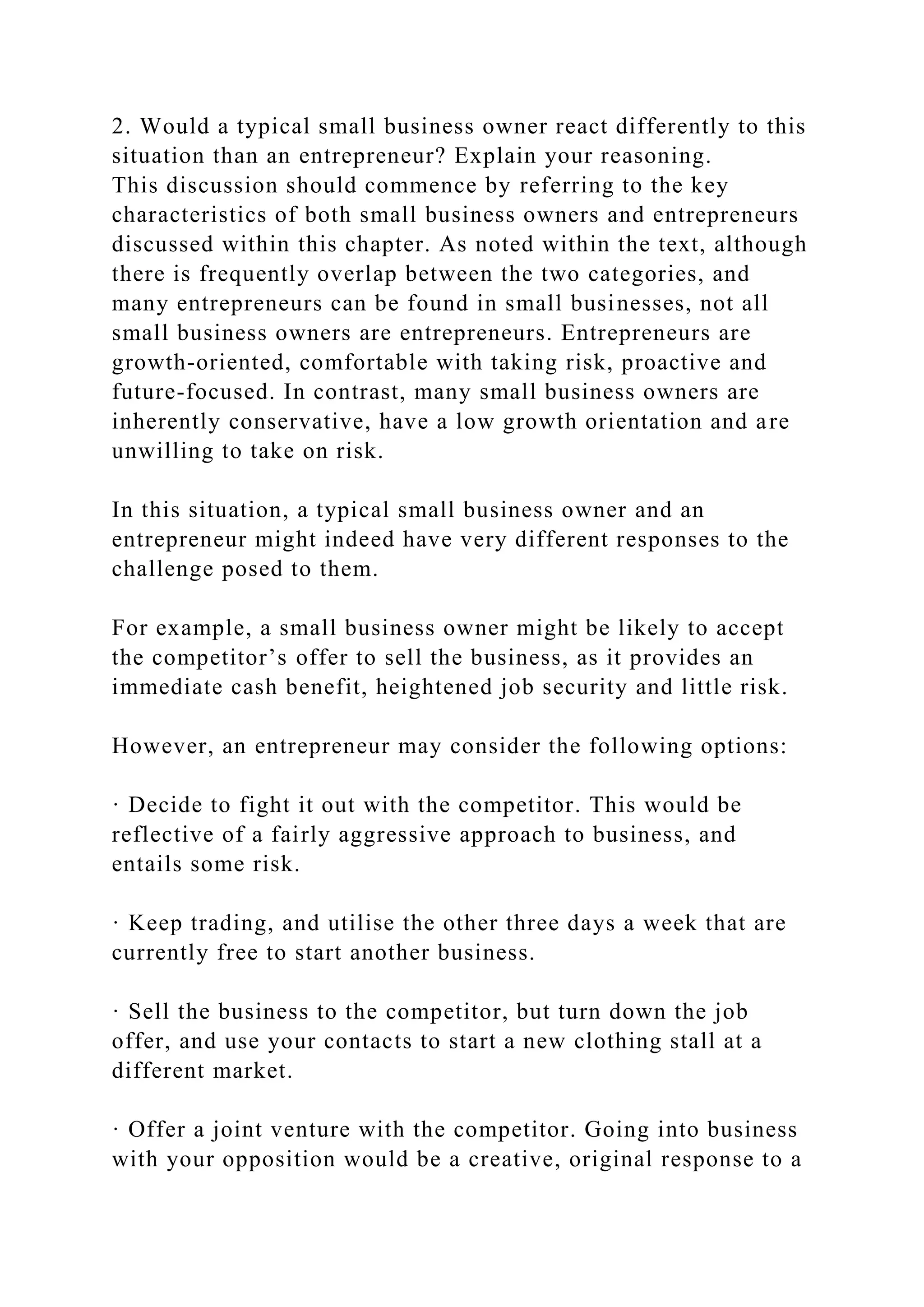
  • 26.
    common? Knowledge is thefirst common thread. The three successive stages of creativity (idea generation), innovation (idea development and evaluation) and entrepreneurship (idea implementation) consist essentially of developing and formalising knowledge to eventually encapsulate it into a marketable product or service. Social networks are the second common thread. They act as the ‘pipeline’ and catalyst for the development and dissemination of knowledge in entrepreneurial organisations. 5. What are the key steps to screen an opportunity? The creativity-innovation-entrepreneurship process essentially implies evaluating and shaping opportunities. Along this process, business ideas will assessed to determine if they represent a real entrepreneurial opportunity — a situation where sustainable value can be created for the entrepreneur and the customer. One such tool is the R-W-W ("real, win, worth it") screen. The process consists of a series of strict filters that are first used to screen out opportunities in order to identify those that offer a significant, commercial viable potential to be exploited. It aims to assess an opportunity and to address three critical issues: ( Product feasibility — Is it real? Can the product be made or service delivered using currently available, or at least feasible, technology? ( Market feasibility — Can we win? Does anyone want it? Has the product any features that someone values and would be ready to pay for? ( Economic feasibility — Is it worth it? Can the product be
  • 27.
    developed, manufactured anddistributed while generating a profit? Discussion questions 1. Can everyone learn to be creative? In his seminal book on creativity The Mechanism of the Mind, Edward de Bono showed that the brain is specifically designed to be non-creative – and we should be grateful for this. With 11 pieces of clothing there are 39,916,800 ways of getting dressed. Trying out one method every minute would take 76 years! The purpose of the brain, he said, is to make stable patterns for dealing with a stable universe. That is why you can get dressed in the morning, cross the road, get to work, read or write. However, thanks to the work of de Bono and the likes, we can now understand creativity. We can understand its logical basis in how the brain works. From such understanding, we can derive the deliberate tools. And these tools can be learnt and used. As with any skill, some people will become more skilful than others. But everyone can learn to be creative. It is not a mystical gift. 2. How can entrepreneurs evaluate the potential return of an innovation? Having creative ideas is only the beginning of the entrepreneurial process. Would-be entrepreneurs must also be able to assess whether their ideas are entrepreneurial opportunities (can the idea be implemented and sold with a profit? Is there a market for the product?). During the next step of the entrepreneurial process, innovation, entrepreneurs must demonstrate that their idea is technically feasible. To do this, a business plan and a prototype of the product are usually built. Finally, the product or service must be sold in the market place. This is the value creation stage and many would-be entrepreneurs also fail to reach this threshold.
  • 28.
    3. Why do seasonedentrepreneurs often say: “You don’t need to reinvent the wheel to become an entrepreneur?” Entrepreneurship can occur with little, if any, innovation. Most of the ‘new’ products and services launched in the marketplace, and the business ventures set up to produce those are more or less copy cats. Thus, the presence of innovation is viewed as a sufficient condition for entrepreneurship but not a necessary one. Moreover, the newness or uniqueness of an innovation is a matter of degree both in terms of the tangible characteristics and in terms of the relevant market. A new business can be based on an incremental innovation (e.g. extension, duplication, synthesis) of an existing product, service or process. 4. Why do consumers fail to buy innovative products even when they offer distinct improvements over existing ones? To understand why new products fail to live up to companies' expectations, we must delve in to the psychology of behaviour change. New products often requires consumers to change their behaviour. As entrepreneurs know, those behaviour changes entail costs Consumers incur transaction costs, such as the activation fees they have to pay when they switch from mobile phone provider to another. What business don't take into account, however, are the psychological costs associated with behaviour changes. Many products fail because of universal, but largely ignored psychological bias. People irrationally overvalue benefits they currently possess relative to those they don't. This bias leads consumers to value the advantages of products they own more than the benefits of new ones. It also leads entrepreneurs to value benefits of innovations they've developed over the advantages of incumbent products. 5. Today’s mix of technological innovation and intensifying
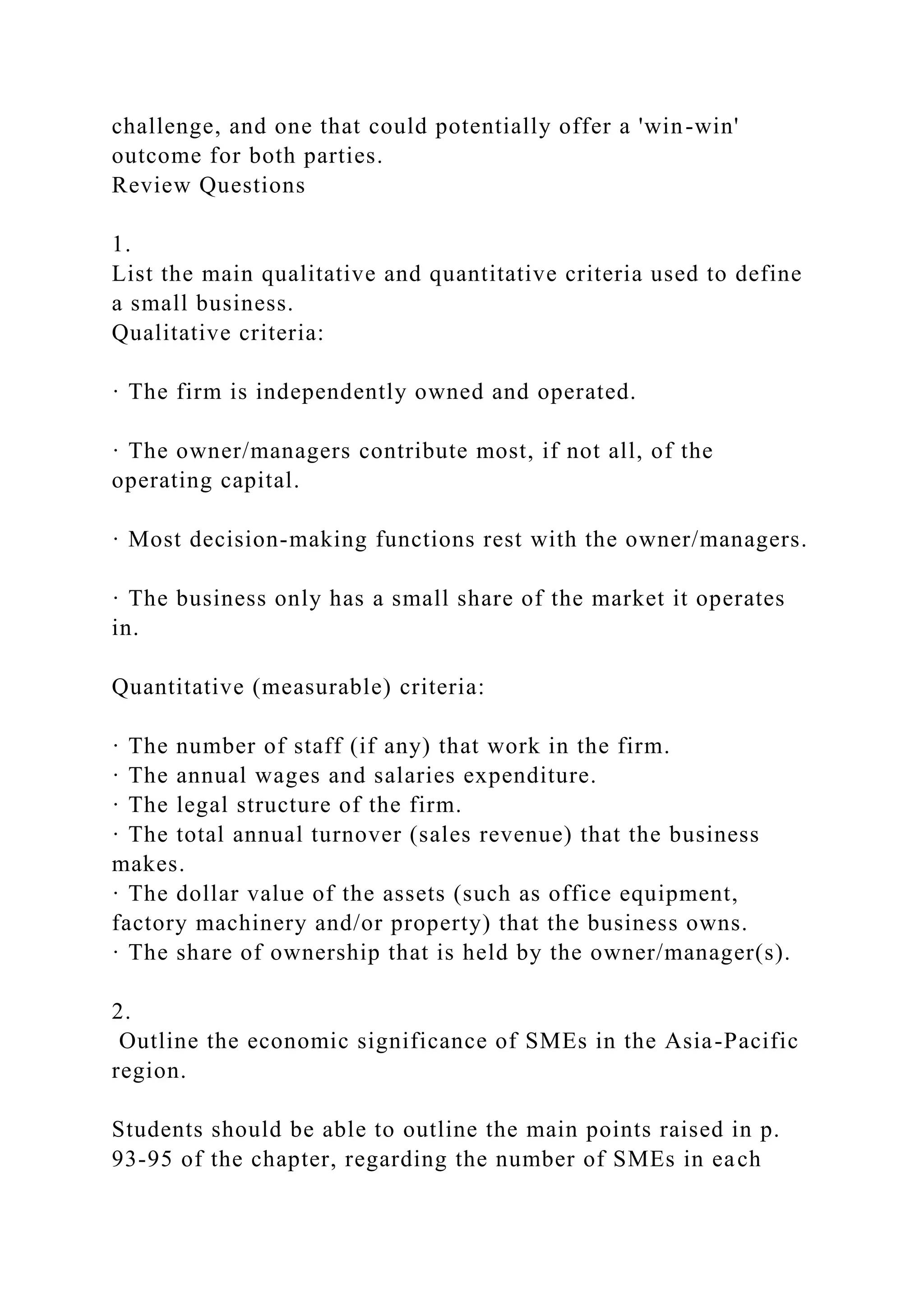
  • 29.
    globalisation is usheringin a new industrial revolution that provides unprecedented opportunities for innovative entrepreneurs. What is your view regarding this statement? Much of the thrust of innovation today is occurring in the digital space. Rather than an ‘industrial’ revolution, it could be considered an information revolution is taking place, with the volume and availability of information increasing exponentially. This rapid change is also linking people around the world and breaking down geographical barriers to business. This is creating many opportunities for entrepreneurs with I.T. and programming skills or ideas. Disruptive innovation is the idea that a new innovation can totally change the competitive landscape, rendering old ways of doing business obsolete. For example, the idea of television streaming on demand is a major threat to traditional broadcast television. But that does not mean the opportunities are limited to I.C.T. fields. The availability of information can lead entrepreneurs to discover value more readily in any market, including traditional ‘offline’ markets. Entrepreneurs may have access to market knowledge that leads them to fill customer needs better than large existing businesses. There is no monopoly on information and knowledge.Case study: JamiQ 1. What type of real innovation has JamiQ introduced in the marketplace? JamiQ is able to offer business clients real time, highly detailed information on how they are being discussed in social media of all kinds. They can do this in many different languages, and provide clients with critical real-time insights for strategic decision making. Their services include: · Real time buzz trending: picking up the moment the client’s company name (or key phrases) appear in social media networks and tracing the buzz (of sharing and discussion) as it unfolds · Sentiment detection: Allowing them to judge to underlying
  • 30.
    sentiment (positive ornegative) towards the company based on social media interactions · Influence scoring: Analysing the level of influence of various media platforms · Market segmentation: Using data mining to show exactly which groups of customers, by location, demographics, and social media platforms are commenting on the company. 2. Who could best take advantage of JamiQ’s services? JamiQ offers a scalable service for business clients, large or small, from one search word to many. Business clients in any country could take advantage of this service, as it works in multiple languages. Government agencies, political parties and not-for-profits may also benefit from this insight into how they are being talked about. In partnership with SingTel they offer a stripped down version called ReputationWatch which is more tailored to small to medium business clients. 3. What additional services could JamiQ offer? JamiQ provides a social media data mining service to business clients. It is likely that clients will become very dependent on JamiQ, and this provides an opportunity to offer further products and services to the same client base. For example, they could offer more traditional CRM software, integrated into the social media tracking service, so that data can be responded to on a customer by customer basis. They could offer a social media marketing campaign service or public relations management service, which actually manages the social media efforts for the company, responds to the feedback that their product delivers, and reports back to the client on real results. This would be a value added service rather than merely providing the raw data that clients must respond to themselves. © John Wiley & Sons Australia, Ltd 2014
  • 31.
    4 © John Wiley& Sons Australia, Ltd 2014 5 __MACOSX/S---C/chapters book high light /._schaper4e_irg_ch03.doc S---C/chapters book high light /schaper4e_irg_ch04.doc Chapter 4: The nature of small business Instructor resource guide to accompany Entrepreneurship and Small Business 4e by Schaper et al Instructor Resource Guide to accompany Entrepreneurship and Small Business 4th Edition Prepared by Michael Schaper, Thierry Volery, Paull Weber and Kate Lewis Updated by Mark Hornshaw University of Notre Dame © John Wiley & Sons Australia, Ltd 2014Chapter 4: The nature of small business What Would You Do? The Shirt On His Back 1 . List the different options that you have for the next 12 months, and the advantages and disadvantages of each course of action.
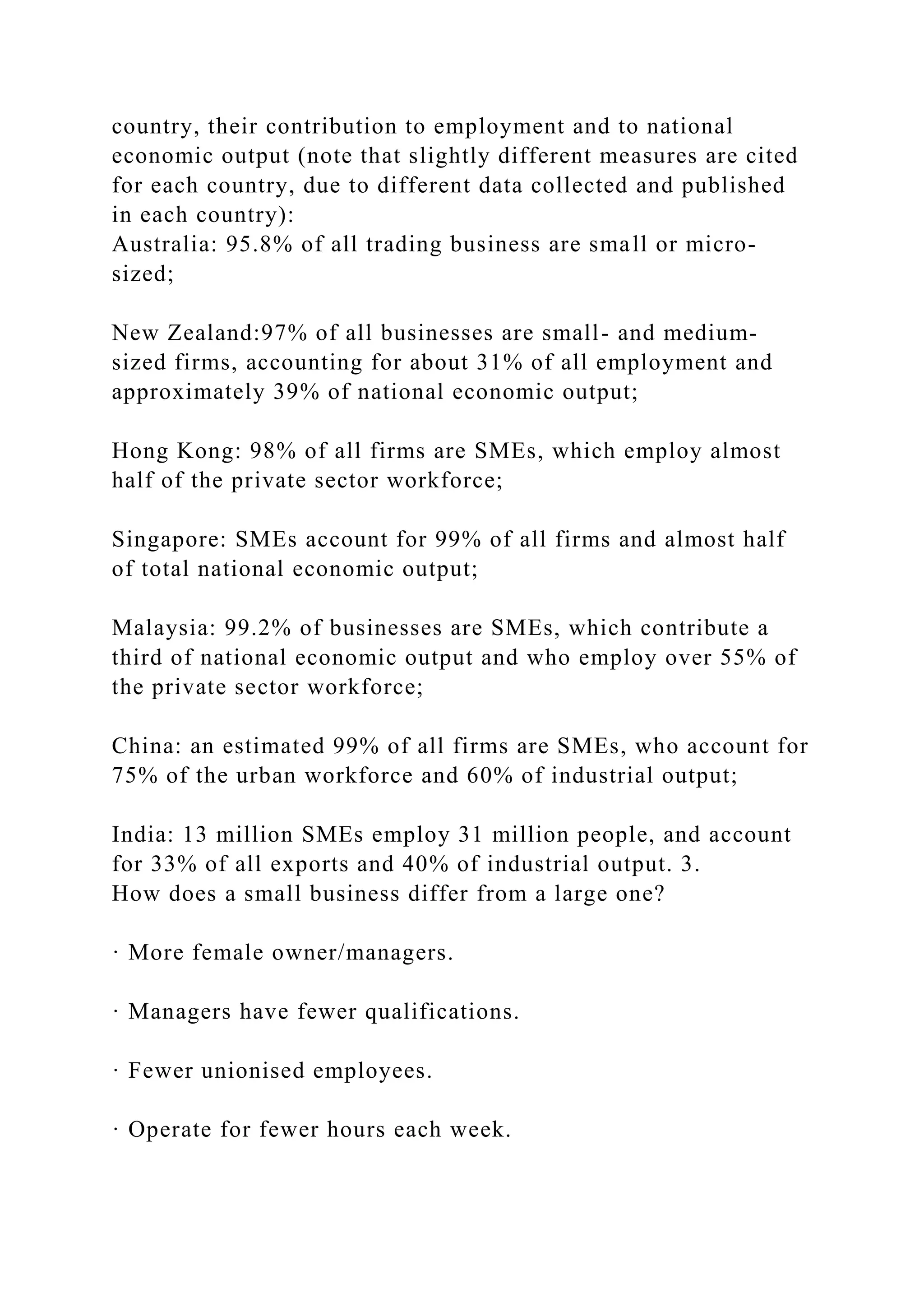
  • 32.
    There are severaldifferent possible outcomes, the key ones of which are: · Continue trading in the same manner as your father. The advantages of this course of action include: you are already familiar with the operating system and processes, the income and expenses are well known, and the market you service is also well known to you. The disadvantages include the fact that sales and income growth prospects are limited, you will forego the lump cash sum of $35,000 being offered by the competitor, and you will have to face the threat of a new rival business competing directly against you in a situation where you have previously had a monopoly. The cost of remaining in your family business is $31,200 – this is the amount you will have to pay your father ($200 per week x 52 weeks x 3 years). · Sell out to the larger competitor. The advantage of this option is that it would provide you with ongoing employment, and you would also make a small profit (you will receive $35,000 compared to the $31,200 you would have to spend in buying the business from your father). However, the drawback includes a loss of independence and autonomy in your working life; the fact that you will no longer 'be your own boss'; and constraints on your future income- earning capacity. Students should also be encouraged to consider other practical courses of action that might lie between these two extremes. For example, you could consider offering the business to a third party (presumably, if someone is prepared to buy it from you for $35,000 then there may also be other willing buyers).
  • 33.
    2. Would atypical small business owner react differently to this situation than an entrepreneur? Explain your reasoning. This discussion should commence by referring to the key characteristics of both small business owners and entrepreneurs discussed within this chapter. As noted within the text, although there is frequently overlap between the two categories, and many entrepreneurs can be found in small businesses, not all small business owners are entrepreneurs. Entrepreneurs are growth-oriented, comfortable with taking risk, proactive and future-focused. In contrast, many small business owners are inherently conservative, have a low growth orientation and are unwilling to take on risk. In this situation, a typical small business owner and an entrepreneur might indeed have very different responses to the challenge posed to them. For example, a small business owner might be likely to accept the competitor’s offer to sell the business, as it provides an immediate cash benefit, heightened job security and little risk. However, an entrepreneur may consider the following options: · Decide to fight it out with the competitor. This would be reflective of a fairly aggressive approach to business, and entails some risk. · Keep trading, and utilise the other three days a week that are currently free to start another business. · Sell the business to the competitor, but turn down the job offer, and use your contacts to start a new clothing stall at a different market. · Offer a joint venture with the competitor. Going into business with your opposition would be a creative, original response to a
  • 34.
    challenge, and onethat could potentially offer a 'win-win' outcome for both parties. Review Questions 1. List the main qualitative and quantitative criteria used to define a small business. Qualitative criteria: · The firm is independently owned and operated. · The owner/managers contribute most, if not all, of the operating capital. · Most decision-making functions rest with the owner/managers. · The business only has a small share of the market it operates in. Quantitative (measurable) criteria: · The number of staff (if any) that work in the firm. · The annual wages and salaries expenditure. · The legal structure of the firm. · The total annual turnover (sales revenue) that the business makes. · The dollar value of the assets (such as office equipment, factory machinery and/or property) that the business owns. · The share of ownership that is held by the owner/manager(s). 2. Outline the economic significance of SMEs in the Asia-Pacific region. Students should be able to outline the main points raised in p. 93-95 of the chapter, regarding the number of SMEs in each
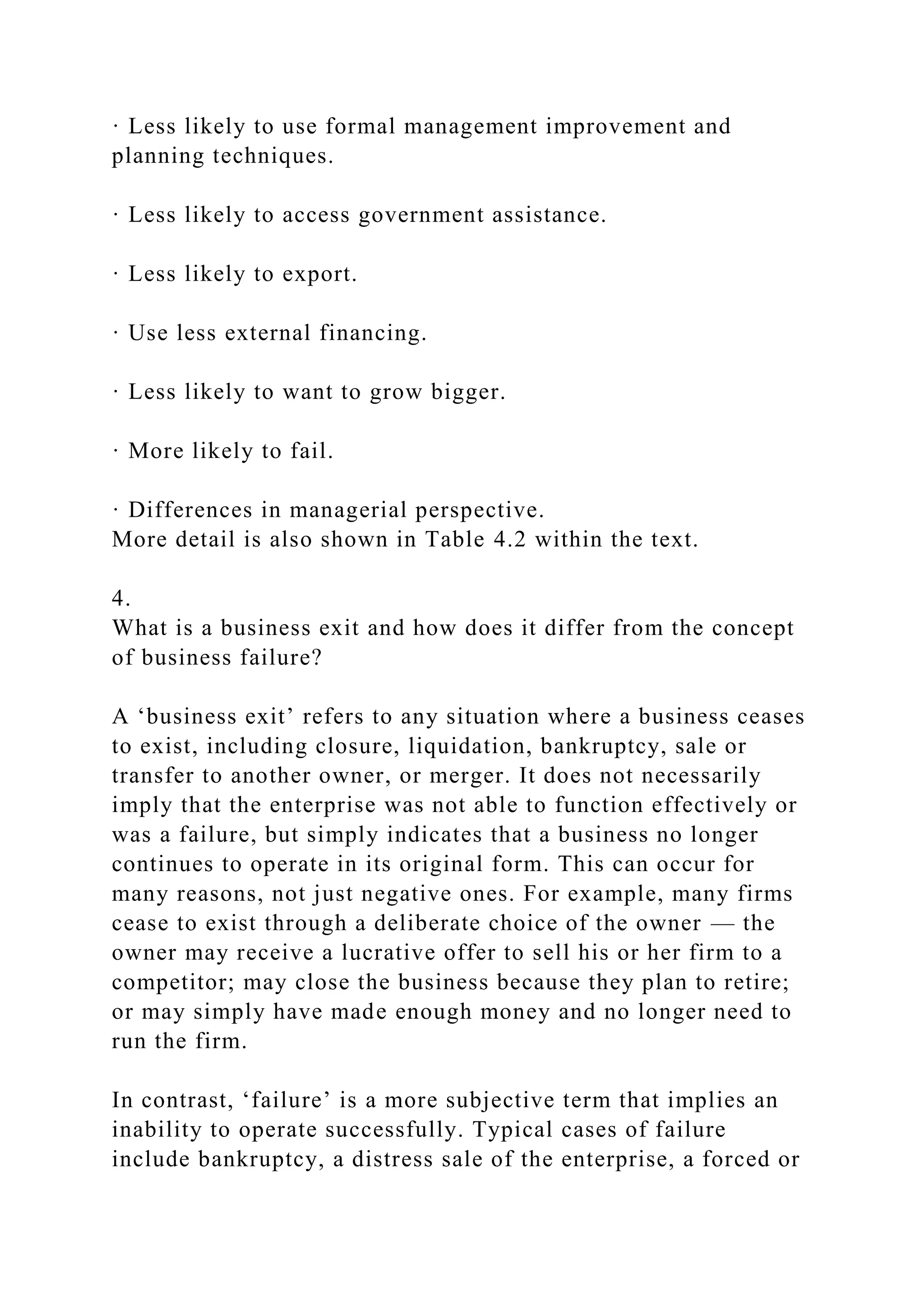
  • 35.
    country, their contributionto employment and to national economic output (note that slightly different measures are cited for each country, due to different data collected and published in each country): Australia: 95.8% of all trading business are small or micro- sized; New Zealand:97% of all businesses are small- and medium- sized firms, accounting for about 31% of all employment and approximately 39% of national economic output; Hong Kong: 98% of all firms are SMEs, which employ almost half of the private sector workforce; Singapore: SMEs account for 99% of all firms and almost half of total national economic output; Malaysia: 99.2% of businesses are SMEs, which contribute a third of national economic output and who employ over 55% of the private sector workforce; China: an estimated 99% of all firms are SMEs, who account for 75% of the urban workforce and 60% of industrial output; India: 13 million SMEs employ 31 million people, and account for 33% of all exports and 40% of industrial output. 3. How does a small business differ from a large one? · More female owner/managers. · Managers have fewer qualifications. · Fewer unionised employees. · Operate for fewer hours each week.
  • 36.
    · Less likelyto use formal management improvement and planning techniques. · Less likely to access government assistance. · Less likely to export. · Use less external financing. · Less likely to want to grow bigger. · More likely to fail. · Differences in managerial perspective. More detail is also shown in Table 4.2 within the text. 4. What is a business exit and how does it differ from the concept of business failure? A ‘business exit’ refers to any situation where a business ceases to exist, including closure, liquidation, bankruptcy, sale or transfer to another owner, or merger. It does not necessarily imply that the enterprise was not able to function effectively or was a failure, but simply indicates that a business no longer continues to operate in its original form. This can occur for many reasons, not just negative ones. For example, many firms cease to exist through a deliberate choice of the owner — the owner may receive a lucrative offer to sell his or her firm to a competitor; may close the business because they plan to retire; or may simply have made enough money and no longer need to run the firm. In contrast, ‘failure’ is a more subjective term that implies an inability to operate successfully. Typical cases of failure include bankruptcy, a distress sale of the enterprise, a forced or
  • 37.
    involuntary merger withanother firm, or liquidation by the owners, creditors or administrators. It is often hard to objectively determine if a business has actually failed. For example, so-called financial failure can range from a situation where the business is making a trading loss each year or where liabilities exceed assets, through to a situation where it is simply not making a satisfactory level of profit or sufficient return on capital invested. In terms of the firm’s marketing performance, a business could be considered a failure if its product recognition is low, its market share declines, or where its original market ceases to exist, even if it still trades at a profit. 5. List the general characteristics of a small business. · Ownership usually consists of just one or two individuals · Financing is provided by the owner · The business has limited market share · Limited life span · Sometimes run on a part-time basis · There is a low level of net profit · Limited product or service offering · Frequently is a home-based business · Geographically limited to one or two locations · Is often a family-based business
  • 38.
    · Is onlylocated in the private sector Discussion Questions 1. Why do so many different countries seem to have similar proportions of SMEs in their business populations? As is indicated in the chapter, most countries have many micro- businesses, some small businesses, a few medium-sized firms and only a limited number of large firms. This could be for a number of reasons: · It always takes a large number of micro- and small-sized businesses to support a few large ones · Business opportunities, competition and other pressures with the private sector inevitably lead to a series of pressures (in every country) that favour the survival of only a small number of large firms · Large business may develop the ability to utilise political connections to tilt the competitive landscape in their favour, such as regulations that suit their business model but that smaller competitors find it harder to comply with · Students should also be encouraged to suggest their own ideas, as the literature on this topic is limited and has failed to conclusively answer this question. 2. Is there any meaningful difference in the definitions of small business and entrepreneurship? Yes. The difference is more than just semantic. It is sometimes a different way of dealing with the business world. Entrepreneurs tend to be focused on issues such as innovation, risk-taking and business growth. They may start small, but generally have an ambition to become a medium or large business. Small business is more directly related to a small- scale firm that may have a more staid and conservative approach to future business development. A small firm may not
  • 39.
    necessarily be entrepreneurialif it simply continues in a static state. The answers to the case study below also elaborate these differences in more detail. 3. What are the advantages and disadvantages of operating a home-based business? Home based businesses are usually in the services sector, relying on the knowledge and abilities of the owner operator. Some advantages include the obvious convenience of being able to work from home and save on travel time, the ability to combine family responsibilities with work, and the opportunity to turn a hobby into an income producing business. Some people may want the business to remain small so this situation can continue. Disadvantages include the lack of separation between work and home, where work responsibilities (such as phone calls, clients, at the door, etc) can intrude on personal time. Some people may find it difficult to work from a home environment, for example feeling embarrassed to take a phone call with the sound of children in the background, and may need a totally separate space. As a business grows and takes on other staff members it may put strains on the rest of the household. 4. What is the most important contribution that SMEs make to a national economy: job creation, wealth generation for their owners, or increased innovation? Explain your reasoning. Answers will depend on students own judgement. Example answers: Job creation: Small business account for around half of all private sector jobs in most countries, so this is a crucial engine for job creation. This also means competition in the employment market and a greater variety of jobs to do. Wealth generation for their owners: Without any coercive power and without a captive market such as a monopoly, the way an entrepreneur becomes wealthy is by serving the needs of others. This is a win-win for the entrepreneur and the wider society.
  • 40.
    The entrepreneur deliversproducts and services that people desire, and are themselves rewarded with profits. This is also a way to limit the power of large companies and avoid the feeling of being ‘forced’ to work in a job you don’t like – go and create a business of your own. Increased innovation: In striving to serve the needs of the market and find an opportunity to profit, entrepreneurs are innovators. They can’t simply continue to do the same things that have always been done, but must look for ways of doing things better, or more efficiently. Large existing businesses can be stuck in their ways, but entrepreneurs usually don’t have this luxury – they must innovate if they want to find a new opportunity. This then forces larger firms to also innovate and better serve the needs of customers, or face losing market share. Society benefits by having more choices, better products and lower prices due to increased competition. Case Study: Bespoke Threads – tailor-made for success 1. Would you recommend that Alison keep operating as she is, or should she expand via franchising? Explain your reasoning. Student answers will vary depending on their perspective. Example answer: I would recommend Alison keeps operating as she is and does not venture into franchising. Alison’s motivation for going into business was to stop working for other people and work for herself. Bespoke Threads in its current form allows her to do this. Alison is more contented now that she is working from home rather than a city shopfront. It suits her lifestyle and family responsibilities, and returns an income she is happy with. The home business is at maximum capacity, and if Alison employed any staff she would need to rent external premises, which she does not want to do. If Alison became a franchisor, she would find she had a lot more management responsibilities, be doing more legal and administrative work, and probably
  • 41.
    interstate travel. Shemay not be able to do this as well as run her own Bespoke Threads outlet at the same time, and would therefore need to take on staff (either administrative or customer service). Possibly, the impetus to pursue franchising comes from a misplaced idea that all successful small businesses ‘must’ grow – but this is not necessarily the true. On the other hand, if Alison, really does want to grow the business, franchising would be a good way to do this. A franchisee is more likely to have the dedication to customer service that is required, with less direct supervision than an employee, and Alison’s ‘head office’ can still be relatively small. She might find ways to get around the space restrictions at home, even moving to a bigger house if necessary. 2. What are some of the personal problems of growing the business further? If Alison was to grow the business any further she would need to take on staff, and this would require more space. If Alison had to rent outside premises again, this would take away the lifestyle advantage she feels she has gained by working from home. Her focus would also be taken away from serving customers in person, and be directed towards marketing, administering the larger organisation, dealing with legal issues and supervising staff members or franchisees. The business itself, which requires a high level of customer service, may also need to be adapted and systemised to accommodate a larger scale, as not everybody will be as skilled as Alison is herself. 3. Is Alison more likely to fail than a bespoke clothing business operating out of a shop? Working from home, Alison has very few overheads. She has no shopfront rent to pay and no staff wages to pay. Therefore Alison is much less likely to fail while working from home. If the business goes through a period of low sales, her expenses
  • 42.
    (being mostly variablecosts) will also decline so that she won’t actually ‘lose’ money. If she takes on fixed costs such as shopfront rents, she is less able to withstand a decline in sales, as a high level of sales is needed just to break even. © John Wiley & Sons Australia, Ltd 2014 6 © John Wiley & Sons Australia, Ltd 2014 5 S---C/chapters book high light /schaper4e_irg_ch05.doc Chapter 5: Community contexts of small business Instructor resource guide to accompany Entrepreneurship and small business 4e by Shaper et al Instructor Resource Guide to accompany Entrepreneurship and Small Business 4th Edition Prepared by Michael Schaper, Thierry Volery, Paull Weber and Kate Lewis Updated by Mark Hornshaw University of Notre Dame © John Wiley & Sons Australia, Ltd 2014 Chapter 5 - Community Contexts of Small Business What Would You Do? The fin edge of the wedge?
  • 43.
    1. Would you banshark fin soup from your menu? Give reasons to justify your answer. Yes, I would ban shark fin soup from my menu. I would put my values ahead of other considerations. I would make every effort to gain a business advantage from the decision, but be satisfied that I had done the right thing whether this pays off or not. For example, I would try to make the name of my restaurant synonymous with the push for sustainable fishing practices by joining and donating to awareness campaigns, and branding my restaurant as a sustainable business, and in so doing try to attract a new, environmentally concerned clientele. At the same time, I would try to bring along my existing clientele by respectfully explaining the decision and offering alternative menu choices. Alternatively: No, I would not ban shark fin soup. I would perhaps make it a less prominent feature on the menu and not promote it as a “chef’s suggestion”. But my role is to serve the customer what they want, and leave the final ethical decision to them. If they still want shark fin soup, I should not overrule them by imposing my values. When they stop buying it, I will stop selling it. I may however donate money towards programs to help endangered species as a way of offsetting the wrong that I feel is being done. 2. What steps can you and other restaurateurs take to improve the level of environmental responsibility in restaurants? As a restaurant owner, I could develop an environmental sustainability policy, addressing two key areas – the sourcing of produce, and the day to day running of the restaurant. In regards to the sourcing of produce, it might take considerable time and effort in order to trace the origins of all food products, and ascertain whether they are grown/harvested/procured using
  • 44.
    environmentally responsible techniques.One way around this may be to “go organic” and rely on third party certification of all products. However this may be expensive and limiting of choices. There may be products which are not necessarily organically certified but which may be a “greener” option than the next product. This especially applies to ocean fish, which can be caught in extremely destructive ways due to the “tragedy of the commons” problem. It will take diligence and resolve to ask the right questions and prove the validity of suppliers’ answers. In regards to the day to day running of the restaurant, the owner can develop guidelines around the use of packaging, energy and water use, and waste management/recycling. There may be significant cost savings as well as environmental benefits involved in the choice of energy for running stoves and refrigerators, for example. 3. How, if at all, are your answers to the first two questions influenced by the size of your business? The size of the business will have a bearing on the resources available to make any changes, where those changes come at a cost (of either time or money). A smaller business may feel their financial capacity is more restricted. On the other hand, a smaller business may feel more compelled than a larger one to be responsive to the demands of customers. A small business owner/manager, working in their own restaurant and dealing with customers every day, may also be able to observe and respond to customer needs in a more immediate and nimble way and the implications of their decision can be quickly observed. Review Questions 1. What is the difference between social responsiveness and social responsibility?
  • 45.
    Social responsiveness —a firm that is willing to engage in socially-beneficial activities, primarily because there is a pragmatic benefit in doing so. Social responsibility — firm that is willing to pursue long-term goals that benefit one’s society, even if there is no individual gain in doing so. The principal difference is the extent to which the firm proactively engages in activities that are beneficial to the community. Socially responsible firms do such things voluntarily, because they believe in them and think that they are important; socially responsive firms do things because they are responding to what their customers, the community, their staff or some other stakeholder wants. 2. What are the seven components that an eco-efficient firm uses in its activities? Eco-efficiency is a management strategy that focuses on the delivery of competitively priced goods and services that satisfy consumer needs while progressively reducing ecological impacts throughout the product life cycle. There are seven ways a firm can make itself more eco-efficient. These require it to: · Reduce the material intensity of goods and services (for example, limit the amount of raw materials used in manufacturing a product) · Reduce the energy intensity of goods and services (limit electricity and other energy used to manufacture an item or to operate it) · Reduce toxic dispersion (reduce production and emission of waste and pollutants) · Enhance material recyclability · Maximise sustainable use of renewable resources · Extend product durability (give the product a long life-span)
  • 46.
    · Increase theservice intensity of goods and services (encourage consumers to purchase intangible services from your firm, rather than actual tangible products that consume more electricity, raw materials, and emit more waste). 3. How does a social entrepreneur differ from a conventional one? A social entrepreneur is an individual who applies entrepreneurial principles and skills to the resolution of social or community problems. They are usually found working in, or managing, a government or not-for-profit sector organisation, rather than a privately-owned firm. They are more likely to lack conventional business skills or have difficulty in raising finance than their private sector counterparts. They also have to answer to a board of management, whereas a conventional entrepreneur usually does not. They measure their performance against a triple bottom line of environmental, social and financial outcomes, while most entrepreneurs only measure their financial performance. Finally, they usually wish to share or disseminate their intellectual property (ideas), rather than guarding them as a private asset. 4. For what reasons is it important to study family businesses? It is important to study family businesses because they make up a very large proportion of all firms. It is suggested that family firms may account for 90% of all businesses worldwide and make a major contribution to wealth creation, job generation and competitiveness. In Australia, for example, family businesses appear to account for a more conservative 70 per cent of all businesses, employ an average 37 employees each, and have an average turnover of AUD $12 million per annum. If we make assumptions about how a rational business owner might make decisions, those assumptions may not necessarily hold true when it comes to family businesses. The business goals and management style may be different, especially
  • 47.
    regarding long termobjectives and management transition. 5. Describe some of the issues unique to family firms. While many issues faced by family firms are similar to those faced by any business, there are some issues unique to family firms at the individual level, the interpersonal level, and the organisational level. Importantly, the founders of family firms are likely to have a significant and long lasting influence on the culture of the firm, even more so than in non family businesses. Founders are likely to personally work in the business for an extended period of time, and take a long term perspective on the success of the business and family. The business may likely be used as a vehicle to advance family goals, not just financial goals. The involvement of the next generation in the family business has its own unique implications. Some family members may join the firm from a sense of obligation, and may or may not share the passion and skills of the founder, which could cause tensions. The additional training and on the job performance achieved by next generation will influence the transfer of knowledge and power from the founder. Intergenerational transition becomes of major importance to the family firm. Managers from the next generation may have their own management style and business strategies, which may be beneficial, or may be seen as disloyal to the founder’s way of doing business. Misunderstandings and conflicts need to be handled in a sensitive and thorough way, as they do not only affect the business but spill over in to family life. Discussion Questions 1. Are the economic needs and concerns of a small-business owner always opposed to those of the broader community? The small business owner serves a need in the community in the
  • 48.
    daily operation ofthe business. The baker serves the community by baking bread while the plumber serves the community by fixing toilets. The business owner who serves well is rewarded with profits, while one who serves below the standard that consumers expect, is punished with losses. In this way, the business owner is forced to comply with the wishes of consumers, who make up the broader community. However, on occasion the economic imperatives of surviving and prospering in business may mean that the owner’s perspective is different from that of the rest of the community. For example, the community may benefit from increased competition to drive down prices and ensure quality is delivered, whereas a business owner may find it easier to block the entry competitors, through government regulations favourable to their own business model, rather than facing the constant threat of competition. 2. Identify community-based resources and activities that support the existence of small firms and discuss how those firms should compensate the community for its use of such resources. Answers to this will vary based on the cause itself and the creativity of the students. 3. Do you agree that family businesses may have unique issues that could influence performance? Justify your selection of at least one unique issue that you believe is important. Business founder’s influence: The founder is likely to be not only a successful entrepreneur but an admired family elder. They are likely to have profound and long lasting influence on the culture of the firm, which manifests through the family as well as the employees. They are likely to have goals which are not only centred around profitability, but around longevity and family succession. Next-generation involvement: The successor to the founder is not necessarily somebody who is hired in an arm’s length way purely for their talents, but may be a family member groomed for the role. This causes relationship issues and potential sources of conflict. There may be unwillingness on the part of
  • 49.
    the elder orthe incoming generation, which may be masked due to family loyalty. There may be different skills, management styles or business strategies which are important for the firm, but which may or may not be displayed due to the legacy and influence of the founder. Case Study: HealthPlus Pty Ltd 1. Despite the importance of succession and the need to plan for it, why don’t 80% of Australian family firms (such as HealthPlus Pty Ltd) put considerable effort into planning for succession? What are some of the obstacles to planning for succession to the next generation? As can be seen from the case of HealthPlus, succession planning in a family business is not dispassionate and “business-like”, it requires addressing deep family tensions and conflicting goals. Family business owners may realise that succession planning is needed, but may be reluctant to bring this up, for fear of lifting the lid on simmering tensions. It is easier to put it off until another day. John, by not properly addressing this during his life time, has allowed the situation to be even more troublesome after his death, when the family has to not only deal with the leadership tensions, but do this at a time of grief and shock over the loss of John, and without his input. 2. What does the term ‘succession planning’ actually mean and encompass? Is it more than just about who will be the next CEO? Who should be involved in developing a succession plan and ideally, when should a firm commence succession planning? Explain your reasoning. As can be seen from the case study, succession planning is more than just selecting who will be the next CEO. It involves all of the roles of family members, and all the tensions that come from the relationships between them. In the case of HealthPlus Pty Ltd, five family members are now beneficial owners of the firm, with equal shares. One is the matriarch of the family, two are full time employees of the firm, and two are children not
  • 50.
    working in thefirm. Each has a different level of interest in the firm, and some have tensions between them. Any choice of the new CEO is likely to have ripple effects on these relationships. Succession planning, should involve all stakeholders and be done over an extended period of time through family meetings. Ideally this should be commenced while the founder is still alive. For HealthPlus, this is complicated further by the fact that some of the children are married, and Olivia’s partner Phil is also working for the firm. If Phil were also involved in family meetings, it could be seen to be giving Olivia one more ‘vote’ at the table. The family might do well to get external consultants or advisors involved to help mediate and guide the process. 4. With regard to HealthPlus: a) In what ways has the lack of succession planning affected the (i) business and (ii) the family? b) Based on the available information, who do you think should be appointed to the position of CEO? What would be an appropriate process to oversee the appointment of the next CEO? Explain your reasoning. c) What changes would you make to the organisational structure of the firm? d) What governance structures would you implement? e) In relation to the ownership distribution, what are some potential issues that HP may need to address in the future? a) The lack of succession planning has left the business in a state of limbo, without a CEO and with family tensions (as well as grief) potentially overriding business needs. This could be troubling for other employees and customers. It has left the family in a situation where the simmering tensions need to be dealt with in a hasty and potentially aggravated way. b) I would advise the firm to hire an external, neutral business
  • 51.
    advisor to overseethe process of choosing the next CEO. While the next CEO could potentially be a non family member, and this may be a good compromise, it is likely that the founder’s vision was to keep the firm ‘in the family’ and the family may want to honour this by selecting one of the siblings. The new CEO, if it is a family member, needs to be somebody who has the time and dedication available for the business. This rules out Niki who is more interested in other things at the present time. If Olivia wants the job, she and Phil will need to work out a way of making this possible, with the heavy family responsibilities she also carries. Sam is a contender, with outside experience to offer although no ‘inside’ experience at HP. Andrew appears to be the one with the ambition and inside experience, and the grooming provided by John, although his authoritative management style may not suit a situation where ownership is shared. c) I would alter the organisation structure by placing a board of directors over the CEO, and including all beneficial owners as directors. Even Niki, who is overseas, would be encouraged to participate in strategic company decisions at this level. d) The governance structure follows from the organisational chart; the CEO should operate as the executive director, but be accountable to the board of directors. The board of directors must have final authority, including the authority to remove the CEO (as an executive, but not as an owner). This would be a high stakes, confrontational move if it were to occur, but the CEO should voluntarily submit themselves to this oversight, and should be chosen on the basis of their willingness to do so. e) The ownership includes a 20 per cent share held by the matriarch Mary. Mary is ageing, and if she dies in the future, she may bequeath her share as she pleases. She may leave it to the four children in equal proportion, or may grant it unequally to one or more children, or may even leave her share to
  • 52.
    somebody outside thefamily. This could be a cause for concern in the future. The family should address this early on, while Mary is alive. If she wishes to leave her share to an outsider or to the children unequally, the family may wish to discuss the buying out of that share for cash. © John Wiley & Sons Australia, Ltd 2014 6 © John Wiley & Sons Australia, Ltd 2014 1 __MACOSX/S---C/chapters book high light /._schaper4e_irg_ch05.doc S---C/chapters book high light /schaper4e_irg_ch06.doc Chapter 5: Options for going into business Instructor resource guide to accompany Entrepreneurship and Small Business 4e by Schaper et al Instructor Resource Guide to accompany Entrepreneurship and Small Business 4th Edition Prepared by Michael Schaper, Thierry Volery, Paull Weber and Kate Lewis Updated by Mark Hornshaw
  • 53.
    University of NotreDame © John Wiley & Sons Australia, Ltd 2014Chapter 6 - Options for going into businessWhat would you do? Food for thought 1. What advice will you give your clients? As a broker, my advice is limited to the purchase of one of these two businesses. Each has its advantages and disadvantages for their situation. They should consider the following: Learning Curve: Elaina and Alex have experience in a television studio and a large corporation, not in the fast food industry. So they will face a steep learning curve. A franchise system will usually offer full training and a detailed business system to follow, whereas the independent business will require more on- the-job learning and more dependency on the existing staff. With committed staff, this could be overcome. Flexibility: If the clients want to work within a fairly rigid system, then the franchise would be ideal. If they want to make changes to the style of food, the type of service offered, the opening hours or any other changes, they would be better off with the independent business. Risk: A franchise system is usually considered lower risk, as they business follows a replicated system that is proven to work in other places, with centralised marketing and administrative support, and is therefore less dependent on the skills of the franchisee/owner. On the other hand, there is also the risk that the franchise group will go out of business or that the franchise agreement will not be renewed in five years time. With a stand
  • 54.
    alone business, theclients sink or swim based on their own management abilities. Competition: In this particular case, the two businesses are in fierce competition with each other and this should be considered before purchasing. If they clients buy the stand alone business, they face a competitor in the noodle franchise which has a larger (central) marketing capacity, but also a fairly rigid product range. They face a “known quantity”, but have for themselves the ability to adapt to customer tastes whenever they want to. They could add noodles to their own menu if they want to. On the other hand if they buy the franchise business, they face the reverse situation, not knowing who will purchase the stand alone business and how it will be modified to compete against them. Ongoing Costs and Profits: The two opportunities have the same purchase price. But the clients should consider the ongoing running costs and opportunities to profit. The franchise system may have an ongoing franchise fee or commission payable to the franchisor, but may get better discounts on supplies due to the larger purchasing power. The stand alone business may face higher costs for supplies, but also has the most flexibility to change suppliers if a better deal can be found. Future scope: The clients should consider their longer term goals. Do they desire to have a steady business which will provide them a regular income? Or do they have ambitions to expand and grow exponentially? If they are extremely entrepreneurial, they franchise system may end up being a limitation on their ability to grow. The stand alone business, if done well, could be turned into a franchise of their own or expanded to other locations. 2. Are there any other options that they should consider if they want to go into business?
  • 55.
    Of course Elainaand Alex are not limited to these two opportunities. With money saved up, some skills and ambition, they can explore any kind of business in any industry they desire. Another avenue for them to consider is to start their own business from scratch. Considering the fast food industry, there are advantages and disadvantages to this. On the plus side, they have full flexibility to start any kind of food outlet they like, in any location they like, and to set it up according to their own style and personality. They will also avoid paying the large upfront cost for the goodwill of the business and for any capital equipment they don’t need, and instead will spend their money in numerous small amounts. On the downside, they face a very steep learning curve. Everything must be researched and negotiated from scratch, and all in a short period of time. From the big decisions such as leasing a shopfront and hiring staff, to the small choices of items such as tablecloths, aprons and straws, everything must be thought through. They must also build up a customer base from nothing, so will need to invest heavily in marketing with uncertain results. Cash flow might be sporadic and the raising of additional funds, if necessary, might be difficult. The purchase of an existing business, while somewhat restrictive, avoids many of these problems in an industry such a fast food. Review questions 1. Explain the respective advantages and disadvantages of starting and buying your own business. Advantages of starting your own business: · Owner can shape his/her own vision · Flexibility · Cost minimisation
  • 56.
    · Inability topurchase · Can pursue lifestyle goals Disadvantages of buying a business: · Hard to raise capital · Lack of established customer base · Hard to manage cash flow · Time and effort wasted on learning how to do things (learning curve expenses) Advantages of buying a business: · Established customer and marketing base · Easier to borrow funds to buy · Predictable cash flow · Established goodwill Disadvantages of buying a business: · May be hard to break existing organisational culture (the attitudes and practices of existing staff) · More expensive to purchase 2. What are the different formulas used to calculate the selling price of a business?
  • 57.
    Market-based valuations 1. The goingmarket rate method Sales price = Sales price of similar firms 2. Revenue multiplier method Sales price = (Turnover) (Standard industry multiple) Asset-based valuations 1. Book value Sales price = Tangible assets + Intangible assets – Liabilities 2. Adjusted book (net asset) value No precise formula—instead, valuers often adjust the initial book value in a number of ways. The assets may be revalued to reflect their current worth, as may be the liabilities. This is a somewhat subjective measure that can vary from one valuer to another. 3. Liquidation value No precise formula – it is the value the owner could sell the assets for as stand-alone items, rather than as part of a going concern (i.e. if selling a restaurant at liquidation value, it would be the sum total of all of the individual pots, pans and cooking equipment; chairs and seats; decorations; food still in storage; etc). 4. Replacement value The cost of replacing all of the firm’s tangible assets at current market costs.
  • 58.
    Earnings-based (cash flow)valuations 1. Return on investment (capitalised value method) Sales price = (Net Annual Profit)(100/ROI) 2. Discounted cash flows CFt = the expected cash flow in period t r = required rate of return, or discount rate, or opportunity rate n = the number of periods considered in the analysis Terminal value = value of the business after the forecast period. There are two ways to compute this value: (1) use the liquidation value of the business expected at the end of the time-frame under consideration; or (2) take the last period’s cash flow as perpetuity and discount it back to present value. 3. Explain the difference between a product franchise and a business system franchise? Product franchise · A franchise to sell a particular product or service · Limited to particular items · Does not help show how to run or successfully manage a business · Simpler; less contractual requirements · Less help to novice business operators · Better suited to entrepreneurs (allows growth-oriented
  • 59.
    individuals more scopeto expand and innovative than is permitted within a business system franchise). Business system franchise · An arrangement where the franchisor not only supplies the product, but also gives comprehensive guidelines as to how the business is to be run. · Aimed at management as much as marketing of products · Binds the operator into a complex set of day-to-day requirements and commitments 4. What are the six steps to follow when starting a business venture? 1. Conduct market research into the basic business idea. 2. Check the statutory requirements—see what licenses, laws and permits apply to the industry you plan to operate in. 3. Access suitable resources— check to see if you have enough money, suitable premises, can obtain relevant insurance, can recruit the right staff, can source suppliers, obtain all necessary equipment, etc. 4. Critical evaluation - compare the three commencement options (buy, start-up or franchise). 5. Work out financial projections (including capital required, sales mix, cash-flow, profit & loss forecasts, etc). 6. Business plan preparation. 5. What are the main differences between the three types of business start-up options?
  • 60.
    The most succinctway to answer this question is to refer to table 6.2 in the text. Differences Amongst Commencement Options Start-Up Purchase Franchise Market/Customer Base Unknown Defined Pre-determined Advertising & Pricing Strategy Unknown Defined Pre-determined Future Growth Possibilities Unlimited Unlimited Restricted Staffing Flexibility High Low Moderate Flexibility in Managerial Decision-Making High Moderate Low Risk of Failure High Moderate Low Level of Initial Financial Outlay At owner’s discretion Substantial Substantial
  • 61.
    Subsequent Financial Commitments Nil Nil Yes(ongoing levies and royalties) Goodwill Costs? No Yes Yes Ability to Raise External Funds Poor Moderate Moderate Note: · There is rarely, if ever, one best commencement option that will suit the needs of all entrepreneurs or small business owners. · Other items can also be added to this list by students. · Also need to take into account personal goals, financial and other resources, etc. Discussion questions 1. Why might an independent start-up business have a better survival rate than a franchise? There is a commonly held view that most franchises have a lower failure rate than new independent small businesses. However, there is only limited empirical evidence to support this argument. In many cases, independent start-ups may in face have better survival rates. Some possible reasons include: · The kind of people who start new businesses could be more entrepreneurial, more in touch with the local customer needs and better able to adapt
  • 62.
    · Failure, ifit does occur, is limited to the one business. If a franchise organisation fails, it can lead to the closure of all the franchisees as well, even if they were individually running successful outlets. · Franchises commonly start from one successful prototype business which works well, is systemised, and then replicated. But this process could be “locking in” the bad with the good. The market conditions which lead to the success of the prototype might change over time, but the franchise company may have become large and out of touch. An independent business on the other hand has local knowledge which can be implemented more easily as the needs of the market change. · Conflict between franchisees and franchisors can lead to unhappiness with the system. For example, if they franchise agreement requires every franchise to buy they supplies (for example paper cups) from the agreed supplier, but the franchisee discovers they can buy the same paper cups for a lower cost elsewhere, this may lead to conflict and eventual breakdown of the contract. 2. If you were preparing to sell your own business, what specific management actions could you take to maximise its selling price? Some steps could include the following: · Prepare a complete set of accurate financial records. · Calculate the sales price using the various different formulas; ascertain which method produces the best result, and use this as your bargaining chip for sales negotiations. · Encourage sales turnover in the period leading up to the
  • 63.
    listing of thefirm for sale; this will show the firm having a high level of income and hence make it more attractive to potential purchasers. · Ensure that the physical appearance of the premises is attractive. · Update and formalise any systems and procedures for the business, to show that it can be run according to a set formula. If it can be run without the day to day involvement of the owner, it will be much more attractive to buyers. · Anticipate any questions the potential buyer is likely to ask – especially the common question: “why are you selling?” Show that all loose ends are tied up and the transition will be a smooth one. 3. What sort of person is best suited to operating a home-based business? A home based business can be advantageous to somebody who wants to minimise their costs and allow themselves added flexibility and hours to suit their lifestyle. It suits somebody who wants to be self-employed and not necessarily grow too large. And it suits somebody wishing to run a professional or service oriented business, without the need for excessive stock or customer traffic. More information is presented in chapter 5. Exercises 1. Using the ROI valuation technique. Calculate the purchase price for a business with a $250 000 annual profit and a level of risk that commands a 15 per cent return on investment. What would be the purchase price for the same business if the anticipated ROI was 10 per cent. Purchase (selling) price =
  • 64.
    ROI must beconverted into a decimal, therefore: For a 15% return on investment: Purchase (selling) price = (Net Annual Profit) / (ROI/100) = (250 000)/(15/100) = (250 000)/(0.15) = $1 666 666 For a 10% return on investment: Sales price = (Net Annual Profit)/(ROI/100) = (250 000)/( 10/100) = (250 000)/(0.1) = $2 500 000 The second (lower) ROI figure produces a higher sales price. This reflects the underlying assumption of the ROI valuation method, wherein low risk = low return on investment = high sales price, and vice versa.2. Altering earnings based valuation factors. Repeat the two calculations in exercise 1 above, but with a firm whose net profit is only $30,000. Purchase (selling) price = (Net Annual Profit) / (ROI/100) = (30 000)/(15/100) = (30 000)/(0.15) = $200 000 For a 10% return on investment: Sales price = (Net Annual Profit)/(ROI/100) = (30 000)/(10/100)
  • 65.
    = (30 000)/(0.1) =$300 0003. Using different valuation methods. A business has tangible assets of $875 000 and liabilities of $50 000 and produces a net profit of $56 000 per annum based on a turnover of $430 000. It is a professional practice (multiple = 2) and has a ROI of 7 per cent. There are no intangible assets. Calculate the purchase price for this firm using each of the book (asset) value, market value (revenue multiplier) and ROI methods. Which of these three methods is the most appropriate one to use? Give reasons for your answer. Tangible assets = $875 000 Liabilities = $50 000 Intangible assets = $0 ROI = 7% Net profit p.a. = $56 000 Multiplier = 2 Annual turnover = $430 000
  • 66.
    Book (asset) valuemethod: Sales price = Tangible assets + Intangible assets – Liabilities = 875 000 + 0 – 50 000 = $825 000 Market value (revenue multiplier) method: Sales price = (Turnover) x (Standard industry multiple) = (430 000) x (2) = $860 000 R.O.I. (return on investment) method: Sales price = (Net Annual Profit) / (ROI /100) = (56 000) / (7/100) = (56 000) / (0.07) = $800 000 The most appropriate mechanism depends on whether you are selling (in which case the revenue multiplier method gives you the highest selling price) or buying (in which the ROI technique produces a more desirable result). These are three different approaches to estimating the selling price for this firm; therefore, we would not expect exactly the same answer for each estimate. These valuation methods produce a number which appears quite objective, but this can be misleading. At the end of the day, the buyer will pay no more then their own subjective valuation, and the seller will accept no less than their own subjective valuation. Case Study: Looking for leaks 1. What are the top five due diligence questions the adviser will ask Alan and his son to consider?
  • 67.
    · How isthe business valued? How do you know that $150,000 is a good price? The vendor has quoted the “opportunity to earn”, but how much of that is attributable to the franchise system, and how much of it is up to you to source the work? · What does the franchise agreement consist of? Does the franchisor offer any guarantees of sales leads? Do they have a marketing budget? Do they charge franchisees an ongoing franchise fee or commission? Do they have any prototype territory to compare with? Will they sell adjacent franchise territories immediately, or only when your territory is well established? · What would be the cost of starting this kind of business yourself, with no franchise arrangement? Can you purchase the equipment outright? Why limit your “territory” to a designated line on a map? Does that added benefit of the franchise system (training, branding, marketing etc) justify the difference in price? · Alan’s son has contacts in the building industry. Have you done your own research about the demand for this service, or are you relying exclusively on the sales pitch? What would plumbers actually be prepared to pay for this service? Who (if anybody) are they currently using? · Have Alan and his son worked out a repayment plan for how and when Alan is to be repaid? 2. Do you think Alan and his son should sign up to the franchise? Why? My advice would be very cautious. The idea sounds like a good one with solid underlying demand (which can be easily tested). But this kind of business has little need to be undertaken within a franchise system. There are few ongoing costs (such as stock) which rely on group purchasing power. Being a business to business service, the work is likely to be based on word of
  • 68.
    mouth and industrycontacts rather than mass marketing. And the required training is likely to be minimal. Furthermore, Alan and his son are experienced businessmen, who can build a business without too much help. A franchise may actually limit their growth. I would advise them to investigate the opportunity to start this kind of business themselves. 3. On the information provided, do you think Alan should lend his son the money? Explain your answer. Yes, assuming the due diligence is done and the business is seen as a positive one, I think Alan should lend his son the money. Alan is a retired lawyer who knows the legal implications of his actions. The son is a hard working person who has run a surveying business for many years and is willing to work as a fly-in fly-out mine worker, so clearly he is no layabout. His previous business collapsed due to a large unpaid bill, but presumably he has learned from this mistake – an error of judgement rather than a character flaw. If a father was thinking of buying a business for a lazy son in order to get him off the couch, then I would advise against it. 4. Compare the options of starting a new independent business in this area against buying the proposed franchise. What are the advantages and disadvantages of each business commencement option? Buying the franchise Advantages: · Equipment and training provided, immediate start · Choice of territories · Shared branding and marketing, potential to become a market
  • 69.
    leader Disadvantages: · The benefitsare unknown – how successful will their marketing efforts be? · The purchase price is a lot of money upfront · The territory is limited according to a map, and other franchisees may become competitors · There may be an ongoing franchise fee or commission, which they may come to resent in the future Starting a new independent business in this area Advantages: · Only the cost of the equipment, no franchise fee. · Unlimited geographical territory · Ability to set up the business according to your own style Disadvantages: · All business processes and procedures need to be started from scratch, which may take longer · The equipment may be hard to source · The franchise business may become a tough competitor, and they may miss out on their choice of territory · They will be dependent on their own marketing and
  • 70.
    advertising efforts 5. What arethe advantages and disadvantages of being the first franchisee to invest in a new franchise? Advantages · Choice of territories · Opportunity to negotiate a reduced price · Opportunity to help shape the franchise agreement while it is still in an embryonic stage Disadvantages · Many unknowns, especially the level of business activity and revenue that will be generated by the franchise system · No other franchisees to speak to for a second opinion, only the franchisor’s word to go on · Very limited brand recognition or reputation, the franchisee will be building this for the group · Potential for the parent company to fail, if they don’t sell enough franchise areas to cover their costs Case Study: Looking for leaks 1. What are the top five due diligence questions the adviser should ask Alan and his son to consider? · How is the business valued? How do you know that $150,000 is a good price? The vendor has quoted the “opportunity to earn”, but how much of that is attributable to the franchise system, and how much of it is up to you to source the work?
  • 71.
    · What doesthe franchise agreement consist of? Does the franchisor offer any guarantees of sales leads? Do they have a marketing budget? Do they charge franchisees an ongoing franchise fee or commission? Do they have any prototype territory to compare with? Will they sell adjacent franchise territories immediately, or only when your territory is well established? · What would be the cost of starting this kind of business yourself, with no franchise arrangement? Can you purchase the equipment outright? Why limit your “territory” to a designated line on a map? Does that added benefit of the franchise system (training, branding, marketing etc) justify the difference in price? · Alan’s son has contacts in the building industry. Have you done your own research about the demand for this service, or are you relying exclusively on the sales pitch? What would plumbers actually be prepared to pay for this service? Who (if anybody) are they currently using? · Have Alan and his son worked out a repayment plan for how and when Alan is to be repaid? 2. Do you think Alan and his son should sign up to the franchise? Why? My advice would be very cautious. The idea sounds like a good one with solid underlying demand (which can be easily tested). But this kind of business has little need to be undertaken within a franchise system. There are few ongoing costs (such as stock) which rely on group purchasing power. Being a business to business service, the work is likely to be based on word of mouth and industry contacts rather than mass marketing. And the required training is likely to be minimal. Furthermore, Alan and his son are experienced businessmen, who can build a
  • 72.
    business without toomuch help. A franchise may actually limit their growth. I would advise them to investigate the opportunity to start this kind of business themselves. 3. On the information provided, do you think Alan should lend his son the money? Explain your answer. Yes, assuming the due diligence is done and the business is seen as a positive one, I think Alan should lend his son the money. Alan is a retired lawyer who knows the legal implications of his actions. The son is a hard working person who has run a surveying business for many years and is willing to work as a fly-in fly- out mine worker, so clearly he is no layabout. His previous business collapsed due to a large unpaid bill, but presumably he has learned from this mistake – an error of judgement rather than a character flaw. If a father was thinking of buying a business for a lazy son in order to get him off the couch, then I would advise against it. 4. Compare the options of starting a new independent business in this area against
  • 73.
    buying the proposedfranchise. What are the advantages and disadvantage of each business commencement option? Buying the franchise Advantages: · Equipment and training provided, immediate start · Choice of territories · Shared branding and marketing, potential to become a market leader Disadvantages: · The benefits are unknown – how successful will their marketing efforts be? · The purchase price is a lot of money upfront · The territory is limited according to a map, and other franchisees may become competitors · There may be an ongoing franchise fee or commission, which they may come to resent in the future Starting a new independent business in this area Advantages: · Only the cost of the equipment, no franchise fee. · Unlimited geographical territory · Ability to set up the business according to your own style
  • 74.
    Disadvantages: · All businessprocesses and procedures need to be started from scratch, which may take longer · The equipment may be hard to source · The franchise business may become a tough competitor, and they may miss out on their choice of territory · They will be dependent on their own marketing and advertising efforts 5. What are the advantages and disadvantages of being the first franchisee to invest in a new franchise? Advantages · Choice of territories · Opportunity to negotiate a reduced price · Opportunity to help shape the franchise agreement while it is still in an embryonic stage Disadvantages · Many unknowns, especially the level of business activity and revenue that will be generated by the franchise system · No other franchisees to speak to for a second opinion, only the franchisor’s word to go on · Very limited brand recognition or reputation, the franchisee will be building this for the group
  • 75.
    · Potential forthe parent company to fail, if they don’t sell enough franchise areas to cover their costs © John Wiley & Sons Australia, Ltd 2014 12 © John Wiley & Sons Australia, Ltd 2014 11 S---C/chapters book high light /schaper4e_irg_ch07.doc Chapter 7: Market research and strategy formulation Instructor resource guide to accompany Entrepreneurship and Small Business 4e by Schaper et al Instructor Resource Guide to accompany Entrepreneurship and Small Business 4th Edition Prepared by Michael Schaper, Thierry Volery, Paull Weber and Kate Lewis Updated by Mark Hornshaw University of Notre Dame © John Wiley & Sons Australia, Ltd 2014Chapter 7 - Market Research and Strategy FormulationWhat Would You Do? Peta’s Play Panels 1. What benefits can Peta's product provide to the parents and to
  • 76.
    the stores? The playpanels could provide a series of benefits both for parents and stores. The benefits for parents are: · Safety. The parents can keep an eye on their children busy playing with the play panels. In addition, the playthings and games are adapted to the children and safe. · Stress reduction. The parents know that their children are occupied and therefore can focus on shopping The product offers numerous benefits for the stores too: · Development of a child-friendly retail environment. Many parents shop with children. As a result, the needs of the children should be considered in the shopping centre layout, infrastructure and service offering. · Increase of safety and order. While safety is primarily the responsibility of the parents, shopping centres and stores can potentially benefit from Peta's product. The play panels will keep children busy and reduce the number of children screaming and running through the stores and possibly breaking products on display. · Increase of sales. Parents who are less stressed and can shop in a relaxed atmosphere will spend more in the stores. It's all about putting shoppers, in this case parents, in "leisure" rather than "mission" mode. If they are in mission mode, parents are in and out quickly. But if they are in leisure mode, they are more likely to spend on additional items. 2. Based on Peta’s observations, what market research would you recommend be conducted in order to show that there is a need for her product?
  • 77.
    Peta should startwith secondary information (data and information that has already been compiled in the form of statistics and reports). This information can be easily accessed on the internet, from industry associations or from databank. For example, a 2004 survey by CFS and Playgroup Australia found that 88 per cent of parents shop with children, and more than 90 per cent of respondents said their antics stopped them making a purchase. In addition, Peta should collect some primary information. There are different ways to do this: · Observation. Direct visual evidence of business activities is one of the oldest and most commonly used tools in research. Simply watching parents during their shopping activities is a very economical yet powerful way of understanding their behaviour. Observation can help solve many different research questions: how many parents shop with their children? How old are the children? How do the parents and behave? · Experimentation. Peta could place the play equipment in a retail store (perhaps her friend Rachel’s store) and measure statistics such as the percentage of children that use the equipment, the average time a parent shopper spends in the store and the average purchase value. This could then be compared to statistics from a similar period before the equipment was installed, or the same period in a different store with a similar demographic of customers. · Survey. Peta could prepare a short questionnaire and administer it on the premise of a shopping centre. This would give her some quantitative information about the parents and children needs during shopping. · Focus group. With a focus group, Peta could gather data relating to the feelings and opinions of parents. It involves a number of people (the best number is between five and 12) having a discussion with a trained interviewer, who solicits
  • 78.
    their views onthe issue of shopping with children and the play panels. This could allow Peta to collect cost-effectively data, and it provides a much deeper insight into the nature of consumer preferences and feelings.Review questions 1. What are the factors that act as constraints to effective market research? The ability to conduct effective research is constrained by several limiting factors: · Cost. All research has a cost. It consumes not only money but also personal effort by owners or employees. ‘Perfect’ information, in the sense of data that is easily available, cost free, and fully relevant, is rare. Information is an expense, and costs arise both when the information is originally collected and when it is stored for future use. Entrepreneurs need to know how much this expense is likely to be and how much they are prepared to pay. · Research experience. Firms and individuals familiar with the conduct and analysis of information tend to be better researchers and to produce more meaningful results than novices in the area. On the whole, the generalist nature of small business management (the fact that the owner has to be competent in many different areas of business) and the lack of research experience by many entrepreneurs mean that few of them have well-developed skills in this area. As a result, the data they collect is often limited in scope and, consequently, value. · Reliability of data. What level of confidence can the entrepreneur have in the information collected? Is the data worth relying on or is further investigation needed to verify the claims made? Over-reliance on one or two key information sources can compromise the results of a study and any
  • 79.
    conclusions drawn. Whereverpossible, it is best to use a variety of sources and research methods so as to overcome possible bias arising from the use of a single data source. · Personal prejudices. One common problem in research is the tendency to seek out self-verifying information; that is, seeking information that proves one’s own biases or claims without adequately considering other contradictory material. Some entrepreneurs and business owners collect only the evidence that supports their initial biases and perspectives rather than information which provides a fully balanced and objective assessment. · Uniqueness. Some entrepreneurial business ideas are so unusual and so different that there is very little existing research to help assess its viability. This is typically the case with a radical innovation that fundamentally changes the existing way of doing business or that offers a completely new product with which no-one is familiar. When this occurs, it may be very difficult to collect any information that is relevant to the venture idea. However, such occurrences are rare. · Time. The amount of time available to properly investigate an issue can vary enormously. Some intending business owners believe that a measured, detailed study over a substantial period of time is necessary to gain all of the required information for their business idea; others want to launch their venture as quickly as possible, even if this means compromising the amount of time spent conducting research. The above limitations mean that most entrepreneurs and owner– managers operate in a situation of what has been termed ‘bounded rationality’— that is, their ability to make well- informed and logical decisions is often distorted by real-world constraints and restrictions on the actual information collected. Most of the existing studies of research-gathering among small
  • 80.
    business owners andentrepreneurs indicate that data collection and analysis tends to be disorganised, limited in scope, and heavily skewed towards one or two sources. When market research is undertaken, informal information sources such as friends and family members are favoured over more conventional data sources. 2. List and briefly explain the different types of secondary research sources available Publications There are numerous books, magazines and industry journals relevant to the modern business environment. General magazines can provide an overview of general economic conditions, or feature stories on competitors and the industry as a whole. Newspapers are also a source of information, both direct and indirect. Although sometimes overlooked, trade magazines are particularly valuable, and provide direct information about particular industries, product offerings, policy issues and likely future developments. Trade journals rate as one of the most frequently used sources of secondary data for established small businesses. Academic bodies can also be a good source of established research. Much of this information has been independently refereed (validated) by other researchers before publication, and therefore tends to have a more substantial basis in solid research than do popular magazines and business periodicals. Business directories Much information is collated and presented on a commercial basis by a number of private sector organisations, such as Dun & Bradstreet or Kompass. These directories can offer data on company backgrounds, credit risk, trading activities, business locations, office holders, staff size, and history. The Yellow
  • 81.
    Pages and othersimilar telephone directories provide an often- overlooked source of basic but useful information. Private market researchers and competitive intelligence providers A variety of commercial researchers compile their own databases of company and industry information, which can be purchased by prospective users. However, such companies sell more than just streams of raw facts and figures (data). Instead, they sell processed and meaningful data (information). While there are many small businesses and regional players providing these services, there exist several global companies in this field, such as Kroll, Euromonitor International, the Economist Intelligence Unit and Factiva. Government bodies Government departments and agencies are another good source of information and research, although it may take some time to uncover the government agency with the most relevant data for a particular business project. Useful bodies can include statistical authorities and departments of commerce or trade. In countries with a federal or provincial structure, such as Australia and Malaysia, it may be necessary to contact national agencies and the corresponding state department as well. Table 7.2 lists some important national government and statistical web sites. The internet The internet is a rich source of information in many different ways. In addition to global search engines such as Google, there are also some specific national search directories (such as WebWombat in Australia) that can help find relevant web sites more quickly than a global search. Other electronic sources
  • 82.
    which are oftenoverlooked are the many chat rooms and virtual communities that exist online. Trade shows Meetings and conventions that bring together manufacturers, distributors, competitors and regulators are an invaluable means of keeping up to date with developments in many industries. Trade shows are now common in many industries, including the mining sector, health care, tourism, sports retailing and manufacturing. Industry associations Many industrial and professional activities are represented by a trade association, chamber of commerce, or related body. These are organisations established by business operators in a particular industry or region to promote the interests of members. To this end, such bodies undertake research, survey their members, publish data and promote a greater public knowledge about their industry and its economic significance. 3. Explain the process of strategy formulation Mintzberg suggested that strategy-making process should be about: "capturing what the manager learns from all sources and then synthesising that learning into a vision of the direction that the business should pursue." The strategic fit between the internal aspects of an organisation and the external environment determines the competitive advantage. Figure 7.2 combines the market-led and resource-led perspectives to outline a process of strategy development. The model presented recognises that strategy formulation is intimately related to the personality of the entrepreneur.
  • 83.
    Typically, the entrepreneurand his or her team will consider both internal and external factors when developing a desired strategy — a subjective representation of the thinking of key persons in the business venture. This emergent strategy forms a sort of information filter that screens relevant data. There is a number of ways in which the entrepreneur can become aware of the desired strategy content: · The entrepreneur's communication of his or her vision. A vision may lack detail but it should highlight the desirability of achieving certain strategy contents in preference to others. · The definition of a mission. The organisation's mission will specify the key elements of the strategy content. The mission will, at a minimum, be able to provide a test as to what strategy contents are desirable and acceptable. · The setting of objectives. The desired objectives may be defined explicitly by the setting of specific objectives. These may be financial or strategic in nature. Quantified objectives provide means of benchmarking the achievement of desired strategy content. · Informal discussion. The identification a desired strategy often occurs through an informal process. It may become evident though ongoing discussions about the business and the opportunities offered by the market. These discussions may involve a variety of people both within and from outside the organisation, and they may take place over a period of time. The realised strategy (products sold, markets targeted, and approach to competing) is the outcome of the strategy formulation and the dominant orientation of the firm. This will in turn influence the performance of the firm. 4.
  • 84.
    What is thedifference between the market-based and resource- based perspective on strategy? There are two dominating perspectives that explain how to achieve a strategic fit: the market-led view and the resource- based view. The market-led view proposes that firms gain competitive advantage through identifying external opportunities in new and existing markets and then aligning the firm with these opportunities. This approach is founded in the so-called ‘strategy-conduct-performance paradigm’. The basic tenet of this paradigm is that the economic performance of an industry is a function of the conduct (or strategy) of buyers and sellers, which in turn is a function of the industry’s structure. In this approach, competitive changes within an industry determine which markets the business venture should enter, stay in or exit. Firms that can successfully adapt to those industry/market requirements will survive and grow, whereas those that fail to adapt are doomed to failure and exit from the industry/market. The market-led (or industrial organisation) perspective is rather deterministic: competitive advantage is ascribed to external characteristics rather than to the competencies of the entrepreneur or the venture and resource- based deployments. In the resource-based perspective, competitive advantage is viewed from the perspective of distinctive resources and competencies that give a firm an edge over its rivals. The resource-based view of competitive advantage suggests that, to maximise returns, the business venture should assemble and deploy appropriate resources that provide opportunities for sustainable competitive advantage in the business’s chosen market. Competitive advantage is thus created by distinctive, valuable firm-specific resources that competitors are unable to reproduce. 5. What is a business model?
  • 85.
    Some people usethe terms ‘strategy’ and ‘business model’ interchangeably. Often they use it to refer to everything they believe gives them a competitive advantage. However, business models and strategy are linked but yet distinct concepts. A practical distinction describes business models as a system that shows how the pieces of a business fit together, while strategy also includes competition. Therefore a business model is the conceptual and architectural implementation of a business strategy and the foundation for the implementation of business processes. In other words, it describes the logic of a ‘business system’ for creating value. A business model comprises of four building blocks: · The customer (target customer, distribution channel, customer relationship) · The firm (core resources and competencies, key processes, partner network) · The value proposition bridges the gap between the firm and the customer (job to be done and offering) · Profit formula (revenue streams, cost structure, margin model) Discussion questions 1. What are the limitations of desk research using secondary data? From the viewpoint of would-be entrepreneurs, secondary data has some important limitations: · The data provided is often at too general level, and does not answer the specific questions that are vital to the new business. · It may well be several years out of date, as a result of the time lag in collecting, processing and publishing the information.
  • 86.
    · Data onthe same market from different sources often conflict, because of different ways of defining the relevant concept or the relevant population. · The information may well indicate the type of potential customer for the business, but not who they are specifically. · And it may well not answer the practical, detailed questions of how the entrepreneur can reach his target market, the buying habits of potential customers, the pricing policy, and so forth. 2. Identify five simple rules for designing an effective questionnaire. Once the research objectives and the sample have been identified, you are ready to design the questionnaire. There are five simple rules to guide this process: · Keep the number of questions to the minimum. "Vital to know" is more important than "nice to know". · Start by asking straightforward, easily answered, factual information. Capture demographic data such sex, age, location that you may need to refer to later. Progress to opinion once you have established the "facts". · Where possible, the answers should be closed question, that is either "Yes / No / Don't Know" or consist of prompted alternatives, which can be ranked in order of importance (1 - 5). · Avoid ambiguity ― make sure that the respondent really understand the questions ― and that interpreting the answers will be equally unambiguous. · Make sure that at the beginning you have a cu-out question to
  • 87.
    eliminate unsuitable respondents(such as those who never use the product / service in question). 3. Why can a well-defined strategy help the venture? The entrepreneurial venture would be expected to gain in the following ways from investing in developing a strategy and communicating it to stakeholders: · A strategy encourages entrepreneurs to assess and articulate their vision. A strategy represents the way in which entrepreneurs achieve their vision. The potential to make a vision into reality will be dependent on the possibility of creating a strategy to deliver it. This possibility will be a function of the achievability of the strategy in the competitive marketplace and the feasibility of the strategy in terms of resources available. · A strategy ensures auditing of the organisation and its environment. A strategy is a call for action. If it is to be successful then it must be based on a sound knowledge of the environment in which the new venture will find itself, the conditions within the marketplace, particularly in terms of competitive pressures. · A strategy illuminates new possibilities and latitudes. A strategy is developed in response to the dictates of the entrepreneur's vision. However, the process is iterative. Strategy development feeds back to the vision. It clarifies the possibilities the venture faces and the latitude the entrepreneur will accept for the achievement of them. · A strategy provides organisational focus. A strategy provides a central theme around which the founding team members can focus their activities. It relates the tasks of the individual to the tasks of the organisation as whole. A strategy is the stream of
  • 88.
    actions that makeup the organisation. As such, it is a unifying principle which gives organisational meaning and significance in relation to each other. 4. How can strategic resources create a sustainable competitive advantage? Strategic resources are defined as those that provide sustained competitive advantage to firms, whereas common resources are necessary for carrying out the firms usual activities but provide no specific advantage. For example, tap water could be considered a necessary resource, but in areas where tap water is readily available to anybody, it is not a strategic resource. Ownership of a dam on the other hand could be considered a strategic resource. Resources are strategic if they are valuable, rare, non- substitutable, and hard to copy. If a firm possesses resources that meet these criteria, then they have something of value that competitors either can’t access, or could access but at such a cost as to make it uneconomic. When customers are prepared to pay for these resources, the firm is able to supply the market with little competition, resulting in sustained competitive advantage. It should be noted that strategic resources are not limited to physical resources. They can also include intangibles such as reputation, organisational culture and human resources. 5. How are the roles that business models play important for emerging ventures? Business models are important for emerging ventures as they capture and articulate the way a real customer need is satisfied in a way that creates value for the customer and returns profit to the firm. It is not enough to merely provide a service to the market, it must be a service that people value (as shown by their
  • 89.
    willingness to pay)higher than the entrepreneur’s cost to produce it, for the endeavour to be sustainable. For example, a process that turned $100 worth of raw materials into $80 worth of finished products (as subjectively valued by the buyers) would be value destroying rather than value creating – and the firm engaged in this would not last long in a free market. The business model is the entrepreneur’s way of demonstrating an understanding of how their endeavour creates value. More specifically, they help to: · Understand and share the logic of the firm to stakeholders · Analyse the overall business model as a whole · Manage the ongoing impact of the business model · Visualise the future prospects of the firm undertaking the business model.Case study: Hunter Safety Lab 1. Outline Hunter Safety Lab's business model. At this stage, Michael and David are developing brand new technology that provides an added level of safety to hunters, especially guarding against subconscious reflex actions that sometimes result in hunters being accidentally shot by their companions. The technology is still being developed and the business model is still not fully worked out. But this solution to the problem of accidental shootings is not like any other product on the market. It uses a radio signal from the clothing or body of fellow hunters to sound an alarm on the rifle when it is pointed at a human. The only other safety solutions available are high visibility clothing, and hunter education. The new technology can operate alongside those other solutions rather than competing with them. So in this way, Hunter Safety Lab could be said to be pursuing a blue ocean strategy – creating a new market with no existing competitors. Michael and David have conducted market research involving gun retailers, who have given very positive feedback. Their business model will likely involve selling the device as an
  • 90.
    accessory to riflesvia gun shops. This will be an up-selling opportunity for the retailers, and an obvious, potentially life saving investment for the hunters. 2. Discuss the strengths and weaknesses of the market research. The initial market research consisted of fairly informal primary research, in the form of surveys among New Zealand hunters and industry figures. The main goal and finding at this stage was to confirm the entrepreneur’s view that the problem was real and that there was a genuine safety issue that was not properly addressed within the market. It was wise to conduct such research early on, to avoid pouring too much money and time into developing a product that was not wanted or needed. A potential weakness of this kind of research, conducted first hand by the entrepreneurs, is that it could be coloured by the entrepreneurs’ personal bias – in other words hearing the answer they want to hear. This kind of research is also time consuming, and is therefore limited in scope. The next stage of market research was secondary research to determine the size of the potential market. New Zealand was found to have a very limited market of hunters, but in the USA, figures showed that overall size of the hunting market and the average annual spend were large and growing rapidly. The research also uncovered the only other competing safety solutions. This kind of research is easier to conduct, and can mostly be done “from the desk” using search engines and government census data. It is useful for revealing macro statistics and showing the overall potential. A weakness of this approach is that it can miss nuance or detail across different segments of the overall market. Also this only shows raw numbers of potential customers, but not individual attitudes towards the specific product, or willingness to buy it. The next stage of research was a more extensive survey of hunters in the USA, asking them about their response to the actual product in order to validate the business model. This
  • 91.
    potentially offers amore robust and reliable result, as they were able to ask hunters to reveal their actual willingness to buy the product rather than merely indicating a general concern about safety. 30% of respondents indicated a strong interest in buying, out of a market of 20 million hunters - a very satisfying result. The feedback from this survey also lead to an overhaul of the actual technology used, to better address customer concerns. The final stage was to interview large retailers and ascertain their willingness to stock the product, which was also reassuring to the entrepreneurs. 3. Imagine yourself as an investor. Would you invest in Hunter Safety Lab based on the results of their market validation? Provide reasons for your decision. As an investor, I would be impressed with the potential for Hunter Safety Lab to gain competitive advantage in the market. Their product is unique with no existing competitors. Hunters themselves appear very willing to pay for the product. Gun retailers appear very enthusiastic about stocking the product and selling it as a safety accessory. The technology itself, assuming it can be patented, could be a strategic resource. On this basis I would definitely want to meet with the entrepreneurs. The other information that is still needed is a clear plan for how this business will return a profit to the entrepreneurs and investors, and this must be answered before a final investment decision can be made. It is one thing for customers to desire the product, but they must value the product (measured by their willingness to pay) higher than the cost to produce and market it. The entrepreneurs need to demonstrate a clear business model for creating value from this technology. � A. Sibillin, Play and spend, BRW, January 8 - February 4, 2009, p. 53 � W.L. Neuman, Social Research Methods, 3rd edn, Allyn & Bacon, Boston, 1997.
  • 92.
    � J.S Bain,Barriers to New Competition, Harvard University Press, Cambridge, MA, 1956. © John Wiley & Sons Australia, Ltd 2014 8 © John Wiley & Sons Australia, Ltd 2014 9 S---C/chapters book high light /schaper4e_irg_ch08.doc Instructor resource guide to accompany Entrepreneurship and Small Business 4e by Schaper et al Chapter 7: Preparing a business plan Instructor Resource Guide to accompany Entrepreneurship and Small Business 4th Edition Prepared by Michael Schaper, Thierry Volery, Paull Weber and Kate Lewis Updated by Mark Hornshaw University of Notre Dame
  • 93.
    © John Wiley& Sons Australia, Ltd 2014 Chapter 8 – Preparing a business plan What Would You Do? Robin the Hood, superheroes online and on demand 1. Evaluate and discuss Robin’s idea. What are the major strengths and flaws of this social business model? Strengths include: · This business can be sustained with very low overhead or onoing cost, so it is very low risk. If it were to fail (or be discontinued for any reason at all) Robin would lose the opportunity cost of his time spend developing the idea, and any money spent on a social media ap – presumably a small amount. · This idea engages volunteers in projects they feel motivated to help with for no payment. It does not depend on any particular individual volunteers, but any members of a self selecting crowd · The concept is to decentralise the administration and essentially automate it through software, leaving very little administration work to be done. The manager/leader can be more of a figurehead and concentrate their time on public relations activities · Longevity and succession is planned right from the outset, with the plan to create a ‘turnkey’ operation Weaknesses include: · As there is no financial return to the workers, and very little salary or profit available to the proprietor, it may be challenging to stay motivated for the long term. Volunteers may sign on during the initial buzz, but then lose interest. The owner may encounter more lucrative job offers or business opportunities, and abandon the project
  • 94.
    · The ideadoes not have a compelling vision to unite the volunteers and community members. There is a general notion of volunteering, but not in any particular social arena or for any particular reason · Managing volunteers can be difficult! More difficult than managing paid employees. If anything – even a small grievance - ruffles somebody’s feathers, they can simply not turn up again · It is debatable whether working for no financial reward is any more ‘noble’ than accepting payment for services. Robin has not articulated why people should do this. 2. Do you think that a somewhat anarchic business like this will benefit form creating a formal business plan? Why? Answers to this may vary. I think a decentralised ‘anarchic’ social enterprise like this would benefit greatly from a formal business plan – possibly even more so than a regular profit maximising business. In a regular business that is pursuing profit and avoiding losses, the absence of a formal business plan can often be overcome by trial and error and ‘suvival of the fittest’ strategies. When a particular strategy succeeds in generating sales and profits, it is pursued more forthrightly, and when another strategy fails to deliver results it is abandoned. In this way the entrepreneur ‘feels their way along’. For this kind of ad-hoc entrepreneur, financial profits and losses are ready yardstick by which they make their decisions. But for a business such as Robin’s, this day-to-day yardstick of success is not available. Therefore, more than ever, he needs a formal plan and vision of what he is trying to achieve, how he is going to do it, and how he will know if he is succeeding. In addition to this, Robin himself is not planning on maintaining control himself, and he hopes other activists may step up – so it is important that he clarifies what the business does and how it does it, so that people know what
  • 95.
    is required ofthem. Review questions 1. List and describe the different types of potential audience for a firm’s business plan. The answer is related to page 187 of the text. At the broadest level an audience will either be internal or external, beyond that, students should be describing the audience in terms of their motive for reading the plan and of course the motive for showing them the plan. These broad considerations will determine the level of detail and the amount of commercially sensitive material disclosed. Internally focussed plans tend to have more focus on operations and on tactical marketing strategy whereas externally focussed plans are in the most part aimed at attracing some form of financial support or some required regulatory approval. Typical internal audiences include partners (owners); existing investors; employees (senior management and/or all employees) and sometimes even the extended family members where they have an interest in the business. External audiences include banks; venture capitalists, other public and private investors as well as external parties that provide assistance to the business. These ‘other’ assistance providers can be government agencies or not-for-profits that need to see a well documented plan is in place before committing funds and resources. There are several individuals, groups or organisations to which the plan may be addressed. Some specific explanations of the document perspective and motives include: · The firm’s owners — who will want to clarify the goals of the venture, expected return, risk factors, etc. · Firm employees — who will want to know how the business is (or should be) structured, and the roles and responsibilities of
  • 96.
    staff members withinit. · External investors (such as venture capitalists or business angels) — who will want to know how the business is set up, the expected financial commitment being sought from them, and their eventual return on investment. · External lenders (such as banks or finance companies) — like other external investors, they will want to know the amount of funds being sought, as well as the security being offered and the firm’s ability to service the debt. · Government agencies — if financial or other assistance is being sought. · Business advisers (such as external accountants, management consultants, mentors, etc; for a full list of these, see chapter 10) — this will help the adviser understand the business’s current and future activities, and make their own contribution more relevant. 2. Define (in the correct order that they appear) the seven major elements of a business plan. · Exectutive Summary: A brief (one or two page) explanation or snapshot of the business idea and goals that describes (in an enticing yet factual manner) the marketing, operational and financial highlights of the business plan. · Background: This section begins withthe mission statement (if one exists). This statement feeds into a discussion of business goals (short and long term) and will encompass a history of the business and key organisational members. · Marketing: This section spans marketing strategy formulation and implementation, both are informed by primary and secondary research of the external envirnoment. This section overviews all facets of the extended marketing mix as they
  • 97.
    relate to theproposed business plan (7 P’s, see chapter 12). · Operations and production: Thissection is dedicated to developing a plan for the efficient and effective use of the inputs and processes required in the transformation process and control and evaluation of these processes. It spans diverse topics such as risk assessment and mitigation, service blueprinting, process design, quality assurance and and human resource strategy. · Financial Projections: This section is a key component of the backbone of the plan, it lays out the projected expenses and income that have been estimated in other parts of the plan to predict future financial performance and balance sheet position. This data is then used to create key financial ratios used in performance mangement and benchmarking. · Implementation Timetable: A visual (often pictoral or graphic) chronological map of key events and milestines over the plan duration. · Appendixes: Items of evidence that support the statement and claims made in the plan, such as data from primary and secondary research. 3. What are the main differences between a strategic plan and a business plan? There is often considerable conceptual overlap between these two types of plans. Put simply: A strategic plan is a document which sets out the long-term focus of the business, its mission and its vision, and attempts to understand the environment in which the business operates. The strategic plan sets out the long-term focus of the business, its mission and vision, and attempts to understand the environment in which the business operates. It does not tend to deal with operational minutiae or day-to-day factors. A business plan is a written document that explains and analyses an existing or proposed business venture. In the example given here in Chapter 8, a business plan tends to cover
  • 98.
    most of thepractical day-to-day issues involved in business creation, growth and management. Goals and strategy are still relevant, but are not necessarily the whole focus of the document. In reality, there is often some overlap between the two: after all, most business plans can be devised only if the owner or entrepreneur has a long-range vision for the venture, and an understanding of the external environment in which it will operate. 4. ‘The disadvantages of preparing a business plan outweigh the advantages.’ Do you agree with this statement? Explain your reasons. Students should outline the various advantages of a business plan (such as more complete information gathering, balanced decision making, and assistance in raising finance) and the disadvantages (i.e. skewed information seeking, incorrect assumptions, inflexibility and unrealistic expectations for the plan) before agreeing or disagreeing with the statement. 5. Outline and briefly describe (in the correct sequence) the eight steps involved in the business-planning process. 1. Set preliminary goals 2. Conduct initial research using secondary data 3. Confirm goals 4. Conduct subsequent detailed research
  • 99.
    5. Write the businessplan 6. Critically assess the proposed plan 7. Implement 8. Evaluate the plan Descriptions of each step are shown on pages 189 to 191. Discussion questions 1. If you were the owner of a business but employed a full-time manager to run your firm, who would be best placed to write up the plan. The advantage of preparing the plan yourself is that it gives you the key role in final decision-making regarding the firm, allows the owner to collect and research all issues (thus deepening your own knowledge about the industry), and ensures that the owner’s goals are incorporated into the business objectives. Devolving the task out to a manager may mean that the manager has better knowledge about day-to-day operations, production, competitors and customers, but could lead to a conflict between owner and manager over priorities and targets. 2. What do you consider the most important part of a business plan for a new venture – the financial forecasts or the marketing plan. Why? Answers to this may vary. I would consider the marketing plan to be the most important part, because this segment provides the rationale for the
  • 100.
    existence of thebusiness. It shows that there is a business opportunity to pursue – a need in the market than can be satisfied through the adoption of the plan. It shows the extent and validity of the market research that has been done to validate this. The financial forecasts are the quantitative aspect of the plan, but they are just projections, not actual data. After the business has traded for a period of time, the actual measured financial results are of utmost importance. But these can never be known with certainty ahead of time. Another way to look at it is to say, what if a section of the plan is completely wrong, which is worse? If the financial forecasts are wrong, then the actual revenues or profits may come in higher or lower than expected. Hopefully this can be adjusted for without closing the whole business, if the product and market information is still qualitatively correct. But if the marketing plan is wrong – perhaps the solution doesn’t actually satisfy a real customer need at all – then the whole business was a failure and the financial forecast will be wrong anyway. 3. What do you think are the major pieces of information that an investor would look for first in a business plan, and why would an investor look for these items? Typically investors will want to know the size, profitability and longevity of the market opportunity defined within the plan and then will focus on the firm’s capacity to deliver a return relative to that opportunity profile. Some investors (typically external investors) will want to be able to see an obvious exit opportunity for themselves— a way to withdraw their funds in a reasonable timeframe, so that they can crystalise the profit on their investment. Other investors who do not plan to exit within a defined timeframe (perhaps internal investors such as family, employee share owners or silent partners) will want an understanding of
  • 101.
    how, when andhow much of a return on their investment they will recieve. They will also be interested in what assets they will have a stake in should the business cease to operate. No matter what the investor timeframes and motives there will always need to be a rational and well informed discussion around risk and return. When considering risk, the investor will factor into their thinking that capabilities of the busienss and of the owners as well as the extrenal evironment in which the firm is operating. 4. ‘Writing the background business goals shold also include the short-term and long-term personal goals of the owner(s).’ Do you agree with this statement? Explain your reasons. There is nothing wrong with a business owner articulating personal goals, and this can be a useful exercise. But it is also wise for a business owner to be able to separate in their own mind which goals are to be achieved through the business and which ones are independent from it. Certainly a business can provide more than mere financial reward – it can also serve as a means of engaging with other people in society to meet more intrinsic psychological or spiritual needs. But the business does not define its owner, and owners should not put too many expectations on it. A realistic view of the business is that it provides income in a way that fits the owner’s lifestyle, and any other benefits along the way are a bonus. In this way, the business can be thought of as a separate entity to its owner. It could be sold to a new owner with their own set of personal goals, without having to re-write the business plan from scratch. If one owner wants to earn $20 million to buy a luxury yacht, and another owner wants to earn $20 million to donate towards poverty reduction in Africa, the business can be a means to earn the profit either way – what you do with the money is (arguably) a separate matter. (An exception to this could be a business that emphasises its social goals as a deliberate strategy – see chapter 5.)
  • 102.
    Case Study: FromHowling Wolves to howling success 1. What do you think are the potential problems for HWWG arising from not having any exit strategy for the directors? The directors of HWWG are from different families, different industries, they have different personal financial positions, are in different stages of their life and business careers as well as having varied motives for being in the wine industry. As such they will have different perspectives on what they want to achieve from the enterprise. All of this diversity means that the chances of any one party needing to exit the business are increased purely on a mathematical basis— the more variables in the equation the more unpredictable the future becomes. From an external perspective, without a clearly articulated exit strategy potential new investors may be concerned about the impact of loss of talent from the group if a director was to leave. The directors clearly have different strengths in operations, marketing, finance and exporting and retail. Investors pay close attention to the capabilities of key people in an organisation and may see risk in loss of key personnel without a documented plan for their orderly exit and replacement, even if the exit plan is never enacted. From an internal perspective, age and family considerations may be a factor as some directors decide for health or personal reasons to cease their involvement. There is also the possibility of tensions arising through differences of opinion on future direction. Without an articulated strategy for permitting the exit of one partner or of selling the entire business such tensions may lead to instability and internal dispute. 2. What financial and operational risks may the business face in a global market that do not exist in the Australian domestic market? To some extent the existing wine export business is managing international risk by operating in multiple markets in different
  • 103.
    political and geographicregions. There is always a level of market risk that the product will not be properly adapted to some markets, or that competitors will out-do them. An obvious factor in the risk equation is the exchange rate risk. This is especially true of the new production facility planned for India. Whilst HWWG has experience of exporting wines into international markets, it does not have prior experience in offshore production. This will require much longer term investments with significant sunk costs and large working capital requirements in a foreign currency, much moreso than exporting finished goods (wine) and then waiting for payment. The comparative (projected) costs of the assets required to produce wine in India and the operational costs involved in doing so are impacted by the exchange rate between the countries and the relatively lower cost of labour and other key inputs in India. Another key risk is probably political/legislative risk; not having a significant understanding of these issues leaves HWWG exposed. So their solution has been to enter into a joint venture with a successful local Indian distiller and distributor as the case explains. Finally, HWWG has already run into problems with intellectual property claims in different jurisdictions. A similarly named commune in Germany resulted in the group having to change their name, branding, logos and labels at considerable cost. A new start up company in the USA with a similar name prompted HWWG to file and win a trademark claim against them. But this is difficult to manage across every country of the world. 3. Should HWWG create a separate but jointly prepared business plan with Birhans for the Indian operation? Explain your reasoning. Clearly in terms of specificity (see page 186) the joint venture will require a common set of goals and objectives and will also
  • 104.
    need a sharedfinance, marketing and operational plan. It is the relative importance of each component of the plan that will be focussed at different audiences and outcomes. Because Howling Wolves are the experts in producing wine in this joint venture they will no doubt take a lead in designing and implementing the operational aspects of growing, harvesting and refining the grapes in Shreepur. The partners (Birhans) will no doubt be relied upon for marketing and distribution in their home markets and they will be most effective in dealing with local legislative and political concerns. Both organisations probably have complimentary skills and capabilities as exporters. The area where most collaboration (and therefore joint planning) is likely required will be in the level of strategic and financial planning undertaken. The two companies will need to agree on how much and for how long they are prepared to be intertwined through this joint venture. If the joint venture is simply for this one project then longer term financial and strategic planning may not be needed. However, if on the other hand the two businesses intend to form a long term and deep relationship then a good collaboratively developed business plan will be important to reduce the uncertainty of the relationship. 4. How do you think entering a partnership to supply with the large national liquor retailer Coles Liquor Group might change the business? The Australian liquor retailing market is dominated by two big players, Coles and Woolworths, with intense rivalry between them. The Coles Liquor group operates a range of different stores reaching different demographics, as does their rival Woolworths. If HWWG can supply a range of different priced wines, on a large enough scale to cover the whole country (which it souds like they could) then a deal with Coles could be a big business opportunity. The rivalry between the two dominant retail chains
  • 105.
    means that anexclusive deal (where the wholesaler agrees not to sell through competing retailers) will potentially attract a more enthusiastic sales push and shelf placement by Coles, resulting in increased sales. A potential downside for HWWG is that if they “place all their eggs in one basket” by dealing exclusively with one retailer, thus alienating other retailers, they lose market power and could over time find their prices being dictated by Coles. To overcome this problem, HWWG should (as the case study suggests) create a separate product line for the Coles Group, and continue to use more diversified sales strategies for their staple brands. Case Study: Business plan scenario - a blueprint for success? 1. Review the sample business plan prepared by Jessie in the appendix to this chapter. What are the strengths and weaknesses of the plan as it currently stands? Students should conduct a detailed analysis of the plan. Issues that might be identified could include (but should not be limited to) the following: The marketing research appears relatively well referenced but it is predominantly secondary data. This allows the information to be cross-checked and confirmed but does not necessarily reflect an up to date overview of the market. It also draws from a variety of sources which is good. However, some sources are slightly dated. More primary research could also be undertaken, such as interviews with potential clients and Jessie could explain in more detail her own existing client base that seems to be supporting the sales projections in the early days of the new business. We also lack an understanding of the characteristics of the SME marketplace for business advice from a sectoral perspective. Are they manufacturing, service based, tourism, retail...? Financial forecasts only cover one year and financiers will often want a longer term perspective. Moreover, it may not be
  • 106.
    realistic to assume(as the plan does) that all payments will be received immediately (note that the financial documents in the business plan, such as the sales mix and cash flow, make no provision for credit sales). The impact of Australia’s GST system has not been included (note to instructors: this is deliberate, to allow students outside of Australia to analyse the data without having to learn about how the GST system operates). 2. Should the directors proceed with the project as outlined in the business plan? Why or why not? Students should be encouraged to put forward their own decisions as to whether to proceed or not. Some may argue ‘yes’, since the plan does appear to be viable, and it produces a cash surplus and a small profit at the end of the first trading year. There is relatively little risk, especially in the first year of operations, as it involves low start up costs. Others may argue against proceeding for a variety of reasons. For example, the idea is still a small scale project and may not ever grow into a larger venture — in which case, the directors must consider whether or not they are making a fair return on their investment capital (RoI). 3. Why do you think Andrew and Stephen have reservations about the plan? What alternative strategies could Jessie adopt for going into business? There are many potential reasons that students may identify at this point. For example, Andrew and Stephen’s reservations may exist because: · They have not written the plan and therefore are not confident about its research findings, financial projections, SWOT
  • 107.
    analysis, etc · Theymay have had a different vision about the sort of business they wanted to get into (for example, they may have been seeking a larger-scale enterprise with more generous financial returns for them) If Andrew and Stephen do not wish to proceed with the project, then Jessie could: · develop an alternative way to start up lower overheads/ less capital requirement · buy a franchise in a similar industry · find other business partners to work with · seek bank finance to fund the venture · buy part ownership of an existing firm. © John Wiley & Sons Australia, Ltd 2014 10 © John Wiley & Sons Australia, Ltd 2014 9 S---C/chapters book high light /schaper4e_irg_ch09.doc Chapter 9: Legal issues Instructor resource guide to accompany Entrepreneurship and Small Business 4e by Schaper et al Instructor Resource Guide to accompany Entrepreneurship and Small Business
  • 108.
    4th Edition Prepared by MichaelSchaper, Thierry Volery, Paull Weber and Kate Lewis Updated by Mark Hornshaw University of Notre Dame © John Wiley & Sons Australia, Ltd 2014 Chapter 9 - Legal IssuesWhat Would You Do? Helping Siti 1. What would be the best business structure for Siti’s business? Siti’s business idea would be best suited to a sole proprietorship structure. It sounds like she is intending to run a micro business, part time, while studying in Australia. She wants to do this with the least amount of paperwork and hassle. Compared to other business structures, a sole proprietorship is relatively easy to set up, retains full control for the owner, is relatively cheap to set up and maintain, and faces fewer regulations. If she wanted to grow larger in the future she could investigate alternative business structures at that time. 2. What steps should she take to establish this structure? In Australia, a sole proprietorship may be established by the simple fact of a person trading under his or her own name. So in a sense, if she begins to run the business in her name, she already is a sole proprietor. If she wants to trade under a
  • 109.
    different name, shewill need to register that business name with her state office of fair trading (or similar) and make sure the name is not already registered to somebody else. 3. What other legal steps do you think Siti may have to take before she can legally operate the business? · Siti will need to apply for an Australian Business Number (ABN) in her own name (or in the name of the business, if it is distinct from her own name) · If her annual turnover is above the designated threshold ($75,000), she will need to register for Goods and Services Tax (GST) and submit returns to the tax office · She will need to apply for a tax file number and pay income tax to the Australian tax office, apart from any obligations imposed by her home country for income earned abroad. As a sole proprietor, any business income is counted as personal income · She will need to check her visa status as an international student, and ascertain whether she is permitted to earn business income while studying, or whether a different kind of visa is required · Depending on the location of the stall, she may be required to comply with local or state health regulations for the serving of food products · In addition, Siti would be well advised to check (and/or get legal advice on) any lease agreement she goes into, and any insurance requirements · If Siti employs other people she will need to comply with various employment legislation · Students may think of other legal considerationsReview
  • 110.
    questions 1. What are thedifferent legal structures a business can operate under and how do they differ from each other? There are three basic types of legal structures: a sole proprietorship; a partnership; or a company. In Australia and New Zealand, a trust can also be a legal structure for a business. The table below details the main differences between these four legal forms of ownership. Legal Structures for a Business Sole ProprietorPartnership CompanyTrustFormation Cost Low Moderate High Moderate/High Personal liability of owner(s) Unlimited Unlimited Limited Limited Ability to raise external capital Low Moderate Moderate/Good Moderate Permanence Limited to owner’s life Usually limited; may be overcome by agreement Enduring Enduring
  • 111.
    Ongoing cost ofcompliance Low Low High Moderate/High Privacy High Moderate Low High 2. What is intellectual property? Intellectual property represents the property of the mind or intellect. In business terms, this equates to proprietary knowledge. Intellectual property can result from an invention, original design, or the practical application of a good idea. Today, a key component of success for a business is intellectual property. It is often the competitive edge that sets a successful small business apart, and as world markets become increasingly crowded, protecting a firm’s intellectual property is essential. Intellectual property is divided into two categories: industrial property (inventions or patents, trademarks, and industrial designs); and copyright (literary and artistic works such as novels, poems, plays, films, musical works, drawings, paintings, photographs, sculptures, and architectural designs). 3. What is the difference between a patent, a trademark, and an industrial design? A patent is an exclusive right granted for an invention, which is a product or a process that provides a new way of doing something, or offers a new technical solution to a problem. A trademark is a distinctive sign which identifies certain goods or services as those produced or provided by a specific person or
  • 112.
    enterprise. An industrialdesign is the ornamental or aesthetic aspect of an article. The design may consist of three- dimensional features, such as the shape or surface of an article, or of two-dimensional features, such as patterns, lines, or colour. The three types of intellectual property cover different aspects of creations of the mind: invention of a product or process (patents); symbols, names, and images (trademarks); and the ornamental or aesthetic aspect of an article (design). The right, which is provided by a design registration, is similar to that provided by a patent. However, protection is limited to the appearance of the product (for example, its shape or pattern). Whereas a patent aims to provide protection for the underlying invention, a registered design protects the visual appearance of a product. 4. Why do certain categories of business require a licence or a permit to operate? Give some examples of such businesses in your own country. Regardless of the business structure chosen, each industry also has its own set of regulations. Therefore, in addition to formally registering a business entity, a business owner must ensure that the firm can comply with all necessary permits and licences that are imposed by government. For example, medical practitioners need an appropriate degree and professional registration to open a practice. Restaurant premises must receive the health department’s approval to ensure the hygienic preparation of food. In all Asia Pacific countries, government authorities also have strict rules regarding whom and how businesses can be launched in strategic industries such as telecommunications, the media, or armament. 5. What are the main duties of a business with regards to taxation? In most countries, businesses are required to:
  • 113.
    · Account forincome tax. Income tax is levied on the taxable income of a person or business, and is generally paid to the central government. In Australia, sole traders do not have to complete a separate return for their business, as they use their personal income tax return to report their business income and deductions. Partnerships must complete a partnership tax return to show the income and deductions of the partnership, and how the profit or loss was shared amongst the partners. Companies must complete a company tax return to calculate income tax. A trust must also lodge an annual income tax return under its own income tax file number. All beneficiaries who receive an income from the trust, must in turn declare this income in their personal income tax return. · Account for business expenses that it claims as deductions. Under income tax law, a person who operates a business can claim deductions for outgoings that are necessarily incurred to produce assessable income for their business, provided these expenses are not of a private, domestic, or capital nature. As a rule, any costs necessarily incurred in the running of a business are allowable as deductions. In addition to the business books, owner-managers are advised to keep evidence of transactions (such as invoices and receipts), and evidence of usage (such as vehicle logs for motor vehicle expenses, airline tickets for travel expenses). · Keep business records, report, and pay tax. Good business records help small business operators to manage their business and make sound business decisions. They are also useful if they ever want to sell their business. Under tax law, a person carrying on a business must keep records for all transactions. These records include any documents that are relevant for the purpose of working out the person’s income and expenditure. Any books of accounts, records, or documents related to the preparation of the income tax return must be retained for a
  • 114.
    period of fiveyears. The best sources of advice on taxation obligations, including record keeping requirements, are qualified accountants or the relevant taxation authority. These authorities generally provide helpful guidebooks as well as online information about taxation requirements. Discussion questions 1. ‘A partnership is a lot like a marriage.’ How accurate is this statement? When talking about partnerships, many observers say: “Get ready for divorce as you plan the wedding.” Partnerships, like marriages, embody many of the difficulties of establishing and maintaining long term relationships. Partners may have divergent and common goals, and over time it may become increasingly difficult to balance these two sets of goals. It is important to be as clear and upfront as possible from the start of a partnership. However, it may prove difficult to foresee the possibilities and conflicts that may arise. As such, it may be more useful to adopt a particular legal format that provides a standard set of pathways for dispute resolution. In any case, partners must initially assess whether they relate well to one another before they start doing business with each other. The fact that conflict may only arise later is all the more reason to put in place a mechanism or agreement to deal with such problems. 2. In a business with multiple owners, whether they are relatives or not, what are likely to be the main factors that determine the business structure they choose? Partnerships, companies or trusts are can all accommodate
  • 115.
    multiple business owners.The general differences between each structure, such as ease and cost of formation, liability, ability to raise capital etc (see table 9.3) will all have a bearing on the choice of structure. In addition to these general considerations there are also factors that specifically relate to the way owners relate to each other. Each group of owners will have their own set of needs, but the following is a guide: · Are all the owners going to work in the business, or contribute in some other way that is valued by the others? Is it clear who is responsible for what activities? Are they going to share the profits according to a set ratio? Do the owners trust one another to take on joint liability? If the owners answer yes to most or all of these questions, they may consider a partnership structure. · Are there some owners working “in the business” and others who are passive owners? Is it important to have liability limited to the assets of the business? Is it likely that the business will need to change the ownership structure, such as taking on equity investors, or allowing owners to sell or dilute their share? If the owners answer yes to most or all of these questions, they may consider a company structure. · Is there a distinction between beneficial owners and legal owners? Is a predominant purpose of the business to own, protect and benefit from long term assets? Is the asset likely to accrue capital gains? Is there a need to gradually transfer control between different generations of a family? If the owners answer yes to most or all of these questions, they may consider a trust structure. 3. A patent registration granted by a national patent office does not necessarily protect an invention worldwide. What can be done to obtain international protection? An applicant must specifically request protection in the desired countries, as a patent registration granted by a national patent office does not provide worldwide protection. A patent is granted by a national patent office (for example, Australian
  • 116.
    Patent Office, Registryof Trademarks and Patents of Singapore). If the applicant has no intention of exploiting the invention in overseas markets, and is not concerned about it being copied by foreign competitors, then only a national patent is required. In this case, the applicant would apply under the national patent law. If the entrepreneur wants to apply for a patent in other countries, there are generally two choices: (1) File separate patent applications in each country (this can be cost effective if only a few countries are involved); or (2) file a single international application under the World Intellectual Property Organisation (WIPO) administered Patent Cooperation Treaty (PCT) and select the countries where an application needs to be submitted (including the home country). The application will automatically take effect in the nominated countries, but the need to meet national requirements and costs can be deferred for a significant period. This gives the inventor extra time to reassess the value of their invention and its export potential before committing to the associated high costs. 4. List and explain the main kinds of anti-competitive practices that a national trade practices law could prohibit. Free competition ultimately benefits consumers through minimum prices and unrestricted supplies of goods and services. Most anti-competitive practices refer to businesses controlling prices or restricting supplies in a market for goods or services. In Australia, these practices include: · Anti-competitive arrangements. Such arrangements can apply to a wide range of situations (for example, market sharing, price fixing, or an understanding between competitors to prevent new competitors entering a market). · Boycotts. Two or more suppliers may join forces and refuse to supply another business.
  • 117.
    · Abuse ofmarket power. Any company with a substantial degree of power in a market for goods and services is prohibited from abusing its market power. · Exclusive dealing. A company cannot impose an exclusive dealing on customers if this substantially lessens competition in a market for goods or services. · Third line forcing. A supplier makes the acceptance of goods from another party a condition of supply. An example of third line forcing, which was shut down by the ACCC, involved a lender who required borrowers to take out loan insurance with a nominated insurance company as a condition of loans. 5. What are the consequences for a local business operating in a country (e.g. China or India) that ranks poorly with regard to ease of doing business? Difficulty in doing business relates to the macro environment, as shown by a STEP analysis (see chapter 7). This can be a result of government policy, or the day-to-day application of policy by various layers of bureaucracy. It can also be a result of anti-competitive behaviour by dominant players in the industry, and often the industry heavy weights have a ‘cosy’ relationship with government regulators to help protect this market dominance. This can be very disheartening for entrepreneurs. An entrepreneur may identify a need in the market place, but feel unable to overcome the regulatory burdens required to meet it. Often in countries where doing business (legitimately) is difficult, black markets tend to flourish, where entrepreneurs simply find alternative ways around the regulatory blockages. This can place law abiding businesses at an even greater disadvantage. A consequence in some countries is that the marketplace becomes bi-polar – with extremely large and politically connected public corporations at
  • 118.
    “the big endof town”, and an abundance of micro businesses “at the street level”, but little in between. To grow a business from small to medium to large becomes just too difficult. Case study: Tunnel vision 1. What legal structure is Noel likely to have used: a. When he started his business; and b. More recently? Noels business started small, but Noel was already a leading expert in his field when he began. He may have started as a sole proprietor, but if he correctly foresaw the potential growth of his mushroom business, he may have set up a company structure from the outset. More recently, he is increasingly likely to operating under a company structure. 2. Explain why you think Noel is likely to have used the structures you selected in question 1. Consider the main advantages and drawbacks of each. If Noel began with a sole proprietor, he may have been taking advantage of: · Ease of formation · Total control over the business · Relatively cheap to setup and maintain · Few regulations However, he may have been inhibited by: · Unlimited liability · Limited resources
  • 119.
    · Lack ofcontinuity · Taxation It would have been very easy for him to just start selling his mushrooms in his own name without worrying about setting up a company. But as he became more successful the limitations of this structure may have prompted him to incorporate as a company. This would have given him advantages such as: · Perpetual existence. Li-Sun Exotic Mushrooms will continue to exist if Noel or any other shareholders dies, as rights to their shares are simply transferred to their legal beneficiary. · Limited liability. The liability of the company’s owners is limited to the unpaid value of the shares they hold · Rights of a natural person to enter into contracts and agreements · Spread of ownership. Noel would have the ability to sell shares in the company to bring in additional owners and investors. · Ability to raise funds. A company can offer investors benefits such as partial equity/ownership, or can borrow funds in its own right. Some form of capital injection would have been necessary for the expansion of the company. . Drawbacks include: · Loss of control. Any spread of ownership leads to a loss of control for the founder.. · Maintenance cost. A company is more expensive to maintain than a sole proprietorship or a partnership. 3. How would you categorise the intellectual property of the business and how might Noel have acted to protect that IP?
  • 120.
    There are variousways to protect IP, including patents and trademarks. Generally, a patentable invention is one that: (1) must be new; (2) must involve an inventive step; and (3) must be capable of industrial application. Much of what Noel does is simply to mimic natural conditions that mushrooms grow in, and is therefore not patentable. For example, the idea of growing mushrooms at a certain humidity or temperature is not a new invention, just something that Noel is very good at. The idea of using an old railway tunnel is not unique, but Noel’s advantage lies in the fact that disused railway tunnels are rare. On the other hand, Noel has developed a particular method of producing artificial logs to grow mushrooms on. He could apply to the patent office for a patent on this method. The patenting board would have to determine if this was novel enough to warrant a patent. In addition, Noel can register a trademark on his business name and logo. A trademark is a symbol, which in the course of trade would enable the public to distinguish Li-Sun’s products from similar products on the market. A symbol can be a device, brand, heading, label, ticket, name, signature, word, letter, numeral, or any combination of these symbols. © John Wiley & Sons Australia, Ltd 2014 2 © John Wiley & Sons Australia, Ltd 2014 1 S---C/chapters book high light /schaper4e_irg_ch10.doc Chapter 10: Financing business ventures Instructor resource guide to accompany Entrepreneurship and Small Business 4e by Schaper et al Instructor Resource Guide to accompany
  • 121.
    Entrepreneurship and SmallBusiness 4th Edition Prepared by Michael Schaper, Thierry Volery, Paull Weber and Kate Lewis Updated by Mark Hornshaw University of Notre Dame © John Wiley & Sons Australia, Ltd 2014 Chapter 10 - Financing business venturesWhat Would You Do? Keeping a cool business head 1. What are some of the possible sources of finance that Nagaraj can access to help him get his business started? The two broad kinds of financing available to a small business are debt or equity. Equity finance involves owners’ capital. If Nagaraj has access to any savings of his own, that would be the obvious first choice – he personally believes in the business and is committed to making it a success. Using his own money would mean he does not need to dilute his share of ownership. Unfortunately it seems that Nagaraj does not have the required funds. The next place to look is with family members or friends. If any of his personal contacts have sufficient funds, and already have a trusting relationship with Nagaraj and/or an interest in his
  • 122.
    business idea, theymay be convinced to take an equity stake. They would be remunerated through an ongoing share of future profits, and also take a risk of losing their money if the business were to fail. Other sources of equity capital such as business angels or venture capital are unlikely to be made available to Nagaraj for this kind of micro-business. These sophisticated investors are usually looking for a business that can generate exponential growth, so they can sell their share in the future for a multiple of the present value. A market stall is not likely to meet these objectives – it is aimed at providing a fairly static part time income to the operator. These may be options for future growth stages, for example if Nagaraj were to franchise the business one day. Debt finance is money borrowed from an outside party, to be repaid with interest and usually cleared completely once the principle is paid back. The advantage of debt finance is that ownership is not diluted and once repaid there is no further drag on profits. The disadvantage is that the principle and interest must be repaid at the agreed rate, regardless of how well the business performs. Nagaraj might approach family and friends to ask if they will lend him funds rather than invest in equity in the business. Some other options are: · Apply for a bank overdraft, personal loan or business loan. Banks may be hesitant to lend the money because Nagaraj has no credit history in Australia, no assets as collateral, and the business is new and untried (see question 2). · Use a credit card. These are usually granted with less stringent borrowing requirements, but at a much higher rate of interest · Use trade credit. This is unlikely to be available for the market stall or a second hand cooler. But it may be available for his stock of fruit and dairy products. · Apply for a lease. Nagaraj may have to buy a brand new cooler to qualify for a lease (although sometimes second hand equipment may be leased back), but the ability to pay a monthly
  • 123.
    lease payment maywork out better for his cash flow. 2. Do you think a bank is likely to lend money to Nagaraj? What factors are likely to be considered by a bank in making such a decision? Nagaraj will find it tough to get approval for a bank loan. The bank will consider the following issues: · Character of the applicant. Nagaraj himself has no credit history in Australia to prove his integrity and trustworthiness. But he may be able to provide written character references or rental receipts. · Capacity to make the repayments. In this case the business is brand new, with no track record of profitability. This constitutes a substantial risk from the bank’s point of view. · Contribution by the entrepreneur himself. Nagaraj has no money of his own to contribute towards the set up costs, so the bank would be taking all of the risk – an unattractive proposition for them. · Collateral offered on the loan. A market stall and a second hand cooler are of little interest to the bank as collateral for a loan. They would prefer something more saleable such as ‘bricks and mortar’, blue chip stocks, new motor vehicles or other investments. · Conditions in the industry and economy as well as the terms of the loan itself. Perhaps the one aspect of the proposal that is in Nagaraj’s favour is the size of the loan required. The amount is very small, so may fall under the conditions for an unsecured loan or even a credit card.
  • 124.
    3. What other informationwould you like to have if you were to consider going into partnership with Nagaraj as a non-working partner in the business? Student answers may vary. Nagaraj would need to provide a business plan showing (among other things) what market research he has conducted, how the business will return a profit, what the potential risks and competitors are, and the projected cash flow from operations. There will also need to be a clear agreement on how the income is distributed to both partners. Will Nagaraj draw a wage to cover his work in the business? How will profits be shared? If the business were to fail or Nagaraj were to leave, would he bear any of the costs or responsibilities or would the non- working partner be left with all the problems? If one partner is putting in ALL of the money, why should it be a partnership at all – instead of just employing Nagaraj?Review questions 1. What are the specific features of debt finance? Give some examples of debt finance. Debt finance is finance that is borrowed from an outside party, which must be reimbursed at or before a fixed date, with interest at a predetermined rate. Debt finance assigns no ownership of the business to the lender, and must be repaid regardless of how well the business performs. Bank overdrafts, trade credit, term loans, and leasing are all examples of debt finance. 2. What is the identifying feature of equity finance? Equity finance is money provided by the owner(s) of a business venture. The main difference between equity and debt is that
  • 125.
    equity provides aresidual ownership interest in the business. Equity finance is not usually ever paid back to the shareholder/owner, unless they sell their share in the business. But the shareholder/owner would expect to earn an ongoing share of the future profits of the business. If the business makes no profit, the owner may receive nothing. Due to the increased risk, people who provide equity finance would normally expect a higher rate of return that those who provide debt finance, all else being equal. 3. What is venture capital and how does it work? Venture capital (VC) consists of independently managed, dedicated pools of capital that focus on equity investments in high growth companies. Venture capitalists will assist companies to grow, but they eventually seek to exit the investment in three to seven years. To enhance the prospect of success, they actively work with the company’s management by contributing their experience and business knowledge that has been achieved through helping other companies with similar growth challenges. VCs do not have a standard set of rules to judge investment propositions. However, the following aspects are always taken into account to evaluate an investment: · Team. Investors back people. · Industry. Most VC firms back projects in an industry that they know, and where they have previously made a profit. · Business model and technology. The VC will ask for evidence that the project has a significant and defensible competitive advantage against existing and potential competitors. · Market opportunities. VC firms focus on opportunities within large, rapidly growing markets, and those within highly profitable niches.
  • 126.
    · Exit. TheVC needs to know and believe that there will be a way of selling the shareholding in the company within three to seven years. 4. What are the advantages and disadvantages an owner-manager should consider before seeking funds in the public market? ‘IPO’, ‘flotation’, ‘going public’, and ‘listing,’ are just some of the terms used when a company obtains a quotation on a stock market. Advantages that management should consider are: · Capital for continued growth. Perhaps the most obvious benefit of going public is the proceeds (cash) of the offering. · Lower cost of capital. The company may get more money and a better price for its stock by selling to the public rather than to a venture capitalist or other private investor. · Increased shareholder liquidity. Going public makes it easier for company shareholders to sell their shares, as it create a public market for the company’s stock. · Enhanced ability to expand. The market created by going public makes it easier for a company to expand through acquisitions and mergers. As registered shares can be converted into cash, a public company can often use its stock instead of cash to acquire a company or other valuable property. · Improved company image. Free publicity, coupled with the perception that going public is a significant milestone of success, enhances a company’s image. The advantages of going public can be substantial, but they can be outweighed by the disadvantages. Disadvantages that should always be considered are:
  • 127.
    · Expense. Goingpublic is expensive. The underwriter’s discounts alone can amount to as much as four to eight per cent of the total proceeds of the offering. Other expenses include filing fees, transfer agent fee, legal fees, printing fees, and accounting fees. · Loss of confidentiality. Going public forces a company to prepare and distribute (to potential investors) a complete description of the company, its history, its strengths, its weaknesses, and its future plans. · Periodic reporting. There are periodic reporting requirements with the national regulatory agency. This will force the company to maintain audited financial statements, increase the company’s costs of doing business by imposing more stringent accounting practices, and impose additional demands on management’s time. · Reduced control. A public offering can reduce management’s control over a company if outsiders obtain enough stock to elect a majority of the company’s board of directors. · Shareholder pressures. Many entrepreneurs find that shareholder expectations and the reporting requirements of the national regulatory agency combine to create significant pressures to continually improve performance on an annual basis. 5. What are some alternative sources of finance for entrepreneurs? In addition to the traditional debt and equity finance, a series of other sources exist that should be categorised separately. It is possible to identify three main ‘alternative sources of finance’: Debt factoring, debt discounting; government backed schemes;
  • 128.
    and microfinance. Debtfactoring and debt discounting involve selling the receivables of a business for cash at a discount, and is often referred to as ‘off balance sheet financing’. Many governments in the Asia Pacific region have established a variety of schemes to provide finance to new firms and fast growing SMEs. These schemes can be a valuable source of both debt and equity funding if the applicant meets the specified criteria. Another possible source of alternative finance is microfinancing, which provides small unsecured funds to start very simple business projects. This type of financing is usually run by development or benevolent organisations, and is most frequently found in developing countries. These alternative sources of finance are often referred to as "bootstrapping". Bootstrap finance refers to the use of methods (for meeting the need for resources) that do not rely on long term external finance from debt holders and/or new owners. Discussion questions 1. Why would a small firm prefer to acquire debt funds through a finance lease rather than a term loan? There are various reasons why a small firm may prefer a finance lease. A finance lease is usually taken over some capital equipment such as vehicles, machines, electronic equipment, phone systems etc. The lessor (finance company) retains legal ownership over the goods, and the lessee (firm) may purchase it for a small residual charge at the end of the period. Some advantages compared to a term loan are: · The equipment itself forms the security for the lease, so it is often easier to obtain · There is usually minimal upfront cost · There may be tax advantages, as the whole monthly lease
  • 129.
    payment is taxdeductible, rather than a depreciating percentage of the original purchase price · The firm may want to keep up to date with the latest equipment, and simply hand it back after the lease period · If equipment is leased, the firm may have the option of taking out a term loan as well for other (non capital) purposes 2. Which is better – debt or equity funding? Give reasons for your answer. There is not a definitive answer to this question, because debt and equity funding each has its own advantages and disadvantages. For example, debt finance has three major advantages over equity finance: · The return requested by the lender (interest rate) and reimbursement schedule is set at the time the debt is contracted. · Debt holders do not have any residual ownership in the business. Therefore, debt holders do not have a say about the way the business is run. · Interest paid on debts can be deducted from profits and therefore reduce corporate taxes. In addition, entrepreneurs are often constrained in their choice between debt and equity finance. For example, during the seed and start-up stages, they will find it hard, if not impossible, to secure debt finance. Consequently, start-ups rely on equity finance. Similarly, SMEs that already have a high debt/equity ratio (high leverage) may be at risk of bankruptcy if they are unable to make repayments on their debt. Such enterprises will find it hard to secure additional debt finance. Start up businesses may perceive some benefits to taking on equity partners. It can help to reduce monthly outlays during the
  • 130.
    start-up period, spreadthe risk as well as bring in somebody else’s expertise to the business. 3. Why does the character of a loan applicant matter to a lender, even when their loans have been guaranteed by sufficient collateral? Lenders (most of the time a banker) will consider the ‘five Cs of credit’ when examining a loan application: · Character. Willingness of the debtor to meet financial obligations. In assessing this element, the banker will consider the morality, integrity, trustworthiness, and quality of management. The individual’s previous background provides useful indications about these various aspects. · Capacity. The ability to meet financial obligations out of operating cash flows. · Contribution. The amount of money the entrepreneur is putting into the project. Few lenders will advance funds if the owner is not contributing a substantial amount of their own money, since this would leave most of the risk in the hands of the financier, not the entrepreneur. · Collateral. Assets pledged as security. For example, real estate, bonds, shares, motor vehicles, plant and equipment. · Conditions. General economic conditions related to the applicant’s business (e.g. industry, business cycle, community, fiscal conditions). Character is just as important as collateral, because the character/calibre of a loan applicant will ultimately determine the willingness of the individual to meet financial obligations. Collateral is important, but if the debtor defaults on payment,
  • 131.
    the seizure ofassets and subsequent process of selling the assets pledged as collateral, can be a lengthy and costly process. In addition, the lender can never be certain of recovering the full amount that was lent, due to adverse market situations. Finally, it is in the interest of the lender to have reliable and trustworthy clients in order to maintain a steady and long term business relationship. 4. Who would be more likely to provide start-up equity – a business angel or a venture capitalist? Why would there be a difference? Business angels are more likely to provide start-up equity, whereas venture capitalists are more likely to fund expansion once initial success is evident. Angel investors commit their own money to the business venture and usually contribute some of their own expertise as a part time activity. They have autonomy over where they invest their money. VC funds have similar goals to Angel investors, they both invest in high growth companies which have an explicit exit strategy within a three to five year time frame. The main difference however is that Venture Capitalists manage dedicated pools of capital that are mainly organised as limited partnerships, rather than strictly personal equity. In other words, the venture capitalist liaises between fund providers and entrepreneurs seeking funding, so they are likely to require a higher level of proof that the entrepreneur and the idea are winners. 5. Why might entrepreneurs and small business owner-managers face difficulties in accessing government-backed schemes? Firstly, a lot of would-be entrepreneurs and SME owner- managers ignore the funding opportunities offered by government backed schemes. Secondly, it is important to be aware of the features for a specific scheme. (for example, what
  • 132.
    stage of thebusiness life cycle does the scheme target? Is there a minimum or maximum size of enterprise requirement? What industries does the scheme aim to promote?). Government backed schemes entail political considerations rather than pure profitability – they are likely to target particular demographics or industries that are politically sensitive or fashionable for some reason. Thirdly, if the firm seems to qualify for the scheme, the entrepreneur must be prepared to go through the tedious application process. This often requires applicants to complete various forms and provide detailed evidence that the individual or the enterprise qualify for the scheme. Case study: Getting a head start 1. Mercatus provides both finance and managerial expertise. Do you think this is a useful linage in Angel investors? Why? Yes, this is extremely useful to start up entrepreneurs. Angel investors are people who have already been successful in business, often as serial entrepreneurs like Ravindran Govidan and his partners. To have people of this calibre not only invest in your business but also guide you to make it successful is invaluable to an entrepreneur. Mercatus does much more than just give general advice to their clients; they have a full business incubation program. But the real competitive advantage to incubatee companies comes through their extensive network of business connections. The mentors at Mercatus can literally open doors to potential customers, manufacturers and service providers that a start up business would normally have difficulty accessing on their own. 2. Identify some alternative sources of finance that Microneedle may have relied on if it had not gained funding from Mercatus. Is Mercatus a better option than those alternative sources? Why? Microneedle may have sought financing through all the usual channels such as owners’ equity, family and friends, bank loans
  • 133.
    and government backedschemes. These sources may have provided the cash, but not the incubation program, mentoring and networking services provided by Mercatus (at least not to the same extent). These services are clearly of greater value to Mecroneedle than just the cash itself. Other financiers could only make a decision to invest based on their confidence in Microneedle and its owners. But a group like Mercatus is able to add their own expertise to the mix, and make a decision based on this widened opportunity. 3. If there are more businesses seeking finance than angels and investors are able to provide, should we be encouraging governments and other sources to close the gap? Or does the gap ensure funds are not directed to businesses that might not be able to make best use of them? This is an important question which will be influenced by a student’s view of economics and the role of government in society more broadly. We live in a world of scarcity, where there will always be people seeking funding for various goals, which all must compete for the available resources. It is impossible to satisfy everybody all the time. Any resources put into one particular project have an opportunity cost – the other uses those resources could have been used for. So the real question when it comes to entrepreneurial projects, is who is best placed to make these resource allocation decisions? Private investors or governments? In order to be self sustaining in the long run, entrepreneurial projects must create value. They must produce something that society values higher than its cost to produce it. For example a project that turns $100 worth of seeds into $80 worth of crops would be a value destroying endeavour, which should be avoided. Profits are the entrepreneur’s ‘reward’ for creating value, while losses are their ‘punishment’ for destroying value, as subjectively determined by customers in the dynamic pricing
  • 134.
    system. Private investors aretypically people who have successfully earned profits and avoided losses over their careers. Those who make poor decisions are weeded out in the process, while those who make wise decisions have increased capital to continue. Investors have no crystal ball to predict the future, but all else being equal, they are better placed to decide which entrepreneurial projects have the best chance of success based on their past performance. Government employees on the other hand have control of funds which are not their own money as they are raised by taxes. Any profits are not theirs to keep, and any losses are not theirs to have to part with, so they are shielded from the market’s rich reward and harsh punishment system. Furthermore their decision making is likely to be based on other non-market considerations which may not produce the best results. Is the business owner from a politically sensitive demographic? Is the industry one that is likely to gather voter sympathy? Are we seen to be fair and equitable to different interest groups? Have we met our quota for the month? What makes it easiest for me to comply with my job requirements? One way or another, scarce resources must be allocated between unlimited needs. A free market decision making process is more likely to identify a value creating opportunity rather than a politically expedient but value destroying one. © John Wiley & Sons Australia, Ltd 2014 6 © John Wiley & Sons Australia, Ltd 2014 7 S---C/chapters book high light /schaper4e_irg_ch11.doc Chapter 11: Accessing business advice and assistance Instructor resource guide to accompany Entrepreneurship and Small Business 4e by Schaper et al
  • 135.
    Instructor Resource Guide toaccompany Entrepreneurship and Small Business 4th Edition Prepared by Michael Schaper, Thierry Volery, Paull Weber and Kate Lewis Updated by Mark Hornshaw University of Notre Dame © John Wiley & Sons Australia, Ltd 2014Chapter 11: Accessing business advice and assistance What Would You Do? Fragile goods? 1. Which sort of business adviser would be most helpful in this situation? Why? Hayley and Adam have been jolted into action by the threat of new competition, but they have more fundamental business issues to deal with as well. Several different types of advisers are potentially useful in this situation: · an accountant can help the partners rectify their poor financial record-keeping and ensure they are currently compliant with all relevant tax and associated accounting laws, but is unlikely to be highly skilled in developing a new business strategy to cope with the threat of new competition; · a business coach or mentor may be useful in helping the partners examine 'whole of business' issues, but will not be skilled in ensuring compliance with existing laws and accounting requirements (and it would seem that the partners
  • 136.
    may be atsome risk in this area); · family and friends will provide emotional support, but will probably not have a great deal of business expertise they can provide, or any technical knowledge (for example, they are probably unable to determine if Hayley and Adam are compliant with existing legal and tax requirements); · other business operators (typically competitors) are unlikely to want to help a competitor to survive, and so are probably of no value in this situation; · there are no external directors, 'business angels' or equity investors involved in this business, as it is a partnership conducted by Hayley and Adam; · a government small business agency adviser (such as a Business Enterprise Centre) may be useful as a 'first-stop' source. Since their services are free, and they are typically generalist services, they may be best placed to give the partners an overview of the current problems they face. However, a BEC will not be able to give specialist technical advice (such as accounting or legal information; they are also unlikely to have detailed knowledge of new trends in the transport and logistics sector) – instead, they could probably help introduce Hayley and Adam to specialist advisers in such fields who could work through each particular set of problems. 2. What written information do you think Hayley and Adam should prepare to take along to their first meeting with an adviser? Why? Any business adviser will only be able to effectively work with clients if they have a detailed understanding of the firm’s past, present and proposed future business activities. Whilst this can be provided verbally, written documentation is more credible and reliable. To this end, the partners would ideally need to provide data that helps explain the financial situation of the
  • 137.
    firm, gives informationon how the business is currently managed, and the owner’s goals and plans for the future. The most concise way to deliver all of this would be in the form of a business plan. As the prototype plan in Chapter 7 shows, a comprehensive business plan would cover all aspects of the firm’s activities, including legal, marketing, financial and operational matters. Ideally, Annabel and Andy should attempt to write a draft business plan to take with them when they consult an adviser. However, if this does not occur, then some of the following forms of documentation would be useful (the following is not an exhaustive list – students may be able to identify other items that could also plausibly be presented to the adviser): - a profit and loss statement for the last few years (this will help determine the viability of the enterprise) - a cash flow statement for the last few years, and for the current year (which will indicate how effectively cash resources are being managed, and how much money is available for new business development) - a balance sheet (which will help identify the current assets, liabilities and net worth of the business) - a written partnership agreement (so that the adviser knows how partners allocate risks, rewards and decision-making within the firm) - information on competitors, including FedEx’s plans (for example, a copy of the newspaper article Annabel has read) - a list of the firm’s current clients (to help determine which ones may be likely to switch to FedEx) Review Questions
  • 138.
    1. Briefly list andexplain the function of each type of business adviser. · Accountants — advise on taxation, recordkeeping, preparation of future financial projections, future funding needs. · Lawyers — advise on general laws, contracts, rental leases, intellectual property issues, contractual disputes, litigation. · Management consultants — can provide practical experience and new techniques in a particular aspect of business (such as human resources, training, marketing, production). · Bank managers — advise on bank’s requirements for funding applications; often also provide informal help with small-scale financial management of the firm. · Financial planners — assist with the development of an integrated personal financial strategy, tax planning, and investment advice for the entrepreneur’s own personal assets. · Publicly-funded small business agencies — can provide general information, access to government programs, and referrals to specialist advisers. · Mentors — other successful business operators who pass on advice and ideas based on their own experience. · Personal or business coaches — enhance the performance of the firm by improving the psychological environment in which a firm’s key decision-maker operates. · Family and friends — informal, intuitive advice from one’s own personal sources.
  • 139.
    · Other businessoperators — can share ideas, have lots of experience in business (‘been there, done that’), and are often seen as more credible than formal experts. · External directors and equity investors – can provide feedback on current performance, and help develop future strategy, of the business. 2. In what ways do governments provide direct assistance to new and small firms? These forms of help include: ( Business start-up assistance -this may include cash grants to start a business, free or subsidised training schemes for prospective business start-ups, access to low-cost or free business advisers, free or subsidised management help and/or access to business information. ( Business development and improvement - grants or subsidies to existing, established firms may be provided to employ consultants to advise on different aspects of business management (such as business planning, improved production processes, quality assurance certification, human resource management, business networking programs, the use of new information technology, and marketing campaigns.) ( Infrastructure support – building, funding and/or maintaining particular key services that can help an industry to develop (such as roads or other transport links to a shipping port – this can assist exporting firms, for example). ( Tax concessions. – this can include tax deductions, offsets or credits for costs related to business start-ups, growth and
  • 140.
    expansion, or ‘taxholidays’ for firms that start trading in or relocate to a specific area (these holidays have been frequently used in parts of the Asia-Pacific to entice new businesses into an area). ( Trade assistance – financial support such as export credits, provision of information about foreign markets, participation in government-run trade missions or trade delegations to other countries, and provision of free or subsidised training courses to improve an entrepreneur’s level of knowledge about the trade process. Another form of assistance is the provision of 'one-stop' shops for SMEs. Often funded or created by government, these are meant to be simple, easy-to-find information gateways where SME owners and entrepreneurs can come for initial advice and, if necessary, referral to more specialist advisers. Business Enterprise Centres in Australia usually operate as 'one-stop' shops, and the governments of both Hong Kong and Singapore have also provided information gateways. 3. Explain the four types of service offered by a business incubator, and the three different types of incubator. The typical services offered in an incubator are: · Access to convenient, reasonably-priced tenancies — incubators usually do not ask for tenants to sign up to a long- term lease; and rents are usually modest. · In-house business services — the incubator can provide many of the professional services needed by small firms, such as receptionists; secretarial services; conference and meeting rooms; photocopier, fax and postage services; access to bookkeeping and word-processing professionals.
  • 141.
    · Business advisoryservices — access to free or low-cost advice from the manager of the centre. · A network of business support, mutual support, peer help and assistance — through sharing premises with fellow business entrepreneurs. There are three common types of business incubators: · Embedded incubators — are often part of, or share premises with, another organisation (such as a BEC in Australia, or within a university campus). · Independent incubators — ‘stand-alone’ facilities that operate on their own, with its own management and advisers. · Specific-purpose incubators —incubators designed to cater for the needs of a particular industry or trade. 4. Where can entrepreneurs go to find the names of potential advisers for their businesses? · Professional bodies – Organisations representative of a particular type of adviser (such as Law Societies and accounting institutes) are often the first, and most logical, source to turn to for names. · Advertisements – Such as those found in telephone directories, professional industry journals, websites, newspapers and so forth. · Personal recommendations – Friends, relations and business colleagues will usually already have their own advisers, and may recommend them. · Small business agencies – Often have details about local
  • 142.
    advisers, and maybe able to provide first-hand assessments as to their costs and quality of service. 5. Explain the different types of business advisory styles. Schein has suggested three different types (or modes) of advisory style: · Expert consultant mode – a business adviser or 'expert' with a high degree of business skill in a specific area. This person is usually contracted to come into an organisation; identify what is wrong; and then prescribe potential solutions for the organisation. Management consulting firms, lawyers and accountants typically fall into this category. · Hired ‘pair of hands’ - a person whose expert services or skills are purchased for a defined length of time, to do a technical task the organisation does not have internal capacity to do itself. Once the assigned task is completed, the adviser leaves. Information technology (IT) specialists who come into a company for a set time to launch a new software program typically fall into this mode. · Facilitator - works directly with business owner-managers to help them identify and solve their own problems. The facilitator does not need to be an expert in multiple fields, but rather must possess the ability to help people help themselves. An example may be a business coach or a Business Enterprise Centre manager. Discussion Questions 1. How do business advisers help a firm to improve its performance? Is there any downside in relying on advice from a business adviser? Business advisers can help improve performance in several ways (students should be encouraged to list others in addition to
  • 143.
    the list below): ·Give a fresh, new way of seeing things and dealing with problems · Provide an unbiased perspective that many entrepreneurs are no longer capable of applying to their own business · Introduce new industry techniques, innovations or processes · Provide specialised technical skills the firm does not have · Use their own experience, industry networks and knowledge to help the business The disadvantage of relying on a business adviser can be: · The adviser may not fully understand the problems, background or capacity of the firm when diagnosing a problem and how to deal with it · The adviser’s own level of industry (technical) knowledge may be weak or incomplete · An adviser may help provide a short-term solution to a problem, but leave the firm before any long-term issues have been dealt with · Relying too much on an adviser may cause a business owner to stop thinking for themselves, and instead become overly reliant on the adviser 2. Is there any particular advantage or disadvantage in relying on financial assistance from a government agency to start your own business? Explain your reasoning. Advantages: · May not require as much bureaucracy to obtain help.
  • 144.
    · Is administeredby people with more understanding of the dynamics of private sector businesses, since it is usually staffed by people from the private sector. · May be more specifically targeted to meet the needs of the applicant’s own industry. Disadvantages: · Few private-sector programs offer as wide a range of funding or assistance as that provided by government. · Amount of funds may be limited. (Students should be encouraged to list others in addition to these given above). 3. What are the risks involved in using online discussion forums as your main source of business advice? Online discussion forums may spark ideas or prompt further enquiry. They may even be a way to identify potential advisors to approach offline. But it is not advisable to rely on the advice given within an online forum. Advice that is given in this way is likely to be off-the-cuff and not fully thought through. Even if the person giving the advice is knowledgeable and experienced (this is by no means guaranteed) they are not giving advice in a formal setting and are not being paid for it, so their answers are not likely to be their “best” advice. Advice given within the boundaries of a formal client/advisor agreement with the advisor is being remunerated in some way is more likely to be reliable. 4. Is a business owner likely to need different type of advice as
  • 145.
    their firm growsin size? Why? Yes. A small start-up firm may be able to rely on more generalist business advice. As a firm grows in size it grows in complexity, it becomes more distinct in its own culture and business model, it has different kinds of financial concerns, and becomes more entrenched within its particular industry. All of these changes require specialist advisors in various fields. A larger firm may need to use different advisors for financial advice, legal advice, marketing advice, HR advice, governance advice etc. Case Study: Ushers 1. List the five most important problems facing this business at present. Some of the potential problems are: · Low profitability (a total net annual profit for the business of HKD $260 000 and $250 000 p.a. equates to only $130 000 and $125 000 respectively for each partner) · Profitability has actually declined from year one to year two of trading – it was HKD $260 000 in the first year, but had declined marginally to HKD $250 000 in the second year · Legal structure (a partnership renders both owners equally liable for debts) · Lack of market research into the new idea · Their remaining tenure in the incubator is limited (most incubators have a time limit for tenants, and typically only give a maximum of three-year or five-year leases), so if they continue trading they will have to meet the additional cost of leasing and fitting out another premise
  • 146.
    · Inability tofind the extra $120 000 needed for the new project – as the case notes, "they do not have any substantial private savings left" · The partners strongly disagree with each other about the future direction of the business NB: Students should be encouraged to first discuss potential problems, but then to list and prioritise these issues, in order to appreciate that it may not be possible to always deal with all problems simultaneously. The purpose of asking them to list the five most important issues is to encourage them to prioritise problems, as opposed to merely identifying all possible issues. 2. What information would a business adviser need in order to best help Rod and Amelia? Some possible data could include: · A detailed set of current financial records (such as the profit and loss statement, cash flow statement and balance sheet) · A list of Rod and Amelia’s personal assets (to determine if there is any way they could raise the additional $120,000 needed for Amelia’s idea) · The current business plan of the firm (if one exists). · A revised prospective business plan that takes into account Amelia’s future plans · Client information to date (who have they been?) · Information from industry bodies about in-bound and other tourism trends within Hong Kong. It would be preferable if this information was in written form.
  • 147.
    3. Which solution wouldyou choose? Why? There are three courses of action outlined by the key players in the case study. These are: 1. Expand into children’s tourism (Amelia’s preferred course of action). This has the advantage of playing to the firm’s existing strengths, market presence and capacity. However, it may be too small to build into a financially-viable project in the medium- to long-term. It could perhaps help make the business more viable by expanding into other, potentially more lucrative, segments of the tourism market. However, the idea has been researched or costed in detail. 2. Continue on with the status quo (Rod’s desired option). Advantages are that the firm can continue to build on its existing strengths and accumulated knowledge, but the disadvantage is that it is not particularly financially rewarding at present – nor is there any guarantee that profitability will rise in future. 3. Exit the business (the recommendation of the business adviser, Bernadette Tsui). This would involve the loss of some face and money invested in the enterprise to date, but would limit future losses. Rod and Amelia could probably also make much higher annual incomes as paid employees (teacher/principal and nurse, respectively). Students should be encouraged to provide their own line of reasoning as to which course of action they would adopt, and why. Note that there are also other courses of action available to Amelia and Rod, such as expanding their existing services into the Australian, European and/or American tourism market. (As a comparator, note that there are already examples of existing
  • 148.
    niche firms whoprofitably help such travellers organise their itineraries — see, for example, www.australie-a-la-carte.com, a French firm that specialises in helping Francophone visitors to Australia). 4. How ethical is a business based on parents who don’t look after their own children? Students may come up with their own answers. Note that the question is a very loaded question. Some students may reject the premise of the question that the clients “don’t look after their children” and say that this is their unique way of “looking after them”. Others may agree with the premise, but still have conflicting answers as to whether it is ethical to run a business in service of this group. One possible view is that the business is very ethical, because it helps parents to provide a richer educational or recreational experience for their children – they are looking after their children better by using this service than by not using it (for example sending them to a local vacation care facility at a school or church). An alternative view is that the business is unethical because it offers an attractive alternative to parents who might otherwise have no choice but to keep their children in their own care. Even if parents “don’t look after their own children” and use competing vacation care services, some students may feel that they personally don’t want to profit from such an arrangement. © John Wiley & Sons Australia, Ltd 2014 8 © John Wiley & Sons Australia, Ltd 2014 7 S---C/chapters book high light /schaper4e_irg_ch12.doc
  • 149.
    Instructor resource guideto accompany Entrepreneurship and Small Business 4e by Schaper et al Chapter 12: Marketing Instructor Resource Guide to accompany Entrepreneurship and Small Business 4th Edition Prepared by Michael Schaper, Thierry Volery, Paull Weber and Kate Lewis Updated by Mark Hornshaw University of Notre Dame © John Wiley & Sons Australia, Ltd 2014 Chapter 12 – Marketing What Would You Do? Understanding the green Chuppie 1. Describe and define the segments(s) that you think Chun should focus on using demographic, psychographic and behavioural segmentation methods. The pertinent facts from this case that may influence segmentation are:
  • 150.
    · Chuppies havebeen identified as behaving and thinking differently to others, that is, they are a recognisable market niche and segment. · They potentially have different attitudes and world views from the more traditional Chinese citizen. · This group might contain a concentration of individuals interested in technology. · Men were identified as needing to be more involved within the house chores. · A majority have already taken steps to be more environmentally responsible. · The group places high importance upon learning and self development. These ‘facts’ are really just assumptions about applying an extension of the survey results to represent the ‘typical’ chuppy. If we take this leap of faith then the segmentation strategy becomes quite clear. The segmentation strategies that are discussed in this chapter are applied thus:: · Geographic: within Shanghai and other large mainland Chinese cities, in areas that are host to high income earners · Demographic: age 16 to 40 years, professionals and students · Psychographic: achievers with a curious outlook, not afraid of change and seeking new experiences. · Behavioural: already light users of green technologies, heavy buyers of new technology.
  • 151.
    · C2C, B2Bor B2C: clearly this idea is focussed on B2C. 2. Having described the segment(s), what would you suggest is the right pricing strategy for this service and why? Pages 297-298 list various pricing strategies. Clearly this business will be targeting a relatively affluent and well educated group of tech savvy young consumers. Clearly this market is not well established so this rules out Going Rate or Cost Plus pricing. There are already some other providers of green services so Maximum pricing is also not appropriate. Chun could and probably should try to leverage a high Perceived Price from her boutique one-on-one service, particularly given she is targeting affluent areas of the city. Skimming is not appropriate since the market is already establishing. Temporary discounting may be effective as a start- up promotional strategy but Chun should ensure that any discounts result in positive word of mouth about something other than price since the business does not benefit from developing a reputation as being ‘cheap’ in such an affluent niche market context. Loss leader strategies are simply not appropriate for a small start-up. Later in the life of the business price lining or price segmentation may be useful to sell generic ‘green’ products or self service consultancy via E-commerce, and a higher priced personalised consultancy service. Review questions 1. What are the 7 Ps of the extended marketing mix? 1. Product or service 2. Promotion 3. Price
  • 152.
    4. Placement 5. People 6.Process 7. Physical evidence 2. Outline and briefly explain the issues that determine the marketing goals set by a business owner. · Age of the enterprise — new firms have to make themselves known in the marketplace; this requires a large initial marketing effort. Mature established firms already have an established market presence, products and customer base; a ‘steady as she goes’ approach is often sufficient. Older firms may be in decline and so need to review their whole marketing focus and product/service offering. · Product life cycle — New (original) products require more marketing effort to alert consumers to their existence, educate them, and encourage them to buy. A product that is already known to consumers (in the growth or mature phase of its product lifecycle) can concentrate on explaining why consumers should buy from them, not their competitors. · Goals of the owner — Typical entrepreneurs often want to grow their business, and so use marketing strategies designed to achieve high levels of turnover and market share, compete on price, and try to sell to as many potential customers as possible. Small business owners tend to be more lifestyle-focused, concentrating on a small niche. This requires less marketing effort. · The marketing philosophy (approach) adopted by the owner/operator — that can be a production-oriented, sales- oriented or consumer-oriented philosophy.
  • 153.
    3. What are thedifferent types of pricing strategy that can be used by a firm? There are several pricing strategies: · Going rate — adopting the same price as most other firms. · Cost-plus — involves taking the cost price of a product and marking-up (increasing) that amount by a certain percentage to arrive at a final sales price. · Maximum — the vendor charges the very most that he or she believes the market can bear. · Perceived — sales price is fixed on the basis of what customers believe an object is worth. · Skimming — charge a high price for an item while it is in demand. · Discounted — charge below the market norm. · Loss — deliberately selling a product at below cost. · Price lining (or price segmentation) — charge varying prices in different times and localities for essentially the same goods, dependent upon varying levels of marketing effort and segment focus. 4. How are a break-even point and a contribution margin calculated? Break-even point: the level of sales where all expenses have been met, but no profit has been made. Two possible formulas
  • 154.
    can be used,depending on whether the number of items to be sold or the dollar turnover needed to reach BEP is being assessed: Break-even point in units = total fixed costs/[unit sales price – variable cost per unit] Break-even point in dollars = fixed costs/contribution margin Contribution margin: the proportion of money left in each dollar of sales, after variable costs have been met, that is available to cover fixed costs and contribute to profits. CM = [total sales – total variable costs]/total sales NB: If expressed as a percentile, the contribution margin can then be used to calculate break-even point (note that this figure is expressed as a dollar value, not number of items sold): Break-even point in dollars = fixed costs/contribution margin 5. Explain the different types of intermediary that exist in the placement component of the marketing mix. · Brokers — bring together the buyer (consumer) and the seller (business) to help the two parties negotiate a purchase between them. · Agents — act as permanent intermediaries. They market the product to consumers for a fee. Very similar to brokers. · Wholesalers — purchase goods, and then sell them directly to
  • 155.
    retailers. In theprocess, they take on responsibility for storing, delivering and promoting the product. · Retailers — sell goods or services directly to the ultimate consumer (usually the general public). Discussion questions 1. Which firm is more able to market its products/services effectively: a new, small entrepreneurial venture or an established large corporation? Small, new entrepreneurial ventures: · Can respond more flexibly if market changes · Can provide more personal contact — this may be a competitive advantage · Marketing tends to be more ad hoc and less formalised · Often good at dealing with very specialised, small niches Larger firms: · Tend to be older, more established — therefore have a better idea of their existing customer base and how to market to them · Already have a track record · Tend to have marketing specialists on staff · Have more financial resources — can afford more sophisticated and large-scale campaigns, can afford to buy in specialist market research, and can employ marketing consultants to advise them
  • 156.
    · Have anaccumulated store of marketing knowledge (the past experience of their staff) 2. ‘Small businesses do not really need to specify their target markets – it does not matter who buys your product or services, just as long as someone does.’ Do you agree with this statement? Why? This statement can evoke discussion with various points of view. On the one hand this statement could be considered true to some extent – while business is going well and the products are selling. Sometimes small businesses enjoy runaway success, selling all the products they can produce, and growing as fast as their financial capacity allows. Such a business may decide not to spend time or money on marketing but simply ‘make hay while the sun shines’. On the other hand this statement could be considered risky or foolhardy. A small business has a limited marketing capacity budget and must decide on the best way to focus their efforts. While there may be a large group of potential customers who could purchase the product or service, the small firm should target their efforts on the specific groups of customers who are likely to purchase. Identifying target markets can help the firm’s overall marketing by: · Allowing it to better define, profile and therefore understand each group · Developing a rank order of priorities: the firm can state which groups are of first, second and so on importance · More effectively targeting the firm’s promotional activities — the firm can develop specific marketing strategies and use different tools to reach each group.
  • 157.
    · Operating morecost effectively — the chances of wasting money by promoting the firm’s offerings to people who are not likely to buy are reduced. · Helping the firm’s staff to better understand their customers. · Making it easier to track (i.e. survey, interview) perceptions and attitudes among each target group. · Conducting highly focused evaluations of the marketing program — it is often possible for the firm to assess the effectiveness of the marketing effort within each target group, rather than just looking at the whole market. 3. Why do you think that it could be argued that price is probably the most important element of the extended marketing mix? All of the seven elements of the extended marketing mix are important, and none can be ignored completely. But price is unique in that it entails more than just marketing considerations. Pricing strategy requires the entrepreneur or manager to consider internal as well as external factors. In a pure (external) marketing sense, the manager considers questions such as what price the market will bear, how the pricing will affect customer perceptions, what prices competitors are charging, what pricing strategy will attract the most sales and so on. But looking internally, the manager must also consider the costs of production, the contribution margin required to break even, and whether the market price will be profitable (or loss making) for the firm. This becomes a whole of business strategy decision. Exercises 1. Calculating margins and mark-ups. A retailer buys roses for A$4 per stem from the rose nursery and sells them at A$5 per stem. What are the mark-up and margin on each rose?
  • 158.
    The product hasa $5 selling price, $4 cost, and $1 profit Mark-up for an individual item = Profit/Cost price = 1/4 = 0.25 = 25% Margin = profit/selling price = 1/5 = 0.2 = 20% 2. More margins and mark-ups. Imported small farm-prawns can be bought from Thailand for A$6.50 per kilogram; they retail at A$8 per kilogram. What are the mark-up and margin on this item? The prawns have an $8 selling price, $6.50 cost, and $1.50 profit per item. Mark-up = profit/cost = 1.50/6.50 = 0.23 = 23% Margin = profit/sales price = 1.5/8 = 0.19 = 19% 3. Establishing an hourly rate. Emily is a landscape gardener planning to start-up her business in New Zealand’s South Island. She wants to earn A$70 000 a year (before tax). Her total fixed costs are estimated at A$15 000, and she wants four weeks annual leave (during summer) plus another two weeks in reserve for any unforeseen problems/illness. In addition, she has identified that her industry in this location usually loses eight weeks per year to inclement weather. Because of this shortened season, she is prepared to work seven days a week when the work is available, and estimates that she will actually be completing garden installations for six hours on each of those days. Emily presumes there are no direct costs of goods as the owners pay for all plants and materials required for the job. Calculate the hourly rate required. If the going rate is $55 per hour, is her business viable?
  • 159.
    Hourly charge rate= Total funds required/hours available Total funds required = owner’s drawings required ($70 000) + fixed Costs ($15000) = $85 000 Hours available = 38 wks x 7 days/week x 6 hours/day = 1596 per annum Hourly charge rate = $85 000/1596 = $53.26. Her business is viable (just), since her needed rate is less than the going hourly rate of $55 per hour. The proposal is very tight with 7 days of the week utilised everything will need to go as planned to reach target profit levels. In reality she would probably need to push the rates up by at least another 10- 20% to account for less than 100% capacity utilisation. Case study: Handmade Homewares 1. Calculate the break-even point of this business, using the contribution margin. Step 1. Work out variable and fixed costs. As stated in the exercise, the operating expenses of the firm consist of $60,200 in fixed costs and the remainder ($12 500) are variable costs. Total variable costs = CoGS + $12500 = 737500 + 12 500 = 750000 Step 2. Work out contribution margin. CM = [Total sales – total variable costs]/Total sales = [850 000
  • 160.
    – 750000]/850 000 CM= 0.11765 = 11.765% (rounded) Step 3. Calculate break-even point. Break-even point in dollars = fixed costs/contribution margin = 60200/0.11.765 = $511687.21 2. Bertie’s father said that if Bertie could lift sales to A$1.1 million he would exceed his required profit of A$65 000, do you agree? (Use contribution margin again to calculate this.) Step 1. Calculate CM (= 0.11765 from above) Step 2. With 11.765 cents in every $1 sale above $511687.21 going to profit, a profit of $69215 would be made ([$1,100,000 - $511687.21] x 0.11765). So it is true that Bertie would exceed his target of $65,000. 3. Is it reasonable for Bertie to expect a part-time seasonal business to pay him the equivalent of his fulltime job? Explain your reasoning There is no objective link between business profits and potential salaries, only the subjective consideration of opportunity costs, as judged by the individual business owner. Opportunity costs are everything the person gives up in order to start the business, not limited to financial costs. Bertie is giving up more than just his salary. A business like this entails more uncertainty and risk than a fulltime job. Bertie could make profits in business or he could make losses – whereas he will never make a loss in a fulltime job. To offset this increased risk, Bertie may rationally
  • 161.
    decide to onlytake this step if he thinks the business will pay him more than his fulltime job. Or, as the case suggests, he would make this step if it he thinks the business will pay him the same as his job, but with additional lifestyle benefits, such as part time work and a picturesque location. Because this is a personal trade-off decision, any choice that Bertie makes could be considered reasonable. © John Wiley & Sons Australia, Ltd 2014 8 © John Wiley & Sons Australia, Ltd 2014 7 S---C/chapters book high light /schaper4e_irg_ch13.doc Instructor resource guide to accompany Entrepreneurship and Small Business 4e by Schaper et al Chapter 13: Operations management Instructor Resource Guide to accompany Entrepreneurship and Small Business 4th Edition Prepared by Michael Schaper, Thierry Volery, Paull Weber and Kate Lewis Updated by Mark Hornshaw University of Notre Dame
  • 162.
    © John Wiley& Sons Australia, Ltd 2014 Chapter 13 – Operations Management What Would You Do? Caught in the Cross-Fire™ 1. How till this Cross-Fire™ pump business be operationally different from his existing one? Operationally this new venture will be very different to Bob’s existing business. The current business involves the design, manufacture and installation of custom high pressure fluid systems. Customisation means that each job is a one-off, designed and built especially for the individual client. This requires orders to be placed in advance based on a successful quotation, and Bob can most likely delay the purchase of materials until after the work is ordered, rather than keeping a large inventory. He can more easily schedule his work by not accepting a new job until he is ready. Each job has a relatively high cost. The new venture manufacturing Cross-Fire™ pumps on the other hand requires a workflow based on continuous production, a system wherein the firm manufactures a fixed array of goods in a standardised format. In this process, raw materials move into the premises, are arranged and processed in a number of set steps and then emerge completed in a series of activities that is invariably the same. Bob is fortunate to have advance orders for the product, but nevertheless must purchase and store the raw materials, and arrange the factory space in such a way as to achieve efficiency and work flow as well as quality assurance. He must then warehouse the finished goods and dispatch them to end customers directly, or via intermediaries. 2. From an operations perspective, do you think he is wise in deciding to manufacture the product in his existing factory and
  • 163.
    location? Why? We aretold in the case study that Bob has sufficient room to create the necessary workspace in his present factory. Since it is a new venture that Bob is still trialling, it is probably wise to work from the existing factory and location. This avoids the considerable cost involved procuring a new site and setting it up with the right fitout and tools. If Bob’s two lines of business both continue to grow, he can look at expanding to a larger site, or two separate sites, in the future. 3. Would you go ahead with this manufacturing opportunity or would you look for some other way to profit from this? Explain your reasoning. Bob is a clever inventor as well as a talented engineer and a successful small business operator. But continuing to do all three of these things comes at the cost of pursuing one of them more intensively. There are various ways he could profit from this new invention besides manufacturing it himself: · He could patent the invention, and then sell the rights to it to another company, either for a one-off sum or an ongoing royalty · He could outsource the manufacturing to another firm, possibly even overseas but still market it himself However, I would advise Bob to go ahead with the plan to manufacture the product himself, for two reasons. Firstly he has excess capacity in his factory with his two workers fairly idle for four months of the year and with unused factory floor space. So the opportunity cost of manufacturing the product in-house is relatively low. This would be different for an inventor working in a garden shed. Secondly, the product is still in prototype phase, and by manufacturing it in-house, Bob is more likely to discover ways to improve the design of the product or manufacturing process. Bob will also be able to ensure quality
  • 164.
    control which iscrucial for getting good customer feedback early in the life cycle of the product. Review questions 1. Summarise the different location options available to a new business venture. What factors should be taken into account when assessing the suitability of a particular site? Location options are: · Operate a business from home (home-based business) · Serviced office · Rent space in a business incubator · Share space (sub let) · Take out a formal rental lease · Purchase a site Issues to consider when choosing from among the above options should include: · Local government zoning regulations — some industries are restricted to particular types of premises and locations · Access to transport — can customers/suppliers/distributors access the venue conveniently? · Parking for customers — is there enough? · Proximity to competitors — should firm be close to them, or far away from them? · Volume of passing trade — important for retailers especially
  • 165.
    · Cost ofthe premises — can the firm afford it? · Lease conditions (if leasing) — how long is the lease? Is this long enough, or too long? · Proximity to owner’s residence — is there a long travelling time? · Facilities available within the premises — are these adequate? · Industry norms — do competitors base themselves in similar types of premises? 2. Explain why wait and fail points are considered ‘moments of truth’ in a service based business. Jan Carlzon, the CEO of SAS airlines famously said “We have 50,000 moments of truth every day." at the start of the First Wave seminars to turn SAS around in 1982, referring to every time an employee of the company came into contact with a customer. Since that coining of the phrase ‘moments of truth’ it has come to mean those pivotal encounters between customer and organisation that leave a lasting impression upon the customer. These moments may not always involve interaction between two people (most often they do). However, they always represent a crossroads where the customer receives a positive, neutral or negative response from the organisation in regard to their question, request, need, want or desire. An opportunity to delight, defray or disappoint Service blueprinting is a methodology that attempts to identify those pressure points where a customer may be likely to get a negative image or response from the firm and ensure that it does not happen or if it does happen that it is able to be quickly resolved. Being pragmatic, most designers of servicscapes or service blueprints realise that some level of wait is necessary
  • 166.
    and even desirableto maximise organisational efficiency, it is the art of balancing expectations with business efficiency that matters. Jan Carlzon identified bureaucratic structures in particular as an impediment to the resolution of potential wait and fail points and advocated the distribution and delegation of authority to keep the customer satisfied, to resolve problems at the point in time and place that they occurred. Meeting or exceeding customer expectations implies an understanding of each customer's personal benchmarks for these things and therefore requires a great deal of flexibility and customisation. There is an implied requirement to have authority to act at the point of interface and to acknowledge that the customer is an integral part of the service factory or system. 3. When choosing a supplier for a new business, what issues should the owner investigate? A supplier is a person or firm that provides raw materials or trading stock for the business enterprise. Issues to consider in the selection of a supplier include: · Cost – how much will they charge? · Is there a discount for bulk orders? · How frequently can they deliver? · What is their product range? · Is the standard of their goods satisfactory? · What is their reputation within the industry? · How reliable are they?
  • 167.
    · How flexibleare they in dealing with new orders, special requests or urgent deliveries? · How many different suppliers operate in this industry? · Will another supplier offer a better deal? · Will the supplier provide just-in-time delivery, if requested? · What is the economic order quantity (EOQ) that your firm will want to order from the supplier? 4. Which inputs will have the greatest impact upon the productivity of a dog wash facility at a retail veterinary clinic as opposed to a mobile pet grooming serice? Inputs are the raw materials and information to be processed or transformed into some output. Inputs can include living things. The most important input for a dog wash facility is quite simply dirty dogs, which are transformed into clean dogs. To run a mobile grooming service also requires a vehicle and trailer. Other necessary inputs such as shampoos and labour would be similar regardless of the location. The factor that will have the most bearing on productivity is whether or not the veterinary clinic will bring in a steady stream of clients wanting their dog washed. If so, then the service could be very productive, utilising close to 100% of staff hours doing chargeable work. The mobile service requires driving time, so less dogs can be groomed per day, but the product is quite marketable since it is a service that comes to the client. Discussion questions 1. Some risks are inherited as a consequence of the chosen industry and business model; as such, they are difficult to mitigate against. What are some examples that illustrate this type of strategic risk?
  • 168.
    A clear exampleof such strategic risk occurs in any business that is dependant on one or more key persons. For example, a famous singer, musician, public speaker or movie star cannot easily be replaced if they fall sick or suffer misadventure. Sometimes whole concerts need to be cancelled and tickets refunded. Any firm that is competing in an industry with a high degree of innovation faces the constant risk of being left behind by competitors, or overinvesting in rapidly obseleted technologies. Financial risk is more pronounced in industries that are exposed to the fluctuations of financial markets, of course. Exchange rate risk is ever-present in industries engaged in cross-currency trade, such as importers and exporters. There are financial instruments available to hedge against this, but it is still a risk. Political or country risk is a factor for firms that operate across borders, especially in developing countries or countries facing war or instability. Any firm that stores a lot of data, especially financial data, is more susceptible to high level cyber crime attacks. Internet security is one of the greatest risks facing many large firms. 2. Describe a service failure you have experienced within the past few months and then identify a way of reducing the risk of this happening again. If possible, think of a way to eliminate the risk altogether. Answers will vary for each individual student. If struggling to think of examples, students may consider their recent experiences with retailers, banks, phone companies, insurance companies, utility providers, government departments, education providers, medical services, gyms, restaurants,
  • 169.
    haridressers, childcare services,internet service providers, home services, airlines, motels, bus or train services, etc. 3. Think of a type of business that would probably benefit from using EOQ techniques. What characteristics made you select that business type? Economic Order Quantity (EOQ) techniques are useful for any business that relies on inventories of raw materials or stock on hand. This includes manufacturers, wholesalers and retailers of physical goods. Too little stock can result in a failure to fulfil customer orders. But too much stock on hand can be expensive, since a large amount of capital can be consumed in the purchase and storage of stock. The key determinant is the cost of acquiring and holding the stock compared to the lost opportunity of not having the goods available to make a sale. This cost may be in terms of capital outlay, risk of obsolescence, risk of expiration, infrequent demand and significant time delays from order to delivery. Businesses that have high delivery costs would include: · Bulky goods such as new cars, boats, trucks and farm equipment · Stock food · Water (carted water) · Sand and soil · Fuel Such goods tend to be transported in bulk to regional wholesale storage hubs and then separated into final B2B orders. Businesses that have a high risk of expiration would include:
  • 170.
    · Fresh produceretailers · Computer software and hardware retailers · Restaurants and fast food stores · High fashion boutiques · Wet cement (extremely short expiry time) Businesses that have low or infrequent demand (and thus may opt for JIT delivery) would include: · Specialty stores · Mechanics · Licensed repairers of all shapes and forms There are of course some classes of assets that don’t fit this model, for example businesses where the assets purchased may actually appreciate during storage, such as art galleries and antique stores. These businesses may actually hold the same stock for years and benefit from appreciation of the asset by doing so. Case study: Damien’s guided computer repairs 1. Create a service blueprint of the mobile service callout, focussing on the wait and fail pointsthat may arise. Based on the case there is a blueprint of the actual callout to repair the PC on the following pages. This is of course just one possible representation of a solution and serves as a talking point should the students not come up with their own blueprint. In this instance, the crucial wait points identified were: · The mobile repairer failing to make contact within a reasonable period of time from the call being booked in. A service standard of 30 minutes was adopted and a random audit
  • 171.
    would be implementedby the telecentre staff member calling back the client after 40 mins. Mitigation: in the case of a communications technical problem, the mobile repair contractor is required to carry a backup mobile phone provided by the company. Once the repairer has called the client to confirm a time of arrival the repairer sends an SMS confirming contact has been made back to head office. · A second wait point was identified during the actual repair if the problem requires specialist advice beyond the capabilities of the mobile repairer. This wait risk could also be a fail point if the problem is not resolved. However, the business model followed in this example involves having one highly trained and skilful technician located at head office acting as a technical help desk for field repairers via a dedicated help line. Fail points were identified in the initial callout, these were: · A misdiagnosis of the fault via telephone, leading to a callout that has no potential for a repair onsite. This is a highly likely event, essentially being a weakness inherent in this business model. The only solution offered to mitigate the problem is a “fixed or it’s free” policy. This policy relates only to the client not having to pay, the franchisor would still need to pay the franchisee a basic callout fee so this is a significant financial failure if it occurs too often. Reducing the risk will primarily be about training and incentivising the call centre staff to get the diagnosis right in the first instance. · A second fail point at the initial job booking stage is where no suitable repairer is available in the vicinity of the callout. The only solution offered to reduce this risk is to identify multiple repairers for each geographic area, a main service provider and backup providers. However, this may be an unpopular tactic with existing franchisees (especially given that the franchises were initially offered as geographically exclusive) who might see it as a reduction in available market rather than a performance/satisfaction building exercise.
  • 172.
    2. Show how youhave considered the eleven dimensions of quality, as discussed on page 335. The dimensions of quality are address in the service blueprint as follows: · Performance: The service blueprint is a way to understand, monitor and control the overall performance of the service · Features: The call out service is a standard feature whenever the phone support cannot fix a problem in 15 minutes; a standard warranty is included, with an extended warranty as an optional feature · Durability: The parts supplied are genuine parts and are covered by warranty. It is difficult to give a blanket warranty over computer repairs, as problems may be caused by other software unrelated to the service · Serviceability: The business itself is a diagnosis and repair service · Aesthetics: Vehicles and staff will be clean and well presented · Perceived quality: The company strives to develop an image of professionalism and competence · Tangible components: Customers interact with the call out franchisees, who are well presented and professional. All replacement components are genuine brands. · Responsiveness: Clients are called by a mobile repair person within 30 minutes of job acceptance · Assurance: Being a franchise network, there are people to call on if the individual service person does not know the answer to a problem · Empathy: The business is set up with the customer need in mind
  • 173.
    3. What are thekey operational risks in this model? Students should utilise a risk assessment matrix of some sort to structure their discussion (an example is provided below). The crucial discussion should be around the likelihood of each identified risk occurring and the resultant impact of each risk. Risks that are identified as extreme and high really must have some level of mitigation attempted. Where no mitigation is possible or practical the default option is to insure the risk, but students should be discouraged from seeing insurance as solving every risk. Apart from showing a lack of problem solving and creative skills, insuring all risks is an expensive way to pass all profits to the insurer! Before thinking about how to mitigate risk it is preferable to have a tool to qualitatively assess the likelihood of a risk event occurring that also considers the probable impact. This is so that the owner can see which ones are the low consequence risks and which are of a major concern. Risk tools typically help to visualise the risk profile by categorising the risk on a grid. The following diagram is an adaptation of ISO (International Standards Organisation) materials with amendments to make it simpler to apply in our small business/student context. The arrows which indicate strategies to reduce risk range from avoidance of risk to reducing the consequences or the likelihood. It is not always possible to avoid risk but students should think deeply about this before leaping for the “obvious” solution. For example, an extreme risk such as fire destroying the business property is not avoided by taking out insurance; the risk is shared with the insurance company. However, the risk would be avoided if the business was one that could be taken completely on-line (you can’t burn down a virtual office!).
  • 174.
    © John Wiley& Sons Australia, Ltd 2014 8 © John Wiley & Sons Australia, Ltd 2014 9 S---C/chapters book high light /schaper4e_irg_ch14.doc Chapter 14: Human resource issues in new and small firms Instructor resource guide to accompany Entrepreneurship and Small Business 4e by Schaper et al Instructor Resource Guide to accompany Entrepreneurship and Small Business 4th Edition Prepared by Michael Schaper, Thierry Volery, Paull Weber and Kate Lewis Updated by Mark Hornshaw University of Notre Dame © John Wiley & Sons Australia, Ltd 2014 Chapter 14 - Human resource issues in new and small firms What Would You Do? Engineered To Succeed 1. What would be the most effective way to find the needed
  • 175.
    employees? There are manymethods to consider, some better suited to this case than others. · Newspaper and internet advertisements are traditional methods for casting a wide scope of potential employees. But in this situation you have to ask yourself: what the benefit would be? Newspapers have a long development time compared to other recruitment methods. The CV examination and interview process, while thorough, takes longer than many other recruitment methods. Internet job sites are quicker and have a wider reach, but may not attract the highly-skilled personnel you are seeking in this case. · Labour hire companies can provide rapid recruitment of generalist skills. They allow small businesses to find skills for variable periods, addressing the longer term risk of cash flow fluctuations. The Australian and global mining industry already uses labour hire extensively. · Subcontractors, like labour hire firms, can provide speedy solutions to skills needs, while keeping long-term costs under control. Subcontracting is common throughout the mining, engineering and construction industries, and it is not uncommon to find long chains of subcontractors, as large projects are divided into smaller projects run by various subcontractors, who in turn further sub-divide the tasks and contract them out to others. Subcontractors add the premium of their own labour, plus the cost of running their business. Identification of appropriate subcontractors can be through a formal lengthy tender process, or else can take place based on personal knowledge and contacts. · Use your professional network to identify likely candidates, and approach them personally. This is quick, and cost effective. For a widely available skill, or for international recruiting, this
  • 176.
    may not beappropriate. But in a highly specialised field where individuals know each other, it has time and cost advantages over other ways of finding employees. 2. What type of employment contract would you use, and why? The key issue to consider is the labour needs versus the long- term cash flow of your business, while providing an attractive package for potential employees. · A short-term contract or casual employment with an employee would meet your cash flow needs over the medium term, but might not be attractive to the key specialists you have identified. Why would a specialist engineer leave long-term employment for a short-term contract? · Permanent employment would be very attractive to potential staff, but does not address the business risk that your company faces. If the downturn continues, and further projects are not secured, then your firm will be faced with a large wages bill it may not be able to support. · Subcontracting the work out to another firm would possibly address the cash flow risk of your business, and get the required skills. However, it would add to cost, and introduce a reputation risk – if other companies find out that you subcontract, why should they use you at all? · A fourth option is to approach skilled engineers and invite them to join the company as shareholders. The benefits of this are possible short-term cost savings, you share the longer term risk of future project uncertainty, and you gain skills for your company. But you will dilute your own equity (ownership) of the company, potentially losing long-term value. You may also introduce a complicated and disruptive element to the management of the company.
  • 177.
    The company webased this case on found another way. The company owner had an extensive network of contacts through the industry, and knew the people he wanted to employ. Most of these people already had excellent contracts, but some of them were warehoused for the downturn. He approached the employer of warehoused staff, and offered to borrow the staff member for several months. To the staff member he offered a short-term contract identical to their substantive employment, plus a small premium. The engineer took leave without pay, and the employing company removed a short-term cost while keeping the engineer’s skills for the long-term. Review Questions 1. Outline the most common sources of job candidates. The most common sources of job candidates include: ( Newspapers and websites. This has traditionally been one of the most common methods of recruiting applicants. ( Unsolicited approaches. This involves looking at people who have proactively applied to the business for any upcoming job vacancies. ( Government-funded or supported employment agencies. ( Competitors. This involves enticing (“poaching”) a valued employee from another business to move across to your firm. ( Friends and family. The use of family members is especially common in many parts of Asia. (
  • 178.
    Educational and special-interestorganisations. This can include secondary schools, industry groups (employer associations), trade unions and universities. ( Recruitment agencies. They have access to jobseeker databases, personal contacts and industry sources to locate and assess potential applicants. 2. What issues does an owner or entrepreneur need to consider before deciding whether to employ another staff member? · Growth goals. Does a new staff member fit into the overall long-term plans for future business growth? · Personal issues for the owner/entrepreneur. Is the entrepreneur competent in dealing with staff, delegating work and letting other people take over some of the business? · Marketing issues. If a business has built up much of its customer base on the basis of the entrepreneur’s personal relationship with clients, how will a new employee affect that relationship, especially if they take over the sales function? · Operations and facilities. What extra equipment, workspace, cars, phones, computers, rest rooms, etc. might be needed? · Financial issues. Can the firm afford the extra expenses (wages, on-costs and facilities) in relation to its cash flow and profit & loss? Will the person ultimately generate enough revenue to cover the cost of employing them? · Alternatives to employment. Instead of employing someone, is it possible to hire a short-term consultant, outsource the work, or reorganise the activities of existing staff? 3. How do employment practices vary from one country to another in the Asia-Pacific region? There are five major ways in which HRM practices vary across
  • 179.
    the region: · Differencesin selection procedures. Comprehensive recruitment and selection in common in Singapore, Malaysia, Australia and New Zealand, but not as common in Hong Kong. · Use of supplementary benefits. Payments such as a “thirteenth month” (end of year bonus equivalent to a month’s salary), medical insurance and housing subsidies are common in India and Asia, but not usually found in Australia or New Zealand. · Differences in regulatory frameworks. Australia and New Zealand have the most extensive set of laws to protect employees, whilst Hong Kong has very minimalist legal protections. Chinese laws vary significantly across that country, whilst Indian laws make it difficult to terminate employees. · Use of family members in the firm. This is common in many Chinese-owned firms, but much less frequent in Australia and New Zealand. · Incidence of informal sector activity. More than half of the workforce in India is found in the unregulated business sector, and employees in this area are usually not protected by many laws. 4. Outline and briefly explain the major legal obligations of employers. · Comply with occupational health and safety laws. Provide a safe working environment, and take all reasonable steps to eliminate or at least minimise the risk of work-related death or injury. · Take out worker’s compensation insurance. Take out insurance to meet the cost of treating, rehabilitating or compensating injured staff members who have been hurt due to a work-related event.
  • 180.
    · Deal withtaxation issues. An employer must notify the taxation authorities of the employees they have; in many countries they must also deduct tax from their wages or salaries and forward these on to the tax office. · Comply with equal employment opportunity laws. In many nations, employers must be aware of legislation designed to prevent discrimination on the grounds of race, gender, ethnicity, etc. · Pay retirement and superannuation fund payments. Make compulsory payments for employee retirement benefits, i.e. · in Australia, the Superannuation Guarantee Levy · in Singapore, the Central Provident Fund system · in Hong Kong, the Mandatory Provident Fund · Keep suitable records. Maintain adequate records of: · the time worked by employees · wage and/or salary payments made to them · leave accrued and/or used · fringe benefits and other rewards paid · taxation payments · payments made for provident fund/superannuation/pension/retirement purposes. 5. List the major differences in employment practices between
  • 181.
    small and largefirms. Small firms Large firms Procedures Flexible and personalised More rigid and impersonal Formal rules & procedures Limited; often unwritten Substantial HR decisions made by: Owner/manager Line managers and/or HR specialists Level of unionisation Low Moderate Number of family members working in firm High Low Proportion of part-time workers Higher Lower Level of staff qualifications Lower Higher Training of staff Lower Higher Ability to recruit staff Lower Higher Discussion Questions 1. You have just interviewed a job applicant who seems ideal
  • 182.
    for your business;however, you are not certain about her background. What steps can you take to check on this person and determine if they are suitable to employ? There are various ways to check the background of employee. One obvious one is to ask for references from previous employers and actually call those employers – don’t just rely on written references. If references are provided from employers several years prior, but not from more recent ones, this could indicate a problem – ask the potential employee if you may call the most recent employer (note there may be some genuine reasons not to, especially if they are still employed there and have not given notice). In most jurisdictions there are police (or other agency) checks available to ascertain if the potential employee has any criminal history, especially when it comes to crimes against children. These are becoming wide spread, especially in child related employment such as teachers, coaches, bus drivers etc. There are many personality and aptitude tests available, which can be made part of the screening process. 2. What is the most effective form of training for staff inside a micro- or small-sized business: personal mentoring by the business owner or a formal course of study at an outside institution? Why? We know that the most micro – or small- businesses are more likely to have more informal, ad-hoc training methods compared to larger corporations. They are less likely to adopt explicit training and human resource development programs. The smaller firm is more likely to have control quite concentrated at the top by the owner/manager, who is likely to have their particular way of doing things. Their own unique approach could be the reason for their competitive advantage in the market. Further, the smaller firm is less likely to be able to
  • 183.
    afford formal outsidetraining for employees, even if they thought it would be valuable, and thus rely on recruiting employees who already have the required general skills. On the other hand, a small firm may grow beyond the abilities of the owner manager, and may find itself in urgent need of training in new methods that the owner cannot personally provide. 3. A self-employed sign-writer working from a small suburban business incubator realises that he can no longer manage his workload alone, and he resolves to recruit an assistant to help him with his painting work. Such a move will mean additional equipment and outlays (estimated expense: A$20 000), and the market wage rate for such a position is about A$55 000 per annum. The sign-writer also estimates that on-costs will be another 30 per cent. An assistant should help boost firm revenue by A$350 000 during his or her first year at work, with a cost of goods sold of 75 per cent. With these outlays, is employing a new person a worthwhile investment of time and money? Why? Students should follow the approach explained in the chapter box titled ‘Calculating Employee Costs & Benefits’ to work out the answer to this question. Total annual employees expenses: Wages $55 000 On-costs (30% of wage) $16 500 Associated expenses $20 000 Total = $91 500 Annual revenue Total sales income by employee 350 000 Less: cost of goods sold (0.75 ( $350 000)
  • 184.
    262 500 Netrevenue produced by employee 87 500 Surplus/deficit Net revenue produced by employee 87 500 Less: Total annual employee expenses 91 500 Surplus/(deficit) (4 000) The result indicates a small loss in the first year. The initial decision would seem to suggest that it is not a good idea to employ the person. However, as a long-term investment, the employment option is probably worthwhile: · The figures are only estimates, and it may well be that more income is earned than this estimate shows, or that on-costs and expenses are lower than anticipated. · At a personal level, the sign-writer may well ‘burn out’ if he does not get an assistant sooner or later. · It’s highly likely that the assistant will become more efficient over time as he or she gets used to working in the business, which will lead to an increase in productivity and sales. If this occurs, then there will be an overall net gain for the firm. Case Study: Evainity Apparel This case study and solution notes were prepared by the small business staff, School of Accounting and Law, RMIT University. 1. Is an increase in salary likely to restore Selina’s motivation and work performance? Evainity Apparel, across five years, has not appeared to reward Selina in the manner that speaks to her motivation for work. For Selina, it seems that money is not as important as status-related
  • 185.
    issues such asrecognition, title and rank. · Selina’s employment started with enthusiastic recruitment by Evaine, who immediately liked Selina’s work. Evaine’s recruitment of Selina appears ‘spur of the moment’ — perhaps this enthusiasm was conveyed to Selina and led her to believe that she would immediately, or very soon, have a significant management role in Evainity Apparel. · Evaine expected Selina’s work to bring in much more business, and this may have lead Selina to feel that she was very important to the survival of the firm. · Selina’s initial position was not commensurate with her expectation. (‘…she was not happy about being treated as the most junior designer...’) However, were her expectations realistic? Had she much employment like this before? Could her expectations be managed? · Selina was unhappy about the benefits given to her as opposed to the other designers — she was often left behind while the others were travelling. Selina at this point did not seem to care about her wage per se or being rewarded for the amount of trade she generated for Evainity Apparel. · Selina might also possibly have been unhappy at the presumable lack of supervision/management. Was she looking for direct supervision or did she miss praise or ‘social setting’? · On the other hand, based on the facts of the case, Selina does not appear troubled by a seemingly non-linkage between the clear success of her designs and the growth of the firm’s sales (e.g., ‘Selina’s designs sold well and the company’s sales increased dramatically’). · Interestingly, Selina did not appear to be interested in a promotion and a new title until another higher ranked staff
  • 186.
    member was ina car accident and subsequently left Evainity Apparel.It seems that at this point, Selina’s dissatisfaction surfaced and she considered seeking other employment. · Selina’s salary is increased, but her standard of work drops markedly. Will more money help solve Selina’s motivational problems? Most probably not. Evaine does not have the time to be doing the work she has taken on, much less to pay any special attention to Selina. The firm seems to be in, or approaching, trouble — declining sales, one less designer and one seriously unmotivated designer. Evaine’s solution is to increase salaries again. Across the 5 years, Selina seems not to be motivated by straight wage level but by access to non-financial benefits (trips) and, increasingly, by stated and declared rank in the firm, even though the firm is very small. Perhaps she is finally starting to feel that SHE is the firm, and this should be recognised. The question now is: if she is given the rank of chief designer, will she develop new needs? And how will Evaine satisfy these needs? 2. Evaluate Evaine’s performance as a human resources manager. What are her weaknesses? Weaknesses of Evaine’s approach to HR include the following: · There does not appear to be any detailed planning of staffing requirements — there is no evidence in the case study that Evaine has tried to measure the current and future volume and type of work, and the staff needed to meet this.
  • 187.
    · Selina’s unhappinessabout the differential benefits provided to different designers may also indicate that Evaine is not fairly rewarding people of equal skills in equal positions. · Evaine appears to have paid little attention to important aspects of the process of attracting, selecting and retaining the right people (such as having effective advertising, and selecting the right applicant). Her ‘on the spot’ recruitment of Selina is a case in point. · The level of sales appears to have taken a while to grow, even when staff numbers have grown substantially. Evaine doubled the size of her staff very quickly (namely 4 new people in 8 weeks, compared to 3 people for several years). Was the amount of staff necessary so soon? · The rapid growth of the firm has caused pressure for a major, firm-changing decision from Evaine. She has come to believe she needs more staff — but is this justified? Is the expansion in trade likely to be permanent? · There was a seemingly poor decision on what the growing firm needs ( sales staff or operational support staff. Evaine feels that it is easier to sell than to operate and administer, and hires such staff — ‘it’s easier to train someone to sell than it is to train them to handle stock, payroll and administrative work’. Is this generally true? Some people believe that selling is very difficult and very much suited to a certain personality type. Evaine may have underestimated the skill needed to be a salesperson, and to train sales staff appropriately. · The poor selection of new staff ( Evaine believes that the firm needs more salespeople but the people she hired apparently are not good at sales. How much knowledge does she have of what constitutes a ‘good salesperson’? Did she have a flawed advertisement / CV reading / interview and selection process? Has she ever hired staff before?
  • 188.
    · At leastone of the new employees feels that the pay at Evaine’s firm is substandard for that sort of firm. Did this employee know the terms of the job before she started? Is Evaine ignorant of conditions for employees in her economic sector or is she miserly? 3. Potentially, there is at least one other potential major human resources issue in this case that Evaine appears to have overlooked. Review this case and outline what you think the undiscussed issue is. The Evainity Apparel case is further exacerbated by the fact that it is a family-controlled business (‘Both Dee and Cathy contributed a small amount of the start-up capital and held a small proportion of the firm’s shares’) and constituted the foundation staff. The hidden issue for this case is this: what has been the aunt’s and the niece’s reaction to new staff and the changes to the firm? What were the original jobs of Aunt Dee and niece Cathy? Whatever they were, their jobs are not primarily sales after the new people are hired (since Evaine states: ‘If I lose one of the new people and am short of a salesperson, I can always call on Aunty Dee or Cathy to help out’). Did they know that new staff members were to be hired? Were they part of the recruitment and interview process? Do the aunt and niece still feel ‘secure’ or are they resentful that their ‘rank and status’ in the firm have now been jeopardised? How informed about and committed to the new direction and expansion of the firm are the aunt and the niece? © John Wiley & Sons Australia, Ltd 2014 8
  • 189.
    © John Wiley& Sons Australia, Ltd 2014 7 S---C/chapters book high light /schaper4e_irg_ch15.doc Chapter 15: Financial information and management Instructor resource guide to accompany Entrepreneurship and Small Business 4e by Schaper et al Instructor Resource Guide to accompany Entrepreneurship and Small Business 4th Edition Prepared by Michael Schaper, Thierry Volery, Paull Weber and Kate Lewis Updated by Mark Hornshaw University of Notre Dame © John Wiley & Sons Australia, Ltd 2014 Chapter 15: Financial information and management What Would You Do? Rolling in the dough? 1. What problems are evident in the current financial information management procedures of this business? There are numerous issues that can be identified here, including the following: · The partnership lacks both a detailed cash flow statement and a profit and loss statement. · The income and expense figures do not seem to add up
  • 190.
    correctly. According tothe stated figures, aggregate income to date has been A$620: the business collected income of A A$150 in the first week, A$240 in the second and A$230 in the third – a total of A$620. Expenses over the three weeks were A$120, A$80 and A$130 respectively – a total of A$330. This should leave a net balance of A$290, not the A$300 claimed by Hayley. And it is not clear if this figure includes Sarah’s A$50 original capital contribution (“float”) or not. · Any way you add it up, the resultant balance at the end of three weeks is not the A$300 Hayley says it is. · No organised manner of record-keeping is evident. Most accounts seem to be kept haphazardly. For example, Sarah is putting the money into a drawer, while keeping accounts in a “pile of paper”. · Some financial records (such as Sarah’s receipt for the first A$50 of expenses, which she has kept at home) are not being kept with the other financial records of the business. · Hayley does not have a clear understanding of cash flow budgeting, or of what constitutes a trading profit. The assumption that A$300 surplus is equivalent to profits available for disbursement to owners is erroneous — there is no proof that this cash is the net profit. · In addition, the firm would be well advised to leave money in the account to pay for future expenses. · Sarah does not seem to have a clear understanding of terminology. Money that has been ‘earned’ is not the same as money that has been ‘collected’. The first implies conventional business income or revenue, whilst the second suggests that it is only cash injected into the enterprise (which could be from either sales or from a partner’s own capital contribution). 2. Which financial information management tool would you
  • 191.
    introduce into thisbusiness first — a cash flow statement or a profit and loss statement? Why? At present, a simple cash flow document would probably be most useful. Compiling the cash flow would require the partners to identify and itemise all their business income and expenses to date, as well as any personal cash contributions or withdrawals made. It would also allow them to work out the resultant surplus or deficit incurred by the crepe stall. Since it is a new venture, data could conceivably be collected on a week-by-week basis. A suitably-constructed cash flow would then let the three partners track the progress of their business on a weekly basis, since it would itemise sales income received and expenses paid each week. This is important, since the (very rough) records compiled by Sarah to date indicate that sales are quite erratic at present. Finally, the information in the cash flow can form the basis of a subsequent profit and loss statement, since most (although not all) items in a cash flow document are also used in a profit and loss statement. Review Questions 1. Why is it necessary to maintain accurate financial information? · To provide objective, empirical information · To help raise money from external financial institutions and financiers · To meet governmental and legal requirements, such as tax office obligations
  • 192.
    · To determineif the business is financially viable (i.e. generating sufficient return on investment, etc.) · To measure profitability · To help measure goal achievement (performance against previously stated financial objectives) · To help sell or buy a business (accurate records will be need to be examined as part of the sales negotiation process) · To help monitor the business on a regular basis (performance appraisal) 2. Which of the financial reports discussed in this chapter are likely to be of most use to a new small firm? Why? Would you answer be different if the firm was not new? Students may argue the merits of any of the financial reports. The four basic business financial documents are: · Sales mix: A document used to estimate sales of each major product or product line, the income generated by each of these, and the resulting cost of goods sold. · Cash flow: A document that shows the movement of all cash into, and out of, a business during a given time frame. · Profit and loss statement: A document that shows business- related revenues, expenses and the resulting profit or loss. · Balance sheet: A document which details the assets, liabilities and net worth (owner’s equity) of the business at a particular moment in time. The two personal financial documents are: · Personal assets and liabilities: A document which shows the
  • 193.
    private assets, liabilitiesand net worth of an entrepreneur. · Personal drawings: An estimate of the likely monthly income the entrepreneur will need to take out of the business For a new firm without any trading history, all reports will be forecasts rather than historical records. Probably the most important of all is the cash flow forecast, delineated into monthly columns to show expected cash in and out of the business each month. This is of vital importance as it affects the viability of the business. A business may be profitable over the course of a year – reflected in a healthy profit and loss statement. But if the expenses come early, and the revenue comes relatively late in the year, and the business has limited working capital to survive on, it may literally run out of cash before it ever gets there. It is normal to expect the early months (or years) of the business to entail higher cash outlays than revenues. The cash flow forecast will indicate how much working capital is needed to carry the business through to profitability. When a firm is more established the answer will depend more on the state of the business and what the report is needed for. Tax departments require accurate historical data, provided by a profit and loss statement. Banks also like to see real profit and loss statements and balance sheets for any loan application. If a firm has plenty of working capital it may be less focussed on the cash flow statement, whereas a firm that is struggling to pay all its bills when they fall due will need to be very aware of their cash movements. 3. What are the different types of ratios that can be used to analyse the financial information provided by a small firm? How are they calculated? Ratio analysis can be divided into three main groups – profitability ratios, liquidity rations, and efficiency ratios. They
  • 194.
    are as follows: Profitabilityratios turnover Sales profit Gross % margin profit Gross = turnover Sales tax before profit Net % margin profit Net =
  • 195.
  • 196.
  • 197.
  • 198.
    equity Debt to = hand on stock Average goods of cost Annual over Stock turn = Ownersof a small firm can use ratios to determine if the business is performing to their expectations and whether it is in good financial shape. For example, if the return on equity showed a 5% return, one entrepreneur may be happy that it is a positive figure, whilst another may feel that the return does not justify their effort and risks given the rate they could earn by simply placing money in the bank. Debt to equity ratio, if high, shows high “gearing” meaning higher earning capacity when profits are strong, but higher risk of losing money when profits decline. Liquidity ratios indicate the businesses ability to pay all short term debt out of short term assets – a positive number indicates a healthy business – and a business owner who can “sleep at night”.
  • 199.
    4. What arethe different types of financial records found in most businesses? · Sales journal (or ledger) — records the sales that are made by the business, either on a daily or weekly basis. · Purchase ledger (journal) — records purchases made by the business. · Petty cash journal — a record of very minor cash expenses that are frequently made. · Accounts receivable — a record of outstanding debtors (people who owe the business money). · Ageing schedule — a list that shows how long various debtors’ accounts have been outstanding; it is also used to determine if the number and amount of debtors is increasing or not. · Accounts payable — shows the outstanding bills the business must still pay to its creditors. · Asset register — a list of the capital equipment purchased for the business (what items were bought, when, and for what price). Can also be used to compile a depreciation schedule. · General ledger — consolidates and compiles most of the above ledgers. · Cash journal (cash book) — a record of all the actual income (cash or equivalent) collected and cash expenses (or equivalent) incurred by the business each month. 5. How can cash journals be used to compile a cash flow document?
  • 200.
    The process isa relatively straightforward one. Most data is just transferred from the cash journals to the cash flow statement in a direct manner. The various totals for each of the columns in the ‘cash income journal’ can be entered as line items in the ‘income’ section of the cash flow document. Similarly, the totals for each expense category (drawn from the ‘cash expenses journal’) are listed under the ‘expenses’ component of the cash flow statement. The business owner then just needs to calculate the monthly surplus or deficit, and resultant bank balances. For example, the data shown in Figure 15.6 is drawn directly from Figures 15.4 and 15.5. Discussion Questions 1. Look at Blueprints Business Planning’s cash flow forecast (shown in the appendix to chapter 8), in which Jesse has failed to provide any estimates of bank overdraft interest charges (which are unlikely to be covered in the amount allowed for bank fees). What would such additional expenses do to the cash flow of the firm? Blueprints Business Planning ends the first month with a cash deficit of $8080 and, assuming all cash is immediately placed in the bank, the account will be in overdraft by this amount. The bank account remains in overdraft until the end of the tenth month of operation when it finally climbs to a positive balance. If during this ten month period the bank was charging interest on the amount overdrawn, the interest charges would have a cumulative effect. It would make each month’s cash outlays greater than the amounts shown, and therefore the final bank balances even further in deficit. It would therefore take longer to bring the account to surplus and the surplus at the end of the period would be smaller. This could be calculated fairly easily with the help of a spreadsheet. 2. What impact would a 10 per cent GST have on the financial documents in the Blueprints Business Planning Pty Ltd business
  • 201.
    plan (shown inthe appendix to chapter 7)? The documents would be affected in the following way: Sales mix: · The final sales price of all goods and services sold by the business would increase by 10 per cent. · The cost of goods sold would also increase by 10 per cent. · Accordingly, both sales revenue and total CoGS would be increased. Cash flow: · Sales revenue and CoGS would increase. · There would also be regular additional disbursements (cash outflows) as the GST tax was forwarded on to the tax office (though the nature and frequency of this would be set by the tax authorities). Profit and loss: · No change (only the GST-free sales revenue is given; likewise, no expense item is shown). Why? Because the GST moneys collected are not revenue or spent earned by the firm: it is only money held in trust, so to speak, for a government tax authority. Balance sheet: · No balance sheet is provided for Blueprints. · If there was a balance sheet, the cash balance may be higher due to cash collected as GST, but the liabilities section would have an entry for GST payable 3. If you were an entrepreneur planning a new business venture,
  • 202.
    would you preparethe financial forecasts yourself or use an accountant? Why? It is probably, on balance, preferable to use an objective third party (i.e. an accountant) to prepare the accounts. If the entrepreneur prepares the financial forecasts: · He or she is likely to be more emotionally committed to the project, and so may be less objective about the forecasts (i.e. tend to use overly-optimistic projections) · If unskilled in financial document preparation, may waste large amounts of time learning how to prepare the forecasts (an inefficient use of time resources) · If unskilled in financial document preparation, may be more prone to making mistakes · They are likely to have more knowledge about the overall activities of the project (whereas an accountant will usually be focusing solely on financial issues) · They will learn from the exercise and have a more thorough understanding of the costs facing the business An accountant: · Can probably compile the documents more quickly · Can compile the documents to a professional standard · Will probably know what information to provide to banks, other external financiers, etc. · Is better able to make technical adjustments to the figures (such as accounting for depreciation or tax)
  • 203.
    · …but won’tnecessarily be able to ensure that financial projections are integrated into the rest of the business plan 4. How can you increase the gross profit margin in a retail business? The gross profit margin is a profitability ratio constructed from data provided in the firm’s profit and loss statement (which is also sometimes called a statement of financial performance or a revenue statement). The formula for gross profit margin is: turnover Sales profit Gross % margin profit Gross = A gross profit margin is a good indicator of just how much a business is making from the sale of its products or services (trading stock or cost of goods sold), before taking into account any of the day-to-day operating and administrative expenses. In general, if a firm has a high gross profit margin, then it indicates a relatively low cost of goods sold. The higher the gross profit margin, then the more money that is left over to pay for operating costs and for a profit for the owner(s). Overall, the aim of most retail traders is to have a high gross profit margin. The best way to achieve this is to lower the cost
  • 204.
    of one’s tradingstock. There are several ways to do this, and so increase the gross margin in a retail business: · Buy your firm trading stock in bulk (this reduces the unit cost of goods) · Increase the selling price of your merchandise (this increases the amount of revenue income each sold item generates for the business) · Buy goods directly from manufacturer (to avoid distributor and wholesaler costs which might be passed on to you in the form of higher unit cost of goods) 4. Identify the possible causes of the difference between a monthly cash surplus of $10,000 and a net profit of $5,000 for the same period? There are various reasons why this could be the case. · Various expenses (stock, rent, wages etc) may have been accounted for, thereby reducing profits, but not yet paid. They will appear as liabilities on the balance sheet, offsetting the extra cash on hand which is an asset. · There are non-cash items which can be used to reduce net profits for taxation purposes. For example depreciation of vehicles and equipment is a deduction from profits that does not constitute a cash payment. Write offs of bad debt from previous periods is another example. · Net profit may have accounted for tax which is not yet transferred to the tax office · Payments may have been collected in advance for work which is not yet performed and invoiced. Exercises
  • 205.
    NB: All questionsand answers provided for this chapter are calculated exclusive of GST. 1. The Farnborough Surf Shop — Start-up Costs and Budget Notes for instructors: · The document below contains the answers to both part (a) (this is shown as the January cash flow figures) and part (b) (this is shown as the February figures). · January’s cash flow includes the rent for two months in advance (a total of A$800); accordingly, no rent is paid in February. · However, lease of the video display unit (A$200 per month) is shown as being paid each month, since there is no evidence stating that the lease was to be paid in advance for the next month. Cash Flow statement Farnborough Surf Shop Pty. Ltd. For the period 1 January–28 February January February INCOME Sales 1000 16 500 Capital 12 000
  • 206.
    Total 13 000 16 500 EXPENSES Accounting 900 Advertising 450 450 BankCharges 6 Bank Interest 20 Electricity & Gas 300 150 Employee Wages 1 600 1 600 Employee Taxes 240 240 Insurance 100 100 Lease Payments 200 200
  • 207.
    Loan Repayments 644 Motor Vehicle 500 Owner’sDrawings 500 500 Rent 800 Repairs 1 200 Stationery 400 Stock (raw materials)/Cost of Goods 9 800 6 850 Telephone 360 360 Total 17 350 11 120 SURPLUS/(DEFICIT) (4 350) 5 380
  • 208.
    BANK BALANCE —start Nil (4 350) BANK BALANCE — end (4 350) 1 030 Amount available on hand at the start of month three (March) will be A$1 030 (equivalent to the closing bank balance for February). 2. Preparing Some Financial Records for Blueprints Business Planning Pty Ltd Devise cash receipts and cash payments journals, a cash flow statement and a profit and loss statement for the firm’s first month of trading. What is the total cash revenue and expenses? What is the closing bank balance in the cash flow? What profit (or loss) has the firm recorded? How do these compare to the forecasts in the original business plan? CASH INCOME (Receipts) Date Inv. Total From B.Plan Training Sundry Notes 1 July 4500 Capital 4500
  • 209.
    12 July 01 900 Newrise 900 25 July 02 500 Squirrel 500 TOTAL 5900 900 500 4500 Notefor instructors: Only two of the four sales (that to Newrise Computing and Squirrel Health Shops) appear in the cash income journal and in the cash flow; the other two sales (Mercury Energy A$1 500 and Indifferent Enterprises A$100, a total of A$1 600) do not because no cash has been received. However, they do appear in the profit & loss statement, since all revenue (whether collected or not) must be presented for the period concerned. These two outstanding debtors would also appear in the balance sheet, if one had been written, as an asset, ‘accounts receivable.’ CASH EXPENSES
  • 210.
    Date Payment Method Payment MadeTo Total Amount Accounting Office Expenses Bank Drawings Telecomms Sundry Notes 1 July Ch 01 ASIC 1200 1200 Startup 2 July Ch 02 Aherns 500 500 Furniture
  • 211.
    5 July Ch 03 OfficeW 1000 1000 15July Ch 04 J Jones 800 800 25July Ch 05 Telstra 600 600 29 July Ch 06 J Jones
  • 212.
    400 400 TOTAL 4500 1500 1200 600 1200 It is notnecessary for students to have identical columns as the ones listed here (except the first four columns regarding date, payment method, payment made to, and total, all of which are mandatory). Alternate titles or expense headings are acceptable, so long as they are logical and the total expenditure figure (A$4 500) is the same. The completed cash flow is as shown below: INCOME Business Planning 900 Training 500 Owners Capital 4500 TOTAL INCOME
  • 213.
    5900 EXPENSES Accounting Nil Office Expenses 1500 Bank Fees Drawings 1200 Telecommunications 600 Sundry 1200 TOTAL 4500 SURPLUS/(DEFICIT) 1400 BANKBALANCE — MONTH START Nil BANK BALANCE — MONTH END 1400 NB: In the above cash flow, the firm has a ‘nil’ bank balance at start of month because it is a brand new business venture. Completed profit & loss statement: Income Business Planning
  • 214.
    2500 Training 500 TOTAL INCOME 3000 EXPENSES Accounting Nil Office Expenses 1500 BankFees Drawings 1200 Telecommunications 600 Sundry 1200 TOTAL 4500 PROFIT/(LOSS) (1500) These results can be compared to the original financial forecasts prepared as part of the Blueprints Pty Ltd business plan shown in Chapter 7. There is a significant discrepancy between the original forecasts shown in Chapter 8 (which show an intended income of A$15 950, expenditure of A$24 030, a deficit of A$8 080, and a closing bank balance of – A$8 080 for July’s cash flow) and these figures. Income is much
  • 215.
    lower in theactual results for July, indicating that sales are much lower than expected but, on a positive note, expenses are also lower than anticipated. In addition, the month ends with money in the bank (A$1 400) in this exercise, compared to the forecast overdrawn account in the original business plan. Case Study: Klein Bottle Interiors 1. Analyse the attached financial documents. Is the business growing or declining? Overall, there are some mixed signals. The dollar value of initial sales revenue is growing (A$1 000 000 in the first year and A$1 150 000 in the second year), as is the dollar value of net profit (A$142 500 in the first year and A$162 000 in the second year). However, if students use some of the financial ratios discussed in this chapter to help analyse the documents, they indicate a static or declining set of ratios. For example: Gross profit margin: is declining; a possible source of concern. Formula for gross profit margin is: Gross profit/Sales turnover Yr 1: 460 000/965 000 = 0.477 = 48 per cent Yr 2: 475 000/1 105 000 = 0.429 = 43 per cent Net profit: Has remained the same, which is acceptable. Formula for net profit margin is: Net profit before tax/Sales turnover Year 1: 142 500/965 000 = 0.148 = 15 per cent Year 2: 162 000/1 105 000 = 0.147 = 15 per cent In both of these ratio calculations, sales turnover is calculated as net of returns and allowances (i.e. it is equivalent to the figure ‘net sales’ in the profit & loss statement for this exercise).
  • 216.
    Other ratios couldalso be employed. 2. Are there any financial problems evident in the current figures? · Sales returns in the P&L statement are shown as increasing (indicating that not all products they supply to customers are of the right quality). Sales returns were A$35 000 in the first year and A$45 000 in the second year. · The accounts receivable item in the balance sheet is large and growing, suggesting that collection of accounts may be slack. · There is a very large amount of cash in the current assets column — perhaps too much. Arguably, such money could be paid out to the shareholders or else used to reduce the mortgage. · Kelly and Aaron are not in the position to make any decisions on their own. As the balance sheet shows, the firm has 50 000 shares issued. They hold 16 000 shares each (total = 32 000), which means that the largest single shareholder (at 18 000 shares) is Bronwyn Fenn. 3. What options do you think Kelly and Aaron should pursue: expansion, a continuation of current performance, or sell their interest in the firm? Expansion: · Riskiest option · Can probably fund a modest expansion from within own existing financial resources, but large-scale expansion will require borrowings · Bronwyn owns the largest single shareholding (18 000 shares) and has not yet consented to such a proposal
  • 217.
    Continuation: · Easiest, lowestrisk option Sale: · Allows owners to capitalise on current positive market — such windfall gains may not be available if the market declines in the near or medium-term future · However, there is a potential opportunity cost — if they sell the business and the market continues to remain buoyant for several more years to come, they will have foregone potential profits · The decision to sell or not is often heavily reliant on the actual selling price they can achieve for the business · Kelly and Aaron will also have to answer the question: what do they do next, once the business is sold (or, in Aaron’s case, after he has finished sailing around the world)? © John Wiley & Sons Australia, Ltd 2014 12 © John Wiley & Sons Australia, Ltd 2014 11 _1230982061.unknown _1230982198.unknown _1230982341.unknown _1230982380.unknown _1230982410.unknown _1230982262.unknown _1230982130.unknown _1230981923.unknown
  • 218.
    _1230982024.unknown _1230981881.unknown _1206272599.unknown S---C/chapters book highlight /schaper4e_irg_ch16.doc Instructor resource guide to accompany Entrepreneurship and Small Business 4e by Schaper et al Chapter 16: ICT as a business tool Instructor Resource Guide to accompany Entrepreneurship and Small Business 4th Edition Prepared by Michael Schaper, Thierry Volery, Paull Weber and Kate Lewis Updated by Mark Hornshaw University of Notre Dame © John Wiley & Sons Australia, Ltd 2014 Chapter 16 – ICT as a business tool What Would You Do? Amelia’s Craft Supplies 1. Would you accept their offer?
  • 219.
    The purported advantageof the offer made by the marketing company to Amelia is their capacity to help her market her products. They do this in two ways. Firstly they are going to create and distribute promotional gift packs which will contain free samples from Amelia’s craft range and secondly they will assist her to leverage sales from an email contact list derived from their existing book sales business. In this chapter there is a discussion about spam. In the case examined here the use of the email list for a different purpose than subscribers agreed to would constitute spam. For this reason alone we should not support its use. Another concern is that there is probably a limited relationship between customers interested in craft supplies and those interested in books. Is it realistic to send samples to 5000 ‘potential clients’? If the business was offering to target those who specifically bought craft books it would be more attractive of course, and perhaps not even spam if the marketing company had an opt-in statement that gave permission to contact clients with related marketing offers. 2. What concerns do you have about these internet-based promotional ideas? Apart from the aforementioned spam issues there is also a question mark over the quality and visibility of the existing directory pages online; this is a new business, so how is the directory ranking on Google? The other obvious concern is that the existing subscriber list of the marketing company is probably not very current since it is three years since this list was last actively developed. Most direct mail organisations suggest that a purchased list is probably obsolete (or at least inefficient) within 12-18 months of purchase. There is also another question related to search engine optimisation. By providing incentives for owners to visit
  • 220.
    the directory website(rather than promoting her own website) Amelia will actually be building the search engine ranking for the directory rather than raising the popularity and ranking of her own website. Review questions 1. What is the difference between data, information and knowledge? Why is it important to make the distinction? Refer to page 403-404 for definitions. The main difference is of course the value of data is increased as it is transferred into something useful and ultimately used to guide business decisions. It is important to make the distinction so that the focus can be on developing data into knowledge that helps improve the performance and value of the business. The discussion will naturally flow into the differences between tacit and explicit knowledge. Data and information are potentially the building blocks of explicit knowledge. They can be retained as very tacit rules and procedures within the mind of the small business owner as long as he or she wants to rely upon a great memory and capacity for recall of things of importance. However, by creating knowledge that is explicit it is possible to step back from such personalised control of the business and allow others to take responsibility and control, an essential ingredient for successful growth. 2. What are the four or five main types of information systems found in SMEs? · Transaction Processing Systems (TPS) · Office Automation Systems (OAS) · Management Information Systems (MIS) · Decision Support Systems (DSS)
  • 221.
    · Enterprise ResourcePlanning (ERP)* *The ERP is not covered in detail in the text since it is fundamentally a tool for larger organisations with multiple business units but it is mentioned in Figure 16.3, a good student may pick up this point. The ERP incorporates facets of all of the systems listed above and also attempts to integrate or link with external resource providers using a common platform across business units and functions. 3. What kinds of ICT do micro- and small businesses typically adopt when they start and as they grow? According to the United Nations Asia-Pacific Development Information Program model, new micro-enterprises will typically start with only a simple phone and entry level computer, with basic PC software and a printer. Growing businesses then engage in the use of the internet, and add some productivity enhancing low cost software and hardware such as VOIP and file sharing, with perhaps some fundamental level of e-commerce. Eventually some businesses will move to a more sophisticated integration of ICT to assist with marketing strategy, customer relations, resource planning and inventory management. This model may be more relevant to traditional brick and mortar businesses. Other new business start-ups may be pure-play e- businesses from the outset, with ICT as their primary mode of operation. 4. Explain why search engine optimisation is more important than the visual appearance of the website. The main purpose of most small business websites has now moved beyond simple information provision or static business cards. Even for very traditional bricks and mortar businesses the expectation is that a web presence will support and at least incrementally improve sales. Therefore the website needs to be viewed as part of the promotional strategy, not just a customer
  • 222.
    service and informationresource, although these functions are also important. The essence of most online promotional strategies is to increase the awareness and likeability of a service or product (brand) and then move beyond this to elicit a sale online or at least drive the customer to make contact with the business. Therefore one of the most important functions of a website is to expose the business products and services to potential new clients. The growing proportion of consumers that now rely upon search engines as their default way of locating goods and services means that obtaining a first page listing in Google, Bing and and other search engines for specified search terms and geographic regions has become vitally important. Basically, it is nice to have an aesthetically pleasing and uncluttered website but that design effort is wasted if no one ever visits. A word of caution with this answer, SEO is all about ensuring that the web page is getting good rankings in the major search engines, but it does not ensure sales, just visits. Good design is still vitally important to convert these visits into sales or prospects. 5. Social media marketing relies on several online applications/tools to reach and monitor social networks. List some of these tools and identify the key differences between them. Social media marketing has become an essential aspect of the marketing strategy for many firms, and many others are wondering whether and how they should adopt it. There are numerous social networking sites such as Facebook, Twitter, Google Plus, Bebo, LinkedIn, and Instagram, not to mention the countless individual blogs; it can be difficult to monitor them all. Various online service providers have started up which provide real time tools and metrics, viewable on a dashboard. These can tell the user how their product or message is being seen and interacted with in the social media world. Some examples are Netvibes.com, Netbase.com, and Blitzmetrics.com and SalesForce.com. There are hundreds of such services each
  • 223.
    with their owndistinguishing features – students should simply type “social media monitoring” into a Google search and many comparison sites will come up. Discussion questions 1. How do you think a hairdresser might improve their business by implementing an ICT strategy? Traditional hairdressing businesses typically rely on occupying convenient locations and hope to develop relationships that lead to repeat business. How many of them have an email address or mobile phone number for these clients? Client permission to have and use these communications methods to keep in contact may be useful in reducing costs for existing relationship strategies such as reminders, birthday and special occasion promotions. Having a good client list that is reliant upon mobile communications access also avoids the problems of either the client moving house OR the salon moving to new premises. It basically decreases the cost of existing planned communication and reduces the risk of losing contact with regular clients. Beyond these obvious traditional marketing strategies, students may find it useful to look at the list of ICT uses at Table 16.1 and brainstorm some less obvious uses of ICT. For example: · Reducing phone costs by installing VOIP · Ensuring that the premises is listed on mapping tools such as Google maps so that it can be located by mobile devices to catch passing trade. · Providing virtual tours of the various hairstyles possible to stimulate more complex and therefore profitable appointments. · Introduce an after hours appointment booking service online. · Installing video/LCD displays that advertise products and services in the wait area. · Using software applications to help with scheduling of appointments and management/reordering of product inventories 2.
  • 224.
    Will tablet computers(such as the iPad) become the dominant business tool for small business? Explain your reasoning. The answer to this question depends on the definition of business tool. If business tool is taken in its broadest sense, there are ICT tools that are more fundamental to the running of a business. For example the internet is becoming a competitive necessity; centralised server based tools such as transaction processing systems and decision support systems, originally targeted towards large businesses, are becoming more prevalent in small businesses as well. From this perspective the tablet is just a peripheral device. But if ‘business tool’ is taken in the context of the visible, physical hardware that small business operators interact with, the answer may be more affirmative. Day to day transactional computing such as ordering meals in a restaurant, scanning items and tallying a receipt at a retail store, booking hairdressing appointments or plumbing jobs, etc, are tasks that take very little computing power and the tablet computer has a high capacity to perform these tasks. The large touch screen means that any specific functions can be programmed for easy selection and repetition; wifi or mobile broadband access means that the device can interact with a central server in real time from just about anywhere. And the falling prices of such devices means they are now cheaper than typical cash registers based on desktop computers. It is easy to see these becoming extremely popular with small business operators. 3. How important do you think a business owner’s personal technical knowledge of ICT is for adopting e-commerce in stages one and two of the e-commerce adoption model? There will be some confusion amongst students between e- commerce adoption and ICT adoption. In terms of the basic communications and IT skills required in figure 16.3, they only extend as far as being able use a telephone (land line), fax, mobile phone and some familiarity with basic word processing to a local printer. There is really no need for any formal
  • 225.
    training here asmost of these skills are widely held. However, the substantive question relates to the stages of e-commerce described on page 412. In this context students should be identifying that stage one (email, surfing the web and online banking) is probably necessary simply to communicate and function efficiently in a web enabled world. However, stage two is a little more problematic. In stage two (getting the business online by creation of a home page) many small businesses unfortunately start out believing that creating a web presence is something that seems simple to do and often they will enlist younger ‘tech savvy’ staff or even relatives with some rudimentary skills to ‘get them online’. The result is invariably a site that lacks impact, is not search engine or user friendly and is difficult or impossible to update and manage the content (for the owner that is). The reality is that there are some very good packaged and or customised e- commerce solutions in the marketplace and in any case this is a skill which can be effectively outsourced. However, owners do need to guard against low cost offers that lock them into a design that is tightly controlled by the web designer (perhaps aiming to profit from ongoing site management). As long as the owners and/or their staff have basic ICT/ computing skills it should be possible in the 21st century to have a professional build a website and leave significant maintenance and the all important content creation to the owners. 4. Where and how do you think communication technology convergence may benefit SMEs? This is a very speculative question and is actually difficult to put bounds on the answer. The emergence of applications for the iPhone (for example) and other smart devices is apparent and immediate. The emergence of cloud computing and complex social networks also has the potential to be disruptive of current technologies. In addition, the movement of major ICT players into the small business space is leading to many more low cost
  • 226.
    solutions and optionsfor SMEs. The possibility is that with ever more low cost ICT solutions, the significant cost barriers that exist when applying a technology solution to a business problem may diminish the competitive gap between the small and the larger businesses. Reference to the discussion on page 405 about owner attitudes to ICT is relevant here as well. The underlying benefits of ICT adoption are only likely to be maximized when the owner manager is a ‘positive owner manager’. No matter what the technology is capable of, it is how the owner embraces its use in the business that really matters. 5. Social media marketing is vital for small business to embrace. Do you agree with this statement? Explain your reasoning. Student answers may vary depending on their own ideas and experiences. It may be an over generalisation to say that one kind of marketing is vital for all businesses. Any given strategy will suit some businesses more than others. Social media marketing is more than just having a company facebook page. It involves actively engaging with a social media audience, and having relevant things to post and share, to build an ongoing (and hopefully positive) dialogue. Some businesses are less suited to this form of marketing. Consider a transport/logistics company that works for two or three large supermarket chains, on long term contracts. A contract may be worth millions of dollars and be awarded on the basis of a competitive tender every three or five years. Would a social media campaign help in this situation? Even if it would help (after all, supply chain managers are people too) what would the transport company post about to keep the interest of their followers? On the other hand, a business serving a large technologically adept client base and seeking repeat business and viral (word of mouth) marketing, is much more suited to social media. Case study: 3Floorsup
  • 227.
    1. As both theweb design and wind turbine maintenance businesses grow, how do you think their respective information systems should evolve or devolve? Based on interview discussions with Stephen Quayle, it is clear that he intends to keep the two businesses quite separate online although both are run from the same small office. This is primarily a marketing strategy decision but does have some operational reasoning as well. Stephen believes that the close and protracted relationship selling involved in the wind farm offering (WTGservice.com) is quite different from the lower value more formulaic transactional/project nature of website design. By creating separate websites with little or no obvious links between them it is simpler to reshape the WTGservice website to suit their few high value multinational clients in ways that would not be appropriate for simple website design projects undertaken by 3Floorsup (for example the creation of the wiki for client access within WTGservice). This strategy also allows 3Floorsup to utilise the skills of their design team in two very different markets with two very different profit margins at play. By deliberately devolving the two ecommerce sites it will also facilitate the sale of either business as a going concern in future. 2. Do you think that 3Floorsup has a typical ICT implementation for its size, age and industry? Given that 3Floorsup is a relatively young business it has a rather advanced ICT strategy and implementation. By way of example, few businesses with only 2 or 3 key employees would have developed a Wiki and a product based segmentation strategy for their online presence. The diagram at figure 16.3
  • 228.
    would suggest thatat best the business would be using advanced communications such as VOIP and wireless intranets. However, given the owners of the business are very much leaders within the ICT space (and they are offering services to others based upon their skills), it is not surprising that they need to lead by example. 3. How would you describe and categorise Steven’s attitude and management style as it relates to ICT adoption? Refer to page 405 for the nomenclature of owner attitudes and managements styles. Clearly this business has positive owner- managers who personally use ICT in their company and find the technology fascinating. As discussed at question two (above), it is not surprising since ICT tools are the actual product, not merely an enabler for this business. © John Wiley & Sons Australia, Ltd 2014 2 © John Wiley & Sons Australia, Ltd 2014 3 S---C/chapters book high light /schaper4e_irg_ch17.doc Chapter 17: Managing growth and transition Instructor resource guide to accompany Entrepreneurship and Small Business 4e by Schaper et al Instructor Resource Guide to accompany Entrepreneurship and Small Business 4th Edition Prepared by Michael Schaper, Thierry Volery, Paull Weber and Kate Lewis Updated by Mark Hornshaw
  • 229.
    University of NotreDame © John Wiley & Sons Australia, Ltd 2014 Chapter 17 - Managing Growth and TransitionWhat Would You Do? Squish Buah 1. Identify the current weaknesses of Squish Buah' leadership style and strategy. The owner-managers must become aware that they need to react to the current market situation and that they have to adjust their internal leadership style and strategy. The company is characterised by inherent weaknesses of family business: · Poor profit discipline. The company’s tendency to concentrate on product quality, empire building and personal relations rather than the contributions of these factors to the long-term profits of the company typifies this syndrome. · Immobile marketing. Squish Buah has developed a narrow range of products and it has only focused on the local market in eastern Malaysia and Brunei since it was established in 1975. · Nepotism. Nepotism is defined as the advancement of relatives on the basis of family rather than merit. Although Sophie realised that something needed to change, she has been unable to develop a clear vision and strategy. The recruitment of Steve Lim is another example of nepotism. · Succession difficulties. Like in many family businesses, the patriarch holds the reins and makes no conscious or rational effort to let go. In order to allow his business to bounce back, Mr Megat must be prepared to move from an entrepreneurial management style
  • 230.
    with centralised decision-makingand informal control toward a professional management style that involves the delegation of decision-making responsibility and the use of formal control mechanisms. This implies that: (1) he recognises the need for change; (2) he develops human resources, possibly by appointing a seasoned director from the travel industry; (3) he delegates responsibility; and (4) he introduces formal control mechanisms. 2. What growth strategy would you recommend that the company adopts in order to expand its business? According to Euromonitor, Malaysia has a large and increasingly sophisticated soft drinks industry. Sophie is also aware that Malaysians are becoming more health conscious and competitors are appealing to these customers with products such a bottled water, fruit juice and functional drinks. Squish Buah are small players compared to multinational giants, but nevertheless they have a well established brand in the markets they serve. This can be leveraged through various internal growth strategies: Increasing market share · Find new distribution channels: e.g. school canteens, vending machines, etc. · Besides producing its own brands of products, the company could also supply a number of OEM (Original Equipment Manufacturer) products to several local and foreign major customers who could sell the products under their own brand. New product development · Healthier beverages and bottled water · Fruit juices or iced tea
  • 231.
    · Adjacent productssuch as ice creams, building on the Squish Buah brand reputation Improving existing products · Conducting market research and experimenting with improved soft drink varieties New geographical markets · Sell to customers in western Malaysia · Enter the nearby Singapore market · Export further abroad Sophie should also study the products and strategies of the following Malaysian beverage producers in order to gain further insight into this competitive market. · Brilliant Fruit Cordial Enterprise Sdn Bhd: www.greenhillfruit.com · Universal Nutribevages: www.nutribev.com · Pitaberry Sdn Bhd: www.pitaberry.com Review questions 1. What are the different dimensions of business growth? The growth of the venture can be approached from a number of perspectives, the key ones being: financial, strategic; and organisational. Financial growth relates to the development of the business as a commercial entity. It is concerned with increases in sales, the investment needed to achieve those sales, and the resulting profits. It is also concerned with increases in what the business owns: its assets. These different financial elements will help to establish the value of the business, that is,
  • 232.
    the price thata potential buyer will be ready to pay for it. Strategic growth relates to the changes that take for the organisation to interact with its environment as a coherent (or strategic) whole. Primarily, this is concerned with the way the business develops its capabilities to exploit a presence in the marketplace. Consequently, strategic growth will be measured in terms of market share or firm notoriety. Organisational growth relates to the changes that take place in the organisational structure, process, and culture as it grows and develops. Organisational growth can be measured through the number of employees, divisions, or organisational levels. 2. What are the four basic theories that explain how and why organisations change? Four basic theories can explain how and why organisations change: life-cycle, teleology, evolution and dialectic. The notion of life-cycle suggests that the business venture undergoes a pattern of growth and development much like a living organism does. A life-cycle model depicts the process of change in the organisation as progressing through a necessary sequence of stages. Often, the stages follow a pattern of new venture development, start-up, growth, maturity, and rebirth/decline. In the teleology theory, the purpose or goal of management is the final cause for guiding movement of the organisation. In this perspective, the business venture sets goals and by taking actions, it tries to reach its goals. The third theoretical approach, evolution, is a theoretical scheme which explains changes in structural forms of populations of organisations across communities or industries. As in biological evolution, organisational change proceeds through continuous cycles of variation, selection, and retention. The fourth theory, dialectics, focuses on stability and change based on the collision of power between opposing entities.
  • 233.
    3. What are thedifferent strategies a venture can consider to grow its business? High growth companies set specific goals and they develop strategies for reaching them. It is possible to distinguish between two main categories of growth strategies: internal and external strategies. Internal strategies for encouraging growth involves actions within companies themselves, such as efforts to increase market share, new product developments, or internal expansions. Conversely, external growth strategies rely on establishing relationships with third parties through strategic alliances, licensing, or acquisitions. 4. What part does luck play in the growth of a business? Researchers, investors and policy makers would like to be able to predict which businesses are likely to grow, and describe what it is that makes them grow. As can be seen on page 434- 435 and in Figure 17.2, growth predictors (outside of the owner themselves) include Management, Economic Factors, Lifecycles, Networks, Resources, and Luck. There are times when despite the intentions of owners and the state of the business and its environment, good luck or bad luck will be a deciding factor in whether or not the business grows. This is commonly cited by successful entrepreneurs when interviewed. Mark Bouris, founder of Wizard Home Loans, maintains that there was a significant element of luck involved in entering the home mortgage business at the start of a massive housing boom in the late 1990s. 5. What are the benefits of an IPO over other harvest strategies? An Initial Public Offering (IPO) is a harvest strategy where shares in the firm are offered to the public and are then able to
  • 234.
    be traded ona public stock exchange. Sale to a financial or strategic buyer or a management buyout give the new owner full control of the business, but very little liquidity (convertibility to cash) – the new owner can only sell the business if they find another willing buyer to take on the task. But an IPO offers small shares of ownership, each with less control but higher liquidity. A shareholder can easily sell some or all of their shares on a stock exchange, and a shareholder needs no hands- on interaction with the business or even knowledge of the industry – greatly expanding the pool of potential buyers. Generally, buyers are willing to pay a significantly higher premium for this added liquidity. From the seller’s perspective then, an IPO can yield a much higher return. Other benefits include the ability to retain some shares to be sold at will in the future, the potential use of future issues of shares to acquire other businesses, and an increase in the stature of the business. Discussion questions 1. Why are many owner-managers not interested in growing their business? Although market forces may press for quantitative growth, this does not necessarily coincide with the personal interests of the entrepreneur. The relationship between personal and organisational objectives is important to understand, because they often overlap in the small entrepreneurial firm. There is a common assumption that people establish their own business venture for purely financial reasons. However, research has found several variations from this expectation. Although the financial aspects of small operations are important, given that all businesses must be financial viable to survive, personal satisfaction and personal achievement are often valued more highly than wealth creation. Thus, for the majority of owner- managers the need to maximise growth, or indeed to grow at all,
  • 235.
    is not self-evident. 2. Towhat extent do the four organisational change theories (life- cycle, teleology, dialectics, evolution) differ from the unit of change and mode of change perspective? Change and developmental processes go on at many organisational levels, including the individual, group, organisation, population and even larger communities of organisations. Evolutionary and dialectical theories operate on multiple entities. Evolutionary forces are defined in terms of the impact they have on populations and have no influence on the individual entity. Dialectical theories require at least two entities to fill the roles of thesis and antithesis. Conversely, life-cycle and teleological theories operate on a single entity. Life-cycle theory explains development as a function of potential immanent within the entity. Teleological theories also require only a single entity’s goals to explain development. The four motors also can be distinguished in terms of whether the sequence of changing events is prescribed initially by either deterministic or probabilistic laws, or whether the progression is constructed and emerges as the change process unfolds. A prescribed mode of change channels the development of entities in a pre-specified direction, typically of maintaining and incrementally adapting their forms in a stable, predictable way. A constructive mode of change generates unprecedented, novel forms that, in retrospect, often are discontinuous and unpredictable departures from the past. Life-cycle and evolutionary theories incorporate a prescribed mode of change. Due to its immanent motor, very seldom do frame-breaking changes or mutations arise in life-cycle models. Similarly, the evolution system operates according to prescribed rules that determine whether the mutation “takes” and change occurs. Teleological and dialectical motors incorporate a constructive
  • 236.
    mode of development.Because goals can be changed at the will of the entity and because the prerequisite may be attained in many different ways, teleological theories project a situation that is in principle unpredictable. Similarly, in dialectical theories, the sequence by which the thesis and antithesis confront and engage each other in a conflict struggle is highly uncertain. 3. Why should we consider both the owner and the organisation when trying to predict the growth trajectory of a business? The answer to this question should be fairly self evident. The owner of the business brings their own goals to the business, which may or may not involve growth at all. They may desire to grow in certain dimensions, such as market share, but not others, such as staffing levels. They also bring their own unique skills, management style and personality, which may promote or restrict different elements of growth. The organisation and its wider environment will also invariably be a predictor of growth, whether or not the owner has the desire and skills to harness it. Figure 17.2 shows the interplay between the owner and the organisation as growth predictors. Success requires some fit between strategy and structure, and between implementation and the skills and capabilities of the people in the organisation. As managers execute their responsibilities in a time-related fashion, they need to: anticipate the situation and do as much as possible to prepare to deal with it; act to carry out plans, and at the same time deal with unanticipated issues and situations that could not possibly be planned for; and review the situation, both to learn everything possible in order to apply it to the next round of events. 4.
  • 237.
    Why is itgenerally more difficult to manage growth and transition issues in family businesses? Family businesses are an important part of our economy, but what makes them different includes two factors: (1) the complex interrelationships of family members interacting with each other and interacting with the business; and (2) the intricate succession planning. In addition, family firms present certain features that can impede a smooth growth and transition: · Opaque structure – The organisation of family firms often looks messy and confusing: authority and responsibility may not be clearly defined, jobs overlap, and the decision making hierarchy may exist only to be bypassed by the patriarch and family members. · Paternalistic leadership – The leadership of a typical family business is authoritarian. The founder of the business owns and manages the family business and the decision making is highly centralised. The role of the founder does not end with his retirement: since the business is essentially an extension of him, he has great difficulty giving up his “baby”. · Conflict of interest – Since the family has the proprietary and management power to pursue its own objectives and aspirations, this may result in competing interest and values of the family and other stakeholders (e.g. minority investors, employees and management). This conflict of interest is usually obvious through excessive nepotism – the advancement of relatives on the basis of family rather than merit. 5. ‘Harvesting a business venture is as much about choosing an exit strategy as deciding when to exit.’ Explain. Exit strategies include sale to a financial or strategic buyer,
  • 238.
    management buy-out, strategicalliance and merger, and initial public offering. The owner may determine that a particular strategy suits their own goals, and that at a particular point in time they will be “ready to move on”. But this is only half the equation. For any transfer of ownership to take place there must be a willing buyer as well as a willing seller. The buyer must value the business higher than the seller values it at that point in time, for any trade to take place. This apparent paradox shows that exit timing is a balance of the entrepreneur’s risk profile and optimum market conditions. The entrepreneur must choose when to exit and will face his own dilemma in choosing a time. The business venture needs to have a track record (i.e. some maturity) combined with future growth prospects. The exit should not be planned too early, because the business has not yet shown its full credibility in the marketplace, but it should not be planned too late either (e.g. when the first signs of decline have emerged). It is therefore essential to select a window of opportunity when market conditions will also be favourable (e.g. financial markets, fame of the industry in which the venture evolves, minimum disruption to the operating business, post venture investment opportunities). Case study: Les Mills International 1. What factors explain the rapid growth of Les Mills International over the past years? The key ingredients for high growth are present in this case. First, there is a clear and clever growth strategy built on licensing. Today, LMI classes are running in more than 15,000 clubs in 80 countries. There is also a management system to support licensed clubs, covering areas such as the recruitment of instructors, studio design and marketing. The company protects its intellectual property through a heavy investment in
  • 239.
    trademark registration andthrough the vigilance of its distributors. This is a strategy that allows for leverage. Rather than employing direct sales people to target individual clubs, LMI recruits national or regional distributors, with an expectation that they will sign up 250 to 300 clubs in order to break even. The distributor is responsible for recruiting and training their own staff to manage the relationship with clubs in their region, and collect the monthly license fees. Another key growth enabler is Philip Mills himself, the current owner-manager. Philip has a clear vision to grow his company: “Our purpose is to inspire life-changing fitness experiences, every time, everywhere.” LMI plans to contribute to the achievement of that goal by growing the numbers of gyms offering Les Mills classes to 25,000 by 2020. Phillip Mills felt it is important to reach as much of the world market as possible capitalising on his ‘first moveradvantage.’ Furthermore, LMI has entered into a number of key partnerships in order to gain brand recognition and grow their market penetration by leveraging other complementary brands. In 2011 LMI entered into a partnership with BeachBody – one of the most successful home exercise companies in the United States – to produce home exercise DVDs which BeachBody promotes on US television. A deal with global food giant Nestle promotes LMI on 8 million cereal boxes and snack bars in 48 countries. 2. Outline any problems that you think might arise from LMI’s recruitment methods in the long term. The specific recruitment method mentioned in the case study is the use of national or regional distributors to sign up clubs as LMI licensees and manage the relationship with them. Although there is no initial cash payment to LMI for the right to become a distributor, the distributor is responsible for hiring the appropriate staff and ensuring they are adequately trained, with the help of LMI professionals. The distributor collects all licensing monthly fees from club owners and remits about 25
  • 240.
    per cent ofthis total to LMI. The strength of this approach is leverage, as mentioned above. There are however a few potential problems with this approach which need to be carefully managed. · The front line staff that interact with licensed clubs on a day to day basis are not recruited by or directly accountable to LMI; they are employees of the national distributor. This can leave room for quality control issues, with reduced ability for LMI (head office) staff to discover inconsistencies or to directly intervene. · The licensed clubs may have brand loyalty to LMI, but their personal loyalty may be strongly inclined towards the licensee and their employees. If the licensee were to split with LMI and start a rival brand, this would be difficult for LMI to control. · With no upfront payment, licensees have less “skin in the game” than typical franchisees. Furthermore, the breakeven point of 250 to 300 clubs may be too big a hurdle for some, leading to tensions if a distributor is sustaining losses past the first one to three years 3. What new markets do you predict LMI will seek to enter in the future to sustain its growth ambitions? The current key growth market for LMI is the western region of the USA. This is a large market with relatively high disposable income and a high rate (20% nationwide) of gym attendance. It could be considered “low hanging fruit”. Once this market becomes more saturated, LMI will have to carefully consider the next step in their growth strategy. They may opt for geographic expansion into new emerging markets. This could include emerging economies such China and India and other Asian countries which are rapidly developing a more affluent and consumer oriented middle class. These are large markets numerically, but penetration of these markets may not be as straightforward as the Californian market. The “gym
  • 241.
    culture” is notnearly as prevalent, and would have to be developed gradually over time. LMI might find other challenges in adapting their exercise regimes to these cultures. On the other hand, new markets do not only mean geographic expansion. Different customer demographics, or the fulfilment of different needs also represent new markets within existing geographic territories. An example of this, already being implemented, is the exercise at home DVD’s released in conjunction with BeachBody. LMI might discover other new markets within their sphere of operations, such as schools, universities, retirement villages, or hospitals – and develop exercise programs to suit their particular needs. Programs for children, elderly people, disabled people or those needing rehabilitation from injuries are other potential new markets. © John Wiley & Sons Australia, Ltd 2014 4 © John Wiley & Sons Australia, Ltd 2014 3 S---C/chapters book high light /schaper4e_irg_ch18.doc Chapter 18: Corporate entrepreneurship Instructor resource guide to accompany Entrepreneurship and Small Business 4e by Schaper et al Instructor Resource Guide to accompany Entrepreneurship and Small Business 4th Edition Prepared by Michael Schaper, Thierry Volery, Paull Weber and Kate Lewis Updated by Mark Hornshaw
  • 242.
    University of NotreDame © John Wiley & Sons Australia, Ltd 2014 Chapter 18 - Corporate EntrepreneurshipWhat Would You Do? Marapili Food 1. What should Nagaraj Bardia do with Shilpa and Vivek? Why? Nagaraj Bardia recognised that Marapili Food is facing stagnating revenues and profits. He describes the firm as running “like a well-oiled machine”, which makes sense given the flat but consistent sales. If Nagaraj wants a different result he has to try doing something different. Marapili Food has creative thinkers in its ranks right now, and Nagaraj can draw on that creativity without causing a corporate crisis. Shilpa Chatterjee’s initiative for the new samosas and pakoras lines is hardly ground-breaking and it targets a growing market niche — something Marapili Food desperately needs. Vivek Kumar's style is too much too fast for a company that is accustomed to a quiet cultural evolution. The trick is to encourage change gradually so that loyal employees that made the company so successful in the past are not threatened but engaged. 2. What would you do in order to develop an entrepreneurial spirit at Marapili Food? Developing an entrepreneurial spirit inside an existing organisation requires four steps: (1) develop a vision and a strategy, (2) create a culture of innovation, (3) develop organisational support and (4) reward results accordingly. This process requires time and relentless effort. To initiate this
  • 243.
    process, Nagaraj mustchange his own mind-set. He must stop thinking about Marapili Food as if it were frozen in time, relying on its past successes. He must come to understand that he can — and should — use the past and the present to build the future. The company has a heritage and a culture to be proud of, and he shouldn't discount that. But there's no need for him to remain mired in them, either. Evidence suggests that most firms build up the attributes of corporate entrepreneurship in long-drawn-out processes over many years, not in a one-shot, single event. This change process must be sustained by appropriate communication. In the initial phase of sharing the vision and initiating the change, communication should focus on facts and target frontline supervisors because they are the opinion leaders in the organisation. It is important to promote open communication in order to nurture ideas and capabilities. Review questions 1. What is the rationale for developing corporate entrepreneurship in an organisation? There are several reasons for corporations to embrace corporate entrepreneurship. First, companies that have developed an entrepreneurial approach are more likely to market radical innovations. These innovations result from the pursuit of discontinuous opportunities that have the potential to generate disproportionate wealth. Other reasons to consider include: retaining and motivating the brightest employees; exploiting under-utilised resources in new ways; and divesting non-core activities. 2. What are the dimensions of corporate entrepreneurship?
  • 244.
    Corporate entrepreneurshipis theprocess whereby an individual or group of individuals, in association with an existing organisation, create a new organisation or instigate renewal or innovation within that organisation. Therefore, strategic renewal represents one dimension of corporate entrepreneurship. It refers to the corporate entrepreneurial efforts that result in significant changes to an organisation’s business or corporate level strategy or structure. Renewal activities reside within the existing organisation and are not treated as new business by the organisation. Corporate venturing is another component of corporate entrepreneurship. Itrefers to corporate entrepreneurial efforts that lead to the creation of new business organisations within the corporate structure. Innovation is the third component. It involves new combinations that may dramatically alter the bases of competition in an industry, or lead to the creation of a new industry, even though it may not be immediately manifested in organisational creation or renewal. For example, innovation can merely lead to the development of new products, services or processes. 3. What is corporate venturing? Corporate venturing refers to corporate entrepreneurial efforts that lead to the creation of new business organisations within the corporate structure. The new organisational units — the equivalent of ‘corporate start-ups’ — may reside inside or outside the boundaries of the firm. Internal corporate venturingrefers to the corporate venturing activities that result in the creation of organisational entities (e.g. a new division or subsidiary) within an existing firm. External corporate venturingrefers to corporate venturing activities that result in the creation of semi-autonomous or autonomous organisational entities outside the existing firm (e.g. spin-offs, joint ventures, venture capital initiatives).
  • 245.
    4. What are thestages of the new venture development process inside an organisation? Successful companies have developed a disciplined, milestone- focused approach to screening and funding new ventures that usually encompasses five main stages: idea generation; concept development; business plan development; incubation and commercialisation; and value capture. This development process evaluates each new venture at predetermined milestones to decide whether to proceed, refine, accelerate or discontinue the individual venture. By applying such a time-phased approach, companies gradually increase their commitments in line with availability of more information. At each stage the option of cutting losses or changing course can also be assessed before more resources are committed. 5. What are the key steps an organisation could follow to develop an entrepreneurial spirit? Developing an entrepreneurial spirit inside an existing organisation requires four main steps: · to develop a vision and a strategy; · to create a culture of innovation; · to establish appropriate organisational systems and procedures, · to reward effort accordingly. This process requires time and relentless effort, usually as a long, drawn out process over many years. Discussion questions 1. Why does corporate venturing usually go beyond new product development often discussed in marketing courses?
  • 246.
    New product developmentfocuses merely on launching new products with the main purpose to increase sales, profit and market share. Corporate venturing, while it also encompasses the launch of a new product, goes further. Firstly, corporate entrepreneurship aims to nurture not only new products, but also the organisation (e.g. a division, a subsidiary, or a joint venture) that will manufacture and commercialise the new product. In other words, corporate entrepreneurship deals with new venture development, rather than just new product development. Secondly, corporate venturing involves clear and often multiple mechanisms for capturing value from the newly created businesses. Value realisation strategies include selling the venture outside the company, IPO, establishing a joint venture, or integrating the venture in company. 2. What tools could be used to produce a successful corporate venturing program? A successful corporate venturing program usually follows a pattern as shown in figure 18.3. At the idea generation stage, firms need to develop a work environment that fosters the generation of hundreds of ideas without letting any slip away. Policies that allow unofficial activity during the workday, that encourage spontaneous discoveries through experimentation, and that create diverse stimuli for employees are all helpful. Sometimes ideas can be solicited from customers and other contacts through crowd sourcing. And tools that help employees tap into the collective knowledge of their social networks are invaluable. At the concept development stage, the main focus is to bring together the right expertise from various disciplines such as researchers, engineers, marketers and accountants to thresh out the idea and push it further. Systems that allow such teams to
  • 247.
    work together areimportant. At the business plan development stage, time and resources are needed to conduct pilot studies and market research, and to develop a document that details the market opportunity, competition, business model, organisational structure and financial projections. At the incubation and commercialisation stage, resources must be acquired to determine the validity of the business model and assess (in practise) its value proposition. This often takes the form of seed funding and dedicated advisers or sponsors are assigned. At the value capture stage, the new business venture is harvested in some way. If the new venture fits within the parent organisation’s core competency, it may be developed into a new subsidiary or division, or incorporated back into the existing company. Otherwise it may be sold to an external bidder, established as a joint venture, or floated as an IPO in order to realise cash – especially if it is a non-core business. 3. To what extent do an organisation’s social networks play a role in the discovery and the pursuit of new business opportunities? Increasingly, it is through informal networks — not just through traditional organisational hierarchies — that information is found and work gets done. Firstly, corporate entrepreneurship opportunities are often perceived because employees have access to unique information through weak social ties and because they are willing to accept ideas based on subjective criteria. This starting point is important because it provides an explanation for how organisations learn to extend their knowledge in ways that are inconsistent with the dominant belief. The employee’s willingness to believe in an idea based on purely subjective criteria steers the course of knowledge development in new directions. Secondly, it appears that information provided through weak, informal ties enable employees to generate ideas and to rally resources in order to
  • 248.
    pursue the mostpromising opportunities. Managers invariably use their personal contacts when they need to, say, meet an impossible deadline, get advice on a strategic decision, or obtain support to back up their ideas. 4. What are the arguments in favour of separating new venture development activities from existing operations in the organisation? Separation is the model of choice when the new and the old differ greatly — for example, an Internet start-up launched by an industrial company. Another reason in favour of separation is that planning and resource allocation processes designed for established businesses can wither the prospects of a new one. Established businesses have customers, organisational structures, and prejudices that predispose them to stick with the familiar when they decide where to make their investments. In the fight for corporate capital, talent and commitment, new ideas often fail to attract managerial attention, particularly in their early stages: compared with an existing business, an idea of unproven worth can seem insubstantial. A separate enterprise can also operate under its own resource allocation criteria, performance measurement systems, and reward structures. 5. What is the role of the organisation's executives in developing and sustaining corporate entrepreneurship? The first step towards instilling an entrepreneurial spirit inside an existing organisation is to develop a vision and a strategy. Leaders of highly innovative companies welcome new ideas: they demonstrate in every decision, action and communication that innovation propels profitability. Executives, through their words and actions, help people to overcome their fear of failure and, in the process, create a culture of intelligent risk taking
  • 249.
    that leads tosustained innovation. Therefore, executives play a central role in the development of the strategy, culture and organisation of an entrepreneurial corporation. Above all, they must able to articulate their vision and demonstrate through adequate communication skills that they value innovation. Case Study: Wong Instant Messaging 1. Are the internship program and the suggestion system adequate tools to develop corporate entrepreneurship at Wong Instant Messaging? Why? Developing a culture of corporate entrepreneurship inside an existing organisation requires managers to: develop a vision and a strategy; create a culture of innovation; establish appropriate organisational systems and procedures; and reward effort accordingly. This process requires time and relentless effort, usually as a long, drawn out process over many years. A suggestion system may or may not ‘work’ from day to day. People may use it if they feel motivated to, or may simply ignore it. Executives will see any suggestions that are made through this system, but they will never know how many good ideas were never put forward at all. A more rigorous and company wide system is required in order to foster true corporate entrepreneurship. The internship program sounds like a way to get new ideas ‘for free’ by accepting interns from the university and hoping they might come up with some fresh insights. Like the suggestion system, this might ‘work’ occasionally. An intern might come up with an idea or two. But ideas often need resources, executive sponsors and cross disciplinary teams to fully explore them, which an intern may not be equipped to assemble. Recently when a young engineer came up with a promising new idea, Henry Wong told him to go off and write business plan for it – but this may not be an area of strength for the engineer and
  • 250.
    may never happen. 2. Whatcourse of action would you recommend in order to further develop corporate entrepreneurship? How could Wong Instant Messaging develop explorative activities leading to innovation? The Wong brothers need to establish corporate entrepreneurship as a strategic priority of the company. The executive team has been set up with a CEO, a marketing director, a finance director, chief technology officer and a human resources chief. This structure is set up for efficiency of continuing operations rather than for innovation and growth. They need to develop an entrepreneurial culture by communicating that innovation propels profitability; to help people to overcome their fear of failure and, in the process, create a culture of intelligent risk taking that leads to sustained innovation. And they need to develop a structure and systems that harnesses new innovations by carrying them right through to new venture development. If they want staff members to explore new opportunities this should be modelled from the top. 3. Is the joint venture in China getting close to breaking even? Explain your reasoning. The monthly operating expenses for China that Henry identified near the start of 2012 amounted to Y150,000 per month. The revenue from China operations is Y3,000,000 per quarter or Y1,000,000 per month. This means the China joint venture is contributing a positive return of Y850,000 per month, at a very impressive 85% operating margin. On a monthly cash flow basis the venture is already better than breaking even. By April 2012, total investments into China tally up to Y4,500,000 being a combination of setup costs, capital expenses and sunk operating costs. Assuming that all of this is still outstanding, and not counting interest or tax, at current sales levels the whole debt will be cleared in under 6 months. This should certainly be viewed as a good news story for Wong
  • 251.
    Instant Messaging. © JohnWiley & Sons Australia, Ltd 2014 6 © John Wiley & Sons Australia, Ltd 2014 5 S---C/Study case Question.pdf Study case: Damien Mellick and Hemi Nikora share a small apartment over a commercial shopfront in Albany, New Zealand, only a short walk from the post office. Hemi works part-time as an IT consultant for a local college in Albany. Damien has a good sales position with an international medical software design company that he got after finishing his commerce degree in neighbouring Auckland last year, but he is keen to start his own business. While studying, his entrepreneurship and 3D design double major had him working his computer pretty hard, so it was always in need of repair/upgrades, which he performed himself, becoming a bit of a "Mr fixit'. He believes that there are many similarly unaccredited self-taught yet technically competent people who just need to be coordinated to build a PC repair franchise network to service all areas of Auckland.
  • 252.
    Basically, Damien andHemi plan to outsource the mobile labour component of the business using a franchise model, effectively creating a network of PC repairers on an exclusive area basis with strong marketing and operational support. Damien and Hemi will differentiate their service by offering to diagnose the problem via telephone before sending out the repairer, so that the right parts and a good estimate of the time available to solve the problem are supplied to the franchisee accepting the callout. This two-step strategy will allow the repairer to focus on fixing the PC effectively with an expert telephone diagnosis providing a correct fault description to the mobile repairer at least 75 per cent of the time. The service offer will thus have two main facets: A telephone assistance service will be operated by the franchisors (Damien and Hemi to begin with) where they will attempt to diagnose and correct software-related problems over phone in a maximum of the 15 minutes for a flat fee. If after 15 minutes the computer problem cannot be resolved remotely, the fee is retained as a callout fee and a local repairer is advised of the probable diagnosis and machine specifications to give them the best chance of repairing the Pc onsite. A callout is then arranged by a local franchisee network partner who has an agreed service response time, processes and standards befitting their relationship to the franchise. Textbook information: Schaper, M., Volery, T., Weber, P., & Gibson, B. (2014). Entrepreneurship and small Business. (4th Asia-Pacific Ed). Milton, Queensland, Australia:
  • 253.
    Wiley Length: 2,500 to3,000 words Requirements: This a case study analysis and environmental research report. It combines quality secondary research on relevant business environment issues that relate to issues identified in the case study organisation (CSO), and application of theories/concepts learnt on the course and researched separately. This is requires students to research and write up an analysis of a business environment, and recommendations based on the case study above. As a rough guide, the final report case study project requires you to: a) Identify/justify the strength(s) and weakness(es) of the CSO (you may need to make intelligent/logical implications from the case study) b) Identify (with supporting specific evidence) the current issues/trends that are/can be relevant to the CSO c) Make specific recommendations (with justifications) to link the respective issues/trends to the respective strengths/weaknesses in the context of the CSO You should use the standard academic business report format. This is a general guideline for how this task may be marked. Please be aware that Part One and Two may be given an overall
  • 254.
    mark, due tothe integration of competencies assessed. Please note that you will receive zero, if little or no evidence of research was done. A+ A A- B+ B B- C+ C C- D Part One (Quality/Credibility in relation to Internal/External research findings) Clearly & explicitly identified, explained & justified relevant research findings; x External (to the case study organisation (‘CSO’)) factors/environment that had impacted &/or is impacting &/or may impact the CSO; supported with relevant and factual data trend from credible sources. Able to discern fact from assumption. x Internal (to CSO) strength(s)/weakness(es) Provided logical, explicit and detailed analysis/discussion that link your internal findings with your external findings. Relevancy of Theory(ies)/concept(s) applied. 25- 23 22 21 20- 18
  • 255.
    17 16 15 14 13-12.5 =12> Part Two (Quality/Credibilityof Recommendations) Provided clear, creative, relevant and detailed recommendations/action plans (in relation to the respective ‘strength(s)’ and ‘weakness(es)’) for the CSO, based on your analysis of the case study and your findings from Part One above. Relevancy of Theory(ies)/concept(s) applied. Provided logical/relevant limitation factors in relation to the assignment report. 25- 23 22
  • 256.
    21 20- 18 17 16 15 14 13-12.5 =12> Part One +Part Two = Part Three (Negative Marking based on quality, existence/non- existence of following:) Table of content, Executive summary (One A4 side), Introduction, Spelling and grammar (up to minus 10). Minor academic dishonesty issues (e.g. excessive use of quotes, incorrect APA referencing – the prescribed textbook must be cited), report structuring problems (presentation), late submission, word limit compliance, etc (up to minus 20).
  • 257.
    NB: Serious breachof academic honesty will be referred directly to disciplinary board. TOTAL SCORE (Part One + Part Two – Part Three) = A+ 50-42 A >42-40 A- >40-38 B+ >38-36 B >36-34 B- >34-32 C+ >32-30 C >30-28 C- >28-25 D
  • 258.
    >25 __MACOSX/S---C/._Study case Question.pdf S---C/studycasewriting.docx Managing Small and Medium Sized Business Name Institutional Affiliation Executive summery This is a research about a small size company of an on call PC repairs located in a small commercial shop front in Albany,
  • 259.
    New Zealand andwhat should be done to make the networking a success for both Damian Mellick and Hemi Nikora. Through practice, Damian was able to repair PCs and therefore he came up with an idea of providing on call services to other clients and enable them repair their PCs from home, however, their business plan is not detailed in form of management, promotion, preventing losses and how they are going to stabilize the business in case of an external threat such as law changes. At this point, they are still using another company’s logo and name. The business plan template has given guidelines about market research to find more about one’s competitors and also the gap existing in the market. It also includes; the structure, location and the date you wish to open. Financial planning and budgeting to avoid losses and offer a business continuity plan in case at some point the business incur great losses. The template has also highlighted the importance of defining a business by stating your purpose for the business, calculating estimated capital and stating how many employees you will need to begin with. The template has also insisted on the business having its own logo and brand name, and also by making your business legal by registering it to the regulations board. They also stated the importance of indicating a date for your break- even point so that a person can work harder on achieving that goal. Since Damian and Hema have academic qualifications and work experience, it will be easy to follow the business plan template Table of contents Executive summary iii Introduction Strength and weakness 1 Strengths 1
  • 260.
    Weakness 2 Current Issues 3 Recommendation 7 References 8 MANAGING SMALLAND MEDIUM SIZE BUSINESS 1 MANAGING SMALL AND MEDIUM SIZE BUSINESS iv Strengths and weaknesses of the case study organization The study case organization has its strengths whereby small sized business such as Damians and Hemis on call PC repair would refer but it has also left out important details that could be crucial to the business Strengths The system has s systematic guideline about planning a business that would assist small size businesses to realize profits. For professionals’ such as Damians and Hemis, it’s an easy to follow guideline with specific instructions such as business definition where they are supposed to plan on where they would set up the business, the services they plan on offering and the exact date they would set up the business. The market analysis would assist them learn about their competitors’ strength and weaknesses as well as the behavior and mindset of their clients. This would assist them in identifying ways to promote their business and the budget and the financial plan that enables one to stabilize in case of unforeseen losses. The system is also short and precise. The business plan template also helps new business in stating what to expect in the later years and therefore preventing one
  • 261.
    from going intothe business blindly. And provides guidelines on how to handle unexpected losses by advising people to write both estimated losses and profits. The case study organization also insists on knowing your strengths and weaknesses in form of employees or capital. Identifying ones’ weakness helps them to improve and mostly in small and middle size businesses, identifying weaknesses at an early stage helps the growth of the business. On the other hand, identifying one’s strength for example talent and academic qualification helps the entrepreneur utilize the strengths. Example, in our case study, Damian and Hemi have the advantage of qualifications and experience which they will use in their new business. The break-even forecast in the study case organization assists one set a goal and work hard to achieve it. This is through estimating how long it will take for the business to start financing its ongoing costs. Setting a business goal helps one avoid unnecessary expenditure and focus on the business growth. It also helps new business owners to understand the importance of following business legal laws by registering business and creating their own logo and brand name. This helps in avoiding legal related problems that could lead to closure of the business Weaknesses The case study has failed to mention how to deal with unforeseen disasters such as fire and the ways to handle It could be the only way to stabilize the business. The plan has not highlighted such disasters and it has only dealt with the losses that a business suffers due to mismanagement of funds. The case study organization requires someone with mathematics and accounts knowledge mostly in the market strategy and the business budget. Also the financial plan and creating a cash flow forecast that requires accurate estimates of future profits and losses requires a professional so does creating a balanced sheet. This is a disadvantage to most who people who would like to follow the plan but fails to perform the required
  • 262.
    estimates. As aresult, they will have to pay a consultant which could be expensive. Following a specific guideline could prevent one from making risks or trying something new. Some businesses become successful by trying something new. The case study organization have not created enough room for adjustment. It also fails to mention the actions to take incase it’s a joint business and how to determine the position of each member. It has also failed to mention the importance of saving mostly by opening a business account. Identify the current issues that can be relevant to the CSO Today, many business owners are uncertain about the market changes, technological changes and also how a change in business laws could affect their business. However, their biggest worry is usually concerning their competitors, their next move and their commodity price alliterations. With the case study organization, some of these worries could be settled by carrying out the competitor analysis. With competitor analysis, one is able to understand their competitors by identifying who they are and learning their strengths and weaknesses. With this information, one can target their weakness and use to gain more clients although this is normally used in a small market strategy. For example, if the competitor sells their goods at higher prices, you could lower the price by a small amount and this would attract clients. You could also buy their product and service to determine the quality so that you can provide a better quality good or service. Another emerging issue is innovation. One is able to become innovative if they discover an existing demand supply gap in the market. If you have already established a business, the case study organization can help since it offers guidelines on grabbing a market opportunity. It could be a gap that the other competitors are trying to fill and therefore learning about the customer mindset and behavior will also help in innovation since one will identify what the clients really wants verses what is offered in the market and therefore it will be easier bridge
  • 263.
    that gap. Many emergingbusinesses are concerned about the changing government laws and regulations. Following the study case organization would help since it insists on legal compliance and registering with the authorities and getting a license they also advise on creating a business logo and brand name. This will reduce the uncertainties since its difficult for a registered business to face law related problems. Technology is improving at a very fast pace, to avoid being left behind, one should understand the scope of his/her business so that they can internalize what’s needed by the business. This can be done through indicating business details and the structure of your business and also through financial planning, the entrepreneur decides on what kind of business to settle for. By doing this, one can concentrate on the kind of technology required in that specific field. Concentrating on one line of technological appliances makes it easy to cope with the pace. Also, dealing with a specific line of technological appliances increases the chance of technological innovation in that particular field. Also through technological improvement especially internet marketing helps in marketing of goods and services. The case study organization has given guidelines about importance of planning to spend money on product promotion. There is also a growing need for business to be diverse and open minded. In today’s business, both employees and clients make a difference in how the business is conducted. The views of the clients are considered. Although this can be challenging since clients will always complain and demand more, one is able to determine an existing gap or how they should improve on the quality of goods and services and also the delivery. The case study organization insists on creating a professional relationship with you clients in a way that they will be honest with their opinions and therefore one can learn their attitude towards your services. Also the case study has insisted on product promotion and through online marketing, one can leave a comment box for customers to give their opinions.
  • 264.
    The market structureis also very complex with wide variety of goods and services. This could make it difficult for the entrepreneur to choose. The consumers too, have more demand for quality goods. Also during planning it could get difficult to make a future budget since many factors are involved. With the case study organization one is able to create flexibility due to their three to five-year financial plan. The plan is inclusive of possible losses and how to avoid them and also a well- constructed balances shit to present to investors in the case where you need a partner. One is also able to deal with market complexities through market analysis, studying the consumer behavior and analyzing the competitors all these guidelines are presented in the case study organization. In business today, one is required to have a have a problem solving solution. One is expected to have a unique way to acquire information. Analyze it and form a solving solution that is applicable. This is to ensure quick back up in case a business go certain challenges, services to the customers will still go on efficiently. A solving solution should be systematic indicating possible causes of the business and ways to solve it. It should be backed up with statistical evidences. In our case study organization, they have advised the entrepreneur to first indicate the business strengths and weaknesses in form of opportunities and threats then define his assets and build a financial plan consisting of cost forecast or the amount he is ready and willing to put in to the business, a revenue forecast in form of expected profits and a breakeven forecast which explains when one is expecting to start paying ongoing cost using the business profits. One is also expected to create a profit and loss forecast and cash flow forecast. Lastly there is a guideline for the balanced sheet forecast where one is expected to calculate the net worth of a business. Although it may look like a complex problem solving solution that may require expert skills, this would help in problem solving solution. Having all this information at hand will make your company more advantaged. Also there is the business continuity planning that
  • 265.
    involves insurance coverageand policies There is also the problem of supply. This is because the quality of goods and services keeps advancing and consumers will always go for the new goods in the market. This shows the high rate of competition in the market. It is therefore advisable to find out how one can keep clients and prevent them from shifting their loyalties. Although clients rush to try new goods in the market, the business that were founded many years back have their trusted clients who do to shift attention and therefore while starting a business, it is important to learn how to keep clients loyal and engaged. On the case study, they have insisted on marketing and promotion and even setting aside some of the capital to promote a product, also they have insisted on continued advertisement to keep your goods at the top of the advertised goods. Examples are the companies that were founded even more than fifty years ago but still set aside money for promotion services to keep their old clients and get new ones. Also, it is advisable to interact with clients as stated in the case study, this can be done through dialogue and therefore helping one understand the mindset of a client and determining the necessary improvements. Talking to clients also helps in you to determine the business weakness and therefore one is given a chance to improve and offer better services. With the correct client relationship, supply of your goods will be more efficient. There is also the problem of globalization whereby there is importation and exportation of goods. If you work in an industry whereby some of the goods are imported, then it is good to take advantage of your local market knowledge. Imported goods are also expensive due to transportation and tariffs therefore as a local entrepreneur you are supposed to sell to locals at an affordable price. According to the case study organization, learning about the market is one of the most important things. That is why being a local investor will give you advantage because you have the opportunity for market research and analysis ad determine the market gap that
  • 266.
    international investors canonly speculate. You also have advantage of having first- hand information from the clients. You can also learn about your competitors online through their websites and know their next move. Recommendations According to me, the business plan should have a supporting success story at the end so as to encourage entrepreneurs to use it. It should also have simpler methods for those who want to start a small business that do not require academic qualifications. It has also not given a detailed information on how to deal with losses which might lead to business closure. They have also generalized business plans regardless of business type and size which is a crucial matter since starting a middle size company would be very different from starting a large enterprise. Some businesses however are profession related such as clinics and they would require more information than provided. They should also provide more information on the internationally recognized business laws and customer relationship. However, in our case of Damian and Hemi, the business plan template would be advisable since it gives outlines on how to start a new business mostly where one has skills and qualification. Damian having a high sales position in a big company has given him skills in the business promotion, advertisement and, customer relationship meaning it would be easy for him to learn customer behavior and their mindsets as recommended in the template and additionally, he has learnt how to fix PCs since that’s the business they intend to start. . References Schaper. M., Volary. T., Weber. P., & Gibson. B., (2014). Entrepreneurship and Small Business (4th Asia- Pacific Ed). Milton, Queensland, Italy: Wiley
  • 267.
    __MACOSX/S---C/._studycase writing.docx 1.What factorsaffect the costs of cancer drugs? How? 2.To what extent would increased government involvement in health insurance or drug research affect these factors? If drug companies can charge monopoly prices for certain drugs, why does the government allow them to do so by granting patents on the drug? (A patent is essentially the granting of monopoly status. ) 3.What is scarcity? How does the cost of medical therapy relate to the economic concept scarcity?