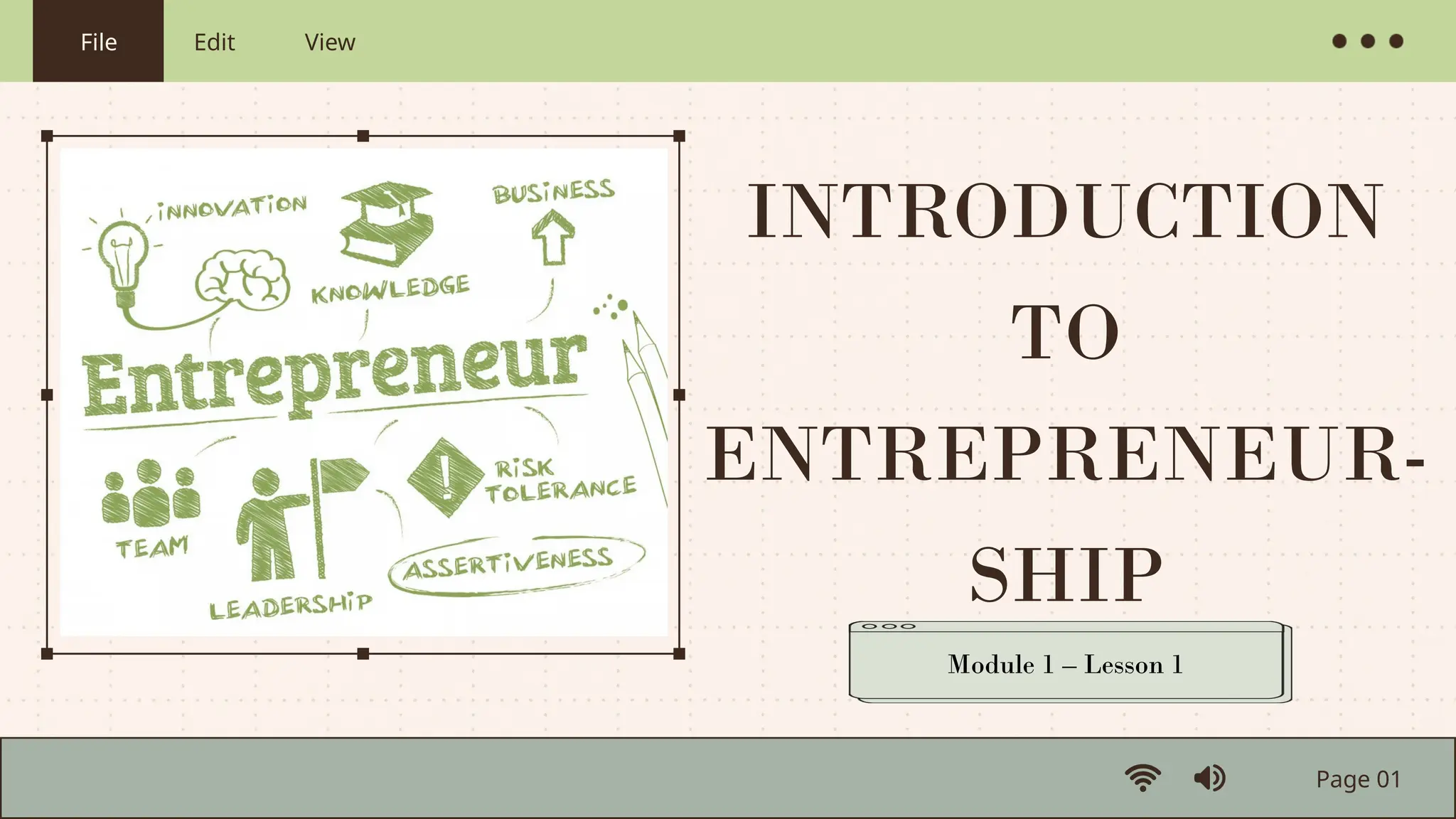
INTRODUCTION
TO
ENTREPRENEUR-
SHIP
File
Page 01
Edit View
Module 1 – Lesson 1
1. Explain the fundamental concepts of entrepreneurship
and recognize the characteristics of successful
entrepreneurs.
2. Develop the ability to identify business opportunities
and outline the initial steps for starting a business.; and
3. Cultivate a positive attitude towards entrepreneurship
by appreciating its importance in personal and
professional development and showing willingness to
engage in entrepreneurial activities.
Objectives
Page 02
File Edit View
Page 06
File Edit View
Entrepreneur vs. Entrepreneurship
Define who an entrepreneur is (a
person who starts and runs a new
business) and what entrepreneurship
is (the process of starting and
operating a business).
Page 06
File Edit View
Entrepreneur:
Definition: An entrepreneur is an individual who initiates, organizes, manages, and assumes
the risks associated with starting and running a business or venture. They are often seen as
innovative risk-takers who identify opportunities and create value through their business
activities.
Role: Entrepreneurs are the driving force behind the creation and growth of new businesses.
They come up with innovative ideas, assemble resources, make decisions, and take on the
responsibility of turning their ideas into successful ventures.
Characteristics: Entrepreneurs typically possess traits such as creativity, a willingness to take
calculated risks, resilience, adaptability, and a strong drive to achieve their goals.
Page 06
File Edit View
Entrepreneurship:
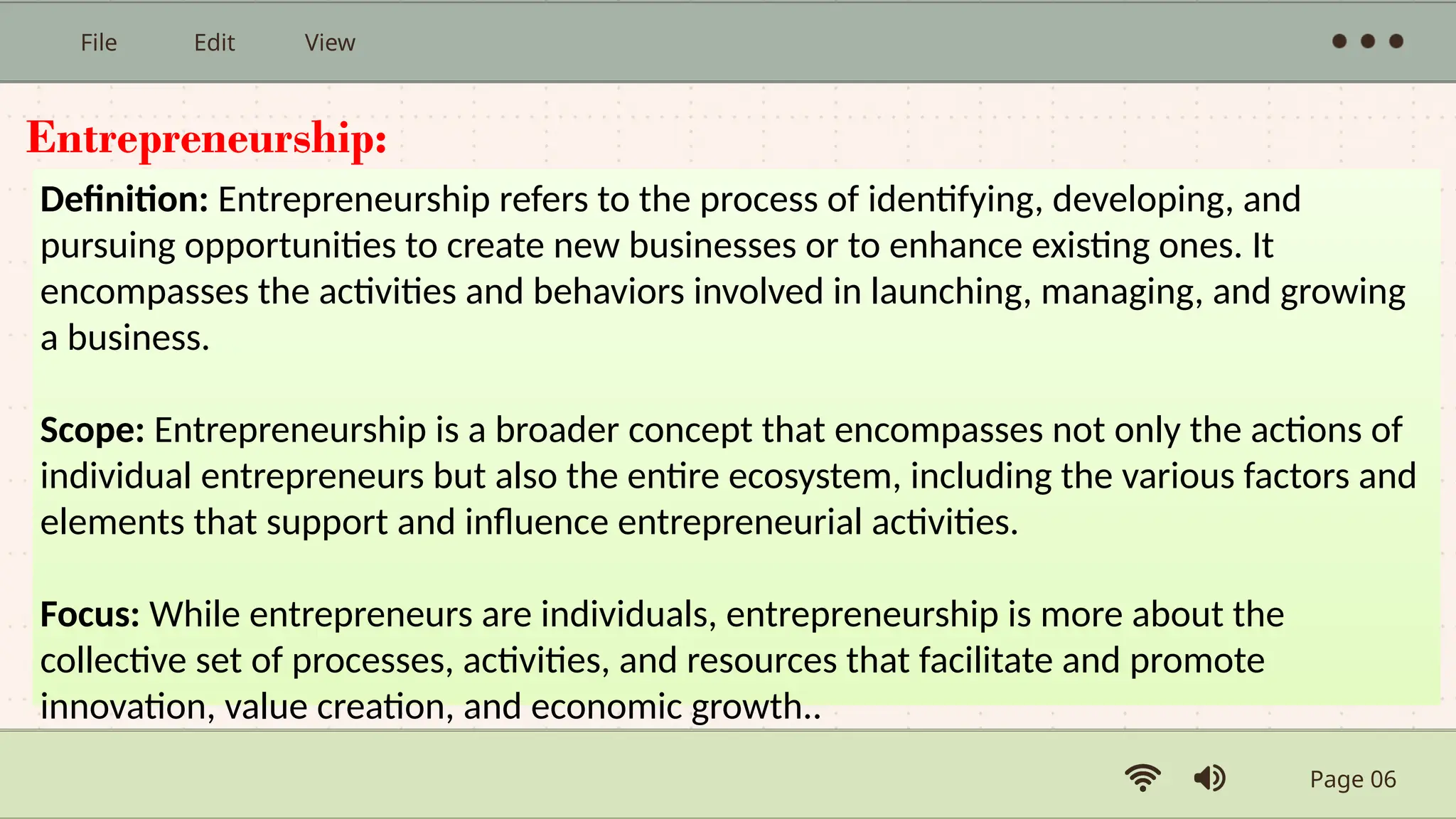
Definition: Entrepreneurship refers to the process of identifying, developing, and
pursuing opportunities to create new businesses or to enhance existing ones. It
encompasses the activities and behaviors involved in launching, managing, and growing
a business.
Scope: Entrepreneurship is a broader concept that encompasses not only the actions of
individual entrepreneurs but also the entire ecosystem, including the various factors and
elements that support and influence entrepreneurial activities.
Focus: While entrepreneurs are individuals, entrepreneurship is more about the
collective set of processes, activities, and resources that facilitate and promote
innovation, value creation, and economic growth..
Page 06
File Edit View
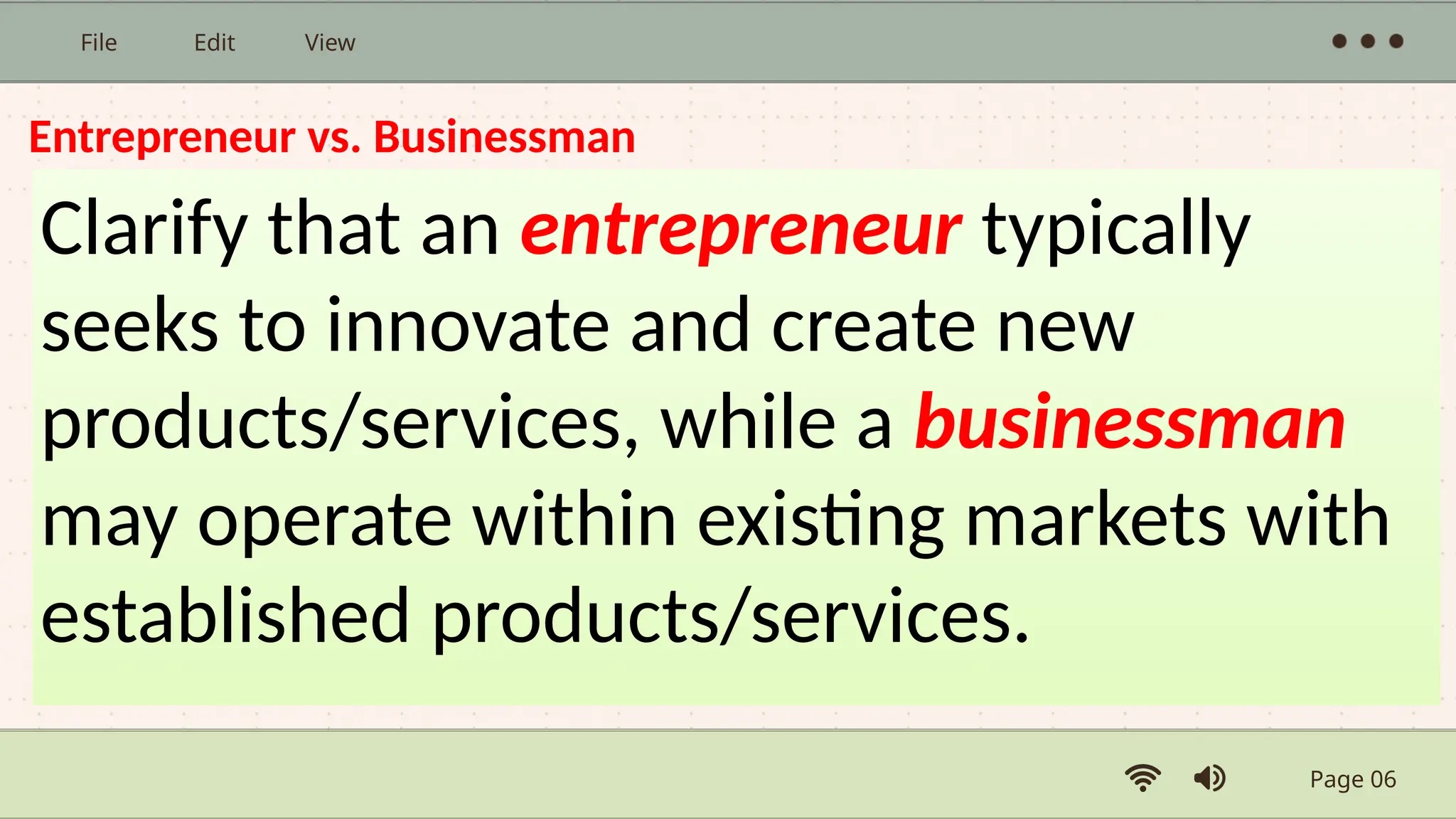
Entrepreneur vs. Businessman
Clarify that an entrepreneur typically
seeks to innovate and create new
products/services, while a businessman
may operate within existing markets with
established products/services.
Page 06
File Edit View
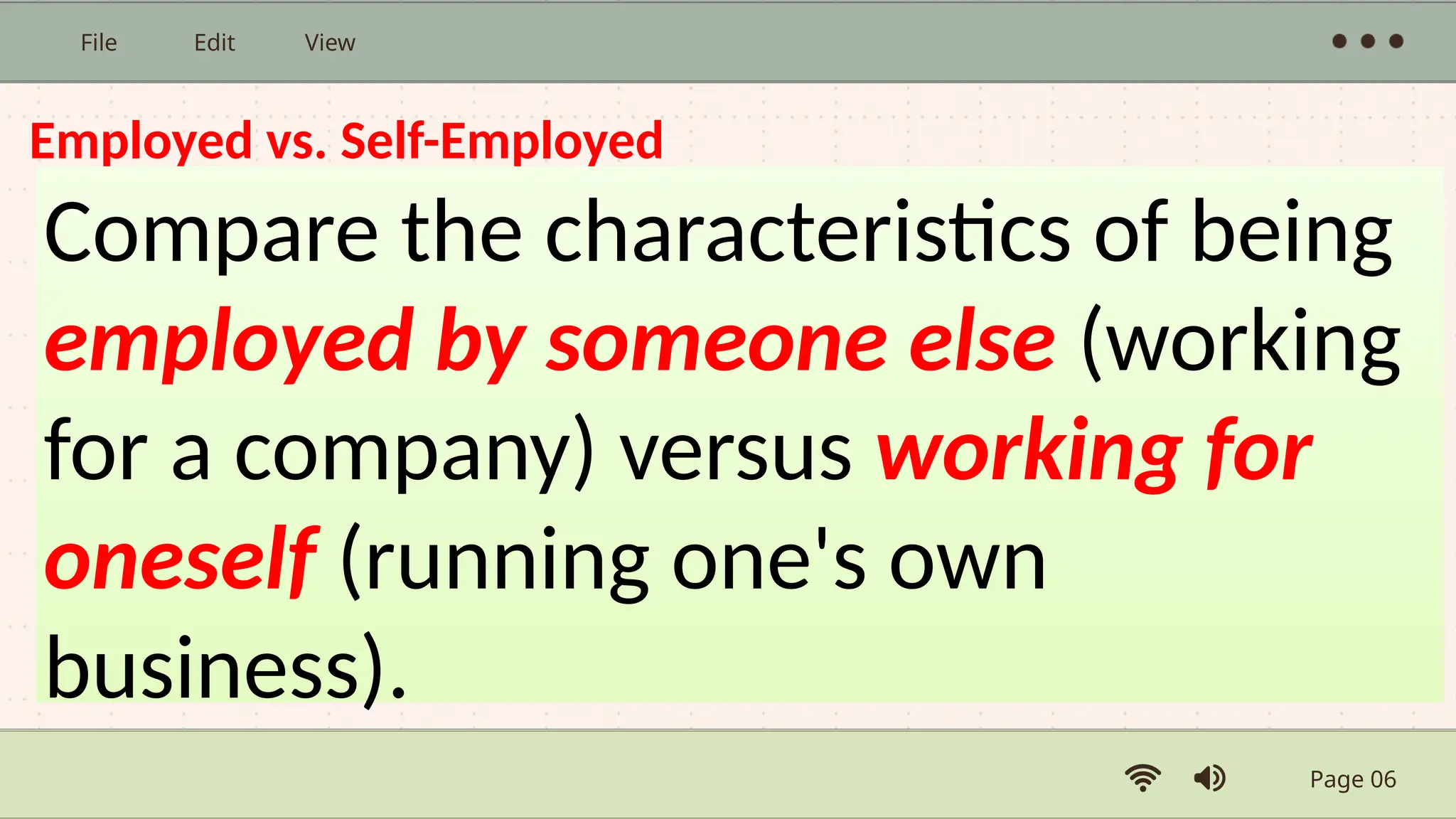
Employed vs. Self-Employed
Compare the characteristics of being
employed by someone else (working
for a company) versus working for
oneself (running one's own
business).
Page 06
File Edit View
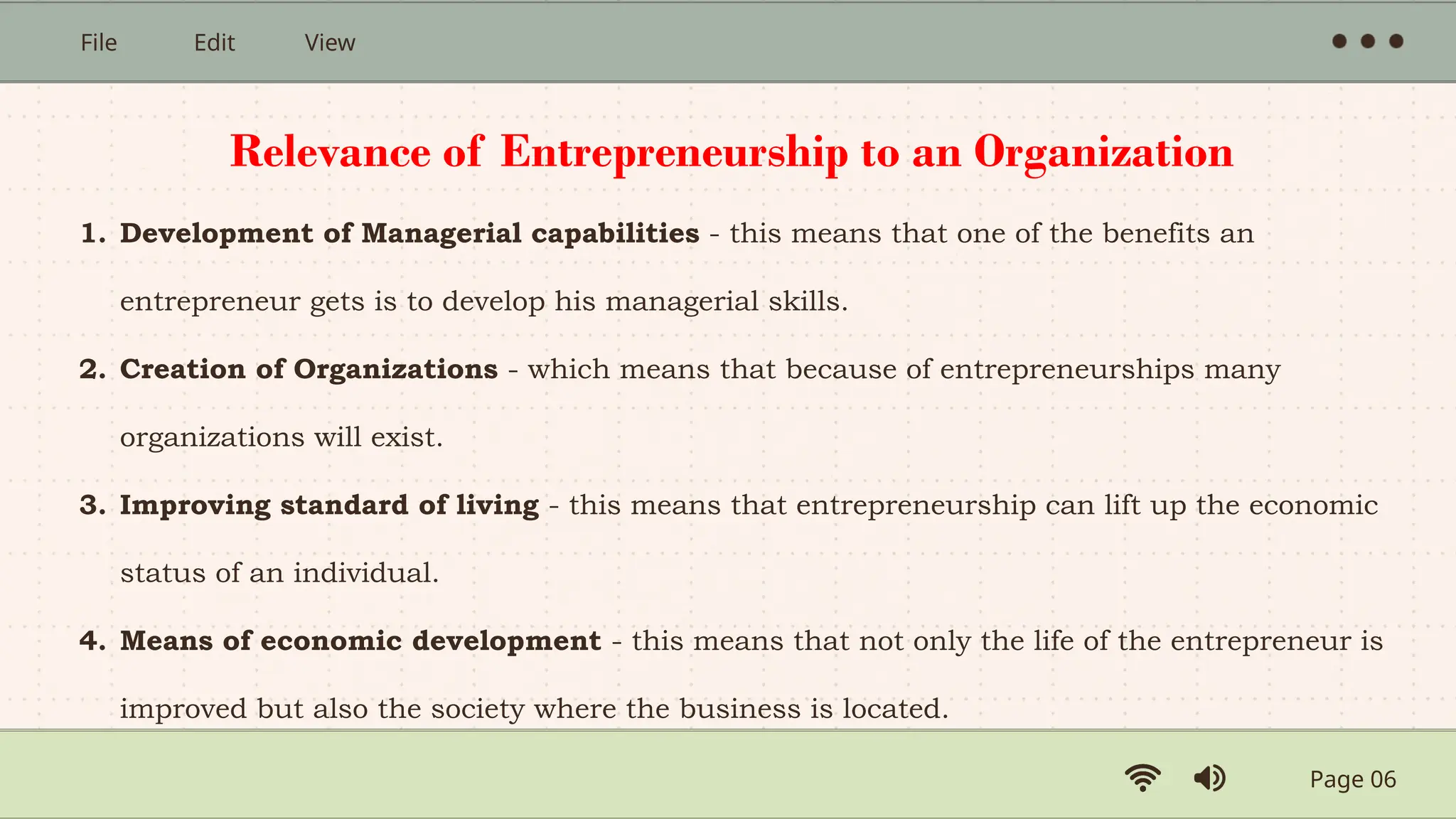
1. Development of Managerial capabilities - this means that one of the benefits an
entrepreneur gets is to develop his managerial skills.
2. Creation of Organizations - which means that because of entrepreneurships many
organizations will exist.
3. Improving standard of living - this means that entrepreneurship can lift up the economic
status of an individual.
4. Means of economic development - this means that not only the life of the entrepreneur is
improved but also the society where the business is located.
Relevance of Entrepreneurship to an Organization
Page 06
File Edit View
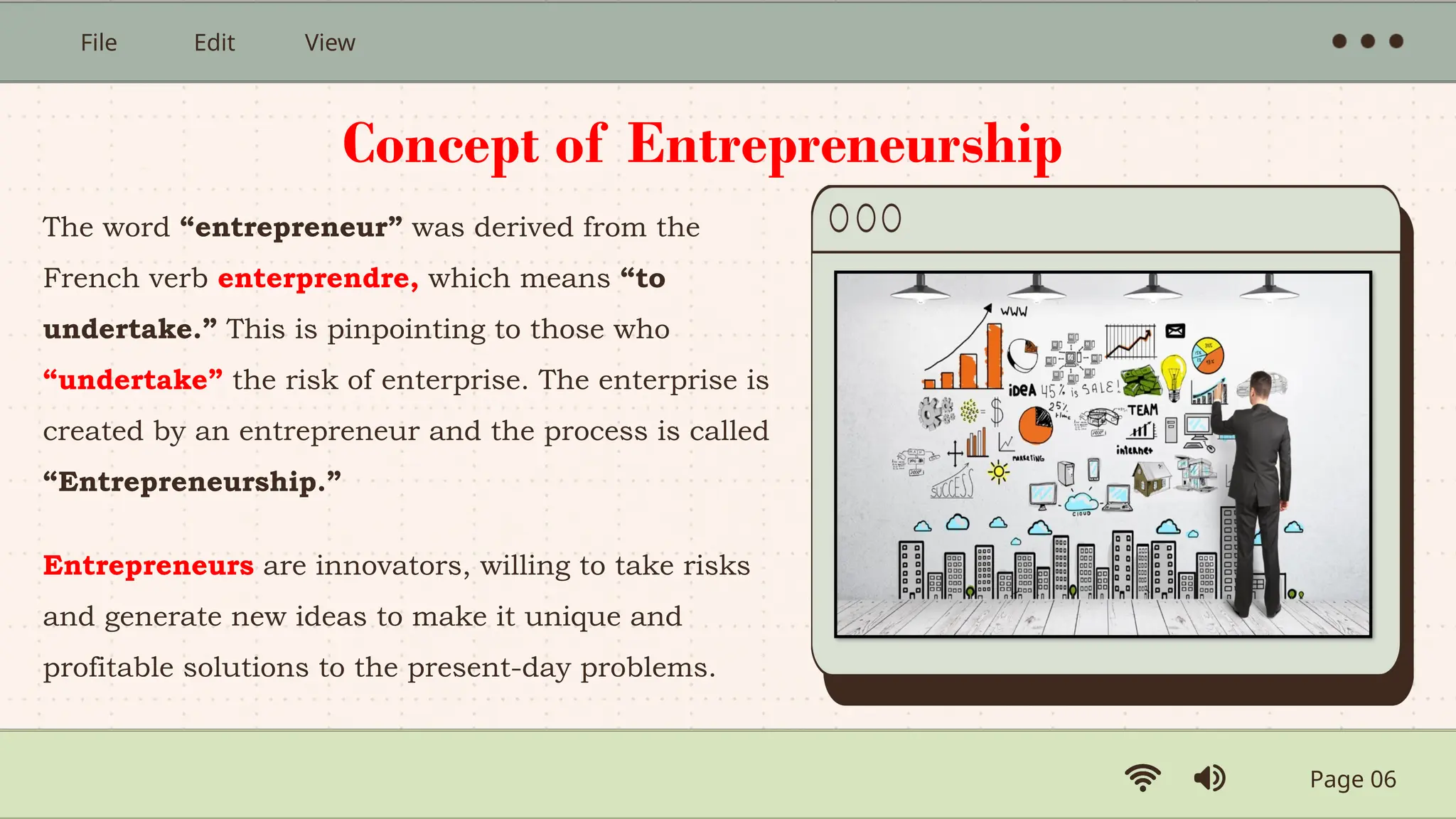
The word “entrepreneur” was derived from the
French verb enterprendre, which means “to
undertake.” This is pinpointing to those who
“undertake” the risk of enterprise. The enterprise is
created by an entrepreneur and the process is called
“Entrepreneurship.”
Entrepreneurs are innovators, willing to take risks
and generate new ideas to make it unique and
profitable solutions to the present-day problems.
Concept of Entrepreneurship
Factors Affecting Entrepreneurship
a. Initiative - which means
doing things even before
being told.
b. Proactive -which means
he can classify
opportunities and seize it.
c. Problem Solver - which
means he can retain good
relations with other
people.
d. Perseverance - meaning
he will pursue things to
get done regardless of
challenges.
e. Persuasion - means
that he can entice
people to buy even if
they don’t.
Page 12
File Edit View
Personality Factors
f. A Planner - meaning he
makes plan before doing
things and do not fail to
monitor it.
g. Risk-taker - which
means that he is willing
to gamble but he will
calculate it first.
Factors Affecting Entrepreneurship
a.political,
b.climate,
c.legal system,
d.economic and social
conditions and
e.market situations.
Page 12
File Edit View
Environmental Factors
Factors Affecting Entrepreneurship
the entrepreneurs have big
business ideas and they
do not stop improving and
thinking of new
worthwhile ideas for their
business.
Page 12
File Edit View
Innovative
Factors Affecting Entrepreneurship
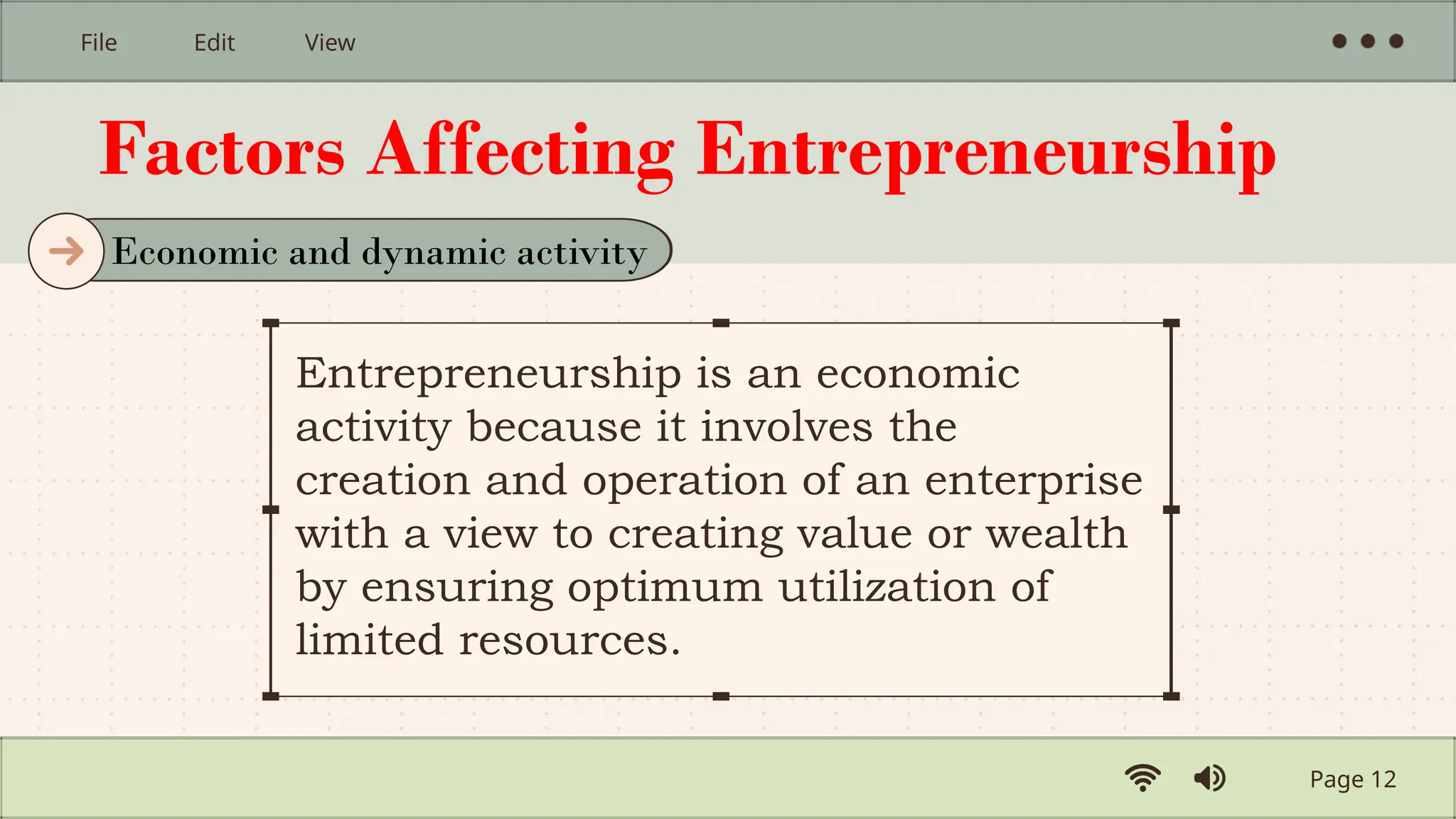
Entrepreneurship is an economic
activity because it involves the
creation and operation of an enterprise
with a view to creating value or wealth
by ensuring optimum utilization of
limited resources.
Page 12
File Edit View
Economic and dynamic activity
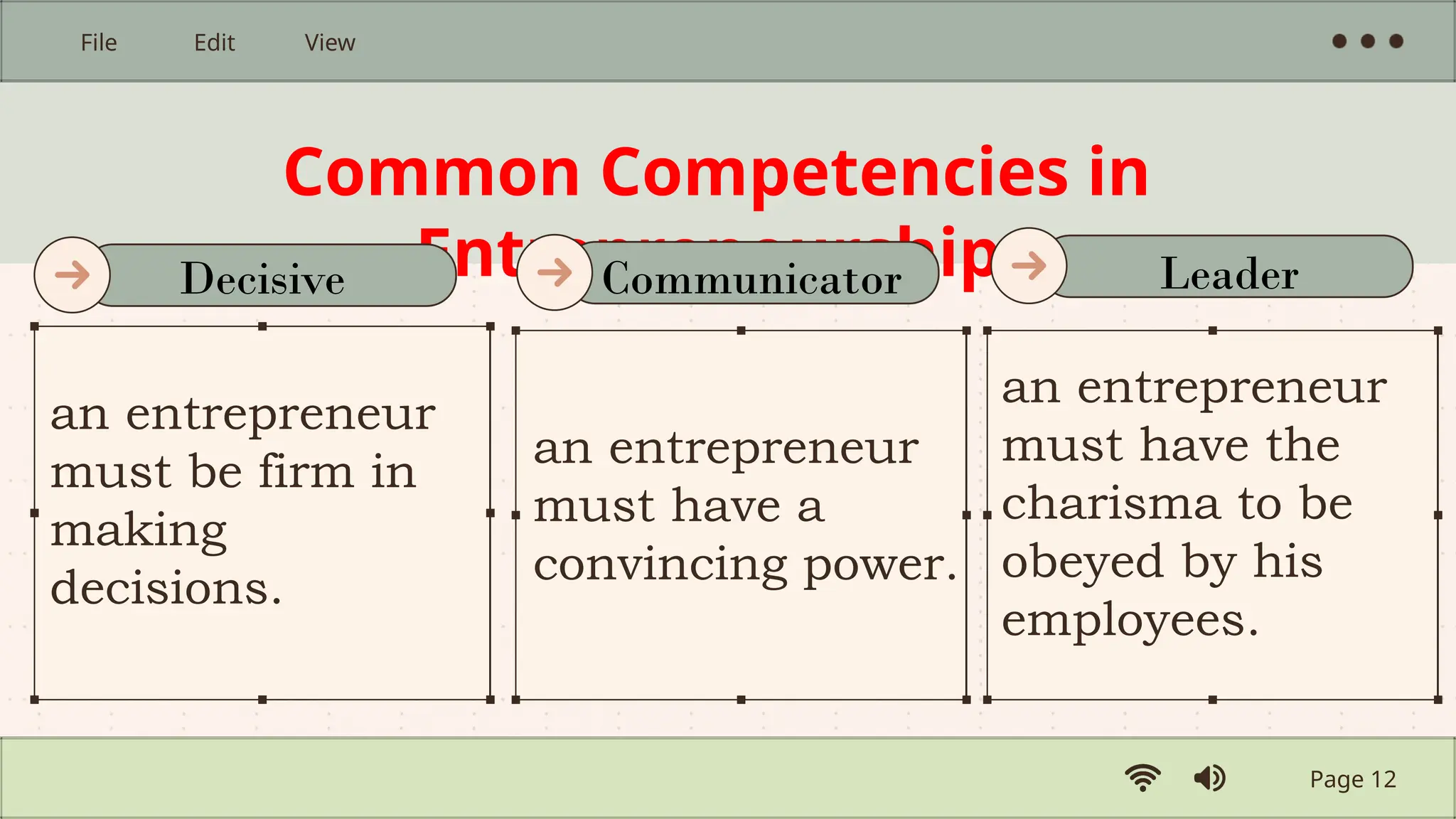
Common Competencies in
Entrepreneurship
an entrepreneur
must be firm in
making
decisions.
an entrepreneur
must have a
convincing power.
an entrepreneur
must have the
charisma to be
obeyed by his
employees.
Page 12
File Edit View
Decisive Communicator Leader
Common Competencies in
Entrepreneurship
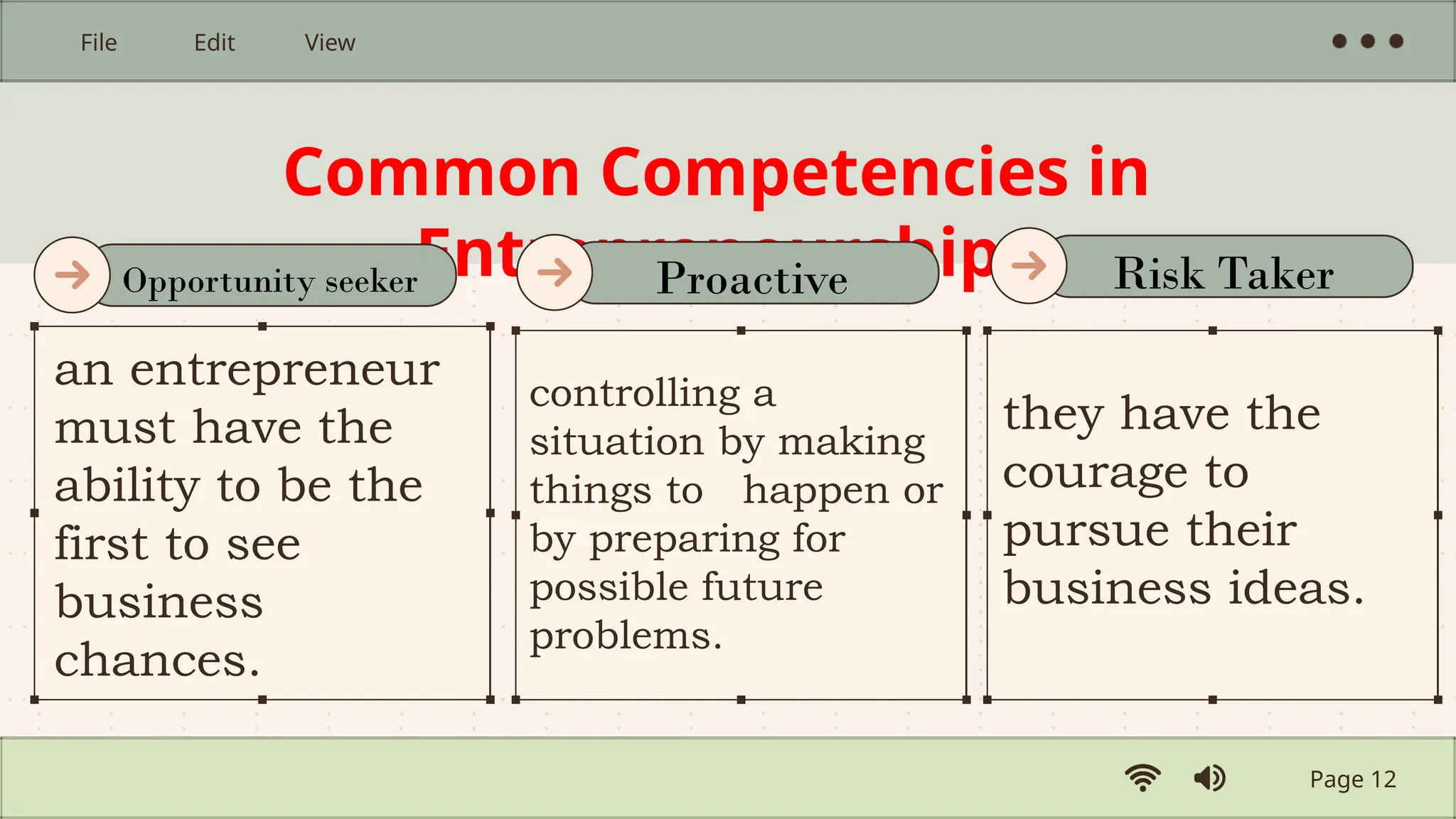
an entrepreneur
must have the
ability to be the
first to see
business
chances.
controlling a
situation by making
things to happen or
by preparing for
possible future
problems.
they have the
courage to
pursue their
business ideas.
Page 12
File Edit View
Opportunity seeker Proactive Risk Taker
Core Competencies in Entrepreneurship
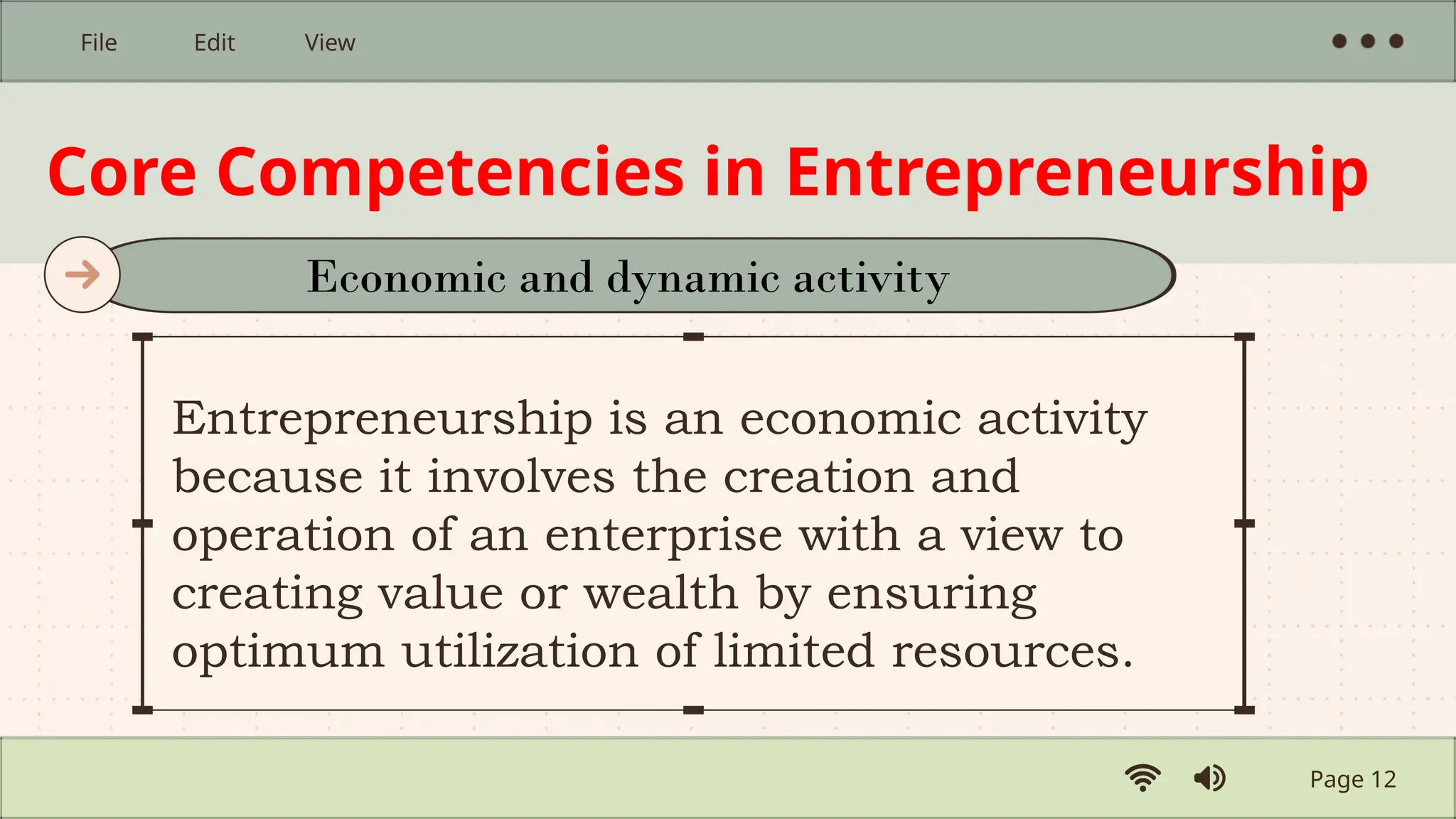
Entrepreneurship is an economic activity
because it involves the creation and
operation of an enterprise with a view to
creating value or wealth by ensuring
optimum utilization of limited resources.
Page 12
File Edit View
Economic and dynamic activity
Core Competencies in Entrepreneurship
The entrepreneur
needs to gamble
but wise enough
to offset the risk.
Entrepreneurs
constantly look
for new ideas,
thus he needs to
be creative.
The entrepreneur
can be
compensated by
his profit coming
from the operation.
Page 12
File Edit View
Risk bearing Profit Potential
Innovative
Types of Entrepreneurs
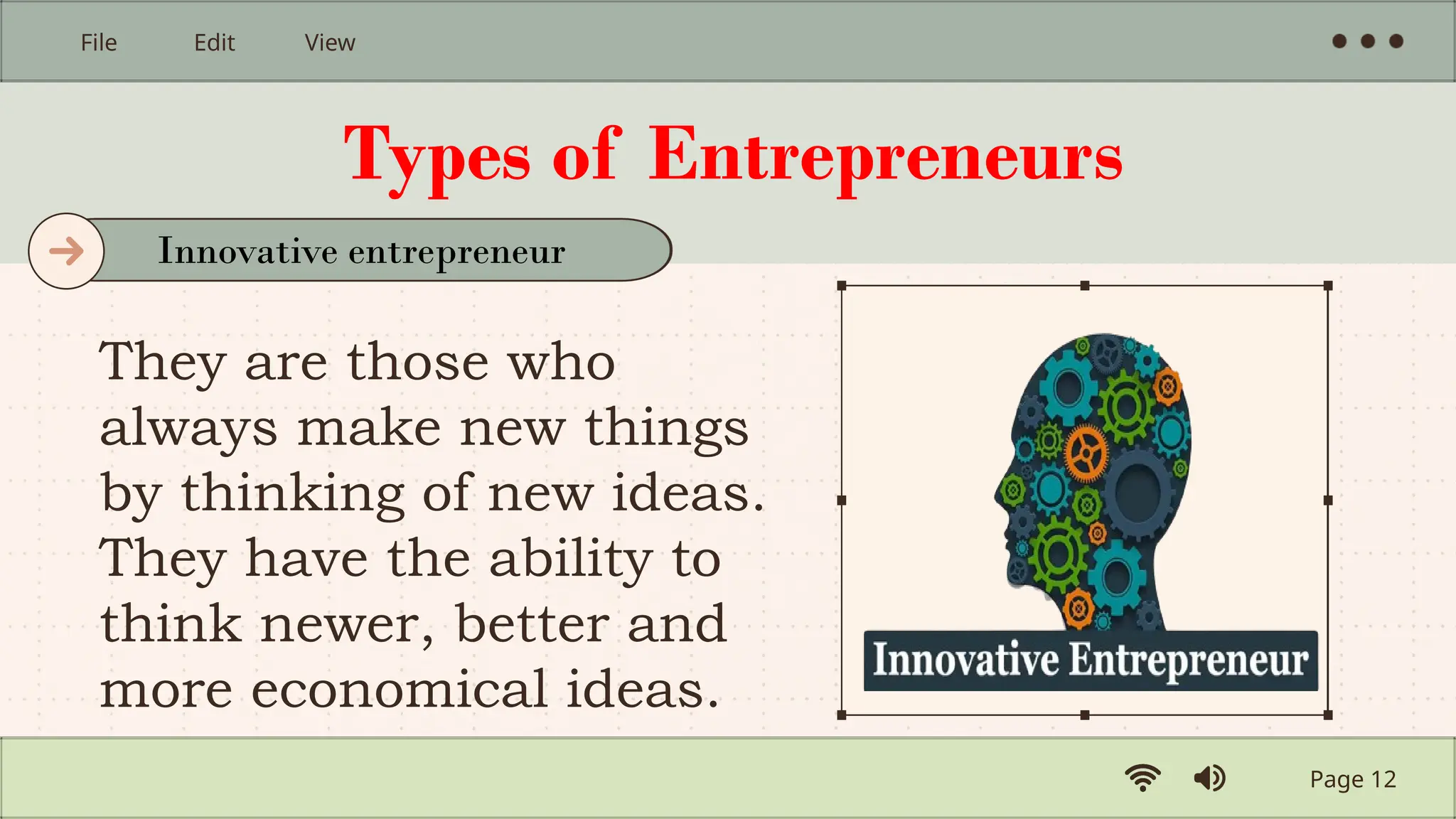
They are those who
always make new things
by thinking of new ideas.
They have the ability to
think newer, better and
more economical ideas.
Page 12
File Edit View
Innovative entrepreneur
Types of Entrepreneurs
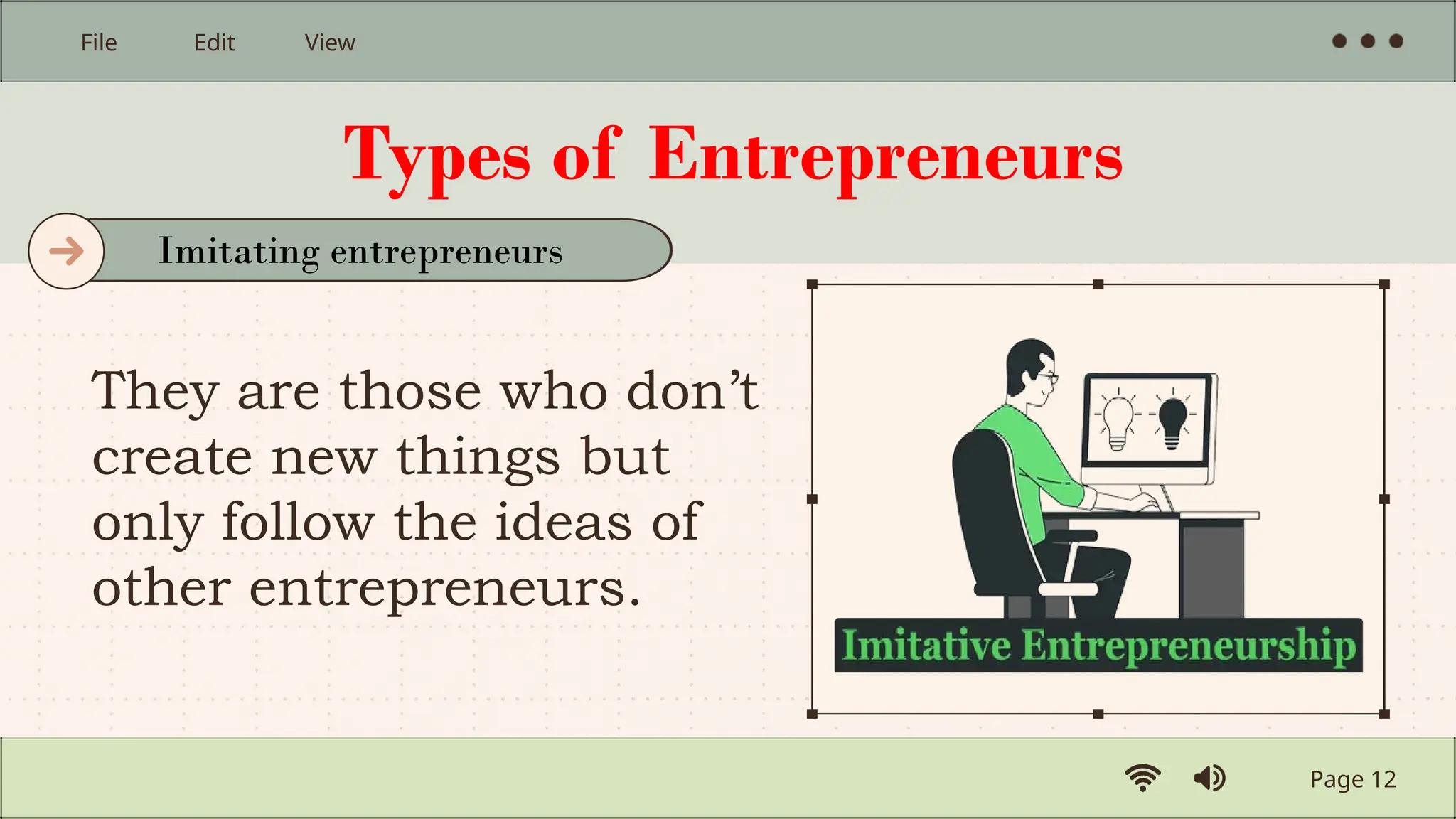
They are those who don’t
create new things but
only follow the ideas of
other entrepreneurs.
Page 12
File Edit View
Imitating entrepreneurs
Types of Entrepreneurs
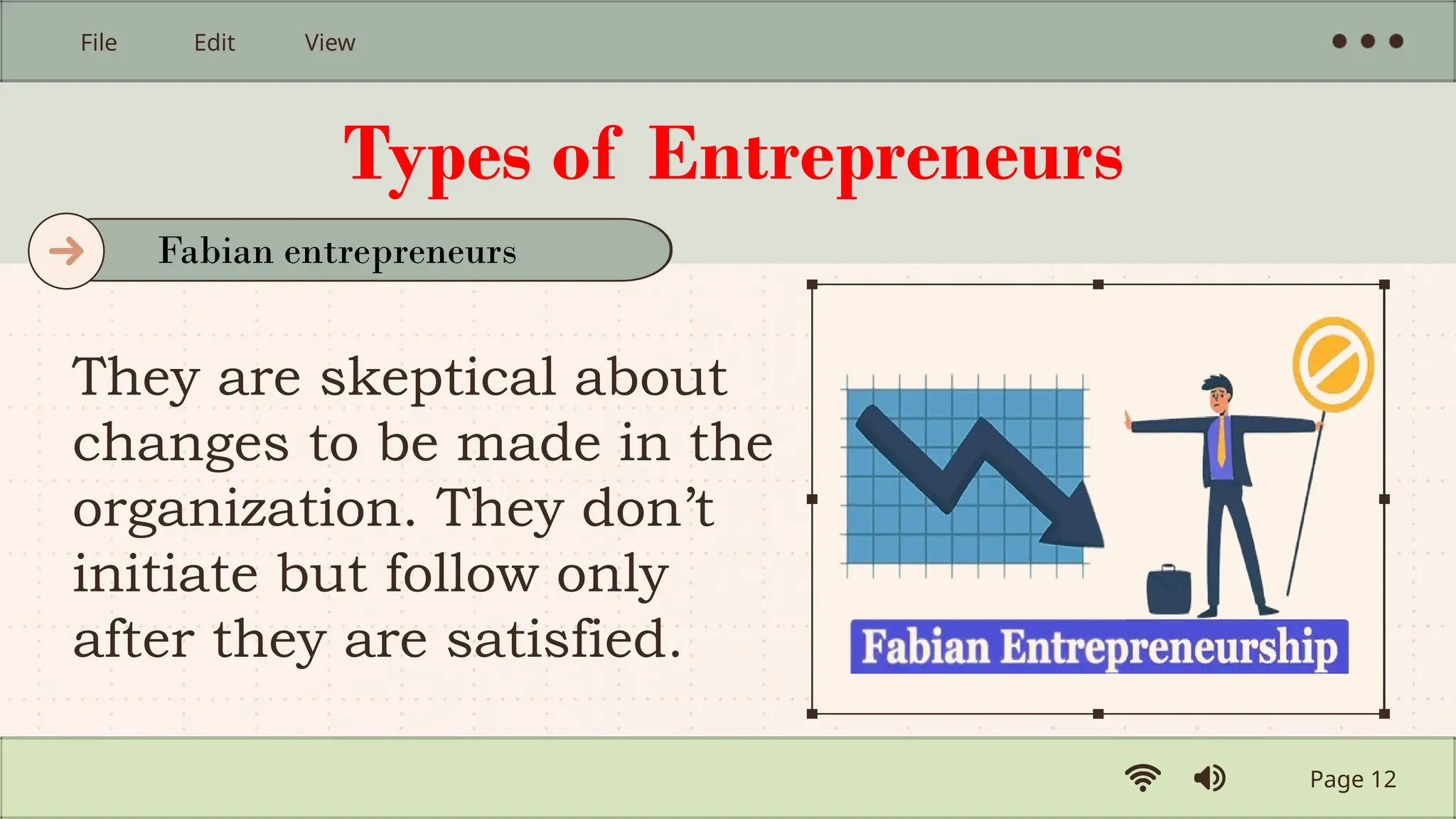
They are skeptical about
changes to be made in the
organization. They don’t
initiate but follow only
after they are satisfied.
Page 12
File Edit View
Fabian entrepreneurs
Types of Entrepreneurs
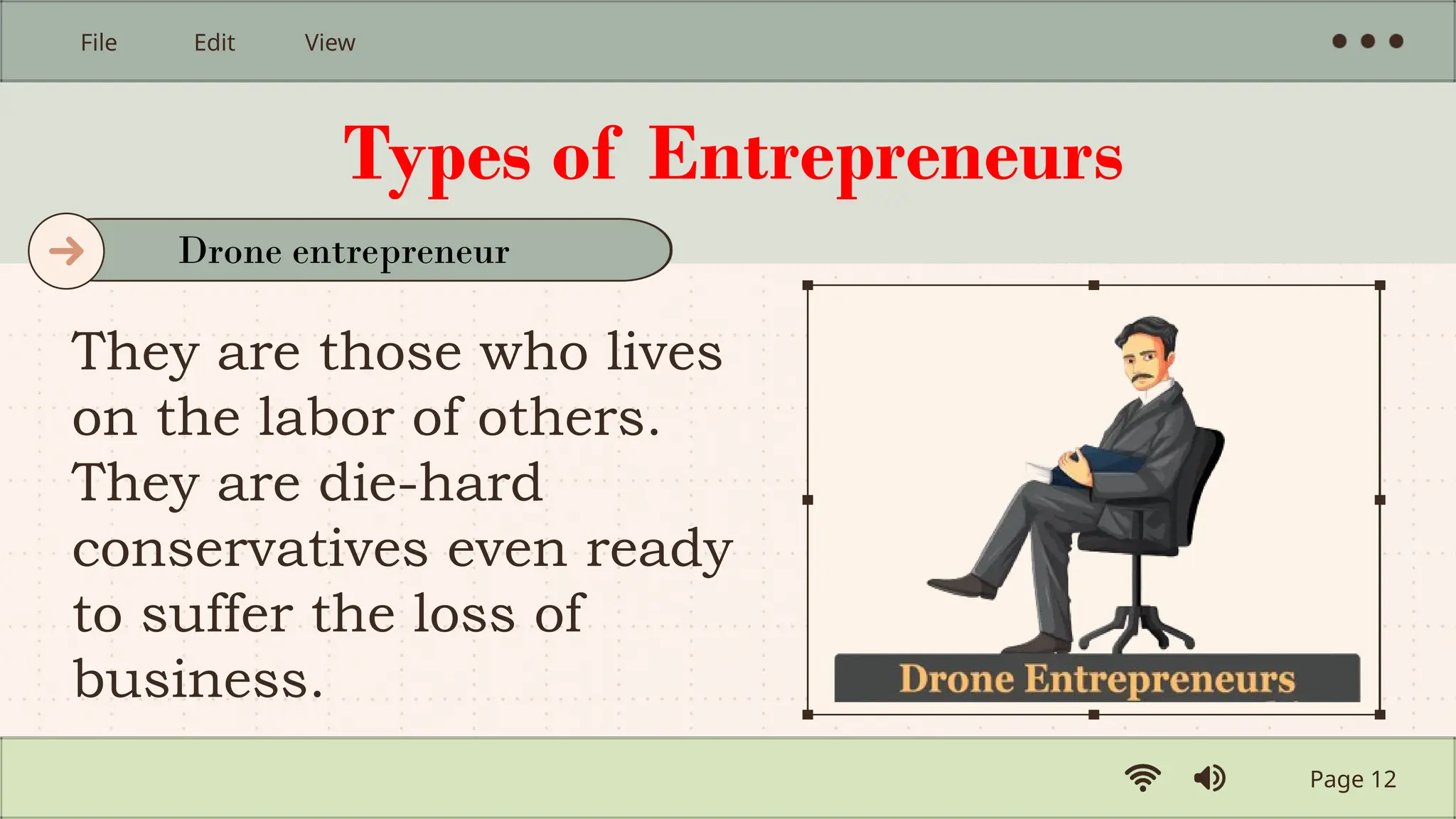
They are those who lives
on the labor of others.
They are die-hard
conservatives even ready
to suffer the loss of
business.
Page 12
File Edit View
Drone entrepreneur
Types of Entrepreneurs
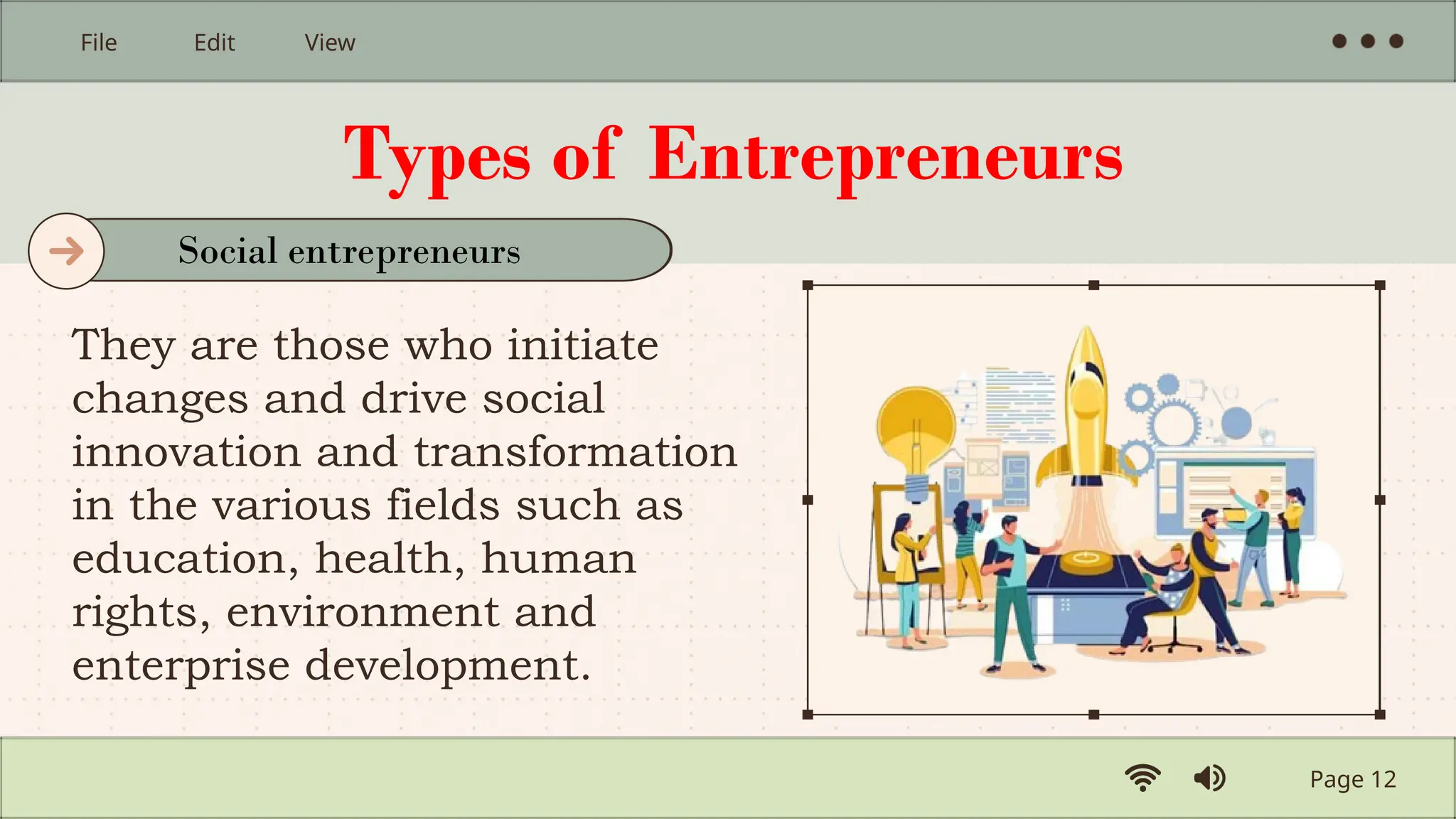
They are those who initiate
changes and drive social
innovation and transformation
in the various fields such as
education, health, human
rights, environment and
enterprise development.
Page 12
File Edit View
Social entrepreneurs
Career Opportunities of Entrepreneurship
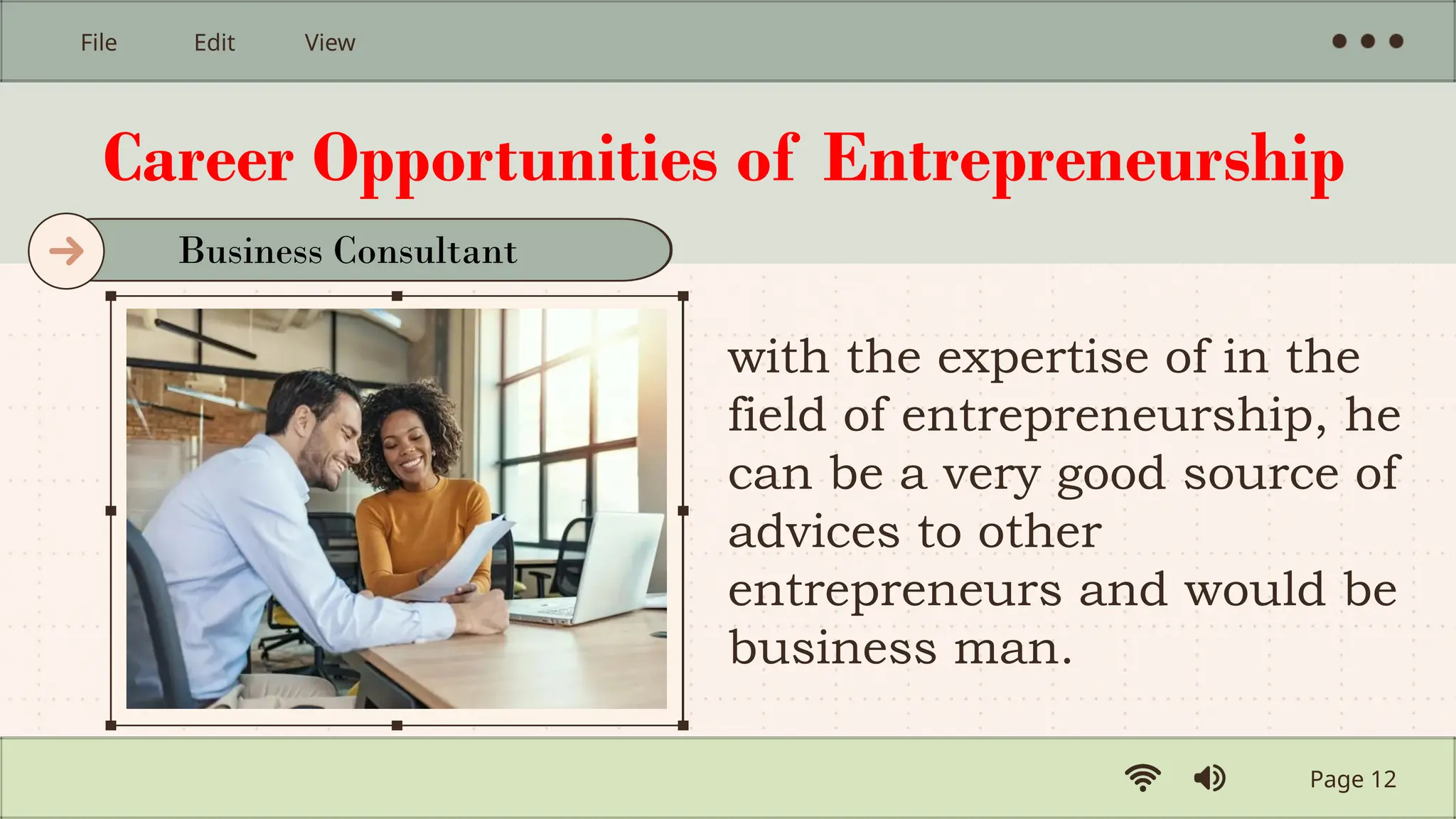
with the expertise of in the
field of entrepreneurship, he
can be a very good source of
advices to other
entrepreneurs and would be
business man.
Page 12
File Edit View
Business Consultant
Career Opportunities of Entrepreneurship
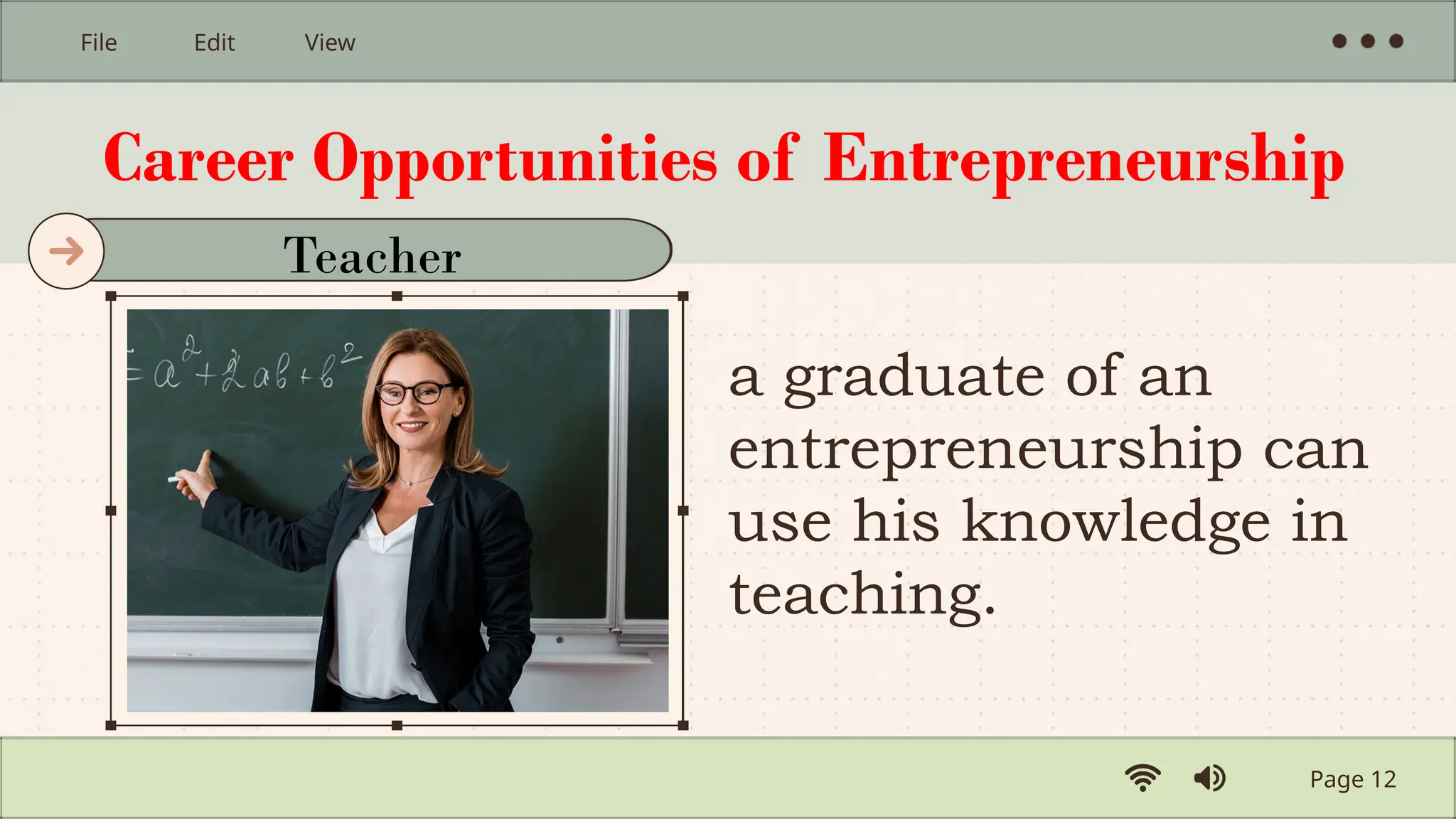
a graduate of an
entrepreneurship can
use his knowledge in
teaching.
Page 12
File Edit View
Teacher
Career Opportunities of Entrepreneurship
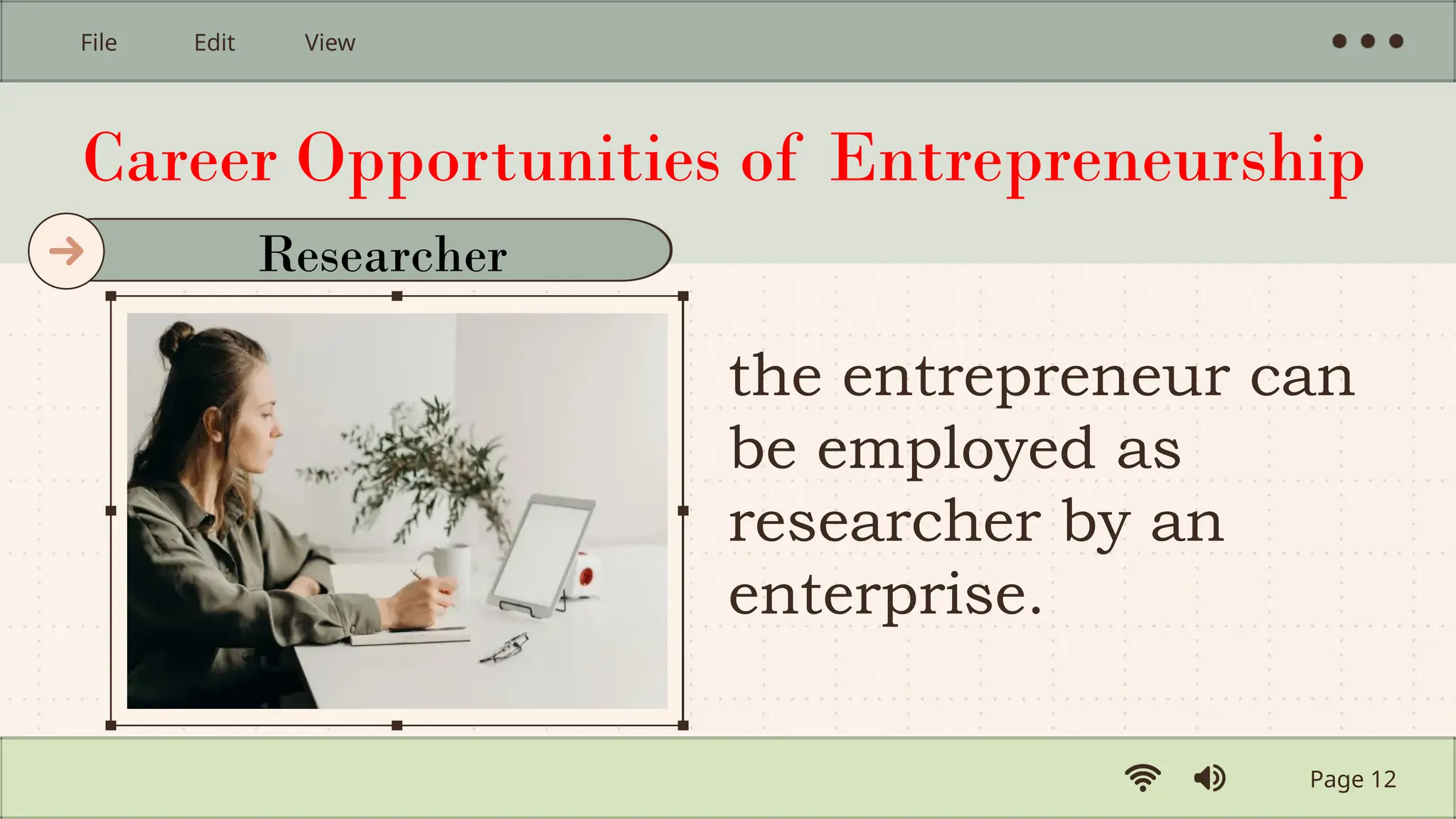
the entrepreneur can
be employed as
researcher by an
enterprise.
Page 12
File Edit View
Researcher
Career Opportunities of Entrepreneurship
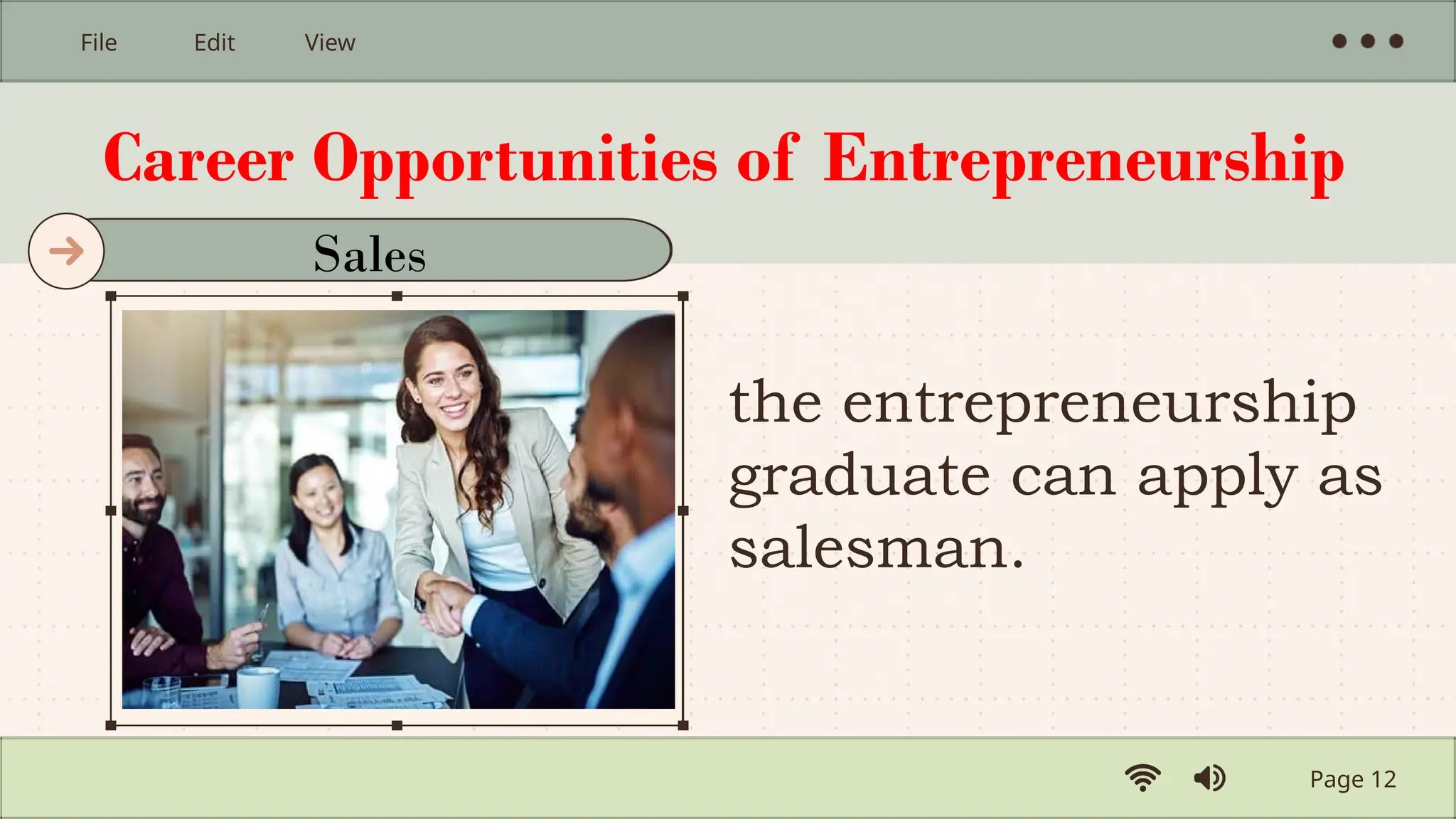
the entrepreneurship
graduate can apply as
salesman.
Page 12
File Edit View
Sales
Career Opportunities of Entrepreneurship
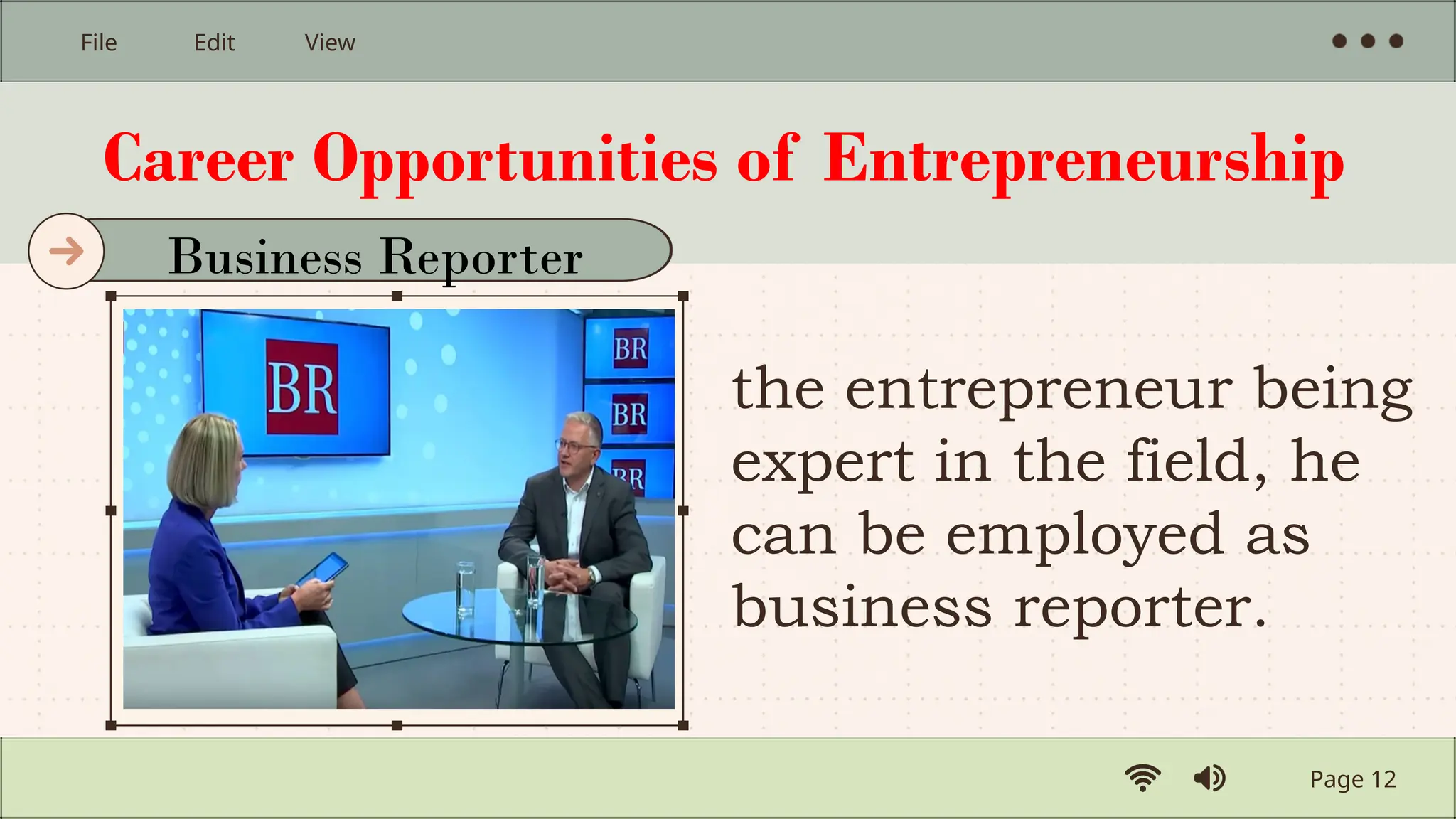
the entrepreneur being
expert in the field, he
can be employed as
business reporter.
Page 12
File Edit View
Business Reporter
Page 17
File Edit View
THANK
YOU!

Introduction to Entrepreneurship Q1-ENTREP

  • 1.
  • 2.
    1. Explain thefundamental concepts of entrepreneurship and recognize the characteristics of successful entrepreneurs. 2. Develop the ability to identify business opportunities and outline the initial steps for starting a business.; and 3. Cultivate a positive attitude towards entrepreneurship by appreciating its importance in personal and professional development and showing willingness to engage in entrepreneurial activities. Objectives Page 02 File Edit View
  • 3.
    Page 06 File EditView Entrepreneur vs. Entrepreneurship Define who an entrepreneur is (a person who starts and runs a new business) and what entrepreneurship is (the process of starting and operating a business).
  • 4.
    Page 06 File EditView Entrepreneur: Definition: An entrepreneur is an individual who initiates, organizes, manages, and assumes the risks associated with starting and running a business or venture. They are often seen as innovative risk-takers who identify opportunities and create value through their business activities. Role: Entrepreneurs are the driving force behind the creation and growth of new businesses. They come up with innovative ideas, assemble resources, make decisions, and take on the responsibility of turning their ideas into successful ventures. Characteristics: Entrepreneurs typically possess traits such as creativity, a willingness to take calculated risks, resilience, adaptability, and a strong drive to achieve their goals.
  • 5.
    Page 06 File EditView Entrepreneurship: Definition: Entrepreneurship refers to the process of identifying, developing, and pursuing opportunities to create new businesses or to enhance existing ones. It encompasses the activities and behaviors involved in launching, managing, and growing a business. Scope: Entrepreneurship is a broader concept that encompasses not only the actions of individual entrepreneurs but also the entire ecosystem, including the various factors and elements that support and influence entrepreneurial activities. Focus: While entrepreneurs are individuals, entrepreneurship is more about the collective set of processes, activities, and resources that facilitate and promote innovation, value creation, and economic growth..
  • 6.
    Page 06 File EditView Entrepreneur vs. Businessman Clarify that an entrepreneur typically seeks to innovate and create new products/services, while a businessman may operate within existing markets with established products/services.
  • 7.
    Page 06 File EditView Employed vs. Self-Employed Compare the characteristics of being employed by someone else (working for a company) versus working for oneself (running one's own business).
  • 8.
    Page 06 File EditView 1. Development of Managerial capabilities - this means that one of the benefits an entrepreneur gets is to develop his managerial skills. 2. Creation of Organizations - which means that because of entrepreneurships many organizations will exist. 3. Improving standard of living - this means that entrepreneurship can lift up the economic status of an individual. 4. Means of economic development - this means that not only the life of the entrepreneur is improved but also the society where the business is located. Relevance of Entrepreneurship to an Organization
  • 9.
    Page 06 File EditView The word “entrepreneur” was derived from the French verb enterprendre, which means “to undertake.” This is pinpointing to those who “undertake” the risk of enterprise. The enterprise is created by an entrepreneur and the process is called “Entrepreneurship.” Entrepreneurs are innovators, willing to take risks and generate new ideas to make it unique and profitable solutions to the present-day problems. Concept of Entrepreneurship
  • 10.
    Factors Affecting Entrepreneurship a.Initiative - which means doing things even before being told. b. Proactive -which means he can classify opportunities and seize it. c. Problem Solver - which means he can retain good relations with other people. d. Perseverance - meaning he will pursue things to get done regardless of challenges. e. Persuasion - means that he can entice people to buy even if they don’t. Page 12 File Edit View Personality Factors f. A Planner - meaning he makes plan before doing things and do not fail to monitor it. g. Risk-taker - which means that he is willing to gamble but he will calculate it first.
  • 11.
    Factors Affecting Entrepreneurship a.political, b.climate, c.legalsystem, d.economic and social conditions and e.market situations. Page 12 File Edit View Environmental Factors
  • 12.
    Factors Affecting Entrepreneurship theentrepreneurs have big business ideas and they do not stop improving and thinking of new worthwhile ideas for their business. Page 12 File Edit View Innovative
  • 13.
    Factors Affecting Entrepreneurship Entrepreneurshipis an economic activity because it involves the creation and operation of an enterprise with a view to creating value or wealth by ensuring optimum utilization of limited resources. Page 12 File Edit View Economic and dynamic activity
  • 14.
    Common Competencies in Entrepreneurship anentrepreneur must be firm in making decisions. an entrepreneur must have a convincing power. an entrepreneur must have the charisma to be obeyed by his employees. Page 12 File Edit View Decisive Communicator Leader
  • 15.
    Common Competencies in Entrepreneurship anentrepreneur must have the ability to be the first to see business chances. controlling a situation by making things to happen or by preparing for possible future problems. they have the courage to pursue their business ideas. Page 12 File Edit View Opportunity seeker Proactive Risk Taker
  • 16.
    Core Competencies inEntrepreneurship Entrepreneurship is an economic activity because it involves the creation and operation of an enterprise with a view to creating value or wealth by ensuring optimum utilization of limited resources. Page 12 File Edit View Economic and dynamic activity
  • 17.
    Core Competencies inEntrepreneurship The entrepreneur needs to gamble but wise enough to offset the risk. Entrepreneurs constantly look for new ideas, thus he needs to be creative. The entrepreneur can be compensated by his profit coming from the operation. Page 12 File Edit View Risk bearing Profit Potential Innovative
  • 18.
    Types of Entrepreneurs Theyare those who always make new things by thinking of new ideas. They have the ability to think newer, better and more economical ideas. Page 12 File Edit View Innovative entrepreneur
  • 19.
    Types of Entrepreneurs Theyare those who don’t create new things but only follow the ideas of other entrepreneurs. Page 12 File Edit View Imitating entrepreneurs
  • 20.
    Types of Entrepreneurs Theyare skeptical about changes to be made in the organization. They don’t initiate but follow only after they are satisfied. Page 12 File Edit View Fabian entrepreneurs
  • 21.
    Types of Entrepreneurs Theyare those who lives on the labor of others. They are die-hard conservatives even ready to suffer the loss of business. Page 12 File Edit View Drone entrepreneur
  • 22.
    Types of Entrepreneurs Theyare those who initiate changes and drive social innovation and transformation in the various fields such as education, health, human rights, environment and enterprise development. Page 12 File Edit View Social entrepreneurs
  • 23.
    Career Opportunities ofEntrepreneurship with the expertise of in the field of entrepreneurship, he can be a very good source of advices to other entrepreneurs and would be business man. Page 12 File Edit View Business Consultant
  • 24.
    Career Opportunities ofEntrepreneurship a graduate of an entrepreneurship can use his knowledge in teaching. Page 12 File Edit View Teacher
  • 25.
    Career Opportunities ofEntrepreneurship the entrepreneur can be employed as researcher by an enterprise. Page 12 File Edit View Researcher
  • 26.
    Career Opportunities ofEntrepreneurship the entrepreneurship graduate can apply as salesman. Page 12 File Edit View Sales
  • 27.
    Career Opportunities ofEntrepreneurship the entrepreneur being expert in the field, he can be employed as business reporter. Page 12 File Edit View Business Reporter
  • 28.
    Page 17 File EditView THANK YOU!

Editor's Notes

  • #3 Marketing Mix is a set of controllable and connected variables that a company gather to satisfy a customer better than its competitor. It is also known as the “Ps” in marketing.
  • #4 Marketing Mix is a set of controllable and connected variables that a company gather to satisfy a customer better than its competitor. It is also known as the “Ps” in marketing.
  • #6 Marketing Mix is a set of controllable and connected variables that a company gather to satisfy a customer better than its competitor. It is also known as the “Ps” in marketing.
  • #7 Marketing Mix is a set of controllable and connected variables that a company gather to satisfy a customer better than its competitor. It is also known as the “Ps” in marketing.
  • #8 Marketing Mix is a set of controllable and connected variables that a company gather to satisfy a customer better than its competitor. It is also known as the “Ps” in marketing.
  • #10 Purpose "Every brand makes a promise. But in a market in which customer confidence is little and budgetary observance is great, it’s not just making a promise that separates one brand from another, but having a significant purpose," (Allen Adamson). How can you define your business' purpose? According to Business Strategy Insider, purpose can be viewed in two ways:
  • #11 Purpose "Every brand makes a promise. But in a market in which customer confidence is little and budgetary observance is great, it’s not just making a promise that separates one brand from another, but having a significant purpose," (Allen Adamson). How can you define your business' purpose? According to Business Strategy Insider, purpose can be viewed in two ways:
  • #12 Purpose "Every brand makes a promise. But in a market in which customer confidence is little and budgetary observance is great, it’s not just making a promise that separates one brand from another, but having a significant purpose," (Allen Adamson). How can you define your business' purpose? According to Business Strategy Insider, purpose can be viewed in two ways:
  • #13 Purpose "Every brand makes a promise. But in a market in which customer confidence is little and budgetary observance is great, it’s not just making a promise that separates one brand from another, but having a significant purpose," (Allen Adamson). How can you define your business' purpose? According to Business Strategy Insider, purpose can be viewed in two ways:
  • #18 Purpose "Every brand makes a promise. But in a market in which customer confidence is little and budgetary observance is great, it’s not just making a promise that separates one brand from another, but having a significant purpose," (Allen Adamson). How can you define your business' purpose? According to Business Strategy Insider, purpose can be viewed in two ways:
  • #19 Purpose "Every brand makes a promise. But in a market in which customer confidence is little and budgetary observance is great, it’s not just making a promise that separates one brand from another, but having a significant purpose," (Allen Adamson). How can you define your business' purpose? According to Business Strategy Insider, purpose can be viewed in two ways:
  • #20 Purpose "Every brand makes a promise. But in a market in which customer confidence is little and budgetary observance is great, it’s not just making a promise that separates one brand from another, but having a significant purpose," (Allen Adamson). How can you define your business' purpose? According to Business Strategy Insider, purpose can be viewed in two ways:
  • #21 Purpose "Every brand makes a promise. But in a market in which customer confidence is little and budgetary observance is great, it’s not just making a promise that separates one brand from another, but having a significant purpose," (Allen Adamson). How can you define your business' purpose? According to Business Strategy Insider, purpose can be viewed in two ways:
  • #22 Purpose "Every brand makes a promise. But in a market in which customer confidence is little and budgetary observance is great, it’s not just making a promise that separates one brand from another, but having a significant purpose," (Allen Adamson). How can you define your business' purpose? According to Business Strategy Insider, purpose can be viewed in two ways:
  • #23 Purpose "Every brand makes a promise. But in a market in which customer confidence is little and budgetary observance is great, it’s not just making a promise that separates one brand from another, but having a significant purpose," (Allen Adamson). How can you define your business' purpose? According to Business Strategy Insider, purpose can be viewed in two ways:
  • #24 Purpose "Every brand makes a promise. But in a market in which customer confidence is little and budgetary observance is great, it’s not just making a promise that separates one brand from another, but having a significant purpose," (Allen Adamson). How can you define your business' purpose? According to Business Strategy Insider, purpose can be viewed in two ways:
  • #25 Purpose "Every brand makes a promise. But in a market in which customer confidence is little and budgetary observance is great, it’s not just making a promise that separates one brand from another, but having a significant purpose," (Allen Adamson). How can you define your business' purpose? According to Business Strategy Insider, purpose can be viewed in two ways:
  • #26 Purpose "Every brand makes a promise. But in a market in which customer confidence is little and budgetary observance is great, it’s not just making a promise that separates one brand from another, but having a significant purpose," (Allen Adamson). How can you define your business' purpose? According to Business Strategy Insider, purpose can be viewed in two ways:
  • #27 Purpose "Every brand makes a promise. But in a market in which customer confidence is little and budgetary observance is great, it’s not just making a promise that separates one brand from another, but having a significant purpose," (Allen Adamson). How can you define your business' purpose? According to Business Strategy Insider, purpose can be viewed in two ways: