

Starting a business
Starting a business
Starting a business
Accelerate entrepreneurs’ success
Our mission
Help create and develop Canadian businesses through financing, venture
capital and consulting services, with a focus on small and medium-sized
enterprises (SMEs)
An unwavering commitment to the
success of Canadian entrepreneurs
Starting a business
We share the entrepreneurial spirit that drives
Canadian businesses from coast to coast
> Our dedicated and experienced employees are helping more than
28,000 clients reach their full potential
> Over 100 branches across Canada to provide our clients with solutions that
meet local economic realities
> Close to $10 billion of assets under management
Starting a business
Our mandate
> Be a complementary lender in the market to other traditional
financing institutions
> Fill the market gaps and maximize financing alternatives
> Operate on a commercial basis, i.e. to be financially sustainable
BDC does not provide:
> Bank accounts, lines of credit, term deposits, investment certificates,
RRSPs or insurance
> Interest-free grants or loans
> Residential or non-commercial loans, vehicle or equipment leasing
Starting a business
For a unique client service experience
Why choose BDC?
Starting a business
Our approach goes beyond money
> We look at your business as a whole, including management expertise,
potential for growth and the viability of the project
> We want to optimize your financial resources by offering repayment
terms tailored to your business cycle and needs
> You can count on professional advice from our consulting services
Starting a business
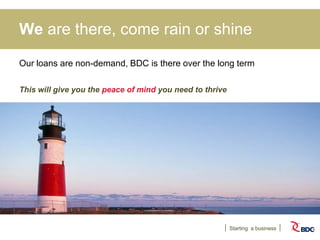
We are there, come rain or shine
Our loans are non-demand, BDC is there over the long term
This will give you the peace of mind you need to thrive
Starting a business
Start-up financing
Starting a business
Start-up financing
BDC can provide support to entrepreneurs who:
> Are in the start-up or early growth phase (less than 24 months of sales)
> Can provide personal and credit references
> Have reasonable personal financial resources invested in the company
> Have a business plan that includes cash flow forecast and can demonstrate
realistic market and sales potential
> Possess experience or expertise in their chosen field
> Have assembled a competent management team
> Demonstrate key personal characteristics of a successful entrepreneur
Starting a business
Start-up financing
Start-up financing
Most industries are eligible, with emphasis on manufacturing, distribution,
construction, business services and tourism industries
Eligible projects:
> Purchase of fixed assets and soft costs expenses
> Working capital
> Start-up marketing expenses
> Purchase of franchise and soft costs expenses
Changes of ownership are not eligible
Up to $150,000
> Amortization period up to 6 years
> Progressive or seasonal repayment options tailored to your business’s cash flow
> Consulting and mentoring solutions available
Starting a business
Get started
Starting a business
Get started
What is an entrepreneur?
An entrepreneur is a person who assumes the organization, management and
risks involved in a business venture
Qualities that make a successful entrepreneur
> Decision maker
> Analytical ability (problem-solving skills)
> Good interpersonal skills
> High drive (highly motivated) – risk taker
Starting a business
Get started
What you need to succeed
> Personal skills
> Business knowledge
> A good idea!
> Start-up money
> Support
> Good personal credit history
Starting a business
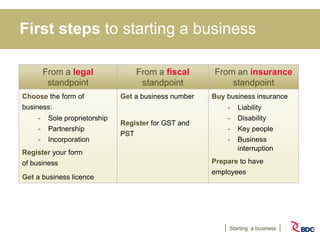
First steps to starting a business
From a legal
standpoint
From a fiscal
standpoint
From an insurance
standpoint
Choose the form of
business:
- Sole proprietorship
- Partnership
- Incorporation
Register your form
of business
Get a business licence
Get a business number
Register for GST and
PST
Buy business insurance
- Liability
- Disability
- Key people
- Business
interruption
Prepare to have
employees
Starting a business
Business plan
Starting a business
Business plan
Your proposal will include your business plan
as well as additional documentation such as:
> Market research
> Industry trends
> Other information supporting your project’s viability
Starting a business
Business plan
What is a business plan
> A business plan can help you detail your goals, and serves as an
operational plan for achieving them
> A business plan is required from anyone who is planning to start a new
business
Why a business plan?
> To describe your business
> To convey your vision to potential investors
> To explain your business goals
> To identify potential problems and ways of solving them
> To state the amount of capital required to finance your venture
Starting a business
Business plan
What a business plan should include:
1) Executive summary
- Your industry, products/services, competitive advantages, amount of
financing required
2) Description of your company
- Legal status, date company founded, mission, objectives and vision
3) Description of your management team
- Roles, experience and competence, education
Starting a business
Business plan
4) Marketing plan in four sections
1) Your product or services: why your products/services will sell
2) Your market potential: target clients, market size and penetration,
demographic factors
3) Overview of your competition: their strengths and weaknesses
4) Marketing strategy: overview of your marketing plan, media chosen,
partners, etc.
Overview of your marketing plan
> Is there a proven market for your products or services?
> Who are your competitors?
> What is your client profile?
> What will you offer that is better?
> How will you get them to switch?
Starting a business
Business plan
5) Human resources plan
– Determine how you will recruit, retain and develop employees:
• HR policy
• Subcontracting and outside professionals
• Organizational and development plan
6) Financial planning
– Forecasts, balance sheet, statement of income,
cash flow budget
7) Appendices that boost your credibility
– Brief bios of your management team, market studies, client
testimonials, etc.
Starting a business
Finding the right financing
Starting a business
Finding the right financing
What lenders look for
> Proof of experience, skills, determination and self-confidence to
successfully carry out your project
> Your personal credit history – past performance can affect perceptions
about how you will perform in the future
> Your business plan must be clear, structured, and short, but it must cover
all elements of your business idea
> Forecast for next 2 years and a cash flow analysis that shows seasonal
fluctuations in your business
Starting a business
Finding the right financing
Finding initial financing
1) Personal investment money:
Cash/collateral on your assets,
proof that you have a long-term commitment to your project
2) Gift capital or love money:
Money loaned by close relative, to be repaid later,
bankers consider this asset as “patient capital”
3) Investments from others:
Money you raise from investors
> Bankers regard such investments highly
> Proof that your idea is sound, but can often diminish the degree of
control you have over your own company
Starting a business
Finding the right financing
4) Supplier (A/P) Financing:
> Policy for paying suppliers based on their payment conditions (often 30
or 60 days after delivery)
> Check with each supplier, since many offer discounts for
quick payment
5) Grants, Subsidies and Tax Credits:
> You may have access to grants, subsidies or tax credits to help recover
expenses such as salaries or equipment
Starting a business
Financing to get started
Starting a business
Financing to get started
Types of loan
> Personal loan
– Money loaned to you, not your business
– Loan secured by your personal assets
– Many banks offer this type of loan to start-up businesses or those with
few assets (land, building or equipment)
> Operating loan (also called Line of credit)
– Short term, flexible financing that you manage yourself
– Borrowing as much as you need up to a determined
amount
– Secured by your inventory and accounts receivable, and your bank can
require full repayment at any time
Starting a business
Financing to get started
> Term loan
– Long-term financing option for fixed assets such as equipment,
land or building
> Working capital loan
– Long-term financing to cover projects such as export,
marketing, e-business, R&D, etc.
– Helps provide you the cash flow to fuel your growth
– Complements your existing line of credit
Starting a business
Insights on investors and lenders
> Many entrepreneurs are intuitive and rely on their experience, industry
knowledge and gut feelings to tell them whether a project “makes sense”
> Most bankers are methodical, and won’t draw conclusions
quickly- especially if they don’t have all the facts before them
> Given that they don’t have your technical knowledge, they will want to see
that you have thoroughly analyzed and planned your project
> A thought-out business plan is key to your success
Starting a business
Useful links
Starting a business
Useful links
Strategis (Industry Canada): www.strategis.ic.gc.ca
Useful resource to find industry-related information and tons of
information on what you need to do to get your business started
Canada Business Service Centre: www.cbsc.org
Excellent resource centre to help in writing business plans, determining
types of loans and other resources that may be applicable to your business
BDC: www.bdc.ca
Number 1 resource for all your financing and consulting needs. Templates
of business plans available and lots of pertinent info
Starting a business
Thank you
Starting a business
1-800-info-BDC www.bdc.ca
SAL RABBANI
(416) 973-0242
sal.rabbani@bdc.ca

BDC - Starting a Business

  • 1.
  • 2.
    Starting a business Accelerateentrepreneurs’ success Our mission Help create and develop Canadian businesses through financing, venture capital and consulting services, with a focus on small and medium-sized enterprises (SMEs)
  • 3.
    An unwavering commitmentto the success of Canadian entrepreneurs
  • 4.
    Starting a business Weshare the entrepreneurial spirit that drives Canadian businesses from coast to coast > Our dedicated and experienced employees are helping more than 28,000 clients reach their full potential > Over 100 branches across Canada to provide our clients with solutions that meet local economic realities > Close to $10 billion of assets under management
  • 5.
    Starting a business Ourmandate > Be a complementary lender in the market to other traditional financing institutions > Fill the market gaps and maximize financing alternatives > Operate on a commercial basis, i.e. to be financially sustainable BDC does not provide: > Bank accounts, lines of credit, term deposits, investment certificates, RRSPs or insurance > Interest-free grants or loans > Residential or non-commercial loans, vehicle or equipment leasing
  • 6.
    Starting a business Fora unique client service experience Why choose BDC?
  • 7.
    Starting a business Ourapproach goes beyond money > We look at your business as a whole, including management expertise, potential for growth and the viability of the project > We want to optimize your financial resources by offering repayment terms tailored to your business cycle and needs > You can count on professional advice from our consulting services
  • 8.
    Starting a business Weare there, come rain or shine Our loans are non-demand, BDC is there over the long term This will give you the peace of mind you need to thrive
  • 9.
  • 10.
    Starting a business Start-upfinancing BDC can provide support to entrepreneurs who: > Are in the start-up or early growth phase (less than 24 months of sales) > Can provide personal and credit references > Have reasonable personal financial resources invested in the company > Have a business plan that includes cash flow forecast and can demonstrate realistic market and sales potential > Possess experience or expertise in their chosen field > Have assembled a competent management team > Demonstrate key personal characteristics of a successful entrepreneur
  • 11.
    Starting a business Start-upfinancing Start-up financing Most industries are eligible, with emphasis on manufacturing, distribution, construction, business services and tourism industries Eligible projects: > Purchase of fixed assets and soft costs expenses > Working capital > Start-up marketing expenses > Purchase of franchise and soft costs expenses Changes of ownership are not eligible Up to $150,000 > Amortization period up to 6 years > Progressive or seasonal repayment options tailored to your business’s cash flow > Consulting and mentoring solutions available
  • 12.
  • 13.
    Starting a business Getstarted What is an entrepreneur? An entrepreneur is a person who assumes the organization, management and risks involved in a business venture Qualities that make a successful entrepreneur > Decision maker > Analytical ability (problem-solving skills) > Good interpersonal skills > High drive (highly motivated) – risk taker
  • 14.
    Starting a business Getstarted What you need to succeed > Personal skills > Business knowledge > A good idea! > Start-up money > Support > Good personal credit history
  • 15.
    Starting a business Firststeps to starting a business From a legal standpoint From a fiscal standpoint From an insurance standpoint Choose the form of business: - Sole proprietorship - Partnership - Incorporation Register your form of business Get a business licence Get a business number Register for GST and PST Buy business insurance - Liability - Disability - Key people - Business interruption Prepare to have employees
  • 16.
  • 17.
    Starting a business Businessplan Your proposal will include your business plan as well as additional documentation such as: > Market research > Industry trends > Other information supporting your project’s viability
  • 18.
    Starting a business Businessplan What is a business plan > A business plan can help you detail your goals, and serves as an operational plan for achieving them > A business plan is required from anyone who is planning to start a new business Why a business plan? > To describe your business > To convey your vision to potential investors > To explain your business goals > To identify potential problems and ways of solving them > To state the amount of capital required to finance your venture
  • 19.
    Starting a business Businessplan What a business plan should include: 1) Executive summary - Your industry, products/services, competitive advantages, amount of financing required 2) Description of your company - Legal status, date company founded, mission, objectives and vision 3) Description of your management team - Roles, experience and competence, education
  • 20.
    Starting a business Businessplan 4) Marketing plan in four sections 1) Your product or services: why your products/services will sell 2) Your market potential: target clients, market size and penetration, demographic factors 3) Overview of your competition: their strengths and weaknesses 4) Marketing strategy: overview of your marketing plan, media chosen, partners, etc. Overview of your marketing plan > Is there a proven market for your products or services? > Who are your competitors? > What is your client profile? > What will you offer that is better? > How will you get them to switch?
  • 21.
    Starting a business Businessplan 5) Human resources plan – Determine how you will recruit, retain and develop employees: • HR policy • Subcontracting and outside professionals • Organizational and development plan 6) Financial planning – Forecasts, balance sheet, statement of income, cash flow budget 7) Appendices that boost your credibility – Brief bios of your management team, market studies, client testimonials, etc.
  • 22.
    Starting a business Findingthe right financing
  • 23.
    Starting a business Findingthe right financing What lenders look for > Proof of experience, skills, determination and self-confidence to successfully carry out your project > Your personal credit history – past performance can affect perceptions about how you will perform in the future > Your business plan must be clear, structured, and short, but it must cover all elements of your business idea > Forecast for next 2 years and a cash flow analysis that shows seasonal fluctuations in your business
  • 24.
    Starting a business Findingthe right financing Finding initial financing 1) Personal investment money: Cash/collateral on your assets, proof that you have a long-term commitment to your project 2) Gift capital or love money: Money loaned by close relative, to be repaid later, bankers consider this asset as “patient capital” 3) Investments from others: Money you raise from investors > Bankers regard such investments highly > Proof that your idea is sound, but can often diminish the degree of control you have over your own company
  • 25.
    Starting a business Findingthe right financing 4) Supplier (A/P) Financing: > Policy for paying suppliers based on their payment conditions (often 30 or 60 days after delivery) > Check with each supplier, since many offer discounts for quick payment 5) Grants, Subsidies and Tax Credits: > You may have access to grants, subsidies or tax credits to help recover expenses such as salaries or equipment
  • 26.
  • 27.
    Starting a business Financingto get started Types of loan > Personal loan – Money loaned to you, not your business – Loan secured by your personal assets – Many banks offer this type of loan to start-up businesses or those with few assets (land, building or equipment) > Operating loan (also called Line of credit) – Short term, flexible financing that you manage yourself – Borrowing as much as you need up to a determined amount – Secured by your inventory and accounts receivable, and your bank can require full repayment at any time
  • 28.
    Starting a business Financingto get started > Term loan – Long-term financing option for fixed assets such as equipment, land or building > Working capital loan – Long-term financing to cover projects such as export, marketing, e-business, R&D, etc. – Helps provide you the cash flow to fuel your growth – Complements your existing line of credit
  • 29.
    Starting a business Insightson investors and lenders > Many entrepreneurs are intuitive and rely on their experience, industry knowledge and gut feelings to tell them whether a project “makes sense” > Most bankers are methodical, and won’t draw conclusions quickly- especially if they don’t have all the facts before them > Given that they don’t have your technical knowledge, they will want to see that you have thoroughly analyzed and planned your project > A thought-out business plan is key to your success
  • 30.
  • 31.
    Starting a business Usefullinks Strategis (Industry Canada): www.strategis.ic.gc.ca Useful resource to find industry-related information and tons of information on what you need to do to get your business started Canada Business Service Centre: www.cbsc.org Excellent resource centre to help in writing business plans, determining types of loans and other resources that may be applicable to your business BDC: www.bdc.ca Number 1 resource for all your financing and consulting needs. Templates of business plans available and lots of pertinent info
  • 32.
  • 33.
    Starting a business 1-800-info-BDCwww.bdc.ca SAL RABBANI (416) 973-0242 sal.rabbani@bdc.ca