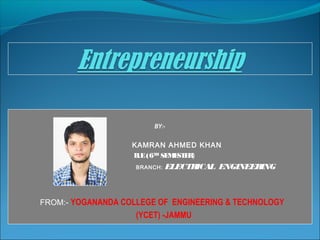
BY:-
KAMRAN AHMED KHAN
B.E(6TH
SEMESTER)
BRANCH: ELECTRICAL ENGINEERING
FROM:- YOGANANDA COLLEGE OF ENGINEERING & TECHNOLOGY
(YCET) -JAMMU
Overview
Who is an entrepreneur?
Planning before becoming an Entrepreneur.
Growth pressures, Managing a family business,
and Corporate Intrapreneurship
Who is an entrepreneur?
“Entrepreneurs are people that notice opportunities
and take the initiative to mobilize resources to make
new goods and services.”
“The process of running own business is known as
Enterpreneurship”
Common Traits of Successful
Entrepreneurs
Common traits
Original thinkers
Risk takers
Take responsibility for own
actions
Common traits
Self employed parents
Set high goals
Feel competent and capable
Questions To be Kept In Mind
What are my motivations for starting a business?
What and where is the market for my product?
How much will all this cost me?
Should my company be domestic or global?
What are my motivations for owning a business?
 Deciding what your motivations are will direct you
toward what type of business fits you best.
 Types:-
1. Lifestyle Venture
2. Smaller Profit Venture
3. High Growth Venture
1. Lifestyle Venture
Small company that provides its owner
independence, autonomy, and control.
Is often run out of household
Provides flexibility (hours, meeting places, attire)
Aligns your personal interests and hobbies with your
desire to make a profit.
2. Smaller Profit Venture
Small company not concentrated on pushing
the envelope and growing inordinately large.
Making millions of dollars not important.
Content with making a decent living.
3. High Growth Ventures
Goal is maximum profit and growth.
Concentrated on pushing envelope and
growing as large as possible.
Focus on innovation
What and where is the market for what I want to Sell?
Planning & Research essential:-
It is A step-by-step outline of how an entrepreneur or the
owner of an enterprise expects to turn ideas into reality.
Extensive market surveys (family, friends, neighbors…)
Magazines and Polls offer some information on the
market
How much will all this cost me?
Plan realistically, not optimistically
 Don’t overestimate your profits
 Don’t underestimate your costs
Sources of Funds
 Banks
 Venture Capitalists – filthy rich, high risk investors
looking for a many times over yield
Should my company be domestic or global?
Drawbacks to Global :–
More research and less accessible connections in startup
phase, more travel time required, more considerations.
Advantages to Global :–
More human resources, more demand, more financing,
easier to start global than go from domestic to global.
Successful Entrepreneurs
Successful
 Creative and Innovative
 Positioning strategies
 Create new products
 Create new processes
 Create new delivery
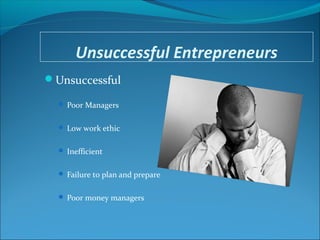
Unsuccessful Entrepreneurs
Unsuccessful
 Poor Managers
 Low work ethic
 Inefficient
 Failure to plan and prepare
 Poor money managers
7 Key Steps toward Starting Your Own Business
A lot of people think starting a business is hard. So Here
are seven key first steps to starting your own business:
 1. Take time to brainstorm.:
An idea is great, but you need to be able to give it legs.
Your job as a new entrepreneur and future business owner
is to think about every aspect of your business. Come up
with answers to every question a stranger or potential
investor might ask you.
 2. Create a business plan.:
The main parts of a business plan include the executive
summary, a company description (what makes the company
unique), a market analysis (the competition and target
demographics), the company's structure, a description of
the service or product line, the marketing and sales strategy,
financial projections -- plus any additional useful information.
 3. Gather needed resources.:
No matter what the size of your business is, you'll need
a few essentials to start operating. Create a list of everything
you’ll need and its approximate cost, whether it’s an office
space with a new desktop and printer or a warehouse to hold
the products.
7 Key Steps toward Starting Your Own Business
 4. Launch marketing and brand-awareness campaigns.
Before you launch the business off the ground, start planning the ideas for
marketing, sales, and branding efforts.
Create a Facebook page, Twitter profile, Google+, and LinkedIn page for your
business, depending on the appropriate social media channel for your company.
Use the company's brand colors and logo to create business cards, letterhead and
email signatures to demonstrate to customers a professional operation.
 5. Get the finances in shape.:
Hire an accountant for your business who can ensure that taxes are done correctly.
While doing your own business taxes can be relatively easy when running a solo business,
laws and regulations vary by state. Consult with an expert to make sure you're in the clear.
 6. Create a maintenance list.
When you finally have your business up and running, keep track of regular tasks
that keep a business running, keeping up with inventory, updating the website and
regularly blogging and using social media.
7 Key Steps toward Starting Your Own Business
7. Set future goals.:
Whether your business is a day or a year old, continuously set goals in order to move
your business forward.
Examine the competition, employees, investors and peers to help you decide what
new goals need to be set and what needs to happen so as to be successful
THANK YOU …..
HAVE A NICE DAYHAVE A NICE DAY
YOGANANDA COLLEGE OF ENGINEERING & TECHNOLOGY
(YCET) -JAMMU

powerpoint presentation on Entrepreneurship

  • 1.
    BY:- KAMRAN AHMED KHAN B.E(6TH SEMESTER) BRANCH:ELECTRICAL ENGINEERING FROM:- YOGANANDA COLLEGE OF ENGINEERING & TECHNOLOGY (YCET) -JAMMU
  • 2.
    Overview Who is anentrepreneur? Planning before becoming an Entrepreneur. Growth pressures, Managing a family business, and Corporate Intrapreneurship
  • 3.
    Who is anentrepreneur? “Entrepreneurs are people that notice opportunities and take the initiative to mobilize resources to make new goods and services.” “The process of running own business is known as Enterpreneurship”
  • 4.
    Common Traits ofSuccessful Entrepreneurs Common traits Original thinkers Risk takers Take responsibility for own actions Common traits Self employed parents Set high goals Feel competent and capable
  • 5.
    Questions To beKept In Mind What are my motivations for starting a business? What and where is the market for my product? How much will all this cost me? Should my company be domestic or global?
  • 6.
    What are mymotivations for owning a business?  Deciding what your motivations are will direct you toward what type of business fits you best.  Types:- 1. Lifestyle Venture 2. Smaller Profit Venture 3. High Growth Venture
  • 7.
    1. Lifestyle Venture Smallcompany that provides its owner independence, autonomy, and control. Is often run out of household Provides flexibility (hours, meeting places, attire) Aligns your personal interests and hobbies with your desire to make a profit.
  • 8.
    2. Smaller ProfitVenture Small company not concentrated on pushing the envelope and growing inordinately large. Making millions of dollars not important. Content with making a decent living.
  • 9.
    3. High GrowthVentures Goal is maximum profit and growth. Concentrated on pushing envelope and growing as large as possible. Focus on innovation
  • 10.
    What and whereis the market for what I want to Sell? Planning & Research essential:- It is A step-by-step outline of how an entrepreneur or the owner of an enterprise expects to turn ideas into reality. Extensive market surveys (family, friends, neighbors…) Magazines and Polls offer some information on the market
  • 11.
    How much willall this cost me? Plan realistically, not optimistically  Don’t overestimate your profits  Don’t underestimate your costs Sources of Funds  Banks  Venture Capitalists – filthy rich, high risk investors looking for a many times over yield
  • 12.
    Should my companybe domestic or global? Drawbacks to Global :– More research and less accessible connections in startup phase, more travel time required, more considerations. Advantages to Global :– More human resources, more demand, more financing, easier to start global than go from domestic to global.
  • 13.
    Successful Entrepreneurs Successful  Creativeand Innovative  Positioning strategies  Create new products  Create new processes  Create new delivery
  • 14.
    Unsuccessful Entrepreneurs Unsuccessful  PoorManagers  Low work ethic  Inefficient  Failure to plan and prepare  Poor money managers
  • 15.
    7 Key Stepstoward Starting Your Own Business A lot of people think starting a business is hard. So Here are seven key first steps to starting your own business:  1. Take time to brainstorm.: An idea is great, but you need to be able to give it legs. Your job as a new entrepreneur and future business owner is to think about every aspect of your business. Come up with answers to every question a stranger or potential investor might ask you.  2. Create a business plan.: The main parts of a business plan include the executive summary, a company description (what makes the company unique), a market analysis (the competition and target demographics), the company's structure, a description of the service or product line, the marketing and sales strategy, financial projections -- plus any additional useful information.  3. Gather needed resources.: No matter what the size of your business is, you'll need a few essentials to start operating. Create a list of everything you’ll need and its approximate cost, whether it’s an office space with a new desktop and printer or a warehouse to hold the products.
  • 16.
    7 Key Stepstoward Starting Your Own Business  4. Launch marketing and brand-awareness campaigns. Before you launch the business off the ground, start planning the ideas for marketing, sales, and branding efforts. Create a Facebook page, Twitter profile, Google+, and LinkedIn page for your business, depending on the appropriate social media channel for your company. Use the company's brand colors and logo to create business cards, letterhead and email signatures to demonstrate to customers a professional operation.  5. Get the finances in shape.: Hire an accountant for your business who can ensure that taxes are done correctly. While doing your own business taxes can be relatively easy when running a solo business, laws and regulations vary by state. Consult with an expert to make sure you're in the clear.  6. Create a maintenance list. When you finally have your business up and running, keep track of regular tasks that keep a business running, keeping up with inventory, updating the website and regularly blogging and using social media.
  • 17.
    7 Key Stepstoward Starting Your Own Business 7. Set future goals.: Whether your business is a day or a year old, continuously set goals in order to move your business forward. Examine the competition, employees, investors and peers to help you decide what new goals need to be set and what needs to happen so as to be successful
  • 18.
    THANK YOU ….. HAVEA NICE DAYHAVE A NICE DAY YOGANANDA COLLEGE OF ENGINEERING & TECHNOLOGY (YCET) -JAMMU