
Entrepreneurship

             Mr. Mazen S. H. Elsayed


Palestinian Community Assistance Program
Principles of Entrepreneurship
Contents

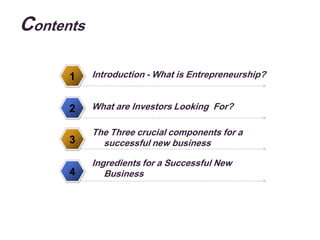
      1    Introduction - What is Entrepreneurship?


      2    What are Investors Looking For?

           The Three crucial components for a
      3      successful new business

           Ingredients for a Successful New
      4       Business
Introduction (1/2)

• After finishing your graduation you will be
  at the crossroads of life:
  – Career in your own business
    [YOB] “Entrepreneurship”
  – wage employment
    [JOB]
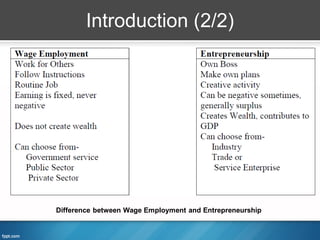
Introduction (2/2)


Difference between Wage Employment and Entrepreneurship
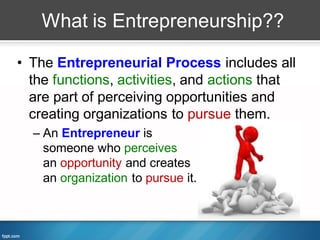
What is Entrepreneurship??

• The Entrepreneurial Process includes all
  the functions, activities, and actions that
  are part of perceiving opportunities and
  creating organizations to pursue them.
  – An Entrepreneur is
    someone who perceives
    an opportunity and creates
    an organization to pursue it.
Critical Factors for Starting a
       New Enterprise

    What about having a QUIZ??
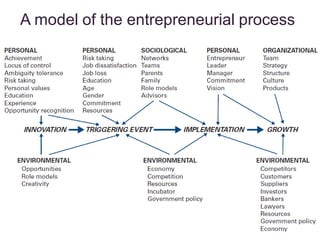
A model of the entrepreneurial process
Critical Factors for Starting a
       New Enterprise (1/3)
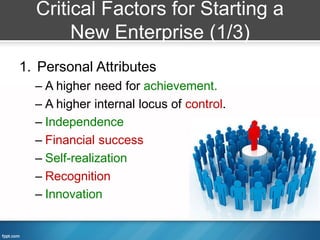
1. Personal Attributes
  – A higher need for achievement.
  – A higher internal locus of control.
  – Independence
  – Financial success
  – Self-realization
  – Recognition
  – Innovation
Critical Factors for Starting a
        New Enterprise (2/3)
1. Environmental Factors:
  – Silicon Valley FEVER
  – Entrepreneur genetics !!
Critical Factors for Starting a
       New Enterprise (3/3)
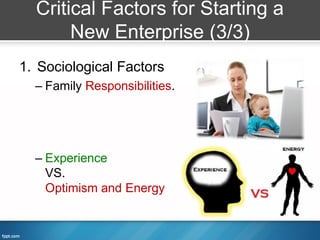
1. Sociological Factors
  – Family Responsibilities.


  – Experience
    VS.
    Optimism and Energy
Evaluating Opportunities for
         New Businesses
• How should you evaluate the prospects of
  starting a new Business??
  – USA: only 1 business in 10 will ever reach its
    10th birthday.
• This is because they are
  started as part-time pursuits
  and are never intended to
  become full-time businesses.
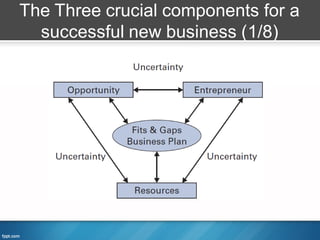
The Three crucial components for a
  successful new business (1/8)
The Three crucial components for a
  successful new business (2/8)
• The crucial ingredients for entrepreneurial
  success are a superb-entrepreneur
  with a first-rate management team
  and an excellent market
  opportunity.
• In entrepreneurship, as in
  any other profession, Luck
  is where preparation and
  opportunity meet.
The Three crucial components for a
  successful new business (3/8)
1. The Opportunity:
  – The biggest misconception about an idea for
    a new business is that it must be unique.
    • If you have a unique idea, you become super-
      secretive, reluctant to discuss it
      with anyone who doesn’t sign a
      nondisclosure agreement.
    • That makes it almost impossible to
      evaluate the idea.
The Three crucial components for a
  successful new business (4/8)
1. The Opportunity (Cont.):
  – The idea in itself is not
    what is important.
  – Developing the idea,
    implementing it, and
    building a successful
    business are the
    important things.
The Three crucial components for a
  successful new business (5/8)
• The Customer:
  – Would-be entrepreneurs who are unable to
    name a customer are not ready to start a
    business.
  – They have found an idea but
    have not yet identified a
    market need.
The Three crucial components for a
  successful new business (6/8)
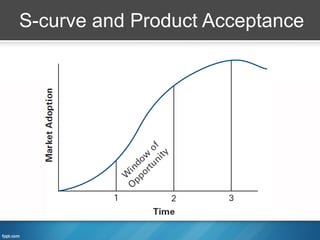
• The Timing:
  – In some emerging industries, there is a
    definite window of opportunity that opens only
    once.
  – Most entrepreneurs should
    avoid these kind of opportunities
    • they will rush to open their
      business, lead to costly mistakes.
The Three crucial components for a
  successful new business (7/8)
1. The Entrepreneur and the Management
   Team:
  – Opportunity will not become
    a successful business without
    strong entrepreneurial and
    management skills.
    a. Experience in the same industry.
    b. management experience.
The Three crucial components for a
  successful new business (8/8)
1. Resources:
  – Entrepreneurial frugality requires:
     • Low overhead.
     • High productivity.
     • Minimal ownership of
       capital assets.
Ingredients for a Successful
          New Business
• Founders: Every startup company must have a
  first-class entrepreneur.
• Focused: Entrepreneurial companies focus on
  niche markets.
• Fast & Flexible: They make decisions quickly and
  implement them swiftly. They keep an open mind.
• Forever-innovating: They are tireless innovators.
• Flat: Entrepreneurial organizations
  have as few layers of management as
  possible.
• Frugal: By keeping overhead low
  and productivity high.
Opportunity Recognition
Contents


    1   How Do I Come Up with a Good Idea?


    2   Is Your Idea an Opportunity?
How Do I Come Up with a Good
         Idea? (1/2)
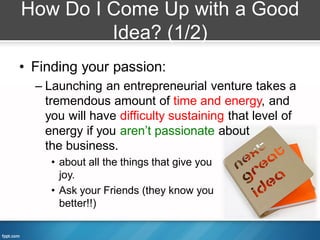
• Finding your passion:
  – Launching an entrepreneurial venture takes a
    tremendous amount of time and energy, and
    you will have difficulty sustaining that level of
    energy if you aren’t passionate about
    the business.
     • about all the things that give you
       joy.
     • Ask your Friends (they know you
       better!!)
How Do I Come Up with a Good
         Idea? (2/2)
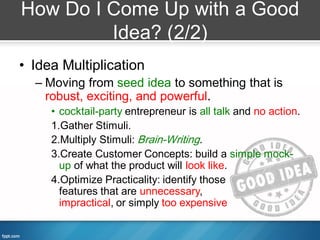
• Idea Multiplication
  – Moving from seed idea to something that is
    robust, exciting, and powerful.
     • cocktail-party entrepreneur is all talk and no action.
     1.Gather Stimuli.
     2.Multiply Stimuli: Brain-Writing.
     3.Create Customer Concepts: build a simple mock-
       up of what the product will look like.
     4.Optimize Practicality: identify those
       features that are unnecessary,
       impractical, or simply too expensive
Is Your Idea an Opportunity?
              (1/5)
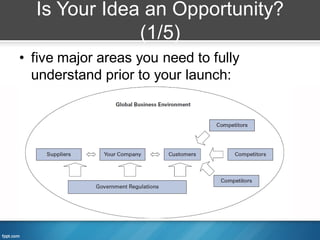
• five major areas you need to fully
  understand prior to your launch:
Is Your Idea an Opportunity?
            (2/5)
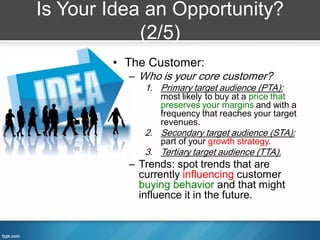
        • The Customer:
          – Who is your core customer?
             1. Primary target audience (PTA):
                most likely to buy at a price that
                preserves your margins and with a
                frequency that reaches your target
                revenues.
             2. Secondary target audience (STA):
                part of your growth strategy.
             3. Tertiary target audience (TTA).
          – Trends: spot trends that are
            currently influencing customer
            buying behavior and that might
            influence it in the future.
S-curve and Product Acceptance
Is Your Idea an Opportunity?
              (3/5)
• The Customer (Cont.):
  – Frequency and Price: how often our average
    customer buys our product or service and
    how much he or she is willing to pay.
    • Don’t use a penetration-pricing strategy.
    • Use cost-plus pricing.
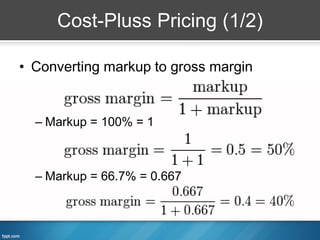
Cost-Pluss Pricing (1/2)

• Converting markup to gross margin


  – Markup = 100% = 1


  – Markup = 66.7% = 0.667
Cost-Pluss Pricing (2/2)

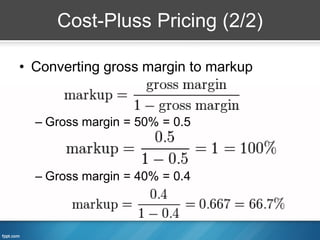
• Converting gross margin to markup


  – Gross margin = 50% = 0.5


  – Gross margin = 40% = 0.4
Is Your Idea an Opportunity?
              (4/5)
• The Competition:
  – How is the customer currently fulfilling the need
    or want you intend to fill?
     • Direct competitors.
     • Indirect competitors.
     • Substitutes.
  – The good news is that many times
    strong competitors won’t bother with new
    startups.
  – How to know your competitors:
     • Ask suppliers.
     • Professional investors.
Is Your Idea an Opportunity?
              (5/5)
• Suppliers and vendors:
  – suppliers can have tremendous power, and
    that will directly affect your margins.
• The Government:
  – Tax
  – Time for registering a new business.
• The Global Environment.
Introduction to business models

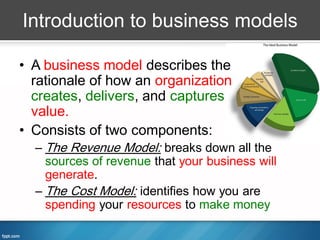
• A business model describes the
  rationale of how an organization
  creates, delivers, and captures
  value.
• Consists of two components:
  – The Revenue Model: breaks down all the
    sources of revenue that your business will
    generate.
  – The Cost Model: identifies how you are
    spending your resources to make money
The Revenue Model

• Breaking down the revenue sources
   into categories.
• Different revenue categories often
  require variations on the firm’s central
  strategy to achieve the highest possible
  outcomes
  – influenced by ‘‘drivers’’ that are directly correlated
    with the level of revenues the company earns.
  – If you don’t fully understand your revenue drivers,
    you won’t achieve the greatest success.
The Cost Model

• A firm needs to spend money to influence the
  revenue drivers.
• Includes two primary categories:
   – Cost of goods sold (COGS):
     represents costs directly associated
     with the revenue source.
   – Operating costs: like
     advertisements, Rapid delivery.
• Until having a full understanding
  of the business model required,
  it is difficult to move on to tactics
  to implement that strategy.
The First-Mover Myth

• To capture a first-mover advantage:
  1. You have to be first (or very early) into the
     market.
  2. You need to capture a large percentage of
     the market quickly (fast growth).
  3. You need to create switching costs so the
     customer will stick with you.
Formulating a Winning
      Strategy
      Exercise  
Business Model Canvas
Contents


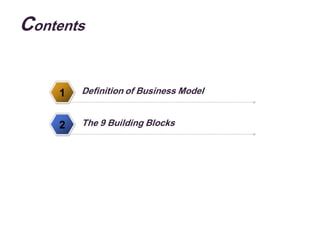
    1   Definition of Business Model


    2   The 9 Building Blocks
Business Model Definition


A Business Model describes the rationale


of how an organization creates, delivers,
and captures Value.
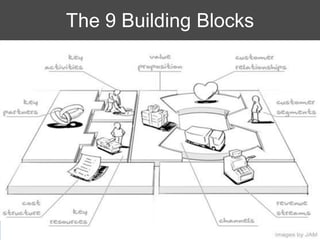
The 9 Building Blocks
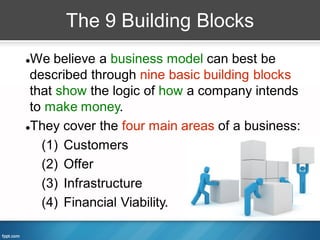
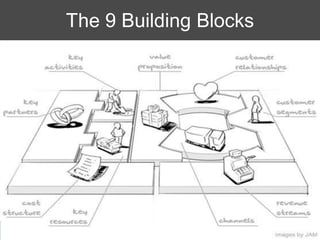
We believe a business model can best be
 described through nine basic building blocks
 that show the logic of how a company intends
 to make money.
They cover the four main areas of a business:


   (1) Customers
   (2) Offer
   (3) Infrastructure
   (4) Financial Viability.
The 9 Building Blocks
1- Customer Segments (1/3)

It defines the different groups of


people or organizations an
enterprise aims to reach and
serve.
      For whom are we creating
       value?
      Who are our most important
       customers?
1- Customer Segments (2/3)
Customer groups represent separate segments if:



    Their needs require and justify a distinct
     offer.
    They are reached through different
     Distribution Channels.
    They require different types of relationships.
    They have substantially different
     profitabilities.
    They are willing to pay for different aspects
     of the offer.
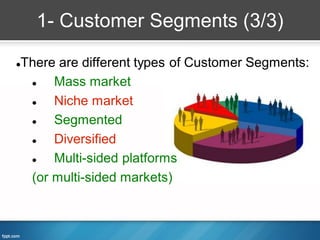
1- Customer Segments (3/3)

There are different types of Customer Segments:



    Mass market
    Niche market
    Segmented
    Diversified
    Multi-sided platforms
 (or multi-sided markets)
2- Value Propositions (1/2)

It describes the bundle of products and services


that create value for a specific Customer
Segment
     What value do we deliver to the customer?
     Which one of our customer’s problems are
      we helping to solve?
     Which customer needs are we satisfying?
     What bundles of products and services are
      we offering to each Customer Segment?
2- Value Propositions (2/2)

Elements from the following non-exhaustive list


can contribute to customer value creation:

* Newness        * Performance
* Customization * Accessibility
* Design         * Brand/status
* Price          * Cost reduction
* Risk reduction * “Getting the job done”
* Convenience/usability
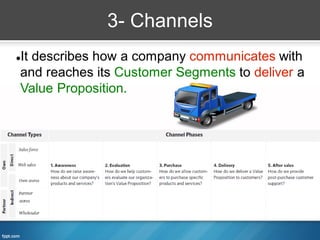
3- Channels
It describes how a company communicates with


and reaches its Customer Segments to deliver a
Value Proposition.
4- Customer Relationships (1/2)

It describes the types of relationships a company
 establishes with specific Customer Segments.
Customer relationships may be driven by the

 following motivations:
      Customer acquisition
      Customer retention
      Boosting sales (upselling)
4- Customer Relationships (2/2)
We can distinguish between several categories


of Customer Relationships:
    Personal assistance
    Dedicated personal assistance
    Self-service
    Automated services
    Communities
    Co-creation
5- Revenue Streams (1/3)

It represents the cash a company generates
 from each Customer Segment (costs must be
 subtracted from revenues to create earnings).
A business model can involve two different types

 of Revenue Streams:
    1.Transaction revenues resulting from one-time customer
         payments
    2. Recurring revenues resulting from ongoing payments to
         either deliver a Value Proposition to customers or
         provide post-purchase customer support.
5- Revenue Streams (2/3)

There are several ways to generate Revenue


Streams:
    Asset sale
    Usage fee
    Subscription fees
    Lending/Renting/Leasing
    Licensing
    Brokerage fees
    Advertising
5- Revenue Streams (3/3)
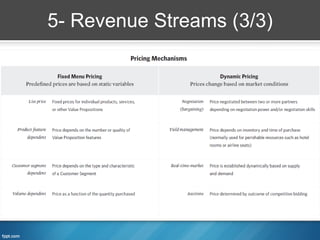
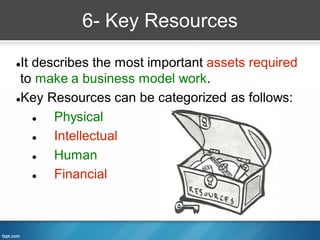
6- Key Resources

It describes the most important assets required
 to make a business model work.
Key Resources can be categorized as follows:


      Physical
      Intellectual
      Human
      Financial
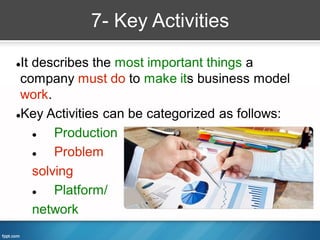
7- Key Activities

It describes the most important things a
 company must do to make its business model
 work.
Key Activities can be categorized as follows:


       Production
       Problem
    solving
       Platform/
    network
8- Key Partnerships (1/2)

It describes the network of suppliers
and partners that make the business
model work.
It can be useful to distinguish between
three motivations for creating
partnerships:
       Optimization and economy of scale
       Reduction of risk and uncertainty
       Acquisition of particular resources and activities
8- Key Partnerships (2/2)

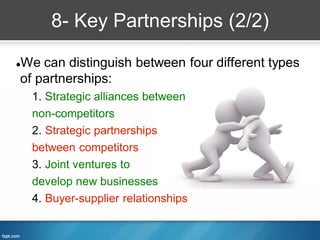
We can distinguish between four different types


of partnerships:
    1. Strategic alliances between
    non-competitors
    2. Strategic partnerships
    between competitors
    3. Joint ventures to
    develop new businesses
    4. Buyer-supplier relationships
9- Cost Structure (1/2)

It describes all costs incurred to operate a
 business model.
It can be useful to distinguish between two broad

 classes of business model Cost Structures:
      Cost-driven
      Value-driven
9- Cost Structure (2/2)

Cost Structures can have the following


characteristics:
    Fixed costs
    Variable costs
    Economies of scale
    Economies of scope
The 9 Building Blocks
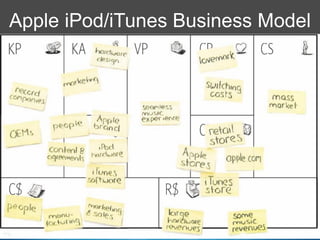
Apple iPod/iTunes Business Model
QUESTIONS

Entrepreneurship

  • 1.
    Entrepreneurship Mr. Mazen S. H. Elsayed Palestinian Community Assistance Program
  • 2.
  • 3.
    Contents 1 Introduction - What is Entrepreneurship? 2 What are Investors Looking For? The Three crucial components for a 3 successful new business Ingredients for a Successful New 4 Business
  • 4.
    Introduction (1/2) • Afterfinishing your graduation you will be at the crossroads of life: – Career in your own business [YOB] “Entrepreneurship” – wage employment [JOB]
  • 5.
    Introduction (2/2) Difference betweenWage Employment and Entrepreneurship
  • 6.
    What is Entrepreneurship?? •The Entrepreneurial Process includes all the functions, activities, and actions that are part of perceiving opportunities and creating organizations to pursue them. – An Entrepreneur is someone who perceives an opportunity and creates an organization to pursue it.
  • 9.
    Critical Factors forStarting a New Enterprise What about having a QUIZ??
  • 10.
    A model ofthe entrepreneurial process
  • 11.
    Critical Factors forStarting a New Enterprise (1/3) 1. Personal Attributes – A higher need for achievement. – A higher internal locus of control. – Independence – Financial success – Self-realization – Recognition – Innovation
  • 12.
    Critical Factors forStarting a New Enterprise (2/3) 1. Environmental Factors: – Silicon Valley FEVER – Entrepreneur genetics !!
  • 13.
    Critical Factors forStarting a New Enterprise (3/3) 1. Sociological Factors – Family Responsibilities. – Experience VS. Optimism and Energy
  • 14.
    Evaluating Opportunities for New Businesses • How should you evaluate the prospects of starting a new Business?? – USA: only 1 business in 10 will ever reach its 10th birthday. • This is because they are started as part-time pursuits and are never intended to become full-time businesses.
  • 15.
    The Three crucialcomponents for a successful new business (1/8)
  • 16.
    The Three crucialcomponents for a successful new business (2/8) • The crucial ingredients for entrepreneurial success are a superb-entrepreneur with a first-rate management team and an excellent market opportunity. • In entrepreneurship, as in any other profession, Luck is where preparation and opportunity meet.
  • 17.
    The Three crucialcomponents for a successful new business (3/8) 1. The Opportunity: – The biggest misconception about an idea for a new business is that it must be unique. • If you have a unique idea, you become super- secretive, reluctant to discuss it with anyone who doesn’t sign a nondisclosure agreement. • That makes it almost impossible to evaluate the idea.
  • 18.
    The Three crucialcomponents for a successful new business (4/8) 1. The Opportunity (Cont.): – The idea in itself is not what is important. – Developing the idea, implementing it, and building a successful business are the important things.
  • 19.
    The Three crucialcomponents for a successful new business (5/8) • The Customer: – Would-be entrepreneurs who are unable to name a customer are not ready to start a business. – They have found an idea but have not yet identified a market need.
  • 20.
    The Three crucialcomponents for a successful new business (6/8) • The Timing: – In some emerging industries, there is a definite window of opportunity that opens only once. – Most entrepreneurs should avoid these kind of opportunities • they will rush to open their business, lead to costly mistakes.
  • 21.
    The Three crucialcomponents for a successful new business (7/8) 1. The Entrepreneur and the Management Team: – Opportunity will not become a successful business without strong entrepreneurial and management skills. a. Experience in the same industry. b. management experience.
  • 22.
    The Three crucialcomponents for a successful new business (8/8) 1. Resources: – Entrepreneurial frugality requires: • Low overhead. • High productivity. • Minimal ownership of capital assets.
  • 23.
    Ingredients for aSuccessful New Business • Founders: Every startup company must have a first-class entrepreneur. • Focused: Entrepreneurial companies focus on niche markets. • Fast & Flexible: They make decisions quickly and implement them swiftly. They keep an open mind. • Forever-innovating: They are tireless innovators. • Flat: Entrepreneurial organizations have as few layers of management as possible. • Frugal: By keeping overhead low and productivity high.
  • 24.
  • 25.
    Contents 1 How Do I Come Up with a Good Idea? 2 Is Your Idea an Opportunity?
  • 26.
    How Do ICome Up with a Good Idea? (1/2) • Finding your passion: – Launching an entrepreneurial venture takes a tremendous amount of time and energy, and you will have difficulty sustaining that level of energy if you aren’t passionate about the business. • about all the things that give you joy. • Ask your Friends (they know you better!!)
  • 27.
    How Do ICome Up with a Good Idea? (2/2) • Idea Multiplication – Moving from seed idea to something that is robust, exciting, and powerful. • cocktail-party entrepreneur is all talk and no action. 1.Gather Stimuli. 2.Multiply Stimuli: Brain-Writing. 3.Create Customer Concepts: build a simple mock- up of what the product will look like. 4.Optimize Practicality: identify those features that are unnecessary, impractical, or simply too expensive
  • 28.
    Is Your Ideaan Opportunity? (1/5) • five major areas you need to fully understand prior to your launch:
  • 29.
    Is Your Ideaan Opportunity? (2/5) • The Customer: – Who is your core customer? 1. Primary target audience (PTA): most likely to buy at a price that preserves your margins and with a frequency that reaches your target revenues. 2. Secondary target audience (STA): part of your growth strategy. 3. Tertiary target audience (TTA). – Trends: spot trends that are currently influencing customer buying behavior and that might influence it in the future.
  • 30.
  • 31.
    Is Your Ideaan Opportunity? (3/5) • The Customer (Cont.): – Frequency and Price: how often our average customer buys our product or service and how much he or she is willing to pay. • Don’t use a penetration-pricing strategy. • Use cost-plus pricing.
  • 32.
    Cost-Pluss Pricing (1/2) •Converting markup to gross margin – Markup = 100% = 1 – Markup = 66.7% = 0.667
  • 33.
    Cost-Pluss Pricing (2/2) •Converting gross margin to markup – Gross margin = 50% = 0.5 – Gross margin = 40% = 0.4
  • 34.
    Is Your Ideaan Opportunity? (4/5) • The Competition: – How is the customer currently fulfilling the need or want you intend to fill? • Direct competitors. • Indirect competitors. • Substitutes. – The good news is that many times strong competitors won’t bother with new startups. – How to know your competitors: • Ask suppliers. • Professional investors.
  • 35.
    Is Your Ideaan Opportunity? (5/5) • Suppliers and vendors: – suppliers can have tremendous power, and that will directly affect your margins. • The Government: – Tax – Time for registering a new business. • The Global Environment.
  • 36.
    Introduction to businessmodels • A business model describes the rationale of how an organization creates, delivers, and captures value. • Consists of two components: – The Revenue Model: breaks down all the sources of revenue that your business will generate. – The Cost Model: identifies how you are spending your resources to make money
  • 37.
    The Revenue Model •Breaking down the revenue sources into categories. • Different revenue categories often require variations on the firm’s central strategy to achieve the highest possible outcomes – influenced by ‘‘drivers’’ that are directly correlated with the level of revenues the company earns. – If you don’t fully understand your revenue drivers, you won’t achieve the greatest success.
  • 38.
    The Cost Model •A firm needs to spend money to influence the revenue drivers. • Includes two primary categories: – Cost of goods sold (COGS): represents costs directly associated with the revenue source. – Operating costs: like advertisements, Rapid delivery. • Until having a full understanding of the business model required, it is difficult to move on to tactics to implement that strategy.
  • 39.
    The First-Mover Myth •To capture a first-mover advantage: 1. You have to be first (or very early) into the market. 2. You need to capture a large percentage of the market quickly (fast growth). 3. You need to create switching costs so the customer will stick with you.
  • 40.
    Formulating a Winning Strategy   Exercise  
  • 41.
  • 42.
    Contents 1 Definition of Business Model 2 The 9 Building Blocks
  • 43.
    Business Model Definition ABusiness Model describes the rationale  of how an organization creates, delivers, and captures Value.
  • 44.
    The 9 BuildingBlocks We believe a business model can best be described through nine basic building blocks that show the logic of how a company intends to make money. They cover the four main areas of a business: (1) Customers (2) Offer (3) Infrastructure (4) Financial Viability.
  • 45.
  • 46.
    1- Customer Segments(1/3) It defines the different groups of  people or organizations an enterprise aims to reach and serve.  For whom are we creating value?  Who are our most important customers?
  • 47.
    1- Customer Segments(2/3) Customer groups represent separate segments if:   Their needs require and justify a distinct offer.  They are reached through different Distribution Channels.  They require different types of relationships.  They have substantially different profitabilities.  They are willing to pay for different aspects of the offer.
  • 48.
    1- Customer Segments(3/3) There are different types of Customer Segments:   Mass market  Niche market  Segmented  Diversified  Multi-sided platforms (or multi-sided markets)
  • 49.
    2- Value Propositions(1/2) It describes the bundle of products and services  that create value for a specific Customer Segment  What value do we deliver to the customer?  Which one of our customer’s problems are we helping to solve?  Which customer needs are we satisfying?  What bundles of products and services are we offering to each Customer Segment?
  • 50.
    2- Value Propositions(2/2) Elements from the following non-exhaustive list  can contribute to customer value creation: * Newness * Performance * Customization * Accessibility * Design * Brand/status * Price * Cost reduction * Risk reduction * “Getting the job done” * Convenience/usability
  • 51.
    3- Channels It describeshow a company communicates with  and reaches its Customer Segments to deliver a Value Proposition.
  • 52.
    4- Customer Relationships(1/2) It describes the types of relationships a company establishes with specific Customer Segments. Customer relationships may be driven by the following motivations:  Customer acquisition  Customer retention  Boosting sales (upselling)
  • 53.
    4- Customer Relationships(2/2) We can distinguish between several categories  of Customer Relationships:  Personal assistance  Dedicated personal assistance  Self-service  Automated services  Communities  Co-creation
  • 54.
    5- Revenue Streams(1/3) It represents the cash a company generates from each Customer Segment (costs must be subtracted from revenues to create earnings). A business model can involve two different types of Revenue Streams: 1.Transaction revenues resulting from one-time customer payments 2. Recurring revenues resulting from ongoing payments to either deliver a Value Proposition to customers or provide post-purchase customer support.
  • 55.
    5- Revenue Streams(2/3) There are several ways to generate Revenue  Streams:  Asset sale  Usage fee  Subscription fees  Lending/Renting/Leasing  Licensing  Brokerage fees  Advertising
  • 56.
  • 57.
    6- Key Resources Itdescribes the most important assets required to make a business model work. Key Resources can be categorized as follows:  Physical  Intellectual  Human  Financial
  • 58.
    7- Key Activities Itdescribes the most important things a company must do to make its business model work. Key Activities can be categorized as follows:  Production  Problem solving  Platform/ network
  • 59.
    8- Key Partnerships(1/2) It describes the network of suppliers and partners that make the business model work. It can be useful to distinguish between three motivations for creating partnerships:  Optimization and economy of scale  Reduction of risk and uncertainty  Acquisition of particular resources and activities
  • 60.
    8- Key Partnerships(2/2) We can distinguish between four different types  of partnerships: 1. Strategic alliances between non-competitors 2. Strategic partnerships between competitors 3. Joint ventures to develop new businesses 4. Buyer-supplier relationships
  • 61.
    9- Cost Structure(1/2) It describes all costs incurred to operate a business model. It can be useful to distinguish between two broad classes of business model Cost Structures:  Cost-driven  Value-driven
  • 62.
    9- Cost Structure(2/2) Cost Structures can have the following  characteristics:  Fixed costs  Variable costs  Economies of scale  Economies of scope
  • 63.
  • 64.
  • 65.