 PRESENTED BY :- SANTOSH
 Introduction of E-R model
 Features
 Basic terminologies of E-R model
 Types of attributes
 Advantages
 Disadvantages
The entity –relationship model is a high level
conceptual data model developed by peter chen
in 1976.
It describe the structure of database and
association retrieval and updation transactions
on the database.
It is based on a view of a real world that
consists of set of objects called entities and
relationships .
 It is top-down approach to database design.
 The E-R model is used for the purpose of good
database design by the database developer so to
use that data model in various DBMS.
 It is simple and easy to understand.
 It provides an easily understood pictorial map
for the database design.
 It offers an effective framework for integrating
multiple applications.
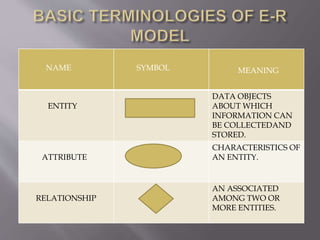
ENTITY
DATA OBJECTS
ABOUT WHICH
INFORMATION CAN
BE COLLECTEDAND
STORED.
ATTRIBUTE
CHARACTERISTICS OF
AN ENTITY.
RELATIONSHIP
AN ASSOCIATED
AMONG TWO OR
MORE ENTITIES.
NAME SYMBOL MEANING
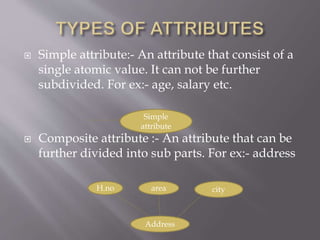
 Simple attribute:- An attribute that consist of a
single atomic value. It can not be further
subdivided. For ex:- age, salary etc.
 Composite attribute :- An attribute that can be
further divided into sub parts. For ex:- address
Simple
attribute
Address
H.no area city
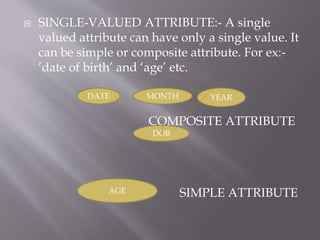
 SINGLE-VALUED ATTRIBUTE:- A single
valued attribute can have only a single value. It
can be simple or composite attribute. For ex:-
’date of birth’ and ‘age’ etc.
COMPOSITE ATTRIBUTE
SIMPLE ATTRIBUTE
DOB
DATE MONTH YEAR
AGE
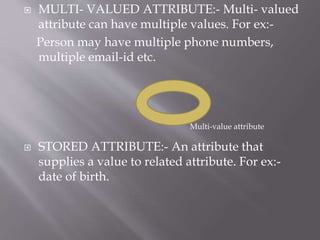
 MULTI- VALUED ATTRIBUTE:- Multi- valued
attribute can have multiple values. For ex:-
Person may have multiple phone numbers,
multiple email-id etc.
 STORED ATTRIBUTE:- An attribute that
supplies a value to related attribute. For ex:-
date of birth.
Multi-value attribute
 DERIVED ATTRIBUTE:- An attribute that’s
value is derived from a stored attribute. For ex:-
age is derived from stored attribute date of
birth.
Derived attribute
 Conceptual simplicity
 Visual representation
 Effective communication tool
 Integrated with relational database model.
 POPULAR FOR HIGH –LEVEL DESIGN
 NO INDUSTRY STANDARD
 LIMITED RELATIONSHIP
REPRESENTATION

E r model

  • 1.
     PRESENTED BY:- SANTOSH
  • 2.
     Introduction ofE-R model  Features  Basic terminologies of E-R model  Types of attributes  Advantages  Disadvantages
  • 3.
    The entity –relationshipmodel is a high level conceptual data model developed by peter chen in 1976. It describe the structure of database and association retrieval and updation transactions on the database. It is based on a view of a real world that consists of set of objects called entities and relationships .
  • 4.
     It istop-down approach to database design.  The E-R model is used for the purpose of good database design by the database developer so to use that data model in various DBMS.  It is simple and easy to understand.  It provides an easily understood pictorial map for the database design.  It offers an effective framework for integrating multiple applications.
  • 5.
    ENTITY DATA OBJECTS ABOUT WHICH INFORMATIONCAN BE COLLECTEDAND STORED. ATTRIBUTE CHARACTERISTICS OF AN ENTITY. RELATIONSHIP AN ASSOCIATED AMONG TWO OR MORE ENTITIES. NAME SYMBOL MEANING
  • 6.
     Simple attribute:-An attribute that consist of a single atomic value. It can not be further subdivided. For ex:- age, salary etc.  Composite attribute :- An attribute that can be further divided into sub parts. For ex:- address Simple attribute Address H.no area city
  • 7.
     SINGLE-VALUED ATTRIBUTE:-A single valued attribute can have only a single value. It can be simple or composite attribute. For ex:- ’date of birth’ and ‘age’ etc. COMPOSITE ATTRIBUTE SIMPLE ATTRIBUTE DOB DATE MONTH YEAR AGE
  • 8.
     MULTI- VALUEDATTRIBUTE:- Multi- valued attribute can have multiple values. For ex:- Person may have multiple phone numbers, multiple email-id etc.  STORED ATTRIBUTE:- An attribute that supplies a value to related attribute. For ex:- date of birth. Multi-value attribute
  • 9.
     DERIVED ATTRIBUTE:-An attribute that’s value is derived from a stored attribute. For ex:- age is derived from stored attribute date of birth. Derived attribute
  • 10.
     Conceptual simplicity Visual representation  Effective communication tool  Integrated with relational database model.
  • 11.
     POPULAR FORHIGH –LEVEL DESIGN  NO INDUSTRY STANDARD  LIMITED RELATIONSHIP REPRESENTATION