Sumya Medhat Ismail
MIS English Section
3rd year
Enterprise Resource Planning
System &
Data Warehousing
Implementation
Sumya Medhat Ismail
MIS English Section
1
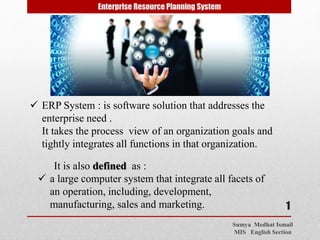
 ERP System : is software solution that addresses the
enterprise need .
It takes the process view of an organization goals and
tightly integrates all functions in that organization.
It is also defined as :
 a large computer system that integrate all facets of
an operation, including, development,
manufacturing, sales and marketing.
Enterprise Resource Planning System
2
Sumya Medhat Ismail
MIS English Section
Enterprise Resource Planning System
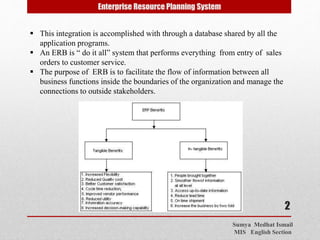
 This integration is accomplished with through a database shared by all the
application programs.
 An ERB is “ do it all” system that performs everything from entry of sales
orders to customer service.
 The purpose of ERB is to facilitate the flow of information between all
business functions inside the boundaries of the organization and manage the
connections to outside stakeholders.
3
Sumya Medhat Ismail
MIS English Section
Enterprise Resource Planning System
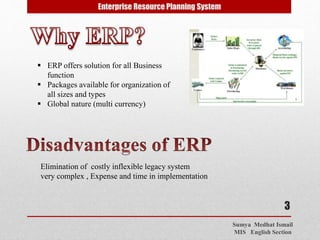
 ERP offers solution for all Business
function
 Packages available for organization of
all sizes and types
 Global nature (multi currency)
Elimination of costly inflexible legacy system
very complex , Expense and time in implementation
4
Sumya Medhat Ismail
MIS English Section
Data Warehousing Implementation
Data Warehousing Implementation Is an integrated, subject-oriented, time-
variant, non-volatile database that provides support for decision making.
Integrated :
the data warehouse is a centralized, consolidated database that
integrates data retrieved from the entire organization.
subject-oriented :
the data warehouse data is arranged and optimized to provide
answers to question coming from diverse functional areas within
a company.
time-variant :
the warehouse data represent the flow of data through time it can even
contain projected data.
non-volatile :
once data entre the data warehouse, they are never removed.
the data warehouse is always growing.
5
Sumya Medhat Ismail
MIS English Section
Data Warehousing Implementation
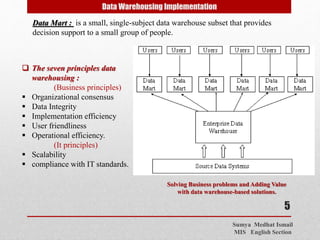
Data Mart : is a small, single-subject data warehouse subset that provides
decision support to a small group of people.
 The seven principles data
warehousing :
(Business principles)
 Organizational consensus
 Data Integrity
 Implementation efficiency
 User friendliness
 Operational efficiency.
(It principles)
 Scalability
 compliance with IT standards.
Solving Business problems and Adding Value
with data warehouse-based solutions.
6
Sumya Medhat Ismail
MIS English Section
Data Warehousing Implementation
 Numerous constraints :
• Available funding.
• Management’s view of the role played by an IS department and of the
extent and depth of the information requirement.
• Corporate culture .
 No single formula can describe perfect data warehouse development
Implementing a Data warehousing
Factors common to Data warehousing
 Data warehouse is not a static database.
 Dynamic framework for decision support that is always a work in
progress.
 Data warehouse data cross department line and geographical
boundaries.
 Must satisfy :
• Data integration and loading criteria.
• Data analysis capabilities with acceptable query performance
• End-user data analysis needs.
 Apply a database design procedures.
Enterprise resource planning system & data warehousing implementation

Enterprise resource planning system & data warehousing implementation

  • 1.
    Sumya Medhat Ismail MISEnglish Section 3rd year Enterprise Resource Planning System & Data Warehousing Implementation
  • 2.
    Sumya Medhat Ismail MISEnglish Section 1  ERP System : is software solution that addresses the enterprise need . It takes the process view of an organization goals and tightly integrates all functions in that organization. It is also defined as :  a large computer system that integrate all facets of an operation, including, development, manufacturing, sales and marketing. Enterprise Resource Planning System
  • 3.
    2 Sumya Medhat Ismail MISEnglish Section Enterprise Resource Planning System  This integration is accomplished with through a database shared by all the application programs.  An ERB is “ do it all” system that performs everything from entry of sales orders to customer service.  The purpose of ERB is to facilitate the flow of information between all business functions inside the boundaries of the organization and manage the connections to outside stakeholders.
  • 4.
    3 Sumya Medhat Ismail MISEnglish Section Enterprise Resource Planning System  ERP offers solution for all Business function  Packages available for organization of all sizes and types  Global nature (multi currency) Elimination of costly inflexible legacy system very complex , Expense and time in implementation
  • 5.
    4 Sumya Medhat Ismail MISEnglish Section Data Warehousing Implementation Data Warehousing Implementation Is an integrated, subject-oriented, time- variant, non-volatile database that provides support for decision making. Integrated : the data warehouse is a centralized, consolidated database that integrates data retrieved from the entire organization. subject-oriented : the data warehouse data is arranged and optimized to provide answers to question coming from diverse functional areas within a company. time-variant : the warehouse data represent the flow of data through time it can even contain projected data. non-volatile : once data entre the data warehouse, they are never removed. the data warehouse is always growing.
  • 6.
    5 Sumya Medhat Ismail MISEnglish Section Data Warehousing Implementation Data Mart : is a small, single-subject data warehouse subset that provides decision support to a small group of people.  The seven principles data warehousing : (Business principles)  Organizational consensus  Data Integrity  Implementation efficiency  User friendliness  Operational efficiency. (It principles)  Scalability  compliance with IT standards. Solving Business problems and Adding Value with data warehouse-based solutions.
  • 7.
    6 Sumya Medhat Ismail MISEnglish Section Data Warehousing Implementation  Numerous constraints : • Available funding. • Management’s view of the role played by an IS department and of the extent and depth of the information requirement. • Corporate culture .  No single formula can describe perfect data warehouse development Implementing a Data warehousing Factors common to Data warehousing  Data warehouse is not a static database.  Dynamic framework for decision support that is always a work in progress.  Data warehouse data cross department line and geographical boundaries.  Must satisfy : • Data integration and loading criteria. • Data analysis capabilities with acceptable query performance • End-user data analysis needs.  Apply a database design procedures.