DataWarehouse Architecture
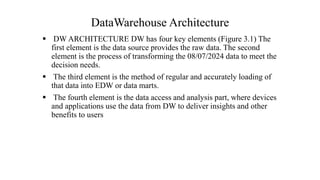
 DW ARCHITECTURE DW has four key elements (Figure 3.1) The
first element is the data source provides the raw data. The second
element is the process of transforming the 08/07/2024 data to meet the
decision needs.
 The third element is the method of regular and accurately loading of
that data into EDW or data marts.
 The fourth element is the data access and analysis part, where devices
and applications use the data from DW to deliver insights and other
benefits to users
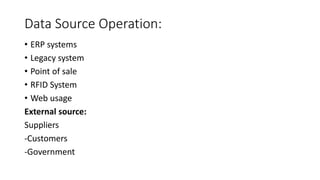
Data Source Operation:
• ERP systems
• Legacy system
• Point of sale
• RFID System
• Web usage
External source:
Suppliers
-Customers
-Government
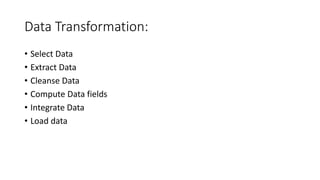
Data Transformation:
• Select Data
• Extract Data
• Cleanse Data
• Compute Data fields
• Integrate Data
• Load data
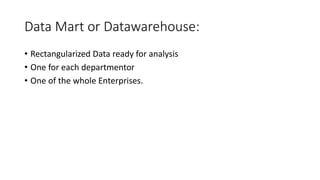
Data Mart or Datawarehouse:
• Rectangularized Data ready for analysis
• One for each departmentor
• One of the whole Enterprises.
Accessing User and Application:
• -OLAP Tools
• -reporting Tools
• Dashboads
• Queries
• Mobile Device
• Data Mining
• Custom apps
Data Sources:
• Data Sources Data warehouses are created from structured data
sources. Unstructured data such as text data would need to be
structured before inserted into the DW.
Operations Data This includes data from all business applications,
include from ERPs systems that form the backbone of an organization's
IT systems.
Data to be extracted will depend upon the subject matter of the data
warehouse. For example, for a sales/marketing DataMart, only the data
about customers, ANN orders, customer service, and so on would be
extracted.
Specialized Applications:
• Specialized Applications This includes applications such as Point of -
5ale (POS) terminals, and e-commerce applications that also provide
customer-facing data.
• Supplier data could come from Supply Chain Management systems
Mianning and budget data should also be added as needed for making
comparisons against targets.
External Syndicated Data:
• External Syndicated Data This includes publicly available dataou
XIAOMI 11 LIT as weather or economic activity data. It can also be
added to the DW aon led, to provide good contextual information to
decision makers
Data Loading Processes:
• Data Loading Processes The heart of a useful DW is the process that
populates the DW with good quality data. This is called the Extract-
Transform-Load (ETL) cycle. = Data should be extracted from the
operational (transactional) database sources, as well as from other
applications, on a regular basis.
• The extracted data should be aligned together by key fields and
integrated into a single dataset. It should be cleansed of any
irregularities or missing values. It should be rolled-up together to the
same level of granularity.
• De- sired fields, such as daily sales totals, should be computed. The
entire data should then be brought to the same format as the central
table of the DW This transformed data should then be uploaded into
the DW
• This ETL process should be run at a regular frequency. Daily
transaction data can be extracted from ERPs, transformed, and
uploaded to the database the same night. Thus, the DW is up to date
every morning.
• If a DW 1S needed for near- real-time information access, then the
ETL processes would need to be executed more frequently.
• ETL work is usually done using automated programming scripts that
are written, tested, and then deployed for periodically updating the
DW.
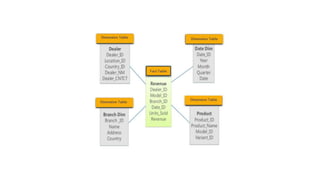
• Data Warehouse Design Star schema is the preferred data
architecture for most DWs. There is a central fact table that provides
most of the information of interest.
• There are lookup tables that provide detailed values for codes used
in the central table. For ex- ample, the central table may use digits to
represent a sales person. ‘
• The lookup table will help provide the name for that sales person
code. Here is an example of a star schema for a data mart for
monitoring sales performance .Other schemas include the snowflake
architecture. The difference between a star and snowflake is that in
the latter, the lookup tables can have their own further lookup
tables.
• There are many technology choices for developing DW. This includes
select- ing the right database management system and the right set
of data manage- ment tools.
• There are a few big and reliable providers of DW systems. The
provider of the operational DBMS may be chosen for DW also.
Alternatively, a best-of-breed DW vendor can be used. There are also
a variety of tools out there for data migration, data upload, data
retrieval, and data analysis.
• Data from a DW can be accessed for many purposes, by many users,
through different devices and systems. The primary use of a DW is to
produce routine management and monitoring reports. = OLAP
(Online Analytical Processing) systems are query and reporting tools
that help to slice the multidimensional data in a DW and produce
desired reports. For example, a sales performance report would show
sales by many dimensions compared with the plan; or one can
request a list of all the prod- ucts sold in a region in a certain price
range during a certain time period and have them displayed in a
report format.
• A dashboarding system uses data from the warehouse and present
analysis to the users. 'The data from a DW can be used to populate
customized per- formance dashboards for executives. The dashboard
could include drill-down capabilities to analyze the performance data
for root cause analysis The data from a DW can be used for ad-hoc
queries and any other applica tions that make use of the internal
data.
• Data from a DW is used to provide data for mining purposes. Parts of
the data would be extracted and then combined with other relevant
data for data mining DW Best Practices
DW Best Practices
• A data warehousing project reflects a significant investment into
information technology (IT). All of the best practices in implementing
any IT project should be followed. m A data warehouse project
should align with the corporate strategy. Top management should be
consulted for setting objectives. Financial viability (ROI) should be
established. The project must be managed by both IT and business
professionals. The DW design should be carefully tested before be-
ginning the development work. It is often much more expensive to
redesign after development work has begun
• . It is important to manage user expectations. 'The data warehouse
should be built incrementally. Users should be trained in using the
system so they can absorb many features of the system. | Quality
and adaptability should be built-in from the start.
• Only relevant. cleansed, and high-quality data should be loaded. The
system should be able to adapt to new tools for access. As business
needs change, new data marts may need to be created for new
needs.
Conclusion:
• Conclusion Data Warehouses are special data management facilities
intended for creating reports and analysis to support managerial
decision making. 'They are to make reporting and querying simple
and efficient. The sources of data operational systems and external
data sources. A data warehouse needs to updated with new data
regularly to keep it useful. Data from a DW provides XIAOMI 1 useful
input for data mining activities.

DataWarehouse Architecture,daat mining,data mart,etl process.pptx

  • 1.
    DataWarehouse Architecture  DWARCHITECTURE DW has four key elements (Figure 3.1) The first element is the data source provides the raw data. The second element is the process of transforming the 08/07/2024 data to meet the decision needs.  The third element is the method of regular and accurately loading of that data into EDW or data marts.  The fourth element is the data access and analysis part, where devices and applications use the data from DW to deliver insights and other benefits to users
  • 2.
    Data Source Operation: •ERP systems • Legacy system • Point of sale • RFID System • Web usage External source: Suppliers -Customers -Government
  • 3.
    Data Transformation: • SelectData • Extract Data • Cleanse Data • Compute Data fields • Integrate Data • Load data
  • 4.
    Data Mart orDatawarehouse: • Rectangularized Data ready for analysis • One for each departmentor • One of the whole Enterprises.
  • 5.
    Accessing User andApplication: • -OLAP Tools • -reporting Tools • Dashboads • Queries • Mobile Device • Data Mining • Custom apps
  • 6.
    Data Sources: • DataSources Data warehouses are created from structured data sources. Unstructured data such as text data would need to be structured before inserted into the DW. Operations Data This includes data from all business applications, include from ERPs systems that form the backbone of an organization's IT systems. Data to be extracted will depend upon the subject matter of the data warehouse. For example, for a sales/marketing DataMart, only the data about customers, ANN orders, customer service, and so on would be extracted.
  • 7.
    Specialized Applications: • SpecializedApplications This includes applications such as Point of - 5ale (POS) terminals, and e-commerce applications that also provide customer-facing data. • Supplier data could come from Supply Chain Management systems Mianning and budget data should also be added as needed for making comparisons against targets.
  • 8.
    External Syndicated Data: •External Syndicated Data This includes publicly available dataou XIAOMI 11 LIT as weather or economic activity data. It can also be added to the DW aon led, to provide good contextual information to decision makers
  • 9.
    Data Loading Processes: •Data Loading Processes The heart of a useful DW is the process that populates the DW with good quality data. This is called the Extract- Transform-Load (ETL) cycle. = Data should be extracted from the operational (transactional) database sources, as well as from other applications, on a regular basis. • The extracted data should be aligned together by key fields and integrated into a single dataset. It should be cleansed of any irregularities or missing values. It should be rolled-up together to the same level of granularity. • De- sired fields, such as daily sales totals, should be computed. The entire data should then be brought to the same format as the central table of the DW This transformed data should then be uploaded into the DW
  • 10.
    • This ETLprocess should be run at a regular frequency. Daily transaction data can be extracted from ERPs, transformed, and uploaded to the database the same night. Thus, the DW is up to date every morning. • If a DW 1S needed for near- real-time information access, then the ETL processes would need to be executed more frequently. • ETL work is usually done using automated programming scripts that are written, tested, and then deployed for periodically updating the DW.
  • 11.
    • Data WarehouseDesign Star schema is the preferred data architecture for most DWs. There is a central fact table that provides most of the information of interest. • There are lookup tables that provide detailed values for codes used in the central table. For ex- ample, the central table may use digits to represent a sales person. ‘ • The lookup table will help provide the name for that sales person code. Here is an example of a star schema for a data mart for monitoring sales performance .Other schemas include the snowflake architecture. The difference between a star and snowflake is that in the latter, the lookup tables can have their own further lookup tables.
  • 12.
    • There aremany technology choices for developing DW. This includes select- ing the right database management system and the right set of data manage- ment tools. • There are a few big and reliable providers of DW systems. The provider of the operational DBMS may be chosen for DW also. Alternatively, a best-of-breed DW vendor can be used. There are also a variety of tools out there for data migration, data upload, data retrieval, and data analysis.
  • 14.
    • Data froma DW can be accessed for many purposes, by many users, through different devices and systems. The primary use of a DW is to produce routine management and monitoring reports. = OLAP (Online Analytical Processing) systems are query and reporting tools that help to slice the multidimensional data in a DW and produce desired reports. For example, a sales performance report would show sales by many dimensions compared with the plan; or one can request a list of all the prod- ucts sold in a region in a certain price range during a certain time period and have them displayed in a report format.
  • 15.
    • A dashboardingsystem uses data from the warehouse and present analysis to the users. 'The data from a DW can be used to populate customized per- formance dashboards for executives. The dashboard could include drill-down capabilities to analyze the performance data for root cause analysis The data from a DW can be used for ad-hoc queries and any other applica tions that make use of the internal data. • Data from a DW is used to provide data for mining purposes. Parts of the data would be extracted and then combined with other relevant data for data mining DW Best Practices
  • 16.
    DW Best Practices •A data warehousing project reflects a significant investment into information technology (IT). All of the best practices in implementing any IT project should be followed. m A data warehouse project should align with the corporate strategy. Top management should be consulted for setting objectives. Financial viability (ROI) should be established. The project must be managed by both IT and business professionals. The DW design should be carefully tested before be- ginning the development work. It is often much more expensive to redesign after development work has begun
  • 17.
    • . Itis important to manage user expectations. 'The data warehouse should be built incrementally. Users should be trained in using the system so they can absorb many features of the system. | Quality and adaptability should be built-in from the start. • Only relevant. cleansed, and high-quality data should be loaded. The system should be able to adapt to new tools for access. As business needs change, new data marts may need to be created for new needs.
  • 18.
    Conclusion: • Conclusion DataWarehouses are special data management facilities intended for creating reports and analysis to support managerial decision making. 'They are to make reporting and querying simple and efficient. The sources of data operational systems and external data sources. A data warehouse needs to updated with new data regularly to keep it useful. Data from a DW provides XIAOMI 1 useful input for data mining activities.