Data Management: 
A Unified Approach 
and analytical systems that drive the business. Those 
systems in turn can enable companies to clear significant 
business obstacles. Survey respondents listed reducing 
costs and increasing operational efficiencies, improving 
agility, improving existing business processes, improving 
decision making, and increasing IT alignment with the 
business as their top five reasons for deploying data 
management solutions. 
“We’re seeing an increased awareness of how infor-mation 
and analytics can be used in real time operation-ally, 
not just in forecasting. When enterprises can pull 
insights into the business processes they get a height-ened 
awareness of the importance and value that is 
embedded in new data sources,” says Kimberly Nevala, 
Director of Business Strategies in the Best Practices 
department at SAS. “This has become an important 
competitive advantage. What we find is an organiza-tion’s 
ability to innovate is only as good as its ability to 
Unified data management is becoming a strategic advan-tage 
in today’s business world. With the advent of big 
data, the volume and type of information that companies 
must use in near-real time to gain a competitive edge is 
growing at an unprecedented rate. Meanwhile, industry 
consolidation is leading to mergers and acquisitions that 
require disparate IT systems to be harmonized in order 
to move forward. These forces, combined with ongoing 
pressure to use all available data to improve employee 
productivity, customer satisfaction and innovation, are 
spurring enterprises to make data management planning 
a top priority. 
To support these plans and help achieve important 
business goals, enterprises are turning to data manage-ment 
solutions with significant urgency. According to 
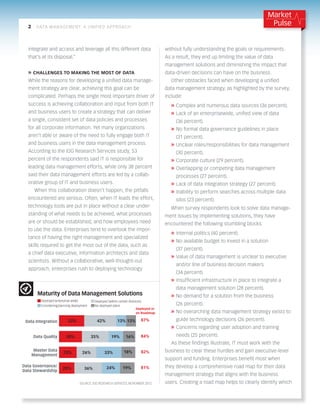
a recent IDG Research Services study of 118 IT profes-sionals, 
87 percent of respondents said data integration 
tools have been deployed or are on their company’s road 
maps; 84 percent answered the same for data quality 
tools; 82 percent for master data management solutions; 
and 81 percent for data governance/data stewardship 
initiatives. Nearly three-fifths of respondents at organiza-tions 
that have data management solutions in place are 
planning to continue making near-term investments in 
these types of tools. 
» THE DATA-DRIVEN COMPANY 
Enterprises that deploy effective data management 
solutions can successfully support the operational 
EFFECTIVE, UNIFIED DA TA MANAGEMENT STRA TEGIES 
DEPEND ON IT AND BUSINESS USERS WORKING TOGETHER. 
Market 
Pulse 
WHITE PAPER 
Quality of IT/LOB Collaboration 
at Organizations 
SOURCE: IDG RESEARCH SERVICES, NOVEMBER 2012 
65% 
Excellent/ 
Good 
30% 
3% 
2% 
Poor 
Fair 
Don’t know 
14% 
Good 
51% 
Excellent
2 DA TA MANAGEMENT: A UNIFIED APPROACH 
integrate and access and leverage all this different data 
that’s at its disposal.” 
» CHALLENGES TO MAKING THE MOST OF DATA 
While the reasons for developing a unified data manage-ment 
strategy are clear, achieving this goal can be 
complicated. Perhaps the single most important driver of 
success is achieving collaboration and input from both IT 
and business users to create a strategy that can deliver 
a single, consistent set of data policies and processes 
for all corporate information. Yet many organizations 
aren’t able or aware of the need to fully engage both IT 
and business users in the data management process. 
According to the IDG Research Services study, 53 
percent of the respondents said IT is responsible for 
leading data management efforts, while only 38 percent 
said their data management efforts are led by a collab-orative 
group of IT and business users. 
When this collaboration doesn’t happen, the pitfalls 
encountered are serious. Often, when IT leads the effort, 
technology tools are put in place without a clear under-standing 
of what needs to be achieved, what processes 
are or should be established, and how employees need 
to use the data. Enterprises tend to overlook the impor-tance 
of having the right management and specialized 
skills required to get the most out of the data, such as 
a chief data executive, information architects and data 
scientists. Without a collaborative, well-thought-out 
approach, enterprises rush to deploying technology 
Market 
Pulse 
without fully understanding the goals or requirements. 
As a result, they end up limiting the value of data 
management solutions and diminishing the impact that 
data-driven decisions can have on the business. 
Other obstacles faced when developing a unified 
data management strategy, as highlighted by the survey, 
include: 
» Complex and numerous data sources (36 percent). 
» Lack of an enterprisewide, unified view of data 
(36 percent). 
» No formal data governance guidelines in place 
(31 percent). 
» Unclear roles/responsibilities for data management 
(30 percent). 
» Corporate culture (29 percent). 
» Overlapping or competing data management 
processes (27 percent). 
» Lack of data integration strategy (27 percent). 
» Inability to perform searches across multiple data 
silos (23 percent). 
When survey respondents look to solve data manage-ment 
issues by implementing solutions, they have 
encountered the following stumbling blocks: 
» Internal politics (40 percent). 
» No available budget to invest in a solution 
(37 percent). 
» Value of data management is unclear to executive 
and/or line of business decision makers 
(34 percent). 
» Insufficient infrastructure in place to integrate a 
data management solution (28 percent). 
» No demand for a solution from the business 
(26 percent). 
» No overarching data management strategy exists to 
guide technology decisions (26 percent). 
» Concerns regarding user adoption and training 
needs (25 percent). 
As these findings illustrate, IT must work with the 
business to clear these hurdles and gain executive-level 
support and funding. Enterprises benefit most when 
they develop a comprehensive road map for their data 
management strategy that aligns with the business 
users. Creating a road map helps t SOURCE: IDG RESEARCH SERVICES, NOVEMBER 2012 o clearly identify which 
Maturity of Data Management Solutions 
Data Integration 
Data Quality 
Master Data 
Management 
Data Governance/ 
Data Stewardship 
33% 
30% 
23% 
20% 
42% 
35% 
26% 
36% 
13% 13% 
16% 
18% 
19% 
19% 
33% 
24% 
87% 
84% 
82% 
81% 
Deployed or 
on Roadmap 
Deployed (enterprise-wide) 
Considering/planning deployment 
Deployed (within certain divisions) 
No deployed plans
3 DA TA MANAGEMENT: A UNIFIED APPROACH 
Market 
Pulse 
BEST PRACTICES FOR CREATING A 
UNIFIED DATA MANAGEMENT ST RATEGY 
Kimberly Nevala offers the following advice for enterprises 
as they embark on a data management initiative: 
Do… 
» Make it business-driven. Ensure that informa-tion 
strategies are based on the goals and priorities 
set by the business, so that the project is able to 
have the most impact. 
» Engage in a long-term commitment. Invest 
in the platforms, skills and methods to support the 
creation, capture, access and delivery of informa-tion. 
The right talent knows how to use information 
from a business perspective and apply data to the 
business process, and how that application changes 
the decision criteria. Specialists understand where 
to insert information to change (for example, how 
an employee interacts with a customer). 
» Include data governance. It helps provide 
alignment and strategic direction around priori-ties, 
which is critical to making the case for ongo-ing 
investments. Formalize the organization and 
rules of engagement; include roles around decision 
making regarding the data that outlines who in the 
organization develops what policies and governs the 
creation of views, what information is important for 
the organization to govern and manage, and develop 
mechanisms to measure value and compliance. 
» Update capabilities and practices on an 
ongoing basis. Operations should remain as ef-ficient 
as possible to ensure business agility. New 
applications, systems and data sources are con-stantly 
being added, and the number of sources that 
create data and systems that consume data grows. 
Don’t… 
» Sell data management as an infrastructure 
project. This garners very little interest and there-fore, 
little funding. It’s important that the business 
benefits, such as faster time to market, greater 
productivity, improved customer service, etc., are 
emphasized. 
» Recommend a complete replacement. Data 
management solutions should work with the existing 
infrastructure. Develop a plan for merging new solu-tions 
with those that have represented a significant 
investment for the organization. 
» Try to boil the ocean. The scope and breadth 
of data problems in a typical organization can ap-pear 
insurmountable, but it’s almost impossible to 
find success by taking a big bang approach. Instead, 
start with a clear purpose, such as improving data 
quality or applying big data to a particular business 
glitch. Next, demonstrate results and then build on 
those results. Small successes will generate more 
interest, and executives will be more willing to dedi-cate 
resources to a program with a proven track re-cord. 
Make some hard choices about what projects 
will get the bang for the buck, and in what areas it 
makes sense to implement unified data management 
capabilities – those where data has broad utilization 
and high business value. 
» Limit the conversation to technology. It’s 
as much about people and processes as it is about 
tools. Instead of talking in terms of what the tech-nology 
can do, have conversations about how the 
technology can improve the business. There’s a lot 
of technology available to organizations today that 
enables a flexible approach to getting information 
and pulling it together, but it’s the value that those 
systems generate that matters. Executives and 
business stakeholders want to see the development 
of analytics or new operational capabilities in 
a timely fashion. They aren’t as interested in the 
work going on behind the scenes to manage it and 
pull it together.
core capabilities the technology tools can bring to bear 
in order to deliver on the value proposition for each tool. 
» A COLLABORATIVE, UNIFIED APPROACH 
When teams of IT and business users are formed to 
guide data management, the results are often positive. 
“Enterprises benefit by thinking about data management 
as a corporate service that’s sponsored by business 
and hosted by IT,” says Nevala. “The strategy around 
data management has to deal with the coordination and 
collaboration of people, processes and technology.” 
As these ideas of coordination and collaboration are 
developed within an organization, concerns over issues 
such as who has ownership of the data are shifted to 
focus on who in the organization needs to use the data. 
Responsibilities for data governance and policy creation 
fall more on the business side, while data management 
is more about the tactical execution of policies and is 
therefore IT’s domain. Ultimately both perspectives are 
needed so that the rules and capabilities are in place 
to capture data, and related policies are executed and 
enforced. 
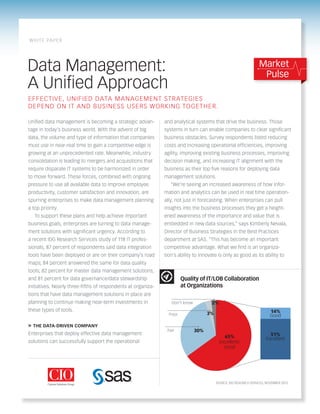
The IDG Research Services survey found that collab-orative 
teams of IT and business drive positive results 
– 65 percent of respondents rated the level of collabora-tion 
between IT and business stakeholders regarding 
data management initiatives as excellent or good. This 
collaboration is a key ingredient to successfully imple-ment 
an end-to-end data management strategy, which is 
underway or planned by nearly two-thirds (65 percent) of 
respondents and viewed as somewhat or very important 
to three-fourths (76 percent) of respondents. 
Collaborative teams enable enterprises to use data 
and drive improvement in much-needed areas: 
» Empower business teams to run their own reports 
using data collected by the organization. 
» Allow the organization to take a data-centric 
approach to decision making. 
» Design data management systems to handle a rapid 
increase in data. 
» Enable organizations to use their data to its fullest 
potential. 
It’s also important that enterprises select the right 
data management platform to cultivate collaboration and 
drive the business. A range of tools are required - from 
point of data capture and creation through usage and 
end of life - encompassing data access, governance, 
integration, quality and master data management. The 
right tools allow business and IT users to plan, implement 
and monitor business-critical information. They establish 
a single, consistent set of data policies and processes for 
all corporate data. They also create and enforce uniform 
standards for enterprise data. The right data manage-ment 
platform becomes an ecosystem in which all the 
key components work together to ultimately reduce or 
eliminate the costs of acquiring data, promote data reuse 
and lower costs through automation. The platform also 
ensures that data is secure, compliant and adheres to 
internal data-sharing policies. 
Respondents to the IDG Research survey rated the 
following characteristics as important when considering 
data management solutions: 
» Ability to integrate with existing systems 
(86 percent). 
» Ease of use (86 percent). 
» Scalability (78 percent). 
» Low cost (75 percent). 
» Ease of installation and setup (75 percent). 
» Ability to handle high-velocity or high-performance 
workloads (69 percent). 
» Availability of consulting expertise from the vendor 
(56 percent). 
A unified data management strategy makes the most 
of these tools by implementing an enterprise’s business 
processes and embracing the way employees work in 
order to make the most of data while keeping the busi-ness 
agile. It’s this combination of tools, processes and 
practices that leads to a data-enabled organization that 
clearly understands which issues are most important to 
the business, what the objectives and drivers are, and 
which data is required for real-time decision making that 
provides value and returns. 
4 DA TA MANAGEMENT: A UNIFIED APPROACH 
SAS and all other SAS Institute Inc. product or service names are registered trademarks or trademarks of SAS Institute Inc. in the USA 
and other countries. ® indicates USA registration. Other brand and product names are trademarks of their respective companies. 
106280_S104839.0313

Data Management

  • 1.
    Data Management: AUnified Approach and analytical systems that drive the business. Those systems in turn can enable companies to clear significant business obstacles. Survey respondents listed reducing costs and increasing operational efficiencies, improving agility, improving existing business processes, improving decision making, and increasing IT alignment with the business as their top five reasons for deploying data management solutions. “We’re seeing an increased awareness of how infor-mation and analytics can be used in real time operation-ally, not just in forecasting. When enterprises can pull insights into the business processes they get a height-ened awareness of the importance and value that is embedded in new data sources,” says Kimberly Nevala, Director of Business Strategies in the Best Practices department at SAS. “This has become an important competitive advantage. What we find is an organiza-tion’s ability to innovate is only as good as its ability to Unified data management is becoming a strategic advan-tage in today’s business world. With the advent of big data, the volume and type of information that companies must use in near-real time to gain a competitive edge is growing at an unprecedented rate. Meanwhile, industry consolidation is leading to mergers and acquisitions that require disparate IT systems to be harmonized in order to move forward. These forces, combined with ongoing pressure to use all available data to improve employee productivity, customer satisfaction and innovation, are spurring enterprises to make data management planning a top priority. To support these plans and help achieve important business goals, enterprises are turning to data manage-ment solutions with significant urgency. According to a recent IDG Research Services study of 118 IT profes-sionals, 87 percent of respondents said data integration tools have been deployed or are on their company’s road maps; 84 percent answered the same for data quality tools; 82 percent for master data management solutions; and 81 percent for data governance/data stewardship initiatives. Nearly three-fifths of respondents at organiza-tions that have data management solutions in place are planning to continue making near-term investments in these types of tools. » THE DATA-DRIVEN COMPANY Enterprises that deploy effective data management solutions can successfully support the operational EFFECTIVE, UNIFIED DA TA MANAGEMENT STRA TEGIES DEPEND ON IT AND BUSINESS USERS WORKING TOGETHER. Market Pulse WHITE PAPER Quality of IT/LOB Collaboration at Organizations SOURCE: IDG RESEARCH SERVICES, NOVEMBER 2012 65% Excellent/ Good 30% 3% 2% Poor Fair Don’t know 14% Good 51% Excellent
  • 2.
    2 DA TAMANAGEMENT: A UNIFIED APPROACH integrate and access and leverage all this different data that’s at its disposal.” » CHALLENGES TO MAKING THE MOST OF DATA While the reasons for developing a unified data manage-ment strategy are clear, achieving this goal can be complicated. Perhaps the single most important driver of success is achieving collaboration and input from both IT and business users to create a strategy that can deliver a single, consistent set of data policies and processes for all corporate information. Yet many organizations aren’t able or aware of the need to fully engage both IT and business users in the data management process. According to the IDG Research Services study, 53 percent of the respondents said IT is responsible for leading data management efforts, while only 38 percent said their data management efforts are led by a collab-orative group of IT and business users. When this collaboration doesn’t happen, the pitfalls encountered are serious. Often, when IT leads the effort, technology tools are put in place without a clear under-standing of what needs to be achieved, what processes are or should be established, and how employees need to use the data. Enterprises tend to overlook the impor-tance of having the right management and specialized skills required to get the most out of the data, such as a chief data executive, information architects and data scientists. Without a collaborative, well-thought-out approach, enterprises rush to deploying technology Market Pulse without fully understanding the goals or requirements. As a result, they end up limiting the value of data management solutions and diminishing the impact that data-driven decisions can have on the business. Other obstacles faced when developing a unified data management strategy, as highlighted by the survey, include: » Complex and numerous data sources (36 percent). » Lack of an enterprisewide, unified view of data (36 percent). » No formal data governance guidelines in place (31 percent). » Unclear roles/responsibilities for data management (30 percent). » Corporate culture (29 percent). » Overlapping or competing data management processes (27 percent). » Lack of data integration strategy (27 percent). » Inability to perform searches across multiple data silos (23 percent). When survey respondents look to solve data manage-ment issues by implementing solutions, they have encountered the following stumbling blocks: » Internal politics (40 percent). » No available budget to invest in a solution (37 percent). » Value of data management is unclear to executive and/or line of business decision makers (34 percent). » Insufficient infrastructure in place to integrate a data management solution (28 percent). » No demand for a solution from the business (26 percent). » No overarching data management strategy exists to guide technology decisions (26 percent). » Concerns regarding user adoption and training needs (25 percent). As these findings illustrate, IT must work with the business to clear these hurdles and gain executive-level support and funding. Enterprises benefit most when they develop a comprehensive road map for their data management strategy that aligns with the business users. Creating a road map helps t SOURCE: IDG RESEARCH SERVICES, NOVEMBER 2012 o clearly identify which Maturity of Data Management Solutions Data Integration Data Quality Master Data Management Data Governance/ Data Stewardship 33% 30% 23% 20% 42% 35% 26% 36% 13% 13% 16% 18% 19% 19% 33% 24% 87% 84% 82% 81% Deployed or on Roadmap Deployed (enterprise-wide) Considering/planning deployment Deployed (within certain divisions) No deployed plans
  • 3.
    3 DA TAMANAGEMENT: A UNIFIED APPROACH Market Pulse BEST PRACTICES FOR CREATING A UNIFIED DATA MANAGEMENT ST RATEGY Kimberly Nevala offers the following advice for enterprises as they embark on a data management initiative: Do… » Make it business-driven. Ensure that informa-tion strategies are based on the goals and priorities set by the business, so that the project is able to have the most impact. » Engage in a long-term commitment. Invest in the platforms, skills and methods to support the creation, capture, access and delivery of informa-tion. The right talent knows how to use information from a business perspective and apply data to the business process, and how that application changes the decision criteria. Specialists understand where to insert information to change (for example, how an employee interacts with a customer). » Include data governance. It helps provide alignment and strategic direction around priori-ties, which is critical to making the case for ongo-ing investments. Formalize the organization and rules of engagement; include roles around decision making regarding the data that outlines who in the organization develops what policies and governs the creation of views, what information is important for the organization to govern and manage, and develop mechanisms to measure value and compliance. » Update capabilities and practices on an ongoing basis. Operations should remain as ef-ficient as possible to ensure business agility. New applications, systems and data sources are con-stantly being added, and the number of sources that create data and systems that consume data grows. Don’t… » Sell data management as an infrastructure project. This garners very little interest and there-fore, little funding. It’s important that the business benefits, such as faster time to market, greater productivity, improved customer service, etc., are emphasized. » Recommend a complete replacement. Data management solutions should work with the existing infrastructure. Develop a plan for merging new solu-tions with those that have represented a significant investment for the organization. » Try to boil the ocean. The scope and breadth of data problems in a typical organization can ap-pear insurmountable, but it’s almost impossible to find success by taking a big bang approach. Instead, start with a clear purpose, such as improving data quality or applying big data to a particular business glitch. Next, demonstrate results and then build on those results. Small successes will generate more interest, and executives will be more willing to dedi-cate resources to a program with a proven track re-cord. Make some hard choices about what projects will get the bang for the buck, and in what areas it makes sense to implement unified data management capabilities – those where data has broad utilization and high business value. » Limit the conversation to technology. It’s as much about people and processes as it is about tools. Instead of talking in terms of what the tech-nology can do, have conversations about how the technology can improve the business. There’s a lot of technology available to organizations today that enables a flexible approach to getting information and pulling it together, but it’s the value that those systems generate that matters. Executives and business stakeholders want to see the development of analytics or new operational capabilities in a timely fashion. They aren’t as interested in the work going on behind the scenes to manage it and pull it together.
  • 4.
    core capabilities thetechnology tools can bring to bear in order to deliver on the value proposition for each tool. » A COLLABORATIVE, UNIFIED APPROACH When teams of IT and business users are formed to guide data management, the results are often positive. “Enterprises benefit by thinking about data management as a corporate service that’s sponsored by business and hosted by IT,” says Nevala. “The strategy around data management has to deal with the coordination and collaboration of people, processes and technology.” As these ideas of coordination and collaboration are developed within an organization, concerns over issues such as who has ownership of the data are shifted to focus on who in the organization needs to use the data. Responsibilities for data governance and policy creation fall more on the business side, while data management is more about the tactical execution of policies and is therefore IT’s domain. Ultimately both perspectives are needed so that the rules and capabilities are in place to capture data, and related policies are executed and enforced. The IDG Research Services survey found that collab-orative teams of IT and business drive positive results – 65 percent of respondents rated the level of collabora-tion between IT and business stakeholders regarding data management initiatives as excellent or good. This collaboration is a key ingredient to successfully imple-ment an end-to-end data management strategy, which is underway or planned by nearly two-thirds (65 percent) of respondents and viewed as somewhat or very important to three-fourths (76 percent) of respondents. Collaborative teams enable enterprises to use data and drive improvement in much-needed areas: » Empower business teams to run their own reports using data collected by the organization. » Allow the organization to take a data-centric approach to decision making. » Design data management systems to handle a rapid increase in data. » Enable organizations to use their data to its fullest potential. It’s also important that enterprises select the right data management platform to cultivate collaboration and drive the business. A range of tools are required - from point of data capture and creation through usage and end of life - encompassing data access, governance, integration, quality and master data management. The right tools allow business and IT users to plan, implement and monitor business-critical information. They establish a single, consistent set of data policies and processes for all corporate data. They also create and enforce uniform standards for enterprise data. The right data manage-ment platform becomes an ecosystem in which all the key components work together to ultimately reduce or eliminate the costs of acquiring data, promote data reuse and lower costs through automation. The platform also ensures that data is secure, compliant and adheres to internal data-sharing policies. Respondents to the IDG Research survey rated the following characteristics as important when considering data management solutions: » Ability to integrate with existing systems (86 percent). » Ease of use (86 percent). » Scalability (78 percent). » Low cost (75 percent). » Ease of installation and setup (75 percent). » Ability to handle high-velocity or high-performance workloads (69 percent). » Availability of consulting expertise from the vendor (56 percent). A unified data management strategy makes the most of these tools by implementing an enterprise’s business processes and embracing the way employees work in order to make the most of data while keeping the busi-ness agile. It’s this combination of tools, processes and practices that leads to a data-enabled organization that clearly understands which issues are most important to the business, what the objectives and drivers are, and which data is required for real-time decision making that provides value and returns. 4 DA TA MANAGEMENT: A UNIFIED APPROACH SAS and all other SAS Institute Inc. product or service names are registered trademarks or trademarks of SAS Institute Inc. in the USA and other countries. ® indicates USA registration. Other brand and product names are trademarks of their respective companies. 106280_S104839.0313