June 17 – 20, 2024 • Caesars Palace • Las Vegas, NV
Cloud Transformation:
Optimizing Operations
and Financial
Performance
The Strategic Integration of ERP and
EPM within Oracle's Ecosystem
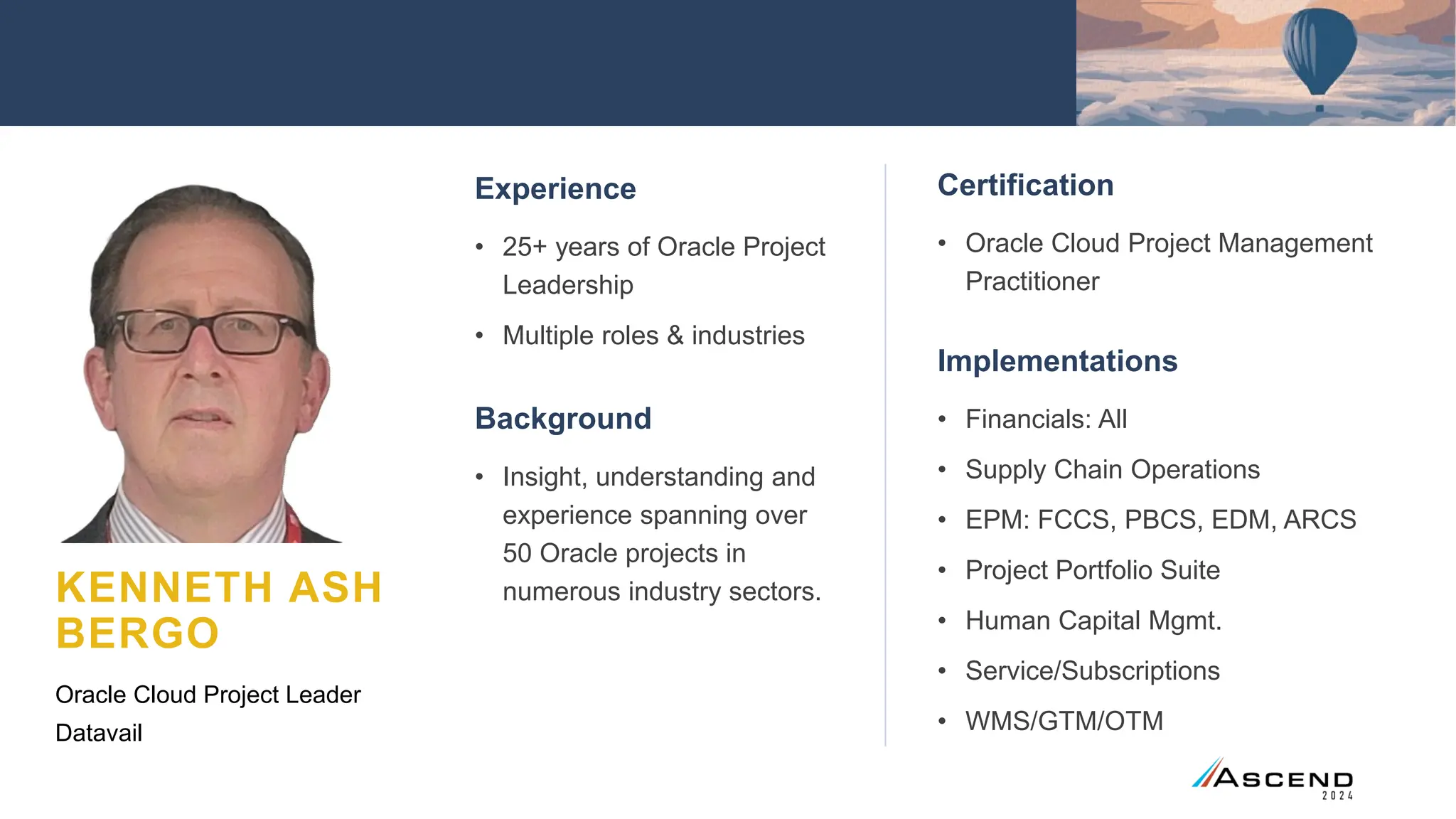
Kenneth Ash Bergo
Oracle Cloud Project Leader, Datavail
info@datavail.com
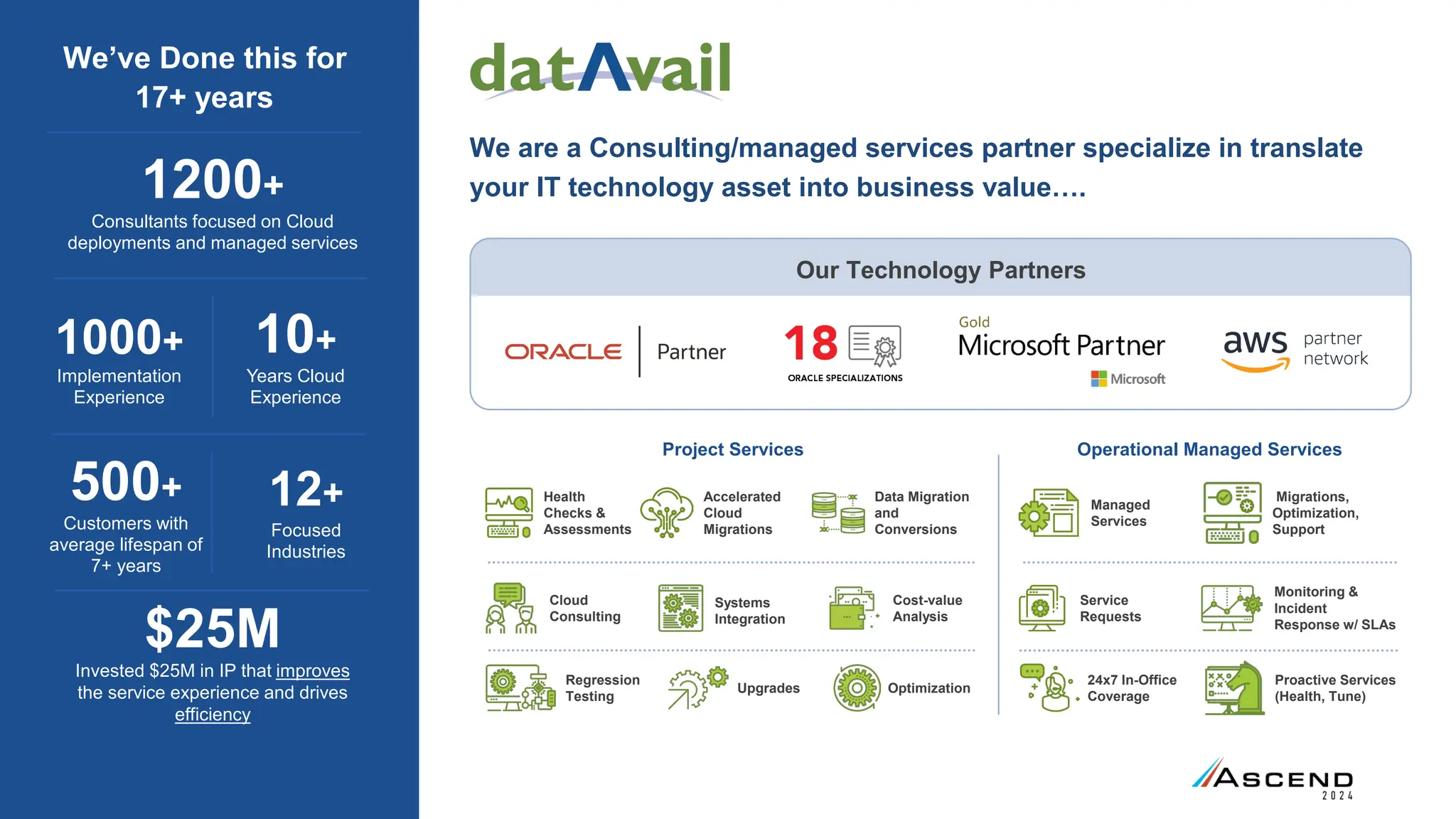
We’ve Done this for
17+ years
1200+
Consultants focused on Cloud
deployments and managed services
1000+
Implementation
Experience
10+
Years Cloud
Experience
12+
Focused
Industries
500+
Customers with
average lifespan of
7+ years
$25M
Invested $25M in IP that improves
the service experience and drives
efficiency
We are a Consulting/managed services partner specialize in translate
your IT technology asset into business value….
Accelerated
Cloud
Migrations
Systems
Integration
Data Migration
and
Conversions
Regression
Testing
Health
Checks &
Assessments
Upgrades
Cloud
Consulting
Cost-value
Analysis
Optimization
Managed
Services
Migrations,
Optimization,
Support
Monitoring &
Incident
Response w/ SLAs
Service
Requests
24x7 In-Office
Coverage
Proactive Services
(Health, Tune)
Project Services Operational Managed Services
Our Technology Partners
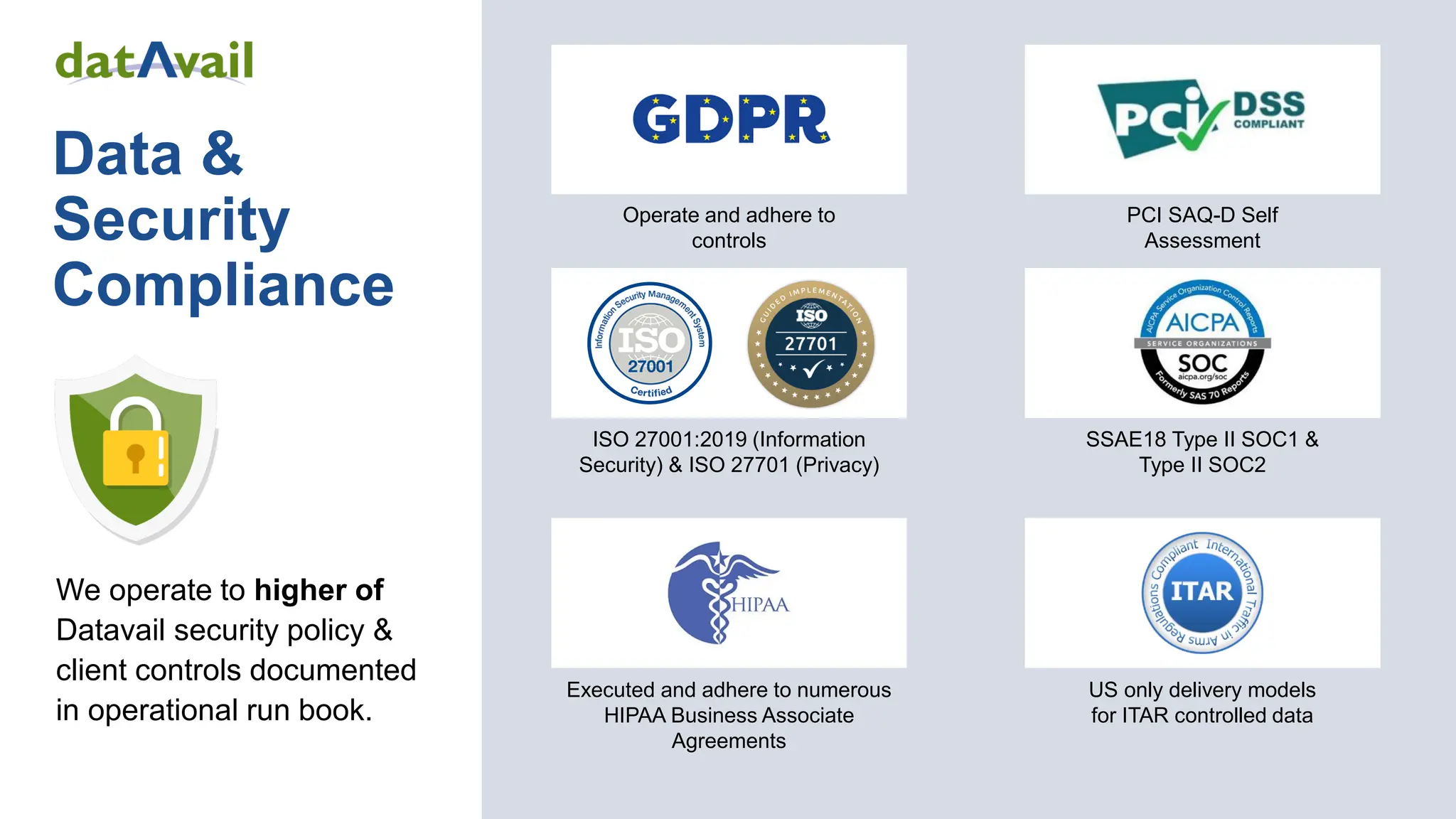
We operate to higher of
Datavail security policy &
client controls documented
in operational run book.
Data &
Security
Compliance
SSAE18 Type II SOC1 &
Type II SOC2
Operate and adhere to
controls
ISO 27001:2019 (Information
Security) & ISO 27701 (Privacy)
PCI SAQ-D Self
Assessment
Executed and adhere to numerous
HIPAA Business Associate
Agreements
US only delivery models
for ITAR controlled data
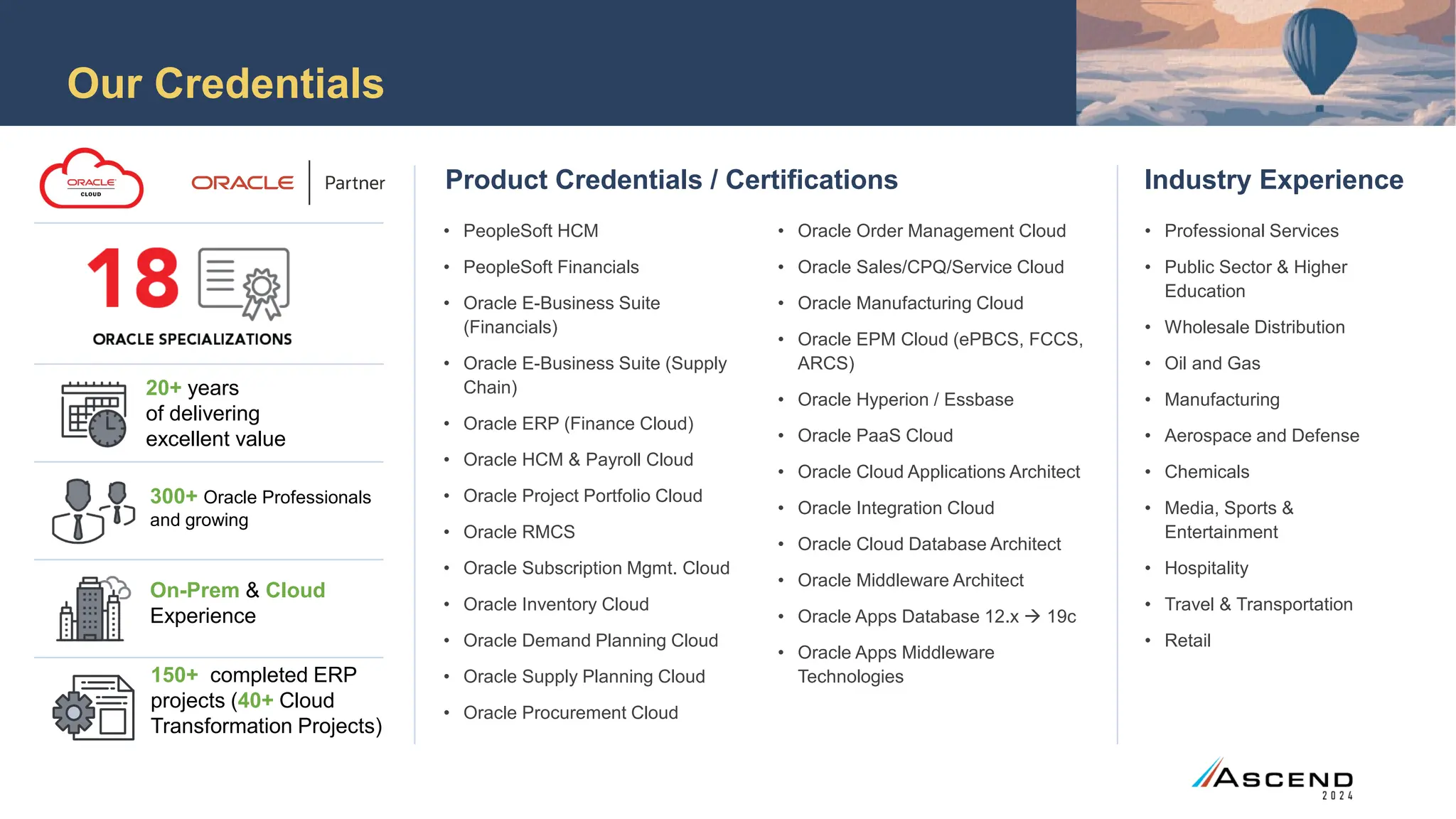
Our Credentials
• PeopleSoft HCM
• PeopleSoft Financials
• Oracle E-Business Suite
(Financials)
• Oracle E-Business Suite (Supply
Chain)
• Oracle ERP (Finance Cloud)
• Oracle HCM & Payroll Cloud
• Oracle Project Portfolio Cloud
• Oracle RMCS
• Oracle Subscription Mgmt. Cloud
• Oracle Inventory Cloud
• Oracle Demand Planning Cloud
• Oracle Supply Planning Cloud
• Oracle Procurement Cloud
• Professional Services
• Public Sector & Higher
Education
• Wholesale Distribution
• Oil and Gas
• Manufacturing
• Aerospace and Defense
• Chemicals
• Media, Sports &
Entertainment
• Hospitality
• Travel & Transportation
• Retail
• Oracle Order Management Cloud
• Oracle Sales/CPQ/Service Cloud
• Oracle Manufacturing Cloud
• Oracle EPM Cloud (ePBCS, FCCS,
ARCS)
• Oracle Hyperion / Essbase
• Oracle PaaS Cloud
• Oracle Cloud Applications Architect
• Oracle Integration Cloud
• Oracle Cloud Database Architect
• Oracle Middleware Architect
• Oracle Apps Database 12.x  19c
• Oracle Apps Middleware
Technologies
Product Credentials / Certifications Industry Experience
20+ years
of delivering
excellent value
300+ Oracle Professionals
and growing
On-Prem & Cloud
Experience
150+ completed ERP
projects (40+ Cloud
Transformation Projects)
Free Beer for a Year!
Agenda
• Executive Summary
Certification
• Oracle Cloud Project Management
Practitioner
Implementations
• Financials: All
• Supply Chain Operations
• EPM: FCCS, PBCS, EDM, ARCS
• Project Portfolio Suite
• Human Capital Mgmt.
• Service/Subscriptions
• WMS/GTM/OTM
KENNETH ASH
BERGO
Experience
• 25+ years of Oracle Project
Leadership
• Multiple roles & industries
Background
• Insight, understanding and
experience spanning over
50 Oracle projects in
numerous industry sectors.
Oracle Cloud Project Leader
Datavail
Executive Summary
Ascend 2024
• Help clients leverage the
transformative power of
integrating ERP (Enterprise
Resource Planning) and
EPM (Enterprise
Performance Management)
within Oracle's ecosystem.
Tt's your gateway to
groundbreaking strategies
that promise not only to
optimize your operations and
financial performance but
also to revolutionize how you
view asset management and
strategic planning.
Here’s What’s in Store for You
• Unearth Hidden Savings: Dive deep into how the fusion of ERP and EPM
systems can streamline your operations and elevate your financial management.
Imagine reducing costs significantly while allocating resources more effectively.
It's not just a dream—it's a tangible outcome awaiting your business.
• Master Your Assets: For capital intense industry sectors like oil and gas,
machinery, and industrials where assets are everything, learn how to wield ERP
and EPM to not just manage but maximize asset utilization. Turn your assets into
unbeatable competitive advantages through sophisticated financial efficiency and
management strategies.
• Futurize Your Strategy: Visionary planning isn't just for visionaries. Aligning ERP
and EPM with your strategic objectives paves the way for not just surviving but
thriving in the future. Equip yourself with the knowledge to marry daily operations
with long-term goals, ensuring your business's growth and success.
Executive Summary
Ascend 2024
• Help clients leverage the
transformative power of
integrating ERP (Enterprise
Resource Planning) and
EPM (Enterprise
Performance Management)
within Oracle's ecosystem.
Tt's your gateway to
groundbreaking strategies
that promise not only to
optimize your operations and
financial performance but
also to revolutionize how you
view asset management and
strategic planning.
Key Takeaways
• Capitalize on Operational and Financial Efficiency: Learn how the strategic
integration of ERP and EPM within Oracle doesn't just improve decision-making
but leads to substantial cost savings.
• Boost Asset Utilization: Gain exclusive insights into enhancing performance,
maintenance, and cost management in asset-heavy sectors, propelling your
business ahead of the curve.
• Align with Strategic Goals: Discover the key to effective operations
management and future-focused planning, ensuring your business is always one
step ahead.
• Return on Investment ROI (Savings): Optimize licensing costs, improve visibility
to cash flow, uses of time value on inventory turnover. Identify and benefits from
deferred tax assets. Improve an average metric to close is 2.2 days sooner.
(Source Oracle), and lower overall inventory costs by 10 percent.(*)
Project Governance
The 3 Pillars of Governance: Structure, People & Information.
Project governance provides direction and defines decision-making procedures and metrics for validating impacts
to the project.
Structure
• Project Methodology, Approach &
Purpose
• Financial Management
• Risk Tracking and Resolution
• Issue Tracking and Resolution
• Quality Standards, Project Standards,
including Naming Conventions and
Standard Look and Feel, Quality
Reporting
• Configuration Control and Release
Management
People
• Center of Excellence
• Standard Communications Plan - to
whom, what format and frequency
• Change Management
• Process for On-Boarding Resources
• Procurement Process, if required
• Execution of Planned Quality
Checkpoints and Validations
• Responsibility assignment Matrix
Information
• Mission Statement
• Scope Definition
• Project Execution Plan
• Critical Success Factors
• Change Control
• Work Plan Control
• Project Documentation Archiving
Policy and Process
• Work Product Deliverables
• Status Reporting
• Requirements Capture
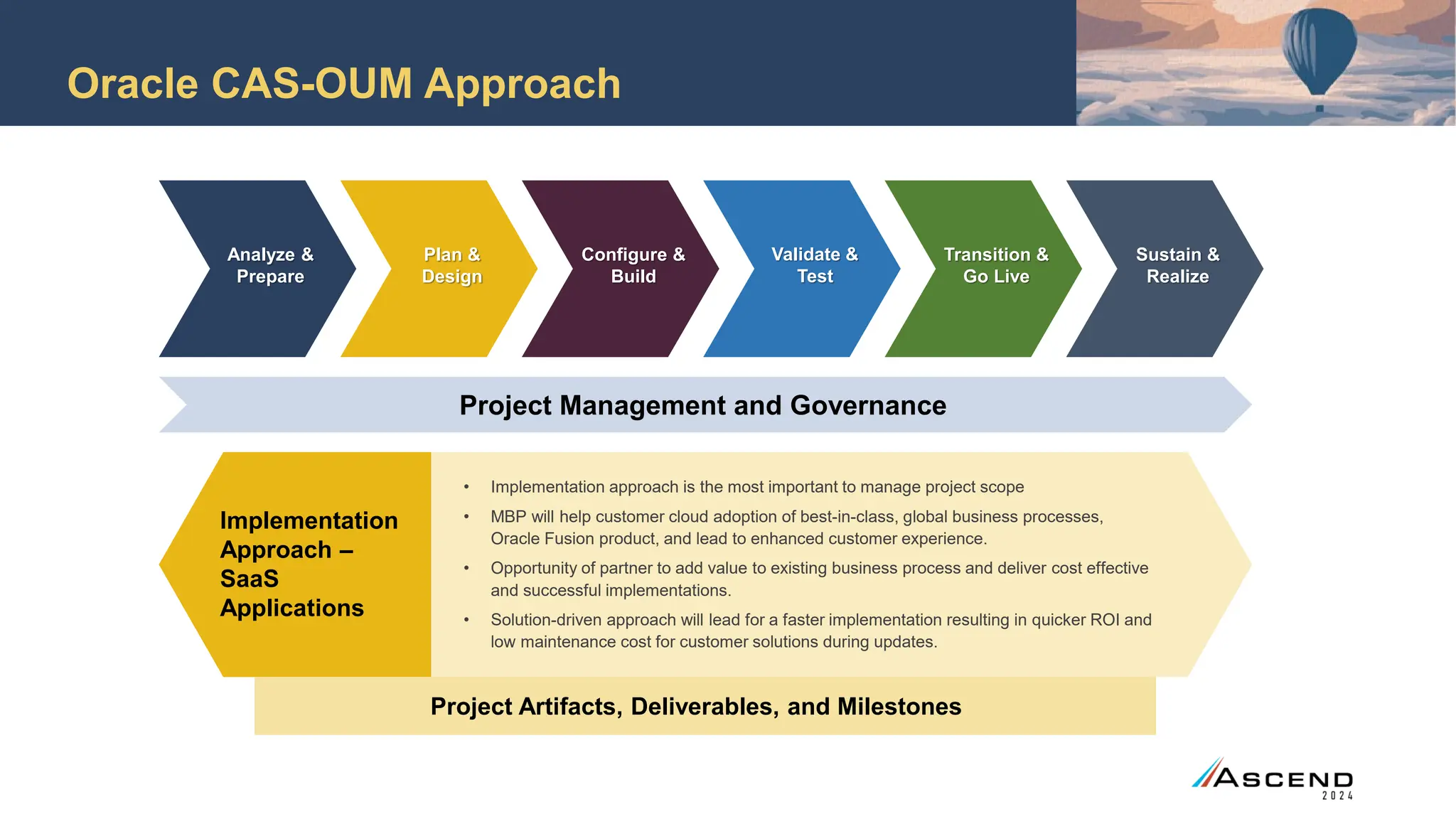
Oracle CAS-OUM Approach
Analyze &
Prepare
Plan &
Design
Configure &
Build
Validate &
Test
Transition &
Go Live
Sustain &
Realize
Project Management and Governance
• Implementation approach is the most important to manage project scope
• MBP will help customer cloud adoption of best-in-class, global business processes,
Oracle Fusion product, and lead to enhanced customer experience.
• Opportunity of partner to add value to existing business process and deliver cost effective
and successful implementations.
• Solution-driven approach will lead for a faster implementation resulting in quicker ROI and
low maintenance cost for customer solutions during updates.
Implementation
Approach –
SaaS
Applications
Project Artifacts, Deliverables, and Milestones
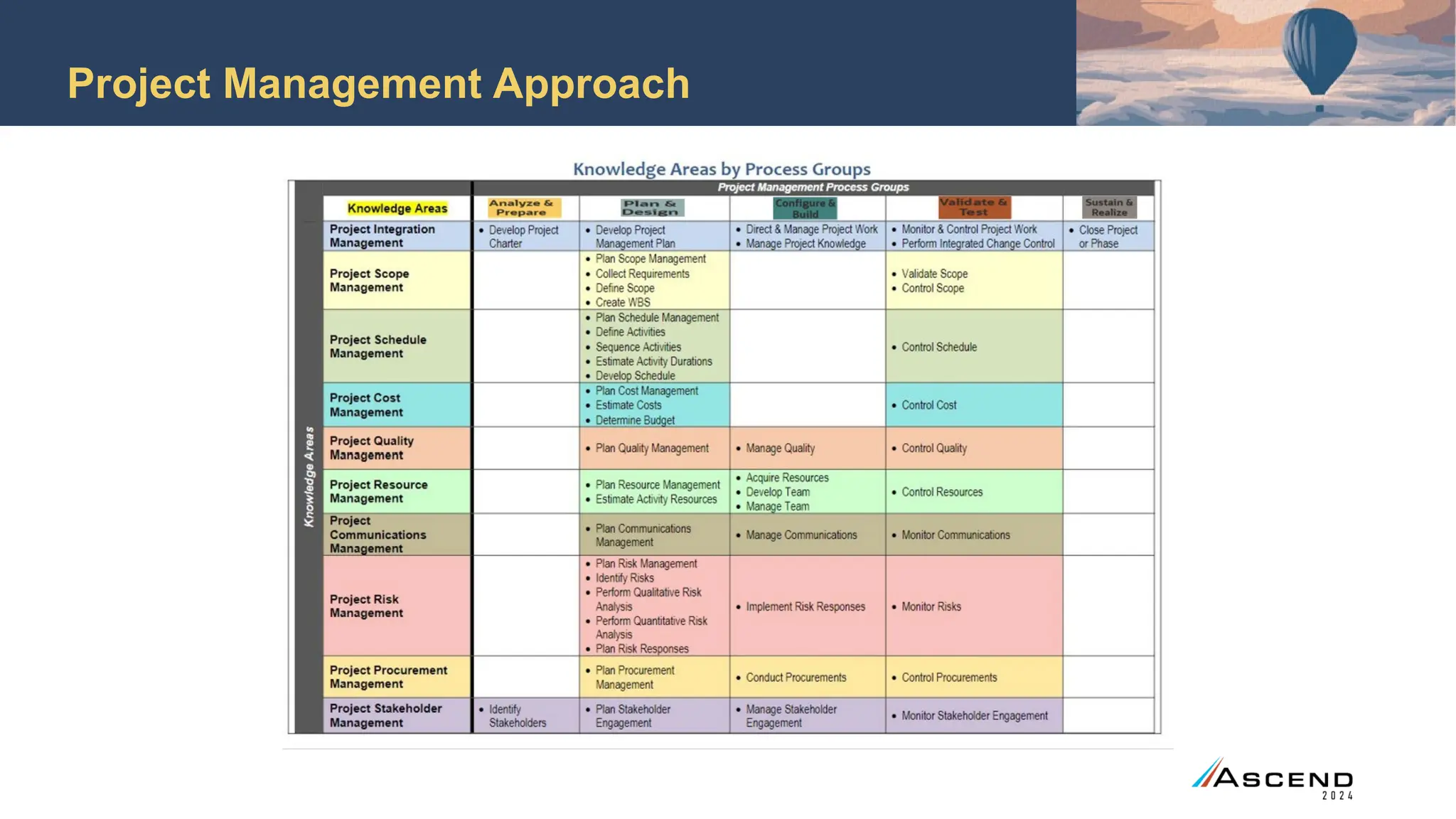
Project Management Approach
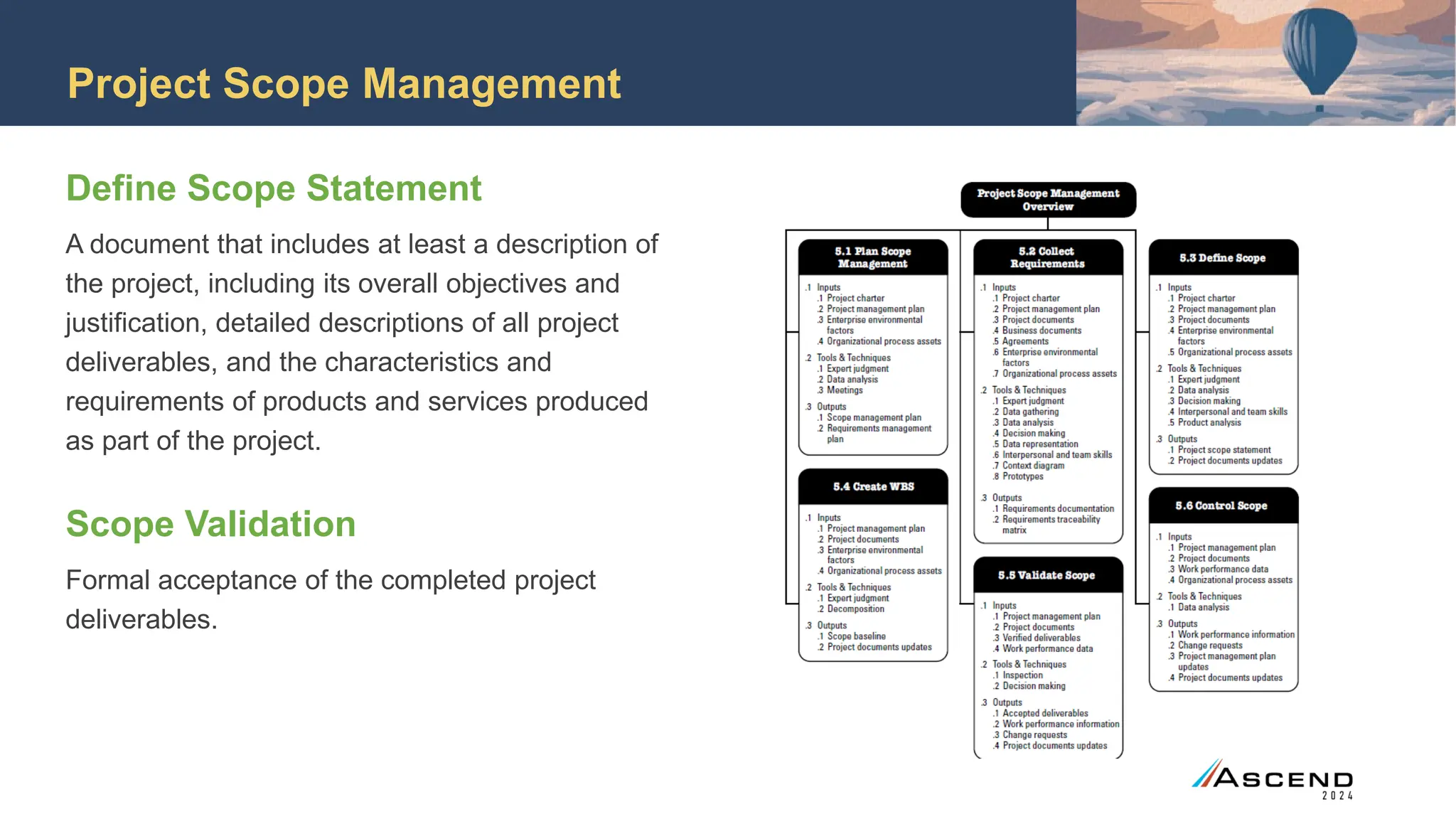
Project Scope Management
Define Scope Statement
A document that includes at least a description of
the project, including its overall objectives and
justification, detailed descriptions of all project
deliverables, and the characteristics and
requirements of products and services produced
as part of the project.
Scope Validation
Formal acceptance of the completed project
deliverables.
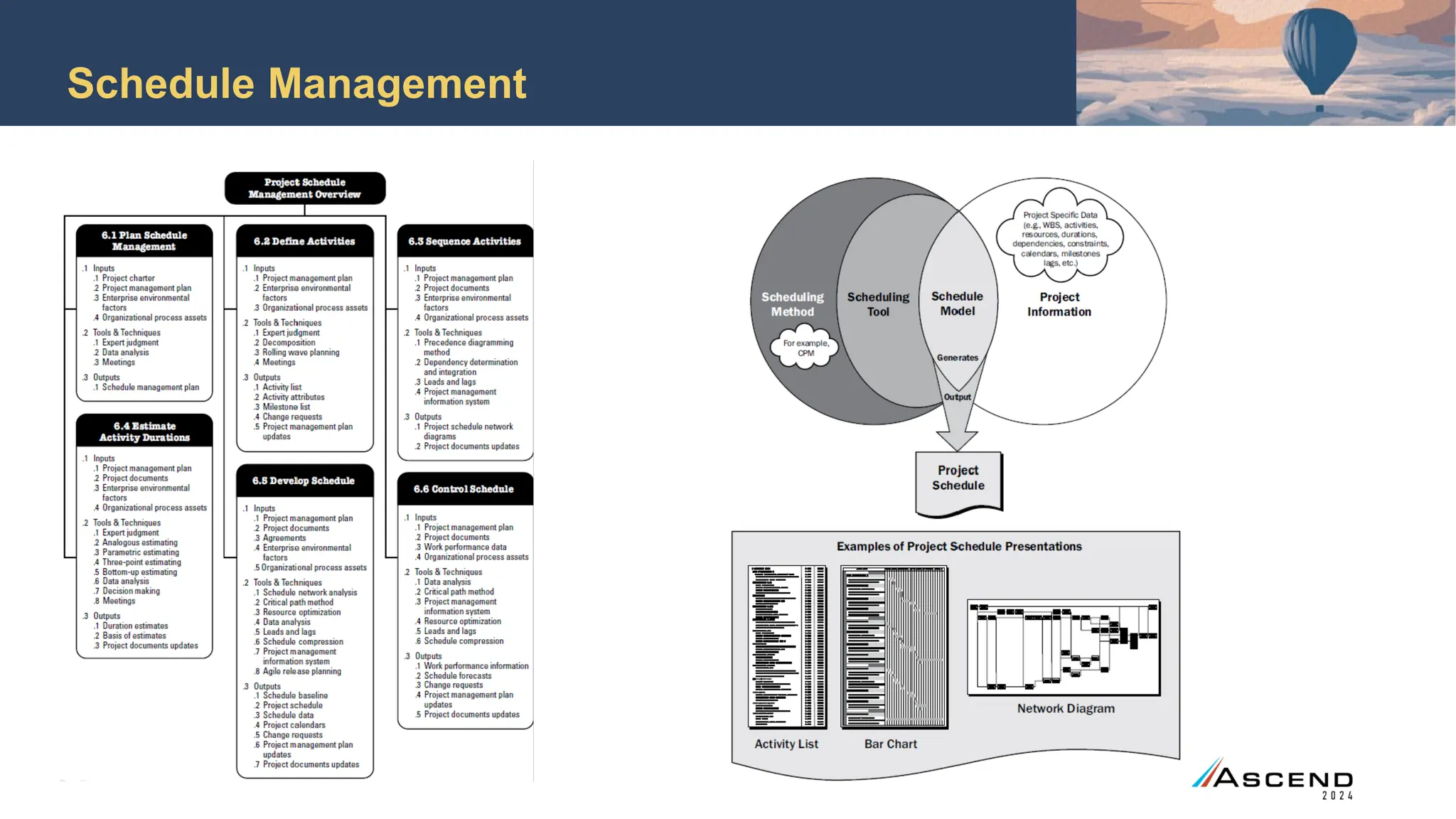
Schedule Management
Resource Management Plan
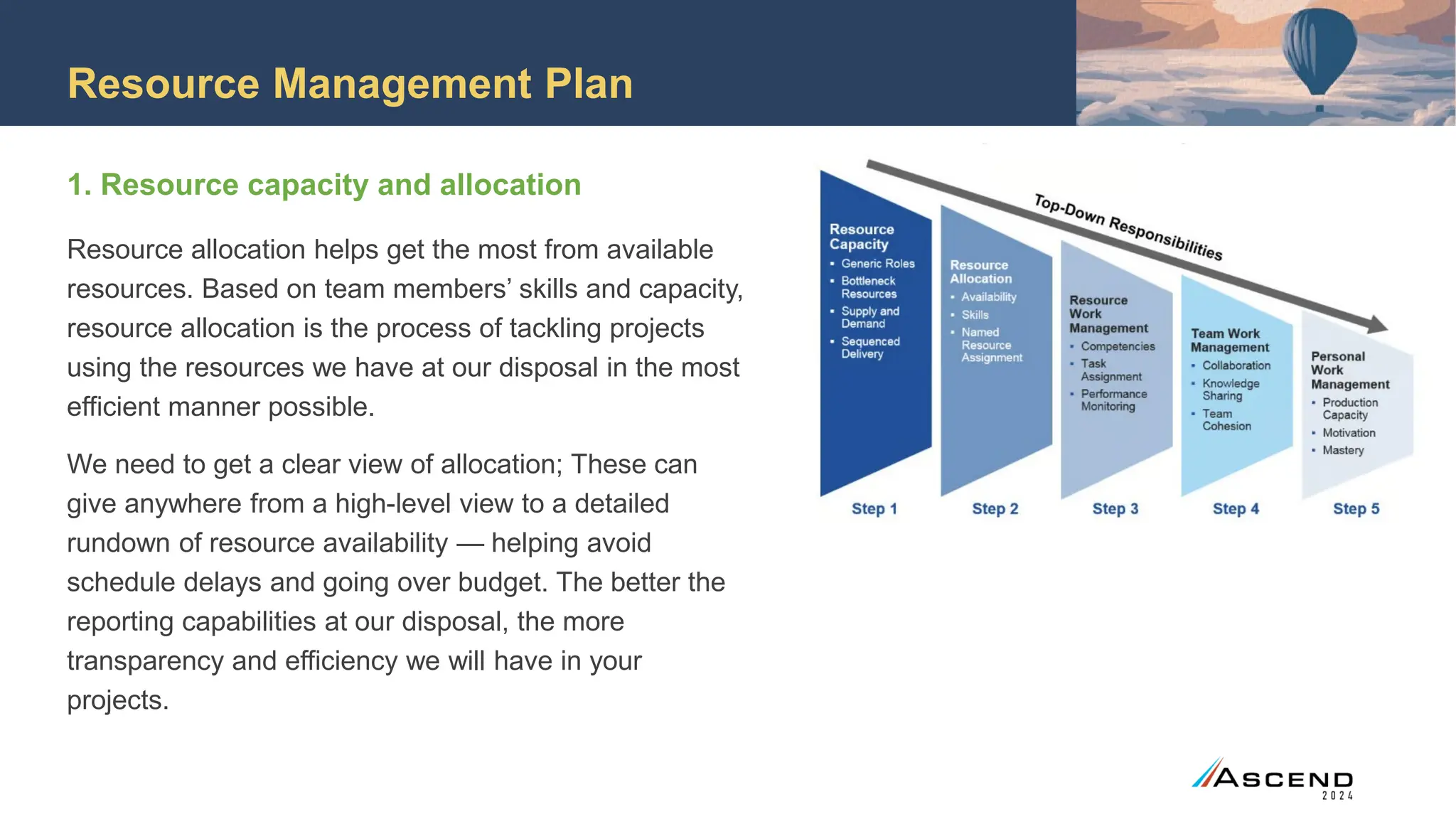
1. Resource capacity and allocation
Resource allocation helps get the most from available
resources. Based on team members’ skills and capacity,
resource allocation is the process of tackling projects
using the resources we have at our disposal in the most
efficient manner possible.
We need to get a clear view of allocation; These can
give anywhere from a high-level view to a detailed
rundown of resource availability — helping avoid
schedule delays and going over budget. The better the
reporting capabilities at our disposal, the more
transparency and efficiency we will have in your
projects.
Resource Management Plan
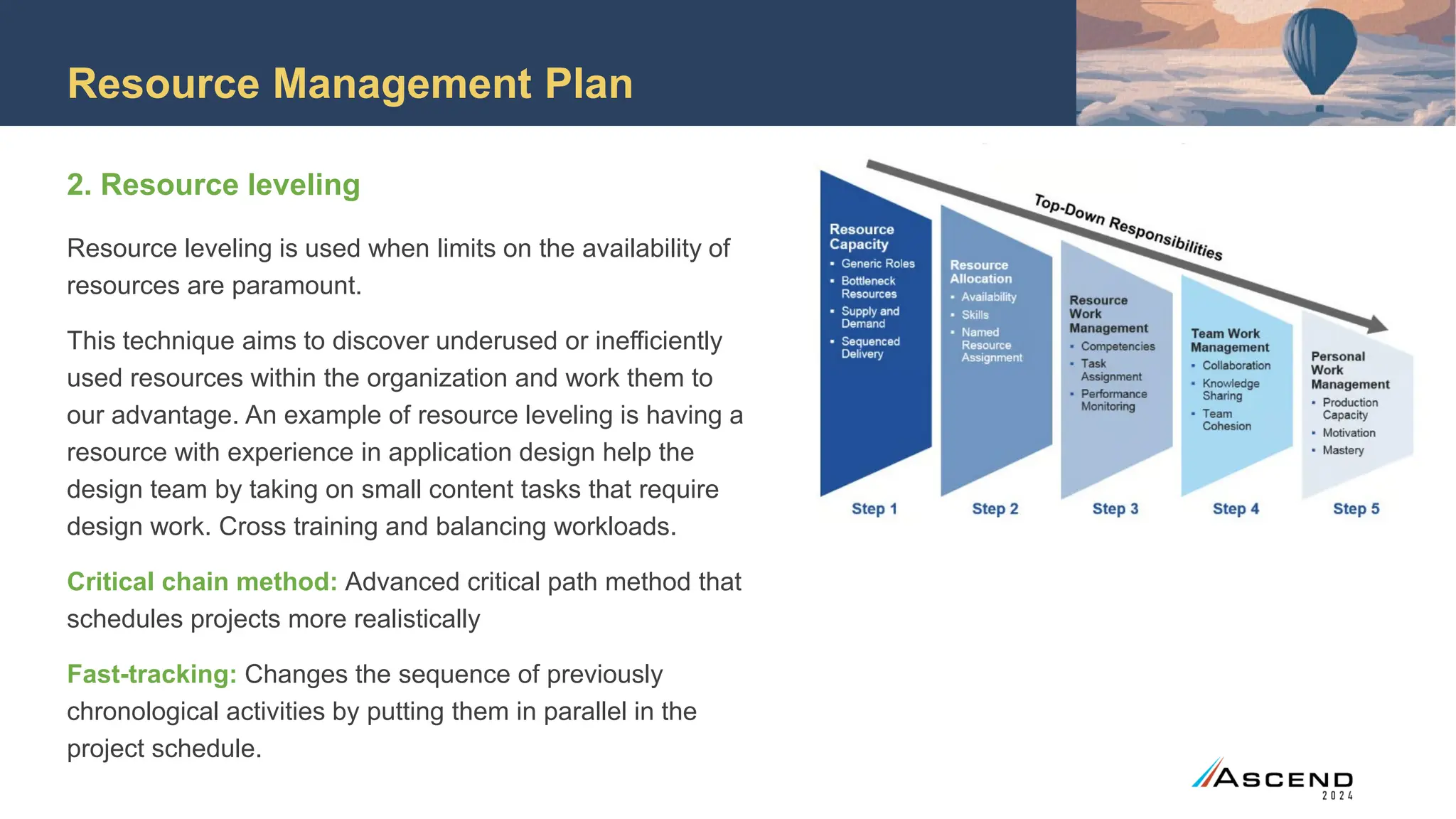
2. Resource leveling
Resource leveling is used when limits on the availability of
resources are paramount.
This technique aims to discover underused or inefficiently
used resources within the organization and work them to
our advantage. An example of resource leveling is having a
resource with experience in application design help the
design team by taking on small content tasks that require
design work. Cross training and balancing workloads.
Critical chain method: Advanced critical path method that
schedules projects more realistically
Fast-tracking: Changes the sequence of previously
chronological activities by putting them in parallel in the
project schedule.
Resource Management Plan
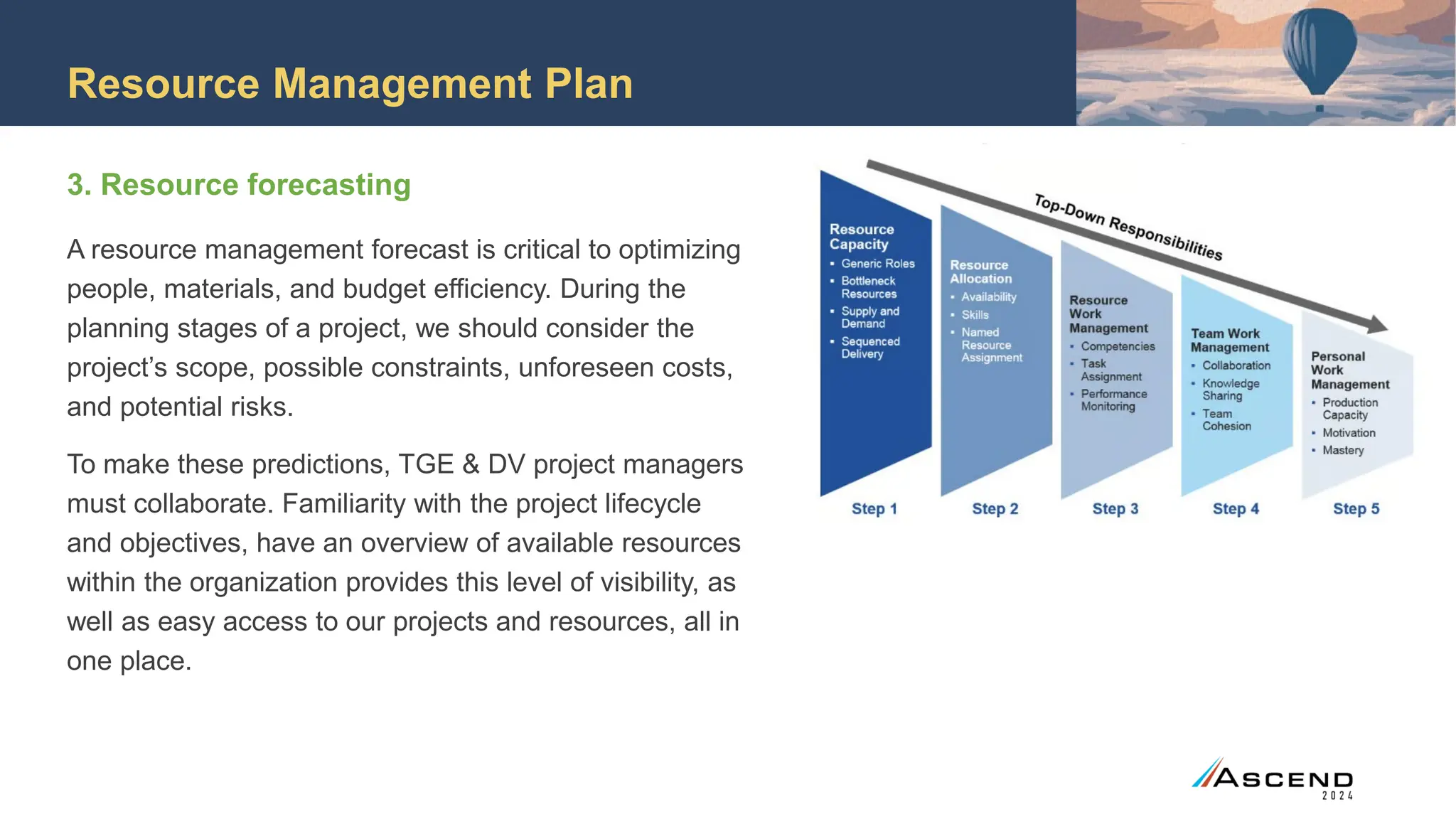
3. Resource forecasting
A resource management forecast is critical to optimizing
people, materials, and budget efficiency. During the
planning stages of a project, we should consider the
project’s scope, possible constraints, unforeseen costs,
and potential risks.
To make these predictions, TGE & DV project managers
must collaborate. Familiarity with the project lifecycle
and objectives, have an overview of available resources
within the organization provides this level of visibility, as
well as easy access to our projects and resources, all in
one place.
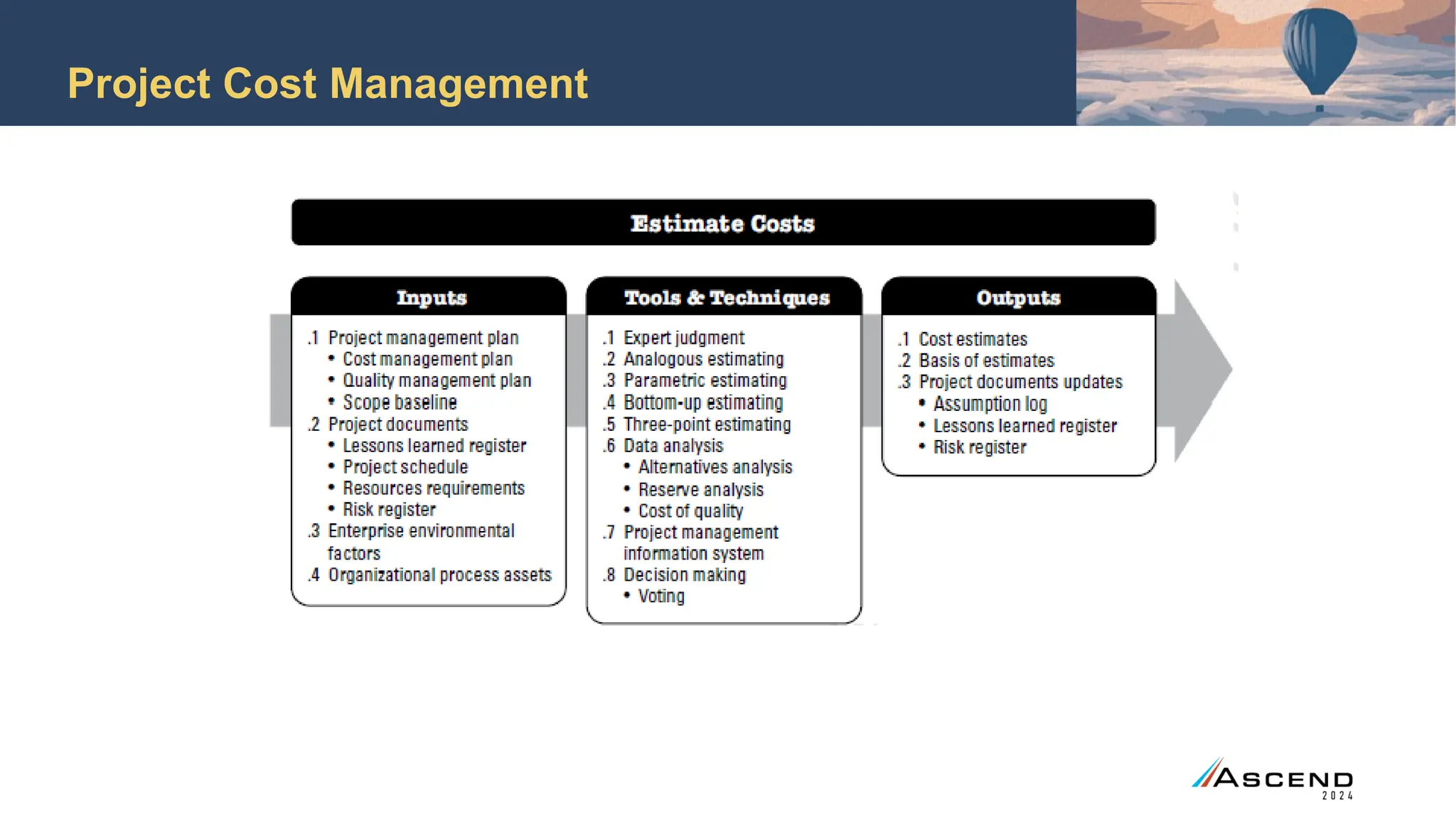
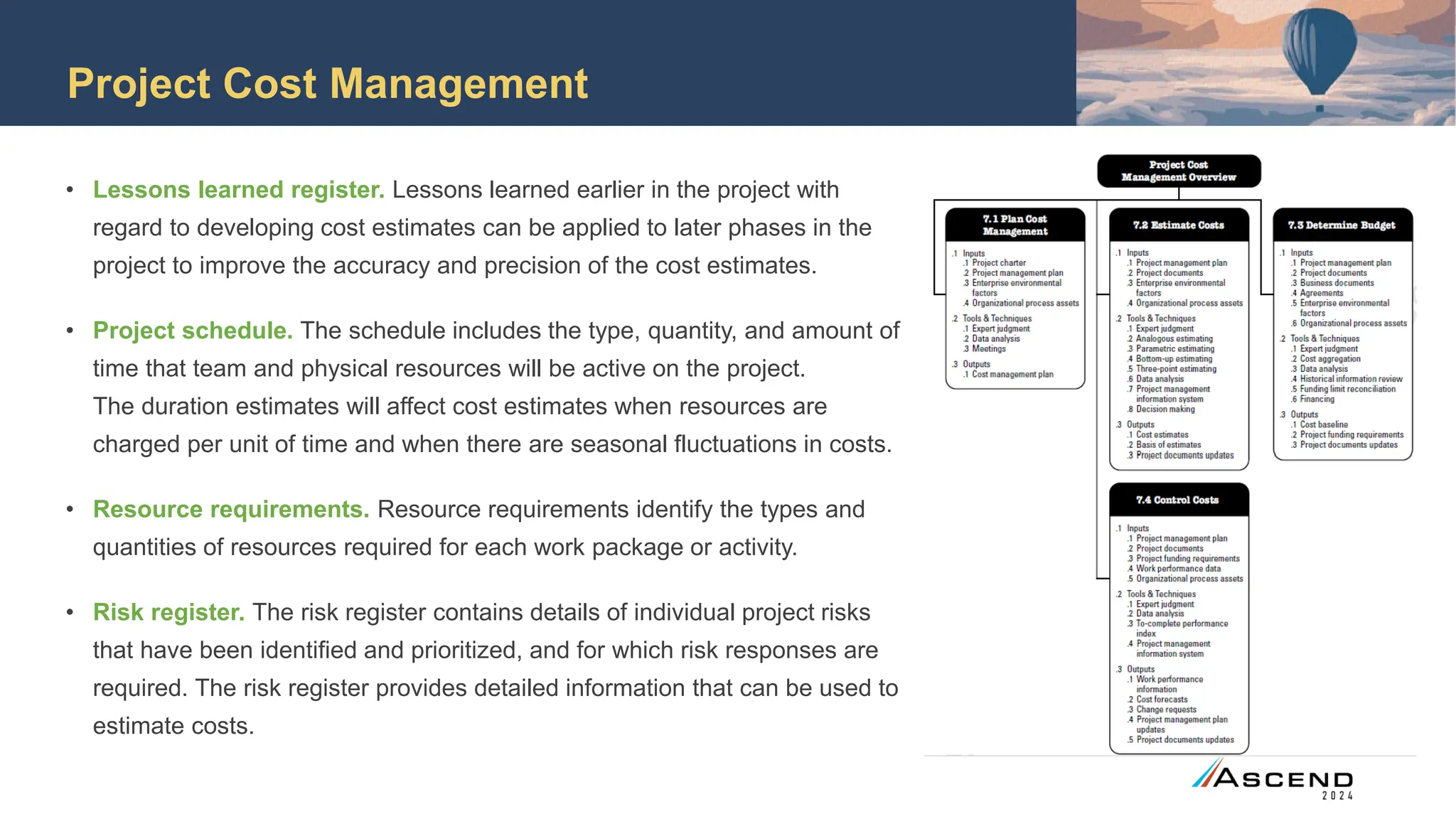
Project Cost Management
• Lessons learned register. Lessons learned earlier in the project with
regard to developing cost estimates can be applied to later phases in the
project to improve the accuracy and precision of the cost estimates.
• Project schedule. The schedule includes the type, quantity, and amount of
time that team and physical resources will be active on the project.
The duration estimates will affect cost estimates when resources are
charged per unit of time and when there are seasonal fluctuations in costs.
• Resource requirements. Resource requirements identify the types and
quantities of resources required for each work package or activity.
• Risk register. The risk register contains details of individual project risks
that have been identified and prioritized, and for which risk responses are
required. The risk register provides detailed information that can be used to
estimate costs.
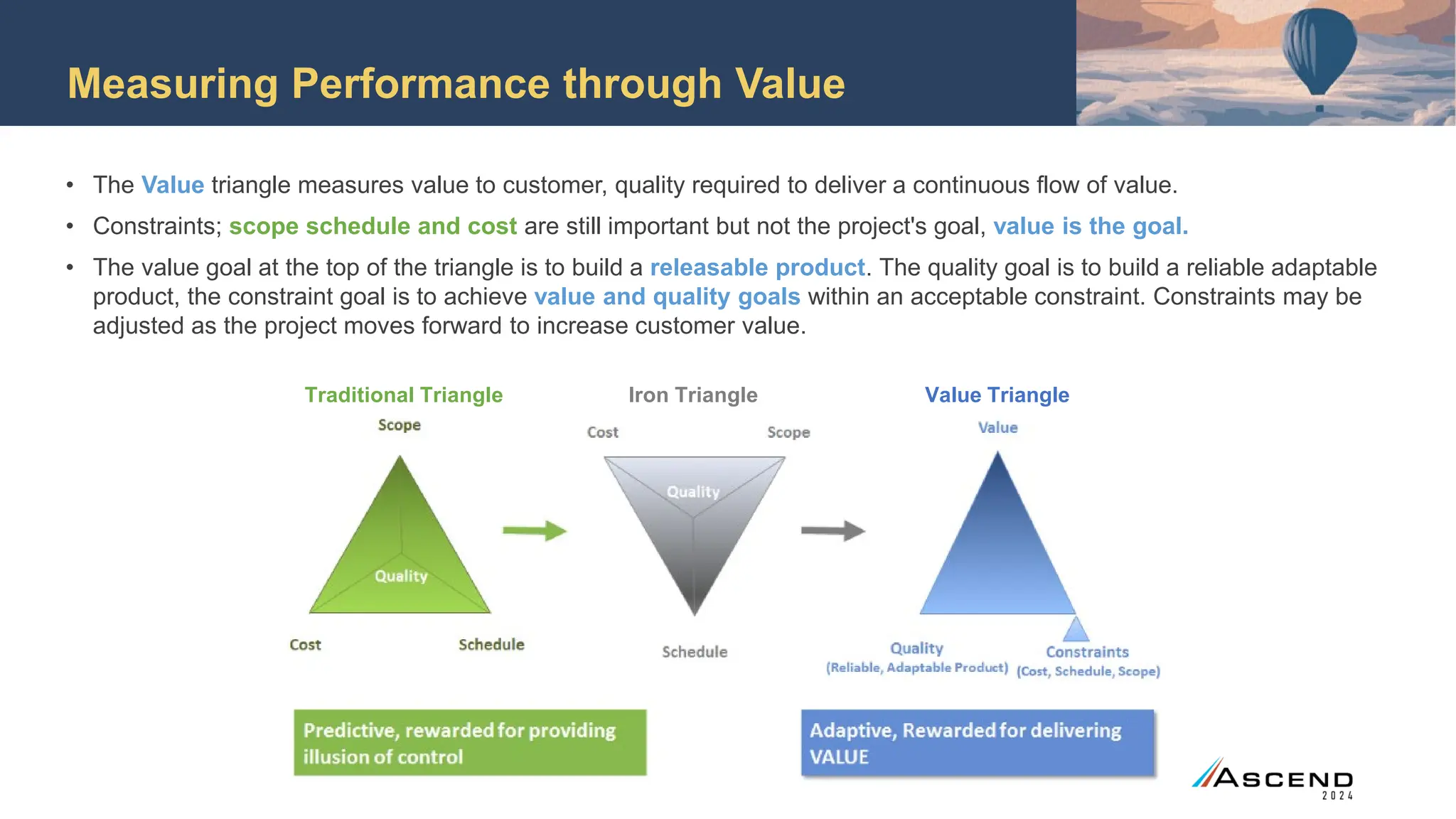
Measuring Performance through Value
• The Value triangle measures value to customer, quality required to deliver a continuous flow of value.
• Constraints; scope schedule and cost are still important but not the project's goal, value is the goal.
• The value goal at the top of the triangle is to build a releasable product. The quality goal is to build a reliable adaptable
product, the constraint goal is to achieve value and quality goals within an acceptable constraint. Constraints may be
adjusted as the project moves forward to increase customer value.
Traditional Triangle Iron Triangle Value Triangle
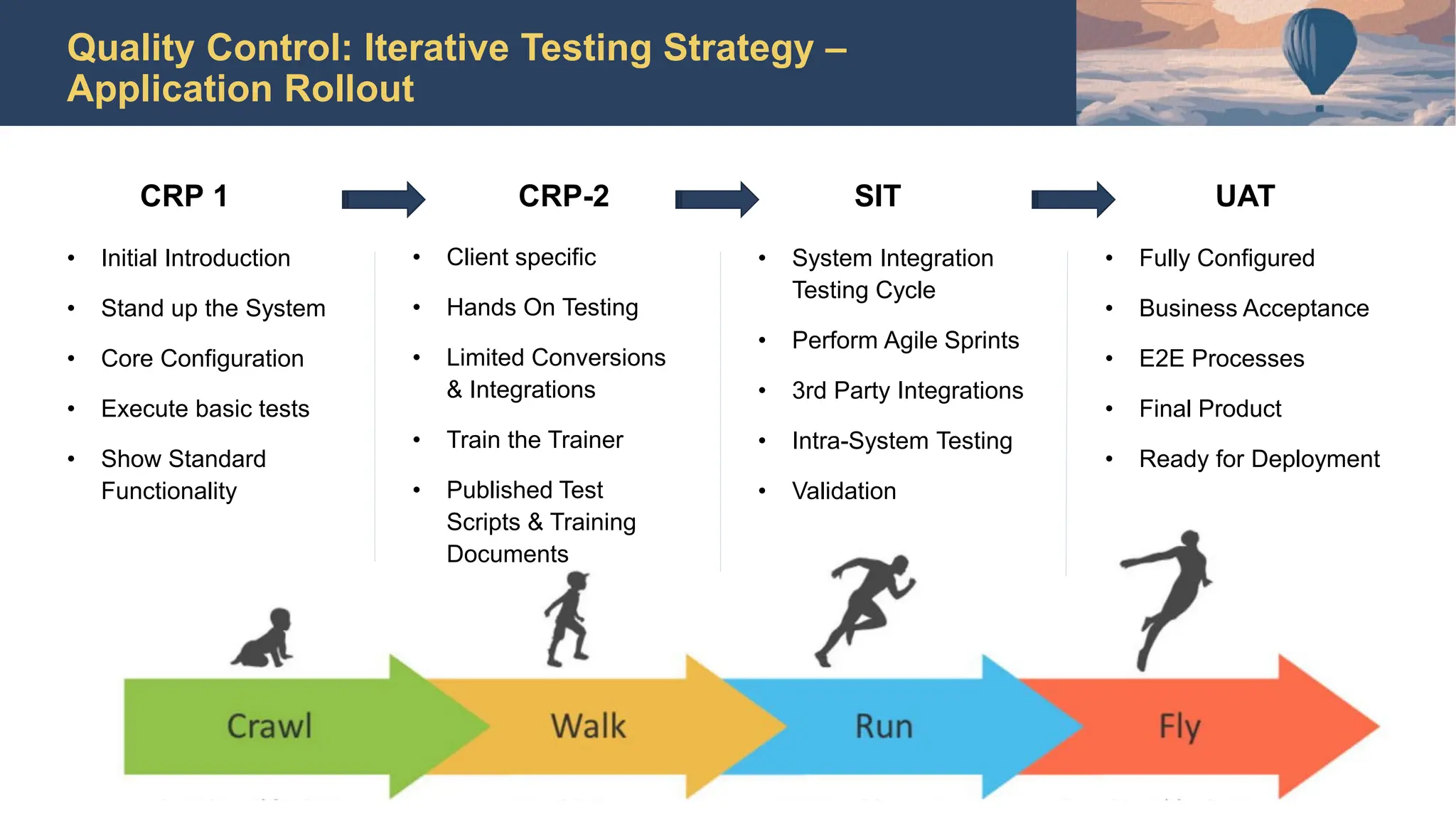
Quality Control: Iterative Testing Strategy –
Application Rollout
• Initial Introduction
• Stand up the System
• Core Configuration
• Execute basic tests
• Show Standard
Functionality
• Client specific
• Hands On Testing
• Limited Conversions
& Integrations
• Train the Trainer
• Published Test
Scripts & Training
Documents
• System Integration
Testing Cycle
• Perform Agile Sprints
• 3rd Party Integrations
• Intra-System Testing
• Validation
• Fully Configured
• Business Acceptance
• E2E Processes
• Final Product
• Ready for Deployment
CRP 1 CRP-2 SIT UAT
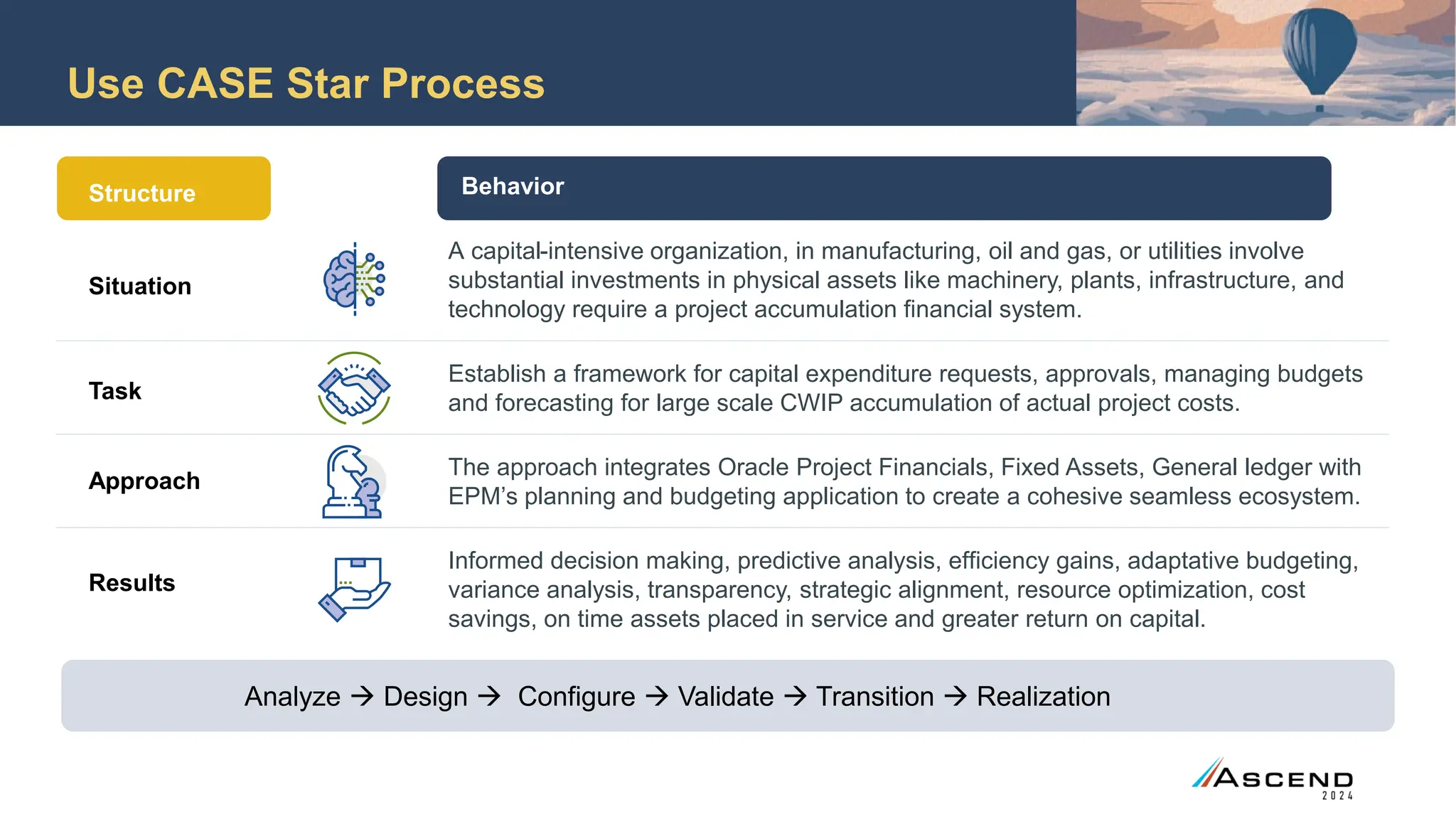
Use CASE Star Process
Analyze  Design  Configure  Validate  Transition  Realization
Structure
Situation
Task
Approach
Results
Behavior
Establish a framework for capital expenditure requests, approvals, managing budgets
and forecasting for large scale CWIP accumulation of actual project costs.
A capital-intensive organization, in manufacturing, oil and gas, or utilities involve
substantial investments in physical assets like machinery, plants, infrastructure, and
technology require a project accumulation financial system.
The approach integrates Oracle Project Financials, Fixed Assets, General ledger with
EPM’s planning and budgeting application to create a cohesive seamless ecosystem.
Informed decision making, predictive analysis, efficiency gains, adaptative budgeting,
variance analysis, transparency, strategic alignment, resource optimization, cost
savings, on time assets placed in service and greater return on capital.
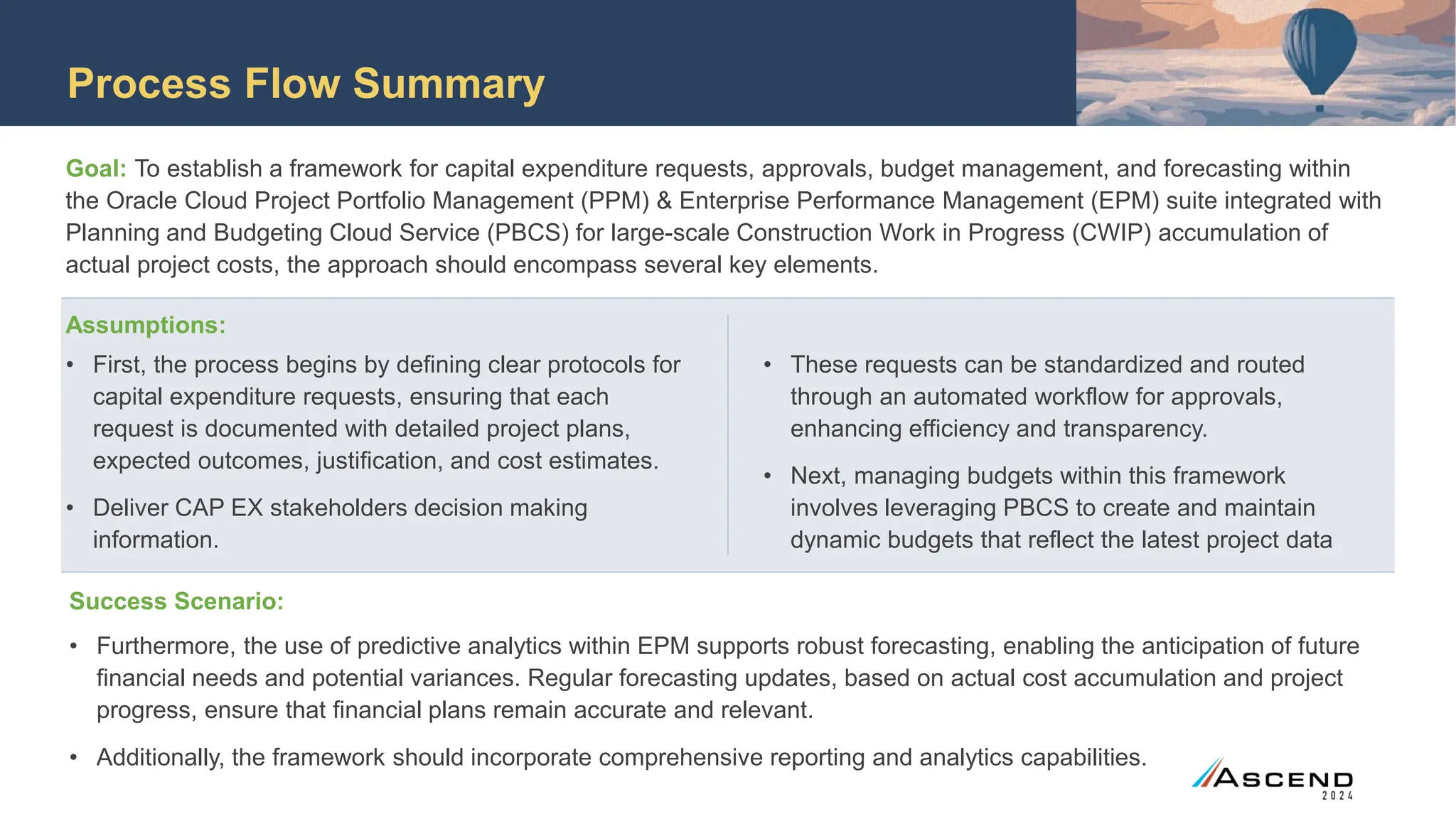
Process Flow Summary
Goal: To establish a framework for capital expenditure requests, approvals, budget management, and forecasting within
the Oracle Cloud Project Portfolio Management (PPM) & Enterprise Performance Management (EPM) suite integrated with
Planning and Budgeting Cloud Service (PBCS) for large-scale Construction Work in Progress (CWIP) accumulation of
actual project costs, the approach should encompass several key elements.
Success Scenario:
• Furthermore, the use of predictive analytics within EPM supports robust forecasting, enabling the anticipation of future
financial needs and potential variances. Regular forecasting updates, based on actual cost accumulation and project
progress, ensure that financial plans remain accurate and relevant.
• Additionally, the framework should incorporate comprehensive reporting and analytics capabilities.
• First, the process begins by defining clear protocols for
capital expenditure requests, ensuring that each
request is documented with detailed project plans,
expected outcomes, justification, and cost estimates.
• Deliver CAP EX stakeholders decision making
information.
• These requests can be standardized and routed
through an automated workflow for approvals,
enhancing efficiency and transparency.
• Next, managing budgets within this framework
involves leveraging PBCS to create and maintain
dynamic budgets that reflect the latest project data
Assumptions:
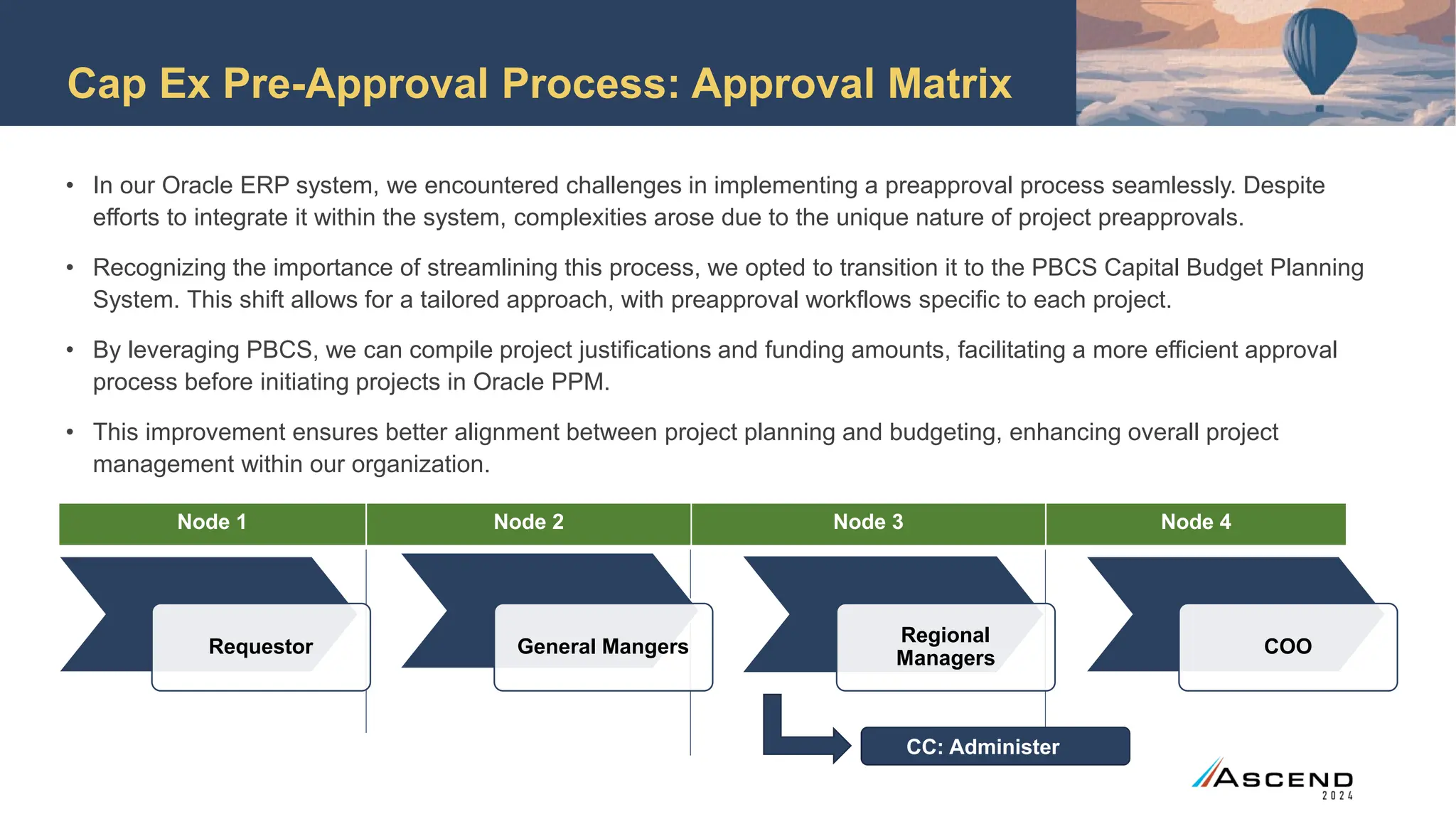
Cap Ex Pre-Approval Process: Approval Matrix
• In our Oracle ERP system, we encountered challenges in implementing a preapproval process seamlessly. Despite
efforts to integrate it within the system, complexities arose due to the unique nature of project preapprovals.
• Recognizing the importance of streamlining this process, we opted to transition it to the PBCS Capital Budget Planning
System. This shift allows for a tailored approach, with preapproval workflows specific to each project.
• By leveraging PBCS, we can compile project justifications and funding amounts, facilitating a more efficient approval
process before initiating projects in Oracle PPM.
• This improvement ensures better alignment between project planning and budgeting, enhancing overall project
management within our organization.
CC: Administer
Requestor General Mangers
Regional
Managers
COO
Node 1 Node 2 Node 3 Node 4
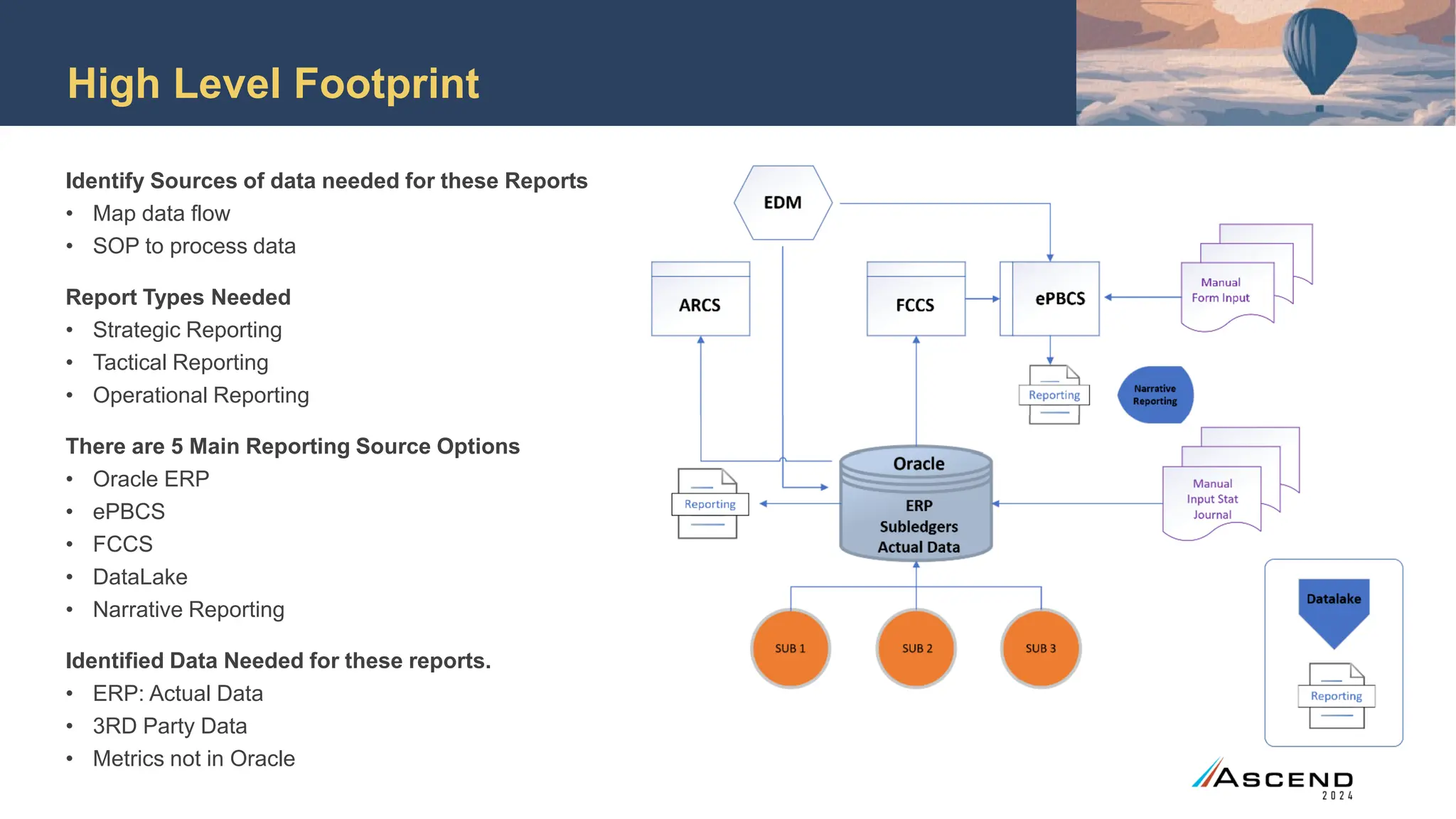
High Level Footprint
Identify Sources of data needed for these Reports
• Map data flow
• SOP to process data
Report Types Needed
• Strategic Reporting
• Tactical Reporting
• Operational Reporting
There are 5 Main Reporting Source Options
• Oracle ERP
• ePBCS
• FCCS
• DataLake
• Narrative Reporting
Identified Data Needed for these reports.
• ERP: Actual Data
• 3RD Party Data
• Metrics not in Oracle
Assumptions
• Oracle ERP System as the Baseline: The project will
work within the confines of the current Oracle ecosystem
for the enhancements and optimization of the Capital
Expenditure Requests (CER) processing system.
Starting with the standard approval process using inputs
and attachments for justification and review.
• Accuracy and Efficiency in Financial Project Cost
Capture: It's assumed that a key goal of the project is to
enhance the accuracy and efficiency of capturing
financial project costs, including improvements to
approval routing, procurement processes, and the
accumulation and capitalization processes.
• Phase 1 Exclusion of Oracle PPM Cloud: It's assumed
that the implementation of Oracle Project Portfolio
Management (PPM) Cloud is not part of Phase 1.
This exclusion is strategic, to prioritize immediate
improvements within the current Oracle standard
application framework. This is a foundational phase
providing a framework for subsequent phases, including
potential integration with Oracle PPM Cloud and other
project execution tools. (Aconex) This foundation is
critical for achieving a scalable and flexible CER
processing system.
• Phase 2 Inclusion of Oracle PPM & Expansion of
EPM Cloud Applications: It's assumed that the
integration of Oracle Project Portfolio Management
(PPM) Cloud and the expansion of EPM Planning &
Budgeting is part of Phase 2. This inclusion is strategic,
to prioritize immediate improvements within the current
Oracle standard application framework.
Assumptions
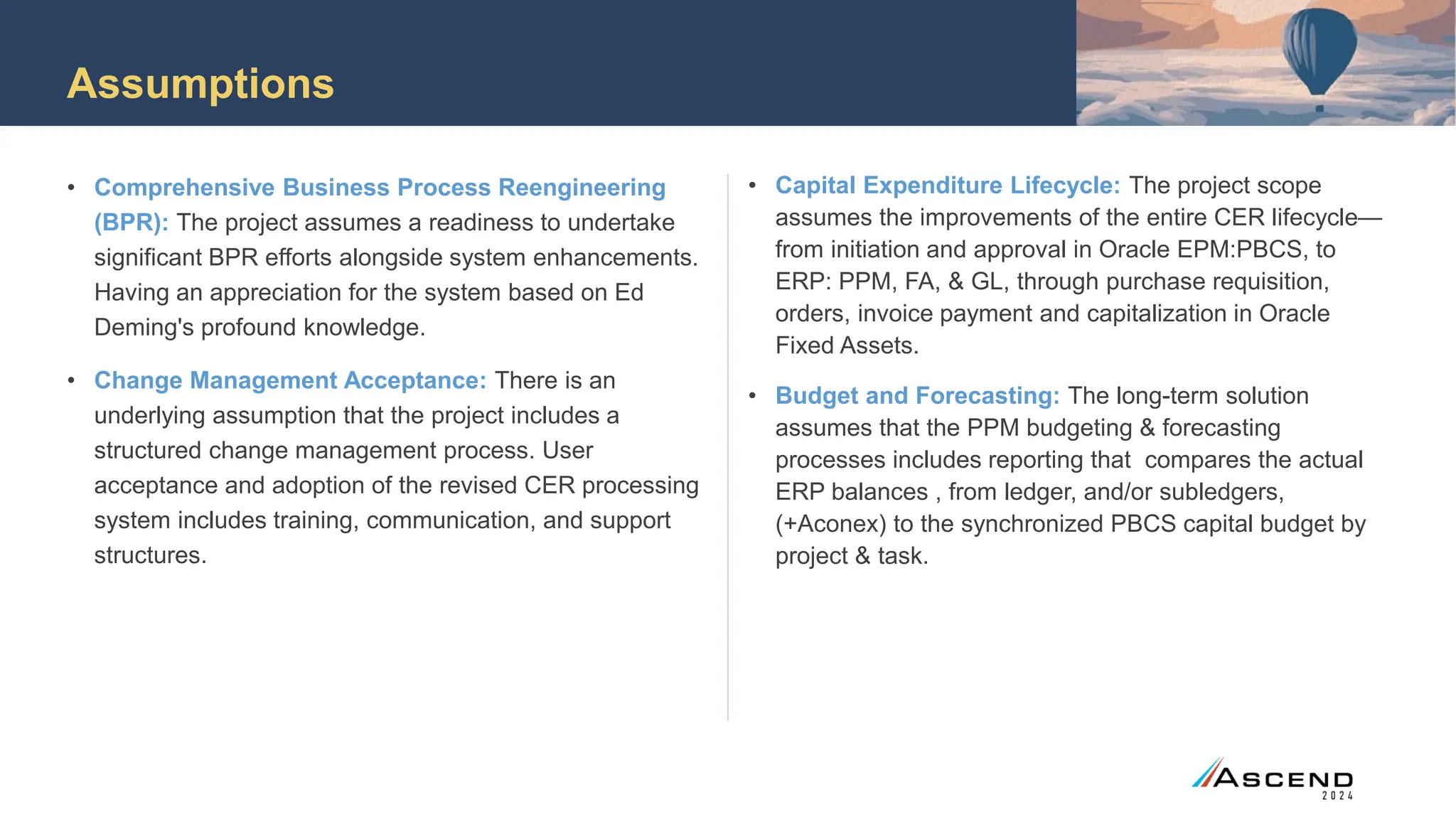
• Comprehensive Business Process Reengineering
(BPR): The project assumes a readiness to undertake
significant BPR efforts alongside system enhancements.
Having an appreciation for the system based on Ed
Deming's profound knowledge.
• Change Management Acceptance: There is an
underlying assumption that the project includes a
structured change management process. User
acceptance and adoption of the revised CER processing
system includes training, communication, and support
structures.
• Capital Expenditure Lifecycle: The project scope
assumes the improvements of the entire CER lifecycle—
from initiation and approval in Oracle EPM:PBCS, to
ERP: PPM, FA, & GL, through purchase requisition,
orders, invoice payment and capitalization in Oracle
Fixed Assets.
• Budget and Forecasting: The long-term solution
assumes that the PPM budgeting & forecasting
processes includes reporting that compares the actual
ERP balances , from ledger, and/or subledgers,
(+Aconex) to the synchronized PBCS capital budget by
project & task.
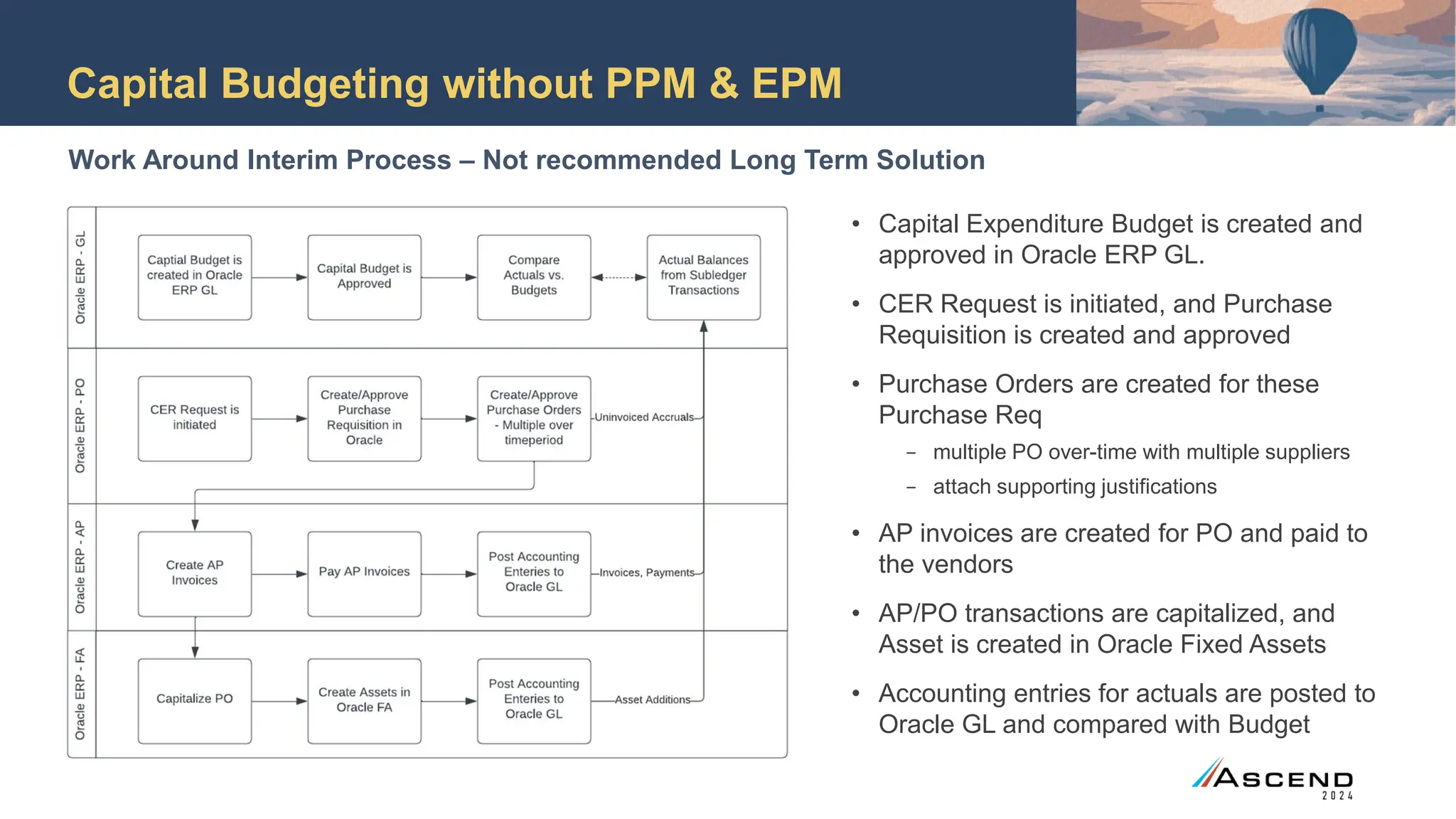
Capital Budgeting without PPM & EPM
• Capital Expenditure Budget is created and
approved in Oracle ERP GL.
• CER Request is initiated, and Purchase
Requisition is created and approved
• Purchase Orders are created for these
Purchase Req
− multiple PO over-time with multiple suppliers
− attach supporting justifications
• AP invoices are created for PO and paid to
the vendors
• AP/PO transactions are capitalized, and
Asset is created in Oracle Fixed Assets
• Accounting entries for actuals are posted to
Oracle GL and compared with Budget
Work Around Interim Process – Not recommended Long Term Solution
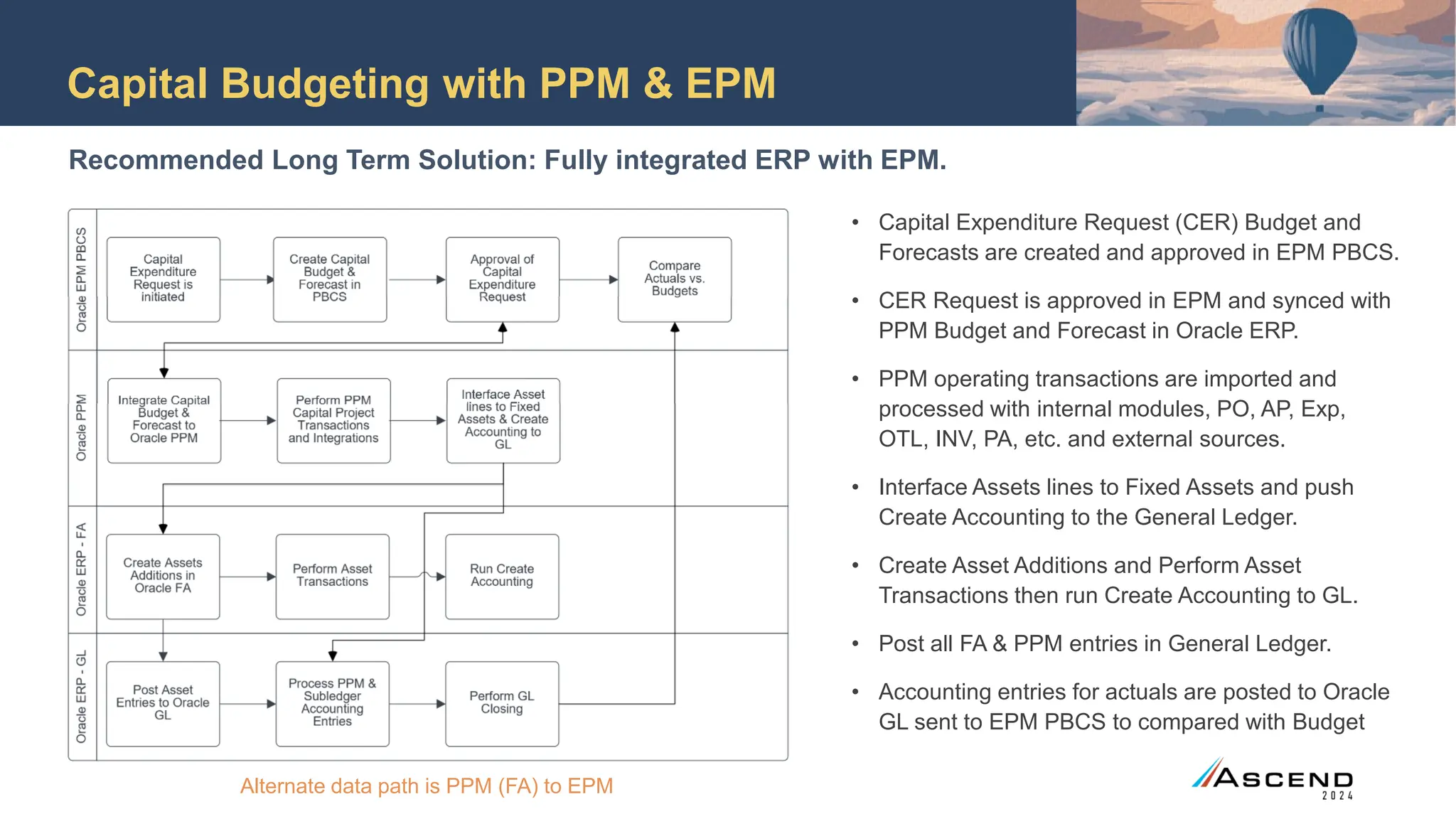
Capital Budgeting with PPM & EPM
• Capital Expenditure Request (CER) Budget and
Forecasts are created and approved in EPM PBCS.
• CER Request is approved in EPM and synced with
PPM Budget and Forecast in Oracle ERP.
• PPM operating transactions are imported and
processed with internal modules, PO, AP, Exp,
OTL, INV, PA, etc. and external sources.
• Interface Assets lines to Fixed Assets and push
Create Accounting to the General Ledger.
• Create Asset Additions and Perform Asset
Transactions then run Create Accounting to GL.
• Post all FA & PPM entries in General Ledger.
• Accounting entries for actuals are posted to Oracle
GL sent to EPM PBCS to compared with Budget
Recommended Long Term Solution: Fully integrated ERP with EPM.
Alternate data path is PPM (FA) to EPM
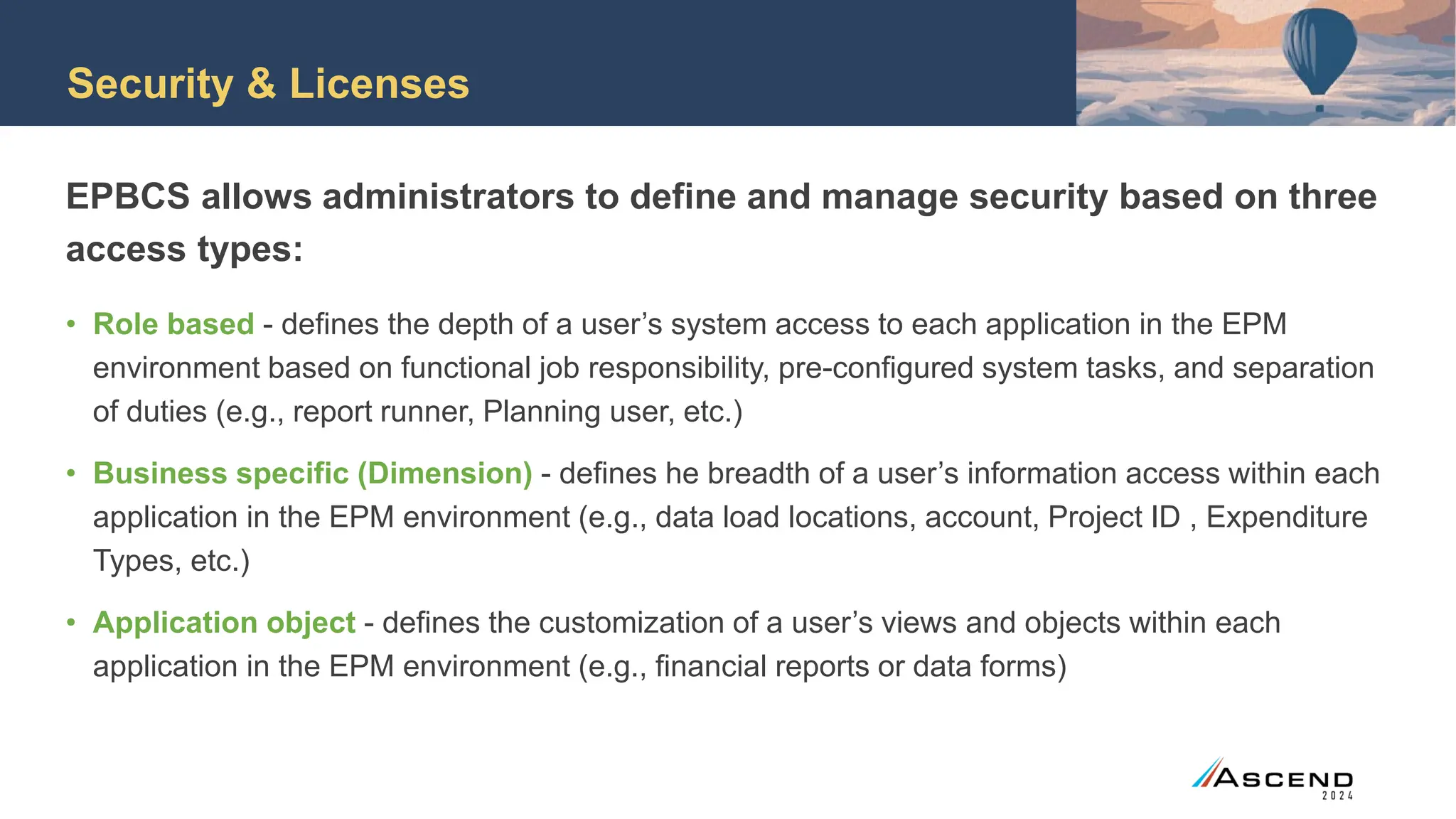
Security & Licenses
EPBCS allows administrators to define and manage security based on three
access types:
• Role based - defines the depth of a user’s system access to each application in the EPM
environment based on functional job responsibility, pre-configured system tasks, and separation
of duties (e.g., report runner, Planning user, etc.)
• Business specific (Dimension) - defines he breadth of a user’s information access within each
application in the EPM environment (e.g., data load locations, account, Project ID , Expenditure
Types, etc.)
• Application object - defines the customization of a user’s views and objects within each
application in the EPM environment (e.g., financial reports or data forms)
Security & Licenses
Security and access rights enable the administrators to maintain control over access to the applications and
application elements. Users will each have an approving manager who will complete the required
documentation and submit access requests based on a user’s role and level of security required. Security for
EPBCS is based on roles granted by the Identity Domain Administrator or the Service Administrator. There
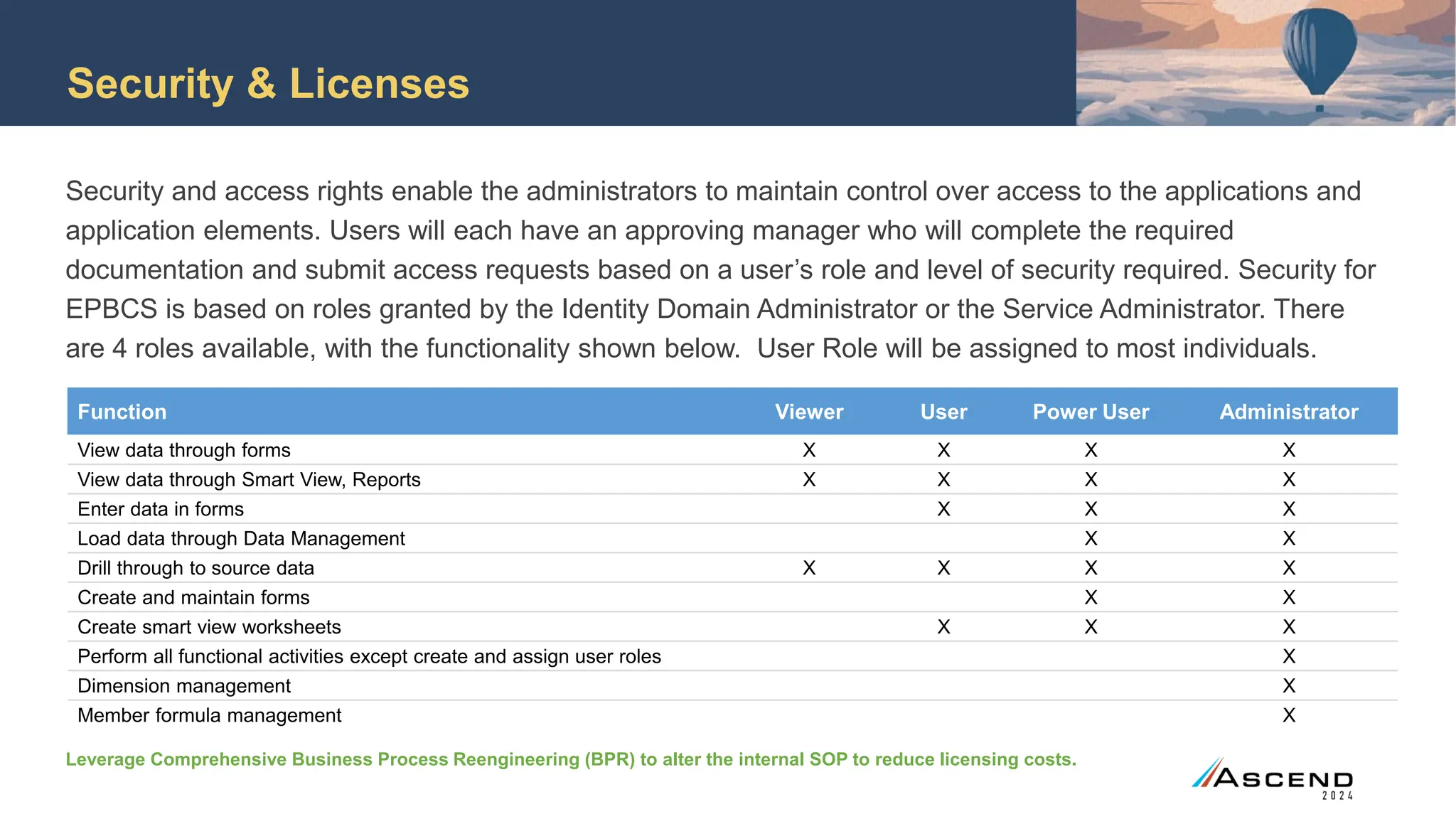
are 4 roles available, with the functionality shown below. User Role will be assigned to most individuals.
Function Viewer User Power User Administrator
View data through forms X X X X
View data through Smart View, Reports X X X X
Enter data in forms X X X
Load data through Data Management X X
Drill through to source data X X X X
Create and maintain forms X X
Create smart view worksheets X X X
Perform all functional activities except create and assign user roles X
Dimension management X
Member formula management X
Leverage Comprehensive Business Process Reengineering (BPR) to alter the internal SOP to reduce licensing costs.
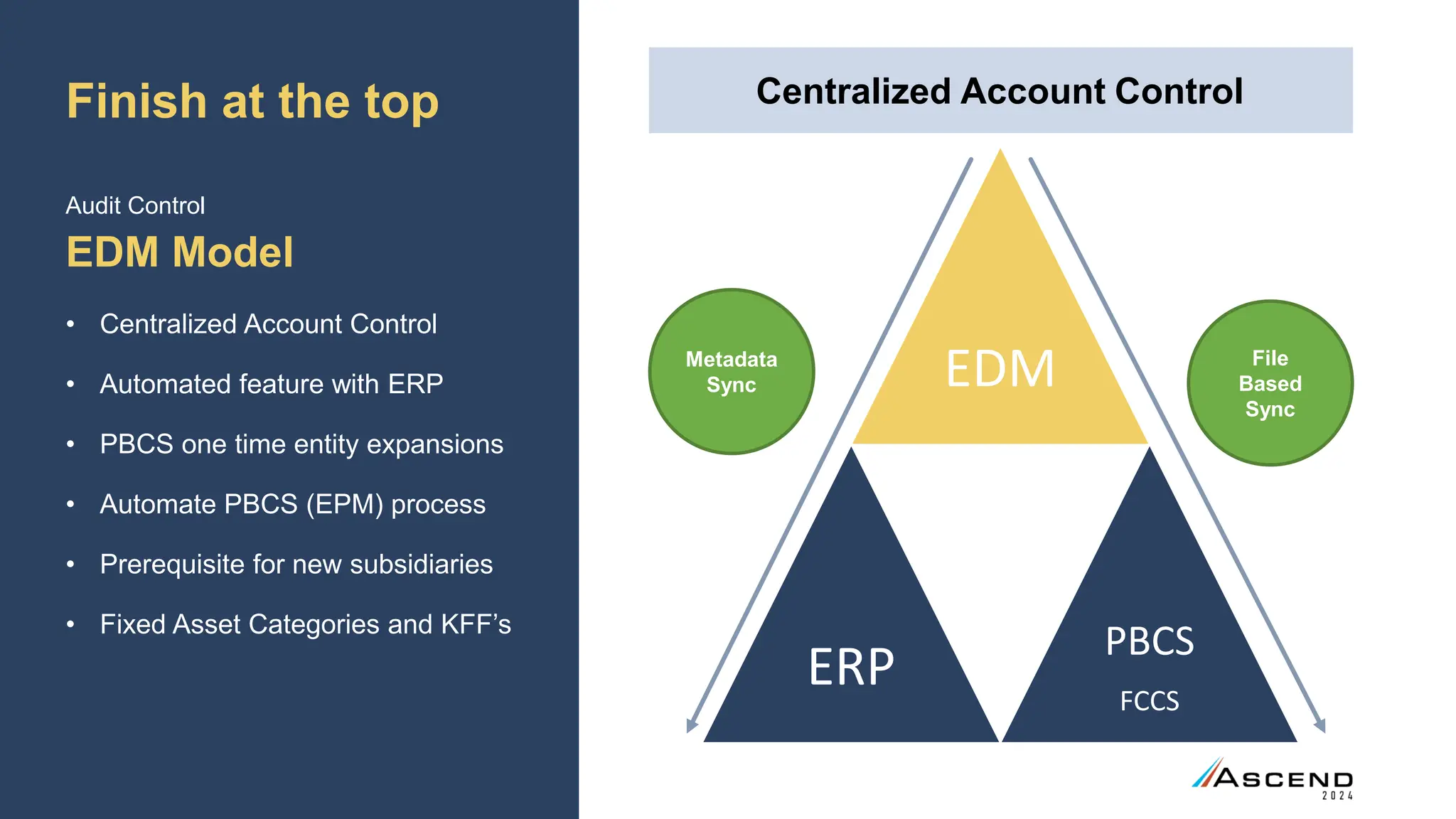
Finish at the top
• Centralized Account Control
• Automated feature with ERP
• PBCS one time entity expansions
• Automate PBCS (EPM) process
• Prerequisite for new subsidiaries
• Fixed Asset Categories and KFF’s
EDM
ERP
PBCS
FCCS
Centralized Account Control
Metadata
Sync
File
Based
Sync
EDM Model
Audit Control
Q&A
info@datavail.com
Thank You For
Attending!
Please complete the session
survey in the conference app.

Cloud Transformation: Optimizing Operations and Financial Performance – Presented by Datavail

  • 1.
    June 17 –20, 2024 • Caesars Palace • Las Vegas, NV Cloud Transformation: Optimizing Operations and Financial Performance The Strategic Integration of ERP and EPM within Oracle's Ecosystem Kenneth Ash Bergo Oracle Cloud Project Leader, Datavail info@datavail.com
  • 2.
    We’ve Done thisfor 17+ years 1200+ Consultants focused on Cloud deployments and managed services 1000+ Implementation Experience 10+ Years Cloud Experience 12+ Focused Industries 500+ Customers with average lifespan of 7+ years $25M Invested $25M in IP that improves the service experience and drives efficiency We are a Consulting/managed services partner specialize in translate your IT technology asset into business value…. Accelerated Cloud Migrations Systems Integration Data Migration and Conversions Regression Testing Health Checks & Assessments Upgrades Cloud Consulting Cost-value Analysis Optimization Managed Services Migrations, Optimization, Support Monitoring & Incident Response w/ SLAs Service Requests 24x7 In-Office Coverage Proactive Services (Health, Tune) Project Services Operational Managed Services Our Technology Partners
  • 3.
    We operate tohigher of Datavail security policy & client controls documented in operational run book. Data & Security Compliance SSAE18 Type II SOC1 & Type II SOC2 Operate and adhere to controls ISO 27001:2019 (Information Security) & ISO 27701 (Privacy) PCI SAQ-D Self Assessment Executed and adhere to numerous HIPAA Business Associate Agreements US only delivery models for ITAR controlled data
  • 4.
    Our Credentials • PeopleSoftHCM • PeopleSoft Financials • Oracle E-Business Suite (Financials) • Oracle E-Business Suite (Supply Chain) • Oracle ERP (Finance Cloud) • Oracle HCM & Payroll Cloud • Oracle Project Portfolio Cloud • Oracle RMCS • Oracle Subscription Mgmt. Cloud • Oracle Inventory Cloud • Oracle Demand Planning Cloud • Oracle Supply Planning Cloud • Oracle Procurement Cloud • Professional Services • Public Sector & Higher Education • Wholesale Distribution • Oil and Gas • Manufacturing • Aerospace and Defense • Chemicals • Media, Sports & Entertainment • Hospitality • Travel & Transportation • Retail • Oracle Order Management Cloud • Oracle Sales/CPQ/Service Cloud • Oracle Manufacturing Cloud • Oracle EPM Cloud (ePBCS, FCCS, ARCS) • Oracle Hyperion / Essbase • Oracle PaaS Cloud • Oracle Cloud Applications Architect • Oracle Integration Cloud • Oracle Cloud Database Architect • Oracle Middleware Architect • Oracle Apps Database 12.x  19c • Oracle Apps Middleware Technologies Product Credentials / Certifications Industry Experience 20+ years of delivering excellent value 300+ Oracle Professionals and growing On-Prem & Cloud Experience 150+ completed ERP projects (40+ Cloud Transformation Projects)
  • 5.
  • 6.
  • 7.
    Certification • Oracle CloudProject Management Practitioner Implementations • Financials: All • Supply Chain Operations • EPM: FCCS, PBCS, EDM, ARCS • Project Portfolio Suite • Human Capital Mgmt. • Service/Subscriptions • WMS/GTM/OTM KENNETH ASH BERGO Experience • 25+ years of Oracle Project Leadership • Multiple roles & industries Background • Insight, understanding and experience spanning over 50 Oracle projects in numerous industry sectors. Oracle Cloud Project Leader Datavail
  • 8.
    Executive Summary Ascend 2024 •Help clients leverage the transformative power of integrating ERP (Enterprise Resource Planning) and EPM (Enterprise Performance Management) within Oracle's ecosystem. Tt's your gateway to groundbreaking strategies that promise not only to optimize your operations and financial performance but also to revolutionize how you view asset management and strategic planning. Here’s What’s in Store for You • Unearth Hidden Savings: Dive deep into how the fusion of ERP and EPM systems can streamline your operations and elevate your financial management. Imagine reducing costs significantly while allocating resources more effectively. It's not just a dream—it's a tangible outcome awaiting your business. • Master Your Assets: For capital intense industry sectors like oil and gas, machinery, and industrials where assets are everything, learn how to wield ERP and EPM to not just manage but maximize asset utilization. Turn your assets into unbeatable competitive advantages through sophisticated financial efficiency and management strategies. • Futurize Your Strategy: Visionary planning isn't just for visionaries. Aligning ERP and EPM with your strategic objectives paves the way for not just surviving but thriving in the future. Equip yourself with the knowledge to marry daily operations with long-term goals, ensuring your business's growth and success.
  • 9.
    Executive Summary Ascend 2024 •Help clients leverage the transformative power of integrating ERP (Enterprise Resource Planning) and EPM (Enterprise Performance Management) within Oracle's ecosystem. Tt's your gateway to groundbreaking strategies that promise not only to optimize your operations and financial performance but also to revolutionize how you view asset management and strategic planning. Key Takeaways • Capitalize on Operational and Financial Efficiency: Learn how the strategic integration of ERP and EPM within Oracle doesn't just improve decision-making but leads to substantial cost savings. • Boost Asset Utilization: Gain exclusive insights into enhancing performance, maintenance, and cost management in asset-heavy sectors, propelling your business ahead of the curve. • Align with Strategic Goals: Discover the key to effective operations management and future-focused planning, ensuring your business is always one step ahead. • Return on Investment ROI (Savings): Optimize licensing costs, improve visibility to cash flow, uses of time value on inventory turnover. Identify and benefits from deferred tax assets. Improve an average metric to close is 2.2 days sooner. (Source Oracle), and lower overall inventory costs by 10 percent.(*)
  • 10.
    Project Governance The 3Pillars of Governance: Structure, People & Information. Project governance provides direction and defines decision-making procedures and metrics for validating impacts to the project. Structure • Project Methodology, Approach & Purpose • Financial Management • Risk Tracking and Resolution • Issue Tracking and Resolution • Quality Standards, Project Standards, including Naming Conventions and Standard Look and Feel, Quality Reporting • Configuration Control and Release Management People • Center of Excellence • Standard Communications Plan - to whom, what format and frequency • Change Management • Process for On-Boarding Resources • Procurement Process, if required • Execution of Planned Quality Checkpoints and Validations • Responsibility assignment Matrix Information • Mission Statement • Scope Definition • Project Execution Plan • Critical Success Factors • Change Control • Work Plan Control • Project Documentation Archiving Policy and Process • Work Product Deliverables • Status Reporting • Requirements Capture
  • 11.
    Oracle CAS-OUM Approach Analyze& Prepare Plan & Design Configure & Build Validate & Test Transition & Go Live Sustain & Realize Project Management and Governance • Implementation approach is the most important to manage project scope • MBP will help customer cloud adoption of best-in-class, global business processes, Oracle Fusion product, and lead to enhanced customer experience. • Opportunity of partner to add value to existing business process and deliver cost effective and successful implementations. • Solution-driven approach will lead for a faster implementation resulting in quicker ROI and low maintenance cost for customer solutions during updates. Implementation Approach – SaaS Applications Project Artifacts, Deliverables, and Milestones
  • 12.
  • 13.
    Project Scope Management DefineScope Statement A document that includes at least a description of the project, including its overall objectives and justification, detailed descriptions of all project deliverables, and the characteristics and requirements of products and services produced as part of the project. Scope Validation Formal acceptance of the completed project deliverables.
  • 14.
  • 15.
    Resource Management Plan 1.Resource capacity and allocation Resource allocation helps get the most from available resources. Based on team members’ skills and capacity, resource allocation is the process of tackling projects using the resources we have at our disposal in the most efficient manner possible. We need to get a clear view of allocation; These can give anywhere from a high-level view to a detailed rundown of resource availability — helping avoid schedule delays and going over budget. The better the reporting capabilities at our disposal, the more transparency and efficiency we will have in your projects.
  • 16.
    Resource Management Plan 2.Resource leveling Resource leveling is used when limits on the availability of resources are paramount. This technique aims to discover underused or inefficiently used resources within the organization and work them to our advantage. An example of resource leveling is having a resource with experience in application design help the design team by taking on small content tasks that require design work. Cross training and balancing workloads. Critical chain method: Advanced critical path method that schedules projects more realistically Fast-tracking: Changes the sequence of previously chronological activities by putting them in parallel in the project schedule.
  • 17.
    Resource Management Plan 3.Resource forecasting A resource management forecast is critical to optimizing people, materials, and budget efficiency. During the planning stages of a project, we should consider the project’s scope, possible constraints, unforeseen costs, and potential risks. To make these predictions, TGE & DV project managers must collaborate. Familiarity with the project lifecycle and objectives, have an overview of available resources within the organization provides this level of visibility, as well as easy access to our projects and resources, all in one place.
  • 18.
  • 19.
    Project Cost Management •Lessons learned register. Lessons learned earlier in the project with regard to developing cost estimates can be applied to later phases in the project to improve the accuracy and precision of the cost estimates. • Project schedule. The schedule includes the type, quantity, and amount of time that team and physical resources will be active on the project. The duration estimates will affect cost estimates when resources are charged per unit of time and when there are seasonal fluctuations in costs. • Resource requirements. Resource requirements identify the types and quantities of resources required for each work package or activity. • Risk register. The risk register contains details of individual project risks that have been identified and prioritized, and for which risk responses are required. The risk register provides detailed information that can be used to estimate costs.
  • 20.
    Measuring Performance throughValue • The Value triangle measures value to customer, quality required to deliver a continuous flow of value. • Constraints; scope schedule and cost are still important but not the project's goal, value is the goal. • The value goal at the top of the triangle is to build a releasable product. The quality goal is to build a reliable adaptable product, the constraint goal is to achieve value and quality goals within an acceptable constraint. Constraints may be adjusted as the project moves forward to increase customer value. Traditional Triangle Iron Triangle Value Triangle
  • 21.
    Quality Control: IterativeTesting Strategy – Application Rollout • Initial Introduction • Stand up the System • Core Configuration • Execute basic tests • Show Standard Functionality • Client specific • Hands On Testing • Limited Conversions & Integrations • Train the Trainer • Published Test Scripts & Training Documents • System Integration Testing Cycle • Perform Agile Sprints • 3rd Party Integrations • Intra-System Testing • Validation • Fully Configured • Business Acceptance • E2E Processes • Final Product • Ready for Deployment CRP 1 CRP-2 SIT UAT
  • 22.
    Use CASE StarProcess Analyze  Design  Configure  Validate  Transition  Realization Structure Situation Task Approach Results Behavior Establish a framework for capital expenditure requests, approvals, managing budgets and forecasting for large scale CWIP accumulation of actual project costs. A capital-intensive organization, in manufacturing, oil and gas, or utilities involve substantial investments in physical assets like machinery, plants, infrastructure, and technology require a project accumulation financial system. The approach integrates Oracle Project Financials, Fixed Assets, General ledger with EPM’s planning and budgeting application to create a cohesive seamless ecosystem. Informed decision making, predictive analysis, efficiency gains, adaptative budgeting, variance analysis, transparency, strategic alignment, resource optimization, cost savings, on time assets placed in service and greater return on capital.
  • 23.
    Process Flow Summary Goal:To establish a framework for capital expenditure requests, approvals, budget management, and forecasting within the Oracle Cloud Project Portfolio Management (PPM) & Enterprise Performance Management (EPM) suite integrated with Planning and Budgeting Cloud Service (PBCS) for large-scale Construction Work in Progress (CWIP) accumulation of actual project costs, the approach should encompass several key elements. Success Scenario: • Furthermore, the use of predictive analytics within EPM supports robust forecasting, enabling the anticipation of future financial needs and potential variances. Regular forecasting updates, based on actual cost accumulation and project progress, ensure that financial plans remain accurate and relevant. • Additionally, the framework should incorporate comprehensive reporting and analytics capabilities. • First, the process begins by defining clear protocols for capital expenditure requests, ensuring that each request is documented with detailed project plans, expected outcomes, justification, and cost estimates. • Deliver CAP EX stakeholders decision making information. • These requests can be standardized and routed through an automated workflow for approvals, enhancing efficiency and transparency. • Next, managing budgets within this framework involves leveraging PBCS to create and maintain dynamic budgets that reflect the latest project data Assumptions:
  • 24.
    Cap Ex Pre-ApprovalProcess: Approval Matrix • In our Oracle ERP system, we encountered challenges in implementing a preapproval process seamlessly. Despite efforts to integrate it within the system, complexities arose due to the unique nature of project preapprovals. • Recognizing the importance of streamlining this process, we opted to transition it to the PBCS Capital Budget Planning System. This shift allows for a tailored approach, with preapproval workflows specific to each project. • By leveraging PBCS, we can compile project justifications and funding amounts, facilitating a more efficient approval process before initiating projects in Oracle PPM. • This improvement ensures better alignment between project planning and budgeting, enhancing overall project management within our organization. CC: Administer Requestor General Mangers Regional Managers COO Node 1 Node 2 Node 3 Node 4
  • 25.
    High Level Footprint IdentifySources of data needed for these Reports • Map data flow • SOP to process data Report Types Needed • Strategic Reporting • Tactical Reporting • Operational Reporting There are 5 Main Reporting Source Options • Oracle ERP • ePBCS • FCCS • DataLake • Narrative Reporting Identified Data Needed for these reports. • ERP: Actual Data • 3RD Party Data • Metrics not in Oracle
  • 26.
    Assumptions • Oracle ERPSystem as the Baseline: The project will work within the confines of the current Oracle ecosystem for the enhancements and optimization of the Capital Expenditure Requests (CER) processing system. Starting with the standard approval process using inputs and attachments for justification and review. • Accuracy and Efficiency in Financial Project Cost Capture: It's assumed that a key goal of the project is to enhance the accuracy and efficiency of capturing financial project costs, including improvements to approval routing, procurement processes, and the accumulation and capitalization processes. • Phase 1 Exclusion of Oracle PPM Cloud: It's assumed that the implementation of Oracle Project Portfolio Management (PPM) Cloud is not part of Phase 1. This exclusion is strategic, to prioritize immediate improvements within the current Oracle standard application framework. This is a foundational phase providing a framework for subsequent phases, including potential integration with Oracle PPM Cloud and other project execution tools. (Aconex) This foundation is critical for achieving a scalable and flexible CER processing system. • Phase 2 Inclusion of Oracle PPM & Expansion of EPM Cloud Applications: It's assumed that the integration of Oracle Project Portfolio Management (PPM) Cloud and the expansion of EPM Planning & Budgeting is part of Phase 2. This inclusion is strategic, to prioritize immediate improvements within the current Oracle standard application framework.
  • 27.
    Assumptions • Comprehensive BusinessProcess Reengineering (BPR): The project assumes a readiness to undertake significant BPR efforts alongside system enhancements. Having an appreciation for the system based on Ed Deming's profound knowledge. • Change Management Acceptance: There is an underlying assumption that the project includes a structured change management process. User acceptance and adoption of the revised CER processing system includes training, communication, and support structures. • Capital Expenditure Lifecycle: The project scope assumes the improvements of the entire CER lifecycle— from initiation and approval in Oracle EPM:PBCS, to ERP: PPM, FA, & GL, through purchase requisition, orders, invoice payment and capitalization in Oracle Fixed Assets. • Budget and Forecasting: The long-term solution assumes that the PPM budgeting & forecasting processes includes reporting that compares the actual ERP balances , from ledger, and/or subledgers, (+Aconex) to the synchronized PBCS capital budget by project & task.
  • 28.
    Capital Budgeting withoutPPM & EPM • Capital Expenditure Budget is created and approved in Oracle ERP GL. • CER Request is initiated, and Purchase Requisition is created and approved • Purchase Orders are created for these Purchase Req − multiple PO over-time with multiple suppliers − attach supporting justifications • AP invoices are created for PO and paid to the vendors • AP/PO transactions are capitalized, and Asset is created in Oracle Fixed Assets • Accounting entries for actuals are posted to Oracle GL and compared with Budget Work Around Interim Process – Not recommended Long Term Solution
  • 29.
    Capital Budgeting withPPM & EPM • Capital Expenditure Request (CER) Budget and Forecasts are created and approved in EPM PBCS. • CER Request is approved in EPM and synced with PPM Budget and Forecast in Oracle ERP. • PPM operating transactions are imported and processed with internal modules, PO, AP, Exp, OTL, INV, PA, etc. and external sources. • Interface Assets lines to Fixed Assets and push Create Accounting to the General Ledger. • Create Asset Additions and Perform Asset Transactions then run Create Accounting to GL. • Post all FA & PPM entries in General Ledger. • Accounting entries for actuals are posted to Oracle GL sent to EPM PBCS to compared with Budget Recommended Long Term Solution: Fully integrated ERP with EPM. Alternate data path is PPM (FA) to EPM
  • 30.
    Security & Licenses EPBCSallows administrators to define and manage security based on three access types: • Role based - defines the depth of a user’s system access to each application in the EPM environment based on functional job responsibility, pre-configured system tasks, and separation of duties (e.g., report runner, Planning user, etc.) • Business specific (Dimension) - defines he breadth of a user’s information access within each application in the EPM environment (e.g., data load locations, account, Project ID , Expenditure Types, etc.) • Application object - defines the customization of a user’s views and objects within each application in the EPM environment (e.g., financial reports or data forms)
  • 31.
    Security & Licenses Securityand access rights enable the administrators to maintain control over access to the applications and application elements. Users will each have an approving manager who will complete the required documentation and submit access requests based on a user’s role and level of security required. Security for EPBCS is based on roles granted by the Identity Domain Administrator or the Service Administrator. There are 4 roles available, with the functionality shown below. User Role will be assigned to most individuals. Function Viewer User Power User Administrator View data through forms X X X X View data through Smart View, Reports X X X X Enter data in forms X X X Load data through Data Management X X Drill through to source data X X X X Create and maintain forms X X Create smart view worksheets X X X Perform all functional activities except create and assign user roles X Dimension management X Member formula management X Leverage Comprehensive Business Process Reengineering (BPR) to alter the internal SOP to reduce licensing costs.
  • 32.
    Finish at thetop • Centralized Account Control • Automated feature with ERP • PBCS one time entity expansions • Automate PBCS (EPM) process • Prerequisite for new subsidiaries • Fixed Asset Categories and KFF’s EDM ERP PBCS FCCS Centralized Account Control Metadata Sync File Based Sync EDM Model Audit Control
  • 33.
  • 34.
    Thank You For Attending! Pleasecomplete the session survey in the conference app.