Enterprise Architecture Best Practice Handbook:

      Building, Running and Managing Effective Enterprise
Architecture Programs - Ready to use supporting documents
      bringing Enterprise Architecture Theory into Practice


Notice of Rights: Copyright © The Art of Service. All rights reserved. No part of
this book may be reproduced or transmitted in any form by any means,
electronic, mechanical, photocopying, recording, or otherwise, without the prior
written permission of the publisher.


Notice of Liability: The information in this book is distributed on an “As Is” basis
without warranty. While every precaution has been taken in the preparation of the
book, neither the author nor the publisher shall have any liability to any person or
entity with respect to any loss or damage caused or alleged to be caused directly
or indirectly by the instructions contained in this book or by the products
described in it.


Trademarks: Many of the designations used by manufacturers and sellers to
distinguish their products are claimed as trademarks. Where those designations
appear in this book, and the publisher was aware of a trademark claim, the
designations appear as requested by the owner of the trademark. All other
product names and services identified throughout this book are used in editorial
fashion only and for the benefit of such companies with no intention of
infringement of the trademark. No such use, or the use of any trade name, is
intended to convey endorsement or other affiliation with this book.
Write a Review and Receive a Bonus Emereo
                        eBook of Your Choice


Up to $99 RRP – Absolutely Free
If you recently bought this book we would love to hear from you – submit
a review of this title and you’ll receive an additional free ebook of your
choice from our catalog at http://www.emereo.org.


How Does it Work?
Submit your review of this title via the online store where you purchased
it. For example, to post a review on Amazon, just log in to your account
and click on the ‘Create Your Own Review’ button (under ‘Customer
Reviews’) on the relevant product page (you’ll find plenty of example
product reviews on Amazon). If you purchased from a different online
store, simply follow their procedures.


What Happens When I Submit my Review?
Once you have submitted your review, send us an email via
review@emereo.org, and include a link to your review and a link to the
free eBook you’d like as our thank-you (from http://www.emereo.org –
choose any book you like from the catalog, up to $99 RRP). You will then
receive a reply email back from us, complete with your bonus ebook
download link. It's that simple!
The Enterprise Architecture Book


TABLE OF CONTENTS


ENTERPRISE ARCHITECTURE ................................................................................ 5
ZACHMAN FRAMEWORK ....................................................................................... 43
EXECUTIVE OVERVIEW ......................................................................................... 57
SUPPORTING DOCUMENTS .................................................................................. 67
  THE OVERVIEW ENTERPRISE ARCHITECTURE .............................................. 69
  THE BASICS ON ENTERPRISE ARCHITECTURE .............................................. 77
  ZACHMAN FRAMEWORK DOCUMENT .............................................................. 87
  ZACHMAN FOR ENTERPRISE ARCHITECTURE ............................................... 93
  IMPLEMENTATION PLAN .................................................................................... 99
FURTHER INFORMATION .................................................................................... 111


                                                                                                     Page 3
Also from Emereo Publishing:


  TOGAF The Open Group Architecture Framework 100 Success Secrets:
100 Most Asked Questions - The Missing TOGAF Guide on How to Achieve and
                Sustain Superior Enterprise Architecture Execution

Addresses the top 100 consultancy and education forum questions, with tips and success
factors on TOGAF design, planning, implementation, and governance of enterprise IT
architecture.
The Enterprise Architecture Book


ENTERPRISE ARCHITECTURE


                                                 Page 5
The Enterprise Architecture Book


Objectives
  •   How to establish a Federated IT Architecture hierarchal structure
  •   Learn how to establish a Federated IT Architecture governance process
  •   The role of a Technical Reference Model and Standards Profile in a
      Federated IT Architecture
  •   The role of IT Architecture Capability Maturity Model in a Federated IT
      Architecture
  •   Apply lessons learned from two Federated IT Architecture efforts


Page 6
The Enterprise Architecture Book


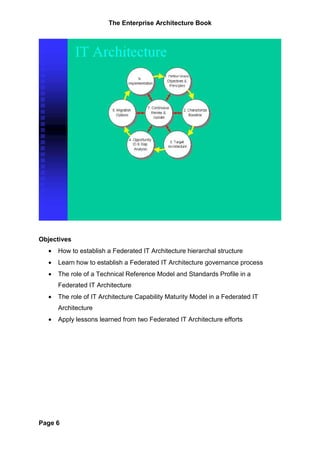
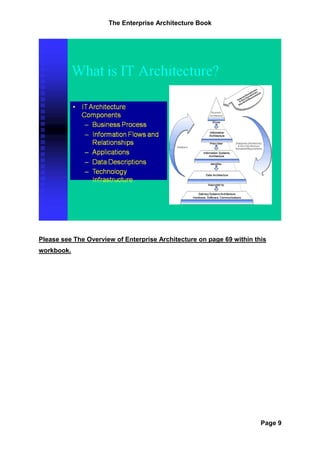
What is IT Architecture?
   •   A blueprint that explains how all the Information Technology and Management
       elements work together as a whole
   •   Provides explicit description of the current and desired relationships among
       business and management processes and Information Technology
   •   IT Architecture contains two elements:
       •   An Enterprise Architecture
       •   A Technical Reference Model and Standards Profile


                                                                              Page 7
The Enterprise Architecture Book


(a)   What is the Enterprise Architecture?


An EA is the explicit description and documentation of the current and desired
relationships among business and management processes and Information
Technology. It describes the "current architecture" and "target architecture" to include
the rules and standards and systems life cycle information to optimize and maintain
the environment which the agency wishes to create and maintain by managing its IT
portfolio.


The EA must also provide a strategy that will enable the agency to support its current
state and also act as the roadmap for transition to its target environment. These
transition processes will include an agency's capital planning and investment control
processes, agency EA planning processes, and agency systems life cycle
methodologies. The EA will define principles and goals and set direction on such
issues as the promotion of interoperability, open systems, public access, compliance
with GPEA, end user satisfaction, and IT security.

Page 8
The Enterprise Architecture Book


Please see The Overview of Enterprise Architecture on page 69 within this
workbook.


                                                                       Page 9
The Enterprise Architecture Book


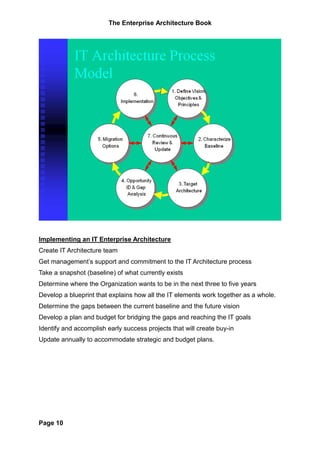
Implementing an IT Enterprise Architecture
Create IT Architecture team
Get management’s support and commitment to the IT Architecture process
Take a snapshot (baseline) of what currently exists
Determine where the Organization wants to be in the next three to five years
Develop a blueprint that explains how all the IT elements work together as a whole.
Determine the gaps between the current baseline and the future vision
Develop a plan and budget for bridging the gaps and reaching the IT goals
Identify and accomplish early success projects that will create buy-in
Update annually to accommodate strategic and budget plans.


Page 10
The Enterprise Architecture Book


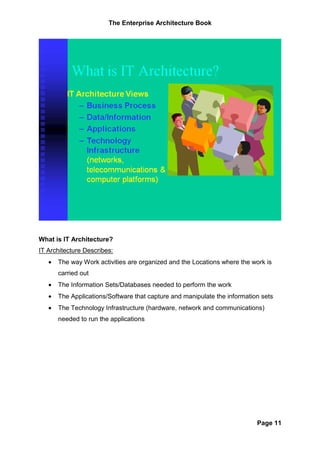
What is IT Architecture?
IT Architecture Describes:
   •   The way Work activities are organized and the Locations where the work is
       carried out
   •   The Information Sets/Databases needed to perform the work
   •   The Applications/Software that capture and manipulate the information sets
   •   The Technology Infrastructure (hardware, network and communications)
       needed to run the applications


                                                                           Page 11
The Enterprise Architecture Book


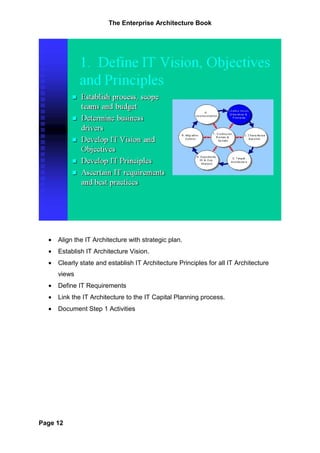
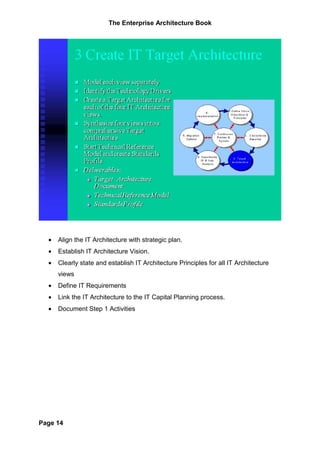
  •   Align the IT Architecture with strategic plan.
  •   Establish IT Architecture Vision.
  •   Clearly state and establish IT Architecture Principles for all IT Architecture
      views
  •   Define IT Requirements
  •   Link the IT Architecture to the IT Capital Planning process.
  •   Document Step 1 Activities


Page 12
The Enterprise Architecture Book


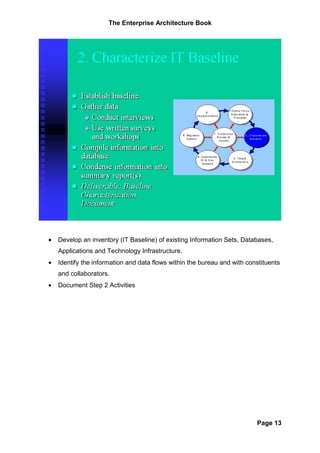
•   Develop an inventory (IT Baseline) of existing Information Sets, Databases,
    Applications and Technology Infrastructure.
•   Identify the information and data flows within the bureau and with constituents
    and collaborators.
•   Document Step 2 Activities


                                                                          Page 13
The Enterprise Architecture Book


  •   Align the IT Architecture with strategic plan.
  •   Establish IT Architecture Vision.
  •   Clearly state and establish IT Architecture Principles for all IT Architecture
      views
  •   Define IT Requirements
  •   Link the IT Architecture to the IT Capital Planning process.
  •   Document Step 1 Activities


Page 14
The Enterprise Architecture Book


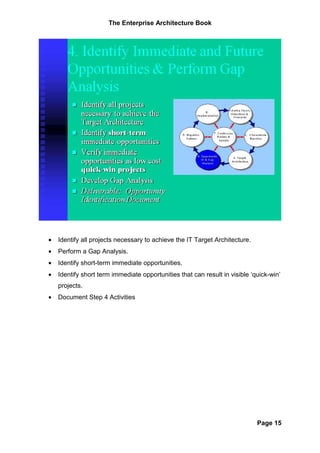
•   Identify all projects necessary to achieve the IT Target Architecture.
•   Perform a Gap Analysis.
•   Identify short-term immediate opportunities.
•   Identify short term immediate opportunities that can result in visible ‘quick-win’
    projects.
•   Document Step 4 Activities


                                                                             Page 15
The Enterprise Architecture Book


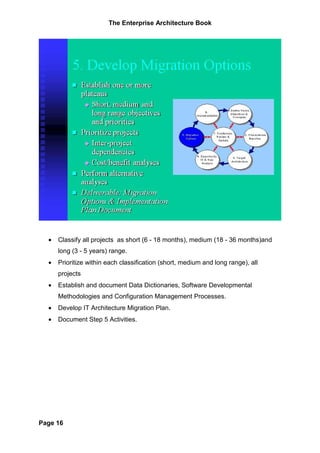
  •   Classify all projects as short (6 - 18 months), medium (18 - 36 months)and
      long (3 - 5 years) range.
  •   Prioritize within each classification (short, medium and long range), all
      projects
  •   Establish and document Data Dictionaries, Software Developmental
      Methodologies and Configuration Management Processes.
  •   Develop IT Architecture Migration Plan.
  •   Document Step 5 Activities.


Page 16
The Enterprise Architecture Book


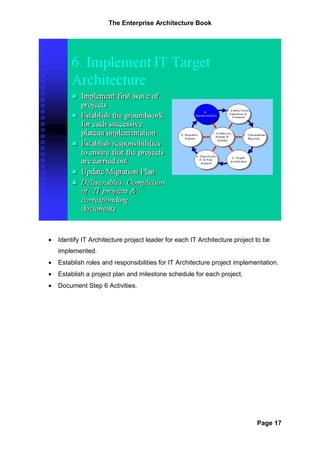
•   Identify IT Architecture project leader for each IT Architecture project to be
    implemented.
•   Establish roles and responsibilities for IT Architecture project implementation.
•   Establish a project plan and milestone schedule for each project.
•   Document Step 6 Activities.


                                                                             Page 17
The Enterprise Architecture Book


Page 18
The Enterprise Architecture Book


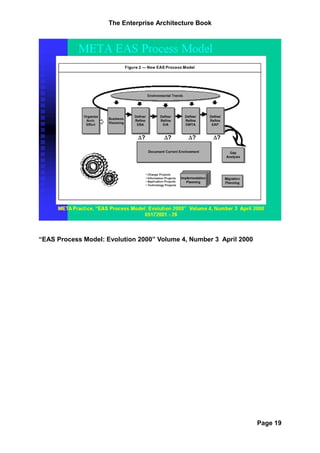
“EAS Process Model: Evolution 2000” Volume 4, Number 3 April 2000


                                                                    Page 19
The Enterprise Architecture Book


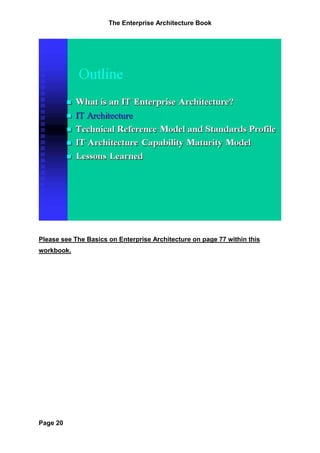
Please see The Basics on Enterprise Architecture on page 77 within this
workbook.


Page 20
The Enterprise Architecture Book


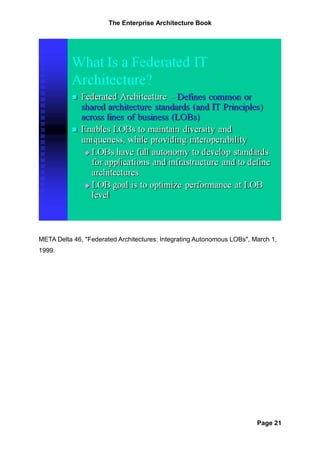
META Delta 46, "Federated Architectures: Integrating Autonomous LOBs", March 1,
1999.


                                                                        Page 21
The Enterprise Architecture Book


Page 22
The Enterprise Architecture Book


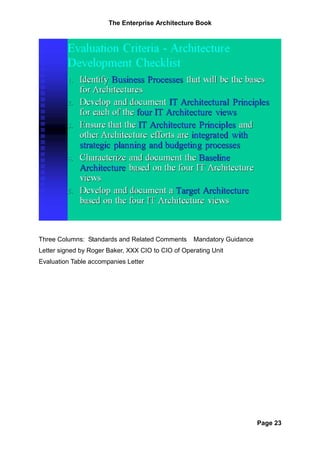
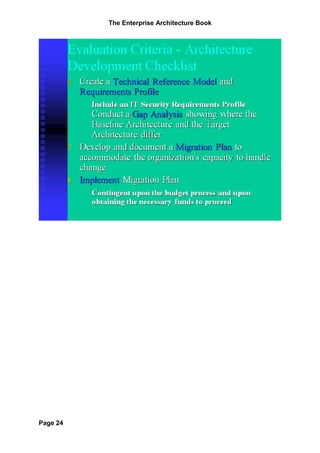
Three Columns: Standards and Related Comments       Mandatory Guidance
Letter signed by Roger Baker, XXX CIO to CIO of Operating Unit
Evaluation Table accompanies Letter


                                                                         Page 23
The Enterprise Architecture Book


Page 24
The Enterprise Architecture Book


                                   Page 25
The Enterprise Architecture Book


Page 26
The Enterprise Architecture Book


                                   Page 27
The Enterprise Architecture Book


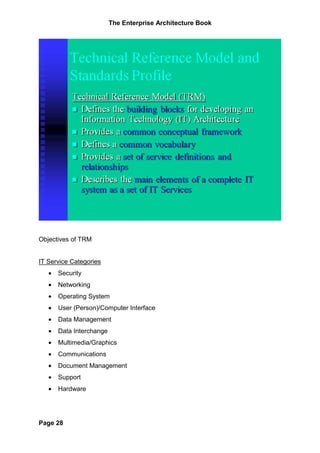
Objectives of TRM


IT Service Categories
   •   Security
   •   Networking
   •   Operating System
   •   User (Person)/Computer Interface
   •   Data Management
   •   Data Interchange
   •   Multimedia/Graphics
   •   Communications
   •   Document Management
   •   Support
   •   Hardware


Page 28
The Enterprise Architecture Book


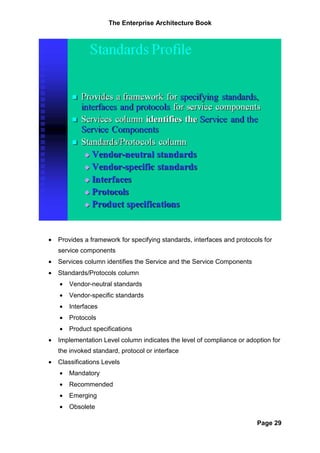
•   Provides a framework for specifying standards, interfaces and protocols for
    service components
•   Services column identifies the Service and the Service Components
•   Standards/Protocols column
    •   Vendor-neutral standards
    •   Vendor-specific standards
    •   Interfaces
    •   Protocols
    •   Product specifications
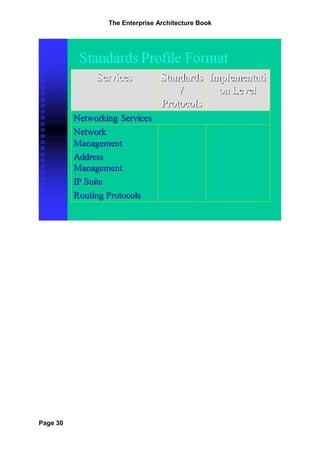
•   Implementation Level column indicates the level of compliance or adoption for
    the invoked standard, protocol or interface
•   Classifications Levels
    •   Mandatory
    •   Recommended
    •   Emerging
    •   Obsolete

                                                                         Page 29
The Enterprise Architecture Book


Page 30
The Enterprise Architecture Book


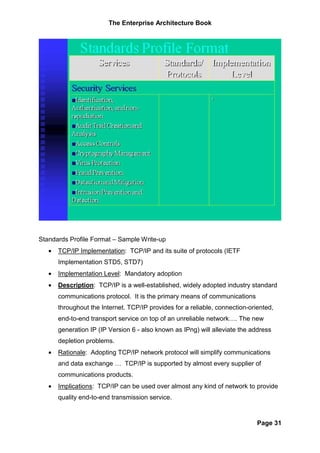
Standards Profile Format – Sample Write-up
   •   TCP/IP Implementation: TCP/IP and its suite of protocols (IETF
       Implementation STD5, STD7)
   •   Implementation Level: Mandatory adoption
   •   Description: TCP/IP is a well-established, widely adopted industry standard
       communications protocol. It is the primary means of communications
       throughout the Internet. TCP/IP provides for a reliable, connection-oriented,
       end-to-end transport service on top of an unreliable network…. The new
       generation IP (IP Version 6 - also known as IPng) will alleviate the address
       depletion problems.
   •   Rationale: Adopting TCP/IP network protocol will simplify communications
       and data exchange … TCP/IP is supported by almost every supplier of
       communications products.
   •   Implications: TCP/IP can be used over almost any kind of network to provide
       quality end-to-end transmission service.


                                                                              Page 31
The Enterprise Architecture Book


Page 32
The Enterprise Architecture Book


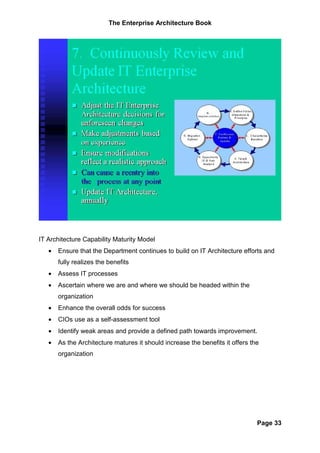
IT Architecture Capability Maturity Model
   •   Ensure that the Department continues to build on IT Architecture efforts and
       fully realizes the benefits
   •   Assess IT processes
   •   Ascertain where we are and where we should be headed within the
       organization
   •   Enhance the overall odds for success
   •   CIOs use as a self-assessment tool
   •   Identify weak areas and provide a defined path towards improvement.
   •   As the Architecture matures it should increase the benefits it offers the
       organization


                                                                               Page 33
The Enterprise Architecture Book


Page 34
The Enterprise Architecture Book


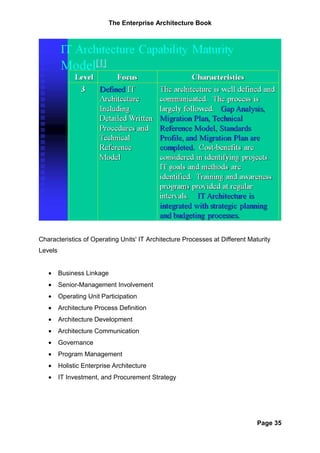
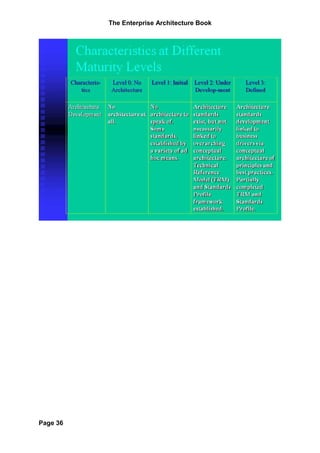
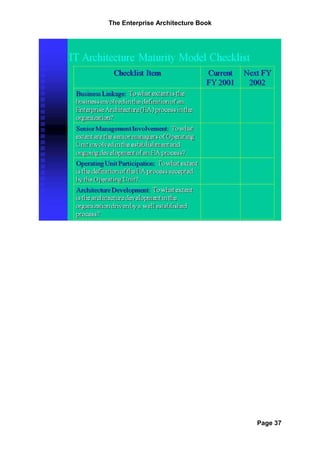
Characteristics of Operating Units' IT Architecture Processes at Different Maturity
Levels


   •     Business Linkage
   •     Senior-Management Involvement
   •     Operating Unit Participation
   •     Architecture Process Definition
   •     Architecture Development
   •     Architecture Communication
   •     Governance
   •     Program Management
   •     Holistic Enterprise Architecture
   •     IT Investment, and Procurement Strategy


                                                                              Page 35
The Enterprise Architecture Book


Page 36
The Enterprise Architecture Book


                                   Page 37
The Enterprise Architecture Book


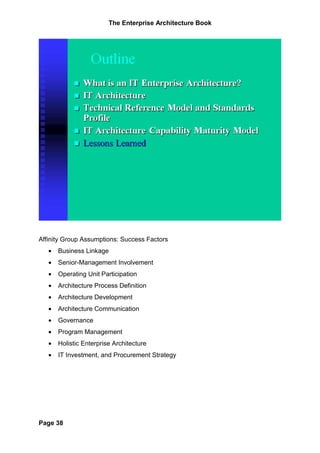
Affinity Group Assumptions: Success Factors
   •   Business Linkage
   •   Senior-Management Involvement
   •   Operating Unit Participation
   •   Architecture Process Definition
   •   Architecture Development
   •   Architecture Communication
   •   Governance
   •   Program Management
   •   Holistic Enterprise Architecture
   •   IT Investment, and Procurement Strategy


Page 38
The Enterprise Architecture Book


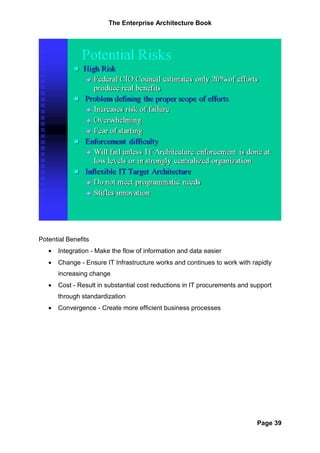
Potential Benefits
   •   Integration - Make the flow of information and data easier
   •   Change - Ensure IT Infrastructure works and continues to work with rapidly
       increasing change
   •   Cost - Result in substantial cost reductions in IT procurements and support
       through standardization
   •   Convergence - Create more efficient business processes


                                                                            Page 39
The Enterprise Architecture Book


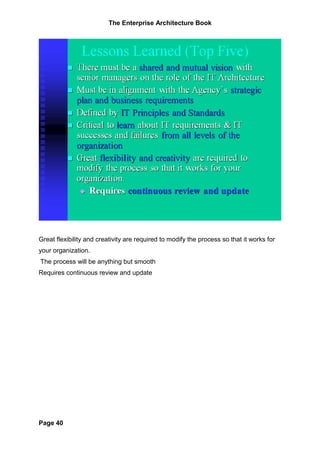
Great flexibility and creativity are required to modify the process so that it works for
your organization.
The process will be anything but smooth
Requires continuous review and update


Page 40
The Enterprise Architecture Book


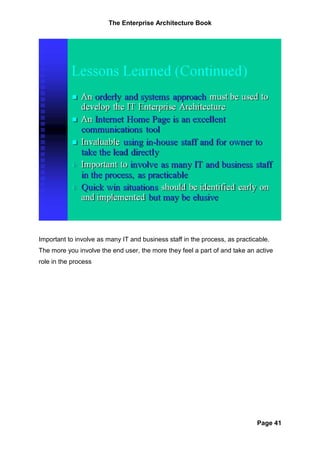
Important to involve as many IT and business staff in the process, as practicable.
The more you involve the end user, the more they feel a part of and take an active
role in the process


                                                                             Page 41
The Enterprise Architecture Book


Page 42
The Enterprise Architecture Book


ZACHMAN FRAMEWORK


                                                Page 43
The Enterprise Architecture Book


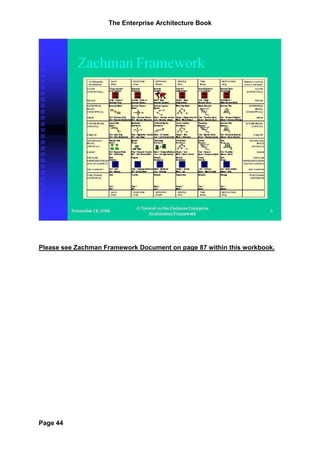
Please see Zachman Framework Document on page 87 within this workbook.


Page 44
The Enterprise Architecture Book


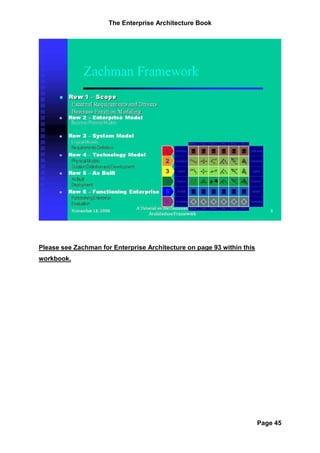
Please see Zachman for Enterprise Architecture on page 93 within this
workbook.


                                                                        Page 45
The Enterprise Architecture Book


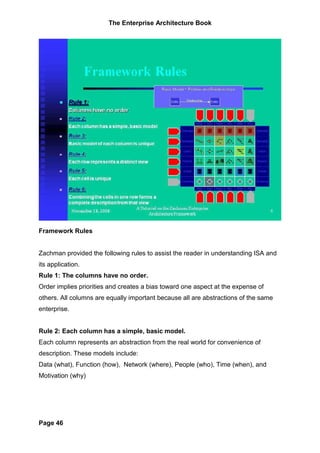
Framework Rules


Zachman provided the following rules to assist the reader in understanding ISA and
its application.
Rule 1: The columns have no order.
Order implies priorities and creates a bias toward one aspect at the expense of
others. All columns are equally important because all are abstractions of the same
enterprise.


Rule 2: Each column has a simple, basic model.
Each column represents an abstraction from the real world for convenience of
description. These models include:
Data (what), Function (how), Network (where), People (who), Time (when), and
Motivation (why)


Page 46
The Enterprise Architecture Book


  Continued…


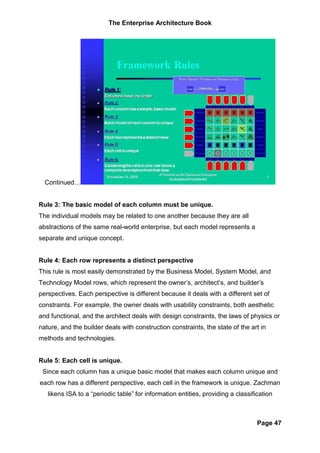
Rule 3: The basic model of each column must be unique.
The individual models may be related to one another because they are all
abstractions of the same real-world enterprise, but each model represents a
separate and unique concept.


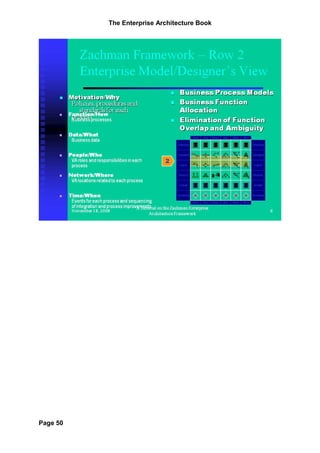
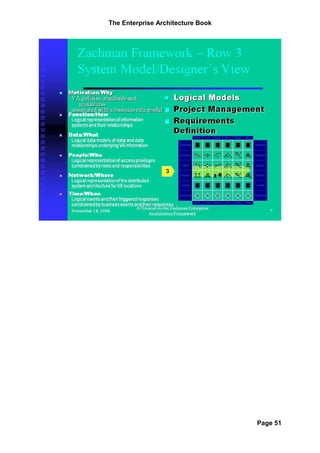
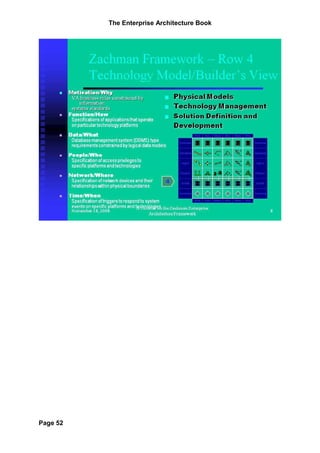
Rule 4: Each row represents a distinct perspective
This rule is most easily demonstrated by the Business Model, System Model, and
Technology Model rows, which represent the owner’s, architect’s, and builder’s
perspectives. Each perspective is different because it deals with a different set of
constraints. For example, the owner deals with usability constraints, both aesthetic
and functional, and the architect deals with design constraints, the laws of physics or
nature, and the builder deals with construction constraints, the state of the art in
methods and technologies.


Rule 5: Each cell is unique.
 Since each column has a unique basic model that makes each column unique and
each row has a different perspective, each cell in the framework is unique. Zachman
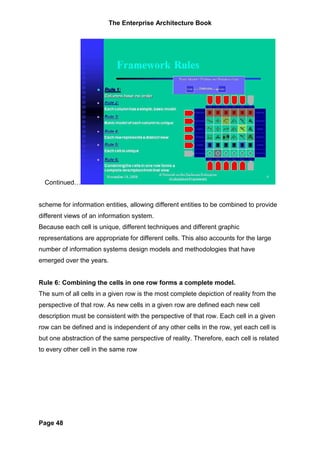
   likens ISA to a “periodic table” for information entities, providing a classification


                                                                                  Page 47
The Enterprise Architecture Book


  Continued…


scheme for information entities, allowing different entities to be combined to provide
different views of an information system.
Because each cell is unique, different techniques and different graphic
representations are appropriate for different cells. This also accounts for the large
number of information systems design models and methodologies that have
emerged over the years.


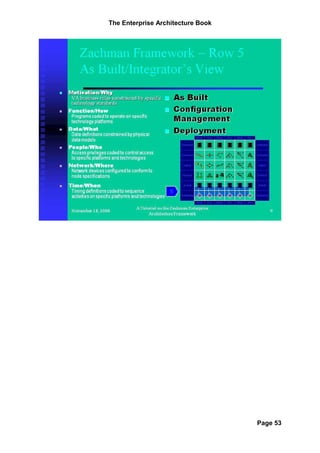
Rule 6: Combining the cells in one row forms a complete model.
The sum of all cells in a given row is the most complete depiction of reality from the
perspective of that row. As new cells in a given row are defined each new cell
description must be consistent with the perspective of that row. Each cell in a given
row can be defined and is independent of any other cells in the row, yet each cell is
but one abstraction of the same perspective of reality. Therefore, each cell is related
to every other cell in the same row


Page 48
The Enterprise Architecture Book


                                   Page 49
The Enterprise Architecture Book


Page 50
The Enterprise Architecture Book


                                   Page 51
The Enterprise Architecture Book


Page 52
The Enterprise Architecture Book


                                   Page 53
The Enterprise Architecture Book


Page 54
The Enterprise Architecture Book


                                   Page 55
The Enterprise Architecture Book


Page 56
The Enterprise Architecture Book


EXECUTIVE OVERVIEW


How can we improve the IT planning process?

Your priorities:

   •   Stakeholder-defined technology architecture guidelines/standards

   •   Integrated, flexible planning/project management process (addressing funding
       issues and needs of different types and sizes of agencies)

   •   Streamline/facilitate IT procurements

   •   IT intelligence sharing/information exchange


                                                                          Page 57
The Enterprise Architecture Book


Page 58
The Enterprise Architecture Book


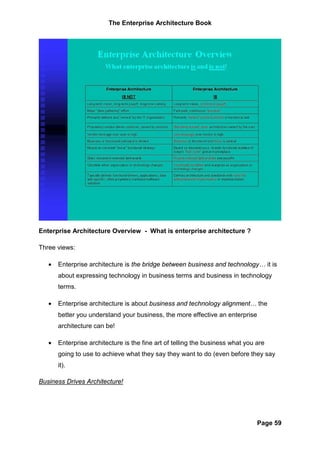
Enterprise Architecture Overview - What is enterprise architecture ?

Three views:

   •   Enterprise architecture is the bridge between business and technology… it is
       about expressing technology in business terms and business in technology
       terms.

   •   Enterprise architecture is about business and technology alignment… the
       better you understand your business, the more effective an enterprise
       architecture can be!

   •   Enterprise architecture is the fine art of telling the business what you are
       going to use to achieve what they say they want to do (even before they say
       it).

Business Drives Architecture!


                                                                                Page 59
The Enterprise Architecture Book


Page 60
The Enterprise Architecture Book


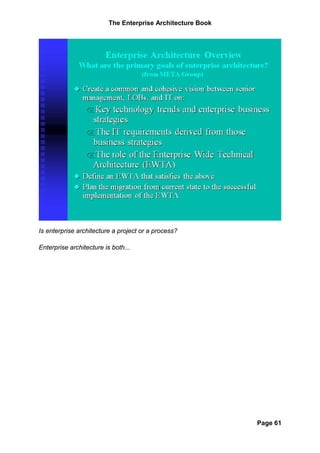
Is enterprise architecture a project or a process?

Enterprise architecture is both...


                                                             Page 61
The Enterprise Architecture Book


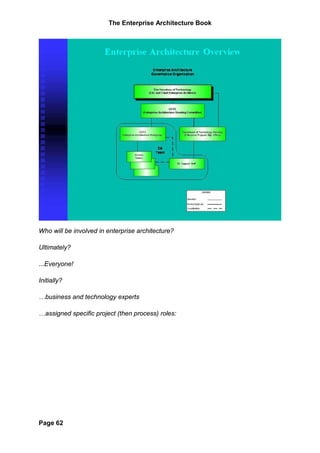
Who will be involved in enterprise architecture?

Ultimately?

...Everyone!

Initially?

…business and technology experts

…assigned specific project (then process) roles:


Page 62
The Enterprise Architecture Book


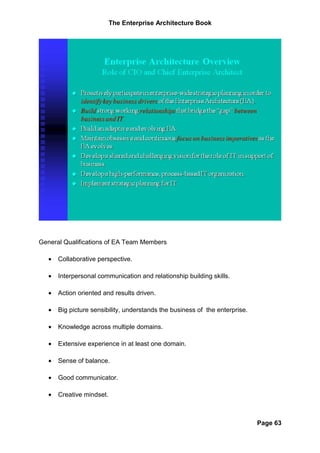
General Qualifications of EA Team Members

   •   Collaborative perspective.

   •   Interpersonal communication and relationship building skills.

   •   Action oriented and results driven.

   •   Big picture sensibility, understands the business of the enterprise.

   •   Knowledge across multiple domains.

   •   Extensive experience in at least one domain.

   •   Sense of balance.

   •   Good communicator.

   •   Creative mindset.


                                                                              Page 63
The Enterprise Architecture Book


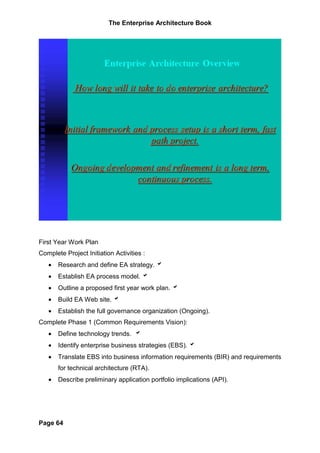
First Year Work Plan
Complete Project Initiation Activities :
   •   Research and define EA strategy. b
   •   Establish EA process model. b
   •   Outline a proposed first year work plan. b
   •   Build EA Web site. b
   •   Establish the full governance organization (Ongoing).
Complete Phase 1 (Common Requirements Vision):
   •   Define technology trends. b
   •   Identify enterprise business strategies (EBS). b
   •   Translate EBS into business information requirements (BIR) and requirements
       for technical architecture (RTA).
   •   Describe preliminary application portfolio implications (API).


Page 64
The Enterprise Architecture Book


Continued…


Begin Phase 2:
   •   Document current environment and technology baseline, the “as is”
       architecture.
   •   (Note: This effort can begin concurrent with Phase 1 activities.)
   •   Define a conceptual architecture, based on principles and best practices.
   •   Begin to define domain architectures.
   •   Begin gap analysis.


                                                                            Page 65
The Enterprise Architecture Book


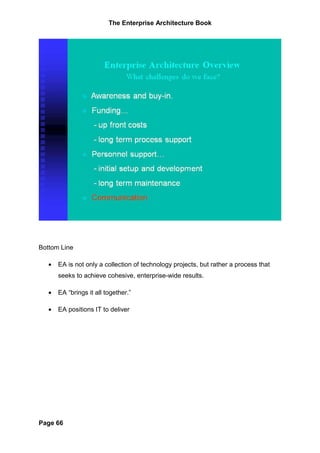
Bottom Line

   •   EA is not only a collection of technology projects, but rather a process that
       seeks to achieve cohesive, enterprise-wide results.

   •   EA “brings it all together.”

   •   EA positions IT to deliver


Page 66
The Enterprise Architecture Book


SUPPORTING DOCUMENTS

Through the documents, look for text surrounded by << and >> these are
indicators for you to create some specific text.


Watch also for highlighted text which provides further guidance and
instructions.


                                                                      Page 67
The Enterprise Architecture Book


Page 68
The Enterprise Architecture Book


THE OVERVIEW: ENTERPRISE ARCHITECTURE

Recently there has been a surprising increase of interest in developing and using
Enterprise Architectures as the "blueprint" for all enterprise engineering activities
including data warehousing, software engineering, information engineering,
commercial software evaluation, enterprise application integration, business to
business and business to customer e-commerce, and the list is endless. The
remarkable truth is that all of these activities are facilitated, and in some instances
even made possible, by an enterprise architecture.


This is not a new concept. In 1987, John Zachman formally proposed the use of
such architectures for software engineering (J. Zachman, "A Framework for
Information Systems Architecture", IBM Systems Journal, 1987, 26(3), pp 276-292).
Since then, Zachman has extended the concept to include more than software
engineering and countless organizations have successfully established and used the
enterprise architecture that Zachman envisioned.


What is new is the realization by many organizations that an enterprise architecture,
properly engineered, could possibly be the single most effective tool they can use to
ensure that the right information gets to the right people, in the right format, and at
the right time.


An enterprise architecture links an enterprise’s strategic plan and performance plans
("business architecture") with its enterprise data architecture, enterprise application
architecture and enterprise technical architecture.
A well-documented architecture is a logical organization of information pertaining to
the following multi-level, multi-dimensional, enterprise-wide elements:
   Strategic goals, objectives, and strategies
   Business rules and measures
   Information requirements
   Application systems
   Relationships between applications and data elements
   Technology infrastructure


                                                                                 Page 69
The Enterprise Architecture Book


An enterprise architecture also contains guidelines, standards, policies and business
rules that define the enterprise’s software engineering environment.
Every enterprise has an architecture. However, it is usually undocumented and the
elements are inconsistent. Most likely some of the architecture elements are
embodied in strategic and performance plans, published and unpublished policies
and procedures, and system documentation. Unfortunately, there are also a lot of
enterprise architecture elements that are embedded in software application code,
and even more that only exist as employee "tribal knowledge."


An enterprise that has fully documented its architecture can use it to accomplish the
following:
   Facilitate change management by linking strategic requirements to systems
   that support them and by linking the business model to application designs
   Enable strategic information to be consistently and accurately derived from
   operational data
   Promote data sharing, thus reducing data redundancy and reducing
   maintenance costs
   Improve productivity through component development, management and
   reuse
   Reduce software development cycle time
   Evaluate commercial products and services
   Share information with customers and business partners
In order to establish an enterprise architecture that can be used to gain these
benefits, it must be “engineered.” This requires rigorous and repeatable approach
that is strategically-driven, information-centric, model-based, and technology
independent. It also requires tools that fully support the approach.
The remainder of this paper describes an effective, productive, common sense
approach to engineering an enterprise architecture. This approach can also be
extended to include all the activities necessary for effective enterprise strategic
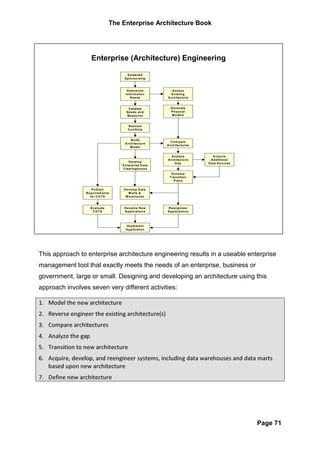
information management. Enterprise Architecture Engineering -- At a Glance The
following diagram illustrates the Enterprise Architecture Engineering approach
described in this paper.


Page 70
The Enterprise Architecture Book


                     Enterprise (Architecture) Engineering

                                         E stab lis h
                                       S p on so rsh ip


                                         D ete rm in e           A sses s
                                        In fo rm atio n          E x is tin g
                                            N ee ds           A rch itectu re


                                          V alid ate            G e n e ra te
                                         N e ed s an d          P h ys ic al
                                         M e asu res             M o d e ls


                                          R es olve
                                          C o n flicts


                                            B u ild
                                                                 C om pa re
                                        A rch itectu re
                                                              A rc hitec tures
                                            M o d el


                                                                 A n alyz e           A cq uire
                                                              A rch itectu re        A d d itio n a l
                                           D eve lo p
                                                                   G ap            D ata S o u rces
                                      E n terprise D ata
                                      C lea rin g h o u s e
                                                                 D eve lo p
                                                                T ran sitio n
                                                                   P lan s


                     P u b lish        D ev elop D a ta
                 R eq u irem en ts        M arts &
                    fo r C O T S        W a re h o u se


                     E valu ate        D eve lo p N ew        R een g in eer
                       CO TS           A p p licatio n s      A p p lica tio n s


                                        Im p le m en t
                                        A pp lic ation


This approach to enterprise architecture engineering results in a useable enterprise
management tool that exactly meets the needs of an enterprise, business or
government, large or small. Designing and developing an architecture using this
approach involves seven very different activities:

1. Model the new architecture
2. Reverse engineer the existing architecture(s)
3. Compare architectures
4. Analyze the gap
5. Transition to new architecture
6. Acquire, develop, and reengineer systems, including data warehouses and data marts
   based upon new architecture
7. Define new architecture


                                                                                                        Page 71
The Enterprise Architecture Book


Identify Enterprise Needs

Identifying enterprise needs is the first, crucial task when engineering an enterprise
architecture. When developing operational information systems, there is often one
single sponsor or one group of users with a clear view of what they need, what the
system should look like, and how it should function. Unlike single-dimensional
application development, when developing an enterprise architecture, there are
normally multiple potential sponsors, each with a different idea of what the enterprise
architecture is and what it should provide, and all requesting or demanding action.
Because of this lack of a single focused direction, identifying precise enterprise
needs is critical to the success of an enterprise architecture project. Different views
of the architecture should be established to represent the varying perspectives of the
architecture stakeholders and enterprise information owners.
Enterprise needs (the business architecture) should be expressed in terms of
business functions, business rules, measures of effectiveness, and critical success
factors. An enterprise’s business plans typically provide the basis for defining
preliminary enterprise needs. In addition, it may be necessary to interview key
enterprise managers and analyze other pertinent documentation in order to ascertain
the enterprise’s strategic information needs.
The best technique for defining and refining preliminary enterprise information needs
is to conduct a series of facilitated focus group sessions. (If no business or
performance plans exist, similar sessions first should be used to create the plans.)
The participants in any of these sessions should be decision-makers for whom the
information is important.


Validate Needs and Measures

After identifying and defining enterprise needs, it is advantageous to communicate
them throughout the enterprise. One of the best justifications for undertaking an
architecture project is the synergy achieved through the process of defining and then
communicating its critical success factors and measures. Everyone becomes aware
of precisely what defines success and how it is measured. In addition, the measures
undergo a "reality check" by people who were not involved in their development, but
who may be measured by them and who will be involved in creating the raw data


Page 72
The Enterprise Architecture Book


from which the measures will be derived. Their feedback is used for refining the
measures.
Completely validating enterprise measures includes describing the cycles or time
periods used. Are quarters, months, or hours appropriate for capturing useful
measurement data? How much historical data will be needed? These vary greatly
by enterprise. The United States Federal Reserve Bank views enterprise measures
in monthly, quarterly and annual increments and uses years of historical data to
determine trends in the economy. An insurance company requires decades of
actuarial data for meaningful measures. A telephone sales operation, on the other
hand, uses hourly enterprise measures and may keep only a few weeks of historical
information.


Resolve Data Conflicts

A well-defined enterprise architecture model cannot contain homonyms, synonyms,
or other data definition conflicts. It must be semantically clear, correct and
consistent. Data definition conflicts often exist because enterprises have one or
more major terms that are used by everyone in the enterprise, but mean different
things in different organizational units. One of the most common examples is
"customer."


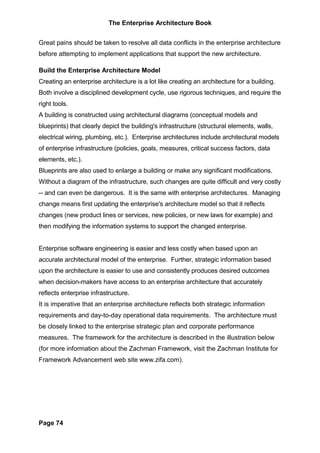
  taht )laudividni ro( noitazinagro eht naem dluoc "remotsuc" ,tnemtrapeD gnitnuoccA eht oT


  .tcudorp a gniyub ro ecivres gniviecer laudividni na naem osla dluoc "remotsuC" .llib a seviecer


  nosrepselas eht hcihw no snoitazinagro eht naem dluoc "remotsuc" ,tnemtrapeD selaS eht oT


  tnemele atad emas eht ebircsed ot seman tnereffid esu yam tnemtraped hcae ,yllanoitiddA .sllac


  .)…sv tcepsorP .sv tneilC .sv remotsuC(


Providing any single interpretation as the only enterprise definition of “customer”
would not meet the needs of the enterprise and would predispose its information
resource management efforts to failure. The conflicts must be resolved so that the
enterprise architecture not only provides the corporate definition of customer, it also
reflects the various definitions understood and used by every enterprise element. It
must also include links between every enterprise architecture data element and
every application data element that implements it (more about this later).


                                                                                          Page 73
The Enterprise Architecture Book


Great pains should be taken to resolve all data conflicts in the enterprise architecture
before attempting to implement applications that support the new architecture.

Build the Enterprise Architecture Model
Creating an enterprise architecture is a lot like creating an architecture for a building.
Both involve a disciplined development cycle, use rigorous techniques, and require the
right tools.
A building is constructed using architectural diagrams (conceptual models and
blueprints) that clearly depict the building's infrastructure (structural elements, walls,
electrical wiring, plumbing, etc.). Enterprise architectures include architectural models
of enterprise infrastructure (policies, goals, measures, critical success factors, data
elements, etc.).
Blueprints are also used to enlarge a building or make any significant modifications.
Without a diagram of the infrastructure, such changes are quite difficult and very costly
-- and can even be dangerous. It is the same with enterprise architectures. Managing
change means first updating the enterprise's architecture model so that it reflects
changes (new product lines or services, new policies, or new laws for example) and
then modifying the information systems to support the changed enterprise.


Enterprise software engineering is easier and less costly when based upon an
accurate architectural model of the enterprise. Further, strategic information based
upon the architecture is easier to use and consistently produces desired outcomes
when decision-makers have access to an enterprise architecture that accurately
reflects enterprise infrastructure.
It is imperative that an enterprise architecture reflects both strategic information
requirements and day-to-day operational data requirements. The architecture must
be closely linked to the enterprise strategic plan and corporate performance
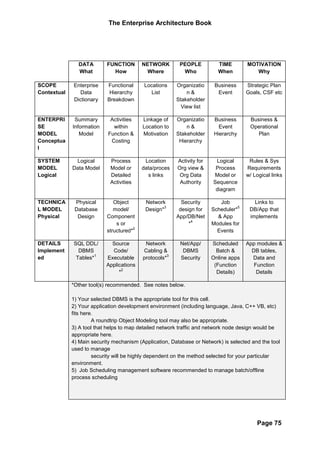
measures. The framework for the architecture is described in the illustration below
(for more information about the Zachman Framework, visit the Zachman Institute for
Framework Advancement web site www.zifa.com).


Page 74
The Enterprise Architecture Book


               DATA        FUNCTION       NETWORK        PEOPLE          TIME        MOTIVATION
               What          How            Where         Who            When           Why

SCOPE        Enterprise    Functional      Locations    Organizatio     Business     Strategic Plan
Contextual     Data         Hierarchy        List           n&           Event       Goals, CSF etc
             Dictionary    Breakdown                    Stakeholder
                                                          View list

ENTERPRI      Summary        Activities   Linkage of    Organizatio     Business      Business &
SE           Information      within      Location to       n&            Event       Operational
MODEL           Model       Function &    Motivation    Stakeholder     Hierarchy        Plan
Conceptua                    Costing                     Hierarchy
l

SYSTEM        Logical       Process        Location     Activity for    Logical       Rules & Sys
MODEL        Data Model     Model or      data/proces   Org view &      Process      Requirements
Logical                     Detailed        s links      Org Data      Model or      w/ Logical links
                            Activities                   Authority     Sequence
                                                                        diagram

TECHNICA      Physical        Object       Network        Security        Job           Links to
                                                  3                              5
L MODEL       Database        model/       Design*       design for    Scheduler*     DB/App that
Physical       Design      Component                    App/DB/Net       & App        implements
                                                              4
                               s or                          *         Modules for
                                      2
                           structured*                                   Events

DETAILS      SQL DDL/        Source        Network       Net/App/      Scheduled     App modules &
Implement      DBMS          Code/        Cabling &       DBMS           Batch &       DB tables,
                     1                              3
ed            Tables*      Executable     protocols*     Security      Online apps     Data and
                           Applications                                 (Function       Function
                                 2
                                *                                        Details)        Details

             *Other tool(s) recommended. See notes below.

             1) Your selected DBMS is the appropriate tool for this cell.
             2) Your application development environment (including language, Java, C++ VB, etc)
             fits here.
                      A roundtrip Object Modeling tool may also be appropriate.
             3) A tool that helps to map detailed network traffic and network node design would be
             appropriate here.
             4) Main security mechanism (Application, Database or Network) is selected and the tool
             used to manage
                      security will be highly dependent on the method selected for your particular
             environment.
             5) Job Scheduling management software recommended to manage batch/offline
             process scheduling


                                                                                         Page 75
The Enterprise Architecture Book


Page 76
The Enterprise Architecture Book


THE BASICS ON ENTERPRISE ARCHITECTURE

Introduction
Having a complete and well documented Information Technology Enterprise
Architecture allows for an organization to make effective decisions about which IT
projects to pursue and the technology or products to use in the implementation.


What Is Enterprise Architecture?

The first phase of the Systems Development Life Cycle (SDLC) is called Project


Identification and Selection. It is in this initial phase that potential projects are
identified and ranked. Then particular projects are chosen for further investigation,
such as a more in-depth cost benefit analysis, or for implementation. So, what
criteria are used to determine which IT projects are going to be pursued or
discarded? If a project is to be pursued further, what technology will be used to
implement and what base infrastructure is needed? These are the answers that an


Enterprise Architecture can answer. Known by a variety of other names such as
Information Architecture, Application Architecture, Business System Architecture,
Enterprise Wide Technical Architecture, the basic process is the same – to develop a
high level plan of how IT will meet future business problems. To briefly define each
of the above mentioned “subsets” of IT Planning:
•   Information Architecture – very similar to Enterprise Architecture, but focuses
    more on the application and data aspects of an IT system. Often includes the
    Application Architecture (mentioned below) and the corporate data model.
•   Application Architecture – highlights the data flows between applications in a
    integrated information system.
•   Business System Architecture – a mix of the strategic plans for both IT and
    business resources. It is normally in pictorial form and used for high-level
    planning.
•   Enterprise Wide Technical Architecture – Another name for Enterprise
    Architecture, that better stresses that technical components as well as the
    infrastructure components of EA (http://www.ewita.com).

                                                                                 Page 77
The Enterprise Architecture Book


A common word in each of the individual components above is architecture. In this
context, an architecture is merely “a set of shared definitions and constraints that
are expected to effect a time, cost or risk reduction in future application development
or operations" (Gartner). The concept of an architecture is then applied to individual
components of a company’s IT infrastructure, or taken all together, covering the
entire enterprise. Each of the components mentioned above complement each
other to form a common goal – effective and efficient IS planning.


A corporation of any size is going to spend a considerable amount of energy
preparing a strategic plan for their business. Corporate strategic planning is where a
corporation takes their current business environment and decides where they want
to be in the future. They then construct a strategic plan on how to get from the
current to the future state. A very analogous process can be applied to Information
Technology – where the current infrastructure is examined, then the desired future
architecture is laid out based on both the business plans as well as what is known
about future technology. A set of projects is then constructed to achieve this goal. It
is important that both business needs and technical needs are considered.
Upgrades, replacements and improvements can’t be performed for technology’s
sake unless there is a business need for it. Conversely, it wouldn’t make a lot of
sense to built complex business processes on top of obsolete information technology
infrastructure.


Traditionally, problems are identified and a project is initiated to solve that particular
problem. A planning-based approach looks further into the future and seeks to find a
solution to the problem both as it exists today and into the future. This is particularly
important for projects that span multiple departments or business units in an
organization or many organizations. Also, as IT costs are becoming a larger and
larger piece of the budget, the cost of an IT “mistake” is more closely scrutinized.
Internet and E-commerce applications and their associated technology are rapidly
growing. An organization may outgrow a specific solution but a strategy is more long
term. Granted, there are times when a tactical, short-term solution is the best
approach to address a very specific, immediate need. However, it must be pointed
out to the business leaders that this is the approach being taken, and the short term


Page 78
The Enterprise Architecture Book


gains may be offset by future support costs, conversion costs, or other implications
of not working within a well-defined strategy.


Building an IT strategy based on a specific architecture can be considered a good
investment – spend the time today for a payoff in the future. Or it could be
considered a risky “bet.” Whether or not it is considered a “bet” or an “investment”
relies on the level of predictability of the environment. A limitation of an architecture
is that it relies on being able to predict the business needs into the future, and the
basics of the technical needs. For example, it is probably a pretty safe bet that a
company is going to want to share files and printers well into the future. They are
also going to be able to want to communicate effectively with their suppliers and
retailers. If the exact technical requirements (of these business requirements) were
known, then all that is needed is a design, not an architecture. However, the
architecture is going to describe these requirements at a higher level - such as the
type of programming languages (e.g. object oriented) or Intel hardware (vs. Sun).
However, the less certain about the future environment, the shorter the life span of
the architecture and it will have a more narrow scope. In highly volatile
environments, maybe the architecture is only good for a year or two, but constantly
revised each year for the next two.


Using the term "strategy", especially when discussing the development of an
Enterprise Architecture, can be confusing. A strategy and an architecture are
relatively analogous terms. However, an architecture is often thought more of as a
static picture that you draw on the wall. A strategy is more like putting the
architecture into motion, defining not only what is to be accomplished, but how it is
going to be accomplished.


IT architecture is analogous to a homeowner discussing high level plans for a house
with an architect. After the plans are made, the architect or the builder (designer) can
make tactical changes later on to meet other requirements, but the overall framework
will stay the same. The same thing applies to IT. An Enterprise Architecture is a high
level planning guide for building the infrastructure out. It has to be flexible enough,
however, to accept minor changes on down the road.


                                                                                 Page 79
The Enterprise Architecture Book


Why Should An Organization Consider Enterprise Architecture?

The role of IT in organizations is changing. In the past, IT was a cost center – it
didn’t add to the bottom line, nor did it help gain a competitive advantage. The best
that IT could do was reduce costs. However, in the past 10 years, CEOs are
realizing that that IT can indeed directly increase revenue. From 1992 to 2002, the
percentage of IT investments that grow revenue within a corporation will rise from
30% to an estimated 80% (Meta). This is significant. IT is now more than just
overhead for a corporation, it is a business asset that much be controlled, monitored,
and managed like any other asset such as buildings, factories, or machinery.
Enterprise Architecture also allows a company to treat all of its IT assets as a
portfolio rather than individual items. Just as you manage a stock portfolio for certain
attributes, such as risk, etc., IT infrastructure should be managed the same way.

Enterprise architecture is the way to strategically manage a company’s investment in
IT. In times of industry consolidation, mergers, acquisitions, spin-offs, drops in the
stock market, and a rougher economy, IT enterprise architecture might be the first
thing to take a back seat to more pressing business problems. However, this is the
worst thing a company can do. At times like these, a company needs to be able to
quickly realign their IT strategy with their changing business strategy. If a corporation
doesn't have a well documented IT strategy, as an enterprise architecture, then
these changes are going to be very hard to make.


Some of the other benefits in having a mature enterprise architecture lie in several
areas. First, by having a well established idea of what infrastructure is going to be
needed in a company, efforts can go into building it, and building it with growth in
mind. Then, as specific business applications wish to utilize this infrastructure for
their needs, it is already built and ready to go. Standards are another area that, while
may seem as a hindrance to some, can be enforced by having a documented
enterprise architecture. When a company supports standards, especially in the IT
arena, support costs are drastically lowered, allowing the IT staff to do one thing, and
do it well vs. having to support a wide-variety of systems, but doing none of them
particularly well.


Page 80
The Enterprise Architecture Book


Having an enterprise architecture can also help a company retain talented staff by
being able to better focus training and other employee development funds, allowing
the IT staff to focus on services for their internal “clients”, reduces the number of
technologies the support staff has to support (see standards discussion above), and
helps better focus the employees efforts, making their job descriptions much more
clear.


As was previously mentioned, creating and maintaining an Enterprise Architecture is
an investment for a company to make, with the payoff occurring sometime in the
future. The goal is to be able to deliver the right information to the right decision
makers at the right time.


Seventy percent of large companies are currently too busy fighting fires, solving
short-term tactical solutions and not developing long-term strategic plans. Just as
planning your business strategy takes a different mindset, so does developing an
Enterprise Architecture. Often a company’s culture and current employees are more
focused on the project at hand rather than looking at their environment from a
enterprise standpoint. Because of this, simply trying to “make” your IT department
think strategically will most likely fail. When Enterprise Architecture is run as a
program, with dedicated staff and an on-going review of the plans, a corporation is
much more likely to have the efforts supported and accepted by the business and IT
staff.


Once the architecture is defined, then individual business units merely have to see
where they “plug-in” to it to get their work done. For example, if the architecture
plans says we are going towards a unified ERP solution, such as SAP, and a
business unit wants a payroll system, maybe looking at SAP is a good start. Or if
Unix systems are the “standard”, then that part of the design is already done. Finally,
if the architecture defines that employee portals are important to the company to
boost productivity, then a project to put a portal component together will be approved
much faster than a standalone system would.


Having an Enterprise IT Architecture is also a valuable tool in reaching the 2nd and
3rd level of the SEI's Capability Maturity Model where the model calls for repeatable

                                                                                 Page 81
The Enterprise Architecture Book


tasks and a defined organizational mission. An Enterprise Architecture forces an
organization to document their IT plans and align them with the business needs.
Once the plans are in place, and standards are set, it is much easier to use the same
methodologies, if not the same technologies to deliver business solutions. Business
leadership is critical in making this move, and with enough commitment, a well
defined architecture can easily push a business to the next level on the SEI model
(level 2 or 3) (Meta - Enterprise Architecture Process...).


Architectures are not set in stone. However, if a business case is made for
something that deviates from these standards, these plans are not show stoppers,
merely a reason to stop and think about it. It is this "stopping and thinking" that
shows where an Enterprise Architecture adds value. It gives the IT decision makers
a baseline of the current and future environment so they can decide how (if at all)
this new project fits into their architecture plans and how well it will work as the plans
mature. It is up to management to decide whether or not to pursue this deviation
from the standard. Or perhaps it is a signal that the standard needs to be revisited.
Again, as was previously mentioned, the architecture plans need to be flexible
enough to allow these kinds of changes as the technology and the business also
changes.


Who Is An Architect And What Do They Do?

Below are six major "parts" of constructing an Enterprise Architecture that an
Enterprise Architect would be responsible for: (This information was taken from an
Information World article by Paul Cottey)
Identify the current state of how IT is currently being used in the organization, what
technologies are being used and how they are deployed along with the business
value that IT is providing.
   •   Examine and document any current initiatives currently being planned or
       implemented that involves IT resources.
   •   Document the future state if the current plans execute and business continues
       as usual.
   •   Document the desired future state, where the business would like to be from
       an IT perspective.


Page 82
The Enterprise Architecture Book


   •   Document the "gap" between the two future states. This is the difference
       between where the IT organization is heading and where it would like to be.
   •   Construct a list of projects and initiatives to put the IT infrastructure back on
       track towards the desired future state. This transition plan will attempt to close
       the gap previously identified.


This is not necessarily a linear process, however, each phase of this process may
trigger changes in previous phases. Also, the constant changes in the business
environment will alter the content and priority of many of the IT projects. Equally
important to keep in mind that this is a continuous process whereas these steps are
repeated, or the architecture be at least reviewed on a regular basis. One obvious
reason for this is that technology is changing rapidly and what might make sense
one day might not make sense the next. Other reasons are more business focused,
such as the changing strategic plan of the business, competition, laws, regulations,
and economic pressures. During hard financial times, taking risks, especially in the
IT area, may not make as much sense as it would during times of economic booms.
All of these factors must be taken into consideration as the Enterprise Architecture
and the resulting architecture plans are reviewed .
An Enterprise Architecture team is often made up of three areas:
       •     Business Leaders
       •     Business Unit or Specialty Architects
       •     Enterprise Architects
First, having a business leader heavily involved in enterprise architecture is
necessary because only they understand the real information needs of the company
and how they fit in with the business plans. This may be an executive, CIO, VP, or
similar high-ranking individual. They may also act as a "sponsor" type of role in
developing and presenting the plans to upper management. This is a very important
role. Irrespective of the quality of the Enterprise Architecture, the success of the
effort is primarily dependent on the support and enforcement of management.
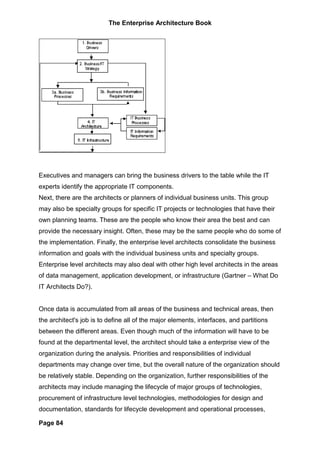
The following picture demonstrates the connection between business drivers and IT
infrastructure.


                                                                                 Page 83
The Enterprise Architecture Book


Executives and managers can bring the business drivers to the table while the IT
experts identify the appropriate IT components.
Next, there are the architects or planners of individual business units. This group
may also be specialty groups for specific IT projects or technologies that have their
own planning teams. These are the people who know their area the best and can
provide the necessary insight. Often, these may be the same people who do some of
the implementation. Finally, the enterprise level architects consolidate the business
information and goals with the individual business units and specialty groups.
Enterprise level architects may also deal with other high level architects in the areas
of data management, application development, or infrastructure (Gartner – What Do
IT Architects Do?).


Once data is accumulated from all areas of the business and technical areas, then
the architect's job is to define all of the major elements, interfaces, and partitions
between the different areas. Even though much of the information will have to be
found at the departmental level, the architect should take a enterprise view of the
organization during the analysis. Priorities and responsibilities of individual
departments may change over time, but the overall nature of the organization should
be relatively stable. Depending on the organization, further responsibilities of the
architects may include managing the lifecycle of major groups of technologies,
procurement of infrastructure level technologies, methodologies for design and
documentation, standards for lifecycle development and operational processes,

Page 84
The Enterprise Architecture Book


training needs, data architecture (naming standards, storage, etc.) (Gartner – What
Do IT Architects Do?). Creating standards between different areas of the company
will ensure that applications can be effectively integrated with each other.


A paper on Enterprise Architecture wouldn't be complete without mentioning the
Zachman Framework. This framework provides a basic structure for organizing a
business's architecture through dimensions such as data, function, network, people,
time, and motivation. The last three dimensions were more recent additions to the
framework. Each dimension is then described through the perspectives of different
players in business's IT organization such as the planner, owner, designer/architect,
builder, subcontractor, and user. This very technical and rather theoretical framework
is rarely used "as-is" rather it is the basis for other, more practical applications of
Enterprise Architecture. The Zachman Framework should be something that any IT
Architect should at least be familiar with, and to understand some of the questions of
who, what, when, why, and how - and from who's perspective are the answers.
Answering these questions will be beneficial in producing a complete Enterprise
Architecture. Another advantage of the Zachman's Framework is the idea of
classification. Classification allows you to "eat the elephant one bite at a time" and
identify different pieces of the IT infrastructure through different perspectives in
logical pieces. By doing this, you have a much more manageable list of components
to analyze.


A final part of the architect’s job involves actually using the architecture that they
have created. Communication is probably the biggest part – an architecture isn’t any
good if the other managers and technical designers in the company are not aware of
it. By educating these people, and showing them roadmaps for technology, they can
make better decisions. The architects should be responsible for dealing with
exceptions and helping to minimize their impact on the stability of the infrastructure.
Despite much industry wide concern about outsourcing, these enterprise architect
jobs are not likely to move outside of the organization. The type of business insight,
longevity, and systems thinking are hard to find in a typical IT outsourcing
arrangement. As important as Enterprise Architecture is to a company, having
stability in this role is crucial.


                                                                                  Page 85
The Enterprise Architecture Book


Conclusion

In the fast paced changing world of both business and information technology,
companies today need to have a well-thought out, documented, and communicated
IT Enterprise Architecture plan to ensure that IT provides a competitive advantage.


Page 86
The Enterprise Architecture Book


ZACHMAN FRAMEWORK DOCUMENT

As a company tries to become better in the creation of information systems a regular
discussion occurs about the need or value of an information architecture. The
success of an individual application is not dependent on having an information
architecture, but the corporate goal of a seamless, integrated corporate information
system requires corporate planning. A major part of this planning may involve
architecture. This article reflects some of my initial thoughts on a long-term project
that I have just started that deals with the Zachman Framework. For information on
the general issue of information architectures refer to references at the end of this
article.


The Zachman Framework basically deals with the common sense rules that we were
given in middle school for writing a story. We were told to provide information about
Who, What, When, Where, Why, and How in every story. This same common sense
partitioning of knowledge occurs in the columns of the Zachman Framework. I will
not try to defend the Zachman Framework over other frameworks, but any
framework that is adopted or developed should be easy to explain to management
and the involved professionals.


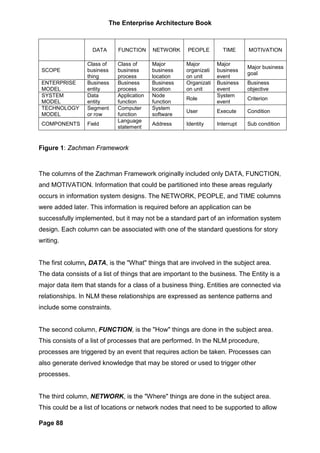
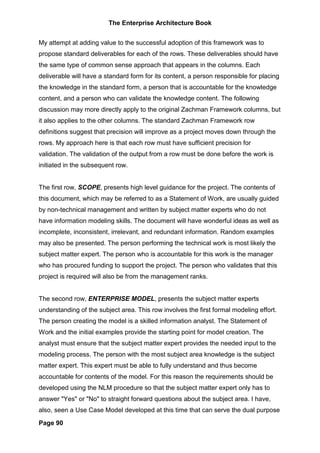
A standard presentation for the Zachman Framework is given in Figure 1. The
knowledge that defines an application can be partitioned within the Zachman
Framework. Each column has a need for a precise model that defines the knowledge
associated with that aspect of the application. A current effort exists to provide the
meta-model for each column. This effort would benefit from using the
NLM/ORM/NIAM approach of examples and sentences to define these
requirements. The type of knowledge captured in individual cells will not be
discussed in this article, but an overview of the columns and a discussion of the rows
will be presented.


                                                                                Page 87
The Enterprise Architecture Book


                   DATA      FUNCTION      NETWORK     PEOPLE        TIME      MOTIVATION

                 Class of    Class of      Major      Major        Major
                                                                               Major business
 SCOPE           business    business      business   organizati   business
                                                                               goal
                 thing       process       location   on unit      event
 ENTERPRISE      Business    Business      Business   Organizati   Business    Business
 MODEL           entity      process       location   on unit      event       objective
 SYSTEM          Data        Application   Node                    System
                                                      Role                     Criterion
 MODEL           entity      function      function                event
 TECHNOLOGY      Segment     Computer      System
                                                      User         Execute     Condition
 MODEL           or row      function      software
                             Language
 COMPONENTS      Field                     Address    Identity     Interrupt   Sub condition
                             statement


Figure 1: Zachman Framework


The columns of the Zachman Framework originally included only DATA, FUNCTION,
and MOTIVATION. Information that could be partitioned into these areas regularly
occurs in information system designs. The NETWORK, PEOPLE, and TIME columns
were added later. This information is required before an application can be
successfully implemented, but it may not be a standard part of an information system
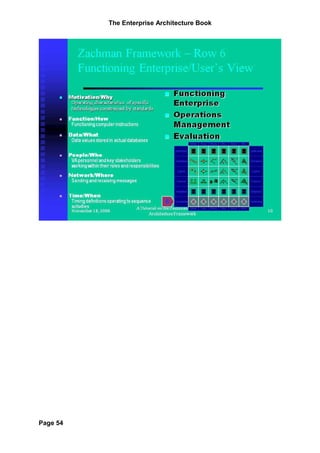
design. Each column can be associated with one of the standard questions for story
writing.


The first column, DATA, is the "What" things that are involved in the subject area.
The data consists of a list of things that are important to the business. The Entity is a
major data item that stands for a class of a business thing. Entities are connected via
relationships. In NLM these relationships are expressed as sentence patterns and
include some constraints.

The second column, FUNCTION, is the "How" things are done in the subject area.
This consists of a list of processes that are performed. In the NLM procedure,
processes are triggered by an event that requires action be taken. Processes can
also generate derived knowledge that may be stored or used to trigger other
processes.


The third column, NETWORK, is the "Where" things are done in the subject area.
This could be a list of locations or network nodes that need to be supported to allow

Page 88
The Enterprise Architecture Book


the knowledge capture and use within the subject area. This availability of access is
required for a successful implementation of an application although there is no
procedure step to capture this knowledge in NLM. One interpretation of this column
could be the physical location for the capture or use of local sentence patterns that
participate in the global definition of knowledge. The design should understand if the
available network supports that current application. The additional knowledge that is
captured to support this conclusion should be documented. The design of this
network is outside of the knowledge definition specified using the NLM procedures
unless the network is "subject area" of the analysis.


The fourth column, WHO, is the "Who" that are allowed to interact with knowledge. It
contains knowledge about the people and organizations within the business. Some
of these rules deal with who is allowed to participate in the events that are triggered
by an event rule. Other rules deal with who is responsible for a piece of knowledge
that is created. This could deal with either a process in a work-breakdown structure
or a sentence pattern within a conceptual schema. Again, the successful
implementation of an application requires this information. The inclusion of this
knowledge creates a better design. This knowledge certainly can be placed in an
NLM diagram, but it may not be done without standard design practices established
within an architecture.


The fifth column, TIME, is the "When" something is done. This could be a fixed time
that triggers a process, the time of an event that triggers another process, or a time
sequencing that says this process must be performed before a follow-on process.
Again, the successful implementation of an application requires this information. The
formal requirement that this be addressed within a design will improve the resulting
quality of the design.


The sixth column, MOTIVATION, is the "Why" things are done. Business goals and
strategies are listed here. These goals and strategies can be expressed as natural
language sentences. In many cases, the sentences that measure these goals and
strategies will have derivation rules for determining the performance of the company
or organization. The derived fact instances are compared with stated goals that are
called out in a business objective.

                                                                               Page 89
The Enterprise Architecture Book


My attempt at adding value to the successful adoption of this framework was to
propose standard deliverables for each of the rows. These deliverables should have
the same type of common sense approach that appears in the columns. Each
deliverable will have a standard form for its content, a person responsible for placing
the knowledge in the standard form, a person that is accountable for the knowledge
content, and a person who can validate the knowledge content. The following
discussion may more directly apply to the original Zachman Framework columns, but
it also applies to the other columns. The standard Zachman Framework row
definitions suggest that precision will improve as a project moves down through the
rows. My approach here is that each row must have sufficient precision for
validation. The validation of the output from a row must be done before the work is
initiated in the subsequent row.


The first row, SCOPE, presents high level guidance for the project. The contents of
this document, which may be referred to as a Statement of Work, are usually guided
by non-technical management and written by subject matter experts who do not
have information modeling skills. The document will have wonderful ideas as well as
incomplete, inconsistent, irrelevant, and redundant information. Random examples
may also be presented. The person performing the technical work is most likely the
subject matter expert. The person who is accountable for this work is the manager
who has procured funding to support the project. The person who validates that this
project is required will also be from the management ranks.


The second row, ENTERPRISE MODEL, presents the subject matter experts
understanding of the subject area. This row involves the first formal modeling effort.
The person creating the model is a skilled information analyst. The Statement of
Work and the initial examples provide the starting point for model creation. The
analyst must ensure that the subject matter expert provides the needed input to the
modeling process. The person with the most subject area knowledge is the subject
matter expert. This expert must be able to fully understand and thus become
accountable for contents of the model. For this reason the requirements should be
developed using the NLM procedure so that the subject matter expert only has to
answer "Yes" or "No" to straight forward questions about the subject area. I have,
also, seen a Use Case Model developed at this time that can serve the dual purpose

Page 90
The Enterprise Architecture Book


of providing consistent and relevant examples and then be used for training future
users of the processes. I will be investigating this in future articles. The person
performing the analysis is the information analyst. The person accountable for the
model content is the subject matter expert. The person who can validate the model is
another subject matter expert. The integrity of the rules developed by the subject
matter expert must be maintained throughout the remaining rows.


The third row, SYSTEM MODEL, presents the required or approved graphical model
that is targeted at implementation, the corporate repository, or both. Standard
models may be required for implementation or to support the corporate data
administration function. The analyst can perform the conversion of the NLM
sentence based model into alternate graphical forms and be held accountable for
maintaining the validated knowledge. Another information analyst can validate that
the knowledge was properly converted. The presentation of this knowledge can be in
either a relational based or object oriented graphical model.


The fourth row, TECHNOLOGY MODEL, presents an extended model that accounts
for a specific targeted platform and deals with performance issues. This row
prepares the model for implementation. The person performing this activity is a
database administrator. The model presented to the row directly supports the future
implementation. Additions to the model can include indexes and meaningless keys to
support performance. These additions do not change any of the fact types validated
by the subject matter expert. The person who is accountable for this model is also
the database administrator. The person validating the resulting model is another
database administrator.


The fifth row, COMPONENTS, presents the code that implements the application.
The person performing this function is the implementer. The implementer is also
accountable for implementing the provided design. The implemented system should
be validated by a tester based on the sentence based NLM model and supported by
the use case descriptions. This final validation ensures that the desires of the subject
matter expert were implemented. The subject matter expert thus becomes
accountable for the implemented system in the same manner that the senior
engineer is accountable for a production component.

                                                                                 Page 91
The Enterprise Architecture Book


There should be no creative input to the design after validation by the subject matter
expert. Any suggested changes or additions to the subject matter expert's model
must be properly modeled so that the subject matter expert can validate the
changes. This must be done whenever issues come up in rows 3 to 5.


The contents of the row 1 documents can be precisely rewritten from the knowledge
stated in row 2. I consider this an academic effort (Although, this is exactly what I do
for developing my modeling course examples.) for corporate applications. The
knowledge content created for the subject area should be available for the benefit of
future projects. This knowledge is first stated in row 2 and then graphically presented
in row 3. A corporate repository would at least hold the row 3 and hopefully hold row
2 knowledge. The row 1 documentation is not usually part of the corporate record, so
the effort to redo it better has little long-term value. In the implementation of a
framework, I do not want to suggest effort be put into what analysts may consider
busy work in the name of architecture compliance. I have enough trouble trying to
convince analysts and management that the necessary modeling should be precisely
done before coding starts.


An information architecture will force a more formal information system process to
exist. The effective reuse of the defined knowledge and the future integration of
applications should be sufficient justification for establishing an architecture.
Happy Modeling!


Page 92
The Enterprise Architecture Book


ZACHMAN FOR ENTERPRISE ARCHITECTURE

The entire enterprise architecture -- enterprise information needs, corporate
performance measures, and critical success factors, along with corresponding logical
and physical models -- should be documented in a central repository with sufficient
detail to meet all enterprise management needs. For example, the logical data
model should include operational data entities that are necessary for day-to-day
enterprise activities as well as strategic information data entities that, when
implemented, will tell executives and managers how well their enterprise is
performing.
Activities critical to capturing a clear understanding of an enterprise’s information
architecture include providing a clear and unambiguous definition of every data
entity, describing the way each is used, defining derivation formulas and aggregation
categories, and documenting data collection and retention time periods. The
resulting enterprise architecture model, which links enterprise needs with data
entities and enterprise rules, becomes both requirement documentation and a
source for communicating the contents of the architecture (and its metadata) to its
users.


Reverse Engineer Existing Environment
While the desired "To Be" architecture is being defined and modeled, the existing
operational systems should be reverse engineered to provide an “As Is” architecture
containing physical data models and data dictionaries.


Assess Current Data Architecture
An enterprise has an architecture, whether documented or not. Before an enterprise
can implement a new architecture, it must document its existing architecture. With
the focused and committed involvement of enterprise managers, there must be a
detailed assessment of the current architecture. This helps to develop the scope
and schedule for all follow-on activity. In order to complete eventual transition to the
new architecture, it is necessary to determine the relative condition of the current
environment. The factors to consider are the “popularity” of the file management
systems, the physical implementation (pages of code, reports, screens, data


                                                                                  Page 93
The Enterprise Architecture Book


structures/schemas, and business rules), and the existence and relevance of
investigative evidence to be included in the detailed assessment.


Generate Data Dictionaries
This effort can be facilitated through the use of automated tools. There are various
sources for these tools, many of which were used to solve Year 2000 problems.
Even with automated tools, however, this activity will be resource-intensive. An
enterprise architecture does not initially require a detailed dictionary for every
existing data source. Detailed reverse engineering should be performed only when a
particular data collection has been identified for conversion.


Develop Physical Data Models
The enterprise architecture should contain a physical model for each
application/database/data store that includes the tables, columns and table
relationships derived from its data dictionary. Every model should include a CRUD
matrix identifying under what conditions the elements are created, read, updated and
deleted.


Map “As Is” Physical Model to “To Be” Logical Model
When both architectures are available, the physical data models (and data
dictionaries) of the old architecture should be mapped to the logical data model of
the new architecture. This mapping should include the relationship between
operational elements and strategic information, including requirements for data
cleansing, summarizing and transformation. Mapping existing data elements to
those desired will help establish the corporate value of current operational data
elements and will allow gap analysis.


Analyze the Gap
Once mapping is complete, the gap between the “As Is” and “To Be” architectures
should be analyzed. Elements in the old architecture that match elements in the new
architecture will provide indicators of current operational data value (elements that
should be converted). Any shortfall in current data will indicate a need for new
applications or data sources. Identifying data elements in the old architecture that do


Page 94
The Enterprise Architecture Book


not map to the new will help determine applications and files that will not need to be
converted during transition and which can likely be eliminated.
Analysis of the two architectures also will help identify data problems that can be
fixed immediately with limited resources and that will result in early, significant return
on investment.


Develop Transition Plan
Once analysis of the relationship between the old and new architectures is complete,
a plan for transition to the new architecture should be defined. The plan should be
based upon the needs and priorities identified during the development of the new
architecture, and should include tasks, timetables, deliverables, costs, and other
resource requirements.

Engineer an Enterprise Data Clearinghouse
The transition from current applications to new applications that support the new
architecture can be facilitated through the implementation of an enterprise data
clearinghouse.
This special-purpose database, based upon the new enterprise architecture,
provides a central store for "cleansed" data from operational systems that can be
used as input to other applications. This immediately reduces interfaces while
improving data quality. The clearinghouse can also provide the source for executive
and decision-support information (see below). At the same time the clearinghouse
provides a bridge for migrating to new applications that implement the new
architecture.
The enterprise data clearinghouse is built over time as data necessary for
functions/projects/business areas are analyzed and the transformation of the data
elements from old to new architecture is implemented. Once the "trusted data" is
stored in the clearinghouse it is available to any application that needs it. The data
can also have more strategic uses.
One use for a clearinghouse is as a staging point or source for a strategic data
warehouse or data mart. A data warehouse is a subject-oriented repository
designed for enterprise-wide information access. It


                                                                                 Page 95
The Enterprise Architecture Book


provides tools to satisfy the information needs of enterprise managers at all
organizational levels — not just for complex data queries, but as a general facility for
getting quick, accurate, and often insightful information. A data warehouse is
designed so that users can recognize the information they want and access that
information using simple tools. Engineering a data warehouse at the same time the
clearinghouse is being implemented will provide executives with strategic information
immediately.


Transition to New Architecture

Programs need to be developed that transform critical key data from the existing
operational systems and use the data to populate the enterprise data clearinghouse.
Because the operational data has already been transformed to meet new information
requirements, it will be easier to transition the current operational systems from the
"As Is" to the "To Be" architecture and allow them to be migrated or replaced one at
a time in priority order.
As each new application is implemented, data and information collection from current
applications will be discontinued and replaced with information from the new
application. For some new applications, there will be data from existing systems that
must be converted to provide historical data.
The conversions may be manual, partially automated, or fully automated, depending
on the accessibility and integrity of the data. Regardless of the conversion method,
a strategy for improving data integrity should be developed, when required to
cleanse operational data.


Enterprise Architecture Engineering Tools

Effective Enterprise Architecture Engineering requires effective tools. Enterprise
needs and measures must be documented in a manner that allows them to be
accessible and flexible. Further, enterprise needs should be linked directly to a
strategic information model, enterprise data dictionary, legacy data base models,
data integration and transformation process models, and data warehouse and data
mart database design models -- all in a single relational repository. This linkage
enables consistently successful development and implementation of high-quality


Page 96
The Enterprise Architecture Book


data warehouses and data marts. It also allows quick reaction to changes in
environment, policy, or customer requirements.
Enterprise Architecture Engineering tools should have the capability to document an
enterprise's multi-level, strategic plans, and link them to appropriate performance
measures. More importantly, the tools should also allow information requirements
that support an enterprise's strategic plans and performance measures to be
modeled and translated into database, data mart, data warehouse, decision support
system (DSS), and executive information system (EIS) models and designs. These
designs can then be developed and implemented, ensuring that the enterprise’s
information systems meet its information needs.
An Enterprise Architecture Engineering tool set should also allow multiple physical
(de-normalized) database designs to be created from and/or linked to subsets of a
single, logical (fully-normalized) enterprise data model in the same repository while
allowing every logical model element to be linked to strategic, business, and system
requirements. This facilitates both data warehouse architecture development and
strategically-driven, customer-focused, model-based, software component
engineering.


                                                                              Page 97
The Enterprise Architecture Book


Page 98
The Enterprise Architecture Book


SAMPLE IMPLEMENTATION PLAN


Project Name

Enterprise Architecture Planning Implementation, Project Number:
ORGANIZATION###

Description

The Department of Information Technology will implement a formal process for
standards development and technology selection called Enterprise Architecture
Planning (EAP). EAP is a formalized, industry recognized process that establishes
the steps necessary for corporations and governments to analyze and select IT
across the enterprise. The EAP process includes the following:
   •   Recognizing and integrating statewide business strategies and objectives into
       IT technology decisions
   •   Establishing a governance process and organizational structure to ensure all
       State agencies follow the IT standards established
   •   Steps for ensuring that IT decisions are made to optimize the effectiveness of
       IT for the whole of state government, not for one agency over another
   •   Defining an architecture and creating technology standards so that agencies
       can make quicker decisions with the assurance that the results will integrate
       well within the overall enterprise
   •   Creating a mechanism to review and act upon requests for IT that deviate
       from the established architecture and technology standards


Project Manager

Project oversight will be provided by xxx, ORGANIZATION’S Director of Enterprise
Architecture Planning.


Project Need, Benefit and Impact
Problems and Opportunities

The following sections deal with identified problems followed by opportunities for
improvement.


                                                                               Page 99
The Enterprise Architecture Book


Problems

   •   Both ORGANIZATION and the agencies use independent internal processes
       to select IT solutions. These independent processes usually focus on
       individual IT project strategies and objectives, not on statewide business
       strategies and objectives.
   •   ORGANIZATION selects IT to meet statewide infrastructure requirements but
       does not optimally involve the agencies to ensure the results will fulfill their
       current and future business needs.
   •   Agencies select IT to meet their respective business needs but do not
       optimally involve ORGANIZATION nor other agencies to ensure the results
       will integrate well with the overall state enterprise.
   •   The current processes for IT selection increase the likelihood of non-
       standardization, duplication of systems, statewide infrastructure integration
       problems, and increased cost for supporting a heterogeneous environment.
       Opportunities

   •   The EAS service has a business-oriented process for analyzing and selecting
       information technologies (IT) across the whole of state government.
   •   ORGANIZATION will be afforded the opportunity to develop technology
       standards utilizing agency input.
   •   ORGANIZATION will be afforded the opportunity to better its image and have
       the agencies look to ORGANIZATION as a valued resource to guide and
       assist them in fulfilling their information management needs and meeting their
       business objectives.


Project Impact

All ORGANIZATION service areas and all state agencies will be impacted by this
project. The principles, standards, and best practices defined by this architecture will
be utilized by all agencies in the executive branch. The statewide products and
services contracts that will be put in place to implement the architecture standards
will be available to all branches of state government and all the state’s political
subdivisions. The other branches of government will be encouraged to participate in
the EAP process, to implement the resulting standards and best practices, and to
utilize the statewide contracts.
Page 100
The Enterprise Architecture Book


IT Architecture

This project will define the Statewide IT architecture that will be used by all
agencies, including ORGANIZATION.


Schedule

We believe that the scope of the effort described herein will take approximately
twenty-four to twenty-eight weeks, with timely participation from the ORGANIZATION
and agency staff involved. The intention is to be far enough along in the process, to


                             PRELIMINARY PROJECT SCHEDULE

              April       May        June        July      August      Sept.        October
  PP&I
  Phase   I
  Phase   2
  Phase   3
  Phase   4
  Phase   5


be able to document the IT projects that will require FY2002-FY2003 budget options
by the budget submission deadline in September of 200x.


Project Objectives

Successful implementation of this project will result in accomplishing the following
objectives.
  •   Increase state IT effectiveness by improving the process for IT selection to
      ensure that IT decisions optimize services for the overall enterprise.
  •   Control the growing complexity (and related support requirements) of the
      statewide infrastructure in order to minimize potential costs by setting
      statewide standards for IT.
  •   Enable State IT service groups to react faster to changing requirements by
      establishing an architecture to guide the decision making process for selecting
      IT.
  •   Integrate the EAP process into ORGANIZATION and Agency IT processes.
  •   Document the EAP process, policies, and procedures.
  •   Acquire the necessary personnel to perform and support the EAP process as
      an ongoing program.

                                                                                  Page 101
The Enterprise Architecture Book


   •   Educate participating ORGANIZATION and agency personnel on the EAP
       process.
   •   Identify statewide business strategies and objectives as the basis for the
       architecture.
   •   Create the architecture principles upon which IT standards will be derived.
   •   Create the IT standards for the state enterprise.
   •   Perform a gap analysis comparing current IT systems with the new
       architecture and IT standards.
   •   Create an Architecture Migration plan to implement the architecture.


Project Scope
Architecture Project Planning and Initiation

The objective of this initial effort is to organize the project to ensure success and
refine the scope of the engagement. The resulting project plan and business case
will establish a detailed ORGANIZATION and EXTERNAL CONSULANT staffing
plan, identify critical success factors, formalize the technology domains to be
addressed, and identify project dependencies. The results of this initial phase will
ensure that all stakeholders and participants understand what is required for
success.
Activities will include:
   •   Developing the detailed project plan.
   •   Reviewing existing ORGANIZATION and agencies’ business strategies,
       strategic automation plans, and existing IT architecture documents to
       determine the quality of available information and how best to provide any
       missing information.
   •   Reviewing the organization(s) charts and deriving the major functional areas.
   •   Documenting the key players (stakeholders).
   •   Documenting the critical success factors for the project.
   •   Determining the scope and boundaries for each of the selected architecture
       domains.
   •   Analyzing project risks in terms of size, scope and project structure.


Page 102
The Enterprise Architecture Book


   •   Finalizing the ORGANIZATION project team members for each phase and
       major task area.
   •   Developing training curriculums and conducting one or more training sessions
       in the architecture development process for ORGANIZATION senior
       management, members of the Business & Technology Strategy Board, the
       Core Architecture Team, the Domain Teams, and the Infrastructure Teams.
   •   Preparing the initial communication plan for business and IT staffs (including
       Web publication).
   •   Preparing and conducting kick-off sessions for business and IT staffs.
   •   Establishing a Governance process and organizational structure.
   •   Determining the points of convergence between Agency business and IT
       planning, and the EWTA process.
   •   Determining the points of convergence between the State’s budget process
       and the EWTA process.
   •   Developing an approach for addressing the state’s E-Government and ERP
       initiatives in phases one through five of the EWTA process and
   •   Establishing the format for each deliverable and the process templates.


The must-do strategies of ORGANIZATION and the agencies will form the basis of
the architecture and help IT focus on the most important requirements of the state’s
business and service programs. The Business Drivers and Business Information
Requirements will be reviewed in a group setting (Business and IT Strategy Board)
to help ensure business buy-in and participation in the architecture process.


Phase One: Clarify Business Strategy and Establish Business Participation:
Create Business Drivers, Business Information Requirements and Architecture
Vision


EXTERNAL CONSULANT will review existing business strategy documentation to
be provided by ORGANIZATION. The documentation and any associated business
strategy documents will establish a base for the Common Requirements Vision.
EXTERNAL CONSULANT and ORGANIZATION will synthesize the current and in-
progress strategy documents to create the initial Business Drivers and Business


                                                                            Page 103
The Enterprise Architecture Book


Information Requirements. A series of interviews with senior business executives in
the agencies is likely to be needed.
Phase One activities include:
   •   Frequent Architecture Team meetings for planning of activities, synthesis and
       review of materials, and creation of deliverables.
   •   Review of existing and in-progress business strategy documents.
   •   On-site working sessions with IT management to identify business
       requirements, critical issues and currently deployed technologies.
   •   Creation and documentation of ORGANIZATION and agencies’ Business
       Drivers and Business Information Requirements.
   •   Management presentation and critique of Business Drivers and Business
       Information Requirements.
   •   Presentation to Business and IT Strategy Board to discuss the findings and
       gain support for the next phase.
   •   A two-day, onsite Architecture boot camp conducted with both an EAS analyst
       and a member of the project team. Senior management will likely only attend
       the first day of this training session. (This might be a Project Planning and
       Initiation deliverable depending upon when ORGANIZATION wants to
       conduct the training)
   •   Critique of Phase One execution including recommendations for
       improvements next time.


Phase Two: Create Architecture Requirements and Architecture Principles


Phase Two begins the transition from a business context to an IT context,
documenting the technology qualities required by the architecture to enable the
business strategy. The Core Architecture Team will utilize the Business Drivers and
Business Information Requirements documented and agreed upon in Phase One to
derive the Architecture Requirements.


Page 104
The Enterprise Architecture Book


The other deliverables of Phase Two are the Architecture Principles adapted to the
state’s environment from industry and IT best practices. These principles guide the
design choices, standards and products recommended by the Domain Teams and
enable the long-term adaptability of the IT environment. Each principle documents

 Limit the number of product permutations to facilitate integration, simplify support efforts, and
 reduce long-term costs.

 Rationale
 In the absence of major business advantage, deploying multiple products delivering similar
 functionality needlessly increases complexity and cost. By limiting the number of
 technologies, and creating a more consistent environment, the State optimizes the cost for
 implementing, supporting, and maintaining the IT environment.
 Furthermore, reducing the number of technology permutations to consider during the
 planning process simplifies the integration of new functionality and allows the IT environment
 to adapt more quickly to business change: a time reduction for technology transition and
 implementation.

 Implications
 • Consider the requirements of potential users in the greater community when investigating
    new technologies.
 • Retire technologies providing insufficient functionality or those with high management
    and support costs, and transition them to new, common services.
 • Include the cost of introducing new technology in cost/benefit analysis (i.e.,
    implementation, retirement, user/IT staff training, support, and maintenance cost)
 • Allow for increasing the breadth of product implementations without repeated contract
    negotiations by identifying the cost savings for enterprise-wide versus niche
    implementation in product licensing agreements.

the rationale and implications specific to the state’s environment. Below is an
example of an Architecture Principle:
        Phase Two activities include:
   •   Creation and documentation of the state’s Architecture Requirements.
   •   Creation and documentation of the state’s Architecture Principles.
   •   Reconciliation of state’s Architecture Principles with Agency IT Principles
       where they have already been defined.
   •   Identification and final selection of relevant Domain Architectures.
   •   Identification of specific recommendations for the detailed development of the
       individual domain architectures.
   •   Identification of domain team participants.
   •   Development of a current environment status report documenting our insights
       to date.


                                                                                     Page 105
The Enterprise Architecture Book


   •   Presentation to Business & Technology Strategy Board and discussion of the
       findings, to ensure continued business participation and gain support for the
       next phase.
   •   Critique of Phase Two execution including recommendations for
       improvements next time.


Phase Three: Develop Domain Architecture Detail


Phase Three creates the detailed domain architectures for the state. If needed,
EXTERNAL CONSULANT will provide domain experts to supplement the
EXTERNAL CONSULANT architecture team, provide knowledge transfer and
produce deliverables. If EXTERNAL CONSULANT domain experts are needed, their
fees are included in the option portion of the fixed fee estimate in the EXTERNAL
CONSULANT Consulting proposal.
Representative Phase Three activities include, but are not limited to:
   •   Train domain teams.
   •   Creation of the principles guiding the design and engineering within each
       individual Domain Architecture selected in Phase Two.
   •   Work with the core architecture team on the definition of a taxonomy of
       technology domains and their relationship to infrastructure patterns.
   •   Work with the domain teams to define domain architectures.
       ORGANIZATION will determine which domain teams will use EXTERNAL
       CONSULANT domain experts to accomplish their work.
   •   Work with the core architecture team on the definition of infrastructure
       patterns and their relationship with technology domains.
   •   Work with the core architecture team on the diagramming of the relationships
       between technology domains and infrastructure patterns.
   •   Work with the infrastructure teams on the standards, configurations and best
       practices for each of the infrastructure patterns.
   •   Critique of Phase Three execution including recommendations for
       improvements next time.


Page 106
The Enterprise Architecture Book


Phase Four: Gap Analysis and Migration Planning


The Gap Analysis phase begins to bring together application, information (data),
organization and technology planning. Gap Analysis begins with a review of the
existing architecture baseline information. In some cases, EXTERNAL
CONSULANT works with clients to create or compress documentation about the
existing environment. In other cases, just documentation review and interpretation
are required. The approach for ORGANIZATION will be developed during the
Process Setup phase. It is the hope of the project team that the Agency IT Planning
process for 200x will deliver an updated view of the state’s installed base of IT in
time to be used in this phase of the EAP process. We will identify the gaps between
the ORGANIZATION and agencies’ current state and the future/target architecture.
For each gap identified, we will develop alternative solutions to “fill” the gap, e.g.,
new applications, new databases, new technology, new skills or management
approaches. The result is a series of recommendations, with priorities and
interdependencies documented.


Migration planning defines the effort necessary to implement the recommendations
from gap analysis. We will identify projects, initiatives and policies to be delivered
over a three-year timeframe.
Phase Four activities include:
   •   Review existing state and agencies’ architecture documentation.
   •   Create documentation regarding the existing architecture, where needed.
   •   Identify gaps between the as-is and future target.
   •   Develop recommendations to close gaps.
   •   Prioritize and identify interdependencies of recommendations.
   •   Identify projects, initiatives and policies for each recommendation.
   •   Define a high-level migration plan for a three-year timeframe.
   •   Define scope and timeline for each project.
   •   Create a program plan to coordinate across all projects.
   •   Critique of Phase Four execution including recommendations for
       improvements next time.


                                                                                 Page 107
The Enterprise Architecture Book


Phase Five: Implementation Planning


During the final phase, we will identify the needed resources and develop the project
profiles to implement the target enterprise architecture. The resources required to
plan implementation projects include IT infrastructure management and staff,
application management and staff, database management and staff and agency
program management and staff.
Phase Five activities include:
   •   Identify resources for implementation planning.
   •   Develop schedule for completion of implementation planning.
   •   Develop project profiles , to include: primary design goals, scope, reuse
       opportunities, business or IT management sponsors, estimated timelines and
       resource requirements and implementation dependencies.
   •   Reconcile results of Agency IT Planning (e.g. Agency IT projects) with the
       results of implementation planning.
   •   Develop enterprise program management charter and plan that all project
       plans roll up to.
   •   Critique of Phase Five execution including recommendations for
       improvements next time.


Project Approach
Approach

Enterprise Architecture Planning will be implemented at the state using the EAP
process model developed by EXTERNAL CONSULANT’S Enterprise Architecture
Strategies service. This model identifies the process steps necessary to perform
EAP and create an Architecture Migration plan. This model also provides the
capability to minimize the time necessary to perform EAP by providing a ‘fast path’
approach that focuses only on the information necessary to create the Enterprise-
Wide Technical Architecture. This model will be modified as necessary to meet the
state’s unique requirements.
Project Structure


Page 108
The Enterprise Architecture Book


This project will be organized using two logical stages consisting of major
milestones:


Stage I –EAP Process Setup

  •   Define the EAP process for State
  •   Document the EAP process, policies, and procedures
  •   Acquire the necessary personnel to perform and support the EAP process
  •   Install the necessary tools required to perform and report on the EAP process
  •   Educate participating personnel (and the State at large) on the EAP process
  •   Integrate the EAP process into State IT processes


Stage II – Perform EAP Process

  •   Identify the statewide business strategies and objectives as the base for the
      architecture
  •   Create the architecture principles upon which IT standards will be derived
  •   Create the IT standards for the enterprise
  •   Perform a gap analysis comparing current IT systems with the new standards
  •   Create an Architecture Migration plan to implement the architecture
  •   Project Requirements
  •   Completely documented EAP system (process, organization, communication)
  •   Neutral EAP process and process owner
  •   Senior level management supports the EAP process
  •   State knowledgeable on EAP process through training, presentations, and
      documentation
  •   EAP utilizes both business program and State IT staffs on EAP teams
  •   Target time duration for EAP setup and first run execution is four to six months
  •   EAP process is based on EXTERNAL CONSULANT’S EAS model and
      modified only when necessary to meet state’s unique requirements
  •   The implemented EAP process and documentation will be reviewed and
      evaluated by EXTERNAL CONSULANT EAS service.
  •   Staffing requirements identified by the EAP process are met


                                                                              Page 109
The Enterprise Architecture Book


  •    Methods for handling exceptions to the architecture are agreed to by the entire
       enterprise
  •    The enterprise agrees to abide by the EAP process, architecture, and
       technology standards
  •    Existing process and procedures within the organization affected by the EAP
       process are identified and updated
  •    The organization’s planning processes are modified and documented as
       needed to incorporate the EAP process
  •    Location(s) for EAP meetings, teamwork, and project are identified and
       available
  •    EAP process will use sound project management principles and follow state
       project management standards and best practices


Project Organization
Stakeholders

Primary Stakeholders:

   •   Chief Information Officer (CIO) [EAP sponsor]
   •   Agency Heads
   •   Agency Deputies and Chief Technology Officer (CTO) [State Business &
       Technology Strategy Board lead]
   •   ORGANIZATION [EAP process owner]


Secondary Stakeholders:

   •   State IT Business & Technology Strategy Board (EAP architecture and
       Architecture Migration plan owner)
   •   ORGANIZATION Directors and Managers
   •   Agency IT Executives, Directors, and Managers whose divisions are
       connected to the Statewide Infrastructure


Page 110
The Enterprise Architecture Book


FURTHER INFORMATION

For more information on other products available from The Art of Service, you can
visit our website: http://www.theartofservice.com


If you found this guide helpful, you can find more publications from The Art of
Service at: http://www.amazon.com


                                                                             Page 111
The Enterprise Architecture Book

INDEX*

A
abstractions 46-8
agencies 8, 57, 99-105, 107-8
agency business 103
analysts 90-2
API (application portfolio implications) 64
Application Architecture 77
application development 78, 84
application development environment 75
application function 88
application portfolio implications (API) 64
applications 11, 46, 69, 71, 74-5, 77, 85, 87-9, 91-2, 95-6, 107
  new 71, 94-6, 107
Applications and Technology Infrastructure 13
architects 47, 79, 82, 84-5
  enterprise level 84
architecture 3, 6-7, 11-12, 14, 59, 69-72, 74, 77-9, 81-3, 85, 87, 89, 92-5, 99-104, 107, 109-10
  business's 85
  target 8, 15
Architecture Capability Maturity Model 6, 33
Architecture Development 35, 38
architecture development process 103
architecture efforts 6, 33
architecture governance process        6
Architecture Migration plan 102, 108-9
Architecture Model 71
architecture plans 81-3
Architecture Principles 12, 14, 102, 105, 109
architecture process 10, 103
Architecture Processes 35
architecture project 17, 72
architecture project leader 17
Architecture Project Planning and Initiation 102
Architecture Requirements 104-5
architecture standards 100
architecture team, core 103-4, 106
Architecture Vision 12, 14
architecture    Project Requirements 109
Art of Service 111
assessment 93-4
assets 80

B
baseline 10, 13, 82
basic model 46-7
Basics on Enterprise Architecture 20
BIR, see business information requirements
blueprints 7, 10, 69, 74
branches 100
builder 47, 79, 85
building 74, 79-80
business 7-8, 59, 62-3, 69, 71-2, 78-9, 81-6, 88-9, 97, 100, 103-4, 108
Business & Operational 75
Business & Technology Strategy Board 103, 106, 110
business applications 80
business architecture 69, 72
business asset 80
business buy-in 103
business case 82, 102
business change 105
business context 104


Page 112
The Enterprise Architecture Book

business drivers 83-4, 104
  initial 103
Business Drivers and Business Information Requirements 103-4
business entity 88
business environment 78, 83
business event 75, 88
Business Event Hierarchy 75
business functions 72
business goals 88-9
business information 84
Business Information Requirements 64, 103-4
business information requirements (BIR) 64, 103-4
Business Information Requirements and Architecture Vision 103
business leaders 78, 83
business leadership 82
business location 88
business model 47, 70
business objectives 100
business participation 106
business partners 70
business plans 72, 78, 83
business problems 77, 80
business process 88
business processes, efficient 39
business program 109
business requirements 79, 104
business resources 77
business rules 70, 72, 94
  strategies     69
business solutions 82
business staff 41
business strategies 81, 102, 104
  changing 80
  statewide 99-100, 102, 109
business strategy documents, associated 103
Business System Architecture 77
business terms 59
business units 78, 81, 84
business value 82

C
Capital Planning process 12, 14
cells 47-8, 75, 87
changes 74, 80, 82-4, 91-2, 97
Chief Information Officer (CIO) 23, 83, 110
Chief Technology Officer (CTO) 110
CIO (Chief Information Officer) 23, 83, 110
Clarify Business Strategy and Establish Business Participation   103
class 88
classification 16, 47, 85
clearinghouse 71, 95-6
  enterprise data 95-6
code 75, 91, 93
columns 23, 46-7, 87-90, 94
     Implementation Level 29
communications,       Architecture 35, 38
company 2, 78-81, 83, 85-7, 89
Complete Project Initiation Activities 64
complex business processes 78
components 78, 84-5, 91
concept 69, 78
conflicts, data definition 73
convergence 103


                                                                       Page 113
The Enterprise Architecture Book

conversions 91, 94, 96
corporation 78, 80-1, 99
costs 78, 80, 95, 105
COTS 71
Create Business Drivers 103
critical success factors 72, 74, 93, 102
CTO (Chief Technology Officer) 110
customer 70, 73

D
data conflicts 73-4
data dictionaries 93-4
data elements 73-4, 94-5
data entities 88, 93
data mart database design models 96
data marts 71, 95, 97
data sources 94
data warehouse 71, 95-7
database administrator 91
decision support system (DSS) 97
deliverables 90, 95, 104-6
descriptions, explicit 7-8
design 75, 79, 81, 84, 89, 91-2, 97, 106
  information system 88
  network node 75
design practices, standard 89
designations 2
dimensions 85
Director of Enterprise Architecture Planning 99
documentation 8, 84, 92, 103-5, 107, 109
  business strategy 103
documents 3, 67, 82-3, 90, 92-3, 97, 101
Domain Architecture 65, 105-6
domain teams 103, 105-6
Drivers and Business Information Requirements 104
DSS (decision support system) 97

E
EA 8, 77
EAP (Enterprise Architecture Planning) 99, 108
EAP process 99-102, 107, 109-10
  implemented 109
     Neutral 109
EAP process for State     Document 109
EAP process model 108
EAP process owner 110
EAP Process Setup 109
EAP process      109
EAP process     State 109
EAS Process Model 19
EBS (enterprise business strategies) 64
Effective Enterprise Architecture Engineering 96
effectiveness 72, 99, 101
effort 65, 80-1, 83, 87, 92, 94, 101, 107
EIS (executive information system) 97
elements, enterprise-wide 69
ENTERPRI SE MODEL Conceptua 75
enterprise 46, 63, 69-74, 77-8, 81, 84, 93, 96-7, 99, 101, 110
  changed 74
  defining 72
  effective 70
  links 93
  real-world 47


Page 114
The Enterprise Architecture Book

enterprise definition 73
enterprise activities 93
enterprise application architecture 69
enterprise architect jobs 85
Enterprise Architects 82-3
enterprise architecture 3, 5, 7-10, 20, 45, 59, 61-2, 69-74, 77, 79-83, 85, 93-5
  complete 85
  documented 80
  documented Information Technology 77
  mature 80
  target 108
Enterprise Architecture Book 3-71, 73, 75-80, 83, 87-96, 98-103, 105-6, 109-11
Enterprise Architecture Book Conclusion 86
Enterprise Architecture Book data warehouses 97
Enterprise Architecture Book Executives 84
Enterprise Architecture Book Great 74
Enterprise Architecture Book Having 81
Enterprise Architecture Book Identify Enterprise 72
Enterprise Architecture Book Information Requirements 104
Enterprise Architecture Book Notice 2
Enterprise Architecture Book Phase 107
Enterprise Architecture Book Phase Five 108
Enterprise Architecture Book tasks 82
Enterprise Architecture Book training 85
enterprise architecture data element 73
enterprise architecture elements 70
Enterprise Architecture Engineering 70, 97
Enterprise Architecture Engineering approach 70
Enterprise Architecture Engineering Tools 96
enterprise architecture forces 82
enterprise architecture links 69
enterprise architecture model 74, 93
  well-defined 73
Enterprise Architecture Overview 9, 59
enterprise architecture plan 86
Enterprise Architecture Planning, see EAP
Enterprise Architecture Planning Implementation 99
Enterprise Architecture Process 82
enterprise architecture project 72
Enterprise Architecture Strategies 108
enterprise business strategies (EBS) 64
Enterprise Data 71
enterprise data architecture 69
enterprise data dictionary 75, 96
enterprise data model 97
enterprise element 73
enterprise information 93
  refining preliminary 72
enterprise information owners 72
enterprise infrastructure 74
enterprise level architects consolidate 84
enterprise management 93
enterprise management tool 71
enterprise managers 93, 96
  interview key 72
enterprise measures 73
  hourly 73
  validating 73
ENTERPRISE MODEL 88, 90
enterprise program management charter 108
enterprise rules 93
enterprise software 74
enterprise standpoint 81


                                                                                   Page 115
The Enterprise Architecture Book

enterprise-wide results 66
Enterprise Wide Technical Architecture 77
Enterprise-Wide Technical Architecture 108
enterprise     109
enterprise's architecture model 74
entities 2, 48, 88
environment 8, 65, 75, 79, 81-2, 93, 97, 105, 107
EWTA process 103
execution 104, 106-7, 109
executive information system (EIS) 97
executives, senior business 104
EXTERNAL CONSULANT 103, 106-9
EXTERNAL CONSULANT and ORGANIZATION 103
EXTERNAL CONSULANT domain experts 106

F
Federated 6
focus 81, 100, 103
form, standard 90
framework 29, 47, 74, 79, 85, 87, 90, 92
FRAMEWORK DOCUMENT 87
Framework for Information Systems Architecture   69
function 46, 72, 75, 85, 88, 91
functionality 105
functions/projects/business areas 95

G
gap analysis 15, 65, 94, 102, 107, 109
gaps 10, 71, 83, 94, 107
Gartner 78, 84-5
goals 8, 10, 74, 78, 81, 84, 89
governance process 99, 103
governments 71, 99-100
groups 72, 84
  specialty 84
guide 100-1, 111

H
historical data   73, 96

I
Identifying enterprise 72
implementation 77, 84, 91-2, 95-6, 105
  architecture project 17
  successful 89, 101
implementation planning 108
implementer 91
implications 79, 105
in-progress business strategy documents 104
information analyst 91
information architecture 77, 87, 92-3
information entities 47-8
information systems design models 48
Information Technology 7-8, 78, 86, 99
infrastructure 39, 74, 78-80, 83-5
  statewide 101, 110
infrastructure patterns 106
initiatives 82-3, 107
integration 92, 105
  enterprise application 69
interdependencies 107
investment 35, 38, 79-81, 95


Page 116
The Enterprise Architecture Book

K
knowledge 87, 89-92
knowledge content 90, 92

L
level 29, 79, 81-2
level plans, high 77, 79
liability 2
linkage,    Business 35, 38
links 73, 75, 97
logical data model 75, 93-4
Logical Process Model 75

M
management processes 7-8
managers 84-5, 90, 93, 110
map 75, 94-5
medium 16
members 103-4
  organization project team 103
model 46-7, 71, 75, 87, 90-1, 94, 97, 108
  architectural 74
modeling 92
MOTIVATION 75, 88-9
multi-level, enterprise's 97

N
network 11, 31, 46, 75, 85, 88-9
Network Design 75
new architecture 71, 74, 93-6, 102
NLM 88-9
NLM procedures 88-90

O
objectives 6, 69, 99-102, 109
operational data 96
operational systems 93, 95-6
organizati 88
Organizatio 75
organization 10, 33, 40, 69, 73, 77-8, 80, 82-5, 89, 99-104, 106-7, 109-10
  governance 64
  logical 69
Organization Consider Enterprise Architecture 80
organization senior management 103
organization service areas 100
organization      33
organizational levels 96
organizational mission, defined 82
organizational structure 99, 103
organizational units 73
Overview Enterprise Architecture 3
owner 2, 47, 85

P
page 9, 20, 44-5, 93
Page 2-111
participation  architecture process definition   35, 38
Perform EAP Process 109
performance plans 69-70, 72
person 2, 28, 90-1
personnel 101, 109
perspectives 47-8, 72, 82, 85
Phase 65, 101, 103-8


                                                                             Page 117
The Enterprise Architecture Book

     Critique of 104, 106-7
phases 77, 83, 103-4, 106-7
  initial 77, 102
physical data models 93-4
physical models 71, 93-4
plan implementation projects 108
planners 84-5
planning 77-8, 81, 87, 103-4, 108
planning/project management process, flexible 57
plans 10, 72, 75, 79, 81-3, 95, 108
policies 70, 74, 97, 101, 107, 109
precision 90
preliminary enterprise, defining 72
Preliminary Project Schedule 101
principles, sound project management 110
problems 78, 94, 99-100
  statewide infrastructure integration 100
Process Model 75
processes 33, 40-1, 61-2, 66, 72, 78, 83, 88-9, 91, 100-1, 109-10
  business-oriented 100
Procurement Strategy 35, 38
Project Approach 108
project dependencies 102
Project Manager 99
Project Name 99
Project Number 99
Project Objectives 101
Project Organization 110
project plan 17, 102
Project Planning and Initiation 104
project plans roll 108
project profiles 108
project risks 102
Project Scope 102
project strategies 100
project structure 102, 108
project team 104, 107
projects 15-17, 61-2, 77-8, 81-4, 90, 92, 99-102, 107-10
  long-term 87
  potential 77
protocols 29, 31, 75
publisher 2

R
rationale 105
recommendations 104-8
relationships 7-8, 88, 94-5, 106
repository, corporate 91-2
resources 82, 108
respective business 100
responsibilities 17, 84
revenue 80
reverse 93-4
role 6, 17, 62, 80, 83, 85
row 47-8, 87-8, 90-2
Rule 46-8

S
SAP 81
scope 75, 88, 90, 93, 101-2, 107-8
SDLC (Systems Development Life Cycle)   77
security 8, 75
selection 77, 100-1


Page 118
The Enterprise Architecture Book

sentence patterns 88-9
sentences 87, 89, 91
service components 29
services 2, 29, 73-4, 81, 101, 111
sessions 72, 104
set 47, 78, 82, 97
software 69-70, 75
source 75, 93-5
stability 85
staffs 80-1, 103, 108-9
Stakeholder-defined technology architecture guidelines/standards   57
stakeholders 75, 102, 110
Standard models 91
standards 8, 23, 29, 70, 80, 82, 84-5, 99-100, 102, 105-6, 109
Standards/Protocols column 29
state 8, 12, 14, 47, 78, 82-3, 100-1, 103, 105-9
state agencies 99-100
State Business 110
state enterprise 100, 102
state government 99-100
state project management standards 110
state    document 109
statement Address Identity Interrupt 88
Statement of Work 90
Statewide 101
statewide contracts 100
statewide infrastructure requirements 100
statewide products 100
statewide standards 101
story 87-8
strategic information model 96
strategic plans 12, 14, 69, 74, 77-8, 97
  changing 83
strategy 8, 78-80, 89, 96
Strategy Board 103-4
subject area 88-90, 92
subject matter expert 90-2
subject matter expert's model 92
success 72, 83, 87, 102
success projects, early 10
support costs 79-80, 105
System Model 47, 75, 88, 91
systems, implemented 91
Systems Development Life Cycle (SDLC) 77

T
TCP/IP 31
technical architecture 64, 69
     Enterprise Wide 77
Technical Reference Model and Standards Profile   6-7
technologies 47, 59, 70, 77-8, 81-5, 105, 107
  infrastructure level 84
technology domains 102, 106
Technology Infrastructure 11, 13
Technology Model 47, 88, 91
technology projects 66
technology standards 99-100, 110
terms 72-3, 79, 102
three-year timeframe 107
tools 70, 75, 81, 94, 96-7, 109
  automated 94
trademarks 2
training sessions 103-4


                                                                        Page 119
The Enterprise Architecture Book

transformation 94-5
transformation process models 96
transition 8, 71, 93, 95-6, 104-5

U
unit 88
United States Federal Reserve Bank     73

V
validation    90, 92

W
work 11, 39, 81-2, 90, 92, 106
workbook 9, 20, 44-5

X
      69-70
    application designs 70
      6-7, 11-17, 29, 33, 57, 63-5, 82-3, 100-5, 107-10
     Application Architecture 77
     Business Leaders 83
     Business System Architecture 77
     Business Unit 83
     Creation 104-6
    Define 12, 14
     Document 65, 82, 101
    Document Step 12-17
     EA 66
     EAP process 109-10
     Enterprise architecture 59
     Establish 12, 14
     Governance 35, 38
     Holistic Enterprise Architecture xf0b7 35, 38
    Identification 105
     Link 12, 14
     Organization 100, 110
     Organization Directors 110
     Program Management 35, 38
     Senior-Management Involvement xf0b7 Operating Unit   35, 38
     State 110
     Work 106
     xf0b7 64
     xf0b7 Establish EA process model 64

Z
Zachman        3, 46, 69
Zachman      for Enterprise Architecture 45
Zachman      Framework 3, 43, 74, 85, 87-8, 90
Zachman      Framework Document 3, 44
Zachman      Framework row definitions, standard   90


Page 120

Enterprise

  • 2.
    Enterprise Architecture BestPractice Handbook: Building, Running and Managing Effective Enterprise Architecture Programs - Ready to use supporting documents bringing Enterprise Architecture Theory into Practice Notice of Rights: Copyright © The Art of Service. All rights reserved. No part of this book may be reproduced or transmitted in any form by any means, electronic, mechanical, photocopying, recording, or otherwise, without the prior written permission of the publisher. Notice of Liability: The information in this book is distributed on an “As Is” basis without warranty. While every precaution has been taken in the preparation of the book, neither the author nor the publisher shall have any liability to any person or entity with respect to any loss or damage caused or alleged to be caused directly or indirectly by the instructions contained in this book or by the products described in it. Trademarks: Many of the designations used by manufacturers and sellers to distinguish their products are claimed as trademarks. Where those designations appear in this book, and the publisher was aware of a trademark claim, the designations appear as requested by the owner of the trademark. All other product names and services identified throughout this book are used in editorial fashion only and for the benefit of such companies with no intention of infringement of the trademark. No such use, or the use of any trade name, is intended to convey endorsement or other affiliation with this book.
  • 3.
    Write a Reviewand Receive a Bonus Emereo eBook of Your Choice Up to $99 RRP – Absolutely Free If you recently bought this book we would love to hear from you – submit a review of this title and you’ll receive an additional free ebook of your choice from our catalog at http://www.emereo.org. How Does it Work? Submit your review of this title via the online store where you purchased it. For example, to post a review on Amazon, just log in to your account and click on the ‘Create Your Own Review’ button (under ‘Customer Reviews’) on the relevant product page (you’ll find plenty of example product reviews on Amazon). If you purchased from a different online store, simply follow their procedures. What Happens When I Submit my Review? Once you have submitted your review, send us an email via review@emereo.org, and include a link to your review and a link to the free eBook you’d like as our thank-you (from http://www.emereo.org – choose any book you like from the catalog, up to $99 RRP). You will then receive a reply email back from us, complete with your bonus ebook download link. It's that simple!
  • 4.
    The Enterprise ArchitectureBook TABLE OF CONTENTS ENTERPRISE ARCHITECTURE ................................................................................ 5 ZACHMAN FRAMEWORK ....................................................................................... 43 EXECUTIVE OVERVIEW ......................................................................................... 57 SUPPORTING DOCUMENTS .................................................................................. 67 THE OVERVIEW ENTERPRISE ARCHITECTURE .............................................. 69 THE BASICS ON ENTERPRISE ARCHITECTURE .............................................. 77 ZACHMAN FRAMEWORK DOCUMENT .............................................................. 87 ZACHMAN FOR ENTERPRISE ARCHITECTURE ............................................... 93 IMPLEMENTATION PLAN .................................................................................... 99 FURTHER INFORMATION .................................................................................... 111 Page 3
  • 5.
    Also from EmereoPublishing: TOGAF The Open Group Architecture Framework 100 Success Secrets: 100 Most Asked Questions - The Missing TOGAF Guide on How to Achieve and Sustain Superior Enterprise Architecture Execution Addresses the top 100 consultancy and education forum questions, with tips and success factors on TOGAF design, planning, implementation, and governance of enterprise IT architecture.
  • 6.
    The Enterprise ArchitectureBook ENTERPRISE ARCHITECTURE Page 5
  • 7.
    The Enterprise ArchitectureBook Objectives • How to establish a Federated IT Architecture hierarchal structure • Learn how to establish a Federated IT Architecture governance process • The role of a Technical Reference Model and Standards Profile in a Federated IT Architecture • The role of IT Architecture Capability Maturity Model in a Federated IT Architecture • Apply lessons learned from two Federated IT Architecture efforts Page 6
  • 8.
    The Enterprise ArchitectureBook What is IT Architecture? • A blueprint that explains how all the Information Technology and Management elements work together as a whole • Provides explicit description of the current and desired relationships among business and management processes and Information Technology • IT Architecture contains two elements: • An Enterprise Architecture • A Technical Reference Model and Standards Profile Page 7
  • 9.
    The Enterprise ArchitectureBook (a) What is the Enterprise Architecture? An EA is the explicit description and documentation of the current and desired relationships among business and management processes and Information Technology. It describes the "current architecture" and "target architecture" to include the rules and standards and systems life cycle information to optimize and maintain the environment which the agency wishes to create and maintain by managing its IT portfolio. The EA must also provide a strategy that will enable the agency to support its current state and also act as the roadmap for transition to its target environment. These transition processes will include an agency's capital planning and investment control processes, agency EA planning processes, and agency systems life cycle methodologies. The EA will define principles and goals and set direction on such issues as the promotion of interoperability, open systems, public access, compliance with GPEA, end user satisfaction, and IT security. Page 8
  • 10.
    The Enterprise ArchitectureBook Please see The Overview of Enterprise Architecture on page 69 within this workbook. Page 9
  • 11.
    The Enterprise ArchitectureBook Implementing an IT Enterprise Architecture Create IT Architecture team Get management’s support and commitment to the IT Architecture process Take a snapshot (baseline) of what currently exists Determine where the Organization wants to be in the next three to five years Develop a blueprint that explains how all the IT elements work together as a whole. Determine the gaps between the current baseline and the future vision Develop a plan and budget for bridging the gaps and reaching the IT goals Identify and accomplish early success projects that will create buy-in Update annually to accommodate strategic and budget plans. Page 10
  • 12.
    The Enterprise ArchitectureBook What is IT Architecture? IT Architecture Describes: • The way Work activities are organized and the Locations where the work is carried out • The Information Sets/Databases needed to perform the work • The Applications/Software that capture and manipulate the information sets • The Technology Infrastructure (hardware, network and communications) needed to run the applications Page 11
  • 13.
    The Enterprise ArchitectureBook • Align the IT Architecture with strategic plan. • Establish IT Architecture Vision. • Clearly state and establish IT Architecture Principles for all IT Architecture views • Define IT Requirements • Link the IT Architecture to the IT Capital Planning process. • Document Step 1 Activities Page 12
  • 14.
    The Enterprise ArchitectureBook • Develop an inventory (IT Baseline) of existing Information Sets, Databases, Applications and Technology Infrastructure. • Identify the information and data flows within the bureau and with constituents and collaborators. • Document Step 2 Activities Page 13
  • 15.
    The Enterprise ArchitectureBook • Align the IT Architecture with strategic plan. • Establish IT Architecture Vision. • Clearly state and establish IT Architecture Principles for all IT Architecture views • Define IT Requirements • Link the IT Architecture to the IT Capital Planning process. • Document Step 1 Activities Page 14
  • 16.
    The Enterprise ArchitectureBook • Identify all projects necessary to achieve the IT Target Architecture. • Perform a Gap Analysis. • Identify short-term immediate opportunities. • Identify short term immediate opportunities that can result in visible ‘quick-win’ projects. • Document Step 4 Activities Page 15
  • 17.
    The Enterprise ArchitectureBook • Classify all projects as short (6 - 18 months), medium (18 - 36 months)and long (3 - 5 years) range. • Prioritize within each classification (short, medium and long range), all projects • Establish and document Data Dictionaries, Software Developmental Methodologies and Configuration Management Processes. • Develop IT Architecture Migration Plan. • Document Step 5 Activities. Page 16
  • 18.
    The Enterprise ArchitectureBook • Identify IT Architecture project leader for each IT Architecture project to be implemented. • Establish roles and responsibilities for IT Architecture project implementation. • Establish a project plan and milestone schedule for each project. • Document Step 6 Activities. Page 17
  • 19.
  • 20.
    The Enterprise ArchitectureBook “EAS Process Model: Evolution 2000” Volume 4, Number 3 April 2000 Page 19
  • 21.
    The Enterprise ArchitectureBook Please see The Basics on Enterprise Architecture on page 77 within this workbook. Page 20
  • 22.
    The Enterprise ArchitectureBook META Delta 46, "Federated Architectures: Integrating Autonomous LOBs", March 1, 1999. Page 21
  • 23.
  • 24.
    The Enterprise ArchitectureBook Three Columns: Standards and Related Comments Mandatory Guidance Letter signed by Roger Baker, XXX CIO to CIO of Operating Unit Evaluation Table accompanies Letter Page 23
  • 25.
  • 26.
  • 27.
  • 28.
  • 29.
    The Enterprise ArchitectureBook Objectives of TRM IT Service Categories • Security • Networking • Operating System • User (Person)/Computer Interface • Data Management • Data Interchange • Multimedia/Graphics • Communications • Document Management • Support • Hardware Page 28
  • 30.
    The Enterprise ArchitectureBook • Provides a framework for specifying standards, interfaces and protocols for service components • Services column identifies the Service and the Service Components • Standards/Protocols column • Vendor-neutral standards • Vendor-specific standards • Interfaces • Protocols • Product specifications • Implementation Level column indicates the level of compliance or adoption for the invoked standard, protocol or interface • Classifications Levels • Mandatory • Recommended • Emerging • Obsolete Page 29
  • 31.
  • 32.
    The Enterprise ArchitectureBook Standards Profile Format – Sample Write-up • TCP/IP Implementation: TCP/IP and its suite of protocols (IETF Implementation STD5, STD7) • Implementation Level: Mandatory adoption • Description: TCP/IP is a well-established, widely adopted industry standard communications protocol. It is the primary means of communications throughout the Internet. TCP/IP provides for a reliable, connection-oriented, end-to-end transport service on top of an unreliable network…. The new generation IP (IP Version 6 - also known as IPng) will alleviate the address depletion problems. • Rationale: Adopting TCP/IP network protocol will simplify communications and data exchange … TCP/IP is supported by almost every supplier of communications products. • Implications: TCP/IP can be used over almost any kind of network to provide quality end-to-end transmission service. Page 31
  • 33.
  • 34.
    The Enterprise ArchitectureBook IT Architecture Capability Maturity Model • Ensure that the Department continues to build on IT Architecture efforts and fully realizes the benefits • Assess IT processes • Ascertain where we are and where we should be headed within the organization • Enhance the overall odds for success • CIOs use as a self-assessment tool • Identify weak areas and provide a defined path towards improvement. • As the Architecture matures it should increase the benefits it offers the organization Page 33
  • 35.
  • 36.
    The Enterprise ArchitectureBook Characteristics of Operating Units' IT Architecture Processes at Different Maturity Levels • Business Linkage • Senior-Management Involvement • Operating Unit Participation • Architecture Process Definition • Architecture Development • Architecture Communication • Governance • Program Management • Holistic Enterprise Architecture • IT Investment, and Procurement Strategy Page 35
  • 37.
  • 38.
  • 39.
    The Enterprise ArchitectureBook Affinity Group Assumptions: Success Factors • Business Linkage • Senior-Management Involvement • Operating Unit Participation • Architecture Process Definition • Architecture Development • Architecture Communication • Governance • Program Management • Holistic Enterprise Architecture • IT Investment, and Procurement Strategy Page 38
  • 40.
    The Enterprise ArchitectureBook Potential Benefits • Integration - Make the flow of information and data easier • Change - Ensure IT Infrastructure works and continues to work with rapidly increasing change • Cost - Result in substantial cost reductions in IT procurements and support through standardization • Convergence - Create more efficient business processes Page 39
  • 41.
    The Enterprise ArchitectureBook Great flexibility and creativity are required to modify the process so that it works for your organization. The process will be anything but smooth Requires continuous review and update Page 40
  • 42.
    The Enterprise ArchitectureBook Important to involve as many IT and business staff in the process, as practicable. The more you involve the end user, the more they feel a part of and take an active role in the process Page 41
  • 43.
  • 44.
    The Enterprise ArchitectureBook ZACHMAN FRAMEWORK Page 43
  • 45.
    The Enterprise ArchitectureBook Please see Zachman Framework Document on page 87 within this workbook. Page 44
  • 46.
    The Enterprise ArchitectureBook Please see Zachman for Enterprise Architecture on page 93 within this workbook. Page 45
  • 47.
    The Enterprise ArchitectureBook Framework Rules Zachman provided the following rules to assist the reader in understanding ISA and its application. Rule 1: The columns have no order. Order implies priorities and creates a bias toward one aspect at the expense of others. All columns are equally important because all are abstractions of the same enterprise. Rule 2: Each column has a simple, basic model. Each column represents an abstraction from the real world for convenience of description. These models include: Data (what), Function (how), Network (where), People (who), Time (when), and Motivation (why) Page 46
  • 48.
    The Enterprise ArchitectureBook Continued… Rule 3: The basic model of each column must be unique. The individual models may be related to one another because they are all abstractions of the same real-world enterprise, but each model represents a separate and unique concept. Rule 4: Each row represents a distinct perspective This rule is most easily demonstrated by the Business Model, System Model, and Technology Model rows, which represent the owner’s, architect’s, and builder’s perspectives. Each perspective is different because it deals with a different set of constraints. For example, the owner deals with usability constraints, both aesthetic and functional, and the architect deals with design constraints, the laws of physics or nature, and the builder deals with construction constraints, the state of the art in methods and technologies. Rule 5: Each cell is unique. Since each column has a unique basic model that makes each column unique and each row has a different perspective, each cell in the framework is unique. Zachman likens ISA to a “periodic table” for information entities, providing a classification Page 47
  • 49.
    The Enterprise ArchitectureBook Continued… scheme for information entities, allowing different entities to be combined to provide different views of an information system. Because each cell is unique, different techniques and different graphic representations are appropriate for different cells. This also accounts for the large number of information systems design models and methodologies that have emerged over the years. Rule 6: Combining the cells in one row forms a complete model. The sum of all cells in a given row is the most complete depiction of reality from the perspective of that row. As new cells in a given row are defined each new cell description must be consistent with the perspective of that row. Each cell in a given row can be defined and is independent of any other cells in the row, yet each cell is but one abstraction of the same perspective of reality. Therefore, each cell is related to every other cell in the same row Page 48
  • 50.
  • 51.
  • 52.
  • 53.
  • 54.
  • 55.
  • 56.
  • 57.
  • 58.
    The Enterprise ArchitectureBook EXECUTIVE OVERVIEW How can we improve the IT planning process? Your priorities: • Stakeholder-defined technology architecture guidelines/standards • Integrated, flexible planning/project management process (addressing funding issues and needs of different types and sizes of agencies) • Streamline/facilitate IT procurements • IT intelligence sharing/information exchange Page 57
  • 59.
  • 60.
    The Enterprise ArchitectureBook Enterprise Architecture Overview - What is enterprise architecture ? Three views: • Enterprise architecture is the bridge between business and technology… it is about expressing technology in business terms and business in technology terms. • Enterprise architecture is about business and technology alignment… the better you understand your business, the more effective an enterprise architecture can be! • Enterprise architecture is the fine art of telling the business what you are going to use to achieve what they say they want to do (even before they say it). Business Drives Architecture! Page 59
  • 61.
  • 62.
    The Enterprise ArchitectureBook Is enterprise architecture a project or a process? Enterprise architecture is both... Page 61
  • 63.
    The Enterprise ArchitectureBook Who will be involved in enterprise architecture? Ultimately? ...Everyone! Initially? …business and technology experts …assigned specific project (then process) roles: Page 62
  • 64.
    The Enterprise ArchitectureBook General Qualifications of EA Team Members • Collaborative perspective. • Interpersonal communication and relationship building skills. • Action oriented and results driven. • Big picture sensibility, understands the business of the enterprise. • Knowledge across multiple domains. • Extensive experience in at least one domain. • Sense of balance. • Good communicator. • Creative mindset. Page 63
  • 65.
    The Enterprise ArchitectureBook First Year Work Plan Complete Project Initiation Activities : • Research and define EA strategy. b • Establish EA process model. b • Outline a proposed first year work plan. b • Build EA Web site. b • Establish the full governance organization (Ongoing). Complete Phase 1 (Common Requirements Vision): • Define technology trends. b • Identify enterprise business strategies (EBS). b • Translate EBS into business information requirements (BIR) and requirements for technical architecture (RTA). • Describe preliminary application portfolio implications (API). Page 64
  • 66.
    The Enterprise ArchitectureBook Continued… Begin Phase 2: • Document current environment and technology baseline, the “as is” architecture. • (Note: This effort can begin concurrent with Phase 1 activities.) • Define a conceptual architecture, based on principles and best practices. • Begin to define domain architectures. • Begin gap analysis. Page 65
  • 67.
    The Enterprise ArchitectureBook Bottom Line • EA is not only a collection of technology projects, but rather a process that seeks to achieve cohesive, enterprise-wide results. • EA “brings it all together.” • EA positions IT to deliver Page 66
  • 68.
    The Enterprise ArchitectureBook SUPPORTING DOCUMENTS Through the documents, look for text surrounded by << and >> these are indicators for you to create some specific text. Watch also for highlighted text which provides further guidance and instructions. Page 67
  • 69.
  • 70.
    The Enterprise ArchitectureBook THE OVERVIEW: ENTERPRISE ARCHITECTURE Recently there has been a surprising increase of interest in developing and using Enterprise Architectures as the "blueprint" for all enterprise engineering activities including data warehousing, software engineering, information engineering, commercial software evaluation, enterprise application integration, business to business and business to customer e-commerce, and the list is endless. The remarkable truth is that all of these activities are facilitated, and in some instances even made possible, by an enterprise architecture. This is not a new concept. In 1987, John Zachman formally proposed the use of such architectures for software engineering (J. Zachman, "A Framework for Information Systems Architecture", IBM Systems Journal, 1987, 26(3), pp 276-292). Since then, Zachman has extended the concept to include more than software engineering and countless organizations have successfully established and used the enterprise architecture that Zachman envisioned. What is new is the realization by many organizations that an enterprise architecture, properly engineered, could possibly be the single most effective tool they can use to ensure that the right information gets to the right people, in the right format, and at the right time. An enterprise architecture links an enterprise’s strategic plan and performance plans ("business architecture") with its enterprise data architecture, enterprise application architecture and enterprise technical architecture. A well-documented architecture is a logical organization of information pertaining to the following multi-level, multi-dimensional, enterprise-wide elements: Strategic goals, objectives, and strategies Business rules and measures Information requirements Application systems Relationships between applications and data elements Technology infrastructure Page 69
  • 71.
    The Enterprise ArchitectureBook An enterprise architecture also contains guidelines, standards, policies and business rules that define the enterprise’s software engineering environment. Every enterprise has an architecture. However, it is usually undocumented and the elements are inconsistent. Most likely some of the architecture elements are embodied in strategic and performance plans, published and unpublished policies and procedures, and system documentation. Unfortunately, there are also a lot of enterprise architecture elements that are embedded in software application code, and even more that only exist as employee "tribal knowledge." An enterprise that has fully documented its architecture can use it to accomplish the following: Facilitate change management by linking strategic requirements to systems that support them and by linking the business model to application designs Enable strategic information to be consistently and accurately derived from operational data Promote data sharing, thus reducing data redundancy and reducing maintenance costs Improve productivity through component development, management and reuse Reduce software development cycle time Evaluate commercial products and services Share information with customers and business partners In order to establish an enterprise architecture that can be used to gain these benefits, it must be “engineered.” This requires rigorous and repeatable approach that is strategically-driven, information-centric, model-based, and technology independent. It also requires tools that fully support the approach. The remainder of this paper describes an effective, productive, common sense approach to engineering an enterprise architecture. This approach can also be extended to include all the activities necessary for effective enterprise strategic information management. Enterprise Architecture Engineering -- At a Glance The following diagram illustrates the Enterprise Architecture Engineering approach described in this paper. Page 70
  • 72.
    The Enterprise ArchitectureBook Enterprise (Architecture) Engineering E stab lis h S p on so rsh ip D ete rm in e A sses s In fo rm atio n E x is tin g N ee ds A rch itectu re V alid ate G e n e ra te N e ed s an d P h ys ic al M e asu res M o d e ls R es olve C o n flicts B u ild C om pa re A rch itectu re A rc hitec tures M o d el A n alyz e A cq uire A rch itectu re A d d itio n a l D eve lo p G ap D ata S o u rces E n terprise D ata C lea rin g h o u s e D eve lo p T ran sitio n P lan s P u b lish D ev elop D a ta R eq u irem en ts M arts & fo r C O T S W a re h o u se E valu ate D eve lo p N ew R een g in eer CO TS A p p licatio n s A p p lica tio n s Im p le m en t A pp lic ation This approach to enterprise architecture engineering results in a useable enterprise management tool that exactly meets the needs of an enterprise, business or government, large or small. Designing and developing an architecture using this approach involves seven very different activities: 1. Model the new architecture 2. Reverse engineer the existing architecture(s) 3. Compare architectures 4. Analyze the gap 5. Transition to new architecture 6. Acquire, develop, and reengineer systems, including data warehouses and data marts based upon new architecture 7. Define new architecture Page 71
  • 73.
    The Enterprise ArchitectureBook Identify Enterprise Needs Identifying enterprise needs is the first, crucial task when engineering an enterprise architecture. When developing operational information systems, there is often one single sponsor or one group of users with a clear view of what they need, what the system should look like, and how it should function. Unlike single-dimensional application development, when developing an enterprise architecture, there are normally multiple potential sponsors, each with a different idea of what the enterprise architecture is and what it should provide, and all requesting or demanding action. Because of this lack of a single focused direction, identifying precise enterprise needs is critical to the success of an enterprise architecture project. Different views of the architecture should be established to represent the varying perspectives of the architecture stakeholders and enterprise information owners. Enterprise needs (the business architecture) should be expressed in terms of business functions, business rules, measures of effectiveness, and critical success factors. An enterprise’s business plans typically provide the basis for defining preliminary enterprise needs. In addition, it may be necessary to interview key enterprise managers and analyze other pertinent documentation in order to ascertain the enterprise’s strategic information needs. The best technique for defining and refining preliminary enterprise information needs is to conduct a series of facilitated focus group sessions. (If no business or performance plans exist, similar sessions first should be used to create the plans.) The participants in any of these sessions should be decision-makers for whom the information is important. Validate Needs and Measures After identifying and defining enterprise needs, it is advantageous to communicate them throughout the enterprise. One of the best justifications for undertaking an architecture project is the synergy achieved through the process of defining and then communicating its critical success factors and measures. Everyone becomes aware of precisely what defines success and how it is measured. In addition, the measures undergo a "reality check" by people who were not involved in their development, but who may be measured by them and who will be involved in creating the raw data Page 72
  • 74.
    The Enterprise ArchitectureBook from which the measures will be derived. Their feedback is used for refining the measures. Completely validating enterprise measures includes describing the cycles or time periods used. Are quarters, months, or hours appropriate for capturing useful measurement data? How much historical data will be needed? These vary greatly by enterprise. The United States Federal Reserve Bank views enterprise measures in monthly, quarterly and annual increments and uses years of historical data to determine trends in the economy. An insurance company requires decades of actuarial data for meaningful measures. A telephone sales operation, on the other hand, uses hourly enterprise measures and may keep only a few weeks of historical information. Resolve Data Conflicts A well-defined enterprise architecture model cannot contain homonyms, synonyms, or other data definition conflicts. It must be semantically clear, correct and consistent. Data definition conflicts often exist because enterprises have one or more major terms that are used by everyone in the enterprise, but mean different things in different organizational units. One of the most common examples is "customer." taht )laudividni ro( noitazinagro eht naem dluoc "remotsuc" ,tnemtrapeD gnitnuoccA eht oT .tcudorp a gniyub ro ecivres gniviecer laudividni na naem osla dluoc "remotsuC" .llib a seviecer nosrepselas eht hcihw no snoitazinagro eht naem dluoc "remotsuc" ,tnemtrapeD selaS eht oT tnemele atad emas eht ebircsed ot seman tnereffid esu yam tnemtraped hcae ,yllanoitiddA .sllac .)…sv tcepsorP .sv tneilC .sv remotsuC( Providing any single interpretation as the only enterprise definition of “customer” would not meet the needs of the enterprise and would predispose its information resource management efforts to failure. The conflicts must be resolved so that the enterprise architecture not only provides the corporate definition of customer, it also reflects the various definitions understood and used by every enterprise element. It must also include links between every enterprise architecture data element and every application data element that implements it (more about this later). Page 73
  • 75.
    The Enterprise ArchitectureBook Great pains should be taken to resolve all data conflicts in the enterprise architecture before attempting to implement applications that support the new architecture. Build the Enterprise Architecture Model Creating an enterprise architecture is a lot like creating an architecture for a building. Both involve a disciplined development cycle, use rigorous techniques, and require the right tools. A building is constructed using architectural diagrams (conceptual models and blueprints) that clearly depict the building's infrastructure (structural elements, walls, electrical wiring, plumbing, etc.). Enterprise architectures include architectural models of enterprise infrastructure (policies, goals, measures, critical success factors, data elements, etc.). Blueprints are also used to enlarge a building or make any significant modifications. Without a diagram of the infrastructure, such changes are quite difficult and very costly -- and can even be dangerous. It is the same with enterprise architectures. Managing change means first updating the enterprise's architecture model so that it reflects changes (new product lines or services, new policies, or new laws for example) and then modifying the information systems to support the changed enterprise. Enterprise software engineering is easier and less costly when based upon an accurate architectural model of the enterprise. Further, strategic information based upon the architecture is easier to use and consistently produces desired outcomes when decision-makers have access to an enterprise architecture that accurately reflects enterprise infrastructure. It is imperative that an enterprise architecture reflects both strategic information requirements and day-to-day operational data requirements. The architecture must be closely linked to the enterprise strategic plan and corporate performance measures. The framework for the architecture is described in the illustration below (for more information about the Zachman Framework, visit the Zachman Institute for Framework Advancement web site www.zifa.com). Page 74
  • 76.
    The Enterprise ArchitectureBook DATA FUNCTION NETWORK PEOPLE TIME MOTIVATION What How Where Who When Why SCOPE Enterprise Functional Locations Organizatio Business Strategic Plan Contextual Data Hierarchy List n& Event Goals, CSF etc Dictionary Breakdown Stakeholder View list ENTERPRI Summary Activities Linkage of Organizatio Business Business & SE Information within Location to n& Event Operational MODEL Model Function & Motivation Stakeholder Hierarchy Plan Conceptua Costing Hierarchy l SYSTEM Logical Process Location Activity for Logical Rules & Sys MODEL Data Model Model or data/proces Org view & Process Requirements Logical Detailed s links Org Data Model or w/ Logical links Activities Authority Sequence diagram TECHNICA Physical Object Network Security Job Links to 3 5 L MODEL Database model/ Design* design for Scheduler* DB/App that Physical Design Component App/DB/Net & App implements 4 s or * Modules for 2 structured* Events DETAILS SQL DDL/ Source Network Net/App/ Scheduled App modules & Implement DBMS Code/ Cabling & DBMS Batch & DB tables, 1 3 ed Tables* Executable protocols* Security Online apps Data and Applications (Function Function 2 * Details) Details *Other tool(s) recommended. See notes below. 1) Your selected DBMS is the appropriate tool for this cell. 2) Your application development environment (including language, Java, C++ VB, etc) fits here. A roundtrip Object Modeling tool may also be appropriate. 3) A tool that helps to map detailed network traffic and network node design would be appropriate here. 4) Main security mechanism (Application, Database or Network) is selected and the tool used to manage security will be highly dependent on the method selected for your particular environment. 5) Job Scheduling management software recommended to manage batch/offline process scheduling Page 75
  • 77.
  • 78.
    The Enterprise ArchitectureBook THE BASICS ON ENTERPRISE ARCHITECTURE Introduction Having a complete and well documented Information Technology Enterprise Architecture allows for an organization to make effective decisions about which IT projects to pursue and the technology or products to use in the implementation. What Is Enterprise Architecture? The first phase of the Systems Development Life Cycle (SDLC) is called Project Identification and Selection. It is in this initial phase that potential projects are identified and ranked. Then particular projects are chosen for further investigation, such as a more in-depth cost benefit analysis, or for implementation. So, what criteria are used to determine which IT projects are going to be pursued or discarded? If a project is to be pursued further, what technology will be used to implement and what base infrastructure is needed? These are the answers that an Enterprise Architecture can answer. Known by a variety of other names such as Information Architecture, Application Architecture, Business System Architecture, Enterprise Wide Technical Architecture, the basic process is the same – to develop a high level plan of how IT will meet future business problems. To briefly define each of the above mentioned “subsets” of IT Planning: • Information Architecture – very similar to Enterprise Architecture, but focuses more on the application and data aspects of an IT system. Often includes the Application Architecture (mentioned below) and the corporate data model. • Application Architecture – highlights the data flows between applications in a integrated information system. • Business System Architecture – a mix of the strategic plans for both IT and business resources. It is normally in pictorial form and used for high-level planning. • Enterprise Wide Technical Architecture – Another name for Enterprise Architecture, that better stresses that technical components as well as the infrastructure components of EA (http://www.ewita.com). Page 77
  • 79.
    The Enterprise ArchitectureBook A common word in each of the individual components above is architecture. In this context, an architecture is merely “a set of shared definitions and constraints that are expected to effect a time, cost or risk reduction in future application development or operations" (Gartner). The concept of an architecture is then applied to individual components of a company’s IT infrastructure, or taken all together, covering the entire enterprise. Each of the components mentioned above complement each other to form a common goal – effective and efficient IS planning. A corporation of any size is going to spend a considerable amount of energy preparing a strategic plan for their business. Corporate strategic planning is where a corporation takes their current business environment and decides where they want to be in the future. They then construct a strategic plan on how to get from the current to the future state. A very analogous process can be applied to Information Technology – where the current infrastructure is examined, then the desired future architecture is laid out based on both the business plans as well as what is known about future technology. A set of projects is then constructed to achieve this goal. It is important that both business needs and technical needs are considered. Upgrades, replacements and improvements can’t be performed for technology’s sake unless there is a business need for it. Conversely, it wouldn’t make a lot of sense to built complex business processes on top of obsolete information technology infrastructure. Traditionally, problems are identified and a project is initiated to solve that particular problem. A planning-based approach looks further into the future and seeks to find a solution to the problem both as it exists today and into the future. This is particularly important for projects that span multiple departments or business units in an organization or many organizations. Also, as IT costs are becoming a larger and larger piece of the budget, the cost of an IT “mistake” is more closely scrutinized. Internet and E-commerce applications and their associated technology are rapidly growing. An organization may outgrow a specific solution but a strategy is more long term. Granted, there are times when a tactical, short-term solution is the best approach to address a very specific, immediate need. However, it must be pointed out to the business leaders that this is the approach being taken, and the short term Page 78
  • 80.
    The Enterprise ArchitectureBook gains may be offset by future support costs, conversion costs, or other implications of not working within a well-defined strategy. Building an IT strategy based on a specific architecture can be considered a good investment – spend the time today for a payoff in the future. Or it could be considered a risky “bet.” Whether or not it is considered a “bet” or an “investment” relies on the level of predictability of the environment. A limitation of an architecture is that it relies on being able to predict the business needs into the future, and the basics of the technical needs. For example, it is probably a pretty safe bet that a company is going to want to share files and printers well into the future. They are also going to be able to want to communicate effectively with their suppliers and retailers. If the exact technical requirements (of these business requirements) were known, then all that is needed is a design, not an architecture. However, the architecture is going to describe these requirements at a higher level - such as the type of programming languages (e.g. object oriented) or Intel hardware (vs. Sun). However, the less certain about the future environment, the shorter the life span of the architecture and it will have a more narrow scope. In highly volatile environments, maybe the architecture is only good for a year or two, but constantly revised each year for the next two. Using the term "strategy", especially when discussing the development of an Enterprise Architecture, can be confusing. A strategy and an architecture are relatively analogous terms. However, an architecture is often thought more of as a static picture that you draw on the wall. A strategy is more like putting the architecture into motion, defining not only what is to be accomplished, but how it is going to be accomplished. IT architecture is analogous to a homeowner discussing high level plans for a house with an architect. After the plans are made, the architect or the builder (designer) can make tactical changes later on to meet other requirements, but the overall framework will stay the same. The same thing applies to IT. An Enterprise Architecture is a high level planning guide for building the infrastructure out. It has to be flexible enough, however, to accept minor changes on down the road. Page 79
  • 81.
    The Enterprise ArchitectureBook Why Should An Organization Consider Enterprise Architecture? The role of IT in organizations is changing. In the past, IT was a cost center – it didn’t add to the bottom line, nor did it help gain a competitive advantage. The best that IT could do was reduce costs. However, in the past 10 years, CEOs are realizing that that IT can indeed directly increase revenue. From 1992 to 2002, the percentage of IT investments that grow revenue within a corporation will rise from 30% to an estimated 80% (Meta). This is significant. IT is now more than just overhead for a corporation, it is a business asset that much be controlled, monitored, and managed like any other asset such as buildings, factories, or machinery. Enterprise Architecture also allows a company to treat all of its IT assets as a portfolio rather than individual items. Just as you manage a stock portfolio for certain attributes, such as risk, etc., IT infrastructure should be managed the same way. Enterprise architecture is the way to strategically manage a company’s investment in IT. In times of industry consolidation, mergers, acquisitions, spin-offs, drops in the stock market, and a rougher economy, IT enterprise architecture might be the first thing to take a back seat to more pressing business problems. However, this is the worst thing a company can do. At times like these, a company needs to be able to quickly realign their IT strategy with their changing business strategy. If a corporation doesn't have a well documented IT strategy, as an enterprise architecture, then these changes are going to be very hard to make. Some of the other benefits in having a mature enterprise architecture lie in several areas. First, by having a well established idea of what infrastructure is going to be needed in a company, efforts can go into building it, and building it with growth in mind. Then, as specific business applications wish to utilize this infrastructure for their needs, it is already built and ready to go. Standards are another area that, while may seem as a hindrance to some, can be enforced by having a documented enterprise architecture. When a company supports standards, especially in the IT arena, support costs are drastically lowered, allowing the IT staff to do one thing, and do it well vs. having to support a wide-variety of systems, but doing none of them particularly well. Page 80
  • 82.
    The Enterprise ArchitectureBook Having an enterprise architecture can also help a company retain talented staff by being able to better focus training and other employee development funds, allowing the IT staff to focus on services for their internal “clients”, reduces the number of technologies the support staff has to support (see standards discussion above), and helps better focus the employees efforts, making their job descriptions much more clear. As was previously mentioned, creating and maintaining an Enterprise Architecture is an investment for a company to make, with the payoff occurring sometime in the future. The goal is to be able to deliver the right information to the right decision makers at the right time. Seventy percent of large companies are currently too busy fighting fires, solving short-term tactical solutions and not developing long-term strategic plans. Just as planning your business strategy takes a different mindset, so does developing an Enterprise Architecture. Often a company’s culture and current employees are more focused on the project at hand rather than looking at their environment from a enterprise standpoint. Because of this, simply trying to “make” your IT department think strategically will most likely fail. When Enterprise Architecture is run as a program, with dedicated staff and an on-going review of the plans, a corporation is much more likely to have the efforts supported and accepted by the business and IT staff. Once the architecture is defined, then individual business units merely have to see where they “plug-in” to it to get their work done. For example, if the architecture plans says we are going towards a unified ERP solution, such as SAP, and a business unit wants a payroll system, maybe looking at SAP is a good start. Or if Unix systems are the “standard”, then that part of the design is already done. Finally, if the architecture defines that employee portals are important to the company to boost productivity, then a project to put a portal component together will be approved much faster than a standalone system would. Having an Enterprise IT Architecture is also a valuable tool in reaching the 2nd and 3rd level of the SEI's Capability Maturity Model where the model calls for repeatable Page 81
  • 83.
    The Enterprise ArchitectureBook tasks and a defined organizational mission. An Enterprise Architecture forces an organization to document their IT plans and align them with the business needs. Once the plans are in place, and standards are set, it is much easier to use the same methodologies, if not the same technologies to deliver business solutions. Business leadership is critical in making this move, and with enough commitment, a well defined architecture can easily push a business to the next level on the SEI model (level 2 or 3) (Meta - Enterprise Architecture Process...). Architectures are not set in stone. However, if a business case is made for something that deviates from these standards, these plans are not show stoppers, merely a reason to stop and think about it. It is this "stopping and thinking" that shows where an Enterprise Architecture adds value. It gives the IT decision makers a baseline of the current and future environment so they can decide how (if at all) this new project fits into their architecture plans and how well it will work as the plans mature. It is up to management to decide whether or not to pursue this deviation from the standard. Or perhaps it is a signal that the standard needs to be revisited. Again, as was previously mentioned, the architecture plans need to be flexible enough to allow these kinds of changes as the technology and the business also changes. Who Is An Architect And What Do They Do? Below are six major "parts" of constructing an Enterprise Architecture that an Enterprise Architect would be responsible for: (This information was taken from an Information World article by Paul Cottey) Identify the current state of how IT is currently being used in the organization, what technologies are being used and how they are deployed along with the business value that IT is providing. • Examine and document any current initiatives currently being planned or implemented that involves IT resources. • Document the future state if the current plans execute and business continues as usual. • Document the desired future state, where the business would like to be from an IT perspective. Page 82
  • 84.
    The Enterprise ArchitectureBook • Document the "gap" between the two future states. This is the difference between where the IT organization is heading and where it would like to be. • Construct a list of projects and initiatives to put the IT infrastructure back on track towards the desired future state. This transition plan will attempt to close the gap previously identified. This is not necessarily a linear process, however, each phase of this process may trigger changes in previous phases. Also, the constant changes in the business environment will alter the content and priority of many of the IT projects. Equally important to keep in mind that this is a continuous process whereas these steps are repeated, or the architecture be at least reviewed on a regular basis. One obvious reason for this is that technology is changing rapidly and what might make sense one day might not make sense the next. Other reasons are more business focused, such as the changing strategic plan of the business, competition, laws, regulations, and economic pressures. During hard financial times, taking risks, especially in the IT area, may not make as much sense as it would during times of economic booms. All of these factors must be taken into consideration as the Enterprise Architecture and the resulting architecture plans are reviewed . An Enterprise Architecture team is often made up of three areas: • Business Leaders • Business Unit or Specialty Architects • Enterprise Architects First, having a business leader heavily involved in enterprise architecture is necessary because only they understand the real information needs of the company and how they fit in with the business plans. This may be an executive, CIO, VP, or similar high-ranking individual. They may also act as a "sponsor" type of role in developing and presenting the plans to upper management. This is a very important role. Irrespective of the quality of the Enterprise Architecture, the success of the effort is primarily dependent on the support and enforcement of management. The following picture demonstrates the connection between business drivers and IT infrastructure. Page 83
  • 85.
    The Enterprise ArchitectureBook Executives and managers can bring the business drivers to the table while the IT experts identify the appropriate IT components. Next, there are the architects or planners of individual business units. This group may also be specialty groups for specific IT projects or technologies that have their own planning teams. These are the people who know their area the best and can provide the necessary insight. Often, these may be the same people who do some of the implementation. Finally, the enterprise level architects consolidate the business information and goals with the individual business units and specialty groups. Enterprise level architects may also deal with other high level architects in the areas of data management, application development, or infrastructure (Gartner – What Do IT Architects Do?). Once data is accumulated from all areas of the business and technical areas, then the architect's job is to define all of the major elements, interfaces, and partitions between the different areas. Even though much of the information will have to be found at the departmental level, the architect should take a enterprise view of the organization during the analysis. Priorities and responsibilities of individual departments may change over time, but the overall nature of the organization should be relatively stable. Depending on the organization, further responsibilities of the architects may include managing the lifecycle of major groups of technologies, procurement of infrastructure level technologies, methodologies for design and documentation, standards for lifecycle development and operational processes, Page 84
  • 86.
    The Enterprise ArchitectureBook training needs, data architecture (naming standards, storage, etc.) (Gartner – What Do IT Architects Do?). Creating standards between different areas of the company will ensure that applications can be effectively integrated with each other. A paper on Enterprise Architecture wouldn't be complete without mentioning the Zachman Framework. This framework provides a basic structure for organizing a business's architecture through dimensions such as data, function, network, people, time, and motivation. The last three dimensions were more recent additions to the framework. Each dimension is then described through the perspectives of different players in business's IT organization such as the planner, owner, designer/architect, builder, subcontractor, and user. This very technical and rather theoretical framework is rarely used "as-is" rather it is the basis for other, more practical applications of Enterprise Architecture. The Zachman Framework should be something that any IT Architect should at least be familiar with, and to understand some of the questions of who, what, when, why, and how - and from who's perspective are the answers. Answering these questions will be beneficial in producing a complete Enterprise Architecture. Another advantage of the Zachman's Framework is the idea of classification. Classification allows you to "eat the elephant one bite at a time" and identify different pieces of the IT infrastructure through different perspectives in logical pieces. By doing this, you have a much more manageable list of components to analyze. A final part of the architect’s job involves actually using the architecture that they have created. Communication is probably the biggest part – an architecture isn’t any good if the other managers and technical designers in the company are not aware of it. By educating these people, and showing them roadmaps for technology, they can make better decisions. The architects should be responsible for dealing with exceptions and helping to minimize their impact on the stability of the infrastructure. Despite much industry wide concern about outsourcing, these enterprise architect jobs are not likely to move outside of the organization. The type of business insight, longevity, and systems thinking are hard to find in a typical IT outsourcing arrangement. As important as Enterprise Architecture is to a company, having stability in this role is crucial. Page 85
  • 87.
    The Enterprise ArchitectureBook Conclusion In the fast paced changing world of both business and information technology, companies today need to have a well-thought out, documented, and communicated IT Enterprise Architecture plan to ensure that IT provides a competitive advantage. Page 86
  • 88.
    The Enterprise ArchitectureBook ZACHMAN FRAMEWORK DOCUMENT As a company tries to become better in the creation of information systems a regular discussion occurs about the need or value of an information architecture. The success of an individual application is not dependent on having an information architecture, but the corporate goal of a seamless, integrated corporate information system requires corporate planning. A major part of this planning may involve architecture. This article reflects some of my initial thoughts on a long-term project that I have just started that deals with the Zachman Framework. For information on the general issue of information architectures refer to references at the end of this article. The Zachman Framework basically deals with the common sense rules that we were given in middle school for writing a story. We were told to provide information about Who, What, When, Where, Why, and How in every story. This same common sense partitioning of knowledge occurs in the columns of the Zachman Framework. I will not try to defend the Zachman Framework over other frameworks, but any framework that is adopted or developed should be easy to explain to management and the involved professionals. A standard presentation for the Zachman Framework is given in Figure 1. The knowledge that defines an application can be partitioned within the Zachman Framework. Each column has a need for a precise model that defines the knowledge associated with that aspect of the application. A current effort exists to provide the meta-model for each column. This effort would benefit from using the NLM/ORM/NIAM approach of examples and sentences to define these requirements. The type of knowledge captured in individual cells will not be discussed in this article, but an overview of the columns and a discussion of the rows will be presented. Page 87
  • 89.
    The Enterprise ArchitectureBook DATA FUNCTION NETWORK PEOPLE TIME MOTIVATION Class of Class of Major Major Major Major business SCOPE business business business organizati business goal thing process location on unit event ENTERPRISE Business Business Business Organizati Business Business MODEL entity process location on unit event objective SYSTEM Data Application Node System Role Criterion MODEL entity function function event TECHNOLOGY Segment Computer System User Execute Condition MODEL or row function software Language COMPONENTS Field Address Identity Interrupt Sub condition statement Figure 1: Zachman Framework The columns of the Zachman Framework originally included only DATA, FUNCTION, and MOTIVATION. Information that could be partitioned into these areas regularly occurs in information system designs. The NETWORK, PEOPLE, and TIME columns were added later. This information is required before an application can be successfully implemented, but it may not be a standard part of an information system design. Each column can be associated with one of the standard questions for story writing. The first column, DATA, is the "What" things that are involved in the subject area. The data consists of a list of things that are important to the business. The Entity is a major data item that stands for a class of a business thing. Entities are connected via relationships. In NLM these relationships are expressed as sentence patterns and include some constraints. The second column, FUNCTION, is the "How" things are done in the subject area. This consists of a list of processes that are performed. In the NLM procedure, processes are triggered by an event that requires action be taken. Processes can also generate derived knowledge that may be stored or used to trigger other processes. The third column, NETWORK, is the "Where" things are done in the subject area. This could be a list of locations or network nodes that need to be supported to allow Page 88
  • 90.
    The Enterprise ArchitectureBook the knowledge capture and use within the subject area. This availability of access is required for a successful implementation of an application although there is no procedure step to capture this knowledge in NLM. One interpretation of this column could be the physical location for the capture or use of local sentence patterns that participate in the global definition of knowledge. The design should understand if the available network supports that current application. The additional knowledge that is captured to support this conclusion should be documented. The design of this network is outside of the knowledge definition specified using the NLM procedures unless the network is "subject area" of the analysis. The fourth column, WHO, is the "Who" that are allowed to interact with knowledge. It contains knowledge about the people and organizations within the business. Some of these rules deal with who is allowed to participate in the events that are triggered by an event rule. Other rules deal with who is responsible for a piece of knowledge that is created. This could deal with either a process in a work-breakdown structure or a sentence pattern within a conceptual schema. Again, the successful implementation of an application requires this information. The inclusion of this knowledge creates a better design. This knowledge certainly can be placed in an NLM diagram, but it may not be done without standard design practices established within an architecture. The fifth column, TIME, is the "When" something is done. This could be a fixed time that triggers a process, the time of an event that triggers another process, or a time sequencing that says this process must be performed before a follow-on process. Again, the successful implementation of an application requires this information. The formal requirement that this be addressed within a design will improve the resulting quality of the design. The sixth column, MOTIVATION, is the "Why" things are done. Business goals and strategies are listed here. These goals and strategies can be expressed as natural language sentences. In many cases, the sentences that measure these goals and strategies will have derivation rules for determining the performance of the company or organization. The derived fact instances are compared with stated goals that are called out in a business objective. Page 89
  • 91.
    The Enterprise ArchitectureBook My attempt at adding value to the successful adoption of this framework was to propose standard deliverables for each of the rows. These deliverables should have the same type of common sense approach that appears in the columns. Each deliverable will have a standard form for its content, a person responsible for placing the knowledge in the standard form, a person that is accountable for the knowledge content, and a person who can validate the knowledge content. The following discussion may more directly apply to the original Zachman Framework columns, but it also applies to the other columns. The standard Zachman Framework row definitions suggest that precision will improve as a project moves down through the rows. My approach here is that each row must have sufficient precision for validation. The validation of the output from a row must be done before the work is initiated in the subsequent row. The first row, SCOPE, presents high level guidance for the project. The contents of this document, which may be referred to as a Statement of Work, are usually guided by non-technical management and written by subject matter experts who do not have information modeling skills. The document will have wonderful ideas as well as incomplete, inconsistent, irrelevant, and redundant information. Random examples may also be presented. The person performing the technical work is most likely the subject matter expert. The person who is accountable for this work is the manager who has procured funding to support the project. The person who validates that this project is required will also be from the management ranks. The second row, ENTERPRISE MODEL, presents the subject matter experts understanding of the subject area. This row involves the first formal modeling effort. The person creating the model is a skilled information analyst. The Statement of Work and the initial examples provide the starting point for model creation. The analyst must ensure that the subject matter expert provides the needed input to the modeling process. The person with the most subject area knowledge is the subject matter expert. This expert must be able to fully understand and thus become accountable for contents of the model. For this reason the requirements should be developed using the NLM procedure so that the subject matter expert only has to answer "Yes" or "No" to straight forward questions about the subject area. I have, also, seen a Use Case Model developed at this time that can serve the dual purpose Page 90
  • 92.
    The Enterprise ArchitectureBook of providing consistent and relevant examples and then be used for training future users of the processes. I will be investigating this in future articles. The person performing the analysis is the information analyst. The person accountable for the model content is the subject matter expert. The person who can validate the model is another subject matter expert. The integrity of the rules developed by the subject matter expert must be maintained throughout the remaining rows. The third row, SYSTEM MODEL, presents the required or approved graphical model that is targeted at implementation, the corporate repository, or both. Standard models may be required for implementation or to support the corporate data administration function. The analyst can perform the conversion of the NLM sentence based model into alternate graphical forms and be held accountable for maintaining the validated knowledge. Another information analyst can validate that the knowledge was properly converted. The presentation of this knowledge can be in either a relational based or object oriented graphical model. The fourth row, TECHNOLOGY MODEL, presents an extended model that accounts for a specific targeted platform and deals with performance issues. This row prepares the model for implementation. The person performing this activity is a database administrator. The model presented to the row directly supports the future implementation. Additions to the model can include indexes and meaningless keys to support performance. These additions do not change any of the fact types validated by the subject matter expert. The person who is accountable for this model is also the database administrator. The person validating the resulting model is another database administrator. The fifth row, COMPONENTS, presents the code that implements the application. The person performing this function is the implementer. The implementer is also accountable for implementing the provided design. The implemented system should be validated by a tester based on the sentence based NLM model and supported by the use case descriptions. This final validation ensures that the desires of the subject matter expert were implemented. The subject matter expert thus becomes accountable for the implemented system in the same manner that the senior engineer is accountable for a production component. Page 91
  • 93.
    The Enterprise ArchitectureBook There should be no creative input to the design after validation by the subject matter expert. Any suggested changes or additions to the subject matter expert's model must be properly modeled so that the subject matter expert can validate the changes. This must be done whenever issues come up in rows 3 to 5. The contents of the row 1 documents can be precisely rewritten from the knowledge stated in row 2. I consider this an academic effort (Although, this is exactly what I do for developing my modeling course examples.) for corporate applications. The knowledge content created for the subject area should be available for the benefit of future projects. This knowledge is first stated in row 2 and then graphically presented in row 3. A corporate repository would at least hold the row 3 and hopefully hold row 2 knowledge. The row 1 documentation is not usually part of the corporate record, so the effort to redo it better has little long-term value. In the implementation of a framework, I do not want to suggest effort be put into what analysts may consider busy work in the name of architecture compliance. I have enough trouble trying to convince analysts and management that the necessary modeling should be precisely done before coding starts. An information architecture will force a more formal information system process to exist. The effective reuse of the defined knowledge and the future integration of applications should be sufficient justification for establishing an architecture. Happy Modeling! Page 92
  • 94.
    The Enterprise ArchitectureBook ZACHMAN FOR ENTERPRISE ARCHITECTURE The entire enterprise architecture -- enterprise information needs, corporate performance measures, and critical success factors, along with corresponding logical and physical models -- should be documented in a central repository with sufficient detail to meet all enterprise management needs. For example, the logical data model should include operational data entities that are necessary for day-to-day enterprise activities as well as strategic information data entities that, when implemented, will tell executives and managers how well their enterprise is performing. Activities critical to capturing a clear understanding of an enterprise’s information architecture include providing a clear and unambiguous definition of every data entity, describing the way each is used, defining derivation formulas and aggregation categories, and documenting data collection and retention time periods. The resulting enterprise architecture model, which links enterprise needs with data entities and enterprise rules, becomes both requirement documentation and a source for communicating the contents of the architecture (and its metadata) to its users. Reverse Engineer Existing Environment While the desired "To Be" architecture is being defined and modeled, the existing operational systems should be reverse engineered to provide an “As Is” architecture containing physical data models and data dictionaries. Assess Current Data Architecture An enterprise has an architecture, whether documented or not. Before an enterprise can implement a new architecture, it must document its existing architecture. With the focused and committed involvement of enterprise managers, there must be a detailed assessment of the current architecture. This helps to develop the scope and schedule for all follow-on activity. In order to complete eventual transition to the new architecture, it is necessary to determine the relative condition of the current environment. The factors to consider are the “popularity” of the file management systems, the physical implementation (pages of code, reports, screens, data Page 93
  • 95.
    The Enterprise ArchitectureBook structures/schemas, and business rules), and the existence and relevance of investigative evidence to be included in the detailed assessment. Generate Data Dictionaries This effort can be facilitated through the use of automated tools. There are various sources for these tools, many of which were used to solve Year 2000 problems. Even with automated tools, however, this activity will be resource-intensive. An enterprise architecture does not initially require a detailed dictionary for every existing data source. Detailed reverse engineering should be performed only when a particular data collection has been identified for conversion. Develop Physical Data Models The enterprise architecture should contain a physical model for each application/database/data store that includes the tables, columns and table relationships derived from its data dictionary. Every model should include a CRUD matrix identifying under what conditions the elements are created, read, updated and deleted. Map “As Is” Physical Model to “To Be” Logical Model When both architectures are available, the physical data models (and data dictionaries) of the old architecture should be mapped to the logical data model of the new architecture. This mapping should include the relationship between operational elements and strategic information, including requirements for data cleansing, summarizing and transformation. Mapping existing data elements to those desired will help establish the corporate value of current operational data elements and will allow gap analysis. Analyze the Gap Once mapping is complete, the gap between the “As Is” and “To Be” architectures should be analyzed. Elements in the old architecture that match elements in the new architecture will provide indicators of current operational data value (elements that should be converted). Any shortfall in current data will indicate a need for new applications or data sources. Identifying data elements in the old architecture that do Page 94
  • 96.
    The Enterprise ArchitectureBook not map to the new will help determine applications and files that will not need to be converted during transition and which can likely be eliminated. Analysis of the two architectures also will help identify data problems that can be fixed immediately with limited resources and that will result in early, significant return on investment. Develop Transition Plan Once analysis of the relationship between the old and new architectures is complete, a plan for transition to the new architecture should be defined. The plan should be based upon the needs and priorities identified during the development of the new architecture, and should include tasks, timetables, deliverables, costs, and other resource requirements. Engineer an Enterprise Data Clearinghouse The transition from current applications to new applications that support the new architecture can be facilitated through the implementation of an enterprise data clearinghouse. This special-purpose database, based upon the new enterprise architecture, provides a central store for "cleansed" data from operational systems that can be used as input to other applications. This immediately reduces interfaces while improving data quality. The clearinghouse can also provide the source for executive and decision-support information (see below). At the same time the clearinghouse provides a bridge for migrating to new applications that implement the new architecture. The enterprise data clearinghouse is built over time as data necessary for functions/projects/business areas are analyzed and the transformation of the data elements from old to new architecture is implemented. Once the "trusted data" is stored in the clearinghouse it is available to any application that needs it. The data can also have more strategic uses. One use for a clearinghouse is as a staging point or source for a strategic data warehouse or data mart. A data warehouse is a subject-oriented repository designed for enterprise-wide information access. It Page 95
  • 97.
    The Enterprise ArchitectureBook provides tools to satisfy the information needs of enterprise managers at all organizational levels — not just for complex data queries, but as a general facility for getting quick, accurate, and often insightful information. A data warehouse is designed so that users can recognize the information they want and access that information using simple tools. Engineering a data warehouse at the same time the clearinghouse is being implemented will provide executives with strategic information immediately. Transition to New Architecture Programs need to be developed that transform critical key data from the existing operational systems and use the data to populate the enterprise data clearinghouse. Because the operational data has already been transformed to meet new information requirements, it will be easier to transition the current operational systems from the "As Is" to the "To Be" architecture and allow them to be migrated or replaced one at a time in priority order. As each new application is implemented, data and information collection from current applications will be discontinued and replaced with information from the new application. For some new applications, there will be data from existing systems that must be converted to provide historical data. The conversions may be manual, partially automated, or fully automated, depending on the accessibility and integrity of the data. Regardless of the conversion method, a strategy for improving data integrity should be developed, when required to cleanse operational data. Enterprise Architecture Engineering Tools Effective Enterprise Architecture Engineering requires effective tools. Enterprise needs and measures must be documented in a manner that allows them to be accessible and flexible. Further, enterprise needs should be linked directly to a strategic information model, enterprise data dictionary, legacy data base models, data integration and transformation process models, and data warehouse and data mart database design models -- all in a single relational repository. This linkage enables consistently successful development and implementation of high-quality Page 96
  • 98.
    The Enterprise ArchitectureBook data warehouses and data marts. It also allows quick reaction to changes in environment, policy, or customer requirements. Enterprise Architecture Engineering tools should have the capability to document an enterprise's multi-level, strategic plans, and link them to appropriate performance measures. More importantly, the tools should also allow information requirements that support an enterprise's strategic plans and performance measures to be modeled and translated into database, data mart, data warehouse, decision support system (DSS), and executive information system (EIS) models and designs. These designs can then be developed and implemented, ensuring that the enterprise’s information systems meet its information needs. An Enterprise Architecture Engineering tool set should also allow multiple physical (de-normalized) database designs to be created from and/or linked to subsets of a single, logical (fully-normalized) enterprise data model in the same repository while allowing every logical model element to be linked to strategic, business, and system requirements. This facilitates both data warehouse architecture development and strategically-driven, customer-focused, model-based, software component engineering. Page 97
  • 99.
  • 100.
    The Enterprise ArchitectureBook SAMPLE IMPLEMENTATION PLAN Project Name Enterprise Architecture Planning Implementation, Project Number: ORGANIZATION### Description The Department of Information Technology will implement a formal process for standards development and technology selection called Enterprise Architecture Planning (EAP). EAP is a formalized, industry recognized process that establishes the steps necessary for corporations and governments to analyze and select IT across the enterprise. The EAP process includes the following: • Recognizing and integrating statewide business strategies and objectives into IT technology decisions • Establishing a governance process and organizational structure to ensure all State agencies follow the IT standards established • Steps for ensuring that IT decisions are made to optimize the effectiveness of IT for the whole of state government, not for one agency over another • Defining an architecture and creating technology standards so that agencies can make quicker decisions with the assurance that the results will integrate well within the overall enterprise • Creating a mechanism to review and act upon requests for IT that deviate from the established architecture and technology standards Project Manager Project oversight will be provided by xxx, ORGANIZATION’S Director of Enterprise Architecture Planning. Project Need, Benefit and Impact Problems and Opportunities The following sections deal with identified problems followed by opportunities for improvement. Page 99
  • 101.
    The Enterprise ArchitectureBook Problems • Both ORGANIZATION and the agencies use independent internal processes to select IT solutions. These independent processes usually focus on individual IT project strategies and objectives, not on statewide business strategies and objectives. • ORGANIZATION selects IT to meet statewide infrastructure requirements but does not optimally involve the agencies to ensure the results will fulfill their current and future business needs. • Agencies select IT to meet their respective business needs but do not optimally involve ORGANIZATION nor other agencies to ensure the results will integrate well with the overall state enterprise. • The current processes for IT selection increase the likelihood of non- standardization, duplication of systems, statewide infrastructure integration problems, and increased cost for supporting a heterogeneous environment. Opportunities • The EAS service has a business-oriented process for analyzing and selecting information technologies (IT) across the whole of state government. • ORGANIZATION will be afforded the opportunity to develop technology standards utilizing agency input. • ORGANIZATION will be afforded the opportunity to better its image and have the agencies look to ORGANIZATION as a valued resource to guide and assist them in fulfilling their information management needs and meeting their business objectives. Project Impact All ORGANIZATION service areas and all state agencies will be impacted by this project. The principles, standards, and best practices defined by this architecture will be utilized by all agencies in the executive branch. The statewide products and services contracts that will be put in place to implement the architecture standards will be available to all branches of state government and all the state’s political subdivisions. The other branches of government will be encouraged to participate in the EAP process, to implement the resulting standards and best practices, and to utilize the statewide contracts. Page 100
  • 102.
    The Enterprise ArchitectureBook IT Architecture This project will define the Statewide IT architecture that will be used by all agencies, including ORGANIZATION. Schedule We believe that the scope of the effort described herein will take approximately twenty-four to twenty-eight weeks, with timely participation from the ORGANIZATION and agency staff involved. The intention is to be far enough along in the process, to PRELIMINARY PROJECT SCHEDULE April May June July August Sept. October PP&I Phase I Phase 2 Phase 3 Phase 4 Phase 5 be able to document the IT projects that will require FY2002-FY2003 budget options by the budget submission deadline in September of 200x. Project Objectives Successful implementation of this project will result in accomplishing the following objectives. • Increase state IT effectiveness by improving the process for IT selection to ensure that IT decisions optimize services for the overall enterprise. • Control the growing complexity (and related support requirements) of the statewide infrastructure in order to minimize potential costs by setting statewide standards for IT. • Enable State IT service groups to react faster to changing requirements by establishing an architecture to guide the decision making process for selecting IT. • Integrate the EAP process into ORGANIZATION and Agency IT processes. • Document the EAP process, policies, and procedures. • Acquire the necessary personnel to perform and support the EAP process as an ongoing program. Page 101
  • 103.
    The Enterprise ArchitectureBook • Educate participating ORGANIZATION and agency personnel on the EAP process. • Identify statewide business strategies and objectives as the basis for the architecture. • Create the architecture principles upon which IT standards will be derived. • Create the IT standards for the state enterprise. • Perform a gap analysis comparing current IT systems with the new architecture and IT standards. • Create an Architecture Migration plan to implement the architecture. Project Scope Architecture Project Planning and Initiation The objective of this initial effort is to organize the project to ensure success and refine the scope of the engagement. The resulting project plan and business case will establish a detailed ORGANIZATION and EXTERNAL CONSULANT staffing plan, identify critical success factors, formalize the technology domains to be addressed, and identify project dependencies. The results of this initial phase will ensure that all stakeholders and participants understand what is required for success. Activities will include: • Developing the detailed project plan. • Reviewing existing ORGANIZATION and agencies’ business strategies, strategic automation plans, and existing IT architecture documents to determine the quality of available information and how best to provide any missing information. • Reviewing the organization(s) charts and deriving the major functional areas. • Documenting the key players (stakeholders). • Documenting the critical success factors for the project. • Determining the scope and boundaries for each of the selected architecture domains. • Analyzing project risks in terms of size, scope and project structure. Page 102
  • 104.
    The Enterprise ArchitectureBook • Finalizing the ORGANIZATION project team members for each phase and major task area. • Developing training curriculums and conducting one or more training sessions in the architecture development process for ORGANIZATION senior management, members of the Business & Technology Strategy Board, the Core Architecture Team, the Domain Teams, and the Infrastructure Teams. • Preparing the initial communication plan for business and IT staffs (including Web publication). • Preparing and conducting kick-off sessions for business and IT staffs. • Establishing a Governance process and organizational structure. • Determining the points of convergence between Agency business and IT planning, and the EWTA process. • Determining the points of convergence between the State’s budget process and the EWTA process. • Developing an approach for addressing the state’s E-Government and ERP initiatives in phases one through five of the EWTA process and • Establishing the format for each deliverable and the process templates. The must-do strategies of ORGANIZATION and the agencies will form the basis of the architecture and help IT focus on the most important requirements of the state’s business and service programs. The Business Drivers and Business Information Requirements will be reviewed in a group setting (Business and IT Strategy Board) to help ensure business buy-in and participation in the architecture process. Phase One: Clarify Business Strategy and Establish Business Participation: Create Business Drivers, Business Information Requirements and Architecture Vision EXTERNAL CONSULANT will review existing business strategy documentation to be provided by ORGANIZATION. The documentation and any associated business strategy documents will establish a base for the Common Requirements Vision. EXTERNAL CONSULANT and ORGANIZATION will synthesize the current and in- progress strategy documents to create the initial Business Drivers and Business Page 103
  • 105.
    The Enterprise ArchitectureBook Information Requirements. A series of interviews with senior business executives in the agencies is likely to be needed. Phase One activities include: • Frequent Architecture Team meetings for planning of activities, synthesis and review of materials, and creation of deliverables. • Review of existing and in-progress business strategy documents. • On-site working sessions with IT management to identify business requirements, critical issues and currently deployed technologies. • Creation and documentation of ORGANIZATION and agencies’ Business Drivers and Business Information Requirements. • Management presentation and critique of Business Drivers and Business Information Requirements. • Presentation to Business and IT Strategy Board to discuss the findings and gain support for the next phase. • A two-day, onsite Architecture boot camp conducted with both an EAS analyst and a member of the project team. Senior management will likely only attend the first day of this training session. (This might be a Project Planning and Initiation deliverable depending upon when ORGANIZATION wants to conduct the training) • Critique of Phase One execution including recommendations for improvements next time. Phase Two: Create Architecture Requirements and Architecture Principles Phase Two begins the transition from a business context to an IT context, documenting the technology qualities required by the architecture to enable the business strategy. The Core Architecture Team will utilize the Business Drivers and Business Information Requirements documented and agreed upon in Phase One to derive the Architecture Requirements. Page 104
  • 106.
    The Enterprise ArchitectureBook The other deliverables of Phase Two are the Architecture Principles adapted to the state’s environment from industry and IT best practices. These principles guide the design choices, standards and products recommended by the Domain Teams and enable the long-term adaptability of the IT environment. Each principle documents Limit the number of product permutations to facilitate integration, simplify support efforts, and reduce long-term costs. Rationale In the absence of major business advantage, deploying multiple products delivering similar functionality needlessly increases complexity and cost. By limiting the number of technologies, and creating a more consistent environment, the State optimizes the cost for implementing, supporting, and maintaining the IT environment. Furthermore, reducing the number of technology permutations to consider during the planning process simplifies the integration of new functionality and allows the IT environment to adapt more quickly to business change: a time reduction for technology transition and implementation. Implications • Consider the requirements of potential users in the greater community when investigating new technologies. • Retire technologies providing insufficient functionality or those with high management and support costs, and transition them to new, common services. • Include the cost of introducing new technology in cost/benefit analysis (i.e., implementation, retirement, user/IT staff training, support, and maintenance cost) • Allow for increasing the breadth of product implementations without repeated contract negotiations by identifying the cost savings for enterprise-wide versus niche implementation in product licensing agreements. the rationale and implications specific to the state’s environment. Below is an example of an Architecture Principle: Phase Two activities include: • Creation and documentation of the state’s Architecture Requirements. • Creation and documentation of the state’s Architecture Principles. • Reconciliation of state’s Architecture Principles with Agency IT Principles where they have already been defined. • Identification and final selection of relevant Domain Architectures. • Identification of specific recommendations for the detailed development of the individual domain architectures. • Identification of domain team participants. • Development of a current environment status report documenting our insights to date. Page 105
  • 107.
    The Enterprise ArchitectureBook • Presentation to Business & Technology Strategy Board and discussion of the findings, to ensure continued business participation and gain support for the next phase. • Critique of Phase Two execution including recommendations for improvements next time. Phase Three: Develop Domain Architecture Detail Phase Three creates the detailed domain architectures for the state. If needed, EXTERNAL CONSULANT will provide domain experts to supplement the EXTERNAL CONSULANT architecture team, provide knowledge transfer and produce deliverables. If EXTERNAL CONSULANT domain experts are needed, their fees are included in the option portion of the fixed fee estimate in the EXTERNAL CONSULANT Consulting proposal. Representative Phase Three activities include, but are not limited to: • Train domain teams. • Creation of the principles guiding the design and engineering within each individual Domain Architecture selected in Phase Two. • Work with the core architecture team on the definition of a taxonomy of technology domains and their relationship to infrastructure patterns. • Work with the domain teams to define domain architectures. ORGANIZATION will determine which domain teams will use EXTERNAL CONSULANT domain experts to accomplish their work. • Work with the core architecture team on the definition of infrastructure patterns and their relationship with technology domains. • Work with the core architecture team on the diagramming of the relationships between technology domains and infrastructure patterns. • Work with the infrastructure teams on the standards, configurations and best practices for each of the infrastructure patterns. • Critique of Phase Three execution including recommendations for improvements next time. Page 106
  • 108.
    The Enterprise ArchitectureBook Phase Four: Gap Analysis and Migration Planning The Gap Analysis phase begins to bring together application, information (data), organization and technology planning. Gap Analysis begins with a review of the existing architecture baseline information. In some cases, EXTERNAL CONSULANT works with clients to create or compress documentation about the existing environment. In other cases, just documentation review and interpretation are required. The approach for ORGANIZATION will be developed during the Process Setup phase. It is the hope of the project team that the Agency IT Planning process for 200x will deliver an updated view of the state’s installed base of IT in time to be used in this phase of the EAP process. We will identify the gaps between the ORGANIZATION and agencies’ current state and the future/target architecture. For each gap identified, we will develop alternative solutions to “fill” the gap, e.g., new applications, new databases, new technology, new skills or management approaches. The result is a series of recommendations, with priorities and interdependencies documented. Migration planning defines the effort necessary to implement the recommendations from gap analysis. We will identify projects, initiatives and policies to be delivered over a three-year timeframe. Phase Four activities include: • Review existing state and agencies’ architecture documentation. • Create documentation regarding the existing architecture, where needed. • Identify gaps between the as-is and future target. • Develop recommendations to close gaps. • Prioritize and identify interdependencies of recommendations. • Identify projects, initiatives and policies for each recommendation. • Define a high-level migration plan for a three-year timeframe. • Define scope and timeline for each project. • Create a program plan to coordinate across all projects. • Critique of Phase Four execution including recommendations for improvements next time. Page 107
  • 109.
    The Enterprise ArchitectureBook Phase Five: Implementation Planning During the final phase, we will identify the needed resources and develop the project profiles to implement the target enterprise architecture. The resources required to plan implementation projects include IT infrastructure management and staff, application management and staff, database management and staff and agency program management and staff. Phase Five activities include: • Identify resources for implementation planning. • Develop schedule for completion of implementation planning. • Develop project profiles , to include: primary design goals, scope, reuse opportunities, business or IT management sponsors, estimated timelines and resource requirements and implementation dependencies. • Reconcile results of Agency IT Planning (e.g. Agency IT projects) with the results of implementation planning. • Develop enterprise program management charter and plan that all project plans roll up to. • Critique of Phase Five execution including recommendations for improvements next time. Project Approach Approach Enterprise Architecture Planning will be implemented at the state using the EAP process model developed by EXTERNAL CONSULANT’S Enterprise Architecture Strategies service. This model identifies the process steps necessary to perform EAP and create an Architecture Migration plan. This model also provides the capability to minimize the time necessary to perform EAP by providing a ‘fast path’ approach that focuses only on the information necessary to create the Enterprise- Wide Technical Architecture. This model will be modified as necessary to meet the state’s unique requirements. Project Structure Page 108
  • 110.
    The Enterprise ArchitectureBook This project will be organized using two logical stages consisting of major milestones: Stage I –EAP Process Setup • Define the EAP process for State • Document the EAP process, policies, and procedures • Acquire the necessary personnel to perform and support the EAP process • Install the necessary tools required to perform and report on the EAP process • Educate participating personnel (and the State at large) on the EAP process • Integrate the EAP process into State IT processes Stage II – Perform EAP Process • Identify the statewide business strategies and objectives as the base for the architecture • Create the architecture principles upon which IT standards will be derived • Create the IT standards for the enterprise • Perform a gap analysis comparing current IT systems with the new standards • Create an Architecture Migration plan to implement the architecture • Project Requirements • Completely documented EAP system (process, organization, communication) • Neutral EAP process and process owner • Senior level management supports the EAP process • State knowledgeable on EAP process through training, presentations, and documentation • EAP utilizes both business program and State IT staffs on EAP teams • Target time duration for EAP setup and first run execution is four to six months • EAP process is based on EXTERNAL CONSULANT’S EAS model and modified only when necessary to meet state’s unique requirements • The implemented EAP process and documentation will be reviewed and evaluated by EXTERNAL CONSULANT EAS service. • Staffing requirements identified by the EAP process are met Page 109
  • 111.
    The Enterprise ArchitectureBook • Methods for handling exceptions to the architecture are agreed to by the entire enterprise • The enterprise agrees to abide by the EAP process, architecture, and technology standards • Existing process and procedures within the organization affected by the EAP process are identified and updated • The organization’s planning processes are modified and documented as needed to incorporate the EAP process • Location(s) for EAP meetings, teamwork, and project are identified and available • EAP process will use sound project management principles and follow state project management standards and best practices Project Organization Stakeholders Primary Stakeholders: • Chief Information Officer (CIO) [EAP sponsor] • Agency Heads • Agency Deputies and Chief Technology Officer (CTO) [State Business & Technology Strategy Board lead] • ORGANIZATION [EAP process owner] Secondary Stakeholders: • State IT Business & Technology Strategy Board (EAP architecture and Architecture Migration plan owner) • ORGANIZATION Directors and Managers • Agency IT Executives, Directors, and Managers whose divisions are connected to the Statewide Infrastructure Page 110
  • 112.
    The Enterprise ArchitectureBook FURTHER INFORMATION For more information on other products available from The Art of Service, you can visit our website: http://www.theartofservice.com If you found this guide helpful, you can find more publications from The Art of Service at: http://www.amazon.com Page 111
  • 113.
    The Enterprise ArchitectureBook INDEX* A abstractions 46-8 agencies 8, 57, 99-105, 107-8 agency business 103 analysts 90-2 API (application portfolio implications) 64 Application Architecture 77 application development 78, 84 application development environment 75 application function 88 application portfolio implications (API) 64 applications 11, 46, 69, 71, 74-5, 77, 85, 87-9, 91-2, 95-6, 107 new 71, 94-6, 107 Applications and Technology Infrastructure 13 architects 47, 79, 82, 84-5 enterprise level 84 architecture 3, 6-7, 11-12, 14, 59, 69-72, 74, 77-9, 81-3, 85, 87, 89, 92-5, 99-104, 107, 109-10 business's 85 target 8, 15 Architecture Capability Maturity Model 6, 33 Architecture Development 35, 38 architecture development process 103 architecture efforts 6, 33 architecture governance process 6 Architecture Migration plan 102, 108-9 Architecture Model 71 architecture plans 81-3 Architecture Principles 12, 14, 102, 105, 109 architecture process 10, 103 Architecture Processes 35 architecture project 17, 72 architecture project leader 17 Architecture Project Planning and Initiation 102 Architecture Requirements 104-5 architecture standards 100 architecture team, core 103-4, 106 Architecture Vision 12, 14 architecture Project Requirements 109 Art of Service 111 assessment 93-4 assets 80 B baseline 10, 13, 82 basic model 46-7 Basics on Enterprise Architecture 20 BIR, see business information requirements blueprints 7, 10, 69, 74 branches 100 builder 47, 79, 85 building 74, 79-80 business 7-8, 59, 62-3, 69, 71-2, 78-9, 81-6, 88-9, 97, 100, 103-4, 108 Business & Operational 75 Business & Technology Strategy Board 103, 106, 110 business applications 80 business architecture 69, 72 business asset 80 business buy-in 103 business case 82, 102 business change 105 business context 104 Page 112
  • 114.
    The Enterprise ArchitectureBook business drivers 83-4, 104 initial 103 Business Drivers and Business Information Requirements 103-4 business entity 88 business environment 78, 83 business event 75, 88 Business Event Hierarchy 75 business functions 72 business goals 88-9 business information 84 Business Information Requirements 64, 103-4 business information requirements (BIR) 64, 103-4 Business Information Requirements and Architecture Vision 103 business leaders 78, 83 business leadership 82 business location 88 business model 47, 70 business objectives 100 business participation 106 business partners 70 business plans 72, 78, 83 business problems 77, 80 business process 88 business processes, efficient 39 business program 109 business requirements 79, 104 business resources 77 business rules 70, 72, 94 strategies 69 business solutions 82 business staff 41 business strategies 81, 102, 104 changing 80 statewide 99-100, 102, 109 business strategy documents, associated 103 Business System Architecture 77 business terms 59 business units 78, 81, 84 business value 82 C Capital Planning process 12, 14 cells 47-8, 75, 87 changes 74, 80, 82-4, 91-2, 97 Chief Information Officer (CIO) 23, 83, 110 Chief Technology Officer (CTO) 110 CIO (Chief Information Officer) 23, 83, 110 Clarify Business Strategy and Establish Business Participation 103 class 88 classification 16, 47, 85 clearinghouse 71, 95-6 enterprise data 95-6 code 75, 91, 93 columns 23, 46-7, 87-90, 94 Implementation Level 29 communications, Architecture 35, 38 company 2, 78-81, 83, 85-7, 89 Complete Project Initiation Activities 64 complex business processes 78 components 78, 84-5, 91 concept 69, 78 conflicts, data definition 73 convergence 103 Page 113
  • 115.
    The Enterprise ArchitectureBook conversions 91, 94, 96 corporation 78, 80-1, 99 costs 78, 80, 95, 105 COTS 71 Create Business Drivers 103 critical success factors 72, 74, 93, 102 CTO (Chief Technology Officer) 110 customer 70, 73 D data conflicts 73-4 data dictionaries 93-4 data elements 73-4, 94-5 data entities 88, 93 data mart database design models 96 data marts 71, 95, 97 data sources 94 data warehouse 71, 95-7 database administrator 91 decision support system (DSS) 97 deliverables 90, 95, 104-6 descriptions, explicit 7-8 design 75, 79, 81, 84, 89, 91-2, 97, 106 information system 88 network node 75 design practices, standard 89 designations 2 dimensions 85 Director of Enterprise Architecture Planning 99 documentation 8, 84, 92, 103-5, 107, 109 business strategy 103 documents 3, 67, 82-3, 90, 92-3, 97, 101 Domain Architecture 65, 105-6 domain teams 103, 105-6 Drivers and Business Information Requirements 104 DSS (decision support system) 97 E EA 8, 77 EAP (Enterprise Architecture Planning) 99, 108 EAP process 99-102, 107, 109-10 implemented 109 Neutral 109 EAP process for State Document 109 EAP process model 108 EAP process owner 110 EAP Process Setup 109 EAP process 109 EAP process State 109 EAS Process Model 19 EBS (enterprise business strategies) 64 Effective Enterprise Architecture Engineering 96 effectiveness 72, 99, 101 effort 65, 80-1, 83, 87, 92, 94, 101, 107 EIS (executive information system) 97 elements, enterprise-wide 69 ENTERPRI SE MODEL Conceptua 75 enterprise 46, 63, 69-74, 77-8, 81, 84, 93, 96-7, 99, 101, 110 changed 74 defining 72 effective 70 links 93 real-world 47 Page 114
  • 116.
    The Enterprise ArchitectureBook enterprise definition 73 enterprise activities 93 enterprise application architecture 69 enterprise architect jobs 85 Enterprise Architects 82-3 enterprise architecture 3, 5, 7-10, 20, 45, 59, 61-2, 69-74, 77, 79-83, 85, 93-5 complete 85 documented 80 documented Information Technology 77 mature 80 target 108 Enterprise Architecture Book 3-71, 73, 75-80, 83, 87-96, 98-103, 105-6, 109-11 Enterprise Architecture Book Conclusion 86 Enterprise Architecture Book data warehouses 97 Enterprise Architecture Book Executives 84 Enterprise Architecture Book Great 74 Enterprise Architecture Book Having 81 Enterprise Architecture Book Identify Enterprise 72 Enterprise Architecture Book Information Requirements 104 Enterprise Architecture Book Notice 2 Enterprise Architecture Book Phase 107 Enterprise Architecture Book Phase Five 108 Enterprise Architecture Book tasks 82 Enterprise Architecture Book training 85 enterprise architecture data element 73 enterprise architecture elements 70 Enterprise Architecture Engineering 70, 97 Enterprise Architecture Engineering approach 70 Enterprise Architecture Engineering Tools 96 enterprise architecture forces 82 enterprise architecture links 69 enterprise architecture model 74, 93 well-defined 73 Enterprise Architecture Overview 9, 59 enterprise architecture plan 86 Enterprise Architecture Planning, see EAP Enterprise Architecture Planning Implementation 99 Enterprise Architecture Process 82 enterprise architecture project 72 Enterprise Architecture Strategies 108 enterprise business strategies (EBS) 64 Enterprise Data 71 enterprise data architecture 69 enterprise data dictionary 75, 96 enterprise data model 97 enterprise element 73 enterprise information 93 refining preliminary 72 enterprise information owners 72 enterprise infrastructure 74 enterprise level architects consolidate 84 enterprise management 93 enterprise management tool 71 enterprise managers 93, 96 interview key 72 enterprise measures 73 hourly 73 validating 73 ENTERPRISE MODEL 88, 90 enterprise program management charter 108 enterprise rules 93 enterprise software 74 enterprise standpoint 81 Page 115
  • 117.
    The Enterprise ArchitectureBook enterprise-wide results 66 Enterprise Wide Technical Architecture 77 Enterprise-Wide Technical Architecture 108 enterprise 109 enterprise's architecture model 74 entities 2, 48, 88 environment 8, 65, 75, 79, 81-2, 93, 97, 105, 107 EWTA process 103 execution 104, 106-7, 109 executive information system (EIS) 97 executives, senior business 104 EXTERNAL CONSULANT 103, 106-9 EXTERNAL CONSULANT and ORGANIZATION 103 EXTERNAL CONSULANT domain experts 106 F Federated 6 focus 81, 100, 103 form, standard 90 framework 29, 47, 74, 79, 85, 87, 90, 92 FRAMEWORK DOCUMENT 87 Framework for Information Systems Architecture 69 function 46, 72, 75, 85, 88, 91 functionality 105 functions/projects/business areas 95 G gap analysis 15, 65, 94, 102, 107, 109 gaps 10, 71, 83, 94, 107 Gartner 78, 84-5 goals 8, 10, 74, 78, 81, 84, 89 governance process 99, 103 governments 71, 99-100 groups 72, 84 specialty 84 guide 100-1, 111 H historical data 73, 96 I Identifying enterprise 72 implementation 77, 84, 91-2, 95-6, 105 architecture project 17 successful 89, 101 implementation planning 108 implementer 91 implications 79, 105 in-progress business strategy documents 104 information analyst 91 information architecture 77, 87, 92-3 information entities 47-8 information systems design models 48 Information Technology 7-8, 78, 86, 99 infrastructure 39, 74, 78-80, 83-5 statewide 101, 110 infrastructure patterns 106 initiatives 82-3, 107 integration 92, 105 enterprise application 69 interdependencies 107 investment 35, 38, 79-81, 95 Page 116
  • 118.
    The Enterprise ArchitectureBook K knowledge 87, 89-92 knowledge content 90, 92 L level 29, 79, 81-2 level plans, high 77, 79 liability 2 linkage, Business 35, 38 links 73, 75, 97 logical data model 75, 93-4 Logical Process Model 75 M management processes 7-8 managers 84-5, 90, 93, 110 map 75, 94-5 medium 16 members 103-4 organization project team 103 model 46-7, 71, 75, 87, 90-1, 94, 97, 108 architectural 74 modeling 92 MOTIVATION 75, 88-9 multi-level, enterprise's 97 N network 11, 31, 46, 75, 85, 88-9 Network Design 75 new architecture 71, 74, 93-6, 102 NLM 88-9 NLM procedures 88-90 O objectives 6, 69, 99-102, 109 operational data 96 operational systems 93, 95-6 organizati 88 Organizatio 75 organization 10, 33, 40, 69, 73, 77-8, 80, 82-5, 89, 99-104, 106-7, 109-10 governance 64 logical 69 Organization Consider Enterprise Architecture 80 organization senior management 103 organization service areas 100 organization 33 organizational levels 96 organizational mission, defined 82 organizational structure 99, 103 organizational units 73 Overview Enterprise Architecture 3 owner 2, 47, 85 P page 9, 20, 44-5, 93 Page 2-111 participation architecture process definition 35, 38 Perform EAP Process 109 performance plans 69-70, 72 person 2, 28, 90-1 personnel 101, 109 perspectives 47-8, 72, 82, 85 Phase 65, 101, 103-8 Page 117
  • 119.
    The Enterprise ArchitectureBook Critique of 104, 106-7 phases 77, 83, 103-4, 106-7 initial 77, 102 physical data models 93-4 physical models 71, 93-4 plan implementation projects 108 planners 84-5 planning 77-8, 81, 87, 103-4, 108 planning/project management process, flexible 57 plans 10, 72, 75, 79, 81-3, 95, 108 policies 70, 74, 97, 101, 107, 109 precision 90 preliminary enterprise, defining 72 Preliminary Project Schedule 101 principles, sound project management 110 problems 78, 94, 99-100 statewide infrastructure integration 100 Process Model 75 processes 33, 40-1, 61-2, 66, 72, 78, 83, 88-9, 91, 100-1, 109-10 business-oriented 100 Procurement Strategy 35, 38 Project Approach 108 project dependencies 102 Project Manager 99 Project Name 99 Project Number 99 Project Objectives 101 Project Organization 110 project plan 17, 102 Project Planning and Initiation 104 project plans roll 108 project profiles 108 project risks 102 Project Scope 102 project strategies 100 project structure 102, 108 project team 104, 107 projects 15-17, 61-2, 77-8, 81-4, 90, 92, 99-102, 107-10 long-term 87 potential 77 protocols 29, 31, 75 publisher 2 R rationale 105 recommendations 104-8 relationships 7-8, 88, 94-5, 106 repository, corporate 91-2 resources 82, 108 respective business 100 responsibilities 17, 84 revenue 80 reverse 93-4 role 6, 17, 62, 80, 83, 85 row 47-8, 87-8, 90-2 Rule 46-8 S SAP 81 scope 75, 88, 90, 93, 101-2, 107-8 SDLC (Systems Development Life Cycle) 77 security 8, 75 selection 77, 100-1 Page 118
  • 120.
    The Enterprise ArchitectureBook sentence patterns 88-9 sentences 87, 89, 91 service components 29 services 2, 29, 73-4, 81, 101, 111 sessions 72, 104 set 47, 78, 82, 97 software 69-70, 75 source 75, 93-5 stability 85 staffs 80-1, 103, 108-9 Stakeholder-defined technology architecture guidelines/standards 57 stakeholders 75, 102, 110 Standard models 91 standards 8, 23, 29, 70, 80, 82, 84-5, 99-100, 102, 105-6, 109 Standards/Protocols column 29 state 8, 12, 14, 47, 78, 82-3, 100-1, 103, 105-9 state agencies 99-100 State Business 110 state enterprise 100, 102 state government 99-100 state project management standards 110 state document 109 statement Address Identity Interrupt 88 Statement of Work 90 Statewide 101 statewide contracts 100 statewide infrastructure requirements 100 statewide products 100 statewide standards 101 story 87-8 strategic information model 96 strategic plans 12, 14, 69, 74, 77-8, 97 changing 83 strategy 8, 78-80, 89, 96 Strategy Board 103-4 subject area 88-90, 92 subject matter expert 90-2 subject matter expert's model 92 success 72, 83, 87, 102 success projects, early 10 support costs 79-80, 105 System Model 47, 75, 88, 91 systems, implemented 91 Systems Development Life Cycle (SDLC) 77 T TCP/IP 31 technical architecture 64, 69 Enterprise Wide 77 Technical Reference Model and Standards Profile 6-7 technologies 47, 59, 70, 77-8, 81-5, 105, 107 infrastructure level 84 technology domains 102, 106 Technology Infrastructure 11, 13 Technology Model 47, 88, 91 technology projects 66 technology standards 99-100, 110 terms 72-3, 79, 102 three-year timeframe 107 tools 70, 75, 81, 94, 96-7, 109 automated 94 trademarks 2 training sessions 103-4 Page 119
  • 121.
    The Enterprise ArchitectureBook transformation 94-5 transformation process models 96 transition 8, 71, 93, 95-6, 104-5 U unit 88 United States Federal Reserve Bank 73 V validation 90, 92 W work 11, 39, 81-2, 90, 92, 106 workbook 9, 20, 44-5 X 69-70 application designs 70 6-7, 11-17, 29, 33, 57, 63-5, 82-3, 100-5, 107-10 Application Architecture 77 Business Leaders 83 Business System Architecture 77 Business Unit 83 Creation 104-6 Define 12, 14 Document 65, 82, 101 Document Step 12-17 EA 66 EAP process 109-10 Enterprise architecture 59 Establish 12, 14 Governance 35, 38 Holistic Enterprise Architecture xf0b7 35, 38 Identification 105 Link 12, 14 Organization 100, 110 Organization Directors 110 Program Management 35, 38 Senior-Management Involvement xf0b7 Operating Unit 35, 38 State 110 Work 106 xf0b7 64 xf0b7 Establish EA process model 64 Z Zachman 3, 46, 69 Zachman for Enterprise Architecture 45 Zachman Framework 3, 43, 74, 85, 87-8, 90 Zachman Framework Document 3, 44 Zachman Framework row definitions, standard 90 Page 120