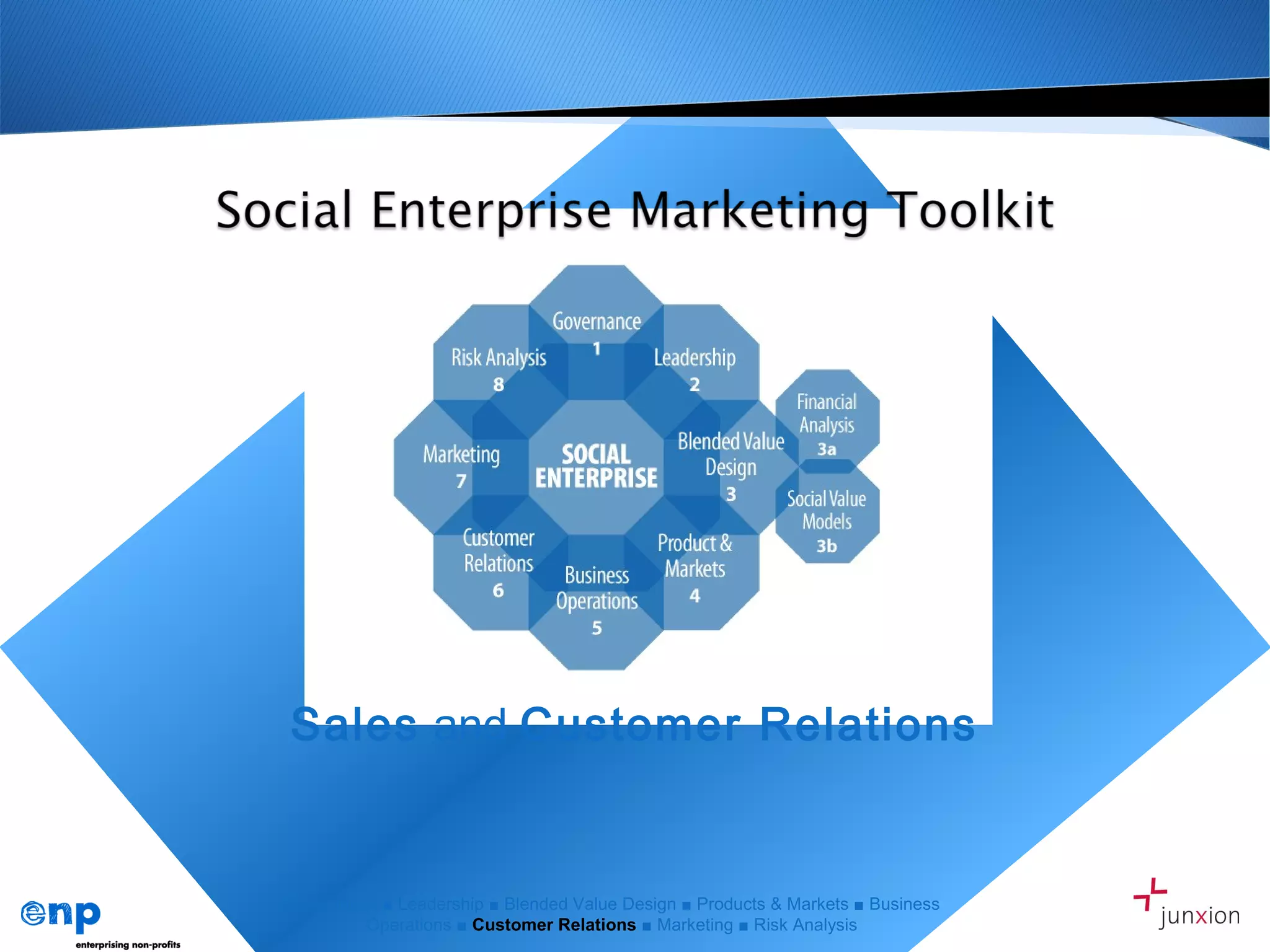
Sales and Customer Relations
Governance ■ Leadership ■ Blended Value Design ■ Products & Markets ■ Business
Operations ■ Customer Relations ■ Marketing ■ Risk Analysis 1
Social Enterprise Sales and Customer
Relations Toolkit
Putting sales and customer service in a social
enterprise model
Governance ■ Leadership ■ Blended Value Design ■ Products & Markets ■ Business
Operations ■ Customer Relations ■ Marketing ■ Risk Analysis
This toolkit has the essentials of
sales planning and customer
relations, which will help you
develop a sales plan, sell more,
build relationships and make a
profit.
Presented by ENP and Octopus Strategies
Governance ■ Leadership ■ Blended Value Design ■ Products & Markets ■ Business
Operations ■ Customer Relations ■ Marketing ■ Risk Analysis
A social enterprise must sell, make a
profit and have customers who believe
in their cause and products – all while
doing good.
Otherwise, it’s just a good hobby!
Governance ■ Leadership ■ Blended Value Design ■ Products & Markets ■ Business
Operations ■ Customer Relations ■ Marketing ■ Risk Analysis
Sales
Governance ■ Leadership ■ Blended Value Design ■ Products & Markets ■ Business
Operations ■ Customer Relations ■ Marketing ■ Risk Analysis
Social enterprise and sales
o A social enterprise uses business as the primary means of achieving its
social mission or purpose.
o Selling in a competitive marketplace is central to a social enterprise.
o This is unlike non-profits, whose market activity is not the primary means of
achieving their mission.
Governance ■ Leadership ■ Blended Value Design ■ Products & Markets ■ Business
Operations ■ Customer Relations ■ Marketing ■ Risk Analysis
Different ways of selling
o Direct Selling: when products/services are sold directly to customers. It
helps to build relationships with customers: Direct communication creates
opportunities to understand the needs, opinions and experiences of the
customer.
o Selling Wholesale: when not selling directly to consumer, but through a
supplier. Supply relationships, prices and choosing the right wholesaler are
crucial here.
o Online (or Tele) Sales: when sold online or over the phone.
It’s cost efficient and a good way of selling to repeat customers.
Governance ■ Leadership ■ Blended Value Design ■ Products & Markets ■ Business
Operations ■ Customer Relations ■ Marketing ■ Risk Analysis
How to sell more
A good sales person will:
o Sell with enthusiasm, for what your social enterprise is offering and
accomplishing.
o Communicate your belief in the product/service to potential customers.
o Follow a sales plan, phased over time, that explains sales targets, how
sales will be made and to whom.
o Understand your customer because meeting their needs and expectations
is the foundation for any small business.
Governance ■ Leadership ■ Blended Value Design ■ Products & Markets ■ Business
Operations ■ Customer Relations ■ Marketing ■ Risk Analysis
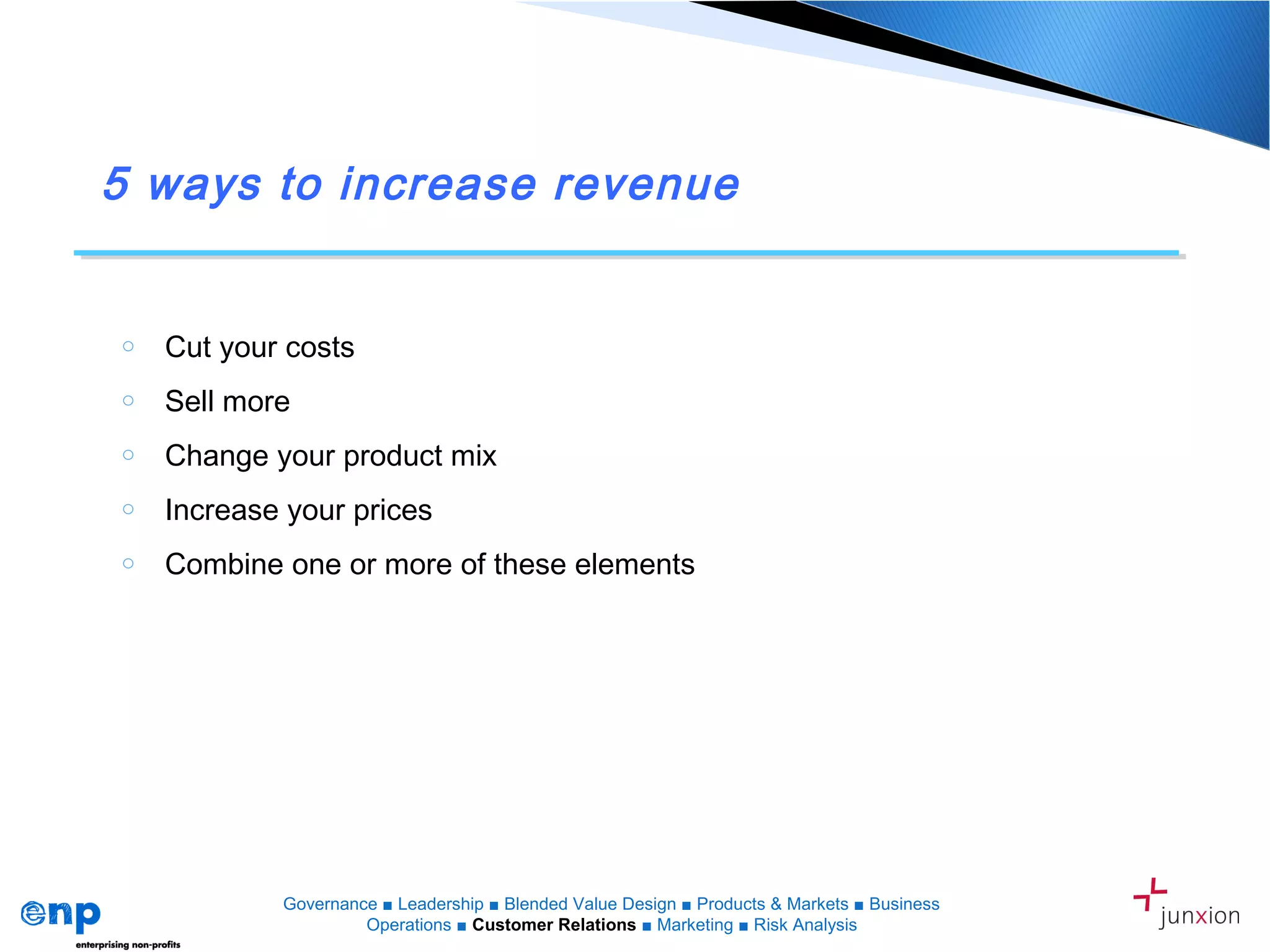
5 ways to increase revenue
o Cut your costs
o Sell more
o Change your product mix
o Increase your prices
o Combine one or more of these elements
Governance ■ Leadership ■ Blended Value Design ■ Products & Markets ■ Business
Operations ■ Customer Relations ■ Marketing ■ Risk Analysis
Both social enterprises and non-profits
work to create a positive social or
environmental impact.
But the models are very different.
Governance ■ Leadership ■ Blended Value Design ■ Products & Markets ■ Business
Operations ■ Customer Relations ■ Marketing ■ Risk Analysis
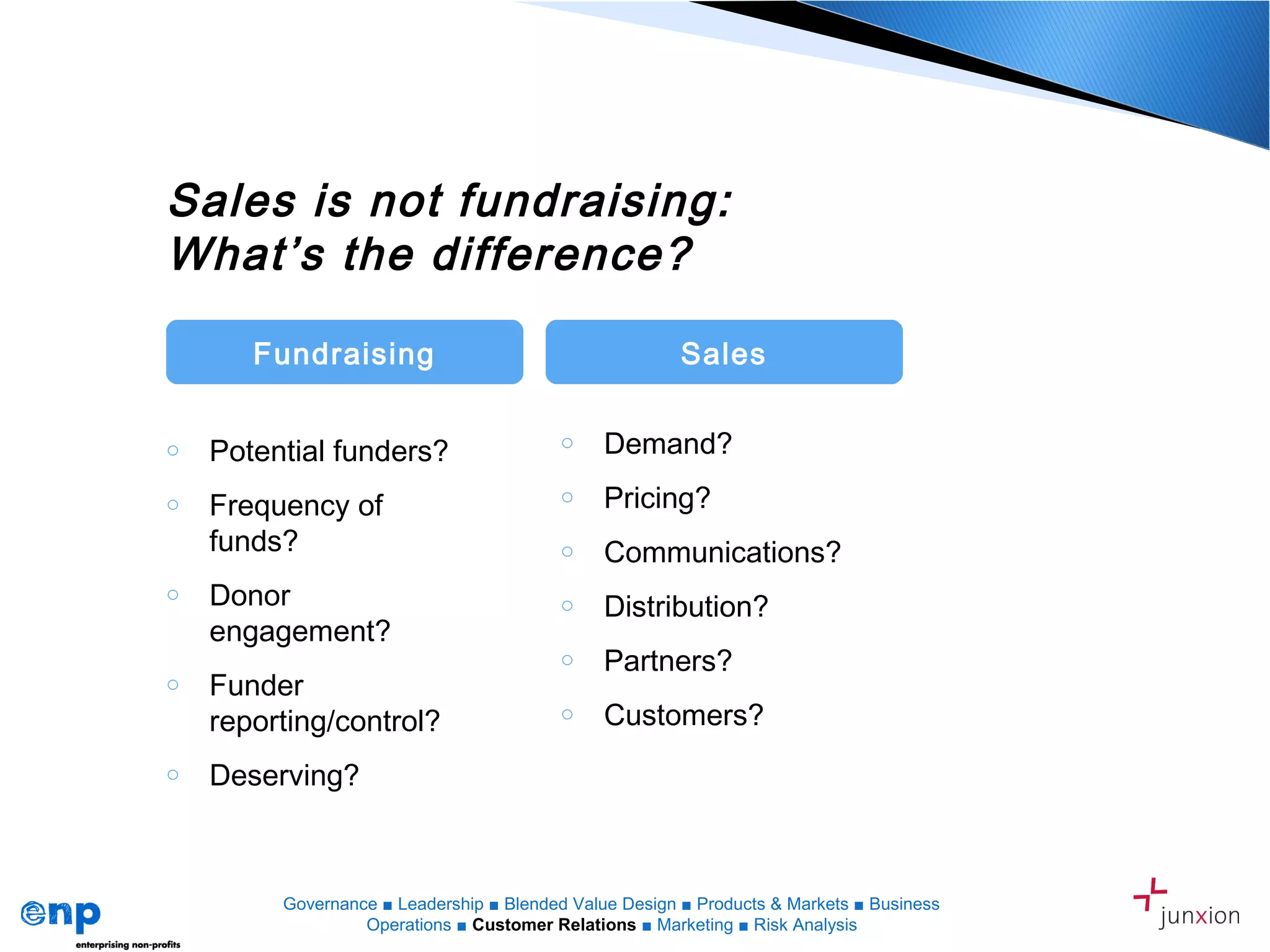
Sales is not fundraising:
What’s the difference?
• ...Positioning
Fundraising Sales
o Potential funders?
o Frequency of
funds?
o Donor
engagement?
o Funder
reporting/control?
o Deserving?
o Demand?
o Pricing?
o Communications?
o Distribution?
o Partners?
o Customers?
Governance ■ Leadership ■ Blended Value Design ■ Products & Markets ■ Business
Operations ■ Customer Relations ■ Marketing ■ Risk Analysis
o Many social enterprises mistakenly assume that they can
get away with a lower service level because their
customers appreciate that they’re a worthy cause.
o However, a good cause cannot make up for bad service or
an inferior product.
Working for a worthy cause
does not guarantee business:
The Four P’s
Governance ■ Leadership ■ Blended Value Design ■ Products & Markets ■ Business
Operations ■ Customer Relations ■ Marketing ■ Risk Analysis
A social enterprise can achieve its
mission if it makes a profit. The more it
earns, the more it can support its work
and social impact.
A smart sales plan is key here.
Governance ■ Leadership ■ Blended Value Design ■ Products & Markets ■ Business
Operations ■ Customer Relations ■ Marketing ■ Risk Analysis
 Market segmentation
 Resource development and allocation
 Advertising strategy
 Marginal cost analysis
14
Governance ■ Leadership ■ Blended Value Design ■ Products & Markets ■ Business
Operations ■ Customer Relations ■ Marketing ■ Risk Analysis
A robust sales plan has the following four key
elements:
Each will be discussed in detail in the following slides.
Market segmentation
A market segment is a group of customers, users or supporters. They
have similar needs. Each segment is different from the other and
needs tailored treatment and a customized communication plan.
Governance ■ Leadership ■ Blended Value Design ■ Products & Markets ■ Business
Operations ■ Customer Relations ■ Marketing ■ Risk Analysis
Market segmentation
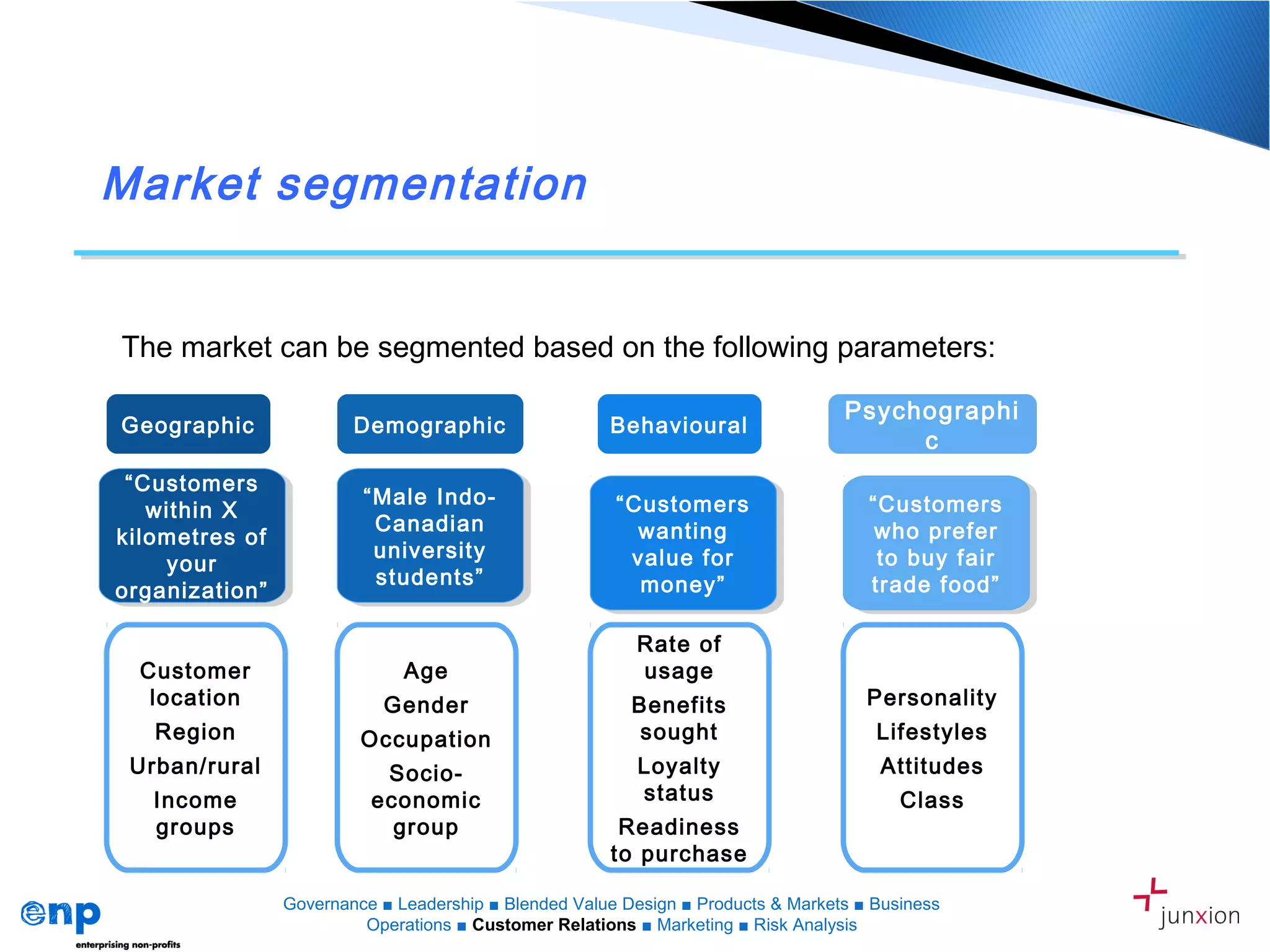
The market can be segmented based on the following parameters:
Governance ■ Leadership ■ Blended Value Design ■ Products & Markets ■ Business
Operations ■ Customer Relations ■ Marketing ■ Risk Analysis
Geographic Demographic Behavioural
Psychographi
c
“Customers
within X
kilometres of
your
organization”
“Customers
within X
kilometres of
your
organization”
“Male Indo-
Canadian
university
students”
“Male Indo-
Canadian
university
students”
“Customers
wanting
value for
money”
“Customers
wanting
value for
money”
“Customers
who prefer
to buy fair
trade food”
“Customers
who prefer
to buy fair
trade food”
Customer
location
Region
Urban/rural
Income
groups
Age
Gender
Occupation
Socio-
economic
group
Rate of
usage
Benefits
sought
Loyalty
status
Readiness
to purchase
Personality
Lifestyles
Attitudes
Class
Social Enterprise Sales and Marketing Toolkit
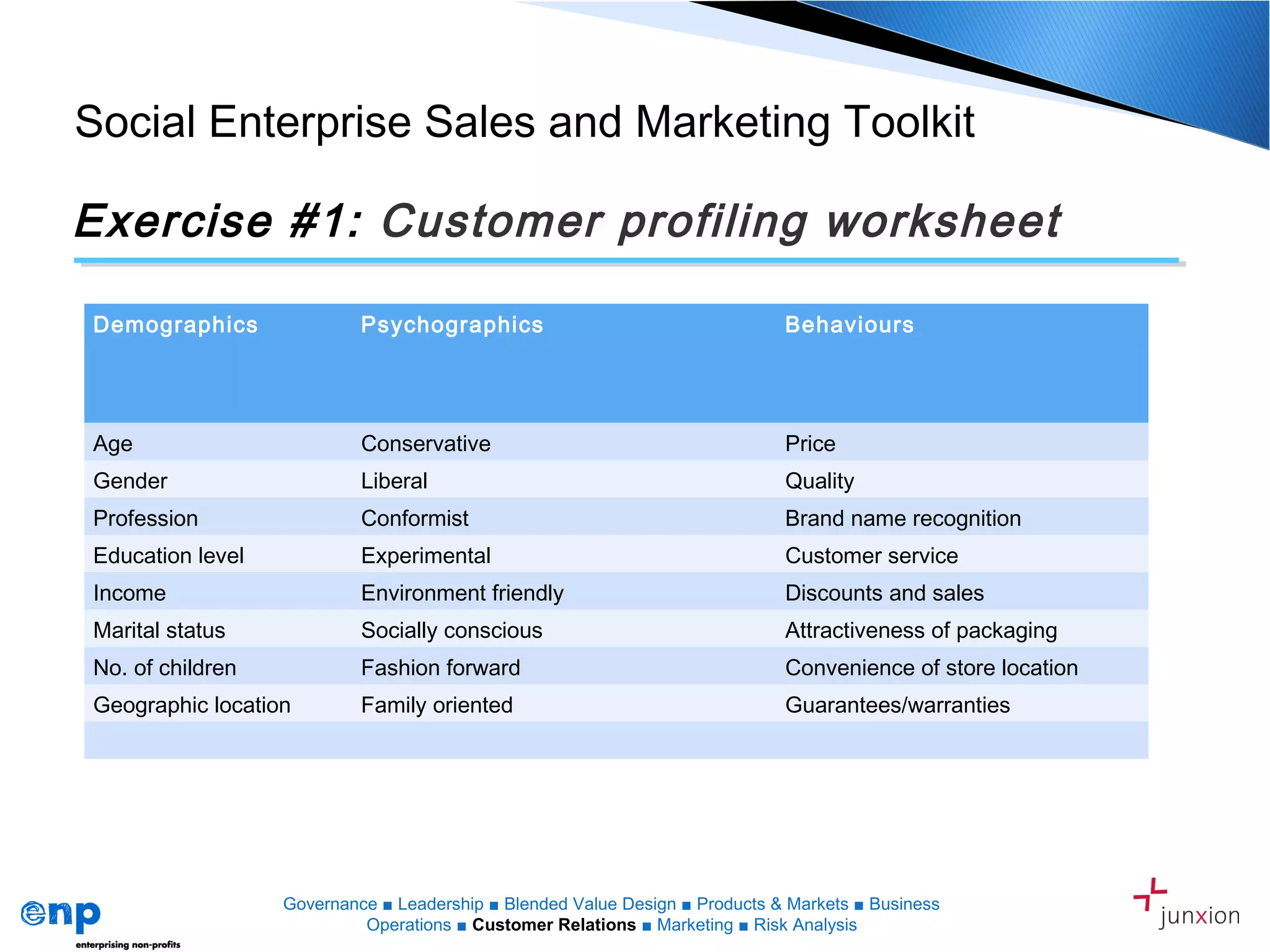
Exercise #1: Customer profiling worksheet
Governance ■ Leadership ■ Blended Value Design ■ Products & Markets ■ Business
Operations ■ Customer Relations ■ Marketing ■ Risk Analysis
Demographics Psychographics Behaviours
Age Conservative Price
Gender Liberal Quality
Profession Conformist Brand name recognition
Education level Experimental Customer service
Income Environment friendly Discounts and sales
Marital status Socially conscious Attractiveness of packaging
No. of children Fashion forward Convenience of store location
Geographic location Family oriented Guarantees/warranties
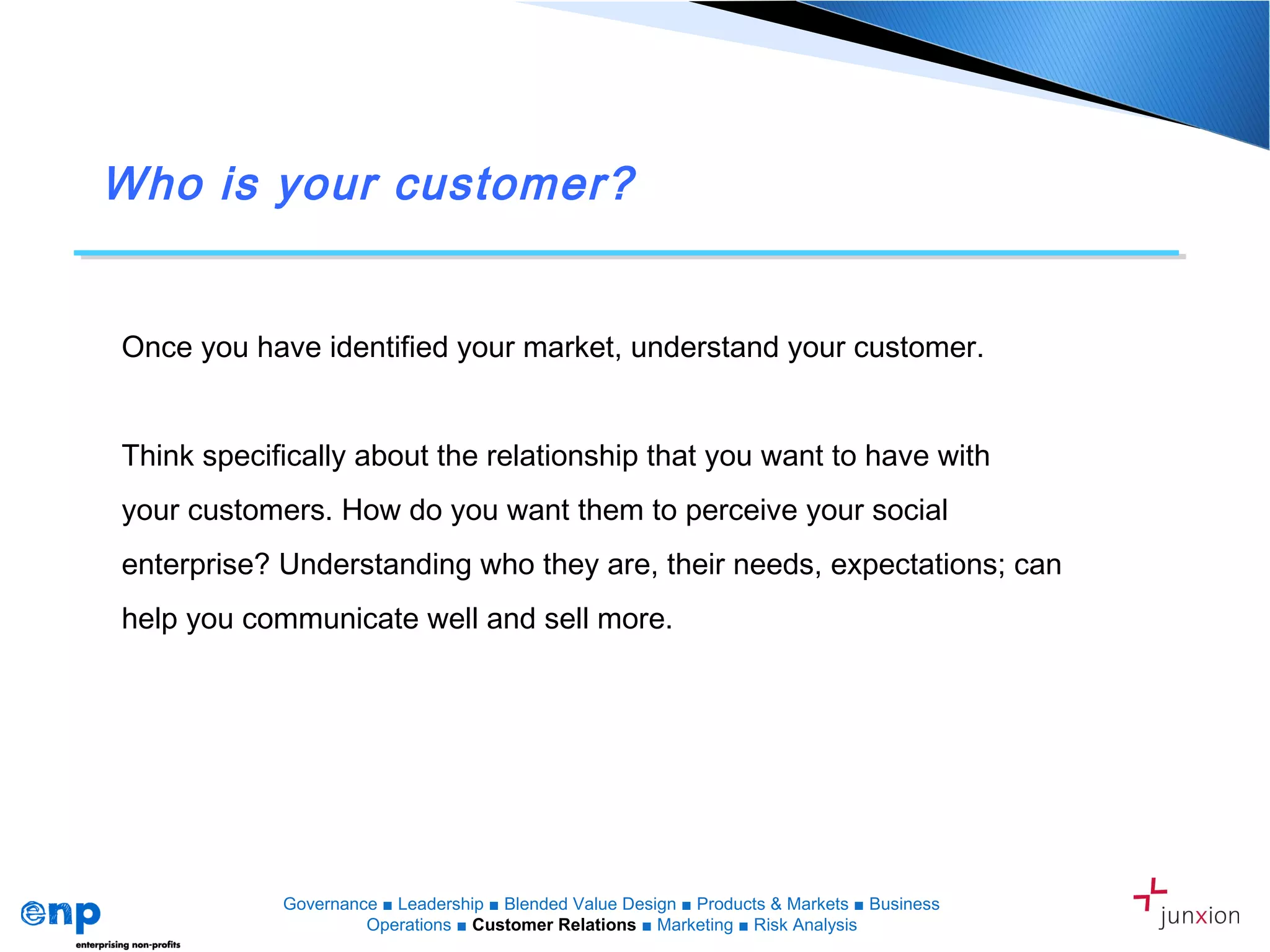
Who is your customer?
Once you have identified your market, understand your customer.
Think specifically about the relationship that you want to have with
your customers. How do you want them to perceive your social
enterprise? Understanding who they are, their needs, expectations; can
help you communicate well and sell more.
Governance ■ Leadership ■ Blended Value Design ■ Products & Markets ■ Business
Operations ■ Customer Relations ■ Marketing ■ Risk Analysis
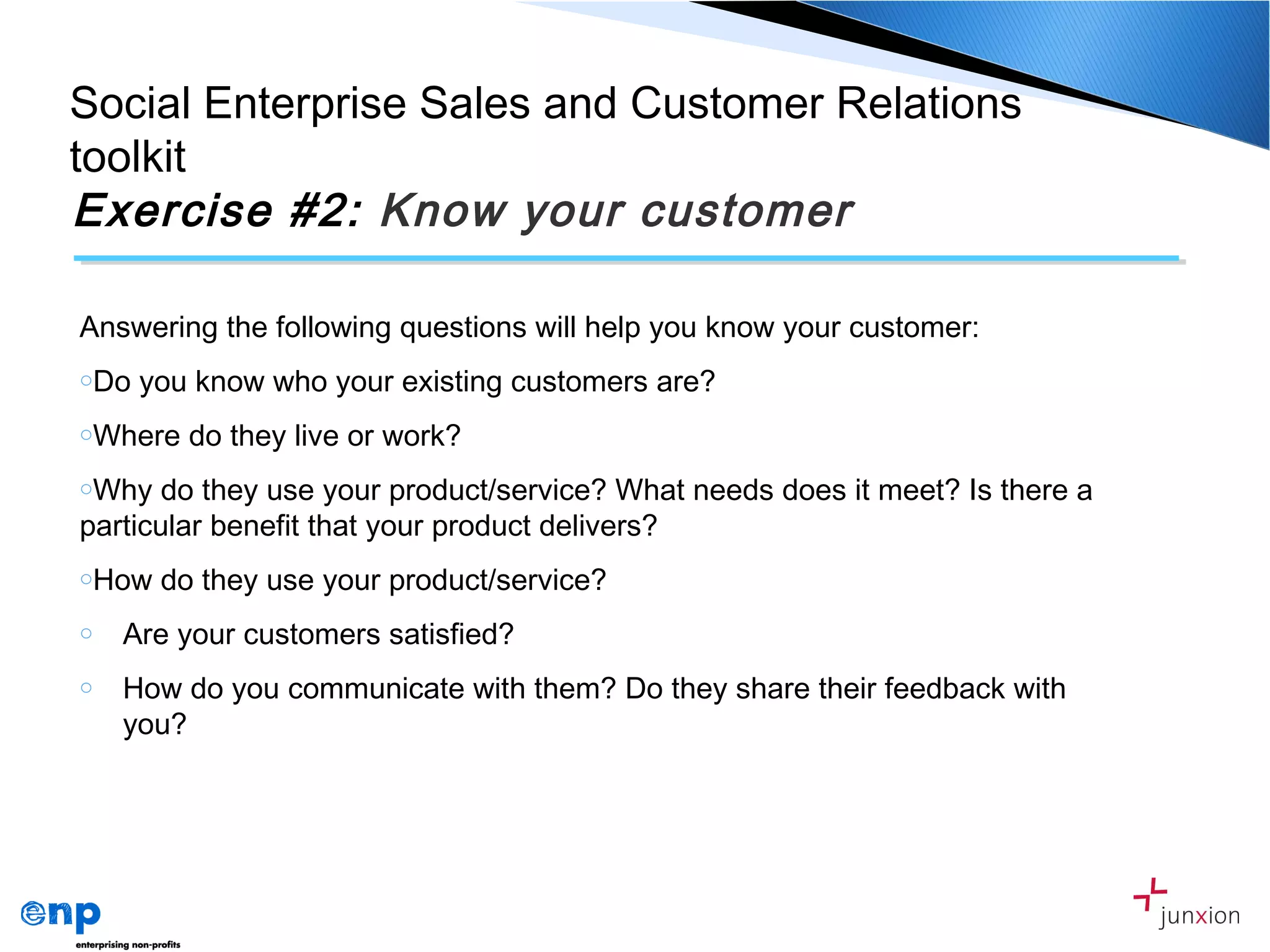
Answering the following questions will help you know your customer:
oDo you know who your existing customers are?
oWhere do they live or work?
oWhy do they use your product/service? What needs does it meet? Is there a
particular benefit that your product delivers?
oHow do they use your product/service?
o Are your customers satisfied?
o How do you communicate with them? Do they share their feedback with
you?
Social Enterprise Sales and Customer Relations
toolkit
Exercise #2: Know your customer
Resource development and
allocation
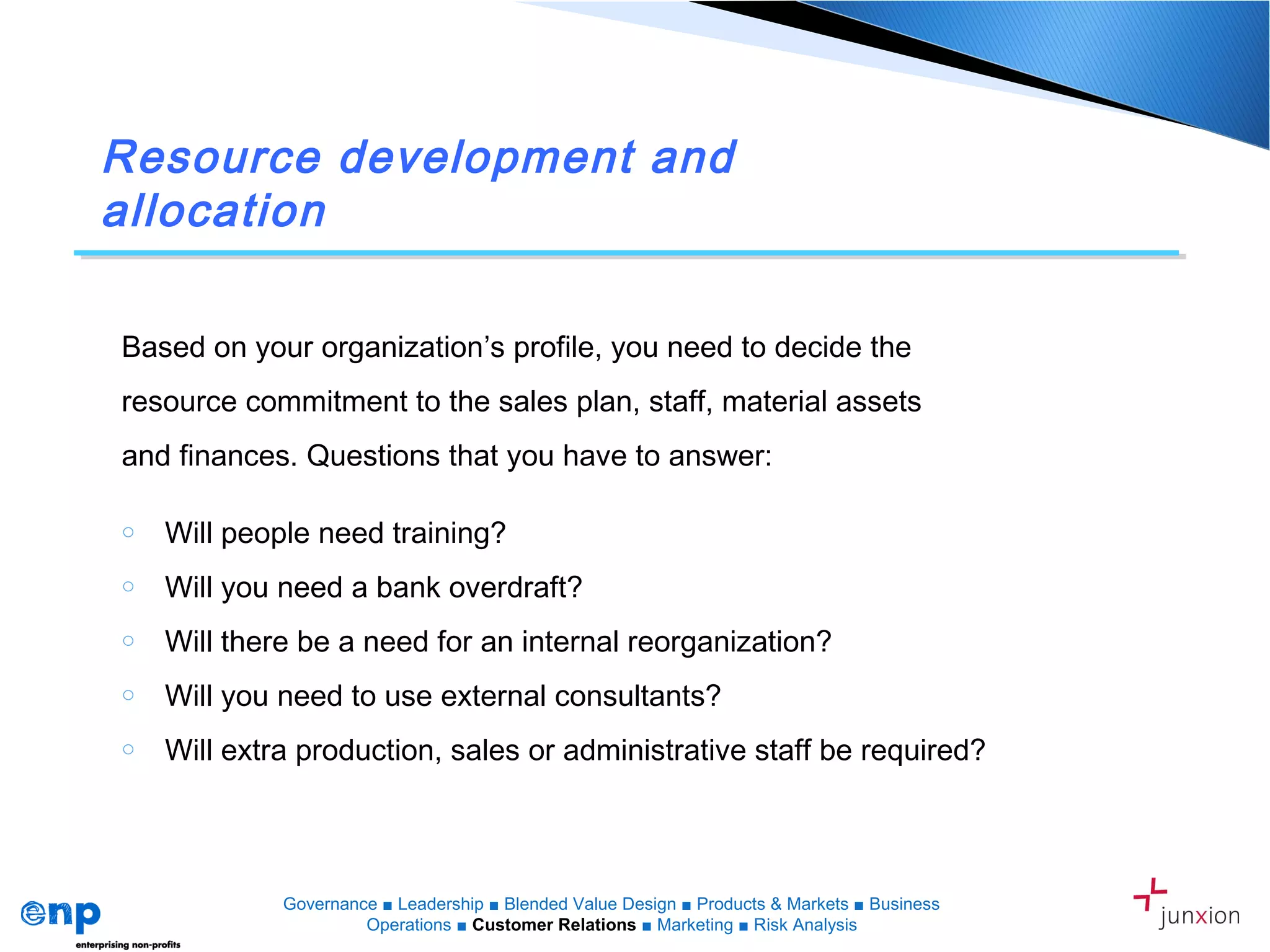
Based on your organization’s profile, you need to decide the
resource commitment to the sales plan, staff, material assets
and finances. Questions that you have to answer:
o Will people need training?
o Will you need a bank overdraft?
o Will there be a need for an internal reorganization?
o Will you need to use external consultants?
o Will extra production, sales or administrative staff be required?
Governance ■ Leadership ■ Blended Value Design ■ Products & Markets ■ Business
Operations ■ Customer Relations ■ Marketing ■ Risk Analysis
Advertising strategy
Advertising strategy determines how you reach your customers
and what the message will be.
It depends on:
o Brand positioning
o Brand proposition
o Brand strategy
o Creative
o Media planning
Governance ■ Leadership ■ Blended Value Design ■ Products & Markets ■ Business
Operations ■ Customer Relations ■ Marketing ■ Risk Analysis
Advertising strategy
Your business goals determine where you should advertise. Different
mediums reach and impact the market differently. For example, radio
generates interest in your product/service but it’s reach is narrow. In
contrast, television grows the market broadly.
Please refer to our presentation ‘Medium and Message’, a part of the
Marketing toolkit, to understand how different mediums reach different
audiences.
Governance ■ Leadership ■ Blended Value Design ■ Products & Markets ■ Business
Operations ■ Customer Relations ■ Marketing ■ Risk Analysis
Marginal cost analysis (MCA)
MCA consists simply of a calculation of what extra sales are generated at what
cost in terms of the advertising budget and wage costs. You have to assess
how much extra income is generated and the degree to which this generates a
gross profit or ’margin’.
It is not necessary for a marketing drive to generate a profit since it may have
other purposes: to increase market recognition prior to introducing a new
product or to clear a warehouse of stockpile, for instance. But the ’marginal
cost’ or ’marginal benefit’ of the marketing drive (i.e., what is lost or gained
compared to the situation now) must be calculated.
Governance ■ Leadership ■ Blended Value Design ■ Products & Markets ■ Business
Operations ■ Customer Relations ■ Marketing ■ Risk Analysis
 New product
 Market
 Cost-plus pricing
24
Governance ■ Leadership ■ Blended Value Design ■ Products & Markets ■ Business
Operations ■ Customer Relations ■ Marketing ■ Risk Analysis
There are three broad pricing strategies:
Each will be discussed in detail in the upcoming slides.
Pricing strategies
Different factors determine how you price your product or
service:
o New product: You could either take advantage of demand for a new
product/service (Price Skimming) or set a fairly low price to gain market
share (Penetration Pricing).
o Market: This is important too. You need to understand your market, the
competitors and how it affects your product/service.
o Cost-plus pricing: Most businesses use the total of their overhead costs and
add a margin to fix prices (after all, you can’t operate at a loss).
Governance ■ Leadership ■ Blended Value Design ■ Products & Markets ■ Business
Operations ■ Customer Relations ■ Marketing ■ Risk Analysis
Prices and the market
In a competitive market, the price of your product or service also
depends on the competition. The following parameters will help you
determine the pricing strategy:
o How does your product perform?
o What is its quality? How does it look?
o How is it packaged and presented?
o How does it compare to the competition?
If your product or service quality is better than your competitors, then charge a
higher price.
Governance ■ Leadership ■ Blended Value Design ■ Products & Markets ■ Business
Operations ■ Customer Relations ■ Marketing ■ Risk Analysis
Remember:
Pricing strategies can change
people’s behaviour. More
expensive is sometimes perceived
as better quality, which can help
the reputation of your organization.
Meanwhile, low prices could
persuade people to buy more from
you.
Governance ■ Leadership ■ Blended Value Design ■ Products & Markets ■ Business
Operations ■ Customer Relations ■ Marketing ■ Risk Analysis
 Market segmentation
 Marketing mix
 Marketing objectives
 Research
 Plan
28
Governance ■ Leadership ■ Blended Value Design ■ Products & Markets ■ Business
Operations ■ Customer Relations ■ Marketing ■ Risk Analysis
It’s important to do your homework well before you
reach your customers. Here is what you need to
consider:
The following slides will explain this in greater detail.
Market segmentation
This concept has been explained earlier. Please refer to slides 15 and
16.
Governance ■ Leadership ■ Blended Value Design ■ Products & Markets ■ Business
Operations ■ Customer Relations ■ Marketing ■ Risk Analysis
Marketing mix
The four Ps: product (or service), price, place and promotion inform
how to market your organization.
The concept of marketing mix has been dealt with in great detail in the Social
Enterprise Marketing Toolkit.
Governance ■ Leadership ■ Blended Value Design ■ Products & Markets ■ Business
Operations ■ Customer Relations ■ Marketing ■ Risk Analysis
Marketing objectives
A well defined set of measurable and quantifiable marketing objectives
is essential before you move out in to the market with a marketing
plan. You must know what you wish to achieve - more customers, users,
sales/visits, loyalty, increased support, higher prices or more profits/resources.
Your marketing plan will be governed by your objectives.
Governance ■ Leadership ■ Blended Value Design ■ Products & Markets ■ Business
Operations ■ Customer Relations ■ Marketing ■ Risk Analysis
Research
Let’s face it - you are not the only one in the market. Competition is
real. Understanding market dynamics and knowing what’s current is
essential to any business.
You must look at both the external situation (demand, supply, trends,
legislative or technical change, attitudes amongst other factors) and
internal issues (ability to deliver, effect of marketing, costs and
organizational change needed).
Governance ■ Leadership ■ Blended Value Design ■ Products & Markets ■ Business
Operations ■ Customer Relations ■ Marketing ■ Risk Analysis
The Marketing Plan
The outcomes of market segmentation, marketing mix, objectives and
research, lead to a marketing plan.
To implement one, you will need to assign responsibilities, allocate
resources, set a timetable, organize systems for monitoring and report
back.
Governance ■ Leadership ■ Blended Value Design ■ Products & Markets ■ Business
Operations ■ Customer Relations ■ Marketing ■ Risk Analysis
Develop a Sales Plan
Your Sales Plan will be determined by the features of product or service
you want to sell, its price, the skills of your sales team, your
distribution network, key partners, your customer service and retention
strategy.
As a start-up, you must think through if you will sell directly to
your customers on your own or will you outsource it and sell through
partners.
Governance ■ Leadership ■ Blended Value Design ■ Products & Markets ■ Business
Operations ■ Customer Relations ■ Marketing ■ Risk Analysis
Your Sales Team
Your sales team is the face of your social enterprise. It’s the link
between your organization and customers. As you build a team,
remember your sales team must:
o Know your customer as well as you do
o Be passionate about your product/service
o Never commit to something they can’t deliver
o Develop an emotional connect with your customers. A phone call over an
email can make the difference.
o Never belittle your competition
o Always follow through
o Focus on goals rather than individual sales target
Governance ■ Leadership ■ Blended Value Design ■ Products & Markets ■ Business
Operations ■ Customer Relations ■ Marketing ■ Risk Analysis
Train your Sales Team
Right coaching will make your sales team effective and efficient. A good training
programme must:
o Help them learn to engage the customer better
o Develop their questioning and listening skills. This often leads to sales rather than a good
pitch
o Make them independent. This will make them feel confident and hence more effective
o Help the team build trust and rapport with the prospects
o Prepare the team to handle objections and prepare appropriate responses to overcome
them
o Develop their skills to spot buying signals and to ask for business
o Cultivate the principles of customer service in their behaviour and follow up after the sale
Governance ■ Leadership ■ Blended Value Design ■ Products & Markets ■ Business
Operations ■ Customer Relations ■ Marketing ■ Risk Analysis
What your sales team should do
Qualify customers: The salesperson who asks the right questions to the right people,
at the right time, at the right place, will have many qualified prospects.
o Who:
- Who has a need for your product/service?
- Who has the money to buy it?
- Who has the most urgent need for it?
- Who has the influence over the prospect?
o Where:
- Where does your prospect live, work, socialize?
- Where can you find a suitable mailing list to reach them?
- Where will you go to contact new prospects?
Governance ■ Leadership ■ Blended Value Design ■ Products & Markets ■ Business
Operations ■ Customer Relations ■ Marketing ■ Risk Analysis
What your sales team should do
o What:
- What will the prospect find most beneficial about your product/service?
- What questions can you ask that will get the prospect to talk about his needs?
- What information you must gather about your prospect before you meet him?
- What is the single biggest problem the prospect has?
o When:
- When is the best time to contact the prospect?
- When to contact the prospect again if your first efforts were not successful?
Governance ■ Leadership ■ Blended Value Design ■ Products & Markets ■ Business
Operations ■ Customer Relations ■ Marketing ■ Risk Analysis
What your sales team should do
Closing: One of the most important stages of selling is closing the deal.
Here are some interesting closing techniques:
o Alternative close: Offering limited set of choices
o Bonus close: Offer delighter to clinch the deal
o Empathy close: Empathize with them
o Yes-set close: Get them to say yes and they will keep saying yes
o Save the world close: Buy now and help save the world.
Governance ■ Leadership ■ Blended Value Design ■ Products & Markets ■ Business
Operations ■ Customer Relations ■ Marketing ■ Risk Analysis
Social Enterprise Sales and Marketing Toolkit
Exercise #3: Sales team
You are as successful as your sales team. Before you build one,
consider:
o How will you recruit and build your sales force? Hiring the right
person can make or break the team.
o How will your sales people sell? What are their skills? How well
do they understand your product or service?
o What is the team reporting structure?
o If the members have authority to negotiate?
o If they solve problems? How do they respond to demanding
situations?
Governance ■ Leadership ■ Blended Value Design ■ Products & Markets ■ Business
Operations ■ Customer Relations ■ Marketing ■ Risk Analysis
Customer
Relations
Governance ■ Leadership ■ Blended Value Design ■ Products & Markets ■ Business
Operations ■ Customer Relations ■ Marketing ■ Risk Analysis
Value is created by building
relationships, addressing customer
needs and focusing on continuous
improvement.
Governance ■ Leadership ■ Blended Value Design ■ Products & Markets ■ Business
Operations ■ Customer Relations ■ Marketing ■ Risk Analysis
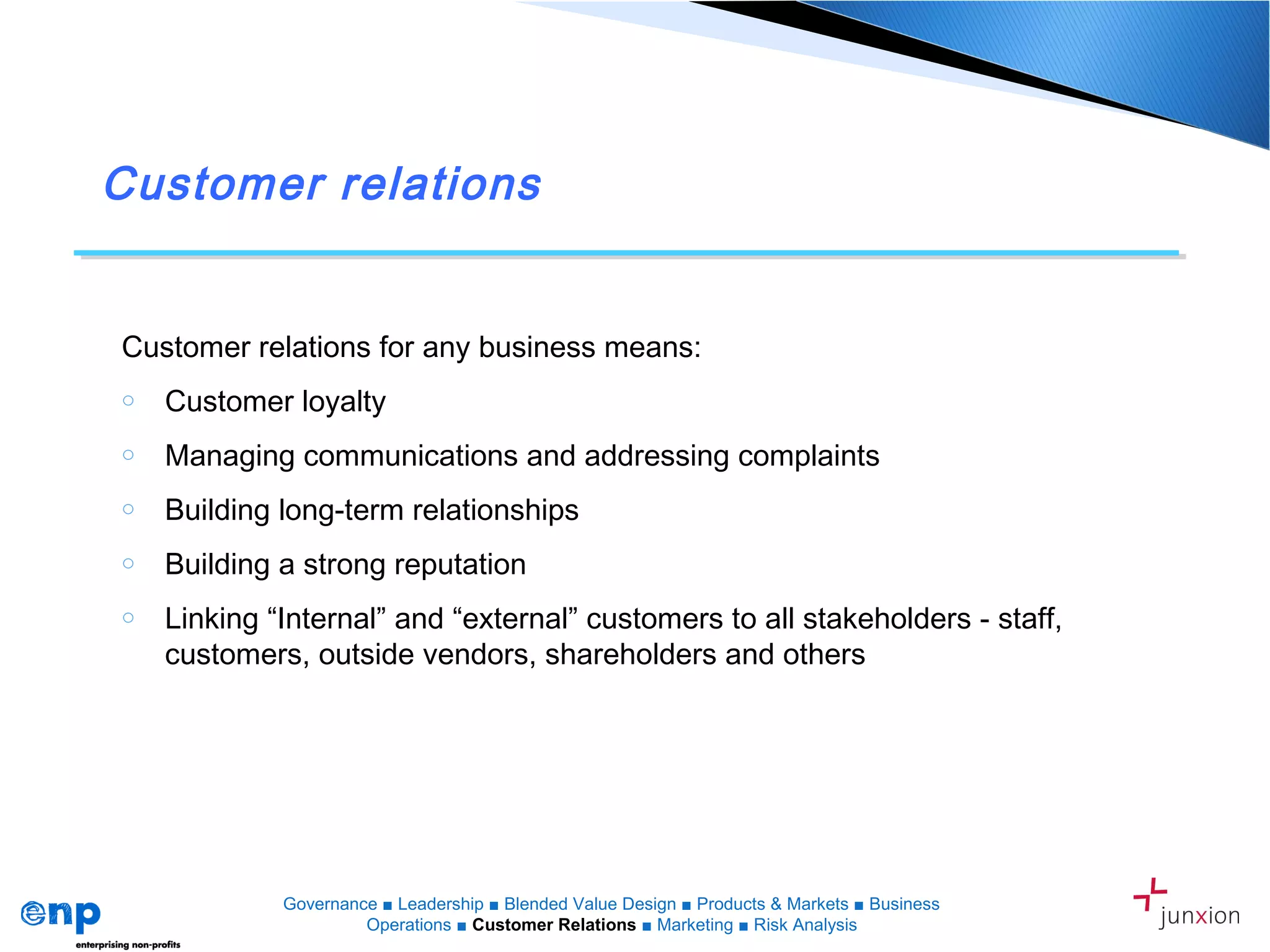
Customer relations
Customer relations for any business means:
o Customer loyalty
o Managing communications and addressing complaints
o Building long-term relationships
o Building a strong reputation
o Linking “Internal” and “external” customers to all stakeholders - staff,
customers, outside vendors, shareholders and others
Governance ■ Leadership ■ Blended Value Design ■ Products & Markets ■ Business
Operations ■ Customer Relations ■ Marketing ■ Risk Analysis
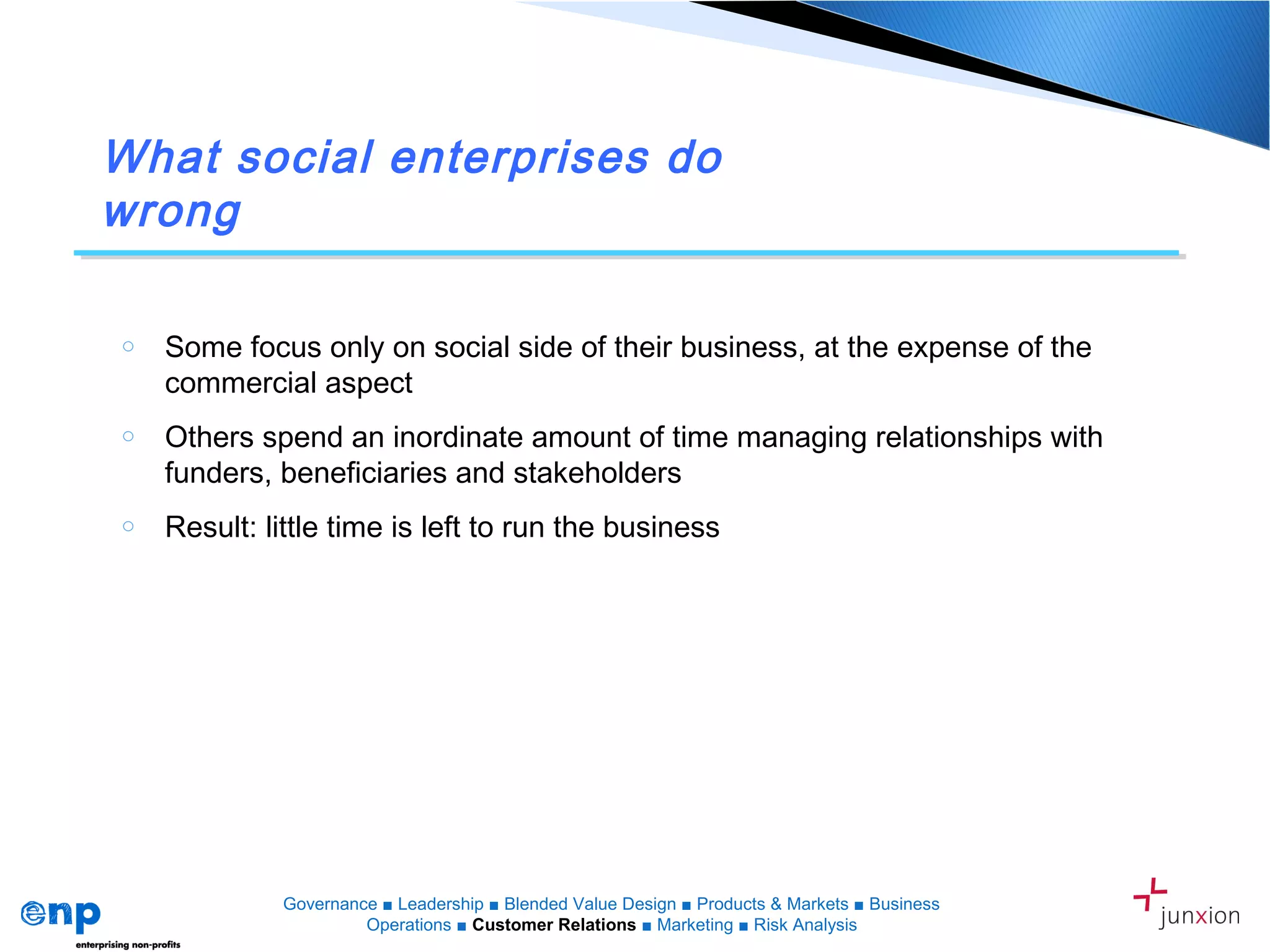
What social enterprises do
wrong
o Some focus only on social side of their business, at the expense of the
commercial aspect
o Others spend an inordinate amount of time managing relationships with
funders, beneficiaries and stakeholders
o Result: little time is left to run the business
Governance ■ Leadership ■ Blended Value Design ■ Products & Markets ■ Business
Operations ■ Customer Relations ■ Marketing ■ Risk Analysis
Who is your customer?
To build relationships with your customers, you need to know them
first. Refer to slide 17 for tips on how to better know your customer.
Governance ■ Leadership ■ Blended Value Design ■ Products & Markets ■ Business
Operations ■ Customer Relations ■ Marketing ■ Risk Analysis
What do your customers think
about?
o Image: Includes first impressions, openness, reputation, positive values and
physical appearance of premises and people
o Products/Services: Are they up to scratch, well priced/good value? How can
they be improved? What new features do customers want?
o Delivery: How do you deliver your products/services? Do you care for your
customers? Are you communicating well with them? How good are you at
customer services?
o Loyalty and attachment: The willingness of customers to continue using
your organization’s products and services, and recommending the
organization and its products or services to others are key to your
organization’s sustainability
Governance ■ Leadership ■ Blended Value Design ■ Products & Markets ■ Business
Operations ■ Customer Relations ■ Marketing ■ Risk Analysis
How to understand your
customers’ need and
expectations?
The best way to know more about your customers’ needs is to collect
information about them.
Why ask? To improve your product or service, to develop new
products, improve delivery and promotion.
What to ask? Begin with the end in mind. It should have a clear purpose.
What to do with it? Once you have measured how satisfied your
customers are, make use of the results to improve your organization
and the products and services you provide.
Governance ■ Leadership ■ Blended Value Design ■ Products & Markets ■ Business
Operations ■ Customer Relations ■ Marketing ■ Risk Analysis
How to understand your
customers’ need and
expectations?
Who will you collect information from? Directly from customers
or internally from within the organization.
What information should you collect? The right questions which cover
the facets, concerns and values of most importance to customers.
How will you ask? Request feedback from customers or monitor internal
performance indicators that demonstrate either customer satisfaction
or quality of customer service.
When should you ask? At various, milestone times, throughout the
relationship.
What type of information should you collect? Qualitative, demographic /
psychographic, behavioural and geographic.
Governance ■ Leadership ■ Blended Value Design ■ Products & Markets ■ Business
Operations ■ Customer Relations ■ Marketing ■ Risk Analysis
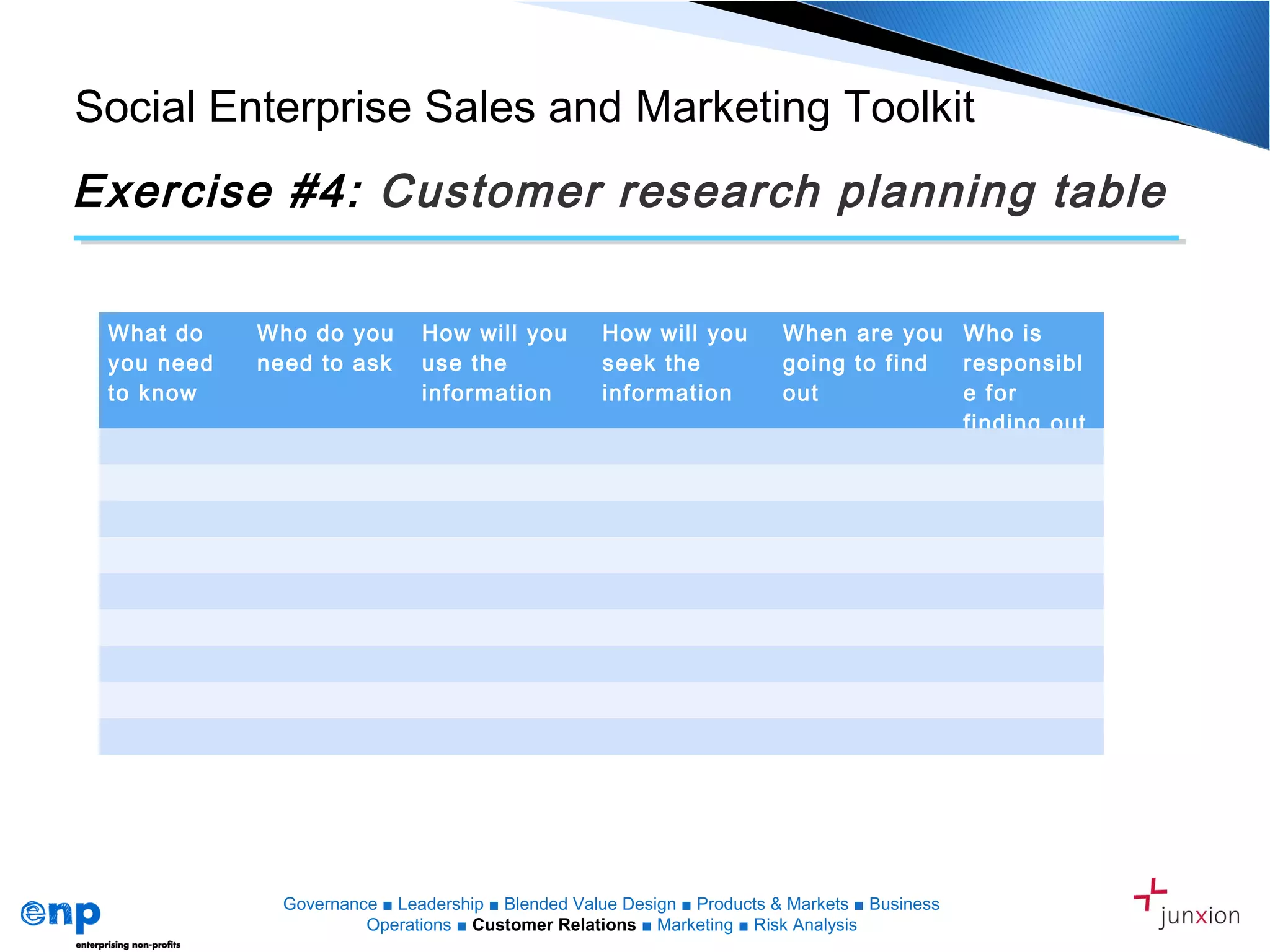
Social Enterprise Sales and Marketing Toolkit
Exercise #4: Customer research planning table
Governance ■ Leadership ■ Blended Value Design ■ Products & Markets ■ Business
Operations ■ Customer Relations ■ Marketing ■ Risk Analysis
What do
you need
to know
Who do you
need to ask
How will you
use the
information
How will you
seek the
information
When are you
going to find
out
Who is
responsibl
e for
finding out
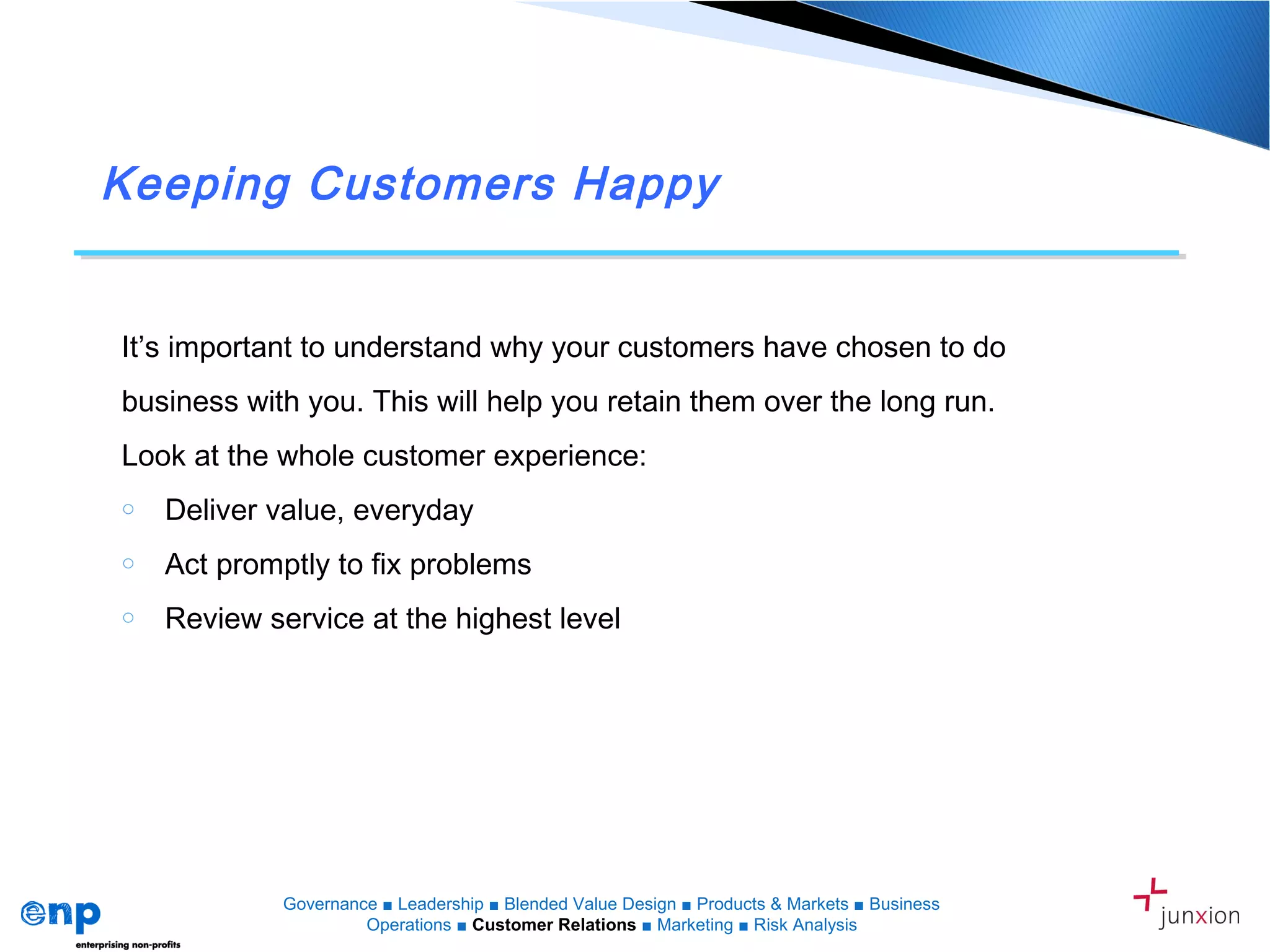
Keeping Customers Happy
Governance ■ Leadership ■ Blended Value Design ■ Products & Markets ■ Business
Operations ■ Customer Relations ■ Marketing ■ Risk Analysis
It’s important to understand why your customers have chosen to do
business with you. This will help you retain them over the long run.
Look at the whole customer experience:
o Deliver value, everyday
o Act promptly to fix problems
o Review service at the highest level
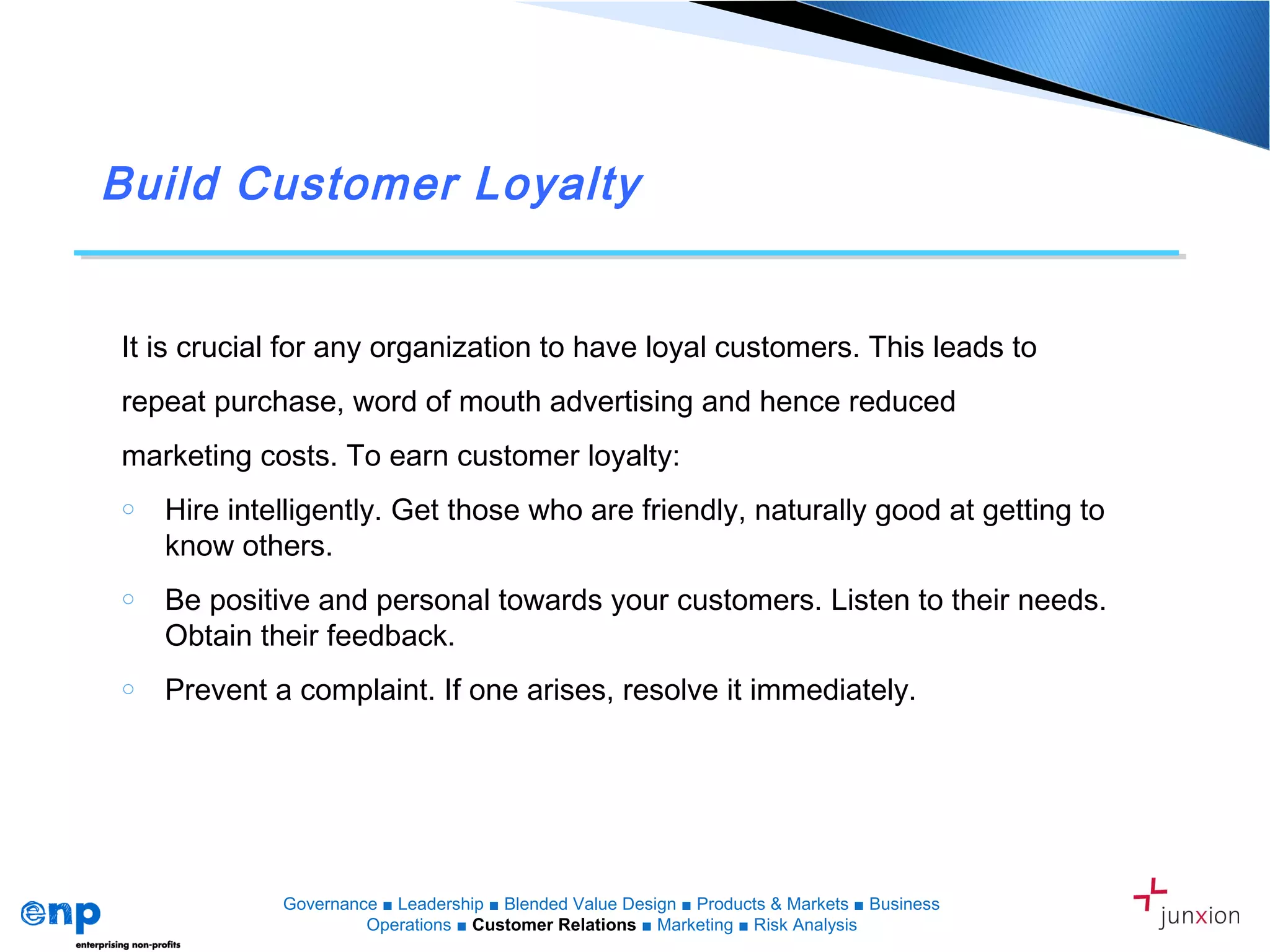
Build Customer Loyalty
Governance ■ Leadership ■ Blended Value Design ■ Products & Markets ■ Business
Operations ■ Customer Relations ■ Marketing ■ Risk Analysis
It is crucial for any organization to have loyal customers. This leads to
repeat purchase, word of mouth advertising and hence reduced
marketing costs. To earn customer loyalty:
o Hire intelligently. Get those who are friendly, naturally good at getting to
know others.
o Be positive and personal towards your customers. Listen to their needs.
Obtain their feedback.
o Prevent a complaint. If one arises, resolve it immediately.
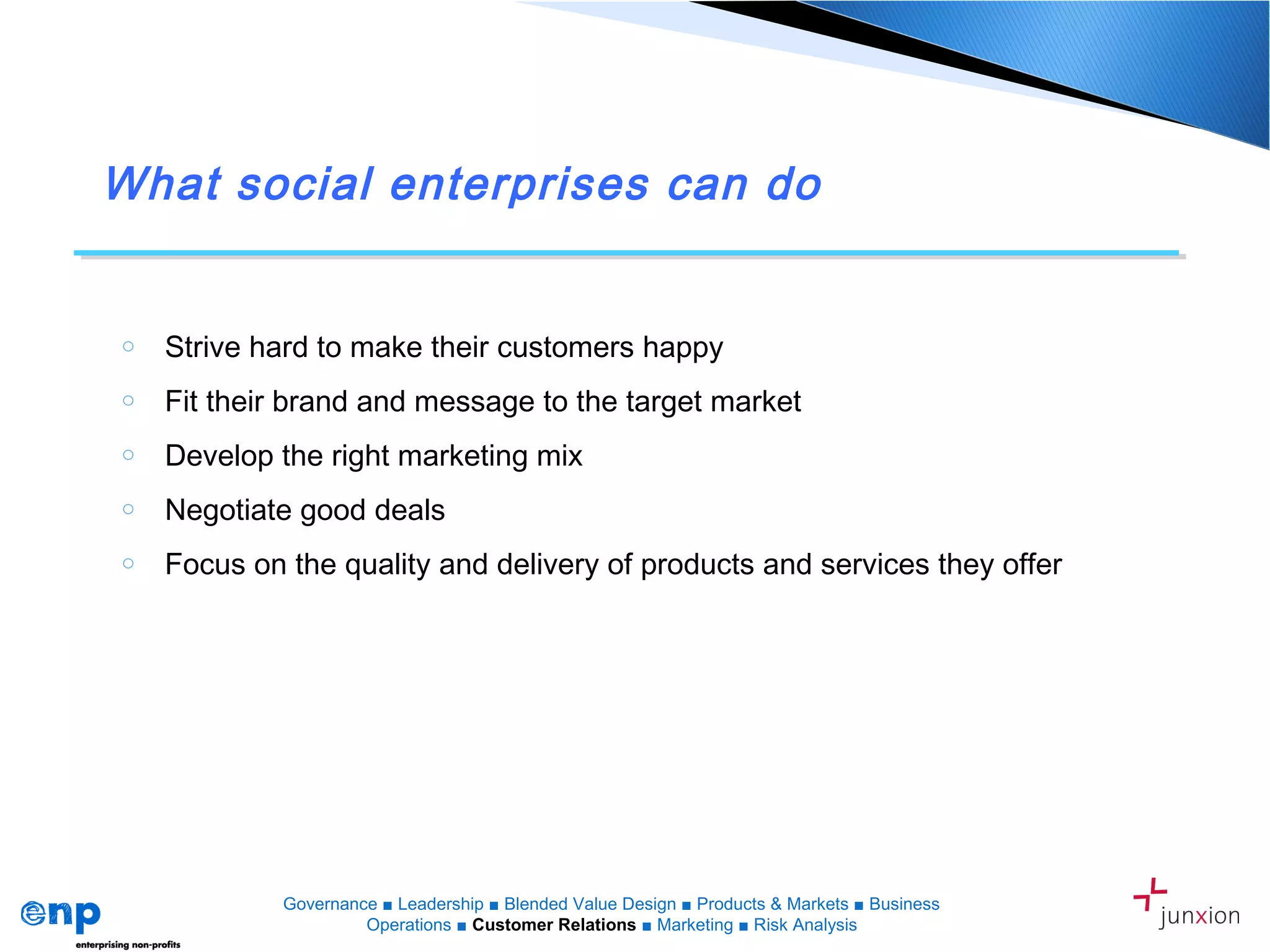
What social enterprises can do
o Strive hard to make their customers happy
o Fit their brand and message to the target market
o Develop the right marketing mix
o Negotiate good deals
o Focus on the quality and delivery of products and services they offer
Governance ■ Leadership ■ Blended Value Design ■ Products & Markets ■ Business
Operations ■ Customer Relations ■ Marketing ■ Risk Analysis

Enp presentation customer_relations_and_sales_v4

  • 1.
    Sales and CustomerRelations Governance ■ Leadership ■ Blended Value Design ■ Products & Markets ■ Business Operations ■ Customer Relations ■ Marketing ■ Risk Analysis 1
  • 2.
    Social Enterprise Salesand Customer Relations Toolkit Putting sales and customer service in a social enterprise model Governance ■ Leadership ■ Blended Value Design ■ Products & Markets ■ Business Operations ■ Customer Relations ■ Marketing ■ Risk Analysis
  • 3.
    This toolkit hasthe essentials of sales planning and customer relations, which will help you develop a sales plan, sell more, build relationships and make a profit. Presented by ENP and Octopus Strategies Governance ■ Leadership ■ Blended Value Design ■ Products & Markets ■ Business Operations ■ Customer Relations ■ Marketing ■ Risk Analysis
  • 4.
    A social enterprisemust sell, make a profit and have customers who believe in their cause and products – all while doing good. Otherwise, it’s just a good hobby! Governance ■ Leadership ■ Blended Value Design ■ Products & Markets ■ Business Operations ■ Customer Relations ■ Marketing ■ Risk Analysis
  • 5.
    Sales Governance ■ Leadership■ Blended Value Design ■ Products & Markets ■ Business Operations ■ Customer Relations ■ Marketing ■ Risk Analysis
  • 6.
    Social enterprise andsales o A social enterprise uses business as the primary means of achieving its social mission or purpose. o Selling in a competitive marketplace is central to a social enterprise. o This is unlike non-profits, whose market activity is not the primary means of achieving their mission. Governance ■ Leadership ■ Blended Value Design ■ Products & Markets ■ Business Operations ■ Customer Relations ■ Marketing ■ Risk Analysis
  • 7.
    Different ways ofselling o Direct Selling: when products/services are sold directly to customers. It helps to build relationships with customers: Direct communication creates opportunities to understand the needs, opinions and experiences of the customer. o Selling Wholesale: when not selling directly to consumer, but through a supplier. Supply relationships, prices and choosing the right wholesaler are crucial here. o Online (or Tele) Sales: when sold online or over the phone. It’s cost efficient and a good way of selling to repeat customers. Governance ■ Leadership ■ Blended Value Design ■ Products & Markets ■ Business Operations ■ Customer Relations ■ Marketing ■ Risk Analysis
  • 8.
    How to sellmore A good sales person will: o Sell with enthusiasm, for what your social enterprise is offering and accomplishing. o Communicate your belief in the product/service to potential customers. o Follow a sales plan, phased over time, that explains sales targets, how sales will be made and to whom. o Understand your customer because meeting their needs and expectations is the foundation for any small business. Governance ■ Leadership ■ Blended Value Design ■ Products & Markets ■ Business Operations ■ Customer Relations ■ Marketing ■ Risk Analysis
  • 9.
    5 ways toincrease revenue o Cut your costs o Sell more o Change your product mix o Increase your prices o Combine one or more of these elements Governance ■ Leadership ■ Blended Value Design ■ Products & Markets ■ Business Operations ■ Customer Relations ■ Marketing ■ Risk Analysis
  • 10.
    Both social enterprisesand non-profits work to create a positive social or environmental impact. But the models are very different. Governance ■ Leadership ■ Blended Value Design ■ Products & Markets ■ Business Operations ■ Customer Relations ■ Marketing ■ Risk Analysis
  • 11.
    Sales is notfundraising: What’s the difference? • ...Positioning Fundraising Sales o Potential funders? o Frequency of funds? o Donor engagement? o Funder reporting/control? o Deserving? o Demand? o Pricing? o Communications? o Distribution? o Partners? o Customers? Governance ■ Leadership ■ Blended Value Design ■ Products & Markets ■ Business Operations ■ Customer Relations ■ Marketing ■ Risk Analysis
  • 12.
    o Many socialenterprises mistakenly assume that they can get away with a lower service level because their customers appreciate that they’re a worthy cause. o However, a good cause cannot make up for bad service or an inferior product. Working for a worthy cause does not guarantee business: The Four P’s Governance ■ Leadership ■ Blended Value Design ■ Products & Markets ■ Business Operations ■ Customer Relations ■ Marketing ■ Risk Analysis
  • 13.
    A social enterprisecan achieve its mission if it makes a profit. The more it earns, the more it can support its work and social impact. A smart sales plan is key here. Governance ■ Leadership ■ Blended Value Design ■ Products & Markets ■ Business Operations ■ Customer Relations ■ Marketing ■ Risk Analysis
  • 14.
     Market segmentation Resource development and allocation  Advertising strategy  Marginal cost analysis 14 Governance ■ Leadership ■ Blended Value Design ■ Products & Markets ■ Business Operations ■ Customer Relations ■ Marketing ■ Risk Analysis A robust sales plan has the following four key elements: Each will be discussed in detail in the following slides.
  • 15.
    Market segmentation A marketsegment is a group of customers, users or supporters. They have similar needs. Each segment is different from the other and needs tailored treatment and a customized communication plan. Governance ■ Leadership ■ Blended Value Design ■ Products & Markets ■ Business Operations ■ Customer Relations ■ Marketing ■ Risk Analysis
  • 16.
    Market segmentation The marketcan be segmented based on the following parameters: Governance ■ Leadership ■ Blended Value Design ■ Products & Markets ■ Business Operations ■ Customer Relations ■ Marketing ■ Risk Analysis Geographic Demographic Behavioural Psychographi c “Customers within X kilometres of your organization” “Customers within X kilometres of your organization” “Male Indo- Canadian university students” “Male Indo- Canadian university students” “Customers wanting value for money” “Customers wanting value for money” “Customers who prefer to buy fair trade food” “Customers who prefer to buy fair trade food” Customer location Region Urban/rural Income groups Age Gender Occupation Socio- economic group Rate of usage Benefits sought Loyalty status Readiness to purchase Personality Lifestyles Attitudes Class
  • 17.
    Social Enterprise Salesand Marketing Toolkit Exercise #1: Customer profiling worksheet Governance ■ Leadership ■ Blended Value Design ■ Products & Markets ■ Business Operations ■ Customer Relations ■ Marketing ■ Risk Analysis Demographics Psychographics Behaviours Age Conservative Price Gender Liberal Quality Profession Conformist Brand name recognition Education level Experimental Customer service Income Environment friendly Discounts and sales Marital status Socially conscious Attractiveness of packaging No. of children Fashion forward Convenience of store location Geographic location Family oriented Guarantees/warranties
  • 18.
    Who is yourcustomer? Once you have identified your market, understand your customer. Think specifically about the relationship that you want to have with your customers. How do you want them to perceive your social enterprise? Understanding who they are, their needs, expectations; can help you communicate well and sell more. Governance ■ Leadership ■ Blended Value Design ■ Products & Markets ■ Business Operations ■ Customer Relations ■ Marketing ■ Risk Analysis
  • 19.
    Answering the followingquestions will help you know your customer: oDo you know who your existing customers are? oWhere do they live or work? oWhy do they use your product/service? What needs does it meet? Is there a particular benefit that your product delivers? oHow do they use your product/service? o Are your customers satisfied? o How do you communicate with them? Do they share their feedback with you? Social Enterprise Sales and Customer Relations toolkit Exercise #2: Know your customer
  • 20.
    Resource development and allocation Basedon your organization’s profile, you need to decide the resource commitment to the sales plan, staff, material assets and finances. Questions that you have to answer: o Will people need training? o Will you need a bank overdraft? o Will there be a need for an internal reorganization? o Will you need to use external consultants? o Will extra production, sales or administrative staff be required? Governance ■ Leadership ■ Blended Value Design ■ Products & Markets ■ Business Operations ■ Customer Relations ■ Marketing ■ Risk Analysis
  • 21.
    Advertising strategy Advertising strategydetermines how you reach your customers and what the message will be. It depends on: o Brand positioning o Brand proposition o Brand strategy o Creative o Media planning Governance ■ Leadership ■ Blended Value Design ■ Products & Markets ■ Business Operations ■ Customer Relations ■ Marketing ■ Risk Analysis
  • 22.
    Advertising strategy Your businessgoals determine where you should advertise. Different mediums reach and impact the market differently. For example, radio generates interest in your product/service but it’s reach is narrow. In contrast, television grows the market broadly. Please refer to our presentation ‘Medium and Message’, a part of the Marketing toolkit, to understand how different mediums reach different audiences. Governance ■ Leadership ■ Blended Value Design ■ Products & Markets ■ Business Operations ■ Customer Relations ■ Marketing ■ Risk Analysis
  • 23.
    Marginal cost analysis(MCA) MCA consists simply of a calculation of what extra sales are generated at what cost in terms of the advertising budget and wage costs. You have to assess how much extra income is generated and the degree to which this generates a gross profit or ’margin’. It is not necessary for a marketing drive to generate a profit since it may have other purposes: to increase market recognition prior to introducing a new product or to clear a warehouse of stockpile, for instance. But the ’marginal cost’ or ’marginal benefit’ of the marketing drive (i.e., what is lost or gained compared to the situation now) must be calculated. Governance ■ Leadership ■ Blended Value Design ■ Products & Markets ■ Business Operations ■ Customer Relations ■ Marketing ■ Risk Analysis
  • 24.
     New product Market  Cost-plus pricing 24 Governance ■ Leadership ■ Blended Value Design ■ Products & Markets ■ Business Operations ■ Customer Relations ■ Marketing ■ Risk Analysis There are three broad pricing strategies: Each will be discussed in detail in the upcoming slides.
  • 25.
    Pricing strategies Different factorsdetermine how you price your product or service: o New product: You could either take advantage of demand for a new product/service (Price Skimming) or set a fairly low price to gain market share (Penetration Pricing). o Market: This is important too. You need to understand your market, the competitors and how it affects your product/service. o Cost-plus pricing: Most businesses use the total of their overhead costs and add a margin to fix prices (after all, you can’t operate at a loss). Governance ■ Leadership ■ Blended Value Design ■ Products & Markets ■ Business Operations ■ Customer Relations ■ Marketing ■ Risk Analysis
  • 26.
    Prices and themarket In a competitive market, the price of your product or service also depends on the competition. The following parameters will help you determine the pricing strategy: o How does your product perform? o What is its quality? How does it look? o How is it packaged and presented? o How does it compare to the competition? If your product or service quality is better than your competitors, then charge a higher price. Governance ■ Leadership ■ Blended Value Design ■ Products & Markets ■ Business Operations ■ Customer Relations ■ Marketing ■ Risk Analysis
  • 27.
    Remember: Pricing strategies canchange people’s behaviour. More expensive is sometimes perceived as better quality, which can help the reputation of your organization. Meanwhile, low prices could persuade people to buy more from you. Governance ■ Leadership ■ Blended Value Design ■ Products & Markets ■ Business Operations ■ Customer Relations ■ Marketing ■ Risk Analysis
  • 28.
     Market segmentation Marketing mix  Marketing objectives  Research  Plan 28 Governance ■ Leadership ■ Blended Value Design ■ Products & Markets ■ Business Operations ■ Customer Relations ■ Marketing ■ Risk Analysis It’s important to do your homework well before you reach your customers. Here is what you need to consider: The following slides will explain this in greater detail.
  • 29.
    Market segmentation This concepthas been explained earlier. Please refer to slides 15 and 16. Governance ■ Leadership ■ Blended Value Design ■ Products & Markets ■ Business Operations ■ Customer Relations ■ Marketing ■ Risk Analysis
  • 30.
    Marketing mix The fourPs: product (or service), price, place and promotion inform how to market your organization. The concept of marketing mix has been dealt with in great detail in the Social Enterprise Marketing Toolkit. Governance ■ Leadership ■ Blended Value Design ■ Products & Markets ■ Business Operations ■ Customer Relations ■ Marketing ■ Risk Analysis
  • 31.
    Marketing objectives A welldefined set of measurable and quantifiable marketing objectives is essential before you move out in to the market with a marketing plan. You must know what you wish to achieve - more customers, users, sales/visits, loyalty, increased support, higher prices or more profits/resources. Your marketing plan will be governed by your objectives. Governance ■ Leadership ■ Blended Value Design ■ Products & Markets ■ Business Operations ■ Customer Relations ■ Marketing ■ Risk Analysis
  • 32.
    Research Let’s face it- you are not the only one in the market. Competition is real. Understanding market dynamics and knowing what’s current is essential to any business. You must look at both the external situation (demand, supply, trends, legislative or technical change, attitudes amongst other factors) and internal issues (ability to deliver, effect of marketing, costs and organizational change needed). Governance ■ Leadership ■ Blended Value Design ■ Products & Markets ■ Business Operations ■ Customer Relations ■ Marketing ■ Risk Analysis
  • 33.
    The Marketing Plan Theoutcomes of market segmentation, marketing mix, objectives and research, lead to a marketing plan. To implement one, you will need to assign responsibilities, allocate resources, set a timetable, organize systems for monitoring and report back. Governance ■ Leadership ■ Blended Value Design ■ Products & Markets ■ Business Operations ■ Customer Relations ■ Marketing ■ Risk Analysis
  • 34.
    Develop a SalesPlan Your Sales Plan will be determined by the features of product or service you want to sell, its price, the skills of your sales team, your distribution network, key partners, your customer service and retention strategy. As a start-up, you must think through if you will sell directly to your customers on your own or will you outsource it and sell through partners. Governance ■ Leadership ■ Blended Value Design ■ Products & Markets ■ Business Operations ■ Customer Relations ■ Marketing ■ Risk Analysis
  • 35.
    Your Sales Team Yoursales team is the face of your social enterprise. It’s the link between your organization and customers. As you build a team, remember your sales team must: o Know your customer as well as you do o Be passionate about your product/service o Never commit to something they can’t deliver o Develop an emotional connect with your customers. A phone call over an email can make the difference. o Never belittle your competition o Always follow through o Focus on goals rather than individual sales target Governance ■ Leadership ■ Blended Value Design ■ Products & Markets ■ Business Operations ■ Customer Relations ■ Marketing ■ Risk Analysis
  • 36.
    Train your SalesTeam Right coaching will make your sales team effective and efficient. A good training programme must: o Help them learn to engage the customer better o Develop their questioning and listening skills. This often leads to sales rather than a good pitch o Make them independent. This will make them feel confident and hence more effective o Help the team build trust and rapport with the prospects o Prepare the team to handle objections and prepare appropriate responses to overcome them o Develop their skills to spot buying signals and to ask for business o Cultivate the principles of customer service in their behaviour and follow up after the sale Governance ■ Leadership ■ Blended Value Design ■ Products & Markets ■ Business Operations ■ Customer Relations ■ Marketing ■ Risk Analysis
  • 37.
    What your salesteam should do Qualify customers: The salesperson who asks the right questions to the right people, at the right time, at the right place, will have many qualified prospects. o Who: - Who has a need for your product/service? - Who has the money to buy it? - Who has the most urgent need for it? - Who has the influence over the prospect? o Where: - Where does your prospect live, work, socialize? - Where can you find a suitable mailing list to reach them? - Where will you go to contact new prospects? Governance ■ Leadership ■ Blended Value Design ■ Products & Markets ■ Business Operations ■ Customer Relations ■ Marketing ■ Risk Analysis
  • 38.
    What your salesteam should do o What: - What will the prospect find most beneficial about your product/service? - What questions can you ask that will get the prospect to talk about his needs? - What information you must gather about your prospect before you meet him? - What is the single biggest problem the prospect has? o When: - When is the best time to contact the prospect? - When to contact the prospect again if your first efforts were not successful? Governance ■ Leadership ■ Blended Value Design ■ Products & Markets ■ Business Operations ■ Customer Relations ■ Marketing ■ Risk Analysis
  • 39.
    What your salesteam should do Closing: One of the most important stages of selling is closing the deal. Here are some interesting closing techniques: o Alternative close: Offering limited set of choices o Bonus close: Offer delighter to clinch the deal o Empathy close: Empathize with them o Yes-set close: Get them to say yes and they will keep saying yes o Save the world close: Buy now and help save the world. Governance ■ Leadership ■ Blended Value Design ■ Products & Markets ■ Business Operations ■ Customer Relations ■ Marketing ■ Risk Analysis
  • 40.
    Social Enterprise Salesand Marketing Toolkit Exercise #3: Sales team You are as successful as your sales team. Before you build one, consider: o How will you recruit and build your sales force? Hiring the right person can make or break the team. o How will your sales people sell? What are their skills? How well do they understand your product or service? o What is the team reporting structure? o If the members have authority to negotiate? o If they solve problems? How do they respond to demanding situations? Governance ■ Leadership ■ Blended Value Design ■ Products & Markets ■ Business Operations ■ Customer Relations ■ Marketing ■ Risk Analysis
  • 41.
    Customer Relations Governance ■ Leadership■ Blended Value Design ■ Products & Markets ■ Business Operations ■ Customer Relations ■ Marketing ■ Risk Analysis
  • 42.
    Value is createdby building relationships, addressing customer needs and focusing on continuous improvement. Governance ■ Leadership ■ Blended Value Design ■ Products & Markets ■ Business Operations ■ Customer Relations ■ Marketing ■ Risk Analysis
  • 43.
    Customer relations Customer relationsfor any business means: o Customer loyalty o Managing communications and addressing complaints o Building long-term relationships o Building a strong reputation o Linking “Internal” and “external” customers to all stakeholders - staff, customers, outside vendors, shareholders and others Governance ■ Leadership ■ Blended Value Design ■ Products & Markets ■ Business Operations ■ Customer Relations ■ Marketing ■ Risk Analysis
  • 44.
    What social enterprisesdo wrong o Some focus only on social side of their business, at the expense of the commercial aspect o Others spend an inordinate amount of time managing relationships with funders, beneficiaries and stakeholders o Result: little time is left to run the business Governance ■ Leadership ■ Blended Value Design ■ Products & Markets ■ Business Operations ■ Customer Relations ■ Marketing ■ Risk Analysis
  • 45.
    Who is yourcustomer? To build relationships with your customers, you need to know them first. Refer to slide 17 for tips on how to better know your customer. Governance ■ Leadership ■ Blended Value Design ■ Products & Markets ■ Business Operations ■ Customer Relations ■ Marketing ■ Risk Analysis
  • 46.
    What do yourcustomers think about? o Image: Includes first impressions, openness, reputation, positive values and physical appearance of premises and people o Products/Services: Are they up to scratch, well priced/good value? How can they be improved? What new features do customers want? o Delivery: How do you deliver your products/services? Do you care for your customers? Are you communicating well with them? How good are you at customer services? o Loyalty and attachment: The willingness of customers to continue using your organization’s products and services, and recommending the organization and its products or services to others are key to your organization’s sustainability Governance ■ Leadership ■ Blended Value Design ■ Products & Markets ■ Business Operations ■ Customer Relations ■ Marketing ■ Risk Analysis
  • 47.
    How to understandyour customers’ need and expectations? The best way to know more about your customers’ needs is to collect information about them. Why ask? To improve your product or service, to develop new products, improve delivery and promotion. What to ask? Begin with the end in mind. It should have a clear purpose. What to do with it? Once you have measured how satisfied your customers are, make use of the results to improve your organization and the products and services you provide. Governance ■ Leadership ■ Blended Value Design ■ Products & Markets ■ Business Operations ■ Customer Relations ■ Marketing ■ Risk Analysis
  • 48.
    How to understandyour customers’ need and expectations? Who will you collect information from? Directly from customers or internally from within the organization. What information should you collect? The right questions which cover the facets, concerns and values of most importance to customers. How will you ask? Request feedback from customers or monitor internal performance indicators that demonstrate either customer satisfaction or quality of customer service. When should you ask? At various, milestone times, throughout the relationship. What type of information should you collect? Qualitative, demographic / psychographic, behavioural and geographic. Governance ■ Leadership ■ Blended Value Design ■ Products & Markets ■ Business Operations ■ Customer Relations ■ Marketing ■ Risk Analysis
  • 49.
    Social Enterprise Salesand Marketing Toolkit Exercise #4: Customer research planning table Governance ■ Leadership ■ Blended Value Design ■ Products & Markets ■ Business Operations ■ Customer Relations ■ Marketing ■ Risk Analysis What do you need to know Who do you need to ask How will you use the information How will you seek the information When are you going to find out Who is responsibl e for finding out
  • 50.
    Keeping Customers Happy Governance■ Leadership ■ Blended Value Design ■ Products & Markets ■ Business Operations ■ Customer Relations ■ Marketing ■ Risk Analysis It’s important to understand why your customers have chosen to do business with you. This will help you retain them over the long run. Look at the whole customer experience: o Deliver value, everyday o Act promptly to fix problems o Review service at the highest level
  • 51.
    Build Customer Loyalty Governance■ Leadership ■ Blended Value Design ■ Products & Markets ■ Business Operations ■ Customer Relations ■ Marketing ■ Risk Analysis It is crucial for any organization to have loyal customers. This leads to repeat purchase, word of mouth advertising and hence reduced marketing costs. To earn customer loyalty: o Hire intelligently. Get those who are friendly, naturally good at getting to know others. o Be positive and personal towards your customers. Listen to their needs. Obtain their feedback. o Prevent a complaint. If one arises, resolve it immediately.
  • 52.
    What social enterprisescan do o Strive hard to make their customers happy o Fit their brand and message to the target market o Develop the right marketing mix o Negotiate good deals o Focus on the quality and delivery of products and services they offer Governance ■ Leadership ■ Blended Value Design ■ Products & Markets ■ Business Operations ■ Customer Relations ■ Marketing ■ Risk Analysis