z
z
z
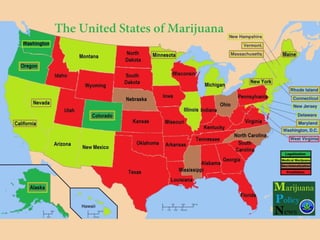
Pending Marijuana Legislation
in 2015
1. Alabama: SB326
2. Iowa: SF484
3. Missouri: HB490 + HB800
4. Nebraska: LB643
5. Pennsylvania: SB3 + HB193
6. South Carolina: H3140, SB672,
H4307
7. Texas: SB1839 + HB3785
z
Failed Marijuana Legislation
in 2015
1. Florida: SB528 + HB 683
2. Georgia: SB7
3. Indiana: SB284 + HB1487
4. Kansas: SB9 + HB2011
5. Kentucky: SB40 + HB3
6. Mississippi: SB2318
7. North Carolina: HB78
8. North Dakota: HB1430
9. Tennessee: SB660 + HB561
10. Utah: SB259
11. West Virginia: SB546 +
HB2909
z
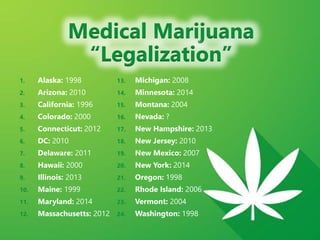
Medical Marijuana
“Legalization”
1. Alaska: 1998
2. Arizona: 2010
3. California: 1996
4. Colorado: 2000
5. Connecticut: 2012
6. DC: 2010
7. Delaware: 2011
8. Hawaii: 2000
9. Illinois: 2013
10. Maine: 1999
11. Maryland: 2014
12. Massachusetts: 2012
13. Michigan: 2008
14. Minnesota: 2014
15. Montana: 2004
16. Nevada: ?
17. New Hampshire: 2013
18. New Jersey: 2010
19. New Mexico: 2007
20. New York: 2014
21. Oregon: 1998
22. Rhode Island: 2006
23. Vermont: 2004
24. Washington: 1998
z
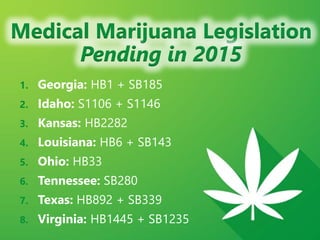
Medical Marijuana Legislation
Pending in 2015
1. Georgia: HB1 + SB185
2. Idaho: S1106 + S1146
3. Kansas: HB2282
4. Louisiana: HB6 + SB143
5. Ohio: HB33
6. Tennessee: SB280
7. Texas: HB892 + SB339
8. Virginia: HB1445 + SB1235
z
Ohio’s Ballot
PROCESS
z
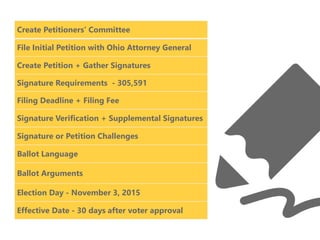
Create Petitioners’ Committee
File Initial Petition with Ohio Attorney General
Create Petition + Gather Signatures
Signature Requirements - 305,591
Filing Deadline + Filing Fee
Signature Verification + Supplemental Signatures
Signature or Petition Challenges
Ballot Language
Ballot Arguments
Election Day - November 3, 2015
Effective Date - 30 days after voter approval
z
What Would the
Amendment DO?
z
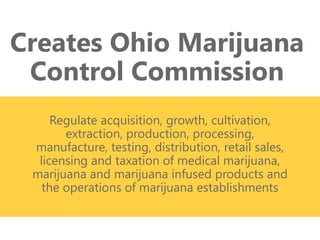
Creates Ohio Marijuana
Control Commission
Regulate acquisition, growth, cultivation,
extraction, production, processing,
manufacture, testing, distribution, retail sales,
licensing and taxation of medical marijuana,
marijuana and marijuana infused products and
the operations of marijuana establishments
z
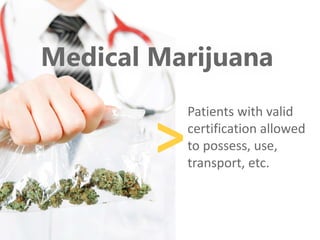
Medical Marijuana
Patients with valid
certification allowed
to possess, use,
transport, etc.
>
z
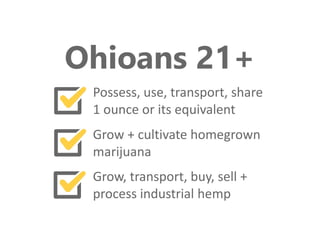
Ohioans 21+
Possess, use, transport, share
1 ounce or its equivalent
Grow + cultivate homegrown
marijuana
Grow, transport, buy, sell +
process industrial hemp
z
Prohibitions + Taxes
z
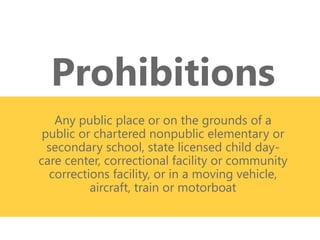
Prohibitions
Any public place or on the grounds of a
public or chartered nonpublic elementary or
secondary school, state licensed child day-
care center, correctional facility or community
corrections facility, or in a moving vehicle,
aircraft, train or motorboat
z
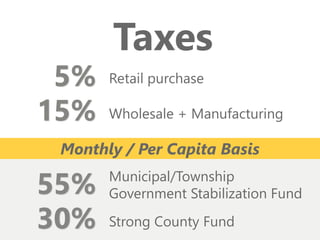
Taxes
Retail purchase
Wholesale + Manufacturing
Monthly / Per Capita Basis
Municipal/Township
Government Stabilization Fund
Strong County Fund
z
Who is Behind the
Constitutional
Amendment?
z
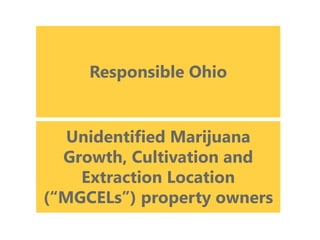
Responsible Ohio
Unidentified Marijuana
Growth, Cultivation and
Extraction Location
(“MGCELs”) property owners
z
z
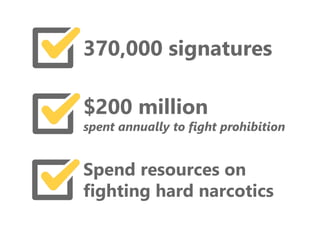
370,000 signatures
$200 million
spent annually to fight prohibition
Spend resources on
fighting hard narcotics
z
Thank You!
Tony Fiore, Of Counsel
Kegler Brown Hill + Ritter
afiore@keglerbrown.com
keglerbrown.com/fiore
614.462.5428
@anthoniofiore
Director, Government Affairs
Ohio State Council of SHRM
Kelley B. Duke
303.628.3663
kduke@irelandstapleton.com
Copyright 2015 Ireland Stapleton Pryor & Pascoe, PC
Implications
of Legalized Marijuana
It’s Spreading
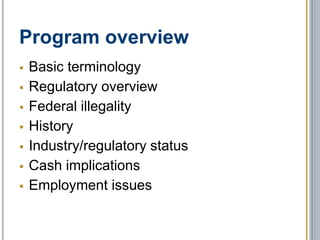
Program overview
 Basic terminology
 Regulatory overview
 Federal illegality
 History
 Industry/regulatory status
 Cash implications
 Employment issues
Basic Terminology
 Retail/recreational
 Dispensary/center/store
 OPC/cultivation-grow facility
 MIP – marijuana infused product
 Excise tax
 Decriminalization/legalization
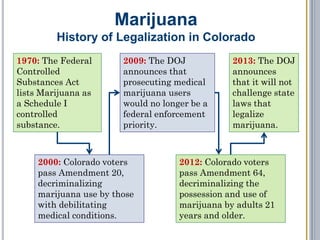
Marijuana
History of Legalization in Colorado
1970: The Federal
Controlled
Substances Act
lists Marijuana as
a Schedule I
controlled
substance.
2000: Colorado voters
pass Amendment 20,
decriminalizing
marijuana use by those
with debilitating
medical conditions.
2009: The DOJ
announces that
prosecuting medical
marijuana users
would no longer be a
federal enforcement
priority.
2012: Colorado voters
pass Amendment 64,
decriminalizing the
possession and use of
marijuana by adults 21
years and older.
2013: The DOJ
announces
that it will not
challenge state
laws that
legalize
marijuana.
Legalized Marijuana Categories
 Industrial hemp – agriculture
 Personal/caregiver – health
 Commercial – revenue/MED
Federal Illegality
 Schedule 1 Narcotic
 Federal seizure
 Conflict with state laws
 No analogies
 Cole & Ogden Memos
 Enforcement protocols
 Children, Veiled Corporate Ownership, Diversion
 State Trooper Enforcement Analogy
First Wave - 2009
 Little or no business experience
 Recession in full bloom
 Lack of regulatory oversight
Second Wave - 2010
 Non-marijuana business people
 Brought legitimate business practices
with them
 Successfully weathered market and
regulatory changes
Third Wave
 Goal: hone systems, processes and
brands to EXPAND
 Therefore, Big Operators
Industry Status
 Half the states have legalized marijuana, including Georgia
 Informal political coalition
 Pre-2000: 95% of MJ smoked
 2015: 40% of MJ smoked
 Oligopoly
 Sophisticated operators
 119K Medical Cards in Colo. – 1.5% of Colo.
 650,000 Colo. users – 12% of Colo.
 National legal cannabis market size: $1.53 billion
 Estimated national legal cannabis market size in 2019: $10.2
billion
 Number of Americans that regularly use cannabis: 17.4 million
 MJ Consumption mirrors alcohol
Cash Implications?
 Prior to 2011 – Cash & Bank Accounts
 Budget for break-ins
 2011 & 2012 – Banks out
 2012 – Present – Alternatives
 All cash
 Card runners
 ATM’s
 Rolling Accounts
 Side accounts
 Bank loosening
 MJ mortgages
 Fourth Courner Credit Union
Marijuana
Relevant Employment Laws
LawfulOff-DutyConduct
UnemploymentCompensation
Workers’Compensation
ADA/CADA
Employers
cannot fire
employees
for doing
legal things
on their
own time
and away
from the
workplace,
even if the
employer
objects to
the activity.
Benefits
can be
denied if
the
employee
was fired
because
he/she had
“not
medically
prescribed”
controlled
substances
in his/her
system at
work.
Benefits
can be
reduced by
50% if the
injury
resulted
from the
presence of
“not
medically
prescribed”
controlled
substances
in the
employee’s
system.
Using
medical
marijuana to
treat
disability not
protected,
so long as
adverse
action based
on uniformly
applied drug
policy
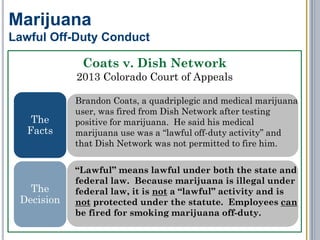
The
Facts
The
Decision
Marijuana
Lawful Off-Duty Conduct
Coats v. Dish Network
2013 Colorado Court of Appeals
“Lawful” means lawful under both the state and
federal law. Because marijuana is illegal under
federal law, it is not a “lawful” activity and is
not protected under the statute. Employees can
be fired for smoking marijuana off-duty.
Brandon Coats, a quadriplegic and medical marijuana
user, was fired from Dish Network after testing
positive for marijuana. He said his medical
marijuana use was a “lawful off-duty activity” and
that Dish Network was not permitted to fire him.
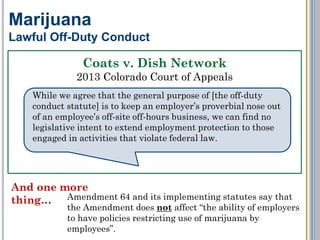
Amendment 64 and its implementing statutes say that
the Amendment does not affect “the ability of employers
to have policies restricting use of marijuana by
employees”.
Marijuana
Lawful Off-Duty Conduct
Coats v. Dish Network
2013 Colorado Court of Appeals
While we agree that the general purpose of [the off-duty
conduct statute] is to keep an employer’s proverbial nose out
of an employee’s off-site off-hours business, we can find no
legislative intent to extend employment protection to those
engaged in activities that violate federal law.
And one more
thing…
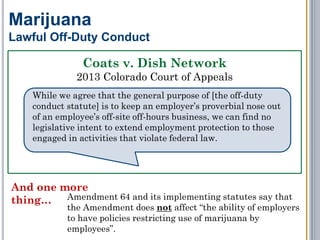
Amendment 64 and its implementing statutes say that
the Amendment does not affect “the ability of employers
to have policies restricting use of marijuana by
employees”.
Marijuana
Lawful Off-Duty Conduct
Coats v. Dish Network
2013 Colorado Court of Appeals
While we agree that the general purpose of [the off-duty
conduct statute] is to keep an employer’s proverbial nose out
of an employee’s off-site off-hours business, we can find no
legislative intent to extend employment protection to those
engaged in activities that violate federal law.
And one more
thing…
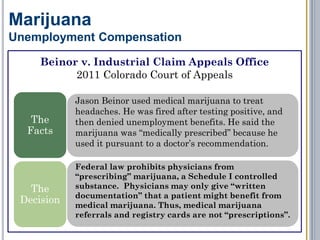
The
Facts
The
Decision
Marijuana
Unemployment Compensation
Beinor v. Industrial Claim Appeals Office
2011 Colorado Court of Appeals
Federal law prohibits physicians from
“prescribing” marijuana, a Schedule I controlled
substance. Physicians may only give “written
documentation” that a patient might benefit from
medical marijuana. Thus, medical marijuana
referrals and registry cards are not “prescriptions”.
Jason Beinor used medical marijuana to treat
headaches. He was fired after testing positive, and
then denied unemployment benefits. He said the
marijuana was “medically prescribed” because he
used it pursuant to a doctor’s recommendation.
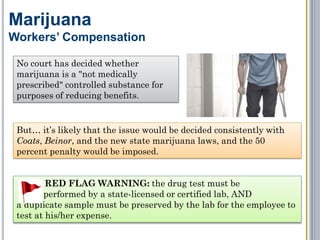
But… it’s likely that the issue would be decided consistently with
Coats, Beinor, and the new state marijuana laws, and the 50
percent penalty would be imposed.
Marijuana
Workers’ Compensation
No court has decided whether
marijuana is a "not medically
prescribed" controlled substance for
purposes of reducing benefits.
RED FLAG WARNING: the drug test must be
performed by a state-licensed or certified lab, AND
a duplicate sample must be preserved by the lab for the employee to
test at his/her expense.
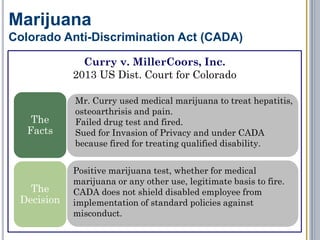
The
Facts
The
Decision
Positive marijuana test, whether for medical
marijuana or any other use, legitimate basis to fire.
CADA does not shield disabled employee from
implementation of standard policies against
misconduct.
Marijuana
Colorado Anti-Discrimination Act (CADA)
Curry v. MillerCoors, Inc.
2013 US Dist. Court for Colorado
Mr. Curry used medical marijuana to treat hepatitis,
osteoarthrisis and pain.
Failed drug test and fired.
Sued for Invasion of Privacy and under CADA
because fired for treating qualified disability.
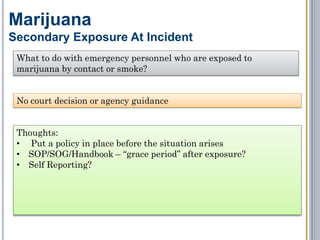
Marijuana
Secondary Exposure At Incident
No court decision or agency guidance
What to do with emergency personnel who are exposed to
marijuana by contact or smoke?
Thoughts:
• Put a policy in place before the situation arises
• SOP/SOG/Handbook – “grace period” after exposure?
• Self Reporting?
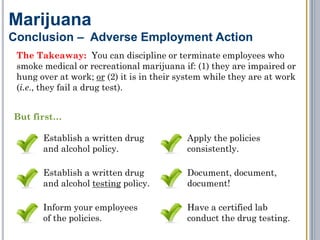
The Takeaway: You can discipline or terminate employees who
smoke medical or recreational marijuana if: (1) they are impaired or
hung over at work; or (2) it is in their system while they are at work
(i.e., they fail a drug test).
Marijuana
Conclusion – Adverse Employment Action
But first…
Establish a written drug
and alcohol policy.
Establish a written drug
and alcohol testing policy.
Inform your employees
of the policies.
Apply the policies
consistently.
Document, document,
document!
Have a certified lab
conduct the drug testing.
The
Facts
The
Decision
Marijuana
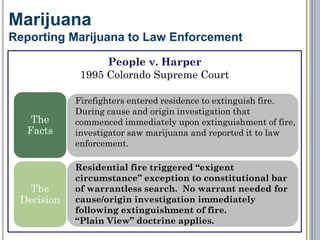
Reporting Marijuana to Law Enforcement
People v. Harper
1995 Colorado Supreme Court
Residential fire triggered “exigent
circumstance” exception to constitutional bar
of warrantless search. No warrant needed for
cause/origin investigation immediately
following extinguishment of fire.
“Plain View” doctrine applies.
Firefighters entered residence to extinguish fire.
During cause and origin investigation that
commenced immediately upon extinguishment of fire,
investigator saw marijuana and reported it to law
enforcement.
The
Facts
The
Decision
Marijuana
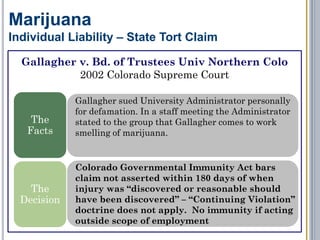
Individual Liability – State Tort Claim
Gallagher v. Bd. of Trustees Univ Northern Colo
2002 Colorado Supreme Court
Colorado Governmental Immunity Act bars
claim not asserted within 180 days of when
injury was “discovered or reasonable should
have been discovered” – “Continuing Violation”
doctrine does not apply. No immunity if acting
outside scope of employment
Gallagher sued University Administrator personally
for defamation. In a staff meeting the Administrator
stated to the group that Gallagher comes to work
smelling of marijuana.
The
Facts
The
Decision
Marijuana
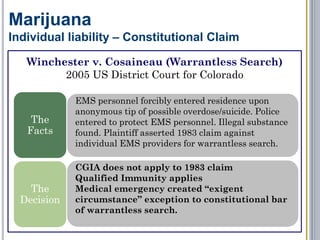
Individual liability – Constitutional Claim
Winchester v. Cosaineau (Warrantless Search)
2005 US District Court for Colorado
CGIA does not apply to 1983 claim
Qualified Immunity applies
Medical emergency created “exigent
circumstance” exception to constitutional bar
of warrantless search.
EMS personnel forcibly entered residence upon
anonymous tip of possible overdose/suicide. Police
entered to protect EMS personnel. Illegal substance
found. Plaintiff asserted 1983 claim against
individual EMS providers for warrantless search.
The
Facts
The
Decision
Marijuana
Individual liability – Constitutional Claim
Young v. Larimer Sheriff’s Office
(Dead Pot Plants)
2014 Colorado Court of Appeals
No legally protected interest on contraband
Medical marijuana illegal under Fed law, so it
is contraband per se
Plaintiff had no legally protected interest in
the marijuana (CHILLING EFFECT)
Police took 42 plants – cut off at base of stem.
Defendant acquitted of all charges under Medical
Marijuana laws – police returned dead plants
Plaintiff sued individual police officers under 1983
Kelley B. Duke
Litigation Attorney
Ireland Stapleton Pryor & Pascoe, PC
kduke@irelandstapleton.com | 303-628-3663
LEGAL ADVICE WITH PERSPECTIVE

Hazed and Confused

  • 1.
  • 2.
  • 3.
    z Pending Marijuana Legislation in2015 1. Alabama: SB326 2. Iowa: SF484 3. Missouri: HB490 + HB800 4. Nebraska: LB643 5. Pennsylvania: SB3 + HB193 6. South Carolina: H3140, SB672, H4307 7. Texas: SB1839 + HB3785
  • 4.
    z Failed Marijuana Legislation in2015 1. Florida: SB528 + HB 683 2. Georgia: SB7 3. Indiana: SB284 + HB1487 4. Kansas: SB9 + HB2011 5. Kentucky: SB40 + HB3 6. Mississippi: SB2318 7. North Carolina: HB78 8. North Dakota: HB1430 9. Tennessee: SB660 + HB561 10. Utah: SB259 11. West Virginia: SB546 + HB2909
  • 5.
    z Medical Marijuana “Legalization” 1. Alaska:1998 2. Arizona: 2010 3. California: 1996 4. Colorado: 2000 5. Connecticut: 2012 6. DC: 2010 7. Delaware: 2011 8. Hawaii: 2000 9. Illinois: 2013 10. Maine: 1999 11. Maryland: 2014 12. Massachusetts: 2012 13. Michigan: 2008 14. Minnesota: 2014 15. Montana: 2004 16. Nevada: ? 17. New Hampshire: 2013 18. New Jersey: 2010 19. New Mexico: 2007 20. New York: 2014 21. Oregon: 1998 22. Rhode Island: 2006 23. Vermont: 2004 24. Washington: 1998
  • 6.
    z Medical Marijuana Legislation Pendingin 2015 1. Georgia: HB1 + SB185 2. Idaho: S1106 + S1146 3. Kansas: HB2282 4. Louisiana: HB6 + SB143 5. Ohio: HB33 6. Tennessee: SB280 7. Texas: HB892 + SB339 8. Virginia: HB1445 + SB1235
  • 7.
  • 8.
    z Create Petitioners’ Committee FileInitial Petition with Ohio Attorney General Create Petition + Gather Signatures Signature Requirements - 305,591 Filing Deadline + Filing Fee Signature Verification + Supplemental Signatures Signature or Petition Challenges Ballot Language Ballot Arguments Election Day - November 3, 2015 Effective Date - 30 days after voter approval
  • 9.
  • 10.
    z Creates Ohio Marijuana ControlCommission Regulate acquisition, growth, cultivation, extraction, production, processing, manufacture, testing, distribution, retail sales, licensing and taxation of medical marijuana, marijuana and marijuana infused products and the operations of marijuana establishments
  • 11.
    z Medical Marijuana Patients withvalid certification allowed to possess, use, transport, etc. >
  • 12.
    z Ohioans 21+ Possess, use,transport, share 1 ounce or its equivalent Grow + cultivate homegrown marijuana Grow, transport, buy, sell + process industrial hemp
  • 13.
  • 14.
    z Prohibitions Any public placeor on the grounds of a public or chartered nonpublic elementary or secondary school, state licensed child day- care center, correctional facility or community corrections facility, or in a moving vehicle, aircraft, train or motorboat
  • 15.
    z Taxes Retail purchase Wholesale +Manufacturing Monthly / Per Capita Basis Municipal/Township Government Stabilization Fund Strong County Fund
  • 16.
    z Who is Behindthe Constitutional Amendment?
  • 17.
    z Responsible Ohio Unidentified Marijuana Growth,Cultivation and Extraction Location (“MGCELs”) property owners
  • 18.
  • 19.
    z 370,000 signatures $200 million spentannually to fight prohibition Spend resources on fighting hard narcotics
  • 20.
    z Thank You! Tony Fiore,Of Counsel Kegler Brown Hill + Ritter afiore@keglerbrown.com keglerbrown.com/fiore 614.462.5428 @anthoniofiore Director, Government Affairs Ohio State Council of SHRM
  • 21.
    Kelley B. Duke 303.628.3663 kduke@irelandstapleton.com Copyright2015 Ireland Stapleton Pryor & Pascoe, PC Implications of Legalized Marijuana
  • 22.
  • 23.
    Program overview  Basicterminology  Regulatory overview  Federal illegality  History  Industry/regulatory status  Cash implications  Employment issues
  • 24.
    Basic Terminology  Retail/recreational Dispensary/center/store  OPC/cultivation-grow facility  MIP – marijuana infused product  Excise tax  Decriminalization/legalization
  • 25.
    Marijuana History of Legalizationin Colorado 1970: The Federal Controlled Substances Act lists Marijuana as a Schedule I controlled substance. 2000: Colorado voters pass Amendment 20, decriminalizing marijuana use by those with debilitating medical conditions. 2009: The DOJ announces that prosecuting medical marijuana users would no longer be a federal enforcement priority. 2012: Colorado voters pass Amendment 64, decriminalizing the possession and use of marijuana by adults 21 years and older. 2013: The DOJ announces that it will not challenge state laws that legalize marijuana.
  • 26.
    Legalized Marijuana Categories Industrial hemp – agriculture  Personal/caregiver – health  Commercial – revenue/MED
  • 27.
    Federal Illegality  Schedule1 Narcotic  Federal seizure  Conflict with state laws  No analogies  Cole & Ogden Memos  Enforcement protocols  Children, Veiled Corporate Ownership, Diversion  State Trooper Enforcement Analogy
  • 28.
    First Wave -2009  Little or no business experience  Recession in full bloom  Lack of regulatory oversight
  • 29.
    Second Wave -2010  Non-marijuana business people  Brought legitimate business practices with them  Successfully weathered market and regulatory changes
  • 30.
    Third Wave  Goal:hone systems, processes and brands to EXPAND  Therefore, Big Operators
  • 31.
    Industry Status  Halfthe states have legalized marijuana, including Georgia  Informal political coalition  Pre-2000: 95% of MJ smoked  2015: 40% of MJ smoked  Oligopoly  Sophisticated operators  119K Medical Cards in Colo. – 1.5% of Colo.  650,000 Colo. users – 12% of Colo.  National legal cannabis market size: $1.53 billion  Estimated national legal cannabis market size in 2019: $10.2 billion  Number of Americans that regularly use cannabis: 17.4 million  MJ Consumption mirrors alcohol
  • 32.
    Cash Implications?  Priorto 2011 – Cash & Bank Accounts  Budget for break-ins  2011 & 2012 – Banks out  2012 – Present – Alternatives  All cash  Card runners  ATM’s  Rolling Accounts  Side accounts  Bank loosening  MJ mortgages  Fourth Courner Credit Union
  • 33.
    Marijuana Relevant Employment Laws LawfulOff-DutyConduct UnemploymentCompensation Workers’Compensation ADA/CADA Employers cannotfire employees for doing legal things on their own time and away from the workplace, even if the employer objects to the activity. Benefits can be denied if the employee was fired because he/she had “not medically prescribed” controlled substances in his/her system at work. Benefits can be reduced by 50% if the injury resulted from the presence of “not medically prescribed” controlled substances in the employee’s system. Using medical marijuana to treat disability not protected, so long as adverse action based on uniformly applied drug policy
  • 34.
    The Facts The Decision Marijuana Lawful Off-Duty Conduct Coatsv. Dish Network 2013 Colorado Court of Appeals “Lawful” means lawful under both the state and federal law. Because marijuana is illegal under federal law, it is not a “lawful” activity and is not protected under the statute. Employees can be fired for smoking marijuana off-duty. Brandon Coats, a quadriplegic and medical marijuana user, was fired from Dish Network after testing positive for marijuana. He said his medical marijuana use was a “lawful off-duty activity” and that Dish Network was not permitted to fire him.
  • 35.
    Amendment 64 andits implementing statutes say that the Amendment does not affect “the ability of employers to have policies restricting use of marijuana by employees”. Marijuana Lawful Off-Duty Conduct Coats v. Dish Network 2013 Colorado Court of Appeals While we agree that the general purpose of [the off-duty conduct statute] is to keep an employer’s proverbial nose out of an employee’s off-site off-hours business, we can find no legislative intent to extend employment protection to those engaged in activities that violate federal law. And one more thing…
  • 36.
    Amendment 64 andits implementing statutes say that the Amendment does not affect “the ability of employers to have policies restricting use of marijuana by employees”. Marijuana Lawful Off-Duty Conduct Coats v. Dish Network 2013 Colorado Court of Appeals While we agree that the general purpose of [the off-duty conduct statute] is to keep an employer’s proverbial nose out of an employee’s off-site off-hours business, we can find no legislative intent to extend employment protection to those engaged in activities that violate federal law. And one more thing…
  • 37.
    The Facts The Decision Marijuana Unemployment Compensation Beinor v.Industrial Claim Appeals Office 2011 Colorado Court of Appeals Federal law prohibits physicians from “prescribing” marijuana, a Schedule I controlled substance. Physicians may only give “written documentation” that a patient might benefit from medical marijuana. Thus, medical marijuana referrals and registry cards are not “prescriptions”. Jason Beinor used medical marijuana to treat headaches. He was fired after testing positive, and then denied unemployment benefits. He said the marijuana was “medically prescribed” because he used it pursuant to a doctor’s recommendation.
  • 38.
    But… it’s likelythat the issue would be decided consistently with Coats, Beinor, and the new state marijuana laws, and the 50 percent penalty would be imposed. Marijuana Workers’ Compensation No court has decided whether marijuana is a "not medically prescribed" controlled substance for purposes of reducing benefits. RED FLAG WARNING: the drug test must be performed by a state-licensed or certified lab, AND a duplicate sample must be preserved by the lab for the employee to test at his/her expense.
  • 39.
    The Facts The Decision Positive marijuana test,whether for medical marijuana or any other use, legitimate basis to fire. CADA does not shield disabled employee from implementation of standard policies against misconduct. Marijuana Colorado Anti-Discrimination Act (CADA) Curry v. MillerCoors, Inc. 2013 US Dist. Court for Colorado Mr. Curry used medical marijuana to treat hepatitis, osteoarthrisis and pain. Failed drug test and fired. Sued for Invasion of Privacy and under CADA because fired for treating qualified disability.
  • 40.
    Marijuana Secondary Exposure AtIncident No court decision or agency guidance What to do with emergency personnel who are exposed to marijuana by contact or smoke? Thoughts: • Put a policy in place before the situation arises • SOP/SOG/Handbook – “grace period” after exposure? • Self Reporting?
  • 41.
    The Takeaway: Youcan discipline or terminate employees who smoke medical or recreational marijuana if: (1) they are impaired or hung over at work; or (2) it is in their system while they are at work (i.e., they fail a drug test). Marijuana Conclusion – Adverse Employment Action But first… Establish a written drug and alcohol policy. Establish a written drug and alcohol testing policy. Inform your employees of the policies. Apply the policies consistently. Document, document, document! Have a certified lab conduct the drug testing.
  • 42.
    The Facts The Decision Marijuana Reporting Marijuana toLaw Enforcement People v. Harper 1995 Colorado Supreme Court Residential fire triggered “exigent circumstance” exception to constitutional bar of warrantless search. No warrant needed for cause/origin investigation immediately following extinguishment of fire. “Plain View” doctrine applies. Firefighters entered residence to extinguish fire. During cause and origin investigation that commenced immediately upon extinguishment of fire, investigator saw marijuana and reported it to law enforcement.
  • 43.
    The Facts The Decision Marijuana Individual Liability –State Tort Claim Gallagher v. Bd. of Trustees Univ Northern Colo 2002 Colorado Supreme Court Colorado Governmental Immunity Act bars claim not asserted within 180 days of when injury was “discovered or reasonable should have been discovered” – “Continuing Violation” doctrine does not apply. No immunity if acting outside scope of employment Gallagher sued University Administrator personally for defamation. In a staff meeting the Administrator stated to the group that Gallagher comes to work smelling of marijuana.
  • 44.
    The Facts The Decision Marijuana Individual liability –Constitutional Claim Winchester v. Cosaineau (Warrantless Search) 2005 US District Court for Colorado CGIA does not apply to 1983 claim Qualified Immunity applies Medical emergency created “exigent circumstance” exception to constitutional bar of warrantless search. EMS personnel forcibly entered residence upon anonymous tip of possible overdose/suicide. Police entered to protect EMS personnel. Illegal substance found. Plaintiff asserted 1983 claim against individual EMS providers for warrantless search.
  • 45.
    The Facts The Decision Marijuana Individual liability –Constitutional Claim Young v. Larimer Sheriff’s Office (Dead Pot Plants) 2014 Colorado Court of Appeals No legally protected interest on contraband Medical marijuana illegal under Fed law, so it is contraband per se Plaintiff had no legally protected interest in the marijuana (CHILLING EFFECT) Police took 42 plants – cut off at base of stem. Defendant acquitted of all charges under Medical Marijuana laws – police returned dead plants Plaintiff sued individual police officers under 1983
  • 46.
    Kelley B. Duke LitigationAttorney Ireland Stapleton Pryor & Pascoe, PC kduke@irelandstapleton.com | 303-628-3663
  • 47.
    LEGAL ADVICE WITHPERSPECTIVE