





Priorities, Design Patterns, and Thoughts on
Data Modeling for Transactions
Relational Data Modeling
Trends for Transactional
Applications
Ike Ellis, MVP
General Manager Data & AI Practice
Solliance, Crafting Bytes
Please silence
cell phones
everything PASS
has to offer
Free online
webinar events
Free 1-day local
training events
Local user groups
around the world
Online special
interest user groups
Business analytics
training
Get involved
Free Online Resources
Newsletters
PASS.org
Explore
Ike Ellis
General Manager – Data &
AI Practice
Solliance
/ikeellis
@ike_ellis
www.ikeellis.com
• Founder of San Diego Power
BI and PowerApps
UserGroup
• San Diego Tech Immersion
Group
• MVP since 2011
• Author of Developing Azure
Solutions, Power BI MVP Book
• Speaker at PASS Summit,
SQLBits, DevIntersections,
TechEd, Craft
Agenda
1. summary of where we’ve been in
data modeling
2. current priorities, state of data
modeling, and design guidelines
3. practice modeling data
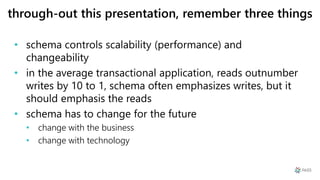
through-out this presentation, remember three things
• schema controls scalability (performance) and
changeability
• in the average transactional application, reads outnumber
writes by 10 to 1, schema often emphasizes writes, but it
should emphasis the reads
• schema has to change for the future
• change with the business
• change with technology
schema definition
• a representation of a plan or theory in the form of an outline
or model
• would you begin any major project without a plan or a
theory?
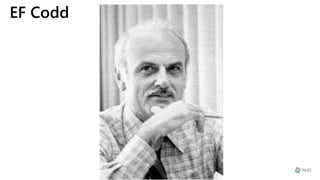
EF Codd
first normal form
• That the data is in a database table. The table stores information in rows and
columns where one or more columns, called the primary key, uniquely identify
each row.
• Each column contains atomic values, and there are not repeating groups of
columns.
Example:
• There is a primary key
• Each column only has one piece of data.
• Bad Example: Order1Date, Order2Date, Order3Date, etc.
second normal form
A table is in 2nd Normal Form if:
• The table is in 1st normal form, and
• All the non-key columns are dependent on the table’s
primary key.
Example:
• you wouldn’t put corporateHeadquartersAddress in the
orders table. it’s irrelevant.
third normal form
A table is in third normal form if:
• A table is in 2nd normal form.
• It contains only columns that are non-transitively
dependent on the primary key
Example:
• you wouldn’t put employeeFullName in the orders table,
even though employeeID is in the orders table
EF Codd’s ideas are a bit outdated
his assumptions and priorities are not our assumptions and
priorities
assumption: disks will always be expensive
my first hard drive was 10MB and cost my dad $1,400 in 1984
results
• this means that we need normalization to decrease
repeating data and thus decrease the overall size of the
data on the disk
• this means that there would be a benefit to over-
normalization, ie a person table
results of over-normalization: terrible
performance with joins
• over-normalization has several drawbacks
• too many joins in a query will always have bad performance
• over-normalized data models are too difficult for new developers or
contractors to learn
• the total number of tables explodes on us. 300 tables per database is very
common in a transactional model
• over-normalization is too steep a learning curve to figure out how to
delete or insert records
• data has to be constantly aggregated to show results if we avoid
repeating data
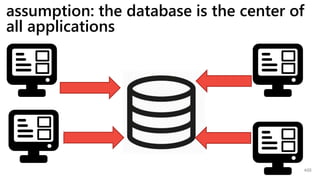
assumption: the database is the center of
all applications
results
• one application can’t release changes to the database
without testing all applications
• this greatly increased the testing surface area, and delays
product releases
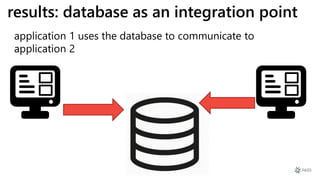
results: database as an integration point
application 1 uses the database to communicate to
application 2
results: database as a messaging service
• application1 tells application2 what to do by using the
database
• multiple columns in a table that have status date tells you
there might be a queue
• deletes on a queue are logged operations. takes a lot of
time and locks the table between applications
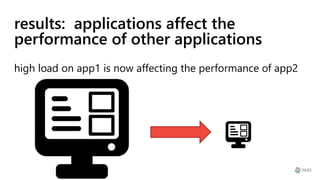
results: applications affect the
performance of other applications
high load on app1 is now affecting the performance of app2
results: in order to upgrade app1, you
have to upgrade app2
app1 might need money and better performance. we have to
pay to upgrade app2 as a result.
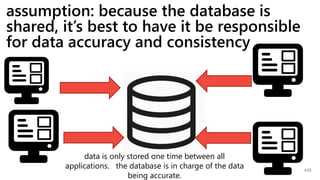
assumption: because the database is
shared, it’s best to have it be responsible
for data accuracy and consistency
data is only stored one time between all
applications. the database is in charge of the data
being accurate.
result: business logic begins to go in
the database
• it’s the one place where business logic is guaranteed to be
enforced
• this loads the cpu of the database
• hurts sql server licensing
• hurts database scalability
• incentivizes the use of stored procedures and triggers to
consolidate business logic
• both things are difficult to test, difficult to refactor, difficult to read
NOW LET’S TALK ABOUT CURRENT
DESIGN PRIORITIES (CDP)
cdp#1: the data needs to be consistent
and high quality
• choose the correct data type
• allow for nulls when the value is unknown
• when data is wrong, create a correction plan and fix the
bug
• build automated tests around data quality
cdp #2: schema should be able to change
• business is complaining that the database is not changing as fast as
the business
• business changes taxonomy. they change student to learner. they change
eligibility to enrollment. if the database doesn’t change, this creates bugs,
confusion, and ambiguity
• technology changes
• new index structures, new table structures, new database technology, new
versions of existing technology
• very fast pace of change
• moving to the cloud
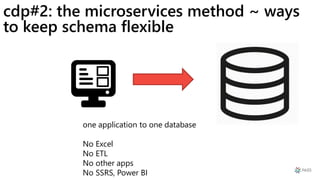
cdp#2: the microservices method ~ ways
to keep schema flexible
one application to one database
No Excel
No ETL
No other apps
No SSRS, Power BI
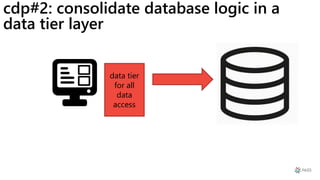
cdp#2: consolidate database logic in a
data tier layer
data tier
for all
data
access
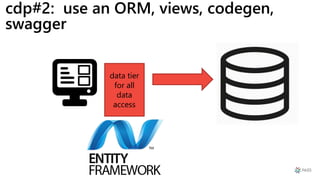
cdp#2: use an ORM, views, codegen,
swagger
data tier
for all
data
access
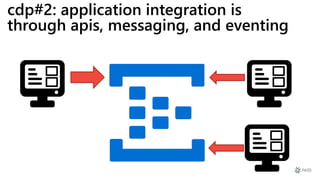
cdp#2: application integration is
through apis, messaging, and eventing
cdp #3: optimize for reads
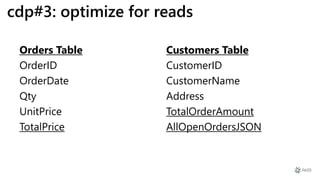
• the application will be judged based on read-speed, not
write speed. users expect writes to take a long time.
schema should focus on the reads
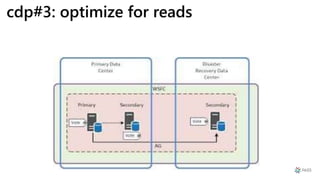
cdp#3: optimize for reads
Customers Table
CustomerID
CustomerName
Address
TotalOrderAmount
AllOpenOrdersJSON
Orders Table
OrderID
OrderDate
Qty
UnitPrice
TotalPrice
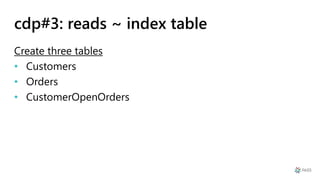
cdp#3: reads ~ index table
Create three tables
• Customers
• Orders
• CustomerOpenOrders
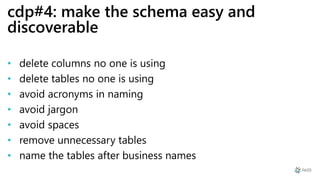
cdp#4: make the schema easy and
discoverable
• delete columns no one is using
• delete tables no one is using
• avoid acronyms in naming
• avoid jargon
• avoid spaces
• remove unnecessary tables
• name the tables after business names
cdp#5: it’s the network, not the disk
• the network is the real problem
• tough to upgrade
• shared by everything
• latency
• hard to optimize
• create schema for the network
• minimize round-trips
• only get the columns and rows that you need
• keep transactions small
• it’s ok to say no to users
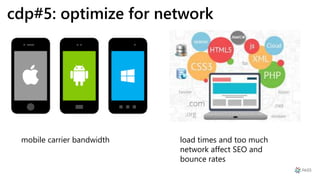
cdp#5: optimize for network
mobile carrier bandwidth load times and too much
network affect SEO and
bounce rates
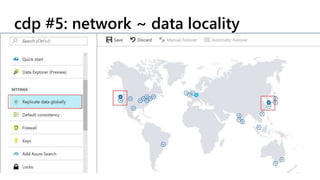
cdp #5: network ~ data locality
cdp #6: raw performance
• think of de-normalization as just another index
• proper schema can increase performance by 1,000 times
• limit joins
• think of the indexing
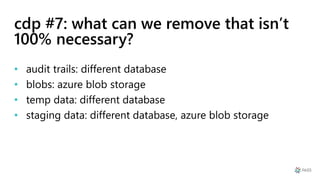
cdp #7: what can we remove that isn’t
100% necessary?
• audit trails: different database
• blobs: azure blob storage
• temp data: different database
• staging data: different database, azure blob storage
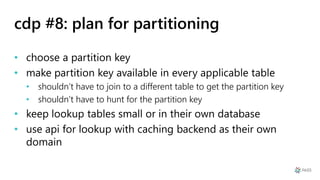
cdp #8: plan for partitioning
• choose a partition key
• make partition key available in every applicable table
• shouldn’t have to join to a different table to get the partition key
• shouldn’t have to hunt for the partition key
• keep lookup tables small or in their own database
• use api for lookup with caching backend as their own
domain
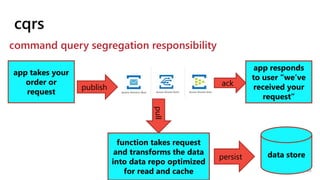
cqrs
command query segregation responsibility
app takes your
order or
request
publish
app responds
to user “we’ve
received your
request”
ack
pull
function takes request
and transforms the data
into data repo optimized
for read and cache
persist data store
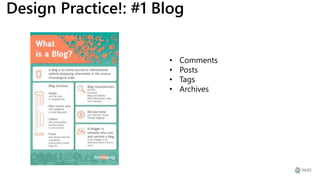
Design Practice!: #1 Blog
• Comments
• Posts
• Tags
• Archives
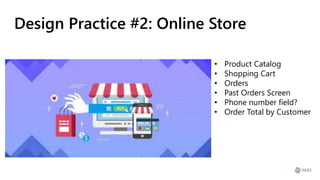
Design Practice #2: Online Store
• Product Catalog
• Shopping Cart
• Orders
• Past Orders Screen
• Phone number field?
• Order Total by Customer
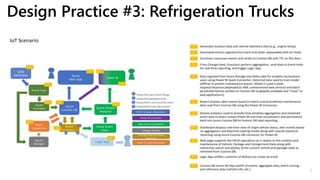
Design Practice #3: Refrigeration Trucks
Session
Evaluations
Submit by 5pm Friday,
November 15th to
win prizes.
Download the GuideBook App
and search: PASS Summit 2019
Follow the QR code link on session
signage
Go to PASSsummit.com
3 W A Y S T O A C C E S S
Ike Ellis
Twitter: @ike_ellis
YouTube: https://www.youtube.com/user/IkeEllisData
Solliance
Microsoft MVP
www.solliance.net
www.craftingbytes.com
www.ikeellis.com
Thank You
Speaker name
@yourhandle
youremail@email.com

Relational data modeling trends for transactional applications

  • 1.
    Priorities, Design Patterns,and Thoughts on Data Modeling for Transactions Relational Data Modeling Trends for Transactional Applications Ike Ellis, MVP General Manager Data & AI Practice Solliance, Crafting Bytes
  • 2.
  • 3.
    everything PASS has tooffer Free online webinar events Free 1-day local training events Local user groups around the world Online special interest user groups Business analytics training Get involved Free Online Resources Newsletters PASS.org Explore
  • 4.
    Ike Ellis General Manager– Data & AI Practice Solliance /ikeellis @ike_ellis www.ikeellis.com • Founder of San Diego Power BI and PowerApps UserGroup • San Diego Tech Immersion Group • MVP since 2011 • Author of Developing Azure Solutions, Power BI MVP Book • Speaker at PASS Summit, SQLBits, DevIntersections, TechEd, Craft
  • 5.
    Agenda 1. summary ofwhere we’ve been in data modeling 2. current priorities, state of data modeling, and design guidelines 3. practice modeling data
  • 6.
    through-out this presentation,remember three things • schema controls scalability (performance) and changeability • in the average transactional application, reads outnumber writes by 10 to 1, schema often emphasizes writes, but it should emphasis the reads • schema has to change for the future • change with the business • change with technology
  • 7.
    schema definition • arepresentation of a plan or theory in the form of an outline or model • would you begin any major project without a plan or a theory?
  • 8.
  • 9.
    first normal form •That the data is in a database table. The table stores information in rows and columns where one or more columns, called the primary key, uniquely identify each row. • Each column contains atomic values, and there are not repeating groups of columns. Example: • There is a primary key • Each column only has one piece of data. • Bad Example: Order1Date, Order2Date, Order3Date, etc.
  • 10.
    second normal form Atable is in 2nd Normal Form if: • The table is in 1st normal form, and • All the non-key columns are dependent on the table’s primary key. Example: • you wouldn’t put corporateHeadquartersAddress in the orders table. it’s irrelevant.
  • 11.
    third normal form Atable is in third normal form if: • A table is in 2nd normal form. • It contains only columns that are non-transitively dependent on the primary key Example: • you wouldn’t put employeeFullName in the orders table, even though employeeID is in the orders table
  • 12.
    EF Codd’s ideasare a bit outdated his assumptions and priorities are not our assumptions and priorities
  • 13.
    assumption: disks willalways be expensive my first hard drive was 10MB and cost my dad $1,400 in 1984
  • 14.
    results • this meansthat we need normalization to decrease repeating data and thus decrease the overall size of the data on the disk • this means that there would be a benefit to over- normalization, ie a person table
  • 15.
    results of over-normalization:terrible performance with joins • over-normalization has several drawbacks • too many joins in a query will always have bad performance • over-normalized data models are too difficult for new developers or contractors to learn • the total number of tables explodes on us. 300 tables per database is very common in a transactional model • over-normalization is too steep a learning curve to figure out how to delete or insert records • data has to be constantly aggregated to show results if we avoid repeating data
  • 16.
    assumption: the databaseis the center of all applications
  • 17.
    results • one applicationcan’t release changes to the database without testing all applications • this greatly increased the testing surface area, and delays product releases
  • 18.
    results: database asan integration point application 1 uses the database to communicate to application 2
  • 19.
    results: database asa messaging service • application1 tells application2 what to do by using the database • multiple columns in a table that have status date tells you there might be a queue • deletes on a queue are logged operations. takes a lot of time and locks the table between applications
  • 20.
    results: applications affectthe performance of other applications high load on app1 is now affecting the performance of app2
  • 21.
    results: in orderto upgrade app1, you have to upgrade app2 app1 might need money and better performance. we have to pay to upgrade app2 as a result.
  • 22.
    assumption: because thedatabase is shared, it’s best to have it be responsible for data accuracy and consistency data is only stored one time between all applications. the database is in charge of the data being accurate.
  • 23.
    result: business logicbegins to go in the database • it’s the one place where business logic is guaranteed to be enforced • this loads the cpu of the database • hurts sql server licensing • hurts database scalability • incentivizes the use of stored procedures and triggers to consolidate business logic • both things are difficult to test, difficult to refactor, difficult to read
  • 24.
    NOW LET’S TALKABOUT CURRENT DESIGN PRIORITIES (CDP)
  • 25.
    cdp#1: the dataneeds to be consistent and high quality • choose the correct data type • allow for nulls when the value is unknown • when data is wrong, create a correction plan and fix the bug • build automated tests around data quality
  • 26.
    cdp #2: schemashould be able to change • business is complaining that the database is not changing as fast as the business • business changes taxonomy. they change student to learner. they change eligibility to enrollment. if the database doesn’t change, this creates bugs, confusion, and ambiguity • technology changes • new index structures, new table structures, new database technology, new versions of existing technology • very fast pace of change • moving to the cloud
  • 27.
    cdp#2: the microservicesmethod ~ ways to keep schema flexible one application to one database No Excel No ETL No other apps No SSRS, Power BI
  • 28.
    cdp#2: consolidate databaselogic in a data tier layer data tier for all data access
  • 29.
    cdp#2: use anORM, views, codegen, swagger data tier for all data access
  • 30.
    cdp#2: application integrationis through apis, messaging, and eventing
  • 31.
    cdp #3: optimizefor reads • the application will be judged based on read-speed, not write speed. users expect writes to take a long time. schema should focus on the reads
  • 32.
  • 33.
  • 34.
    cdp#3: optimize forreads Customers Table CustomerID CustomerName Address TotalOrderAmount AllOpenOrdersJSON Orders Table OrderID OrderDate Qty UnitPrice TotalPrice
  • 35.
    cdp#3: reads ~index table Create three tables • Customers • Orders • CustomerOpenOrders
  • 36.
    cdp#4: make theschema easy and discoverable • delete columns no one is using • delete tables no one is using • avoid acronyms in naming • avoid jargon • avoid spaces • remove unnecessary tables • name the tables after business names
  • 37.
    cdp#5: it’s thenetwork, not the disk • the network is the real problem • tough to upgrade • shared by everything • latency • hard to optimize • create schema for the network • minimize round-trips • only get the columns and rows that you need • keep transactions small • it’s ok to say no to users
  • 38.
    cdp#5: optimize fornetwork mobile carrier bandwidth load times and too much network affect SEO and bounce rates
  • 39.
    cdp #5: network~ data locality
  • 40.
    cdp #6: rawperformance • think of de-normalization as just another index • proper schema can increase performance by 1,000 times • limit joins • think of the indexing
  • 41.
    cdp #7: whatcan we remove that isn’t 100% necessary? • audit trails: different database • blobs: azure blob storage • temp data: different database • staging data: different database, azure blob storage
  • 42.
    cdp #8: planfor partitioning • choose a partition key • make partition key available in every applicable table • shouldn’t have to join to a different table to get the partition key • shouldn’t have to hunt for the partition key • keep lookup tables small or in their own database • use api for lookup with caching backend as their own domain
  • 43.
    cqrs command query segregationresponsibility app takes your order or request publish app responds to user “we’ve received your request” ack pull function takes request and transforms the data into data repo optimized for read and cache persist data store
  • 44.
    Design Practice!: #1Blog • Comments • Posts • Tags • Archives
  • 45.
    Design Practice #2:Online Store • Product Catalog • Shopping Cart • Orders • Past Orders Screen • Phone number field? • Order Total by Customer
  • 46.
    Design Practice #3:Refrigeration Trucks
  • 47.
    Session Evaluations Submit by 5pmFriday, November 15th to win prizes. Download the GuideBook App and search: PASS Summit 2019 Follow the QR code link on session signage Go to PASSsummit.com 3 W A Y S T O A C C E S S
  • 48.
    Ike Ellis Twitter: @ike_ellis YouTube:https://www.youtube.com/user/IkeEllisData Solliance Microsoft MVP www.solliance.net www.craftingbytes.com www.ikeellis.com
  • 49.